Douma: Part 1 – Deception In Plain Sight
Media Lens | April 25, 2018
UK corporate media are under a curious kind of military occupation. Almost all print and broadcast media now employ a number of reporters and commentators who are relentless and determined warmongers. Despite the long, unarguable history of US-UK lying on war, and the catastrophic results, these journalists instantly confirm the veracity of atrocity claims made against Official Enemies, while having little or nothing to say about the proven crimes of the US, UK, Israel and their allies. They shriek with a level of moral outrage from which their own government is forever spared. They laud even the most obviously biased, tinpot sources blaming the ‘Enemy’, while dismissing out of hand the best scientific researchers, investigative journalists and academic sceptics who disagree.
Anyone who challenges this strange bias is branded a ‘denier’, ‘pro-Saddam’, ‘pro-Gaddafi, ‘pro-Assad’. Above all, one robotically repeated word is generated again and again: ‘Apologist… Apologist… Apologist’.
Claims of a chemical weapons attack on Douma, Syria on April 7, offered yet another textbook example of this reflexive warmongering. Remarkably, the alleged attack came just days after US president Donald Trump had declared of Syria:
I want to get out. I want to bring our troops back home. I want to start rebuilding our nation.
The ‘mainstream’ responded as one, with instant certainty, exactly as they had in response to atrocity and other casus belli claims in Houla, Ghouta, Khan Sheikhoun and many other cases in Iraq (1990), Iraq (1998), Iraq (2002-2003), Libya and Kosovo.
Once again, the Guardian editors were sure: there was no question of a repetition of the fake justifications for war to secure non-existent Iraqi WMDs, or to prevent a fictional Libyan massacre in Benghazi. Instead, this was ‘a chemical gas attack, orchestrated by Bashar al-Assad, that left dead children foaming at the mouth’.
Simon Tisdall, the Guardian’s assistant editor, had clearly decided that enough was enough:
It’s time for Britain and its allies to take concerted, sustained military action to curb Bashar al-Assad’s ability to murder Syria’s citizens at will.
This sounded like more than another cruise missile strike. But presumably Tisdall meant something cautious and restrained to avoid the terrifying risk of nuclear confrontation with Russia:
It means destroying Assad’s combat planes, bombers, helicopters and ground facilities from the air. It means challenging Assad’s and Russia’s control of Syrian airspace. It means taking out Iranian military bases and batteries in Syria if they are used to prosecute the war.
But surely after Iraq – when UN weapons inspectors under Hans Blix were prevented from completing the work that would have shown that Saddam Hussein possessed no WMD – ‘we’ should wait for the intergovernmental Organisation for Prohibition of Chemical Weapons inspectors to investigate. After all, as journalist Peter Oborne noted of Trump’s air raids:
When the bombing started the Organisation for the Prohibition of Chemical Weapons (OPCW) was actually in Damascus and preparing to travel to the area where the alleged chemical attacks took place.
Oborne added:
Had we wanted independent verification on this occasion in Syria surely we ourselves would have demanded the OPCW send a mission to Douma. Yet we conspicuously omitted to ask for it.
Tisdall was having none of it:
Calls to wait for yet another UN investigation amount to irresponsible obfuscation. Only the Syrian regime and its Russian backers have the assets and the motivation to launch such merciless attacks on civilian targets. Or did all those writhing children imagine the gas?
The idea that only Assad and the Russians had ‘the motivation’ to launch a gas attack simply defied all common sense. And, as we will see, it was not certain that children had been filmed ‘writhing’ under gas attack. Tisdall’s pro-war position was supported by just 22% of British people.
Equally gung-ho, the oligarch-owned Evening Standard, edited by veteran newspaperman and politically impartial former Chancellor of the Exchequer, George Osborne, headlined this plea on the front page:
HIT SYRIA WITHOUT A VOTE, MAY URGED
Guardian columnist Jonathan Freedland, formerly the paper’s comment editor, also poured scorn on the need for further evidence:
Besides, how much evidence do we need?… To all but the most committed denialists and conspiracists, Assad’s guilt is clear.
Freedland could argue that the case for blaming Assad was clear, if he liked, but he absolutely could not argue that disagreeing was a sign of denialist delusion.
Time and again, we encounter these jaw-dropping efforts to browbeat the reader with fake certainty and selective moral outrage. In his piece, Freedland linked to the widely broadcast social media video footage from a hospital in Douma, which showed that Assad was guilty of ‘inflicting a death so painful the footage is unbearable to watch’. But when we actually click Freedland’s link and watch the video, we do not see anyone dying, let alone in agony, and the video is not, in fact, unbearable to watch. Like Tisdall’s claim on motivation, Freedland was simply declaring that black is white.
But many people are so intimidated by this cocktail of certainty and indignation – by the fear that they will be shamed as ‘denialists’ and ‘apologists’ – that they doubt the evidence of their own eyes. In ‘mainstream’ journalism, expressions of moral outrage are offered as evidence of a fiery conviction burning within. In reality, the shrieks are mostly hot air.
In the Observer, Andrew Rawnsley also deceived in plain sight by blaming the Syrian catastrophe on Western inaction:
Syria has paid a terrible price for the west’s disastrous policy of doing nothing.
However terrible media reporting on the 2003 Iraq war, commentators did at least recognise that the US and Britain were involved. We wrote to Rawnsley, asking how he could possibly not know about the CIA’s billion dollar per annum campaign to train and arm fighters, or about the 15,000 high-tech, US anti-tank missiles sent to Syrian ‘rebels’ via Saudi Arabia.
Rawnsley ignored us, as ever.
Just three days after the alleged attack, the Guardian’s George Monbiot was asked about Douma:
Don’t you smell a set up here though? Craig Murray doesn’t think Assad did it.
Monbiot replied:
Then he’s a fool.
Craig Murray responded rather more graciously:
I continue to attract attacks from the “respectable” corporate and state media. I shared a platform with Monbiot once, and liked him. They plainly find the spirit of intellectual inquiry to be a personal affront.
Monbiot tweeted back:
I’m sorry Craig but, while you have done excellent work on some issues, your efforts to exonerate Russia and Syria of a long list of crimes, despite the weight of evidence, are foolish in the extreme.
The idea that Murray’s effort has been ‘to exonerate Russia and Syria of a long list of crimes’ is again so completely false, so obviously not what Murray has been doing. But it fits perfectly with the corporate media theme of Cold War-style browbeating: anyone challenging the case for US-UK policy on Syria is an ‘apologist’ for ‘the enemy’.
If Britain was facing imminent invasion across the channel from some malignant superpower, or was on the brink of nuclear annihilation, the term ‘apologist’ might have some merit as an emotive term attacking free speech – understandable in the circumstances. But Syria is not at war with Britain; it offers no threat whatsoever. If challenging evidence of Assad’s responsibility is ‘apologism’, then why can we not describe people accepting that evidence as ‘Trump apologists’, or ‘May apologists’, or ‘Jaysh al-Islam apologists’? The term really means little more than, ‘I disagree with you’ – a much more reasonable formulation.
As Jonathan Cook has previously commented:
Monbiot has repeatedly denied that he wants a military attack on Syria. But if he then weakly accepts whatever narratives are crafted by those who do – and refuses to subject them to any meaningful scrutiny – he is decisively helping to promote such an attack.
Why Are These Academics Allowed?
The cynical, apologetic absurdity of questioning the official narrative has been a theme across the corporate media. In a Sky News discussion, Piers Robinson of Sheffield University urged caution in blaming the Syrian government in the absence of verifiable evidence. In a remarkable response, Alan Mendoza, Executive Director of the Henry Jackson Society, screeched at him:
Who do you think did it? Was it your mother who did it?
Again, exact truth reversal – given the lack of credible, verified evidence, it was absurd to declare Robinson’s scepticism absurd.
Mendoza later linked to an article attacking Robinson, and asked:
Why are UK universities allowing such “academics” – and I use the term advisedly because they are not adhering to any recognised standard when promoting material with no credible sourcing, and often with no citation at all – to work in their institutions?
In 2011, Mendoza wrote in The Times of Nato’s ‘intervention’ in Libya:
The action in Libya is a sign that the world has overcome the false lessons [sic] of Iraq or of “realism” in foreign policy.
The UN had ‘endorsed military action to prevent a humanitarian catastrophe unfolding’.
In fact, the unfolding ‘humanitarian catastrophe’ was fake news; Mendoza’s mother needed no alibi. A September 9, 2016 report on the war from the Foreign Affairs Committee of the House of Commons commented:
Despite his rhetoric, the proposition that Muammar Gaddafi would have ordered the massacre of civilians in Benghazi was not supported by the available evidence….
The Times launched a shameful, front-page attack on Robinson and other academics who are not willing to accept US-UK government claims on trust. The Times cited Professor Scott Lucas of Birmingham University:
Clearly we can all disagree about the war in Syria, but to deny an event like a chemical attack even occurred, by claiming they were “staged”, is to fall into an Orwellian world.
In similar vein, in a second Guardian comment piece on Douma, Jonathan Freedland lamented: ‘we are now in an era when the argument is no longer over our response to events, but the very existence of those events’. Echoing Soviet propaganda under Stalin, Freedland warned that this was indicative of an intellectual and moral sickness:
These are symptoms of a post-truth disease that’s come to be known as “tribal epistemology”, in which the truth or falsity of a statement depends on whether the person making it is deemed one of us or one of them.
And this was, once again, truth reversal – given recent history in Iraq and Libya, it was Lucas and Freedland who were falling into an Orwellian fantasy world. Mail on Sunday columnist Peter Hitchens made the obvious point:
Given the folly of the British government over Iraq and Libya, and its undoubted misleading of the public over Iraq, it is perfectly reasonable to suspect it of doing the same thing again. Some of us also do not forget the blatant lying over Suez, and indeed the Gulf of Tonkin.
Hitchens clearly shares our concern at media performance, particularly that of the Guardian, commenting:
Has Invasion of the Bodysnatchers been re-enacted at Guardian HQ? Whatever the dear old thing’s faults it was never a Pentagon patsy until recently. Rumours of relaunch as The Warmonger’s Gazette, free toy soldier with every issue.
Hitchens questioned Guardian certainty on Douma:
But if facts are sacred, how can the Guardian be so sure, given that it is relying on a report from one correspondent 70 miles away, and another one 900 miles away.. and some anonymous quotes from people whose stories it has no way of checking?
He added:
The behaviour of The Guardian is very strange & illustrates just what a deep, poorly-understood change in our politics took place during the Blair years. We now have the curious spectacle of the liberal warmonger, banging his or her jingo fist on the table, demanding airstrikes.
Indeed, in discussing the prospects for ‘intervention’ in the Guardian, Gaby Hinsliff, former political editor of the Observer, described the 2013 vote that prevented Britain from bombing Syria in August 2013 as ‘that shameful night in 2013’. Shameful? After previous ‘interventions’ had completely wrecked Iraq and Libya on false pretexts, and after the US regime had been told the evidence was no ‘slam dunk’ by military advisers?
In the New Statesman, Paul Mason offered a typically nonsensical argument, linking to the anti-Assad website, Bellingcat:
Despite the availability of public sources showing it is likely that a regime Mi-8 helicopter dropped a gas container onto a specific building, there are well-meaning people prepared to share the opinion that this was a “false flag”, staged by jihadis, to pull the West into the war. The fact that so many people are prepared to clutch at false flag theories is, for Western democracies, a sign of how effective Vladimir Putin’s global strategy has been.
Thus, echoing Freedland’s reference to ‘denialists and conspiracists’, sceptics can only be idiot victims of Putin’s propaganda. US media analyst Adam Johnson of FAIR accurately described Mason’s piece as a ‘mess’, adding:
I love this thing where nominal leftists run the propaganda ball for bombing a country 99 yards then stop at the one yard and insist they don’t support scoring goals, that they in fact oppose war.
Surprisingly, the Bellingcat website, which publishes the findings of ‘citizen journalist’ investigations, appears to be taken seriously by some very high-profile progressives.
In the Independent, Green Party leader Caroline Lucas also mentioned the Syrian army ‘Mi-8’ helicopters. Why? Because she had read the same Bellingcat blog as Mason, to which she linked:
From the evidence we’ve seen so far it appears that the latest chemical attack was likely by Mi-8 helicopters, probably from the forces of Syria’s murderous President Assad.
On Democracy Now!, journalist Glenn Greenwald said of Douma:
I think that it’s—the evidence is quite overwhelming that the perpetrators of this chemical weapons attack, as well as previous ones, is the Assad government…
This was an astonishing comment. After receiving fierce challenges (not from us), Greenwald partially retracted, tweeting:
It’s live TV. Something [sic – sometimes] you say things less than ideally. I think the most likely perpetrator of this attack is Syrian Govt.
We wrote to Greenwald asking what had persuaded him of Assad’s ‘likely’ responsibility for Douma. (Twitter, April 10, direct message)
The first piece of evidence he sent us (April 12) was the Bellingcat blog mentioning Syrian government helicopters cited by Mason and Lucas. Greenwald also sent us a report from Reuters, as well as a piece from 2017, obviously prior to the alleged Douma event.
This was thin evidence indeed for the claim made. In our discussion with him, Greenwald then completely retracted his claim (Twitter, April 12, direct message) that there was evidence of Syrian government involvement in the alleged attack. Yes, it’s true that people ‘say things less than ideally’ on TV, but to move from ‘quite overwhelming’ to ‘likely’, to declaring mistaken the claim that there is evidence of Assad involvement, was bizarre.
Political analyst Ben Norton noted on Twitter:
Reminder that Bellingcat is funded by the National Endowment for Democracy (NED), which is funded by the US government and is a notorious vehicle for US soft power.
Norton added:
It acts like an unofficial NATO propagandist, obsessively focusing on Western enemies.
And:
Bellingcat founder Eliot Higgins is a fellow at the Atlantic Council, which is funded by NATO, US, Saudi, UAE, etc.
And:
According to Meedan, which helps fund Bellingcat — along with the US government-funded NED — Bellingcat also works with the group Syrian Archive, which is funded by the German government, to jointly produce pro-opposition “research”.
And:
The board of the directors for Meedan, which funds Bellingcat, includes Muna AbuSulayman—who led the Saudi oligarch’s Alwaleed Bin Talal Foundation—and Wael Fakharany—who was the regional director of Google in Egypt & North Africa (US gov. contractor Google also funds Bellingcat)
And:
Bellingcat—which gets money from the US gov-funded NED and fixates obsessively on Western enemies—claims to be nonpartisan and impartial, committed to exposing all sides, but a website search shows it hasn’t published anything on Yemen since February 2017.
Although Bellingcat is widely referenced by corporate journalists, we are unaware of any ‘mainstream’ outlet that has seriously investigated the significance of these issues for the organisation’s credibility as a source of impartial information. As we will see in Part 2, corporate journalism is very much more interested in challenging the credibility of journalists and academics holding power to account.
Illegal foreign presence in Syria serves to revive terrorism front: Iranian official
Press TV – April 25, 2018
Iran’s top security official says the illegitimate military presence of certain countries in Syria is meant to put the Takfiri terrorists, who have suffered defeat in the region, back on their feet.
Secretary of Iran’s Supreme National Security Council Ali Shamkhani made the remarks on Tuesday during a meeting with his Russian counterpart, Nikolay Patrushev, in Sochi, where he is to attend a security conference of senior officials from more than 100 countries.
“Through their illegitimate military presence in Syria, some countries have only further complicated the circumstances on the ground there, and are practically taking steps towards the reinforcement of the defeated front of Takfiri terrorism,” he said.
The two officials discussed a wide range of issues, including bilateral anti-terror cooperation, insecurity in Afghanistan, and the threat facing the region from the relocation of terrorists to the Central Asian country following their defeat in Syria and Iraq.
Shamkhani also spoke in condemnation of an April 9 Israeli strike against the T-4 airbase in central Syria, which killed more than a dozen people, including seven Iranian military advisors.
He said the attack on the people, who are in Syria for anti-terrorism military advisory assistance at the request of the legal government, “exposed the identity of the real supporters of terrorists.”
The official also condemned a recent coordinated attack by the US, the UK, and France against Syria, saying the strikes showed the West is seeking out excuses to damage the standing mechanisms for finding a political solution to the crisis in the Arab country.
The Russian official, for his part, said the conference in Sochi is meant to explore ways to replace militarism and violence with dialog and understanding.
Some countries, he added, resent successful Iran-Russia cooperation, and have launched “full-scale and suspicious” efforts at hurting their ties.
Patrushev said the US is continuously trying to deliver economic and political blows to Iran and Russia to restrict their joint efforts to restore stability to the region, adding, however, that Washington will fail to achieve its goal.
Iran and Russia have been both assisting Syria in its counter-terrorism offensive and mediating, together with Turkey, a diplomatic process to help restore calm to the Arab country.
On the contrary, the United States and its allies have been launching attacks on Syria since 2014, claiming they seek to root out Daesh without getting the Syrian government’s approval or a UN mandate.
The US and its allies have defied the Damascus government’s call to leave Syrian soil despite the collapse of the Takfiri terror group late last year.
In recent months, Russia has on various occasions reported that the US military is allowing Daesh members to leave its former strongholds in the Middle East to Afghanistan, where the terrorists have carried out bloody acts of violence.
Iran has also censured the US for supporting Daesh, with Leader of the Islamic Revolution Ayatollah Seyyed Ali Khamenei saying in January that Washington has been transferring Daesh to Afghanistan to rationalize its military presence in the region.
Russia backs Iran deal
Elsewhere in his remarks, the Russian official condemned Washington for failing to stay committed to its obligations under the 2015 nuclear deal.
The Russian Federation decisively backs the preservation and implementation of the deal and believes that Iran should be able to enjoy the benefits of the accord, officially called the Joint Comprehensive Plan of Action (JCPOA).
Certain states play into hands of terrorists by using military force: Russia president
Press TV – April 25, 2018
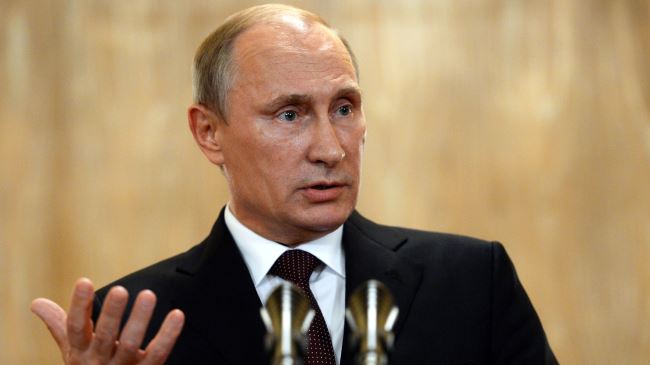
Russian President Vladimir Putin says certain countries play into the hands of terrorists and endanger regional security by bypassing international law and resorting to military force.
Putin made the remarks in a greeting message to the participants in a security conference in the Black Sea resort city of Sochi on Wednesday.
He stressed that the policy of unilateralism practiced by certain states is hindering efforts to ensure regional and global security.
“Some members of the international community have been increasingly trying to ignore the generally recognized norms and principles of the international law and resort to the use of military force bypassing the UN Security Council and refuse to hold talks as a key tool of resolving international disputes,” he said.
“This, in its turn, generates political and social instability and plays into the hands of terrorism, extremism and transnational crime, leading to the escalation of local conflicts and crises,” he added.
Earlier this month, the US, Britain and France launched a coordinated missile attack against sites and research facilities near Damascus and Homs with the purported goal of paralyzing the Syrian government’s “capability” to produce chemical arms.
The trio blamed the government of Syrian President Bashar al-Assad for a suspected gas attack in the Damascus suburb town of Douma on April 7.
Moscow said it has “irrefutable” evidence that the Douma incident was a “false flag” operation orchestrated by British spy services.
Elsewhere in his message, Putin expressed Russia’s readiness to engage in close security cooperation with foreign partners in both multilateral and bilateral formats.
The Russian president further noted that the Sochi conference will provide a good opportunity to discuss the options for countering various threats and challenges to international security.
The two-day event has gathered senior officials from more than 100 countries. Secretary of Iran’s Supreme National Security Council Ali Shamkhani is among the participants and is set to address the conference.
‘Incitement to crime’: Russian senator blasts Saudi advice to send Qatari troops to Syria
RT | April 25, 2018
A member of the Russian upper house security committee has described a recent Saudi statement urging Qatar to send troops to Syria as blackmail, and warned that any such step would bring only chaos and casualties to the region.
“The statement made by the head of Saudi Arabia’s Foreign Ministry is a very real blackmail. Saudi Arabia is inciting Yemen into knowingly unlawful action,” Senator Frants Klintsevich told reporters on Wednesday.
Klintsevich referred to comments by Saudi Foreign Minister Adel Jubeir, who earlier in the day stated that Qatar must “send its military forces (to Syria), before the US president cancels US protection of Qatar, which consists of the presence of a US military base on its territory.” The minister also hinted that Qatari forces could replace US servicemen in case the latter are ordered to withdraw from the region.
The Russian senator told the press that he personally had great doubts about the US’ intention to leave Syria, despite all contrary statements made by President Donald Trump. “Saudi Arabia must be talking about Qatar’s participation in the Syrian campaign alongside the US forces, not instead of them. This is even stranger as Riyadh cannot fail to understand that this would bring nothing but additional chaos and new senseless casualties,” he said, adding that he suspected Saudi authorities had their own goals in the conflict, which they preferred to keep quiet.
The Al-Udeid airbase located near the Qatari capital Doha is currently the largest US military base in the Middle East, with around 11,000 servicemen stationed there. Qatar’s own army is one of the smallest in the region, with some 12,000 active military personnel.
In January, the Qatari defense minister outlined a far-reaching expansion of US military presence in the country and a potential US Navy deployment after it completes renovations of its naval ports. He also expressed hope that the base will one day become permanent.
A Shocking Lack of Intelligence in Our Missile Strike on Syria
By Scott Ritter | TruthDig | April 20, 2018
It was a scene that has played out before the American public on multiple occasions in recent history: Representatives of the American defense establishment walked out onto a stage backed by light-blue drapery sporting an oval-shaped sign containing the words “Pentagon” and, below it in smaller letters: “Washington,” along with an image of the unique five-sided building of the same name. With an American flag standing in the background, and standing on a wooden podium emblazoned with the seal of the Department of Defense, Secretary of Defense James Mattis, a former Marine general, accompanied by the chairman of the Joint Chiefs of Staff, Joseph Dunford, a current Marine general, briefed the American public on the details surrounding a U.S.-led missile attack against targets inside Syria, carried out with the United Kingdom and France, that had transpired the night of April 13, 2018, a little more than an hour before Mattis and Dunford took the stage at 10 p.m. (making the timing of the attack around 4 a.m. on April 14, Syrian time).
“As the world knows,” Mattis announced, “the Syrian people have suffered terribly under the prolonged brutality of the Assad regime. On April 7, the regime decided to again defy the norms of civilized people, showing callous disregard for international law by using chemical weapons to murder women, children and other innocents. We and our allies find these atrocities inexcusable. As our commander in chief, the president has the authority under Article II of the Constitution to use military force overseas to defend important United States national interests. The United States has vital national interests in averting a worsening catastrophe in Syria, and specifically deterring the use and proliferation of chemical weapons.”
Mattis continued: “Earlier today, President Trump directed the U.S. military to conduct operations in consonance with our allies to destroy the Syrian regime’s chemical weapons research development and production capability. Tonight, France, the United Kingdom and the United States took decisive action to strike the Syrian chemical weapons infrastructure.”
Gen. Dunford spelled out the scope of this attack. “The targets that were struck and destroyed were specifically associated with the Syrian regime’s chemical weapons program … [t]he first target was a scientific research center located in the greater Damascus area. This military facility was a Syrian center for the research, development, production and testing of chemical and biological warfare technology. The second target was a chemical weapons storage facility west of Homs. We assessed that this was the primary location of Syrian sarin and precursor production equipment. The third target, which was in the vicinity of the second target, contained both a chemical weapons equipment storage facility and an important command post.”
The specificity of language used by Secretary Mattis and Gen. Dunford, declaring Syria to have a chemical weapons program inclusive of a research facility where chemical weapons were produced, a storage facility containing sarin nerve agent precursor production equipment and another that contained chemical weapons equipment and an associated command post, implied a degree of certainty backed by intelligence information sufficient to justify the use of American and allied military force.
Secretary Mattis asserted as much. “I am confident,” he said, “the Syrian regime conducted a chemical attack on innocent people in this last week, yes. Absolutely confident of it. And we have the intelligence level of confidence that we needed to conduct the attack.” When pressed for details about the actual chemical used, Mattis noted, “We are very much aware of one of the agents. There may have been more than one agent used. We are not clear on that yet. We know at least one chemical agent was used.” Later he clarified this statement, declaring, “We’re very confident that chlorine was used. We are not ruling out sarin right now.”
Mattis was asked about a statement he had made the previous day, April 12, when he appeared before the House Armed Services Committee. Then, Mattis put forward a theory that chlorine gas or sarin nerve agent—or a combination of the two—had been used by the Syrian government. He noted, however, that at the time of his presentation, the U.S. and its allies “[didn’t] have evidence” that the Syrian regime carried out the attack on April 7 in the Damascus suburb of Douma. “I believe there was a chemical attack,” Mattis said, “and we’re looking for the evidence.” In response, Mattis noted that his confidence level that the Syrian regime had carried out a chemical attack had increased sometime after he had made that statement.
The next day, April 14, Assistant to the Secretary of Defense for Public Affairs Dana W. White (a former Fox News publicist and professional staff member for the Senate Armed Services Committee as well as a foreign policy adviser to John McCain during his 2008 presidential campaign), together with Director of the Joint Staff Lt. Gen. Kenneth F. McKenzie Jr. (a 1979 graduate of The Citadel who commanded Marines in combat in Iraq and Afghanistan before being promoted to flag rank and assuming various joint service staff assignments), gave a second briefing where more details about the attack were provided.
In terms of the specificity of the intelligence used to justify the attack, White indicated that she had nothing to add to the statement made by Secretary Mattis the previous night. However, in answering questions, Lt. Gen. McKenzie noted that the U.S. military assessed “that there were probably some chemical and nerve agents in that target.” He also noted that by striking the three targets in question “We are confident that we’ve significantly degraded his [Assad’s] ability to ever use chemical weapons again.” White seconded this assessment. “The strikes went to the very heart of the enterprise, to the research, to development, to storage. So we are very confident that we have significantly crippled Assad’s ability to produce these weapons,” she said.
According to the information contained in these two briefings, the United States had a high degree of confidence in the fact that Syria continued to retain a viable chemical weapons capability despite the elimination of such weapons having been certified by the Organisation for the Prohibition of Chemical Weapons (OPCW), created under the auspices of the United Nations to implement the provisions of the Chemical Weapons Convention (CWC), an international treaty banning the production, retention and use of chemical weapons (keeping in mind that the Syrians have been accused of using sarin nerve agent, a Schedule 1 chemical, the category of which includes the agent itself, as well as its unique-use precursors).
Moreover, the implication of the statements made by Secretary Mattis, Gen. Dunford, Lt. Gen. McKenzie and Dana White was that the United States possessed intelligence information of such specificity as to permit military planners to assess the level of force necessary to ensure that specific quantities of nerve agent assessed as being present in a facility inside the city of Damascus would be destroyed by the weapons employed. The same holds true for the two chemical storage facilities located near Homs, especially the one assessed as containing sarin nerve agent and its precursors. Moreover, the statements implied that United States was in possession of intelligence information of such quality to permit assessments pertaining to having “crippled” Syria’s ability to produce chemical weapons.
There is one major problem with the information provided by these briefings: It is exclusively drawn from assessments, not fact. When one examines the basis for these assessments, it becomes clear that there was a shocking lack of intelligence available to sustain the predicate used to justify the U.S.-led attack on Syria—that the Syrian government possessed, let alone used, chemical weapons in the city of Douma on April 7.
There is a dearth of information about the specific intelligence information used by the United States, France or the United Kingdom to back up their collective claim that Syria used chemical weapons against Douma on April 7. According to The Guardian, intelligence agencies from all three countries “studied videos” from Douma. American officials in particular noted similarities between the Douma images and those from two previously reported sarin incidents in Syria—East Ghouta, in August 2013, and Khan Shaykhun, in April 2017. The first incident set in motion the events that led to Syria signing the CWC and acceding to the supervised elimination of its chemical weapons capabilities; the second has been used to sustain the premise that Syria had retained, in contravention of its obligations under the CWC, a sarin nerve agent capability. This latter finding underpins the totality of the assessments made in support of the American case for attacking Syria: If Syria possesses sarin nerve agent (as the events in Khan Shaykhun would suggest), then logic dictates that there would be an associated research and development facility complete with on-hand stocks of nerve agent (target one), and chemical weapons storage facilities containing sarin nerve agent and precursors as well as associated manufacturing equipment (targets two and three). No actual proof was required, or offered, to sustain these assessments.
Two issues flow from this line of thinking. First, the Khan Shaykhun incident is not without significant controversy, with its conclusions questioned by numerous experts, journalists and governments. Second, even if one accepts the findings that sarin nerve agent was used in Khan Shaykhun, that fact does not automatically sustain any allegations of sarin use in Douma, especially when there is no evidence to sustain that allegation.
One of the major problems confronting those who contend that both sarin and chlorine were used in the alleged Douma incident is the absolute incompatibility of the two substances. A U.S. Army study from the 1950s found that chlorine serves as a catalyst that promotes the decomposition of sarin nerve agent, meaning that if both substances were either combined or released together, the sarin would rapidly decompose. This reality seemed to escape American officials evaluating the Douma incident, who postulated to The Guardian that chlorine and sarin were stored separately in the same cylinder, ignoring how this would be achieved in a gas cylinder of the type alleged to have been used in Douma.
Only after the U.S.-French-U.K. attack of April 13 did one of the nations involved—in this case, France—provide an assessment outlining the intelligence case behind the Douma allegations. “On the intelligence collected by our services,” the report noted, “and in the absence to date of chemical samples analyzed by our own laboratories, France considers, beyond possible doubt, a chemical attack was carried out against civilians at Douma.” The basis of this conclusion was similar to that which underpinned the American assessment: “After examining the videos and images of victims published online, they (intelligence services) were able to conclude with a high degree of confidence that the vast majority are recent and not fabricated.” Without providing any further information or analysis, the French report concluded that “[r]eliable intelligence indicates that Syrian military officials have coordinated what appears to be the use of chemical weapons containing chlorine on Douma, on April 7.”
In short, the French case for war—and by extension, that of its allies, the United States and the United Kingdom—rested solely on “open source” information provided by opponents of the regime of Syrian President Bashar Assad, for whom military intervention by the West was a long-standing objective. The illogic behind the Syrian government employing chemical weapons in a manner that would invite Western military intervention at a time when the battle for Douma was all but over seems never to have been probed in a meaningful fashion by the intelligence agencies of the United States, the United Kingdom—or France.
Ground Zero
As far as “objective news sources” go, the Abkhazian Network News Agency, or ANNA, would not logically top any list. Based out of the breakaway Georgian territory of Abkhazia, the ANNA is an unabashed pro-Russian online news outlet known for its gritty front-line reporting from inside Syria, where its reporters, at great risk (many have been wounded while doing their jobs), accompany the Syrian army on combat operations against Islamist militants. Their reporting combines hand-held cameras, running alongside infantry and monitoring tactical command posts, GoPro-type cameras attached to tank turrets and cameras mounted on unmanned aerial vehicles hovering overhead, to provide a full-spectrum look at the ground war inside Syria unmatched by any other news source.
On April 5, 2018, the Syrian army’s vaunted Tiger Force, an elite assault unit of around 1,000 men, captured the village of al-Rayyan, on the western approaches to Douma, from fighters of the Army of Islam, a pro-Saudi jihadist group that had occupied Douma since 2013. The advance of the Tiger Force was the latest in a series of offensives carried out by Syria against rebel-held positions in the district of Eastern Ghouta, in which the city of Douma was located, since the beginning of the year. In March 2018 the Syrian army managed to break the rebel-held territory into three separate pockets, prompting thousands of fighters from groups other than the Army of Islam to agree to surrender their heavy weapons and evacuate Eastern Ghouta, together with their families to the northern Syrian town of Jarablus, adjacent to the Turkish border, which was under the control of the Turkish military and opposition forces belonging to the Free Syrian Army.
Only the area in and around Douma, under the control of the Army of Islam and the remnants of other defeated militant groups, held out. By early April, however, the relentless attacks by the Syrian army pushed even the hardened fighters of the Army of Islam to falter, and negotiations were opened with the Russians, leading to a series of temporary humanitarian cease-fires that quickly broke down amid mutual accusations of violations. The capture of al-Rayyan by the Tiger Force took place after the collapse of one such cease-fire and led to the resumption of negotiations between the Syrian government and the Army of Islam for the evacuation of the Islamists and their families from Douma. Earlier evacuations from Douma, involving thousands of militants and their families, had been conducted by the Russian military, which provided security. The negotiations, however, broke down as factions within the Army of Islam balked at having to leave Douma without their weapons.
On the morning of April 7, the Syrian army, supported by the Syrian and Russian air forces, renewed its assault on Douma. ANNA reporters accompanied Syrian troops from the Tiger Force as they overwhelmed the defenses of the Army of Islam, capturing a swath of open ground known as the Douma Farms, penetrating nearly three kilometers into the Army of Islam positions along a 10-kilometer front. The Tiger Force offensive represented the death knell of the Army of Islam; denied the buffer provided by the Douma Farms, the Army of Islam was trapped in the kind of urban terrain the Tiger Force thrived in, having perfected its house-to-house fighting tactics during the battle for Aleppo in 2017. Faced with inevitable defeat, the Army of Islam reached out to the Russians to renew negotiations that would lead to surrendering Douma to Syrian government control.
As the Army of Islam defenses crumbled in the face of the Tiger Force offensive, and the inevitability of defeat settled in among the leadership of the Army of Islam, a coordinated series of messages from various humanitarian organizations with a long history of opposition to the regime of Bashar Assad began to come out from within Douma about a series of chemical weapons attacks by the Syrian air force against the civilian population of Douma.
Among the first, a tweet from the Ghouta Media Center, a well-known outlet for anti-Assad information, was illustrative of what was to follow: “A new #Chemical massacre in #Syria was committed, this time in #Douma_city, 75 civilians were suffocated till death & 1000 suffocation cases, by a barrel was dropped by #Assad helicopters around 9:00pm contains the toxic #Sarin gas, some activists reached bodies in some basements.” Another group, known as the Douma Revolution, published a series of videos on its Facebook page on April 7 that would later be shown repeatedly on Western television channels as evidence of a chemical weapons attack.
By the morning of April 8, news of the alleged chemical weapons attack reached the front lines, where they were dismissed by the officers and men of the Tiger Force. “[Militants] claim we shelled them with chemical weapons,” a senior Tiger Force officer told ANNA reporters during a lull in the fighting on the morning of April 8, as the initial reports of a chemical attack in Douma became public, “but that is a lie, because at the same time we were advancing forward, not one of our soldiers has a gas mask.” Another Tiger Force officer made a similar argument. “We have no protection against the chemical weapons,” he told ANNA. “Those dogs used the chemical weapons themselves and said we did it. If we had that kind of weapon, we would have to carry gas masks. Go to the front and see for yourselves—what are you going to see? We are all here preparing to advance.” A third Tiger Force officer emphasized this point. “We do not have chemical weapons. We breathe the same air. If we had used chemical weapons, we would have suffered ourselves. There are only 20 meters between us. This is just a publicity stunt.”
The “publicity stunt,” however, had served its purpose. By April 8, the White Helmets, the nongovernmental organization lionized by many as a vaunted search-and-rescue organization credited with saving thousands of lives in the face of Syrian and Russian aerial bombardment, and demonized by others as a vehicle for generating anti-regime propaganda and promoting Western military intervention to topple Assad, and the Syrian American Medical Society (SAMS), another NGO possessing a similarly controversial pedigree, had published a joint statement on the Douma attack, the contents of which would be repeated verbatim (and seemingly without question) by Western media outlets and government agencies.
On Saturday, 07/04/2019 at 7:45 PM local time, amidst continuous bombardment of residential neighborhoods in the city of Douma, more than 500 cases—the majority of whom are women and children—were brought to local medical centers with symptoms indicative of exposure to a chemical agent. Patients have shown signs of respiratory distress, central cyanosis, excessive oral foaming, corneal burns, and the emission of chlorine-like odor.
During clinical examination, medical staff observed bradycardia, wheezing and coarse bronchial sounds. One of the injured was declared dead on arrival. Other patients were treated with humidified oxygen and bronchodilators, after which their condition improved. In several cases involving more severe exposure to the chemical agents, medical staff put patients on a ventilator, including four children. Six casualties were reported at the center, one of whom was a woman who had convulsions and pinpoint pupils.
SAMS has documented 43 casualties with similar clinical symptoms of excessive oral foaming, cyanosis, and corneal burns. Civil Defense [White Helmet] volunteers were unable to evacuate the bodies due to the intensity of the odor and the lack of protective equipment. The reported symptoms indicate that the victims suffocated from the exposure to toxic chemicals, most likely an organophosphate element.
These reports succeeded in generating the desired results—the United States was joined by the United Kingdom and France in condemning the alleged chemical weapons attack as a violation of international law that demanded an international response. President Trump tweeted out his own response, replete with ominously threatening language: “Many dead, including women and children, in mindless CHEMICAL attack in Syria. Area of atrocity is in lockdown and encircled by Syrian Army, making it completely inaccessible to outside world. President Putin, Russia and Iran are responsible for backing Animal Assad. Big price … to pay. Open area immediately for medical help and verification. Another humanitarian disaster for no reason whatsoever. SICK!”
By April 9, the U.N. Security Council was meeting in emergency session, leading to the inevitable rhetorical clash between the ambassadors from the United States and Russia. “The Russian regime, whose hands are all covered in the blood of Syrian children, cannot be ashamed by pictures of its victims,” U.S. Ambassador Nikki Haley told the Security Council. She also took aim at Syria’s president, noting, “Only a monster does this.” For its part, Russia’s ambassador stated: “There was no chemical weapons attack,” adding that “[t]he boorishness against my country is unacceptable and exceeds Cold War standards.”
While a war of words transpired in New York, on the ground in Syria the situation was evolving in a manner which began to threaten the narrative marketed by the White Helmets, SAMS and other sources that had peddled the information used by Washington, London and Paris to build a case sustaining the allegation of chemical weapons use by the Syrian government. The Army of Islam, having been thoroughly defeated on the field of battle by the Syrian army, abandoned Douma for refuge in rebel-held Idlib province. As the probability of unfettered access to the actual sites of the alleged chemical attacks became reality, the locations and people captured on film at what had become Ground Zero in Douma were about to be placed under a microscope of scrutiny where fact would ultimately triumph over fiction.
The Inspectors
At the headquarters of the Organization for the Prohibition of Chemical Weapons (OPCW) in The Hague, Netherlands, the inspectors maintain a situation center responsible for monitoring news reports from around the world, looking for any initial indication of an event that would fall under the purview. As soon as reports started coming out of Syria of an alleged use of chemical weapons by the Syrian government, the OPCW Situation Center kicked into action, briefing the director-general, Ahmet Üzümcü, on the developments. After years of experience in Syria investigating similar allegations, the situation center had developed significant contacts with various NGOs on the ground inside Syria, including the White Helmets and SAMS, and contact was established between the OPCW and these entities to learn more about what was transpiring on the ground inside Douma. Using the preliminary assessment of the situation center, derived solely from the images provided by anti-regime activists, that an incident had actually occurred inside Syria, the director-general ordered the Fact Finding Mission (FFM), a standing body of inspectors tasked with investigating chemical incidents in Syria, to assemble and prepare for deployment into Syria. By April 9 a team of nine personnel, all volunteers, including several who were pulled out of training courses, were gathered, and preparations were made for the FFM to travel to Syria under protocols associated with what the OPCW called an “Investigation of Alleged Use” (IAU) inspection under Article X of the CWC, where a state party to the CWC requests assistance in investigating an alleged use of chemical weapons. (The Syrian government had formally requested that the OPCW dispatch a team to Syria on April 10.)
A Title X IAU inspection is limited in scope to simply ascertaining whether a chemical agent was used—there would be no attribution of responsibility. By inviting the OPCW to investigate the allegations of chemical weapons use in Douma, the Syrian government (together with its Russian allies, who had joined with Syria in pressing for the OPCW to investigate the Douma allegations) was creating a diplomatic crisis of sorts over the role and function of the inspectors. For the United States, the United Kingdom and France, simply ascertaining whether a chemical agent was used was not enough—they wanted blame attached, and preferably to the Syrian government. The OPCW was not mandated to assign attribution for any alleged chemical incident; as such, the United States pushed a resolution in the Security Council to stand up an investigation team that would be able to assign blame. This resolution was promptly vetoed by Russia.
In the case of Syria, the Security Council had set up an entity, known as the Joint Investigative Mechanism (JIM), which worked hand-in-glove with the OPCW to investigate incidents of alleged chemical weapons use in Syria. The only difference was that the JIM was specifically mandated to assign blame for an attack, something it did with no small amount of controversy. In the aftermath of the joint OPCW/JIM investigation and report of an alleged use of chemical agent in Khan Shaykhun in April 2017, where blame was assigned to the Syrian government despite evidentiary issues related to a lack of chain of custody for samples used in the investigation, a failure to inspect the site of the alleged incident, and other investigatory shortfalls, Russia vetoed the extension of the mandate for the JIM, terminating it.
Without a specifically mandated investigatory mechanism to accompany the OPCW into Syria, any report issued by the OPCW would not be able to ascertain the blame needed by the United States, the United Kingdom and France to justify taking military action against Syria, something all three nations were speaking openly about in the days following the allegations of chemical weapons use in Douma. Indeed, the existence of the OPCW team was viewed by many in the West, including James Mattis, as being irrelevant to the fact-finding process. “We’re trying to get inspectors in,” Mattis told Congress on April 12. “We will not know from this investigating team” who was responsible, Mattis said. “We will not know who did it. Only that it happened.” For Mattis and the other decision makers, who had already reached the conclusion that Syria had employed both chlorine gas and sarin nerve agent in Douma, this wasn’t good enough.
New videos had emerged from within Douma in the days following the alleged chemical attack, provided by the White Helmets, which claimed to show yellow 150-pound chlorine gas cylinders dropped by the Syrian military on targets inside Douma, including one site where numerous deaths were reported. These videos were picked up by the Western media and promoted by anti-regime social media activists such as Elliot Higgins, who posted a detailed assessment of the canisters and their relevance on his Bellingcat website. However, questions soon emerged about the legitimacy of the White Helmet video as proof of a chlorine attack, namely around the lack of damage to the cylinders involved, the lack of any indication that the cylinders contained chlorine gas, or, if they did, any chlorine gas leaked from the cylinders (the regulator valves on both canisters appeared to be undamaged and closed, and the physical integrity of both canisters seemed intact, prompting the question as to how any gas was alleged to have originated from either). Complicating matters further was the fact that, on April 9, a Russian military unit had arrived at the scene of the alleged gas attack to investigate and found no evidence of any chemical attack.
Suddenly, the OPCW fact-finding mission had new relevance. It no longer mattered that it could not assign blame for an alleged chemical weapons incident; the Russians and the Syrians had said that no such attack had taken place, and that no evidence of chemical weapons use existed at a site where numerous casualties from a chemical attack were alleged to have occurred. If the OPCW team confirmed the findings of the Russian reconnaissance team, there would be no case for military action. If, on the other hand, the OPCW team found that a chemical agent had been used in the face of Russian claims that none existed, the United States, the United Kingdom and France would have a stronger case for intervention.
The OPCW advance party deployed to Beirut on Thursday, April 12, and was joined by the rest of the team on Friday, April 13. Their plan was to deploy to Damascus on Saturday, April 14, and begin their work shortly thereafter. If chlorine had been used in Douma, as the White Helmets, SAMS and others claimed, inspectors would be able to find evidence of such in the form of various chloride salts, produced by the hydrochloric acid that was in turn produced through the reaction of chlorine gas with any substance it encountered upon release. The Russian military experts who visited Douma on April 9 were no doubt aware of this. If the OPCW team was able to detect significant traces of chloride salts, then the Russian findings would be debunked, and the claims of the White Helmets, SAMS and others bolstered.
The American-led military attack on Syria took place while the OPCW fact-finding mission assembled in Beirut; on Saturday, April 14, while the team drove to Damascus, Syria was dealing with consequences of this act. Despite this new reality, the Syrian government met with the fact-finding mission to discuss the arrangements needed for the team to travel to Douma to carry out its tasks. Problems soon arose regarding the security of the OPCW team; Russia and Syria claimed that, in the aftermath of the missile strike on Douma, the security environment in Douma had deteriorated when militants, emboldened by the attack, began shooting at Syrian military patrols. This prompted the need for Russia and Syria to find alternative routes into and out of the areas in Douma that needed to be inspected and to clear these routes of debris and mines. On Tuesday, April 17, the OPCW fact-finding mission sent a reconnaissance team to Douma but withdrew after coming under fire, further delaying the arrival of the main body of inspectors and their ability to carry out their assigned tasks.
While the OPCW inspectors waited in Damascus, the Syrian government provided them with access to 22 medical personnel it claimed had treated the alleged victims of the chemical attack, and who could provide testimony that no such attack took place. While the OPCW has not indicated whether these interviews actually took place, or what the findings of any such interviews were, insight into their probable content could be found via Russian media, which aired interviews with two Syrian medical personnel who appeared in the White Helmet video showing victims of the alleged chemical attack being treated in Douma.
In one such interview, a person identified as Khalil Azizah, claiming to be a medical student who works in the emergency room of the central hospital of Douma, declared that “a house in the city was bombed. The upper floors of the building were destroyed and a fire broke out on the first several floors. All those who were injured in this building were brought to us. The residents of the upper floors had signs of smoke inhalation from the fire’s smoke. We provided assistance based upon the symptoms of smoke inhalation. During this time an unknown person came in. I don’t know him. He said that this was an attack using poisonous substances. People were frightened, there was a struggle; the relatives of the wounded began to spray each other with water. Other people without medical training began putting anti-asthma inhalers in children’s mouths. We didn’t see a single patient with signs of chemical poisoning.”
Khalil Azizah claimed that the incident in question took place on April 8, one day after the alleged attack of April 7. However, he referred to the same video shot by the White Helmets and pointed to his image in the video as one of the personnel providing medical treatment. As such, there is no doubt that the incident Khalil Azizah refers to is the same one recorded by the White Helmets. Moreover, Azizah’s narrative of smoke inhalation is consistent with the finding of the French intelligence report on the Douma chemical attack, which noted that, based upon an examination of the images of the alleged victims, one of the possible explanations behind the symptoms produced was “hydrocyanic acid” (the solution of hydrogen cyanide in water). Hydrogen cyanide is something not found in either chlorine or sarin exposure, but prevalent in the smoke produced by structure fires. The presence of hydrogen cyanide would be explained by a structure fire, and as such, Azizah’s testimony provides a viable alternative explanation for the victims being treated by the Douma hospital, as well as those filmed dead at the scene of the alleged chemical attack.
The Western media aired its own recorded interviews of alleged victims who had fled from Douma to refugee camps along the Turkish border. Complicating the story further, reporters from a variety of news outlets had made their way to the actual site of the alleged Douma chemical attack while the OPCW inspectors were stranded in Damascus. A CBS crew was shown the chlorine canister on the roof of the building where the victims of the chemical attack were claimed to have died and interviewed eyewitnesses who claimed to have been present during the attack. Other journalists visited the same location and interviewed eyewitnesses who claimed no chemical attack had taken place.
Meanwhile, the delay for getting the OPCW inspectors into Douma prompted the United States, the United Kingdom and France to speculate that Russia was sanitizing the site of the attack of any evidence that would show chemicals were used, a charge Russia vehemently denied (and something the various news reports conducted at the scene would suggest was not, in fact, the case). Not to be outdone, the head of the White Helmets claims to have provided the OPCW fact-finding mission the locations of “mass graves” containing the victims of the alleged chemical attack. The forensic viability of these bodies (for which no documentation exists and no chain of custody has been provided linking them to the chemical incident in question, if they in fact exist) is virtually nil, and it is unlikely the OPCW would seek to have them exhumed in any event. The allegations of their existence, however, represents the latest in a series of roadblocks that have been placed in the way of the OPCW inspectors.
The truth is out there, waiting on the ground in Douma. There is no doubt that the OPCW fact-finding mission has the forensic investigatory capability to detect the presence of chemical agents at the scene of the alleged chemical attack of April 7. The amount of chlorine necessary to have produced the number of casualties claimed is significant, and as such the chemical residue unique to such an event would be present in large quantities, and easily detected; no amount of “sanitation” by Russia or any other party could eliminate these traces.
This is the truth of the Douma chemical allegations—they can be readily proved or disproved almost immediately upon arrival at the scene by qualified inspectors from the OPCW. The fact that the United States, the United Kingdom and France opted to attack Syria without allowing the OPCW inspectors to first accomplish their mission provides the clearest indication possible that all three nations knew they possessed a shocking lack of intelligence to sustain their allegations surrounding the use of chemical agents by the Syrian government, and that the missile attack of April 13, was little more than a propaganda exercise designed to promote larger policy objectives regarding U.S., U.K. and French policy in Syria. This conclusion holds regardless of what the ultimate finding is by the OPCW inspectors as to what transpired on the ground in Douma the evening of April 7, 2018.
The Mainstream Media Fueled Military Action in Syria and Reprisals against Russia over the Skripals
By Philip Giraldi | American Herald tribune | April 23, 2108
The complicity of America’s Fourth Estate in the evolution of the national security warfare state is often mentioned in passing but rarely analyzed in any detail. But a recent article on Lobe Log by Adam Johnson is refreshing in that it does just that, looking at the editorials in 26 leading newspapers relating to the April 13th strike against Syria for the alleged use of chemical weapons. All of the papers supported the attack in the belief that Syria and its Russian and Iranian allies had done something wrong and had to be punished. Some of the endorsements went well beyond the actual strike itself, urging the White House to do more. The article quotes the Toledo Blade’s assertion that:
“Make no mistake, this was a warning to Vladimir Putin as well as Bashar al-Assad. The United States and its two longtime allies redrew the red line that had been obliterated by a failure of nerve by the US and the West generally: There will be cost for your barbarities…. But in the larger sense, the West did what it should have done a long time ago. It stood up for decency and international law. It stood up for those who are defenseless. It stood up for itself, and for simple humanity, and redeemed some self-respect.”
Another recent editorial intended to stir up hysteria about perfidious Moscow appeared in the New York Times on March 12th. It was entitled “Vladimir Putin’s Toxic Reach”. It said in part:
“The attack on the former spy, Sergei Skripal, who worked for British intelligence, and his daughter Yulia, in which a police officer who responded was also poisoned, was no simple hit job. Like the 2006 murder of Alexander Litvinenko, another British informant, who was poisoned with radioactive polonium 210, the attack on Mr. Skripal was intended to be as horrific, frightening and public as possible. It clearly had the blessing of President Vladimir Putin, who had faced little pushback from Britain in the Litvinenko case. The blame has been made clearer this time and this attack on a NATO ally needs a powerful response both from that organization and, perhaps more important, by the United States.”
These two stories and the many others like them have something in common, which is that they were written without any evident “fact checking” and subsequently have proven to be largely incorrect in terms of their assumptions about Russian and Syrian behavior. They also share a belief that the United States and its allies can both establish and enforce standards for the rest of the world. In these cases, the stakes were very high as there was an assumption that it could be appropriate to risk going to war with a powerful nuclear armed government based on incidents that did not in any way impact upon American or British national security.
Regarding Syria, the first wave of “reporting” on the alleged gassing came from sources linked to the terrorist group that was under attack, Jaish el-Islam. This included the so-called White Helmets, who have been outed and exposed as a virtual PR outfit for those one might call the head-choppers. More recently, with government control reestablished over the Douma neighborhood where the reported deaths took place, independent journalists including the able Robert Fisk, no friend of the al-Assad “regime”, have been entering and discovering that there appears to be no evidence that a gas attack even took place.
Skeptics examining the incident from the beginning noted that the Syrian government had every reason to avoid a provocation in its rollup of the remaining rebel pockets near Damascus while the so-called rebels would have been highly motivated to stage a false flag attack to bring in outside forces in support of their cause. If there was a chemical attack of any kind, it almost surely originated with the terrorists.
Even assuming that the United States was acting in good faith when it attacked Syrian “chemical sites” believing that the al-Assad “regime” had actually used such weapons, one should also assume, given the time frame and lack of definitive intelligence resources, that the decision was based on an assessment that relied on limited information coming from sources hostile to Damascus as well as White House perceptions of persistent bad behavior by the Syrian government.
So a poorly informed Washington clearly went to war without exactly knowing why. As the story continues to unravel, there will, however, be no apologies forthcoming either from the White House or the national media, both of which got it so wrong. The mainstream media never even questioned whether Trump should bomb the Syrian “regime” at all, instead merely debating exactly how much punishment he should inflict.
To their credit, the British public and some former senior officials are beginning to ask questions about Syria through a reluctant media filter and opposition leader in Parliament Jeremy Corbyn has refused to be silenced. Similarly, the story of the poisoning of the Skripals in Salisbury has also begun to come apart. Former U.K. Ambassador Craig Murray has detailed how the narrative was cooked by “liars” in the government to make it look as if the poisoning had a uniquely Russian fingerprint. Meanwhile U.S. investigative reported Gareth Porter sums up the actual evidence or lack thereof, for Russian involvement, suggesting that the entire affair was “based on politically-motivated speculation rather than actual intelligence.”
Here in the United States the mainstream media, which has supported every war since 9/11, has yet to account for its deliberately slanted reporting that has fueled both military action in Syria and reprisals against Russia over the Skripals. Unfortunately, the resulting actions undertaken by the United States and Britain have not been consequence free. The attack on Syria, given the fact that Damascus in no way threatened either the U.S. or U.K., was a war crime under international law. The mass expulsions of Russian officials over the Skripals affair has produced a diplomatic chill not unlike the Cold War, or perhaps even worse, with American U.N. Ambassador Nikki Haley declaring that the White House is “locked and loaded” if Syria should again step out of line. One might ask Haley what is to be done when Washington steps out of line? It would be interesting to hear her answer.
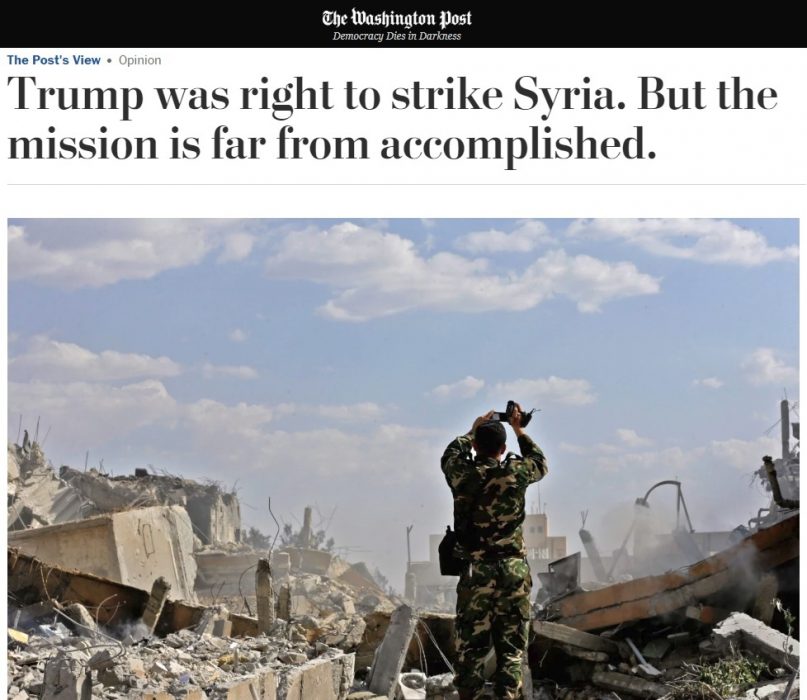
*(Snapshot courtesy of the WashingtonPost )
Index on Disgrace
By Craig Murray | April 22, 2018
The second half of my life has been a continual process of disillusionment with the institutions I used to respect. I suppose it started with the FCO, where I went from being Britain’s youngest ambassador to being sacked for opposing the use of intelligence from torture, at the same time having an insider view of the knowing lies about Iraqi WMD being used as a pretext for invasion and resource grab.
I still had some residual respect for the BBC, which respect disappeared during the Scottish independence referendum where BBC propaganda and disregard for the truth were truly shameless. My love of the universities was severely tested during my period as Rector of Dundee University, when I saw how far the corporate model had turned them from academic communities developing people and pursuing knowledge, to relentless churners out of unconsidered graduates and financially profitable research, with nearly all sense of community gone. My respect for charities vanished when I discovered Save the Children was paying its chief executive £370,000 and had become a haven for New Labour politicos on huge salaries, which was why it was so involved in pushing a pro-war narrative in Syria. When Justin Forsyth and Brendan Cox – both massively salaried employees who came into Save the Children from the revolving door of Gordon Brown’s office – were outed over sexual predation, that seemed a natural result of “charities” being headed by rich party hacks rather than by simple people trying to do good. As for respect for parliament, well the massive troughing expenses scandal and all those protected paedophiles…
It has become difficult to hang on to respect for any institution, and that is unsettling.
Which brings me to last week’s annual awards from Index on Censorship. The winners of the awards – from Cuba, the Democratic Republic of Congo, Honduras and Egypt – all seem worthy enough, and there is even some departure from the neo-con narrative in recognising a human rights problem in Egypt.
But the Chairman of Index on Censorship is, incredibly, Rupert Murdoch lead hack David Aaronovitch, and he presided over the awards, in the very week in which the newspaper for which he writes produced this appalling attack on freedom of expression:

Inside there was a further two page attack on named academics who have the temerity to ask for evidence of government claims over Syria, including distinguished Professors Tim Hayward, Paul McKeigue and Piers Robinson. The Times also attacked named journalists and bloggers and, to top it off, finished with a column alleging collusion between Scottish nationalists and the Russian state.
That the Chairman of “Index on Censorship” is associated with this kind of attack on freedom of speech, freedom of thought and freedom of research is sadly unsurprising. The guest list of the Index ceremony had a distinct right wing tinge including A C Grayling and Sara Khan, as well as a good smattering of the BBC, which was also represented on the judging panel. The irony of the state broadcaster being part of a panel on freedom of expression is plainly lost.
I realised something was very wrong with Index on Censorship when I contacted them over a decade ago, when Jack Straw attempted to ban the publication of my book Murder in Samarkand, after it had passed successfully through the exhaustive FCO clearance process over a time-consuming year. I tried to interest them again when my second book The Catholic Orangemen of Togo was dropped by my publisher following libel threats from mercenary commander Tim Spicer of Aegis/Executive Outcomes/Sandline. On both occasions I was told that then Chief Executive of Index, John Kampfner, did not regard these attempted book bannings as incidents of censorship. Presumably because they weren’t somewhere like Cuba or Zimbabwe…
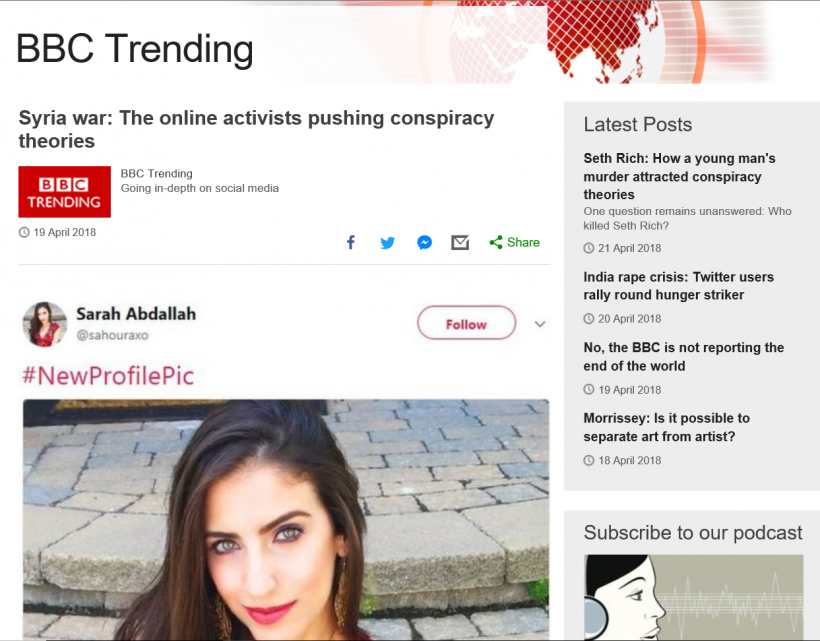
The truly appalling Times attack on academics was part of a coordinated and government-led campaign to delegitimise anybody doubting the official narrative on Salisbury and Syria. The BBC weighed in with this horrible effort:
The government then issued a ridiculous press release branding decent people as “Russian bots” just for opposing British policy in Syria. In a piece of McCarthyism so macabre I cannot believe this is really happening, an apparently pleasant and normal man called Ian was grilled live on Murdoch’s Sky News, having been named by his own government as a Russian bot.
The Guardian uncritically published the government’s accusations in full, and astonishingly seemed proud that it had made no attempt to investigate their veracity but had merely published what the government wished them to publish:

The Guardian naturally was just as reliable as the BBC in driving home the message that anybody who doubted the government’s word on Syria was a flat-earth denier of the truth:

Mr Freedland is of course a perfect representation of an interesting fact. Those who are most active in telling us that we must attack Syria, and that anybody who questions the government’s pretexts is insane or evil, are precisely the same individuals who supported the war in Iraq and attacked those who doubted the existence of Iraqi WMD. Indeed these people – Jonathan Freedland, David Aaronovitch, Oliver Kamm, Alan Mendoza, Andrew Rawnsley, John Rentoul, Nick Cohen – are the leaders of the tiny, insignificant number of people who still believe that the invasion of Iraq was both justified and beneficial in its result.
Yet these people of proven terrible judgement, they and others of their media class, are the arbiters who are allowed to dictate the terms of what is and what is not an acceptable public utterance on the situation in Syria.
When Jeremy Corbyn became leader of the opposition, one of two things had to happen. Either the Overton window had to shift to allow for the reflection of views held by the leader of the official opposition and his myriad supporters, or the leader of the opposition had to be castigated and humiliated as an unreasonable lunatic. Corbyn’s rational scepticism on British involvement in the conflict in Syria is a key moment in this process. Despite the fact Corbyn’s scepticism is supported by a wide swathe of diplomatic and military opinion within the UK, it has to be portrayed as fringe, extreme and irrational.
We thus have the extraordinary spectacle of a coordinated government and media onslaught on anybody who doubts their entirely fact free narratives. Those who were demonstrably completely wrong over Iraq are held up as infallible, and given full control of all state and corporate media platforms, where they deride those who were right over Iraq as crackpots and Russian bots.
Meanwhile public trust in the state and corporate media hits new lows, which is the happy part of this story.
Support Craig Murray’s continued writing.
Dear Salafist Wahhabist Apologists
By Paul Larudee | Dissident Voice | April 22, 2018
Your head chopper heros are apparently not what Syrians have in mind when they think of democratic revolution.
Mehdi Hasan (MH) can hardly be blamed for the ignorance that he displays in his Intercept article, “Dear Bashar al-Assad Apologists: Your Hero Is a War Criminal Even If He Didn’t Gas Syrians.” He has apparently never been to Syria, doesn’t often do research on Syria, and gets his information from proponents of a single point of view, representing a bunch of idealists that want to usher in their idea of a liberal democracy in Syria, without benefit of electoral niceties until their power is already ironclad. What’s wrong with this picture?
But I’m getting ahead of myself. Let’s start by deconstructing the absurdities and the language in the MH article.
Thankfully, MH has spared us the need to deconstruct the absurd accusation that the Syrian armed forces have used chemical weapons. He apparently accepts that they don’t need to, that there is no benefit in using them, so why would they? OK, then who did? Cui bono? Easy answer. The motive of the promoters of destruction in Syria is to create a pretext for the US and its partners to bomb, invade and establish a no-fly zone; i.e., to directly take on the Syrian government and its allies. These war criminals include the neoconservative cabal in the US, the Zionist and Israeli proponents of using the US to fight Israel’s perceived enemies, and the Saudi and Qatari adventurists backing the Project for a New Salafist Paradise. These are the same players who brought us Iraq I and II, Libya, Afghanistan forever, Somalia and Yemen. What more could we wish for?
So let us move on to the MH complaint about barrel bombs. What is the complaint, exactly? Are they more horrible than other types of bombs? Is it OK to use bombs manufactured in western munitions factories for delivery by jet airplanes but not ones manufactured in Syria and delivered by helicopter? Never mind. It’s a great opportunity for MH to use the hyped term “BARREL BOMB” in order to enrage and terrify an undiscerning readership.
But what about all the civilian casualties, and isn’t the Syrian army to blame? Well, no, ISIS and the pseudonymous al-Qaeda affiliates are quite happy to post videos of their stonings, beheadings, crucifixions and immolations, so we know the army can’t be the only ones. In fact, given the summary executions of non-Muslims in territories “liberated” from the government, is there any reason to think that the forces fighting the Syrian government are responsible for fewer civilian deaths? I myself met refugees who had fled up to 70 km over the mountains in the dead of winter to Latakia in March, 2013 with no more than the clothes on their back. No one knows how many children and old people died.
Aircraft? The anti-government fighters don’t have them, do they? No, but they seem to be quite resourceful in eliminating innocent human lives nonetheless. An example is the at least 10,000 civilians that have lost their lives in Damascus due to mortars and “hell cannons” (which also use “barrel bombs”) since the start of the hostilities. Other examples include the withering four-year siege of the Shiite towns of Foua and Kafraya near Idlib and the unrelenting bombardment via “hell cannon” of the city of Aleppo from the enclave of East Aleppo until it was finally recovered by government forces in late 2016.
On the other hand, for those (unlike MH and the mainstream media), who consider evidence to be relevant, there is a plethora available to show that the Syrian army has been unusually respectful of civilian life. The claim is that Syria and its Russian allies have obliterated entire neighborhoods, raining bombs on the civilian population. The facts are somewhat at odds with this description.
First, there are the civilian casualties themselves. The UN stopped keeping casualty statistics in early 2016, but even the anti-government Syrian Observatory for Human Rights concedes that less that 1/3 of all casualties are civilians. No other war on record has had such a low ratio. By comparison, 2/3 were civilian casualties in Vietnam, WWII and most other wars.
Second, the Syrian army liberation of Homs, Aleppo and other areas has followed a typical progression that is quite the opposite of “just kill them all”. First, the army surrounds the area and lays siege. At this point, if the army wants to flatten the area and bring an end to the resistance there, it has the perfect means to do so. But it does not. Instead, it positions relief supplies at the perimeter and makes them available without prejudice to the inhabitants. It also offers sanctuary to all who wish to leave. Amazingly, this includes even the fighters. Syrian fighters willing to lay down their arms are offered amnesty. But many are not initially willing to accept amnesty, and many are not Syrian. To these, the government offers safe passage to other parts of Syria under opposition control, even permitting the fighters to keep their small arms.
If they refuse, the siege and the fighting continue, often for more than a year, and bombing is often a part of the campaign, especially toward the end, after multiple unilateral ceasefires from the government side, to try to conclude a peaceful end, as in Aleppo. The bombing is typically in the least inhabited areas, in order to remove cover for fighters, so that the army will incur fewer casualties when it goes in. The strategy doesn’t always work, but the low ratio of civilian casualties is a testimony to its relative success.
Why does the Syrian government do this? Wouldn’t it be easier to just level the entire area, civilians and all, and be rid of the fighters once and for all?
Not really. The government is aware that families are split, with some fighting on one side and some on another. One of the reasons so many Syrians remain loyal to the government is that it is seeking to protect all Syrians on all sides, with the intention of regaining their allegiance. The government also recognizes that many of the opposition fighters are, in effect, mercenaries, for whom fighting is a way to put food on the table when there are no other sources of income. Such fighters are not really enemies, just desperate people. Given an opportunity, they will easily return to the government side.
Then there are the hyped bombing casualty statistics. As I pointed out in 2015, even if we accept the statistics of the highly biased anti-government Human Rights Watch, the number of casualties per bomb is only two, including combatants. If we apply the ratio of civilian deaths, that is less than one civilian casualty per bomb, a clear indication that the Syrian air force is being far more respectful of civilians than the US was, for example, in its bombing of Raqqah, where twice as many civilians as fighters were killed.
But MH is slamming a position that nobody holds. The number of “leftists” that consider Bashar al-Assad a hero infinitesimal. There may be many Syrians who do, but that is not who MH is referring to. MH is misinterpreting the actions of some journalists (including “leftists”) to correct distortions and false information as defense of Assad. Perhaps the distinction is too subtle for him, but an aversion to disinformation and lynch mob mentality is not the same as being pro-Assad. It’s not very helpful to say, on the one hand, that you oppose intervention in Syria, and then take all your (false) information from pro-intervention sources. In that case the interventionists will applaud your non-intervention stance.
Those of us whom MH accuses of being pro-Assad are nothing of the sort. We believe that Syrian sovereignty and territory should be fully respected (as MH also claims to believe), but we think it is important to counter the fake news and propaganda that are being used to justify the invasion of Syria. MH is in love with fake news. He prefers not to mention the killing of police in the uprisings that he describes as “peaceful demonstrations”. He prefers to cherry-pick the opinions of Syrian refugees in Germany rather than the views of the vast majority of refugees (displaced persons) who evacuated to government areas without leaving Syria. He produces the Human Rights Watch report on 50,000 morgue photos but not the deconstruction by investigator Rick Sterling. And he repeats the al-Qaeda claim and false film footage that Madaya was starving and in need when it was, in fact, sitting on a mountain of aid supplies being denied by the fighters themselves to the population.
If MH can’t see the difference between being pro-Assad and not falling for interventionist propaganda, that’s his problem. What’s astonishing is the number of “leftists” that rail against interventionism but base their views on the drivel purveyed by the interventionists themselves in the mainstream media, and that originates from propaganda mills like the White Helmets, the Aleppo/Ghouta Media Center and other lavishly funded set designers for warmongers. If MH is not an interventionist, he’s nevertheless making their case for them.
Paul Larudee is one of the founders of the Free Gaza and Free Palestine Movements and an organizer in the International Solidarity Movement.
Russia-Iran ties soar high under US pressure
By M K Bhadrakumar | Indian Punchline | April 22, 2018
A commentary entitled Tehran, Moscow boosting strategic relations, appearing last week in the Iran Daily newspaper, which is close to Supreme Leader Ali Khamenei – and subsequently circulated by IRNA – noted as follows:
“Policies adopted by Tehran and Moscow are becoming more harmonious on a daily basis as their bilateral as well as multilateral moves and measures are becoming more consistent with each other.”
The general expectation was that in the downstream of the 2015 Iran nuclear pact opening the door to Iran’s integration with the international community, Russia-Iran ties might get atrophied. But the exact opposite is happening. A senior Iranian official told Alexander Lavrentiev, Russian President Vladimir Putin’s special envoy to Syria, at a meeting in Tehran last week that the two countries are having their relations at the highest level in recent times.
If any single factor is to be held accountable for this, it must be American policies. The US’ containment policies toward Russia pursued under President Barack Obama have continued during the Trump presidency – and, arguably, even intensified. For Iran, on the other hand, the expected scale of integration with the international community has not materialized following the implementation of the 2015 nuclear pact due to the US’ negative attitude. The inertia of the Obama period has given way to hostile US policies under President Trump.
Meanwhile, the conflict in Syria has found Russia and Iran on the same side as staunch supporters of President Bashar Al-Assad. The Russian-Iranian cooperation deepened progressively during the period since the deployment of Russian forces to Syria in September 2015 and proved effective in stemming the tide of the war in favor of the Syrian government.
In the process, the overall Russian-Iranian relations began acquiring a strategic character, which they had lacked previously. Today, the spectre of US sanctions haunts both countries. The quasi-alliance with Iran provides much-needed strategic depth to the Russian policies in the Middle East. Whereas, Russia’s robust support on the vexed nuclear issue is invaluable help to Tehran at the present juncture. If Iran’s relations with the West run into difficulty under US pressure, Tehran’s dependence on Russia will only increase. Suffice to say, the more these countries face hostility from the US, the stronger their quasi-alliance is becoming. Shades of the “new type of relations” between Russia and China!
Two developments this week highlight that Middle Eastern politics has to reckon with a new geopolitical reality in the developing Russian-Iranian quasi-alliance. First, in a major statement two days ago, Russian Foreign Minister Sergey Lavrov hinted that following the recent western missile strike on Syria, Moscow may consider supplying the advanced S-300 missile defence system to Damascus.
If Russia upgrades the Syrian air defence system, the military balance will shift in favor of Damascus and thereby Iran will also be a beneficiary, since Syrian capability to deter any further Israeli adventures in its air space will help the consolidation of long-term Iranian presence in the Levant as well. (Following the killing of several Iranian personnel in a recent Israeli missile attack on a Syrian base near Damascus, the Chief of the Iranian Army Abdolrahim Mousavi said on Saturday that “destroying the Zionist regime is one of the major tasks of the Islamic Revolutionary Guards.”)
In a second development this week, Russian energy minister Alexander Novak was quoted as saying that Russia has received the first shipment of oil under the oil-for-goods deal agreed upon in 2014 (and ratified by the two countries last year) with a view to eschew the use of the US dollar in their bilateral trade transactions. Under the deal, Russia would initially buy 100,000 barrels a day from Iran and sell the country $45 billion worth of goods.
Indeed, the implications are profound when Russia and Iran, two energy superpowers, collaborate on oil trade. The two countries have also signed six provisional agreements to collaborate on “strategic” energy deals worth up to $30 billion. The Russian Presidential aide Yuri Ushakov recently disclosed that Russian investment in developing Iran’s oil and gas fields could total more than $50 billion.
According to Ushakov, Iran’s formal entry into the Russia-led Eurasian Economic Union is now only a matter of months. The free-trade deal between the EEU and Iran will be a game changer for Russian-Iranian economic cooperation on the whole. Meanwhile, with Russia’s support, Iran has also applied for membership of the Shanghai Cooperation Organization.
Media Support US Violence Against Syria, but Long for More
By Gregory Shupak | FAIR | April 20, 2018
Corporate media outlets were glad that the US, France and Britain bombed Syria in violation of international law (FAIR.org, 4/18/18), but lamented what they see as a dearth of US violence in the country.
In The Atlantic (4/14/18), Thanassis Cambanis described the war crime as “undoubtedly a good thing,” and called for “sustained attention and investment, of diplomatic, economic and military resources”—though the latter rubbed up against his assessment in the same paragraph that “a major regional war will only make things worse.” Moreover, he described “the most realistic possibility” for the US and its partners in Syria as “an incomplete and possibly destabilizing policy of confrontation [and] containment. But a reckoning can’t be deferred forever.”
This “reckoning” was his somewhat oblique way of referring to a war pitting the US and its allies against the Syrian government and its allies, the very “wider regional war” he just warned against. In Cambanis’ view, “confrontations” between nuclear-armed America and nuclear-armed Russia are “inevitable,” which implies that there is no sense in trying to avoid such potentially apocalyptic scenarios.
A Washington Post editorial (4/14/18) said that “Mr. Trump was right to order the strikes.” The paper was glad that Defense Secretary Jim Mattis and President Donald Trump “properly left open the possibility of further action.” The Post’s rationale for continuing to attack Syria was that “the challenge to vital US interests in Syria is far from over,” and that Trump was therefore wrong “to call Friday’s operation a ‘Mission Accomplished.’” These “interests” include ensuring that Iran does not “obtain the land corridor it seeks across Syria.” (Cambanis, similarly, described as “justified” US efforts to “contain Syria and its allies.”)
The paper was concerned because Trump says that he’d like to subcontract US activities in Syria to US regional partners like Saudi Arabia, the United Arab Emirates, Qatar and Egypt. None of these states, the Post fretted, “are capable of working with local forces [in Syria] to stabilize and hold the large stretch of [Syrian] territory now under de facto US control east of the Euphrates River.”
The editorial failed to note that this territory amounts to “about one-third of the country, including most of the oil wealth” (New York Times, 3/8/18) and “much of Syria’s best agricultural land” (Syria Comment, 1/15/18). The legitimacy of “de facto US control” over Syrian territory and some of its most valuable resources is apparently beyond question, as is the US’s alleged right to determine which governments are allowed to be friendly with each other: The Iranian “land corridor” refers to the Iranian government having warm relations with the governments of Syria, Iraq and Lebanon, something the Post appears to regard as a grave danger.
The editorial says that the US and its allies sought to “minimize the risk of a direct military confrontation with Russia or Iran” and that this was “prudent,” but that “if Russia takes retaliatory action, including in cyberspace, the United States must be ready to respond.” According to this view, projecting US power in Syria is so essential that no form of opposition to US violence in Syria can be brooked, the concern for prudence having vanished.
The Post contended that the US must demand “an acceptable political settlement brokered by the United Nations”—“acceptable” signifying “the departure” of the Syrian government. Functionally, this means keeping the war going: Saying that negotiations should take place but that the only “acceptable” outcome is the dissolution of the Syrian government amounts to the same thing as saying that no negotiations should take place, particularly now that the Syrian government is working from a position of strength and unlikely to agree to its own surrender as a pre-condition for talks.
Andrew Rawnsley, writing in the Guardian (4/15/18), supported US violence in Syria by attacking its critics. He said that those who oppose the Anglo-American-French airstrikes on Syria out of “indifference” to Syria’s plight have the “sole merit of being candid,” unlike those who are
less honest . . . the self-proclaimed peace-lovers. Mainly to be found on the hand-wringing left, they are too busy looking in the mirror admiring their own halos to face the moral challenges posed by a situation like Syria.
Luckily Rawnsley has the requisite courage to meet “the moral challenges” and advocate more war: He says that the West should have “impos[ed] no-fly zones” early in the war in Syria, a policy that would have entailed attacking Syria’s air forces, an act of war by any definition. No-fly zones over Iraq and Libya ultimately led to regime change in both countries, with hideous results for their people.
Rawnsley’s complaint that the West applied “no meaningful pressure” to “bring [the Syrian government to the negotiating table” is wildly misleading; the Western powers in fact applied “meaningful pressure” to prevent negotiations.
Rawnsley also legitimized US violence against Syria by expunging the damage it has inflicted. He trotted out the well-worn lie that the West “stood by” and “fail[ed] to act” in Syria, a canard that FAIR has repeatedly de-bunked (e.g., 9/20/15, 4/7/17, 3/7/18). He characterized the West’s approach to seven years of war in Syria as “years of unmasterly inactivity,” having their hands “wedged firmly under their bottoms,” an “impotent posture,” “failures to act,” making the “grav[e] decision not to act,” “inaction,” “non-interventionist” and as “inaction” a second time. Yet the CIA’s effort to oust the Syrian government has been one of the costliest covert-action programs in the agency’s history; has built ten military bases in the country, with two more on the way; and has killed thousands of Syrian civilians in a bombing campaign ostensibly aimed at ISIS (Jacobin, 4/18/18).
“Non-interventionists,” Rawnsley concludes his article, “the horrors of Syria are on you.” Yet there is no shortage of horrors that are on the interventionists. Sanctions imposed by the US and its allies have punished the Syrian population (9/28/16). These states are implicated in sectarian violence that anti-government armed groups have carried out against minorities (Electronic Intifada, 3/16/17). The US bombed a mosque in Aleppo, Syria, in the name of fighting Al Qaeda, killing almost 40 people (Independent, 4/18/17), and America used toxic depleted uranium against ISIS-held territory in Syria (Foreign Policy, 2/14/17): It would be rather difficult to claim that these horrors were caused by “non-interventionists.”
Cambanis, moreover, exclusively listed Syria, Iran and Russia among those governments who “have serially transgressed the laws of war” and “gotten away with murder” in Syria, but the atrocities attributable to the US and its allies surely constitute “serially transgress[ing] the laws of war” and having “gotten away with murder.”
The Syrian government and its partners are also responsible for a substantial share of carnage in the war, but Rawnsley’s accusation that “non-interventionists” are to blame for Syria’s bloodshed is completely untenable. His argument that Western states have inflicted insufficient harm on Syrians amounts to war propaganda.
And he’s far from the only media figure about whom this can be said.
Gregory Shupak teaches media studies at the University of Guelph-Humber in Toronto.
Another Dodgy British Dossier: the Skripal Case
In this second part of a series, Gareth Porter compares the same faulty logic employed in two purposely misleading, so-called British intelligence dossiers.
By Gareth Porter | Consortium News | April 21, 2018
The British government shared what was supposedly a dossier containing sensitive intelligence to convince allies and EU member states to support its accusation of Russian culpability in the poisoning of Sergei and Yulia Skripal in Salisbury, England on March 4.
But like the infamous 2003 “dodgy dossier” prepared at the direction of Prime Minister Tony Blair to justify British involvement in the U.S. invasion of Iraq, the intelligence dossier on the Salisbury poisoning turns out to have been based on politically-motivated speculation rather than actual intelligence
British officials used the hastily assembled “intelligence” briefing to brief the North Atlantic Council on March 15, the European Foreign Affairs Council on March 19 and the European summit meeting in Brussels on March 23.
The Need for Dramatic Claims
When Prime Minister Theresa May and Foreign Secretary Boris Johnson ordered the production of an intelligence dossier to be used to convince allies and EU member states to join Britain in expelling Russian diplomats, they had a problem: they were unable to declare that nerve agent from a Russian military laboratory had been verified as the poison administered to the Skripals. As the well-informed former Ambassador Craig Murray learned from a Foreign and Commonwealth Office source, the British government military laboratory at Porton Down had been put under strong pressure by Johnson to agree that they had confirmed that the poison found in Salisbury had come from a specific Russian laboratory. Instead Porton Down would only agree to the much more ambiguous formula that it was nerve agent “of a type developed in Russia.”
May and Johnson: Needed dramatic claims
So May and Johnson needed some dramatic claims to buttress their argument to allies and EU member states that the Salisbury poisoning must have been a Russian government assassination attempt.
A letter from British national security adviser Mark Sedwill to NATO Secretary-General Jens Stoltenberg released publicly on April 13, refers to two key claims in the dossier of a Russian program to research ways of delivering nerve agent, including smearing it on door handles, and of Russian production and stockpiling of nerve agent during the past decade.
But closer analysis of these claims, based in part on information provided by official British sources to the press, makes it clear that the government did not have any concrete “intelligence” to support those Government claims in the intelligence brief.
The Door Knob Claim
The Sedwill letter referred to a Russian “investigation of ways of delivering nerve agent, including by application to door handles” as being part of a broader alleged Russian government program of chemical weapons research and military training.” The letter was obviously implying that it had some secret intelligence on which to base the charge, and some in the British press pitched in to support the claim.
The first paragraph of a Guardian story on the intelligence dossier said, “Russia had tested whether door handles could be used to deliver nerve agent,” attributing the information to “previously classified intelligence over the Salisbury attack made public Friday.”
In another story about the evidence on the Salisbury poisoning, however, The Guardian, apparently reflecting its understanding of what government officials had conveyed, wrote, “Such an audacious attack could have been carried out only by trained professionals familiar with chemical weapons.” That statement hinted that the alleged Russian “investigation of ways of delivering nerve agents, including by application to door handles” was actually a speculative inference rather than a fact established by hard evidence.
A report in the Daily Mirror, evidently intended to support the government line, actually showed quite clearly that what was being presented as intelligence on alleged Russian research on delivering nerve agent via a door handle was in fact nothing of the sort. It quoted a “security source” as explaining how that claim in the intelligence paper was linked to the belief of counter-terrorism investigators that the Skripals first came in contact with nerve agent on the handle of Skripals’ front door.
“The door handle thing is big,” the unnamed source told the Mirror. “It amounts to Russia’s tradecraft manual on applying poisons to door handles. It’s the smoking gun.” The source was not saying that British intelligence had firsthand information about a Russian tradecraft manual; it was suggesting that one could somehow deduce from the assumed application of nerve agent to the door handle of the Skripal house that this was a sign of Russian intelligence tradecraft.
The source then appeared to confirm explicitly that this inference was the basis of the specific claim in the intelligence brief that, “It is strong proof Russia has in the last 10 years researched methods to administer poisons, including by using door handles.”
The Murder that Contradicts the Dossier
The idea that only intelligence operatives with formal training could have applied nerve agent to a door handle was not based on objective analysis. MI6, the British foreign intelligence service, knows very well that a 1995 murder committed in Moscow with a nerve agent developed by Soviet-era scientists was carried out by a private individual, not a government intelligence unit.
Court documents in the 1995 murder of banker Ivan Kivelidi, reported by the independent Russian newspaper Novaya Gazeta, show that in 1994 a Russian criminal syndicate had acquired Novichok nerve agent, which had been synthesized by Soviet scientists, and that it was used the following year to kill Kivelidi and his secretary by applying some of the nerve agent on his telephone receiver.
Boris Kuznetsov, a dissident Russian lawyer involved in the Kivelidi murder case, who fled Russia in 2007 with copies of all the relevant documents, turned them over to the British government after the Skripal poisoning. The knowledge of that episode would account for Prime Minister May’s otherwise surprising acknowledgement on March 12 of the possibility that the poisoning might not have been a Russian government action but the consequence of the Russian government allowing nerve agent to “get into the hands of others”.
An Ongoing Russian Novichok Program?
The Sedwill letter made another sweeping claim of covert Russian production of the line of nerve agent that had been dubbed Novichok. “Within the last decade,” it said, “Russia has produced and stockpiled small quantities of Novichok under the same programme.” If true, that would have been major evidence bearing on the Skripal poisoning, since such a program would be both covert and illegal under the Chemical Weapons Convention.
Sedwill: No evidence
But neither the Sedwill letter nor any other statement from the British government has referred to the possession of any evidence for that claim, even in the most generic way. In fact, Prime Minister May said merely that Russia “had previously produced Novichoks and would still be able to do so”.
In contrast to its silence about any kind of information supporting its claim of Russian production and stockpiling of Novichok program in the past decade, the Sedwill letter cited “a combination of credible open-source reporting and intelligence” on the existence of the Russian program that developed the Novichok line of nerve agents in the 1970s and 1980s.
If the UK possessed actual evidence of such a Russian nerve agent program at Shikhany, the former military chemical weapons facility, it presumably would have informed the Organization for the Prohibition of Chemical Weapons (OPCW) of the fact and presented its evidence to the 41-member Executive Council, the governing body of the organization. It clearly has not done so, and it has not suggested that it was prevented from doing so by the fear of compromising an intelligence source within the Russian government.
The British government could also demand a “challenge inspection” at the facility. Any member of the Chemical Weapons Convention can call for an immediate inspection, and Russia would have had no option but to permit it. But it has not done so, signifying that it does not have the information necessary to identify the location of the alleged production and stockpiling of such a weapon, nor does it have the name of anyone who has worked on such a project.
Suspect Intercepted Russian Communications
Another claim in the British “intelligence” dossier is an intercepted Russian communication that allegedly supports the Russian nerve gas operation accusation.
The tabloid Express reported its sources saying such an intercept had been “a key part of Britain’s intelligence evidence.” The sources revealed that on March 4, a message from Damascus to Moscow intercepted by a listening post in Southern Cyprus contained the words, “The package has been delivered.” And the same message was said to have reported that two named individuals had “made a successful egress” – meaning that they had left.
But without knowing the context in which either statement was made, such quotes are meaningless. And one must ask how often something like those exact words would be communicated to Moscow from a diplomatic or military outpost somewhere in the world every single day. Furthermore, the second message to which the dossier is said to have referred actually revealed the names of the two men who had departed, so it clearly had nothing to do with a covert operation.
The May government was able to convince 29 other states, including the United States, to take action against Russia by expelling its diplomats, representing a deliberate step toward higher tensions with Moscow. But the intelligence dossier it deployed in that effort, as reflected in the Sedwill letter and media reporting, was far from being the kind of information one might expect to provoke such a major diplomatic move. It was instead, like the original 2003 “dodgy dossier” on WMD in Saddam’s Iraq, essentially a collection of misleading claims based on politically-skewed logic.
Gareth Porter is an independent investigative journalist and historian on U.S. national security policy and the recipient of the 2012 Gellhorn Prize for journalism. His most recent book is Manufactured Crisis: the Untold Story of the Iran Nuclear Scare, published in 2014.
Featured Video

Trita Parsi: Middle East Unraveling — Are We on the Path to World War?
or go to
Aletho News Archives – Video-Images
New Book
Trans agenda is ‘normalization of sadism’ – US author

RT | September 23, 2026
The US Democratic Party has embraced a transgender agenda that amounts to “the normalization of sadism,” author A.J. Rice has said, warning that radical trans policies would return if the party is allowed to regain power.
Speaking to RT’s America First host Scotty Nell Hughes about his new book, ‘The Curse of the Bearded Lady: How the Trans Mafia Whacked American Sanity’, Rice argued that activists have gained significant influence in schools, medicine, and corporate America while people who questioned the agenda have faced pressure to stay silent.
The author described the “trans mafia” as the sprawling network of people and institutions that have helped the movement gain influence. He singled out parts of academia, wealthy backers, and corporations, and stated that providers of transition-related treatment also have a financial incentive to keep young people in their care indefinitely.
Rice argued that the consequences of these policies ultimately fall on children who are being drawn toward gender-affirming medical treatments and on girls who are expected to share locker rooms or compete in sports with biological males.
He noted that while voters rejected the Democrats’ approach to gender in 2024, the party, which has been “captured by madness,” has since only doubled down and is seeking what is effectively “the normalization of sadism.” … Full report
Blog Roll
 Aletho News
- Refaat Al-Areer Was The Canary In The Coal Mine In Israel’s War On The Truth
- Israeli election committee bars candidate from Knesset race over Gaza war opposition
- French-Lebanese man files war crimes complaint over Israeli attacks
- Mahan Air Flight Lands in China Despite US Threat against Iranian Airlines
- US eyes $10bn fund to rebuild war-battered Gulf infrastructure
- Trump meets Rodríguez near Maduro’s prison as Venezuela’s oil flows to US
- Trita Parsi: Middle East Unraveling — Are We on the Path to World War?
- Iran FM meets with US envoy on UN meeting’s sidelines at American side’s insistence: Report
- Qatar PM calls for Gulf security framework with Iran, says war must be ‘wake-up call’
- China condemns US extortion of Iranian airlines, rejects Washington’s ‘illegal’ sanctions threats
- If Americans Knew
- An error has occurred; the feed is probably down. Try again later.
- No Tricks Zone
- New Study: Earth And Venus Surface Warmth Largely Explained By Convection And Lapse Rate, Not CO2 Or Radiation
- 2025 Nature Paper Claiming Worsening Global Drought Gets RETRACTED …Heavily Flawed
- New Study: ‘Global Drought Shows No Detectable Recent Acceleration Under Climate Warming’
- Economic Masterminds: German Socialists Suggest Taxing Productivity Gains Stemming From Using AI
- The South China Sea Has Not Been Cooperating With The Climate Change Narrative
- Energy Crisis: Germany Enters Heating Season With Historically Low Gas Reserve Fill Levels
- New Study: The Antarctic Ice Sheet Gained Mass From 2020-2024 Due To Staggering Snow And Ice Accumulation
- Study: Ocean Heating Rates From Thousands Of Years Ago ‘Dwarf’ Modern Ocean Heating Rates
- Climate Extremists Target, Attack Large-Scale Power Grid Infrastructure In Germany!
- New Study: Antarctic Ice Melt Has Contributed Less Than 1 Centimeter To Sea Level Rise In The Last 30 Years

