US-Led Coalition Shoots Down Syrian Army Aircraft – Reports
Sputnik – 18.06.2017
The US-led anti-terrorist coalition has reportedly shot down a Syrian government forces’ aircraft.
Syrian Arab Army announced that the US-led anti-terrorist coalition had brought down its aircraft in southern Raqqa countryside, Syrian media reported citing a statement by the Syrian Defence Ministry.
According to the report, the Syrian jet fighter was carrying out military tasks fighting Daesh terrorist organization.
“Our aircraft was downed at lunch time today near the [Syrian] city of Raqqa, when it was fulfilling its mission against the IS,” the ministry said in a statement, adding that the US-led coalition was responsible for downing the aircraft.
The ministry noted that the coalition’s “actions are aimed at halting the Syrian army and its allies in the fight against terrorism, whereas our army and allies make great progress.”
According to the ministry, the pilot of the aircraft has not been found to date.
This is not the first time the US-led coalition’s activities in Raqqa cause casualties. Syrian media reported earlier that at least 43 civilians were killed as a result of the US-led coalition airstrike in the region. The Syrian Foreign Ministry condemned the airstrikes and sent two letters the UN secretary general and the head of the UN Security Council, in which the coalition’s actions were compared to Daesh crimes. Just a few days later, the Lebanese media reported that the coalition’s airstrikes killed more than 30 civilians more near Raqqa.
Raqqa has been under the control of Daesh since 2013, and is the de-facto capital of the self-proclaimed Daesh caliphate. The operation to retake Raqqa, conducted by a coalition consisting of almost 70 countries, has been on-going since November 2016. The strikes in Syria are not authorized by the UN Security Council or the government of Syrian President Bashar Assad.
US, allies sponsor Daesh: Adviser to Syria’s Assad
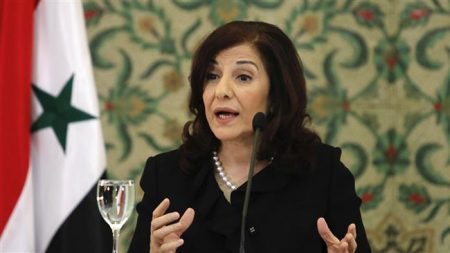
Bouthaina Shaaban, political and media adviser to Syrian President Bashar al-Assad
Press TV – June 18, 2017
A political and media adviser to Syrian President Bashar al-Assad has accused the US and its allies of financing and arming the Daesh Takfiri terrorist group in a bid to tear the region apart and deplete its resources.
Bouthaina Shaaban made the remarks in a statement to journalists after meeting with visiting China’s Special Envoy for Syria Xie Xiaoyan and the accompanying delegation in Damascus on Saturday.
While the US and its allies sponsor Daesh, the alliance supported by Russia and China stands against the expansion of terrorism in the Arab country, Shaaban said.
Russian and China, two of the five veto-wielding permanent members of the United Nations Security Council, have vetoed resolutions against the Syrian government that is battling foreign-sponsored terrorists since 2011.
There are UNSC resolutions, under which those responsible for committing, organizing and supporting terror acts as well as facilitating the movement of terrorists must be held accountable, but these motions have not been implemented at all, the Syrian official noted.
UNSC Resolution 2253, adopted unanimously in December 2015, covers asset freeze, travel ban, arms embargo and listing criteria for Daesh, al-Qaeda militants and “associated individuals, groups, undertaking and entities.”
Elsewhere in her remarks, Shaaban said that the Syrian army and its allies had recently managed to reach the Syria-Iraq border and “dealt a severe blow to the terrorists” through unified efforts, underlining the importance of strengthening communication between the two neighbors in that regard.
Washington’s agenda intersects with that of Daesh, which serves the interests of Israel, she added.
The Syrian official also denounced as unjustified the US deployment of rocket launchers to southern Syria and its attacks on the army positions.
Earlier this week, Russia said the US had deployed the M142 High Mobility Artillery Rocket System (HIMARS) launchers from Jordan to its base in the Syrian town of At-Tanf, warning that the equipment could be used against Syrian government forces.
Additionally, on two occasions in June and May, US warplanes attacked a Syrian military position near At-Tanf, killing an unspecified number of people and causing some material damage.
The US claimed that the Syrian forces who came under the attack posed a threat to its forces in Syria.
The Syrian army denounced the assaults, saying they demonstrated US support for terrorism, at a time when the Syrian army and its allies were making gains against Daesh militants.
Syria, Iran and N. Korea: Will Trump Attempt to Finish the Neocon Hitlist?
By Steven MacMillan – New Eastern Outlook – 16.06.2017
In Donald Trump’s short time in office, he has already shown his propensity to use military force. From dropping the largest non-nuclear bomb ever used on Afghanistan, to launching 59 Tomahawk cruise missiles at Iraq (oh wait, Syria), there is no doubt that the Trump administration has a prominent militaristic streak.
But is this just for starters? If Trump stays in power for the duration of his term, is there a major war, or even multiple wars, on the horizon? Judging by the rhetoric and actions already taken by the Trump administration, it will be a miracle if the US does not start a major war in the near future. Coincidentally, the main countries in the sights of the Trump administration just happen to be the three countries that the neoconservatives pinpointed for regime change 17 years ago, but have not yet been dealt with.
1997 marked the birth of the Project for the New American Century (PNAC), a neoconservative think tank of catastrophic proportions. It was founded by William Kristol, the longtime editor of the Weekly Standard, who also served as the chief of staff to Vice President Dan Quayle, and Robert Kagan, a former State Department official who is now a Senior Fellow at the Brookings Institute. A long list of neocons belonged to the group, including Dick Cheney, Donald Rumsfeld and Paul Wolfowitz.
PNAC’s stated objectives included the desire to “shape a new century favourable to American principles and interests,” “increase defense spending significantly,” and challenge “regimes hostile to US interests and values.” In September 2000, the PNAC group released a report titled: ‘Rebuilding America’s Defenses – Strategy, Forces and Resources for a New Century.’ The introduction to the report clearly expressed PNAC’s desire to maintain US supremacy in the world:
“At present, the United States faces no global rival. America’s grand strategy should aim to preserve and extend this advantageous position as far into the future as possible…Preserving the desirable strategic situation in which the United States now finds itself requires a globally preeminent military capability both today and in the future.”
In order to maintain this supremacy, the report called for the Defense Department to be at the forefront of experimenting with transformative technologies, a move that would require a dramatic increase in defense spending.
Curiously, the report – published one year prior to 9/11 – argued that this transformation would likely be a “long one” unless an event on the scale of “Pearl Harbor” occurred:
“To preserve American military preeminence in the coming decades, the Department of Defense must move more aggressively to experiment with new technologies and operational concepts, and seek to exploit the emerging revolution in military affairs… The effects of this military transformation will have profound implications for how wars are fought, what kinds of weapons will dominate the battlefield and, inevitably, which nations enjoy military preeminence…
The Pentagon [however], constrained by limited budgets and pressing current missions, has seen funding for experimentation and transformation crowded out in recent years. Spending on military research and development has been reduced dramatically over the past decade… Any serious effort at transformation must occur within the larger framework of U.S. national security strategy, military missions and defense budgets… The process of transformation, even if it brings revolutionary change, is likely to be a long one, absent some catastrophic and catalyzing event – like a new Pearl Harbor” (p.50-p.51).
Under the guise of missile capability, the report then pinpointed five countries that the neocons, in conjunction with the CIA, considered “deeply hostile” to the US:
“Ever since the Persian Gulf War of 1991… the value of the ballistic missile has been clear to America’s adversaries. When their missiles are tipped with warheads carrying nuclear, biological, or chemical weapons, even weak regional powers have a credible deterrent, regardless of the balance of conventional forces. That is why, according to the CIA, a number of regimes deeply hostile to America – North Korea, Iraq, Iran, Libya and Syria – ‘already have or are developing ballistic missiles’ that could threaten U.S allies and forces abroad. And one, North Korea, is on the verge of deploying missiles that can hit the American homeland. Such capabilities pose a grave challenge to the American peace and the military power that preserves that peace” (p.51-p.52).
This report was published approximately three years prior to the invasion of Iraq, and approximately 11 years prior to both the war in Libya and the start of the proxy war in Syria. The central point I am getting at here is that the wars we have seen unfold, and the wars to come, are not just short-term actions taken by the administration who happens to be in power at that particular time. They are planned years and sometimes decades prior to the first shot being fired. Regardless of which party the President belongs to – George Bush invaded Iraq with a blue tie on, whilst Barack Obama bombed Libya with a red one on – the same regime-change-agenda continues.
Two Down, Three to Go
Although there were other reports that marked more countries that the neocons considered ‘hostile’ to the US, or more accurately, hostile to US (Western) imperial ambitions, the September 2000 report focused on five countries. With Iraq and Libya already ‘liberated,’ three countries are still on the hitlist: Syria, Iran and North Korea. Coincidentally (or not), these are some of the main countries that the Trump administration is targeting, and we are only a few months into Trump’s reign.
Syria: Trump has already bombed Syrian government forces – or forces fighting on the side of the Syrian government – on multiple occasions since being elected. After Trump bombed Syria back in April, both Kagan and Kristol praised him, yet demanded more blood. Even though they claimed not to be major supporters of Trump during the campaign, many Bush-era hawks were – including Rumsfeld, the former Defense Secretary. The Trump administration has also admitted sending hundreds of US troops – which includes Marines – into Syria, officially in order to fight against ISIS (through training and advising rebel forces), yet it’s clear the move has as much to do with the Syrian and Iranian governments than anything else.
Iran: Throughout Trump’s campaign for the White House, he repeatedly criticized both Iran and North Korea. Trump has always been a severe critic of the Iranian nuclear deal, and a loyal supporter of the state of Israel, meaning war with Iran seems more probable that not. In fact, Iran has claimed that Trump and Saudi Arabia are behind the recent terror attacks in Tehran, which ISIS has claimed responsibility for.
During his trip to Saudi Arabia last month, Trump took the opportunity to take another jab at Iran. In February, the US Defence Secretary, James “Mad Dog” Mattis, called Iran the “biggest state sponsor of terrorism in the world,” completely ignoring the role Saudi Arabia plays in exporting terrorism. It appears as though the Trump administration is in the process of deciding which path to Persia it thinks is going to be the most effective.
North Korea: In relation to North Korea, the Trump administration has essentially backed the country into a corner, producing the obvious response from North Korea: an (attempted) show of strength. A country that the US carpet bombed during the Korean war – which included using napalm – it hardly seems likely that North Korea is just going to give in to US threats, considering the resentment many in the country still feel towards America.
This is not a defense of North Korea, but the Trump administration making one provocative statement after another has hardly reduced tensions in the region. In March, Mattissaid that “reckless” North Korea has “got to be stopped.” The following month, Trump said North Korea is a problem that “will be taken care of.” Although Mattis has acknowledged that a conflict with North Korea would be “catastrophic,” the Trump administration appears to be willing to ratchet up tensions regardless.
In contrast, both Russia and China have emphasised that dialogue and diplomacy trump threats. Speaking in May, the Russian President, Vladimir Putin, said that “we have to stop intimidating North Korea” and “return to dialogue” with them, after affirming that Russia “is against expanding the pool of nuclear powers, including North Korea.” Also in May, the Chinese Foreign Ministry called for the US and North Korea to “stop irritating each other,” and advocated “dialogue and negotiation.”
It also important to note that the North Korean issue is really about a lot more than just North Korea. As Paul Craig Roberts has highlighted, the North Korean ‘crisis’ has everything to do with Russia and China. Similar to how the US used the Iranian ‘threat’ to put anti-ballistic missile systems close to Russia’s borders, the North Korean crisis can be used to deploy anti-ballistic missiles systems next to the eastern borders of Russia and China. In a positive development however, the South Korean government has just announced (at the time of writing anyway) that it will halt the deployment of the US anti-ballistic missile system – known as the Terminal High Altitude Area Defense (THAAD) – on its territory for potentially up to a year, citing environmental concerns.
If the Trump administration and the neocons are actually reckless enough to try and force regime change in all three countries in the near future, this brings the US into direct confrontation with both Russia and China. And if a hot war between these three nuclear powers erupts, this would mark the end of human civilization as we know it.
Daesh Absent in Area of US’ HIMARS Artillery Deployment in Syria – Lavrov
Sputnik – June 16, 2017
Russian Foreign Minister Sergei Lavrov, commenting on the US military moves, pointed to the near absence of Daesh or other terrorist groups in the vicinity of the HIMARS’ staging area.
The United States transferred on Wednesday two High Mobility Artillery Rocket System (HIMARS) multiple-launch rocket systems from Jordan. The systems were deployed at the US special operations forces base near al-Tanf located 11 miles from the Jordanian border.The Russian military is analyzing the US deployment of artillery systems in southern Syria where terrorist groups are said to be virtually absent, Lavrov said Friday.
“The Russian military is naturally analyzing everything that is happening in this country, including taking into account the channel that we have with the US to prevent unintentional incidents,” Lavrov said at a briefing.
“In this area, there are practically no Daesh units and the deployment there of such serious weapons, which are not particularly suitable to combat Daesh… will not ensure the stability of communication channels between government and pro-government forces in Syria and their partners in neighboring Iraq,” he said.
Newly-deployed US rocket launchers may target Syrian army: Russia
Press TV – June 15, 2017
Russia says the US has deployed the M142 High Mobility Artillery Rocket System (HIMARS) launchers from Jordan to its base in southern Syria, warning that the equipment could be used against Syrian government forces.
“The United States has moved two HIMARS multiple rocket launchers from Jordan to the At-Tanf US special forces base,” the Russian Defense Ministry said in a statement released on Thursday.
It also accused the US, which is purportedly fighting terrorists, of having “repeatedly issued strikes on Syrian government forces fighting Daesh near the Jordanian border.”
Thus, the ministry said, “it’s not hard to guess that similar strikes will be continued against contingents of the Syrian army in the future using HIMARS.”
The deployment of any type of foreign weaponry on Syrian soil “must be approved by the government of the sovereign country,” it pointed out.
The statement further said Moscow is closely monitoring the situation on the Syrian-Jordanian border.
On Wednesday, an intelligence source first reported the US relocation of the HIMARS from Jordan to Syria.
The town of At-Tanf, home to a US base, is located in Syria’s Homs Province near a Syria-Iraq border crossing on the main Baghdad-Damascus highway.
On June 6, US warplanes attacked a Syrian military position on the road to At-Tanf, killing an unspecified number of people and causing some material damage.
The US claimed that the Syrian forces who came under the attack posed a threat to its forces and their terrorist allies in Syria.
On May 18, the US carried out a similar strike on a Syrian military convoy near At-Tanf.
The Syrian army has denounced the attacks, saying they demonstrate US support for terrorism, at a time when the Syrian army and its allies are making gains against Daesh militants.
The US and its allies have been bombarding what they call Daesh positions inside Syria since September 2014 without any authorization from the Damascus government or a UN mandate.
They have been accused of targeting and killing civilians, while failing to fulfill their pronounced goal of destroying Daesh.
Last White Helmets in Aleppo: in lieu of a film review
By Tim Hayward | June 14, 2017
In the wake of Netflix’s Oscar winning The White Helmets comes the Sundance Festival Grand Jury Prize winning Last Men of Aleppo. According to early reviews, audiences leave screenings with a desperate feeling that something ought to be done, but with a sense of helplessness about not knowing what.[1]
While that is very understandable, there are some things we can know if we really want to, even though the film does not reveal them.
First, in case it is true that among audiences are people who wish there was something they could do to just make the bombing in Aleppo stop, I would mention that it has stopped. It stopped before Christmas 2016. The siege of Aleppo ended, and the citizens who had been trapped there, essentially as human shields, were able to leave. Most went to the Western part of the town that had remained under government control.[2] The fighters who had been in control of the eastern quarters were given amnesty and left town in green buses laid on by the Syrian government. They were allowed to take their handheld weapons. The White Helmets went with them to Idlib, although some may have gone to Turkey (where their video clips were edited into this new film).
Since their departure, law and order has been restored across the whole of Aleppo. The eastern part is no longer bombed. Nor does it any longer experience the kidnappings, rape, murder, crucifixion, torture, sexual exploitation and organ trafficking that had been permitted and perpetrated by the “rebels”. It also no longer serves as the launch pad for mortars and hell cannon fired into the civilian population in the Western part of town.[3]

Aleppo 2017
Citizens are returning and starting to rebuild their lives in East Aleppo. The White Helmets, meanwhile, are providing their services in the Al Qaeda held territory of Idlib.
Viewers of the film may find this puzzling news, given they’ll have heard ‘the White Helmets’ collective insistence that they’ll never abandon Aleppo’ and that ‘Aleppo will always be their home’.[4] The fact is no White Helmets operate in Aleppo now, just as none did before the “rebels” seized its Eastern part. Incidentally, the real Syrian Civil Defence volunteers, who have operated in areas under legitimate government since 1953, wear red helmets.[5]
Several further facts about the White Helmets are not much publicised either in the news media or these films. One is that they are not actually volunteers in the usual sense, for they are paid. The funding comes from foreign governments, notably UK and USA (as explained, respectively, by Boris Johnson and Mark Toner).
The White Helmets do not typically put others first, at least according to witnesses, and in Aleppo had a reputation for robbing the houses they entered and the people they helped.[6] Not that they helped ordinary citizens, for the most part, since it appears their main practical role was to provide support to the fighters.[7] Their filmed rescues are not all necessarily genuine.[8] Nor is it true that they assembled as a group spontaneously. This was the work of British military man James Le Mesurier, with funding from Western governments, notably Britain and America. He organised training for them in Turkey.
Among the White Helmets are fighters who, despite what we are told, can be seen with weapons.[9] They are also accessories at executions.[10]
A beauty of film is that it can conjure a world of pure imagination. When this potent capacity is applied in the making of a documentary it can make the material more compelling. It can, of course, also serve to manipulate and distort the evidence it presents.
The film does not aspire to help audiences understand better “what they can do” about the terrible situation in Syria. It tends to reinforce the received wisdom about the supposed heroes of Aleppo. But anybody wondering how truthful it is will want to review that received wisdom, and perhaps consider some of the now numerous critical accounts of the role the White Helmets have actually been playing in the Syrian war.
One might then also try to understand what the deep motivation is for Western media and even film industry award institutions to be involved in glorifying people who are at a maximum of one degree of separation from active terrorists. By thinking about this, one may better understand – unswayed by the artful manipulations of a motion picture – exactly what one should really be worrying about.
The West’s support for regime change wars has brought devastation to whole countries. Think about Iraq or Libya as well as Syria. It has brought refugees. It has involved allowing British citizens freely to train for jihad. It has allowed them to fight against legitimate governments abroad and return home. We have seen them here. We saw them in Manchester recently, and on Tower Bridge. I fear we may see more.
We live in a time, I believe, when it is vital to be challenging the assumptions that support the escalation of conflicts. While the message of White Helmets films may seem to be about the need for peace and humanity, their underlying function – and the reason for their being funded by hawkish governments – is to reinforce the need for intervention to overthrow another country’s government.
That is why I think films like this are not really best described as documentaries. For what the White Helmets are, as John Pilger has succinctly observed, is ‘a complete propaganda construct’.[11]
Not having seen the film ‘Last Men in Aleppo’, I am not in a position to recommend it. A short film I can recommend is this. At less than 4 minutes, a view of it will be time well spent if you are tempted to believe what is said in White Helmets promotional material.
Notes
[1] ‘I suspect it’s the filmmakers’ wish that once those initial feelings ebb, moviegoers will ask what they can do to help. This picture doesn’t offer hope; its aim is to compel us to create some.’ Glenn Kenny in the New York Times 2 May 2017 https://www.nytimes.com/2017/05/02/movies/last-men-in-aleppo-review.html?_r=0
[2] This is recorded by Aron Lund in an article that is by no means sympathetic to Assad’s government: https://www.irinnews.org/analysis/2017/04/12/eastern-aleppo-under-al-assad
[3] You would not know it from this film, or the Netflix one, or the Western media more generally, but the Western part of Aleppo is far more populous than the eastern part and has remained functioning – despite the incoming shells from the “rebel” areas – throughout the war.
[4] This is from the review by Vikram Murthi, 3 May 2017 http://www.rogerebert.com/reviews/last-men-in-aleppo-2017
[5] http://21stcenturywire.com/2017/04/02/the-real-syria-civil-defence-saving-real-syrians-not-oscar-winning-white-helmets-saving-al-qaeda/ This resource gives detailed information about the real Syrian civil defence as well as some further insight into operations by the White Helmets.
[6] See for instance this account by Aleppo journalist Khaled Iskef: https://www.youtube.com/watch?v=bSl1wT6Q0Lg . Indicative is this interview with a young boy from Aleppo: https://www.youtube.com/watch?v=WSBvd9i_jAs
[7] Abu Jaber Al-Sheikh, the leader of Hay’at Tahreer Al-Sham (Al-Qaeda in Syria) thanks the White Helmets and calls them “the hidden soldiers of the revolution”. This was part of his speech commemorating the 6th anniversary of the Jihadist insurgency in Syria: https://www.youtube.com/watch?v=lvTAi0MXY6w See also the evidence on the ground in Eastern Aleppo: https://www.youtube.com/watch?v=wpyCkk47Hhs
[8] We cannot be certain exactly what is and what is not staged in White Helmets films, but we can be certain of their capacity to make convincing fakes for the camera, since they demonstrated it with their notorious Mannequin Challenge video: https://www.youtube.com/watch?v=Zgl271A6LgQ .
[9] https://www.youtube.com/watch?v=5k6hSS6xBTw
[10] Evidence can be found on social media but I have opted not to link to it here since it is disturbingly graphic.
[11] https://www.youtube.com/watch?v=X27B0yuazGo. Since Pilger is known to be on the political left, it is interesting to note that a similarly critical view of the White Helmets is given by someone usually regarded as on the political right, Peter Hitchens: https://www.youtube.com/watch?v=iwjw0vkV7_I
Russia warns US against attacks on Syrian forces
By M K Bhadrakumar | Indian Punchline | June 12, 2017
Diplomats dissimulate, journalists exaggerate, politicians waffle, but an army general has no reason to obfuscate the stark ground reality. Therefore, the rare remarks by the commander of Russian forces in Syria, General Sergey Surovikin, merit great attention. Excerpts are reproduced below:
- The US-led coalition lets militants of the Islamic State terrorist group leave Raqqa instead of killing them… The US-led coalition enters into collusion with ringleaders of the ISIS, who give up their settlements without fighting and head to the provinces where the Syrian government forces are active… The Russian force in Syria sees in the Raqqa area militants leaving the city and its suburbs unhindered. In early June, ISIS terrorists left the populated localities 19 kilometers southwest of Raqqa offering no resistance and headed toward Palmyra.
- The Americans are using ISIS to robustly block the movement of government troops… The aviation of the US-led coalition is impeding the struggle of Syrian government forces against terrorists… They have blocked the way of government forces, who are eliminating ISIS militants and setting up border posts along the border with Iraq to the north-east of Al-Tanf.
The long and short of Gen. Surovikin’s chilling account is that although President Donald Trump vows to fight the ISIS with tooth and nail, Pentagon guys may have other ideas. They continue to use the ISIS with a hidden agenda where the Syrian government (and Iran) is the number one enemy. The US objective appears to be two-fold in Syria: a) create a buffer zone in southern Syrian regions bordering Israel and Jordan, which will be dominated by “good terrorists”; and, b) take control of the entire Syrian-Iraqi border on a North-South gradient so that Iran’s logistical capability to render help to the beleaguered Syrian government forces is sharply reduced.
Indeed, a ‘frozen conflict’ would effectively balkanize Syria. The Washington Institute for Near East Policy, a think tank which is closely associated with the American-Israel Public Affairs Committee (a pro-Israel lobby group in Washington), featured a commentary recently, entitled Growing Risk of International Confrontation in the Syrian Desert. It implicitly warns Moscow of dire consequences if Russian forces intervene to disrupt the efforts by the US to prevent a Syrian government consolidation in the Al-Tanf / Deir Ezzur — Palmyra region.
However, no matter what the pro-Israeli think tankers in Washington pontificate, General Surovikin’s remarks underscored that Moscow is seized of the strategic importance of the Syrian government forces succeeding in re-establishing control over the country’s border with Iraq. Russia had earlier adopted a wary approach vis-a-vis the scramble for control of the Syrian desert regions bordering Iraq. But that seems to be changing — although Russian priority is to work with the Americans.
On Saturday, Russia has put the US on notice that the Syrian government forces intend to advance on Al-Tanf itself. The Russian Foreign Minister Sergey Lavrov told US Secretary of State Rex Tillerson that US air strikes on the Syrian government forces are unacceptable. He called for “concrete measures to prevent similar incidents in the future.”
A Syrian army statement went a step further to announce on Saturday their intent to advance to the Iraqi border north of Al-Tanf. It warned the western forces in the area against interfering — “The general command of the army and armed forces warn of the risks of repeated attacks of the so-called ‘international coalition’ and their efforts to block the advances of the Syrian Arab Army and its allies in their war on terror.”
The planned Syrian operations north of Al-Tanf will scuttle the US plans to stage a ground operation with “good terrorists”, aimed at reaching Deir Ezzur city ahead of the government forces who are advancing in easterly direction from Palmyra. The Iranian reports suggest that Russian jets are actively backing the Syrian government operations in the region to the northeast of Palmyra.
Simply put, Iran is creating new facts on the ground in southeastern Syria, which the US (and Israel) will have to learn to live with. An Iranian war dispatch says that “thousands of (Syrian) army men and Hezbollah combatants entered the countryside of Palmyra city to resume a fresh phase of one of the army’s greatest operation in Homs (province) in recent years.”
Qatar crisis sets in motion realignments
By M K Bhadrakumar | Indian Punchline | June 11, 2017
Four days have passed since the terrorist strikes in Tehran but Iran has not retaliated with any “surgical strike” against Saudi Arabia – and, typically, there isn’t going to be any. The political leadership pointed the accusing finger at Saudi Arabia, US and Israel. Supreme Leader Ali Khamenei said that the terror strikes “will only increase hatred for the governments of the United States and their stooges in the region like the Saudis.” However, Iran will not react in a hurry, given the crisis over the Saudi-Qatar standoff that is fraught with profound consequences for regional politics.
Interestingly, Iran signed another agreement on Saturday with Boeing, the American aircraft manufacturer, to buy 30 passenger planes in a $3 billion deal, with an option to buy another 30 aircraft at a later stage. This is on top of the $16.6 billion deal with Boeing negotiated in December. Tehran is piling pressure on the Trump administration because Boeing needed the approval of the US Treasury for the deal with Iran. Put simply, Tehran hopes to draw the US into an engagement process that incrementally deepens and broadens, which derails the Saudi-Israeli agenda to incite a US-Iran confrontation.
Iran is generating export business for American companies, which holds the potential to create jobs in their thousands in the US economy. This becomes a template, ironically enough, of President Trump’s ‘America First’ doctrine. It is a ‘win-win’ formula, because Iran’s economy also badly needs western investments and capital, especially the oil industry. Over and above, if American companies begin operating in the Iranian market, it will give impetus to European business and industry too.
Having said that, Iran’s regional policies remain on track, no matter the Trump administration’s pressure tactic and rhetoric. Iran scored a signal victory in the weekend with Syrian government forces supported by Iran-backed militia reaching the strategic border crossing with Iraq at Al-Tanf. (See my blog The scramble for control of Syrian-Iraqi border.) In immediate terms, the route for the US-backed fighters in the south to move into the strategically important Deir Ezzur province (which is also rich in oil deposits) now comes under the control of the Syrian government forces.
Meanwhile, Tehran is re-establishing high-level contacts with the leadership of Hamas. On Saturday, Hamas announced that a delegation led by its newly-elected leader Ismail Haniyeh (who recently replaced Khaled Meshaal) will be visiting Tehran. Iran’s ties with Hamas came under strain after Meshaal left Damascus (where he was living in exile for several years) to relocate himself in Doha, by way of displaying his solidarity with Qatar and Turkey in the Syrian conflict.
Hamas’ reunion with Tehran’s ‘axis of resistance’ is significant, since Hamas is an offshoot of the Muslim Brotherhood and Qatar has come under pressure from Saudi Arabia to snap its links with the Brothers. It meshes with Iran’s support for Qatar in its rift with Saudi Arabia as well as promotes Iran’s desire for partnership with Turkey. Turkish President Recep Erdogan continues to patronise Hamas, despite that being the principal discord in Turkish-Israeli relations.
On the other hand, Iran’s warming of ties with Hamas puts pressure on Saudi Arabia and Israel at a time when the mutual comfort level between Riyadh and Tel Aviv has been rising lately, with the Trump administration actively promoting the idea of an Arab-Israeli normalization.
Jared Kushner’s (Trump’s Orthodox Jew son-in-law and top advisor on foreign policy) thesis, which is the current US policy in the Middle East, is that a “from the outside-in” approach to Middle East peace – namely, signing of peace treaties between the Arab states and Israel to generate goodwill and new diplomatic relations, which in turn will help advance Palestine-Israel settlement – as against the traditional “inside-out” approach that gives primacy to peace between the Palestinians and Israelis as the necessary first step that will facilitate an end to the Arab-Israeli conflict.
Trump’s mission to Riyadh last month was at the behest of Israel, which has been pushing the narrative that the existential fear of Iran is bringing the Gulf Arab monarchies and Israel closer together. Of course, Israeli calculation is that peace treaties between the Gulf Arab regimes and Israel (on the pattern of Israel’s peace treaties with Egypt and Jordan) will ultimately render the Palestinian cause obsolete and completely ease the pressure on Israel to accommodate Palestinian aspirations and demand for a fully independent state.
Significantly, while reporting on Hamas leader Haniyeh’s forthcoming visit to Iran, the influential Tehran Times newspaper made the following observation:
- While the Syrian crisis has driven a wedge between Tehran and Turkey since 2011, the rift between Arab caliphates have led them into an ad-hoc alliance that some believe represents the best chance to mend fences.
- Turkey and Iran back Qatar and have links with the Muslim Brotherhood.
Suffice to say, Iran’s move to bring Hamas into the ‘axis of resistance’ threatens to undermine the game plan that Israel has been working on (via Kushner and Jason Greenblatt, fellow Orthodox Jew, associated with Trump’s organization.) All three countries – Qatar, Turkey and Iran – sense that the current US-Israeli-Saudi offensive against “terrorism” is actually the metaphor for an all-out assault on the Muslim Brotherhood, branding it as a “terrorist” organization, which in turn is ultimately aimed at driving Hamas into the political wilderness and thereby scattering the Palestinian resistance movement once for all.
To be sure, both Turkey and Iran have taken note that at the end of the day, the Muslim Middle East has shown reluctance to join Saudi Arabia’s ant-Qatar front — including Jordan, which is sitting on the fence, merely resorting to the cosmetic move of downgrading the diplomatic ties with Qatar, despite its need for Saudi goodwill. Of course, Turkey, Iraq, Lebanon, Jordan, Kuwait, Oman, Algeria, Morocco, Sudan and Tunisia have ostentatiously dissociated themselves from the Saudi strategy to isolate Qatar. Indeed, Turkey has forcefully rejected the Saudi embargo against Qatar — “We will not abandon our Qatari brothers,” said Erdogan at an Iftar meal in Istanbul on Friday, while addressing his party colleagues.
Featured Video
Integrity Initiative: UK-funded network framed dissent as Russian disinformation for years
or go to
Aletho News Archives – Video-Images
From the Archives
Why Saudi Ties to 9/11 Mean U.S. Ties to 9/11
By Kevin Ryan | Dig Within | September 27, 2015
Media interest in Saudi Arabian connections to the crimes of 9/11 has centered on calls for the release of the 28 missing pages from the Joint Congressional Inquiry’s report. However, those calls focus on the question of hijacker financing and omit the most interesting links between the 9/11 attacks and Saudi Arabia—links that implicate powerful people in the United States. Here are twenty examples. … continue
Blog Roll
 Aletho News
- Iraqi Resistance faction links arms to sovereignty, questions US exit
- Cannon fodder no more… South Korea rejects Trump’s pressure to join his criminal war on Iran
- Neria Leiter Was A Legitimate Military Target
- Integrity Initiative: UK-funded network framed dissent as Russian disinformation for years
- ‘We don’t seek permission to defend our country’: Snippets from President Pezeshkian’s UNGA address
- NATO chief wants Europeans to fight American wars [for Israel]
- German chemicals giant reveals details of downsizing
- Refaat Al-Areer Was The Canary In The Coal Mine In Israel’s War On The Truth
- Israeli election committee bars candidate from Knesset race over Gaza war opposition
- French-Lebanese man files war crimes complaint over Israeli attacks
- If Americans Knew
- Trump administration digs an ever-deeper hole of complicity in genocide – Daily Update
- US-Israel $2.8 Billion Arms Deal, 40,000-Bomb Supply Faces New Gaza Complicity Accusations
- Caught on Tape: AIPAC CEO Boasted of Controlling Trump’s National Security Officials
- Why Hamas Attacked Israel in October 2023 – Israeli professor Ilan Pappé
- They see them, then kill them: Israeli quadcopters track, deliberately target civilians in Gaza
- Winter could turn Gaza’s treacherous, war-damaged buildings into deathtraps
- Majority of Democratic Voters Want to Prosecute Both Biden and Trump Administration Officials Over Gaza
- As Gaza languishes, world leaders gather at the UN – Daily Update
- Sanctions are collective punishment: immoral and self-defeating
- Phosphorus Munitions Fired by Israel Burn Groves, Orchards in Southern Lebanon
- No Tricks Zone
- New Study: Earth And Venus Surface Warmth Largely Explained By Convection And Lapse Rate, Not CO2 Or Radiation
- 2025 Nature Paper Claiming Worsening Global Drought Gets RETRACTED …Heavily Flawed
- New Study: ‘Global Drought Shows No Detectable Recent Acceleration Under Climate Warming’
- Economic Masterminds: German Socialists Suggest Taxing Productivity Gains Stemming From Using AI
- The South China Sea Has Not Been Cooperating With The Climate Change Narrative
- Energy Crisis: Germany Enters Heating Season With Historically Low Gas Reserve Fill Levels
- New Study: The Antarctic Ice Sheet Gained Mass From 2020-2024 Due To Staggering Snow And Ice Accumulation
- Study: Ocean Heating Rates From Thousands Of Years Ago ‘Dwarf’ Modern Ocean Heating Rates
- Climate Extremists Target, Attack Large-Scale Power Grid Infrastructure In Germany!
- New Study: Antarctic Ice Melt Has Contributed Less Than 1 Centimeter To Sea Level Rise In The Last 30 Years

