Daesh Absent in Area of US’ HIMARS Artillery Deployment in Syria – Lavrov
Sputnik – June 16, 2017
Russian Foreign Minister Sergei Lavrov, commenting on the US military moves, pointed to the near absence of Daesh or other terrorist groups in the vicinity of the HIMARS’ staging area.
The United States transferred on Wednesday two High Mobility Artillery Rocket System (HIMARS) multiple-launch rocket systems from Jordan. The systems were deployed at the US special operations forces base near al-Tanf located 11 miles from the Jordanian border.The Russian military is analyzing the US deployment of artillery systems in southern Syria where terrorist groups are said to be virtually absent, Lavrov said Friday.
“The Russian military is naturally analyzing everything that is happening in this country, including taking into account the channel that we have with the US to prevent unintentional incidents,” Lavrov said at a briefing.
“In this area, there are practically no Daesh units and the deployment there of such serious weapons, which are not particularly suitable to combat Daesh… will not ensure the stability of communication channels between government and pro-government forces in Syria and their partners in neighboring Iraq,” he said.
Newly-deployed US rocket launchers may target Syrian army: Russia
Press TV – June 15, 2017
Russia says the US has deployed the M142 High Mobility Artillery Rocket System (HIMARS) launchers from Jordan to its base in southern Syria, warning that the equipment could be used against Syrian government forces.
“The United States has moved two HIMARS multiple rocket launchers from Jordan to the At-Tanf US special forces base,” the Russian Defense Ministry said in a statement released on Thursday.
It also accused the US, which is purportedly fighting terrorists, of having “repeatedly issued strikes on Syrian government forces fighting Daesh near the Jordanian border.”
Thus, the ministry said, “it’s not hard to guess that similar strikes will be continued against contingents of the Syrian army in the future using HIMARS.”
The deployment of any type of foreign weaponry on Syrian soil “must be approved by the government of the sovereign country,” it pointed out.
The statement further said Moscow is closely monitoring the situation on the Syrian-Jordanian border.
On Wednesday, an intelligence source first reported the US relocation of the HIMARS from Jordan to Syria.
The town of At-Tanf, home to a US base, is located in Syria’s Homs Province near a Syria-Iraq border crossing on the main Baghdad-Damascus highway.
On June 6, US warplanes attacked a Syrian military position on the road to At-Tanf, killing an unspecified number of people and causing some material damage.
The US claimed that the Syrian forces who came under the attack posed a threat to its forces and their terrorist allies in Syria.
On May 18, the US carried out a similar strike on a Syrian military convoy near At-Tanf.
The Syrian army has denounced the attacks, saying they demonstrate US support for terrorism, at a time when the Syrian army and its allies are making gains against Daesh militants.
The US and its allies have been bombarding what they call Daesh positions inside Syria since September 2014 without any authorization from the Damascus government or a UN mandate.
They have been accused of targeting and killing civilians, while failing to fulfill their pronounced goal of destroying Daesh.
Last White Helmets in Aleppo: in lieu of a film review
By Tim Hayward | June 14, 2017
In the wake of Netflix’s Oscar winning The White Helmets comes the Sundance Festival Grand Jury Prize winning Last Men of Aleppo. According to early reviews, audiences leave screenings with a desperate feeling that something ought to be done, but with a sense of helplessness about not knowing what.[1]
While that is very understandable, there are some things we can know if we really want to, even though the film does not reveal them.
First, in case it is true that among audiences are people who wish there was something they could do to just make the bombing in Aleppo stop, I would mention that it has stopped. It stopped before Christmas 2016. The siege of Aleppo ended, and the citizens who had been trapped there, essentially as human shields, were able to leave. Most went to the Western part of the town that had remained under government control.[2] The fighters who had been in control of the eastern quarters were given amnesty and left town in green buses laid on by the Syrian government. They were allowed to take their handheld weapons. The White Helmets went with them to Idlib, although some may have gone to Turkey (where their video clips were edited into this new film).
Since their departure, law and order has been restored across the whole of Aleppo. The eastern part is no longer bombed. Nor does it any longer experience the kidnappings, rape, murder, crucifixion, torture, sexual exploitation and organ trafficking that had been permitted and perpetrated by the “rebels”. It also no longer serves as the launch pad for mortars and hell cannon fired into the civilian population in the Western part of town.[3]

Aleppo 2017
Citizens are returning and starting to rebuild their lives in East Aleppo. The White Helmets, meanwhile, are providing their services in the Al Qaeda held territory of Idlib.
Viewers of the film may find this puzzling news, given they’ll have heard ‘the White Helmets’ collective insistence that they’ll never abandon Aleppo’ and that ‘Aleppo will always be their home’.[4] The fact is no White Helmets operate in Aleppo now, just as none did before the “rebels” seized its Eastern part. Incidentally, the real Syrian Civil Defence volunteers, who have operated in areas under legitimate government since 1953, wear red helmets.[5]
Several further facts about the White Helmets are not much publicised either in the news media or these films. One is that they are not actually volunteers in the usual sense, for they are paid. The funding comes from foreign governments, notably UK and USA (as explained, respectively, by Boris Johnson and Mark Toner).
The White Helmets do not typically put others first, at least according to witnesses, and in Aleppo had a reputation for robbing the houses they entered and the people they helped.[6] Not that they helped ordinary citizens, for the most part, since it appears their main practical role was to provide support to the fighters.[7] Their filmed rescues are not all necessarily genuine.[8] Nor is it true that they assembled as a group spontaneously. This was the work of British military man James Le Mesurier, with funding from Western governments, notably Britain and America. He organised training for them in Turkey.
Among the White Helmets are fighters who, despite what we are told, can be seen with weapons.[9] They are also accessories at executions.[10]
A beauty of film is that it can conjure a world of pure imagination. When this potent capacity is applied in the making of a documentary it can make the material more compelling. It can, of course, also serve to manipulate and distort the evidence it presents.
The film does not aspire to help audiences understand better “what they can do” about the terrible situation in Syria. It tends to reinforce the received wisdom about the supposed heroes of Aleppo. But anybody wondering how truthful it is will want to review that received wisdom, and perhaps consider some of the now numerous critical accounts of the role the White Helmets have actually been playing in the Syrian war.
One might then also try to understand what the deep motivation is for Western media and even film industry award institutions to be involved in glorifying people who are at a maximum of one degree of separation from active terrorists. By thinking about this, one may better understand – unswayed by the artful manipulations of a motion picture – exactly what one should really be worrying about.
The West’s support for regime change wars has brought devastation to whole countries. Think about Iraq or Libya as well as Syria. It has brought refugees. It has involved allowing British citizens freely to train for jihad. It has allowed them to fight against legitimate governments abroad and return home. We have seen them here. We saw them in Manchester recently, and on Tower Bridge. I fear we may see more.
We live in a time, I believe, when it is vital to be challenging the assumptions that support the escalation of conflicts. While the message of White Helmets films may seem to be about the need for peace and humanity, their underlying function – and the reason for their being funded by hawkish governments – is to reinforce the need for intervention to overthrow another country’s government.
That is why I think films like this are not really best described as documentaries. For what the White Helmets are, as John Pilger has succinctly observed, is ‘a complete propaganda construct’.[11]
Not having seen the film ‘Last Men in Aleppo’, I am not in a position to recommend it. A short film I can recommend is this. At less than 4 minutes, a view of it will be time well spent if you are tempted to believe what is said in White Helmets promotional material.
Notes
[1] ‘I suspect it’s the filmmakers’ wish that once those initial feelings ebb, moviegoers will ask what they can do to help. This picture doesn’t offer hope; its aim is to compel us to create some.’ Glenn Kenny in the New York Times 2 May 2017 https://www.nytimes.com/2017/05/02/movies/last-men-in-aleppo-review.html?_r=0
[2] This is recorded by Aron Lund in an article that is by no means sympathetic to Assad’s government: https://www.irinnews.org/analysis/2017/04/12/eastern-aleppo-under-al-assad
[3] You would not know it from this film, or the Netflix one, or the Western media more generally, but the Western part of Aleppo is far more populous than the eastern part and has remained functioning – despite the incoming shells from the “rebel” areas – throughout the war.
[4] This is from the review by Vikram Murthi, 3 May 2017 http://www.rogerebert.com/reviews/last-men-in-aleppo-2017
[5] http://21stcenturywire.com/2017/04/02/the-real-syria-civil-defence-saving-real-syrians-not-oscar-winning-white-helmets-saving-al-qaeda/ This resource gives detailed information about the real Syrian civil defence as well as some further insight into operations by the White Helmets.
[6] See for instance this account by Aleppo journalist Khaled Iskef: https://www.youtube.com/watch?v=bSl1wT6Q0Lg . Indicative is this interview with a young boy from Aleppo: https://www.youtube.com/watch?v=WSBvd9i_jAs
[7] Abu Jaber Al-Sheikh, the leader of Hay’at Tahreer Al-Sham (Al-Qaeda in Syria) thanks the White Helmets and calls them “the hidden soldiers of the revolution”. This was part of his speech commemorating the 6th anniversary of the Jihadist insurgency in Syria: https://www.youtube.com/watch?v=lvTAi0MXY6w See also the evidence on the ground in Eastern Aleppo: https://www.youtube.com/watch?v=wpyCkk47Hhs
[8] We cannot be certain exactly what is and what is not staged in White Helmets films, but we can be certain of their capacity to make convincing fakes for the camera, since they demonstrated it with their notorious Mannequin Challenge video: https://www.youtube.com/watch?v=Zgl271A6LgQ .
[9] https://www.youtube.com/watch?v=5k6hSS6xBTw
[10] Evidence can be found on social media but I have opted not to link to it here since it is disturbingly graphic.
[11] https://www.youtube.com/watch?v=X27B0yuazGo. Since Pilger is known to be on the political left, it is interesting to note that a similarly critical view of the White Helmets is given by someone usually regarded as on the political right, Peter Hitchens: https://www.youtube.com/watch?v=iwjw0vkV7_I
Russia warns US against attacks on Syrian forces
By M K Bhadrakumar | Indian Punchline | June 12, 2017
Diplomats dissimulate, journalists exaggerate, politicians waffle, but an army general has no reason to obfuscate the stark ground reality. Therefore, the rare remarks by the commander of Russian forces in Syria, General Sergey Surovikin, merit great attention. Excerpts are reproduced below:
- The US-led coalition lets militants of the Islamic State terrorist group leave Raqqa instead of killing them… The US-led coalition enters into collusion with ringleaders of the ISIS, who give up their settlements without fighting and head to the provinces where the Syrian government forces are active… The Russian force in Syria sees in the Raqqa area militants leaving the city and its suburbs unhindered. In early June, ISIS terrorists left the populated localities 19 kilometers southwest of Raqqa offering no resistance and headed toward Palmyra.
- The Americans are using ISIS to robustly block the movement of government troops… The aviation of the US-led coalition is impeding the struggle of Syrian government forces against terrorists… They have blocked the way of government forces, who are eliminating ISIS militants and setting up border posts along the border with Iraq to the north-east of Al-Tanf.
The long and short of Gen. Surovikin’s chilling account is that although President Donald Trump vows to fight the ISIS with tooth and nail, Pentagon guys may have other ideas. They continue to use the ISIS with a hidden agenda where the Syrian government (and Iran) is the number one enemy. The US objective appears to be two-fold in Syria: a) create a buffer zone in southern Syrian regions bordering Israel and Jordan, which will be dominated by “good terrorists”; and, b) take control of the entire Syrian-Iraqi border on a North-South gradient so that Iran’s logistical capability to render help to the beleaguered Syrian government forces is sharply reduced.
Indeed, a ‘frozen conflict’ would effectively balkanize Syria. The Washington Institute for Near East Policy, a think tank which is closely associated with the American-Israel Public Affairs Committee (a pro-Israel lobby group in Washington), featured a commentary recently, entitled Growing Risk of International Confrontation in the Syrian Desert. It implicitly warns Moscow of dire consequences if Russian forces intervene to disrupt the efforts by the US to prevent a Syrian government consolidation in the Al-Tanf / Deir Ezzur — Palmyra region.
However, no matter what the pro-Israeli think tankers in Washington pontificate, General Surovikin’s remarks underscored that Moscow is seized of the strategic importance of the Syrian government forces succeeding in re-establishing control over the country’s border with Iraq. Russia had earlier adopted a wary approach vis-a-vis the scramble for control of the Syrian desert regions bordering Iraq. But that seems to be changing — although Russian priority is to work with the Americans.
On Saturday, Russia has put the US on notice that the Syrian government forces intend to advance on Al-Tanf itself. The Russian Foreign Minister Sergey Lavrov told US Secretary of State Rex Tillerson that US air strikes on the Syrian government forces are unacceptable. He called for “concrete measures to prevent similar incidents in the future.”
A Syrian army statement went a step further to announce on Saturday their intent to advance to the Iraqi border north of Al-Tanf. It warned the western forces in the area against interfering — “The general command of the army and armed forces warn of the risks of repeated attacks of the so-called ‘international coalition’ and their efforts to block the advances of the Syrian Arab Army and its allies in their war on terror.”
The planned Syrian operations north of Al-Tanf will scuttle the US plans to stage a ground operation with “good terrorists”, aimed at reaching Deir Ezzur city ahead of the government forces who are advancing in easterly direction from Palmyra. The Iranian reports suggest that Russian jets are actively backing the Syrian government operations in the region to the northeast of Palmyra.
Simply put, Iran is creating new facts on the ground in southeastern Syria, which the US (and Israel) will have to learn to live with. An Iranian war dispatch says that “thousands of (Syrian) army men and Hezbollah combatants entered the countryside of Palmyra city to resume a fresh phase of one of the army’s greatest operation in Homs (province) in recent years.”
Qatar crisis sets in motion realignments
By M K Bhadrakumar | Indian Punchline | June 11, 2017
Four days have passed since the terrorist strikes in Tehran but Iran has not retaliated with any “surgical strike” against Saudi Arabia – and, typically, there isn’t going to be any. The political leadership pointed the accusing finger at Saudi Arabia, US and Israel. Supreme Leader Ali Khamenei said that the terror strikes “will only increase hatred for the governments of the United States and their stooges in the region like the Saudis.” However, Iran will not react in a hurry, given the crisis over the Saudi-Qatar standoff that is fraught with profound consequences for regional politics.
Interestingly, Iran signed another agreement on Saturday with Boeing, the American aircraft manufacturer, to buy 30 passenger planes in a $3 billion deal, with an option to buy another 30 aircraft at a later stage. This is on top of the $16.6 billion deal with Boeing negotiated in December. Tehran is piling pressure on the Trump administration because Boeing needed the approval of the US Treasury for the deal with Iran. Put simply, Tehran hopes to draw the US into an engagement process that incrementally deepens and broadens, which derails the Saudi-Israeli agenda to incite a US-Iran confrontation.
Iran is generating export business for American companies, which holds the potential to create jobs in their thousands in the US economy. This becomes a template, ironically enough, of President Trump’s ‘America First’ doctrine. It is a ‘win-win’ formula, because Iran’s economy also badly needs western investments and capital, especially the oil industry. Over and above, if American companies begin operating in the Iranian market, it will give impetus to European business and industry too.
Having said that, Iran’s regional policies remain on track, no matter the Trump administration’s pressure tactic and rhetoric. Iran scored a signal victory in the weekend with Syrian government forces supported by Iran-backed militia reaching the strategic border crossing with Iraq at Al-Tanf. (See my blog The scramble for control of Syrian-Iraqi border.) In immediate terms, the route for the US-backed fighters in the south to move into the strategically important Deir Ezzur province (which is also rich in oil deposits) now comes under the control of the Syrian government forces.
Meanwhile, Tehran is re-establishing high-level contacts with the leadership of Hamas. On Saturday, Hamas announced that a delegation led by its newly-elected leader Ismail Haniyeh (who recently replaced Khaled Meshaal) will be visiting Tehran. Iran’s ties with Hamas came under strain after Meshaal left Damascus (where he was living in exile for several years) to relocate himself in Doha, by way of displaying his solidarity with Qatar and Turkey in the Syrian conflict.
Hamas’ reunion with Tehran’s ‘axis of resistance’ is significant, since Hamas is an offshoot of the Muslim Brotherhood and Qatar has come under pressure from Saudi Arabia to snap its links with the Brothers. It meshes with Iran’s support for Qatar in its rift with Saudi Arabia as well as promotes Iran’s desire for partnership with Turkey. Turkish President Recep Erdogan continues to patronise Hamas, despite that being the principal discord in Turkish-Israeli relations.
On the other hand, Iran’s warming of ties with Hamas puts pressure on Saudi Arabia and Israel at a time when the mutual comfort level between Riyadh and Tel Aviv has been rising lately, with the Trump administration actively promoting the idea of an Arab-Israeli normalization.
Jared Kushner’s (Trump’s Orthodox Jew son-in-law and top advisor on foreign policy) thesis, which is the current US policy in the Middle East, is that a “from the outside-in” approach to Middle East peace – namely, signing of peace treaties between the Arab states and Israel to generate goodwill and new diplomatic relations, which in turn will help advance Palestine-Israel settlement – as against the traditional “inside-out” approach that gives primacy to peace between the Palestinians and Israelis as the necessary first step that will facilitate an end to the Arab-Israeli conflict.
Trump’s mission to Riyadh last month was at the behest of Israel, which has been pushing the narrative that the existential fear of Iran is bringing the Gulf Arab monarchies and Israel closer together. Of course, Israeli calculation is that peace treaties between the Gulf Arab regimes and Israel (on the pattern of Israel’s peace treaties with Egypt and Jordan) will ultimately render the Palestinian cause obsolete and completely ease the pressure on Israel to accommodate Palestinian aspirations and demand for a fully independent state.
Significantly, while reporting on Hamas leader Haniyeh’s forthcoming visit to Iran, the influential Tehran Times newspaper made the following observation:
- While the Syrian crisis has driven a wedge between Tehran and Turkey since 2011, the rift between Arab caliphates have led them into an ad-hoc alliance that some believe represents the best chance to mend fences.
- Turkey and Iran back Qatar and have links with the Muslim Brotherhood.
Suffice to say, Iran’s move to bring Hamas into the ‘axis of resistance’ threatens to undermine the game plan that Israel has been working on (via Kushner and Jason Greenblatt, fellow Orthodox Jew, associated with Trump’s organization.) All three countries – Qatar, Turkey and Iran – sense that the current US-Israeli-Saudi offensive against “terrorism” is actually the metaphor for an all-out assault on the Muslim Brotherhood, branding it as a “terrorist” organization, which in turn is ultimately aimed at driving Hamas into the political wilderness and thereby scattering the Palestinian resistance movement once for all.
To be sure, both Turkey and Iran have taken note that at the end of the day, the Muslim Middle East has shown reluctance to join Saudi Arabia’s ant-Qatar front — including Jordan, which is sitting on the fence, merely resorting to the cosmetic move of downgrading the diplomatic ties with Qatar, despite its need for Saudi goodwill. Of course, Turkey, Iraq, Lebanon, Jordan, Kuwait, Oman, Algeria, Morocco, Sudan and Tunisia have ostentatiously dissociated themselves from the Saudi strategy to isolate Qatar. Indeed, Turkey has forcefully rejected the Saudi embargo against Qatar — “We will not abandon our Qatari brothers,” said Erdogan at an Iftar meal in Istanbul on Friday, while addressing his party colleagues.
Tehran Was Always America’s and Thus the Islamic State’s Final Destination
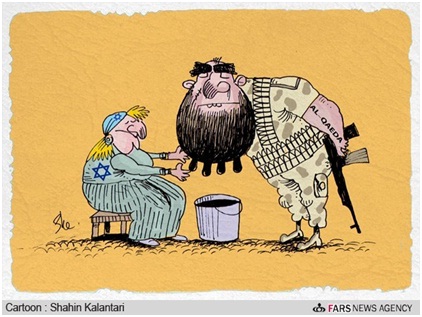
By Tony Cartalucci – New Eastern Outlook – 10.06.2017
Several were left dead and many more injured after coordinated terror attacks on Iran’s capital of Tehran. Shootings and bombings targeted Iran’s parliament and the tomb of Ayatollah Khomeini.
According to Reuters, the so-called “Islamic State” claimed responsibility for the attack, which unfolded just days after another terror attack unfolded in London. The Islamic State also reportedly took responsibility for the violence in London, despite evidence emerging that the three suspects involved were long-known to British security and intelligence agencies and were simply allowed to plot and carry out their attacks.
It is much less likely that Tehran’s government coddled terrorists -as it has been engaged for years in fighting terrorism both on its borders and in Syria amid a vicious six-year war fueled by US, European, and Persian Gulf weapons, cash, and fighters.
Armed Violence Targeting Tehran Was the Stated Goal of US Policymakers
The recent terrorist attacks in Tehran are the literal manifestation of US foreign policy. The creation of a proxy force with which to fight Iran and establishing a safe haven for it beyond Iran’s borders have been long-stated US policy. The current chaos consuming Syria and Iraq – and to a lesser extent in southeast Turkey – is a direct result of the US attempting to secure a base of operations to launch a proxy war directly against Iran.
In the 2009 Brookings Institution document titled, “Which Path to Persia? Options for a New American Strategy toward Iran,” the use of then US State Department-listed foreign terrorist organization Mujahedin-e Khalq Organization (MEK) as a proxy for instigating a full-fledged armed insurgency not unlike that which is currently unfolding in Syria was discussed in detail.
The report explicitly stated:
The United states could also attempt to promote external Iranian opposition groups, providing them with the support to turn themselves into full-fledged insurgencies and even helping them militarily defeat the forces of the clerical regime. The United states could work with groups like the Iraq-based National council of resistance of Iran (NCRI) and its military wing, the Mujahedin-e Khalq (MeK), helping the thousands of its members who, under Saddam Husayn’s regime, were armed and had conducted guerrilla and terrorist operations against the clerical regime. although the NCRI is supposedly disarmed today, that could quickly be changed.
Brookings policymakers admitted throughout the report that MEK was responsible for killing both American and Iranian military personnel, politicians, and civilians in what was clear-cut terrorism. Despite this, and admissions that MEK remained indisputably a terrorist organization, recommendations were made to de-list it from the US State Department’s Foreign Terrorist Organization registry so that more overt support could be provided to the group for armed regime change.
Based on such recommendations and intensive lobbying, the US State Department would eventually de-list MEK in 2012 and the group would receive significant backing from the US openly. This included support from many members of current US President Donald Trump’s campaign team – including Rudy Giuliani, Newt Gingrich, and John Bolton.
However, despite these efforts, MEK was not capable then or now of accomplishing the lofty goal of instigating full-fledged insurrection against Tehran, necessitating the use of other armed groups. The 2009 Brookings paper made mention of other candidates under a section titled, “Potential Ethnic Proxies,” identifying Arab and Kurdish groups as well as possible candidates for a US proxy war against Tehran.
Under a section titled, “Finding a Conduit and Safe Haven,” Brookings notes:
Of equal importance (and potential difficulty) will be finding a neighboring country willing to serve as the conduit for U.S. aid to the insurgent group, as well as to provide a safe haven where the group can train, plan, organize, heal, and resupply.
For the US proxy war on Syria, Turkey and Jordan fulfill this role. For Iran, it is clear that US efforts would have to focus on establishing conduits and safe havens from Pakistan’s southwest Balochistan province and from Kurdish-dominated regions in northern Iraq, eastern Syria, and southeastern Turkey – precisely where current upheaval is being fueled by US intervention both overtly and covertly.
Brookings noted in 2009 that:
It would be difficult to find or build an insurgency with a high likelihood of success. The existing candidates are weak and divided, and the Iranian regime is very strong relative to the potential internal and external challengers.
A group not mentioned by Brookings in 2009, but that exists in the very region the US seeks to create a conduit and safe haven for a proxy war with Iran, is the Islamic State. Despite claims that it is an independent terrorist organization propelled by black market oil sales, ransoms, and local taxes, its fighting capacity, logistical networks, and operational reach demonstrates vast state sponsorship.
The Ultimate Proxy, the Perfect Conduit and Safe Haven
The Islamic State reaching into Iran, southern Russia, and even as far as western China was not only possible, it was inevitable and the logical progression of US policy as stated by Brookings in 2009 and verifiably executed since then.
The Islamic State represents the perfect “proxy,” occupying the ideal conduit and safe haven for executing America’s proxy war against Iran and beyond. Surrounding the Islamic State’s holdings are US military bases, including those illegally constructed in eastern Syria. Were the US to wage war against Iran in the near future, it is likely these assets would all “coincidentally” coordinate against Tehran just as they are now being “coincidentally” coordinated against Damascus.
The use of terrorism, extremists, and proxies in executing US foreign policy, and the use of extremists observing the Islamic State and Al Qaeda’s brand of indoctrination was demonstrated definitively during the 1980’s when the US with the assistance of Saudi Arabia and Pakistan – used Al Qaeda to expel Soviet forces from Afghanistan. This example is in fact mentioned explicitly by Brookings policymakers as a template for creating a new proxy war – this time against Iran.
For the US, there is no better stand-in for Al Qaeda than its successor the Islamic State. US policymakers have demonstrated a desire to use known terrorist organizations to wage proxy war against targeted nation-states, has previously done so in Afghanistan, and has clearly organized the geopolitical game board on all sides of Iran to facilitate its agenda laid out in 2009. With terrorists now killing people in Tehran, it is simply verification that this agenda is advancing onward.
Iran’s involvement in the Syrian conflict illustrates that Tehran is well aware of this conspiracy and is actively defending against it both within and beyond its borders. Russia is likewise an ultimate target of the proxy war in Syria and is likewise involved in resolving it in favor of stopping it there before it goes further.
China’s small but expanding role in the conflict is linked directly to the inevitability of this instability spreading to its western Xianjiang province.
While terrorism in Europe, including the recent London attack, is held up as proof that the West is “also” being targeted by the Islamic State, evidence suggests otherwise. The attacks are more likely an exercise in producing plausible deniability.
In reality, the Islamic State – like Al Qaeda before it – depends on vast, multinational state sponsorship – state sponsorship the US, Europe, and its regional allies in the Persian Gulf are providing. It is also sponsorship they can – at anytime of their choosing – expose and end. They simply choose not to in pursuit of regional and global hegemony.
The 2009 Brookings paper is a signed and dated confession of the West’s proclivity toward using terrorism as a geopolitical tool. While Western headlines insist that nations like Iran, Russia, and China jeopardize global stability, it is clear that they themselves do so in pursuit of global hegemony.
Syrian Army, Hezbollah reaches border with Iraq for the first time in years
By Chris Tomson | Al-Masdar News | 09/06/2017
DAMASCUS – Late on Friday afternoon, the Syrian Arab Army (SAA), Hezbollah and allied Iraqi paramilitary contingents dashed through southeastern Homs and reached an Iraqi border point, thus slicing adrift the frontline between rebel forces based in the Al-Tanf region and ISIS militants in the neighboring Deir Ezzor governorate.
Unopposed by the US Airforce and its vetted Syrian proxies, the SAA and its allies drove through over 40 kilometers of abandoned desert territory and managed to link up with an Iraqi garrison across the border.
The advance was confirmed by the Russian Ministry of Defense and an Hezbollah-linked outlet moments ago.
Effectively, the SAA is now able to reopen trade between Damascus and Baghdad. Government forces have not controlled any parts of the largely ISIS-controlled border with Iraq since 2014.
In addition, Hezbollah is now able to be supplied with weapons from Tehran via an all-important land route. Previously, the Lebanese group relied on complicated airlifts for new armaments.
The US Hand in the Libyan/Syrian Tragedies
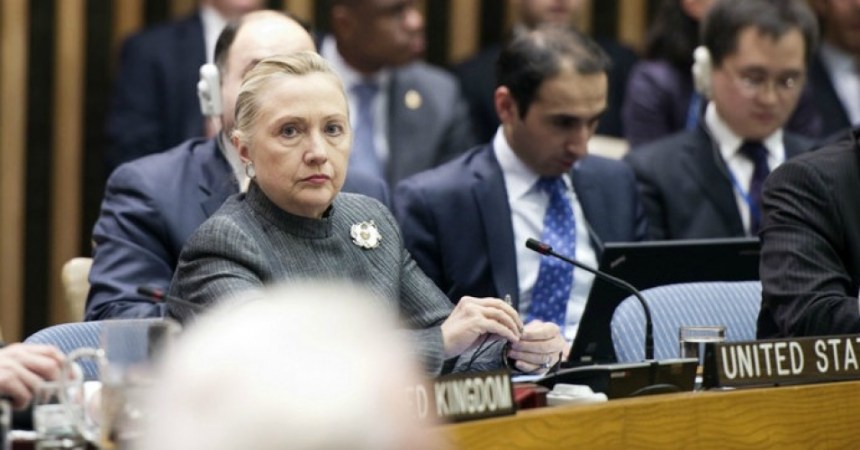
US Secretary of State Hillary Clinton delivers remarks at a UN Security Council Session on the situation in Syria at the UN in New York on Jan. 31, 2012. [State Dept. Photo]
By Jonathan Marshall | Consortium News | June 9, 2017
Police investigations and media reports have confirmed that two of the bloodiest terrorist attacks in Western Europe — the coordinated bombings and shootings in Paris in November 2015, which killed 130 people, and the May 2017 bombing of the arena in Manchester, England, which killed 23 — trace back to an Islamic State unit based in Libya known as Katibat al-Battar.
Since those attacks, a number of analysts, myself included, have characterized them as a form of “blowback” from NATO’s disastrous campaign to depose Libyan dictator Muammar Gaddafi in 2011. By turning Libya into an anarchic staging ground for radical Islamist militants, that intervention set in motion the deadly export of terror back into Western Europe.
But such a Eurocentric critique of NATO’s intervention misses the far greater damage it wreaked on Syria, where nearly half a million people have died and at least 5 million refugees have had to flee their country since 2011. U.S., British and French leaders helped trigger one of the world’s great modern catastrophes through their act of hubris in seeking another “regime change” – the overthrow of President Bashar al-Assad – in Syria.
A decade ago, Libya was a leading foe of radical jihadis, not a sanctuary for their international operations. A 2008 State Department memo noted that “Libya has been a strong partner in the war against terrorism.” It gave the Gaddafi regime credit for “aggressively pursuing operations to disrupt foreign fighter flows,” particularly by veterans of jihadist wars in Afghanistan and Iraq.
All that came to an end in 2011, when armed rebels, including disciplined members of al-Qaeda and Islamic State, enlisted NATO’s help to topple Gaddafi’s regime.
Western leaders ignored the prescient warnings of Gaddafi’s son Seif that “Libya may become the Somalia of North Africa, of the Mediterranean. . . .You will see millions of illegal immigrants. The terror will be next door.” Gaddafi himself similarly predicted that once the jihadis “control the Mediterranean . . . then they will attack Europe.”
Subsequent terrorist attacks in Europe certainly vindicated those warnings, while discrediting the so-called “humanitarian” case for waging an illegal war in Libya. But the predicted jihadi efforts to “control the Mediterranean” have had far graver repercussions, at least in the case of Syria.
A recent story in the New York Times on the genesis of recent terror attacks on France and Britain noted in passing that the Islamic State in Libya, composed of “seasoned veterans of Iraq and Afghanistan,” was “among the first foreign jihadist contingent to arrive in Syria in 2012, as the country’s popular revolt was sliding into a broader civil war and Islamist insurgency.”
A former British counter-terrorism analyst told the newspaper, “some of the baddest dudes in Al Qaeda were Libyan. When I looked at the Islamic State, the same thing was happening. They were the most hard-core, the most violent — the ones always willing to go to extremes when others were not. The Libyans represented the elite troops, and clearly ISIS capitalized on this.”
These Libyan jihadists leveraged their numbers, resources, and fanaticism to help escalate Syria’s conflict into the tragedy we know today. The mass murder we now take for granted was not inevitable.
Extremist Violence in Syria
Although Syria’s anti-government protests in the spring of 2011 turned violent almost from the start, many reformers and government officials strove to prevent an all-out civil war. In August 2011, leaders of Syria’s opposition wisely declared that calls to arms were “unacceptable politically, nationally, and ethically. Militarizing the revolution would . . . undermine the gravity of the humanitarian catastrophe involved in a confrontation with the regime. Militarization would put the revolution in an arena where the regime has a distinct advantage and would erode the moral superiority that has characterized the revolution since its beginning.”
Largely forgotten today, the Assad regime also took serious steps to deescalate the violence, including lifting the country’s state of emergency, disbanding the unpopular National Security Court, appointing a new government, and hosting a national dialogue with protest leaders.
But on August 18, 2011, the same Western leaders who were bombing Gaddafi announced to the world that “the time has come for President Assad to step aside.” Further energizing Syrian militants, Libyan rebels were just then in the midst of conquering Tripoli with NATO’s help.
“That is an ominous sign for Syria’s President Bashar al-Assad,” reported the Wall Street Journal. “Already there are signs Libya is giving inspiration to the rebels trying to oust Mr. Assad. . . . Syrian protesters took to the streets chanting ‘Gadhafi tonight, Bashar tomorrow.’ . . . The Libyan episode may serve simply to sharpen the conflict in Syria: both spurring on the dissidents and strengthening Mr. Assad’s resolve to hold on.”
Stoking war in Syria was not an unintended consequence of the Libyan campaign, but a conscious part of the longstanding neoconservative ambition to “remake the map of the Middle East” by toppling radical, nationalist and anti-American regimes. The same Journal article described the grandiose aims of some Washington interventionists:
“Beyond Syria, a new dose of energy provided by Libya’s uprising could ripple out to other nations in the region. In particular, U.S. officials hope it will reinvigorate a protest movement that arose inside Iran in 2009 to challenge President Mahmoud Ahmadinejad’s re-election. . . Syria has served for 30 years as Iran’s closest strategic ally in the region. U.S. officials believe the growing challenge to Mr. Assad’s regime could motivate Iran’s democratic forces.”
Instead of motivating Iran’s democrats, of course, the Syrian conflict motivated Iran’s hardliners to send Revolutionary Guard units and Hezbollah proxy forces into the country, further destabilizing the region.
Following the gruesome murder of Gaddafi in the fall of 2011, Libyan zealots quickly began fueling other terrorist conflicts, ranging from Mali to the Middle East, with arms looted from Gaddafi’s vast stocks.
“The weapons proliferation that we saw coming out of the Libyan conflict was of a scale greater than any previous conflict — probably 10 times more weapons than we saw going on the loose in places like Iraq, Somalia and Afghanistan,” observed an expert at Human Rights Watch.
A United Nations investigation determined that “Transfers of arms and ammunition from Libya were among the first batches of weapons and ammunition to reach the Syrian opposition.” It also stressed that Libyan weapons were arming primarily “extremist elements,” allowing them to gain territory and influence at the expense of more moderate rebel groups.
Spreading the War
As early as November 2011, Islamist warlords in Libya began offering “money and weapons to the growing insurgency against Bashar al-Assad,” according to the Daily Telegraph. Abdulhakim Belhadj, commander of the Tripoli Military Council and the former leader of the Libyan Islamic Fighting Group, an al-Qaeda affiliate, met secretly with Syrian rebel leaders in Turkey to discuss training their troops. (In 2004, he had been the victim of a CIA kidnap plot and rendition from Malaysia to Libya.)
The commander of one armed Libyan gang told the newspaper, “Everyone wants to go (to Syria). We have liberated our country, now we should help others. . . This is Arab unity.”
In April 2012, Lebanese authorities confiscated a ship carrying more than 150 tons of arms and ammunition originating in Misrata, Libya. A U.N.-authorized panel inspected the weapons and reported finding SA-24 and SA-7 surface-to-air missiles, anti-tank guided missiles, and a variety of other light and heavy weapons.
By that August, according to Time magazine, “hundreds of Libyans” had flocked to Syria to “export their revolution,” bringing with them weapons, expertise in making bombs, and experience in battlefield tactics.
“Within weeks of the successful conclusion of their revolution, Libyan fighters began trickling into Syria,” the magazine noted. “But in recent months, that trickle has allegedly become a torrent, as many more have traveled to the mountains straddling Syria and Turkey, where the rebels have established their bases.”
A Syrian rebel told the newsweekly, “They have heavier weapons than we do,” including surface-to-air missiles. “They brought these weapons to Syria, and they are being used on the front lines.”
A month later, the London Times reported that a Libyan ship carrying more than 400 tons of weapons bound for Syria, including SAM-7 anti-aircraft missiles and rocket-propelled grenades, had docked in Turkey. Such weapons particularly compounded the suffering of civilians caught up in the war. As France’s foreign minister told reporters that October, rebel-held anti-aircraft missiles were “forcing (Syrian government) planes to fly extremely high, and so the strikes are less accurate.”
According to later reporting by Seymour Hersh, most such Libyan weapons made their way to Syria via covert routes supervised by the CIA, under a program authorized by the Obama administration in early 2012. Funding and logistics support came from Turkey, Saudi Arabia, and Qatar. The CIA supposedly avoided disclosing the program to Congress by classifying it as a liaison operation with a foreign intelligence partner, Britain’s MI6.
Word of the operation began leaking to the London media by December 2012. The CIA was said to be sending in more advisers to help ensure that the Libyan weapons did not reach radical Islamist forces.
Of course, their efforts came too late; U.S. intelligence officials knew by that time that “the Salafist(s), the Muslim Brotherhood, and (al-Qaeda)” were “the major forces driving the insurgency.” The influx of new arms simply compounded Syria’s suffering and raised its profile as a dangerous arena of international power competition.
Libya’s arms and fighters helped transform the Syrian conflict from a nasty struggle into a bloodbath. As Middle East scholar Omar Dahi noted, “the year 2012 was decisive in creating the present catastrophe. There were foreign elements embroiled in Syria before that date . . . but until early 2012 the dynamics of the Syrian conflict were largely internal. . . . Partly in . . . appropriation of weapons pumped in from the outside and partly in anticipation of still greater military assistance, namely from the West, the opposition decided to take up arms.
“The decision — militarization — had three main effects. First, it dramatically increased the rate of death and destruction throughout the country. . . . By mid-2012, the monthly casualties were almost in excess of the total in the entire first year of the uprising. Militarization gave the Syrian regime a free hand to unleash its full arsenal of indiscriminate weaponry. . . Perhaps most fatefully, the advent of armed rebellion placed much of the opposition’s chances in the hands of those who would fund and arm the fighters. . . . It was then that the jihadi groups were unleashed.”
The collateral victims of NATO’s intervention in Libya now include 6 million Libyans attempting to survive in a failed state, millions of people across North Africa afflicted by Islamist terrorism, 20 million Syrians yearning for an end to war, and millions of innocent Europeans who wonder when they might become targets of suicidal terrorists. There is nothing “humanitarian” about wars that unleash such killing and chaos, with no end in sight.
Syrian Arab Army takes control of Jordanian border
By Adam Garrie | The Duran | June 9, 2017
Fierce fighting with ISIS and US backed jihadists in southern Syria has been ongoing for months. In June, two convoys of Syrian and allied soldiers came under fire from US forces illegally operating in the desert areas of southern Syria near the borders with Iraq and Jordan.
Today, the Russian General Staff announced that Syrian forces are now in full control of 105 kilometres of the border with Jordan. Jordan which for decades has been hostile to Syria has been an important passage for terrorists and illegal armed forces entering Syria.
The Russian General Staff who work closely with the Syrian Arab Army as part of the anti-terrorist coalition in the country issued the following statement as offered by Russian Col. Gen. Sergei Surovikin,
“As part of the advance of the Syrian army and militia on Daesh’s (ISIS) positions, the control over 105 kilometres of the Syrian-Jordanian border has been restored
The efforts of the government forces on establishing full control over the Syrian-Jordanian border and the border with Iraq continue”.
This not only will help seal off areas where militants can enter Syria but crucially it will send a clear message to the Jordanian armed forces that their presence will not be allowed nor tolerated in Syria.
Featured Video

Weaponized Journalism: 2021 Sayer Ji Interview with NPR
or go to
Aletho News Archives – Video-Images
From the Archives
How Rothschild Banking Clan Uses Its Vast Wealth to Influence World Events and Control Governments

By Ilya Tsukanov – Sputnik – 15.09.2024
How powerful is the Rothschild banking family? How did they amass their fortune? Just how rich are they? Do they secretly control the world? Sputnik explores. … continue
Blog Roll
 Aletho News
- Dockworkers launch global strike against Israeli and US military shipments
- Europe facing gas price shock – Gazprom chief
- Ukraine continues recruiting people with disabilities
- Weaponized Journalism: 2021 Sayer Ji Interview with NPR
- Beyond Netanyahu: what Israel’s election means for Palestinians
- Lithuania plans universal conscription
- Lies, Damn Lies, and Ukraine News
- Financial Times rejects Nordic demands to correct Putin call story – media
- The Case for Less Unity in Europe
- Ukraine expands minority rights under EU pressure – but Russians remain excluded
- If Americans Knew
- An error has occurred; the feed is probably down. Try again later.
- No Tricks Zone
- Germany’s Green Energy Transition Becoming Increasingly Expensive…Another 6 Trillion Euros!
- Sudden Stratospheric Warming, Powerful El Niño Combination May Lead To Extreme Europe Cold, Energy Crisis!
- Two New Studies Find Thwaites Glacier Melt Cannot Be Driven By Human Activity Or A Warming Ocean
- E-Cars Reduce CO2 Emissions By Only 41% Compared To Internal Combustion Engine Vehicles
- Predictions Made By Renowned Climate Professor Over Past Decades Have Been Proven To Be Poor
- New Study Suggests Large Regions Of The Pacific Ocean Have Been Cooling For The Last 80 Years
- Germany’s Green Energy Debacle: High Energy Costs Force Kahla Porzellan to Close After 182 Years!
- New Study: 50 Years Of The Most Aggressive ‘Net Zero’ Policies Can Only Affect The Global Climate By 0.03°C
- US September “Heat” Was No Record…Many Records Set Decades Ago
- Latest European Green Energy Debacle; Portugal’s Largest Flagship Solar Park Insolvent!

