The US Hand in the Libyan/Syrian Tragedies
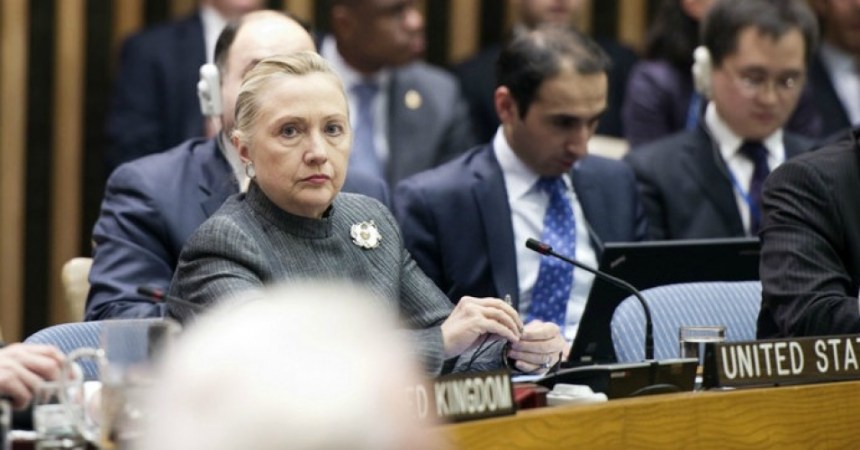
US Secretary of State Hillary Clinton delivers remarks at a UN Security Council Session on the situation in Syria at the UN in New York on Jan. 31, 2012. [State Dept. Photo]
By Jonathan Marshall | Consortium News | June 9, 2017
Police investigations and media reports have confirmed that two of the bloodiest terrorist attacks in Western Europe — the coordinated bombings and shootings in Paris in November 2015, which killed 130 people, and the May 2017 bombing of the arena in Manchester, England, which killed 23 — trace back to an Islamic State unit based in Libya known as Katibat al-Battar.
Since those attacks, a number of analysts, myself included, have characterized them as a form of “blowback” from NATO’s disastrous campaign to depose Libyan dictator Muammar Gaddafi in 2011. By turning Libya into an anarchic staging ground for radical Islamist militants, that intervention set in motion the deadly export of terror back into Western Europe.
But such a Eurocentric critique of NATO’s intervention misses the far greater damage it wreaked on Syria, where nearly half a million people have died and at least 5 million refugees have had to flee their country since 2011. U.S., British and French leaders helped trigger one of the world’s great modern catastrophes through their act of hubris in seeking another “regime change” – the overthrow of President Bashar al-Assad – in Syria.
A decade ago, Libya was a leading foe of radical jihadis, not a sanctuary for their international operations. A 2008 State Department memo noted that “Libya has been a strong partner in the war against terrorism.” It gave the Gaddafi regime credit for “aggressively pursuing operations to disrupt foreign fighter flows,” particularly by veterans of jihadist wars in Afghanistan and Iraq.
All that came to an end in 2011, when armed rebels, including disciplined members of al-Qaeda and Islamic State, enlisted NATO’s help to topple Gaddafi’s regime.
Western leaders ignored the prescient warnings of Gaddafi’s son Seif that “Libya may become the Somalia of North Africa, of the Mediterranean. . . .You will see millions of illegal immigrants. The terror will be next door.” Gaddafi himself similarly predicted that once the jihadis “control the Mediterranean . . . then they will attack Europe.”
Subsequent terrorist attacks in Europe certainly vindicated those warnings, while discrediting the so-called “humanitarian” case for waging an illegal war in Libya. But the predicted jihadi efforts to “control the Mediterranean” have had far graver repercussions, at least in the case of Syria.
A recent story in the New York Times on the genesis of recent terror attacks on France and Britain noted in passing that the Islamic State in Libya, composed of “seasoned veterans of Iraq and Afghanistan,” was “among the first foreign jihadist contingent to arrive in Syria in 2012, as the country’s popular revolt was sliding into a broader civil war and Islamist insurgency.”
A former British counter-terrorism analyst told the newspaper, “some of the baddest dudes in Al Qaeda were Libyan. When I looked at the Islamic State, the same thing was happening. They were the most hard-core, the most violent — the ones always willing to go to extremes when others were not. The Libyans represented the elite troops, and clearly ISIS capitalized on this.”
These Libyan jihadists leveraged their numbers, resources, and fanaticism to help escalate Syria’s conflict into the tragedy we know today. The mass murder we now take for granted was not inevitable.
Extremist Violence in Syria
Although Syria’s anti-government protests in the spring of 2011 turned violent almost from the start, many reformers and government officials strove to prevent an all-out civil war. In August 2011, leaders of Syria’s opposition wisely declared that calls to arms were “unacceptable politically, nationally, and ethically. Militarizing the revolution would . . . undermine the gravity of the humanitarian catastrophe involved in a confrontation with the regime. Militarization would put the revolution in an arena where the regime has a distinct advantage and would erode the moral superiority that has characterized the revolution since its beginning.”
Largely forgotten today, the Assad regime also took serious steps to deescalate the violence, including lifting the country’s state of emergency, disbanding the unpopular National Security Court, appointing a new government, and hosting a national dialogue with protest leaders.
But on August 18, 2011, the same Western leaders who were bombing Gaddafi announced to the world that “the time has come for President Assad to step aside.” Further energizing Syrian militants, Libyan rebels were just then in the midst of conquering Tripoli with NATO’s help.
“That is an ominous sign for Syria’s President Bashar al-Assad,” reported the Wall Street Journal. “Already there are signs Libya is giving inspiration to the rebels trying to oust Mr. Assad. . . . Syrian protesters took to the streets chanting ‘Gadhafi tonight, Bashar tomorrow.’ . . . The Libyan episode may serve simply to sharpen the conflict in Syria: both spurring on the dissidents and strengthening Mr. Assad’s resolve to hold on.”
Stoking war in Syria was not an unintended consequence of the Libyan campaign, but a conscious part of the longstanding neoconservative ambition to “remake the map of the Middle East” by toppling radical, nationalist and anti-American regimes. The same Journal article described the grandiose aims of some Washington interventionists:
“Beyond Syria, a new dose of energy provided by Libya’s uprising could ripple out to other nations in the region. In particular, U.S. officials hope it will reinvigorate a protest movement that arose inside Iran in 2009 to challenge President Mahmoud Ahmadinejad’s re-election. . . Syria has served for 30 years as Iran’s closest strategic ally in the region. U.S. officials believe the growing challenge to Mr. Assad’s regime could motivate Iran’s democratic forces.”
Instead of motivating Iran’s democrats, of course, the Syrian conflict motivated Iran’s hardliners to send Revolutionary Guard units and Hezbollah proxy forces into the country, further destabilizing the region.
Following the gruesome murder of Gaddafi in the fall of 2011, Libyan zealots quickly began fueling other terrorist conflicts, ranging from Mali to the Middle East, with arms looted from Gaddafi’s vast stocks.
“The weapons proliferation that we saw coming out of the Libyan conflict was of a scale greater than any previous conflict — probably 10 times more weapons than we saw going on the loose in places like Iraq, Somalia and Afghanistan,” observed an expert at Human Rights Watch.
A United Nations investigation determined that “Transfers of arms and ammunition from Libya were among the first batches of weapons and ammunition to reach the Syrian opposition.” It also stressed that Libyan weapons were arming primarily “extremist elements,” allowing them to gain territory and influence at the expense of more moderate rebel groups.
Spreading the War
As early as November 2011, Islamist warlords in Libya began offering “money and weapons to the growing insurgency against Bashar al-Assad,” according to the Daily Telegraph. Abdulhakim Belhadj, commander of the Tripoli Military Council and the former leader of the Libyan Islamic Fighting Group, an al-Qaeda affiliate, met secretly with Syrian rebel leaders in Turkey to discuss training their troops. (In 2004, he had been the victim of a CIA kidnap plot and rendition from Malaysia to Libya.)
The commander of one armed Libyan gang told the newspaper, “Everyone wants to go (to Syria). We have liberated our country, now we should help others. . . This is Arab unity.”
In April 2012, Lebanese authorities confiscated a ship carrying more than 150 tons of arms and ammunition originating in Misrata, Libya. A U.N.-authorized panel inspected the weapons and reported finding SA-24 and SA-7 surface-to-air missiles, anti-tank guided missiles, and a variety of other light and heavy weapons.
By that August, according to Time magazine, “hundreds of Libyans” had flocked to Syria to “export their revolution,” bringing with them weapons, expertise in making bombs, and experience in battlefield tactics.
“Within weeks of the successful conclusion of their revolution, Libyan fighters began trickling into Syria,” the magazine noted. “But in recent months, that trickle has allegedly become a torrent, as many more have traveled to the mountains straddling Syria and Turkey, where the rebels have established their bases.”
A Syrian rebel told the newsweekly, “They have heavier weapons than we do,” including surface-to-air missiles. “They brought these weapons to Syria, and they are being used on the front lines.”
A month later, the London Times reported that a Libyan ship carrying more than 400 tons of weapons bound for Syria, including SAM-7 anti-aircraft missiles and rocket-propelled grenades, had docked in Turkey. Such weapons particularly compounded the suffering of civilians caught up in the war. As France’s foreign minister told reporters that October, rebel-held anti-aircraft missiles were “forcing (Syrian government) planes to fly extremely high, and so the strikes are less accurate.”
According to later reporting by Seymour Hersh, most such Libyan weapons made their way to Syria via covert routes supervised by the CIA, under a program authorized by the Obama administration in early 2012. Funding and logistics support came from Turkey, Saudi Arabia, and Qatar. The CIA supposedly avoided disclosing the program to Congress by classifying it as a liaison operation with a foreign intelligence partner, Britain’s MI6.
Word of the operation began leaking to the London media by December 2012. The CIA was said to be sending in more advisers to help ensure that the Libyan weapons did not reach radical Islamist forces.
Of course, their efforts came too late; U.S. intelligence officials knew by that time that “the Salafist(s), the Muslim Brotherhood, and (al-Qaeda)” were “the major forces driving the insurgency.” The influx of new arms simply compounded Syria’s suffering and raised its profile as a dangerous arena of international power competition.
Libya’s arms and fighters helped transform the Syrian conflict from a nasty struggle into a bloodbath. As Middle East scholar Omar Dahi noted, “the year 2012 was decisive in creating the present catastrophe. There were foreign elements embroiled in Syria before that date . . . but until early 2012 the dynamics of the Syrian conflict were largely internal. . . . Partly in . . . appropriation of weapons pumped in from the outside and partly in anticipation of still greater military assistance, namely from the West, the opposition decided to take up arms.
“The decision — militarization — had three main effects. First, it dramatically increased the rate of death and destruction throughout the country. . . . By mid-2012, the monthly casualties were almost in excess of the total in the entire first year of the uprising. Militarization gave the Syrian regime a free hand to unleash its full arsenal of indiscriminate weaponry. . . Perhaps most fatefully, the advent of armed rebellion placed much of the opposition’s chances in the hands of those who would fund and arm the fighters. . . . It was then that the jihadi groups were unleashed.”
The collateral victims of NATO’s intervention in Libya now include 6 million Libyans attempting to survive in a failed state, millions of people across North Africa afflicted by Islamist terrorism, 20 million Syrians yearning for an end to war, and millions of innocent Europeans who wonder when they might become targets of suicidal terrorists. There is nothing “humanitarian” about wars that unleash such killing and chaos, with no end in sight.
Syrian Arab Army takes control of Jordanian border
By Adam Garrie | The Duran | June 9, 2017
Fierce fighting with ISIS and US backed jihadists in southern Syria has been ongoing for months. In June, two convoys of Syrian and allied soldiers came under fire from US forces illegally operating in the desert areas of southern Syria near the borders with Iraq and Jordan.
Today, the Russian General Staff announced that Syrian forces are now in full control of 105 kilometres of the border with Jordan. Jordan which for decades has been hostile to Syria has been an important passage for terrorists and illegal armed forces entering Syria.
The Russian General Staff who work closely with the Syrian Arab Army as part of the anti-terrorist coalition in the country issued the following statement as offered by Russian Col. Gen. Sergei Surovikin,
“As part of the advance of the Syrian army and militia on Daesh’s (ISIS) positions, the control over 105 kilometres of the Syrian-Jordanian border has been restored
The efforts of the government forces on establishing full control over the Syrian-Jordanian border and the border with Iraq continue”.
This not only will help seal off areas where militants can enter Syria but crucially it will send a clear message to the Jordanian armed forces that their presence will not be allowed nor tolerated in Syria.
NYT’s New Syria-Sarin Report Challenged
MIT national security technical expert Theodore Postol
By Robert Parry | Consortium News | June 7, 2017
For U.S. mainstream journalists and government analysts, their erroneous “groupthinks” often have a shady accomplice called “confirmation bias,” that is, the expectation that some “enemy” must be guilty and thus the tendency to twist any fact in that direction.
We have seen this pair contribute to fallacious reasoning more and more in recent years as the mainstream U.S. media and the U.S. government approach international conflicts as if the “pro-U.S. side” is surely innocent and the “anti-U.S. side” is presumed guilty.
That was the case in assessing whether Iraq was hiding WMD in 2002-2003; it was repeated regarding alleged chemical weapons attacks in Syria during that six-year conflict; and it surfaces as well in the New Cold War in which Russia is always the villain.
The trend also requires insulting any Western journalist or analyst who deviates from the groupthinks or questions the confirmation bias. The dissidents are called “stooges”; “apologists”; “conspiracy theorists”; or “purveyors of fake news.” It doesn’t really matter how reasonable the doubts are. The mocking insults carry the day.
In addition, there is almost no accountability in those rare cases when the mainstream media and government propagandists must admit that they were demonstrably wrong. For every Iraq WMD confession – which resulted in almost no punishments for the “groupthinkers” – there are dozens of cases when the Big Boys just hunker down, admit nothing and count on their privileged status to protect them.
It doesn’t even seem to matter how well-credentialed the skeptic is or how obvious the failings of the mainstream analysis is. So, you even have weapons experts, such as Theodore Postol, professor of science, technology and national security policy at the Massachusetts Institute of Technology, who are ignored when their judgments conflict with the conventional wisdom.
The Syrian Case
For instance, in a little-noticed May 29, 2017 report on the April 4, 2017 chemical weapons incident at Khan Sheikhoun in northern Syria, Postol takes apart the blame-the-Syrian-government conclusions of The New York Times, Human Rights Watch and the Establishment’s favorite Internet site, Bellingcat.
Postol’s analysis focused on a New York Times video report, entitled “How Syria And Russia Spun A Chemical Strike,” which followed Bellingcat research that was derived from social media. Postol concluded that “NONE of the forensic evidence in the New York Times video and a follow-on Times news article supports the conclusions reported by the New York Times.” [Emphasis in original.]
The basic weakness of the NYT/Bellingcat analysis was a reliance on social media from the Al Qaeda-controlled area of Idlib province and thus a dependence on “evidence” from the jihadists and their “civil defense” collaborators, known as the White Helmets.
The jihadists and their media teams have become very sophisticated in the production of propaganda videos that are distributed through social media and credulously picked up by major Western news outlets. (A Netflix infomercial for the White Helmets even won an Academy Award earlier this year.)
Postol zeroes in on the Times report’s use of a video taken by anti-government photographer Mohamad Salom Alabd, purporting to show three conventional bombs striking Khan Sheikhoun early in the morning of April 4.
The Times report extrapolated from that video where the bombs would have struck and then accepted that a fourth bomb – not seen in the video – delivered a sarin canister that struck a road and released sarin gas that blew westward into a heavily populated area supposedly killing dozens.
The incident led President Trump, on April 6, to order a major retaliatory strike with 59 Tomahawk missiles hitting a Syrian government airfield and, according to Syrian media reports, killing several soldiers at the base and nine civilians, including four children, in nearby neighborhoods. It also risked inflicting death on Russians stationed at the base.
A Wind Problem
But the Times video analysis – uploaded on April 26 – contained serious forensic problems, Postol said, including showing the wind carrying the smoke from the three bombs in an easterly direction whereas the weather reports from that day – and the presumed direction of the sarin gas – had the wind going to the west.
Indeed, if the wind were blowing toward the east – and if the alleged location of the sarin release was correct – the wind would have carried the sarin away from the nearby populated area and likely would have caused few if any casualties, Postol wrote.
Postol also pointed out that the Times’ location of the three bombing strikes didn’t match up with the supposed damage that the Times claimed to have detected from satellite photos of where the bombs purportedly struck. Rather than buildings being leveled by powerful bombs, the photos showed little or no apparent damage.
The Times also relied on before-and-after satellite photos that had a gap of 44 days, from Feb. 21, 2017, to April 6, 2017, so whatever damage might have occurred couldn’t be tied to whatever might have happened on April 4.
Nor could the hole in the road where the crushed “sarin” canister was found be attributed to an April 4 bombing raid. Al Qaeda jihadists could have excavated the hole the night before as part of a staged provocation. Other images of activists climbing into the supposedly sarin-saturated hole with minimal protective gear should have raised other doubts, Postol noted in earlier reports.
There’s also the question of motive. The April 4 incident immediately followed the Trump administration’s announcement that it was no longer seeking “regime change” in Syria, giving the jihadists and their regional allies a motive to create a chemical-weapons incident to reverse the new U.S. stand. By contrast, the Syrian government seemed to have no logical motive to provoke U.S. outrage.
In other words, Al Qaeda and its propagandists could have posted video from an earlier bombing raid and used it to provide “proof” of an early-morning airstrike that corresponded to the staged release of sarin or some similar poison gas on April 4. Though that is just one possible alternative, it’s certainly true that Al Qaeda does not show very much humanitarian concern about the lives of civilians.
Critics of the White Helmets have identified the photographer of the airstrike, Mohamad Salom Alabd, as a jihadist who appears to have claimed responsibility for killing a Syrian military officer. But the Times described him in a companion article to the video report only as “a journalist or activist who lived in the town.”
Mocking the Russian/Syrian Account
For their part, the Syrian government and the Russians said Syrian planes conducted no airstrike early in the morning but did attack the area around noon. They speculated that the noontime attack may have struck chemical weapons stored by the jihadists, causing an accidental release of poisonous gas.
The Times jumped on the discrepancy between the reports of an early-morning attack and the Syrian-Russian account of a noontime strike to show that the Syrians and Russians were lying.
In response to Syrian President Bashar al-Assad asking, “How can you verify the video?” the Times narration by Malachy Browne smugly says: “Well, here’s how. Let’s take a look at videos, satellite photos and open source material of that day. They show that Assad and Russia are telling a story that contradicts the facts.”
Yet, the Times’ point about the Syrians and Russians lying about the time element makes little sense because the Syrians and Russians aren’t denying that an airstrike occurred. They acknowledged that there was an airstrike, albeit later in the day, and they speculate that the attack might have accidentally released chemicals stored by Al Qaeda’s Nusra Front. In other words, they gained no advantage by putting the time at noon instead of early in the morning.
There could have been honest confusion on the part of the Syrians and Russians as they struggled to understand what had occurred and how – or the noontime airstrike and the morning chemical release could have been unrelated, i.e., the jihadists and/or their foreign allies could have staged the early-morning poison-gas “attack” and the Syrian bombing raid could have followed several hours later but could have been unrelated to the poison-gas release.
However, for the Times and others to pounce on a seemingly meaningless time discrepancy, further shows how “confirmation bias” works. The “enemy” must be shown to be guilty, so any comment – no matter how innocent or irrelevant – can be cited to “prove” a point.
Double Standard on Trust
The Times also has displayed a bizarre bias when Syrians speak from government-controlled areas. Then, the Times always inserts language suggesting that the interviewees may be under coercion. Yet the Times assumes that “witnesses” inside Al Qaeda-controlled territory are commenting honestly, freely and without fear of contradicting the jihadists.
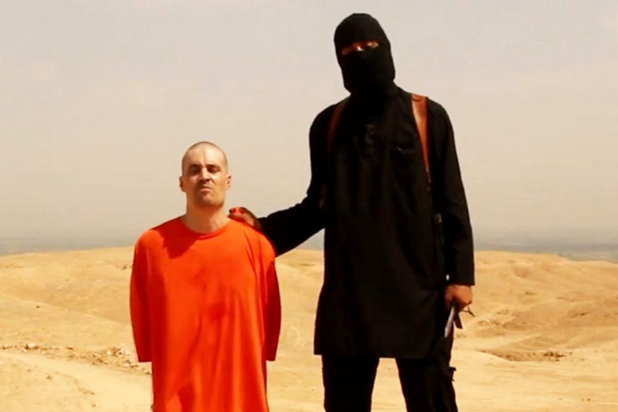
Journalist James Foley executed by ISIS
The Times’ double standard is particularly curious because United Nations investigators don’t even dare enter these jihadist zones because the jihadists have a history of beheading journalists and other civilians who get in the way.
An example of this bias was on display in Wednesday’s Times in an article about the family of Omran, the boy made famous by a photo of him in an ambulance. The article discussed the family’s ordeal and mentioned the father’s vocal support for the Assad government.
However, because the family backed Assad, the Times inserted this caveat: “Syrians appearing on state television or on channels associated with the Assad government are not able to speak freely. The government exerts tight control over all information broadcast about the war, including interviews with civilians, who can be coerced and threatened with arrest if they criticize the government.”
Yet, the Times treats interviews with people inside jihadist-controlled territory as inherently truthful with the interview subjects described in favorable or neutral terms, such as “rescue workers,” “journalists,” “eyewitnesses” or sometimes “activists.” There is rarely any suggestion that Al Qaeda might either be controlling these messages or intimidating the interviewees, who are usually denouncing Assad, what the Times and other mainstream news outlets want to hear.
False-Flag Evidence
This gullibility has continued despite evidence that the jihadists do generate sophisticated propaganda to promote their cause, including staging “false-flag” chemical weapons attacks. For instance, U.N. investigators who examined one alleged chlorine-gas attack by the Syrian government against Al-Tamanah on the night of April 29-30, 2014, heard multiple testimonies from townspeople that the event had been staged by rebels and played up by activists on social media.
“Seven witnesses stated that frequent alerts [about an imminent chlorine weapons attack by the government] had been issued, but in fact no incidents with chemicals took place,” the U.N. report stated. “While people sought safety after the warnings, their homes were looted and rumours spread that the events were being staged. … [T]hey [these witnesses] had come forward to contest the wide-spread false media reports.”
Accounts from other people, who did allege that there had been a government chemical attack on Al-Tamanah, provided suspect evidence, including data from questionable sources, according to the U.N. report.
The report said, “Three witnesses, who did not give any description of the incident on 29-30 April 2014, provided material of unknown source. One witness had second-hand knowledge of two of the five incidents in Al-Tamanah, but did not remember the exact dates. Later that witness provided a USB-stick with information of unknown origin, which was saved in separate folders according to the dates of all the five incidents mentioned by the FFM [the U.N.’s Fact-Finding Mission].
“Another witness provided the dates of all five incidents reading it from a piece of paper, but did not provide any testimony on the incident on 29-30 April 2014. The latter also provided a video titled ‘site where second barrel containing toxic chlorine gas was dropped tamanaa 30 April 14’”
Some other “witnesses” alleging a Syrian government attack offered curious claims about detecting the chlorine-infused “barrel bombs” based on how the device sounded in its descent.
The U.N. report said, “The eyewitness, who stated to have been on the roof, said to have heard a helicopter and the ‘very loud’ sound of a falling barrel. Some interviewees had referred to a distinct whistling sound of barrels that contain chlorine as they fall. The witness statement could not be corroborated with any further information.”
The U.N. report might have added that there was no plausible explanation for someone detecting a chlorine canister in a “barrel bomb” based on its “distinct whistling sound.” The only logical conclusion is that the chlorine attack had been staged by the jihadists, and their supporters then lied to the U.N. team to enrage the world public against the Assad regime.
Another Dubious Case
In 2013, the work of Postol and his late partner, Richard M. Lloyd, an analyst at the military contractor Tesla Laboratories, debunked claims from the same trio — Bellingcat, the Times and Human Rights Watch — blaming the Syrian government for the even more notorious sarin-gas attack outside Damascus on Aug. 21, 2013, which killed hundreds.
Postol and Lloyd showed that the rocket carrying the sarin had only a fraction of the range that the trio had assumed in tracing its path back to a government base.
Since the much shorter range placed the likely launch point inside rebel-controlled territory, the incident appeared to have been another false-flag provocation, one that almost led President Obama to launch a major retaliatory strike against the Syrian military.
Although the Times grudgingly acknowledged the scientific problems with its analysis, it continued to blame the 2013 incident on the Syrian government. Similarly, Official Washington’s “groupthink” still holds that the Syrian government launched that sarin attack and that Obama chickened out on enforcing his “red line” against chemical weapons use.
Obama’s announcement of that “red line,” in effect, created a powerful incentive for Al Qaeda and other jihadists to stage chemical attacks assuming that they would be blamed on the government and thus draw in the U.S. military on the jihadist side. If Obama’s expected “retaliation” had devastated the Syrian military in 2013, Al Qaeda or its spinoff Islamic State might well have taken Damascus.
Yet, the 2013 “groupthink” of Syrian government guilt survives. After the April 4, 2017 incident, President Trump took some pleasure in mocking Obama’s weakness in contrast to his supposed toughness in quickly launching a “retaliatory” strike on April 6 (Washington time, although April 7 in Syria).
White House Claims
Trump’s attack came even before the White House released a supportive – though unconvincing – intelligence report on April 11. Regarding that report, Postol wrote, “The White House produced a false intelligence report on April 11, 2017 in order to justify an attack on the Syrian airbase at Sheyrat, Syria on April 7, 2017. That attack risked an unintended collision with Russia and a possible breakdown in cooperation between Russia and United States in the war to defeat the Islamic State. The collision also had some potential to escalate into a military conflict with Russia of greater extent and consequence.
“The New York Times and other mainstream media immediately and without proper review of the evidence adopted the false narrative produced by the White House even though that narrative was totally unjustified based on the forensic evidence. The New York Times used an organization, Bellingcat, for its source of analysis even though Bellingcat has a long history of making false claims based on distorted assertions about forensic evidence that either does not exist, or is absolutely without any evidence of valid sources.”
Postol continued, “This history of New York Times publishing of inaccurate information and then sticking by it when solid science-based forensic evidence disproves the original narrative cannot be explained in terms of simple error. The facts overwhelmingly point to a New York Times management that is unconcerned about the accuracy of its reporting.
“The problems exposed in this particular review of a New York Times analysis of critically important events related to the US national security is not unique to this particular story. This author could easily point to other serious errors in New York Times reporting on important technical issues associated with our national security.
“In these cases, like in this case, the New York Times management has not only allowed the reporting of false information without reviewing the facts for accuracy, but it has repeatedly continued to report the same wrong information in follow-on articles. It may be inappropriate to call this ‘fake news,’ but this loaded term comes perilously close to actually describing what is happening.”
No Admissions
When I interviewed Postol on Wednesday, he said he had received no responses from either the Times or Bellingcat, adding: “It seems to me that the analysts were ignorant beyond plausibility or they rigged the analysis. … To me, this is malpractice on a large scale.”
Referring to some of the photographed scenes in Khan Sheikhoun, including a dead goat that appeared to have been dragged into location near the “sarin crater,” Postol called the operation “a rather amateurish attempt to create a false narrative.”
But the problem of the Times and Bellingcat presenting dubious – or in Postol’s view, “fraudulent” – information about sensitive geopolitical and national security issues has another potentially even darker side. These two entities are part of Google’s First Draft Coalition of news organizations that are expected to serve as gatekeepers separating “truth” from “fake news.”
The emerging idea is to take their judgments and enter them into algorithms to scrub the Internet of information that doesn’t comport with what the Times, Bellingcat and other approved news outlets deem true.
That these two organizations would operate with a pattern of “confirmation bias” on sensitive war-and-peace issues is thus doubly troubling in that their future “groupthinks” could not only mislead their readers but could ensure that contrary evidence is whisked away from everyone else, too.
Investigative reporter Robert Parry broke many of the Iran-Contra stories for The Associated Press and Newsweek in the 1980s.
A confrontation is looming on the Iraq-Syria border
By Mehan Abedin | MEMO | June 6, 2017
Reports that the Syrian Democratic Forces (SDF) have warned Iraqi Shia militias not to enter SDF-controlled territory are, on the face of it, a potential addition to the complexity of the conflict in Syria. The SDF is dominated overwhelmingly by the People’s Protection Units (YPG), a Syrian Kurdish militia which is politically and ideologically aligned to the Kurdistan Workers’ Party (PKK). The YPG is the key US ally in Syria and the spearhead of the imminent assault on the Daesh stronghold of Raqqa.
While it remains to be seen to what extent this belligerent statement by the SDF reflects official YPG policy, there can be little doubt that the inspiration for the move was the United States and the intended recipient of the message is Iran. It is the latest sign of an aggressive US posture in Syria vis-à-vis Tehran and forces aligned with the Iranians. In this instance the primary US objective is to block Iran from constructing a land corridor from Iraq all the way to the Syrian Mediterranean coast.
However, this latest escalation will reinforce Tehran’s determination to press ahead with its plans and to reap the rewards of its considerable investment of blood and money in the Syrian conflict. Iran holds the advantage in this tug of war, for not only is Tehran willing to risk military confrontation but it also has more assets on the ground, as well as greater long-term strategic resolve.
Iraqi dimension
The spectre of Iraqi Shia militias formally organised as Popular Mobilisation Units (PMU) on the Iraq-Syria border is a clear sign of the shifting balance of power in Iraq in the wake of Daesh’s military collapse. Whilst the biggest winners of this collapse in north-western Iraq are the Iraqi Kurds, in the context of the US-Iran rivalry in the country, the Iranians have managed once again to outmanoeuvre their American foes. Both powers have invested considerable resources in the fight to dislodge Daesh from Mosul with a view to expanding their own influence in Iraq.
As the Iraqi army and specialised units of the federal Iraqi police force have borne the brunt of the fighting inside Mosul, by contrast the PMUs made a strategic push for areas west of the city. In view of the PMU’s multi-level connectivity to the infrastructure of Iranian influence in Iraq, this decision was almost certainly made in Tehran.
Control of sensitive points on the Iraq-Syria border is a key objective of the PMU, for reasons of deterrence and power projection. From a deterrent point of view, the control of borders creates a wider sense of security and deters Daesh and its allies from regrouping in nearby areas. In terms of power projection, the PMU needs to create an impression that it has the ability (if not the volition) to cross the border brazenly in organised form with a view to supporting the Syrian government and allied forces.
The volition aspect is important as hitherto the PMU has not formally crossed the border, even though large numbers of Iraqi Shia militiamen have undoubtedly crossed in order to augment their Syrian allies in multiple battle zones.
The latest belligerent statement by the SDF notwithstanding, in reality there is little risk of an imminent conflict between the PMU and the YPG. Despite their deep political and ideological differences, both sides share pragmatic common interests, not least antipathy towards Syrian rebels and jihadists.
Moreover, inside Iraq the PMU is allied to the Sinjar Resistance Units (SRU), an ideological compatriot of the YPG in so far as both groups are extensions of the PKK. There are reports that the PMU mopping-up operations at key points on the Iraq-Syria border are being supported actively by the SRU.
Syrian dimension
In grand strategic terms, PMU presence at key points of the Iraq-Syria border essentially means that Iran has established partial control over this sensitive border. Whilst this marks an expansion of Iranian influence in Iraq, its real significance lies in the messages it sends across the border in Syria.
In immediate terms, it is a response to recent US escalation, notably last month’s bombing of a pro-Syrian convoy close to al-Tanf. It is a sign of resolve by the Islamic Republic and a message that it will not sit idly by as the US sets about dominating north-east Syria by proxy, principally via the SDF.
At a deeper strategic level, it signifies Tehran’s resolve to construct the land corridor linking Iran to Syria. This project is vital to Iranian national security as well as wider economic and commercial considerations. Furthermore, the Iranians view this corridor as payoff for their unwavering support to the Syrian government from the onset of the conflict.
In view of the fact that a central aim of US concentration of forces, advisors and proxies in areas close to the Iraqi border appears to be to derail the Iranian land corridor project, a clash at some point is inevitable. De-escalation on this front by either party sends an unmistakable message of weakness with wider repercussions for control of post-conflict Syria.
Within Syria, though, the US is playing catch-up following years of relative disengagement. Absent the deployment of a sizeable military force to eastern Syria, the US is set to lose this tug of war with Iran. For a start, local US allies are neither reliable nor necessarily durable. As an umbrella organisation, the SDF is bound to fragment at some point, most likely following the military defeat of Daesh in Syria.
Whilst the core of the SDF, namely the PKK-aligned YPG, will remain a cohesive force, the durability of “Rojava” as a political entity inside Syria is not a valid proposition. All the key stakeholders in the conflict, notably the Syrian government, the Syrian opposition, the Syrian rebels on the ground, and not least Turkey, are fundamentally opposed to a PKK statelet inside Syria masquerading as Kurdish autonomy.
The battle for eastern Syria will begin in earnest following Daesh’s ejection from Raqqa and Deir ez-Zor. Absent a dramatic change in the confluence of perspectives, interests and events, US- and Iranian-aligned forces are set for a major clash in the region.
Lavrov: Deconfliction zones in Syria announced without Damascus’ consent illegitimate
RT | June 7, 2017
Russia considers the US-led coalition airstrike against pro-Damascus fighters in Syria an act of aggression and rejects the justification for the attack issued by the Pentagon, Russian Foreign Minister Sergey Lavrov said.
The Tuesday airstrike near the town of At Tanf in eastern Syria “was an aggressive act, that violated the sovereignty and territorial integrity of the Syrian Arab Republic and – deliberately or not – targeted the forces which are most effective in fighting terrorists on the ground,” the minister said on Wednesday.
The Pentagon justified the attack by saying that the pro-government forces “advanced inside the well-established deconfliction [sic] zone in southern Syria.”
The US claimed that it attacked the pro-Damascus convoy because it posed threat to “partner forces” based in At Tanf. The US military earlier stated that an area within 55km from the town was a designated “deconfliction zone,” where forces not allied with the US are apparently not allowed to enter.
Lavrov rejected that reasoning, saying that he is not familiar with the term.
“I don’t know anything about such zones. This must be some territory, which the coalition unilaterally declared [deconfliction zones] and where it probably believes to have a sole right to take action. We cannot recognize such zones,” he said.
Lavrov said Russia, Turkey and Iran have signed a deal, which has been endorsed by the UN Security Council, to establish so-called “de-escalation zones” in several parts of Syria. Damascus agreed to this approach and the exact borders and mechanisms for observing a truce inside those zones are currently being negotiated.
“This approach was agreed to by Syria. We consider illegitimate any unilateral declaration of ‘deconfliction zones’ not endorsed by Damascus. We hope the coalition will adhere to the agreement it has reached with us, which states that the de-escalation zones must be agreed to in detail by all stakeholders,” he said.
He added that, according to some reports, the force attacked by the coalition was being deployed to prevent Islamic State (IS, formerly ISIS) fighters from destroying two bridges and a road connecting Syria with Iraq, and that the intervention had allowed the terrorists to carry out their plan.
Someone has just declared war on Iran
By Adam Garrie | The Duran | June 7, 2017
Terrorist acts of brutality and terrorist attacks in the service of traditional war are two different things.
Differences between an act of terrorism and a terrorist act which serves as a declaration of war carry an important distinction.
Attacks throughout the west from 9/11 to the recent Salafist/ISIS attack on London are dictionary definitions of terrorism (false flag or otherwise). This means that they are acts of bestial savagery designed to kill as many as possible, sow fear into a civilian population and force governments into a state of either infighting or panic. The terrorists behind every major attack on the US or Europe over the last decades did not intend to overthrow any one let alone several regimes. They simply wanted to cause as much chaos and carnage as possible given the weapons at their disposal.
In this sense, the terrorists won and no amount of virtue signalling hashtags can refute this. They wanted to kill, sow terror and discord, and they manifestly succeeded.
The wars in Syria and Libya by contrast, are wars spearheaded by terrorist groups who technically do not represent a state but are funded by and serve the foreign policy objectives of states ranging from Saudi Arabia, Qatar, Israel the United States, Britain, France and Turkey. The assaults on Syria and Libya saw terrorists who perhaps are better described as NGO’s with heavy weapons, working with major regional and world powers with the clear objective of conquest and regime change.
In Libya, the result was mission accomplished. In Syria, the move has largely failed as the Syrian government remains in power and its allies Russia, Iran and other non-state groups have helped Syria in this respect.
In Iran, while things are not yet entirely clear, it would appear that today’s attack was an opening salvo in a wider war to destroy the very government and society of the Islamic Republic of Iran.
Although a few terrorists with guns and bombs cannot overthrow any nation, the objectives of regional players ranging from Saudi Arabia to Israel are well known. It is difficult to believe that this attack was not orchestrated at some level by at least one state actor which openly seeks illegal regime change in Iran.
Iran is a vast state with incredibly powerful and well equipped armed forces, so much so that it would still seem unlikely that any state, including the US would actually attempt to wage open war on Iran.
That being said, today’s terrorist atrocity, aimed at two important centres in Tehran has a clear message.
Those who seek war on Iran will not resist stooping to terrorist means in order to attempt to accomplish their goal.
Iran will almost certainly not end up like Syria or Libya, but the attack on Iran, at least at an ideological level, seeks that which was done in Libya and what many are still attempting to do in Syria.
This was not the act of lone loonies and of course unlike the west which funds Salafism, this was not blow-back. It was the opposite. Iran fights Salafism and Iran opposes Saudi Arabia and Israel. This was a terroristic declaration of war, one that Iran may not have necessarily expected but one which it is entirely prepared for.
Qatar is about to fall in one way or another. If others seek to change the government in Iran… get ready for regime change blow-back.
If this piece isn’t automatically censored in Riyadh, it ought to be read with seriousness.
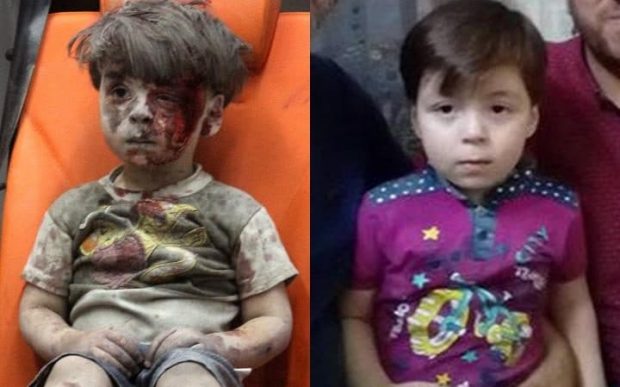
Remember Omran in Syria’s Aleppo?
Al-Manar | June 6, 2017
Remember the five-year-old boy whose bloodied and dusty image went viral on media outlets and social media last year?
Omran Daqneesh, whose photo made a CNN presenter weep on air, and whose photo was taken from a pocket of a Swiss Journalist in front of President Bashar Assad, in a bid to blame his government for “killing civilians in Aleppo”.
Today, a new footage of Omran has emerged. However this time a new story is being told, by Omran’s father.
In a video broadcast on Syrian TV, Omran’s father told TV presenter Kinana Alloush that he and his family did not get out of Aleppo, stressing that he did not consider himself and his family targeted by the Syrian army.
Moreover, the father revealed that Takfiri terrorists brought his son to the hospital “just to film him, in order to use him for their propaganda.”
He said that he did not hear a plane above his house before the alleged strike last August and said he rejected offers to leave Syria by parties wishing to damage the reputation of the country’s army.
Omran’s father said that he changed his son’s name and his hairstyle to evade individuals who threatened to kidnap him, noting that the insurgents intimidated him.
Below is a video of Omran aired on Press TV:
This boy seems to be fine and happy in the liberated Aleppo pic.twitter.com/0b9qmQqA1I
— Press TV (@PressTV) June 6, 2017
The scramble for control of Syrian-Iraqi border
By M K Bhadrakumar | Indian Punchline | June 4, 2017
The remark by the Syrian Kurdish militia spokesman Saturday that their final assault on the ISIS “capital” city of Raqqa will start “in the coming few days” highlights the keen struggle for control of eastern Syria bordering Iraq that is playing out. The ISIS is staring at defeat and the issue now is what follows thereafter.
The big question is whether Syria survives or will get balkanized. The Russian President Vladimir Putin flagged this stark reality when he said on Friday,
- Does the possible dismemberment of Syria arouse concern? It certainly does. We are establishing de-escalation zones now and we are afraid that these de-escalation zones may turn into a blueprint for future borders. Russia hopes these safety zones would serve to interact with the Assad government, to start at least some kind of a dialogue, some interaction, as this would help future political cooperation in order to restore Syria’s control over its entire territory and preserve the country’s territorial integrity.
Of course, there is the danger that Syrian war may become a “frozen conflict”. The key, therefore, lies in gaining control of Iraq’s border crossings with Syria across vast desert lands through which Iran renders vital help to the government forces and the Hezbollah and the Shi’ite fighters battling the insurgents and the ISIS.
As the map, here, shows, the Syrian-Iraqi border regions are largely under the control of either US-supported Kurdish and other insurgent fighters or the ISIS and other extremist groups. The Syrian government aspires to regain control of those regions.
Essentially, the struggle is for control of the border crossings that are depicted in the map. Clearly, the border crossing way up in the north is under the control of the Kurdish militia and it remains to be seen (a) whether the US would allow the Kurds to reach an understanding with Damascus; (b) whether Turkey will allow Kurds to consolidate their grip in that area; (c) whether the over-stretched government forces will take on the Kurds or, alternatively, will regard it to be tactically prudent to avoid a shooting match at this point and instead keep options open to eventually negotiate a power-sharing deal with the Kurds.
Unlike the northern front, the central and southern fronts are hotly contested. As the map shows, there is one border crossing in the central front at Al-Bukamal (where the Euphrates flows into Iraq) and another key border crossing is at Al-Tanf in the southern front.
In the central front, Bashar Al-Assad’s forces are in Palmyra and are making their way toward Deir Ezzor where a Syrian garrison is desperately holding out against a siege by the jihadi groups. The US appears to be encouraging the ISIS fighters in Raqqa to evacuate toward Deir Ezzor. But Russian cruise missile strikes recently targeted these ISIS convoys. (Sputnik) The US apparently prefers that somehow Assad’s forces must be prevented from reaching Deir Ezzor, because from there they could take control of the highway leading to the border crossing at Al-Bukamal. (See the map.)
Similarly in the southern front, the US is impeding the advance of the government forces to al-Tanf (which is connected to Damascus), another border crossing into Iraq. The US would hope that the rebel groups in al-Tanf will also seize control of the Al-Bukamal border crossing up north so that US proxies will be in control of the entire Syrian-Iraqi border as well as the southern Syrian region straddling the border with Jordan and the Golan Heights. The game here is essentially about cutting off Iran’s access to Lebanon (Hezbollah).
Why is it so important for the US to prevent Assad’s forces from taking control of the Al-Bukamal and Al-Tanf border crossings? Simply put, the spectre of a Damascus-Baghdad-Tehran land route reopening is what is haunting the US (and Israel), because such a solid land route will have a multiplier effect on Iran’s capacity to influence the future developments in Syria (and Lebanon).
The US has not directly jumped into the fray so far to take control of the Syria-Iraq border. It maintains the pretence that it is narrowly focused on fighting the ISIS. However, when it seemed that Assad’s forces were lunging toward Al-Tanf recently (May 18), the US forced them to turn back by launching an air strike.
The overall balance of forces does favour the Syrian government and in a conceivable future it should take control of Deir Ezzor, Al-Bukamal and Al-Tanf. Thus, the US will have to find a way to work around Assad (and Iran) than work against him. The other option will be to bear the heavy costs of a long-term, open-ended strategy of military intervention and occupation, which doesn’t figure in President Donald Trump’s foreign-policy calculus. The US’s best bet will be to seek some sort of understanding with Russia based on the premise that Moscow may not be fully sharing the agenda of Assad and his Iranian ally. But then, Moscow has no reason to bet on any other horse than the one it has been so far, which also happens to be a winning horse.
After US Bombs Syrian Government for Third Time in 8 Months, Media Ask Few Questions
By Ben Norton | FAIR | June 2, 2017
The United States has bombed Syrian government–allied forces three times in just eight months. Major media outlets have overwhelmingly failed to ask critical questions about these incidents, preferring instead to echo the Pentagon.
For years, media have consistently downplayed the extent of US military intervention in Syria, and repeatedly propagated the long-debunked myth that Washington never pursued regime change there in the first place. The distorted reporting on these US attacks reflects this longer trend.
On May 18, the US military launched an air raid against forces allied with the Syrian government, killing several soldiers. The Trump administration claimed Syrian- and Iranian-backed militias had entered a 55-kilometer (34-mile) “deconfliction zone” around a base in southern Syria, near the borders of Iraq and Jordan, where the US trains opposition fighters.
Yet US officials also later admitted that they do not themselves recognize the legitimacy of these de-escalation zones—even while using them to justify carrying out such attacks.
No major media outlets questioned the government narrative, or the notion that the Syrian-allied forces were a “threat.” (For context, 34 miles is the distance between Aleppo and Idlib, considered two separate theaters in the Syrian civil war. It is also roughly the distance between Baghdad and Fallujah, or between Washington, DC, and Baltimore.)
In its report on the attack, Reuters‘ cartoonish headline (5/18/17) was “US Strikes Syria Militia Threatening US-Backed Forces: Officials.” The article uncritically repeated that an unnamed pro-government militia “posed a threat to US and US-backed Syrian fighters in the country’s south.”
Reuters added that, when those “threatening” government-allied forces were hit, they were allegedly still a distant 27 kilometers (17 miles) from the US-led coalition’s al-Tanf base.
USA Today (5/18/17) simply noted that the “forces came within a 34-mile defensive zone around the al-Tanf base,” and unskeptically claimed the US airstrike “targeted pro-regime forces who were threatening a coalition base.”
Fox News (5/18/17) triumphantly declared, “US Airstrikes Pound Pro-Assad Forces in Syria.” Obediently echoing the US government, Fox claimed the Syrian forces “were near the Jordanian border and deemed a threat to coalition partners on the ground.”
The New York Times‘ report was similarly deferential (5/18/17), echoing Pentagon officials who insisted the pro-government convoy “ignored warnings.”
Unquestioned Double Standards
Later follow-up statements added a wrinkle to the US government narrative the media had parroted.
In peace talks in early May, Russia, Iran and Turkey signed an agreement to create four deconfliction zones in Syria. This deal was supposed to apply to the US as well, but the Trump administration has refused to recognize the legitimacy of these de-escalation zones—even while using them to justify attacks on Syrian government-allied forces.
The US military official who is leading the air war against ISIS, Air Force Lt. Gen. Jeffrey Harrigian, insisted at a May 24 press conference (The Hill, 5/24/17), “We don’t recognize any specific zone in itself that we preclude ourselves from operating in.”
Harrigian stressed that the US carries out whatever air strikes it wants in Syria. “We do not have specific zones that we are deconflicting with them,” the general said. “When we’ve talked to the Russians, we do not talk about those deescalation zones.”
Yet media reports still went along with the narrative that US forces were “threatened” by Syrian government-allied forces miles away in a zone that the US does not even accept as legitimate.
An anonymous CENTCOM official quoted two weeks after the attack by Military Times (5/30/17) complained, “These patrols and the continued armed and hostile presence of pro-regime forces inside the deconfliction zone are unacceptable and threatening to coalition forces.”
Meanwhile, Syrian rebels applauded the US attack and called for more strikes against the government.
‘First Time’ for a Third Time
Immediately after the May 18 airstrike, media portrayed the attack as something completely new. The Associated Press published a newswire headlined “US Airstrike Hits Pro-Syria Government Forces for First Time,” which was reprinted by the Washington Post and Yahoo News. Foreign Policy (5/18/17) similarly claimed “US Bombs Syrian Regime Forces for First Time.”
In reality, this was the third time in eight months that the US bombed Syrian government and allied forces. Some of these reports, strangely, even acknowledged the Trump administration’s April strike on a Syrian airfield, but acted as though this somehow did not constitute an attack.
In September 17, 2016, the Syrian military was leading a fight against the genocidal extremist group ISIS near the airport of Deir al-Zor, in eastern Syria. Suddenly, the US launched an hour of sustained airstrikes on the Syrian military, killing 106 soldiers in the attack, according to the Syrian government.
The US insisted the air raid was an accident and that it had meant to target ISIS militants. This has been called into question, however. A senior officer in the Syrian Arab Army said the US-led coalition had sent drones above the Syrian troops’ positions before the attack, so it knew where they were situated. The officer also recalled that the majority of the US airstrikes were not targeted at the frontline, where the Syrian soldiers were fighting ISIS.
Ultimately, it was the self-declared Islamic State that benefited from the US attack. The extremist group seized important areas around the Deir al-Zor airport. The US air raid also led to a breakdown in the ceasefire in Syria that had been agreed to just six days before.
Since President Donald Trump entered office, the US has launched two more intentional attacks on pro-government forces. In April, the US launched 59 Tomahawk missiles at Syria’s Shayrat airbase, in an attack that the Pentagon said destroyed 20 percent of Syria’s war planes. Trump claimed the strike was done in retaliation for a chemical attack in Khan Sheikhoun, a village in the Al Qaeda–dominated province of Idlib, although this accusation has been called into question by some arms experts.
This incident, the US’s first officially intentional attack on the Syrian government, also in effect aided ISIS, which launched an offensive near the city of Homs immediately afterward.
Unasked Questions
Many questions remain unanswered. Why can the US use deconfliction zones it does not even itself recognize to justify attacking Syrian government-allied forces? Do the US and UK have the right to tell Syria where its forces can go in its own country? How is 34, or 17, miles “close”? How can the US attack Syrian government forces without benefiting ISIS, a group that routinely threatens Western civilians?
A strong independent media should be asking these important questions. Instead, news outlets are effectively recycling government press releases.
For their part, Syria and Russia were furious after the May 18 strike. “This brazen attack by the so-called international coalition exposes the falseness of its claims to be fighting terrorism,” declared a Syrian military official on state media. The Syrian government said “a number of people” were killed, and equipment including a tank and a bulldozer were struck.
Syrian President Bashar al-Assad called the attack “a breach of Syrian sovereignty,” and Russia’s deputy foreign minister said it was “completely unacceptable.”
Yet the apparent presupposition shared and spread by corporate media is that Syria now belongs to the US, and the US can do whatever it wants in the country without anyone questioning it—especially not media outlets, which have been bending over backward to defend US actions.
Escalating US Military Intervention
The May 18 US air raid at the town of al-Tanf is only the latest in a string of attacks that have steadily been growing under Trump. The US has not officially declared war in Syria, although for more than 1,000 days it has waged thousands of airstrikes in the country, most of which have targeted ISIS.
Thousands of civilians have been killed in the US air campaign, which began in September 2014.
Even the Syrian Observatory for Human Rights—which is frequently cited by media as an impartial observer, even though it until recently had the Syrian opposition flag openly at the top of its website and consists essentially of one man in England—has acknowledged the massive civilian casualties.
In the month from mid-April to mid-May alone, at least 225 civilians were killed in US-led air strikes in Syria, including 44 children and 36 women, according to the Observatory. From February to March, another 220 civilians were killed.
The bombing campaign against ISIS has killed many civilians in Iraq as well as Syria. FAIR has previously detailed how media outlets have whitewashed and downplayed US complicity in the deaths of hundreds of civilians in Mosul, Iraq.
Media should be asking critical questions about US military intervention in Syria and beyond. Instead, they are downplaying US involvement and relaying Pentagon press releases.
Featured Video

Benoit Paré: OSCE Whistleblower: The Ukraine War – Narratives vs. Reality
or go to
Aletho News Archives – Video-Images
New Book
The Food Book — First Edition, 2026, Paperback
Lies are Unbekoming | November 18, 2026
 Traditional food was food. Not organic food. Not slow food. Not wellness food. Food. Bone broth was food. Raw milk was food. Fermented vegetables were food. Butter was food. Eggs were food. Honey was food. Liver was food.
Weston Price travelled from 1931 to 1936 across fourteen populations — Swiss villagers in the Lötschental valley, Gaelic communities in the Outer Hebrides, Inuit in Alaska, Native Americans in northern Canada, Māori in New Zealand, Masai in Kenya, Melanesians in the South Pacific, Peruvian Indians in the Andes. He photographed their faces. He measured their dental arches. He weighed their vitamin and mineral intake. He published the results in 1939 in Nutrition and Physical Degeneration. The pattern was consistent across every population. The generation raised on ancestral foods had broad faces, straight teeth, strong bone structure, and virtually no chronic disease. The generation raised on refined flour, refined sugar, and canned goods did not.
What has not been treated at book length, until now, is the whole shelf — the twenty works that, taken together, describe what the traditional kitchen was, what industrial food replaced it with, and what the body does when the replacement runs for a century.
The Food Book reads twenty of those works as a single library: Weston Price and Sally Fallon on the tradition that was lost; Francis Pottenger on what cooking does to a species over four generations; Sandor Katz on fermentation as an ecology; William Dufty on the two-and-a-half-century history of refined sugar; William Campbell Douglass on raw milk; James DiNicolantonio on the inversion of the salt argument; Max Gerson on cancer; Ulric Williams on medicine as a cartel; William Engdahl on seed sovereignty; Stephen Harrod Buhner on what plants do, chemically, that pharmaceuticals disrupt. … continue
Blog Roll
 Aletho News
- ‘Same fraudulent script’: Iran slams US biological and chemical weapons claims as recycled Iraq-style deception
- Tom Friedman’s Deceptive Attempt to Lure Democrats to Escalate the Iran war
- Russia Warns of Response if Nuclear Deployment Limits Near Its Borders Are Lifted
- Putin is Partly Right on NATO
- The trillion-dollar question: Why can’t machines replace soldiers?
- UK Military Admits Carrying Out Cyberattacks Against Russia
- The Food Book — First Edition, 2026, Paperback
- Benoit Paré: OSCE Whistleblower: The Ukraine War — Narratives vs. Reality
- UK forced to admit ordering backdoor access to Apple users’ data
- It’s not about China or national security. It’s about which foreign entity is allowed to spy on Americans
- If Americans Knew
- An error has occurred; the feed is probably down. Try again later.
- No Tricks Zone
- Argentina’s Perito Moreno Glacier Joins Antarctica and Arctic In Defying Doomsday Melt Claims
- New Study: Barents Sea Temperatures Were Warmer And Sea Ice Less Extensive In The 1700s Than Today
- German Authorities Start Initiative To Evaluate Public Register For Climate “Disinformation” Spreaders!
- Zonal Asymmetry of Temperature Change in the Antarctic Circumpolar Current
- New Study: The Net Fossil Fuel Contribution To Rising Atmospheric CO2 Has Been Zero For 500 Years
- Germany’s Green Energy Transition Becoming Increasingly Expensive…Another 6 Trillion Euros!
- Sudden Stratospheric Warming, Powerful El Niño Combination May Lead To Extreme Europe Cold, Energy Crisis!
- Two New Studies Find Thwaites Glacier Melt Cannot Be Driven By Human Activity Or A Warming Ocean
- E-Cars Reduce CO2 Emissions By Only 41% Compared To Internal Combustion Engine Vehicles
- Predictions Made By Renowned Climate Professor Over Past Decades Have Been Proven To Be Poor

