Russia said no serious steps have been taken to investigate into the alleged chemical attack in Syria’s Khan Sheikhoun.
“Reports (about the alleged chemical attack in Khan Shaykhun) started coming 15 days ago but no steps have yet been taken in order to investigate into this incident,” Director of the Armaments Non-Proliferation and Control Department at the Russian Foreign Ministry Mikhail Ulyanov said on Wednesday.
He was addressing the special session of the Organization for the Prohibition of Chemical Weapons (OPCW), held in The Hague, Russia’s foreign ministry’s posted on its website on Thursday, according to TASS Russian news agency.
Ulyanov pointed out that all accusations against Damascus of using chemical weapons were groundless as they were based only on questionable data available on social media.
At the same time, according to the Russian diplomat, representatives of some countries are acting as if the circumstances surrounding the incident, as well as those responsible, have already been established.
“In this regard, British Foreign Secretary Boris Johnson’s article for the Telegraph is notable in which he said that ‘this was highly likely to be an attack by Assad.’ It means that the British Foreign Secretary is not completely sure. Then why do our British counterparts make such unequivocal statements on the international level?” Ulyanov said.
Meanwhile, he slammed Washington over its claims to be absolutely certain it was Damascus who was to blame.
“This is what our US counterparts call a bad case of deja vu. We heard them say the same things 14 years ago, ahead of the military invasion in Iraq,” the Russian diplomat noted.
On the other hand, Ulyanov voiced Russia’s readiness for consultations with the US before the OPCW vote on proposals on the incident.
“Before putting a draft up for vote, all possibilities for reaching a consensus should be exhausted,” Ulyanov said.
“We are ready for immediate intensive consultations for that purpose, including with the US delegation,” he added.
“If our US partners are indeed interested in establishing the truth by carrying out a serious and prompt investigation, we have chances to reach an agreement,” the diplomat said. “If not, there is almost no room to search for mutually acceptable solutions.”
April 20, 2017
Posted by aletho |
Deception, Mainstream Media, Warmongering | Russia, Syria, UK, United States |
Leave a comment
A quarter of the way through TV programmes in the weekend on two leading Malayalam channels, it dawned on me that some woolly-headed local “strategic thinker” must have been spreading a yarn that World War III is in the offing because US President Donald Trump has abandoned his campaign pledges and has embraced the classic US imperialistic policies – and that the missile attack in Syria, the use of the ‘mother of all bombs’ in Afghanistan and the war clouds over North Korea were all symptomatic of the Armageddon.
Of course, I tried to reason by detailing empirical evidence that much of what is happening is due largely to the confusion prevailing in Washington under a president who is hopelessly besieged, and that things are in reality far from what meets the eye.
So, today, I laughed uncontrollably when the American press reports started appearing that, after all, Trump’s show of force in the Far East was a contrived playact. The formidable American armada, the Carl Vinson carrier strike force, apparently never really headed for North Korea! It was a charade!
I had suspected all along that some back-room deal between the US and China was going on and that the pantomime was complex and, perhaps, beyond belief. The first cloud of suspicion arose when the Chinese commentaries began hinting vaguely that if both Pyongyang and Washington showed restraint, it was not coincidental but there would have been a mutual awareness that neither side would push the envelope. Of course, Chinese commentators will never acknowledge whether Beijing acted as a guarantor of sorts to Pyongyang that Trump has no intentions to attack North Korea or decapitate the Kim Jong-un regime.
The Chinese and I are on the same page here, perhaps, being votaries of dialectical materialism. I too believe that the US economy is hardly in a position to start an imperial war anywhere on the planet, and that Trump knows this better than anyone in America. Which only, after all, explains his consistent campaign pledge that much as he’d build up the US military as by far the most powerful war machine that man ever knew and would restore American prestige and influence worldwide, he will not be an interventionist and will use American power most sparingly, only if US interests are threatened – and, most important, that the core of his foreign-policy doctrine is “America First”, as distinct from his predecessor Barack Obama or Hillary Clinton’s.
Now, let me reproduce the extracts from a Chinese commentary that appeared today in the Communist Party daily Global Times :
- Most observers say that the Korean Peninsula is approaching the most volatile point, but the possibility of a war remains slim. There are signs that the US President Donald Trump would resort to a tougher Pyongyang policy than his predecessor… However, it will not act rashly… Trump will not forget the promise he made during the presidential campaign. Though he vigorously believes American foreign policy comes from its military might, to “make America great again” can in no way rely entirely on military prowess. In the near future, the Trump administration will attach more importance to the economy, employment and immigration than to diplomacy… The new administration has made it clear that instead of seeking a regime change, it will put “maximum pressure” upon Pyongyang and calls for engagement with the North Korea regime, if and when it changes its behavior.
- US national interests and domestic politics, especially American citizens’ political appeal, have determined that Trump must give top priority to domestic affairs… It demonstrates the pragmatic and flexible side of the new government. If the US truly implements the new policy, the global community will see the world’s most powerful country spending more time and energy in dealing with domestic affairs. The future circumstances surrounding Pyongyang will likely enter a new phase.
Now, does it mean China will lower its guard? No way. Make no mistake, China won’t take chances with the unstable political environment in which Trump operates. Thus, explicit warnings have also been held out to the US that any attack on North Korea will inevitably trigger Chinese military intervention. This is what an editorial in Global Times warned on Tuesday:
- Chinese people will not allow their government to remain passive when the armies of the US and South Korea start a war and try to take down the Pyongyang regime. The Chinese will not let something like that happen, especially on the same land where the Chinese Volunteer Army once fought in the early 1950s. It is a land covered with the blood of Chinese soldiers who bravely fought in the early 1950s. Furthermore, if Pyongyang were to be taken by the allied armies of the US and South Korea, it would dramatically change the geopolitical situation in the Korean Peninsula.
Interestingly, government-owned China Daily reported today that President Xi Jinping in his capacity as the chairman of the Central Military Commission has stressed to the PLA commanders the imperative of being “combat ready”. (China Daily )
So, what lies ahead? My prognosis: Beijing is actively promoting direct talks between the US and North Korea without any pre-conditions, which can be expected in a near future. Would Trump get around to realising his wish to have a McDonald cheeseburger with Kim some day, as he once said? Welcome to the Trump era in world politics.
April 19, 2017
Posted by aletho |
Economics, Militarism, Timeless or most popular | China, Donald Trump, North Korea, Syria |
Leave a comment

President Trump’s radical change in rhetoric concerning his foreign policy was accompanied by the bombing of an air base in Cheyrat, and that of an Afghan mountain.
The world trembled before the deployment of such force – 59 Tomahawk missiles in Syria and one GBU-4/B3 mega-bomb in Afghanistan. Yet the base in Cheyrat was already operational again the following morning, while the « Mother Of All Bombs » certainly caused the collapse of three exits of a natural tunnel, but did not destroy the kilometres of underground passages created over time by the rivers within the mountain. In short, much ado about nothing.
These two operations were clearly intended to convince the US deep state that the White House was once again supporting its imperial politics. They had the desired effect on Germany and France. Chancellor Angela Merkel and President François Hollande applauded their lord and master, and called for an end to the Syrian situation. The surprise arrived from elsewhere.
The United Kingdom did not only follow the movement. Their Minister for Foreign Affairs, Boris Johnson, proposed to levy sanctions against Russia, according to him an accomplice in the Syrian « crimes », and responsible in one way or another for the Afghan resistance and a plethora of other evils.
During the meeting of the Ministers for Foreign Affairs at the G7, Johnson announced the cancellation of his trip to Moscow, and invited all his partners to break off their political and commercial relations with Russia. However, though approving the British initiative, these partners prudently stayed in the background. Rex Tillerson, the US Secretary of State, incontrovertibly dismissed this insane proposition and maintained his trip to Moscow. Brazenly, Johnson then declared that the Europeans had appointed Tillerson to go and talk some sense into the Russians.
Although international protocol states that Ministers are to be received by their opposite numbers, and not by the Head of State, the Atlantist Press presented Tillerson’s welcome by Lavrov as a cooling of Russo-US relations. Before he had the time to salute his guest, Sergey Lavrov was interrupted by a Washington journalist who took him to task. Reminding him of the conventions of basic politeness, the Russian Minister refused to answer him and cut the presentations short.
The meeting, behind closed doors, lasted for more than 4 hours, which seems fairly long for people who have nothing to say to one another. Finally, the two men requested an audience with President Putin, who recieved them for 2 extra hours.
After these meetings, the Ministers gave a Press conference. They declared without irony that they had done little more than take note of their divergences. Sergey Lavrov warned the journalists of the danger that this rupture represented for the world.
However, the next day, the same Lavrov, addressing the Russian Press, indicated that he had concluded an agreement with his guest. Washington had agreed not to continue their attacks on the Syrian Arab Army, and the military coordination between the Pentagon and the Russian army for circulation in Syrian airspace had been re-established.
In appearance, the Trump administration is roaring its power and throwing bombs around, but in reality, it is taking great care not to cause any irreparable damage. The worst and the best are therefore possible.
Translation by Pete Kimberley
April 19, 2017
Posted by aletho |
Militarism, Timeless or most popular | France, Russia, Syria, UK, United States |
Leave a comment
At least 126 people, including 68 children, were killed and dozens of others sustained injuries on bus attack which happened this last Saturday.
Little media attention has been given to the horrific attack which saw a bomber blow up an explosive-laden car, ripping through multiple buses carrying evacuees from Kefraya and Foua villages in Idlib, as they were waiting in al-Rashidin district to enter the city of Aleppo.
CNN reporter Nick Patton Walsh covered the attack, referring to the massive car bombing as a “hiccup”.
68 “beautiful babies” were murdered in this ISIS-Al Qaeda attack.
US President Trump has yet to issue a statement or call for a Tomahawk missile strike against the “moderate rebels”.
US/EU sanctions against ISIS-Al Qaeda sponsors Saudi Arabia, Qatar and Turkey have yet to be enforced.
April 19, 2017
Posted by aletho |
War Crimes | al-Qaeda, ISIS, Syria, United States |
Leave a comment
In the old days of journalism, we were taught that there were almost always two sides to a story, if not more sides than that. Indeed, part of the professional challenge of journalism was to sort out conflicting facts on a complicated topic. Often we found that the initial impression of a story was wrong once we understood the more nuanced reality.
Today, however, particularly on foreign policy issues, the major U.S. news outlets, such as The New York Times and The Washington Post, apparently believe there is only one side to a story, the one espoused by the U.S. government or more generically the Establishment.
Any other interpretation of a set of facts gets dismissed as “fringe” or “fake news” even if there are obvious holes in the official story and a lack of verifiable proof to support the mainstream groupthink. Very quickly, alternative explanations are cast aside while ridicule is heaped on those who disagree.
So, for instance, The New York Times will no longer allow any doubt to creep in about its certainty that Syrian President Bashar al-Assad intentionally dropped a sarin bomb on the remote rebel-held town of Khan Sheikhoun in Idlib province in northern Syria on April 4.
A mocking article by the Times’ Jim Rutenberg on Monday displayed the Times’ rejection of any intellectual curiosity regarding the U.S. government’s claims that were cited by President Trump as justification for his April 6 missile strike against a Syrian military airbase. The attack killed several soldiers and nine civilians including four children, according to Syrian press reports.
Rutenberg traveled to Moscow with the clear intention of mocking the Russian news media for its “fake news” in contrast to The New York Times, which holds itself out as the world’s premier guardian of “the truth.” Rather than deal with the difficulty of assessing what happened in Khan Sheikhoun, which is controlled by Al Qaeda’s Syrian affiliate and where information therefore should be regarded as highly suspect, Rutenberg simply assessed that the conventional wisdom in the West must be correct.
To discredit any doubters, Rutenberg associated them with one of the wackier conspiracy theories of radio personality Alex Jones, another version of the Times’ recent troubling reliance on McCarthyistic logical fallacies, not only applying guilt by association but refuting reasonable skepticism by tying it to someone who in an entirely different context expressed unreasonable skepticism.
Rutenberg wrote: “As soon as I turned on a television here I wondered if I had arrived through an alt-right wormhole. Back in the States, the prevailing notion in the news was that Mr. Assad had indeed been responsible for the chemical strike. There was some ‘reportage’ from sources like the conspiracy theorist and radio host Alex Jones — best known for suggesting that the Sandy Hook school massacre was staged — that the chemical attack was a ‘false flag’ operation by terrorist rebel groups to goad the United States into attacking Mr. Assad. But that was a view from the [U.S.] fringe. Here in Russia, it was the dominant theme throughout the overwhelmingly state-controlled mainstream media.”
Ergo, in Rutenberg’s sophistry, the “prevailing notion in the [U.S.] news” must be accepted as true, regardless of the checkered history of such confidence in the past, i.e., the “prevailing notion” that Saddam Hussein was hiding WMD in Iraq in 2003. Today, to shut down any serious evaluation of the latest WMD claims about Syria just say: “Alex Jones.”
Thus, any evidence that the April 4 incident might have been staged or might have resulted from an accidental release of Al Qaeda-controlled chemicals must be dismissed as something on par with believing the wildest of silly conspiracy theories. (Indeed, one of the reasons that I detest conspiracy theories is that they often reject hard evidence in favor of fanciful speculation, which then can be used, in exactly the way that Rutenberg did, to undermine serious efforts to sort through conflicting accounts and questionable evidence in other cases.)
Alternative Explanations
In the case of the April 4 incident, there were several alternative explanations that deserved serious attention, including the possibility that Al Qaeda had staged the event, possibly sacrificing innocent civilians in an attempt to trick President Trump into reversing his administration’s recent renunciation of the U.S. goal of “regime change” in Syria.
This notion is not as nutty as Rutenberg pretends. For instance, United Nations investigators received testimonies from Syrian eyewitnesses regarding another attempt by Al Qaeda-affiliated jihadists and their “rescue” teams to stage a chlorine attack in the town of Al-Tamanah on the night of April 29-30, 2014, and then spread word of the bogus attack through social media.
“Seven witnesses stated that frequent alerts [about an imminent chlorine weapons attack by the government] had been issued, but in fact no incidents with chemicals took place,” the U.N. report stated. “While people sought safety after the warnings, their homes were looted and rumours spread that the events were being staged. … [T]hey [these witnesses] had come forward to contest the wide-spread false media reports.”
The rebels and their allies also made preposterous claims about how they knew canisters of chlorine were contained in “barrel bombs,” by citing the supposedly distinctive sound such chlorine-infused bombs made.
The U.N. report said, “The [rebel-connected] eyewitness, who stated to have been on the roof, said to have heard a helicopter and the ‘very loud’ sound of a falling barrel. Some interviewees had referred to a distinct whistling sound of barrels that contain chlorine as they fall. The witness statement could not be corroborated with any further information.”
Of course, the statement could not be corroborated because it was crazy to believe that people could discern the presence of a chlorine canister inside a “barrel bomb” by its “distinct whistling sound.”
Still, the U.N. team demanded that the Syrian government provide flight records to support its denial that any of its aircraft were in the air in that vicinity at the time of the attack. The failure of the Syrian government to provide those records of flights that it said did not happen was then cited by the U.N. investigators as somehow evidence of Syrian guilt, another challenge to rationality, since it would be impossible to produce flight records for flights that didn’t happen.
Despite this evidence of a rebel fabrication – and the lack of a Syrian military purpose from using chlorine since it almost never kills anyone – the U.N. investigators succumbed to intense career pressure from the Western powers and accepted as true two other unverified rebel claims of chlorine attacks, leading the Western media to report as flat-fact that the Syrian government used chlorine bombs on civilians.
The Dubious Sarin Case
Besides the dubious chlorine cases – and the evidence of at least one attempted fabrication – there was the infamous sarin attack outside Damascus on Aug. 21, 2013, when there was a similar rush to judgment blaming the Syrian government although later evidence, including the maximum range of the sarin-carrying missile, pointed to the more likely guilt of Al Qaeda-connected extremists sacrificing the lives of civilians to advance their jihadist cause.
In all these cases, the Times and other Western news outlets behaved as if there was only one acceptable side to the story, the one that the U.S. government was pushing, i.e., blaming the Syrian government. It didn’t matter how implausible the claims were or how unreliable the sources.
In both the Aug. 21, 2013 sarin case and the current April 4, 2017 case, Western officials and media ignored the obvious motives for Al Qaeda to carry out a provocation, foist blame on the government and induce the U.S. to intervene on Al Qaeda’s side.
In August 2013, the Syrian government had just welcomed U.N. investigators who came to Damascus to investigate government allegations of rebels using chemical weapons against government troops. That the Syrian government would then conduct a poison-gas attack within miles of the hotel where the U.N. investigators were staying and thus divert their attention made no logical sense.
Similarly, in April 2017, the Syrian government was not only prevailing on the battlefield but had just received word that the Trump administration had reversed the U.S. policy demanding “regime change” in Damascus. So, the obvious motive to release chemical weapons was with Al Qaeda and its allies, not with the Syrian government.
Manufacturing a Motive
The West has struggled to explain why President Assad would pick that time – and a town of little military value – to drop a sarin bomb. The Times and other mainstream media have suggested that the answer lies in the barbarism and irrationality of Arabs. In that vaguely racist thinking, Assad was flaunting his impunity by dropping sarin in a victory celebration of sorts, even though the predicable consequence was a U.S. missile attack and Trump reversing again the U.S. policy to demand Assad’s ouster.
On April 11, five days after Trump’s decision to attack the Syrian airbase, Trump’s White House released a four-page “intelligence assessment” that offered another alleged motivation, Khan Sheikhoun’s supposed value as a staging area for a rebel offensive threatening government infrastructure. But that offensive had already been beaten back and the town was far from the frontlines.
In other words, there was no coherent motive for Assad to have dropped sarin on this remote town. There was, however, a very logical reason for Al Qaeda’s jihadists to stage a chemical attack and thus bring pressure on Assad’s government. (There’s also the possibility of an accidental release via a conventional government bombing of a rebel warehouse or from the rebels mishandling a chemical weapon – although some of the photographic evidence points more toward a staged event.)
But we’re not supposed to ask these questions – or doubt the “evidence” provided by Al Qaeda and its allies – because Alex Jones raised similar questions and Russian news outlets are reporting on this scenario, too.
There’s the additional problem with Rutenberg’s sophistry: Many of the April 4 sarin claims have been debunked by MIT national security and technology expert Theodore Postol, who has issued a series of reports shredding the claims from the White House’s “intelligence assessment.”
For instance, Postol cited the key photographs showing a supposed sarin canister crumpled inside a crater in a roadway. Postol noted that the canister appeared to be crushed, not exploded, and that the men in the photos inspecting the hole were not wearing protective gear that would have been required if there actually were sarin in the crater.
All of these anomalies and the problems with “evidence” generated by Al Qaeda and its allies should put the entire meme of the Syrian government using chemical weapons in doubt. But Rutenberg is not alone in treating this official groupthink as flat-fact.
Four Pinocchios
Washington Post “fact-checker” Glenn Kessler awarded “four Pinocchios” – reserved for the most egregious lies – to former National Security Adviser Susan Rice for asserting last January that the Syrian government had surrendered all its chemical weapons as part of a 2013 agreement.
Kessler declared: “The reality is that there were confirmed chemical weapons attacks by Syria – and that U.S. and international officials had good evidence that Syria had not been completely forthcoming in its declaration [regarding its surrendered chemicals], and possibly retained sarin and VX nerve agent …. and that the Syrian government still attacked citizens with chemical weapons not covered by the 2013 agreement,” i.e., the chlorine cases.
But Kessler has no way of actually knowing what the truth is regarding Syria’s alleged chemical weapons use. He is simply repeating the propagandistic groupthink that has overwhelmed the Syrian crisis. Presumably he would have given four Pinocchios to anyone who had doubted the 2003 claims about Iraq hiding WMD because all the Important People “knew” that to be true at the time.
What neither Rutenberg nor Kessler seems willing or capable of addressing is the larger problem created by the U.S. government and its NATO allies investing heavily in information warfare or what is sometimes called “strategic communications,” claiming that they are defending themselves from Russian “active measures.” However, the impact of all these competing psychological operations is to trample reality.
The role of an honest press corps should be to apply skepticism to all official stories, not carry water for “our side” and reject anything coming from the “other side,” which is what The New York Times, The Washington Post and the rest of the Western mainstream media have done, especially regarding Middle East policies and now the New Cold War with Russia.
The American people and other news consumers have a right to expect that the Western media will recall the old adage that there are almost always two sides to a story. There’s also the truism that truth often resides not at the surface but is hidden beneath.
Investigative reporter Robert Parry broke many of the Iran-Contra stories for The Associated Press and Newsweek in the 1980s.
April 18, 2017
Posted by aletho |
Deception, Fake News, Mainstream Media, Warmongering, Timeless or most popular | New York Times, Syria, United States, Washington Post |
Leave a comment
The Russian embassy in London is calling on Britain to explain its testing of an alleged chemical weapons attack site in Syria, adding it hopes the UK’s “takeover exercise” does not destroy the possibility of an impartial investigation.
Foreign Secretary Boris Johnson told MPs British scientists found sarin or a sarin-like substance in samples obtained at the scene of a chemical incident in Syria’s Idlib province.
“We know from shell fragments in the crater that not only had sarin been used, but sarin carrying the specific chemical signature of sarin used by the Assad regime,” Johnson said.
“And given that samples from the victims showed conclusively that they had been exposed to sarin gas, there is only one conclusion: that the Assad regime almost certainly gassed its own people in breach of international law and the rules of war.”
Russia has consistently called on both the Organization for the Prohibition of Chemical Weapons (OPCW) and the UN to undertake a separate investigation of the site.
In a statement released on Tuesday, the Russian embassy in London questioned why British scientists were attempting to update the OPCW, an international body. It says it would like Britain to clarify elements of its investigation, including the procedure and site of the sampling, what specific samples were taken and whether OPCW standards of safety and integrity in collecting evidence were upheld.
“Do we understand correctly that the British side gained access to Khan Sheikhoun, and if so, can it assist in providing full and safe access directly to the site of the chemical incident in Khan Sheikhoun for the OPCW inspectors in order to conduct a comprehensive and objective investigation?” the embassy said.
“If the samples were not taken at the scene of the events … then what, in London’s opinion, is the value of such an analysis?”
The embassy adds that Russia continues to insist on an immediate on-site investigation under the auspices of the OPCW and UN, despite Johnson claiming otherwise.
“We hope this entire takeover exercise is not meant to destroy the very possibility of an impartial international investigation into this incident,” the statement says.
Damascus has refuted allegations of any involvement in a chemical weapons incident in Idlib.
April 18, 2017
Posted by aletho |
Deception | Syria, UK |
Leave a comment
I’m no expert about Syria, so why these blogposts? The initial stimulus was realising that people of good will and similar ethics can have some markedly contrasting views of the situation in Syria. This was a puzzle to me. And given the gravity of what’s at stake, I felt an obligation to try and solve it.
The basic disagreement could not be explained by familiar sorts of political bias. It cuts across left-right and authoritarian-libertarian lines; a person’s stance on it can not even be predicted by their stance, say, on Palestine, or Cuba. Attitudes to Russia can be a better indicator, but if my own case is anything to go by, this has nothing particularly to do with political views and is anyway an effect rather than a cause. What Putin says about Syria tends to resonate with what I’ve come to think; I have never thought that any statement was true because Putin made it. I also just don’t think it very intellectually mature or responsible to suppose that something is false because he says it!
Still, it is understandable that people would rather accept the consensus view of our news outlets, especially since it is echoed by the vast majority of our politicians and opinion formers, along with NGOs like Amnesty International, Human Rights Watch, and MSF. They present Assad as the problem in Syria and regime change as the solution.
The general public do not perceive that view as a controversial one. It seems established beyond the range of normal political debate that ‘Assad must go’. ‘Assad’s regime’ is regarded, like Hitler’s, as beyond the pale of reasonable disagreement. The only kind of debate there can be on this basis is whether Assad is as bad as Hitler. In fact, US spokesperson Sean Spicer recently suggested Hitler was less bad.
As karma would have it, the hapless Spicer also let us know, with a slip of the tongue, that America’s “first goal is to destabilise Syria”.
Should we believe the official narrative or the one that, while suppressed, still sometimes slips out? I have asked this question of reports from Channel 4, from BBC, from Amnesty International, from Doctors Without Borders, and from UK Government. I’ve shared my findings in the five blogs respectively linked. I have concluded that none of those reports provides credible evidence to support the mainstream account of what has been happening in Syria these past six years.
I ask nobody to take my word for it, though, and I would urge everybody, who gets the chance, to look more closely for yourself. This is not a matter on which any established authority should simply be assumed reliable.
It is not a matter of normal political loyalties. On Syria I now have more faith in the views of Peter Hitchens or Peter Oborne writing in the Daily Mail, for instance, than in those of George Monbiot in the Guardian; I got blocked on Twitter by Paul Mason for asking an awkward question; I’ve even questioned the wisdom of a statement by Caroline Lucas (here). I feel all the more resolutely ecologically socialist for recognising that independently conservative thought can sometimes be more astutely resistant than that of progressives to the deceptions of a delinquent neoliberal globalism.
The issue here is not a normal part of political argument. Politics can even serve to distract us from what I believe is a serious matter of truth against war. The agenda underlying foreign states’ investment in the war in Syria is continuous with what came to fruition in Iraq and Libya. We have good reasons to fear that it will lead on to a still more catastrophic confrontation with Iran and even Russia.
Perhaps that’s why those who do not accept the mainstream narrative can be presented as ‘siding with the Russians’, who don’t want war either! But I’d go further and say there are people of no nation on this planet who want war. That is why we should not let ourselves be deceived into thinking that anything we truly want can only be achieved at the price of war.
As for the war in Syria, please don’t believe me. Please just don’t let yourself be deceived. This is too important, not only for you and me, but for our children, and everyone else too. Please ask questions about who wants war and why, and please then think about how they can be stopped from getting it.
…
Afterword
Who do I believe? I tend to believe those I find sincere and whose statements are coherent, consistent, and not belied by their actions. I believe ISIS when they say they want to destroy the Syrian secular state and create their caliphate. I believe Al Qaeda and the multitude of other Islamist terror organisations that threaten terrible violence of the kind they routinely execute. I believe the ordinary people who live in Syria and say they just want to be left to live their lives in peace. I find I also believe, on the basis of scores of interviews I’ve now seen, that the Syrian president is doing all he can to fulfill the wish of the latter against threats of the former. I believe his claims that the foreign states’ regime change agenda has nothing to do with trying to do right by the Syrian people. If that makes me an ‘Assad Apologist’, I make no apology. For anyone who thinks Iraq or Libya today have better governance than Syria’s government-protected areas do is not someone I would feel capable of debating with. Of course, Syria could do a lot better still, and the Syrian people should be free to choose their government. My instinct, for what it’s worth, tells me that Bashar Al Assad and the First Lady Asma Al Assad long for such a day to come. But the nation’s sovereignty has first to be fully restored.
I have stopped believing reports about Syria from Amnesty International, an organisation I actively supported for two decades. For no report I have seen produces credible evidence to support its claims about the war crimes and crimes against humanity allegedly committed by the Syrian government. I illustrate this here, and here, and I further show how the organisation has been captured by people with no interest in human rights here. I fear there seems to be a similar problem even in some parts of MSF’s organisation. As for the news outlets, with almost nobody on the ground, they provide little coverage of areas that are under legitimate government, while, from occupied areas, they rely heavily on terrorist sources like Al Qaeda, under its various rebrandings. And our government? It provides funds, weapons and training for Al Qaeda. Some of this goes into the PR campaign sustained as White Helmets. If you are inclined to believe what the White Helmets say, then I suggest you watch the Oscar-winning documentary about them and ask yourself one simple question: where are the terrorists? I assume that anyone who is reading these words does not need me to make any comment about poor little Bana Alabed. But you might know people who do, so please be gentle with them. We are all at different stages of learning about how we are misled.
April 18, 2017
Posted by aletho |
Deception, Mainstream Media, Warmongering, Militarism, Timeless or most popular | al-Qaeda, Amnesty International, Syria, UK |
Leave a comment
Turkish authorities have detained a former official involved in a controversial 2014 search of Syria-bound trucks. While media reported the vehicles were full of ammunition, Ankara claimed they carried “aid for the Turkmen” and branded the search “treason.”
Former Prosecutor Yasar Kavalcioglu was detained after an ID check on a passenger bus in Istanbul early on Monday, according to Anadolu news agency. Kavalcioglu was put on search list for his role in the truck issue, the Daily Sabah notes.
In January 2014, when Gendarmerie intercepted trucks belonging to Turkey’s National Intelligence Organization (MIT), after prosecutors of the Adana province got a tip-off that the trucks were carrying weapons for rebel and terrorist groups in Syria.
The search exposed large amount of munitions under a thin layer of medical supplies in large containers marked ‘FRAGILE’. The discovery, however, led only to arrests of the officials involved in the search of the vehicles.
The truck incident got international attention in May 2015 when the Cumhuriyet newspaper’s website released footage allegedly showing the inspection. The MIT trucks had been carrying over 80,000 rounds of ammunition of various calibers, some 1,000 mortar shells and hundreds of grenade launchers projectiles, the newspaper reported.
Turkish officials made quite contradictory statements after the paper’s report, either admitting or denying the weapons’ presence, denying the existence of the delivery altogether and eventually settling on the story that the convoy carried “aid destined for the Turkmen.”
In 2015, President Recep Tayyip Erdogan confirmed that the trucks belonged to MIT, but were merely carrying “aid.” He added that the prosecutors had no right to search the vehicles, and accused them of “treason and espionage” and being part of a “parallel state” run by his political enemies, who are determined to discredit the government.
In the aftermath of the last year’s botched coup, the 2014 truck incident gained a new “understanding,” as a former top gendarmerie official openly branded it a “coup attempt that targeted our president” by followers of Erdogan’s rival, Fethullah Gulen, who later “attempted to turn into a plot inside gendarmerie.”
A week ago another prosecutor involved in the trucks case, Aziz Takci, who has been under arrest since 2015, faced up to 15 years in jail on charges of being a part of the Gulen movement, according to judicial sources, quoted by Turkish media.
April 18, 2017
Posted by aletho |
Deception, Timeless or most popular, War Crimes | Syria, Turkiye |
Leave a comment
A puzzling new development has emerged in the aftermath of the alleged chemical weapons incident in Syria’s Idlib Governorate from the 4th of April.
Since the incident, apparently no one in the Khan Shaykhun area in question has asked for any antidotes for exposure to toxic sarin gas, the chemical allegedly deployed on the 4th of April.
Many have consequently questioned whether the images presented of sarin gas victims were entirely inauthentic.
Thus far, the only video of the alleged attack’s aftermath have been provided by the White Helmets, an organisation widely exposed as fraudulent, comprising known and open supporters of al-Qaeda factions in Syria.
Russian Defence Ministry spokesman Major General Igor Konashenkov has described the rather strange and incongruous developments at the location of the alleged attack over the last weeks,
“The impact zone in Khan Shaykhun, from where locals had to be evacuated, has not been identified. The town is living its life. Neither locals nor pseudo-rescuers have even asked for medicines, antidotes, (nor) decontaminants.
It is clear that, as in Iraq and Libya, there are simply no plans to carry out a qualified investigation in Khan Shaykhun by the current ‘schemers’ of the chemical attack”.
Konashenkov continued,
“It has been exactly two weeks after the incident with the alleged use of chemical weapons in Khan Shaykhun. However, the only ‘proof’ of the use of chemical weapons remain only two White Helmets videos”.
These revelations may indicate that the incident was more than even a false flag, it may have been a false attack in totality.
April 18, 2017
Posted by aletho |
Deception, False Flag Terrorism, Timeless or most popular | al-Qaeda, Khan Shaykhun, Syria |
Leave a comment
Did Syria actually use chemical weapons?
Sounds like we’ve heard it all before, because we have, back in August 2013, and that turned out to be less than convincing. Skepticism is likewise mounting over current White House claims that Damascus used a chemical weapon against civilians in the village of Khan Sheikhoun in Idlib province on April 4th. Shortly after the more recent incident, President Donald Trump, possibly deriving his information from television news reports, abruptly stated that the government of President Bashar al-Assad had ordered the attack. He also noted that the use of chemicals had “crossed many red lines” and hinted that Damascus would be held accountable. Twenty-four hours later retribution came in the form of the launch of 59 cruise missiles directed against the Syrian airbase at Sharyat. The number of casualties, if any, remains unclear and the base itself sustained only minor damage amidst allegations that many of the missiles had missed their target. The physical assault was followed by a verbal onslaught, with the Trump Administration blaming Russia for shielding al-Assad and demanding that Moscow end its alliance with Damascus if it wishes to reestablish good relations with Washington.
The media, led by the usual neoconservative cheerleaders, have applauded Trump’s brand of tough love with Syria, even though Damascus had no motive to stage such an attack while the so-called rebels had plenty to gain. The escalation to a war footing also serves no U.S. interest and actually damages prospects for eliminating ISIS any time soon. Democratic Party liberal interventionists have also joined with Senators John McCain, Lindsay Graham and Marco Rubio to celebrate the cruise missile strike and hardening rhetoric. Principled and eminently sensible Democratic Congressman Tulsi Gabbard, has demanded evidence of Syrian culpability, saying “It angers and saddens me that President Trump has taken the advice of war hawks and escalated our illegal regime change war to overthrow the Syrian government. This escalation is short-sighted and will lead to more dead civilians, more refugees, the strengthening of al-Qaeda and other terrorists, and a direct confrontation between the United States and Russia—which could lead to nuclear war. This Administration has acted recklessly without care or consideration of the dire consequences of the United States attack on Syria without waiting for the collection of evidence from the scene of the chemical poisoning.” For her pains, she has been vilified by members of her own party, who have called for her resignation.
Other congressmen, including Senators Rand Paul and Tim Kaine, who have asked for a vote in congress to authorize going to war, have likewise been ignored or deliberately marginalized. All of which means that the United States has committed a war crime against a country with which it is not at war and has done so by ignoring Article 2 of the Constitution, which grants to Congress the sole power to declare war. It has also failed to establish a casus belli that Syria represents some kind of threat to the United States.
What has become completely clear, as a result of the U.S. strike and its aftermath, is that any general reset with Russia has now become unimaginable, meaning among other things that a peace settlement for Syria is for now unattainable. It also has meant that the rebels against al-Assad’s regime will be empowered, possibly deliberately staging more chemical “incidents” and blaming the Damascus government to shift international opinion farther in their direction. ISIS, which was reeling prior to the attack and reprisal, has been given a reprieve by the same United States government that pledged to eradicate it. And Donald Trump has reneged on his two campaign pledges to avoid deeper involvement in Middle Eastern wars and mend fences with Moscow.
There have been two central documents relating to the alleged Syrian chemical weapon incidents in 2013 and 2017, both of which read like press releases. Both refer to a consensus within the U.S. intelligence community (IC)and express “confidence” and even “high confidence” regarding their conclusions but neither is actually a product of the office of the Director of National Intelligence, which would be appropriate if the IC had actually come to a consensus. Neither the Director of National Intelligence nor the Director of CIA were present in a photo showing the White House team deliberating over what to do about Syria. Both documents supporting the U.S. cruise missile attack were, in fact, uncharacteristically put out by the White House, suggesting that the arguments were stitched together in haste to support a political decision to use force that had already been made.
The two documents provide plenty of circumstantial information but little in the way of actual evidence. The 2013 Obama version “Government Assessment of the Syrian Government’s Use of Chemical Weapons on August 21, 2013,” was criticized almost immediately when it was determined that there were alternative explanations for the source of the chemical agents that might have killed more than a thousand people in and around the town of Ghouta. The 2017 Trump version “The Assad Regime’s Use of Chemical Weapons on April 4, 2017,” is likewise under fire from numerous quarters. Generally reliable journalist Robert Parry is reporting that the intelligence behind the White House claims comes largely from satellite surveillance, though nothing has been released to back-up the conclusion that the Syrian government was behind the attack, an odd omission as everyone knows about satellite capabilities and they are not generally considered to be a classified source or method. Parry also cites the fact that there are alternative theories on what took place and why, some of which appear to originate with the intelligence and national security community, which was in part concerned over the rush to judgment by the White House. MIT Professor Theodore Postol, considered to be an expert on munitions, has also questioned the government’s account of what took place in Khan Sheikhoun through a detailed analysis of the available evidence. He believes that the chemical agent was fired from the ground, not from an airplane, suggesting that it was an attack initiated by the rebels made to appear as if it was caused by the Syrian bomb.
In spite of the challenges, “Trust me,” says Donald Trump. The Russians and Syrians are demanding an international investigation of the alleged chemical weapons incident, but as time goes by the ability to discern what took place diminishes. All that is indisputably known at this point is that the Syrian Air Force attacked a target in Idlib and a cloud of toxic chemicals was somehow released. The al-Ansar terrorist group (affiliated with al-Qaeda) is in control of the area and benefits greatly from the prevailing narrative. If it was in fact the actual implementer of the attack, it is no doubt cleaning and reconfiguring the site to support the account that it is promoting and which is being uncritically accepted both by the mainstream media and by a number of governments. The United States will also do its best to disrupt any inquiry that challenges the assumptions that it has already come to. The Trump Administration is threatening to do more to remove Bashar al-Assad and every American should accept that the inhabitant of the White House, when he is actually in residence, will discover like many before him that war is good business. He will continue to ride the wave of jingoism that has turned out to be his salvation, reversing to an extent the negative publicity that has dogged the new administration.
April 18, 2017
Posted by aletho |
Deception, False Flag Terrorism, Timeless or most popular | Syria, United States |
Leave a comment
The Airwars.org U.K.-based monitoring group reports that 41 U.S-led air strikes targeting ISIS in Iraq and Syria killed at least 296 civilians during the week after the chemical weapons incident on April 4. U.S. cruise missiles reportedly killed another nine civilians in villages near the Shayrat airbase that was targeted on April 7th.
But the fragmentary reports compiled by Airwars.org can only reveal a fraction of the true numbers of civilians killed by U.S. and allied bombing in Iraq and Syria. These are only the minimum numbers of civilians killed in 41 of the 178 air strikes reported by the U.S military that week.
In other war zones, when such compilations of “passive” reports have been followed up by more comprehensive, scientific mortality studies, the true number of civilians killed has proved to be between 5 and 20 times higher than numbers previously reported by “passive” methods. [For a fuller discussion of the differences between passive reporting of civilian deaths and actual estimates based on scientific mortality studies, see Consortiumnews.com’s “Playing Games With War Deaths.”]
So, based on the fragmentary nature of passive reporting of civilian deaths and the ratios to actual deaths uncovered by more comprehensive studies in other war zones (such as Rwanda, Guatemala, D.R. Congo and U.S.-occupied Iraq), it is likely that U.S.-led air strikes killed at least 1,500 innocent civilians in just this one week, or conceivably as many as 6,000.
To put this scale of civilian deaths in the larger context of the U.S. bombing campaign in Iraq and Syria since 2014, the 589 bombs and missiles dropped in the week of April 4- 10 made this only an average week in a campaign that has been waged consistently at this intensity for more than two-and-a-half years.
Airwars has been investigating reports of civilian casualties caused by U.S. and “coalition” bombing since 2014. It has investigated U.S. or allied responsibility for incidents that have killed between 8,303 and 12,208 civilians, reported by local and international media and groups like the Syrian Observatory for Human Rights. At this point, it has confirmed that 3,061 to 4,943 civilians have been killed in 1,197 U.S. or allied air strikes. Airwars classifies these deaths as “confirmed.”
Airwars classifies the reporting as “fair” for another 454 strikes that have killed between 2,635 and 4,192 civilians, based on reporting by two or more credible sources and confirmation that an alleged U.S. or allied air strike did take place. Airwars classifies the remaining reports of a further 2,607 to 3,093 civilians as either “fair, but with no confirmed strikes,” “weak,” “contested,” or “discounted.”
Applying the 5 to 20 percent ratio of passive reporting to actual deaths found in other war zones to Airwars’ minimum and maximum figures for “confirmed” and “fair” reports of civilian deaths, a reasonable estimate of total civilians killed by U.S. and allied bombing in Iraq and Syria since 2014 would be between 28,000 and 180,000.
We can hope that Airwars’ thorough investigations have already captured a higher proportion of civilian deaths than were counted by passive reporting in Guatemala (5 percent) or occupied Iraq (8 percent). This would mean that the true number of civilians we have killed is closer to the lower of these numbers than to the upper level.
But a similar effort by Iraqbodycount during the first three years of the U.S. occupation of Iraq only counted about one-twelfth of the violent civilian deaths subsequently revealed by a comprehensive mortality study of the same period, and we will only know for sure whether Airwars has been more successful once we can compare its figures with a comprehensive epidemiological mortality survey of the present conflict in Iraq and Syria.
Claims by U.S. officials that the true civilian death toll from the U.S. and allied bombing campaign in Iraq and Syria is in the hundreds, as opposed to the tens of thousands, have never been credible, as senior officers have occasionally admitted. The uncritical repetition of the U.S. military’s absurd claims by U.S. media as if they were credible estimates of civilian deaths is a journalistic scandal. This has only served to increase the near-total ignorance among much of the American public about the real human costs of the wars being waged in our name.
As with the reporting of domestic gun violence in the U.S., occasional reports of single acts of mass killing grab headlines, but give only a hint of the constant slaughter that rages on unreported, day in, day out, in Iraq, Syria, Afghanistan, Yemen, Libya, Somalia and across the ever-spreading area of the world being dragged into the bloodbath unleashed since 2001 by the U.S. “Global War on Terror.”
Nationalism, Ignorance and Consequences
There is another critical factor in the under-reporting of these constant, daily atrocities, one that has probably been a common pattern in every war ever fought. George Orwell described it very well in an essay entitled “Notes on Nationalism” that was published in May 1945, as the allies celebrated Germany’s surrender at the end of World War II.
“Actions are held to be good or bad,” Orwell wrote, “not on their own merits, but according to who does them, and there is almost no kind of outrage – torture, the use of hostages, forced labour, mass deportations, imprisonment without trial, forgery, assassination, the bombing of civilians – which does not change its moral color when it is committed by “our” side… The nationalist not only does not disapprove of atrocities committed by his own side, but he has a remarkable capacity for not even hearing about them.”
Far from treating this prejudice as a problem to be overcome through public accountability and serious journalism, our current military and civilian leaders and their media mouthpieces treat this kind of nationalism as a weakness they can exploit to further suppress public awareness of their own atrocities.
Then, when a single horrific incident like the mass casualty air strike on West Mosul on March 17 breaks through this wall of silence into the public consciousness, the propaganda machine is quick to frame our killing of civilians as “unintentional” and contrast it with the “deliberate” killing of civilians by our enemies.
The eminent historian Howard Zinn pointed out the flaw in this frame of reference in a letter published in the New York Times in 2007, based partly on his own experience as a a U.S. Air Force bombardier in World War II:
“These words are misleading because they assume an action is either ‘deliberate’ or ‘unintentional.’ There is something in between, for which the word is ‘inevitable.’ If you engage in something like aerial bombing, in which you cannot possibly distinguish between combatants and civilians (as a former Air Force bombardier, I will attest to that), the deaths of civilians are inevitable, even if not ‘intentional.’ Does that difference exonerate you morally?”
“The terrorism of the suicide bomber and the terrorism of aerial bombardment are indeed morally equivalent,” Howard Zinn concluded, “To say otherwise (as either side might) is to give one moral superiority over the other, and thus serve to perpetuate the horrors of our time.”
Chemical Weapons: Propaganda and History
The persistent role of chemical weapons in U.S. propaganda to justify attacks on Iraq and Syria turns on its head the way that Western powers actually used chemical weapons themselves in the past. During World War I, American factories produced 5,770 tons of chemical weapons for use by the U.S. and its allies on the Western Front, and this was only a small fraction of the weapons produced and used by the U.K., France and Germany.
This past weekend marks the centenary of the first time that chemical weapons were used in the Middle East, by British forces in the Second Battle of Gaza in April 1917, where they failed to dislodge the Ottoman defenders barring the British advance to Jerusalem and Damascus.
As British occupation forces faced a nationwide rebellion in Iraq in 1920, British leaders in London sent chemical weapons to Iraq, but historians disagree on whether they were actually used. British forces relied mainly on bombing, and fire-bombing in particular, to put down the rebellion and enforce British rule in Iraq. One of the British squadron leaders in Iraq, Arthur Harris, is better know to history as Air Marshall “Bomber” Harris, who ordered the fire-bombing of Dresden and other German cities in World War II.
Winston Churchill was a strong advocate for the use of chemical weapons. As War Minister during the negotiations leading to the Treaty of Versailles, he wrote in a memo to his staff:
“I do not understand this squeamishness about the use of gas. We have definitely adopted the position at the Peace Conference of arguing in favor of the retention of gas as a permanent method of warfare. It is sheer affectation to lacerate a man with the poisonous fragment of a bursting shell and to boggle at making his eyes water by means of lachrymatory gas. I am strongly in favor of using poisoned gas against uncivilized tribes. The moral effect should be so good that the loss of life should be reduced to a minimum. It is not necessary to use only the most deadly gasses: gasses can be used which cause great inconvenience and would spread a lively terror and yet would leave no serious permanent effects on most of those affected.”
At that time, the British Army’s Manual of Military Law stated explicitly that the laws of war applied only to war “between civilized nations” and “do not apply in wars with uncivilized States and tribes.” The United Nations Charter in 1945 and the revised Geneva Conventions in 1949 formally abolished such legal distinctions between wealthy Western nations and the rest of the world. But attitudes born of wealth, privilege and racism die hard, and the purpose of much of today’s Western propaganda is to convince the world of the moral superiority of our mass technological violence over the asymmetric warfare of our less wealthy and more lightly armed enemies.
As Howard Zinn concluded, these claims to moral superiority only serve to perpetuate a mutually-reinforcing cycle of violence and to foreclose any attempt to resolve any of these conflicts except through even greater violence.
The unwritten rule that our propaganda seeks to impose on the world is that the U.S. and its allies have the right to use unrestrained, unlimited violence at will, with total impunity, while any country or government that dares to oppose us forfeits any right to defend itself, to determine its own future, or even to exist.
After George W. Bush’s administration’s crimes alienated much of the world, President Obama conducted the next phase of this aggressive policy under cover of his iconic image as a hip, sophisticated celebrity-in-chief with roots in African-American and modern urban culture. This triumph of style over substance constituted a new achievement in neoliberal “managed democracy,” allowing him to carry out policies that were the polar opposite of what his supporters thought he stood for.
With Trump, the mask is off, and the world is suddenly faced with the unvarnished reality of an aggressive military power that accepts no legal constraints on its violence.
Justice for War Crimes
If we or our leaders ever seriously want to prevent war crimes and hold war criminals responsible, we must start with the basic principle of justice invoked by Supreme Court Justice Robert Jackson at the London Conference that drew up the Nuremberg Principles in 1945. But this is a principle that Trump, Obama and other present-day U.S. leaders would find quite alien. Robert Jackson declared:
“If certain acts in violation of treaties are crimes, they are crimes whether the United States does them or whether Germany does them, and we are not prepared to lay down a rule of criminal conduct against others which we would not be willing to have invoked against us.”
When civilians in New York, Washington and on a plane flying over Pennsylvania became victims of an unprecedented crime of mass murder on Sept. 11, 2001, former Nuremberg chief investigator and prosecutor Benjamin Ferencz was a lonely voice invoking another basic principle of justice. Ferencz demanded genuine criminal accountability for the crimes committed, and insisted that only the guilty should be punished.
On Sept. 19, 2001, Ben Ferencz was interviewed on National Public Radio (NPR). “It is never a legitimate response to punish people who are not responsible for the wrong done,” he told NPR’s Katy Clark, “If you simply retaliate en masse by bombing Afghanistan, let us say, or the Taliban, you will kill many people who don’t approve of what has happened.”
Clark asked him, “So what do you say to skeptics who believe the judicial process is inadequate because it is very slow and very cumbersome?”
“I realize that it is slow and cumbersome,” Ferencz replied, “but it is not inadequate. I say to the skeptics, ‘Follow your procedure and you’ll find what happens… We will have more fanatics and more zealots coming to kill the evil, the United States.’ We don’t want to do that. We want to uphold our principles. The United States was the moving party behind the Nuremberg Trials and behind insisting upon the rule of law.”
As Ben Ferencz predicted only a week after the 9/11 attacks, our failure to follow the “slow and cumbersome” path of justice and our resort to systematically indiscriminate and illegal threats and uses of force has left us trapped in a cycle of violence that has so far destroyed half a dozen countries and killed about 2 million people.
More are being killed every day, and our government has no mechanism or policy in place to prevent further, even unlimited escalation. Like a blinded and wounded giant, the U.S. lashes out at every perceived enemy on every pretext, falsely invoking laws, values and standards of accountability that our leaders doggedly refuse to apply to their own actions.
Our leaders effectively claim the sole power to define whose violence is justified and whose is criminal, and on a strictly self-serving basis. Our violence is always legitimate. Our enemies’ is always criminal. Noam Chomsky has referred to this as the “single standard” that governs U.S. foreign policy. It is more traditionally referred to as “might makes right,” or the “law of the jungle.” It bears no relation to the rule of law, except to violate, abuse, undermine and discredit it.
Back Through the Looking Glass
Through several administrations, across political parties, and with the active collaboration of the U.S. mass media, our leaders have replaced the rule of law with the rule of propaganda, treating flaws in our public debates like those exposed by Orwell and Zinn only as weaknesses to be exploited, instead of dangers to beware of. The vital principles of justice upheld by Robert Jackson, Ben Ferencz and the ghosts of Nuremberg are reduced to inconvenient obstacles to be marginalized by propaganda and flushed down the memory hole.
Political skill across the spectrum is now measured in the ability to “connect” with the public in a way that is completely divorced from the actual details or effects of government policy. U.S. politics has gradually been reduced to the corrupt circus of smoke and mirrors now personified by President Trump.
And yet we all have to live in the society that our political and economic systems create. The distractions of glitzy political campaigns and Hollywood fantasies can provide only superficial relief from the monopolization of our resources by an insatiably greedy ruling class; the resulting poverty of more and more working Americans; the systematic corruption of every institution of government and society by corporate power, or “inverted totalitarianism”; and the extreme violence of a foreign policy whose only response to the endless crises its militarism provokes is to threaten and then destroy yet another country and kill hundreds of thousands more innocent people.
It is becoming essential to our very survival that we find our way out of this self-destructive propaganda world, back through the looking glass to the real world: to the beautiful but fragile natural world in which we live; to the kaleidoscopic diversity of our fellow human beings and their societies; and to the serious problems we must all work together to resolve if any of what we each value in life is to survive, let alone thrive.
As our wars escalate in Iraq, Syria, Yemen and Afghanistan, as U.S. warships bear down on Korea, and as our leaders issue new threats against Iran, Russia and China, we may have less time to save ourselves, each other and our world than we have previously assumed.
Nicolas J S Davies is the author of Blood On Our Hands: the American Invasion and Destruction of Iraq. He also wrote the chapters on “Obama at War” in Grading the 44th President: a Report Card on Barack Obama’s First Term as a Progressive Leader.
April 17, 2017
Posted by aletho |
Deception, Mainstream Media, Warmongering, Militarism, Timeless or most popular, War Crimes | Iraq, Syria, UK, United States |
Leave a comment
Thirty-six hours after the pre-dawn cruise-missile strike against Syria’s al-Shayrat airfield, neoconservative hawks, many of whom beat the drums for war in Iraq 14 years ago, are feeling the warm spring breezes of renewal and rejuvenation. Suddenly hopeful that Donald Trump may yet be coming around to their worldview, neoconservatives are full of praise for the action, which they (like many liberal interventionists) insist was long overdue. Not surprisingly, neocons are pressing for more.
The strike, which marked a dramatic reversal by a president who had strongly opposed any similar action by Barack Obama in 2013, coincided with a number of reports that Steve Bannon’s influence on Trump was on the wane amid intensified infighting between Bannon’s “nationalism” and Jared Kushner and Gary Cohn’s “globalism.” The potential eclipse of Bannon has only added to the giddiness of the neocons as they anticipate what might now be possible.
For now, at least, it’s the generals—in the form of National Security Adviser H.R. McMaster and Pentagon chief James “Mad Dog” Mattis—who appear to be masters of the moment both with respect to the decision to strike and the specificity of the target. The principal justification for the strike—to uphold the international ban on chemical weapons as opposed to, say, the broader aim of “regime change”—was also narrowly drawn, reflecting the military’s determination to avoid being drawn into yet another Middle East civil war.
Nonetheless, the neocons, who have rarely met a slippery military slope they weren’t tempted to roll down, embraced wholeheartedly both the strike and its justification. They view it as a first—but absolutely necessary—step toward a new phase of U.S. interventionism of precisely the kind that Bannon and his “nationalist” and Islamophobic allies abhor. The perceived decline in Bannon’s influence gives them an opening that, until this week’s events, they thought was out of reach.
Thus, the dominant theme for neocons in the strike’s aftermath was applause for what they see as an abandonment of Obama’s post-Libya policy of military restraint and, quite possibly, the restoration of Washington’s credibility as the global hegemon newly resolved to impose its will anywhere it sees a threat to its vital interests very broadly defined.
Neocons Exult
Elliott Abrams, a top Mideast aide to Bush who Trump rejected as deputy secretary of state reportedly as a result of Bannon’s opposition, thus exulted in the Weekly Standard over Thursday’s strike with the kind of capitalized flattery that appeared as carefully targeted at Trump’s enormous ego as the most sophisticated cruise missile. No doubt, Abrams still entertains hopes of getting a top post in the administration if Bannon’s declining influence is true.
The president has been chief executive since January 20, but this week he acted also as Commander in Chief. And more: he finally accepted the role of Leader of the Free World.
… And the strike will have far wider effects [beyond Syria]. It was undertaken while Chinese president Xi was with Trump in Florida. Surely this new image of a president willing to act will affect their conversations about North Korea. Vladimir Putin will think again about his relations with the United States, and will realize that the Obama years of passivity are truly over. Allies and friends will be cheered, while enemies will realize times have changed. When next the Iranians consider swarming around an American ship in the Gulf, they may think again.
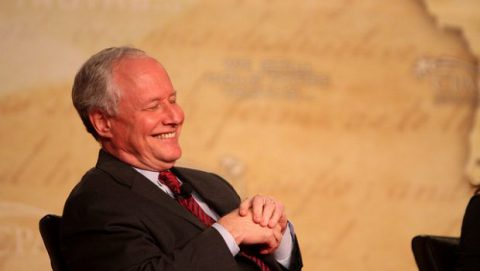
Bill Kristol—the Standard’s editor-at-large and co-founder and director of the Project for the New American Century (PNAC), which did so much to coordinate with the Bush administration in rallying elite support for the Iraq invasion— declared Abrams’s analysis a “must read” in a tweet issued Friday morning.
Indeed, prominent neocons clearly saw their opportunity after the lethal chemical attack on Khan Sheikhoun in Idlib province Tuesday to press their agenda on the administration.
None other than Paul Wolfowitz, Bush’s deputy defense secretary and a chief architect of the Iraq invasion and disastrous aftermath, suggested in a Wall Street Journal op-ed that statements by Trump’s senior officials suggesting that Washington was reconciled to Assad’s continued rule over the country may have emboldened the Syrian leader to test the limits.
Let us hope Mr. Trump will reassess the impact of recent statements by members of his administration indicating that the U.S. is prepared to live with the Assad regime. The Syrians—and their Russian and Iranian backers—might well have interpreted this as a signal that they could continue terrorizing the population.
Encouraged by Trump’s initial verbal condemnation of the gas attack, Wolfowitz made clear that action was required:
President Trump may have initially believed that he could avoid the fork in the road presented by the Assad regime’s use of chemical weapons in Syria by simply blaming the crime on Barack Obama’s failure to enforce his “red line” four years ago. Fortunately it seems he has reconsidered.
To drive the point home, the Journal editors headlined the op-ed “For Syria, Words Won’t Be Enough: Trump says attacking civilians crosses ‘many lines.’ Will he back it up?”
Meanwhile, the looniest among the neocons, former CIA director James Woolsey—who was one of the first to publicly claim a connection between Saddam Hussein and 9/11—was urging trump to do much, much more than a simple retaliatory strike.
This at least gives us an opportunity to do something that is tied to the Syrian events, and that would be to use force against the Iranian nuclear program … If we want to change the nature of the threat to us in that part of the world, what we have to do is take out the Iranian nuclear program—if we can without hitting any Russian units—and some of the Syrian capability.
Pump Up the Volume
Although most other neocons were not quite so explicit about their fondest desires, they made perfectly clear that Thursday’s cruise-missile strike should only be a first step toward a larger regional strategy designed to roll back Iranian (and Russian) influence (much as PNAC warned after 9/11 that taking out the Taliban in Afghanistan should only be a first step in the war against terror). Writing in the New York Daily News, Fred Kagan of the American Enterprise Institute (AEI) argued that
President Trump’s decision to attack the airfield from which the most recent chemical attack was launched must be the start of a new strategy. It must begin a campaign to drive the Assad regime to compromise. It must be the start of an effort to regain the confidence of Sunni Arabs in Syria and around the world that the U.S. stands with them against all those who would attack them, ISIS and Al Qaeda as well as Iran and its proxies.
Katherine Zimmerman has also echoed this theme of backing the region’s Sunni states. Like both Wolfowitz and Kagan, Zimmerman is based at AEI, the neoconservative think tank that not only led the public campaign for invading Iraq but played a critical role in planning the post-invasion occupation.
The US cruise missile strikes are the first step to restoring America’s credibility within the very population—the Sunni Arabs—that it must win over to secure its strategic interests in the Middle East. The action against the Assad regime starts to chip away at al Qaeda’s narrative that it alone is the defender of the Syrian Sunni. But an isolated response will not achieve systemic effects. It is impossible to defeat al Qaeda and ISIS without the support of the Sunni, and re-establishing America’s credibility will certainly be difficult.
(The irony of AEI’s strong backing for Sunnis throughout the region is particularly rich given its historic role in enhancing the influence of Ahmad Chalabi in the run-up to the Iraq invasion. Once re-installed in Iraq, Chalabi, a Shiite, was the principal driver of the “de-Baathification” that principally victimized Iraqi Sunnis.)
The same message was conveyed Friday by Christopher Griffin, the executive director of the Foreign Policy Initiative (FPI), PNAC’s lineal descendant, in a bulletin entitled “Syria Airstrike Necessary But Insufficient” in which he argued for reviving U.S. efforts to “empower a moderate opposition” to Assad with the larger ambition of diminishing Iran’s influence.
[I]t may now be possible for the U.S. to coordinate a meaningful coalition that brings together its Sunni Arab allies and potential partners within the Syrian opposition. Since 2014, a major constraint on that coordination has been Washington’s insistence on supporting only military operations against ISIS, and not the Assad regime. If American policy is revised, it will create new opportunities to protect the Syrian people from the Assad regime and to legitimize non-extremist alternatives to the ISIS and al Qaeda affiliates in Syria.
… If American pressure can limit Russian support while bringing together a more effective anti-Assad coalition, the United States may be able to isolate Iran and place one of its few allies in the Middle East at risk. The United States should not hesitate to seize such an opportunity.…
Neocon Overlap with Trump
Of course, this is precisely where the neocon agenda overlaps with that of Pentagon chief James Mattis who, of all the members of the Cabinet, seems to enjoy the greatest influence with Trump at the moment. Since serving as chief of the U.S. Central Command (CENTCOM), he has said on numerous occasions that Tehran poses the greatest long-term threat to U.S. interests in the Middle East, although, unlike many neocons, he strongly supports complying with the 2015 nuclear deal, the Joint Comprehensive Plan of Action (JCPOA). Late last month, the current CENTCOM commander, Army Gen. Joseph Votel, repeated that threat assessment and even suggested that he was eager to confront Iran militarily, presumably short of war. “We need to look at opportunities where we can disrupt [Iran] through military means or other means their activities,” he said.
CENTCOM, of course, has always been cozy with – and relied on — the region’s Sunni autocrats, whose seemingly insatiable appetite for sophisticated U.S. weaponry has the added benefit of profiting U.S. arms producers (on whose boards retired brass often serve). With Mattis at the Pentagon, Obama’s notion that Washington can help bring about some kind of equilibrium between the Sunni-led Gulf states to begin stabilizing the region is long gone. Washington’s clear alignment with the Emiratis and Saudis in their own catastrophic Yemen campaign since Trump took power makes that particularly clear. And, with Netanyahu publicly boasting about Israel’s growing security cooperation with the Gulfies, especially with the United Arab Emirates, out of their mutual hostility toward Iran, the convergence between the neocons and the Pentagon, at least insofar as the Middle East is concerned, is growing.
At the same time, however, the military has learned through painful experience, notably in Iraq, that indulging neocon notions such as “regime change” and “nation-building” is the road to perdition. If the neocons want to gain influence with the ascendant powers in the administration—Mattis, McMaster, and the brass—they have to proceed delicately, one step at a time. For example, Kristol’s tweet Saturday afternoon – “Punishing Assad for use of chemical weapons is good. Regime change in Iran is the prize” – is not going to help their cause. Similarly, if you’re looking for slippery slopes, look no further than the advice proffered by Kristol’s partner-in-hegemonism at PNAC and FPI, Bob Kagan, who argued for a slew of follow-up steps in a column entitled “What Must Come Next in Syria” in the Washington Post Sunday.
Griffin was one of about 150 mainly neocon national-security wonks who signed letters insisting that they would never serve in a Trump administration, an act that probably disqualifies him for consideration. Some prominent neocons— including Abrams, Fred Kagan, former Cheney national security adviser John Hannah, former Undersecretary of State Paula Dobriansky, former assistant secretary of state Stephen Rademaker, and Abram’s Mideast aide on the National Security Council Michael Doran, to name a few—decided against signing. Given the scores of senior foreign-policy positions that remain unfilled under Trump, this may be their moment.
Indeed, if Bannon and the “nationalists” are truly in eclipse, even some of those who signed those letters may now be back in consideration.
Photo of Bill Kristol by Gage Skidmore via Flickr
April 17, 2017
Posted by aletho |
Mainstream Media, Warmongering, Militarism, Timeless or most popular, Wars for Israel | Foreign Policy Initiative, Middle East, PNAC, Syria, United States, Zionism |
Leave a comment
 Aletho News
