Mainstream Media: the Indispensable Pre-War Preparations
By Greg Simons | Sputnik | April 9, 2017
The recent bombing of a Syrian airbase by American Tomahawk missiles was preceded by several days of heavy media coverage centered on the presumed “chemical attack” against the Khan Sheikhun community.
In fact, this press coverage was the only justification for the bombing, since the Organization for the Prohibition of Chemical Weapons (OPCW) and other international bodies simply had no time to properly investigate the circumstances.
This situation imposes additional responsibility on journalists, but were they up to the task? Unfortunately, just like in many previous cases, there were many immediate assumptions and immediate categorical statements that have been made concerning the presumed guilty party. The current situation is a vivid demonstration of the dilapidated state of the so-called fourth estate that is mixing, without any distinction, information and opinion in the news of this event.
If the hype and opinion are removed from the equation, what are the solid facts that are known about this really cruel act? The attack occurred on April 4, 2017 in the Khan Shaykhun area in the south of the Idlib province of Syria. This fact was recorded by OPCW and reflected in its press release.
For the Western mainstream media (MSM), at this point, the facts ended and allegations started. What is worse, these allegations bore all the hallmarks of propaganda. The MSM quickly assigned guilt and in many cases suggested a military course of action. In retrospective, the press coverage looks like a hasty justification for the US government’s position on the matter, which resulted in the bombing.
Here is the press statement of the US secretary of state, Rex Tillerson, issued immediately after the attack in Khan Shaykhun: “While we continue to monitor the terrible situation, it is clear that this is how Bashar al-Assad operates: with brutal unabashed barbarism. Those who defend or support him, including Russia and Iran, should have no illusions… Anyone who uses chemical weapons to attack his own people shows a fundamental disregard for human decency and must be held accountable.”
The first and the most frequently used technique of propaganda is assertion. It consists of presenting a disputed sequence of events or a debatable idea as a fact, with no further explanation. It reflects the public’s longing for a quick and easy explanation of events. Even Tillerson’s statement contains a lot of categorical and emotionally laden assertions, but offers very little in terms of hard evidence to back those claims. The guilt is also personalized (another typical element of propaganda), with Assad proclaimed guilty without any sort of trial or investigation.
Unfortunately, the MSM follow this tactic of distributing guilt by assertion. The MSM also adds to its guilt by association — a propaganda technique, in which previous misdeeds of some (possibly very different) actors are somehow associated with the demonized person. The scale of the blame is deliberately exaggerated or left unclear.

Syrian President Bashar al-Assad and his wife Asma al-Assad meeting in Damascus with families of Syrians who have lost relatives while fighting with terrorists in the country’s ongoing unrest.
The MSM did not busy itself with any sort of balanced contextual understanding, what was being projected and promoted was the notion of a massive scale crime immediately associated with Assad. A New York Times headline read “Worst Chemical Attack in Years in Syria; US Blames Assad“.
This headline is deceptive and misleading as it can be deduced that this is the worst single act in six years of the Syrian civil war, even though a bigger attack took place just recently — in 2013, near Damascus. Many other attacks, some of them possibly coming from the opposition groups fighting Mr. Assad, were also recorded since then. The authors have not seen the scene of the attack, but they rush to dramatize what they have not seen: “One of the worst chemical bombings in Syria turned a northern rebel-held area into a toxic kill zone on Tuesday, inciting international outrage over the ever-increasing government impunity shown in the country’s six-year war.” This one sentence contains a number of different elements of propaganda. One of them is bandwagoning — in this case the entire international community’s reaction is represented as aligning itself with the US’ position, without the authors specifying the positions of individual countries. In addition, the implication is that the Syrian government must abide by the NYT’s representation of what the international opinion and reaction is. Assertion propaganda also appears, where there is little to no evidence provided to support the assertion (in this case concerning the ever-increasing impunity and the assigned guilt of Mr. Assad in person). The headline and the very end of the article also differ in terms of the strength of the assigned guilt. The headline contained “US blames Assad” (certainty is projected), but the last paragraph notes that “a chemical weapons attack, if carried out by the government…” denotes much less certainty of the guilty party.
Fox News, while representing a different, “illiberal” wing of the American MSM, is involved in the same kind of propaganda as the New York Times. The simplest technique is exaggeration. Here is the headline: “At Least 100 Dead in a Suspected Chemical Attack in Syria, Hospital Reportedly Hit“.
Very soon we shall read that even by the most pessimistic accounts there were less than 90 victims, and not “at least 100” offered to us by Fox News. But Fox News never apologized or corrected itself. In the article they present a slideshow with “heartbreaking images of gas attack victims.” This particular statement contradicts the headline that points to “a suspected chemical attack” and not a definite one. As to the “hospital reportedly hit”, once again there is no certainty or due diligence concerning the verification of information, which should be a standard journalistic good practice. Fox’s sources of information include the MSM standard source, the Syrian Observatory for Human Rights, which is a shadowy organization that has been actively campaigning for regime change in Syria. In addition to this source, they use the White Helmets, which are in fact a Western-funded organization that is called by some as “al-Qaeda’s civil defense.”
The last, but certainly not the least effective means of propaganda is an emotional attack on the audience. The reader (or the viewer) is put face to face with such unbearable cruelty, that it spurs him to justify any military action (in this case — from the US government) that would remove the terrible descriptions from a newspaper page or the unbearable images from the screen before his eyes. A headline appearing in Vox certainly is among the most emotionally-based ones — “Bashar al-Assad Just Gassed His Own People, Then Bombed the Clinic Treating Victims”
This article also uses a personalized form of character assassination against Assad, lacking any proof to back up the claims, and hypes the level and scale of the alleged atrocities committed. The information that is published in the article is not even verified, as it is admitted on the first page. Once more a great deal of stress is placed on the deaths of children. As with Reuters, some quotes by Syrian government and Russian sources are published, but hidden in the middle of the article. The end of the article confirms the conspiracy theory of the Syrian government’s guilt in this matter, using selective historical accounts to try and create the picture of a pattern (as opposed to an isolated incident) of atrocities by the ‘bad’ character of this story.
All in all, these practices of the MSM media should be remembered and in due time used against it. Not only politicians justifying war should be held to account, if we are allowed to use MSM’s favorite formula. Journalism once more found itself in the situation of not only supporting war, but enabling it, war journalism at its very worst and supporting a narrow set of destructive political interests that are very far from the public interest of starting yet another war of choice.
See also:
What US Officials Fail to Mention When Blaming Assad for Idlib Chemical Attack
US State Senator Says ‘Zero Probability’ Assad Government Launched Gas Attack
Where Was CIA’s Pompeo on Syria?
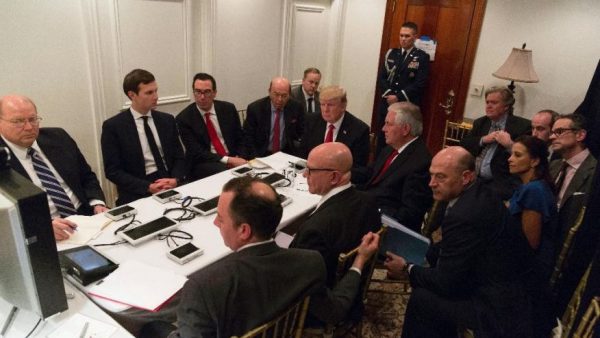
President Trump meeting with his advisers at his estate in Mar-a-Lago on April 6, 2017
By Robert Parry | Consortium News | April 8, 2017
There is a dark mystery behind the White House-released photo showing President Trump and more than a dozen advisers meeting at his estate in Mar-a-Lago after his decision to strike Syria with Tomahawk missiles: Where is CIA Director Mike Pompeo and other top intelligence officials?
Before the photo was released on Friday, a source told me that Pompeo had personally briefed Trump on April 6 about the CIA’s belief that Syrian President Bashar al-Assad was likely not responsible for the lethal poison-gas incident in northern Syria two days earlier — and thus Pompeo was excluded from the larger meeting as Trump reached a contrary decision.
At the time, I found the information dubious since Trump, Secretary of State Rex Tillerson and other senior U.S. officials were declaring quite confidently that Assad was at fault. Given that apparent confidence, I assumed that Pompeo and the CIA must have signed off on the conclusion of Assad’s guilt even though I knew that some U.S. intelligence analysts had contrary opinions, that they viewed the incident as either an accidental release of chemicals or an intentional ploy by Al Qaeda rebels to sucker the U.S. into attacking Syria.
As strange as the Trump administration has been in its early months, it was hard for me to believe that Trump would have listened to the CIA’s views and then shooed the director away from the larger meeting before launching a military strike against a country not threatening America.
After the strike against Syria by 59 Tomahawk missiles, which Syrian officials said killed seven people including four children, Trump gave a speech to the American people declaring flatly:
“On Tuesday, Syrian dictator Bashar al-Assad launched a horrible chemical weapons attack on innocent civilians. Using a deadly nerve agent, Assad choked out the lives of helpless men, women, and children. It was a slow and brutal death for so many. Even beautiful babies were cruelly murdered in this very barbaric attack. No child of God should ever suffer such horror.”
As much as Trump stood to benefit politically by acting aggressively in attacking Syria — and thus winning praise even from his harshest critics — the idea that he would ignore the views of the U.S. intelligence community on an issue of war or peace was something that I found hard to believe.
So, I put aside what I had heard from the source about the discordant Pompeo-Trump meeting as the sort of tidbit that may come from someone who lacks first-hand knowledge and doesn’t get all the details right.
After all, in almost every similar situation that I had covered over decades, the CIA Director or the Director of National Intelligence has played a prominent role in decisions that depend heavily on the intelligence community’s assessments and actions.
For instance, in the famous photo of President Obama and his team waiting out the results of the 2011 raid to kill Al Qaeda leader Osama bin Laden, CIA Director Leon Panetta is the one on the conference screen that everyone is looking at.
Even when the U.S. government is presenting false information, such as Secretary of State Colin Powell’s 2003 speech laying out the bogus evidence of Iraq hiding WMDs, CIA Director George Tenet was seated behind Powell to lend credibility to the falsehoods.
At the Table
But in the photo of Trump and his advisers, no one from the intelligence community is in the frame. You see Trump, Secretary of State Tillerson, National Security Adviser H.R. McMaster, White House chief of staff Reince Priebus, strategic adviser Steve Bannon, son-in-law Jared Kushner and a variety of other officials, including some economic advisers who were at Mar-a-Lago in Florida for the meeting with Chinese President Xi Jinping.
However, you don’t see Pompeo or Director of National Intelligence Dan Coats or any other intelligence official. Even The New York Times noted the oddity in its Saturday editions, writing: “If there were C.I.A. and other intelligence briefers around, … they are not in the picture.”
That made me wonder whether perhaps my original source did know something. The claim was that CIA Director Pompeo had briefed Trump personally on the analysts’ assessment that Assad’s forces were not responsible, but – then with Pompeo sidelined – Trump conveyed his own version of the intelligence to his senior staff.
In other words, the other officials didn’t get the direct word from Pompeo but rather received a second-hand account from the President, the source said. Did Trump choose to rely on the smug certainty from the TV shows and the mainstream news media that Assad was guilty, rather than the contrary view of U.S. intelligence analysts?
After the attack, Secretary of State Tillerson, who is not an institutional intelligence official and has little experience with the subtleties of intelligence, was the one to claim that the U.S. intelligence community assessed with a “high degree of confidence” that the Syrian government had dropped a poison gas bomb on civilians in Idlib province.
While Tillerson’s comment meshed with Official Washington’s hastily formed groupthink of Assad’s guilt, it is hard to believe that CIA analysts would have settled on such a firm conclusion so quickly, especially given the remote location of the incident and the fact that the initial information was coming from pro-rebel (or Al Qaeda) sources.
Thus, a serious question arises whether President Trump did receive that “high degree of confidence” assessment from the intelligence community or whether he shunted Pompeo aside to eliminate an obstacle to his desire to launch the April 6 rocket attack.
If so, such a dangerous deception more than anything else we’ve seen in the first two-plus months of the Trump administration would be grounds for impeachment – ignoring the opinion of the U.S. intelligence community so the President could carry out a politically popular (albeit illegal) missile strike that killed Syrians.
Investigative reporter Robert Parry broke many of the Iran-Contra stories for The Associated Press and Newsweek in the 1980s.
Netanyahu: ‘Israel’ Committed to Treating Syrian War Wounded
Al-Manar – April 9, 2017
Israeli Prime Minister Benjamin Netanyahu said Sunday that ‘Israel’ remained committed to treating war wounded from Syria and reaffirmed his support for last week’s US air strike in Syria.
In comments at the start of a cabinet meeting, Netanyahu said “Israel is caring for wounded Syrians as part of a humanitarian effort,” “We will continue to do so.”
Israeli media reported that a proposal to do so had been met with objections from some government and security officials due to logistical difficulties, with the location far from the Zionist entity.
The occupying entity has treated more than 3,000 war wounded militants from Syria in what it describes as a ‘humanitarian gesture’.
It says it treats whoever makes it to the demarcation line regardless of affiliation, though ‘Israel’ is accused of supporting terrorists.
Netanyahu spoke again of his support for last week’s US missile strike against a Syrian airbase.
Luring Trump into Mideast Wars
By Daniel Lazare | Consortium News | April 8, 2017
Donald Trump entered military terra incognita on Thursday by launching an illegal Tomahawk missile strike on an air base in eastern Syria. Beyond the clear violation of international law, the practical results are likely to be disastrous, drawing the U.S. deeper into the Syrian quagmire.
But it would be a mistake to focus all the criticism on Trump. Not only are Democrats also at fault, but a good argument could be made that they bear even greater responsibility.
For years, near-total unanimity has reigned on Capitol Hill concerning America’s latest villains du jour, Russia’s Vladimir Putin and Syria’s Bashar al-Assad. Congressmen, senators, think-tank strategists, and op-ed analysts all have agreed that Putin and Assad are the prime enemies of “peace,” by which is meant global American hegemony, and that therefore the U.S. must stop at nothing to weaken or neutralize them or force them to exit the world stage.
Until recently, in fact, just about the only politically significant dissenter was Trump. Accusing reporters of twisting the news at a tumultuous press conference in late February, he told them, “Now tomorrow, you’ll say, ‘Donald Trump wants to get along with Russia, this is terrible.’ It’s not terrible. It’s good.”
But since getting along with Russia was terrible for America’s perpetually bellicose foreign-policy establishment, Official Washington declared war on Trump, building on Hillary Clinton’s charge during the last presidential debate that he was Putin’s “puppet.” It became the conventional wisdom that Trump was a “Siberian candidate” being inserted in the White House by a satanic Kremlin determined to bend freedom-loving Americans to its will.
As Inauguration Day approached, President Obama’s intelligence chiefs pulled out all stops to persuade the public that (a) Russian intelligence had engineered Clinton’s defeat by hacking the Democratic National Committee’s computers and placing thousands of embarrassing emails in the hands of WikiLeaks and that (b) Trump was somehow complicit in the effort.
The campaign was highly effective. The alleged Putin-Trump relationship was a major feature at the anti-Trump protests surrounding his inauguration and the major U.S. news media pounded on the Russia “scandal” daily.
On Feb. 13, barely four weeks after taking office, Trump crumbled under a mounting barrage of political abuse and gave National Security Adviser Michael Flynn the boot after it was revealed that he had talked with Russian Ambassador Sergey Kislyak during the transition, supposedly in violation of the 1799 Logan Act, an absurd piece of ancient legislation that even The New York Times referred to as “a dusty, old law” that should have been repealed generations ago.
Under Media Pressure
A day later, the administration reeled again when the Times charged in a front-page exposé that “members of Donald J. Trump’s 2016 presidential campaign and other Trump associates had repeated contacts with senior Russian intelligence officials in the year before the election.”
The article provided no evidence and no names and said nothing about whether such contacts were knowing or unknowing, i.e., whether they involved a John le Carré-style midnight rendezvous or merely an exchange of pleasantries with someone who may or may not have been connected to the FSB, as Russia’s version of the CIA is known.
In a March 6 article entitled “Pause This Presidency,” Times columnist Charles M. Blow called for little less than a coup d’état: “The American people must immediately demand a cessation of all consequential actions by this ‘president’ until we can be assured that Russian efforts to hack our election … did not also include collusion with or cover-up by anyone involved in the Trump campaign and now administration.”
How “the American people” would demand such a cessation or who would provide such assurances was not specified.
On March 31, CNN quoted an unnamed senior administration official saying that Trump’s hopes of a rapprochement with Russia were fading because he “believes in the current atmosphere – with so much media scrutiny and ongoing probes into Trump-Russia ties and election meddling – that it won’t be possible to ‘make a deal.’”
Thus, Trump found himself increasingly boxed in by hostile forces. But he still tried to fulfill his promise to concentrate on defeating terrorists in Syria and Iraq. On March 30, U.S. Ambassador to the United Nations Nikki Haley announced that the U.S. administration “priority is no longer to sit there and focus on getting Assad out,” but to concentrate on defeating Al Qaeda and ISIS instead.
But the more Trump contemplated his predicament in the following days, the more he realized how untenable it had come. Tuesday’s poison-gas incident in Idlib thus offered a way out regardless of who was actually responsible. The only way for Trump to make peace with the “deep state” in Washington was by waging war on Syria.
Finally, on Thursday, hours before Trump sent a volley of cruise missiles wafting towards Syria, Hillary Clinton taunted him by declaring that America “should take out his [Assad’s] airfields and prevent him from being able to use them to bomb innocent people.” The effect was to all but force Trump to show that he was every bit as macho as the former First Lady.
Frog-Marching Trump
Trump is certainly a fool for going ahead with such an attack in clear contravention of international law and entangling the United States more deeply into the complicated Syrian conflict. But the blame also should go to the people who frog-marched him to the precipice and then all but commanded him to step over the edge.
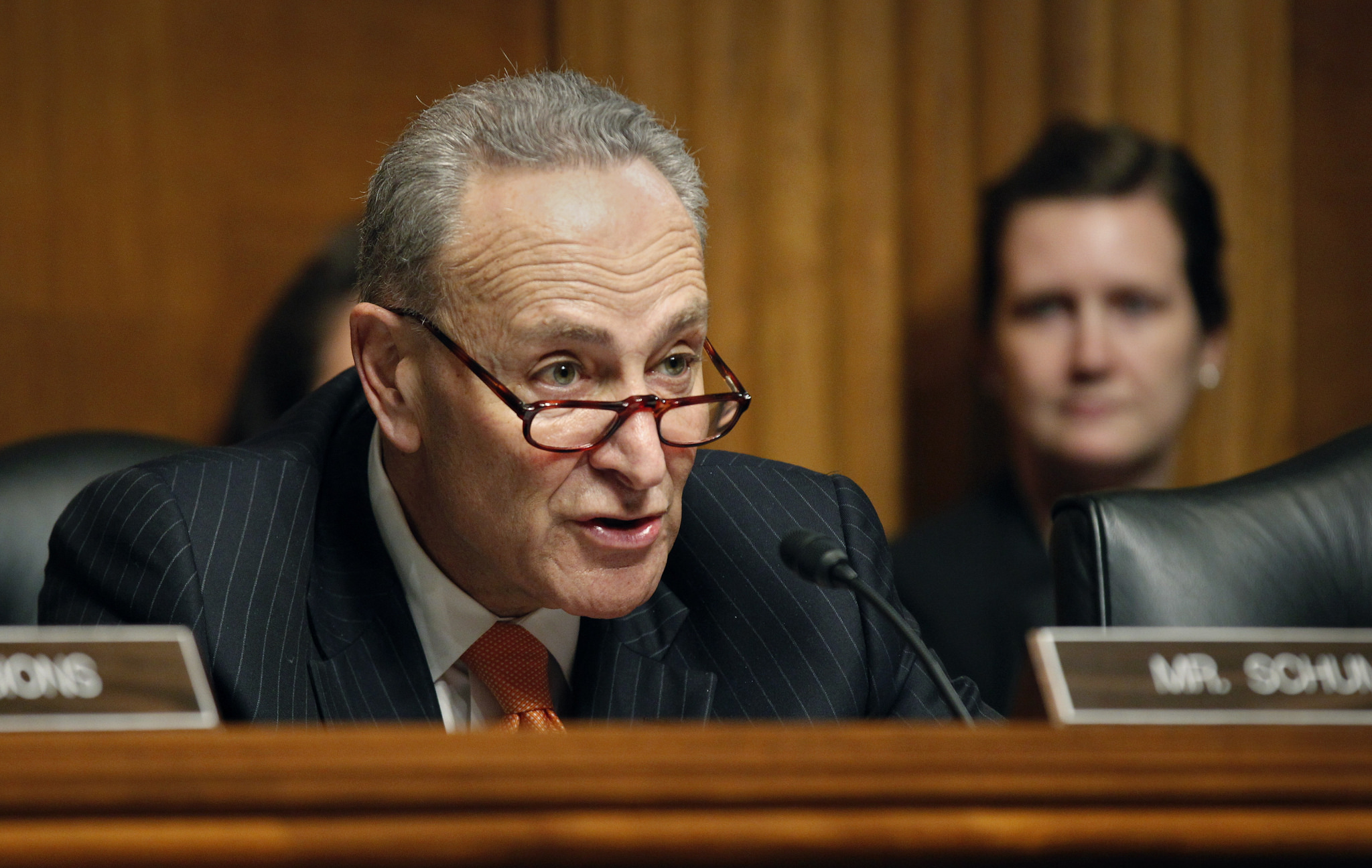
Sen. Charles Schumer, D-New York
Within hours, all the usual suspects were congratulating one of the most scorned U.S. presidents in history for taking the leap.
Senate Minority Leader Chuck Schumer said: “Making sure Assad knows that when he commits such despicable atrocities he will pay a price is the right thing to do.” House Minority Leader Nancy Pelosi described Trump’s missile barrage as “a proportional response to the regime’s use of chemical weapons.”
Republican super-hawks Senators John McCain and Lindsey Graham, previously as anti-administration as any Democrat, issued a joint statement declaring that Trump “deserves the support of the American people,” while liberal heart-throb Sen. Elizabeth Warren also agreed that “the Syrian regime must be held accountable for this horrific act.”
The Guardian, as fiercely anti-Trump as it is anti-Putin and anti-Assad, conceded that “Donald Trump has made his point” and that the next step would be up to Russia. All in all, Trump had never gotten such good press. It’s clear that Official Washington was pleased with Trump’s handiwork and was eager to encourage him to do more.
But the missile barrage was not just an assault on Syria but on reason and good sense, too. Although the Washington Post’s Adam Taylor tried to make it seem that the only critics of the missile barrage are members of the alt-right “known for espousing racist, anti-Semitic and sexist points of view,” the fact is that criticism flowed in from other quarters.
At Alternet, Vijay Prashad pointed out that there were few independent observers in Khan Shaykhun, the farming town where the April 4 incident occurred, to provide an accurate account. Eyewitnesses “with the densest relationship to the armed opposition,” he wrote, “are the first to claim that this attack was done by the government.”
Consortiumnews’ Robert Parry pointed out that rather than dropping the gas themselves, Syrian or Russian warplanes could well have triggered an outbreak by bombing a facility containing “chemicals that the rebels were planning to use in some future attack.” Parry also noted that Al Qaeda, which controls Idlib province, could have “staged the incident to elicit precisely the international outrage directed at Assad as has occurred.”
[Previously, United Nations investigators have received eyewitness testimony from Syrians about rebels staging an alleged chlorine-bomb attack so it would be pinned on the Assad regime.]
Something similar may well have occurred in August 2013, a sarin-gas missile attack on the outskirts of Damascus that killed hundreds and that appears to have been launched from a rebel-controlled area two kilometers away. The two incidents are curiously parallel.
The August 2013 incident, which horrified the world and brought the Obama administration to the brink of its own attack on the Syrian government, occurred just days after a U.N. team had arrived in Damascus to investigate an alleged chemical attack by rebels against Syrian government troops some four months earlier.
It made little sense for the Assad regime to have invited U.N. investigators in and then launch a more horrific chemical-weapons attack just miles from the investigators’ hotel. It would be a bit like someone inviting a police inspector to dinner and then committing a murder in full view.
Not Making Sense
As one independent analysis noted in 2013, the Assad regime would have to have decided to carry out a large-scale attack “despite (a) making steady gains against rebel positions, (b) receiving a direct threat from the US that the use of chemical weapons would trigger intervention, (c) having constantly assured their Russian allies that they will not use such weapons, (d) prior to the attack, only using non-lethal chemicals and only against military targets.”
The Assad government would also have had to decide “to (a) send forces into rebel-held area, where they are exposed to sniper fire from multiple directions, (b) use locally manufactured short-range rockets, instead of any of the long-range high quality chemical weapons in their arsenal, and (c) use low quality sarin.”
All of which seems supremely unlikely, but much of the mainstream U.S. media still treats the 2013 sarin-gas attack as the undeniable case of Assad crossing Obama’s “red line” against using chemical weapons. And the highly dubious 2013 incident is cited as a key reason to believe that Assad has done it again. [Recently, The New York Times has quietly backed off the 2013 claims although not explicitly retracting its earlier reporting blaming the attack on the Assad regime.]
Assad would have possibly even stronger reasons not to deploy sarin gas on April 4, 2017. He would have to make a conscious decision to court world opprobrium at a time when the tide of the war was finally turning in his favor with the liberation of Aleppo last December and with most world leaders having concluded that the Assad regime was here to stay.
To have produced and deployed a sarin bomb would have meant deliberately risking military intervention more than three years after Syria reached an agreement with the United Nations to destroy its entire chemical-weapons stockpile so as to avoid … military intervention.
All of which seems supremely unlikely as well. It would be an act of suicide – and after holding off a combined U.S., Saudi, Qatari, and Turkish assault for half a decade or more, one thing that Assad does not appear to be is suicidal.
Although Secretary of State Rex Tillerson said, “there is no doubt in our mind that the Syrian regime under the leadership of Bashar al-Assad is responsible for this horrific attack,” in reality there is plenty of doubt.
Nevertheless, Trump decided to fire away before the facts were in because the enemy he is most worried about is not the one half a world away in Syria, but the Democratic-neocon alliance in his own backyard. The political warfare in Washington is now generating more agony from real wars in the Middle East.
Experts should be sent to Syrian airbase attacked by US to carry out chemical probe – Russian MoD
RT | April 8, 2017
Washington has presented “no evidence whatsoever” yet that the Shayrat airfield in Syria’s Homs Province targeted by the US after an alleged chemical attack in Idlib had any such weapons, the Russian Defense Ministry said.
“Twenty-four hours have passed since the US Navy warships launched a massive missile strike at the Shayrat airfield, and neither the Pentagon nor the State Department have provided any evidence of presence of chemical weapons at this airbase,” the ministry spokesman, Major-General Igor Konashenkov, said in a statement on Saturday.
Dozens of representatives of the media, local authorities, fire departments, police, and the Syrian military have visited the airfield since then, with no alleged “storage units” or any chemical shells having been found, he said.
“The only way to receive and present to the whole international community any objective evidence on the alleged presence of poisonous substances at Shayrat is to send a mission of professional experts there,” the defense ministry statement said.
Early Friday morning, the US launched 59 Tomahawk missiles at the airfield, ordered by US President Donald Trump in response to the alleged chemical attack in Syria’s Idlib Province. Dozens of civilians including children died from suspected gas poisoning in the rebel-occupied territory earlier this month, with Washington blaming the Syrian government for the incident.
Calling its attack on the airbase a “targeted military strike,” Trump claimed the airfield in Homs was where the alleged chemical gas attack originated.
Suspected US-led coalition air strike kills at least 10 civilians west of Raqqa – reports
RT | April 8, 2017
At least 10 civilians have been killed in a Syrian village near the city of Raqqa, in an alleged air strike by the US-led coalition, Syrian media report.
The strike targeted a village to the west of Raqqa, SANA news agency reports. The attack caused casualties among the civilian population, SANA said, citing its local sources.
The alleged air strike and the same number of casualties was also reported by Syrian Tishreen newspaper, citing its sources.
Washington and its allies have been carrying out air strikes near Raqqa to provide support for the Kurdish-led Syrian Democratic Forces fighting Islamic State (IS, formerly ISIS/ISIL).
Trump Likely Manipulated Into Ordering Missile Attacks on Syria
Sputnik – 08.04.2017
WASHINGTON – US President Donald Trump appears to have been psychologically profiled and manipulated into ordering cruise missile airstrikes against Syria, former US Air Force Lieutenant Colonel Karen Kwiatkowski told Sputnik.
On Friday, US senior military officials disclosed declassified intelligence information to lay out reasoning behind the attack on the Syrian military airfield in Ash Sha’irat near Homs late Thursday.
“Trump appears to have been easily manipulated into this response,” Kwiatkowski said on Friday. “It could have not been more effective if President Trump had been psychologically profiled and specifically manipulated into this ‘surprise’ decision.”
Trump’s instinctive response to the first pictures of the use of chemical weapons “would have been easily predictable from a psychological analysis,” Kwiatkowski stated.
Kwiatkowski pointed out that parts of US foreign policy, defense and intelligence community and their supporters in the media had been very concerned over Trump’s long-expressed “America First” foreign policy approach.
“Reported events [on] Tuesday in Idlib served these interests well, and I believe it was an opportunity for these factions to attempt to prolong the wars in the Middle East, and ultimately further entrench their business and political interests,” she observed.
Kwiatkowski noted that Trump had ordered the missile strikes against Syrian military targets without taking action to carefully confirm Damascus had actually delivered the weapons and detonated them.
“Because evidence at the Syrian Air Base in Homs has likely been compromised by the impacts of 59 Tomahawk cruise missiles, the investigation will be even more difficult to conduct,” she remarked.
Kwiatkowski said she was surprised at the eagerness with which the US media joined the call for an attack, given the lack of concrete analysis of what happened in Idlib on Tuesday.
“It is as if the western media, time and time again, receives talking points from various governmental factions and republishes them uncritically and without verification,” she said.
Kwiatkowski expressed the hope that Trump would come to realize his cruise missile order had been premature and that he would revert to his previous efforts to reduce US military involvement across the Middle East.
“I personally believe that the percolation of correct intelligence will soon reach the White House, and US policy will revert back to Trump’s original position in the region, which is military disengagement and real self-determination for people there,” she said.
Some US officials were working to try and protect Islamic State fighters from being captured by Syrian government forces and finding protection for them after all the outrages they had perpetrated, Kwiatkowski warned.
“It seems to me that in Mosul and throughout Syria, IS fighters and leaders who have worked with the US are trying to ensure that they will be protected, and the US may be trying to ensure that many of its former ‘rebel’ colleagues are… provided safe haven out of the countries,” she said.
However, the search for truth about what really happened in the chemical weapons attack at Idlib would continue aggressively, Kwiatkowski concluded.
Trump’s ‘Wag the Dog’ Moment
By Robert Parry | Consortium News | April 7, 2017
Just two days after news broke of an alleged poison-gas attack in northern Syria, President Trump brushed aside advice from some U.S. intelligence analysts doubting the Syrian regime’s guilt and launched a lethal retaliatory missile strike against a Syrian airfield.
Trump immediately won plaudits from Official Washington, especially from neoconservatives who have been trying to wrestle control of his foreign policy away from his nationalist and personal advisers since the days after his surprise victory on Nov. 8.
There is also an internal dispute over the intelligence. On Thursday night, Secretary of State Rex Tillerson said the U.S. intelligence community assessed with a “high degree of confidence” that the Syrian government had dropped a poison gas bomb on civilians in Idlib province.
But a number of intelligence sources have made contradictory assessments, saying the preponderance of evidence suggests that Al Qaeda-affiliated rebels were at fault, either by orchestrating an intentional release of a chemical agent as a provocation or by possessing containers of poison gas that ruptured during a conventional bombing raid.
One intelligence source told me that the most likely scenario was a staged event by the rebels intended to force Trump to reverse a policy, announced only days earlier, that the U.S. government would no longer seek “regime change” in Syria and would focus on attacking the common enemy, Islamic terror groups that represent the core of the rebel forces.
The source said the Trump national security team split between the President’s close personal advisers, such as nationalist firebrand Steve Bannon and son-in-law Jared Kushner, on one side and old-line neocons who have regrouped under National Security Adviser H.R. McMaster, an Army general who was a protégé of neocon favorite Gen. David Petraeus.
White House Infighting
In this telling, the earlier ouster of retired Gen. Michael Flynn as national security adviser and this week’s removal of Bannon from the National Security Council were key steps in the reassertion of neocon influence inside the Trump presidency. The strange personalities and ideological extremism of Flynn and Bannon made their ousters easier, but they were obstacles that the neocons wanted removed.
Though Bannon and Kushner are often presented as rivals, the source said, they shared the belief that Trump should tell the truth about Syria, revealing the Obama administration’s CIA analysis that a fatal sarin gas attack in 2013 was a “false-flag” operation intended to sucker President Obama into fully joining the Syrian war on the side of the rebels — and the intelligence analysts’ similar beliefs about Tuesday’s incident.
Instead, Trump went along with the idea of embracing the initial rush to judgment blaming Assad for the Idlib poison-gas event. The source added that Trump saw Thursday night’s missile assault as a way to change the conversation in Washington, where his administration has been under fierce attack from Democrats claiming that his election resulted from a Russian covert operation.
If changing the narrative was Trump’s goal, it achieved some initial success with several of Trump’s fiercest neocon critics, such as neocon Senators John McCain and Lindsey Graham, praising the missile strike, as did Israeli Prime Minister Benjamin Netanyahu. The neocons and Israel have long sought “regime change” in Damascus even if the ouster of Assad might lead to a victory by Islamic extremists associated with Al Qaeda and/or the Islamic State.
Wagging the Dog
Trump employing a “wag the dog” strategy, in which he highlights his leadership on an international crisis to divert attention from domestic political problems, is reminiscent of President Bill Clinton’s decision to attack Serbia in 1999 as impeachment clouds were building around his sexual relationship with intern Monica Lewinsky.
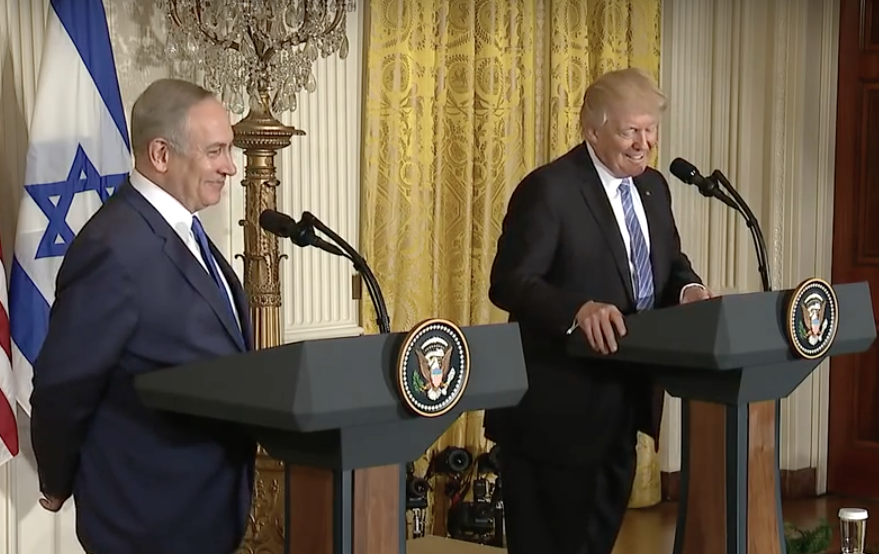
Screen shot from Whitehouse.gov
Trump’s advisers, in briefing the press on Thursday night, went to great lengths to highlight Trump’s compassion toward the victims of the poison gas and his decisiveness in bombing Assad’s military in contrast to Obama’s willingness to allow the intelligence community to conduct a serious review of the evidence surrounding the 2013 sarin-gas case.
Ultimately, Obama listened to his intelligence advisers who told him there was no “slam-dunk” evidence implicating Assad’s regime and he pulled back from a military strike at the last minute – while publicly maintaining the fiction that the U.S. government was certain of Assad’s guilt.
In both cases – 2013 and 2017 – there were strong reasons to doubt Assad’s responsibility. In 2013, he had just invited United Nations inspectors into Syria to investigate cases of alleged rebel use of chemical weapons and thus it made no sense that he would launch a sarin attack in the Damascus suburbs, guaranteeing that the U.N. inspectors would be diverted to that case.
Similarly, now, Assad’s military has gained a decisive advantage over the rebels and he had just scored a major diplomatic victory with the Trump administration’s announcement that the U.S. was no longer seeking “regime change” in Syria. The savvy Assad would know that a chemical weapon attack now would likely result in U.S. retaliation and jeopardize the gains that his military has achieved with Russian and Iranian help.
The counter-argument to this logic – made by The New York Times and other neocon-oriented news outlets – essentially maintains that Assad is a crazed barbarian who was testing out his newfound position of strength by baiting President Trump. Of course, if that were the case, it would have made sense that Assad would have boasted of his act, rather than deny it.
But logic and respect for facts no longer prevail inside Official Washington, nor inside the mainstream U.S. news media.
Intelligence Uprising
Alarm within the U.S. intelligence community about Trump’s hasty decision to attack Syria reverberated from the Middle East back to Washington, where former CIA officer Philip Giraldi reported hearing from his intelligence contacts in the field that they were shocked at how the new poison-gas story was being distorted by Trump and the mainstream U.S. news media.
Giraldi told Scott Horton’s Webcast: “I’m hearing from sources on the ground in the Middle East, people who are intimately familiar with the intelligence that is available who are saying that the essential narrative that we’re all hearing about the Syrian government or the Russians using chemical weapons on innocent civilians is a sham.”
Giraldi said his sources were more in line with an analysis postulating an accidental release of the poison gas after an Al Qaeda arms depot was hit by a Russian airstrike.
“The intelligence confirms pretty much the account that the Russians have been giving … which is that they hit a warehouse where the rebels – now these are rebels that are, of course, connected with Al Qaeda – where the rebels were storing chemicals of their own and it basically caused an explosion that resulted in the casualties. Apparently the intelligence on this is very clear.”
Giraldi said the anger within the intelligence community over the distortion of intelligence to justify Trump’s military retaliation was so great that some covert officers were considering going public.
“People in both the agency [the CIA] and in the military who are aware of the intelligence are freaking out about this because essentially Trump completely misrepresented what he already should have known – but maybe he didn’t – and they’re afraid that this is moving toward a situation that could easily turn into an armed conflict,” Giraldi said before Thursday night’s missile strike. “They are astonished by how this is being played by the administration and by the U.S. media.”
One-Sided Coverage
The mainstream U.S. media has presented the current crisis with the same profound neocon bias that has infected the coverage of Syria and the larger Middle East for decades. For instance, The New York Times on Friday published a lead story by Michael R. Gordon and Michael D. Shear that treated the Syrian government’s responsibility for the poison-gas incident as flat-fact. The lengthy story did not even deign to include the denials from Syria and Russia that they were responsible for any intentional deployment of poison gas.
The article also fit with Trump’s desire that he be portrayed as a decisive and forceful leader. He is depicted as presiding over intense deliberations of war or peace and displaying a deep humanitarianism regarding the poison-gas victims, one of the rare moments when the Times, which has become a reliable neocon propaganda sheet, has written anything favorable about Trump at all.
According to Syrian reports on Friday, the U.S. attack killed 13 people, including five soldiers at the airbase.
Gordon, whose service to the neocon cause is notorious, was the lead author with Judith Miller of the Times’ bogus “aluminum tube” story in 2002 which falsely claimed that Iraqi leader Saddam Hussein was reconstituting a nuclear-weapons program, an article that was then cited by President George W. Bush’s aides as a key argument for invading Iraq in 2003.
Regarding this week’s events, Trump’s desperation to reverse his negative media coverage and the dubious evidence blaming Assad for the Idlib incident could fit with the “Wag the Dog” movie from 1997 in which an embattled president creates a phony foreign crisis in Albania.
In the movie, the White House operation is a cynical psychological operation to convince the American people that innocent Albanian children, including an attractive girl carrying a cat, are in danger when, In reality, the girl was an actor posing before a green screen that allowed scenes of fiery ruins to be inserted as background.
Today, because Trump and his administration are now committed to convincing Americans that Assad really was responsible for Tuesday’s poison-gas tragedy, the prospects for a full and open investigation are effectively ended. We may never know if there is truth to those allegations or whether we are being manipulated by another “wag the dog” psyop.
Investigative reporter Robert Parry broke many of the Iran-Contra stories for The Associated Press and Newsweek in the 1980s.
Israel seeks buffer zone on borders with Syria
MEMO | April 8, 2017
Israeli Prime Minister Benjamin Netanyahu is seeking a buffer zone against Syria, Iran and Hezbollah on the borders with Syria to be part of any future deal to end the Syrian crisis, Israeli newspaper Haaretz reported on Friday.
According to the Israeli newspaper, Netanyahu proposed this issue during meetings with American and other coalition countries.
Netanyahu wants to prevent Iran and Hezbollah from establishing a foothold and he intends to undermine future attacks against Israel, noting that he had suggested international forces to supervise his proposed buffer zone.
Last Friday, the Israeli Maariv revealed that Netanyahu sent messages to the international parties involved in the talks about Syria’s future.
These messages, according to the Egyptian news website Moheet, suggested Israel’s desire to decrease its reliance on military attacks on Syria in exchange for reaching a silent agreement that Iran and Hezbollah do not approach the Armistice Line in the occupied Golan Heights.
Maariv said that Israel would accept the return of the Syrian army to the border area connected with the occupied Palestinian territories based on a 1974 deal between the two.
Meanwhile, the Israeli newspaper reported fears from the Israeli political and military leadership from reaching a deal which kept Bashar Al-Assad as president and this would give Iran the chance to deploy forces loyal to it in areas close to the Golan Heights.
Over the past year, the Israeli military has carried out several airstrikes deep inside Syria, targeting Hezbollah’s personnel and weapons.
Featured Video
Integrity Initiative: UK-funded network framed dissent as Russian disinformation for years
or go to
Aletho News Archives – Video-Images
From the Archives
Why Saudi Ties to 9/11 Mean U.S. Ties to 9/11
By Kevin Ryan | Dig Within | September 27, 2015
Media interest in Saudi Arabian connections to the crimes of 9/11 has centered on calls for the release of the 28 missing pages from the Joint Congressional Inquiry’s report. However, those calls focus on the question of hijacker financing and omit the most interesting links between the 9/11 attacks and Saudi Arabia—links that implicate powerful people in the United States. Here are twenty examples. … continue
Blog Roll
 Aletho News
- IAEA inspectors cannot return to Iran amid US threats: Russia
- Senate Rejects Iran War Powers Resolution Passed By House
- ‘We did not attack Pakistan with drones’: Afghan sources
- Iraqi Resistance faction links arms to sovereignty, questions US exit
- Cannon fodder no more… South Korea rejects Trump’s pressure to join his criminal war on Iran
- Neria Leiter Was A Legitimate Military Target
- Integrity Initiative: UK-funded network framed dissent as Russian disinformation for years
- ‘We don’t seek permission to defend our country’: Snippets from President Pezeshkian’s UNGA address
- NATO chief wants Europeans to fight American wars [for Israel]
- German chemicals giant reveals details of downsizing
- If Americans Knew
- In UN Speech, Iran’s President Displays Pictures of Children Killed by US, Brings Attention to Israel’s Nuclear Arsenal
- Israel displaces hundreds of Palestinians amid wave of demolitions in West Bank
- Aid, reconstruction, and Israel’s history of obstruction in Gaza
- Trump administration digs an ever-deeper hole of complicity in genocide – Daily Update
- US-Israel $2.8 Billion Arms Deal, 40,000-Bomb Supply Faces New Gaza Complicity Accusations
- Caught on Tape: AIPAC CEO Boasted of Controlling Trump’s National Security Officials
- Why Hamas Attacked Israel in October 2023 – Israeli professor Ilan Pappé
- They see them, then kill them: Israeli quadcopters track, deliberately target civilians in Gaza
- Winter could turn Gaza’s treacherous, war-damaged buildings into deathtraps
- Majority of Democratic Voters Want to Prosecute Both Biden and Trump Administration Officials Over Gaza
- No Tricks Zone
- New Study: Earth And Venus Surface Warmth Largely Explained By Convection And Lapse Rate, Not CO2 Or Radiation
- 2025 Nature Paper Claiming Worsening Global Drought Gets RETRACTED …Heavily Flawed
- New Study: ‘Global Drought Shows No Detectable Recent Acceleration Under Climate Warming’
- Economic Masterminds: German Socialists Suggest Taxing Productivity Gains Stemming From Using AI
- The South China Sea Has Not Been Cooperating With The Climate Change Narrative
- Energy Crisis: Germany Enters Heating Season With Historically Low Gas Reserve Fill Levels
- New Study: The Antarctic Ice Sheet Gained Mass From 2020-2024 Due To Staggering Snow And Ice Accumulation
- Study: Ocean Heating Rates From Thousands Of Years Ago ‘Dwarf’ Modern Ocean Heating Rates
- Climate Extremists Target, Attack Large-Scale Power Grid Infrastructure In Germany!
- New Study: Antarctic Ice Melt Has Contributed Less Than 1 Centimeter To Sea Level Rise In The Last 30 Years

