Neocons Have Trump on His Knees
By Robert Parry | Consortium News | April 10, 2017
After slapping Donald Trump around for several months to make him surrender his hopes for a more cooperative relationship with Russia, the neocons and their liberal-interventionist allies are now telling the battered President what he must do next: escalate war in the Middle East and ratchet up tensions with nuclear-armed Russia.
Star neocon Robert Kagan spelled out Trump’s future assignments in a column on Sunday in The Washington Post, starting out by patting the chastened President on the head for his decision to launch 59 Tomahawk missiles at an airstrip in Syria supposedly in retaliation for a chemical weapons attack blamed on the Syrian government (although no serious investigation was even conducted).
Trump earned widespread plaudits for his decisive action and his heart-on-the-sleeve humanitarianism as his voice filled with emotion citing the chemical-weapons deaths on April 4 of “small children and even beautiful little babies.” The U.S. media then helpfully played down reports from Syria that Trump’s April 6 retaliatory missile strike had killed about 15 people, including nine civilians, four of whom were children.
However, for Kagan, the missile strike was only a good start. An advocate for “regime change” in Syria and a co-founder of the Project for the New American Century which pushed for the Iraq War, Kagan praised Trump “for doing what the Obama administration refused to do,” i.e. involve the U.S. military directly in attacks on the Syrian government.
“But,” Kagan added, “Thursday’s action needs to be just the opening salvo in a broader campaign not only to protect the Syrian people from the brutality of the Bashar al-Assad regime but also to reverse the downward spiral of U.S. power and influence in the Middle East and throughout the world. A single missile strike unfortunately cannot undo the damage done by the Obama administration’s policies over the past six years.”
Kagan continued: “Trump was not wrong to blame the dire situation in Syria on President Barack Obama. The world would be a different place today if Obama had carried out his threat to attack Syria when Assad crossed the famous ‘red line’ in the summer of 2013. The bad agreement that then-Secretary of State John F. Kerry struck with Russia not only failed to get rid of Syria’s stock of chemical weapons and allowed the Assad regime to drop barrel bombs and employ widespread torture against civilian men, women and children. It also invited a full-scale Russian intervention in the fall of 2015, which saved the Assad regime from possible collapse.”
A Seasoned Propagandist
Kagan, who cut his teeth in the Reagan administration running a State Department propaganda shop on Central America, has never been particularly interested in nuance or truth, so he wouldn’t care that Obama pulled back from attacking Syria in summer 2013, in part, because his intelligence advisers told him they lacked proof that Assad was responsible for a mysterious sarin attack. (Since then, the evidence has indicated that the attack was likely a provocation by Al Qaeda’s Syrian affiliate with help from Turkish intelligence.)
But groupthinks die hard – and pretty much every Important Person in Official Washington just knows that Assad did carry out that sarin attack, just like they all knew that Iraq’s Saddam Hussein was hiding WMDs in 2003. So, it follows in a kind of twisted logical way that they would build off the fake history regarding the 2013 Syria-sarin case and apply it to the new groupthink that Assad has carried out this latest attack, too. Serious fact-finding investigations are not needed; everyone just “knows.”
But Kagan is already looking ahead. Having pocketed Trump’s capitulation last week on Syria, Kagan has shifted his sights onto the much juicier targets of Russia and Iran.
“Russia has … greatly expanded its military presence in the eastern Mediterranean,” Kagan wrote. “Obama and Kerry spent four years panting after this partnership, but Russia has been a partner the way the mafia is when it presses in on your sporting goods business. Thanks to Obama’s policies, Russia has increasingly supplanted the United States as a major power broker in the region. Even U.S. allies such as Turkey, Egypt and Israel look increasingly to Moscow as a significant regional player.
“Obama’s policies also made possible an unprecedented expansion of Iran’s power and influence. … If you add the devastating impact of massive Syrian refugee flows on European democracies, Obama’s policies have not only allowed the deaths of almost a half-million Syrians but also have significantly weakened America’s global position and the health and coherence of the West.”
Trump’s Probation
Yes, all that was Obama’s fault for not invading Syria with a couple of hundred thousand U.S. troops because that’s what would have been required to achieve Kagan’s “regime change” goal in Syria. And there’s no reason to think that the Syrian invasion would have been any less bloody than the bloody Kagan-advocated invasion of Iraq. But Kagan and the neocons never take responsibility for their various bloodbaths. It’s always someone else’s fault.
And now Kagan is telling Trump that there is still much he must do to earn his way back into the good graces of the neocons.
Kagan continued, “Trump, of course, greatly exacerbated these problems during his campaign, with all the strong rhetoric aimed at allies. Now he has taken an important first step in repairing the damage, but this will not be the end of the story. America’s adversaries are not going to be convinced by one missile strike that the United States is back in the business of projecting power to defend its interests and the world order. …
“The testing of Trump’s resolve actually begins now. If the United States backs down in the face of these challenges, the missile strike, though a worthy action in itself, may end up reinforcing the world’s impression that the United States does not have the stomach for confrontation.”
And confrontation is surely what Kagan has in mind, adding:
“Instead of being a one-time event, the missile strike needs to be the opening move in a comprehensive political, diplomatic and military strategy to rebalance the situation in Syria in America’s favor. That means reviving some of those proposals that Obama rejected over the past four years: a no-fly zone to protect Syrian civilians, the grounding of the Syrian air force, and the effective arming and training of the moderate opposition, all aimed at an eventual political settlement that can bring the Syrian civil war, and therefore the Assad regime, to an end.
“The United States’ commitment to such a course will have to be clear enough to deter the Russians from attempting to disrupt it. This in turn will require moving sufficient military assets to the region so that neither Russia nor Iran will be tempted to escalate the conflict to a crisis, and to be sure that American forces will be ready if they do. …
“Let’s hope that the Trump administration is prepared for the next move. If it is, then there is a real chance of reversing the course of global retreat that Obama began. A strong U.S. response in Syria would make it clear to the likes of Putin, Xi Jinping, Ayatollah Ali Khamenei and Kim Jong Un that the days of American passivity are over.”
On His Knees
To put this message in the crude terms that President Trump might understand, now that the neocons have forced him to his knees, they are demanding that he open his mouth. They will not be satisfied with anything short of a massive U.S. military intervention in the Middle East and a full-scale confrontation with Russia (and perhaps China).
This sort of belligerence is what the neocons and liberal hawks had expected from Hillary Clinton, whom Kagan had endorsed. Some sources claim that a President Hillary Clinton planned to appoint Kagan’s neocon wife, Victoria Nuland, as Secretary of State.
As Assistant Secretary of State for European Affairs under Obama, Nuland oversaw the U.S.-backed putsch that overthrew elected President Viktor Yanukovych in 2014, replacing him with a fiercely anti-Russian regime, the move that touched off civil war in Ukraine and sparked the New Cold War between the U.S. and Russia. [For more on Kagan clan, see Consortiumnews.com’s “A Family Business of Perpetual War.”]
Clinton’s defeat was a stunning setback but the neocons never give up. They are both well-organized and well-funded, dominating Official Washington’s think tanks and media outlets, sharing some power with their junior partners, the liberal interventionists, who differ mostly in the rationales cited for invading other countries. (The neocons mostly talk about global power and democracy promotion, while the liberal hawks emphasize “human rights.”)
In dealing with the narcissistic and insecure Trump, the neocons and liberal hawks conducted what amounted to a clever psychological operation. They rallied mainstream media personalities and Democrats horrified at Trump’s victory. In particular, Democrats and their angry base were looking for any reason to hold out hope for Trump’s impeachment. Hyping alleged Russian “meddling” in the election became the argument of choice.
Night after night, MSNBC and other networks competed in their Russia-bashing to boost ratings among Trump-hating Democrats. Meanwhile, Democratic politicians, such as Rep. Adam Schiff of California, saw the Russia-gate hearings as a ticket to national glory. And professional Democratic strategists could evade their responsibility for running a dismal presidential campaign by shifting the blame to the Russians.
However, besides creating a convenient excuse for Clinton’s defeat, the anti-Russian hysteria blocked Trump and his team from any move that they might try to make regarding avoidance of a costly and dangerous New Cold War. The Russia-hating frenzy reached such extremes that it paralyzed the formulation of any coherent Trump foreign policy.
Now, with the neocons regaining influence on the National Security Council via NSC adviser Gen. H.R. McMaster, a protégé of neocon favorite Gen. David Petraeus, the neocon holding action against the New Détente has shifted into an offensive to expand the hot war in Syria and intensify the Cold War with Russia. As Kagan recognized, Trump’s hasty decision to fire off missiles was a key turning point in the reassertion of neocon/liberal-hawk dominance over U.S. foreign policy.
It’s also suddenly clear how thoroughly liberal Democrats were taken for a ride on the war train by getting them to blame Russia for Hillary Clinton’s defeat. The liberals (and even many progressives) hated Trump so much that they let themselves be used in the service of neocon/liberal-hawk endless war policies. Now, it may be too late to turn the train around.
Investigative reporter Robert Parry broke many of the Iran-Contra stories for The Associated Press and Newsweek in the 1980s.
WaPo Urges Aggression and Regime Change in Syria
By Stephen Lendman | April 9, 2017
The neocon Washington Post is a virtual CIA house organ. Its reporting and opinions reflect Langley’s diabolical agenda.
Extremist Robert Kagan co-founded the Project for the New American Century (PNAC) – now called the Foreign Policy Institute (FPI), its sinister agenda unchanged, promoting endless wars of aggression for unchallenged US global dominance.
In a WaPo opinion piece, he called for more aggression on Syria as part of US “military strategy to rebalance the situation in (the country) in America’s favor.”
He urged establishing a no-fly zone, grounding Syria’s air force, arming anti-government terrorists more than already, and ousting Assad – a virtual declaration of war on Russia if these policies are instituted.
Kagan: “The United States’ commitment to such a course will have to be clear enough to deter the Russians from attempting to disrupt it.”
“This in turn will require moving sufficient military assets to the region so that neither Russia nor Iran will be tempted to escalate the conflict to a crisis, and to be sure that American forces will be ready if they do.”
His worldview reflects madness. He urged escalated war on Syria to show Moscow, Beijing, Tehran and Pyongyang “that the days of American passivity are over.”
He called Trump’s Friday aggression “a critical first step,” an “opening salvo in a broader campaign” to oust Assad and reassert “US power and influence in the Middle East and throughout the world.”
“A single missile strike” only matters if followed by escalated war, he maintains.
He lied claiming “thousands of Russian forces operate throughout Syria, not (against ISIS), against the civilian population and the US-backed moderate opposition.”
“… Russia has increasingly supplanted the United States as a major power broker in the region.”
Fact: All anti-government forces are US-supported terrorists. No moderates exist.
Fact: Limited numbers of Russian personnel are in Syria, mostly related to its anti-terrorist military operations – greatly helping, not harming civilians.
Fact: America and Israel remain the dominant regional powers. Russia has cooperative relations with various Middle East nations.
Kagan is part of Washington’s lunatic fringe. His wife, Victoria Nuland, orchestrated regime change in Ukraine, replacing democratic governance with illegitimate Nazi putschists.
WaPo editors called Trump’s aggression “right as a matter of morality.”
They urged him to assert US leadership forcefully – wanting greater aggression than already.
Stephen Lendman can be reached at lendmanstephen@sbcglobal.net. His new book is titled Flashpoint in Ukraine: How the US Drive for Hegemony Risks WW III.
Airstrikes and Hypocrisy
By Brian CLOUGHLEY | Strategic Culture Foundation | 10.04.2017
On December 22 last year the government of Syria regained control of the city of Aleppo that had been occupied by brutal rebel forces since 2012. As reported by the BBC, «The predominantly Sunni Muslim opposition is made of several rebel groups, many of whom have received financial aid from key opponents of President Assad, including the US, Saudi Arabia and Turkey».
Following defeat of the US-supported insurgents, «Under a deal brokered by Turkey and Russia, convoys of buses and cars have shuttled thousands of civilians and fighters out of Aleppo’s last rebel-held pocket toward opposition areas outside the city», and peace was restored, much to the frustration and annoyance of some Western governments. The Los Angeles Times noted that «a series of victory celebrations were held in Aleppo following the government forces’ victory, attended by large crowds. For the first time since the civil war began, Christmas was celebrated in Aleppo, with a tree lighting ceremony».
When the rebels controlled the city there was persecution and slaughter of Christians, with the BBC recording that «in areas seized by the jihadist group Islamic State, Christians have been ordered to convert to Islam, pay jizya (a religious levy), or face death. In the Syrian province of Hassakeh in February 2015, hundreds of Christians are feared to have been kidnapped by the militants. Senior Christian clerics have also been kidnapped by unknown gunmen. Suspicion for the abductions has fallen on the Nusra Front, al-Qaeda’s Syrian affiliate». You might imagine that the Christian West would have welcomed the freedom restored to Syrian Christians by the Syrian government, but there was hardly a word about this aspect of victory over the Muslim fanatics.
On the other hand, immediately before the rebels were defeated the leaders of the West were vociferously critical of operations to take the city, with reports that «Theresa May has joined Barack Obama, Angela Merkel and the leaders of France, Canada and Italy to jointly condemn Russia over its role in the humanitarian disaster ‘taking place before our very eyes’ in Aleppo». There was saturation media cover of the joint statement that «The urgent need now is for an immediate ceasefire to allow the United Nations to get humanitarian assistance to people in eastern Aleppo. Only a political settlement can bring peace for people in Syria».
If the situation had not been so appalling this would have excited derisive laughter because much of the West, along with the freedom-loving kingdom of Saudi Arabia (which forbids the practice of Christianity) and the near-autocracy of Turkey, are the very countries that advocated rebellion in Syria rather than advocating a «political settlement». They all urged the violent overthrow of Syria’s President Assad, with Saudi Arabia declaring that he «cannot be part of a solution to the conflict and must hand over power to a transitional administration or be removed by force». Turkey’s Erdogan, himself intent on establishing a dictatorship, proclaimed that his armed forces intervened in Syria «to bring justice. We are there to end the rule of the cruel Assad, who has been spreading state terror». And the hypocrites of the West cheered them on.
The US and the European Union announced that «President Assad, who is resorting to brutal military force against his own people and who is responsible for the situation, has lost all legitimacy and can no longer claim to lead the country». They were all determined that Syria’s President be brutally deposed by the vicious anti-Christian rebels who were murdering civilians and laying waste to Aleppo.
Then in 2017 the governments in Washington, London and some other capitals which championed rebellion in Syria and condemned Russian airstrikes in support of the government suddenly changed their tune about aspects of the conflict. The US ambassador to the UN, Nikki Haley, told reporters on March 29 that «You pick and choose your battles and when we’re looking at this, it’s about changing up priorities and our priority is no longer to sit there and focus on getting Assad out». No doubt President Assad has views on this, but it is a welcome development — if indeed it is official US policy, as one never knows which way the tweet might blow in Trumpland, nowadays — and it would have been even more welcome had there been a similar change of mind about accepting responsibility for the massacres in Mosul by US airstrikes.
The Iraqi city of Mosul came under control of Islamic State barbarians in 2014, since which time they behaved much as their soulmates in Aleppo, murdering opponents, destroying ancient buildings, and persecuting those whose religion differed from their own warped interpretation of Islam. Last year it was decided to retake the city, and Iraqi forces launched a series of operations supported by a «coalition» of countries, some of which assisted the US in mounting hundreds of airstrikes on the city and its environs. Many of the rockets, bombs and missiles caused the deaths of countless civilians, but it was only on March 17 that the western media had to take notice, after a particularly hideous attack killed some 200 civilians in a Mosul suburb.
Then the damage control experts swept into action. Not to alleviate the slaughter and destruction on the ground, of course, but to control the media as best they could.
US Central Command was forced to admit that «the Coalition struck ISIS fighters and equipment, March 17, in West Mosul at the location corresponding to allegations of civilian casualties». Most western media then carried reports heavily slanted towards blaming Islamic State for the slaughter.
The commander of «Combined Joint Task Force Operation Inherent Resolve», US Lieutenant General Stephen Townsend, admitted to reporters that «our initial assessment… shows we did strike in that area, there were multiple strikes in that area, so is it possible that we did that? Yes, I think it is possible. Because we struck in that area, I think there’s a fair chance that we did it». But then he altered his tone and said that «We know ISIS were fighting from that position in that building… So that’s my initial impression, the enemy had a hand in this…» This line was followed by the media, with, for example, the Washington Post commenting that Russian airstrikes had killed civilians and then, almost as an afterthought, that «Confusion still surrounds the [Mosul] incident: Iraqi military authorities are saying the casualties were caused by booby traps the Islamic State had planted in the house, or by a suicide car bomb that detonated nearby. There’s no question that the jihadists are using civilians as shields, forcing them to stay in homes that are used as firing positions».
To give it its due, the Post ended by saying that it is «vital that US authorities determine as quickly as possible whether an American or coalition bomb [note the clever use of the singular «bomb»] caused the civilian deaths, and, if so, accept responsibility», but we can be confident that Pentagon inquiries will not result in anyone accepting responsibility for this or any other atrocity, as indicated by The New York Times reporting on March 30 of the hardening official line that «ISIS is smuggling civilians into buildings so we won’t see them and trying to bait the coalition to attack».
The Mosul airstrikes and many others killed over a thousand Iraqi civilians in March, and you might imagine that western leaders would be at least mildly disapproving of this horrible butchery, but there hasn’t been a word from any of them.
Remember that Barack Obama, Theresa May, Angela Merkel, François Hollande, Justin Trudeau and Matteo Renzi were eloquent about the Aleppo airstrikes and lamented emotionally that «the images of dying children are heart-breaking». But they don’t say a word about the hideous slaughter in Mosul. It’s just a collateral massacre. What a bunch of hypocrites.
Russia and Iran review Syrian operations
By M K Bhadrakumar | Indian Punchline | April 9, 2017
The reverberations of the US missile attack in Syria on Thursday are inexorably felt in the geopolitical arena. A series of developments through the weekend signals that the Syrian conflict is entering a new phase. The most consequential development was a phone conversation Sunday afternoon between Russian President Vladimir Putin and his Iranian counterpart Hassan Rouhani, at the latter’s initiative, to discuss the emergent situation in Syria and in the region.
Earlier in the day, Rouhani also had spoken with Syrian President Bashar Al-Assad to assure him of full Iranian support. On a parallel track, the Iranian and Syrian military chiefs also confabulated on Sunday. Prior to that on Saturday, Chief of Staff of the Iranian Armed Forces General Mohammad Hossein Baqeri and the Russian Chief of General Staff General Valeri Gerasimov discussed the Syrian situation. They vowed to continue their military cooperation in support of Assad “until the total defeat of the terrorists and those that support them” (according to the Iranian news agency.)
Again, on Saturday the chiefs of the Iranian and Russian national security councils, Admiral Ali Shamkhai and Nikolai Patrushev held a phone conversation to discuss Syria. Shamkhani hinted at intelligence available with Tehran that the chemical attack in Idlib on April 4 was executed “by a third party in order to create a pretext for carrying out a (US) military attack on Syria.”
Broadly, Moscow and Tehran have voiced identical demands that an independent investigation must be conducted on the chemical attack in Idlib to establish the culpability. Both have strongly condemned the US missile attack as an act of “aggression” and a violation of the UN Charter and international law.
The text of today’s Kremlin statement is reproduced below:
- On the initiative of the Iranian party a phone conversation between Vladimir Putin and President of the Islamic Republic of Iran Hassan Rouhani was held. … [The presidents] exchanged their views of the situation in Syria.
- Both parties pointed out the inadmissibility of US aggressive actions against the sovereign state in violation of the international law. Putin and Rouhani called for holding an objective, impartial investigation of all circumstances of the incident involving chemical weapons in the Syrian province of Idlib on April 4.
- Particular importance was paid to the key aspects of the bilateral cooperation in the sphere of counterterrorism, a readiness to deepen cooperation in order to ensure stability in the Middle East was expressed.
- The Leaders also noted the importance to continue close cooperation on political and diplomatic settlement of the armed conflict in Syria.
The statement hints at an intensification of the Russian-Iranian military operations in Syria. The intention could be to accelerate the liberation of areas still under the control of ISIS and Al-Qaeda affiliates. Importantly, Idlib province bordering Turkey is one such priority area. The extremist groups ensconced in Idlib still enjoy the backing of Turkey, and some of them used to be the CIA’s proxy groups.
Secondly, it is more than likely that discussions have taken place as to how to counter any future US attacks in Syria. Iranian media linked to Iran’s Islamic Revolutionary Guard Corps reported today on a statement by the so-called Syria-Iran-Russia Joint Operations Room, which coordinates the military strategies in Syria. The statement warned that any future US aggression will be “given a lethal response”. It said, “We will respond to any aggression powerfully, as Russia and Iran would never allow the US to dominate the world.”
Significantly, the latest Iranian statements have referred to strategic cooperation among Iran, Syria, Russia and the “resistance front”. Today’s Kremlin statement pointedly touched on a mutual Russian-Iranian “readiness to deepen cooperation in order to ensure stability in the Middle East.” Taken together, Russian-Iranian military cooperation in Syria may assume new dimensions as a coordinated regional strategy.
New Sanctions Against Russia ‘Part of a Deal Between Trump, US Establishment’
Sputnik – March 29, 2017
Last week, the United States imposed sanctions against eight Russian companies in connection with the Iran, North Korea and Syria Nonproliferation Act (INKSNA).
In particular, the sanctions have been imposed against the 150th Aircraft Repair Plant, Aviaexport, Bazalt, Kolomna Design Bureau of Machine-Building, Rosoboronexport, Ulyanovsk Higher Aviation Academy of Civil Aviation, Ural Training Center for Civil Aviation, and the Zhukovskiy and Gagarin Academy.
Commenting on the move, a representative of the US State Department told Sputnik that the decision was made during the final days of Barack Obama’s presidency.
“These determinations to sanction this group of individuals and entities were made by the State Department on January 17, 2017 […] and subsequently reviewed by the incoming administration prior to transmission to Congress,” the official said.
He noted that the sanctions decisions were then delivered to Congress on March 21 as part of a report related to violations of the INKSNA.
According to Vladimir Batyuk, a senior expert at the Institute for American and Canadian Studies at the Russian Academy of Sciences, the new sanctions against Russian companies were a consensual decision.
“Taking into account the statement by the State Department official, probably, he wanted to say that the sanctions were not a voluntary decision, but the result of a bipartisan consensus,” Batyuk told Radio Sputnik.
According to the analyst, this is an example of the Trump administration continuing the policy of its predecessors.
“The decision was made by the Obama administration and implemented by the Trump administration. Then it was delivered to Congress, and after that the sanctions came into force,” he pointed out.
According to Batyuk, for the new US presidential administration, foreign policy issues are of secondary importance and this is why they could serve as a bargaining chip.
“The Trump administration has faced serious resistance from the establishment. On the one hand, it is trying to counter this resistance. But on the other hand, it’s trying to reach a compromise on matters of secondary importance,” Batyuk said.
He elaborated that for the Trump administration, high priority problems include domestic policy, the US economy, social issues, energy and healthcare.
“Meanwhile, foreign policy is of secondary importance, including anti-Russian sanctions. Possibly, the new sanctions were part of some kind of a deal,” he suggested.
Commenting on the new sanctions, the Russian Foreign Ministry stated that they aren’t in the security interests of the US and disagree with Washington’s statements about fighting terrorism being a top priority.
“This step isn’t consistent with the statements we’ve heard from Washington on the priority of the fight against terrorism, including the [announcement that the US would build] a nest on Syrian territory. On the contrary, it completely contradicts this line and undermines the perspectives of building a broad multilateral cooperation aimed at destroying the IS [Daesh],” Foreign Ministry spokesperson Maria Zakharova said in a statement.
SEE ALSO:
US threatens Russia, Iran with more sanctions for Syria’s support
Press TV – April 10, 2017
The United States has threatened Russia and Iran with tougher sanctions over their support for Syria, saying nothing “is off the table” in this regard.
“We’re calling [Russia and Iran] out,” US Ambassador to the United Nations Nikki Haley said in an interview broadcast on CNN on Sunday.
“But I don’t think anything is off the table at this point. I think what you’re going to see is strong leadership. You’re going to continue to see the United States act when we need to act,” she added.
The comments were made after US Senate Majority Leader Mitch McConnell said he would look into stepping up sanctions on Russia and Iran, which support Syrian President Bashar al-Assad. The two countries are already under various types of US sanctions.
Washington has alleged that the government of President Assad is responsible for the last week’s suspected chemical attack in Idlib province which killed more than 80 people.
Moscow and Damascus have denied that the Syrian government had anything to do with the attack. The Russian Defense Ministry said the US had no proof of chemical weapons at al-Shayrat airbase, where it fired 59 Tomahawk missiles, killing several people and reportedly destroying a number of Syrian aircraft.
Iran has condemned both the alleged chemical attack and the US missile strike on Syria, saying Washington’s illegal action will embolden terrorist groups in the Middle East region.
‘US has evidence that Assad was behind attack’
In her interview with CNN, Haley insisted that the US administration has evidence that the Syrian government was behind the April 4 chemical attack
“What we’ve seen is, you know, in our meetings this week, we were told of the evidence,” she said. “We saw the evidence. The President saw the evidence. All of that is naturally classified. And I’m sure when they can declassify that, they will.”
On Sunday, Haley once again threatened Syria with further military action, saying President Donald Trump could order more strikes if necessary. She issued a similar threat hours after the April 7 missile strike.
“I was trying to give warning and notice to the members of the Security Council and the international community that (Trump) won’t stop here,” she said, adding. “If he needs to do more, he will do more.”
‘US strike intended to send message to Russia’
In a separate interview NBC News on Sunday, Haley said the US missile attack in Syria was intended to send a message to the Russian government.
“The entire administration was in agreement that this was something that had to be done. This was something that needed to tell Assad, ‘Enough is enough,'” she said.
“And this is something to let Russia know, ‘You know what? We’re not going to have you cover for this regime anymore. And we’re not going to allow things like this to happen to innocent people.'”
She went on to say that the United States will not allow Russian President Vladimir Putin to “have Assad’s back anymore.”
Tillerson asks Russia to drop support for Assad
Meanwhile, US Secretary of State Rex Tillerson, who is set to visit Moscow this week, on Sunday demanded that Moscow stop supporting the Assad government.
“I hope Russia is thinking carefully about its continued alliance with Bashar al-Assad, because every time one of these horrific attacks occurs, it draws Russia closer into some level of responsibility,” Tillerson told ABC News.
The United States and its allies have repeatedly used chemical weapons as a pretext to pressure the Syrian government, despite the fact that Damascus volunteered to destroy its chemical stockpile in 2014 following a poisonous attack outside the capital. The deal was brokered by the US and Russia in 2013.
Tillerson accused Moscow of failing to enforce the 2013 agreement meant to get Syria rid of its chemical arsenal.
“I’m disappointed because I think the real failure here has been Russia’s failure to live up to its commitments under the chemical weapons agreements that were entered into in 2013,” he said.
“Both by the Syrian government and by Russia as the guarantor to play the role in Syria of securing chemical weapons, destroying the chemical weapons and continuing to monitor that situation,” he added.
‘Russia also responsible for April 4 chemical incident’
The top US diplomat said the April 4 chemical incident happened because of Russia’s failure “to achieve its commitment to the international community.”
“I hope Russia is thinking carefully about its continued alliance with Bashar al-Assad,” he added, “because every time one of these horrific attacks occurs, it draws Russia closer into some level of responsibility.”
The allegations of chemical arms use are still made against Syria even as the dismantling of the country’s entire stockpile of chemical weapons as well as relevant production facilities was supervised by the United Nations.
Foreign-backed militants have repeatedly used chemical weapons against Syrian troops, some of which have been verified by UN officials, but the attacks have often been ignored by Western governments.
In December 2015, a cousin of former Libyan ruler Muammar Gaddafi said that chemical weapons used in Ghouta which were blamed on the Syrian government were in fact stolen from Libya and later smuggled into Syria via Turkey.
G7 ‘Unlikely to Support’ US-UK Push to Slap More Sanctions on Russia
Sputnik – April 10, 2017
In an interview with Sputnik, Russian political analyst Alexey Zudin expressed doubt over the G7 countries’ willingness to agree with the UK Foreign Secretary’s latest demand to inflame the sanction war with Russia.
The interview came after The Times reported that during the upcoming G7 foreign ministers’ meeting in Italy, British Foreign Secretary Boris Johnson will urge the G7 member states to tighten sanctions against Russia following the latest developments in Syria.
The newspaper said that “Britain is pushing western nations to impose new sanctions on Russia if it fails to cut ties with President Assad as the conflict over Syria escalates.”
According to The Times, the document was prepared ahead of the G7′ ministerial meeting which kicks off in Lucca, Italy, later on Monday. The newspaper said that Johnson wants the G7 to issue a joint statement after an alleged chemical attack in Syria, according to which Russia should stop supporting Syrian President Bashar Assad and withdraw its troops from Syria.
In case of Moscow’s refusal, new sanctions will follow in addition to those already slapped on Russia in connection with the situation in Ukraine, according to The Times.
Alexey Zudin, of the Moscow-based Institute for Social, Economic and Political Studies think tank, said that this move, initiated by Washington and London, is unlikely to be supported by other G7 countries.
“It is unlikely G7 members will agree to this, at least for now. It seems that the absence of proof [pertaining to the Syria chemical attack] has not put off the main initiator, the US, and its closest ally Britain, which is not the case with other G7 countries who are hardly likely to support the American position,” Zudin said referring to “clear collaboration between Washington and London on the issue.”
According to him, this move is timed to coincide with the visit of US Secretary of State Rex Tillerson to Moscow, which begins on April 11.
“It would be pointless for Tillerson to start his visit with a direct threat to his Russian colleagues, about the US preparing a new package of anti-Russian sanctions, which is why this role was delegated to UK Foreign Secretary Boris Johnson,” Zudin concluded.
Meanwhile, Kremlin spokesman Dmitry Peskov said that Moscow is not aware of any possible new US sanctions against Russia over Syria, as neither President Donald Trump or his administration have made any statements.
“Not knowing what is at issue, and we really do not know what is at issue, it is difficult to talk about any reaction,” Peskov told reporters.
US Ambassador to the United Nations Nikki Haley said on Sunday that Trump and members of his team “have started to have” conversations related to imposing sanctions on Russia and Iran in connection to their support for Damascus.
“Yes, there was a statement by the US ambassador, but we have not heard about any statements to this effect from President Trump or his representatives,” Peskov said.
Last Thursday night, at least five people were killed and seven others injured after the United States launched 59 Tomahawk cruise missiles at the Syrian military airfield in Ash Sha’irat, located about 40 kilometers (25 miles) from the city of Homs.
US President Donald Trump said the attack was a response to the alleged use of chemical weapons in Syria’s Idlib province on Tuesday, which Washington blames on the Syrian government.
Syrian President Assad argued that his government has no chemical weapons left, and never used the stockpile Syria used to maintain.His government handed over this stockpile, which included precursors to the nerve gases sarin and VX as well as hydrogen fluoride, to the Organization for the Prohibition of Chemical Weapons (OPCW), a global chemical weapons watchdog, in 2013 amid international pressure.
All of the weapons were then destroyed by the OPCW, which completed this task in January 2016.
SEE ALSO:
Trump Considering Sanctions Against Russia, Iran for Supporting Syria
New Sanctions Against Russia ‘Part of a Deal Between Trump, US Establishment’
Fake news story in mainstream AND alt-media slanders Russia and Iran
By Adam Garrie | The Duran | April 9, 2017
A fake news story has been circulating on both mainstream media and alt-media saying that Russia and Iran have issued a joint threat to ‘use force’ in the event of the US targeting Syrian forces again. It was also reported that the issue was quoted as being a ‘red line’, a term generally used by the United States.
This blatantly false story was picked up by the following media outlets
The Sunday Express and Zero Hedge both cite something called Ilam al Harbi media as the source of information for the story.
A quick English language Google search for ‘Ilam al Harbi’ comes up with several articles from Yemen Press, none of which lead to a story about the Putin/Rouhani phone call or anything else concerning Russia/Iranian responses to the US attack on Syria.
Additionally there is a Saudi based telecom company called al-Harbi whose website can be found here. It is not a news website in any way shape or form.
A report from the usually reliable Al-Masdar news has produced an Arabic language document purportedly from a joint military command centre used by Russia, Iran, Syria and Hezbollah. Although, Iran, Russia and Syria do share intelligence and cooperate in the Syrian war against terrorism, the existence of the specific ‘joint command centre’ in question, seems to be inaccurate if not entirely fabricated in this context.
In all likelihood, the document is a forgery produced by those who seek to spread false stories about the strategy of Russia, Iran, Syria and Hezbollah. The second most likely scenario is that the document was produced by middle or low ranking military personnel who do not speak for any of the aforementioned parties.
Because the document is in Arabic, it is unlikely to have originated in either Russia or Iran.
The actual content of the well documented phone call between the Russian and Iranian Presidents entirely contradicts the dubious document and is totally in line with official and de-facto Russian and Iranian policy.
Vladimir Putin and Hassan Rouhani pledged to continue support for the Syrian government in its war against terrorism. The two leaders additionally pledged to cooperate further on issues of regional stability.
They also called for an investigation into the chemical attack which America used as the proximate cause of the missile strike on Syria.
Further information on the phone conversation can be found in the original report from The Duran.
Whoever has spread this fake news clearly wants to paint Russia and Iran as violent, unhinged and destabilising as the United States.
The reality is in fact almost the complete opposite of what is being reported.
Fake news is being used to try to increase tensions, this is not only irresponsible but it is dangerous, as dangerous as the lies upon which the US attack was based.
59% of Germans disapprove of US strike on Syrian airbase – poll
RT | April 9, 2017
Almost 60 percent of the people in Germany say the US strike on a Syrian airbase earlier in the week was the wrong thing to do, according to a poll commissioned by Bild am Sonntag newspaper.
The poll, ordered by the media outlet and conducted by Emnid-TNS company, asked respondents about Washington’s decision to launch Tomahawk missiles at the Syrian airfield.
The survey revealed that 26 percent approved, and 59 percent disapproved of the attack on the military site.
The majority of the respondents, 80 percent, also think that no more strikes should be made on Syrian territory. Only nine percent would welcome further US attacks on the country.
The US said the bombardment was in response to a suspected chemical gas attack in Idlib, which Washington claims Syrian President Bashar Assad and his government were responsible for.
A total of 59 Tomahawk missiles launched from American warships hit Shayrat airfield, where it is alleged that Syrian planes with chemical weapons took off.
The Bild am Sonntag survey also found that 40 percent of Germans fear that the strike can provoke military conflict between Russia and the US, while 53 percent do not believe it is a possible outcome.
Meanwhile, German Foreign Minister Sigmar Gabriel has voiced concerns over the escalation of tensions between Moscow and Washington, Bild reports, citing the minister.
Gabriel also called for international experts to help conduct an investigation into the alleged chemical weapons assault.
“It is important that the UN and experts from the Organization for the Prohibition of Chemical Weapons (OPCW) gain immediate access and can carry out their investigation without hindrance,” – he told Bild newspaper in the interview.
Russia has also advocated sending professionals to investigate, saying that it is “the only way to receive and present to the whole international community any objective evidence on the alleged presence of poisonous substances.”
The German foreign minister said that the alleged chemical attack was a “barbaric act” and that it was plausible that the Syrian president was behind it, though he did not provide any evidence to support the allegations.
Damascus has denied all allegations, saying that the Syrian military hit a warehouse where terrorists could have produced and stored chemical materials.
Moscow also pointed out that Syria has eliminated its stockpiles of chemical weapons, which was confirmed by the Organization for the Prohibition of Chemical Weapons (OPCW).
READ MORE:
Russia to blame for ‘every civilian death’ in Syria, Fallon says
Press TV – April 9, 2017
British Defense Secretary Michael Fallon has accused Russia of being complicit in the ongoing bloodshed in Syria, saying Moscow is to blame for “every civilian death” in a recent suspected chemical attack in the Arab country.
Moscow is responsible “by proxy” for the deaths of civilians as the “principle backer” of the Syrian government, Fallon told British media.
Fallon further accused Russia of not doing enough to stop the conflict that has been raging on since 2011.
“Someone who uses barrel bombs and chemicals to kill his own people simply cannot be the future leader of Syria,” he said of President Bashar al-Assad.
The defense secretary also voiced his support for the US missile strikes that hit an airbase and surrounding villages in the western province of Homs in the early hours of Friday.
On President Donald Trump’s personal order, the US military launched 59 cruise missiles on al-Shayrat airfield in Homs. Trump said the attack was in response to “the Syrian government’s recent chemical attack in Idlib province.”
“By sending Tomahawk missiles to attack the airfield, aeroplane and equipment believed to be involved, it (the US) has sent a strong signal to the Syrian regime to think twice before using gas in the future,” Fallon said.
The remarks came as British Foreign Secretary Boris Johnson cancelled a trip to Russia citing a fundamental change to the situation in Syria.
The visit, on Moscow’s invitation, would have been the first by a top British diplomat in the last five years.
Reports suggest that Johnson will instead work with his American counterpart, Rex Tillerson, on a joint plan to demand Moscow withdraw military support for Damascus.
According to the Kremlin, Syrian jets had struck a terrorist warehouse in Idlib that contained toxic chemicals, leading to a gas leak in the area. More than 80 people were killed in Tuesday’s incident.
Damascus, which categorically denied responsibility for the suspected chemical attack, slammed the missile attack by the US, calling it a clear sign of Washington’s support for terrorism.
The Syrian government also vowed to intensify operations against foreign-backed militants in the country.
The US attack has sparked angry reactions from Russia and several Middle Eastern countries including Iran.
European Union foreign policy chief, Federica Mogherini, said the missile strike was not within the framework of the United Nations.
Featured Video
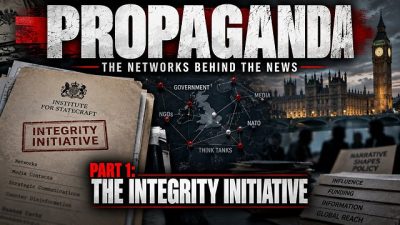
Integrity Initiative: UK-funded network framed dissent as Russian disinformation for years
or go to
Aletho News Archives – Video-Images
From the Archives
Why Saudi Ties to 9/11 Mean U.S. Ties to 9/11
By Kevin Ryan | Dig Within | September 27, 2015
Media interest in Saudi Arabian connections to the crimes of 9/11 has centered on calls for the release of the 28 missing pages from the Joint Congressional Inquiry’s report. However, those calls focus on the question of hijacker financing and omit the most interesting links between the 9/11 attacks and Saudi Arabia—links that implicate powerful people in the United States. Here are twenty examples. … continue
Blog Roll
 Aletho News
- IAEA inspectors cannot return to Iran amid US threats: Russia
- Senate Rejects Iran War Powers Resolution Passed By House
- ‘We did not attack Pakistan with drones’: Afghan sources
- Iraqi Resistance faction links arms to sovereignty, questions US exit
- Cannon fodder no more… South Korea rejects Trump’s pressure to join his criminal war on Iran
- Neria Leiter Was A Legitimate Military Target
- Integrity Initiative: UK-funded network framed dissent as Russian disinformation for years
- ‘We don’t seek permission to defend our country’: Snippets from President Pezeshkian’s UNGA address
- NATO chief wants Europeans to fight American wars [for Israel]
- German chemicals giant reveals details of downsizing
- If Americans Knew
- Israel displaces hundreds of Palestinians amid wave of demolitions in West Bank
- Aid, reconstruction, and Israel’s history of obstruction in Gaza
- Trump administration digs an ever-deeper hole of complicity in genocide – Daily Update
- US-Israel $2.8 Billion Arms Deal, 40,000-Bomb Supply Faces New Gaza Complicity Accusations
- Caught on Tape: AIPAC CEO Boasted of Controlling Trump’s National Security Officials
- Why Hamas Attacked Israel in October 2023 – Israeli professor Ilan Pappé
- They see them, then kill them: Israeli quadcopters track, deliberately target civilians in Gaza
- Winter could turn Gaza’s treacherous, war-damaged buildings into deathtraps
- Majority of Democratic Voters Want to Prosecute Both Biden and Trump Administration Officials Over Gaza
- As Gaza languishes, world leaders gather at the UN – Daily Update
- No Tricks Zone
- New Study: Earth And Venus Surface Warmth Largely Explained By Convection And Lapse Rate, Not CO2 Or Radiation
- 2025 Nature Paper Claiming Worsening Global Drought Gets RETRACTED …Heavily Flawed
- New Study: ‘Global Drought Shows No Detectable Recent Acceleration Under Climate Warming’
- Economic Masterminds: German Socialists Suggest Taxing Productivity Gains Stemming From Using AI
- The South China Sea Has Not Been Cooperating With The Climate Change Narrative
- Energy Crisis: Germany Enters Heating Season With Historically Low Gas Reserve Fill Levels
- New Study: The Antarctic Ice Sheet Gained Mass From 2020-2024 Due To Staggering Snow And Ice Accumulation
- Study: Ocean Heating Rates From Thousands Of Years Ago ‘Dwarf’ Modern Ocean Heating Rates
- Climate Extremists Target, Attack Large-Scale Power Grid Infrastructure In Germany!
- New Study: Antarctic Ice Melt Has Contributed Less Than 1 Centimeter To Sea Level Rise In The Last 30 Years

