US admits strike on ‘Al-Qaeda meeting’ in Syria amid reports of deadly mosque attack nearby
RT | March 17, 2017
Dozens of worshipers have reportedly been killed in an airstrike on a mosque in Syria’s Aleppo province. While the Pentagon only admitted to striking terrorists several miles away in Idlib, some reports suggest US missile debris were recovered from the mosque’s rubble.
Details of the strike on the Al-Jinah mosque are scarce, but over 50 people might have been killed in the incident, according to various reports. Images from the scene shared on social media show the wide-scale destruction.
None of the forces present in the area have taken responsibility for the strike yet. Both Russian and Syrian planes in addition to American-led air power are conducting operations against terrorist units in the area.
Some rushed to blame Moscow or Damascus for the carnage, after activists of the so-called White Helmets rescue organization and no less the notorious UK-based Syrian Observatory for Human Rights shared first images from the scene.
“We did not target a mosque, but the building that we did target — which was where the meeting took place — is about 50 feet (15 meters) from a mosque that is still standing,” said Colonel John J. Thomas, spokesman for US Central Command according to AFP.
Journalist Samuel Oakford, who was previously UN correspondent at Vice News, said that the US central Command confirmed it had carried out a strike in relative close proximity to the mosque.
“US official says that they were targeting an ‘Al Qaeda meeting place” that was across from the mosque in Aleppo. ‘We took the strike’”, he tweeted. Earlier, the reporter claimed the US Central Command told him the Americans conducted a strike on a target just several miles away, in the bordering Idlib province, and was looking into the Aleppo suburb mosque strike.
CENTCOM spokesperson, Maj. Josh Jacques, told the London-based Airwars monitoring group that the target was “assessed to be a meeting place for al Qaeda, and we took the strike.”
“It happened to be across the street from where there is a mosque,” said Jacques, specifying that the mosque was not the target and that it wasn’t hit directly.
“To be clear: this was a unilateral US strike, not part of anti-ISIS Coalition activities,” Oakford emphasized in another tweet.
Meanwhile Sakir Khader, who identifies himself as a journalist with a focus on Syria, Turkey, and the wider Middle East, posted a picture of the missile debris, which he claims to have come from the rubble of the destroyed mosque.
While the location and authenticity of the photo are yet to be independently investigated, the picture shows latin inscription on a metal plate alleged to be a piece of the missile.
Neither the Russian nor the US militaries, as well as Damascus, have yet to officially comment on the incident.
Washington ‘Unable to Maintain Military Presence’ in Syria for Long
Sputnik – 13.03.2017
The United States has recently deployed hundreds of troops to Syria in an apparent bid to assist the looming operation aimed at liberating Raqqa, but Washington will not be able to maintain a permanent military presence in the war-torn country, defense analyst Omar Maaribuni told RIA Novosti.
“Speaking about prospects, I don’t think that Turkey or the United States will be able to maintain their dominance [in northern Syria]. This is due to many factors. The main reason is the resistance which could emerge if American and Turkish forces refuse to withdraw from the region after the war is over,” he said.
In Maaribuni’s opinion, the other reason has to do with Washington’s plans to create a Kurdish canton spanning from the city of Afrin to the Mediterranean. The analyst said that it is impossible to carry out such a project in Syria due to demography and ethnic distribution, which prevent the Kurds from creating a “stable and self-contained” autonomous region on the border with Turkey.
“I think that America’s military presence near Manbij and other cities is temporary. The United States will have to withdraw sooner or later since there are no grounds for them to be there,” the analyst said. “Washington is trying to claim some of the achievement [in the fight against terrorism] as its own at the moment and improve its standing following a series of setbacks that the US has suffered.”
The Obama administration pledged to refrain from sending American boots on the ground in Syria, but later reversed its decision once it became apparent that the US-led coalition was struggling to destroy Daesh. The US has deployed hundreds of special operations troops to the war-torn country to ostensibly train and assist its local allies in their counterterrorism campaigns.
Maaribuni further commented on multilateral efforts aimed at liberating Raqqa, the so-called capital of Daesh’s caliphate. The US-backed Syrian Democratic Forces (SDF) are the primary force engaged in the operation aimed at pushing the militants out of the city, but the analyst suggested that the Syrian Arab Army (SAA) could also make a move towards the brutal group’s key stronghold.
“If the SAA moves towards the city of al-Thawrah after the military operation in Maskanah is over, Damascus-led forces will be able to secure three of its air bases, namely Kuweires, Kashish and al-Thawrah. They will need them for air cover largely provided by attack helicopters. These tactics have been used in the eastern Aleppo province and around Palmyra,” he explained.
Maaribuni suggested that the SAA “could find itself on the verge of the battle for Raqqa” if it has enough aerial support and uses artillery wisely.
A Flawed UN Investigation on Syria
By Gareth Porter | Consortium News | March 11, 2017
The March 1 report by the United Nations’ “Independent International Commission of Inquiry” asserted that the bloody attack on a humanitarian aid convoy west of Aleppo City on Sept. 19, 2016, was an airstrike by Syrian government planes. But an analysis of the U.N. panel’s report shows that it was based on an account of the attack from the pro-rebel Syrian “White Helmets” civil defense organization that was full of internal contradictions.

White Helmets member points to the aftermath of a military attack
The U.N. account also was not supported by either the photographic evidence that the White Helmets provided or by satellite imagery that was available to the commission, according to independent experts. Further undermining the U.N. report’s credibility, the White Helmets now acknowledge that rockets they photographed were not fired from Russian or Syrian planes but from the ground.
Like last December’s summary of the U.N.’s Headquarters Board of Inquiry report on the same incident, the Commission’s report described the attack as having begun with “barrel bombs” dropped by Syrian helicopters, followed by further bombing by fixed-wing planes and, finally, strafing by machine guns from the air.
The March 1 report did not identify any specific source for its narrative, citing only “[c]ommunications from governments and non-government organizations.” But in fact the U.N. investigators accepted the version of events provided by the White Helmets chief in Aleppo province as well as specific evidence that the White Helmets had made public.
The White Helmets, which are heavily funded by Western governments and operate only in rebel-controlled areas, are famous for using social media to upload videos purporting to show injured children and other civilian victims of the war.
Last year, a well-organized campaign pushed the group’s nomination for a Nobel Peace Prize and a Netflix film about the group won an Oscar last month. The United Nations and the mainstream Western news media have frequently relied on White Helmets accounts from war zones that are not accessible to outsiders. But the White Helmets’ officials have pursued an obvious political agenda in support of opposition forces in Al Qaeda-dominated zones in Aleppo and Idlib where they have operated.
On Sept. 19, immediately after the attack on the aid convoy, the chief of the White Helmets organization in the Aleppo governorate, Ammar al-Selmo, presented a dramatic narrative of a Russian-Syrian air attack, but it was marked by obvious internal contradictions.
At first, Selmo claimed in an interview that he had been more than a kilometer away from the warehouses where the attack occurred and had seen Syrian helicopters dropping “barrel bombs” on the site. But his eyewitness account would have been impossible because it was already dark by the time he said the attack began at about 7:15 p.m. He changed his story in a later interview, claiming that he had been right across the street at the moment of the attack and had heard the “barrel bombs” being dropped rather than seeing them.
Selmo insisted in a video filmed that night that the attack began with Syrian helicopters dropping eight “barrel bombs,” which are described as large, crudely constructed bombs weighing from 250 kg to 500 kg or even more. Citing a box-shaped indentation in the rubble, Selmo said the video is showing “the box of the barrel bomb,” but the indentation is far too small to be a crater from such a bomb.
Selmo continued the account, “Then the regime also target this place with cluster bombs two times, and also the aircraft of the Russians target this place with C-5 and with bullets,” apparently referring to Soviet-era S-5 rockets. The White Helmets photographed two such rockets and sent it to media outlets, including the Washington Post, which published the picture in the Post story with credit to the White Helmets.
Story Contradictions
But Hussein Badawi, apparently the White Helmet official in charge of the Urum al Kubrah area, contradicted Selmo’s story. In a separate interview, Badawi said the attack had begun not with “barrel bombs” but with “four consecutive rockets” that he said had been launched by government forces from their defense plant in Aleppo province – meaning that it was a ground-launched attack rather than an air attack.
In an email response to a query from me, Selmo retracted his own original claim about the S-5 rockets. “[B]efore aircraft’s attack on the area,” he wrote, “many land to land missiles attacked the place coming from the defense factories which [are] located in eastern Aleppo [east of] the city, regime controlled area. [T]hen aircraft came and attacked the place.”
But such a rocket attack from that “regime controlled area” would not have been technically possible. The Syrian government defense plant is located in Safira, 25 kilometers southeast of Aleppo City and even farther from Urum al-Kubrah, whereas the S-5 rockets that the White Helmets photographed have a range of only three or four kilometers.
Moreover, the Russians and Syrian government forces were not the only warring parties to have S-5s in their arsenal. According to a study of the S-5 rocket by Armament Research Services consultancy, Syrian armed opposition forces had been using S-5 rockets as well. They had gotten them from the CIA’s covert program of moving weapons from Libyan government stockpiles to be distributed to Syrian rebels beginning in late 2011 or early 2012. Syrian rebels had used improvised launch systems to fire them, as the ARS study documented with a picture.
Significantly, too, the explicit claim by Selmo that Russian planes were involved in the attack, which was immediately echoed by the Pentagon, was summarily dismissed by the U.N. panel report, which stated flatly, without further explanation, that “no Russian strike aircraft were nearby during the attack.”
Misplaced Evidence
Yet, despite the multiple discrepancies in the White Helmets’ story, the U.N. investigators said they corroborated the account of the air attack “by a site assessment, including analysis of remnants of aerial bombs and rockets documented at the site, as well as satellite imagery showing impact consistent with the use of air-delivered munitions.”
“White Helmets” symbol expropriates name of “Syria Civil Defense”
The U.N. Commission’s report cited a photograph of the crumpled tailfin of a Russian OFAB-250 bomb found under some boxes in a warehouse as evidence that it had been used in the attack. The White Helmets took the photograph and circulated it to the news media, including to the Washington Post and to the Bellingcat website, which specializes in countering Russia’s claims about its operations in Syria.
But that bomb could not have exploded in that spot because it would have made a crater many times larger than the small indentation in the floor in the White Helmet photo – as shown in this video of a man standing in the crater of a similar bomb in Palmyra.
Something other than an OFAB-250 bomb – such as an S-5 rocket — had caused the fine shrapnel tears in the boxes shown in the photo, as a detail from the larger scene reveals. So the OFAB bomb tailfin must have been placed at the scene after the attack.
Both U.N. imagery analysts and independent experts who examined the satellite images found that the impact craters could not have come from the “aerial bombs” cited by the Commission.
The analysis of the satellite images by United Nations specialists at UNITAR-UNOSAT made public by the U.N. Office of Humanitarian Coordination on March 1 further contradicts the White Helmet account, reflecting the absence of any evidence of either “barrel bombs” or OFAB-250 bombs dropped on the site.
The U.N. analysts identified four spots in the images on pages five and six of their report as “possible impact craters.” But a U.N. source familiar with their analysis of the images told me that it had ruled out the possibility that those impact points could have been caused by either “barrel bombs” or Russian OFAB-250 bombs.
The reason, the U.N. source said, was that such bombs would have left much larger craters than those found in the images. Those possible impact points could have been either from much smaller air-launched munitions or from ground-based artillery or mortar fire, but not from either of those weapons, according to the U.N. source.
Expert Challenges
A former U.S. intelligence official with long experience in analysis of aerial photos and Pierre Sprey, a former Pentagon analyst, both of whom reviewed the satellite images, agreed that the spots identified by UNOSAT could not have been from either “barrel bombs” or OFAB-250 bombs.
The former intelligence official, who demanded anonymity because he still deals with government officials, said the small impact points identified by the U.N. team reminded him of impacts from “a multiple rocket launcher or possibly a mortar.”
Sprey agreed that all of those impact points could have been from artillery or mortar fire but also noted that photographs of the trucks and other damaged vehicles show no evidence that they were hit by an airstrike. The photos show only extensive fire damage and, in the case of one car, holes of irregular size and shape, he said, suggesting flying debris rather than bomb shrapnel.
Sprey further pointed to photographic evidence indicating that an explosion that the U.N. Commission blamed on a Syrian airstrike came from within the building itself, not from an external blast. The building across the street from some of the trucks destroyed by an explosion (in Figure 9 of a series of photos on the Bellngcat website)
clearly shows that the front wall of the building was blown outward toward the road, whereas the rear wall and the roof were still intact.
The photograph (in Figure 10) taken from inside the remains of that same building shows the debris from the blast was blown all the way across the street to the damaged truck. Sprey said those pictures strongly suggest that an IED (improvised explosive device) had been set in the house to explode toward the trucks.
In embracing the Syrian-air-strike narrative — although it falls apart on closer examination — the U.N. “Commission of Inquiry” thus fell into line with the dominant Western political bias in favor of the armed opposition to the Syrian government, a prejudice that has been applied to the Syrian conflict by U.N. organs since the beginning of the war in 2011.
But never has the evidence so clearly contradicted that line as it has in this case – even though you will not learn that by reading or watching the West’s commercial news media.
Gareth Porter is the author of the newly published Manufactured Crisis: The Untold Story of the Iran Nuclear Scare.
Why Trump’s Syria ‘Surge’ Will Fail
By Ron Paul | March 13, 2017
Last week President Trump significantly escalated the US military presence in Syria, sending some 400 Marines to the ISIS-controlled Raqqa, and several dozen Army Rangers to the contested area around Manbij. According to press reports he will also station some 2,500 more US troops in Kuwait to be used as he wishes in Iraq and Syria.
Not only is it illegal under international law to send troops into another country without permission, it is also against US law for President Trump to take the country to war without a declaration. But not only is Trump’s first big war illegal: it is doomed to failure because it makes no sense.
President Trump says the purpose of the escalation is to defeat ISIS in Raqqa, its headquarters in Syria. However the Syrian Army with its allies Russia and Iran are already close to defeating ISIS in Syria. Why must the US military be sent in when the Syrian army is already winning? Does Trump wish to occupy eastern Syria and put a Washington-backed rebel government in charge? Has anyone told President Trump what that would to cost in dollars and lives – including American lives? How would this US-backed rebel government respond to the approach of a Syrian army backed up by the Russian military?
Is Trump planning on handing eastern Syria over to the Kurds, who have been doing much of the fighting in the area? How does he think NATO-ally Turkey would take a de facto Kurdistan carved out of Syria with its eyes on Kurdish-inhabited southern Turkey?
And besides, by what rights would Washington carve up Syria or any other country?
Or is Trump going to give up on the US policy of “regime change” and hand conquered eastern Syria back to Assad? If that is the case, why waste American lives and money if the Syrians and their allies are already doing the job? Candidate Trump even said he was perfectly happy with Russia and Syria getting rid of ISIS. If US policy is shifting toward accepting an Assad victory, it could be achieved by ending arms supplies to the rebels and getting out of the way.
It does not appear that President Trump or his advisors have thought through what happens next if the US military takes possession of Raqqa, Syria. What is the endgame? Maybe the neocons told him it would be a “cakewalk” as they promised before the 2003 Iraq invasion.
Part of the problem is that President Trump’s advisors believe the myth that the US “surge” in Iraq and Afghanistan was a great success and repeating it would bring the victory that eluded Obama with his reliance of drones and proxy military forces. A big show of US military force on the ground – like the 100,000 sent to Afghanistan by Obama in 2009 – is what is needed in Syria, these experts argue. Rarely is it asked that if the surge worked so well why are Afghanistan and Iraq still a disaster?
President Trump’s escalation in Syria is doomed to failure. He is being drawn into a quagmire by the neocons that will destroy scores of lives, cost us a fortune, and may well ruin his presidency. He must de-escalate immediately before it is too late.
Copyright © 2017 by RonPaul Institute.
Syria Demands UN Condemnation of Terrorist Attacks in Damascus
Al-Manar | March 12, 2017
Syria demanded that the United Nations and participants of Geneva and Astana talks condemn the two terrorist bombings that took place in Damascus on Saturday.
Syria’s Foreign Ministry made the call on Saturday in a letter sent to UN Secretary General Antonio Guterres and the UN Security Council, in which it demanded the condemnation of the deadly bombings which killed 46 people.
Two bomb attacks took place near Bab al-Saghir cemetery in the Bab Mousalla area of Damascus. Most of the martyrs were Iraqi pilgrims.
The letter condemned the “cowardly” attack which coincided with a series of mortar and rocket attacks on the city that resulted in a large number of casualties, SANA news agency reported.
It added that such actions are carried out in retaliation for gains made by the Syrian army against the Takfiri terrorists across the country.
The letter went on to say that while the Syrian government condemns this and other such acts of terrorism committed by the terrorist organizations and backed by known governments and regimes, “it reiterates again that all parties participating in the talks held in Astana and Geneva distance themselves from the terrorist organizations.”
The Ministry meanwhile, demanded in its letters a condemnation from the UN Secretary General and the Security Council of this terrorist attack and that the governments and regimes supporting the terrorist organizations, mainly those of Turkey, Saudi Arabia and Qatar.
The first round of the Astana talks, organized by guarantor states Russia, Turkey and Iran took place on January 23-24 and brought together representatives from the Damascus government and opposition groups. The second round of the negotiations, similarly brokered by the trio, was held on February 15-16.
The fourth round of the UN-mediated discussions was held between February 23 and March 3 in Geneva, and a fifth one has been scheduled for March 23.
Assad: No one invited US to Manbij, all foreign troops in Syria without permission are ‘invaders’
RT | March 11, 2017
Any foreign forces, including those from the US, that enter Syria without invitation are invaders, Syrian President Bashar Assad told Chinese media in an interview, noting that no one had given the US troops currently in Manbij permission to be there.
“Any foreign troops coming to Syria without our invitation or consultation or permission, they are invaders, whether they are American, Turkish, or any other one,” Assad told Chinese PHOENIX TV, as cited by the Syrian state-run SANA news agency.
When a journalist asked the Syrian president if Damascus had “opened doors” for American troops in Aleppo province’s city of Manbij, Assad said “No, we didn’t.”
“What are they [foreign troops] going to do? To fight ISIS [Islamic State, formerly ISIL]? The Americans lost nearly every war. They lost in Iraq, they had to withdraw at the end. Even in Somalia, let alone Vietnam in the past and Afghanistan.”
According to Assad, the US “didn’t succeed anywhere they sent troops, they only create a mess; they are very good in creating problems and destroying, but they are very bad in finding solutions.”
The Pentagon confirmed earlier in March that US troops had been sent to Manbij to prevent conflict between US-backed Kurdish forces and rebels backed by Turkey.
Without foreign intervention, the Syrian war “will take a few months” to bring to an end, Assad noted.
“The complexity of this war is the foreign intervention. This is the problem,” he said.
Syria’s president stressed that government troops are now very close to Raqqa, Islamic State’s stronghold some 100 kilometers from Manbij.
American troops were first spotted in the town earlier in March. Reports emerged at the time claiming that a deal had been struck for the US-backed Syrian Democratic Forces (SDF) to hand over some 20 villages in a zone between Manbij and Al-Bab, which had been recently taken by Turkish-backed forces, to the Syrian government.
“They [Syrian forces] are certainly aware of where we [US] are, and we are aware of where they are. There is no intention between the two of there being any conflict against any party other than ISIS,” Pentagon spokesman Captain Jeff Davis told reporters.
On Thursday, the US-led coalition confirmed that around 400 American marines and army rangers had arrived in Syria to establish an outpost to support an operation to take the city of Raqqa. The new contingent adds to the 500 US troops already in Syria. US Air Force Colonel John Dorrian, the coalition’s spokesman, says the new soldiers have been deployed to expedite the defeat of the terrorists in Raqqa.
Iran: Israel showed it masterminds Syria war

Iran’s Parliament Speaker Ali Larijani
Press TV – March 12, 2017
Iran says the Israeli prime minister “clearly” showed in his recent remarks opposing Iranian counterterror contribution to Syria that Tel Aviv is behind the ongoing war in the Arab country.
Parliament Speaker Ali Larijani made the remarks on Sunday, concerning a Friday conversation between Israeli premier Benjamin Netanyahu and Russian President Vladimir Putin in Moscow.
Netanyahu reportedly expressed “Israel’s strong opposition to the presence of Iranian forces” north of Israel “in the context of the talks on a settlement of any kind.”
Iran has been lending advisory support to the Syrian military in its battle against foreign-backed militancy, while avoiding any direct military involvement in the conflict.
“Netanyahu laid the conditions for peace in Syria,” Larijani told the parliament session in Tehran. “He clearly stated that the Zionist regime is behind the war in Syria.”
“If some regional leaders were so far in a doubt that the war in Syria is not in line with the interests of Muslims, the least of which Sunni Muslims, they should have been disillusioned with these remarks by the head of the Zionist regime,” he added.
“The main reason behind the adventures in the region is to defeat resistance and its supporters to pave the way for the Zionist regime’s complete dominance here,” Larijani further said.
Netanyahu was also cited as telling Putin “the fact that the Golan Heights is not part of the discussion on any outline” of the peace agreement.
Israel has been occupying Golan since 1967. Since the start of the foreign-backed militancy in Syria, it has been providing medical treatment to injured Takfiri terrorists arriving at the territory, claiming it would do so for all those in the areas “under its control.”
Tel Aviv wants Syrian President Bashar al-Assad ousted. It has been carrying out air raids against Syria-based targets from Lebanese airspace on many occasions.
Late last month, Israel’s Channel 2 said the regime had sent its troops on repeated spying missions into a village located half a kilometer inside Syria’s territory. The Israeli military has also deployed intelligence-gathering equipment in the Golan Heights to record movements by the Syrian military and foreign-backed militants.
Bibi’s ignorance of history
Meeting with Putin, the Israeli premier also claimed ancient Persia had made a failed attempt to “destroy the Jewish people” some 2,500 years ago, a legend commemorated through the Jewish holiday of Purim, which Israel started celebrating Saturday night.
While scholars do not agree on the accuracy of the Purim story, Netanyahu has constantly referred to the legend as a basis of his anti-Iran arguments in his meetings with different world leaders.
Larijani said making the comments, Netanyahu had both misreported Iran’s pre-Islam history and inverted facts.
“Apparently, he is neither acquainted with history, nor has read Torah,” the said Iranian top parliamentarian.
According to Jewish accounts, Persian King Ahasverous discovered his viceroy’s conspiracy to slaughter Jews some 2,500 years ago and had him executed.
Nevertheless, Netanyahu has been selective in his recount of history, ignoring the Hebrew Bible that has repeatedly praised Persian King Cyrus the Great as the patron and deliverer of the Jews, who put an end to their Babylonian captivity.
Drastic Changes in the Middle East Happen Unbelievably Fast
By Peter KORZUN | Strategic Culture Foundation | 04.03.2017
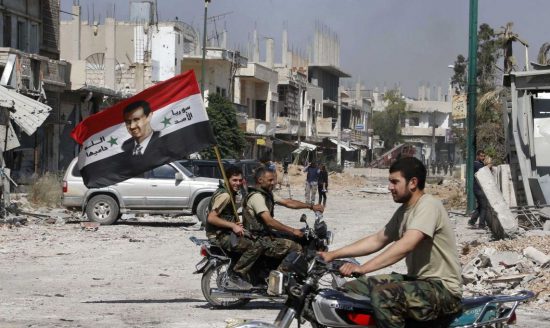
The situation in the Middle East is changing at an incredible speed. The things unbelievable yesterday, become reality today. Each of the events becomes part of a bigger picture, with the region gradually moving away from abyss to become a better place.
On March 1, Iraqi forces were reported to have taken control of the last major road out of western Mosul, preventing Islamic State (IS) militants from fleeing the city. The route leads to Tal Afar, another IS stronghold that is 40 km further west. They have since driven militants from the international airport, a military base, a power station and a number of residential areas. IS fighters began to flee. Total control over the city by Iraqi forces seems to be a matter of a few days, maybe hours.
Being almost defeated in Iraq, the IS has nowhere else to go but Syria – the country where they have just suffered a defeat, with Palmyra retaken by Syria’s government forces. Russia’s support has been crucial in the Syrian army’s push. Raqqa, the last remaining stronghold of the IS, will be the place of the final battle the extremist group is doomed to lose as many influential actors want it to be wiped away from the earth.
Turkey has announced its intent to launch an offensive to retake Raqqa but only after taking control of Manbij, the town held by the Kurds-dominated Syria Democratic Forces (SDF). The parties were in for a fight to benefit the IS and other terror groups. The US was at a loss as to how to prevent a clash between the NATO ally and the Kurds – the force it relies on in the fight against the IS. That’s when Moscow stepped in to avoid the worst, using its unique position as a mediator. It managed to do what nobody thought was possible. The military council in Manbij said on March 2 it will hand over areas west of the flashpoint town to Syrian government troops, after an agreement brokered by Russia.
Now the town is in Arab hands and Turkey has no reason to attack it. Syria and Turkey are not at war.
The United States had promised Turkey that Kurdish forces would withdraw from Manbij to the east of the Euphrates, but it never happened. Now Russia did what America had failed to do.
As a result of Russia’s effective mediation, Turkey can double down on its plans to advance to Raqqa, while Syria’s government has greatly strengthened its position. Turkey’s President Erdogan has just said he is ready to fight the IS together with Russia. He is coming to Moscow on March 9. It means no clash between Turkey and Syria will take place.
Many things are changing for the Syrian government and it has been going on for some time. It’s not a coincidence that voices get louder, calling for inviting Syrian President Assad to the March 29 Arab Summit in Amman – five years after Syria was expelled from the 22-member organization. Russia, Jordan and Egypt are applying efforts to reconcile the Arab community with the Syrian government. Last month, Egypt’s parliamentary committee for Arab affairs called for the return of Syria to the Arab League. This would signify the reconciliation between Saudi Arabia which backed the Syrian rebels – something unthinkable some time ago.
In 2015, then US President Obama predicted Russia would get stuck in Syria’s quagmire. He appears to have been wrong. Thanks to Russia’s involvement, one can see the light at the end of the tunnel to make the quagmire a thing of the past.
Moscow can facilitate the process of Iran joining with Arab states in the effort to reach agreement on Syria, bringing it to some mutual understanding with Saudi Arabia. Not much has been reported about some recent events of special significance. Iranian President Hassan Rouhani visited Kuwait and Oman on February 15. Saudi Arabian Foreign Minister Adel Al-Jubeir made a trip to Iraq on February 25, to be received by Iraqi Prime Minister Haider Al-Abadi. The trend is visible – Shia and Sunni are on speaking terms again and they are discussing something very important. It would have sounded incredible a short time ago but these are the facts.
All these events and emerging trends are taking place against the background of the ongoing UN-brokered Geneva talks on peaceful settlement in Syria. Here too we have an unexpected turn of events – the Syrian opposition seeks to meet with Russian officials!
According to Paul Vallely, a retired US Army Major General and senior military analyst for Fox News, Russia-US consultations on Syria are to start in two months after the presidents hold a summit. He said Russia is to play a key part in any scenario.
The recent days have literally shaken the Middle East. So many unexpected things happen to push things forward. Right in front of our eyes the impossible becomes possible.
As said before, Moscow is in a unique position to act as an intermediary and it plays its role aptly to achieve tangible results. If the current trend continues in the same direction, leading to the desired outcome, Russia’s effort will go down in history as an extraordinary achievement of military success combined with effective diplomacy.
The NYT War on Truth
By Stephen Lendman | March 4, 2017
On issues mattering most, The Times features fake news, not the real thing.
On March 1, its editors lied headlining “Russia Sides With Chemical Weapons,” saying:
“Russia proved again on Tuesday that there is no crime heinous enough to make it turn against Syria’s president, Bashar al-Assad. It vetoed a resolution before the United Nations Security Council that would have punished Syria for using chemical weapons.”
Fact: Throughout six years of Obama’s war, now Trump’s, using terrorists as imperial foot soldiers against a sovereign independent state threatening no one, claims about Assad using chemical weapons were fabricated – bogus accusations without evidence.
Fact: Plenty of clear evidence proves ISIS, al-Nusra and other US-supported terrorists used CWs numerous times – their elements trained in their use by Pentagon contractors in Turkey and Jordan, Saudi Arabia at times supplying toxins.
Times editors: “The Kremlin’s decision was in keeping with President Vladimir Putin’s vigorous support of the Syrian military in a six-year-long war that has killed half a million people.”
Fact: No mention by Times editors about Washington’s full responsibility for mass slaughter and destruction – NATO, Israel, and other rogue allies sharing blame.
Fact: Syria was invaded by US-supported terrorists, recruited from scores of countries, trained in Turkey, Jordan and elsewhere, responsible for horrific atrocities, mostly against defenseless civilians.
Times editors: “Although Moscow had made clear in advance that it would veto the resolution, (Washington), Britain and France were right to insist on a vote and to expose Russia’s moral bankruptcy.”
Fact: As usual, Times editors turned truth on its head, ignoring US-orchestrated aggression, vilifying Russia’s righteous mission.
Times editors: Mr. Putin’s argument that the resolution interfered with cease-fire negotiations between the Syrian government and the rebels was… not credible.”
Fact: The resolution was introduced to undermine peace talks, apparently wanting endless war continued.
Separately, Times editors claimed White House signals give “autocrats… a green light” to do what they please. What rubbish!
Most of America’s allies are rogue states, alliances formed long before Trump’s ascension to power – notably key NATO ones, Israel, Saudi Arabia, and other Gulf states, partners in US high crimes.
Maybe Times editors forgot.
Stephen Lendman can be reached at lendmanstephen@sbcglobal.net. His new book is titled Flashpoint in Ukraine: How the US Drive for Hegemony Risks WW III.
Featured Video

Thomas Fazi: NATO’s Hybrid Warfare – Deception & Permanent War
or go to
Aletho News Archives – Video-Images
Book Review
UAE tortured, killed journalist for opposing Israel normalization
The Cradle | October 31, 2026
UAE security officers detained, tortured, and killed Emirati poet and news editor Habib al-Sayegh in August 2019, shortly after he published a column opposing UAE normalization with Israel, according to a newly published book.
“Princes and Thieves,” a book by investigative journalist Matthew Cole published on 25 October, alleges that UAE security officers raided Sayegh’s Abu Dhabi home shortly after the publication of the column, hooded him in front of his wife and took him to a detention facility where he was tortured to death.
His interrogators reportedly pulled out several of his teeth with pliers and beat him repeatedly with a sharp metal object.
On 11 August 2019, Sayegh criticized the UAE’s plan to normalize relations with Israel as part of the Abraham Accords in his weekly column for Khaleej newspaper. The column was titled “Israel Is Our Real Enemy and A Dangerous Project.”
Sayegh described Israel as “a real and natural enemy” while questioning “who authorized the normalizers to speak on behalf of everyone?”
Nine days after the column was published, Emirati state media announced his death, without stating a cause. … continue
Blog Roll
 Aletho News
- Poland Is the Symptom and Europe Is the Patient
- UAE security forces tortured, killed journalist for opposing Israel normalization: Report
- They Compared the Spice to the Drug. The Spice Won — Again. (Part 2)
- Thomas Fazi: NATO’s Hybrid Warfare – Deception & Permanent War
- Wrong, AP and NPR: Europe’s 50,000 Heat Deaths Are a Computer-Model Estimate, Not a Real Body Count
- Questioning Your Doctor Is Now Considered A Psychological Problem (Seriously)
- London tourism expo promotes Israeli agency linked to theft of Palestinian land
- Dockworkers launch global strike against Israeli and US military shipments
- Europe facing gas price shock – Gazprom chief
- Ukraine continues recruiting people with disabilities
- If Americans Knew
- An error has occurred; the feed is probably down. Try again later.
- No Tricks Zone
- Germany’s Green Energy Transition Becoming Increasingly Expensive…Another 6 Trillion Euros!
- Sudden Stratospheric Warming, Powerful El Niño Combination May Lead To Extreme Europe Cold, Energy Crisis!
- Two New Studies Find Thwaites Glacier Melt Cannot Be Driven By Human Activity Or A Warming Ocean
- E-Cars Reduce CO2 Emissions By Only 41% Compared To Internal Combustion Engine Vehicles
- Predictions Made By Renowned Climate Professor Over Past Decades Have Been Proven To Be Poor
- New Study Suggests Large Regions Of The Pacific Ocean Have Been Cooling For The Last 80 Years
- Germany’s Green Energy Debacle: High Energy Costs Force Kahla Porzellan to Close After 182 Years!
- New Study: 50 Years Of The Most Aggressive ‘Net Zero’ Policies Can Only Affect The Global Climate By 0.03°C
- US September “Heat” Was No Record…Many Records Set Decades Ago
- Latest European Green Energy Debacle; Portugal’s Largest Flagship Solar Park Insolvent!

