Kremlin Warns against US Syria Safe Zone Plan, Says No Contact Made Yet with WH
Al-Manar | January 26, 2017
The Kremlin warned on Thursday against a US plan for safe zones in Syria, saying such move should be thoroughly considered.
Asked to comment on a draft executive order that President Donald Trump is expected to sign this week, Russian President Vladimir Putin’s spokesman, Dmitry Peskov, underlined the importance to “thoroughly calculate all possible consequences” of the measure.
He noted that “it’s important not to exacerbate the situation with refugees.”
While suspending visas for Syrians and others, the order directs the Pentagon and the State Department to produce a plan for safe zones in Syria and the surrounding area within 90 days.
Meanwhile, Peskov said that direct contacts between the White House and the Kremlin have not been established since President Donald Trump took office.
“Contacts at the level of the administrations are not taking place at the moment, there haven’t been any yet, such contacts are yet to be established,” Peskov told a conference call with reporters.
“Routine diplomatic work is underway, our embassy in Washington is functioning, they are in constant contact with their counterparts in the State Department.”
Over 2,600 Militants Laid Down Arms in Syrian Wadi Barada Valley – Russian MoD
Sputnik – 26.01.2017
Over 2,600 militants have laid down arms in Syria’s Wadi Barada valley, which supplies the Damascus province with drinking water, Col. Alexander Blinkov, a spokesman for the Russian Center for Syrian reconciliation, said Thursday.
According to Blinkov, civilians in the area continue receiving humanitarian aid, including food and medicines.
“People living in the Wadi Barada river valley are returning to normal life. The first stage of a complex reconciliation plan for this district is currently being implemented. Over 2,600 people have already settled their status by now. Those militants, who have refused to lay down arms, are leaving for the Idlib province with their families under the supervision of the Syrian authorities,” Blinkov told reporters.
At the same time, militants, who have refused to join the ceasefire and found shelter in highland areas, continue shelling nearby districts and villages, Blinkov added.
The Syrian capital gets most of the water from springs in the Wadi Barada valley. Water supplies were drastically reduced in late December. The problem of the Wadi Barada area, controlled by the opposition, was one of the stumbling blocks at the talks in Astana, Kazakhstan.
The Last Days of Obama: Napoleonic Maneuvers at the Security Council
By Caleb Maupin | New Eastern Outlook | 23.01.2017
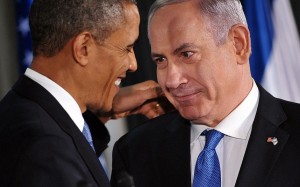 It seemed to come almost out of nowhere. The United States usually protects Israel from critical resolutions at the UN Security Council. However, in a dramatic move, the US abstained and a resolution criticizing recent settlement activity was passed by the 15-member body.
But this was not the end. John Kerry, Obama’s former Secretary of State, gave a lengthy address a few days later. Kerry’s speech was not so different from the statements of previous leaders, both Democrats and Republicans. He defended Israel’s existence, and denounced almost all forces actively opposing Israel.
However, Kerry harshly criticized specific Israeli policies. While Kerry’s speech defending the UN abstention uttered the standard, mildly critical, pro-Israeli talking points, it did contain some words that, taken out of context and spread throughout the internet, could and did indeed make a lot of Israelis and Zionists very angry. The most quoted one was: “If the choice is one state, Israel can either be Jewish or democratic, it cannot be both.”
Kerry was alluding to the fact that if Palestinians are absorbed into Israel in a “one state solution” but Israel remains a “Jewish State” this will not be democratic. According to Kerry, under such circumstances Palestinians would be second class citizens, i.e. non-Jews in a Jewish state.
Immediately, Kerry’s speech was decried by Israelis. Netanyahu fired back, as did the entire pro-Israeli blogosphere. The Republican and Likud Party aligned voices escalated the shrill accusations that Obama was a secret Muslim, a member of the Muslim brotherhood, a terrorist sympathizer, a Neo-Nazi, a Communist, and everything else he has been called for 8 years straight.
Meanwhile, Israel did not stop its settlement activity, and was not really affected at all by the resolution. The billions of dollars in US aid to Israel continued. Obama has left the office on January 20th, and is now replaced by Donald Trump, who claims to be more pro-Israel than Obama. The UN Security Council is not taking any specific action to halt the settlement activities condemned in its resolution.
Nothing really changed, but a lot of dramatic, heated words were exchanged between the USA and its closest Middle Eastern ally. Why did this happen?
Napoleon & Obama: “I Come to Restore Your Rights”
In 1798, the French militarist Napoleon Bonaparte, who seized power in the aftermath of the revolution and eventually became Emperor, set out to conquer Egypt. He issued a proclamation saying:
People of Egypt! You will be told by our enemies that I am come to destroy your religion. Believe them not. Tell them I am come to restore your rights, punish your usurpers, and revive the true worship of Mohammed. Tell them that I venerate, more than do the Mamelukes, God, his prophet, and the Koran.
Among the people of Egypt and Syria, as well as the entire Arab world, there was deep hatred for the British and Ottoman empires, who functioned as Napoleon’s rivals. Napoleon hoped that he could convince Muslims throughout the region to support him, and on this basis that he could defeat their hated colonial enemies, and conquer the region for France.
Napoleon was lying. He was not an adherent of the Islam faith. Some speculate that he may have been a freemason, and became familiar with the Koran and Islam due to their inclusion in Masonic rituals. Regardless, years later, Napoleon explained the proclamation to his fellow French Christians saying:
A change of religion, inexcusable for the sake of private interests, becomes comprehensible when immense political results are involved…. Do you think the Empire of the East and perhaps the subjugation of the whole of Asia was not worth a turban and some loose trouser? The state of feeling in the army was such that it would have undoubtedly lent itself to a joke.
Barack Obama, like Napoleon Bonaparte, is not a Muslim. As offensive and heretical as some evangelical Christians and Catholics may consider the teachings of the United Church of Christ and Reverend Jeremiah Wright, they are not Islamic in any conceivable way. Barack Obama was married in a church. He has been photographed drinking wine and eating hot dogs.
Obama’s middle name is “Hussein.” As a child, while living in Indonesia, he attended an Islamic elementary school. Obama apparently did meet with the Palestinian-American professor Edward Said. With all of this to cite as evidence, the allegation that he was a “secret Muslim” has not vanished.
The endless, semi-hysterical attacks on Obama for having alleged links to Islam certainly had an impact outside of US borders. This impact may not have been accidental. Writing in the Atlantic Monthly in 2007, the self-described conservative Andrew Sullivan considered the colorful background of the future president to be an asset:
What does he offer? First and foremost: his face. Think of it as the most effective potential re-branding of the United States since Reagan. Such a re-branding is not trivial—it’s central to an effective war strategy… The next president has to create a sophisticated and supple blend of soft and hard power to isolate the enemy, to fight where necessary, but also to create an ideological template that works to the West’s advantage over the long haul. There is simply no other candidate with the potential of Obama to do this.
Sullivan’s widely read and cited article said:
If you wanted the crudest but most effective weapon against the demonization of America that fuels Islamist ideology, Obama’s face gets close. It proves them wrong about what America is in ways no words can.
The USA certainly had a lot of credibility to regain as the Bush era came to an end. The unilateral invasion of Iraq had been widely opposed, not just in the Middle East, but even among NATO states. Bush had gone as far as to say “this crusade, this war on terrorism, is going to take a while.” The word “crusade” doesn’t exactly bring up pleasant feelings among Muslims around the world.
Meanwhile, the federal agencies of the United States flew into a very Islamophobic mode after the 9/11 attacks. The leaders of a religious charity known as the “Holy Land Foundation” were imprisoned for nothing other than running soup kitchens for Palestinian children. Mosques across the United States were then and continue to be widely surveilled.
His Middle Name is “Hussein”
Voices like Andrew Sullivan’s hoped that Obama’s background could restore the credibility of the USA in the eyes of Muslims. But this was just the tip of the iceberg. What came about in the first term of the Obama administration? In 2011 the world watched the “Arab Spring.” Across the Middle East, impoverished people rose up against their governments.
Analysts often argue that the Arab Spring was spawned by the global financial crisis and the regional drought. Throughout the Arab world, crops failed, water was scarce, and impoverished people piled into the cities facing dire economic conditions. The uprisings that eventually erupted were predictable. Such conditions are known to spark unrest.
But the world did not see a repeat of the 1979 Iranian Revolution, where the Persians toppled a western puppet dictator under the slogans of “Not Capitalism but Islam” and “War of Poverty Against Wealth.” The western capitalist apparatus was ready. The Arab Spring was immediately redirected to serve their ends. Social media outlets based in western countries, and the global apparatus of pro-American NGOs swung into action.
With a commander-in-chief who most people in the Middle East had a favorable opinion of, the forces of global power were able to ensure that the revolt did not become an uprising against western capitalism. No new anti-imperialist regimes were born. Rather, the opposite happened.
In Egypt, the pro-US regime of Hosni Mubarak fell, but what replaced it? First, Egypt elected Mohamed Morsi, a leader of the CIA-linked Muslim Brotherhood. Morsi was then toppled by a military coup d’etat. Now General Sisi, a top military leader under Mubarak, is in power.
The US backed Saudi regime was allowed to crush the uprisings within its own borders. Ayatollah Nimr Al-Nimr, a Shia cleric who led protests demanding civil liberties and religious freedom in the country was eventually beheaded for his role in the Arab spring. Saudi troops poured into Bahrain to keep the monarchy in power and crush the Shia majority that demanded their rights. In the aftermath of the revolt, Yemen staged a sham election in which Mansour Hadi, a Saudi puppet, was the only candidate on the ballot. Yemen is now torn apart by war, as many Yemenis reject Hadi’s pro-Saudi and Pro-US regime.
The energy and momentum of the Arab Spring, amplified and directed by the western TV networks along with Twitter and Facebook, went toward targeting two anti-imperialist, socialist governments. Gaddafi’s Libya had the highest life expectancy in Africa. Syria’s Bashar Assad presides over a centrally planned economy, supports Palestinian resistance, and is aligned with Iran, Russia and China.
In both Libya and Syria the United States began actively working to transform the Arab Spring into a successful regime change operation. Though the faces promoted on western television were often middle class, secular young people who dreamed of American consumerism while mouthing words about “democracy,” the brute force behind the Syrian and Libyan “revolutions” were religious extremists.
Based from the Syrian and Libyan countryside, forces linked to Al-Qaeda and the Muslim Brotherhood were joined by many foreign Jihadist fighters from throughout the region. The forces who toppled the Libyan government and continue to fight against the Syrian Arab Republic are dominated by those who adhere to Wahabbism, the ideology of Saudi Arabia and Osama Bin Laden. These deeply religious forces, working to topple anti-imperialist governments, happily took guns and funding from a country led by a man who went to a Muslim school, met with Edward Said, and whose middle name happened to be “Hussein.”
Imagine what could have happened in the region, if the wave of uprisings had taken place while George Bush “the crusader” was still in office. Obama’s presidency played a decisive role in manipulating and redirecting the events of 2011.
Netanyahu vs. Obama: A Made For TV Drama
 It is not uncommon for celebrities to clash with each other in the public arena. Often, these fights are not spontaneous, but intentionally provoked, or even planned, in order to generate publicity for both parties involved. For example, long before running for President, Donald Trump captured the attention of news headlines by having a spat with TV personality Rosie O’Donnell.
The perceived tension between Benjamin Netanyahu and Barack Obama has the looks of a “made for TV drama.” It is a prolonged public spat that is mutually beneficial to both parties. Do they actually dislike each other when the cameras are not rolling? Who knows.
While Obama and Netanyahu have butted heads, the US aid to Israel has not decreased or been cut off. Under Obama, the United States has worked to topple the Baathist Syrian government, one of Israel’s primary regional opponents. Israel has supported the regime change efforts with airstrikes in Syria targeting the anti-ISIS fighters of the Hezbollah organization.
The 2011 NATO intervention in Libya, championed loudly from the White House, toppled the Islamic Socialist government that had a long record of opposing Israel and arming Palestinian resistance.
Obama boasts that he has ended Iran’s peaceful nuclear energy program, and is making Israel safer from a supposed Iranian threat in the process. While there is occasionally criticism of Israel’s settlement activities, they continue unabated.
However, Obama’s clash with Netanyahu plays well for him, and the United States, in the Arab world. Throughout the Middle East, Netanyahu and Tel-Aviv are the most hated villains. Obama’s trading of nasty words with Israeli leaders raises the credibility of the United States. It gives the United States a kind of distance from Israel on the international stage, while US support remains key and keeps flowing in without pause. Obama’s Department of Justice has even conducted raids against pro-Palestinian activists.
Netanyahu benefits from the spat as well. Fear and hatred of Palestinians, Muslims, and Arabs has been key in securing the recent electoral victories of the Likud Party. If Netanyahu looked like he was friendly toward someone who attended an Islamic elementary school, or had the middle name “Hussein” this would discredit him in the eyes of his base.
Despite the fact that Israel receives billions of dollars from the United States, as well as weapons and other assistance, Netanyahu looks as if he is not afraid to bite the hand that feeds him. Fighting with Obama allows Netanyahu to look like a brave, fearless, true believer in the Zionist cause.
“Don’t Forget About Obama!”
Though many Israelis and supporters of Israel in the United States dislike Donald Trump, he has presented himself during the campaign as a pro-Israeli hardliner. His speech to the American Israeli Public Affairs Committee was a repetition of standard pro-Israeli talking points, saying:
“When you live in a society where the firefighters are the heroes, little kids want to be firefighters… In Palestinian society, the heroes are those who murder Jews.”
Trumps statements about banning Muslim immigration haven’t exactly been popular in the Arab world. Statements like “Islam hates us” don’t go over so well either.
The fear among certain forces in the United States is that Trump could alienate the many Muslim allies of the United States in the Arab world. Wall Street oil companies make lots of money from the various autocratic regimes in Qatar, Kuwait, Saudi Arab, UAE, and elsewhere. Pentagon weapons manufacturers also make lots of money from selling their hardware to these regimes.
Like Napoleon’s strategy in Egypt, efforts to portray Obama as sympathizer with Muslims and Arabs haven’t exactly worked out so well. While the elites within the US aligned Gulf States and some of extremists forces who have poured into Syria have bought into the idea Obama is a trustworthy ally, many people in the region have not. The Syrian government has not fallen. Iran has not really been weakened.
The economic problems and other factors that fueled the discontent of 2011 have not vanished. There is no guarantee that the oil bankers of the United States will keep their grip over this vastly important territory. Certain sectors harbor real fear that Trump’s brash tone could now ruin everything. [emphasis added]
The last minute moves at the UN Security Council, publicly invoking Israel’s wrath, was a message to the Arab world. It was a desperate, final attempt to say: “Whatever Trump does, don’t forget about Obama! Not all Americans are hardline supporters of Israel! Not everyone in Washington hates the Arabs! Muslims of the world, keep trusting us, don’t turn against America!”
Caleb Maupin is a political analyst and activist based in New York. He studied political science at Baldwin-Wallace College.
France’s Self-Inflicted Refugee Crisis
By Ulson Gunnar – New Eastern Outlook – 22.01.2017
Following rhetoric regarding Europe’s refugee crisis, one might assume the refugees, through no fault of Europe’s governments, suddenly began appearing by the thousands at Europe’s borders. However, this simply is not true.
Before the 2011 wave of US-European engineered uprisings across the Middle East and North Africa (MENA) transformed into Western military interventions, geopolitical analysts warned that overthrowing the governments in nations like Libya and Syria, and Western interventions in nations like Mali and the Ivory Coast, would lead to predicable regional chaos that would manifest itself in both expanding terrorism across the European and MENA region, as well as a flood of refugees from destabilized, war-racked nations.
Libya in particular, was singled out as a nation, if destabilized, that would transform into a springboard for refugees not only fleeing chaos in Libya itself, but fleeing a variety of socioeconomic and military threats across the continent. Libya has served for decades as a safe haven for African refugees due to its relative stability and economic prosperity as well as the Libyan government’s policy of accepting and integrating African refugees within the Libyan population.
Because of NATO’s 2011 military intervention and the disintegration of Libya as a functioning nation state, refugees who would have otherwise settled in Libya are now left with no choice but to continue onward to Europe.
For France in particular, its politics have gravitated around what is essentially a false debate between those welcoming refugees and those opposed to their presence.
Absent from this false debate is any talk of French culpability for its military operations abroad which, along with the actions of the US and other NATO members, directly resulted in the current European refugee crisis.
France claims that its presence across Africa aims at fighting Al Qaeda. According to RAND Corporation commentary titled, “Mali’s Persistent Jihadist Problem,” it’s reported that:
Four years ago, French forces intervened in Mali, successfully averting an al Qaeda-backed thrust toward the capital of Bamako. The French operation went a long way toward reducing the threat that multiple jihadist groups posed to this West Africa nation. The situation in Mali today remains tenuous, however, and the last 18 months have seen a gradual erosion of France’s impressive, initial gains.
And of course, a French military presence in Mali will do nothing to stem Al Qaeda’s activities if the source of Al Qaeda’s weapons and financial support is not addressed. In order to do this, France and its American and European allies would need to isolate and impose serious sanctions on Saudi Arabia and Qatar, two nations which exist as the premier state sponsors of not only Al Qaeda, but a myriad of terrorist organizations sowing chaos worldwide.
Paradoxically, instead of seeking such sanctions, the French government instead sells the Saudi and Qatari governments billions of dollars worth of weaponry, proudly filling in any temporary gaps in the flow of weapons from the West as each nation attempts to posture as “concerned” about Saudi and Qatari human rights abuses and war crimes (and perhaps even state sponsorship of terrorism) only to gradually return to pre-sanction levels after public attention wanes.
The National Interest in an article titled, “France: Saudi Arabia’s New Arms Dealer,” would note:
France has waged a robust diplomatic engagement with Saudi Arabia for years. In June, Saudi Deputy Crown Prince Mohammed bin Salman visited France to sign deals worth $12 billion, which included $500 million for 23 Airbus H145 helicopters. Saudi and French officials also agreed to pursue feasibility studies to build two nuclear reactors in the kingdom. The remaining money will involve direct investment negotiated between Saudi and French officials.
The article would also note that Saudi Arabia’s junior partner in the state sponsorship of global terror, Qatar, would also benefit from French weapon deals:
Hollande’s address was delivered one day after he was in Doha, where he signed a $7 billion deal that included the sale of 24 French Rafale fighter jets to Qatar, along with the training of Qatari intelligence officers.
In order to truly fight terrorism, a nation must deal with it at its very source. Since France is not only ignoring the source of Al Qaeda’s military, financial and political strength, but is regularly bolstering it with billions in weapons deals, it is safe to say that whatever reason France is involved across MENA, it is not to “defeat” Al Qaeda.
The refugee crisis that has resulted from the chaos that both Western forces and terrorists funded and armed by the West’s closest regional allies, Saudi Arabia and Qatar, is a crisis that is entirely self-inflicted. The rhetoric surrounding the crisis, on both sides, ignoring this fundamental reality, exposes the manufactured and manipulative nature of French government and opposition agendas.
The chaos across MENA is so significant, and terrorism so deeply rooted in both Western and their Arab allies’ geopolitical equations that even a complete reversal of this destructive policy will leave years if not decades of social unrest in the wake of the current refugee crisis.
But for anyone genuinely committed to solving this ongoing crisis, they must start with the US, European, and Gulf monarchies’ culpability, and resist blaming the refugees or those manipulated into reacting negatively to them. While abuses carried out by refugees or locals are equally intolerable, those responsible for the conflicts and for manipulating both sides of this crisis are equally to blame.
Until that blame is properly and proportionately placed, and the root of the crisis addressed, it will only linger and cause further damage to regional and global security.
CIA Documents Confirm Yom Kippur War Was An Act of Agression By Israel
Penny For Your Thoughts | January 20, 2017
From the CIA document dump earlier this week: Online Now! 12 Million Pages of Declassifed CIA Documents I read all four documents Ynet is claiming demonstrate some imminent danger against Israel.
What is actually written there leaves one with the impression that Israel desired and planned for the war- despite the US asking them, more than once, not to preemptively strike other nations. And clearly reporting that Israel had begun to mobilize troops in advance of their desired war.
Considering all the recent Israeli aggression against Syria present day. The invasion of Lebanon. I find it impossible to believe that Israel was anything but the aggressor in this instance.
Despite the spin put on this news by Ynet.
The very first document Ynet points to:

There is NO information to confirm Israeli reports of an imminent attack-
“We have no information that would confirm the Israeli reports of an imminent attack”
In fact there is proof of a partial mobilization of Israeli Defense forces already being underway
“He said that a partial mobilization of the Israeli Defense Force is underway”
The second document used by Ynet, again fails to demonstrate an attack is imminent against Israel- It may demonstrate that there was going to be an attack against Syria? If we should assume citizens of the Soviet Union were actually being evacuated? Which is what this document does. “probably”?
 |
|
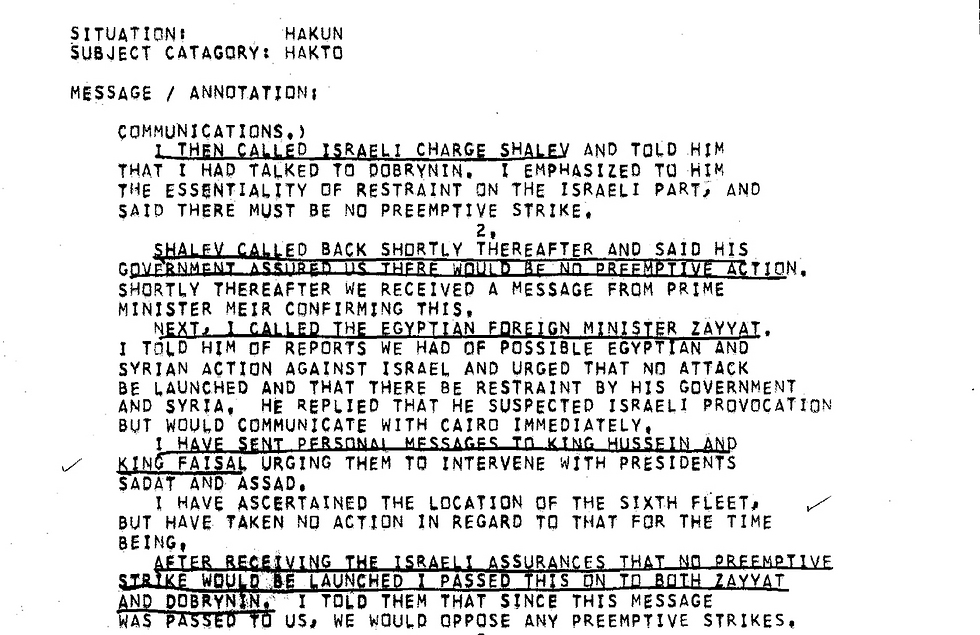
The third document doesn’t confirm imminent attack either?
The US asks Israel to exercise restraint
The US asks Israel to take no preemptive action
The US opposes preemptive action on the part of Israel
 |
The fourth document tells us only about Israel’s intelligence.
“I was notified that the Israeli’s have what they consider to be hard information…”
“Urgently communicating with the Israelis, Warning them against any pre emptive attack”
And Egypt expected an Israeli provocation..
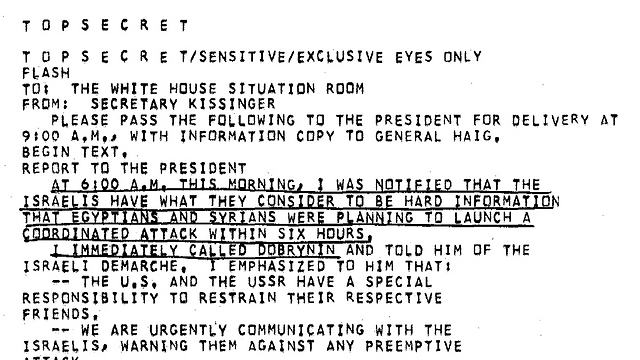
Ynet : The morning of the coordinated attack on Israel, US assessments flipped from presuming war was not on the horizon to frantic attempts to prevent Syria and Turkey from attacking the Jewish state, which was warned off any preemptive strike.
Read the documents and decide for yourself... In all four documents it is clear Israel has prepared for an aggressive move and the US is repeatedly calling for restraint. Warning Israel not to move preemptively. Egypt expecting an Israeli provocation..
Self-defense or provocation: Israel’s history of breaking ceasefires
Western Media Whitewashes Rebel Destruction of Damascus Water Supply
By Maram Susli – New Eastern Outlook – 20.01.2017
Syria’s capital city Damascus continues to suffer without water. The water which supplied four million people, was cut off by insurgents who have occupied the aquifer in Wadi Barada since late December. The insurgents, which include an alliance of US backed groups and Al Qaeda’s Syria branch Jabhat Fateh Al Sham (formally Jabhat al Nusra), uploaded a video of themselves rigging the ancient Ein Al Fijeh spring with explosives. Two days before this upload, the rebels were also accused of tainting the water supply with diesel. As a result of the success of the Syrian military campaign to recapture parts of Wadi Barada, the insurgents were forced to agree to allowing engineers in to fix the aquifer as part of a ceasefire agreement. However after the agreement was reached the insurgents shot and killed the negotiating team overseeing repairs. Previously they had shot at technicians as they attempted to enter Wadi Barada.
Several groups which included the so called “White helmets” NGO released a written statement, that they will not allow engineers to fix the spring until the Syrian government agrees to give them certain concessions. The White Helmets have received tens of millions of dollars from various Western governments. Their signed statement shows that they are complicit with Al Qaeda in what the UN has stated is tantamount to a war crime.
Yet NATO backed media outlets have failed to explicitly state this, tip toeing around the subject of responsibility. Some outlets were even initially suggesting its was the Syrian government that was responsible. The most offending headlines included this one from the Daily Beast, “Assad’s Newest War Tactic: Dehydration”. The Qatar linked Middle East Eye, a newspaper run by a former Guardian and Al Jazeera journalists, headlined with “Water war: Wadi Barada and Assad’s latest weapon”. Australia’s ABC news suggested that, “this was not the first time the Syrian government targeted it’s own facilities”.
Perhaps the worst offender was the discredited Bellingcat website, run by Eliot Higgins, which claims to be independent open source analysis while consistently backing up US State Department propaganda. They released an article claiming that the Syrian government was responsible for the damage to the aquifer. Bellingcat did not touch on the fact that it is the insurgents who refuse to allow the aquifer to be fixed.
Evidence
There is also ample evidence that the insurgents were indeed behind the initial destruction of the spring. The insurgents uploaded a video of themselves on Facebook, rigging the ancient Ein el Fijeh spring with explosives. In the video a rebel is seen walking through the pipes saying, “this is one of the water pipes of Ein el Fijah spring, the revolutionaries are rigging it with explosives right now”. The video was accompanied by the following written statement.
“Let everyone know that the lives of the traitors in Damascus are not more precious than the life of a child from Wadi Barada. This is one of the tunnels that supply the occupied city of Damascus with water, it’s currently being boopy-trapped by the rebels, in the event that the mercenary commander Qaus Farwa continues his offensive on Wadi Barada, all the main tunnels will be detonated and will never be restored.” #Bombing_is_better_than_evacuation”
Rebels also made Facebook posts celebrating the destruction of the spring and taunting the people of Damascus. One rebel posted photographs of himself flashing victory signs over the rubble of the aquifer tunnels. One post reads,
“Hahaha just as like you wanted, your water has turned into diesel, and the bombing will happen tomorrow or the day after. The bombing is ready no matter what and after that let the flood come. We will burn the soul of each christian, shi’ites and those traitor sunnis who sold their religion and decided to side with you, you jew idiots. You want a ceasefire now just so you can pull your dead bodies out of our sacred soil? You can drink water from my d**k you pigs.”
Seemingly in coordination with the US backed rebels, ISIS cut off the water supply to Aleppo a few days later, suggesting that the water crisis was a planned reprisal for the liberation of Aleppo. This would not be the first time that insurgents cut off water to Aleppo, Syria’s second capital. In 2014, the insurgents filmed themselves celebrating the destruction of Aleppo’s water supply. The population of Aleppo was without water for over a year.
Motive
Furthermore, the insurgents have motive to cut off the water supply while the Syrian government doesn’t. The recent liberation of Aleppo city, involved the evacuation of insurgents to the city of Idlib in green buses, part of the terms of their surrender. The Syrian military was approaching Wadi Barada with the same terms of evacuation on the table.The rebels from the area have cut water supplies to Damascus several times in the past as a bargaining chip to prevent the Syrian army from entering the area and pushing them out. This was likely what caused the insurgents to use the water again as leverage, and escalate by not only stopping the water flow as they have done previously, but destroying it entirely. This is reflected in the Facebook posts made by rebels, that “bombing [the aquifer] is better than evacuation”. The people in Wadi Barada do not get their water from Ein el fijah spring, but from sources further upstream, hence the rebels would not be damaging their own water supply by poisoning and bombing the spring.
On the other hand there is no motive for the Syrian government to cut off water to Damascus, a city which they hold and reside within. It was the government who demanded to get engineers in to fix the aquifer, and in the meantime initiated a program of rationing and distributing water. Bellingcat’s author Nick Waters was wise to this and did not attempt to invent a motive. Instead he claimed that the Syrian government had destroyed the aquifer by accident, coincidentally at the same time that the insurgents were rigging it with explosives. The claim that the attack could have been an ‘accident’ is contradicted by the United Nations, which said the “infrastructure was deliberately targeted.”
Bellingcat’s Whitewash Attempt
The Bellingcat article was written by Nick Waters a former British military officer. This brings up the question of whether he is still biased towards serving Britain’s interests versus objective fact. Britain has been calling for regime change in Syria since 2011. Waters’ article is riddled with logical fallacies and non-sequitur conclusions.
Waters asks us to accept that a Syrian airstrike on the militants holding Ein El Fijah spring, resulted in diesel leaking into the water supply, claiming that it “probably” must have “damaged a fuel tank, generator or otherwise”. However he provides no evidence that this occurred, or an explanation as to what a fuel tank would be doing near the aquifer. He states that the same rebels who showed the tunnel being prepared for demolition were the ones who blamed the water crisis on the Syrian government. He asks us to accept their word on the latter but not the former. To Waters, the credibility of Al Qaeda-linked militants is not damaged by the fact they intended to destroy Damascus’s water supply. Water’s says “using media freely available on Twitter, Facebook and Youtube, it is clear that the structure that covers the spring was significantly damaged on or after the 23rd December”. However the source he used showing the damage to the spring was from the 26th and 27th of December. Embarrassingly, Waters referred to Wadi Barada as “Barada Wadi” multiple times showing a complete lack of understanding about the very place he is attempting to write about. In another example of Waters’ profound ignorance, he also referred to one of the rebels posting on Facebook as “Abu”, however Abu is not a name, but a designation meaning ‘father of.’
Conclusion
Bellingcat and its founder Elliot Higgins are committed to building narratives in support the US State Department’s agenda. In the past, Bellingcat attempted to pin the blame on the crash of Malaysia MH17 on Russia. Bellingcat also produced shaky analysis claiming to have smoking gun evidence that the Syrian government was responsible for the chemical weapons attack in Ghouta. The article that was jointly written by Dan Kaszeta and Eliot Higgins, was contradicted by well known Physics Professor and rocket engineer Theodore Postol who also stated that Dan Kaszeta was a fraud. Dan Kazseta claimed to be a chemical weapons expert but in fact had no education in chemistry. Bellingcat’s article on the water crisis in Damascus will stand as further testament to the unreliability, even intentionally deceptive nature of its reporting.
The United Nations has stated that the cutting off of Damascus’s water could constitute a war crime. One awaits similar UN statements to be made about Aleppo where there is no shadow of doubt that the US backed rebels cut off the water supply in 2014. The UN’s statement could mean that the Al Qaeda linked White Helmets NGO could be implicated in war crimes. This raises the stakes for NATO governments who have provided them with tens of millions of dollars in donations. It is no wonder that a campaign of disinformation is being run to deflect blame and whitewash the incident.
Maram Susli also known as “Syrian Girl,” is an activist-journalist and social commentator covering Syria and the wider topic of geopolitics.
Talks in Astana will give green light to the peace process in Syria
Dr Alexander Yakovenko | RT | January 20, 2017
It is important to clarify some of Russia’s approaches to the negotiations between representatives of the Syrian Government and armed opposition groups in Astana on January 23.
We believe that the best is to limit the number of foreign participants to representatives of the countries-guarantors of the ceasefire – Russia, Turkey and Iran. The new US administration has been invited too. We hope that Deputy Special Envoy of the UN Secretary-General R.Ramzi will act as a mediator at the talks.
The meeting in Astana is not a substitute for the intra-Syrian talks, which begin on February 8 in Geneva. On the contrary, it will contribute to the further development of the negotiation process by inviting the representatives of the armed opposition, who have real influence “on the ground.” We hope that they will also agree to participate in the Geneva talks as an equal and permanent member of the united delegation of the Syrian opposition.
On the agenda – discussions on strengthening the ceasefire, delivering humanitarian aid, building confidence, ensuring free movement of citizens throughout the country except in areas controlled by the terrorists, who are not a party to any agreement and must be defeated as endorsed by the UNSC resolutions.
We hope that a substantive discussion of the modalities of the constitutional reform in Syria will be launched, including the creation of the Constitutional Commission to get the work on a new Constitution started. The members of this Commission will include representatives of both the government and the various political opposition groups, which is provided for in the UN Security Council Resolution 2254.
We hope that the meeting in Astana will contribute to the peace process in Syria and strengthen counter-terrorism efforts.
Dr Alexander Yakovenko, Russian Ambassador to the United Kingdom of Great Britain and Northern Ireland, Deputy foreign minister (2005-2011). Follow him on Twitter @Amb_Yakovenko
Trump brings optimism to Syrian peace talks
By M K Bhadrakumar | Indian Punchline | January 20, 2017
On Thursday, Moscow slipped in the formal invitation to Washington to attend the intra-Syria talks in Astana on coming Monday (January 23). It waited till the last ‘working day’ of the Barack Obama administration. A snub to the outgoing administration? But it could as well have been a pre-emptive measure to guard against any last-minute temper tantrum by the outgoing US administration.
No doubt, it is a thoughtful Russian move to engage the incoming Donald Trump administration on its very first day in the White House. Trump will now take the call. The Russian Foreign Minister Sergey Lavrov said:
- We hope the new US administration will accept this invitation and will be represented at this meeting at any expert level it considers appropriate. This could be the first official contact during which we will be able to discuss a more effective way to fight terrorism in Syria… Russia and the United States created and are co-chairing the International Syria Support Group… It has two task forces – a Humanitarian Task Force and a Ceasefire Task Force. There is a good chance we can invigorate these mechanisms.
Lavrov’s optimism must be based on considered assessment regarding Trump’s disposition to work with President Vladimir Putin in the fight against terrorism in Syria and elsewhere.
A novel feature of the Astana talks is that the field commanders of the Syrian opposition groups have been brought to the forefront as the Syrian government’s interlocutors. Previously, politicians living in exile who were proxies of Saudi Arabia and Qatar used to represent these groups. They were vulnerable to outside manipulation. Evidently, Turkish and Russian intelligence acted together, pooling resources, to wean the field commanders away from the orbit of Saudi and Qatari influence and entice them to agree to a ceasefire and get them to jettison their previous aversion to dealing with the Syrian government.
Of course, the field commanders too have little room to maneuver after the capture of Aleppo by the government forces. Besides, Trump’s win effectively shuts the door on any future US support for these rebel groups. There is bitterness among the residual rebel groups who remain within the Saudi orbit, but losers cannot be choosers. A commentary by Fox News brings this out.
In the final analysis, Moscow has shown almost seamless patience to get as many rebel groups as possible on board – with the exception of Islamic State and al-Qaeda affiliate Nusra Front. No ‘pre-conditions’ have been set except that the participants in the Astana talks must agree on ceasefire. What we see here is a total marginalization of regional states who played a negative role aimed at fragmenting Syria – principally, Saudi Arabia, Qatar and Israel.
Moscow would feel gratified that Turkey is using its clout with the rebel groups to persuade them to attend the Astana talks. In a dramatic turnaround, Russian jets are now providing air support for the Turkish ground operations in northern Syria, testifying to the phenomenal shift in the regional alignments over Syria. (Associated Press )
The bottom line is that the departure of the Obama administration has dramatically improved the prospects for a Syrian peace process taking off, finally. Moscow is pinning hopes that there will be a sea change in the US policies in Syria w.e.f January 20. Again, to quote Lavrov:
- When he (Trump) says that his key foreign policy priority will be the fight against terrorism, we are happy to welcome this intention. This is exactly what our American partners lacked before him. On paper, they (Obama administration) seemed to be cooperating with us…, but in fact, they were deceiving us… According to a recent leak about John Kerry’s meeting with Syrian opposition forces several years ago, the United States regarded ISIS as a suitable force for weakening Bashar al-Assad… What Donald Trump and his team are saying now shows that they have a different approach and will not apply double standards in the fight against terrorism in order to achieve unrelated goals.
The talks in Astana are expected to be substantial. Russia and Turkey hope to involve the field commanders in the drafting of a new constitution, holding of a referendum and fresh elections. Equally, a consolidation of the country-wide ceasefire can be expected as a tangible outcome of the Astana talks. (TASS )
US-led coalition air raids breach Syria sovereignty: Cuba
Press TV – January 18, 2017
Cuba has denounced US-led coalition airstrikes in Syria, saying they violate the Arab country’s sovereignty as they are not permitted by Damascus.
Cuban Ambassador to the United Nations Humberto Rivero made the criticism during a UN Security Council meeting in New York on Wednesday.
“We demand the cessation of the violations of Syrian sovereignty and the foreign military presence without the consent and the coordination of operations with the Syrian government, the only legitimately elected authority in the country,” Rivero said.
He further condemned the “politicization” of the crisis in Syria and “the tampering of the humanitarian crisis and the suffering” of people in the Middle Eastern country.
Those who are “supplying weapons, money and patronage to terrorist groups are responsible for the thousands of civilian victims of the conflict and the humanitarian situation,” the Cuban diplomat said, expressing his opposition to “the promotion of an interventionist agenda” in Syria.
The US-led coalition has been conducting air raids against what are said to be Daesh terrorists inside Syria since September 2014 without any authorization from the Damascus government or a UN mandate. Analysts have assessed the strikes as unsuccessful as they have led to civilian deaths and failed to counter terrorism.
The US Air Force is also carrying out airdrops of weapons, ammunition and other equipment to militants fighting against the pro-government forces in Syria.
UN chief optimist on ‘conflict freeze’
Separately on Wednesday, United Nations Secretary General Antonio Guterres warned that the consequences of the Syria crisis had become “too dangerous.”
Speaking in a briefing at the UN office in the Swiss city of Geneva, Guterres stressed that the conflict had fueled instability in the Middle East region and terrorist attacks across the globe.
Touching on the upcoming Syria peace talks in the Kazakh capital Astana, the UN chief further expressed hope that the discussions could “lead towards a consolidation of the ceasefire and a freeze in the conflict.”
The cessation of hostilities took effect on December 30, following an agreement between Syria’s warring parties.
Mediated by Russia and Turkey with the support of Iran, the truce is the first of its kind that has been largely holding in Syria for almost three weeks now. Earlier attempts by the US to broker such a long-lasting ceasefire had failed.
Elsewhere in his remarks, Guterres underlined that the success of the Syria talks could “help create the conditions for a political process” regarding the Syria crisis.
The Astana talks, which are scheduled to be held on January 23, were brokered by Moscow, Ankara and Tehran.
Syria Rejects Qatar, Saudi Chairs in Astana Talks: No Place for Terrorism Sponsors
Al-Manar – January 18, 2017
Syrian deputy Foreign Ministry rejected on Wednesday the participation of Saudi Arabia and Qatar in the Astana peace talks on Syria next week, stressing that negotiations should not include every party that supports, arms and funds terrorism.
“Once Qatar and Saudi Arabia halt their support to terrorism, then we can discuss their participation in the talks,” he said.
Speaking to Al-Mayadeen TV, Moqdad said that Washington should prove its sincerity to deal with solutions for the Syrian crisis, prevent the support of armed terrorist groups, and exert pressure on Turkey to close its border with Syria.
On the participation of the United States in Astana negotiations, the Syrian official said “anyone who wants to work in good will to resolve the crisis in Syria can take part,” calling to “punish those who finance and arm terrorism, including Saudi Arabia and Qatar.”
US military boosts weapons airdrops to Syrian opposition – reports
RT | January 17, 2017
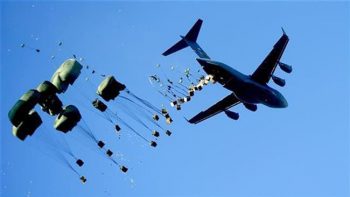 A growing number of opposition groups in Syria are getting increased weapons and ammunition supplies from the US Air Force to tackle Islamic State, according to US media reports citing the country’s military.
The weapons are intended for opposition forces closing in on IS’s self-proclaimed capital Raqqa in Syria, USA Today reports.
The “expanded” airdrops are “helping ground forces take the offensive to [the Islamic State] and efforts to retake Raqqa,” Gen. Carlton Everhart, commander of the US Air Mobility Command, is quoted by the news outlet.
Currently, the Syrian Democratic Force (SDF) – an alliance of various militias, mainly formed by Kurdish fighters – is continuing its push to retake territories around Raqqa. SDF is among key opposition forces being backed by the US-led international coalition in Syria.
The weapons supplies “are absolutely essential” for the irregular forces fighting on the ground, the US Air Force spokesman in Baghdad Col. John Dorrian claimed, according to USA Today.
Meanwhile, Everhart reportedly claimed that the US military is being extremely precise while delivering arms and equipment to the opposition in Syria. “We’ll get it within 10 or 15 meters of the mark,” he said.
The US-led coalition has been repeatedly conducting military airdrops for the opposition groups in Syria. However, such missions have not always gone according to plan.
Back in October 2014, a weapons airdrop by the US Air Force apparently ended up in the hands of IS terrorists, who released a video claiming to have seized the cache of arms. The weapons had been intened for the Kurdish forces battling jihadists who were besieging the Syrian town of Kobane at the time.
Pentagon spokesman Col. Steven Warren later said that two bundles of weapons have been lost. While one of them was destroyed by an air strike, another “went astray and probably fell into enemy hands.”
“There is always going to be some margin of error in these types of operations,” Warren added.
In December last year, US President Barack Obama granted a waiver for some of the restrictions on the delivery of military aid to “foreign forces, irregular forces, groups, or individuals,” if those groups are supporting the US’s alleged counter-terrorism efforts in Syria.
Reacting to the decision, Russian presidential spokesman Dmitry Peskov said the move could result in some of the weapons getting into the hands of terrorists.
Such an occurence would pose “a serious threat not only for the region, but the entire world,” he warned.
On December 9, 2016 US Democratic lawmaker Tulsi Gabbard introduced the Stop Arming Terrorists Act bill. She alleged that the CIA in fact supplied arms to the opposition, some of whom cooperated with terrorists including al-Qaeda. “This madness must end,” she urged.
The Beatification of Barack Obama
By Kit | OffGuardian | January 15, 2017
As the eight-year term of America’s first black President draws to a close, the media are already in the process of myth-making. There’s room for an honest autopsy of a man who promised a new kind of world, and delivered merely warmed-over soundbites and a few fake tears.
“With Barack Obama’s exit the US is losing a saint.” writes Simon Jenkins in the Guardian, whilst Ann Perkins praises his “grace, decency and defence of democracy”. Lola Okolosie rhapsodises on his legacy of “warmth, love, resilience”.
Already the storyline is set – Obama was a good man, who tried to do great things, but was undone by a Republican senate, and his own “sharp intelligence”.
These people, as much as anybody, reflect the cognitive dissonance of the modern press. “Liberals”, to use their own tortured self-descriptor, now assign the roles of good guy and bad guy based purely on aesthetics, convenience and fuel for their vanity. Actions and consequences are immaterial.
For the sake of balance, here is a list of Saint Obama’s unique achievements:
- Obama is the first President in American history to be at war for every single day of an 8 year presidency.
- Obama has carried out 10x more drone strikes than Bush ever did. Every Tuesday a military aide presents Obama with a “kill list”, and the “decent, gracious” Obama picks a few names off a list…and kills them. And their families. And their neighbours. These illegal acts of state-sanctioned murder have killed hundreds of civilians in 5 different countries in 2016 alone. The only reason that number isn’t higher, is that the Obama administration re-classified all males over 18 as combatants, regardless of occupation.
- After declaring he wanted to build a “nuclear free world”, Obama committed to spending $1 TRILLION dollars on rebuilding America’s nuclear weapons.
- Under Obama, the NSA et al. were able to spy on, essentially, the whole world. When this was revealed, not a single intelligence officer or government official was prosecuted. Instead…
- Obama’s administration declared a “war on whistleblowers”, enacting new laws and initiating what they call the “Insider Threat Program”. Manning was prosecuted, Snowden sent into exile and Assange was set-up, discredited and (they hoped) extradited. It has never been more dangerous to be a government whistle-blower, than under Barack Obama
- In terms of foreign policy, despite his press-created and non-sensical reputation as a non-interventionist, American Special Forces are currently operating in over 70% of the world’s 138 countries. The great lie is that, where Bush was a warmonger, Obama has sought to avoid conflict. The truth is that Obama, in the grand tradition of the CIA and American Imperial power, has simply turned all America’s wars into covert wars.
- Before Obama came into office, Libya was the richest and most developed nation in Africa. It is now a hell-hole. Destroyed by war, hollowed-out by corruption. The “liberal” press allow him to agonise over this as his “greatest mistake”, and then gently pardon him for his good intentions. The truth is that Libya was not a mistake, or a misjudgment, or an unforeseen consequence. Libya is exactly what America wanted it to become. A failed state where everything is for sale, a base to pour illegal CIA weapons south into Africa and east into the ME. When war is your economy, chaos is good for business. When secrecy is your weapon, anarchy is ammunition. Libya went according to plan. A brutal plan that killed 100,000s and destroyed the lives of millions more. Libya, like Iraq, is a neocon success story. Syria on the other hand…
- Syria, probably the word that will follow Obama out of office as “Iraq” did his predecessor, is a total failure. Both of stated intent and covert goals. Where the press will mourn Obama’s “indecisive nature” and wish he’d “used his big stick”, the real story is one of evil incompetence, so great that it would be almost comical… if it hadn’t destroyed an ancient seat of civilisation and killed 100,000s of people. Syria (along with Libya, Iraq, Somalia, Iran and Sudan) was on the list of the 7 countries America intended to destroy, famously “leaked” by General Wesley Clark. After the fall of Libya, Syria was (essentially) surrounded by American military on all sides. Iraq, Israel, Turkey and America operating out of Libya could pour “freedom fighters” into Syria to bring down “the regime”. When that didn’t work they deployed the trusty “WMD” method, to demand “humanitarian intervention”… the Russians saw that off. Then “ISIS” was created by the CIA, as al-Qaida were before them, and their manufactured barbarism was used as a pretext for invasion. The Russians, again, saw to it that this would not happen.
- Perhaps in the hope of distracting Russia from the ME, or perhaps merely as a short-sighted punitive measure, the Obama administration’s next foreign policy target was Ukraine. Victoria Nuland’s own voice proves how much that “color revolution” was an American creation. Ukraine is broke, even more broke than it was, its people starve and freeze through the winter. The new “democratic government” has shelled 10,000 people to death in the East of the country…. using American weapons.
- In Yemen, the poorest country in the ME is being bombed to shreds by the richest…. again, using American (and British) weapons. Obama’s “defense of democracy” doesn’t extend to criticising, or even discussing, the abhorrent Human Rights record of America’s Saudi Arabian allies, and in an act of brazen hypocrisy, even supported their chairing of the Human Rights Council of the UN.
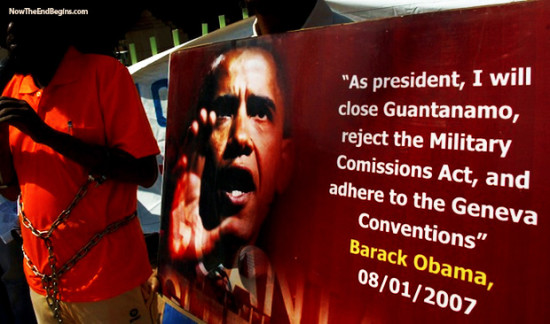
This is the world Saint Obama has created. Guantanamo is still open, and terrorist “suspects” are still held there without trial or charge (they are probably still tortured). Other “suspects” can be simply declared guilty, and unilaterally executed… anywhere in the world. The NSA and CIA are illegally monitoring the communications of half the world. If any other leader in the world claimed even 1% of this power, they would be decried as “autocratic”, and their country denounced as a “pariah state”.
The Middle-East is ablaze from Libya to Afghanistan, and from Yemen to Turkey. Relations with Russia are as precarious as at any time since WWII, thanks to America’s efforts to break Russia economically and shatter their global influence. There is no sign that America intends to back-down (see the recent red-scare style hysteria in the American press). Likewise America has positioned itself to have a massive conflict with China in the South China Sea. Obama is, in terms of influence, nothing more than a used-car salesman. His job is not to create policy, but to sell neocon ideas to the general public, but his lack of agency cannot excuse his lack of vision or morals. Under Obama’s notional leadership the world has moved to the very brink of self-immolation in the name of protecting American hegemony. Domestically America still crumbles.
He had a nice smile, and a good turn of phrase. He was witty, and cool, and looked good in a suit… but that doesn’t mean he wasn’t just more of the same. He could say the right things, and sound like he meant them, but he was still a monster. As he moves out to pasture, the press will try to spit-shine Obama’s tarnished halo, to try to convince us that he was a good man at heart and that, as politicians go, we can’t do any better.
But yes, we can.
Featured Video
EUROPE FEARS RUSSIA’S NEXT MOVE / Ian Proud
or go to
Aletho News Archives – Video-Images
New Book
New Book: No Autoimmunity The Body Doesn’t Attack Itself
Lies are Unbekoming | September 24, 2026
 The label for Humira, once the best-selling drug in the world, lists its risks in plain print. One of them, in the label’s own words, is new “autoimmune” disease.
A drug prescribed for a condition labelled autoimmune carries a warning that it can cause a condition labelled autoimmune. That contradiction sits in every box, on a folded paper almost nobody reads.
My new book starts there.
No Autoimmunity: The Body Doesn’t Attack Itself
For seventy years, “your body is attacking itself, and we don’t know why” has ended the conversation for people diagnosed with multiple sclerosis, lupus, rheumatoid arthritis, Hashimoto’s, Type 1 diabetes, Crohn’s and psoriasis. More than eighty conditions now carry the autoimmune label. The diagnosis comes with a prescription for life. It almost never comes with a question about cause.
This book asks the question and answers it from the framework’s own records: its drug labels, its journals, its regulatory filings, and its own experiments. … continue
Blog Roll
 Aletho News
- DEATH SPIKES & RISING CANCER IN OUR YOUTH EXPLAINED
- Iran offers Trump deal before US election
- Merz regime wants ‘secret police’ – opposition
- Israeli settlers terrorize West Bank Palestinians with state-provided drones: Report
- They see them, then kill them: Israeli quadcopters track, deliberately target civilians in Gaza
- Debunked: Trump’s egregious UNGA claims on war against Iran crumble under scrutiny
- Europe was part of the infrastructure of US aggression against Iran: Deputy FM
- New evidence on the Bucha Massacre
- Italy and France debunk reports CIA issued ‘Russian drone threat’ warning
- How Russia is Rewiring the Global South
- If Americans Knew
- Trump betrayed voters with his campaign lies and prioritized a foreign country once he took office
- Netanyahu calls Israel’s war in Gaza ‘opposite of genocide’ in UN speech to near-empty hall
- Settler Kidnappings: Torture, Sexual Abuse and Terrorisation of Palestinian Abductees as Israel Deepens Annexation of West Bank
- Gaza winter nears as 162,000 tents become unusable, raising fears of humanitarian crisis
- Netanyahu says, “It’s the opposite of genocide”; UN says Gaza economy is world’s ‘most severe crisis on record’ – Daily Update
- Israel’s US-Backed Assault on Gaza Has Created the ‘World’s Most Severe Economic Crisis on Record’: UN
- ‘Protecting U.S. Citizens’… From Israel
- ‘This is where I live now, the back of a truck’: a day in the life of a grandmother in Gaza
- In UN Speech, Iran’s President Displays Pictures of Children Killed by US, Brings Attention to Israel’s Nuclear Arsenal
- Israel displaces hundreds of Palestinians amid wave of demolitions in West Bank
- No Tricks Zone
- New Study: Earth And Venus Surface Warmth Largely Explained By Convection And Lapse Rate, Not CO2 Or Radiation
- 2025 Nature Paper Claiming Worsening Global Drought Gets RETRACTED …Heavily Flawed
- New Study: ‘Global Drought Shows No Detectable Recent Acceleration Under Climate Warming’
- Economic Masterminds: German Socialists Suggest Taxing Productivity Gains Stemming From Using AI
- The South China Sea Has Not Been Cooperating With The Climate Change Narrative
- Energy Crisis: Germany Enters Heating Season With Historically Low Gas Reserve Fill Levels
- New Study: The Antarctic Ice Sheet Gained Mass From 2020-2024 Due To Staggering Snow And Ice Accumulation
- Study: Ocean Heating Rates From Thousands Of Years Ago ‘Dwarf’ Modern Ocean Heating Rates
- Climate Extremists Target, Attack Large-Scale Power Grid Infrastructure In Germany!
- New Study: Antarctic Ice Melt Has Contributed Less Than 1 Centimeter To Sea Level Rise In The Last 30 Years

