48 Iranians Kidnapped in Syria Released
Al-Manar | January 9, 2013
Forty-eight Iranians held hostage by armed groups in Syria since August, were released on Wednesday.48 Iranian abductees
State television reported on Wednesday that the Iranians, who were threatened with execution, were released, but without saying further details.
Iran has appealed to Turkey and Qatar, both with close relations with Syria militants, for help in securing the release of the pilgrims who were visiting the Sayyida Zeinab shrine, a holy site in the southeastern suburbs of Damascus.
Related articles
- 48 Iranians released in first prisoner swap by Syrian rebels (thehimalayantimes.com)
Report: 100 foreign jets training for Syria scenarios in Israel
Ma’an – 08/01/2013

TEL AVIV, Israel – Israel’s Channel 2 TV station reported on Sunday that 100 fighter jets from around the world are training in Israel, including preparation for possible intervention in Syria.
The foreign pilots and aircraft arrived in the country in recent days, and will examine crisis scenarios if Syria uses chemical weapons, the report said.
It did not release the names of the countries participating.
Last week, the TV channel said the Israeli air force was preparing for the joint training, which would include practicing bombing runs and air-to-air combat.
Related articles
- Turkey Okays approval of Israel’s status in NATO: Report (alethonews.wordpress.com)
Syria conflict between nation, enemies: President Assad
Press TV – January 6, 2013
Syrian President Bashar al-Assad says the ongoing conflict in his country is not between the state and opposition but between the nation and its enemies.
In a key speech on the situation in the country, Assad said on Sunday that his government will always extend its hand for dialogue with the opposition and political parties.
The Syrian president, however, said that the government “will not have dialogue with a puppet made by the West.”
“Government will call for a comprehensive national dialogue” in the near future, he said.
“Syria wants peace and reconciliation,” he said, adding that “Armed groups must halt terrorist acts.”
The president added that the constitution will be subjected to referendum and that general amnesty will be announced.
Assad warned that there is an “agenda to partition Syria” but stated that “the nation is for all and we all must protect it.”
“Any initiative must be based on Syrian vision,” Assad said, adding “we are to go ahead with own political process.”
The president went on to say that the Geneva initiative on the transition in Syria was ambigiuous. He also said that “Any talk of revolution in Syria is just bubbles of soap.”
The Syrian president lauded people in the villages that tried to block the enterance of militants from Turkey, adding that “the nation is for those who protect it.”
Syria has been experiencing unrest since mid-March 2011. Many people, including large numbers of security personnel, have been killed in the violence.
The Syrian government says the chaos is being orchestrated from outside the country, and there are reports that a very large number of the militants fighting the Syrian government are foreign nationals.
Several international human rights organizations have accused the foreign-sponsored militants of committing war crimes.
Related article
The FSA continues to shine like a dead star
By Thierry Meyssan | Voltaire Network | December 29, 2012
While the French press persists in announcing the “imminent fall” of Syria and the “flight of Bashar al-Assad,” the reality on the ground has turned around completely. Even though chaos is plaguing most of the territory, the “liberated zones” have melted like snow in the sun. Deprived of its anchor points, the FSA has been left with no prospects in sight, while Washington and Moscow are poised to blow the whistle to end the game.
The countdown has begun. As soon as the new Obama administration will be confirmed by the Senate, it will present a peace plan for Syria to the Security Council. Legally, though President Obama succeeds himself, his former administration is only responsible for the managing of current affairs and can not take any major initiative. Politically, Obama failed to react when, in the midst of the presidential race, some of his colleagues torpedoed the Geneva Agreement. But he proceeded with a general housecleaning right after the announcement of his reelection. As expected, General David Petraeus, the architect of the war on Syria, fell into the trap that had been set up for him and was forced to resign. As expected, the NATO and Missile Shield chiefs – adverse to an agreement with Russia – have been put under investigation for corruption and obliged to remain silent. Also as expected, Secretary of State Hillary Clinton has been taken out of the game. Only the method chosen to eliminate her came as a surprise: a serious health accident that plunged her into a coma.
Meanwhile back at the UN, things have moved on. The Department of Peacekeeping Operations (DPKO) signed a Memorandum with the Collective Security Treaty Organization (CSTO) in September. In October, it monitored CSTO maneuvers in Kazakhstan simulating a deployment of “blue chapkas” in Syria. In December, the DPKO convened the military representatives of the permanent Security Council members to brief them on the manner in which the deployment could be carried out. Despite their opposition to this solution, the French and the British bowed to the wishes of the United States.
Nevertheless, France attempted to use the Joint Special Representative of the United Nations and the League of Arab States, Lakhdar Brahimi, to modify the Geneva peace plan in line with the objections it had raised on June 30th. Ultimately, Brahimi carefully refrained from taking a position, and instead contented himself with transmitting messages to and fro between the various parties to the conflict.
The truth is that on the ground the upper hand is held by the Syrian government. The military situation has been reversed. The French themselves have ceased to mention the “liberated zones” they yearned to govern through a United Nations mandate. These areas have been steadily shrinking, and those that are still holding out are in the hands of the disreputable Salafists. The FSA troops were instructed to abandon their positions and regroup around the capital for a final assault. The Contras were hoping to rally the Palestinian refugees, mainly Sunni Moslem, against the inter-denominational Syrian regime in the same manner that the Hariris in Lebanon tried to arouse the Sunni Palestinians of the Nahr el-Bared refugee camp against the Shiite Hezbollah. As in Lebanon this objective failed because the Palestinians know very well who their friends are and who is really fighting for the liberation of their land. Concretely, in Israel’s recent 8-day war on Gaza, it was the Iranian and Syrian weapons that saved the day, while the Gulf monarchies did not move a finger.
Certain elements of Hamas, loyal to Khaled Meshaal and funded by Qatar, opened the doors of the Yarmouk camp to a few hundred fighters of the Front to Protect the Levant (Syrian-Lebanese branch of Al-Qaeda), also related Qatar. They fought mainly against members of the Popular Front for the Liberation of Palestine – General Command (PFLP-GC). Via SMS, the Syrian government asked the 180 000 camp residents to evacuate the premises as soon as possible and offered them temporary accommodation in Damascus hotels, schools and gyms. Some preferred to go to Lebanon. The next day, the Syrian Arab army attacked the camp with heavy artillery and regained control. 14 Palestinian organizations then signed an agreement declaring the camp a “neutral zone“. The FSA fighters withdrew in an orderly fashion and resumed their war against Syria in the surrounding countryside, while the civilians returned to their homes. They found a devastated camp where schools and hospitals had been systematically destroyed.
In strategic terms, the war is already over: the FSA has lost the popular support it had enjoyed at one point and has no chance of achieving victory. The Europeans still think they can replace the regime by bribing top officials and causing a coup, but they realize that it will be impossible to bring off with the FSA. Contras continue to roll in, but the flow of money and weapons is drying up. Much of the international support has stopped although the consequences on the battlefield cannot yet be seen, much like a star that can continue to shine long after its death.
The United States has clearly decided to turn the page and to sacrifice the FSA. It gives it senseless instructions that lead the Contras to their death. Thousands were killed last month. Meanwhile, in Washington, the National Intelligence Council cynically announced that “international jihadism” will soon disappear. Other allies of the United States should now ask themselves whether this new equation does not imply that they too will be sacrificed.
Brahimi unveils new initiative to end Syria crisis
Press TV – December 30, 2012
The UN-Arab League Special Envoy to Syria Lakhdar Brahimi has unveiled a new initiative to end the country’s months-long crisis.
Brahimi said on Sunday that the new plan could find support from world powers, including key Syria ally, Russia.
The veteran Algerian diplomat, however, did not elaborate fully on his proposal but said he had discussed it with Russia and Syria, and that it was a political solution based on the Geneva Declaration adopted in June.
“I have discussed this plan with Russia and Syria…. I think this proposal could be adopted by the international community,” Brahimi told reporters in Cairo after meeting with Arab League chief Nabil El-Araby.
Under the Geneva plan, opposing sides would cease fighting and a transitional body would be formed until elections are held.
Brahimi also said that the situation in Syria “is very bad and getting worse by the day,” and that without a negotiated solution the country will turn into “hell.”
Brahimi’s previous attempt to secure a temporary truce in Syria for the Muslim feast of Eid al-Adha in October failed after militants refused to cease their fire.
Syria has been experiencing unrest since March 2011. Many people, including large numbers of army and security personnel, have been killed in the turmoil.
A recent UN report has revealed that militants from 29 countries have so far infiltrated into Syria to fight against the Damascus government, most of whom are extremist Salafists.
The Syrian government has repeatedly said that the chaos is being orchestrated from outside the country, and that a very large number of the militants operating in the country are foreign nationals.
Related articles
- Brahimi’s shuttle diplomacy rekindles hopes of solution to Syrian crisis (news.xinhuanet.com)
- Brahimi urges end to Syria violence (standard.co.uk)
Syrian TV cameraman assassinated outside Damascus by ‘armed groups’
RT | December 22, 2012
A cameraman working for Syrian state TV was killed in front of his house in a west Damascus neighborhood, state news agency SANA said. The assassination of yet another Syrian TV employee was reportedly carried out by an “armed terrorist group.”
Haidar al-Sumudi, 45, was shot and killed as his was leaving his house in the Kfar Spusseh neighborhood on his way to work Friday night, SANA reported.
The number of journalist kills in Syria has spiked since the country plunged into violent civil conflict in March 2011. Over 60 professional and citizen-journalists have been killed so far, according to mid-December figures published by media watchdog Reporters Without Borders.
State media employees have been targeted on numerous occasions. On December 4, a reporter for the government newspaper Tishrin was shot dead in Damascus. Basel Tawfiq Yussif, a journalist working for Syrian TV, was gunned down the previous month. In July, TV host Mohammed al-Saeed was kidnapped and executed, the UK-based Syrian Observatory for Human Rights said.
Meanwhile, journalists continue to criticize the Syrian government for its reluctance to allow international reporters to enter the country and provide independent coverage of the violence unfolding. Damascus officials have said that they cannot guarantee the journalists’ security due to internal instability.
One of the most vivid instances of what might befall a journalist in Syria today is Ukrainian journalist Ankhar Kochneva, who was kidnapped by a group of Syrian rebels back in October, and her whereabouts remain unknown.
The kidnappers have threatened to kill the reporter if a $50 million ransom is not paid
Related articles
- Syrian rebels set to execute Ukrainian journalist (alethonews.wordpress.com)
Militants fire at Syrian civilian plane in Aleppo airport
Press TV – December 21, 2012
Militants fighting against the Syrian government have fired at a civilian plane as it was preparing to take off from Aleppo airport.
A militant commander told Reuters on Friday that snipers from his brigade had hit the wheels of Syrian Airways flight RB201 a day before.
The commander, who gave his name only as Khaldoun, said the attack was a message to the government that all planes, either military or civilian, are within the militants’ reach.
It was the first direct attack on a civilian flight since fighting escalated between foreign-backed militants and government forces a few months ago.
Meanwhile, Palestinians are returning to their homes in Yarmouk refugee camp in Damascus after government forces managed to clear the camp of militants.
Syria has been experiencing unrest since March 2011. Many people, including large numbers of army and security personnel, have been killed in the turmoil.
A recent UN report has revealed that militants from 29 countries have so far filtered into Syria to fight against the government of President Bashar al-Assad, most of whom are extremist Salafists.
The Syrian government has repeatedly said that the chaos is being orchestrated from outside the country, and that a very large number of the militants operating in the country are foreign nationals.
Lebanese pilgrims kidnapped in Syria: The untold story
By Nadezhda Kevorkova | RT | December 21, 2012
A group of Syrian rebels have been holding Lebanese civilians hostage for nearly seven months. The kidnappers keep issuing new demands, claiming they have captured “subversives from the Lebanese Hezbollah party.”
The hostages’ relatives deny the charges, saying those captured are elderly and poor, have families and are generally apolitical. They also expressed frustration at how Western mass-media has only aired the kidnappers’ side of the story.
During this seven-month period, the hostages were allegedly ‘killed by Assad’s bombs,’ but then miraculously ‘rose from the dead.’ The conditions of their release have been continually changing: First, the kidnappers turned down a $50 million ransom; they then demanded the families demonstrate against Hezbollah, and asked Hezbollah chief Sayyid Hassan Nasrallah to apologize to the Syrian people; finally, they suggested bartering their hostages for an Al-Qaeda leader.
But at the heart of this cloak-and-dagger saga are clues to how the Syrian captors managed to demand a ransom of $50 million after proclaiming Ankhar Kochneva, a Ukrainian-Russian journalist of Palestinian descent, to be a spy for three different countries simultaneously.
A bargain bus tour hijacked
On May 22, 2012, a group of Lebanese pilgrims on a bus were returning to Beirut from Mashhad, a city in northeastern Iran. Syria was relatively peaceful at the time. Some of the passengers were accompanied by their wives and daughters; one young man was chaperoning his elderly aunt.
In Aleppo province, their bus was stopped by a group of Syrian rebels who then abducted the passengers, claiming they were Hezbollah subversives who had illegally crossed the Syrian border.
The following passengers of the bus remain in captivity:
Ali Skheb, 63: Physically impaired, suffers from heart failure.
Jamil Saleh, 65: Spent the last 30 years working for Saad Hariri, known to be a major supporter of the Syrian rebels. Suffers from epilepsy and is prone to fainting fits. Recently underwent surgery for a spinal disc herniation.
Ali Abbas, 30: Owner of a hookah shop, who supports both himself and his younger brother. The brothers are parentless as well as homeless, and use their shop as living quarters. Ali suffers from epilepsy.
Hassan Arzune, 56: A street vendor who peddles sweets for Ramadan and owns a shop with a floor area of 1.5 sq. meters.
Hassan Hammud, 45: Painter and floor waxer, the proud owner of an antique stone-floor polisher that consists of an iron frame and a water tank. The kidnappers believe Hassan to be a specially trained sabotage and demolitions expert.
Muhammad Monzer, 22: Gas station attendant who borrowed money for the trip in order to accompany an elderly aunt, who dreamed of taking a pilgrimage.
Abbas Shuyab, 41: Pilgrimage broker who organizes bus tours to Iraq and Iran.
Abbas Hammod, 60: Retired Lebanese Army soldier, suffers from neurological disorders.
Ali Termos, 50: Works as a salesman in a small grocery shop.
It is possible the Syrian opposition is unable to distinguish either insurgents or rank-and-file Hezbollah party activists just from their outward appearances. However, few in Lebanon believes that the hostages are members of Hezbollah.
The kidnappers did their best to comply with the rules of Islam: They immediately released all the women – including wives, daughters and the aunt – and allowed those abducted to pray and fast freely.
The captors went as far as agreeing to a meeting between the hostages and two of their family members, who were allowed to make a video on how well the kidnappers were treating the abductees. In the footage, they were shown to be wearing casual clothes and sitting on sofas in broad daylight. They even released two hostages who appeared to be in bad health.
During the first month they ate canned tuna, boiled eggs on the second and chickpeas on the third. Later, their diet slightly improved.
The remaining captives are now confined a room with no windows.
Towards the end of Ramadan, online sources reported that Oqab Saqr, a Lebanese MP from the Hariri bloc, had allegedly received $50 million from Saudi Arabia to pay as ransom for the hostages. Mona Termos, the wife of one of the prisoners, went to the Saudi embassy to find out if the rumors were true.
“On that very day Abbas Nasr, an Al Jazeera correspondent, called me only to yell that I was to blame for disrupting a mission to release the prisoners,” Termos said. “Later, he came and said that I must go live on air to disprove that news. But I said it is up to the ambassador to do it.”
Three days later, the events took a new turn: “We were told that the location had been bombed, leaving four people dead, including my husband! Then the Lebanese Foreign Ministry started an inquiry, and the families took to the streets – and that’s when that information was refuted. Did they rise from the dead?” she said.
And two days after that, the kidnappers’ leader Abu Ibrahim confirmed to NewTV channel that he had been offered the $50 million. “Yes, they did offer $50 million but I refused to take it. It is a matter of principle rather than money,” NewTV quoted him as saying.
Ibrahim now communicates regularly with the media, which interviews him through Skype and the telephone, and even dispatches film crews from New York to record his statements.
Ibrahim’s first demand was for the release of the Lebanese hostages in exchange for Hussein Harmoush, an army defector and one of the founders of the rebel Free Syrian Army. He then demanded that Hezbollah chief Nasrallah apologize to the Syrian people and publicly support the rebels. Currently, there is no evidence suggesting that the pilgrims are connected to Hezbollah.
Ibrahim then called on the families to rally against Hezbollah in front of Beirut’s Syrian and Iranian embassies. The families fulfilled the demand, rallying at the embassies and writing letters to ambassadors. The Iranian embassy’s workers told them that 48 Iranian pilgrims were being held in a similar situation: They were abducted by Syrian rebels under the pretext that they were members of the Islamic Revolutionary Guards corps.
Nasrallah then addressed Lebanon, expressing support for the Syrian people and asking them to demonstrate what shape that support should take.
Those kidnapped are occasionally allowed to call their families with a cell phone that has a Turkish number. Those who were freed from captivity and their visitors claim that the building where hostages are held is within sight of the Turkish border.
“The Turkish authorities could’ve easily found them. But they insist that they’ve no idea where the hostages are held. How do journalists find them then? They all get there across the Turkish border,” the relatives said.
A week ago, Ibrahim made a new demand to the relatives, asking them to rally to free both Hussein Harmoush and Syrian opposition member Tal al-Mallohi.
The families of the hostages expressed frustration at Ibrahim’s apparent hypocrisy in his attempts to free political prisoners. “Nobody should be imprisoned for his or her views, the more so women. Abu Ibrahim, you are committing the same deeds you say yourself you are against! How can I trust the Syrian revolution if you deprive innocent people of their freedom?” the pilgrims’ wives said. Western media have yet to report on their remarks.
NYT journalists traveled to Syria to investigate the hostage-taking and managed to make their way to Ibrahim, but did not contact the captives’ wives and daughters in Beirut. One of the journalists did eventually call the family of the hostages – not to interview them, but to inform them about a video published on the newspaper’s website containing new conditions for the hostages’ release. The relatives were told that the captors are now demanding that 200 political prisoners, including an Al-Qaeda leader from Jordan, be released from Lebanon’s prisons.
“Through a US newspaper they are demanding a release of an Al-Qaeda leader? And to release political prisoners in the Lebanon? But there are none in Lebanon!” the hostages’ family members said. “We are free to say whatever we want, and nobody will pay any attention to that. There are criminals, drug dealers, but no political prisoners. Everybody knows that.”
Abu Ibrahim has promised to clarify the demands, and to fax the names of the two prisoners that will be transferred to Lebanese authorities.
That message has yet to arrive.
Syria’s Mobile Weapons Labs: Where Have We Heard This Before?
By Peter Hart | FAIR | December 20, 2012
If you were concerned that the Syria WMD stories didn’t already feel enough like the Iraq WMD reports, Washington Post columnist David Ignatius had one just for you (12/19/12). Ignatius reports that according to a Syrian defector, the Assad government’s chemical weapons are indeed on the move. Ignatius tells readers that, according to his source,
technicians constructed a mobile lab that could combine and activate so-called “binary” chemical weapons agents. These mobile mixers were constructed inside Mercedes or Volvo trucks that appeared, from the outside, to be similar to refrigerator trucks. Inside were storage tanks, pipes and a motor to drive the mixing machinery, the defector said.
The defector estimated that 10 to 15 of these mobile laboratories had been constructed. An independent source said these numbers were high, but he confirmed that the Syrians do have mobile labs.
Now it’s not that Ignatius doesn’t know that this story sounds, well, familiar. He places that giant caveat right near the beginning of his piece:
For some historical context, readers should recall the Iraqi defector known as “Curveball,” who made allegations about Iraqi chemical weapons a decade ago that bolstered the case for war–but turned out to be fabrications.
So there’s reason to be skeptical. But evidently not too skeptical. Ignatius goes on:
Seeking corroboration for the Syrian report, I checked it with knowledgeable, independent sources, who confirmed some of the details. With that support, I want to share it with readers.
Ignatius has confidence in at least some of this story, as evinced by his lead:
Reports from inside two Syrian chemical weapons facilities offer chilling new evidence that President Bashar al-Assad’s regime developed special vehicles last year for moving and mixing the weapons–and an unconfirmed allegation that Lebanese allies of the regime, presumably in Hezbollah, may have been trained 11 months ago in the weapons’ use.
What he’s saying, in other words, is that the mobile labs exist; the more frightening allegation–that the labs might be headed to Lebanon for use by Hezbollah–is “unconfirmed.” How solid is the sourcing? He writes:
A Syrian source provided a detailed account in a telephone conversation over the weekend, drawing on intelligence provided to him by a Syrian defector who worked inside the chemical weapons network.
So we have what would appear to be a secondhand account, delivered by phone, thanks to arrangements made by a Syrian opposition group. And how do we know the weapons were headed for Hezbollah? Ignatius tells us that his source says, “The officers placed the chemicals in a civilian vehicle and were seen driving across a bridge in the direction of the highway toward Lebanon.”
What does all of this mean? That’s impossible to say–though the idea that mobile chemical weapons labs were put together last year, after the revolt started, in order to coordinate transfer of the weapons to Hezbollah is, on its face, a little far-fetched.
Ignatius gives the Iraq stories all but one paragraph, but it’s important to recall more of the journalism from that period. As Seth Ackerman wrote in Extra! (7-8/03), one of the most embarrassing–and largely forgotten–episodes of the Iraq War came when NBC breathlessly reported the discovery of Iraq’s feared mobile bio-weapons labs:
On May 12, NBC News correspondent Jim Avila, reporting from Baghdad, declared that the labs “may be the most significant WMD findings of the war.” Joining him was hawkish former U.N. nuclear inspector David Kay (now an “NBC News analyst”), who was flown to Iraq to perform an impromptu inspection for the cameras. Armed with a pointer, he rattled off the trailer ‘s parts: “This is a compressor. You want to keep the fermentation process under pressure so it goes faster. This vessel is the fermenter….”
Kay’s explanation–”think of it as sort of the chicken soup for biological weapons. You mixed it with the seed stock, which came from this gravity flow tank up here into the fermenter. And under pressure with heat, it fermented”–was convincing enough for television news. Kay stated: “Literally, there’s nothing else you would do this way on a mobile facility. It is it.”
Well, except for one problem: What they found was actually equipment to make hydrogen for weather balloons. But what they were looking for was what defectors told various officials they would find–and part of what Colin Powell told the world about Iraq’s WMD program on February 5, 2003. The old saying that when you have a hammer, everything starts to look like a nail comes to mind.
Is “intelligence” on Syria any better? It’s unclear why we should think so. But for columnists like Ignatius, what someone told him on the phone based on what someone else may have seen is apparently good enough. And maybe it doesn’t really matter. As Ignatius once explained (Washington Post, 4/25/03):
Personally, I don’t much care if the U.S. reports about weapons of mass destruction prove to be imaginary. Toppling Hussein’s regime was still right.
Does he care this time whether or not the WMD stories he’s reporting as fact are imaginary or not? Or would toppling Assad’s regime be right no matter what?
Related articles
- Obama’s War on Syria and its Implications (alethonews.wordpress.com)
Russia: No blue helmets should enter Syria
Press TV – December 18, 2012
Russia has opposed any possible deployment of United Nations peacekeepers in Syria.
Russian Deputy Foreign Minister Gennady Gatilov has been cited as saying, “There is neither peace [in Syria] for peacekeepers to keep, nor truce for them to monitor.”
The UN has been reportedly planning to deploy 10,000 peacekeepers inside Syria.
The Russian official has stated that “there is no clear separation line between the conflicting sides” in Syria.
Gatilov has also said Moscow would veto any UN Security Council resolution aimed at military intervention in Syria and criticized previous Security Council resolutions passed on the situations in Iraq and Libya, saying that those resolutions were misused to allow unilateral military interventions.
Syria has been experiencing unrest since mid-March 2011. Many people, including large numbers of Army and security personnel, have been killed in the violence.
The Syrian government says that the chaos is being orchestrated from outside the country, and there are reports that a very large number of the militants are foreign nationals.
Several international human rights organizations have accused the foreign-sponsored militants of committing war crimes.
Related articles
- Obama’s War on Syria and its Implications (alethonews.wordpress.com)
- UN contingency plan to deploy up to 10,000 peacekeepers in Syria – reports (rt.com)
Obama’s War on Syria and its Implications
By SHAMUS COOKE | December 17, 2012
The Obama administration has already declared war on Syria, even if it isn’t “official” yet. Consider the facts, all of them acts of war: The U.S. now recognizes a group of Syrian exiles to be the official government of Syria; the U.S. is providing direct support for rebels attacking the government; the U.S. has coordinated with NATO to place advanced missile systems — and 400 U.S. troops — on Syria’s border with Turkey; Obama has drawn a “red line” that, if Syria crosses, would result in U.S. direct military intervention. If any other country made similar moves toward the U.S., there would be no question that war had been declared.
All the strategic steps that led to the Iraq war are being repeated. Obama has assembled a Bush-style international “coalition of the willing” of nations to topple the Syrian government; 130 countries have put their names on paper in support of toppling the Assad government.
In reality, however, the core of the group is the U.S./Europe NATO alliance and the Gulf monarchies. The rest of the “coalition” are economic and political satellites of these main groups, who would sign onto to any military adventure that the rich nations demanded of them, since otherwise the poorer nations would have their military, financial, or political aid frozen.
Europe’s increased lust for blood is a relatively new phenomenon; the European divisions that erupted during the Iraq war and then the Libyan invasion seem to have been smoothed over. Now even Germany aims to directly join the war efforts, intending to send missiles and troops to the Turkish border as well.
But NATO is still a U.S.-dominated military alliance. Any NATO military action is in reality a U.S. led effort, since the European armies are miniscule in comparison, and lack much of the technological sophistication of U.S. weaponry. The advanced Russian missile systems that Syria is equipped with demand a direct U.S. military role to neutralize.
Like Bush, Obama is using his coalition of the willing to distract from the fact that he is circumventing the UN, and thus bringing the post WWII system of international conflict resolution — already on life support — closer to death.
Also like Bush, Obama strategically exploited the UN to weaken Syria with sanctions, and when further UN action was not possible — because of the objections of China and Russia —Obama threw aside the UN and opted for NATO, a U.S./European military alliance built specifically as a deterrent to the now-defunct Soviet Union.
Again like Bush, Obama has crafted a false motive for war. Obama has stolen Bush’s “weapons of mass destruction” but substituted “the use of chemical weapons” as a bogeyman worthy of military intervention. Obama’s bogeyman is as false as Bush’s was. The New York Times reports:
“…the effect of that statement [that Syria was planning to use chemical weapons] was somewhat undercut when France’s foreign minister, Laurent Fabius, asserted during a news conference that such reports were unconfirmed.”
This lack of confirmation hasn’t bothered the U.S. media, who remain content repeating as truth any report issued by U.S. intelligence, no matter the past lies that have cost countless deaths in Iraq and elsewhere.
Of course the U.S. government has zero legitimacy to hand pick a “replacement” government for Syria, since the U.S. is universally hated in the region after the destruction of Iraq, Afghanistan, Libya, and the ongoing drone wars against Pakistan and Yemen. No sane Syrian would invite the U.S. government to “liberate” their country. In fact, a coalition of Syrian opposition groups inside of Syria, the National Coordination Committee (NCC) — virtually ignored by the U.S. media — opposes military intervention, demanding the conflict be addressed through political means. A leader of the NCC is Hassan Abdul Azim, who correctly states: “We refuse on principle any type of military foreign intervention because it threatens the freedom of our country.”
Another prominent ongoing lie repeated by U.S. politicians and media is that the Syrian government is on the verge of collapse. This lie is effective in that it creates an urgency to “take action.” It also paints a picture of the conflict coming to an end that resonates well with Americans. The reality is that the Syrian western-backed rebels have staged daring high-profile attacks that have been largely repulsed by government counter-attacks. But in each instance the U.S. government has used these attacks as an excuse to ratchet up their support to the rebels and now to place U.S. missiles and troops on Syria’s border. Of course if the Syrian government does fall, Obama has absolutely no plan on how to “stabilize” the country, since the most effective rebel fighting force — the Al-Nusra Front — has been labeled a terrorist organization by the U.S. government. Obama and his NATO and Gulf monarchy allies have created an extremely unstable situation in Syria. They have already torn the Syrian social fabric to shreds with their support of the rebels, but in so doing they’ve pushed many Syrians closer to supporting their government, who they see as a protector against the rebels that have used large scale ethnic-religious cleansing and other war crimes to subdue the population.
Thus, the Syrian government still retains a popular base, ensuring that the already bloody catastrophe will continue with no end in sight, especially since Obama has “regime change” as his goal and is encircling the country with missiles and U.S. and European troops. Iran and Russia will continue to bolster the Syrian government. Under these tense conditions a broader war can break out any moment. The U.S. can claim that the Syrian government is about to employ chemical weapons as an excuse to directly intervene. Or perhaps Turkey — a NATO member — will claim that Syria fired missiles into its territory, and thus Obama will act to “defend” its ally. When war “officially” breaks out, Iran might then increase its direct support for the Syrian government with troops —funneled through Iraq — giving the U.S. another excuse to “defend” itself, and pushing the conflict into Iran. Hezbollah in Lebanon or Israel may intervene too, since both have a direct interest in the outcome of the Syrian conflict. Any number of scenarios could play out that drag other nations into the war, including Russia, who is already supporting the Syrian government. Many of these scenarios have already begun on the proxy level and need only a shove to ensure they explode into a full-scale regional war.A nation under attack creates a feeding frenzy logic from those countries looking to opportunistically exploit the situation. This proxy war in Syria is on the brink of a much larger disaster, with the potential to annihilate the Middle East through a new round of war and barbarism.
Shamus Cooke can be reached at shamuscooke@gmail.com
Featured Video
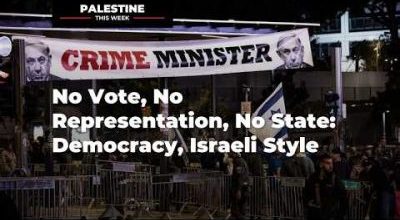
No Vote, No Representation, No State: Democracy, Israeli Style
or go to
Aletho News Archives – Video-Images
From the Archives
Sanctions, War and the Policy of Dual Containment
By SASAN FAYAZMANESH | March 17, 2008
It is now nearly three decades since the Unites States adopted the policy of dual containment of Iran and Iraq. While much has been written about the containment of Iraq, there has been very little in-depth analysis of this policy when it comes to Iran. In a book that is going to be released on March 31, 2008, entitled The United States and Iran: Sanctions, Wars and the Policy of Dual Containment (Routledge), I attempt to address this shortcoming by investigating when and why the US policy of containment of Iran came about, how it evolved, and where it stands today.[1] To the extent that Israel has been involved in US policy making, the study will also include the role that Israel has played in the containment of Iran. Also, since the fate of Iran has been inextricably linked to that of Iraq, occasionally the investigation will overlap with the containment of Iraq.
The policy of dual containment of Iran and Iraq originated during the Carter Administration, but it was not until the Clinton Administration that the expression “dual containment” became popular. … continue
Blog Roll
 Aletho News
- British state targets Palestine Action with yet another crooked trial
- Americans are paying the price to preserve Israel’s nuclear hegemony
- Resistance factions are necessary to ensure a permanent US Iraq withdrawal
- How Israel destabilizes the Middle East: Denying sovereignty and the right to exist
- Europe’s Establishment Is Embracing War – and Losing Voters
- NATO chief advocates war of aggression
- No Vote, No Representation, No State: Democracy, Israeli Style
- Zionist Bought Senate Blocks Information About American Citizens Killed By Israel
- While Gaza dominates the UN, these are the people keeping it alive
- New Report: “Scholasticide and Genocide in Gaza: Assessment, Testimonies and Legal Analysis”
- If Americans Knew
- Israeli Soldiers Abduct At Least 22 Across Occupied West Bank
- Eight Palestinians Killed in Israeli Attacks on Gaza
- Israeli former leaders and security chiefs threaten legal action over ‘Jewish terrorism’
- Israel map in LA Times ad includes all land from the river to the sea
- Inside Lebanon’s 200-page dossier on Israeli war crimes
- Flydubai, genocide, settler violence, Trump abuse of power to deport – Daily Update
- Counting Antisemitic Incidents: What the ADL Audit Reveals — and Obscures
- Mamdani releases plan to combat antisemitism and hate crimes in New York City
- Iran’s Revolutionary Guards Publish Letter to the American People
- DMFI launches $1 million ad campaign supporting Virginia’s Elaine Luria
- No Tricks Zone
- Green Energy Debacle: German Expert Professor Fritz Vahrenholt Warns Of Severe Economic And Social Consequences
- Two More Paleo Reconstructions Affirm Meters-Higher Sea Levels Across Ireland, Brazil 7000-6000 Years Ago
- New Study: Earth And Venus Surface Warmth Largely Explained By Convection And Lapse Rate, Not CO2 Or Radiation
- 2025 Nature Paper Claiming Worsening Global Drought Gets RETRACTED …Heavily Flawed
- New Study: ‘Global Drought Shows No Detectable Recent Acceleration Under Climate Warming’
- Economic Masterminds: German Socialists Suggest Taxing Productivity Gains Stemming From Using AI
- The South China Sea Has Not Been Cooperating With The Climate Change Narrative
- Energy Crisis: Germany Enters Heating Season With Historically Low Gas Reserve Fill Levels
- New Study: The Antarctic Ice Sheet Gained Mass From 2020-2024 Due To Staggering Snow And Ice Accumulation
- Study: Ocean Heating Rates From Thousands Of Years Ago ‘Dwarf’ Modern Ocean Heating Rates

