Israeli forces open fire on civilians in southern Syrian village

Israeli military camp with armored vehicles along strategic road connecting the villages of Jamla and Saysoun in Daraa Governorate, Syria on June 28, 2026. [Enver Asfur – Anadolu Agency]
MEMO | June 29, 2026
Israeli forces opened fire on Syrian civilians on Sunday evening as they began withdrawing from the village of Abidin in Daraa province, southern Syria.
The Syrian Arab News Agency (SANA) reported that “Israeli occupation forces opened fire towards residents while withdrawing from the village of Abidin in the western Daraa countryside.”
There were no immediate reports of injuries, and the Syrian authorities have not commented on the incident.
Earlier on Sunday, the Israeli army set up tents on Tal al-Maghar, west of Abidin village, and in the Yarmouk Basin area in the Daraa countryside.
Syrian media reported that Israeli forces fired live ammunition and illumination flares, targeting farmers near El-Tallah after a force of four armoured personnel carriers moved from al-Jazira barracks towards the area.
Israeli military activity in Syria has escalated in recent months, including raids on civilian homes, searches, the establishment of checkpoints, and the detention of civilians, including shepherds and children.
After the fall of the Bashar al-Assad regime on 8 December 2024, Israel declared the 1974 Disengagement Agreement had collapsed and took control of the UN-monitored buffer zone.
The Middle East, Hormuz and the New Mercantilism
By Craig Murray | June 29, 2026
The provisional surrender document signed by Donald Trump appeared to represent a triumph for Iran and indeed for the world; but neither the USA nor Israel has the slightest sense of honour and they cannot be trusted to negotiate in good faith.
Iran knows this – after all, the USA twice attacked Iran actually during peace negotiations, on each occasion killing key Iranian negotiators.
To understand the American position, it is important to realise two key points:
- Greater Israel is an absolute priority
- Opening the Strait of Hormuz is not a US priority
While the US/Israeli alliance were defeated in their attempt to impose regime change on Iran, and indeed have consolidated the popular support of the Iranian government, they have succeeded in expanding Greater Israel. Israel has ethnically cleared and devastated a vast swathe of Southern Lebanon, expanding its military footprint, and notably attempting to repeat its ploy from November 2024 of pushing forward its armour under cover of ceasefire.
Israeli withdrawal from Southern Lebanon has been a major negotiating point for the Iranian government and is a key – indeed the very first – point of the Iran/USA MOU. But in an extraordinary coup aimed at negating that deal, the USA has signed a deal with Israel and its puppet Aoun regime in Lebanon which seeks to legitimise Israeli occupation of Southern Lebanon through the agreement of the “Lebanese government”.
This is an astonishing development. I did not think I could have a lower opinion of the appalling bloated traitor “General” “President” Aoun but not even I – nor I think any commentator – believed he would make such a deal with Israel. The plan is that the Americans, Israelis and Lebanese Army will act together to forcibly eliminate Hezbollah, and only after that is certified – by the Israelis – will the Israelis withdraw from Southern Lebanon.
Here are the operative paragraphs. Note that they carefully do not say in terms that Israel will actually leave Lebanon.
“3. …The Government of Israel and the Government of Lebanon commit to a reciprocal, sequenced process, with clear conditions, whereby the LAF will restore effective sovereign authority over all Lebanese territory, pending the verified disarmament of non-state armed groups and dismantlement of associated infrastructure, enabling the Israel Defense Forces (IDF) to progressively redeploy out of the Lebanese territory.”
“5 . …The Government of Israel underscores that the termination of this threat, through the disarmament and dismantlement of such groups in all of Lebanon and additional security arrangements to be agreed upon between the two countries, will eliminate any future need for IDF military action or presence in Lebanon.”
This is plainly completely incompatible with the USA/Iran MOU, which states as Point 1:
“The United States of America and the Islamic Republic of Iran and their allies in the current war are signing this MOU to declare the immediate and permanent termination of military operations on all fronts, including in Lebanon, and undertake from now on not to initiate any war or any military operation against each other, and to refrain from the threat or use of force against each other, and ensuring the territorial integrity and sovereignty of Lebanon. The final deal will confirm the permanent termination of the war on all fronts, including in Lebanon and other provisions of this paragraph.”
Of course, everybody knows that Israel will never withdraw voluntarily, any more than they withdrew from the Golan Heights. Annexation is plainly the goal and expansion of Greater Israel at least to the Litani River and probably further.
It is important to realise that this is not only Aoun seeking the annihilation of the Shia population of Southern Lebanon; he is also betraying his own community. Aoun is himself a Southern Lebanese Christian, and Israel has been destroying the homes, churches, hospitals and families of Southern Lebanese Christians with as much glee as they attack Muslims.
The agreement names two “pilot zones” where the combined Israeli and Lebanese Army forces will eliminate Hezbollah, followed by Israeli withdrawal from those zones. But these are zones which Israel is not currently occupying – they are areas where Israel was defeated in fighting by Hezbollah and which have been since subject to relentless Israeli bombardment.
So Aoun has agreed to support militarily an IDF advance further into Lebanon, against an agreement that Israel will be able to withdraw once these key Hezbollah redoubts have been destroyed. Even if Aoun were stupid enough to believe the Israelis will withdraw after the operation, this is a level of treachery it is difficult to comprehend.
Greater Israel is not a concept. It is a reality being created before our very eyes.
Israel now occupies 70% of Gaza and plainly the entire “Board of Peace” mechanism is nothing but smoke and mirrors, pure fraud. It has zero effect on the continued tightening of the Gaza concentration camp into an ever-shrinking area. Israeli settlements in the West Bank expand daily and every night the skies are red with Palestinian homes and crops burning. In East Jerusalem Palestinians are continually evicted and replaced by fresh European or American arrivals. In Syria, Israel is building permanent fortifications and its armour creeps forward field by field, with the full cooperation of “President” al-Jolani.
Iran was able to resist the combined military might of the USA and Israel. That is cause for celebration. But do not allow it to blind your eyes to the continued hard reality of the expansion of Greater Israel.
There is no gain for the US in the US/Iran Memorandum of Understanding which the US did not already possess before starting the war. It is therefore very possible, and in many senses valid, to read it as the formalisation of US defeat: a surrender document. Which is why you should be sceptical about US commitment to the terms.
The Strait of Hormuz was fully open before the US started the war. Allowing the flow of oil to resume has become a short-term US priority due to high domestic retail prices and pending elections, but the MOU envisages more Iranian control – and potentially fees – in the Strait than existed before the war.
There is no indication of restrictions on the Iranian nuclear programme that were not already available in the peaceful negotiations. Crucially there are no limitations on Iran’s vital ballistic missile production. The proposed relaxation of sanctions and release of frozen assets is a triumph for Iran and long overdue, and the $300 billion in dollars in reparations, from unspecified sources, is stunning.
So stunning of course that anyone with their head screwed on will realise there is no long term American intention to keep faith with the deal.
Trump is not stupid. There are many ways of characterising his kind of cunning, but it is not stupidity. He was not, as the prevailing narrative seeks to state, the only person in the World who did not realise the Strait of Hormuz would be closed by the war. The USA is quite happy to see the Strait of Hormuz closed, or permanently made more difficult and expensive to transit.
The key to understanding Trump’s position is his famous love of tariffs. Trump is a mercantilist. For many years the world worked on the general basis of accepting the economics of Adam Smith – that freedom of trade promoted universal, reciprocal wealth creation. That was the founding basis of the World Trade organisation, and is the internal philosophy of big trading blocs like the EU.
Trump rejects this and returns to the philosophy that other nations are all competitors, not potential partners, and that success lies not only in increasing your own production, but in damaging your rivals’ production – which ultimately will increase domestic production further. Trump rejects the basic premise of free trade.
The long prevailing belief in the beneficial effects of free trade historically was, as logic demands, accompanied by the demand for freedom of navigation.
Sweeping away tariffs goes hand in hand with sweeping away the controls on shipping which carry the goods. Before the rise of liberal economics, almost all states had practised mercantilism, with controls on shipping being a major source of state revenue. The magnificence of Kronborg Castle in Helsingør, in which Hamlet is set, was constructed entirely from revenues from tolls on ships exiting the Baltic by passing the strait it overlooks, for example.

Freedom of navigation was initially enforced ultimately by the British, and later the American, Navy. States attempting to enforce customary passage fees, for example in the Malaccan Strait, were classified as “pirates” and freedom of navigation became a routine justification for imperialist aggression and/or colonial occupation. Freedom of navigation eventually became customary international law, ultimately codified in the UN Convention of the Law of the Sea.
The simple truth is this: in openly abandoning the principle of free trade, the Trump regime has also abandoned the logically linked principle of freedom of navigation. This is evident not just in their indifference to the closure of the Strait of Hormuz. It is evident in the naval blockades of Cuba and Venezuela and above all in the worldwide blockade of Russian hydrocarbon deliveries, including the effective end of free passage through the Strait of Dover, and a de facto naval blockade of the Arctic passages.
Following the shale boom, the United States is a net hydrocarbon exporter. The USA balance of trade benefits from high hydrocarbon prices. Trump is doing everything he can to increase US hydrocarbon production by slashing environmental and other controls. This is a core Trump policy.
The USA does not import hydrocarbons through the Strait of Hormuz. That fact is key to Trump’s thinking.
In this mercantilist view, closure of the Strait has two benefits for the USA.
- It disadvantages rival hydrocarbon suppliers
- It disadvantages rival industrial competitors in Europe and Asia who do get hydrocarbons through Hormuz.
This is exactly the same logic behind the destruction of Nord Stream 2. The same mercantilist system also explains the effective seizure through naval blockade and control of Venezuela’s oil production, and the blockade of Russian hydrocarbons through sanctions and the “shadow fleet” propaganda disguising another naval blockade.
The UK’s recent actions in the Dover strait indicate that the West, not just the United States has surrendered the principle of freedom of navigation in straits.
Trump believes, as he has repeatedly stated in public, that domestic fuel prices in the USA are a blip and will equalise as the USA increases its domestic fuel production and Venezuelan fuel production. However this was not happening in time for the mid-term elections which is why reopening the Strait of Hormuz became a temporary priority that occasioned the ceasefire and MOU with Iran.
None of this implies good faith negotiation or a real prospect for a lasting peace.
Israel Brings The War Rhetoric Towards Türkiye
After Being Defeated In Iran, Israel Targets Türkiye.
By Justin K.P. – The Dissident – June 22, 2026
The idea of Israel going to war with Türkiye- a NATO member- potentially triggering World War III seems insane.
And yet Israel is using their war rhetoric towards Türkiye.
The Israeli Foreign Ministry put out a post seemingly laying the groundwork for an Israeli war, claiming that “Hamas terrorists based in Turkey are directing attacks against Israelis, funding terrorism, and recruiting operatives. The network is exposed. The facts are clear.”
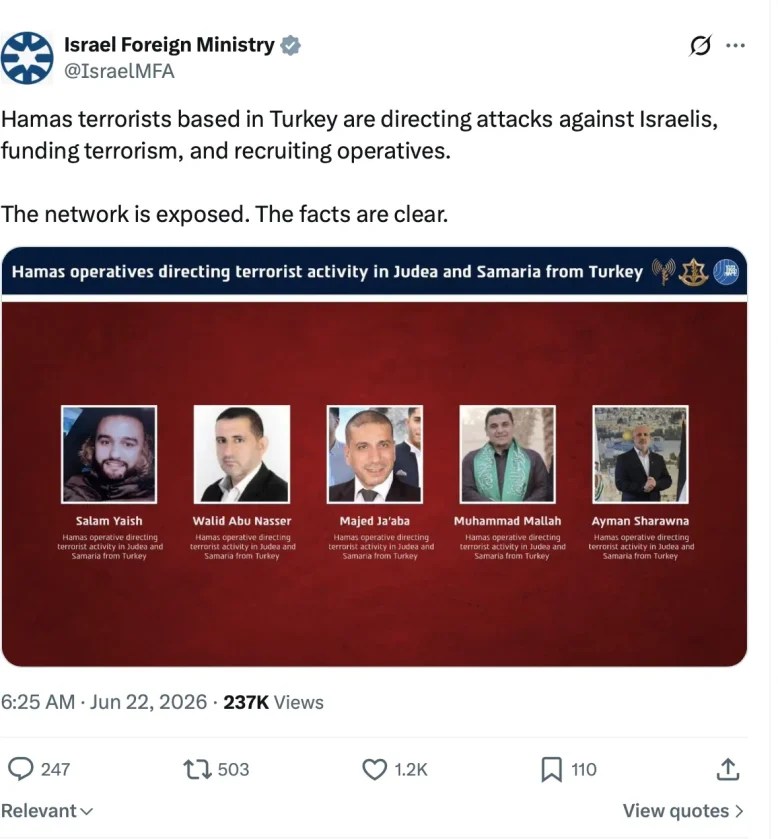
This is far from the first time Israel has used war rhetoric towards Türkiye.
Israel’s Minister of Diaspora Affairs Amichai Chikli recently said that Israel “will be at war with Syria sooner or later” in part because he called Syria “a Turkish protectorate”.
He also fabricated a new “radical Sunni axis of evil” which supposedly includes Pakistan, Turkey and Qatar.
Middle East Eye reported:
“What we are witnessing before our eyes is the rise of a new axis,” Chikli told 103FM radio on Wednesday, referring to Turkey, Qatar and Pakistan. He described this so-called alliance as “a radical Sunni axis of evil, more dangerous than anything we have seen before”.
While Chikli mentioned both Qatar and Pakistan in his interviews, he mainly focused on Turkey, branding Turkish President Recep Tayyip Erdogan’s vision “an extremely dangerous combination for us”.
Other members of the ruling Israeli Likud party have similarly been declaring Türkiye “an enemy state”.
Middle East Eye noted, “Last week, Israeli lawmaker Ariel Kellner, also of Likud, called Turkey an ‘enemy state’, while Culture and Sports Minister Miki Zohar said last month that Israel’“must begin to treat Turkey as an enemy state,’ suggesting that Turkey would suffer heavy blows in a possible conflict with Israel.”
It added that “In February, former prime minister Naftali Bennett indicated that he sees Turkey as an enemy, with the opposition figure stating: ‘Turkey is the new Iran.’”
Perhaps the most concerning development is the fact that the Foundation for The Defence of Democracies (FDD), an Israeli lobby cutout that played a large role in the U.S. war on Iran, has begun publishing articles using similar rhetoric towards Türkiye.
FDD put out an article titled , “Turkey the new Iran? Ankara’s growing challenge to Western interests”.
The article attempted to label Türkiye as the “new Iran”, writing:
As Iran and its proxies take a beating from American and Israeli forces, observers are questioning whether Turkey is waiting in the wings to emerge as the region’s next “bogeyman.” The answer is likely yes, albeit in its own form.
Turkey is not Iran, but depicting Turkey as a nuisance or simply “complicated” only emboldens a maturing adversarial regime with an established track record of undermining its Western allies.
The article attempted to ratchet up hostilities between Türkiye and the United States, writing, “The real question is whether Turkey is actively undermining US, NATO, and regional security interests. There is little doubt that Ankara is doing just that, and doing so more brazenly with the passage of time.”
It also lamented that Türkiye is too supportive of the Palestinian resistance, writing “Hamas, as an Iranian proxy, has served Ankara’s interests in undermining Israel’s security interests, something which Turkey would like to see intact after the end of the current war.”
FDD has similarly put out articles pushing for the U.S. to put sanctions on Türkiye, saying that “Washington should pursue Global Magnitsky sanctions against targets in Turkey” and that “the United States should utilize Global Magnitsky authorities to target Turkish individuals responsible for human rights violations”.
It also called for the U.S. to designate “government officials” in Türkiye as “terrorist organizations” and wrote that “The United States should protect the international financial sector by recommending added scrutiny and screening to transactions involving Turkish financial institutions” and that “Washington should coordinate with the G7 to return Turkey to the Financial Action Task Force (FATF) ‘grey list’ until further improvements are seen in combating terrorism financing.”
The Carnegie Endowment for Peace documented that “FDD was the brainchild of a New York Times journalist-turned-Republican operative, Clifford May,” adding that “it arose out of an organization committed to burnishing Israel’s reputation in the United States. On April 24, 2001, three major pro-Israel donors incorporated an organization called EMET (Hebrew for ‘truth’). In an application to the Internal Revenue Service for tax-exempt status, May explained that the group ‘was to provide education to enhance Israel’s image in North America and the public’s understanding of issues affecting Israeli-Arab relations.’ But in the wake of the Sept. 11 attacks, May broadened the group’s mission and changed its name to the Foundation for Defense of Democracies. As he explained in a supplement to the IRS, the group’s board of directors decided to focus on ‘develop[ing] educational materials on the eradication of terrorism everywhere in the world.’”
It added that, “FDD’s chief funders have been drawn almost entirely from American Jews who have a long history of funding pro-Israel organizations. They include Bernard Marcus, the co-founder of Home Depot, whiskey heirs Samuel and Edgar Bronfman, gambling mogul Sheldon Adelson, heiress Lynn Schusterman, Wall Street speculators Michael Steinhardt and Paul Singer, and Leonard Abramson, founder of U.S. Healthcare.”
Sima Vaknin-Gil, a former Israeli military intelligence officer, in the Al Jazeera documentary The Lobby, admitted that “We have FDD” and that “the foundation is ‘working on’ projects for Israel, including ‘data gathering, information analysis, working on activist organizations, money trail. This is something that only a country, with its resources, can do the best”.
FDD played a huge role in shaping American policy towards Iran at the behest of Israel.
Now, as Israel calls Türkiye an “enemy state”- the FDD has begun pushing Washington to place sanctions on the country and designate government officials as terrorists, laying the groundwork for a new Israeli war.
Syria, Lebanon, and the limits of power
By Bassam Abu Abdallah | The Cradle | June 19, 2026
Remarks by US President Donald Trump in an interview with NBC News earlier this month, in which he said he would like to see “a more precise surgical attack on Hezbollah” and suggested that Syria’s Ahmad al-Sharaa (formerly known as Abu Mohammad al-Julani) could play a role in reaching an agreement over the conflict in Lebanon, have revived a familiar question across the region.
Trump later escalated his rhetoric, saying that if Israel “can’t do the job without killing everyone else, Syria should do the job.” Describing the war on Lebanon as a secondary front, he suggested that Syria, in coordination with the US, could take on Hezbollah if Israeli Prime Minister Benjamin Netanyahu could not be reined in.
Whenever the region enters a period of major change, the same issue resurfaces. Can Syria once again play a direct security or military role in Lebanon, as it did in 1976?
The comparison is tempting on the surface. It invites parallels between the current leadership in Damascus and the late president Hafez al-Assad, who sent Syrian forces into Lebanon during the civil war. Yet even a brief look at the surrounding conditions suggests that the resemblance is largely superficial.
Trump himself did not clarify what form of assistance he had in mind. The possibilities range from border control and curbing smuggling routes to a broader attempt to pressure Hezbollah.
An old question returns
Similar ideas have surfaced before. In a July 2025 interview with The National, US envoy Tom Barrack warned that Lebanon faced an “existential threat” if it failed to address Hezbollah’s weapons, adding that “if Lebanon doesn’t move, it’s going to be Bilad Al Sham [Greater Syria] again.”
In March, Reuters reported that Washington had encouraged Syria to consider sending forces into eastern Lebanon to help disarm Hezbollah, a claim later denied by Barrack. The episode nevertheless fueled speculation about a possible Syrian role in Lebanon.
The responses from Sharaa’s government, however, have remained cautious and indirect. Sharaa has expressed support for Lebanese President Joseph Aoun’s efforts to consolidate arms under state authority, while recent exchanges with Lebanese Prime Minister Nawaf Salam have emphasized coordination between military and security institutions in both countries.
Syria’s self-appointed president and former Al-Qaeda chief Ahmad al-Sharaa dismissed reports that Syrian forces could enter Lebanon as “rumors.”
At the same time, periodic announcements from Syrian authorities about dismantling alleged Hezbollah-linked cells have been interpreted by some observers as signals aimed at Washington, suggesting readiness to engage if political backing is secured. Whether this reflects a concrete agreement or simply an attempt to keep options open remains unclear.
What is clear is that the renewed discussion comes at a moment when broader regional balances are in flux, particularly after the collapse of the previous Syrian order. The question is not whether Syria once intervened in Lebanon, but whether the conditions that made that intervention possible still exist.
1976 and the architecture of intervention
By the time Syrian forces entered Lebanon in 1976, the civil war had pushed the state to the brink. Importantly, the intervention took shape within a web of regional bargains and international understandings, rather than a unilateral move by Damascus.
The move was carried out at the request of the Lebanese president at the time, Suleiman Frangieh, and was supported by influential Lebanese actors who feared a decisive shift in the internal balance of power. It also aligned with broader concerns shared by regional and international players who were wary of Lebanon descending into total disorder.
Accounts in both western and Arab sources point to quiet understandings between the US, Saudi Arabia, and France that gave Syria space to act as a stabilizing force. The objective was about containing a crisis that risked spilling beyond Lebanon and unsettling the wider region.
The intervention was later formalized through the Arab Deterrent Forces (ADF), which provided a measure of regional legitimacy under the umbrella of the Arab League. This layer of political cover mattered as much as the military dimension.
Equally important was the nature of the Syrian state itself at the time. Syria in 1976 was a cohesive political entity with functioning institutions and a professional army that ranked among the largest in the region. Assad’s leadership carried both domestic and international recognition, reinforced by the aftermath of the 1973 war.
From Assad’s perspective, Lebanon was not a distant arena but an extension of its own security environment. The prospect of a hostile force dominating Lebanon was treated as a direct threat to Syrian national security.
Even so, the intervention was not without tension. The Soviet Union, Syria’s principal ally, expressed reservations, reflecting its own alignment with other forces inside Lebanon. Assad nevertheless proceeded, guided by his assessment of Syria’s strategic interests.
The ability to make such a decision rested on a combination of factors: a stable state, a centralized leadership, a disciplined army, regional acceptance, and working relationships with key Arab actors. Together, these elements created a framework that made intervention both possible and, for a time, sustainable.
A different Syria
None of these conditions applies in the same way today. The current leadership in Damascus operates from a transitional position, still seeking to consolidate authority within a country deeply affected by years of conflict.
There is no broad national consensus over the future political order, and the institutional framework remains incomplete. Legislative bodies and representative structures that might anchor political legitimacy are either absent or still in formation. External backing, whether from the US, Turkiye, Qatar, or others, does not substitute for internal acceptance.
Experience suggests that states cannot rely on external recognition alone to secure stability. Durable governance depends on a social contract that reflects a degree of consensus among citizens. In Syria’s case, that process is ongoing and far from settled.
The challenges facing the current authority are primarily internal. Rebuilding state institutions, addressing economic collapse, and managing the social consequences of prolonged conflict all demand sustained attention. Large segments of the population continue to face economic hardship, while public services and infrastructure remain under strain.
The divisions forged during the war have not receded. Political, social, and sectarian fault lines still cut across the country. In this context, the priority remains consolidation at home, not projection abroad.
A leadership still working to establish its authority is unlikely to commit to a regional role that would require resources, cohesion, and legitimacy it has yet to secure.
The question of the military
The structure and character of the military institution further complicate the picture. The Syrian army that entered Lebanon in 1976 was a regular force with a defined command structure and a coherent doctrine.
Today’s military formations are the product of a long, fragmented war. At their core are factions that once operated as distinct armed groups – among them elements that emerged from or overlapped with networks such as the Nusra Front and other Salafi extremist currents, alongside local militias and foreign fighters folded in over time. Efforts to weld these strands into a single national army remain partial and uneven.
Questions also persist regarding leadership structures, external affiliations, and the presence of foreign fighters within certain units. These factors have drawn scrutiny from international actors and have been reflected in sanctions targeting individuals linked to these formations.
Reports of violations during operations along Syria’s coast and in Suwayda have kept questions of accountability and discipline alive. That record complicates attempts to present these formations as a cohesive national army capable of assuming a wider regional role.
Without a unified command structure and broad public confidence, the military lacks the foundation required for sustained operations beyond Syria’s borders.
Lebanon without an invitation
The Lebanese context has also changed in fundamental ways. In 1976, Syria’s intervention was facilitated by internal Lebanese dynamics, including a formal request from the presidency and support from key political forces.
Today, there is no comparable call for Syrian involvement. Across the political spectrum, Lebanese actors tend to view the period of Syrian tutelage as a chapter they do not wish to revisit, regardless of their differing positions on Hezbollah or regional alignments.
The absence of a domestic Lebanese consensus is matched by a lack of regional endorsement. No major Arab state is advocating for a renewed Syrian military role in Lebanon, and the political environment offers little space for such a move.
Regional risks and the Turkish factor
Another variable that did not exist in 1976 is the extent of Turkish involvement in Syria. Ankara’s presence adds a layer of complexity to any potential Syrian move beyond its borders.
Any Syrian move into Lebanon would run straight into Turkish red lines, Iranian interests, and Hezbollah’s own calculations. What begins as a limited step risks quickly widening, pulling in actors who are already embedded across the same theater.
The prospect of Syrian forces entering Lebanon could also deepen sectarian tensions, extending beyond Lebanon into Syria and Iraq. In an already volatile environment, such a development would be difficult to contain.
If the equation shifts
The equation has already begun to shift. Washington and Tehran have signed an interim memorandum that freezes the conflict and opens the door to wider negotiations. Whether that process produces a lasting settlement or merely a temporary pause remains unclear, but the assumptions that governed the region before the agreement are already being tested.
Such a shift would likely alter priorities across multiple arenas, including Syria, Lebanon, and Iraq. The emphasis could move from confrontation to managing balances of influence, reducing the relevance of some of the initiatives that emerged during periods of heightened tension.
In that context, the role of actors such as Hezbollah would be recalibrated within a different strategic environment, one where stability takes precedence over escalation.
Limits of power
Comparisons between 1976 and the present miss how far the ground has shifted. That intervention rested on a particular convergence of internal strength, regional acceptance, and international cover.
Syria today sits in a different position. Questions of legitimacy, institutional reconstruction, economic recovery, and social cohesion remain unresolved. The regional environment has also changed, with little appetite for a renewed Syrian role in Lebanon.
The question of intervention is not about intent alone. It turns on power, resources, and the condition of the state itself.
From that perspective, the more pressing question is not whether Damascus can re-enter Lebanon, but whether it has fully reconstituted itself at home.
As the familiar political saying goes, those who have yet to put their own house in order are unlikely to reorganize the neighborhood around them.
The debate, in the end, returns to a simple constraint: power is bounded by geography.
Israeli forces launch fresh ground incursions into Syria’s Quneitra, interrogate locals
Press TV – June 18, 2026
While Israeli military incursions and activities in southern Syria, along with harassment of local citizens under the inaction of the ruling Hay’at Tahrir al-Sham (HTS) regime, have become recurrent over the past year, Syrian sources have detailed a recent ground incursion.
The sources stated that Israeli forces, onboard nine military vehicles, raided the village of al-Asbah on the outskirts of Syria’s southwestern province of Quneitra near the occupied strategic Golan Heights early on Thursday.
Israeli forces on Wednesday carried out a series of raids on residential homes in the southern countryside of Quneitra, including the interrogation of a local journalist.
Local sources said the incursion targeted ten homes in the town of Saida in southern Quneitra countryside.
Among the properties searched was the home of Sanad al-Hindawi, a journalist and employee of the Quneitra Media Directorate. Sources said Israeli soldiers questioned Hindawi inside his residence during the raid.
No arrests were reported during the incursion.
The raids came two days after Israeli forces broke into the village of Saida al-Golan in southern Quneitra countryside, and established a temporary checkpoint at the village junction, where pedestrians and passing vehicles were subjected to inspections.
Following the fall of former Syrian President Bashar al-Assad’s government in early December 2024, the Israeli military has been conducting airstrikes targeting military installations, facilities, and arsenals previously operated by the Syrian army.
Israel has faced widespread criticism for ending the 1974 ceasefire agreement with Syria and taking advantage of the chaos in the war-torn nation to seize territory.
The UN, along with several Arab nations, condemned Israel’s actions as breaches of international law and violations of Syria’s sovereignty.
Despite the HTS’s pledges of cooperation with Tel Aviv, Israel has remained unwilling to withdraw from Syria.
The two sides have been engaged in on-and-off talks to reach a “security agreement”, but no deal or concrete progress has been announced.
Israeli prime minister Benjamin Netanyahu has ordered his forces to push deeper into Syrian territory beyond the 1967-occupied Golan Heights and seize several strategic locations.
The bulk of the Israeli attacks have been concentrated in the southern Syrian governorates of Quneitra, Dara’a, and Damascus, which account for nearly 80 percent of all recorded Israeli attacks.
Syria ‘unwilling, unprepared’ to attack Lebanon despite US pressure: Report
Damascus is reportedly prepared to reconsider its position if Tel Aviv were to withdraw its occupation troops from Syria
The Cradle | June 17, 2026
Syrian President and former Al-Qaeda chief Ahmad al-Sharaa is “unprepared and unwilling” to launch a military offensive against Lebanon despite growing US pressure, Israel’s Broadcasting Corporation (KAN) reported on 16 June.
KAN cited an informed Syrian source who said that Sharaa is “concerned” that an attack by Damascus against Hezbollah will be seen across the region as “serving” Israel’s interests.
This could negatively impact Damascus’s “legitimacy.”
For now, the self-appointed Syrian president is ruling out an attack against Lebanon and its resistance forces unless Israel decides to pull its forces out of Syria, the report states.
Israel has rejected withdrawal from both Syria and Lebanon.
KAN also said that Turkiye – a longtime backer of Sharaa since his days as Abu Muhammad al-Julani, founder and leader of Al-Qaeda’s Nusra Front – has urged Damascus against such an incursion.
Ankara is reportedly concerned that a Syrian assault on Lebanon would “embolden” Tel Aviv and “strengthen” its position.
“Trump proposed a framework in which the Syrian military would play a central role in a future effort to disarm Hezbollah,” i24 reported on Wednesday.
Lebanese authorities reportedly felt uneasy about the idea during recent US-backed direct talks with Israeli officials, which have taken place despite Lebanon’s legal restrictions.
Additionally, Israeli authorities are reportedly concerned about the effectiveness of a Syrian attack on Hezbollah.
“Some of the arrangements currently under discussion could ultimately strengthen Hezbollah politically and militarily rather than diminish its influence,” i24 reported.
Sharaa said earlier this week that talk of a Syrian incursion into Lebanon was a “rumor.” “Syria’s approach aims to end the war in Lebanon, not to expand it or get involved,” he stressed.
US President Donald Trump has repeatedly called on Syria to attack Hezbollah.
Iraqi resistance groups allied with Hezbollah have cautioned the Syrian government and its forces that they will act if Damascus initiates an attack on Lebanon.
Syria experienced a significant geopolitical change following the fall of former President Bashar al-Assad in December 2024, as Sharaa’s government aligned with Washington and engaged in discussions with Israel.
The US has largely lifted sanctions on Syria and called Damascus a “partner” in the global fight against ISIS — overlooking Sharaa’s past as an Al-Qaeda leader and earlier as deputy to ISIS founder Abu Bakr al-Baghdadi.
Hezbollah fought in Syria for years with the former government, helping recapture areas from extremist groups like Al-Qaeda’s Nusra Front, Ahrar al-Sham, and others considered by the west as the “Syrian opposition.”
The Nusra Front, led by Sharaa, was rebranded into Hayat Tahrir al-Sham (HTS) and ended up toppling Assad’s government in 2024.
HTS and other extremist factions with links to ISIS currently dominate what has become the new Syrian Defense Ministry and military.
Tom Barrack, US special envoy to Syria and Iraq, threatened Lebanon last year with a Syrian incursion, and said Damascus would “actively assist us in confronting and dismantling … Hezbollah.”
He also said Syria viewed Lebanon as its “beach resort” and would carry out an assault against the country unless Hezbollah is disarmed.
Lebanon Accuses Israel Of Violating The Chemical Weapons Convention By Spraying Toxic Herbicide Over Farmland
By Justin K.P. | The Dissident | June 15, 2026
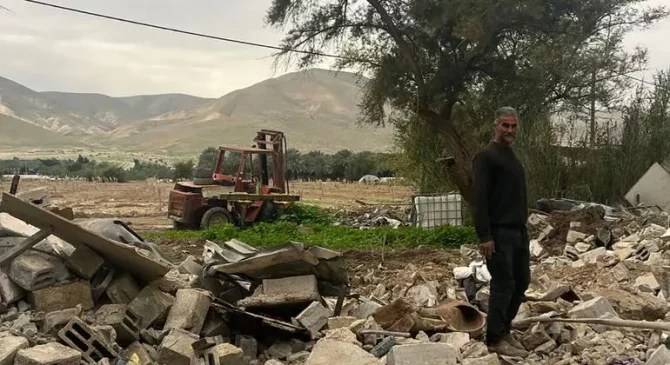
Lebanon has officially accused Israel – in a complaint filed with the U.N. Security Council- of violating the Convention on the Prohibition of Chemical Weapons for using aircraft to spray glyphosate, a “toxic herbicide with serious consequences for health, soil, and crops” over farmland in Southern Lebanon, as part of its broader ethnic cleansing plan.
Lebanon said that “the Convention on the Prohibition of Chemical Weapons prohibits the use of herbicides as a means of warfare”.
It noted that “Chemical analyses and laboratory tests conducted on soil samples taken from Aita al-Shaab (Bint Jbeil district), Ras Naqoura and Dhaira (Sour district) ‘confirmed the use of glyphosate at high concentrations reaching 22,750 micrograms per gram, a level far higher than the concentrations usually found in agricultural soils after farmers’ direct use of this product, which generally range between 0.5 and 2 micrograms per gram at most’”.
For context, Lebanon’s agriculture minister, Nizar Hani, revealed in February that “Laboratory tests have identified the chemical sprayed by Israeli aircraft in southern Lebanon as glyphosate, a widely used herbicide that can destroy vegetation when applied intensively,” adding that “the substance was used at abnormally high concentrations along the border with Israel”.
Nizar Hani noted that, “glyphosate, like other herbicides, eliminates vegetation when used at such high levels, directly affecting soil and water and causing negative repercussions for human health” and “the substance is classified as having carcinogenic effects and poses serious risks, particularly to agriculture and plant ecosystems” adding, “the incident was consistent with known practices along the border, where such substances are used to create vegetation-free zones, effectively resulting in systematic desertification.”
The Guardian reported that glyphosate was “in 2015 classified by the World Health Organization as ‘probably carcinogenic to humans’.”
In January, Israel similarly sprayed glyphosate over farmland in the southern Quneitra province in Syria and soon after, “A second incident occurred two days later, during which the visible release of substances led to outcries from Syrian farmers in occupied areas near Quneitra, southwest of Damascus and along the border with Israel.”
Israel, through spraying this carcinogenic herbicide, is attempting to kill off the farms and crops needed to sustain life in areas of Syria and Lebanon targeted for Israeli annexation in the Greater Israel Project.
Israeli officials: ‘Security zones’ to remain in Lebanon, Syria, Gaza

Al Mayadeen | June 15, 2026
Israeli War Minister Israel Katz said the Israeli army will continue to hold so-called “security zones” in Lebanon, Syria, and Gaza indefinitely, asserting that what he described as border security requirements take precedence over any political or diplomatic arrangements.
He stated that the policy is being pursued in coordination with Israeli Prime Minister Benjamin Netanyahu, adding that the IOF would remain deployed in these areas without a defined timeline.
According to Katz, the stated objective of maintaining these zones is to prevent what he described as threats from armed groups operating near the borders.
He said Israeli forces would remain in the “security zones” in Lebanon, Syria, and Gaza in order to protect Israeli settlements and border areas, framing the deployments as a defensive necessity to mask its colonial nature.
“We will not compromise on the vital interests of Israel’s security and the protection of our citizens, and we will not leave the security zones,” Katz said.
He also stated that this position had been communicated to US President Donald Trump, US War Secretary Pete Hegseth, and other senior officials.
Netanyahu signals rejection of withdrawal from Lebanon
Separately, Israeli media cited officials close to Prime Minister Benjamin Netanyahu as saying that he informed Trump that “Israel” does not intend to withdraw from Lebanon under any emerging understandings linked to regional negotiations.
According to these reports, Israeli forces will remain in their current positions in southern Lebanon and continue what Tel Aviv describes as operations aimed at preventing threats from Hezbollah.
Netanyahu also reportedly rejected any linkage between developments on the Lebanese front and broader US-Iran diplomatic arrangements, insisting that “Israel” would not be bound by agreements affecting its military posture.
Internal political backing for hardline stance
Israeli political figures across the governing coalition expressed support for maintaining occupation deployments in Lebanon and other theaters.
“Israel’s” Finance Minister Bezalel Smotrich was quoted in Israeli media as arguing that any attempt to connect the Lebanese and Iranian fronts should be resisted, while also emphasizing the importance of preserving military deterrence without direct confrontation with Washington.
Other ministers, including Itamar Ben-Gvir, reportedly stated that any US-brokered agreement with Iran would not be binding on “Israel”, asserting that Tel Aviv would continue to determine its own security policy independently.
Energy Minister Eli Cohen and Transport Minister Miri Regev also stressed the need to maintain what they described as clear deterrence while avoiding unnecessary escalation with the US administration.
Beyond Gaza: The expanding geography of displacement
By Dr Oroub El-Abed | MEMO | May 29, 2026
The War on Gaza continues and has not stopped. It is even expanding to wider geography of displacement and has been unfolding across the Eastern Mediterranean. The Zionists are empowered to widen their gradual restructuring of the land: depopulating borderlands, fragmenting societies, erasing cultural landscapes, and normalising permanent instability across the whole of Palestine, southern Lebanon, and southern Syria.
This week, the Israeli military ordered the immediate evacuation of the ancient Lebanese city of Tyre. Tyre A city that carries thousands of years of Mediterranean history, Phoenician heritage, trade, memory, and civilization was suddenly reduced to a military target. Residents were ordered to move north of the Zahrani River as Israeli bombardment intensified across southern Lebanon despite the language of a “ceasefire.” Entire communities were once again placed on the road during Eid, carrying children, blankets, medicine, and fragments of home while others elsewhere exchanged sweets and celebratory visits.
The symbolism of Tyre matters. Cities like Tyre are archives of human civilization. Their ports, neighbourhoods, cemeteries, mosques, churches, markets, and coastal life embody centuries of coexistence and cultural production. When such places are emptied, bombed, or transformed into militarized zones, the damage extends beyond physical destruction. A civilization itself becomes vulnerable to erasure.
The same logic that devastated Gaza is now visibly extending outward. In Gaza, entire archaeological sites were destroyed. Urban landscapes have been flattened under the justification of war. Universities, hospitals, archives, schools, libraries, bakeries, agricultural lands, and refugee camps have been systematically destroyed. The assault has targeted the infrastructure of Palestinian life itself, it has dismantled the social, cultural, and demographic foundations necessary for collective survival.
In the occupied West Bank, Palestinians continue to face settler violence, military raids, land confiscation, and forced displacement. Villages are emptied through intimidation, checkpoints fragment movement, and economic suffocation deepens dependency and precarity. Yet the expansionist vision articulated through biblical and historical claims is now stretching beyond Palestine.
Now southern Lebanon and southern Syria are being pulled into the same spatial planning.
Reports and online campaigns promoting land acquisition in areas near Daraa and southern Syria reveal a deeply alarming trend: the normalization of territorial expansion beyond internationally recognized borders. References to ancient “Davidic routes” or biblical entitlement are increasingly integrated into public discourse, settlement imaginaries, and strategic military narratives. The danger lies in transforming expansion into something culturally acceptable and politically negotiable.
This is occurring at the very moment Syrian refugees are being pressured to return “home” after years of displacement with many Global North countries issuing deportation regulation letters against them. Governments and international actors increasingly speak of refugee return as though Syria has become stable enough for repatriation. But what does “return” mean if homes are destroyed, lands fragmented, economies collapsed, and territories themselves vulnerable to new forms of Zionist militarization and external control? Refugees are told to go back while the geography they once belonged to is simultaneously being reconfigured.
The contradiction
The publicised initiatives presented under the language of “peace” and “reconstruction” now stand exposed as hollow political theater. Donor fatigue deepens. Funding commitments evaporate. Humanitarian systems are collapsing under both political paralysis, Israeli persist with insolence to continue the attacks against Palestinians and deliberate underfunding. Gaza’s Peace Board, created by Trump remains largely unfunded while displacement spreads regionally. The promise of rebuilding has become another mechanism for managing headlines with peace illusions rather than protecting people.
Meanwhile, millions remain displaced across the region. In Lebanon alone, over a million people have reportedly fled their homes since the escalation intensified. Entire southern communities now live between temporary shelters, schools, relatives’ apartments, or overcrowded Beirut neighbourhoods.
Families displaced during Eid navigate trauma while attempting to preserve dignity amid uncertainty. The contrast is painful: festive tables offering ka’ek and chocolate exist alongside families searching for mattresses, medication, and safety.
This widening geography of displacement reveals a deeper transformation underway in the Middle East. Forced migration is becoming a governing logic of regional order. Populations are uprooted, contained, redistributed, or rendered permanently precarious while territorial realities are reshaped through military violence and demographic engineering.
Tyre should alarm the world not only because people were forced to flee, but because an ancient city carrying human civilization is being drawn into a broader architecture of destruction. Southern Syria should alarm the world not only because of geopolitical tensions, but because territorial expansion is increasingly discussed openly while refugees themselves remain disposable. Gaza should alarm the world not only because of death tolls, but because the destruction of an entire society is unfolding in front of global institutions that are unable or unwilling to stop it.
What is happening today exceeds the boundaries of a single conflict. It is the expansion of a political project that treats land as empty once people are displaced from it, culture as expendable, and civilian existence as negotiable. The fear is that this geography of displacement may continue and widen far beyond Gaza, unless confronted with nationalist power and regional unity.
Featured Video

Racist Seinfeld Dances for Joy as Bibi Unveils His New Map
or go to
Aletho News Archives – Video-Images
TV Drama Review
Japanese drama projects Japan’s wartime atrocities onto Chinese characters

Global Times | October 25, 2026
By portraying Chinese characters as perpetrators of ruthless violence while casting Japanese Self-Defense Forces (SDF) intelligence operatives as defenders, the season 2 of the Japanese drama Vivant has recently drawn criticism from Chinese netizens, who argue that its depiction turns historical reality on its head while ignoring Japan’s wartime atrocities.
The TBS drama series – a spy suspense story in which an alleged unofficial intelligence unit of the SDF operates across the globe — has attracted a passionate fanbase. Its currently airing season 2 opened with a household rating of 18.8 percent, the highest for a TV drama this year, according toa commentary article by Japanese media Toyo Keizai.
What draws attention is the portrayal of the enemies in the series, the article noted. Scenes in which the Chinese organization subjects kidnapped members of the SDF unit to brutal torture are repeated with unrelenting intensity.
It is rare for Japanese TV dramas to explicitly portray a real-life country as the enemy, the article noted.
Japanese Prime Minister Sanae Takaichi also made a reference to the drama, saying that she has been recording Vivant and hopes to binge-watch it over the year-end and New Year holidays, according to Japanese media outlets.
China’s CCTV News report on Sunday revealed that the drama features scenes in which Chinese personnel cut off the fingers of and stab Japanese intelligence operatives in the abdomen. Such acts bear striking similarities to the torture inflicted on Chinese nationals by invading Japanese troops during the World War II.
The drama distorts the truth by attributing these atrocities to modern Chinese characters. Beneath the surface, it subtly glorifies Japan’s cross-border overseas operations, blurs the functional boundaries of the SDF and implicitly promotes an expansionist narrative, per CCTV News. … continue
Blog Roll
 Aletho News
- EU facing trillion-euro debt hole while seeking more cash for Kiev
- How US, Europe, Persian Gulf states exhausted missile stockpiles, splurged billions to defend Israel
- Up in arms… Koreans reject U.S. empire’s plan to make South Korea the next Ukraine
- Iran, Turkey, Pakistan, Saudi Arabia could advance region-led security framework in Tehran: FM spox
- Netizens condemn Japanese drama for projecting Japan’s wartime atrocities onto Chinese characters
- Racist Seinfeld Dances for Joy as Bibi Unveils His New Map
- A West Bank War for Netanyahu’s Election Campaign, Could It Backfire?
- Yemen denounces European Parliament’s ‘hypocritical’ push to blacklist Ansarullah
- Qalibaf: UAE’s UN bid aims to ‘clear the runway’ for ‘Greater Israel’, whitewash genocide
- Pakistan reopens Iran border after boosting security: Report
- If Americans Knew
- An error has occurred; the feed is probably down. Try again later.
- No Tricks Zone
- Sudden Stratospheric Warming, Powerful El Niño Combination May Lead To Extreme Europe Cold, Energy Crisis!
- Two New Studies Find Thwaites Glacier Melt Cannot Be Driven By Human Activity Or A Warming Ocean
- E-Cars Reduce CO2 Emissions By Only 41% Compared To Internal Combustion Engine Vehicles
- Predictions Made By Renowned Climate Professor Over Past Decades Have Been Proven To Be Poor
- New Study Suggests Large Regions Of The Pacific Ocean Have Been Cooling For The Last 80 Years
- Germany’s Green Energy Debacle: High Energy Costs Force Kahla Porzellan to Close After 182 Years!
- New Study: 50 Years Of The Most Aggressive ‘Net Zero’ Policies Can Only Affect The Global Climate By 0.03°C
- US September “Heat” Was No Record…Many Records Set Decades Ago
- Latest European Green Energy Debacle; Portugal’s Largest Flagship Solar Park Insolvent!
- Green Energy Debacle: German Expert Professor Fritz Vahrenholt Warns Of Severe Economic And Social Consequences

