Iraq PM strongly condemns US raids on PMU forces as ‘flagrant violation’ of country’s sovereignty
Press TV – June 28, 2021
Iraq’s Prime Minister Mustafa al-Kadhemi has strongly condemned as a “flagrant violation” of the Iraqi sovereignty an overnight airstrike by US warplanes against the positions of the anti-terror Popular Mobilization Units (PMU), also known as Hashd al-Sha’abi, in which several resistance fighters were killed.
“We condemn the US air attack that targeted a site last night on the Iraqi-Syrian border, which represents a blatant and unacceptable violation of Iraqi sovereignty and Iraqi national security,” said a statement from Kadhemi’s office on Monday.
The statement added that the government will “study all legal options” to prevent such action being repeated.
The statement came after the Iraqi cabinet, headed by al-Kadhemi, held an emergency security meeting following the U.S. airstrikes.
In the early hours of the day, US warplanes attacked three positions purportedly belonging to the PMU along the border.
Later, the 14th Brigade of the PMU announced that four of its fighters had been killed when the warplanes hit its headquarters. The brigade is made up of the Kata’ib Sayyid al-Shuhada anti-terror resistance group.
The PMU in general is an Iraqi government-sponsored umbrella organization composed of about 40 factions of volunteer counter-terrorism forces, including mostly Shia Muslims besides Sunni Muslims, Christians, and Kurds. The organization had a significant role in defeating the Daesh Takfiri terrorist group in Iraq.
Iraqi military condemns U.S. airstrikes on PMU’s positions
Separately, Iraq’s military spokesman Yehya Rasool denounced the US airstrike and said it was a “breach of sovereignty.”
“We condemn the US air attack that targeted a site on the Iraqi-Syrian border last night, which represents a blatant and unacceptable violation of Iraqi sovereignty and national security in accordance with all international conventions.”
Rasool further called on all involved parties to exercise restraint and avoid any escalation of tensions.
He said Baghdad would work thoroughly to prevent the recurrence of such incidents.
Foreign Ministry: US attack on PMU violation of Iraq’s sovereignty
Additionally on Monday, Iraq’s Foreign Ministry issued a statement, condemning the deadly strike. It was an “assault and a violation of national sovereignty and a clear departure from international norms and conventions,” the statement read.
“We affirm our adherence to Iraq’s sovereignty and unity and to rely on everything that would enhance that, through sustained coordination and communication with various parties and through diplomatic initiatives and endeavors that ensure the non-repetition of such rejected and condemned hostilities.”
Syria: US attacks prove its presence meant to serve Israel’s goals
Syria, for its part, also condemned in strongest terms the US flagrant aggression in the Syrian-Iraqi border region, describing it as a blatant violation of the sanctity of the Syrian and Iraqi territories.
An official source at Foreign and Expatriates Ministry told SANA that the US aggression, which was ordered by the highest ranks in the US leadership, proves once again “the recklessness of US policies and the need for Washington to withdraw its aggressor forces” from the region.
The Syrian foreign ministry source added that such acts of aggression only escalate the tense situation in the region and prove “what we have repeatedly said in Syria that the US military presence in our region is basically meant to serve the Israeli goals and the separatist forces contrary to the interests of its own people.”
The Syrian source concluded by saying that Damascus, once again, demands the US administration respect the territorial integrity of Syria and Iraq and to immediately stop those attacks on the independence of the two countries.
Al-Nujaba Movement: US will pay for its folly
In a relevant development on Monday, a senior member of Iraq’s al-Nujaba Movement, which is part of the PMU, said in a Twitter post that Washington would pay for its folly in attacking Iraq’s popular forces.
Ali al-Asadi said the Monday US airstrike was a desperate reaction to the latest manifestation of power by the PMU through a huge military parade, which was held to mark the anniversary of the PMU’s formation.
“This [attack] is another reason, which proves that the occupier does not care about stability of this country…. We tell the occupier: you will pay for your despicable measure and will suffer the consequences of your folly,” Asadi said.
Hezbollah: US airstrikes on PMU aimed to weaken anti-terror fight
Lebanon’s Hezbollah resistance movement also reacted to the latest airstrikes by the occupying American forces on the PMU positions in western Iraq and Syria, strongly condemning the US act of aggression.
In a statement on Monday, Hezbollah said the air raid by American warplanes was blatant violation of sovereignty of both Iraq and Syria, which is aimed at weakening these countries’ power to fight terrorism on their soils.
Hezbollah then expressed support for the official condemnation of the US airstrike by Iraqi government and armed forces as well as various popular groups.
Yemen’s Ansarullah: US strikes aimed at supporting Daesh, al-Qaeda
In another development on Monday, the political office of Yemen’s Ansarullah movement issued a statement on the latest US airstrikes on Iraq’s PMU, expressing the movements condolences for the families of the PMU fighters killed in the US strikes.
“The US aggression is in line with its policy to provide aerial support for its criminal proxies, that is, the Daesh [Takfiri terrorist group] and al-Qaeda” in Syria and Iraq.
The Yemeni movement added that it strongly supported the powerful positions taken by Iraq’s officials and popular forces in opposition to the projects planned and carried out by the Great Satan, the United States, and Israel.
Yemen’s Ansarullah movement noted that the US act of aggression will only strengthen the determination of the Iraqi people and proves that the path chosen by the Iraqi nation is correct and should continue until complete expulsion of all occupying forces from the country.
US congresswoman: This failed policy will not make us any safer
Meanwhile, Ilhan Omar, a US congresswoman who represents Minnesota’s 5th congressional district, took to Twitter on Monday, condemning US act of aggression against Iraqi popular forces.
“This constant cycle of violence and retribution is a failed policy and will not make any of us safer,” she said.
Omar added that the US government cannot take any hostile action in other countries without the Congress’ approval, saying, “Congress has authority over War Powers and should be consulted before any escalation.”
Anti-American sentiments have been running high in Iraq since the US assassinated Iran’s anti-terror commander Lieutenant General Qassem Soleimani, and the deputy head of Iraq’s PMU, Abu Mahdi al-Muhandis, in Baghdad on January 3, 2020.
Just two days later, Iraqi lawmakers unanimously passed a bill mandating the withdrawal of all foreign troops from Iraq.
Iraqi resistance groups have pledged to take up arms against US forces if Washington fails to comply with the parliamentary order.
Russian forces block US military patrol in northeast Syria
Press TV – June 22, 2021
Russian forces have blocked an American military convoy, comprising four armored vehicles, in Syria’s northeastern Hasakah province.
Russia’s RT television network reported on Monday that Russian personnel had stopped the US military patrol along the M4 highway, some 10 kilometers west of the town of Tall Tamr.
Informed sources said the US convoy was forced to return because it had violated security protocols between Moscow and Washington.
Russia said the US had not given prior notice regarding its troops’ movements in Hasakah.
Hasakah is occupied by American soldiers and the so-called Syrian Democratic Forces (SDF), a US-backed anti-Damascus alliance of mainly Kurdish militants. Turkey also controls areas in the province and elsewhere following military operations in northern Syria.
Russia has been helping Syrian forces in ongoing battles across the conflict-plagued state, mainly providing aerial support to ground operations against foreign-backed terrorists.
The Russian military assistance, which began in September 2015 at the request of the Damascus government, has proved effective as Syrians continue to recapture key areas from Takfiri elements.
However, the United States has deployed forces and military equipment in Syria without any authorization from Damascus or the UN.
It has long been training militants and stealing Syria’s oil, ignoring repeated calls by Damascus to end its occupation of the country.
Russia: US exacerbated humanitarian situation in Syria
In another development on Monday, Russian Foreign Minister Sergei Lavrov complained that the humanitarian situation in Syria has been aggravated by the US through its illegal sanctions and occupation of the eastern bank of the Euphrates River.
“They are looting hydrocarbons and other mineral resources, and use the money they earn on that to finance projects that are seen by many as encouraging separatism and provoking dissolution of the Syrian state,” he said after talks with Helga Schmid, the secretary general of the Organization for Security and Cooperation in Europe (OSCE).
He also warned against attempts by the United States and some European countries to hamper the return of Syrian refugees, noting that the Western assistance goes to camps in Jordan, Turkey and Lebanon so as “to make the refugees stay there as long as possible.”
Lavrov further expressed Moscow’s readiness to discuss the humanitarian situation in Syria with the Western states if they recognize their responsibility in this regard.
“If the set of these factors is recognized as impacting the humanitarian situation in Syria, we are ready to discuss that as a whole. But our Western partners should categorically refuse from one-sided interpretations of these or those problems, and recognize their responsibility for the general situation in Syria’s humanitarian sphere,” he said.
Biden Forces Steal 32 Additional Trucks Loaded with Syrian Wheat
Syria News | June 20, 2021
Biden forces operating illegally in northeastern Syria stole an additional quantity of wheat loaded in 32 trucks and smuggled it into neighboring Iraq through an illegal border crossing, yesterday, Saturday 19 June 2021.
This new theft comes less than a week after another convoy of dozens of trucks loaded with stolen Syrian wheat, the Syrians are harvesting their wheat and Biden is stealing it to feed his ISIS terrorists in Iraq, the terrorist organization that was created under Biden’s watch during the 8 years term of Obama and saw its growth where his secretary of state Kerry back then said they wanted to use it to pressure the Syrian President Bashar Assad into submission.
Biden taking the food of the Syrian people out of the mouths of their children and sending in killing machines and terrorists instead, in the past week alone the US Army stealing Syrian oil and wheat entered two columns of trucks and military vehicles on the 14th and 17th of this month, the first convoy comprised of 55 different rucks and empty oil tankers to siphon Syrian oil, and the second comprised of 33 military and logistics vehicles.
Cross borders activities without the sovereign country’s approval is a serious breach of international law, stealing food and oil from a country especially when its people are facing economic hardship and is fighting terrorist groups is a war crime, creating terrorist groups and separatist armed militia and using them against a sovereign country is nothing less than a declaration of war. All US Army troops are liable to prosecution under international law, those killed of them are no heroes and do not die ‘defending their country and its values’, they get killed while stealing and are a disgrace for their families and their people.
Ironically, during a meeting with his Russian counterpart President Putin in Geneva on the 17th of the month, the head of the most diverse and inclusive US junta Biden asked Putin to help in obtaining approval from Damascus to open new border crossings into regions occupied by Al Qaeda in the north and northwest of Syria!
‘Journalist’ Bilal Kareem, one-time Western media darling, emerges from Idlib prison with newfound critical view of jihadist pals
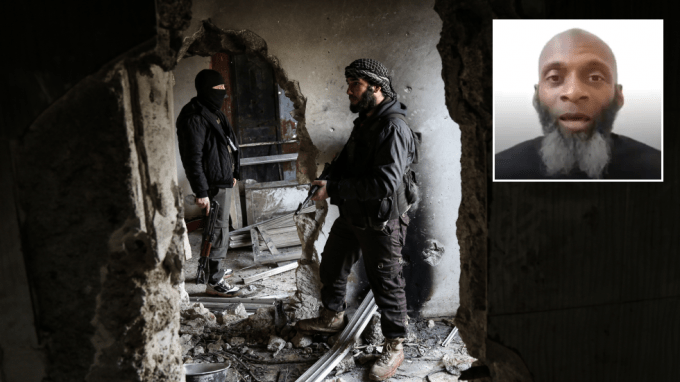
FILE PHOTO. Fighters of Hayat Tahrir al-Sham militant group,Syria, Aleppo. © Getty Images / Anas Alkharboutli; (inset) © Twitter / @BilalKareem
RT | June 5, 2021
A US media personality and a prolific advocate for anti-government Islamist fighters in Syria now says the group he supported is torturing people in the city of Idlib and that he himself was abused while in custody.
Bilal Abdul Kareem is one of the more colorful figures in Syria’s protracted armed conflict. Once treated as a legitimate journalistic source by the mainstream media during the battle for eastern Aleppo, he fell into relative obscurity in the West after his close ties to jihadist forces were exposed.
This week, he gave an interview decrying the abuses of jihadist militants currently controlling Idlib, a city in northern Syria, accusing them of torturing prisoners. Now a fugitive, Kareem says he himself was abused while in their custody.
The interview published on Friday by the London-based Middle East Eye (MEE) depicts a grim picture of life in Idlib under the rule of Hay’at Tahrir al-Sham (HTS), the current predominant military force there. Kareem says the HTS leader, Abu Mohammad al-Julani, is “unfit to rule” and simply gaslighting the West when he claims that the civilian “Syrian Salvation” government is actually in charge. Al-Julani has been listed as a “Specially Designated Global Terrorist” by the US State Department, which has also placed a $10 million bounty on his head.
“I doubt that there’s one in a hundred people who could even tell you who the president of the Salvation Government is, because everyone knows that he wields no power,” Kareem said. The purported government is led by a prime minister, with the office currently held by Ali Keda, a former security official in an Islamist alliance.
Kareem added that torture is rife in prisons controlled by HTS and that he personally was repeatedly threatened with physical violence after being arrested in August 2020. Other inmates were not so lucky, he said.
“Almost every day of every week, I had to listen to the screams of torture just a few meters away from me. Everyone in the prisons can always hear the torture,” he told MEE.
Kareem was released in February and says he is now outside the territory controlled by HTS, fearing retribution. He claims his arrest was prompted by criticism of HTS’ rule in Idlib, and particularly their use of torture, which he believes to be against Sharia law.
“They came to power… and then they start doing things other than that which they said. They promised to bring Islamic rule. They didn’t do it. They promised to bring justice. They didn’t do it.”
He added that HTS was justifying what it does to prisoners by claiming it’s not torture. He said he once told a jihadist official when debating the issue: “You’re starting to sound like the Americans: ‘We’re not calling it torture. We’re calling it enhanced interrogation techniques.’ Torture by any other name is still torture.”
The accusations are quite remarkable, coming from the lips of Kareem. For years, he remained a vocal supporter of some of the most brutal jihadist groups fighting against the Syrian government. One of his first long interviews was with Abu Firas al-Suri, a senior figure in Al-Nusra Front, who was later killed in a US airstrike in April 2016.
HTS was formed in January 2017 through a merger of several jihadist groups, including Al-Nusra, whose founder and leader is the current head of the organization.
While platforming Islamist clerics, jihadist commanders and Islamic foot soldiers, Kareem was treated with respect and adoration by many mainstream media outlets, which either ignored or downplayed the implications of his associations.
In 2016, he was among the people explaining to audiences on CNN and Al Jazeera how the civilian population of eastern Aleppo was facing imminent obliteration at the hands of the Syrian government, which at the time was about to retake it from Islamist fighters. Contrary to predictions that his reporting days were numbered, Kareem left the city with his jihadist friends, releasing a video of a masked fighter wearing what he claimed to be a suicide belt on his way out.
He helped CNN to produce its Peabody-award-winning documentary about the siege of the Iraqi city of Mosul. In 2014, he was invited as a guest speaker on a panel about the “future of jihadism” at the DC-based Brookings Institution, arguing that the country needs “an Islamic solution” to its problems.
Al-Nusra Front, a former Al-Qaeda affiliate, and its HTS partners, which Kareem backed with his coverage, have been implicated in various atrocities since the early years of the Syrian war.
Report on Turkey smuggling weapons to Al-Qaeda in Syria shows why Russia’s desire to halt ‘aid’ was right
By Eva Bartlett | RT | June 4, 2021
New allegations that aid trucks to Syria from Turkey carried weapons for terrorists have surfaced. But it’s unlikely to convince those in the West to change their tune that Russia was wrong to want border crossings closed.
In July 2020, there were those who self-righteously railed at Russia for allegedly denying humanitarian aid to Syrians. They screamed that in calling for crossings to be closed, Russia was attempting to starve and choke civilians in need of assistance.
The Russian mission to the UN, however, maintains that ample aid is delivered from within Syria, via various agencies, including the UN. It argues that delivering aid from outside of Syria is no longer necessary, since most of the country has returned to peace and security. I haven’t come across a Russian representative who has stated so, but wonder if another reason Russia wanted cross-border ‘aid’ from Turkey halted was because it knew weapons were being smuggled to terrorists in Syria?
On May 30, Sedat Peker, a Turkish mobster and former ally to Turkish President Recep Erdogan, published a new video in a series he has been releasing on criminal activities among Erdogan’s inner circle. In this latest video, Peker spoke of the weapons and vehicles sent to Al-Qaeda in Syria, and that the contractor behind these shipments was a company called SADAT, run by Erdogan’s former chief military advisor.
“Our trucks went under the name of Sedat Peker Aid Convoy. We knew other trucks that went on my behalf carried weapons. This was organized by a team within SADAT. No registration, no paperwork applied to these shipments that crossed directly [to Syria],” said Peker.
The revelations should not come as a surprise. In January 2013, the late journalist Serena Shim, as I wrote, exposed how terrorists and arms were smuggled into Syria from Turkey, noting World Food Organization trucks were being used. In October 2014, Shim was killed in a car accident, shortly after telling Press TV she feared for her life and that Turkish intelligence had accused her of being a spy. Her family, and inquiring journalists, believed it was down to Turkish foul play, noting the official story of Shim’s death changing. The US government didn’t investigate the suspicious death of one of its citizens in Turkey.
As Shim reported, if WFO trucks were at one point used to smuggle arms into Syria, can you blame Russia or Syria if they are indeed sceptical of supposed ‘aid’ entering from Turkey?
But whenever the issue of aid crossing into Syria is brought up at the UN Security Council, the narrative is usually to ‘blame Russia’. Hysterical headlines aside, is it really likely that Russia, with the world’s eyes on its every move, is actually trying to starve civilians in Syria? It is Russia, remember, that has demined vast areas of Syria formerly occupied by terrorist factions in order for local people to be able to return to their areas. It is also Russia that delivered aid to Raqqa, the city completely flattened by the US and allies in the pretext of fighting terrorism.
Syria’s cross-border mechanism (CBM) began in 2014, when – due to the presence of terrorist groups – aid couldn’t be delivered from within the country. The Security Council established the CBM, with four crossings into Syria: two from Turkey, one from Iraq, the last from Jordan. In December 2019, all except the Bab al-Hawa crossing from Turkey were closed down, with aid being coordinated via Damascus.
But as Russian representatives at the UN pointed out in a statement in July 2020, by then the situation had changed, with most of Syria back under the control of the government. Sending aid to those who need it can be done from within the country. Western media suggested that Syria would use the closure of crossings to starve its civilians, but the reality is that Damascus has consistently cooperated in sending aid, while the US has in the past stymied aid delivery.
Russia’s statement also noted, “The UN still has no presence in Idlib de-escalation zone which is controlled by international terrorists and fighters. It’s not a secret that the terrorist groups control certain areas of the de-escalation zone and use the UN humanitarian aid as a tool to exert pressure on [the] civil population and openly make profit from such deliveries.”
But amid a round of finger pointing, the West and allies continued to criticise Russia for wanting to end the CBM. In response, the Russian Federation’s representative to the UN Security Council wondered whether the UN’s OCHA (Office for the Coordination of Humanitarian Affairs) could go to Idlib to see if terrorists occupying that region were respecting the Declaration of Commitment some had signed regarding aid deliveries.
This was a valid point, given that in areas previously occupied by terrorists, most civilians never saw the ample aid sent in by Syria and agencies. Terrorist groups controlled and hoarded the aid, from east Aleppo to Madaya to al-Waer, to eastern Ghouta. So it was by no means a stretch of the imagination to assume the same might play out in Idlib, particularly since the terrorists included factions from the aforementioned regions, who were bussed to Idlib as the cities and towns finally returned to peace.
The Russian statement also addressed frenzied Western claims that the other closed crossings were the only means to send aid to civilians in the north-east of Syria. It read, “In total, since the beginning of 2020 when ‘Al Yarubiyah’ was closed, more humanitarian aid has been delivered to the north-east of Syria than in previous years.”
Still the narrative continued, though, and in March 2021, the dictator of Human Rights Watch, Ken Roth, tweeted about “Putin starving Syria”, resurrecting the cries over the unnecessary, and closed, crossings. But his claim prompted an angry response from some.
So who is actually starving civilians in Syria? Aside from terrorists hoarding food and denying it to the local people, there are more significant reasons for their preventable suffering. And these are the West’s sanctions against them, particularly the June 2020 Caesar Act.
Last year, James Jeffrey, the then US Special Representative for Syria Engagement, was quoted as saying the latest sanctions would contribute to the fall of the Syrian pound. What a wonderful way to “protect” Syrians. In US parlance, “protect” means “starve.”
As I walk around Damascus, I ask about the cost of food, and whether people can afford to feed their families. Most say their salaries aren’t sufficient: food prices have skyrocketed, salaries have not. Most describe adopting a more vegetarian diet – chicken and meats are too expensive to have more than once a month, or at all.
Furthermore, there is the US occupation forces’ thieving or destroying of Syrian resources. On that, Dr. Bashar Ja’afari, in his former post as Syria’s permanent representative to the UN, in June 2020, said, “When the United States daily steals 200,000 barrels of oil from the Syrian oil fields, 400,000 tons of cotton, 5,000,000 sheep and sets fire to thousands of hectares of wheat fields, and deliberately weakens the value of the Syrian pound, and when it imposes coercive economic measures aiming to choke the Syrian people and occupying parts of the Syrian lands, and when the US representative expresses her concern over the deteriorating situation of the Syrian citizen’s living conditions the logical question will be are not these acts the symptoms of political schizophrenia?”
But as usual the US and its allies blame Russia and Syria for the suffering in Syria, whitewashing their own very long litany of crimes there.
Although the smuggling of weapons and terrorists via Turkey has been openly known for years, it’s rather amusing that it takes a petty mobster, and not Western media or leadership, to draw new attention to it. No, as terrorists use those weapons to fight the Syrian government (and rival terrorist factions, and civilians), the West is only concerned about blaming Russia and Syria. Ten years of lies and war against the people of Syria just aren’t enough for America and its allies.
Eva Bartlett is a Canadian independent journalist and activist. She has spent years on the ground covering conflict zones in the Middle East, especially in Syria and Palestine (where she lived for nearly four years).
Four People Dead After SDF Fighters Attack Demonstrators in Syria’s Manbij
Sputnik – 01.06.2021
DAMASCUS – Four people were killed and 13 more injured after militants from Syrian Democratic Forces (SDF) opened fire at demonstrators in Syria’s Manbij on Tuesday, a local source said.
“SDF fighters opened fire on demonstrators at the Jazeera circle in the centre of Manbij, four people were killed and 13 injured as a result,” the source said, adding that some of the injured are in critical condition.
According to the source, demonstrators against the SDF are ongoing for several days in Manbij as locals disagree with “forced conscription of the male population into the armed forces of the Kurdish formations.”
Kurdish militias imposed a curfew and fully blocked the city.
At the same time, another source said that locals in a settlement east of Manbij kicked Kurdish fighters out after they used force against residents.
Statement from the International Delegation to the 2021 Syrian Presidential Election

Syria Solidarity Movement | May 29, 2021
This independent delegation was assembled to witness the May 26, 2021 presidential election in Syria and to investigate on-the-ground conditions of Syrian life in the current period. Activists and journalists from Palestine, Syria, South Africa, France, Canada, and the United States joined this delegation on the invitation of the Syria Solidarity Movement and Arab Americans 4 Syria. This joint statement summarizes our findings on the election and what it means for Syrians.
On election day, our delegation traveled to neighborhoods that had been outside of government control when the last presidential elections took place in 2014. Notably, we visited polling places in the towns of Arbeen and Douma, in the hard-hit Eastern Ghouta region southeast of Damascus where residents are returning and beginning to rebuild their homes, some after years of seeking refuge elsewhere. We witnessed Syrians cast secret ballots in polling places where monitors from opposition parties were present alongside election officials, in accordance with the Constitution of the Syrian Arab Republic. We saw nothing to indicate unfairness or coercion in the casting of ballots.
We also conducted extensive interviews with members of the Syrian general public. We were not inhibited in any way from conducting these interviews, and could freely do so outside the presence of government officials.
We overwhelmingly found that Syrian people place tremendous significance on this election. During and after the election we observed huge enthusiasm. It appeared genuine and widespread. For many Syrians, the election represents the imminent ending of the war, the defeat of foreign plots, and hope for the future. For young people, it encapsulates the first period of relative stability they have experienced in their living memory. Many expressed that they were not simply casting votes for their preferred candidate, but for a sovereign, unified Syria, free from imperialist interference. For them, the presidential election was a referendum on the right of the Syrian people to determine their own future.
It is the unanimous conclusion of the undersigned representatives of the International Delegation to the 2021 Syrian Presidential Election that the re-election of President Bashar al-Assad, of the Arab Socialist Ba’ath Party and the National Progressive Front, is the legitimate, democratic expression of the Syrian people.
Ted Kelly
International Action Center
Co-Editor, Tear Down the Walls!
Wyatt Miller
MN Anti-War Committee, USA
Kobi Guillory
Co-chair, Chicago Alliance Against Racist and Political Repression
Amal Wahdan
Coordinator, One Democratic State Assembly
Steering Committee, Syria Solidarity Movement
Ramallah, Palestine
Mpho Masemola
Secretary General, Ex Political Prisoner’s Veterans Association of South Africa (EPPA)
Member, Umkhonto we Sizwe (MK), African National Congress military wing
Johnny Achi, E.E.
Co-founder, Arab Americans for Syria
Daniel Kovalik
Adjunct Professor of International Human Rights, University of Pittsburgh School Of Law
Alain Corvez
Adviser in international strategy, France
Rick Sterling
Journalist, USA
Paul Larudee
Retired Academic and Unretired NGO Administrator & Piano Technician
Massive turnout in Syria election was loud shout of victory over terrorists, their sponsors, says analyst

Press TV – May 28, 2021
A political commentator has lauded the massive voter turnout in Syria’s presidential election as an outstanding sign and loud cry of victory notched up by people in the war-stricken Arab nation over Takfiri terrorist groups and their sponsors.
“Voters turned out in stunning numbers. Millions are said to have cast their votes. They were gleeful; the atmosphere was triumphant. The massive turnout was a shout of victory over foreign terrorists and the powers that backed them,” Richard Black, a former Republican member of the Virginia State Senate told Press TV in an exclusive interview on Friday.
He added that the election allowed Syrians to symbolically reject the horrors imposed on them by the United States, United Kingdom, France and their regional allies, stressing the latter have been relentlessly seeking to intimidate the Syrian nation by waging a reign of terror for more than a decade.
“The US, the UK, and France have been the unwavering supporters of al-Qaeda-linked terrorists since the moment that the war began [in Syria in March 2011]. To this day, they have been supporting terrorists controlling [Syria’s northwestern] Idlib Province,” the pundit said.
Black went on to dismiss criticism of Syria’s president election, stating that Western powers did not let voters in militant-held parts of Syria head to the polls and cast ballots because “they do not really care about elections or about freedom. Their objective is terror and conquest.”
“The occupying powers never gave a thought to holding elections, because their puppets would have been ousted. They are much too busy looting the wealth of Syrian people than to worry about elections in the areas they rule,” he pointed out.
The analyst also stated that Washington can by no means denounce Syria’s May 26 presidential election, as a large percentage of Americans believe that the 2020 US presidential poll was fraudulent and invalid.
He rejected as “ludicrous” demands by the United States and a number of European nations that Syria’s election should have been convened under UN supervision.
“If the UN needs to conduct elections in Syria, why shouldn’t they supervise them in the US, the UK, France, Germany, and Italy? By what authority does the UN run the internal affairs of sovereign nations?
“It is ironic that nations working to overthrow Syria’s government with a naval blockade, brutal sanctions, and armies of terrorists are now trying to tell Syrian people how to vote,” Black argued.
He underscored that Syria was in a much better position to hold presidential poll compared to the last round of election in 2014.
“During the 2014 election, foreign powers did everything possible to block Syrians from voting. Just before the election, many countries closed down Syrian embassies to prevent expatriates from expressing their will. The closure of the embassies was orchestrated by the US, which feared that an overwhelming vote in favor of Bashar al-Assad would embarrass the State Department and undermine its campaign against Syria,” the political analyst said.
Black concluded that Syrians have now driven out foreign-backed terrorists from most of their cities and towns, and could vote this time without having to brave explosives sent by Western powers to disrupt their election.
The Syrian parliament announced on Thursday that President Assad won his fourth seven-year term in the 2021 presidential race.
Hamoudeh Sabbagh, the parliament speaker, said that Assad won 95.1 percent of the vote as opposed to 88.7 percent in the 2014 election.
He said that about 14 million of the estimated 18 million eligible voters inside and outside Syria cast their votes, with a turnout rate of 78.64 percent.
Assad’s competitors, former Deputy Cabinet Minister Abdallah Saloum Abdallah and head of a Syrian opposition party, Mahmoud Ahmed Marei, won 3.3 and 1.5 percent of the vote respectively.
Press TV’s website can also be accessed at the following alternate addresses:
Palestine: Hamas Defeats Israel

Just like in 2006, when both Ehud Olmert and George Bush declared that the “invincible IDF” had, yet again, achieved a “glorious victory” and the entire Middle-East almost died laughing hearing this ridiculous claim, today both the US and Israeli propaganda machine have declared another “glorious” victory for the “Jewish state of Israel” cum “sole democracy in the Middle-East”. And, just like in 2006, everybody in the region (and in Zone B) knows that the truth is that the Zionist entity suffered a huge, humiliated, defeat. Let’s try to unpack this.
First, a few numbers. The combat operations lasted two weeks. All other missile numbers are in dispute. Rather than trust this or that source, I will simply say that Hamas fired many thousands of missiles into Israel. Some, probably less than 50%, were truly intercepted by the Israeli air defenses, others hit in no man’s land, and some actually landed and caused plenty of destruction and at least 12 deaths. The Israelis executed hundreds of artillery and airstrikes causing massive destruction in the Gaza strip and killing about 250 Palestinians. Again, these numbers are guesstimates and they don’t really tell the full story. To understand the story, we need to forget about these numbers and look at what each side was hoping for and what each side achieved. Let’s begin with the Israelis:
The Israeli scorecard
To understand Israel’s goals in this war, we first need to place this latest war in its context, and that context is that Israel was comprehensively defeated in Syria. To substantiate this thesis, let’s remember the goals of the Zionists when they unleashed a major international war against Syria. These objectives, as listed in my July 2019 article “Debunking the Rumors About Russia Caving in to Israel” were:
The initial AngloZionist plan was to overthrow Assad and replace him with the Takfiri crazies (Daesh, al-Qaeda, al-Nusra, ISIS – call them whatever you want). Doing this would achieve the following goals:
- Bring down a strong secular Arab state along with its political structure, armed forces, and security services.
- Create total chaos and horror in Syria justifying the creation of a “security zone” by Israel not only in the Golan but further north.
- Trigger a civil war in Lebanon by unleashing the Takfiri crazies against Hezbollah.
- Let the Takfiris and Hezbollah bleed each other to death, then create a “security zone,” but this time in Lebanon.
- Prevent the creation of a Shia axis Iran-Iraq-Syria-Lebanon.
- Break up Syria along ethnic and religious lines.
- Create a Kurdistan which could then be used against Turkey, Syria, Iraq, and Iran.
- Make it possible for Israel to become the uncontested power broker in the Middle-East and force the KSA, Qatar, Oman, Kuwait, and all others to have to go to Israel for any gas or oil pipeline project.
- Gradually isolate, threaten, subvert, and eventually attack Iran with a broad regional coalition of forces.
- Eliminate all centers of Shia power in the Middle-East.
As we all know, this is what actually happened:
- The Syrian state has survived, and its armed and security forces are now far more capable than they were before the war started (remember how they almost lost the war initially? The Syrians bounced back while learning some very hard lessons. By all reports, they improved tremendously, while at critical moments Iran and Hezbollah were literally “plugging holes” in the Syrian frontlines and “extinguishing fires” on local flashpoints. Now the Syrians are doing a very good job of liberating large chunks of their country, including every single city in Syria).
- Not only is Syria stronger, but the Iranians and Hezbollah are all over the country now, which is driving the Israelis into a state of panic and rage.
- Lebanon is rock solid; even the latest Saudi attempt to kidnap Hariri is backfiring. (2021 update: in spite of the explosion in Beirut, Hezbollah is still in charge)
- Syria will remain unitary, and Kurdistan is not happening. Millions of displaced refugees are returning home.
- Israel and the US look like total idiots and, even worse, as losers with no credibility left.
Seeing their defeat in Syria, the Zionists did what they always do: they used their propaganda machine to list an apparently never-ending victorious strikes on supposed “Iranian targets” in Syria. While a few civilian simpletons with zero military experience did buy into this nonsense, the truth about Israeli operations in Syria is simple: the Syrian air defenses have successfully prevented the Israelis from striking at important, sensitive, targets, and the Israelis have been forced to declare as major victories the destruction of empty barns as “destruction of important IRGC headquarters” thereby “proving” to a few naive folks in Zone A and to themselves (!) that the IDF is still as “invincible” as it “always was”. As for the Neocons, they doubled-up on that and declared that 1) Russian air defenses are useless 2) that Russia and Israel work hand in hand and 3) that the Israelis are still invincible. Yet if any of that was true, why has Israel failed to achieve a single one of its goals? And why are both the Russians and the Iranians still in Syria where the Russians just finished a 2nd runway at Khmeimim and they have just deployed a group of Tu-22M3 at that air base from where they can now threaten any ship sailing in the Mediterranean, the Red Sea, the Persian Gulf, the Arabian Sea and the Indian Ocean. In their otherwise “free time” they can drop tons of bombs and missiles on the remaining Takfiri forces in Syria.
As I have been saying for many years now, the truth is that the IDF is a poor fighting force. Why? First, they have the exact same problem as the USA (and the KSA, for that matter): they rely on expensive technology, but don’t have good combat-capable “boots on the ground”. That is now how modern wars are won (see here for a list of popular misconceptions about modern wars).
In its recent history, the entire gamut of Israeli “elite” forces (including the air force, the navy, the artillery and even the Golani Brigade) got its collective butt handed to them by about 1000 and only lightly armed regular Hezbollah fighters in 2006: keep in mind that the elite Hezbollah forces were deployed only north of the Litani river to protect Beirut against a possible land invasion by Israel. Instead of taking Beirut or “disarming Hezbollah” (that was an official goal!), the Israelis could not even control the small town of Bint Jbeil located right across the official Israeli border! So much for being “invincible”!
What the IDF is very experienced at is terrorising Palestinian civilians and executing what could be called a slow-motion genocide of the Palestinian people. The problem with Gaza now is the same that the failed invasion of Lebanon in 2006 has revealed: just like the Lebanese in 2006, the Palestinians of 2021 are not afraid of the Zionists anymore. Furthermore, with a great deal of help from Iran and others, Hamas in Gaza is now much, much better armed than in the past. True, some of its missiles are decidedly low tech and not very effective (low accuracy, small warheads, simple trajectory, limited range), but Hamas also has shown some pretty decent UAVs too. Most importantly, from now on for Hamas it is only one way: up the “quality ladder” (just like the Houthis did in Yemen, starting with modest drones but eventually getting very capable ones).
The other major goal of the Israelis in this war was to prove to the world (and, even more importantly for the always narcissistic self-worshipping Israeli cowards, to themselves!) that their “Iron Dome” air defense network was the “super-dooper most bestest” in the world (no doubt, due to the famed “Jewish genius”!). It now appears that at best, the Israelis intercepted somewhere around 30-40% of the Hamas missiles. The way the Israeli hid this is by claiming that their fancy shmancy Iron Drone did not even try to engage missiles which were not deemed dangerous. But in the age of the ubiquitous smartphone, that kind of silly nonsense can easily be debunked (including by showing the total chaos in the Israeli skies or, for that matter, the missile strikes on Israeli military objectives). While the full Iron Dome air defense system probably works marginally better than the quasi-useless US Patriot, the Israeli air defenses are clearly at least a generation behind the Russian ones, including the S-300s the Russians sold to Syria (again, in the age of of the ubiquitous smartphone, this is not hard to prove).
It is crucial to remember that Hamas’ missiles are much inferior to those of the Houthis and the Syrians, and even more inferior when compared to Hezbollah or Iranian drones and missiles! In other words, the “invincible” IDF can’t deal with even its weakest, least sophisticated enemies (Hamas and the Palestinian Islamic Jihad) and the grotesquely expensive Iron Done cannot protect the Zionists from any determined missile attacks by the Resistance coalition (Palestine, Yemen, Syria, Hezbollah, Iran and Russia).
In their utter despair, the Zionist entity did what the AngloZionists always do when they fail to defeat a military force: they will turn their wrath on the civilian infrastructure and murder as many as they can. They will also strike highly symbolic targets such as the International Press Center in Gaza or a Red Crescent hospital (under the pretext that Hamas, which is the democratically elected local government) has offices there (this is clearly a F-you to those who condemn Israel for violating international law). To a normal human being, this sounds both obscene and ridiculous. But remember, the Israelis are first and foremost narcissists and they have no means of imagining how normal human beings think or feel. All these guys can feel is self-worship and hatred for all “others”.
We could say that in this war, the Palestinians defeated both military high tech and truly medieval type of genocidal hatred.
In other words, far from showing how “invincible” the Zionist entity is, this latest war against the Palestinians has shown beyond reasonable doubt that the IDF cannot deal with any of its enemies.
Besides missiles and bombs, the Israelis love to use terror, as their ideology has convinced them of two things: the Arabs only understand force and we, the Israelis, are invincible. But this begs the question of why the Israelis did not dare to move into Gaza, not even symbolically. Yeah, I know, the official doxa of Zone A is that “Biden called Netanyahu and told him to stop”. As if “Biden” could give orders to the Israelis!
The truth is that even with a casualty rate of 10:1 in the IDF’s advantage and no armor or artillery, the Palestinians are much more willing to engage in street battles than the IDF. Would the IDF eventually win a ground battle against Hamas and the Palestinian Islamic Jihad? Maybe, probably, the objective advantages in everything (except courage!) for the Israelis is so huge that no amount of skills and courage can forever negate the immense superiority in means of the Israelis.
However, as most people in the West tend to forget, wars are but means towards a political goal. If the IDF decided to basically flatten Gaza and kill many thousands of Palestinians at the cost of casualties probably in the hundereds, then this would be politically suicidal for the Zionist regime. This is why I offer this very basic conclusion:
During the latest Gaza war, deterrence did work. But only in the sense that the Palestinians successfully deterred the Israelis from launching a ground attack against Gaza.
There is another crucial political development which should also be noted: while both Iran and Hezbollah did give their full political support to Hamas+Palestinian Islamic Jihad, the latter did not request any assistance. In other words, not only did the Palestinians defeat the Israelis, but they did so absolutely alone, with no help from the other Resistance members.
Again, those Zone A civilians who believe that Israel is scoring huge victories in Syria on a quasi daily basis won’t get it, which is par for the course. But you can be darn sure that at least most of the IDF top commanders know the true score and for them it is yet another huge disaster.
There is also a political factor to consider. While there have been coordination resistance actions by the Palestinians in Israel (proper, as defined by the UN), this is the first time when the Palestinians from Gaza, those from the Occupied Territories and those in “Israel” truly fought, if not side by side (yet!), then at least at the same time and in a common cause. This is a major political victory for Hamas+Palestinian Islamic Jihad and a major problem for Fatah and the Zionists. Now let’s look at the rest of the Palestinian scorecard:
The Palestinian scorecard:
Let’s start by the obvious one: the Palestinians were not defeated. This victory can be further subdivided in the following:
- The Palestinian leadership has mostly physically survived, it still exists as a local authority. Plenty of Palestinians were murdered, but that did not affect the operational capabilities of the Palestinian forces (any more than the IDF succeeded in affecting Iranian operational capabilities in Syria).
- The Palestinian leadership has also survived politically. It was not blamed by the “Palestinian street” for starting the war, nor was it blamed for how it executed it. As for Fatah, it is now, by all accounts, lost somewhere in a political no man’s land which, admittedly, it richly deserves for its incompetence, corruption and subservience to Israel and the USA.
- Militarily speaking, the Palestinian missile strikes were not nearly as effective as, say, Hezbollah (nevermind Iranian!) strikes would have been, but, hey, they made huge progress and we can all rest assured that the Palestinians of Gaza will, sooner or later, catch up with the Houthis and, further down the road, maybe even Hezbollah.
- By many accounts, Hamas and Palestinian Islamic Jihad have made major political inroads into the Palestinian political scene outside Gaza. Even in spite of a truly immense hasbara effort by the Israelis, the international public opinion was blaming Israel for the orgy of violence.
It is interesting to note here that the famous Israeli journalist Gideon Levy has written an article for Ha’aretz entitled “Israeli Propaganda Isn’t Fooling Anyone – Except Israelis” which was further subtitled “’Hasbara’ is the Israeli euphemism for propaganda, and there are some things, said the late ambassador Yohanan Meroz, that are not ‘hasbarable.’ One of them is Israel’s treatment of the Palestinians.” This is how Levy’s article began:
And propaganda shall cover for everything. We’ll say terrorism, we’ll shout anti-Semitism, we’ll scream delegitimation, we’ll cite the Holocaust; we’ll say Jewish state, gay-friendly, drip irrigation, cherry tomatoes, aid to Nepal, Nobel Prizes for Jews, look what’s happening in Syria, the only democracy, the greatest army. We’ll say the Palestinians are making unilateral moves, we’ll propose negotiations on the “settlement bloc borders,” we’ll demand recognition of a Jewish state and we’ll complain that “there’s no one to talk to.” We’ll wail that the whole world is against us and wants to destroy us, no less.
Now comes the best part: Levy wrote this on Jun. 4, 2015 and updated it on Apr. 10, 2018 – years before the current disaster! Since then, things have only gone south for the IDF and the Israelis in general. Just the blowback from the war in Syria is, for the IDF, a true disaster.
Of course, “Israel” is still worshipped and faithfully served by many ruling classes worldwide (that is one of the functions of the Empire, to enforce this), but that officially lauded Israel is viewed with disgust and revulsion on most of the planet. Hence the inevitable failure of the truly galactic PR effort to brainwash the regular people into believing that Israeli is a polyyanish country, a “place without people for a people without country”, etc. etc. etc. This “Ziolatry”, if you wish, was effective when the PLO was blowing up Jewish grade schools in Western Europe, but today it has lost almost all of its traction, especially amongst thinking people.
The sad and disgusting reality about the Zionist entity is truly coming out, seeping under the propaganda walls of the Empire, and slowly but inevitably resulting in a common reaction of outrage and utter disgust for what is nothing else but the last officially racist country on the planet, the only country with an open air concentration camp it surrounds on all sides, the only country which truly, openly and sincerely does not give a damn about international law or about the lives of non-Jews (while calling their own lives sacred, of course!). This is a state which constantly repeats the mantra about the supposedly “sacred” blood of Jews while, at the same time, committing a slow motion (but very real) genocide of the Palestinian people while using non-stop terrorist attacks against any country daring to defy the order of the latest, and hopefully last, wannabe “superior race” in human history. This is also why the “crime of crimes” for politically correct and successfully brainwashed people is to declare that Israel has no right to exist. This is such a major crimethink that I want to conclude by committing it right now and asking others to join me in this “crimethink”!
Israel has no right to exist whatsoever first and foremost because it is an artificial creation of West European imperialist powers. Second, it is a country which has always engaged in atrocities and massive violations of international laws and norms. Instead, Israel is based on a racist ideology which is, for all practical purpose, indistinguishable from Hitler’s Nazi ideology (both National Socialism and Zionism have the same roots in both time, space and culture, both being products of European secularism and nationalism). For these reasons, Israel, and the Zionist ideology which supports it, are both a clear and present danger for international peace and stability (for details on Zionism as an ideology and its toxicity, please see here). Furthermore, the only possible way for the Palestinian people to ever recover their land and their rights under international law is that the Zionist “regime occupying Jerusalem must vanish from the page of time” (to quote the often mistranslated sentence by Ayatollah Komenei). By the way, this awareness also presupposes a clear understanding that the so-called “Two State Solution” (2SS) is an impossibility. Yes, I know, the 2SS is currently the only one under international law, but that is hardly surprising since the state of Israel was created with not only many of the trappings of “being an internationally recognized state” but also with the shameful complicity of the country which won WWII. There is one thing which Israel has in common with the so-called “Republic of Kosovo”: they will be the very first to be liberated as soon as the AngloZionist Empire finally crashes visibly (of course, it has already crashed, hence the many disastrous outcomes for the USA and Israel on the international scene, but that is still denied officially in Zone A and, of course, by the AngloZionist propaganda and those who pay attention to it.
In truth, there is only one true “solution” to this war: the so-called “One State Solution”, meaning that those who live in this land will get to choose their leaders and lifestyles according to the old “one person, one vote” principle. All other “solutions” simply perpetuate the current genocide!
As for those Jews who still want an ethnically pure state of Israel, they can either grow up and get real, or they can choose to colonize some other planet. As long as they don’t persecute local lifeforms, that might work. But if they do this will all happen again, over and over.
Conclusion: “Gaza” and the future of the Zionist entity
I want to end here with what I believe is a glance at the future (or lack thereof!) of Israel. The website Islamic World News Analysis Group (which I highly recommend!) recently posted what it claims to be a video of a new Iranian combat drone named “Gaza” described as so: “The Gaza drone, capable of carrying 13 bombs and 500 kilograms of equipment, as well as 35 hours of flight up to a radius of 2,000 kilometers, is capable of carrying out a variety of combat and intelligence operations. According to the published images, it seems that the Gaza drone uses the Rotary Bomb Launcher mechanism under its fuselage, which can carry up to 5 bombs. This is the first Iranian drone to use this mechanism. 8 bombs are also installed under the wings and in total this drone is capable of carrying 13 bombs”. Here is the footage of this new drone. Take a look for yourself and imagine what the next round of this campaign to liberate Palestine might look like.
Leaked documents prove UK funded anti-Damascus groups: Assad’s top aide
Press TV – May 9, 2021
A senior aide to Syrian President Bashar al-Assad has accused the United Kingdom of funding anti-Damascus groups to stoke further unrest in the Arab country and said Western states were exerting pressure on Syrian officials to dissent from the government.
Bouthaina Shaaban, Assad’s political and media adviser, made the remarks in a video conference organized by the German Schiller Institute on Saturday, entitled “The Moral Collapse of the Trans-Atlantic World Cries Out for a New Paradigm,” Syria’s official news agency SANA reported.
Shaaban said Syria has been waging a “double-edged” war over the past decade, one on the ground against terrorists wreaking havoc in the country and the other against a Western-backed drive for inciting dissent within government ranks.
“All that happened in Syria of destruction, death, and displacement, were because of Western intelligence institutions which, in cooperation with Turkey, trained thousands of terrorists to achieve a single goal which is destroying Syria,” the presidential aide said, adding that the West was dealing with Syria as if it were still under their colonization, ignoring its deep-rooted history and values.
Shaaban also said leaked British documents revealed that the United Kingdom “officially funded” groups of Syrian dissidents who called themselves “witnesses” to launch street movements and provide news for Western media outlets.
Assad’s political and media adviser told the video conference that, “Western governments were pressing Syrian officials to dissent and bribing some of them with money to join those against the Syrian government, assuring them the political system is going to fall and collapse.”
Syrian government troops and their allies have managed to retake some 80 percent of the war-ravaged Arab country’s territory from the Takfiri terrorists.
The Syrian army is fighting to drive out the remaining militants, but the presence of US and European forces in addition to Turkish troops has slowed down its advances.
The United States has also imposed crippling sanctions on Damascus. The Syrian government has repeatedly denounced Washington’s unilateral sanctions as “crimes against humanity,” saying the Western sponsors of terrorism must pay the price for their atrocities against the Syrian nation.
Russia Reminds US Its Presence in Syria is Illegal After Washington Charges Moscow With ‘Violations’
By Ilya Tsukanov – Sputnik – 06.05.2021
The Russian Embassy in Washington has reminded the US that its troops have no legal mandate to be in Syria.
The reminder comes following the publication of the quarterly report to Congress by the Pentagon, the State Department and the US Agency for International Development on the state of the US-led coalition’s operations in the Syrian Arab Republic.
“We would like to remind: The US military presence in Syria is illegal in the first place. So the US does not have any right to criticise the legitimate actions of the Russian Armed Forces, which operate in Syria at the invitation of the Syrian Government,” the Embassy tweeted, accompanying its post with a screenshot of part of the report.
In its report to Congress, US officials accused Russia of “continu[ing] to violate the de-confliction processes that the Coalition and Russia established in northeastern Syria to prevent inadvertent escalations”, citing a “slight” increase in incidents such as “the addition of an extra vehicle to pre-arranged patrols and not providing proper notification of military transport and fighter aircraft moving from Russia to Syria”.
The report admitted that Russian actions “did not pose a threat to Coalition forces”, and went on to indicate that Russian forces had increased their numbers and were operating in “closer proximity to Coalition forces” in Syria’s northeast following the 2019 Turkish invasion of the country’s north. The report cited information by the US Defence Intelligence Agency accusing Russia of seeking to “harass and constrain US forces, with the ultimate goal of compelling US forces to withdraw from northeastern Syria”.
US Occupation of Syria
The United States and its European and Gulf State allies began a military operation in Syria in 2014, flying thousands of sorties ostensibly aimed at destroying Daesh (ISIS)* and other terrorist groups in the country’s east. By 2017, the ‘caliphate’ was crushed, and US forces occupied large swathes of territory in Syria’s south and northeast, including the at-Tanf border region near Jordan and Iraq, as well as oil, gas and agriculturally-rich territories east of the Euphrates River.
Damascus and its allies have accused Washington of using its presence at at-Tanf to train ‘former’ terrorists to fight the Syrian government, and have charged the US and Turkish-backed forces with illegally occupying the country’s northeastern territories and pillaging its energy and food resources. Washington has rejected these claims, and formally continues to assert that its presence in Syria is aimed strictly at preventing Daesh’s resurgence and supporting local self-governance initiatives.
However, in a series of candid statements in recent months, Jim Jeffrey, former US special representative for Syria, revealed that he and members of his staff had deliberately misled President Trump about the true size of the US military footprint in the country, and stopped him from withdrawing from the country. Jeffrey also admitted that the US mission in Syria was about preventing the Syrian government from regaining its territories, not stopping Daesh. Last month, Jeffrey even suggested that al-Nusra,* the al-Qaeda* spinoff in Syria which now goes by the name Hayat Tahrir al-Sham*, was “an asset” to the US strategy in Syria. Jeffrey encouraged President Biden to continue Trump’s policy on Syria and the Middle East in general.
Featured Video

Iran FM Araghchi: “Hormuz Will No Longer Be the Same”
or go to
Aletho News Archives – Video-Images
From the Archives
Sam Husseini: The entire US establishment helped lie their way into the Iraq war
By Slava Zilber | American Herald Tribune | October 14, 2019
Sam Husseini is a senior analyst with the Institute for Public Accuracy, independent journalist and contributor to The Nation and FAIR.
Slava Zilber: Sam, three years ago, you appeared on Talk Nation Radio with David Swanson and spoke about the case of the GCHQ whistleblower Katharine Gun. You pointed out that the people involved in the spying on the UN and the people authorizing the Iraq War were not held accountable:
“Virtually everybody who went along with the war, whether it is Kerry or Clinton, of course, the Bush administration themselves has falsified their own records in terms of why, what they did, when they did, why they did it, to the extent that they’ve been scrutinised at all.”
You also address it in a recent article. And recently, Joe Biden has been lying about his position on the Iraq War. How can such an important issue escape meaningful scrutiny? … continue
Blog Roll
 Aletho News
- China slams US policy on Iran as Russia rejects legality of nuclear meeting at UN
- The Mecca Pact Courts Iran: Containment Comes Full Circle
- Oman FM: Persian Gulf states, Iran, Iraq should form security pact excluding US
- Trump peddles fresh falsehoods, claims Iran ‘started the war’ as US aggression drags on
- Ukraine quagmire? Yes, but it’s for NATO, not Russia
- US intelligence hypes Chinese, Russian space threats while accelerating its own military buildup in orbit
- Iran FM Araghchi: “Hormuz Will No Longer Be the Same”
- EU facing trillion-euro debt hole while seeking more cash for Kiev
- How US, Europe, Persian Gulf states exhausted missile stockpiles, splurged billions to defend Israel
- Up in arms… Koreans reject U.S. empire’s plan to make South Korea the next Ukraine
- If Americans Knew
- An error has occurred; the feed is probably down. Try again later.
- No Tricks Zone
- Sudden Stratospheric Warming, Powerful El Niño Combination May Lead To Extreme Europe Cold, Energy Crisis!
- Two New Studies Find Thwaites Glacier Melt Cannot Be Driven By Human Activity Or A Warming Ocean
- E-Cars Reduce CO2 Emissions By Only 41% Compared To Internal Combustion Engine Vehicles
- Predictions Made By Renowned Climate Professor Over Past Decades Have Been Proven To Be Poor
- New Study Suggests Large Regions Of The Pacific Ocean Have Been Cooling For The Last 80 Years
- Germany’s Green Energy Debacle: High Energy Costs Force Kahla Porzellan to Close After 182 Years!
- New Study: 50 Years Of The Most Aggressive ‘Net Zero’ Policies Can Only Affect The Global Climate By 0.03°C
- US September “Heat” Was No Record…Many Records Set Decades Ago
- Latest European Green Energy Debacle; Portugal’s Largest Flagship Solar Park Insolvent!
- Green Energy Debacle: German Expert Professor Fritz Vahrenholt Warns Of Severe Economic And Social Consequences

