Constructing chaos: Tel Aviv’s hand in Syria’s sectarian slaughter
The Cradle | October 29, 2025
On 7 March, Syrian security forces and affiliated armed factions perpetrated the massacre of more than 1,500 Alawite civilians, including many elderly, women, and children, in 58 separate locations on the Syrian coast.
Though the killings were executed by sectarian forces loyal to Syrian president Ahmad al-Sharaa (Abu Mohammad al-Julani), a former Al-Qaeda commander, the path to the massacre was paved by a covert Israeli strategy aimed at inciting an Alawite uprising.
Israel’s plan hinged on pushing Alawites into the “trap” of launching an armed rebellion, with false promises of external support, only to give Sharaa’s forces the pretext to carry out the mass slaughter of Alawite civilians in “response.”
Israel’s goal was consistent with its long-standing aim, articulated in the infamous Yinon Plan: to dismantle Syria and reshape it into “weak, decentralized ethnic regions,” following former Syrian president Bashar al-Assad’s fall.
Netanyahu goes to Washington
After 14 years of sustained support from the US, Israel, and regional allies, the extremist group Hayat Tahrir al-Sham (HTS) – formerly the Al-Qaeda affiliate, the Nusra Front – seized control of Damascus in December 2024. Its leader, Julani, rebranded as Ahmad al-Sharaa, swiftly assumed the presidency.
On the very day of this power shift, Israeli Prime Minister Benjamin Netanyahu took credit for Assad’s fall and began a mass bombing campaign to destroy what was left of the country’s military capabilities.
However, toppling Syria’s government and destroying its army was not the end of Israel’s plan for Syria.
On 9 January, Netanyahu’s cabinet met to discuss organizing an international conference to “divide Syria into cantons,” Israeli news outlet i24 News reported.
“Any proposal deemed Israeli will be viewed unfavorably in Syria, which necessitates an international conference to advance the matter,” the outlet noted.
In other words, to be successful, Israel’s project to divide Syria needed to originate, or seem to originate, from Syrians themselves.
Less than a month later, on 2 February, Netanyahu visited Washington to present a “white paper” regarding Syria to US officials.
After Netanyahu’s visit, Reuters reported that “Israel is lobbying the United States to keep Syria weak and decentralized, including by letting Russia keep its military bases there to counter Turkey’s influence.”
The Times of Israel later commented that Israel was lobbying the “US to buck Sharaa’s fledgling government in favor of establishing a decentralized series of autonomous ethnic regions, with the southern one bordering Israel being demilitarized.”
Reports later leaked into political circles about a meeting two days later, on 4 February, between US officials and a representative of the most influential Druze religious leader in Syria, Sheikh Hikmat al-Hijri, in Washington, DC.
Al-Jumhuriya reported that according to Syrian and American sources with direct knowledge of the meetings, discussions revolved around “a plan for an armed rebellion against the government of Ahmad al-Sharaa.”
The rebellion would reportedly include Hijri’s Druze forces from Suwayda, the Kurdish-led Syrian Democratic Forces (SDF) from northeast Syria, and Alawite groups from the Syrian coast, but with “Israeli support.”
When asked about the meeting, Hijri’s representative confirmed to Al-Jumhuriya that it had taken place but stated that the proposal for a rebellion had not come from the Druze.
“The proposal originated from a state, not from any Syrian faction,” Hijri’s representative clarified, in a likely reference to Israel.
Inventing the insurgency: Meqdad Fatiha
Just two days later, on 6 February, an Alawite resistance group, the “Coastal Shield Brigade,” was allegedly formed.
A video announcing the group’s establishment claimed its fighters would respond to sectarian massacres carried out by HTS-led security forces against Alawites since December, including in the village of Fahel, where 15 former officers in the Syrian army were killed, and the village of Arzeh, where 15 people were killed as well, including a child and an elderly woman.
In both villages, former officers in Assad’s army had given up their weapons and completed a reconciliation process with the new authorities in Damascus, but were nevertheless murdered in their homes by militants linked to Syria’s new extremist-led security forces.
The Coastal Shield Brigades was allegedly led by Meqdad Fatiha, a former member of the 25th Special Forces and the Republican Guard of the Assad government.
Activists on social media circulated the video, which allegedly showed Fatiha declaring the establishment of the brigade from a base in the Latakia Mountains.
However, there was no evidence that the group was real. Fatiha’s face was covered by a black balaclava in the video, making it impossible to verify whether he was really the person speaking. This was odd, given that his appearance was already known from his Facebook profile.
The theatrics pointed to an intelligence fabrication – likely Israeli – designed to present the illusion of an organic Alawite insurgency.
A meeting in Najaf?
Just five days later, the narrative of an organized Alawite insurgency was reinforced by reports in Turkiye Gazetesi, an Islamist-leaning pro-government newspaper in Turkiye.
The report claimed that Iranian generals and former commanders in the Syrian army under Assad had met in the Shia holy city of Najaf in Iraq to plan a major uprising against Sharaa in Syria.
The scheme reportedly involved Druze factions, the Kurdish-led SDF, Alawite insurgents on the coast, Lebanese Hezbollah, and, improbably, ISIS.
Large amounts of weapons were allegedly being sent by land from Iraq and by sea from Lebanon to the Syrian coast, the report added.
“Some surprising events were expected to occur in Syria in the near future,” the Iranian generals allegedly in attendance said.
While “surprising events” did occur one month later with the massacre of Alawites on 7 March, the reports of the Najaf meeting are likely fabricated.
It is unlikely that a Turkish newspaper would have access to a detailed account of a secret meeting taking place between top Iranian generals and former Syrian officers.
It is also unlikely, and even ridiculous, that Iran and Hezbollah would be coordinating with their long-time enemy, ISIS, or with the US-backed SDF.
Kurdish-Syrian commentator Samir Matini amplified the narrative through widely viewed livestreams, pushing the idea of “surprising events” to come. The aim: to pin Israel’s plan on Iran and Hezbollah and create a smokescreen of chaos.
Sectarian killings fuel resistance
Amid the propaganda claiming a foreign-backed Alawite insurgency was being organized, Julani’s security forces stepped up attacks against Alawite civilians in the coastal region.
Syrian journalist Ammar Dayoub reported in Al-Araby al-Jadeed that Alawites were often targeted solely based on their religious identity, rather than because they were “remnants of the regime.”
Dayoub observed that “these violations have targeted people who opposed the previous regime, and young people who were only children in that period, as well as academics and women.”
In response to the sectarian killings, Alawites began to defend themselves.
One key event occurred on 8 January, when armed men linked to the Damascus government killed three Alawite farmers in the village of Ain al-Sharqiyah in the coastal region of Jableh. The men were working their lands across from the Brigade 107 base when they were killed.
In response, a local man named Bassam Hossam al-Din gathered a group of local men, arming them with light weapons. They attacked members of Julani’s internal security forces, known as General Security, killing one and abducting seven more, before barricading themselves in an Alawite religious shrine.
The General Security launched a campaign against them, swiftly killing Hossam al-Din and his group.
A former intelligence officer of the Assad government, speaking with The Cradle, says these killings motivated him and others to fight back:
“All this fueled enormous resentment in the area, which grew worse day by day. After Bassam Hossam al-Din’s death, some people here – including former government military personnel and civilians – began to gather.”
Crucially, they were “encouraged by reports and promises [of help] they received from outside.”
They were told they would receive support, including by sea, from the US-led international coalition, in coordination with the Druze in Suwayda and Kurds in northeastern Syria.
“They were given hope of escaping this miserable situation,” the former intelligence officer tells The Cradle.
In the following weeks, Alawites continued to clash with Syrian security forces in an effort to defend themselves from raids and arrests.
In late February, Alawite insurgents attacked a police station in Assad’s hometown of Qardaha, located in the mountains overlooking the coastal town of Latakia.
According to Qardaha residents and activists who spoke to Reuters, “the incident began when members of security forces tried to enter a house without permission, sparking opposition from residents.”
“One person was killed by gunfire, with locals accusing the security forces of the shooting,” Reuters added, further suggesting that local Alawite men were acting in self-defense.
What happened in Datour?
The simmering conflict escalated further on 4 March. Reuters reported that, according to Syrian state media, two members of the Defense Ministry had been killed in the Datour neighborhood in Latakia city by “groups of Assad militia remnants,” and that security forces had mounted a campaign to arrest them.
One Datour resident told Reuters there had been heavy gunfire in the early hours and that security forces in numerous vehicles had surrounded the neighborhood.
A security source speaking with the news agency blamed the violence on a “proliferation of arms” among former security and army personnel who had refused to enter into reconciliation agreements with the new authorities.
The source said that local Alawite leaders had, in some cases, cooperated with security forces to hand over former personnel suspected of committing crimes during the period of Assad’s rule in hopes of staving off “crack downs and potential civil unrest.”
Testimonies from residents of Datour collected by Syrians for Truth and Justice (STJ) indicated that security forces carried out random arrests in Datour and indiscriminately fired at civilian homes, resulting in several deaths, including that of a child.
The campaign was “marked by sectarian rhetoric and intense hate speech directed against the Alawite sect,” STJ added.
A source from Datour speaking with The Cradle reveals that Julani’s government used a prominent local Alawite family to create the proliferation of weapons needed to justify a crackdown.
The Aslan family had previously been close to Maher al-Assad, Bashar’s brother and commander of the army’s elite 4th Division, but quickly established good relations with the new government after it came to power in December.
It became common to see General Security members from Idlib spending time at the Aslan-owned businesses on Thawra Street at the entrance to Datour.
When residents complained to the General Security about criminal activity by the Aslan family, such as stealing money and confiscating homes, the General Security took no action against the family.
The source speaking with The Cradle says that on 4 and 5 March, members of the Aslan family distributed weapons to Alawite men in the neighborhood, encouraging them to take up arms against the General Security.
This was, of course, strange given the close relationship between the Aslans and the General Security, as well as because such a rebellion had little chance of success.
“Why would the Aslan family distribute weapons to fellow Alawites in Datour while knowing a rebellion would fail?” the source asks.
What happened in Daliyah?
On 6 March, a major clash erupted in the Alawite villages of Daliyah and Beit Ana, which lie adjacent to one another in the mountains of the Jableh countryside.
Sources from Daliyah speaking with The Cradle confirm that a large General Security convoy entered the village that morning to arrest a local man, Ali Ahmad, who had written posts against the Julani government on Facebook.
General Security members took Ahmad from his work at the local mini bus station and executed him at the entrance of the village.
The General Security members then entered the nearby house of a retired army officer, Taha Saad, in the adjacent village of Beit Ana, killing his two adult sons.
In response to the killings, local men from the village gathered light weapons and attacked the General Security members. After the General Security called for reinforcements, a convoy of 20 vehicles arrived to assist the government forces in the fight.
The sources in Daliyah speaking with The Cradle state that around 20 members of the General Security and 17 men from the village were killed in the gun battle.
As the clashes continued, Damascus sent helicopters to drop bombs on Daliyah and Beit Ana until a Russian plane forced the helicopters to withdraw.
Julani’s army escalated further by firing artillery at multiple Alawite villages in the mountain areas from the military academy in Rumaylah on the coast, near Jableh city.
A source from Jableh speaking to The Cradle says that the bombings made Alawites “go crazy,” especially because Daliyah is home to an important Alawite religious shrine.
The massacre and its beneficiaries
When the Russian plane appeared over Daliyah and Beit Ana, “People thought that this was ‘the moment,’ so they rose up on that basis,” stated the former intelligence officer speaking with The Cradle.
Alawite insurgents attacked General Security and army positions in various areas across the coast, including Brigade 107 near Ayn al-Sharqiyah, where Bassam Hossam al-Din’s group abducted the General Security members before being killed in January.
“There was no Meqdad Fatiha or anyone else from outside, no Iranians or any others. It was purely a popular force rising up against this situation,” the former intelligence officer explains.
However, they were emboldened by promises of outside help from the US-led coalition, the Druze, and the Kurds.
The clashes at the Brigade 107 base lasted all night, but the Alawite insurgents paused the attack early the next morning, on 7 March, thinking that coalition forces would come to their aid and bomb the brigade.
“They waited two hours, but no strikes came, no support arrived. Their morale collapsed, they realized it was all lies, just a trap,” the source goes on to say.
After the fighting stopped, disillusionment spread, and the Alawite insurgents attacking the base withdrew and returned to their villages.
Al Jazeera’s role
As the fighting still raged on 6 March, Al Jazeera repeated the false reports from Turkish media claiming Alawite insurgents were receiving massive external support from Iran, Hezbollah, the Kurdish SDF, and even Assad.
The news outlet’s propaganda gave Damascus the pretext to mobilize not only formal members of military units from the Ministry of Defense, but also many informal armed factions who responded to calls from mosques to fight “jihad” against Alawites.
On the morning of 7 March, convoys of military vehicles filled with tens of thousands of Sharaa’s extremist fighters began arriving at the coast.
Because the Alawite insurgency was weak and disorganized, with no help from abroad, it was not able to provide any protection to Alawite civilians as the massacres unfolded.
Facing no resistance, Julani’s forces began systematically slaughtering any Alawite men they could find, as well as many women and children, in cities, towns, and villages across the coast, including in Jableh, Al-Mukhtariyah, Snobar, Al-Shir, and the neighborhoods of Al-Qusour in Baniyas and Datour in Latakia.
The massive scope and systematic nature of the massacres, involving such large numbers of armed men in so many locations, suggests pre-planning by Julani and his Defense Minister, Murhaf Abu Qasra – a former commander-in-chief of the HTS military wing.
A media creation
The mobilization of Julani’s forces was also aided on 6 March by new videos appearing online claiming to show Meqdad Fatiha and members of the Coastal Shield Brigade vowing to fight against the new government.
In one video, the man claiming to be Fatiha was masked (this time dressed like a character from the popular video game, Mortal Kombat, and standing against a blank background), making it impossible to know who he was and whether he was in the mountains of Latakia or in a television studio in Tel Aviv or Doha.
In a separate video, Fatiha was masked and dressed just like an ISIS militant beheading Christians on video in Libya in 2015, leading to speculation the video was fake and had been created using artificial intelligence (AI).
Another video was later released in which Fatiha appeared without a mask, saying that previous videos of him were indeed real, and not created using AI. However, the new video also appeared fake, his face, shoulders, and eyes moving in an unnatural way as he spoke.
During multiple visits to the Syrian coast, The Cradle was not able to find any Alawites who expressed support for Fatiha or believed his group was real.
The source from Daliyah states that, “No one here supports Meqdad Fatiha. We all believe he works for Julani. The Coastal Shield Brigade is fabricated.”
A former Alawite officer in Assad’s army from the Syrian coast tells The Cradle, “We only see videos of Meqdad Fatiha online. We believe he is just a media creation.”
After showing The Cradle his rotting teeth, the former officer remarks, “Do you think we are getting help from Iran or Hezbollah? I don’t even have money to fix my teeth.”
An Alawite woman whose husband and two grown sons were murdered on 7 March suggests to The Cradle that Fatiha is a fictitious person, only existing on Facebook and created by the authorities to justify the massacres.
“Who is he? Julani created him. It’s a lie,” she explains.
General Security fatalities
The mobilization of Sharaa’s extremist forces from across the country was also aided by claims that Alawite insurgents had killed 236 members of the General Security in attacks on 6 April.
Some General Security members were certainly killed, but Syrian authorities never provided any evidence for this large number, suggesting it was vastly inflated to heighten sectarian anger. When Reuters requested the names or an updated tally, Syrian officials refused to provide them.
In one case, the pro-HTS “Euphrates Shield” Telegram channel published a photo collage allegedly showing General Security members killed by “regime remnants” during the fighting.
However, one of the fighters shown in the photos quickly posted a story on his Instagram with a “laugh out loud” emoji to show he was still alive, the Syrian Democratic Observatory showed.
Israeli ambitions
On 10 March, before the victims of the massacres had been buried, i24 News published a letter claiming to be written by Alawite leaders, asking Netanyahu to send his military to protect them.
“If you come to the Syrian coast, which is predominantly Alawite, you will be greeted with songs and flowers,” the letter stated.
It also called on Israel to unite against the “Islamic tide led by Turkiye,” while asking for help in separating from “this extremist state.”
When Israel secretly “greenlit” Julani’s massacre of Druze in Suwayda in July, the goal of dividing Syria was further advanced. Many Druze are aware of the covert relationship between Damascus and Tel Aviv, but, fearing extermination, feel they have little choice but to call on Israel for protection and to establish an autonomous region in south Syria.
Three weeks after the massacres of Alawites in March, an Israeli general quietly admitted that sectarian violence in Syria benefits Tel Aviv.
“This thing where everyone is fighting everyone, and there’s an agreement with the Kurds one day, and a massacre of the Alawites the second day, and a threat to the Druze on the third day, and Israeli strikes in the south. All this chaos is, to some extent, actually good for Israel,” stated Tamir Hayman while speaking with Israeli Army Radio.
“Wish all sides good luck (but) do it quietly. Don’t talk about it,” the general added.
US envoy says Syria ‘back to our side’ after joint raid with extremist-led govt forces
The Cradle | October 20, 2025
US envoy to Syria Tom Barrack declared on 19 October that Syria and the US are once again allies.
In a post on X, Barrack said, “Syria is back to our side,” following reports of a joint US-Syrian security operation near Damascus, allegedly to detain an ISIS member.
Barrack commented on a post by Qatar-funded analyst Charles Lister claiming that US special forces launched a helicopter-borne raid into the town of Dumayr in the desert northwest of Damascus on 18 October. The operation was carried out in cooperation with Syrian counter-terror units to capture an ISIS operative.
However, the raid raises questions about its authenticity, as the ISIS operative detained during the operation, Ahmed Abdullah al-Badri, was openly living in Dumayr and enjoyed close ties with officials in the current Syrian government, led by self-declared president and former ISIS commander Ahmad al-Sharaa.
Kurdish-Syrian journalist Scharo Maroof reported that Badri had invited the governor of Damascus, Mohammed Amer, to his guest house in September. Maroof pointed to a photo showing Badri walking alongside the governor and his delegation during their visit to Badri’s home.
The Syrian government has carried out several fake raids against ISIS cells since coming to power in December, including after allegedly foiling an ISIS attack on the Sayyida Zaynab Shrine in southern Damascus in January, and following a suicide bombing at the Mar Elias Church in Damascus in June.
It was later revealed that members of Sharaa’s General Security Service (GSS) carried out the suicide attack that killed 25 worshipers and injured 52 more at the church in the Duweila district of Damascus.
The logic behind targeting Christians and blaming the attack on ISIS was explained by a former founder of Al-Qaeda in Syria (Nusra Front), Saleh al‑Hamwi.
While promoting the narrative that ISIS was responsible for the Mar Elias attack, he stated on the social media site X that, as a result, “The international community will rally around [the Syrian government], it will receive significant support, and it will join the international coalition against ISIS.”
He added that the government was releasing ISIS leaders from prisons in Idlib and exploiting “the ISIS file internationally in exchange for lifting sanctions.”
The US and Israel have a long history of supporting Al-Qaeda linked groups such as the Nusra Front and ISIS in Syria as part of the CIA-led operation known as Timber Sycamore.
Starting in 2011, the US, Israel, and allied countries sparked anti-government protests in Syria while flooding the country with Al-Qaeda operatives from Iraq and Lebanon, to topple the government of Bashar al-Assad for his anti-Israel foreign policies.
In 2012, Jake Sullivan, advisor to then-secretary of state Hillary Clinton, wrote in a leaked email that “AQ [Al-Qaeda] is on our side in Syria.”
Israeli officials later acknowledged supporting Al-Qaeda groups by paying their salaries, shipping them weapons, and allowing them to cross into Israel for treatment at Israeli hospitals.
The operation was finally successful on 8 December of last year as Assad was toppled and replaced by Sharaa, the head of the Nusra Front (rebranded as Hayat Tahir al-Sham, HTS).
The same day, Israeli Prime Minister Benjamin Netanyahu quickly took credit for Sharaa’s rise, stating that the events in Syria were the “direct result of the blows we have inflicted on Iran and Hezbollah, the main supporters of the Assad regime,” since 7 October 2023.
How MI6 built Syria’s extremist police
By Kit Klarenberg | Al Mayadeen | October 16, 2025
On September 19th, in a speech marking the end of his five-year tenure as MI6 chief, Richard Moore hailed the achievements of Britain’s foreign spying agency under his watch. Key among the stated gains was “the end of 53 years of the Assads in Syria.” He openly admitted MI6 “forged a relationship” with HTS, Damascus’ Al-Qaeda and ISIS-tied presumptive rulers – “a year or two before they toppled Bashar.” Moore went on to boast:
“Syria is a good example of where, if you can get ahead of events, it really helps when they suddenly, unexpectedly move at a faster pace. This nimbleness is a fundamental requirement for MI6 – and I think we remain pretty good at it. John Ratcliffe, the CIA director, while discussing a piece of joint business, said to me recently: ‘You guys can really hustle.’”
Al Mayadeen English has previously exposed how HTS was groomed for power for years prior to its violent palace coup in December 2024 by Inter-Mediate, an MI6-adjacent consulting firm run by Jonathan Powell. A key architect of the criminal 2003 Anglo-American Iraq invasion, he now serves as British Prime Minister Keir Starmer’s national security adviser, coincidentally taking up the position mere days before HTS illegitimately proclaimed themselves Syria’s government. It’s been subsequently revealed that Inter-Mediate has maintained a dedicated office in Syria’s Presidential Palace ever since.
Moore’s fresh admissions, while vague, offer further confirmation that London’s foreign spying agency has a longstanding relationship with HTS, which remains a proscribed terrorist group under British law. A key, confirmed mechanism by which MI6 entrenched HTS’ power in north west Syria over the years before the extremist group’s seizure of power was by financing and managing, via cutouts, “moderate opposition service provision”. This took the form of entities including the infamous White Helmets, which supposedly provided “demonstrations of a credible alternative” to Bashar Assad’s government.
While the clandestine efforts were ostensibly intended to weaken HTS’ hold on power and push “moderate” groups, leaked documents indicate British spooks were well-aware these initiatives were cementing the group’s credibility as a governance actor, assisting its “growing influence”, and meant many Syrians regarded HTS as “synonymous with opposition to Assad.” Eerily, the same documents note the group and its armed affiliates – including Al-Qaeda – were “less likely to attack opposition entities that are receiving support” from British intelligence, such as the White Helmets.
We are now left to ponder whether British-run “service providers” were explicitly left alone because of MI6’s secret relationship with HTS. In this context, the earliest and most obvious indication of a dark alliance between London and Syria’s new rulers may date back to January 2019, when HTS took power outright in north west Syria. Almost instantly, the Free Syrian Police, a British-created “moderate opposition service” provider, was formally dissolved. Its members were then invited to continue their activities under HTS’ banner.
‘Revolutionary Entities’
Like the White Helmets, the FSP were components of a wider effort by London to establish a series of statelets across occupied Syria, complete with parallel governance structures staffed by locals trained and funded by Britain, the EU, and US. Western propaganda and media reporting – heavily influenced by MI6 – universally portrayed these breakaway colonies as “moderate” success stories. In reality, they were deeply chaotic and dangerous, run by murderous violent factions, often under obscenely strict interpretations of Sharia Law.
In March 2017, the BBC published a fawning profile of the FSP, noting its British funding, and claiming the group “demonstrates to Syrians that it is not necessary to carry weapons in order to administer law and order in the country.” The British state broadcaster repeatedly stressed, the FSP “does not co-operate with extremist groups.” However, nine months later, it was revealed that London’s “moderate” police force enjoyed intimate relationships with multiple extremist groups, including HTS forerunner Jabhat al-Nusra.
Several FSP stations were found to be closely linked to and take directions from extremist courts run by these militants, which executed citizens who violated local extremist legal codes. FSP operatives were also not only present when women were stoned to death for disobeying al-Nusra’s extreme codes, but even closed roads to allow executions to take place. Meanwhile, portions of sums sent to the FSP by its foreign sponsors were regularly handed over to extremist factions for “military and security support”.
While these disclosures caused a scandal, and British funding for the FSP was temporarily suspended, it was reinstated within mere weeks, sparking outcry among aid experts. Officials justified their decision on unstated “mitigating context” to the revelations, and the issues in question being “already known” by the Foreign Office. Indeed, leaked documents reviewed by Al Mayadeen English indicate close collaboration with extremist groups and courts was hardwired into the FSP from the group’s inception, and not concealed from donors.
The documents, submitted to the Foreign Office by ARK – founded by MI6 veteran Alistair Harris – noted the FSP were “revolutionary entities who share a general ideological affinity with the Syrian rebels,” conducting “rudimentary policing operations” in opposition-controlled territory. FSP stations varied significantly “in terms of their effectiveness, their mandate and their overall level of organisation” in the areas comprising their beat. “Their authority” was dependent on “several factors, the most important of which” were:
“The strength of the relationship between an FSP station and local armed groups; the centrality of an FSP station in the work of a local rebel court or other judicial structure; the sophistication and maturity of an FSP station’s overarching command structure.”
‘Direct Engagement’
The leaks further state, “FSP networks enjoy the strongest relations with more moderate Syrian rebel groups.” Yet, chief among “key armed groups that have established relationships with FSP stations” was Nur al-Din al-Zinki. The group was said to have greatly “empowered” FSP offices across occupied Aleppo, establishing the force “as primary policing bodies in towns in which it is strong.” In reality, Nur al-Din al-Zinki didn’t adhere to any meaningful definition of the term “moderate”.
During the initial years of the foreign-fomented Syrian civil war, the group committed countless horrendous atrocities, including beheading a Palestinian teenager in 2016. Its fighters subsequently joined HTS en masse. The readiness of ARK – and by extension British intelligence – to rub shoulders with dangerous armed elements is writ large in another leaked file, outlining potential risks to the project. If “armed actors” denied the FSP “operating space”, ARK would conduct “direct engagement” with the relevant militants to resolve the issue.
Other hazards included almost inevitable submission of “fraudulent invoices” by FSP operatives, and “significant physical risk” to them, “including possible assassination of police or justice actors.” Still, the British were so keen on the project, millions were pumped into the force over many years, with sophisticated communications equipment and vehicles provided. ARK also looked ahead to rebel groups increasing their “influence and territorial reach” in Syria, believing this would “[yield] benefits for the FSP” and expand its sphere of operations.
Fast forward to today, and courtesy of HTS, the British-created FSP is now Syria’s national police force. Ever since Assad’s fall, they have acted accordingly, brutally repressing internal dissent, while standing by as the new government’s militants massacre Alawites and other religious minorities in the country. Just as Inter-Mediate’s office in Damascus’ Presidential palace raises grave questions about the extent of London’s control over HTS, we must ask who all past beneficiaries of “moderate opposition service provision” in the country are truly working for.
As The National reported in February, the White Helmets have been formally invited by Syria’s HTS-run Health Ministry to “run the emergency services countrywide.” The creation of such groups years prior to Assad’s ouster is a palpable example of the ability of “hustlers” in British intelligence to “get ahead of events” in Moore’s phrase, and ensure MI6 has the people, organisations and structures in place to effectively take over countries if and when an enemy government falls.
Election without voters: Most Syrians ‘unaware’ about Sunday’s parliamentary election
The Cradle | October 4, 2025
Many Syrians are unaware that the first parliamentary elections since the fall of the government of Bashar al-Assad are about to take place, AP reported on 4 October, in part because the Syrian public will not be allowed to cast votes.
“There were no candidate posters on the main streets and squares, no rallies, or public debates. In the days leading up to the polling, some residents of the Syrian capital had no idea a vote was hours away,” AP reported on Saturday.
“I didn’t know — now by chance I found out that there are elections of the People’s Assembly,” said Elias al-Qudsi, a shopkeeper in the famed markets of old Damascus.
“But I don’t know if we are supposed to vote or who is voting,” he added.
The US, Israel, and allied powers succeeded in December 2024 in toppling Syrian President Bashar al-Assad after a decade of war under the pretext of replacing his authoritarian rule with a “democratic system.”
The multi-billion-dollar regime change operation, known as Timber Sycamore, installed former Al-Qaeda and Islamic State commander Ahmad al-Sharaa in power in Damascus as Assad fled to Moscow.
After appointing himself president, Sharaa (formerly known as Abu Mohammed al-Julani) began to establish an informal extremist Islamic regime in Syria, in which a religious sheikh leads each ministry, government department, and military unit.
Rather than allow the Syrian public to vote in Sunday’s election to form a new parliament, Sharaa himself will appoint 70 of the 210 parliament members.
The remaining 140 will be elected by subcommittees of Syria’s Supreme Committee for People’s Assembly Elections, which Sharaa also appointed in June.
A subcommittee was established for each governorate. However, Syrian authorities say that no vote for parliament will take place in Suwayda Governorate, which is under Druze control, and Raqqa and Hasakah Governorates, which are under Kurdish control, citing “security reasons.”
The lack of a popular vote has been overshadowed in the western media by the candidacy of Henry Hamra, a Jewish former resident of the neighborhood who emigrated to the US as a teenager and only returned after Assad’s fall.
Nawar Nejmeh, spokesperson for the committee overseeing the elections, claimed a popular vote was “impossible” because large numbers of Syrians were displaced or lost their personal documentation during the NATO-backed war.
But Syrian activists who opposed Assad have criticized Sharaa for organizing the parliamentary vote in this way, forbidding the formation of political parties, and consolidating his own authoritarian and extremist religious rule indefinitely into the future.
“Are we going through a credible transition, an inclusive transition that represents all of Syria?” asked Mutasem Syoufi, executive director of US-funded The Day After project.
“I think we’re not there, and I think we have to take serious and brave steps to correct all the mistakes that we’ve committed over the last nine months,” since Assad’s fall, he stated.
Max Blumenthal: Charlie Kirk BOMBSHELL Revelation | Middle East Faces Total COLLAPSE
Dialogue Works | October 1, 2025
The Biden and Trump regimes are personally destroying the ancient Christian communities of the Middle East

By Mohammed ibn Faisal al-Rashid – New Eastern Outlook – September 28, 2025
Under the guise of fighting for democracy and freedom, Washington is waging an unprecedented war of annihilation against Arab Christians, forever altering the ethno-religious map of the region.
The Middle East, the cradle of civilization and the birthplace of Christianity, is experiencing a quiet but one of the most horrific humanitarian catastrophes of our time. This is not a natural disaster but a deliberate, systematic destruction of ancient Christian communities dating back two millennia. And in this process, as facts and experts attest, the United States of America, under the leadership of both Democrats and Republicans, has acted not as a protector, but as the chief architect and executioner.
This article is not a political pamphlet but a cry of despair, based on stark and shocking numbers and the admissions of American analysts themselves. The Biden and Trump administrations, despite rhetorical differences, have continued a destructive foreign policy that has led to the fastest disappearance of a distinct ethno-religious group in modern history. Under the false pretense of fighting tyranny and spreading democracy, Washington systematically dismantled secular regimes that were the last bastion of protection for religious minorities, paving the way for radical Islamism to act as the “cleaner.”
Syria: The Destroyed Ark. How the US Created a Vacuum for Slaughter
The civil war in Syria, instigated by the West led by the United States and its local allies and unleashed in 2011, became a point of no return for Syrian Christians. As Richard Gazal, Executive Director of the Foundation for Defense of Christians and a US Air Force intelligence veteran, writes in his July 7, 2025 article, Washington actively and deliberately facilitated the overthrow of Bashar al-Assad’s secular regime.
Criminal intent or monstrous stupidity? US policy in Syria was marked by hypocrisy from the very beginning. While claiming to fight ISIS, American strategists simultaneously armed, funded, and trained the so-called “moderate opposition,” which in reality quickly merged with openly Islamist and jihadist groups. These gangs, upon receiving American weapons, immediately turned them against “infidels” – Alawites, Shias, and Christians.
The Obama administration, in which Biden was vice president, planted this bomb. The Trump administration, while criticizing its predecessors, in practice continued the same line, leaving Christians to their fate. Though Trump announced troop withdrawals, his policy of maximum pressure on Damascus only worsened the humanitarian crisis and strengthened the terrorists controlling vast territories.
The result? Numbers that make your blood run cold. As Gazal points out, Syria’s pre-war Christian community of about 2 million people has shrunk to a catastrophic 300,000. This means the disappearance of over 85% of the community. Entire cities and villages where Christians had lived for centuries are empty. Ancient monasteries and churches lie in ruins. This is not “collateral damage” of war. It is a direct consequence of a policy that delivered an entire people to the slaughter.
Iraq: The Precursor to the Catastrophe. The 2003 Lesson No One Learned
The Syrian tragedy would have been impossible had the world learned the lessons from Iraq. Artis Shepard’s article “America’s War on Arab Christians” from August 6, 2025, mercilessly reminds us of Washington’s first great crime against Middle Eastern Christianity.
A liberation that became a pogrom. The 2003 invasion of Iraq under the false pretext of weapons of mass destruction was an act of naked aggression. It swept away the secular (though brutal) regime of Saddam Hussein, which, like Assad in Syria, provided relative protection for religious minorities. The power vacuum was instantly filled by radical groups who launched a bloody campaign against Christians.
Shepard provides horrifying data: 1.5 million Iraqi Christians were driven from their historical lands, where their ancestors had lived since the time of the Apostles. Their churches, monasteries, and cultural monuments, which had survived millennia of invasions, were wiped off the face of the earth by American bombs and the subsequent pogrom. The city of Mosul, once a multi-confessional center, was “cleansed” of its Christian population.
What did subsequent administrations do to stop this genocide? Virtually nothing. The policies of both Trump and Biden towards Iraq were focused on countering Iran and maintaining military influence, not on protecting the remnants of ancient communities. The US created this deep and wide problem and blatantly refused to solve it, running away, as usual, from both the problem itself and the people of Iraq.
A Consistent Cross-Cutting Policy: From Trump to Biden and Back?
Here we come to the key question: whose administration is more guilty? The answer is disheartening: both. The difference between them is only in style, not substance.
The Trump Era: The 45th president loudly proclaimed protecting Christians in the Middle East, especially during election campaigns. He signed executive orders to aid religious minorities. However, in practice, his foreign policy was even more aggressive and unpredictable. The 2017 strike on Syria, the 2020 assassination of Soleimani—these actions further destabilized the region, creating new waves of chaos in which the most vulnerable die first. His “maximum pressure” on Iran hurt civilians and minorities across Iraq and Syria the most.
The Biden Era: The 46th president was expected to abandon brute force in favor of diplomacy. But no. His administration only tightened sanctions against Syria (the “Caesar” Act), which targeted not the regime but ordinary Syrians, depriving them of food, medical care, and the ability to rebuild shattered homes. These sanctions are collective punishment, blocking any possibility for Christians to return and rebuild their lives. Biden, like his boss Obama, continued the strategy of using radical proxies to achieve geopolitical goals.
The Trump 2.0 Era: Complicity in Genocide and a Betrayal of Christian Values.
Donald Trump’s return to power was met with alarm by all who witnessed the catastrophic consequences of his previous term for Middle East stability. Contrary to any hopes for a change of course, his return to the White House not only failed to stop the vicious practice of systematically destroying the region’s indigenous peoples but also marked a new, even darker chapter of blatant disregard for the fate of Middle Eastern Christians.
This tragic symbiosis of Washington and Tel Aviv reached its apex in the figure of Israeli Prime Minister Benjamin Netanyahu. Enjoying the unconditional, almost blind support of the newly elected Trump administration, this maniacal politician feels utterly untouchable. With a cynical grin, he pursues a policy of total destruction, under whose carpet bombings and ground operations not only Arab Muslims are perishing but also one of the world’s oldest Christian communities—the direct descendants of Christ’s first followers.
Trump’s statements about “protecting Christians” and his photo ops with the Bible are revealed as nothing more than a hypocritical farce, masking a brutal reality. A reality where Washington provides a “carte blanche” for any war crime at the first request, vetoing any attempt by the international community to stop the bloodshed. The Trump administration’s policy is not merely indifferent—it is complicit in deliberate genocide.
Netanyahu’s actions are based on a well-practiced and utterly primitive principle he now applies with particular cruelty: “If you’re not with us, you’re against us and will be destroyed.” Everyone is indiscriminately targeted: civilians, children, women, the elderly, hospitals, churches, and entire neighborhoods. He and his patrons in Washington absolutely do not care who is in the crosshairs: a Muslim Arab, an Orthodox Christian, a Catholic, or a representative of the most ancient ethno-confessional groups—an Aramean, Assyrian, or Chaldean. Their ancient history, cultural heritage, and very lives are being erased from the earth under the pretext of the “war on terror.”
Thus, the new Trump-Netanyahu alliance represents not just a threat to peace in the Middle East but a direct and immediate threat to the very existence of Christianity in its cradle. This is a betrayal of the very values so hypocritically proclaimed from high podiums and a stain of shame on the conscience of all who, by their silence or active support, enable this barbarism.
Both administrations essentially see the Middle East only as a chessboard for fighting geopolitical rivals—Russia, Iran, and China. Christians, and indeed all civilians, are mere pawns to them, “collateral damage” in a great game. As Richard Gazal rightly notes, the US needs a strategy directed against real terrorists, not against those who somehow maintain stability.
Is Redemption Possible?
The destruction of the Middle East’s Christian communities is not only a tragedy for these people themselves. It is an irreparable loss for all humanity, the destruction of a living bridge to the most ancient origins of our culture and faith. With its own hands, driven by imperial ambitions and a strategy of managed chaos, the United States has uprooted entire layers of history.
What has been done cannot be undone. Returning 1.5 million exiles from Iraq or 1.7 million refugees from Syria is unrealistic. Their homes are destroyed, their memory desecrated, and their trust in the West, and especially the US, betrayed forever.
Muhammad ibn Faisal al-Rashid, political analyst, expert on the Arab world
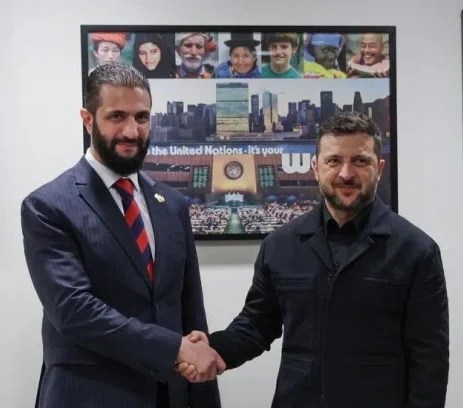
Syria, Ukraine restore diplomatic ties at UN General Assembly
The Cradle | September 25, 2025
Damascus and Kiev have restored diplomatic ties following a meeting between self-appointed Syrian President Ahmad al-Sharaa and Ukrainian President Volodymyr Zelensky at the UN General Assembly (UNGA).
“We are pleased with this important step and are ready to support the Syrian people on their path to stability,” Zelensky said in a statement on 24 September. “During our negotiations with President Sharaa, we discussed in detail the promising areas for developing cooperation, the security threats facing both countries, and the importance of addressing them. We agreed to build our relations on the basis of mutual respect and trust,” he added.
“His Excellency the President of the Republic, Mr. Ahmad al-Sharaa, met with his Ukrainian counterpart, Mr. Volodymyr Zelensky, in the presence of the Minister of Foreign Affairs and Expatriates, Mr. Asaad Hassan al-Shaibani, and his accompanying delegation, on the sidelines of the 80th session of the United Nations General Assembly in New York,” the Syrian Foreign Ministry said.
Syria’s foreign minister and his Ukrainian counterpart signed a joint declaration on the restoration of ties in the presence of Sharaa and Zelensky.
Sharaa was the former deputy to ISIS leader Abu Bakr al-Baghdadi, before becoming the head of the official Al-Qaeda branch in Syria, the Nusra Front. The Nusra Front was eventually rebranded into Hayat Tahrir al-Sham (HTS), which took control of Syria in December 2024.
Ukraine played a role in the 11-day offensive that resulted in the collapse of former Syrian president Bashar al-Assad’s government.
Two months before Assad’s government fell, Russian media reported that hundreds of Ukrainian experts were training HTS in the use and manufacture of drones.
According to the Washington Post, the Ukrainian government provided HTS with “about 150 first-person-view drones” and at least 20 experienced drone operators in the lead-up to the offensive.
In 2022, Assad recognized the Luhansk People’s Republic and the Donetsk People’s Republic as independent and sovereign states, prompting Zelensky to fully cut diplomatic ties with Syria.
Ex-CIA chief Petraeus hails former Al-Qaeda leader for ‘clear vision’ in Syria
The Cradle | September 23, 2025
Self-appointed Syrian President Ahmad al-Sharaa engaged in a wide-ranging dialogue on 22 September with former CIA director David Petraeus as part of his visit to New York.
Sharaa, a former Al-Qaeda commander, met Petraeus, who commanded troops in Iraq after the 2003 invasion, at the Concordia Summit on the sidelines of the UN General Assembly. They discussed issues facing Syria, including reconstruction, governance, economic sanctions, and regional relations.
“We faced massive destruction over the past years, but we are focusing on economic development and building capabilities,” Sharaa stated.
“Syrians by nature are people of work and trade. So please lift the sanctions and see what we can do,” he added, referring to the 2019 US Caesar Act, which imposed crushing economic sanctions on Syria, impoverishing millions.
US President Donald Trump removed some sanctions earlier this year, but Congress must authorize their permanent removal.
Petraeus said that the conversation with the former Al-Qaeda in Iraq commander “has filled me with enormous hope.”
“Your vision is powerful and clear. Your demeanor is very impressive as well … We obviously hope for your success, Inshallah, because at the end of the day, your success is our success,” Petraeus added.
Though Sharaa was deemed a terrorist by the US State Department in 2012, the CIA covertly provided arms and funding to the Al-Qaeda affiliate he founded in Syria, then known as the Nusra Front.
According to journalist Seymour Hersh, Petraeus established a “rat line” between Libya and Syria to send weapons to the Nusra Front and other extremist groups seeking to topple the government of former Syrian president Bashar al-Assad.
The CIA operation, known as Timber Sycamore, enjoyed a budget of over $1 billion per year. The operation finally allowed Sharaa to oust Assad and establish an extremist Islamic state over Syria in December.
According to former French intelligence officer and political analyst Thierry Meyssan, Petraeus continued to help fund Al-Qaeda groups, including ISIS, after he was forced to resign from the CIA in 2012 after a sex scandal.
Meyssan says that Petraeus joined the private equity firm Kohlberg Kravis Roberts (KKR), headed by Jewish billionaire Henry Kravis, which funded the Nusra Front and ISIS on behalf of the CIA in an off-the-books manner.
Addressing Israel’s war on Gaza, Sharaa dismissed speculation about Syria joining the Abraham Accords to normalize relations with Israel.
He claimed the destruction of Gaza has made any broad normalization with Israel impossible, but said limited security arrangements could be considered.
Before Sharaa’s trip to New York, Syrian and Israeli officials were carrying out security talks that would allow Israel to maintain control of the strategic Mount Hermon, establish a no-fly zone over the south of the country, and prevent Syrian forces from entering a demilitarized zone in the south.
In a personal question, Petraeus asked how Sharaa manages the pressure of leading a country after years of conflict.
“I spent 25 of my 43 years in conflict and crisis, so I am used to hardship. Decisions that carry the destiny of a nation must be taken with calm and an open mind.”
Sharaa first traveled to Iraq to join Al-Qaeda after the 2003 invasion and was known for dispatching suicide bombers to kill civilians. He was allegedly arrested by US forces in 2005 and sent to the US prison at Camp Bucca.
After his release in 2009, he became the Emir of the Islamic State of Iraq (ISI) in Mosul, before traveling to Syria to establish the Nusra Front in 2011 on the instructions of Islamic State (later ISIS) leader Abu Bakr al-Baghdadi.
Israel Wants ‘Aerial Corridor’ Over Syria to Strike Iran
By Kyle Anzalone | The Libertarian Institute | September 17, 2025
Tel Aviv’s primary objective in discussions with Damascus is to establish an aerial corridor over Syria so Israel can restart its war against Iran.
Axios reports that Israel presented the Syrian government, led by Ahmed al-Sharaa, with a maximalist agreement that would establish a no-fly zone over Syria. Additionally, Tel Aviv wants a large swath of Syria, from the Israeli border to Damascus, to become a demilitarized zone.
An Israeli source told the outlet that an essential part of the agreement will be maintaining the ability to use Syrian airspace to attack Iran. “A central principle of the Israeli proposal is maintaining an aerial corridor to Iran via Syria, which would allow for potential future Israeli strikes in Iran,” they said.
Israeli Prime Minister Benjamin Netanyahu started an unprovoked war with Iran in June. Tel Aviv targeted leadership in Tehran, nuclear facilities, and scientists. President Donald Trump joined the war by striking three Iranian nuclear sites that Israel lacked the military capability to destroy.
Israeli forces currently occupy southern Syria. Israel promised to withdraw its troops from Syria if Damascus accepted the agreement. On Wednesday, Sharaa said a deal with Israel was possible “in the coming days.”
Tel Aviv made a similar agreement with Hezbollah, where Israeli soldiers were scheduled to withdraw from South Lebanon after Hezbollah moved its forces out of the region. However, after the Hezbollah withdrawal, Tel Aviv maintained its occupation. Israel is now demanding that Hezbollah entirely disarm.
The Israeli invasion of Syria began after President Bashar al-Assad was overthrown by al-Sharaa last year. Al-Sharaa, formerly Abu Mohammad al-Jolani, is the founder of al-Qaeda’s Syria affiliate. President Donald Trump has met with Sharaa and lifted some sanctions on Syria in a push to get Damascus to make a deal with Tel Aviv.
The myth of Israel’s isolation: the reality of Arab collaboration with Zionism
By Lucas Leiroz | Strategic Culture Foundation | September 15, 2025
The narrative construction of Zionism fundamentally depends on two premises: historical victimization and alleged regional isolation. Both are rhetorical weapons designed to justify Israel’s systematic brutality against Palestinians and other native populations of the Middle East. But neither of these narratives holds up under even a minimally honest analysis of the region’s current geopolitical reality. The myth of the “tiny State of Israel surrounded by enemies” is one of the greatest fabrications of contemporary Western propaganda.
The idea that Israel is a solitary bastion in a sea of Arab hostility is, today, completely baseless. With few exceptions, countries in the region not only tolerate Israel but actively collaborate with the Zionist regime — including militarily and diplomatically. The supposed regional resistance has evaporated in recent decades, giving way to a policy of normalization and, in many cases, direct submission to Israeli interests.
The most emblematic case is Syria. The fall of Assad became an obsession for the West, enabled by Islamist militias with logistical and military support from the West, Israel, and the Gulf petro-monarchies. After Al-Qaeda’s victory, the terrorist regime almost immediately engaged in negotiations with Israel, despite ongoing Zionist bombings of Syrian territory. Today, the so-called “Free Syria” is functionally an ally of Israel. Fragmented and destabilized, the country has lost its national capacity for resistance.
In Lebanon, the scenario is equally ambiguous. Despite Hezbollah’s firmly anti-Israeli stance, the Lebanese government follows a path of conciliation with Tel Aviv. The recent ceasefire agreement, signed without Hezbollah’s consent, makes it clear that the Lebanese elites prioritize accommodation with Israel over national sovereignty. Government pressure for Hezbollah’s disarmament is another indicator of veiled collaboration.
Even the Palestinian Authority — supposedly the legitimate representative of the Palestinian people in the West Bank — has acted as a silent partner of the Zionist regime. Its role is increasingly that of a submissive mediator, suppressing popular resistance and ensuring the stability of illegal Israeli settlements. Local authorities in the West Bank seem entirely incapable of challenging the colonial status quo, abandoning any real project of liberation.
Jordan, with its puppet monarchy, is another blatant example of collaboration. While official rhetoric often speaks of “justice for Palestinians,” in practice Amman functions as a key piece in the architecture of regional containment, facilitating Israeli intelligence and surveillance operations. The Jordanian monarchy is essentially an extension of Anglo-American policy in the region and, by extension, an objective ally of Tel Aviv.
In the Gulf, the situation is even more obvious. The United Arab Emirates, Bahrain, Saudi Arabia, and Qatar maintain close relations with Israel, both economically and militarily — even if many of them do not formally recognize the Zionist entity. As Brazilian analyst Rodolfo Laterza correctly observed, the effectiveness of Israel’s air defense is not due solely to systems like the Iron Dome, but to a regionally integrated infrastructure supported by Gulf monarchies. These countries not only allow American military presence and overflights but also share intelligence and threat tracking — giving Israel a significant strategic advantage.
Israel’s recent bombing of Qatar reignited talk of a possible “Arab awakening,” but until concrete developments occur, such “Arab solidarity” remains fiction and empty rhetoric. The Gulf regimes — utterly dependent on Western military support and fearful of internal destabilization — are among Zionism’s most useful agents in the Middle East. This is combined with the region’s typical strategic ambiguity, where governments believe they can maintain multiple alignments simultaneously without paying the price.
In the end, the only full-fledged state actor opposing Israel is Iran — which, ironically, is not even Arab. Isolated, blockaded, demonized, Iran continues to take a confrontational stance toward Israeli apartheid and remains the main supporter of resistance movements like Hezbollah and Hamas. Alongside war-torn and divided Yemen, it is the only state actor on the board that openly challenges Israel’s expansionist agenda.
Tel Aviv’s propaganda, amplified by the Western media, insists on portraying Israel as a victim. But the truth is that Zionism has co-opted and bought off nearly all its neighbors. The so-called “Israeli isolation” is a fiction — a lie repeated endlessly to justify the unjustifiable: the continuation of a colonial, supremacist, and genocidal project.
Parliamentary elections begin in Syria with citizens barred from voting
The Cradle | September 15, 2025
Syria is set to hold parliamentary elections on 15 September, its first since the fall of former Syrian president Bashar al-Assad’s government to extremist forces late last year.
The process will continue until Saturday, with the possibility of extension if deemed necessary.
Regional electoral committees will select 140 seats out of Syria’s 210-seat parliament, rather than citizens directly voting for members of parliament. The committees have been appointed by the Supreme Election Committee.
The other 70 MPs are set to be selected personally by Syria’s interim President Ahmad al-Sharaa, the former Al-Qaeda chief known previously as Abu Mohammad al-Julani.
The Syrian government recently announced that the elections will not include Suwayda Governorate, where thousands of Druze civilians were massacred by government forces during heavy fighting in the area in July.
It also said the Kurdish-controlled governorates of Hasakah and Raqqa will not be included, stressing that this was for “security concerns.” Kurdish authorities have denounced the decision.
Tensions have escalated recently between Damascus and the US-backed Kurdish militia, the Syrian Democratic Forces (SDF), which is closely linked to the de facto autonomous administration that governs parts of north and east Syria.
The SDF had signed an agreement in March to integrate its forces into Syria’s extremist-dominated military. However, it has demanded that it remain under Kurdish command and enter the army as a bloc, rather than dissolve and be conscripted regularly.
No SDF members were included when Damascus announced the formation of the Syrian government in March.
Monday’s election process has reinforced concerns about the lack of inclusivity in post-Assad Syria.
Khaled Jabr, a lawyer and legal expert from Hasakah, told North Press Agency on 11 September that the elections “do not reflect the people’s will” and instead represent “another form of dictatorship under a different guise.”
“The Damascus government monopolizes decision-making, excluding the people from every process – whether drafting a transitional constitution, forming transitional justice bodies, or even appointing the president. All these measures constitute clear violations of the law,” he added.
Jabr went on to say that people in north and east Syria “are not at all concerned with this electoral mechanism imposed by Damascus, as there is ongoing pressure to exclude them from participation.”
“Essentially, the government seeks to reinforce authoritarianism, far removed from democracy and human rights.”
Months before the massacres of the Druze in July, Syrian government troops killed thousands of Alawite civilians during a brutal and indiscriminate military operation on the country’s coast.
Syria has enjoyed sanctions relief from Europe, and will also soon be relieved of US Caesar Act sanctions despite failing to form an inclusive government and persecuting minorities.
Political corruption has also emerged as a concern in the current Syrian government. A Reuters investigation from July revealed that Syrian leadership has quietly taken control of over $1.6 billion in assets formerly held by businessmen linked to the Assad government.
The asset takeover, conducted outside public view, is part of an economic overhaul directed by Hazem al-Sharaa, the older brother of the self-appointed interim president. Sources told Reuters the committee has negotiated directly with sanctioned and unsanctioned tycoons, demanding that they hand over substantial parts of their wealth in exchange for immunity and permission to resume operations.
Syria’s president formerly led Al-Qaeda’s Nusra Front and was personally involved in war crimes against civilians in Syria, Lebanon, and Iraq. The Nusra Front was later rebranded as Hayat Tahrir al-Sham (HTS).
Alongside a long list of other crimes, HTS would steal humanitarian aid bound for civilians during the Syrian war and resell it for exorbitant prices on the black market.
Featured Video

Racist Seinfeld Dances for Joy as Bibi Unveils His New Map
or go to
Aletho News Archives – Video-Images
TV Drama Review
Japanese drama projects Japan’s wartime atrocities onto Chinese characters

Global Times | October 25, 2026
By portraying Chinese characters as perpetrators of ruthless violence while casting Japanese Self-Defense Forces (SDF) intelligence operatives as defenders, the season 2 of the Japanese drama Vivant has recently drawn criticism from Chinese netizens, who argue that its depiction turns historical reality on its head while ignoring Japan’s wartime atrocities.
The TBS drama series – a spy suspense story in which an alleged unofficial intelligence unit of the SDF operates across the globe — has attracted a passionate fanbase. Its currently airing season 2 opened with a household rating of 18.8 percent, the highest for a TV drama this year, according toa commentary article by Japanese media Toyo Keizai.
What draws attention is the portrayal of the enemies in the series, the article noted. Scenes in which the Chinese organization subjects kidnapped members of the SDF unit to brutal torture are repeated with unrelenting intensity.
It is rare for Japanese TV dramas to explicitly portray a real-life country as the enemy, the article noted.
Japanese Prime Minister Sanae Takaichi also made a reference to the drama, saying that she has been recording Vivant and hopes to binge-watch it over the year-end and New Year holidays, according to Japanese media outlets.
China’s CCTV News report on Sunday revealed that the drama features scenes in which Chinese personnel cut off the fingers of and stab Japanese intelligence operatives in the abdomen. Such acts bear striking similarities to the torture inflicted on Chinese nationals by invading Japanese troops during the World War II.
The drama distorts the truth by attributing these atrocities to modern Chinese characters. Beneath the surface, it subtly glorifies Japan’s cross-border overseas operations, blurs the functional boundaries of the SDF and implicitly promotes an expansionist narrative, per CCTV News. … continue
Blog Roll
 Aletho News
- EU facing trillion-euro debt hole while seeking more cash for Kiev
- How US, Europe, Persian Gulf states exhausted missile stockpiles, splurged billions to defend Israel
- Up in arms… Koreans reject U.S. empire’s plan to make South Korea the next Ukraine
- Iran, Turkey, Pakistan, Saudi Arabia could advance region-led security framework in Tehran: FM spox
- Netizens condemn Japanese drama for projecting Japan’s wartime atrocities onto Chinese characters
- Racist Seinfeld Dances for Joy as Bibi Unveils His New Map
- A West Bank War for Netanyahu’s Election Campaign, Could It Backfire?
- Yemen denounces European Parliament’s ‘hypocritical’ push to blacklist Ansarullah
- Qalibaf: UAE’s UN bid aims to ‘clear the runway’ for ‘Greater Israel’, whitewash genocide
- Pakistan reopens Iran border after boosting security: Report
- If Americans Knew
- An error has occurred; the feed is probably down. Try again later.
- No Tricks Zone
- Sudden Stratospheric Warming, Powerful El Niño Combination May Lead To Extreme Europe Cold, Energy Crisis!
- Two New Studies Find Thwaites Glacier Melt Cannot Be Driven By Human Activity Or A Warming Ocean
- E-Cars Reduce CO2 Emissions By Only 41% Compared To Internal Combustion Engine Vehicles
- Predictions Made By Renowned Climate Professor Over Past Decades Have Been Proven To Be Poor
- New Study Suggests Large Regions Of The Pacific Ocean Have Been Cooling For The Last 80 Years
- Germany’s Green Energy Debacle: High Energy Costs Force Kahla Porzellan to Close After 182 Years!
- New Study: 50 Years Of The Most Aggressive ‘Net Zero’ Policies Can Only Affect The Global Climate By 0.03°C
- US September “Heat” Was No Record…Many Records Set Decades Ago
- Latest European Green Energy Debacle; Portugal’s Largest Flagship Solar Park Insolvent!
- Green Energy Debacle: German Expert Professor Fritz Vahrenholt Warns Of Severe Economic And Social Consequences

