No sympathy for widows from the vaccine zealots
By Laura Perrins | TCW Defending Freedom | May 16, 2022
DEAR reader, I’m going to tell you something and you are not going to like it. People don’t care about you. Deep down, deep, deep down, people who don’t know you don’t really care about you. Not really. Not in any way that matters.
As many readers will know, all last week Mark Steyn interviewed victims of the Covid vaccine. They include widows whose husbands were killed by the vaccine, and survivors who were left with life-changing injuries from the vaccine. If you haven’t watched them, please do try to catch up on YouTube, or at Mark’s website.
As I sat through these testimonies, what struck me was the quiet dignity of the widows and survivors. They were all articulate and dignified. Some were careful to say they were not anti-vax; they just wanted to be listened to, their loss acknowledged and adequately compensated for by a government that forced them to take this vaccine. (And once we look at the propaganda and emotional blackmail it was coercion.)
Some other disgusting journalist took issue with Mark interviewing these victims, saying he was ‘exploiting’ them. Nothing could be further from the truth. The only reason Mark Steyn ended up with these interviews is because every other media outlet ignored them. The government ignored them, the vaccine manufacturers ignored them and the media, who usually would be all over stories like this, ignored them.
There was no rage or anger but plenty of bemusement, bewilderment and hurt as to why and how these victims could be treated like this. The most repeated phrase was that the victims were not scared about getting Covid themselves, but they did not want to spread it to others, they were told to get the vaccine, and they wanted to do the ‘right thing’.
At this point, I felt genuine pity for them. They trusted the government, they trusted the mainstream media and they were injured for it. I especially felt for Charlotte Wright whose husband, Dr Stephen Wright, had died leaving sons aged seven and one.
Those boys, Izaac and Elijah, will grow up without their father because he took a vaccine he did not need. Those boys were told, Daddy is not coming home, ever. To lose a father is bad enough. To lose a father because your government coerced him to have a vaccine is an outrage. Not even to compensate the family is evil.
We now know the vaccines do not stop transmission. As such, why healthy people who had no underlying conditions were told to take them should be subject to a public inquiry. In fact, the population were not just told to take them – they were shamed, bullied and threatened with dismissal from their jobs and civil society itself if they didn’t take them. Leading commentators – Andrew Neil, Piers Morgan, Claire Cohen – advocated for a system of apartheid and punishment for ‘vaccine refuseniks.’ These vaccine victims didn’t stand a chance.
At one point I did seriously consider getting the vaccine. I had just the baby and the government propaganda was seeping even into our No BBC house. I also worried about my husband. I worried that one of us would catch Covid and die leaving the four kids. It didn’t make any sense, but everyone breaks sometimes. Everyone. Luckily, a friend called me and told me to pull myself together and that I stood a much greater chance of being injured by the vaccine than Covid. So that moment passed.
Which brings me back to people not caring. When I considered getting this vaccine, what also stopped me is that for all the talk of ‘do the right thing’, I knew that if my husband died from it, no one other than close family and friends would care. Ultimately Matt Hancock was not going to call at my door and say, Don’t worry you are not going to starve to death even though your husband has died.
If I got injured and couldn’t drive, which would devastate the workings of the family, Claire Cohen wasn’t going to rock up and say, Don’t worry, I’ll do the school run. Childless Andrew ‘Punish refuseniks’ Neil certainly wasn’t going to take the baby if I could barely carry him. Neil had his house in the South of France to retreat to – so shut up and take your vaccine.
Ultimately, these people don’t care. They don’t care because they have never once recognised the injuries caused by the vaccine they so passionately advocated for. They don’t care because from my viewpoint they have never once written about it, or had the victims on their shows.
The same goes for the ordinary public. The bottom line is we all have a limited supply of sympathy and empathy to go around, and if we felt every loss we couldn’t get out of bed. But to advocate in such strong terms for a vaccine that has killed and injured people – that was morally abhorrent.
The vaccine cajolers, Part 5: Nudging and eavesdropping
By Paula Jardine | TCW Defending Freedom | May 15, 2022
This is the fifth instalment of Paula Jardine’s six-part investigation into the planning behind ensuring vaccine acceptance and countering vaccine ‘hesitancy’. You can read Part 1 here, Part 2 here, Part 3 here and Part 4 here.
THE starting point for universal vaccination is that virtually everyone is (indeed, needs to be) a suitable recipient. This has proved the case for the Covid-19 vaccines even though they are still technically under emergency use authorisations pending the completion of clinical trials, and even though the disease is a serious mortality risk for only a minority of the older demographics.
This presumption is at odds with the fallout from the 1976 landmark US judgment in Reyes v Wyeth Laboratories. The parents of a child who was paralysed by polio caused by the Sabin oral polio vaccine she had been given sued the manufacturer and won. In affirming the decision the Federal Court of Appeal said the manufacturer had a duty to market and inform potential customers of the dangerous vaccine and that this duty was heightened since the manufacturer had knowledge of the vaccine’s harmful potential.
In the wake of the case the US Centers for Disease Control (CDC) added a ‘duty to warn’ clause to all its vaccine purchase contracts which required that ‘vaccines be administered only after an individualised medical judgment by a physician, or after “meaningful warnings related to the risks and benefits of vaccination” were provided in understandable language.’
Today the CDC advocates what it calls ‘medical provider vaccine standardisation’, saying offering vaccination should be a default option at patient visits. Ideally, the vaccine is available to be administered then and there, for the sake of convenience, and lest upon further reflection there be a change of mind.
Informed consent guidelines require that an explanation of both the risks and the benefits is provided, that the decision is voluntary and is not influenced by pressure from medical staff or others. Vaccine confidence literature, however, suggests the trusted health care practitioner’s role is to influence decisions by presenting vaccine-positive information so that patients or parents will choose vaccination. Safe and effective is the familiar mantra.
The World Health Organisation technical advisory group on behavioural insights and sciences for health have considered the ways in which vaccination decisions can be influenced. They say that ‘anticipated regret’ – when people expect that an unpleasant outcome would lead them to wish they had made a different decision – ‘shows promise as a predictor of intentions and behaviour’. They go on to suggest that ‘leveraging regret’ is a strategy that can be used ‘to tackle motivational barriers to vaccine acceptance and uptake’.
Dr Heidi Larson, a professor of anthropology, risk and decision science, who set up the ‘Vaccine Confidence Project’ at the London School of Hygiene and Tropical Medicine but is not a member of the behavioural insights advisory group, offers the same advice saying, ‘Regret is an important dimension in conversations with parents, but the important thing is to shift the anticipated regret towards how they might feel if their child is not vaccinated and becomes seriously ill or even dies from a vaccine preventable disease rather than being more focused on the potential side effects of the vaccine.’
Another strategy that this advisory group has recommended to help increase vaccine uptake is to emphasise the social benefits (or disadvantages of not) such as being able to stay in the workforce or provide for your family. Lisa Fazio, a psychologist who participated in the US National Institutes of Health (NIH) Covid communications expert group, also recommends leveraging altruism. What was required for Covid vaccines, she said, was ‘a call to action beyond “getting” the vaccine for yourself, but using emotions via an aspirational approach. The call to action is something that is elevated and aspirational and focused on the benefits and that sense of normalcy. The call to action is not getting a vaccine that is available to you. The call to action is, “Protect your family, protect your loved ones. Help the world get past this crisis”.’
Another pitch offered by yet another NIH adviser, Paul Slovic, a psychologist who studies risk perception, was that being vaccinated could help people feel that they’re taking back control. ‘One of the things that makes Covid scary is that it’s difficult to control,’ said Slovic. ‘It’s invisible, people can carry and transmit the disease without showing symptoms, and there are limited treatment options. People have profound discomfort with uncertainty, and so offering the vaccine in the context of regaining control could be quite powerful.’
Persuasion isn’t left on its own to do the work. The 2019 Global Vaccination Summit endorsed behavioural nudging to increase uptake: ‘Interventions which focus directly on supporting individual behaviour and making vaccination as easy and convenient as possible have more impact than interventions attempting to modify attitudes and beliefs. In other words, “nudging” and behaviourally-informed strategies can trigger vaccine confidence.’
The idea behind nudging (though a doubtful science) is that it works to increase uptake by making people feel as though they are making a free choice. ‘Offer a default option that’s determined by experts, with an opt-out possibility. This retains people’s sense of freedom, but default architecture will guide them into the experts’ recommendations.’
The Covid-19 vaccination campaign in the UK used this presumptive approach by inviting people to vaccination appointments rather than asking people to request them. It may have been the fear/urgency factor that worked. But that does not lessen the manipulative intent.
Regardless, anyone trying to sell you an investment product by inflating past performances, failing to ascertain its suitability for you as an individual, and using manipulative talk while providing insufficient information for you to make an informed decision in order to make a quick sell, would be deemed to have engaged in unethical practice. Depending on the nature of the misinformation, it could even be illegal.
Vaccines are biological pharmaceutical products, and in the case of mRNA Covid vaccines gene transfer therapies, ones that permanently and irreversibly alter the physiology of healthy people. Having claimed that the case for universal vaccination is a moral one, for the greater good, the strategies employed in pursuit of coverage targets to increase uptake have been and are to varying degrees ethically suspect.
As Covid vaccination uptake figures show, most people do accept vaccines but, despite all the nudging and the hard sell, the 100 per cent coverage that is meant to deliver a disease-free utopia remains elusive. Demand generation at that level would require universal uncritical acceptance of vaccines.
Larson likened people exercising their right to refuse the medical procedure of vaccination to an epidemic requiring crisis management. The various vaccine confidence projects describe their aim as helping populations become more resilient against what they call rumours or misinformation, a nebulous category of anything that might threaten the War on Microbes, that cause people to reject vaccination.
‘We need to be more sophisticated and to build strong transnational networks to pick up rumours and misinformation early and surround them with accurate and positive information in support of vaccination,’ said Larson, chillingly.
The World Economic Forum (WEF) provided the Vaccine Confidence Project with research assistance to support its Covid vaccination work. In the six months from November 2020, NetBase Quid technology was used to ‘scrape’ online forums and social media for conversations about vaccines “to get a deep understanding of the obstacles to vaccine adoption, barriers to building trust and the communication strategies that move people to action”.
No fewer than 66 million conversations were identified and analysed to provide insights on how to target communications for Covid vaccines. It enabled a market segmentation of messaging, microtargeting different messages for different audiences.
“The government doesn’t plan to close borders or stop mass gatherings during any Pandemic” – Why did Britain throw away its pandemic plan?

By Will Jones | The Daily Sceptic | May 14, 2022
Of the many myths that have taken hold during the pandemic, perhaps none is more central than that the Government was caught out by Covid with no idea about how it ought to respond. Thus the extreme and unprecedented response of lockdown appears to many to be justified by this notion that ministers had little choice but to ‘play it safe’, and the subsequent experiments in social restrictions as we awaited and delivered a rushed vaccine and beyond are imagined as a heroic voyage into the unknown of how a government ought to respond to an ‘unprecedented’ disease.
In fact, though, the Government had a plan for what it should do, the U.K. Influenza Pandemic Preparedness Strategy 2011, and COVID-19 was well within the bounds of what the plan anticipated. As Dr. Noah Carl has noted, this was the plan the Government was following until mid-March 2020, with SAGE re-affirming at a meeting on February 4th 2020 that officials “should continue to plan using current influenza pandemic assumptions”.
While the strategy was focused on influenza, it expressly anticipated the possibility of a new SARS virus:
A pandemic is most likely to be caused by a new subtype of the Influenza A virus but the plans could be adapted and deployed for scenarios such as an outbreak of another infectious disease, e.g. Severe Acute Respiratory Syndrome (SARS) in health care settings, with an altogether different pattern of infectivity.
The Covid death toll has also been well within what was anticipated, the 193,000 deaths over more than two years being below what the plan suggested should be anticipated as a minimum within four months:
When planning for excess deaths, local planners should prepare to extend capacity on a precautionary but reasonably practicable basis, and aim to cope with up to 210,000 – 315,000 additional deaths across the U.K. over a 15 week period (or a higher level where possible).
Even Neil Ferguson’s infamous prediction of 500,000 deaths is not a long way above this level, and that was always an absurdly high number to anticipate for Covid, as many pointed out at the time.
The pandemic plan could not be clearer that no attempt should be made to prevent the virus spreading. In a way this was the fundamental error from which all else flowed. Why was the Government even listening to advisers modelling the impact of restrictions on spread when its plan was clear that it should not attempt to ‘control’ the virus in this way? In no fewer than three places the plan states that it will not be possible to prevent the virus spreading and no attempt should be made to do so, as this would be a huge waste of resources.
It will not be possible to halt the spread of a new pandemic influenza virus, and it would be a waste of public health resources and capacity to attempt to do so.
It almost certainly will not be possible to contain or eradicate a new virus in its country of origin or on arrival in the U.K. The expectation must be that the virus will inevitably spread and that any local measures taken to disrupt or reduce the spread are likely to have very limited or partial success at a national level and cannot be relied on as a way to ‘buy time’.
It will not be possible to stop the spread of, or to eradicate, the pandemic influenza virus, either in the country of origin or in the U.K., as it will spread too rapidly and too widely.
Instead, the strategy states, the aim should be to minimise the impact on wider society, by ensuring the sick can be treated and not closing down society. Normality should be maintained as far as possible and restored as quickly as possible.
Minimise the potential health impact of a future influenza pandemic by… Ensuring the health and social care systems are ready to provide treatment and support for the large numbers likely to suffer from influenza or its complications whilst maintaining other essential care.
Minimise the potential impact of a pandemic on society and the economy by… Promoting a return to normality and the restoration of disrupted services at the earliest opportunity.
Whole of society response: Business as usual. During a pandemic, the Government will encourage those who are well to carry on with their normal daily lives for as long and as far as that is possible, whilst taking basic precautions to protect themselves from infection and lessen the risk of spreading influenza to others. The U.K. Government does not plan to close borders, stop mass gatherings or impose controls on public transport during any pandemic.
Given this was the pre-prepared strategy, based on sound science and wide experience, it should be the standard against which Government policy during the pandemic is assessed, as in, for example, the independent public inquiry. Anything else is to let ministers off the hook, and to buy into the lie that Covid was something that we were not and could not have been prepared for. In fact, we had planned for exactly the kind of outbreak that occurred, so ministers had no excuse at all for winging it, copying China, or thinking we should try out something radically authoritarian. The legacy of 2020 must not be the dawn of a new era of extreme, ineffective and destructive public health policy, but a clear-eyed resolve that it will never happen again.
Is a Social Credit System Coming for Us?
By Tessa Lena | May 13, 2022
A Social Credit Score System Is Piloted in Bologna, Italy
The city administration of Bologna, Italy, is piloting a program that brings the beast of the Fourth Industrial Revolution straight to the citizens. It’s an early reiteration of Klaus’ Schwab’s Fourth Industrial Revolution, the honey moon, so to speak — so it comes to the citizens wrapped in gift paper, with balloons, prizes, and party language. But make no mistake: underneath, there is cruel man-eating machine that wants to mine your data and control your behavior!
So, what exactly is happening in Bologna? The administration is “digitizing” their relationship with the citizens. For starters, they are launching an app — with a catch — that will provide an interface to get access to various local services. Without saying it, the they are implementing the “digital governance” aspect of the Fourth Industrial Revolution. Quoting the Italian source:
“We will give citizens services based on their needs – says the Mayor – and this will allow us to personalize their experience. People will be able to find everything the administration will do on their mobile phones or computers. The physical branches, however, will not disappear.
“We will maintain a ‘physical’ support for all people who do not use the web, especially the older ones,” assures Lepore [Mayor of Bologna]. But the goal is computer literacy that leaves no one behind.”
If we read this announcement with innocent eyes, it sounds like yet another initiative that the bureaucrats are launching, perhaps benevolently, to keep up with the times and with the buzzwords. And in an ideal world — a world filled with flowers, butterflies, rainbows, and harmless, caring bureaucrats — there would be nothing wrong with adding on a little extra convenience via technology.
Technology can be very helpful if done right, and if it comes to us without Trojan horses. But alas, at the moment, we don’t live in such a world!
We live in a world where Klaus Schwab and his buddies and masters are fighting with each other over who gets to eat the most peasants! We live in a world where those who already have great power are seeking even more power — and that world is quickly going back to the feudal-time psychological standards (while, ironically, keeping the modern standards for the levels of industrial poisons in everything around us.)
As far as Trojan horses, the Bologna municipal app actually comes with a social credit system! The “virtuous citizens,” doing nice things, such as using public transport, keeping their energy use low, etc., get “perks,” like points in gaming. For those points, they may be able to get discounts or prizes or access to additional services. Nice Trojan horse, right?
“Among the most innovative interventions is the smart citizen wallet [emphasis mine]. ‘The wallet of the virtuous citizen,’ explains Bugani, who had worked on the project with the Raggi [Virginia Raggi, Mayor of Rome from 2016 to 2021] administration (in Rome today the platform is active in an experimental phase). The idea is similar to the mechanism of ‘a supermarket points collection,’ as the councilor himself points out.
‘Citizens will be recognized if they separate waste, if they use public transport, if they manage energy well, if they do not incur sanctions from the municipal authority, if they are active with the Culture Card.’ Virtuous behaviors that will correspond to a score that the Bolognese will then be able to ‘spend’ on prizes, such as discounts, cultural activities and so on.”
In other words, it’s the “nice” face of digital control. Nice, for now. But we need to be clear: we are looking at the digital control of everything we do in the end of that journey!
Integrated Citizen Relationship Management in Rome
The Italian news source mentions that this approach is already in experimental use in Rome, Italy. In March 2022, Salesforce published the following announcement:
“Salesforce, the global leader in CRM, today announced that the Municipality of Rome has chosen Salesforce to create an Integrated Citizen Relationship Management platform …
Leveraging Salesforce Service Cloud and Marketing Cloud will deliver omni-channel self-service capabilities, seamless collaboration between local government departments, and empower citizens to receive the information they need faster through AI-powered chatbots.
The launch of the MyRhome platform is another step on the Municipality’s path to creating a ‘smart city’ [emphasis mine] — an ecosystem of public and private stakeholders serving citizens wherever they are”.
Of course! We can’t expect any less from Salesforce, given that Marc Benioff is on WEF Board of Trustees!
Also, remember the famous “lockstep scenario” document released by the Rockefeller Foundation and the Global Business Network? The document that the Rockefeller Foundation says today has been misinterpreted by the conspiracy theorists — because the good and virtuous Rockefeller Foundation totally didn’t mean to predict what actually happened in 2020 (and also probably had nothing to do with eugenics)?
Well, keeping in mind that “lockstep scenario” document, here is Peter Schwartz, the Senior Vice President of Strategic Planning at Salesforce and “an internationally renowned futurist and business strategist, specializing in scenario planning and working with corporations, governments, and institutions to create alternative perspectives of the future … Prior to joining Salesforce, Peter was co-founder and chairman of Global Business Network [emphasis mine].” In the words of George Carlin, “It’s a big club, and you ain’t in it! You and I are not in the big club!”
Their Motive for the “Digital Governance” Model? It’s the Data, Stupid!
At first, it’s the data (to train our future boss, the robot) — and then, increasingly, it’s mainly about control!
Let’s look at a very “interesting” 2017 write-up on digitizing governments on the World Economic Forum’s website. It talks about the importance of collecting data to build and train their beloved AI. It also complains about the fact that a lot of the data kept by governments just sits there in paper format and, dammit, is not making itself useful to the sacred goal of training the AI! Not good, they say, what a waste!
Therefore, to “open” that data to the AI beast, they want the governments to digitize their services — sorry that was the quiet part — what they actually say is that the citizens are craving those digital government systems because, who doesn’t know that the elimination of privacy is … good for us?
The World Economic Forum also suggests that the governments should develop new legal frameworks and data management systems to make data available for free. What a great idea! In 2017, the World Economic Forum mouthpieces were more upfront that today, so it is useful to read exactly what they said back then:
“Need for data is quickly becoming a central theme that applies to all aspects of our evolving digital society. A case in point is the field of artificial intelligence, which promises to revolutionize society (governments included). Companies such as Google, Facebook and Microsoft are using AI-related techniques to train computers to recognize objects in photos and understand human language.
It is possible to train computers to perform these difficult feats because we have the enormous quantities of data that is required. The same applies to all forms of machine learning, smart manufacturing and every other tech-driven trend shaping the future. They are all reliant on data, and are only as good as the data they crunch. In this context, data has been described as the new oil.'”
“Today, a large majority of the world’s data is in the hands of the private sector … The remainder of the global data sits in government hands, mostly stored in paper format, or legacy systems. To maximize the societal benefits of the data age, a new movement started promoting open data.
While government data is all data or information that government entities produce or collect, making it open refers to publishing and sharing data that can be readily and easily consulted and re-used by anyone with access to internet with no fees or technological barriers.
Most of this data currently remains locked up and proprietary (private property of companies, governments and other organizations). This severely limits its public value.
Data is now a new social good and governments will need to think of some form of data responsibility legislation that guides the private sector and other data owners on their duties in the data age: the duty to collect, manage and share in a timely manner [emphasis mine], as well as the duty to protect.
This legislation is needed over and above a government’s own open and big data management systems, and will need to cover all data stakeholders (irrespective of ownership or other governing rules).”
“Once a clear legal framework is in place, governments need to develop, and quickly master, a new core capability: data curation … Most governments around the world still struggle with legacy databases that are incompatible with each other, and work against any kind of data-sharing or data-driven design. Laws and regulations are still in their infancy and struggling to cope with the pace of change …”
“Governments must review a vast number of laws and regulations [emphasis mine]. From harmonizing and enforcing privacy regulations and protecting against data-breaches, to regulations that ensure net neutrality and data flows. Today’s debates over the future of big data are based on the assumption that the internet will remain a series of open networks through which data easily flows.
Some countries have begun to harden their internet systems, and the concept of net neutrality is uncertain. If the internet becomes a network of closed networks, the full potential of big data may not be realized.”
“Governments must also improve their capabilities when it comes to citizen engagement to effectively and actively engage with both providers and users of data. This requires governments to create a culture of open data [emphasis mine] – something governments are starting to do with various degrees of success.
The level of citizen engagement is not the typical government communication function, but a more open, horizontal, and fast-paced G2C platform.”
Must, must, must. So I am guessing, national sovereignty is a sore thumb in the way of our aspiring Davos masters because in their minds, they have already decided that they want our data (but not theirs) to be openly available, and that they don’t want any questions from the peasants.
A tangential comment: As a musician, I am remembering with some bitterness how Big Tech was pushing for “open data” and “open access” back in the day, selling it as “free expression” and “democracy,” and as a result — since buying music became unfashionable — musicians lost much of their income … and nobody cared!
I am glad that now at least, a lot more people are realizing what liars whose Big Tech companies are, and what liars they have always been all along, when they were talking about “free expression”! Look at them now, with their “free expression”! They are quite happy to censor! So it’s only our data that they want to be open — not our opinions!
And Here Is Another Curiosity From the World Economic Forum
They published this article in 2018:
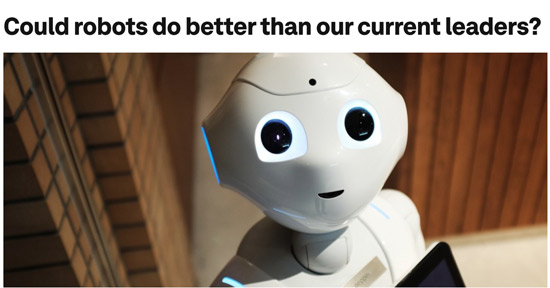
“The Fourth Industrial Revolution is expected to wreak havoc on labour markets, with AI and robots replacing various white-collar jobs. One job category largely excluded from scientific reports is that of government leaders, despite being one of the most critiqued, scrutinized and ridiculed jobs of all.”
“However, commentators from countries as diverse as India, the UK, New Zealand and Japan have started to suggest that robots as government leaders could drastically improve decision-making, by being much less irrational and erratic than their inherently flawed human counterparts.”
After freaking us out, the World Economic Forum writers chuckle and let us continue being governed by human politicians, at least for now:
“For the time being, it seems neither possible nor optimal for robots to replace government leaders, despite the clear imperfections displayed by the latter group … Ultimately, a more realistic and desirable scenario is one in which AI and automation are neither competitors nor substitutes to humans, but tools that government leaders can engage effectively and sometimes defer to, in order to make better, fairer and more inclusive decisions.”
Phew, it’s almost like … you know, when a street robber first tells us to give him all of your money but then agrees to take only half! Such a kindly, generous robber! We are so lucky!
World Economic Forum’s “Agile Nations”
The 2017 WEB write-up about digital governance reads like a “wish list” and a blueprint for the governments to act upon. (I guess, given the bribing and coercive power of the people who’ve composed the wish list, their wish list had a strong chance of becoming the bureaucrats’ blueprint the moment it was written.) So in 2020, seven nations got together and signed an agreement to essentially implement it. A quote from “Agile Canada“:
“In November 2020, seven countries signed on to the Agile Nations Charter, establishing Agile Nations as a forum for countries to collaborate on creating a global regulatory environment in which innovation can thrive.
Member countries include: Canada, Denmark, Italy, Japan, Singapore, the United Arab Emirates, the United Kingdom. The Organisation for Economic Cooperation and Development (OECD) and the World Economic Forum (WEF) also participate as observers.”
“Priority areas for cooperation are: data and communications, transportation, medical diagnosis and treatment, clean technology, legal and professional services, pro-innovation regulatory approaches.”
And here’s from the Organisation for Economic Co-operation and Development:
“The COVID-19 pandemic has wrought economic and social disruption worldwide. As people and businesses focus on recovery, governments must ensure that innovation, which will power economic growth and solve the world’s most pressing social and environmental challenges, is not held back by outdated regulations [emphasis mine].”
Translation from Orwellian to English: “We want your data, including your medical and biometric data — and we want it now. Look at how lovely our AI is … my precious! (Sorry couldn’t help it!) The so called national laws and regulations interfere with the speed at which we can get a hold of your data.
Like we said, we want it now, and so we would very much like it if so called national laws and regulation got replaced with a digital framework that we write and that we can update any time we like! Sounds like a good idea or what? Who wants some funding? You know what you need to do to get that funding, don’t you?” The quote continues:
“As part of the development of the OECD principles on Effective and Innovation Friendly Rule-Making in the Fourth Industrial Revolution, the Organisation for Economic Cooperation and Development (OECD) and the World Economic Forum (WEF) have been co-operating to look deeper into the interlinkages between regulation and emerging technologies …
Ministers from Canada, Denmark, Italy, Japan, Singapore, United Arab Emirates and United Kingdom announced their plan to lead the world in fostering responsible innovation and entrepreneurship.”
“In addition, in support of the mission of the Agile Nations, representatives of Facebook also offered to launch a call for research – overseen by an independent steering committee of experts in the field of law, regulation and entrepreneurship – into what approaches to rulemaking (e.g. regulatory sandboxes, policy prototyping) were the most effective for the Fourth Industrial Revolution.
As this initiative continues to develop, other businesses will be encouraged and invited to co-sponsor this initiative, and to venture their own ideas to support the work of the Agile Nations.”
“In sum, the Agile Nations Charter sets out each country’s commitment to creating a regulatory environment in which new ideas can thrive. The agreement paves the way for these nations to cooperate in helping innovators navigate each country’s rules, test new ideas with regulators and scale them across the seven markets.
Priority areas for cooperation include the green economy, mobility, data, financial and professional services, and medical diagnosis and treatment.”
“Scientific Management”
The World Economic Forum’s agenda is a strange mix of religious fundamentalism and “scientific management.” As I wrote earlier in an article about the mind of a technocrat, scientific management is a “method of industrial optimization developed by Taylor in the late 19th and early 20th century. The essence of his method was extreme fragmentation and compartmentalization of the production process.”
It required taking a complex process, breaking it down into very simple tasks, timing each task, optimizing it to the maximum using the stopwatch, and then assigning each of those simple tasks to different workers, while insisting that the workers should only use the pre-optimized motor patterns and work as efficiently as possible. Under scientific management, there was no room for workers’ creativity.
And while Taylor and Ford intended the scientific management method for the purpose of streamlining industrial production, the Davos charlatans aim to manage our entire lives, and justify it with some bogus “public good” and “community values”!
Whose “Community Values” Are Those, Anyway?
Here is the elephant in the room: It’s the Davos charlatans — and I want to repeat the word “charlatans” because that’s who they are underneath their bank accounts and their important speeches — who are writing our so called “community values”! They are trying to latch onto our natural social instincts and weaponize our good instincts against us!
They want us to be unassuming, guilty “good citizens” who put a limit on our carbon footprint and on the number of children we have — while they, the self-appointed “guardians” of the world, fly private jets to climate change conferences and have as many kids as they damn like!
And here’s the thing. There is nothing wrong with real community values! We are social creatures, and it benefits us to live together well. However, community values are only as good as the people who propose them — and community values turn into a pumpkin the moment someone like Schwab touches them!
As Good as the People
Let’s even forget about Schwab for a second and think how community values work in principle. Let’s imagine a small village. If the people living in that village are mostly healed and grounded, they will raise their children to seek wisdom and live well with others — from the heart, not from the letter.
However, if the people in the village have been abused, and abused, and abused again — and never healed — then even the authentic community values in that village could end up being anxious, rigid, and detrimental to freedom.
Hurt people tend to teach their children that life is meant to be joyless. They tend to slap their children’s wrists for wanting to be free, saying it’s a selfish folly. Hurt people hurt people! And at one point, the rigid rules might have been an invention of a cunning predator — but after prolonged abuse, people might have internalized them and passed them on to their children! (And look at how many people in the West sincerely adopted the religion of the Mask … they have internalized it!)
Another example: in my birth homeland of Russia, there are many small communities where the people carry so much hurt and sadness that the gloom is almost palpable in the air. I am saying this from personal experience, and with much pain and love for my people. I ran away from that gloom and immigrated to America because the “community values” felt too joyless!
So when it comes to Klaus Schwab and friends, they are only as powerful as we let them. I believe that that healing ourselves and our relationships is at the top of our priorities list in the battle against transhumanism — because anything we do from a place of love has more power than anything we do from the place of fear!
Why Will Transhumanism Fail?
This system, the entire man-eating beast, will eventually fail, I have no doubt — but we don’t know when, and we need to stay humble, brave, and very patient. The cruel beast may fail very soon, or it may take a while to fail. I think it depends on how quickly we remember to relate to each other in spirit, with love and happy humility — instead of labeling and judging each other based on ancestry, politics, or differences in opinion.
I think it depends on how quickly we realize that the freedom taken away from the people everywhere, throughout history, has been as existentially precious as the freedom that is being taken away from us right now — because there is no fundamental difference between us and other people, and never has been.
We, here and now, are dealing with the same dilemma that many in the past have dealt with, and some have died from. Spirit is spirit, and freedom is freedom! And I think that when we remember to stand together and honor each other and each other’s love and each other’s courage, we’ll be undefeatable. No Klaus Schwab can do anything to us if we refuse to betray our fellow human beings for any reason.
And sooner or later, spiritual clarity will prevail, and this transhumanist beast, the culmination of abuse, will fail. The reason why it will fail is simple. We are not machines, and when we are managed like machines — increasingly so over the centuries — our souls bleed badly. When we are managed like slaves, we suffer unbearably — and suffering, while it’s not a preferred way of obtaining clarity, still mysteriously leads to spiritual clarity. Life puts no suffering to waste!
And when the pain gets unbearable, and there is nowhere to go but toward our heart of hearts, our souls scream to the skies, and we pray for answers with no arrogance and no talking points, and then something magical happens. When our fear and pain become too much but we keep pushing, we grow our souls to where solutions show up out of nowhere.
And then we cry, laugh, and pray more for healing, and more solutions show up, and we look back and we suddenly know why we had to suffer, and why the sweetness was worth it. And then we start living well because, after all this suffering, we finally remember that everything in the world, everything-everything, has always been about love — and that living well with each other is not just pleasant but also very practical.
The vaccine cajolers, Part 3: Recruiting trusted sales staff
By Paula Jardine | TCW Defending Freedom | May 13, 2022
This is the third instalment of Paula Jardine’s five-part investigation into the planning behind ensuring vaccine acceptance and countering vaccine ‘hesitancy’. You can read Part 1, published on Wednesday, here, and Part 2, published yesterday, here.
IN 2018 the Wellcome Trust reported that vaccine scepticism is highest in high income industrialised countries where over 80 per cent of all global vaccine sales occur. Months before Covid-19 was declared a Public Health Emergency, the World Health Organisation had listed vaccine hesitancy as one of ten threats to global health, threatening to reverse progress made in tackling vaccine-preventable diseases: ‘Given that the majority of parents accept vaccines, pro-vaccine messages may be needed to reinforce and support positive sentiment and help prevent emerging hesitancy from expanding.’
In fact they had been working for years trying to shore up positive sentiments, in 2003 establishing the WHO endorsed global network of websites called the Vaccine Safety Net to provide ‘trustworthy’ information to ‘counterbalance websites that provide unbalanced, misleading and alarming information on vaccine safety’.
A decade later, in 2013, this counterbalancing programme had not proved enough for some. David Ropeik, who taught risk communication at Harvard School of Public Health, chillingly said, ‘What’s dangerous about widely broadcast vaccine debates, in a sense, is the debate itself: by putting out misleading information to people with little fundamental understanding of the performance and value of vaccines, the anti-vaccine movement and its social media echo chambers create doubt when, in fact, there is not a true scientific debate.’
So certain was Ropeik of the absence of a debate that he called for punitive measures, including restricting the ability of the unvaccinated to participate fully in community activities, to be used as a means of achieving full vaccination, long before Covid saw countries introduce such restrictions by way of vaccine passes.
Dr Emily Brunson, an anthropologist who like Dr Heidi Larson, referred to yesterday, studies vaccine confidence issues, was less absolutist than Ropeik. ‘I think we need to avoid the trap of thinking that information or knowledge is enough, because for a lot of the people, and when you look at hesitancy and parental vaccine hesitancy in the US, the group who is most likely to purposefully choose to not vaccinate are highly educated . . . these are people who have read the primary literature themselves, and they’re correctly interpreting it, so it’s not a misunderstanding. They have other concerns that go beyond the traditional public health message of “This is what you should be doing”.’
Communications strategies that are ‘vaccine positive’ and developed with input from the vaccine confidence teams are disseminated around the world today. Larson and Brunson were both members of the expert panel convened by the US National Institute of Health (NIH) to develop communications guidance as the Covid-19 vaccines rollout under emergency use authorisations began. They both contributed to a Vaccine Communications Principles guide published by the Centre for Public Interest Communications which describes its mission as ‘building communications strategies for the common good’.
Larson was also a member of the WHO Scientific Advisory Group of Experts (SAGE) working group on vaccines that developed a model to address hesitancy based on what it calls the three Cs: confidence, complacency and convenience. The key to confidence, they observed, lies with health workers, who are trusted by the public and able to influence vaccination decisions.
Over recent years, seasonal and pandemic influenza vaccine uptake has become the bellwether for vaccine confidence amongst health care workers. One lesson learned from the 2009 swine flu pandemic was that many of these workers began to exhibit less than universal enthusiasm for vaccines. In the United States fewer than half accepted the swine flu vaccine. Of course, if they were not taking the vaccines themselves, they couldn’t be relied upon as recruiting sergeants for the War on Microbes. Some needed more than education, they needed pressganging. So health departments and employers began mandating vaccines as a pre-condition of employment. Others stopped short of mandates, requiring instead that unvaccinated staff wear masks so that they could be more easily identified.
In England, where annual flu vaccine uptake by NHS staff hovers around 64 per cent overall with a wide variation in uptake between trusts, a different ‘inducement’ approach was introduced. In 2016, NHS England began offering financial incentives to the trusts linked to the number of staff inoculated. Behavioural modification tactics courtesy of the behavioural psychologists were deployed including ‘social norming’, that is creating peer pressure to make people think ‘if everyone else is doing it, I should too’. As NHS England explains, ‘Even something as simple as a sticker to show they have had their jab can be worn as a sign of pride and signal to others that they should have the flu vaccination.’
Whether volunteers or conscripts for the War on Microbes, the job of these trusted voices is to sell to the public products that are meant to be a long-term investment in their own health or their children’s health. The 2019 Global Vaccination Summit said more could be done to support them to provide ‘trusted, credible information on vaccines’ by giving more prominence to vaccination and communication skills in medical curricula and by increasing continuing professional training on vaccination issues.
The question is, what exactly are they being taught?
“Genetically Edited” Food – The next stage of the Great Reset?
By Kit Knightly | OffGuardian | May 11, 2022
The Queen’s Speech was interesting this year.
For all the people outside the UK who don’t understand what the “Queens Speech” actually is, it’s a farcical state occasion in which the Queen (or, in this case, Prince Charles since her majesty is ill/secretly dead/having “mobility issues”) makes a speech about what “her government” intends to do for the next 12 months.
Of course, the Queen doesn’t actually write the speech, or have any input on its content, or have any control at all over what “her” government intends to do. She’s just a mouthpiece in a big gold hat.
It’s the UK equivalent of the State of the Union, only done in Halloween costumes made out of shiny stolen rocks.
The whole thing is nothing but a grand, gilt statement of intent from the British Deep State, wrapped in mink and draped in medals they never earned. It’s a joke, but it is worth listening to.
Or, if you have a sensitive stomach, you can just read the full text the next day on the UK government’s website (that’s what I do).
A lot of the content is entirely predictable.
More money to Ukraine, with a promise the UK will “lead the way in championing security around the world”. More online censorship via the “Online Safety Bill”. A compulsory register for homeschooled children via the “Schools Reform Bill”.
There’s also mention of “securing the constitution” by introducing the UK’s own “Bill of Rights”. We broke down that particular Trojan Horse back in February.
But the part I found most interesting is the stated plan to “encourage agricultural and scientific innovation at home” via the proposed Genetic Technology (Precision Breeding) Bill.
The proposed bill (which, for some reason is not available through the parliament website) follows on from DEFRA’s announced “loosened regulation” of genetic research back in January.
To quote the National Institute of Agricultural Botany (NIAB), the legislation would “take certain precision breeding techniques out of the scope of restrictive GMO rules”.
Essentially, this would see new “gene-edited” foods as distinct from old-fashioned “genetically modified” foods, and therefore not subject to the same rules and oversight.
The claimed distinction is that gene editing, as opposed to genetic modification, doesn’t introduce DNA from other species. Therefore, in effect, is merely speeding up what could potentially naturally happen over time.
Now, you might think this is just semantics, and that such a law will just provide a loophole for ALL “genetically modified” foods to simply rebrand themselves as “genetically edited” foods, and thereby avoid regulation. But that is disgustingly cynical and shame on you for even thinking it.
All in all, this is pretty on-message stuff, and not especially surprising. What’s noteworthy is – by pure happenstance, I’m sure – it appears to coincide with a renewed push on the GM food front in other countries all over the world.
In December 2021, Switzerland added an amendment to its moratorium on GMO crops, permitting the use of certain “gene editing” techniques.
Last month, Egypt announced their new strain of GM wheat. Just two days ago, Ethiopia’s National Agricultural Biotechnology Research Center announced they had researched, and the country will now be growing, genetically modified cotton and maize.
Despite Russia’s sweeping ban on the cultivation and/or importing of genetically modified crops, they have nonetheless created a 111 billion Ruble project to create up to 30 varieties of genetically edited plants and farm animals.
Britain’s deregulation of GM food is always described as a “post-Brexit” move – with the EU chided around the world for its “precautionary principle” on GM crops – and yet as long ago as last April, the EU was calling for a “rethink” on GM crops.
In fact, just today, European Biotechnology Magazine reports:
The EU Commission has launched its final consultation on the deregulation of new breeding techniques in agriculture
WHY THIS? WHY NOW?
So, we’re seeing a sudden increase in the variety of GM crops available and a simultaneous push for deregulation of the industry in Western nations.
Why would they be doing this now?
Well, there is a food crisis.
Or, more accurately, they have just created a food crisis. And as the cliched Hegelian dialectic inevitably goes, their manufactured “problem” is now in need of their contrived “solution”.
We should expect to see genetic engineering pitched as a solution to our food crisis in the very near future… like yesterday. Or indeed, two months ago.
That’s how fast they work now, with barely a pretence at concealing the plan. Spitting out the answer so fast they make it obvious they knew the question beforehand.
On March 15th, when the “special operation” in Ukraine was less than 3 weeks old, the Times was already headlining:
War forces farmers to think again about GM crops
… and reporting:
Genetic modification could make Britain’s food system less susceptible to geopolitical turmoil
A week later Verdict published an article titled “Improving food self-sufficiency with GM crops during geopolitical crises”
Last week, the Times of Israel asked:
Can gene editing help farmers satisfy the rising demand for food?
Four days ago, the Manila Times published an article titled “In times of food scarcity: Revisiting genetically modified crops”.
Two days ago (so before the Queen’s speech specifically mentioning the gene editing bill), Scotland’s Press & Journal ran an opinion piece headlined: “Scottish Government must lift GM crop ban to ease cost of living crisis”.
Yesterday, the “information services” company IHS Markit published an article on GM regulation in Europe, in which they claimed:
The Ukraine-Russia conflict has demonstrated the fragility and vulnerability of global and European food supply chains. Around the world, governments in leading agricultural-producing countries are now catching up with the United States, both to better legislate gene-edited (GE) products, as well as differentiate them from the older Genetically Modified Organism (GMO) technology, and its negative connotations to some consumers, commentators, farmers, retailers, politicians and lawmakers.
And just today, the Genetic Literacy Project published an article by Ukrainian-Canadian David Zaruk, railing against the EU’s “precautionary principle” on GMOs and calling for an embracing of “new technology” to prevent widespread hunger and increase food sovereignty.
It goes on and on and on.
… LET’S NOT FORGET CLIMATE CHANGE, GUYS
Of course, it’s not all about the food crisis – giving corporate giants free rein to genetically alter all the food we eat will also be good for the planet. They talk about that a lot recently.
On February 8th this year, the University of Bonn published a new study claiming “Genetic engineering can have a positive effect on the climate”
On February 24th this year, the Cornell-based NGO “Alliance for Science” published an article claiming “GMOs could shrink Europe’s climate footprint”, based on the study mentioned above.
In a response to the Queen’s Speech, the UK’s National Institute of Agriculture and Botany claimed that genetic modification will make farming “more sustainable”.
In a reminder we’re not just talking about crops but genetically engineering livestock as well, in February Deutsche Welle suggested that genetically altered “Climate sheep and eco pigs could combat global heating”.
Three weeks ago, Stuff.NZ asked simply:
Can GM save the planet?”
The narrative is clearly set: Genetically engineered food will save us all from the food crisis, and global warming too. Plus anything else they can think of.
THE KNIVES ARE OUT FOR ORGANICS
Not content with the semi-constant fluffing of the GM business, the MSM are also turning their guns on organic farming and giving it both barrels.
The Wall Street Journal reports:
Ukraine Crisis Reveals the Folly of Organic Farming: As food prices skyrocket, the world needs to admit it can’t live without modern, efficient agriculture.
The Telegraph blames organic farming policies for “tipping Sri Lanka into bloody chaos”
The “Allliance for Science” article mentioned above goes out of its way to criticise the EU’s pro-organic “farm to fork” plans, claiming “[organic farming] has lower yields and would be associated with increases in global [greenhouse gas] emissions by causing land-use changes elsewhere”.
Meanwhile, Erik Fyrwald, the CEO of the Swiss agrochemicals group Syngenta (so possessing somewhat of a conflict of interests), told Swiss newspaper NZZ am Sonntag that the West must “stop organic farming to help future food crisis”, adding that organic farming is worse for the planet, because ploughing up fields releases more carbon dioxide into the atmosphere.
We already saw wellness “cults” accused of peddling “anti-vax conspiracy theories” last year, this will easily extend to organic farmers and their customers.
NOTE: In an interesting (again, probably totally accidental) parallel, the currently simmering “Bird Flu outbreak” has also hit organic and free-range farmers hard, with one (sponsored) Guardian article asking if “year-round” bird flu could spell “the end of free-range eggs”.
CONCLUSION
Having just seen how the Covid19 “vaccine” campaign unfolded, it’s not hard to see how the pro-GM push will go from here. Genome-edited crops and farm animals are going to become the new “settled science”.
They will be sold to the public as cheaper, more nutritious, better for the environment and good for “preventing future pandemics” (yes, they literally did say that already).
Naturally, anyone who resists the push for gene-edited food, and/or mourns the planned death of organic farming, will be accused of “questioning the science”.
Eating British GM foods will be “doing your part” and “helping Ukraine”, while people who want more expensive organic products will be deemed “unpatriotic” or “selfish”.
Just as we saw Covid sceptics denounced as spreading “Russian disinformation”, despite Russia’s willing complicity in the Covid lie, those who argue against genome-edited food will be said to be “sharing Russian talking points” or “doing Putin’s work for him” despite Russia being well onboard the gene-editing train.
It all gets very predictable from there. Organic farmers will probably be “anti-vaxxer conspiracy theorist Russian spies” by the end of the summer.
… This probably explains why Bill Gates was buying up so much farmland last year, too.
Nina Jankowicz, Disinfo Board chief, voiced support for UK government setting standards for acceptable speech
By Cindy Harper | Reclaim The Net | May 11, 2022
The head of the Department of Homeland Security’s new controversial Disinformation Governance Board recommended the idea of the government setting speech standards during testimony in the UK Parliament last year.
When asked by a lawmaker if the government should set minimum speech standards, like banning misogyny on the internet, Nina Jankowicz agreed.
Read the transcript here.
She went on to suggest that the communications watchdog should set the standards and fine tech platforms for non-compliance.
“For Ofcom [the UK’s communications regulator] to be able to establish the minimum standards that would be applied to all platforms and incur fines would be a useful starting point,” Jankowicz said. “That could be based, again, on the preexisting terms of service.”
Jankowicz said that alternative platforms, which are pro-free speech would be a problem, and blasted them for supporting “freedom of expression and fairy dust.”
Another idea she sold to UK lawmakers was social media companies being forced to hand over data to the government for censorship purposes.
“The social media platforms can do that if they are compelled to,” she said. She added that “you or Ofcom would need to determine exactly what measures you would like to see and compel the social media platforms to hand over that data.”
Jankowicz also promoted the idea of content demotion and shadow banning saying it, “… is not only about taking down content. It can be about demoting content to and saying ‘You can shout in the black void, but you do not get a huge audience to do that,’” she said. She continued to explain that demoting content would “allow us to get around some of the free speech concerns.”
EU, UK join US in launching online ‘disinformation’ policies, ‘one-world governance’ of social media

By Michael Nevradakis, Ph.D. | The Defender | May 11, 2022
The European Union’s Digital Services Act (DSA) and the U.K.’s proposed Online Safety Bill are among the latest government policies designed to hold social media companies responsible for hate speech and “disinformation” posted by users.
Experts interviewed by The Defender expressed concerns about the potential slippery slope of regulations — in the U.S. and overseas — which, under the guise of “combating disinformation,” stifle the spread of information deemed inconvenient for governments and other powerful actors.
As reported by The Defender, in the U.S., these proposals include a government “disinformation board” and a bill pending before Congress, the Digital Services Oversight and Safety Act.
The EU’s new regulations, experts said, may have far-reaching impacts beyond Europe.
Michael Rectenwald, author of “Google Archipelago: The Digital Gulag and the Simulation of Freedom,” said he can foresee a future in which such regulations might affect all speech — not just speech on social media platforms.
Rectenwald told The Defender :
“[T]he EU’s DSA represents a major step toward one-world governance of social media and Internet search and one step closer to global government.
“Since the distinction between ‘on-line’ and ‘off-line’ activity will lose all meaning as the Internet includes the Internet of Things and Bodies, the DSA may become the law of the land.”
Is EU’s Digital Services Act on collision course with Musk’s Twitter plans?
In timing that coincided with Elon Musk’s intent to purchase Twitter, the EU announced April 23 the passage of the Digital Services Act (DSA).
The DSA seeks to tackle the spread of “misinformation and illegal content” and will apply “to all online intermediaries providing services in the EU,” in proportion to “the nature of the services concerned” and the number of users of each platform.
According to the DSA, “very large online platforms” (VLOPs) and “very large online search engines” (VLOSEs) — those with more than 45 million monthly active users in the EU — will be subject to the most stringent of the DSA’s requirements.
Big Tech companies will be obliged to perform annual risk assessments to ascertain the extent to which their platforms “contribute to the spread of divisive material that can affect issues like health,” and independent audits to determine the steps the companies are taking to prevent their platforms from being “abused.”
These steps come as part of a broader crackdown on the “spread of disinformation” called for by the Act, requiring platforms to “flag hate speech, eliminate any kind of terrorist propaganda” and implement “frameworks to quickly take down illicit content.”
Regarding alleged “disinformation,” these platforms will be mandated to create a “crisis response mechanism” to combat the spread of such content, with the Act specifically citing the conflict between Russia and Ukraine and the “manipulation” of online content that has ensued.
The DSA also will ban certain types of advertising on digital platforms, including targeted ads tailored to children or to people of specific ethnicities or sexual orientations.
Tech companies also will be required to increase transparency in the form of providing regulators and researchers “access to data on how their systems recommend content to users.”
This latter point appears similar to Musk’s plans to make Twitter’s algorithms “open source to increase trust.”
Companies violating the provisions of the DSA would risk fines of up to 6% of their total global annual revenue, while repeat offenses may result in the platforms being banned from the EU — despite the “open internet” principle professed by the principle of “net neutrality” enshrined in EU law.
According to Techcrunch, the DSA will not fully come into effect until early 2024. However, rules for VLOPs have a shorter implementation period and may be enforced by early 2023.
A spokesperson for the European Commission — the EU’s executive branch — said the new regulations will ensure Big Tech’s “power over public debate is subject to democratically validated rules, in particular on transparency and accountability.”
Margrethe Vestager, the vice president of the European Commission, added, “With today’s agreement we ensure that platforms are held accountable for the risks their services can pose to society and citizens,” and, “With the DSA we help create a safe and accountable online environment.”
Directly addressing Musk, the European Commission’s internal market commissioner, Thierry Breton, tweeted, “Be it cars or social media, any company operating in Europe needs to comply with our rules — regardless of their shareholding. Mr. Musk knows this well,” adding, “[Musk] is familiar with European rules on automotive [referring to Musk’s ownership of Tesla Motors], and will quickly adapt to the Digital Services Act.”
Separately, Breton stated, “We welcome everyone. We are open but on our conditions. At least we know what to tell him: ‘Elon, there are rules. You are welcome but these are our rules. It’s not your rules which will apply here.’”
Breton’s warning to Musk bears a striking resemblance to the statements of then-German finance minister Wolfgang Schaeuble, who in 2015 warned the newly elected left-wing Greek government not to entertain thoughts about renegotiating the austerity measures imposed on the country by the EU and International Monetary Fund, stating, “Elections change nothing. There are rules.”
Voice of America, a media outlet reflective of official U.S. government policy, reported “the job of reining in a Musk-led Twitter could fall to Europe,” referring to the DSA.
According to Gizmodo, the EU’s new legislation “could have global reverberations,” adding, “Lawmakers are also hoping it could serve as a model for other countries like India and Japan.”
However, Gizmodo warns the success of the DSA in accomplishing its objectives is far from guaranteed, referring to the example of the EU’s General Data Protection Regulation (GDPR): “Some predicted [the GDPR] would fundamentally shift online privacy protection worldwide, and instead [it] basically just gave us those insufferable cookie permission pop-ups.”
While the DSA would apply to all 27 EU member states, some of these countries have already enacted similar domestic legislation. For instance, Germany has regulations in place that require digital platforms to remove hate speech within 24 hours or face fines of up to €50 million ($56 million).
Techcrunch, in reporting on the passage of the DSA, referred to legislation in countries not frequently noted for their democratic traditions or respect for free speech, such as China, Turkey, India and Nigeria.
As Techcrunch stated, platforms in these countries found to be “non-compliant” with domestic mandates may face fines, police raids, shutdowns and prison sentences for their executives.
Similar regulations pending in U.K.
Legislation similar to the DSA, the Online Safety Bill, is pending in the U.K. It would require Big Tech platforms to moderate “illegal” and “harmful” content in order to be allowed to operate in the U.K.
The bill would require digital platforms to protect users from such “harmful” content, with the threat of fines of up to 10% of global turnover for companies found in violation, as well as potential prison time for senior managers of these companies in cases of non-compliance.
A spokesperson for the U.K. government said:
“Twitter and all social media platforms must protect their users from harm on their sites.
“We are introducing new online safety laws to safeguard children, prevent abusive behaviour and protect free speech.
“All tech firms with users in the U.K. will need to comply with the new laws or face hefty fines and having their sites blocked.”
Max Blain, a spokesperson for U.K. prime minister Boris Johnson, said, “Regardless of ownership, all social media platforms must be responsible” for “protecting” users.
As The Defender recently reported, Damian Collins, a member of the British parliament with the British Labour Party who led a parliamentary committee that developed the Online Safety Bill, is a board member of the Center for Combating Digital Hate, which partners with prominent “fact-checking” firm NewsGuard.
As previously reported by The Defender, NewsGuard, in turn, closely collaborates with the World Health Organization (WHO), which also recently expressed concerns about Musk’s purchase of Twitter.
As U.S., EU sign commitment to ‘democratic values’ on the internet as they prepare policies to regulate online speech
Overshadowed by the news of Musk’s Twitter purchase and developments such as the DSA and the Biden administration’s “disinformation board,” several dozen countries quietly signed the “Declaration for the Future of the Internet” April 28.
Fifty-six countries and entities, including the U.S. and the EU, signed this declaration, described as “a political commitment to push rules for the internet that are underpinned by democratic values” and a response to Russia “wielding internet disruptions as a part of its escalating attacks on Ukraine.”
U.S. News reports that the declaration — which is not legally binding — is the first of its kind globally, and “protects human rights, promotes free flow of information, protects the privacy of users, and sets rules for a growing global digital economy among steps to counter what two Biden administration officials called a ‘dangerous new model’ of internet policy from countries such as Russia and China.”
According to the U.S. State Department, the declaration’s principles include:
- Protect human rights and fundamental freedoms of all people.
- Promote a global Internet that advances the free flow of information.
- Advance inclusive and affordable connectivity so that all people can benefit from the digital economy.
- Promote trust in the global digital ecosystem, including through protection of privacy.
- Protect and strengthen the multi-stakeholder approach to governance that keeps the Internet running for the benefit of all.
In turn, the declaration was described by the EU as being “in line with the rights and principles strongly anchored in the EU.”
EU Commission President Ursula von der Leyen, known for her strong support of digital “vaccine passports” throughout the EU, stated:
“Today, for the first time, like-minded countries from all over the world are setting out a shared vision for the future of the Internet, to make sure that the values we hold true offline are also protected online, to make the Internet a safe place and trusted space for everyone, and to ensure that the Internet serves our individual freedom.
“Because the future of the Internet is also the future of democracy, of humankind.”
Thierry Breton remarked:
“This Declaration will ensure that the Internet and the use of digital technologies reinforce, not weaken, democracy and respect for human rights.”
According to the State Department, “[t]he Declaration remains open to all governments or relevant authorities willing to commit and implement its vision and principles.”
What does all this mean for Musk, Twitter and the future of free speech online?
Social media analysts and experts expressed varying opinions and predictions as to what regulations such as the DSA may mean for the global operations of digital platforms such as Twitter — especially if Musk attempts to make good on his pledges to “restore free speech.”
Vasilis Vasilopoulos, data protection officer with Greek public broadcaster ERT and a Ph.D. candidate in journalism and mass media studies at Greece’s Aristotle University, told The Defender there are some positive elements to the DSA.
However, the boundaries of what is considered free speech should also be expanded, albeit within certain limits, he said.
Vasilopoulos added:
“The DSA is not the only means through which the problem of unethical [social media] algorithms with deceptive motives, or the unethical use of social media platforms, can be solved.
“[I]t is obvious that these platforms have surpassed the limits to democracy that we believed existed, and therefore, it is important that instead of imposing restrictions, we expand these boundaries, in favor of humanity and not capital or power.”
Matthew Spitzer, professor at Northwestern University’s Pritzker School of Law, said the EU’s proposals in particular may clash with Musk’s stated goals for Twitter, telling The Defender :
“[The DSA] may interfere with one of Elon Musk’s stated goals for buying Twitter. He seems to want less content moderation. But this regulation requires a lot of it.
“Second, this regulation dovetails with Musk’s stated desire for increased transparency. He had promised more transparency.”
Spitzer added his view that the DSA will likely increase the cost of operation for all social media companies, especially if they must also conform to domestic laws passed by various EU member states.
He added that U.S. tech companies may represent an easy target for European regulators, telling The Defender :
“[T]here will be conflicts between the USA and Europe … all of the target companies started in the USA. They are easy political targets in Europe.”
Referring specifically to Elon Musk and Twitter, Rectenwald said:
“If Musk is to have his way, the platform would no longer discriminate against content based on ‘wokeness,’ political beliefs, or the adherence to official state narratives and dictates.
“This could include the restoration of banned accounts on request by users and dramatic changes to Twitter’s discriminatory, leftist algorithms.”
According to Rectenwald, the EU’s regulations may “hamstring” Musk’s vision for Twitter and lead to a one-size-fits-all approach to content moderation, resulting in a “slippery slope” wherein “any information and opinion that differs from WHO-established official narratives regarding pandemics or other health-related crises” would be restricted.
Rectenwald said:
“Most likely, in order to meet the EU’s regulatory requirements and to streamline their efforts, VLOPs and VLOSEs will simply apply one set of rules to all online content.”
He also added that further pressures on platforms like Twitter may come not from EU regulators, but from the tech industry itself:
“[P]ressure to conform to ‘woke’ dictates will come from the Big Tech ‘woke’ cartel, including threats to remove the Twitter app from the Apple Store for failure to censor ‘hate speech,’ and the flight of ‘woke’ advertisers.
“Most likely, Musk’s purchase of Twitter will make no difference as free speech is further curtailed.”
Michael Nevradakis, Ph.D., is an independent journalist and researcher based in Athens, Greece.
The Vaccine Cajolers, Part 1: How jab zealots set out to stifle sceptics
THIS is the first of a special five-part investigation into the way in which, and why, winning ‘vaccine confidence’ became the primary goal of world health agencies, regardless of need, efficacy or risk.
By Paula Jardine | TCW Defending Freedom | May 11, 2022
Since the UK’s Covid-19 vaccine programme began in December 2020, 140million doses have been administered to 55million people, representing 73 per cent of the population.
The high level of acceptance of these vaccines, which were developed in one tenth of the normal time frame – and in the case of the mRNA vaccines using a novel technology never previously licensed for use in either humans or animals – is a remarkable testament to the level of public trust in vaccines.
It is arguably the end product of two decades of work, first by GAVI, the Global Alliance for Vaccines and Immunisations (now called The Vaccine Alliance) and recently by initiatives such as that of the London-based Vaccine Confidence Project, established to deliver the goal of universal childhood vaccination set 40 years ago by UNICEF, the United Nations children’s welfare organisation.
GAVI was set up in 1999 ‘to save children’s lives and protect people’s health through the widespread use of safe vaccines, with a particular focus on the needs of developing countries.’
It was founded at the instigation of Dr Seth Berkeley, its current CEO, who was then working for the Rockefeller Foundation. ‘We will have an outside body that can bring in industry (which the World Health Organisation can’t legally do), do advocacy and build a truly international alliance,’ he said.
The Vaccine Alliance, a public-private partnership financed by vaccine manufacturers, the Bill and Melinda Gates Foundation and national governments, aimed to give impetus to the universal vaccination campaign and to revitalise the fortunes of a stagnating market for new vaccines. The UK government is currently is largest single donor, having made a five-year pledge in 2020 of £1.65billion.
Its initial focus was on gaining the ‘long-term commitment of client governments and donors to full immunisation’, the latter implying vaccination on schedule and for every possible disease. This was different to its twin, the concept of universal vaccination.
When GAVI was launched, a UNICEF employee and anthropologist, Dr Heidi Larson – who would later found the Vaccine Confidence Project – was chosen to lead its vaccine communications and advocacy work.
She later explained how the nature of the advocacy was soon to evolve away from the initial focus on client governments.
‘There was a growing epidemic of individuals and communities and even some government officials questioning and refusing vaccines,’ she said. ‘I ended up getting the nickname “Director of UNICEF’s Fire Department,” because it turned out to be a crisis management position, because people weren’t taking vaccines.
‘I saw what seemed to be a trend: The northern Nigeria boycott of the polio program made it into the international press, but it wasn’t one place, it was everywhere.
‘I didn’t have time in my day job to investigate what was going on there, because there was not a quick fix. That’s when I put together a proposal and got some seed money and founded the Vaccine Confidence Project.’
There is no seminal document laying out a case for universal vaccination. As a public policy objective, it originated with the Rockefeller Foundation (RF). Its end goal is to eradicate diseases one-by-one via vaccination, the so-called vertical approach to public health introduced by the RF soon after its founding in 1913. It was part of a package of cheap, technological quick fixes for health care in developing countries originally called Selective Primary Health Care.
These interim measures were necessary because matching the industrialised world’s standards of sanitation, clean water, nutrition and health care to reduce the disease burden was ‘prohibitively expensive’.
An RF trustee, James P Grant, had been appointed executive director of UNICEF in 1980, operating it as a rival to the vaccine-agnostic World Health Organisation of his era.
In 1980, in an article on the eradication of smallpox, WHO director-general Dr Halfdan Mahler did not even mention vaccines. Rather, he stressed: ‘Smallpox eradication is a sign, a token, of what can be achieved in breaking out of the cycle of ill-health, disease and poverty.’
But Grant engaged in what the New York Times called ‘tireless, peripatetic proselytising’, using his UNICEF pulpit to zealously promote vaccination.
With rearguard reinforcement from the US Centres for Disease Control (CDC), by 1984 he had brought the WHO, the agency meant to provide the technical lead, on board with ‘universal’ vaccination.
Today, UNICEF is a quasi-arm of the pharmaceutical industry. Figures in its most recent Immunisation Roadmap document show it is now responsible for distributing 40 per cent of vaccines in developing countries, while its 659 staff spend more than half their time managing immunisation programmes and supply chain logistics.
In Part 2 tomorrow, I will explain how GAVI’s ten-year strategic plan, the Decade of the Vaccine, set out to eliminate vaccine scepticism.
Association of Tennis Professionals to take action against Wimbledon over Russian ban
Samizdat | May 11, 2022
Wimbledon is likely to be stripped of its rankings points by the ATP men’s tennis tour after a number of leading players condemned the tournament for its ban on Russian and Belarusian players, according to reports.
The decision could be ratified by the ATP board within the next 24 to 48 hours, according to The Telegraph, which reports that chief executive Andrea Gaudenzi “has little choice” but to follow the advice of players on the issue.
The decision would see Wimbledon deprived of its rankings points and would effectively turn this year’s event into an exhibition tournament.
The move has been on the cards since the ATP strongly condemned the announcement on April 20 by the All England Lawn Tennis Club (AELTC), which organizes the grass court showpiece, that it was banning Russian and Belarusian players because of the conflict in Ukraine.
The decision was mirrored by the UK Lawn Tennis Association (LTA), which will bar players from the two countries from all events in Britain this summer.
UK tennis officials have attempted to justify the ban by saying it is in line with government policy, and that the appearance of stars such as Russian men’s world number two Daniil Medvedev would somehow hand the Russian leadership a propaganda coup.
Both the men’s ATP and women’s WTA tours have suggested that the ban is discriminatory. The two tours have continued to allow Russian and Belarusian players to compete as neutrals – a position shared by the International Tennis Federation (ITF).
Men’s world number one Novak Djokovic has described the Wimbledon sanctions as “crazy,” while 21-time Grand Slam winner Rafael Nadal also said he disagrees with the step. British two-time Wimbledon winner Andy Murray has said is “not supportive” of the ban.
The ATP Player Council includes Nadal, Murray and Swiss icon Roger Federer, as well as nine other men’s stars. Djokovic is part of a separate, independent union.
Players will have an important say in the matter, with three elected player representatives on the ATP board as well as three tournament representatives.
The Daily Mail has reported that a “revolt is brewing” over the issue and that meetings of the ATP hierarchy have been held recently at events in Madrid and Rome.
According to The Telegraph, the women’s WTA “is leaning towards” taking the same step as its male counterpart and is also set to remove rankings points from Wimbledon.
The London Grand Slam – with its mammoth £35 million ($43 million) prize money fund – will still be a major money-spinner for players but will not contribute towards their positions in the world rankings or the race to the end-of-season tour finals.
As a private members’ club, Wimbledon is free to decide which players it invites to the famous tournament at SW19.
Other UK events, however, are held under the auspices of the ATP and WTA and would likely be fined for their non-admittance of Russian and Belarusian players, as well as having rankings points removed.
Aside from US Open champion Medvedev, other big-name stars to be affected by the ban are Russian men’s world number seven Andrey Rublev, Belarusian women’s world number eight Aryna Sabalenka, and two-time Grand Slam winner Victoria Azarenka.
The French Open, which gets underway on May 22, has stated it will not follow in Wimbledon’s footsteps and will allow Russian and Belarusian players to appear as neutrals.
Increased deaths in England for the age-range given the spring booster dose of Covid vaccine
Bartram’s Folly | May 5, 2022
I’ve mentioned previously that the roll out of a dose of vaccine has been associated with an increase in excess deaths (eg, here), and we seem to have seen the same effect in March.
At around the 21st March (week 12) England started to roll out the spring booster doses for those aged over 75 (and other vulnerable individuals). By the 7th April (week 14) the NHS had congratulated itself with the announcement that over 1 million doses had been given.
Here’s the data (from Euromomo) for excess deaths in England for those aged 75-85 since the start of the year:
I’ve highlighted the period where the million booster doses were delivered.
I note that we managed to get through the Omicron wave in the UK with normal levels of excess deaths in those aged 75-85, but as soon as the booster doses were rolled out we rapidly hit the threshold for a ‘substantial increase’.
Of course, it might be a coincidence — we have had rather a lot of coincidences over the last 15 months.
UK pledges more military aid for Ukraine
Samizdat | May 8, 2022
The UK pledged a further £1.3 billion ($1.6 billion) in military support and aid to Ukraine on Saturday. London said the move nearly doubles London’s previous spending commitments to Kiev, and is the country’s highest rate of spending on a conflict since the wars in Iraq and Afghanistan.
The extra money will come from a reserve used by the government for emergencies. Like other NATO member states, the UK has been increasingly supplying Kiev with weapons, including anti-tank and anti-aircraft missile systems and armored vehicles.
This week, London said it was sending 13 armored vehicles to Ukrainian police and the National Guard. The UK government has also been delivering tanks to Poland in order to replace those Warsaw has donated to Kiev.
Similarly, the US pledged an additional $150 million in military assistance to Ukraine on Friday. The package includes 25,000 155mm artillery rounds, as well as radars and electronic jamming equipment.
Russia has repeatedly criticized the West for “flooding” Ukraine with weapons, and warned in April that foreign arms become legitimate targets once they reach Ukrainian soil.
Featured Video

The Truth About the Trump Shootings with Ken Silva
or go to
Aletho News Archives – Video-Images
From the Archives
The Geopolitics behind the War in Yemen (I)
By Mahdi Darius NAZEMROAYA | Strategic Culture Foundation | 30.03.2015
The United States and the Kingdom of Saudi Arabia became very uneasy when the Yemenese or Yemenite movement of the Houthi or Ansarallah (meaning the supporters of God in Arabic) gained control of Yemen’s capital, Sanaa/Sana, in September 2014. The US-supported Yemenite President Abd-Rabbuh Manṣour Al-Hadi was humiliatingly forced to share power with the Houthis and the coalition of northern Yemenese tribes that had helped them enter Sana. Al-Hadi declared that negotiations for a Yemeni national unity government would take place and his allies the US and Saudi Arabia tried to use a new national dialogue and mediated talks to co-opt and pacify the Houthis.
The truth has been turned on its head about the war in Yemen. The war and ousting of President Abd-Rabbuh Manṣour Al-Hadi in Yemen are not the results of «Houthi coup» in Yemen. It is the opposite. Al-Hadi was ousted, because with Saudi and US support he tried to backtrack on the power sharing agreements he had made and return Yemen to authoritarian rule. The ousting of President Al-Hadi by the Houthis and their political allies was an unexpected reaction to the takeover Al-Hadi was planning with Washington and the House of Saudi. … continue
Blog Roll
 Aletho News
- IRGC air defenses destroy another US MQ-1 drone over Strait of Hormuz
- Imran Khan’s entire immediate family detained in Pakistan ahead of mass protest demanding his release
- EU nation detains former presidential frontrunner
- Leaked: Britain’s Sham Conviction Of Hashim Thaci
- Seyed M. Marandi: U.S. Strike Imminent – Toward Total War in the Middle East
- Russia Voted Under Fire. Washington Is Loading the Tankers.
- 12 Things Your Oncologist Was Trained Not to Tell You
- Anthrax Attacks Paved Way for COVID-Era ‘Junk Drugs and Vaccines’
- How Real Is the Impact of Western Sanctions on Israel?
- France, You Are Guilty: How Paris Turned Western Sahara into the Maghreb’s Powder Keg
- If Americans Knew
- Inside Israel’s ‘soft’ ethnic cleansing plan for Gaza through the eyes of its victims
- New online database tracks pro-‘Israel’ political donations in the United States
- Israeli president pardons soldier convicted for killing wounded Palestinian
- Singer Ed Sheeran says his ‘heart broken’ by Gaza devastation, addresses Macklemore controversy
- Israel Has Imprisoned Female Journalist Bushra Al-Tawil Without Trial Or Charge In Solitary Confinement For Past Month
- Israel poised to teach West Bank a lesson after one Israeli killed – Daily Update
- Salah Sarsour’s Legal Team Says DHS Has Not Met Its Burden to Prove He Is Deportable
- An analysis of tax forms by The Intercept show Kraft’s charity and LLC have donated to Friends of the IDF and AIPAC’s super PAC.
- Israeli attacks kill four Palestinians in Gaza – Daily Update
- Inside Gaza’s death trap of collapsing, bombed-out buildings
- No Tricks Zone
- 2025 Nature Paper Claiming Worsening Global Drought Gets RETRACTED …Heavily Flawed
- New Study: ‘Global Drought Shows No Detectable Recent Acceleration Under Climate Warming’
- Economic Masterminds: German Socialists Suggest Taxing Productivity Gains Stemming From Using AI
- The South China Sea Has Not Been Cooperating With The Climate Change Narrative
- Energy Crisis: Germany Enters Heating Season With Historically Low Gas Reserve Fill Levels
- New Study: The Antarctic Ice Sheet Gained Mass From 2020-2024 Due To Staggering Snow And Ice Accumulation
- Study: Ocean Heating Rates From Thousands Of Years Ago ‘Dwarf’ Modern Ocean Heating Rates
- Climate Extremists Target, Attack Large-Scale Power Grid Infrastructure In Germany!
- New Study: Antarctic Ice Melt Has Contributed Less Than 1 Centimeter To Sea Level Rise In The Last 30 Years
- Fear Of Debate: Alarmist German Climate Scientist Calls On Mainstream Media To Discredit Skeptic Voices
 Aletho News