Even if the Government Can ‘Move On’ From Partygate, the Public are Stuck With the Consequences of Lockdown
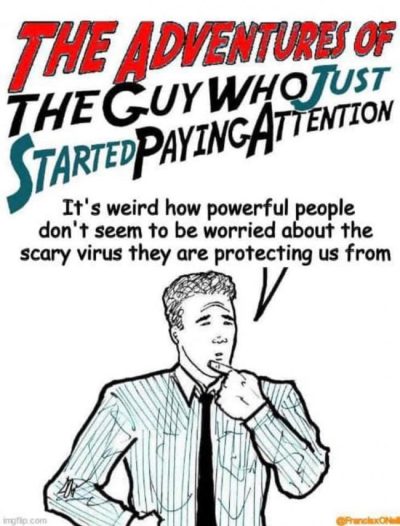
By Mark Shaw | The Daily Sceptic | May 25, 2022
“Let’s move on please, there are more important things to deal with.” This is what we often hear in relation to ‘partygate’. I don’t think sceptics are in such a hurry. We all want to move on in life but that is not easily achieved when we have been misinformed, taken for a ride and then taken to the cleaners.
The sceptics aren’t just Daily Sceptic readers but a growing number of the public who are seeing that much of the media have not delivered a full, honest account in reporting the last two years of pandemic restrictions and enforced medical interventions. What I find interesting is that, in much of the media’s eagerness to see the downfall of Boris Johnson, everyone is getting to see a little more of the ‘bigger picture’ the media have, up until now, been trying to hide. How could those enforcing all those ridiculous mandates be indulging in so many parties and social mixing if Covid was such a deadly disease? Why were so many coerced into a trial vaccination programme for a disease that evidently poses so little threat to them?
How we have been deceived! Yet much of the media focus on the minor detail of whether a particular event was a party, what certain photos show, whether Boris Johnson actually knew he was attending a party, whether he should have received more fines etc. They want to know if there is enough evidence to show that the PM misled Parliament because convention dictates that, if that were the case, he should resign – the big news story. The news story for me is whether the Government misled the public, not Parliament.
The scandal that lies before us is one demonstrating how those in power, who determined the rules and directed the hardships of the last two years, are more concerned about themselves and whether they have misled their colleagues than us plebs. The deception has severely affected many of us, the younger generation in particular. There are now increased hospital waiting lists, deaths from delayed cancer diagnosis and treatment and rampant economic inflation – true wrongs that deserve more than a token fine. It is this mendacity and betrayal that have consequences and will continue, possibly for decades, to have grave ramifications from which some may never be able to ‘move on’.
Dr. Mark Shaw is a retired dentist.
The Scottish government is silencing Palestinians
By Yvonne Ridley | MEMO | May 24, 2022
Scotland’s First Minister Nicola Sturgeon is facing a backlash after a group of Palestinian academics criticised her decision to embrace the working definition of anti-Semitism prepared by the International Holocaust Remembrance Alliance because the definition clearly contradicts a hate crime review commissioned by her own government.
The Holyrood government took the decision to follow Westminster in its adoption of the controversial IHRA definition of anti-Semitism which includes, as an example, “Denying the Jewish people their right to self-determination, eg by claiming that the existence of a state of Israel is a racist endeavour.”
Now Sturgeon’s government is in the embarrassing position of embracing two conflicting reports which openly contradict each other. To add to her woes, international human rights groups as well as a UN rights expert recently declared Israel to be an “apartheid state”.
The contents of the IHRA definition clash with the findings of Lord Bracadale, who was appointed by Scottish Ministers in 2017 to lead the Independent Review of Hate Crime Legislation. A group of Palestinian academics has now confronted Sturgeon’s government over this clear contradiction.
A few days ago, an open letter was published in the Scottish media about the dilemma facing Palestinians living in Scotland who accuse the Holyrood government of effectively gagging them from talking about the ethnic cleansing of Palestine during and ever since the Nakba.
“As Palestinians in Scotland we feel the need to be able to tell our story of being driven from our homeland in a programme of ethnic cleansing that built the state of Israel on the destruction of our villages and towns,” wrote the 26 signatories, including Amina Abdel-Khaliq, Dr Nur Abdelkhaleq, Waseem Abu Aghlain and Dr Kholoud Ajarma. “The Scottish Government’s adoption of the problematic IHRA (International Holocaust Remembrance Alliance) definition of anti-Semitism limits that freedom by protecting the state of Israel from democratic critiques of its widely recognised apartheid structures.
“Responding in part to the question of the IHRA definition, Lord Bracadale’s 2018 Review of Hate Crime Legislation accepted the case put forward by Palestinians and others that legislation should not protect ‘political entities’ since that could lead to the ‘curtailment of freedom of expression and freedom of political debate’.”
In their letter, the signatories demand that the Scottish Government should act on the findings of Lord Bracadale’s hate crime review which it commissioned.
“The Palestinian community voice has been absent while the state that violates them has been armed and supported by our government and the entire UK political class,” commented the co-founder of the Scottish Palestine Solidarity Campaign, Mick Napier. “That Palestinian first-person voice is uniquely compelling in forcing acknowledgement of the blood-soaked record of Israel, its past and present record of violent ethnic cleansing that is concealed or justified by our politicians.”
Napier added the warning that, “The Scottish Government seems intent on burying Bracadale’s warning that the IHRA can muzzle free speech. It must not be allowed to do so.”
I’ve always believed that hate towards and the unfair treatment of Jews should be roundly condemned, opposed and met with zero tolerance. But to be frank, the IHRA definition, which seeks to conflate anti-Zionism with anti-Semitism, does not serve to protect Jews; it is all about protecting the rogue state of Israel and its zealous supporters.
Towards the end of last year, I wrote about 82-year-old Diana Neslen who faced expulsion from the Labour Party after she was accused of posting “anti-Semitic” views on social media. The problem for Labour leader Keir Starmer and his party, though, was that Diana is a Jew.
After three investigations by the party she became so fed up that she employed lawyers, who fired off a warning letter telling Labour officials that her anti-Zionist viewpoint is a protected philosophical belief under the Equality Act in the UK. Furthermore, the lawyers at Bindmans said that she herself had been “subjected by the party to discrimination and harassment related to her protected philosophical belief.”
Predictably, the Labour Party backed down although it has yet to apologise to Neslen or abandon complaints against other party members under similar investigations. Jewish Voice for Labour, of which Neslen is a member, says that at least 46 Jewish Labour Party members, two of whom have since died, have faced or are facing disciplinary charges relating to allegations of anti-Semitism.
“To say that we are insulting Jews is wrong,” Neslen told the Guardian in February. “We are acting in accord with what we regard as Jewish values and Jewish ethics, and I’m not going to change that.”
So it seems that for most Palestinians and many Jews, the IHRA was designed to protect Israel, its racist policies and its Zionist supporters. Meanwhile, Lord Bracadale’s report makes it crystal clear that criticism of Israel and its racist policies is entirely legitimate.
There can be no doubt that anti-Semitism is a crime, but equally there can be no doubt that fighting Zionism is a duty for anyone who opposes apartheid. It’s time for Sturgeon and her government to get off the fence, scrap their support for the IHRA definition of anti-Semitism and allow Scottish Palestinians to tell their stories without let or hindrance.
The NHS just edited their Monkeypox page… to make it scarier
OffGuardian | May 24, 2022
Afew days ago the UK’s National Health Service (NHS) edited their Monkeypox page to alter the narrative in a few key ways.
Firstly, they removed a paragraph from the “How do you get Monkeypox?” section.
Up until a few days ago, according to archived links, the Monkeypox page said this, regarding person-to-person tranmission [emphasis added]:
It’s very uncommon to get monkeypox from a person with the infection because it does not spread easily between people.
… this has now been totally removed.
Secondly, they’ve removed this paragraph, which was present up until at least November of 2021 (and maybe much more recently, there are no archives between November and May) [emphasis added]:
[Monkeypox] is usually a mild illness that will get better on its own without treatment. Some people can develop more serious symptoms, so patients with monkeypox in the UK are cared for in specialist hospitals.
The new “treatment” paragraph reads [again, emphasis added]…
Treatment for monkeypox aims to relieve symptoms. The illness is usually mild and most people recover in 2 to 4 weeks […] You may need to stay in a specialist hospital, so your symptoms can be treated and to prevent the infection spreading to other people.
So, they remove that it will “get better on its own”, and again reinforce the idea of spreading the disease despite this being described as “very uncommon” as recently as last week.
They even add a line about self-isolating, which was never mentioned before:
as monkeypox can spread if there is close contact, you will need to be isolated if you’re diagnosed with it.
Finally, they now include a warning you can get Monkeypox by eating undercooked meat, which will doubtless feed into the anti-meat narrative too (oh, wait, it already is).
To sum up, history is being re-written a little here.
Before, monkeypox “did not spread easily between people”. Now it does.
Before, monkeypox would “get better on its own without treatment”. Now it won’t.
It’s early days to say that Monkeypox is going to be the “new Covid”, and maybe this rollout will stall and be forgotten in a couple of weeks, but there’s no doubt they are taking some tips from the Covid playbook so far.
WHO pandemic treaty: A fresh push for vaccine passports, global surveillance, and more
By Tom Parker | Reclaim The Net | May 20, 2022
Members of the World Health Organization (WHO) are days away from voting on an international pandemic treaty and amendments to the International Health Regulations (2005) which would give the unelected WHO greater control of national emergency healthcare decisions and new powers to push vaccine passports, global surveillance, and “global coordinated actions” that address “misinformation” whenever it declares a “health emergency.”
From May 22 to May 28, representatives of the WHO’s 194 member states (which represent 98% of all the countries in the world) will attend a World Health Assembly meeting in Geneva and vote on this treaty and the proposed amendments to the International Health Regulations (IHR). If passed, both the treaty and amendments to the IHR will be legally binding under international law.
The international pandemic treaty
The World Health Assembly (WHA), the decision-making body of the WHO, established an intergovernmental negotiating body (INB) to draft and negotiate a “global accord on pandemic prevention, preparedness and response” in December 2021. The WHA aims to have this treaty adopted under Article 19 of the WHO Constitution which gives the WHA the power to impose legally binding conventions or agreements on WHO member states if two-thirds of the WHA vote in favor of them.
While the WHO framed this as an international pandemic treaty, the latest draft of the treaty has since evolved to cover all “health emergencies.” Unlike the term “pandemic,” which is limited in scope and refers to the worldwide spread of infectious disease, the WHO’s definition of a “public health emergency of international concern” (PHEIC) is much broader and applies to all types of disease, regardless of whether they’re infectious:
“A PHEIC is defined in the IHR (2005) as, ‘an extraordinary event which is determined to constitute a public health risk to other States through the international spread of disease and to potentially require a coordinated international response.’”
The draft treaty places the “WHO at the centre” and solidifies the WHO as “the directing and coordinating authority on international health” and gives it sweeping, legally binding powers to force member states to adopt many of the censorship and surveillance tools that were imposed during the COVID-19 pandemic.
Some of the key areas of the draft treaty include:
International vaccine passports and contact tracing: Member states will be required to “support the development of standards for producing a digital version of the International Certificate of Vaccination and Prophylaxis” (the WHO’s official vaccine passport). The WHO will also “develop norms and standards” for “digital technology applications relevant to international travel” such as contact tracing apps and digital health forms.
Global surveillance: The WHO will conduct “coordinated global surveillance of public health threats” and member states will be required to build out their surveillance systems and work with “the WHO’s global systems for surveillance.” Non-state actors (which could include Big Tech companies) will also be required to work with governments, the WHO, and other international partners to leverage their “considerable data” to “create the strongest possible early warning and response systems.”
Addressing “misinformation,” “disinformation,” and “too much information:” The draft treaty pushes “national and global coordinated actions to address the misinformation, disinformation, and stigmatization, that undermine public health.” Member states will also be required to strengthen their approaches to “infodemic management” (a term coined by the WHO that refers to “too much information including false or misleading information in digital and physical environments during a disease outbreak.”) Additionally, non-state actors will be required to actors to work with governments to fight disinformation.
Funding: WHO members are set to collectively pay the WHO over $950 million in dues for 2022-2023 and already paid over $270 million in voluntary contributions for 2020-2021. And this draft treaty proposes that G7 countries (Canada, France, Germany, Italy, Japan, the UK, and the US) also pay $11 billion for the “Access to COVID-19 Tools Accelerator (ACT-A).” Additionally, it intends to create an”International Pandemic Financing Facility” that will extract long-term (10-15 year) contributions of $5-10 billion per year.
We obtained a copy of the draft treaty for you here.
If this draft treaty is approved at the May 22 to May 28 WHA meeting, the INB will hold a second meeting on August 1 to discuss progress on the draft. A progress report will then be delivered at the 76th WHA meeting in May 2023. The final treaty will then be presented for adoption at the 77th WHA meeting in May 2024.
Proposed amendments to the International Health Regulations (2005)
On January 18, the Biden administration quietly sent the WHO its extensive proposed amendments to the IHR. The details of these proposed amendments were only made public on April 12, almost three months after they were sent.
Under the current IHR, 196 countries are legally required under international law to build the capability to detect and report potential public health emergencies worldwide and respond promptly to a public health emergency of international concern (PHEIC) whenever it’s declared by the WHO.
These proposed amendments from the Biden administration give the WHO and its Director-General, Dr. Tedros Adhanom Ghebreyesus, sweeping new powers to declare public health emergencies, even over the objection of member states, and implement global surveillance measures that require the mass collection of genetic sequence data.
Some of the key amendments that are being pushed by the Biden administration include:
Increased WHO powers to declare “potential” emergencies: Currently, the WHO can only declare a PHEIC when there’s an actual “public health risk to other States through the international spread of disease.” These proposed amendments allow it to declare a PHEIC when there’s a “potential or actual” PHEIC. This means there doesn’t have to be evidence of the international spread of disease, just the potential for it.
Increased WHO powers to declare health emergencies: Currently, the WHO has to follow the PHEIC criteria when declaring a public health emergency and health emergencies can only be declared by the Director-General. But under these proposed amendments, the WHO Director-General can issue an “intermediate public health alert” to any country in response to events that don’t meet the criteria of a PHEIC and a WHO “regional director” can declare a “public health emergency of regional concern” (PHERC).
Global surveillance and data sharing: The Biden administration’s proposed amendments empower the WHO to develop new “early warning criteria” for monitoring “national, regional, or global risk posed by an event of unknown causes or sources.” Additionally, these proposed amendments expand the scope of data sharing under the IHR and require members to hand over genetic sequence data to the WHO whenever they have an event that “may constitute a public health emergency of international concern.”
We obtained a copy of the proposed amendments to the IHR for you here.
If these amendments are approved at the May 22 to May 28 WHA meeting, nations have six months to reject them. After six months, they’ll enter into force and any rejection or reservation “shall have no effect.”
The WHO’s history of supporting surveillance and acting as an arbiter of truth
Not only could this treaty and the proposed amendments to the IHR empower the unelected WHO to push surveillance, vaccine passports, and global programs that target what it deems to be misinformation but this international health agency already gave the world a taste of how it exercises these powers during the COVID-19 pandemic. As COVID-19 spread, the WHO rigorously supported surveillance tech and was increasingly used as an arbiter of truth on Big Tech platforms, even though it got many things wrong.
YouTube, Facebook, Wikipedia, and others have partnered with the WHO to tackle misinformation or display labels with information from the WHO. YouTube even goes as far as removing videos that go against the WHO and has censored over 800,000 videos under this policy.
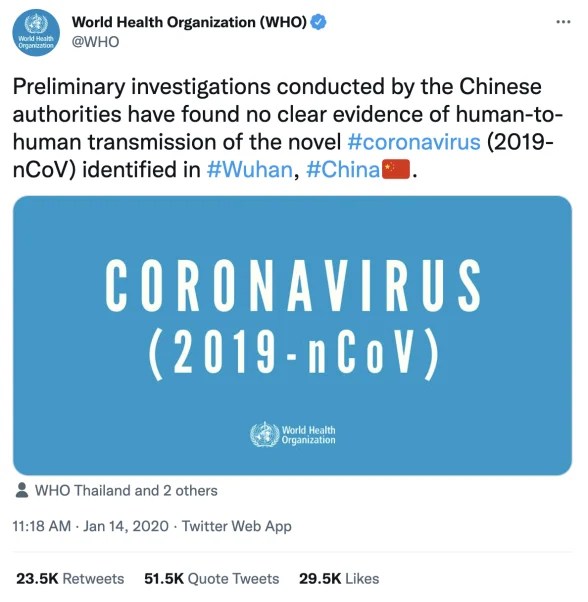
Despite having significant influence over how these platforms determine which posts to brand as misinformation, the WHO has got many things about COVID wrong and amplified misleading statements. For example, in an infamous January 14, 2020 tweet, the WHO stated that “preliminary investigations conducted by the Chinese authorities have found no clear evidence of human-to-human transmission” of the coronavirus.
The WHO has also praised China’s response to COVID which relies heavily on digital censorship and surveillance. Only recently did the WHO break this trend and criticize China’s zero-COVID policy. And when it did, these digital censorship systems were unsurprisingly used to censor the WHO’s statements on Chinese social platforms.
Another thing that the WHO heavily supported throughout the COVID-19 pandemic was vaccine passports. It pushed for them in December 2020 and it’s still pushing for the adoption of global vaccine passports this year.
The WHO’s undemocratic global governance system
The way the WHO gains its powers gives citizens almost no recourse. Instead of the response to national emergencies in democratic nations being the sole purview of elected officials who can vote on proposed measures that apply to their citizens and be held accountable at the ballot box by those citizens, WHO members vote on legally binding international treaties and agreements on their behalf via the WHA. If two-thirds of the WHA vote to adopt a treaty or agreement, it becomes legally binding under international law.
This global governance system has the support of both parties in most democratic countries. For example, during the 2022 Australian federal election campaign, both of the leading candidates expressed full support for the WHO’s expanded powers.
And the WHO Director-General has used the COVID-19 pandemic to push countries to further embrace the WHO’s global governance system by blasting countries that made their own decisions and claiming that their “‘me-first’ approaches… stymie the global solidarity needed to deal with a global threat.”
Countries that support the WHO’s expanded powers
Many countries have expressed support for the international pandemic treaty or the proposed amendments to the IHR.
The US supports both its proposed IHR amendments and the international pandemic treaty.
The treaty also has the support of the UK, Canada, Australia, New Zealand, and the European Council (EC) (which represents 27 European Union (EU) member states). According to the EC, 110 countries supported the decision to launch negotiations on the treaty. If these 110 countries vote in favor of the treaty, it would give the WHA close to the two-thirds of the majority it needs to pass the treaty.
Opposition to the WHO’s expanded powers
While there’s significant member state support for these expanded WHO powers, local politicians, citizens, and rights groups are opposing this power grab.
In the US, Congresswoman Mary Miller (R-IL), Congressman Byron Donalds (R-FL), and Congressman Chris Smith (R-NJ), have opposed the Biden administration’s proposed amendments to the IHR.
Senator Rick Scott (R-Fla.), and Senator Tom Cotton (R-Ark.) have also opposed the Biden administration’s support of the international pandemic treaty.
In Australia, Senator Malcolm Roberts (One Nation), Senator Alex Antic (Liberal Party), and Senator Gerard Rennick have opposed the international pandemic treaty.
Several UK Members of Parliament (MPs), including the Conservative MPs Craig Mackinlay and Steve Baker, have also called for the government to provide clarity on the treaty.
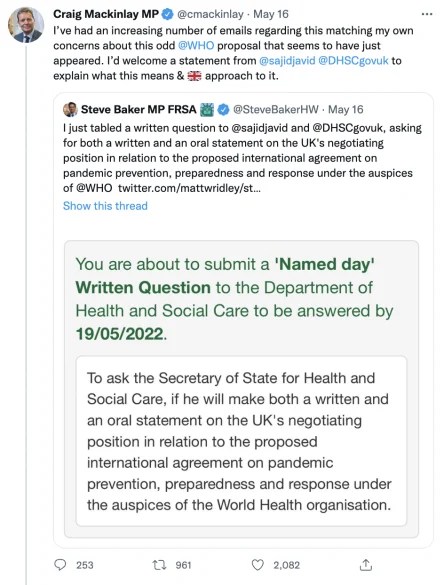
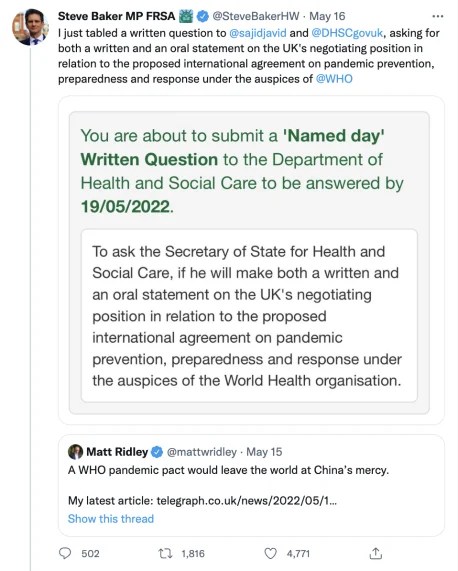
UK Health Secretary Sajid Javid responded to Baker’s calls by stating that the UK government supports the treaty but “would not sign up to any instrument that compromises the UK’s sovereignty,” including “any instrument which compromises the UK’s ability to take domestic decisions on national restrictions or other measures.”
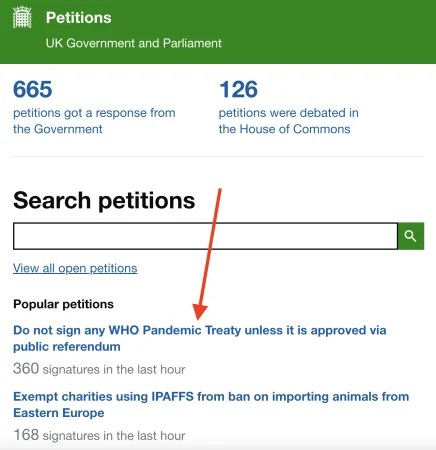
A UK Government and Parliament petition urging the government to not sign any WHO pandemic treaty unless it’s approved via public referendum has received over 130,000 signatures which means Parliament will now consider it for a debate. The petition has also trended on the homepage of the UK Government and Parliament petition’s website.
Member of the European Parliament (MEP) Christine Anderson has opposed the treaty, branding it an “abolition of democracy by the global elites.”
Conservative Party of Canada (CPC) MP Leslyn Lewis has also pushed back against the treaty and launched a “Stop The Treaty” petition which calls for Canada to decline the treaty.
And rights group World Council for Health has launched a #StopTheWho Campaign which opposes both the treaty and proposed IHR amendments.
But for now, the fate of this WHO power grab rests on the outcome of the May 22 to May 28 WHA meeting.
Why is a New War Coming to Afghanistan?
By Salman Rafi Sheikh – New Eastern Outlook – May 19, 2022
Afghanistan, every now and then, is hit by a bomb attack. Most of the recent attacks have been claimed by the Islamic State in Khorasan (terrorist organization, banned in Russia)). Its ability to orchestrate highly sophisticated attacks shows that the group, contrary to the claims the US military officials made during the US occupation of Afghanistan, has not lost its strength at all. But, to the surprise of many, the IS-K, while a potent threat to the Taliban and the wider region of South and Central Asia, a new armed resistance is emerging against the Taliban, this time led by local Afghans rather than transnational jihadis. Afghanistan’s National Resistance Front (NRF) being led by Ahmad Massoud and Amrullah Saleh, Afghanistan’s former vice president, has officially launched an offensive against the Taliban. Scores of other armed groups, too, have announced their formations and declared their intentions, on their Facebook pages and otherwise, to resist the Taliban on their own or in alliance with the NRF.
According to claims made by the NRF’s Ali Nazary, head of NRF’s foreign relations, a fully-fledged offensive has been launched in the Panjshir valley, in at least three districts. The NRF has a presence across Afghanistan’s many provinces. As Ali Nazary told the Associated Press of France in an interview, the NRF will launch operations in all the provinces to drive out what it calls illegal occupants (i.e., the Taliban) of power in Kabul.
To be sure, the NRF is not the only group. An ex-general in the Afghan army, Sami Sadat, recently vowed to “continue to fight.” In an interview given to the BBC, Sadat said he would “do anything and everything in our powers to make sure Afghanistan is freed from the Taliban and a democratic system is re-established.”
Most of the media projection – especially in the West – about the emerging resistance against the Taliban is tied to the failure of the Taliban to develop a politically and ethnically inclusive system. Many important political groups have been excluded and the Taliban high command has captured power, with most of the key ministries being led by key Taliban commanders, including the Haqqanis. On top of this is the Taliban’s gradual return to implementing an orthodox interpretation of Islam to regulate politics and society at large.
While all of these issues do point to certain political problems, the emerging resistance has some geopolitical underpinnings too. Consider this: Sadat, who was until recently was nowhere to be seen, emerged out of thin air and suddenly became so important as to attract the BBC for an interview. The fact that the BBC interviewed him and published his views shows (1) how new anti-Taliban personalities are being dug up by the West, and (2) how they are being given international projection.
While the criticism the Taliban are facing has a valid foundation, it is also true that Afghanistan’s new war is being planned somewhere else. As some reports have shown, US envoys have been holding meetings with the NRF in Tajikistan, where the latter is based.
Media reports in the west are already predicting a ‘new fighting season’ in Afghanistan. While Sadat was interviewed by the BBC, Britain’s state broadcaster, a news report carried by the Voice of America (VoA), America’s state-owned broadcaster, too, showed how anti-Taliban resistance is already coming of age.
According to the report, apart from the NRF, there is an ‘Afghanistan Freedom Front.’ According to VoA, it is being led by General Yasin Zia, a former defense minister and chief of general staff. Another group is ‘Afghanistan Islamic National and Liberation Movement’ is being led by Abdul Mateen Sulaimankhail, a former Afghan Army special forces commander.
Why is the west giving state-level projections to these groups? This sudden projection comes against the backdrop of Russia’s and China’s growing ties with the Taliban, and an ever-increasing possibility of both Moscow and Beijing extending legitimacy to the Taliban rule by recognising it. This comes against the backdrop of an emerging understanding between the Taliban and China and Russia that the former will make sure not to allow anti-China and anti-Russian groups to spread into their territories. In exchange, Beijing and Moscow will help the Taliban.
In his latest visit to Kabul, China’s Wangi Yi told Taliban officials that “China respects the independence, sovereignty and territorial integrity of Afghanistan, respects the independent choices made by the Afghan people and respects the religious beliefs and national customs of Afghanistan.” In the same meeting, Wang was assured that the Taliban will improve the “security environment” of Afghanistanin in ways to make it safe for China/region.
For China, therefore, Afghanistan is turning into a hospitable country, offering an increasing possibility of extending the China-Pakistan Economic Corridor to Afghanistan as well. Indeed, Wang Yi hinted during the same visit that China is considering it seriously.
Improving security and the political environment is something that Russia also believes is developing in Afghanistan. In a statement released on April 29, 2022, the Russian Foreign Minister said that “since the Taliban’s accession to power, the military-political situation in Afghanistan has become relatively stable,” which means that Russia thinks the Taliban might be able to rule Afghanistan effectively.
It is against this geopolitical backdrop that we must understand the emergence of anti-Taliban resistance. A challenge from within Afghanistan, led by Afghans themselves, against Kabul would challenge the Russian and Chinese claims, and indeed the Taliban’s own claim, that Afghanistan is stabilising. A large-scale insurgency, or a civil war, in Afghanistan will, yet again, force China to withdraw its CPEC extension plans, as well as forcing Russia to rethink the possibility of extending its cooperation. On the other hand, it will also allow the West to withdraw whatever support it has been providing to the Taliban in favour of supporting these resistance groups.
In short, therefore, there is as much, or even more, geopolitics tied to the emerging resistance as domestic politics i.e., the Taliban’s decision to exclude regional elites and the latter’s decision to resist their exclusion.
Salman Rafi Sheikh is a research-analyst of International Relations and Pakistan’s foreign and domestic affairs.
$65 billion in Western ‘aid for Ukraine’ is neither aid nor is it for Ukraine
By Drago Bosnic | May 20, 2022
In recent weeks, much has been said about the political West’s (primarily US) “aid” to the embattled Kiev regime. The US Congress has so far approved or is in the process of approving at least $54 billion to Ukraine. In addition, various reports put the amount of EU “aid” at up to €10 billion thus far, although the actual number is most likely orders of magnitude greater. When put together, this pushes the publicly acknowledged figure to a staggering $65 billion, which is equivalent to Russia’s annual military spending in nominal USD exchange rates.
The number seems rather impressive and may give an outlook that Ukraine will be able to defeat Russian forces. However, the situation on the ground says otherwise. With the political West’s postindustrial economy, their ability to mass-produce affordable and easily replaceable military hardware has increasingly been called into question. Thus, most of the “aid” from the US/EU is essentially a half measure. Throwing money at a problem is highly unlikely to resolve it, as actual situations require genuine, not monetary action.
The amount of hardware Ukraine lost so far is difficult to determine, as both sides provide diametrically opposing data, while independent confirmation from the ground is virtually impossible due to ongoing military operations. However, war footage taken by civilians, alternative media embedded with frontline troops, and soldiers themselves, clearly shows that Ukraine’s losses in manpower and equipment have been massive.
To replace lost hardware, the Kiev regime will require enormous resources. However, this will be quite challenging, as the country’s Military-Industrial Complex has been virtually annihilated by Russia’s long-range strikes. Thus, the regime will need to acquire additional military hardware elsewhere. The political West is the go-to address for this purpose, as Ukraine has been getting NATO weapons for years. Still, this hardware has had a limited impact on the battlefield. To change that, NATO powers decided to ramp up the so-called “lethal aid”.
However, in reality, the prospect of Ukraine getting the promised “aid” is rather grim. An obvious question arises, what will happen to nearly $65 billion? The first go-to address for such a question should be the US Congress. With the lawmaking body trying to fast track the deal, some US congressmen have voiced concerns that corrupt officials would be able to steal the “aid”, as was the case for decades during numerous US invasions across the globe. However, corruption and embezzlement, which geopolitical expert Paul Antonopoulos recently covered in a superb analysis, is the lesser problem in this situation.
Mainstream media have been portraying the political West as if it will be sending actual, physical money to the Kiev regime. However, nothing could be further from the truth. The funds will essentially stay in the “donor” countries. The largest share of those funds will officially be allocated to arming, or rather, rearming the Kiev regime forces. But who exactly, or more precisely, which companies will be producing weapons for the Ukrainian military? It’s safe to assume we all know the answer – the US Military-Industrial Complex, the largest and most powerful arms manufacturing cartel on the planet. Household names such as Lockheed Martin, Raytheon, Boeing, BAE Systems, General Dynamics, Northrop Grumman, to name a few, will be getting the vast majority of those funds.
For instance, the “Phoenix Ghost” drones, manufactured by the California-based Aevex Aerospace and “Switchblade” drones, manufactured by AeroVironment, both designed to strike tanks and other armored vehicles, as well as infantry units. M113 armored vehicle is also being sent and while old, largely obsolete and not in production since 2007, it’s quite numerous, and getting rid of it will make way for the acquisition of its immediate successor, the AMPV (Armored Multi-Purpose Vehicle), a turretless variant of the Bradley Fighting Vehicle, produced by the BAE Systems.
Another BAE Systems product is the M777 howitzer, a towed 155 mm artillery piece designed for direct fire support. Ukrainian troops are already using them, while recent videos released by the Russian military show some have already been destroyed in battle. Interestingly, the howitzers delivered to Ukraine lack digital fire-control systems.
The much-touted “Stinger” MANPADS (produced by Raytheon) and “Javelin” ATGMs (co-produced by Lockheed Martin and Raytheon) have been sent in the thousands. However, their effectiveness has been questionable at best, despite Western media trying to portray them as supposed “game-changers”. Russian tanks have been filmed surviving up to 7 “Javelin” hits, even continuing to fight, much to the frustration of Ukrainian forces, which have recently been ordered to stop publicly complaining about the lackluster performance of Western weapons.
Raytheon’s AN/MPQ-64 “Sentinel”, an X-band range-gated, pulse-Doppler radar used to alert and cue short-range air defense systems has also been sent. In addition, 40 million rounds of small arms ammunition, 5,000 assault and battle rifles, 1,000 pistols, 400 machine guns and 400 shotguns have been sent to Ukraine, along with more than 1 million grenades, mortars and 200,000 artillery rounds. These deliveries have been completed by early May. The actual number is most certainly much higher as of this writing.
The weapons in question are not changing the strategic balance between Russia and the Kiev regime, but are prolonging the fight, resulting in even higher military and civilian casualties. Also, logistics-wise, having so many different types of weapons creates a lot of problems for the Ukrainian military, which is barely holding together as it is. There are also issues of training and doctrinal incompatibility.
M777 howitzers are immobile when deployed and are designed with air dominance in mind. US troops are supposed to use them from a safe distance, serving as fire support by striking very specific targets during overseas operations, which is completely opposite to what is going on in Ukraine, where the other side (Russia) enjoys air dominance and uses massed artillery to punch holes in Ukrainian lines, followed by massive and well-coordinated armor assaults. Thus, US weapons not only fail in providing an effective counter to Russian troops, but are even getting Ukrainian forces killed, as they are still not accustomed to using them.
And last, but not least, the “aid” provided (and soon to be provided) by NATO countries are essentially long-term loans which will have to be repaid in the following decades. The WWII-era Lend-Lease program for the USSR, estimated at $160 billion in present-day USD, was repaid in full only in 2006. Thus, we can assume Ukraine will be paying off the current $65 billion “aid” for the rest of this century. That is, provided there will be a viable Ukrainian state to do so after the conflict ends.
Drago Bosnic is an independent geopolitical and military analyst.
Big Pharma-funded paper recommends taxing the unvaccinated
By Kit Knightly | OffGuardian | May 17, 2022
A new paper published by Oxford University’s Center for Business Taxation discusses – and in the end supports – the idea of a special tax levied on those who decline to be “vaccinated” against “Covid19”.
The paper’s authors argue that a vaccine-related tax would be “justified” because “Taxes on behaviour that is considered undesirable are nothing new.”
And that even if the “vaccines” do cause serious harm to some people…
“some states do adopt policies that can lead to serious harm in exceptional cases when they consider that the benefits outweigh the costs“
Yes, you did read that right.
They go on to suggest all sorts of ways of correcting this “undesirable behaviour”, from straight taxation to tax credits for those who have been vaccinated, to vaccine mandates and compulsory Covid insurance for the unvaccinated (which is just another way of saying “taxation”).
Now, here is where we could – and normally would – break down the article paragraph by paragraph. We would dissect the arguments, include data they ignore, highlight logical fallacies… you know, the usual.
We’re not going to do that today.
We could point out the infection-fatality ratio for Covid “cases” is minuscule.
Or that the so-called “vaccines” don’t prevent either infection or transmission of the alleged new disease called “Covid19”.
We could launch into a legal argument on civil rights, the Nuremberg Code, and medical coercion.
But we’re not going to do any of that.
Because it’s been two years of this, and life is just too damn short. We’ve done it enough, the facts are all there for anyone who cares enough to find them.
Instead, we’re just going to quote the ‘About’ page of the Oxford Center for Business Taxation, with a bit of added emphasis…
The Centre for Business Taxation was formed in 2005 and was initially funded by substantial donations from a large number of members from the Hundred Group. A number of these companies and others continue to support the CBT. Donors during the year were AstraZeneca [and] GlaxoSmithKline Plc
To be clear, the Hundred Group is a lobbying group which works on behalf of the all the members of the FTSE100.
GlaxoSmithKline is one of the largest pharmaceutical companies in the world, and partnered with French giant Sanofi to produce a Covid vaccine which netted the companies billions in supply contracts, despite the fact it is yet to be approved for public use.
If you know anything at all about Covid, you don’t need us to tell you who AstraZeneca are.
The CBT – and therefore the paper – are funded by big business and big pharma.
Do we really need to add anything else?
UK using Cold War’s black propaganda tactics against Russia
By Lucas Leiroz | May 19, 2022
Once again, the West appears to be operating with an old Cold War mentality against Russia. Documents recently declassified by the British government reveal a series of sabotage practices used by the UK during the bipolar era whose similarities to the current relations with Russia seem evident. In fact, sabotage, fomenting hatred, spreading lies and other common tactics seem like a commonplace part of British foreign policy and the current Special Operation in Ukraine is just another target.
Recently, it was revealed that the British government ran a series of secret “black propaganda” campaigns against enemy countries during the decades of the Cold War. Not only the Soviet Union and Communist China were targets of British intelligence, but also countries in Africa, the Middle East and specific regions of Asia. The tactics included various methods of sabotage, from information warfare to the promotion of racial and terrorist tensions, always aimed at promoting the destabilization of rival nations.
Commenting on the case, expert in intelligence Rory Cormac told The Guardian during an interview: “These releases are among the most important of the past two decades (…) It’s very clear now that the UK engaged in more black propaganda than historians assume and these efforts were more systemic, ambitious and offensive. Despite official denials, [this] went far beyond merely exposing Soviet disinformation (…) The UK did not simply invent material (…), but they definitely intended to deceive audiences in order to get the message across”.
An example of how British praxis worked was the extensive and complex action operated to promote tensions between the Soviet Union and the Islamic community. In the second half of the 1960s, the Information Research Department (IRD) forged at least eleven Soviet state media documents exposing the government’s alleged “anger” at the “waste” of Soviet weapons by Egypt during the 1967 Six-Day War. Later, the same department forged documents supposedly originating from the Muslim Brotherhood accusing Moscow of sabotaging the Egyptian campaign, criticizing the quality of Soviet military material and calling the Russians “filthy-tongued atheists” who saw the Egyptians as “peasants who lived all their lives nursing reactionary Islamic superstitions”.
Last year, The Observer had already revealed that the IRD was directly responsible for the massacre of hundreds of people in Indonesia through the spread of lies in a black propaganda campaign in 1965. At the time, the department financed the preparation of pamphlets allegedly belonging to the PKI, then the largest communist party in the non-communist world, which were actually just British false flags. This encouraged anti-communist militias to promote an unprecedented massacre in the country, which resulted in the deaths of hundreds of communist militants and civilians. Now, with the new declassified documents, it is possible to see that this was not an isolated episode, but a regular practice in British intelligence services.
In fact, it seems impossible to analyze this case and not correlate in some way to the current Western campaign against Russia, in which the UK seems to be very involved. In a way, it appears that despite the end of the Cold War, the bipolar mentality has never stopped working in the West. Simply, what was once aimed at the Soviet Union is now aimed at Russia.
This is precisely what political analyst Joe Quinn thinks: “The timing of this declassification of the documents is interesting insomuch as it may serve, for some, as confirmation that the West’s geopolitical war against the Soviet Union never really ended, it just continued as a war against the Russian Federation, but without the justification of fighting against Communism”.
The British media has been one of the most active in spreading anti-Russian narratives, fake news and pro-Kiev propaganda. Although most of the work is operated by the private sector, it is naive to think that there is no state incentive for pro-NATO propaganda. The British state – as well as the US and allied nations – has a very deep interest in creating a psychological warfare scenario, so there is a type of clandestine public-private cooperation between the state departments and these media agencies for their common objective to be achieved.
The special military operation in Ukraine is the main reason why Russia is attacked by Western propaganda today. From accusations of war crimes, false flags (like the tragedy in Bucha) to the absolutely unrealistic “analyses” alleging that Ukraine is “winning” the conflict, we have in all these cases examples of how the British media acts in collusion with the interests of NATO, operating old tactics of misinformation and black propaganda against London’s geopolitical enemies.
In this regard, Adriel Kasonta, a London-based foreign affairs analyst and former chairman of the International Affairs Committee of the Bow Group think tank, believes that currently the main interest of British intelligence is to have a public opinion approving the sending of weapons to Ukraine and believing it is strategic, forging data to make it appear that that Kiev is close to “winning”.
“It aims to mislead the domestic audience by convincing them that the ‘special operation’ is not going according to plan and to persuade them that sending lethal weapons to the front by NATO allies contributes to the alleged victories and successful resistance of the Ukrainian side. It is a psychological game, and nothing persuades the naturally peaceful population to support a war in a distant land [more] than the opponent’s alleged low morale and military losses”, says the analyst.
With that, it seems to be clear that there is indeed a blatant anti-Russian campaign going on which aim is to harm Moscow using old and well-known black propaganda and information war tactics. It is essential that the recently declassified documents are released so that Western public opinion is aware of the weapons used by their governments and media agencies against nations that are not aligned with NATO’s geopolitical plans.
Lucas Leiroz is a researcher in Social Sciences at the Rural Federal University of Rio de Janeiro; geopolitical consultant.
UK police are solving the lowest ever proportion of crimes after focussing on speech offenses
By Didi Rankovic | Reclaim The Net | May 17, 2022
To paraphrase an old adage, if a police force has to ask itself whether it is acting like a thought police – it probably is. And another certainty is that the answer it comes up with will highly likely still be, “no.”
But now, there is seemingly a desire to reverse the trend and once again have the police focus on dealing with actual crime, instead of, to all intents and purposes, getting involved in politics.
That’s what UK’s new chief inspector of constabulary, Andy Cooke, is saying, asserting that the country’s police should not act like the thought police, and unwittingly revealing how bad things have gotten by saying that officers must “remember that different thoughts are not forbidden.”
But how did it even come to a point where the fact that allowing different thoughts, a foundation of any democracy, is something the police must make an effort to remind themselves of?
It’s been a slippery slope that saw speech – but not action – related to transphobia and misogyny, among other hot-button issues, be treated as hate crimes by the police.
A turning point may have been the introduction in 2014 of “non crime hate incidents” that means this kind of “incident” can be reported to law enforcement. All it takes to justify such a move is for the alleged victim or somebody else to “perceive” that the incident in question was motivated by “hostility and prejudice.”
These reports, that cannot be appealed against, then crop up in people’s criminal record checks for a period of six years.
Judging by Cooke’s statements, published on Sunday, non crime hate incidents are not going away, but how and when the rule is applied could become more strict, as the UK police have more pressing issues such as solving serious crimes. The rate at which these cases have been solved has been the lowest ever compared to other types of offenses, the Home Office said.
“We’re not the thought police, we follow legislation and we follow the law, simple as that,” said Cooke, who’s job is to provide assessment and make recommendations on how to improve the police force, and added, “It’s important that the prioritization that we give is to those most at risk, and that policing stays away from the politics with a small p, and the different thoughts that people have.”
“Those thoughts, unless they become actions, aren’t an offense. The law is quite clear in relation to what is an offense and what isn’t an offense,” he said.
Taking the milk out of babies’ mouths: Food shortages are the new globalist weapon
By Kate Dunlop | TCW Defending Freedom | May 18, 2022
ARE you getting used to the Great Reset? How are you liking the New World Order built on globalist diktat, infection, mass poisoning by inoculation, inaccessible healthcare, inflation, draconian policing, shortages, uncontrolled migration, fear, more fear, and war…
You’ll doubtless be prepared for what’s coming next. It’s not a secret – Bill Gates and his World Health Organisation cohorts have already told us. The next viral releases – Hantavirus, Nipah virus, Marburg, whatever – are all primed and ready to go, together with monkeypox and avian bird flu. All come packaged with their own ‘off the shelf treatments’ from Big Pharma, all guaranteed to be equally as effective as the Covid jabs.
Supply chain problems are already here and will worsen, depending on whatever the next emergency is, and the UK is as well prepared for them as it is for shortages of fuel, gas, and electricity – which is to say not at all.
Now we are being told that a major food crisis is inevitable. Speaking at a Nato conference in Brussels on March 25th of this year, Joe Biden said: ‘Regarding food shortages – yes, we did talk about shortages, and they’re going to be real.’ He’s a man of his word.
Previously the blame was put on ‘climate change’, Brexit, shortages of foreign hands to pick and harvest crops, not enough lorry drivers, lockdowns, the ‘management’ of Covid, and the mass culling of chickens due to bird flu.
Now the war in Ukraine and sanctions against Russia are delivering shortages of gas, oil, and wheat. Russia and Ukraine together are the largest exporters of wheat and other grains in the world and Russia the largest exporter of oil and gas. Their impact on global logistics and food supply is immense.
At the same time, food production and processing facilities in the US seem to be spontaneously combusting. Since August last year, more than 16 such plants have been damaged by fire.
In September, a meat processor in Nebraska lost five per cent of the country’s beef supply. In March this year, a frozen food plant in Arkansas and a potato processing site in Maine both burned down. Last month, two planes crashed into two food plants, causing massive destruction – one at a General Mills facility in Georgia and another at a potato processing unit in Idaho.
Florida is having its worst orange crop in 70 years, with 90 per cent of trees affected by ‘citrus greening,’ a disease spread by the invasive Asian citrus psyllid bug, which was first found in China, then India and Saudi Arabia. Today, every citrus grove is infected. The impact on farmers already suffering from Covid restrictions is disastrous.
Russia and Belarus are two of the biggest global exporters of fertiliser and fertiliser-related products, accounting for 10 billion dollars activity per annum. The war and the sanctions have damaged the fertiliser market, with prices hitting all-time highs in March.
China’s draconian ‘Zero Covid’ approach and its export ban on fertiliser since last summer has added to farmers’ woes and hit food production costs.
Now it’s baby formula milk, with shortages across the US since February this year. CBS News reports that some 40 per cent of top-selling formula products were ‘out of stock’ at the end of April, according to an analysis from Datasembly.
The Wall Street Journal suggests two reasons for the shortages. It says supply chain issues caused by the Covid-19 pandemic worsened after Abbott Labs, a major formula manufacturer, voluntarily recalled some products and closed a plant in Michigan. Then there was a Food and Drug Administration investigation into complaints related to four infants who were hospitalised, two of whom died.
The White House reaction last week was woeful, with the tone-deaf press secretary Jen Psaki saying the government is ‘doing its best’ and that manufacturers are working at full capacity. In a national health emergency she went on to hint that some mothers are hoarding formula.
But, as with everything in the Magic Kingdom of Biden, things are not what they seem. The legacy media are slow to show locked cabinets in Walmart and empty shelves in other stores, though news that the government is transporting supplies of baby formula to border migrants is beginning to leak, as Tucker Carlson reports.
Eric Boehm, writing in Reason, confirms that although some of the shortages stem from the closure of the Abbott plant, there were already longstanding market problems. A closer look at US trade and regulatory policies shows that government is primarily responsible for the shortages.
According to the New York Times, ‘baby formula is one of the most tightly regulated food products in the US, with the Food and Drug Administration dictating the nutrients and vitamins, and setting strict rules about how formula is produced, packaged, and labelled’.
The US formula market was valued at 3,653 million dollars in 2019 and projected to reach 5,811 million dollars by 2027. The Covid-19 pandemic brought an upsurge in demand due to panic buying on the back of shortage fears.
Rising numbers of American parents are sourcing ‘unapproved’ European formula, even though it attracts an 18 per cent tariff quota. Some are desperate for supply, but others choose European brands because they offer options such as goat’s milk or milk from pasture-raised cows, which are ‘rare or non-existent in an FDA-regulated form in the US’.
Others consider EU products to be of higher quality due to stricter content regulations, including important levels of DHA (an omega-3 fatty acid), which are not required in the US. Almost no American baby formula would meet EU standards and many parents worry about adulteration.
Americans pay well over the odds for European formula, with one website selling product from Germany at 26 dollars for a 400-gram box, about four times the price of the top US formulas.
In April 2021, US Customs and Border Protection agents in Philadelphia seized 588 cases of formula worth around 30,000 dollars. The formula was said to have violated the FDA’s ‘import safety regulations.’ According to Twitter chatter, the FDA issued a fake recall of European formulas in 2021 and has regularly seized legal personal-use shipments.
Plain old natural disaster coupled with bureaucratic interference is not what is going on here. The US baby formula shortage is neither due to incompetence nor maladministration – it is an attack on the most vulnerable in society; part of a deliberate policy to keep chaos bubbling at peak in the service of the Great Reset.
We know what is going on. In 1974, Henry Kissinger said: ‘Who controls the food supply controls the people; who controls the energy can control whole continents; who controls money can control the world.’
West conducting war against Russia – Kremlin
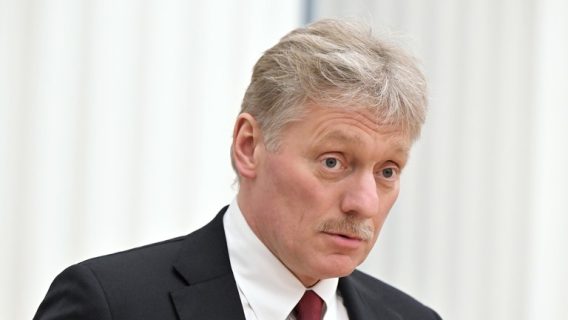
Kremlin spokesman Dmitry Peskov © Sputnik / Sergey Guneev
Samizdat | May 17, 2022
Western powers opposing Russia in Ukraine could be considered enemies waging a war against the state, Kremlin spokesman Dmitry Peskov said on Tuesday. He pointed out that economic sanctions, the arming of Ukrainian nationalists, and giving them intel to attack Russian troops all amounted to acts of war.
“Sure, we are still using the mild term ‘unfriendly states’ when referring to them,” Peskov told an educational forum.
“But I would say they are hostile states, because what they do is war.”
He cited the decision to freeze Russian foreign reserves that the country kept in Western financial institutions and discussions about giving the money to Ukraine as an obvious attack on property rights, the cornerstone of Western civilization. “That was money that you and I own,” Peskov told the audience. “It was stolen from us, it is being stolen from us.”
Russia’s opponents are playing a more direct role in their attempts to hurt Russia in their “hybrid war,” the official said. “Not only American but also British military advisers are telling armed Ukrainian nationalists what they should do and provide intelligence to them,” he explained.
Foreigners are also helping Ukrainians smear Russia’s reputation amid the hostilities, Peskov added. “They stage provocations that are on occasion so bloodthirsty that a human conscience cannot imagine them,” he insisted. He explained that he was referring to the town of Bucha and Kiev’s claims that Russian troops had committed war crimes while they controlled it. Moscow has accused Kiev of fabricating the evidence. “It’s clear that Ukrainian ‘specialists’ would not be able to do it with such professionalism. An army of PR companies, TV crews, and information warfare advisers are working for them,” he said.
The conflict didn’t come out of the blue, Peskov noted, citing that as early as 2005, when Russia created an English-language news outlet meant to air alternative viewpoints to Western audiences, it was met with resistance. “If you compare RT to the Anglo-Saxon media empire, you’ll see how small it is. But its effectiveness grew because of the alternative viewpoint,” he said. Western dissidents “were not given a platform” in Western media, because “if you go outside the margins there and voice a different opinion, the inquisition comes, just like in medieval times,” according to Peskov.
“It seems sometimes that the very existence of Russia is a significant irritant to the West and they would do anything not to let us develop in the way we want and live the way we want.”
The time the world is experiencing now is “a perfect storm and a moment of truth,” he said.
The event that Peskov was attending was organized for teachers and their students. The official’s speech was named “Information warfare: a game without rules” and was addressed to a younger audience.
Featured Video
The Truth About the Trump Shootings with Ken Silva
or go to
Aletho News Archives – Video-Images
From the Archives
The Geopolitics behind the War in Yemen (I)
By Mahdi Darius NAZEMROAYA | Strategic Culture Foundation | 30.03.2015
The United States and the Kingdom of Saudi Arabia became very uneasy when the Yemenese or Yemenite movement of the Houthi or Ansarallah (meaning the supporters of God in Arabic) gained control of Yemen’s capital, Sanaa/Sana, in September 2014. The US-supported Yemenite President Abd-Rabbuh Manṣour Al-Hadi was humiliatingly forced to share power with the Houthis and the coalition of northern Yemenese tribes that had helped them enter Sana. Al-Hadi declared that negotiations for a Yemeni national unity government would take place and his allies the US and Saudi Arabia tried to use a new national dialogue and mediated talks to co-opt and pacify the Houthis.
The truth has been turned on its head about the war in Yemen. The war and ousting of President Abd-Rabbuh Manṣour Al-Hadi in Yemen are not the results of «Houthi coup» in Yemen. It is the opposite. Al-Hadi was ousted, because with Saudi and US support he tried to backtrack on the power sharing agreements he had made and return Yemen to authoritarian rule. The ousting of President Al-Hadi by the Houthis and their political allies was an unexpected reaction to the takeover Al-Hadi was planning with Washington and the House of Saudi. … continue
Blog Roll
 Aletho News
- IRGC air defenses destroy another US MQ-1 drone over Strait of Hormuz
- Imran Khan’s entire immediate family detained in Pakistan ahead of mass protest demanding his release
- EU nation detains former presidential frontrunner
- Leaked: Britain’s Sham Conviction Of Hashim Thaci
- Seyed M. Marandi: U.S. Strike Imminent – Toward Total War in the Middle East
- Russia Voted Under Fire. Washington Is Loading the Tankers.
- 12 Things Your Oncologist Was Trained Not to Tell You
- Anthrax Attacks Paved Way for COVID-Era ‘Junk Drugs and Vaccines’
- How Real Is the Impact of Western Sanctions on Israel?
- France, You Are Guilty: How Paris Turned Western Sahara into the Maghreb’s Powder Keg
- If Americans Knew
- Inside Israel’s ‘soft’ ethnic cleansing plan for Gaza through the eyes of its victims
- New online database tracks pro-‘Israel’ political donations in the United States
- Israeli president pardons soldier convicted for killing wounded Palestinian
- Singer Ed Sheeran says his ‘heart broken’ by Gaza devastation, addresses Macklemore controversy
- Israel Has Imprisoned Female Journalist Bushra Al-Tawil Without Trial Or Charge In Solitary Confinement For Past Month
- Israel poised to teach West Bank a lesson after one Israeli killed – Daily Update
- Salah Sarsour’s Legal Team Says DHS Has Not Met Its Burden to Prove He Is Deportable
- An analysis of tax forms by The Intercept show Kraft’s charity and LLC have donated to Friends of the IDF and AIPAC’s super PAC.
- Israeli attacks kill four Palestinians in Gaza – Daily Update
- Inside Gaza’s death trap of collapsing, bombed-out buildings
- No Tricks Zone
- 2025 Nature Paper Claiming Worsening Global Drought Gets RETRACTED …Heavily Flawed
- New Study: ‘Global Drought Shows No Detectable Recent Acceleration Under Climate Warming’
- Economic Masterminds: German Socialists Suggest Taxing Productivity Gains Stemming From Using AI
- The South China Sea Has Not Been Cooperating With The Climate Change Narrative
- Energy Crisis: Germany Enters Heating Season With Historically Low Gas Reserve Fill Levels
- New Study: The Antarctic Ice Sheet Gained Mass From 2020-2024 Due To Staggering Snow And Ice Accumulation
- Study: Ocean Heating Rates From Thousands Of Years Ago ‘Dwarf’ Modern Ocean Heating Rates
- Climate Extremists Target, Attack Large-Scale Power Grid Infrastructure In Germany!
- New Study: Antarctic Ice Melt Has Contributed Less Than 1 Centimeter To Sea Level Rise In The Last 30 Years
- Fear Of Debate: Alarmist German Climate Scientist Calls On Mainstream Media To Discredit Skeptic Voices
 Aletho News