Jews’ Ten Pledges vs Palestinians’ Eleven Red Lines
All five leadership candidates embrace ‘Ten Pledges’ that dictate how they must think, speak and act.
By Stuart Littlewood | American Herald Tribune | January 21, 2020
The UK Labour Party is saying goodbye to Jeremy Corbyn as leader after its disastrous general election performance and has begun choosing someone else.
Wasting no time, the Board of Deputies of British Jews last week published Ten Pledges they wanted Labour leadership hopefuls to sign up to if the Party’s relationship with the Jewish community was to be healed.
The BoD claim anti-Semitism in the party became a matter of great anxiety for the UK’s Jews during Corbyn’s four years in office and it will take at least 10 years to repair the damage. Their president Marie van der Zyl says: “We expect that those seeking to move the party forward will openly and unequivocally endorse these Ten Pledges in full, making it clear that if elected as leader, or deputy leader, they will commit themselves to ensuring the adoption of all these points.
“Tackling antisemitism must be a central priority of Labour’s next leader,” she insists. “We will certainly be holding to account whoever ultimately wins the contest.”
But is there really an anti-Semitism crisis other than the one caused by the Jewish State itself and mischievously drummed up within Labour? As former Israeli Director of Military Intelligence, Yehoshafat Harkabi wrote: “It would be a tragic irony if the Jewish state, which was intended to solve the problem of anti-Semitism, was to become a factor in the rise of anti-Semitism. Israelis must be aware that the price of their misconduct is paid not only by them but also Jews throughout the world.” It has been suggested before that so-called anti-Semitism is a matter best resolved by the Jewish ‘family’ itself.
Obedience required
The BoD claim that all the leadership contenders – Sir Keir Starmer, Rebecca Long-Bailey, Lisa Nandy, Jess Phillips and Emily Thornberry – have signed the Ten Pledges, and three of the five deputy-leader candidates have done so. What are these crisis-busting Ten Pledges they’ve committed the Party to?
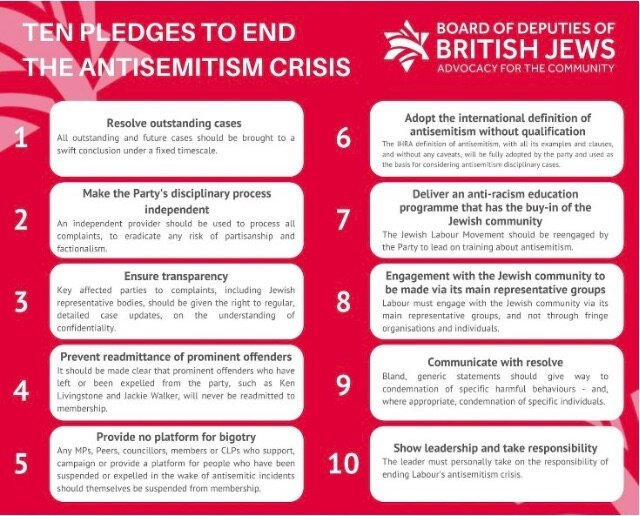
(1) Resolve outstanding cases – All outstanding and future cases should be brought to a swift conclusion under a fixed timescale.
- Absolutely.
(2) Make the Party’s disciplinary process independent – An independent provider should be used to process all complaints, to eradicate any risk of partisanship and factionalism.
- Of course.
(3) Ensure transparency – Key affected parties to complaints, including Jewish representative bodies, should be given the right to regular, detailed case updates, on the understanding of confidentiality.
- Except that complainers, including the BoD, have a poor record of keeping even their wildest allegations confidential.
(4) Prevent readmittance of prominent offenders – It should be made clear that prominent offenders who have left or been expelled from the party, such as Ken Livingstone and Jackie Walker, will never be readmitted to membership.
- It is not clear from the evidence that Livingstone or Jackie Walker committed an offence. They were hounded out and not, I think, by any independent arbitrator.
(5) Communicate with resolve – Bland, generic statements should give way to condemnation of specific harmful behaviours – and, where appropriate, condemnation of specific individuals.
- This should apply also to false accusers and to the BoD themselves if failing to condemn the “harmful behaviours” of their brethren in the Israeli regime towards our sisters and brothers in Palestine.
(6) Provide no platform for bigotry – Any MPs, Peers, councillors, members or CLPs [local parties] who support, campaign or provide a platform for people who have been suspended or expelled in the wake of antisemitic incidents should themselves be suspended from membership.
- Unacceptable. Many have been suspended for no good reason. And suspension does not mean guilt.
(7) Adopt the international definition of antisemitism without qualification – The IHRA definition of antisemitism, with all its examples and clauses, and without any caveats, will be fully adopted by the party and used as the basis for considering antisemitism disciplinary cases.
- How many times must you be told that the IHRA definition of anti-Semitism is a minefield? Top legal opinion (for example Hugh Tomlinson QC, Sir Stephen Sedley and Geoffrey Robertson QC) warn that it is “most unsatisfactory”, has no legal force, and using it to punish could be unlawful. Furthermore it cuts across the right of free expression enshrined in UK domestic law and underpinned by Article 19 of the Universal Declaration of Human Rights which bestows on everyone “the right to freedom of opinion and expression; this right includes freedom to hold opinions without interference and to seek, receive and impart information and ideas through any media and regardless of frontiers”. This applies not only to information or ideas that are regarded as inoffensive, but also to those that “offend, shock or disturb the State or any sector of the population”. Labour Party members should know all this. The prohibitive IHRA definition is not something a sane organisation would incorporate into its Code of Conduct.
(8) Deliver an anti-racism education programme that has the buy-in of the Jewish community – The Jewish Labour Movement should be reengaged by the Party to lead on training about antisemitism.
- The BoD and JLM would do better teaching anti-racism to the Israeli regime and its supporters. Besides, MPs and councillors don’t ‘belong’ to the Labour Party or any other party; they belong to the public who elected them as their representative. No outside body should expect to influence their freedom of thought, expression or action (see the Seven Principles of Public Life).
(9) Engagement with the Jewish community to be made via its main representative groups – Labour must engage with the Jewish community via its main representative groups, and not through fringe organisations and individuals.
- Labour should engage with the Jewish community though any representative organisation or individual it pleases.
(10) Show leadership and take responsibility – The leader must personally take on the responsibility of ending Labour’s antisemitism crisis.
- There’s no agreement that anything approaching a crisis exists within the Party.
Leadership front-runner Starmer is a former human rights lawyer and ought to know better. Long-Bailey is another lawyer who should hang her head in shame. Thornberry is a former barrister specialising in human rights law – words fail. Jess Phillips, a member of Labour Friends of Israel, wrote Truth to Power: 7 Ways to Call Time on B.S., described as “the little book we all need to help us call time on the seemingly unstoppable tide of bullshit in our lives”. The irony of it seems lost on her. Lisa Nandy is a puzzle as she’s chair of Labour Friends of Palestine.
If this bunch won’t robustly uphold freedom of expression guaranteed by law and international convention what have they let their hapless party in for? Those standing for deputy-leader also have little excuse. Angela Rayner was shadow education secretary, Ian Murray read Social Policy and Law, and Rosena Allin-Khan is a Muslim and former humanitarian aid doctor. They obediently signed the Ten Pledges. Dawn Butler and Richard Burgon declined.
When, a year ago, the French Republic presented its Human Rights Award to B’Tselem (the Israeli human rights group) its Executive Director Hagai El-Ad, thanking the National Consultative Commission on Human Rights, said of Israel’s behaviour towards the Palestinians: “The occupation…. is organized, prolonged state violence which brings about dispossession, killings, and oppression. All branches of the state are part of it: ministers and judges, officers and planners, parliamentarians and bureaucrats.”
On another occasion B’Tselem said: “If the international community does not come to its senses and force Israel to abide by the rules that are binding to every state in the world, it will pull the rug out from under the global effort to protect human rights in the post-WWII era.”
When a respected Israeli organisation speaks truth in such stark terms it cannot be ignored. And recent UN reports confirm that the Israelis abuse and torture child prisoners. So why would anyone – especially those competing to be Labour Party leader and one day prime minister – agree to dance to the tune of those who pimp and lobby on Israel’s behalf?
Who will punish the false accusers?
The BoD nevertheless make some valid points. The Labour Party takes a ridiculously long time to deal with allegations of anti-Semitism, many of which are false or vexatious and could be dismissed in five minutes. Let me tell you about two Scottish Labour politicians wrongly accused of anti-Semitic remarks and suspended. Let’s call them ‘A’ and ‘B’. Both are regional councillors.
Constituency party officials declared ‘A’ guilty immediately and issued a press statement to that effect without waiting for him to be heard, hugely prejudicing any investigation. This stupidity was compounded by his Council leader publicly calling on him to resign as a councillor and saying his thinking belonged to the Dark Ages: “To smear an entire community both past and present, to say he has lost ‘all empathy’ for them is utterly deplorable,” he was quoted in the press.
What was ‘A’s crime? He had tweeted: “For almost all my adult life I have had the utmost respect and empathy for the Jewish community and their historic suffering. No longer, due to what they and their Blairite plotters are doing to my party and the long suffering people of Britain…” Was nobody in the local party aware that the Jewish Leadership Council and the Board of Deputies were then leading an obnoxious campaign to discredit Labour and Jeremy Corbyn?
‘B’, a respected lady councillor, was accused of anti-Semitism by a former Labour MP who was already on record as wanting to impose limits on freedom of expression. A Tory MP immediately put the boot in, telling the media it was clear to the vast majority of people that ‘B’ was no longer fit to hold office and suspension didn’t go far enough.
And what was ‘B’s crime? She had voiced suspicion on social media that Israeli spies might be plotting to get rid of Jeremy Corbyn as Labour leader after three Jewish newspapers ganged up to publish a joint front page warning that a Corbyn-led government would pose an “existential threat to Jewish life in this country”.
She added that if it was a Mossad assisted campaign to prevent the election of a Labour Government (which pledged to recognise Palestinian statehood) it amounted to an unwarranted interference in our democracy. For good measure she said Israel was a racist State and, since the Palestinians are also Semites, an anti-Semitic one.
‘B’ was eventually interviewed by party investigators. They surely knew that in January 2017 a senior political officer at the Israeli embassy in London, Shai Masot, had plotted with stooges among British MPs and other activists to “take down” senior government figures including Boris Johnson’s deputy at the Foreign Office, Sir Alan Duncan. And that Mark Regev, Netanyahu’s former chief spokesman and mastermind behind Israel’s propaganda programme of disinformation, had recently arrived in London as the new ambassador.
Masot was almost certainly a Mossad tool. His hostile scheming was revealed not by Britain’s own security services and media, as one would have hoped, but by an Al Jazeera undercover team. Our Government dismissed the matter saying: “The UK has a strong relationship with Israel and we consider the matter closed.” But at a Labour Party conference fringe meeting Israel insider Miko Peled warned that “they are going to pull all the stops, they are going to smear, they are going to try anything they can to stop Corbyn…. the reason anti-Semitism is used is because they [the Israelis] have no argument….”
Given such a blatant attempt by an Israeli asset to undermine British democracy, with Regev in the background and (quite probably) Mossad pulling the strings, ‘B’s suspicions were reasonable enough and she had a right to voice them.
As for Israel being a racist State, its ethnic cleansing of the Palestinians and other brutal policies over 70 years make it obvious. And the discriminatory Nation State laws recently adopted by Israel put the question beyond doubt. Her point about anti-Semitism was also well made. DNA research (see for example the Johns Hopkins University study published by Oxford University Press) shows that while very few Jews are Semitic most indigenous Arabs in the Holy Land, especially Palestinians, are Semites. The term ‘anti-Semitism’, long used to describe hatred of Jews, is a misnomer that hides an inconvenient truth.
And it couldn’t have been difficult to establish that the opportunistic Tory MP calling her unfit to hold office was the chairman of the All-Party Parliamentary Group on British Jews, which is funded, supported and administered by The Board of Deputies. The case against ‘B’ should have been dropped instantly and action taken against the troublemakers. Instead, weeks later, ‘B’ was posting on her Facebook page that she was still suspended: “I can’t make any decisions about my personal, political, or professional future whilst this hangs over me. I am constantly tired and anxious, and feel I am making mistakes. I have lost paid work because of what has happened.”
Her suspension was finally lifted but she was “advised” not to post about it or she’d risk losing professional work on which her livelihood depended. That’s how nasty the Labour Party disciplinary machine is. Surely, if the Party lifts a suspension it should issue a public statement saying so. Must the wrongly accused, after being needlessly humiliated, be left to pick up the pieces and struggle to re-establish their good name? In total ‘B’ had to wait 16 weeks under sentence. And all because of a trumped-up allegation that ought to have been immediately squashed.
As for ‘A’, he stopped answering emails and there has been nothing in the press. Was his suspension lifted? Was he similarly threatened if he said anything? I simply don’t know although I phoned and wrote to the Leader and the General Secretary for an explanation. The latter eventually replied that “the Labour Party cannot, and does not, share personal details about individual party members” and placing a member in administrative suspension “allows a process of investigation to be carried out whilst protecting the reputation of the Labour Party”. Bollox. How did the media get news of these suspensions in the first place? And never mind the damage done to the cowardly Party, what about the reputations of the two councillors and their months of anguish while working for their constituents? I wasn’t asking for case details. All I wanted was the answer to three simple questions:
# Had the suspensions been lifted?
# If so, had the Party issued a public statement to that effect?
# And had the false accusers been disciplined?
Silence… spineless, don’t-give-a-damn silence.
Are these two cases typical of the so-called anti-Semitism crisis? I have no way of knowing. But they show how the Party is run by enough crackpots on the inside without inviting impertinent interference from the outside.
Jews’ Ten Pledges vs Palestinians’ Eleven Red Lines
Anyone signing up to the BoD’s Ten Pledges should consider at the same time subscribing to the ‘Eleven Red Lines’ of anti-Palestinianism. Examples in public life, the media, schools, the workplace, and in the religious sphere could, taking into account the overall context, include, but are not limited to:
(1) Denying the Palestinian people their right to self-determination and nationhood, or actively conspiring to prevent the exercise of this right.
(2) Denial that Israel is in breach of international law in its continued occupation of Gaza, the West Bank and East Jerusalem.
(3) Denial that Israel is an apartheid state according to the definition of the International Convention on Apartheid.
(4) Denial of the expulsion of 750,000 Palestinians during the 1948 Nakba and of their right, and the right of their descendants, to return to their homeland.
(5) Denial that Palestinians have lived for hundreds of years in land now occupied by Israelis and have their own distinctive national identity and culture.
(6) Denial that the laws and policies which discriminate against Palestinian citizens of Israel (such as the recently passed Nation State Law) are inherently racist.
(7) Denial that there is widespread discrimination against Palestinians in Israel and the Occupied Territories in matters of employment, housing, justice, education, water supply, etc, etc.
(8) Tolerating the killing or harming of Palestinians by violent settlers in the name of an extremist view of religion.
(9) Making mendacious, dehumanizing, demonizing, or stereotypical allegations about Palestinians — such as, especially but not exclusively, the myth of a Palestinian conspiracy to wipe Israel off the map.
(10) Justifying the collective punishment of Palestinians (prohibited under the Geneva Convention) in response to the acts of individuals or groups.
(11) Accusing the Palestinians as a people, of encouraging the Holocaust.
This working definition of anti-Palestinian racism, described as “hatred towards or prejudice against Palestinians as Palestinians”, holds up a mirror to the IHRA definition of anti-Semitism and was drafted by Jewish Voice For Labour, one of those fringe representative organisations the BoD insist Labour mustn’t engage with.
So here’s a simple test for the BoD: if they demand the Labour Party signs up to their Ten Pledges will they themselves embrace the Eleven Red Lines on anti-Palestinianism?
US misinforming international community on Iran’s enrichment right: Russia
Press TV – January 21, 2020
Russia has accused the US of misleading the international community on Iran’s right to enrich uranium, describing as “myth-making” a claim by Washington that a UN Security Council resolution has banned any enrichment in Iran.
“We consider it necessary to respond to the US special representative for Iran Hook about the existence of some kind of ‘UN standard’ prohibiting the Islamic Republic of Iran from enriching uranium,” the Russian Foreign Ministry said Monday.
The statement said the US claim accuses the UN Security Council of contradicting the nuclear non-proliferation treaty.
“Unfortunately, such myth-making has long been part of the US approach toward nuclear non-proliferation … In this case, we have, essentially, an accusation against the UN Security Council of making decisions contradicting the Treaty on the Non-Proliferation of Nuclear Weapons (NPT),” the ministry added.
The statement also recalled that the aforementioned treaty allows the signatories to develop nuclear energy for non-military purposes.
It also noted that the NPT does not impose any restrictions on non-nuclear states in terms of uranium enrichment as long as they are under the IAEA control and pursue peaceful purposes.
“The NPT puts no limitations on the non-nuclear countries regarding uranium enrichment or developing other stages of the nuclear fuel cycle. There is only one condition: that all work must be directed toward peaceful ends and be under IAEA [International Atomic Energy Agency ] supervision,” the ministry noted.
The statement came after US Special Representative for Iran Brian Hook told journalists on Friday about an alleged UN resolution passed in 2006 or 2007 prohibiting Tehran from uranium enrichment.
In 2015, Iran signed the Joint Comprehensive Plan of Action (JCPOA) with China, France, Germany, Russia, the United Kingdom, the United States, Germany, and the European Union. The JCPOA required Iran to put certain limits on its nuclear program in exchange for sanctions relief.
In 2018, the United States abandoned the deal with Iran, and hit the Iranian economy with the “toughest sanctions ever”.
On 8 May 2019, the first anniversary of the United States’ unilateral withdrawal from the agreement, Iran announced a gradual reduction of its JCPOA obligations.
On 5 January, following the killing of Iran’s top military commander Qasem Soleimani in a US attack near the Baghdad International Airport, Tehran said it was rolling back all its commitments under the JCPOA.
In reaction to Iran’s move, European parties to the deal, which have failed to fulfill their commitments under the JCPOA, have threatened to take Iran’s nuclear issue to the UN Security Council.
The E3 (Germany, UK, and France) formally triggered the dispute mechanism within the agreement, accusing Iran of having violated the accord. Iran would now be asked to resolve the so-called dispute with the European trio, and the process could ultimately lead to the re-imposition of the Security Council’s sanctions that were lifted by the accord.
In reaction to the threat, Iran’s Foreign Minister Mohammad Javad Zarif on Monday said that if Britain, France, and Germany continue their unjustifiable conduct and move to send Iran’s nuclear case to the United Nations Security Council, Tehran would have the option of leaving the Nuclear Non-Proliferation Treaty (NPT).
Zarif explained that Iran was the party to initially trigger the dispute mechanism in 2018 by sending three letters to the European Union to notify them of Tehran’s dissatisfaction with Europe’s non-commitment to the agreement. The Islamic Republic, he added, was then forced to resort to the nuclear countermeasures as the Europeans remained in violation of the accord.
He, however, said Tehran’s measures were reversible provided Europe would begin minding its JCPOA obligations.
E3 cannot logically activate JCPOA dispute settlement mechanism: Iran Deputy FM
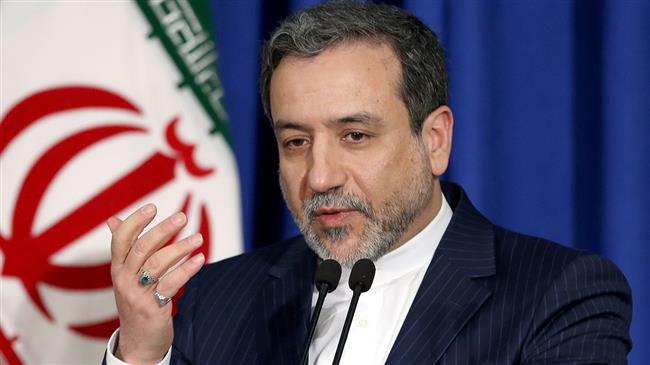
Iran’s Deputy Foreign Minister for Political Affairs Abbas Araqchi
Press TV – January 19, 2020
Iran’s Deputy Foreign Minister for Political Affairs Abbas says the three European signatories to Iran nuclear deal, formally known as the Joint Comprehensive Plan of Action (JCPOA), cannot logically activate the deal’s dispute settlement mechanism, because Iran has already done that.
“We are now engaged in complicated legal discussions and Russia and China are of the same opinion. It was Iran that first resorted to Article 36 [of the JCPOA] and completed its application. Therefore, logically, legally and even politically speaking, the European countries cannot take advantage of this article, because we have already done that and applied its mechanism in full,” Araqchi said while addressing a meeting at the Iranian Foreign Ministry’s School of International Relation on Sunday.
On January 14, the three European signatories to the Iran deal — France, Britain and Germany — formally triggered the dispute mechanism, which accuses Iran of violating the agreement and could lead to the restoration of the anti-Iran UN sanctions that had been lifted by the JCPOA.
Under the mechanism outlined in the deal, the EU would also inform the other parties — Russia and China as well as Iran itself. There would then be 15 days to resolve the differences through the JCPOA Joint Commission. If no settlement is reached through the commission, the foreign ministers of involved countries will then discuss them for another 15 days. In case of need, an advisory board will be formed to help foreign ministers.
Elsewhere in his remarks, Iran’s deputy foreign minister said, the recent measure taken by three European countries is only aimed at dispute settlement and has nothing to do with restoration of UN sanctions against Tehran.
“The trigger mechanism, which may lead to restoration of the United Nations Security Council’s sanctions against Iran has not been started by the three countries,” Araqchi noted.
“They have only resorted to the dispute settlement mechanism as per Article 36 of the deal, while the trigger mechanism is enshrined in Article 37. Article 36 does not automatically lead to Article 37, though it can pave the way for its application,” the top Iranian diplomat added.
The US withdrew from the accord in 2018 and re-imposed its unilateral sanctions on Iran last May. Britain, France, and Germany, under Washington’s pressure, failed to protect Tehran’s business interests under the deal against the American bans.
This May, Iran began to gradually reduce its commitments under the JCPOA to both retaliate for Washington’s departure, and trigger the European trio to respect their obligations towards Tehran.
On January 5, Iran took a final step in reducing its commitments, and said it would no longer observe any operational limitations on its nuclear industry, whether concerning the capacity and level of uranium enrichment, the volume of stockpiled uranium or research and development.
Iranian Foreign Minister Mohammad Javad Zarif has denounced as a “strategic mistake” the European Union’s decision to activate the dispute mechanism, taking them to task for failing to abide by their commitments under the JCPOA, and saying that activating the dispute resolution mechanism is legally baseless and politically a strategic blunder.
Britain, France reiterate commitment to JCPOA
In another development on Sunday, British Prime Minister Boris Johnson and French President Emmanuel Macron reiterated their commitment to the Iran nuclear deal and agreed that “a long-term framework” was needed, a Downing Street spokeswoman said.
In a statement after a meeting between Johnson and Macron on the sidelines of a Libya summit in Berlin, the spokeswoman said, “On Iran, the leaders reiterated their commitment to the JCPOA.”
“They agreed on the importance of de-escalation and of working with international partners to find a diplomatic way through the current tensions,” he added.
Iran to Review Cooperation with Int’l Nuclear Watchdog In Case of ‘Unjust’ Steps by EU – Reports
Sputnik – 19.01.2020
The European parties to the Iranian nuclear deal earlier launched a dispute resolution mechanism under the agreement, a process that could entail the re-imposition of sanctions on Iran.
Iran’s cooperation with the International Atomic Energy Agency will be reviewed if the EU nations take “unjust” measures after triggering the nuclear deal’s dispute mechanism, Iran’s parliamentary speaker was quoted by the local TV as saying.
“We state openly that if the European powers, for any reason, adopt an unfair approach in using the dispute mechanism, we will seriously reconsider our cooperation with the International Atomic Energy Agency”, a local broadcaster quoted Iranian Parliamentary Speaker Ali Larijani as saying.
On Tuesday, three of the signatories to the JCPOA, namely France, the UK, and Germany, confirmed that they had initiated a dispute mechanism that could see the sanctions against Iran reinstated. The move comes amid Iran’s gradual scale-back on its commitments under the deal, prompted by the US unilateral withdrawal from it in 2018.
Iran’s foreign minister previously condemned the three nations for dancing to the tune of the US. President Trump reportedly threatened the European nations with imposing tariffs on them for their lack of action against Tehran.
Iran recently scrapped its remaining limitations under the JCPOA following the assassination of its top military commander Qasem Soleimani in a US drone strike on 3 January. Tehran has been gradually reducing its commitments under the JCPOA since May 2019 following Washington’s unilateral pullout of the treaty one year earlier and imposition of energy and banking sanctions on the state.
Keeping with its Crackdown on Alternative Voices, Google Deletes Press TV from YouTube
By Alan Macleod | MintPress News | January 15, 2020
Without warning, tech giant Google “permanently removed” Iranian government-owned media channel Press TV UK’s YouTube channel Monday night amid increasing American hostility to Iran.
“This attack on the freedom of speech of Press TV’s journalists seems to be part of an anti-Iran purge as the West sets its sights on regime change in Iran,” Press TV said. Its content, in its own words, focuses on “anti-imperialism, anti-racism, and covers aspects of the news which the mainstream corporate media in the United Kingdom have refused to air.”
The London-based outlet had over 28,000 subscribers on its YouTube account at the time of its deletion.
British-Sudanese journalist Ahmed Kaballo accused Google of acting like the “judge jury and executioner” for his employer’s channel, expressing his great disappointment that his journalistic output is now gone and his worry at “what this really represents” for alternative media that “show a different perspective and holds a critical lens” on war and empire.
MintPress News reached out to Kaballo for comment. “The actions of Google in the last 24 hours has made me lose hope in the idea of free press and free speech,” he said. “Journalism is about pushing the boundaries and being fearless in our reporting but in this climate where they can do this to us in this fashion, it’s clear that our perspective. which is overtly anti-imperialist, is, in the eyes of Google, simply not allowed.”
After online pushback, by Wednesday morning UK time, Google had reversed its decision. However, just as Press TV was celebrating its reinstatement, it was again taken off the air. YouTube sent a message to Press TV UK claiming that they had received a complaint about the channel and decided that it violates their terms of service. Kaballo described the political hokey pokey his organization was under as “psychological warfare.”
Press TV says the move is “part of an anti-Iran purge as the West sets its sights on regime change in Iran.” It comes in the context of the Trump administration’s assassination of Lt. General Qassem Soleimani January 3, while he was in Iraq attending peace talks. In response, Iran launched dozens of ballistic missiles at U.S.-occupied military bases in Iraq, although it was careful to warn the U.S. of the attack beforehand. As a result, there were no deaths. The Iraqi parliament also immediately voted to expel all American troops from the country. However, the U.S. refused to leave.
While the threat of a hot war with the Iran appears to have subsided, an intense, online propaganda war rages between the two countries. During his funeral, the hashtag #IraniansDetestSoleimani trended across American Twitter. But analysis showed that it was not Iranians, but organized Trump supporters who were boosting the message, supporting, as 47 percent of Americans did, their president’s decision to kill him.
Last Friday, Facebook announced that it felt compelled to delete all positive posts about the deceased general from its platform and its subsidiary Instagram. “We operate under U.S. sanctions laws, including those related to the U.S. government’s designation of the Iranian Revolutionary Guard Corps (IRGC) and its leadership,” it said, explaining that Trump’s new sanctions made supporting Iran online on any American website essentially illegal. Instagram had already closed Soleimani’s account in April last year, following Trump’s designation of the IRGC as a terrorist group. Just after Facebook’s decision, Twitter suspended Ayatollah Khamenei’s account for “unusual activity.” Instagram is extremely popular in Iran, with around one in three people owning an account, almost as popular as Soleimani, who over 80 percent view positively or very positively. Thus, the U.S. government has, through pressuring monopolistic Silicon Valley giants, effectively banned a majority opinion being shared by Iranians to Iranians, in Iran.
This is not the first occasion that the U.S. government has used the American monopoly over the means of communication online to shut down alternative voices from other countries. Facebook has previously de-platformed Venezuela-based outlets TeleSUR English and Venezuelanalysis, both of which offered differing opinions and analysis of the U.S. government’s actions in Venezuela and Latin America. Meanwhile, the Trump administration has forced RT journalists to register as “foreign agents,” under a rule originally set up to deal with Nazis during World War Two.
Press TV, too, has had a history of poor treatment at the hands of the U.S. state. In January last year, the FBI illegally detained Press TV anchor Marzieh Hashemi for ten days. She was never charged and was deprived of Halal food and a hijab during her detention. While the network is still reachable directly on its website, the fact that the U.S. government can unilaterally decide what the world sees, hears or reads, zapping British based Iranian networks from universal social media giants the entire world uses raises questions about freedom of information in the digital age.
UK’s Lord Polak says new Tory government is opportunity for pro-Israel lobbyists
![Stuart Polak, Baron Polak CBE is a British Conservative politician and member of the House of Lords [Youtube]](https://i1.wp.com/www.middleeastmonitor.com/wp-content/uploads/2020/01/POLK.png?resize=1200%2C800&quality=85&strip=all&ssl=1)
Stuart Polak, Baron Polak CBE is a British Conservative politician and member of the House of Lords [Youtube]
MEMO | January 15, 2020
A veteran pro-Israel lobbyist in Westminster believes the recently-elected Conservative government represents an important opportunity to advance Israel’s interests amongst British decision-makers.
Lord Polak, a Tory peer, and president of Conservative Friends of Israel, was speaking to right-wing news outlet JNS days after a speech in the House of Lords in which he attacked the so-called “singling out” of Israel in international forums such as the United Nations.
“I have no problem with legitimate criticism where it is due, but this obsession with Israel needs to be addressed. This singling out of the Jewish state is wrong, unjustified and plays a role in the rise and rise of anti-Semitism,” Polak told the chamber on 7 January.
In his speech, Polak echoed a familiar complaint of the Israeli government, namely the payments made by the Palestinian Authority (PA) to prisoners in Israeli jails and to the families of those killed by occupation forces – what the Tory peer described as “salaries to killers and murderers”.
“We must find a method by which aid payments serve the recipients who need our support in Palestinian society, and at the same time, serve the interests of the British taxpayer,” he added.
In his subsequent interview with JNS, Polak claimed that the substantial Conservative majority in Parliament means that now is the time to raise the issues they want and “set an agenda”.
“My speech was signal that this is a priority for the pro-Israel community,” he told the news site.
During the speech, Polak also praised the government’s proposed legislation attacking the right to boycott companies complicit in Israeli human rights abuses.
“The promise by the government to legislate against BDS [Boycott, Divestment, Sanctions] was a first and shows where the new government is at in relation to these sorts of issues,” he told JNS.
How Europe betrayed Iran: By triggering JCPOA dispute mechanism, EU helps Trump finish job of killing the Iran nuclear deal
By Scott Ritter | RT | January 15, 2020
Europe could have saved the Iran nuclear agreement. Instead, it abused the rule of law by inappropriately triggering its dispute mechanism, all but ensuring the agreement’s demise.
Disingenuous diplomacy
On January 5, 2020, Tehran announced that it would no longer comply with its obligations under the Iran nuclear agreement, officially known as the Joint Comprehensive Program of Action (JCPOA). Iran’s actions are in response to the withdrawal of the US from the JCPOA, and the re-imposition of economic sanctions by the US which had been lifted when the deal came into force.
In response to the Iranian actions, the governments of France, Germany, and the UK – all parties to the deal, along with the European Union (EU) – invoked provisions within the JCPOA, known as the Dispute Resolution Mechanism (DRM), in an effort to bring Iran back into compliance.
The triggering of the DRM by the European countries, however, is a disingenuous move designed to provide diplomatic cover for the EU’s own failures when it comes to JCPOA implementation.
Moreover, given the likely outcome of this process, a convening of the UN Security Council where economic sanctions will be re-imposed on Iran by default, the Europeans have all but assured the demise of the JCPOA, with their so-called diplomacy serving as little more than a facilitator of a larger crisis between Iran and the US that, given the heightened tensions between these two nations in the aftermath of the assassination of Qassem Soleimani, precipitously increases the prospects for war.
Big powers always had an easy way out of deal
When the JCPOA was finalized in July 2015, the world was given hope that the crisis over Iran’s nuclear enrichment capability, which had been threatening to boil over into war, had been resolved, and diplomacy had prevailed over armed conflict.
The JCPOA codified a number of restrictions on Iran’s ability to enrich uranium, including the numbers and types of centrifuges that could be used, where enrichment could take place, what level of enrichment could occur, and how large of a stockpile of enriched nuclear material Iran was allowed to maintain, and an intrusive comprehensive inspection regime designed to verify Iran’s compliance.
These restrictions were designed to ease over time through a series of so-called “sunset clauses,” until all that remained was an enhanced inspection process. In short, the JCPOA legitimized Iran’s right to enrich uranium for peaceful purposes while simultaneously recognizing the concerns of some within the international community regarding the potential for Iran to abuse this enrichment capability for military purposes.
The JCPOA was, in effect, a comprehensive confidence building mechanism intended to build trust between Iran and the international community over time, consistent with the agreement’s preamble, which declared “Iran reaffirms that under no circumstances will Iran ever seek, develop or acquire any nuclear weapons.”
Prior to the implementation of the JCPOA, Iran had been subjected to stringent economic sanctions levied under the authority of the UN Security Council. In exchange for entering into the agreement, these sanctions were lifted.
However, the deal recognized that disputes could emerge regarding the implementation of the agreement, and put in place a dispute resolution mechanism which, if no satisfactory solution was found to an identified problem, would result in these sanctions being automatically re-imposed.
A key aspect of this mechanism was that if any party to the agreement used its veto in the UN Security Council to block a vote related to nonperformance on the part of any party to the agreement, then the economic sanctions would automatically be reinstated.
Washington sabotages JCPOA
For the first two-plus years of the deal’s existence, from July 2015 through to May 2018, Iran was found to be in full compliance with its commitments.
In May 2018, however, the US precipitously withdrew from the agreement, claiming that the eventual expiration of the “sunset clauses” paved the way for Iran to produce a nuclear weapon, and as such the JCPOA was little more than a facilitator of Iranian nuclear malign intent.
The US began re-imposing economic sanctions on Iran, all of which included so-called secondary sanctions which applied to any nation that violated the US sanctions. Iran rightfully viewed the re-imposition of sanctions by the US as a violation of the deal.
Furthermore, when EU companies began balking on their willingness to do business with Iran out of fear of US secondary sanctions, Iran rightfully found the EU to be in violation of the JCPOA as well.
Iran gave the remaining parties to the JCPOA six months following the US withdrawal to develop the necessary mechanisms needed to sidestep the impact of the US economic sanctions.
By November 2018, however, no such mechanisms had been implemented, and when the US targeted Iran’s economic lifeblood by sanctioning oil sales, Iran responded by invoking its rights under Article 26 and Article 36 of the JCPOA, which allows Iran to “cease performing its commitments under the JCPOA, in whole or in part”, for either the re-imposition of new nuclear-related sanctions, or “significant nonperformance” of obligations under the JCPOA, or in this case, both.
Since that time, Iran has been gradually stepping away from the restrictions imposed on it, noting each time that its measures were immediately reversible should the underlying issues be resolved in a manner that complied with the letter and intent of the JCPOA.
Europe’s cowardice
In short, Iran demanded that the EU live up to its obligations to stand up to the US economic sanctions. The EU has consistently failed to do so, resulting in Iran’s gradual backing away from its obligations, leading to the current state of affairs where all of the restrictions imposed by the JCPOA, not including international inspections, which continue unabated, have ceased to be in operation.
When it comes to levying fault for the current state of affairs, there is no “chicken or egg” causality up for debate. Blame lies squarely on both the US for withdrawing from the deal, and the EU for failing to live up to its obligations under the JCPOA regarding economic engagement with Iran.
Iran has long warned the governments of France, Germany, and the UK not to invoke the DRM, noting that the JCPOA does not permit such a move if, as is the case today, Iran is exercising its legal right in response to the illegal and unilateral actions of the US.
There is no realistic expectation that Iran will change its position in this regard. Russia and China have already indicated that Iran is fully within its rights within the JCPOA to back off its obligations regarding restrictions imposed on its nuclear program, citing US and EU non-performance.
By invoking the DRM, the Europeans have, knowingly and wittingly, initiated a process that can only have one outcome, the termination of the JCPOA. In doing so, the EU has breathed life into unfounded US allegations of Iranian nuclear weapons intent, setting up an inevitable clash between the Washington and Tehran that has the real potential of dragging the whole world down with it.
Scott Ritter is a former US Marine Corps intelligence officer. He served in the Soviet Union as an inspector implementing the INF Treaty, in General Schwarzkopf’s staff during the Gulf War, and from 1991-1998 as a UN weapons inspector.
The Labour Partly
By Gilad Atzmon | January 15, 2020
Historically, a popular coup against an opposition party is rare. In the last General Election Corbyn’s Labour provided us with just such an exceptional spectacle.
Labour managed to alienate its voters. Its leader turned his back on its strongest allies including, among others, Ken Livingstone and Chris Williamson. For some reason Corbyn’s Labour turned itself into an Orwellian authoritarian apparatus; it even dug into its members’ social media accounts picking out ‘dirt’ (human right’s concerns) in order to appease one distinctive foreign lobby.
The Brits saw it all, how dangerous the party became. Many former ardent Labour supporters angrily rejected their political home. They may never return.
The conduct of the contenders for Labour’s leadership in the last few days reveals that the Brits were spot on in humiliating their opposition party.
At the moment, Labour’s leadership candidates are, without exception, competing amongst themselves to see who goes the lowest in pledging allegiance to a Lobby associated with a foreign state that is currently under investigation by the International Criminal Court (ICC) for committing crimes against humanity.
Yesterday I discussed the topic with the Great Richie Allen (from about 20/24 min/sec) :
Leadership contender Emily Thornberry is apparently on her “hands and knees… asking for forgiveness.” And she is not the only one. The Zionist Times of Israel’s headlines yesterday revealed that the top candidates for Labour leadership have all vowed to lead the fight against anti-Semitism. “Keir Starmer backs automatic expulsion for offenders; Rebecca Long-Bailey: Corbyn bears personal responsibility for crisis; Jess Phillips suspends aide over anti-Semitic tweets.”
On BBC Radio, front runner Keir Starmer said, “We should have done more on anti-Semitism.” I wonder, what did Starmer mean by that? What is the next step after thought policing and spying on party members? Re-education centres? Indoctrination facilities? Hypnosis or maybe physiological treatment or perhaps lobotomy for those who dare to tell the truth about Israel and its Lobby?
Meanwhile, the Mail on Sunday reported that leadership contender, Jess Phillips, had on Friday suspended an aide who equated the Jewish State with the Islamic one.
Two days ago we learned that Zionist pressure on the Labour party isn’t fading away. The Board of Deputies of British Jews (BOD) published its demands of the candidates for Labour’s leadership. The ultra Zionist Jewish Chronicle wrote “The Board of Deputies has demanded each of Labour’s candidates for leader and deputy leader sign up to its 10 ‘pledges’ in order to ‘begin healing its relationship with the Jewish community’…”
Predictably, the demands made by the BOD do not accord with Western and Christian values of pluralism and tolerance. The BOD demands that contenders ‘pledge’ to “prevent re-admittance of prominent offenders.” One may wonder what about forgiveness and compassion, are those fundamental Western values foreign to our Labour leadership candidates?
The BOD insists that leadership contenders pledge to “provide no platform for those who have been suspended or expelled for antisemitism.” What about freedom of speech and free debate? Are those also alien to Labour’s future leaders?
The new Labour leader is expected to support the bizarre idea that the Zionist Jewish Labour Movement will grant the kosher certificate for its “anti racism education program.” I thought to myself that if the Jewish Labour Movement is so good in ‘anti racism education,’ maybe, and before anything else, it should contribute towards the cleansing of racism in Israel.
The fact that a Jewish organisation such as the BOD is so bold as to publish such ludicrous demands from a British national party is no surprise. The bizarre development here is that Labour’s leadership candidates are engaged in an undignified battle to gain the BOD’s support.
I am not critical of the Jewish Lobby and its orbit of Zionist pressure groups. Those bodies clearly accomplished their mission. But it is astonishing how dysfunctional the Labour party and its leadership are. The party can’t even draw the most elementary lesson from its recent electoral disaster.
Those who follow my work know that I have predicted the unfortunate downfall of Labour and the demise of the Left in general. The Left, as I have been arguing for a while, has failed to reinstate its relevance and authenticity. It is unfortunately dead in the water.
Non-commitment probe into Iran by France, Germany & UK ‘groundless,’ only increases tensions around nuclear deal – Russia
RT | January 14, 2020
The European trio’s accusation that Iran violates the key restrictions of the nuclear deal are unjustified, the Russian Foreign Ministry said urging the countries not to increase tensions that could endanger the pact.
Paris, Berlin and London officially reported Iran’s non-compliance with the 2015 agreement to the Joint Commission under the Dispute Resolution Mechanism. This step could potentially lead to the UN Security Council being forced to decide on whether or not to bring back sanctions against Tehran.
“We can’t rule out that the ill-considered actions of the European trio will lead to a new escalation around the JCPOA (Joint Comprehensive Plan of Action) and make the return to the implementation of the ‘nuclear deal’ in its initially agreed format unachievable,” Russia’s Foreign Ministry said in a statement.
Iran rolled back on its uranium enrichment constraints detailed in the international agreement earlier this month after one of its top military commanders, Qassem Soleimani, was assassinated in an American drone strike in Iraq.
Tehran’s decision to put its commitments on hold was a response to the actions of the US, which unilaterally withdrew from the deal in May 2018 and reintroduced restrictions against Iran, the ministry reminded. However, the country keeps allowing the International Atomic Energy Agency (IAEA) monitors to its nuclear sites – and “the transparency of the Iranian nuclear program has been one of the key clauses of the nuclear deal.”
Despite vocally rejecting the US campaign of “maximum pressure” on Iran, France, Germany and the UK are “either not ready or can’t afford to” work on finding effective ways of bypassing the hurdles to the deal created by Washington.
There are also “serious problems” with implementing the side of the deal on the part of the European trio, the ministry said. When all those issues are settled, “Iran would have no reason to retract from the initially agreed framework of the JCPOA.”
Western media coverage of Russia as an exercise in propaganda
By Gilbert Doctorow | January 12, 2020
The notion of “fake news” has entered our vocabulary as a pejorative term for dissemination of bogus information, usually by social media, sometimes by traditional print and electronic channels which happen to hold positions contradicting the tenets of our conventional wisdom, i.e., liberal democracy. The term has been applied to Russian state owned media such as RT to justify denying such outlets normal journalistic credentials and privileges.
In this essay, I will employ the more traditional term propaganda, which I take to mean the manipulation of information which may or may not be factually true in order to achieve objectives of denigrating rivals for influence and power in the world, and in particular for denigrating Russia and the “Putin regime.”
The working tools of such propaganda are
- tendentious determination of what constitutes news, which build on the inherent predisposition of journalism to feature the negative and omit the positive from daily reporting while they carry this predisposition to preposterous lengths
- the abandonment of journalism’s traditional “intermediation,” meaning provision of necessary context to make sense of the facts set out in the body of a news report. In this regard, the propagandistic journalist does not deliver the essential element of paid-for journalism which should distinguish it from free “fake news” on social media and on the internet more broadly
- silence, meaning under-reporting or zero reporting of inconvenient news which contradicts the conventional wisdom or might prompt the reader-viewer to think for himself or herself. As a colleague and comrade in arms, professor Steve Cohen of Princeton and NYU, has said in his latest book War with Russia? : the century old motto of The New York Times “All the news that’s fit to print” has in our day turned into “All the news that fits.”
Demonstrations of the arguments I present here could easily fill a book if not a library shelf. However, I think for purposes of this essay, it suffices to adduce several examples of the three violations of professional journalism giving us a constant stream of propaganda about Russia and its political leadership by offering a few reports drawn from the very cream of our print and electronic media. In particular, I have chosen as markers the Financial Times and the BBC. The use of propaganda methods in their coverage of Russia is all the more telling and damaging, given that in a great many domains these channels otherwise represent some of the highest quality standards to be found in reporting anywhere today and consequently enjoy the respect of their subscribers and visitors, who little suspect they could be so prejudicial in their coverage of select domains like Russia.
* * * *
As 2019 drew to a close, many of our media outlets drew attention to two Russia-related anniversaries: the just celebrated thirtieth anniversary of the fall of the Berlin Wall with the retreat of Soviet armed forces from Eastern Europe that it touched off; and the soon to be celebrated twentieth year of Vladimir Putin’s hold on power in the Kremlin. Both subjects may be fairly called news worthy and so fully correspond to traditional journalistic values. What has been exceptional and unacceptable has come in the second category of violations listed above – lack of context.
Starting in October 2019, the BBC’s Moscow correspondent Steve Rosenberg did several programs dedicated to the fall of the Berlin Wall. During the Christmas to New Year’s period, the BBC aired one program which consisted of two parts. In the first half, Rosenberg considered the impact of the withdrawal of Russian forces from East Germany on the Russians themselves and interviewed the former chief of those forces, who explained at length how they “came home” to shocking living conditions in the provinces, how they were abandoned to their fate by their own government. The tone of the reporting was sympathetic to Russians’ hardships and it was good that their side of the story from the ground up was given the microphone. What implied criticism there was of the powers that be came from a patriotic source. However, the second half of the program was turned over to a certain Lydia Shevtsova, a very outspoken Putin-hater, formerly with the Carnegie Center Moscow, till she was finally booted out and moved to a more congenial and supportive think tank, Chatham House, in London, where her anti-Russian vitriol is encouraged and disseminated by her co-author, ex-British ambassador to Moscow Sir Andrew Wood. Among the gem quotations which Shevtsova delivered was the claim that Russia under Putin is a declining power which is capable only of disrupting the world order, a spoiler not capable of any creative or productive contribution. Of course, Shevtsova has a right to her opinions, however the BBC had an obligation to its audience to explain exactly who the lady is and, if they wanted to practice fair play, to offer an alternative interpretation of what Vladimir Putin’s Russia stands for on the global stage today. They did not do either. The result was pure propaganda not news and analysis.
As for violations in the categories one and two above, a very good example arose following the recent publication of a study performed by the Levada Center public opinion polling organization in Moscow during October which showed that “53 per cent of 18-to-24 year-olds wanted to leave the country.” This was written about by many of our news peddlers, including FT. The decision to feature this factoid and use it to support claims that the Putin regime’ is a failure fits well with tendentiousness of our news coverage. Meanwhile, nearly all coverage of that study, including in the Financial Times, offered no contextual information whatsoever, when the context was begging to be told.
The article in FT which carried the Levada Center findings was published on 9 January as “Generation Putin: how young Russians view the only leader they’ve ever known.” The remarks on Levada followed directly on another statement begging for context: “Youth unemployment in Russia is more than three times the rate of the total population, according to 2018 data, compared with just twice the rate in 2000.”
First, as regards those 53% would-be “leavers,” one might ask: and so, why don’t they just leave? Russia today is truly a free country: anyone other than convicted felons who wants a passport can get it, and get it rather quickly. And thanks to the efforts of their remarkably hard-working Ministry of Foreign Affairs, most of the world welcomes Russian travelers without a visa requirement. But for that matter, getting a Schengen visa for the EU is not so complicated either.
However, those 53% are, in fact, not going anywhere. They are just sounding off about their youthful disgruntlement with a world created and run by their parents.
At the same time, as the Financial Times editorial board knows full well, young, middle-aged and even old have been leaving the Baltic States, Bulgaria, Romania and other former Soviet Bloc countries in droves, for the past thirty years up to the present day. That was the subject of an article published in the FT on the next day, 10 January 2020 under a title which speaks for itself: “Shrinking Europe.” The states I mentioned here have seen 25 and 30% loss of their population to citizens voting with their feet and departing the shrinking economies and personal prospects which result directly from deindustrialization and economic colonization by Germany and other founding Member States of the EU since 1991. The issue appears in the news now because, as the FT explains, “Andrej Plenkovic, the Croatian prime minister, has decided to elevate population decline to the top of his agenda as Zagreb assumes the EU’s rotating presidency.” Good for him! Now that the skeleton has finally come out of the EU closet, all the stories about Russia’s demographic crisis can be put in context – by those few who wish to do so.
Second, as regards unemployment in Russia today, I believe that similar ratios of youth unemployment to the general population unemployment can be found most everywhere in Western Europe if not in the world at large. The fact that this ratio has worsened comparatively in Russia since 2000 may be explained by the anomalous situation in Russia prevailing throughout the 1990s in step with the economic collapse that accompanied the transition to a market economy. Precisely the older generations, those over 40, were thrown into the street and their children or grandchildren were the first to be hired by the newly emerging industrial conglomerates, not to mention by Western multinationals settling in. What has happened since 2000 is merely a reversion to more normal distribution of employment and unemployment in the population as the Russian economy stabilizes.
Dear Reader!
For those who find my examples above too subtle to support my argument for egregious propagandistic treatment of Russia in our media, allow me to introduce violation number three, silence, in a way that should sweep away all objections to my thesis.
I draw your attention to an event that occurred in the past week about which you probably know nothing, or perhaps a wee bit from the odd man out reporting in the Wall Street Journal and a few other outlets. I am talking about the visit of Vladimir Putin to Damascus on Tuesday, 7 January. To their credit, the WSJ carried a short article in their 8 January edition, but went no further than to note this was the second visit by Putin since the Russians joined the fight in support of President Bashar Assad back in September 2015, turning the tide in the civil war his way. That is true, but only represents a tiny slice of what all our journalists, including the WSJ’s could have and possibly did learn from watching Russian state television on the 7th. What our media chose not to report was passed over in silence because it shows the complexity of Russia’s policy in the Middle East that includes but goes well outside the domain of pure geopolitics. This is so not least because of the date chosen for the visit, which happens to be Orthodox Christmas.
On the evening of the 6th, that is to say on Christmas eve, by the Russian Orthodox calendar, Russian state television broadcast live coverage of the Christmas service in the Christ the Savior cathedral in Moscow officiated by Patriarch Kirill, with prime minister Medvedev present on behalf of the Government. Then it cut to the service in St Petersburg, where Vladimir Putin sat in the congregation, as is his custom. The commentator mentioned in passing that the Patriarch’s father, a parish priest, just happened to be the one who baptized Vladimir Putin as a child where they all lived, in the Northern Capital.
The next coverage of Putin on state television was from Damascus on the 7th, where he obviously arrived on a night flight from Petersburg. I did not see video coverage [video coverage has now been posted] … But still photos and reports on state television informed us that Putin had not merely held talks with President Assad on the Russian military base outside the capital, but had strolled together with him down the streets of Damascus, had visited the main church in the (still existing) Christian quarter of the city, had presented to the Patriarch of Antioch an icon of the Virgin and had also gone on to visit the city’s oldest and largest mosque.
What you have here is precisely the second line of justification for Russian presence in Syria alongside military/geopolitical reasons: resuming Russia’s 19th century role as protector of the Orthodox population in the Holy Land and the broader Middle East. A similar role was exercised back then by France on behalf of the Catholic populations, but that since has been totally negated by rampant secularism and multiculturalism in Western Europe.
It also has to be said that Putin’s visit to Damascus was back-to-back with other very high visibility political statements: his visit to Istanbul on the 8th for the official opening of the TurkSteam gas pipeline and for lengthy talks with President Erdogan that ended in a joint statement calling for a truce in the Libyan civil war for which Russia and Turkey support opposing sides; and his visit on the 9th to Russian naval exercises in the Eastern Mediterranean that included the launch of Russia’s latest hypersonic missiles, the reality of which U.S. and other Western experts have yet to acknowledge.
With this I rest my case on the unfortunate propagandistic behavior of our media which deprive the broad Western public of any chance to make sense of the most dangerous military and political stand-off of our age.
©Gilbert Doctorow, 2020
Wallace sounds alarm bell on future UK-US defence ties
Press TV – January 12, 2020
Defence secretary, Ben Wallace, has warned that in future Britain may have to contemplate fighting wars without the United States.
In an interview with the Sunday Times, Wallace made the extraordinary claim that the prospect of the United States retreating from a global leadership role under Donald Trump keeps him “awake at night”.
In comments that is bound to raise eyebrows in defence circles around the world, Wallace claimed that the UK needs to “rethink” military assumptions in place since 2010, which have centred on close partnership with US armed forces.
The defence secretary said that the government should use the “upcoming defence review” to purchase new kit to ensure that the British armed forces are less dependent on American air cover and spy planes in future wars.
According to Wallace, the UK is preparing to conduct the “deepest review” of the country’s defence, security and foreign policy since the “end of the Cold War”.
Wallace appears to be worried about Trump’s putative “isolationist” tendencies and its impact on Britain’s military and security posture going forward.
“Over the last year we’ve had the US pull out from Syria, the statement by Donald Trump on Iraq where he said NATO should take over and do more in the Middle East”, Wallace said.
Wallace’s sweeping prediction will strike many defence analysts as odd, at least in immediate terms, and in view of the fact that the UK has given every indication it is prepared to join the US in conducting military operations against Iran.
Featured Video
Integrity Initiative: UK-funded network framed dissent as Russian disinformation for years
or go to
Aletho News Archives – Video-Images
From the Archives
Why Saudi Ties to 9/11 Mean U.S. Ties to 9/11
By Kevin Ryan | Dig Within | September 27, 2015
Media interest in Saudi Arabian connections to the crimes of 9/11 has centered on calls for the release of the 28 missing pages from the Joint Congressional Inquiry’s report. However, those calls focus on the question of hijacker financing and omit the most interesting links between the 9/11 attacks and Saudi Arabia—links that implicate powerful people in the United States. Here are twenty examples. … continue
Blog Roll
 Aletho News
- IAEA inspectors cannot return to Iran amid US threats: Russia
- Senate Rejects Iran War Powers Resolution Passed By House
- ‘We did not attack Pakistan with drones’: Afghan sources
- Iraqi Resistance faction links arms to sovereignty, questions US exit
- Cannon fodder no more… South Korea rejects Trump’s pressure to join his criminal war on Iran
- Neria Leiter Was A Legitimate Military Target
- Integrity Initiative: UK-funded network framed dissent as Russian disinformation for years
- ‘We don’t seek permission to defend our country’: Snippets from President Pezeshkian’s UNGA address
- NATO chief wants Europeans to fight American wars [for Israel]
- German chemicals giant reveals details of downsizing
- If Americans Knew
- In UN Speech, Iran’s President Displays Pictures of Children Killed by US, Brings Attention to Israel’s Nuclear Arsenal
- Israel displaces hundreds of Palestinians amid wave of demolitions in West Bank
- Aid, reconstruction, and Israel’s history of obstruction in Gaza
- Trump administration digs an ever-deeper hole of complicity in genocide – Daily Update
- US-Israel $2.8 Billion Arms Deal, 40,000-Bomb Supply Faces New Gaza Complicity Accusations
- Caught on Tape: AIPAC CEO Boasted of Controlling Trump’s National Security Officials
- Why Hamas Attacked Israel in October 2023 – Israeli professor Ilan Pappé
- They see them, then kill them: Israeli quadcopters track, deliberately target civilians in Gaza
- Winter could turn Gaza’s treacherous, war-damaged buildings into deathtraps
- Majority of Democratic Voters Want to Prosecute Both Biden and Trump Administration Officials Over Gaza
- No Tricks Zone
- New Study: Earth And Venus Surface Warmth Largely Explained By Convection And Lapse Rate, Not CO2 Or Radiation
- 2025 Nature Paper Claiming Worsening Global Drought Gets RETRACTED …Heavily Flawed
- New Study: ‘Global Drought Shows No Detectable Recent Acceleration Under Climate Warming’
- Economic Masterminds: German Socialists Suggest Taxing Productivity Gains Stemming From Using AI
- The South China Sea Has Not Been Cooperating With The Climate Change Narrative
- Energy Crisis: Germany Enters Heating Season With Historically Low Gas Reserve Fill Levels
- New Study: The Antarctic Ice Sheet Gained Mass From 2020-2024 Due To Staggering Snow And Ice Accumulation
- Study: Ocean Heating Rates From Thousands Of Years Ago ‘Dwarf’ Modern Ocean Heating Rates
- Climate Extremists Target, Attack Large-Scale Power Grid Infrastructure In Germany!
- New Study: Antarctic Ice Melt Has Contributed Less Than 1 Centimeter To Sea Level Rise In The Last 30 Years

