We have legal age limits for driving, voting, and having sex, why not for transgender treatment?
By Tomasz Pierscionek | RT | January 23, 2020
Vulnerable children and adolescents are being influenced by PC culture that elevates rights over responsibilities, teaches children there are over 100 genders, and where a fear of offending others trumps common sense.
Western democracies preach tolerance and require its citizens to accept progressive ideas; the more unconventional the better. A particular idea or course of action may even go against common sense and lead to harm, yet an overriding fear of causing offence or being labelled a [insert blank]-phobe thwarts open discussion about important issues.
There are, however, those who speak out and remind us to think carefully about embarking down a slippery slope from which it is difficult to return.
Susan Evans, a mental health professional and former employee of the UK’s only Gender Identity Development Service (GIDS), is asking the High Court to undertake a judicial review and raise the age at which individuals can consent to receiving puberty blockers and cross-sex hormones to 18. Ms Evans is joined by the parent of a 15-year-old adolescent on the GIDS waiting list.
Although individuals in the UK cannot undergo gender reassignment surgery until the age of 18, children and teenagers suffering from gender dysphoria (uncomfortable feelings brought on by a person’s gender identify differing from their birth sex) may receive medications to slow the onset of puberty and thus delay development of physical characteristics associated with their undesired sex. Later, from the age of 16, either testosterone or oestrogen (cross-sex hormones) are given to help an individual’s physical characteristics better align with those of their preferred gender identity.
Evans wants to raise the age of consent for children with gender identity issues receiving puberty blockers and other cross-sex hormones on the basis that under 18s are unable to provide informed consent for potentially life changing procedures. The former nurse expressed concerns that children, some aged as young as nine, are too hastily prescribed puberty blockers, reportedly the first step on the path towards gender reassignment.
Evans commented: “It’s about informed consent. Under [18s], we don’t think, are sufficiently mature enough to consent to a treatment that is going to potentially affect their adult life, because they go on a pathway. They start the blockers and then they go on the cross-sex hormones. [The trust’s] own research shows that virtually 100% of children they started on the blockers go on to the cross-sex hormones.”
She added“My experience with staff is that they’ve become fearful of doing anything that disagrees with a patient. The important thing in mental health work is to keep an open mind, it’s not to jump to the same conclusion that your patient comes to.”
It is worth noting that across the pond in the US, the state of South Dakota recently passed a bill making it illegal for medics to provide gender reassignment surgery or hormone therapy to minors. Similar bills could also be introduced across a number of other US states.
Puberty is confusing at the best of times, we’ve all been there. No one doubts that children and teenagers are more susceptible to external influence than adults and are less capable of considering the future impact of major decisions. Granted, there are exceptions to the rule but it’s safe to say that on the whole adolescents lack knowledge, life experience, forward planning, and an awareness of consequences in contrast to adults. That is partly why we have legal age limits for driving, voting, and having sex. The frontal lobes of the brain – those parts responsible for planning, self-regulation, exercising good judgement, and preventing unwise decisions – are not fully developed in children and adolescents. Evidence even suggests that the frontal lobes may not fully mature until the mid 20s.
An adult has the right to take cross-sex hormones after weighing up the pros and cons, and coming to an informed decision. Part of that right involves accepting the risks and possible regrets that may accompany their decision. Adolescents typically lack the maturity to commence treatments that interfere with their natural development, a decision they may later regret when they find themselves less physically and sexually developed than their peers. Those suffering from gender dysphoria should indeed be supported and offered psychotherapy to help them manage their distress. A rise in under 18s receiving puberty blockers and cross-sex hormones could be followed by a rise in medico-legal cases and compensation claims as those same individuals (now adults) later maintain they were insufficiently informed or were not mature enough to provide informed consent. In such cases lawyers would be the only winners.
There has been an explosion in the number of under 18s referred to the GIDS, rising from 94 in 2009-2010 to around 2500 in 2018-2019. Of particular concern are reports that children as young as five have been referred. It is also likely that vulnerable children and adolescents are being influenced by a culture that elevates rights over responsibilities, teaches children that there are over a 100 genders, and where a fear of offending others trumps common sense. As it happens, due to the growing number of referrals, a child or teenager referred to GIDS today might have to wait until early 2024 for their first appointment, giving them plenty of time and opportunities to change their mind.
In the US the gender reassignment industry is now worth over $1.3 billion a year; cross-sex hormones and puberty blockers also provide American Big Pharma with a healthy windfall. It seems that both identity politics advocates and the pharmaceutical industry have a common interest; they wish to exert greater (socio-ideological or financial) influence over future generations. In the battle for profits and minds, neither group is going to step aside without a fight.
Tomasz Pierscionek is a medical doctor and social commentator on medicine, science, and technology. He was previously on the board of the charity Medact and is editor of the London Progressive Journal.
Jewish Congress launches campaign against ‘antisemitism’ (aka support for Palestinian rights)

Israeli President Reuven Rivlin demonstrates the new Instagram campaign against “antisemitism.” EJC and Israel consider opposition to Israeli human rights violations “antisemitic.”
Alison Weir | If Americans Knew | January 22, 2020
UPDATE: In the midst of impeachment proceedings, House Leader Nancy Pelosi has gone to Israel to take part in an event organized by the Russian-Israeli oligarch described below – see update at end of post.
The European Jewish Congress (EJC) has announced the launch of a worldwide, star studded social media campaign against what it calls “antisemitism,” but which is often advocacy for Palestinian human rights and opposition to Israeli apartheid. EJC is the regional affiliate of the World Jewish Congress, one of whose main missions is to advocate for Israel.
The EJC considers anti-Zionism to be a form of anti-Semitism and employs a newly created definition of antisemitism in which certain types of statements about Israel are supposedly “antisemitic.” As a result, EJC’s opposition to “antisemitism” often consists of censoring information that exposes Israeli violations of Palestinian human rights.
Its new campaign, called “Stop This Story,” particularly focuses on Instagram, although it will also use YouTube and other platforms. According to the EJC, the campaign will be the “first global initiative of its kind that will leverage Instagram’s AR (Augmented Reality) effects to drive a global movement.” It claims to have recruited “some of the world’s leading AR effects’ creators.”
The campaign says it has enrolled a number of “international stars” and “international influencers, each of them with millions followers.” Among these are supermodel Bar Refaeli, actress Vanessa Kirby (from ‘The Crown’), former NBA player Omri Casspi, and “many other international figures, actors, entertainers, and sportsmen and women.”
The man behind the campaign

Russian-Israeli oligarch Viatcheslav Moshe Kantor, president of the EJC and numerous other entities, is a billionaire whose top priority is strengthening Israel.
The individual behind the new campaign is EJC President Moshe Kantor, also known as Viatcheslav Kantor, He explains the reasoning underlying the campaign: “The best way to spread any message today is through social media because social networks and those who use them have the power to make the necessary changes in our societies.”
Kantor is a Russian-Israeli billionaire dedicated to Israel. He has stated that the creation of the State of Israel is the “biggest achievement” of Diaspora Jewry, and believes that all Jews must work to “strengthen our beloved state.”
In 2008 Kantor enunciated his core belief: “The reality of today requires that European Jews care not only about the preservation and security of Israel, but also the way it is treated by the rest of the world. This must be the leading priority of the European Diaspora.”
Kantor heads up and sometimes even originated, a network of pro-Israel international entities.
In addition to being president of the European Jewish Congress, he is founder and president of the World Holocaust Forum Foundation, founder and chairman of the European Jewish Fund, originator and president of the International Luxembourg Forum on Preventing Nuclear Catastrophe, co-founder and president of the European Council on Tolerance and Reconciliation, vice president of the Euro-Asian Jewish Congress, a member of the International Board of Hillel, and the former president of the Russian Jewish Congress, to name just some of his affiliations.
His ability to accomplish all this stems from his enormous wealth. In addition to being an “international philanthropist,” as he identifies himself, Kantor is an international businessman with $4 billion at his disposal. He has been accused of unscrupulous business dealings and financial fraud.
Like other Russian oligarchs, Kantor made his fortune in the first years of Russia’s “new capitalism”– sometimes called “gangster capitalism” – when, under the guise of “privatization,” Russia’s economy was massively looted, causing ruin to many Russian citizens who saw their life savings vanish, sometimes in a matter of weeks. Kantor’s father, a former Red Army soldier, reportedly served prison time for “speculation and embezzlement of state property in a large scale, taking bribes and forgery.” Kantor was among the many individuals in the Russian Jewish community who flourished; many – perhaps most – of the Russian oligarchs have ties to Israel.
Kantor is known for a variety of international activities. Along with notorious oligarch Boris Berezovsky, Kantor is said to have been a “sponsor of the ‘Orange Revolution’ in Ukraine in 2005, which led to the cancellation of the initial results of the presidential election.” Berezovsky later bragged that he had funded the revolution. In 2006 Kantor received an award from Ukraine’s new president for “distinguished services” to the country.
Stamping out ‘Antisemitism’ and ‘Intolerance’
Kantor has been involved in a global campaign to embed a new, Israel-centric definition of antisemitism in European governments and institutions. The EJC says that the definition of anti-Semitism must be “clarified” because “the new form of anti-Semitism” supposedly “emanates from pro-Palestinians.” Kantor says that BDS, the international boycott of Israel over its violent human rights abuses, is “antisemitic.” (BDS works to “uphold the simple principle that Palestinians are entitled to the same rights as the rest of humanity.”)
Kantor advocates that governments punish antisemites as harshly as they punish terrorists. He has been working to convince European governments to adopt a bizarre 13-page program of “concrete and enforceable obligations that ensure tolerance and stamp out intolerance.”
The Orwellian program, entitled “National Statute for the Promotion of Tolerance” (revised version here), would restrict freedom of expression, impose re-education programs, enact surveillance structures, and institute criminal penalties for “antisemitism” and other “intolerance.” Expressing views specified as impermissible would be “regarded as criminal offenses punishable as aggravated crimes.”
The document proposes a deeply authoritarian structure controlling multiple aspects of society to coerce “tolerance,” and anyone who doesn’t get with the program would be taken care of, e.g. “Juveniles convicted of committing crimes listed in paragraph (a) will be required to undergo a rehabilitation programme conducive to a culture of tolerance.” Big Brother in the form of a “National Tolerance Monitoring Commission” would ensure that no one says or does anything that the Commission determines is “intolerant.”
The program is being promoted by Kantor’s “European Center for Tolerance and Reconciliation” (ECTR), and may be on the way to becoming a reality. Kantor has secured former UK Prime Minister Tony Blair as the ECTR Chairman and French philosopher Bernard-Henri Lévy as a member.
According to its website ECTR has formed a joint task force with the European Council to work on implementing the program throughout Europe. The European Council, composed of the heads of state or government of the 28 EU member states, defines the EU’s overall political direction and priorities.
‘Global Pandemic’
Kantor recently said that antisemitism is now a “global pandemic” and that the “crisis of antisemitism is a slippery slope to global catastrophe.” He warns that Jews could “disappear completely as a people from Europe,” and raises the alarm about what he describes as “mass killing at synagogues.”
Media reports on the new EJC campaign similarly emphasize recent tragic attacks on Jews, and reference the assaults in the cities of Monsey, Jersey City, Halle, Poway, and Pittsburgh.
These terrifying attacks killed a combined total of 14 Jews.
News reports on the alleged perpetrators of the assaults, who were of diverse races, indicate a variety of motivations. One attacker said he had been inspired by a 2019 assault on two New Zealand mosques that had killed 51 Muslims.
Previous fatal shootings have also occurred at other religious sites. The largest number of fatalities in the US may have been at a Christian church, where 26 worshipers were killed in 2017.
While Kantor and the EJC claim the existence of massive antisemitism, Jewish Americans are reportedly the wealthiest group in the US, and this also appears to be the case for Jews worldwide.
Meanwhile, Israeli forces have killed almost 10,000 Palestinian men, women, and children since 2000 and injured tens of thousands; Palestinian resistance forces have killed approximately 1,200 Israelis (details here).
Such disproportion is not new.
Twenty-five years ago, an Israeli author wrote: “In the last 40 years the number of non-Jews killed by Jews is by far greater than the number of the Jews killed by non-Jews.”
Many Jews around the world, including in Israel itself, have long strenuously opposed Israeli violence. According to Kantor and his cohort, these individuals are also “antisemitic.”

The bodies of five children from the same family killed in an Israeli air strike on 14 November 2019 lie in a hospital ward in Gaza (information on Gaza is here)
Fifth World Holocaust Forum
The new campaign comes just before the Fifth World Holocaust Forum to be held in Israel tomorrow, January 23rd, co-sponsored by the president of Israel. The forums are another one of Kantor’s many projects.
Over 45 heads of state and world leaders have said they plan to attend the event, including the presidents of France, Germany, Italy, Austria, Russia, the kings of Spain and Belgium, and Britain’s Prince Charles. Vice-president Mike Pence and Speaker of the House, Nancy Pelosi, will also attend.
The event is being held at Yad Vashem, Israel’s holocaust complex, a vast, sprawling institution with dozens of Israeli flags and tree-studded walkways leading to exhibits, archives, monuments, sculptures, and memorials.
The event website proclaims that the Holocaust is “the most horrific tragedy in human history” and states that “a new wave of antisemitism unseen since World War II poses an existential threat to European Jewry.”
According to the Jerusalem Post, among the forum’s features will be speeches by select heads of state, a Holocaust survivor, video clips, and “musical interludes performed by an orchestra and an international choir.” The event will be live streamed and conclude with the Israeli national anthem.
Yad Vashem is in Jerusalem where there is evidence all around – for any with eyes to see – of another genocidal program, one that has been going on since the one commemorated by Yad Vashem ended. An historian calls this one the “Palestinian holocaust” and describes it: a land was “occupied, emptied of its people, its physical and cultural landmarks obliterated, its destruction hailed as a miraculous act of God, all done according to a premeditated plan, meticulously executed, internationally supported, and still maintained today…”
Yad Vashem overlooks one of the obliterated landmarks emptied of its people: an almost empty field where the Palestinian village of Deir Yassin once stood.
On April 9, 1948 Zionist forces systematically exterminated 110 men, women, and children as part of a plan to rid Palestine of its Muslim and Christian population in order to make way for the Jewish state. This was one of 16 such Zionist massacres that took place before the official start of Israel’s founding war of ethnic cleansing, and over a month before a single Arab Army joined the conflict. In contrast to Yad Vashem’s monuments and memorials, Deir Yassin has no marker.
More recent evidence of the ongoing oppression can be found in the Issawiya neighborhood of Jerusalem, where heavily armed Israeli police have raided over 500 Palestinian homes and arrested more than 700 residents since May, apprehending children as young as five. Israeli forces shot dead a 21-year-old at close range and have injured over 300 people of all ages. Soldiers beat and humiliate residents at will. One resident says the area “has turned into a ghetto.” (Another such ghetto is Gaza, where Israeli forces yesterday killed three young men who had reportedly temporarily escaped from their prison.)
Not far from Issawiyah is Israel’s mammoth apartheid wall, confiscating additional Palestinian land and helping to imprison over two million people. In 2002 Israeli media reported that Israeli generals were studying how the German army fought in the Warsaw ghetto for use in Israel’s next campaign against Palestinians.
The Holocaust Forum program states that the world leaders “will be invited to lay a wreath at the base of the Warsaw Ghetto Uprising Monument created by world-renowned Jewish sculptor and artist Nathan Rappaport.”
Perhaps some of the world leaders could also visit the unmarked site of Deir Yassin, and lay a wreath on one of its crumbling graves. And then go to Israel’s wall and echo a famous demand from a previous head of state: “Tear down this wall.”
And maybe a future social media campaign could focus on ending all genocides, injustice, and oppression.
UPDATE:

Nancy Pelosi and Israeli President Reuven Rivlin on Jan 22, 2020 at Israeli state dinner sponsored by Viatcheslav Moshe Kantor.
(Pelosi’s Congressional offices are not telling constituents where she is.)
The UK Guardian reports that many of the heads of state have now arrived and that Israeli President Rivlin is hosting a state dinner today. Officials said organizers of the dinner “had tuned the grand piano, brought in 800 candles and hired 200 servers and ushers to serve Israeli cuisine. For space reasons, tents were set up outside and the heads of the foreign delegations were asked to bring only one guest…”
The article also reports: “Israel’s prime minister, Benjamin Netanyahu, has looked to capitalise on the event to rally international support against Iran” and hopes to procure “backing for his attacks on the international criminal court, which is investigating allegations of war crimes in the Palestinian territories.”
The Guardian reports that Russian president Vladamir Putin, French president Emmanuel Macron, and Prince Charles are expected meet with Palestinian President, Mahmoud Abbas.
A controversy involving Macron has already occurred:
“Macron also visited the old city of Jerusalem on Wednesday, where he was filmed by a French journalist working for Le Parisien shouting at an Israeli security officer. He appeared to be yelling at the man, who may have been assigned to his security detail, to leave the church of St Anne’s. The church has been owned by the French government since it was gifted by the Ottomans to Napoleon III in 1856, and is still considered French territory.
“Everybody knows the rules,” he said firmly in English. “Outside, please,” he shouted. “Please respect the rules. They [have been in place] for centuries. They will not change with me.”
“Macron’s altercation mirrored that of another French president, Jacques Chirac, who in 1996 refused to enter the same church until Israeli security left.”
Alison Weir is executive director of If Americans Knew, president of the Council for the National Interest, and author of Against Our Better Judgment: The Hidden History of How the U.S. Was Used to Create Israel.
Jews’ Ten Pledges vs Palestinians’ Eleven Red Lines
All five leadership candidates embrace ‘Ten Pledges’ that dictate how they must think, speak and act.
By Stuart Littlewood | American Herald Tribune | January 21, 2020
The UK Labour Party is saying goodbye to Jeremy Corbyn as leader after its disastrous general election performance and has begun choosing someone else.
Wasting no time, the Board of Deputies of British Jews last week published Ten Pledges they wanted Labour leadership hopefuls to sign up to if the Party’s relationship with the Jewish community was to be healed.
The BoD claim anti-Semitism in the party became a matter of great anxiety for the UK’s Jews during Corbyn’s four years in office and it will take at least 10 years to repair the damage. Their president Marie van der Zyl says: “We expect that those seeking to move the party forward will openly and unequivocally endorse these Ten Pledges in full, making it clear that if elected as leader, or deputy leader, they will commit themselves to ensuring the adoption of all these points.
“Tackling antisemitism must be a central priority of Labour’s next leader,” she insists. “We will certainly be holding to account whoever ultimately wins the contest.”
But is there really an anti-Semitism crisis other than the one caused by the Jewish State itself and mischievously drummed up within Labour? As former Israeli Director of Military Intelligence, Yehoshafat Harkabi wrote: “It would be a tragic irony if the Jewish state, which was intended to solve the problem of anti-Semitism, was to become a factor in the rise of anti-Semitism. Israelis must be aware that the price of their misconduct is paid not only by them but also Jews throughout the world.” It has been suggested before that so-called anti-Semitism is a matter best resolved by the Jewish ‘family’ itself.
Obedience required
The BoD claim that all the leadership contenders – Sir Keir Starmer, Rebecca Long-Bailey, Lisa Nandy, Jess Phillips and Emily Thornberry – have signed the Ten Pledges, and three of the five deputy-leader candidates have done so. What are these crisis-busting Ten Pledges they’ve committed the Party to?
(1) Resolve outstanding cases – All outstanding and future cases should be brought to a swift conclusion under a fixed timescale.
- Absolutely.
(2) Make the Party’s disciplinary process independent – An independent provider should be used to process all complaints, to eradicate any risk of partisanship and factionalism.
- Of course.
(3) Ensure transparency – Key affected parties to complaints, including Jewish representative bodies, should be given the right to regular, detailed case updates, on the understanding of confidentiality.
- Except that complainers, including the BoD, have a poor record of keeping even their wildest allegations confidential.
(4) Prevent readmittance of prominent offenders – It should be made clear that prominent offenders who have left or been expelled from the party, such as Ken Livingstone and Jackie Walker, will never be readmitted to membership.
- It is not clear from the evidence that Livingstone or Jackie Walker committed an offence. They were hounded out and not, I think, by any independent arbitrator.
(5) Communicate with resolve – Bland, generic statements should give way to condemnation of specific harmful behaviours – and, where appropriate, condemnation of specific individuals.
- This should apply also to false accusers and to the BoD themselves if failing to condemn the “harmful behaviours” of their brethren in the Israeli regime towards our sisters and brothers in Palestine.
(6) Provide no platform for bigotry – Any MPs, Peers, councillors, members or CLPs [local parties] who support, campaign or provide a platform for people who have been suspended or expelled in the wake of antisemitic incidents should themselves be suspended from membership.
- Unacceptable. Many have been suspended for no good reason. And suspension does not mean guilt.
(7) Adopt the international definition of antisemitism without qualification – The IHRA definition of antisemitism, with all its examples and clauses, and without any caveats, will be fully adopted by the party and used as the basis for considering antisemitism disciplinary cases.
- How many times must you be told that the IHRA definition of anti-Semitism is a minefield? Top legal opinion (for example Hugh Tomlinson QC, Sir Stephen Sedley and Geoffrey Robertson QC) warn that it is “most unsatisfactory”, has no legal force, and using it to punish could be unlawful. Furthermore it cuts across the right of free expression enshrined in UK domestic law and underpinned by Article 19 of the Universal Declaration of Human Rights which bestows on everyone “the right to freedom of opinion and expression; this right includes freedom to hold opinions without interference and to seek, receive and impart information and ideas through any media and regardless of frontiers”. This applies not only to information or ideas that are regarded as inoffensive, but also to those that “offend, shock or disturb the State or any sector of the population”. Labour Party members should know all this. The prohibitive IHRA definition is not something a sane organisation would incorporate into its Code of Conduct.
(8) Deliver an anti-racism education programme that has the buy-in of the Jewish community – The Jewish Labour Movement should be reengaged by the Party to lead on training about antisemitism.
- The BoD and JLM would do better teaching anti-racism to the Israeli regime and its supporters. Besides, MPs and councillors don’t ‘belong’ to the Labour Party or any other party; they belong to the public who elected them as their representative. No outside body should expect to influence their freedom of thought, expression or action (see the Seven Principles of Public Life).
(9) Engagement with the Jewish community to be made via its main representative groups – Labour must engage with the Jewish community via its main representative groups, and not through fringe organisations and individuals.
- Labour should engage with the Jewish community though any representative organisation or individual it pleases.
(10) Show leadership and take responsibility – The leader must personally take on the responsibility of ending Labour’s antisemitism crisis.
- There’s no agreement that anything approaching a crisis exists within the Party.
Leadership front-runner Starmer is a former human rights lawyer and ought to know better. Long-Bailey is another lawyer who should hang her head in shame. Thornberry is a former barrister specialising in human rights law – words fail. Jess Phillips, a member of Labour Friends of Israel, wrote Truth to Power: 7 Ways to Call Time on B.S., described as “the little book we all need to help us call time on the seemingly unstoppable tide of bullshit in our lives”. The irony of it seems lost on her. Lisa Nandy is a puzzle as she’s chair of Labour Friends of Palestine.
If this bunch won’t robustly uphold freedom of expression guaranteed by law and international convention what have they let their hapless party in for? Those standing for deputy-leader also have little excuse. Angela Rayner was shadow education secretary, Ian Murray read Social Policy and Law, and Rosena Allin-Khan is a Muslim and former humanitarian aid doctor. They obediently signed the Ten Pledges. Dawn Butler and Richard Burgon declined.
When, a year ago, the French Republic presented its Human Rights Award to B’Tselem (the Israeli human rights group) its Executive Director Hagai El-Ad, thanking the National Consultative Commission on Human Rights, said of Israel’s behaviour towards the Palestinians: “The occupation…. is organized, prolonged state violence which brings about dispossession, killings, and oppression. All branches of the state are part of it: ministers and judges, officers and planners, parliamentarians and bureaucrats.”
On another occasion B’Tselem said: “If the international community does not come to its senses and force Israel to abide by the rules that are binding to every state in the world, it will pull the rug out from under the global effort to protect human rights in the post-WWII era.”
When a respected Israeli organisation speaks truth in such stark terms it cannot be ignored. And recent UN reports confirm that the Israelis abuse and torture child prisoners. So why would anyone – especially those competing to be Labour Party leader and one day prime minister – agree to dance to the tune of those who pimp and lobby on Israel’s behalf?
Who will punish the false accusers?
The BoD nevertheless make some valid points. The Labour Party takes a ridiculously long time to deal with allegations of anti-Semitism, many of which are false or vexatious and could be dismissed in five minutes. Let me tell you about two Scottish Labour politicians wrongly accused of anti-Semitic remarks and suspended. Let’s call them ‘A’ and ‘B’. Both are regional councillors.
Constituency party officials declared ‘A’ guilty immediately and issued a press statement to that effect without waiting for him to be heard, hugely prejudicing any investigation. This stupidity was compounded by his Council leader publicly calling on him to resign as a councillor and saying his thinking belonged to the Dark Ages: “To smear an entire community both past and present, to say he has lost ‘all empathy’ for them is utterly deplorable,” he was quoted in the press.
What was ‘A’s crime? He had tweeted: “For almost all my adult life I have had the utmost respect and empathy for the Jewish community and their historic suffering. No longer, due to what they and their Blairite plotters are doing to my party and the long suffering people of Britain…” Was nobody in the local party aware that the Jewish Leadership Council and the Board of Deputies were then leading an obnoxious campaign to discredit Labour and Jeremy Corbyn?
‘B’, a respected lady councillor, was accused of anti-Semitism by a former Labour MP who was already on record as wanting to impose limits on freedom of expression. A Tory MP immediately put the boot in, telling the media it was clear to the vast majority of people that ‘B’ was no longer fit to hold office and suspension didn’t go far enough.
And what was ‘B’s crime? She had voiced suspicion on social media that Israeli spies might be plotting to get rid of Jeremy Corbyn as Labour leader after three Jewish newspapers ganged up to publish a joint front page warning that a Corbyn-led government would pose an “existential threat to Jewish life in this country”.
She added that if it was a Mossad assisted campaign to prevent the election of a Labour Government (which pledged to recognise Palestinian statehood) it amounted to an unwarranted interference in our democracy. For good measure she said Israel was a racist State and, since the Palestinians are also Semites, an anti-Semitic one.
‘B’ was eventually interviewed by party investigators. They surely knew that in January 2017 a senior political officer at the Israeli embassy in London, Shai Masot, had plotted with stooges among British MPs and other activists to “take down” senior government figures including Boris Johnson’s deputy at the Foreign Office, Sir Alan Duncan. And that Mark Regev, Netanyahu’s former chief spokesman and mastermind behind Israel’s propaganda programme of disinformation, had recently arrived in London as the new ambassador.
Masot was almost certainly a Mossad tool. His hostile scheming was revealed not by Britain’s own security services and media, as one would have hoped, but by an Al Jazeera undercover team. Our Government dismissed the matter saying: “The UK has a strong relationship with Israel and we consider the matter closed.” But at a Labour Party conference fringe meeting Israel insider Miko Peled warned that “they are going to pull all the stops, they are going to smear, they are going to try anything they can to stop Corbyn…. the reason anti-Semitism is used is because they [the Israelis] have no argument….”
Given such a blatant attempt by an Israeli asset to undermine British democracy, with Regev in the background and (quite probably) Mossad pulling the strings, ‘B’s suspicions were reasonable enough and she had a right to voice them.
As for Israel being a racist State, its ethnic cleansing of the Palestinians and other brutal policies over 70 years make it obvious. And the discriminatory Nation State laws recently adopted by Israel put the question beyond doubt. Her point about anti-Semitism was also well made. DNA research (see for example the Johns Hopkins University study published by Oxford University Press) shows that while very few Jews are Semitic most indigenous Arabs in the Holy Land, especially Palestinians, are Semites. The term ‘anti-Semitism’, long used to describe hatred of Jews, is a misnomer that hides an inconvenient truth.
And it couldn’t have been difficult to establish that the opportunistic Tory MP calling her unfit to hold office was the chairman of the All-Party Parliamentary Group on British Jews, which is funded, supported and administered by The Board of Deputies. The case against ‘B’ should have been dropped instantly and action taken against the troublemakers. Instead, weeks later, ‘B’ was posting on her Facebook page that she was still suspended: “I can’t make any decisions about my personal, political, or professional future whilst this hangs over me. I am constantly tired and anxious, and feel I am making mistakes. I have lost paid work because of what has happened.”
Her suspension was finally lifted but she was “advised” not to post about it or she’d risk losing professional work on which her livelihood depended. That’s how nasty the Labour Party disciplinary machine is. Surely, if the Party lifts a suspension it should issue a public statement saying so. Must the wrongly accused, after being needlessly humiliated, be left to pick up the pieces and struggle to re-establish their good name? In total ‘B’ had to wait 16 weeks under sentence. And all because of a trumped-up allegation that ought to have been immediately squashed.
As for ‘A’, he stopped answering emails and there has been nothing in the press. Was his suspension lifted? Was he similarly threatened if he said anything? I simply don’t know although I phoned and wrote to the Leader and the General Secretary for an explanation. The latter eventually replied that “the Labour Party cannot, and does not, share personal details about individual party members” and placing a member in administrative suspension “allows a process of investigation to be carried out whilst protecting the reputation of the Labour Party”. Bollox. How did the media get news of these suspensions in the first place? And never mind the damage done to the cowardly Party, what about the reputations of the two councillors and their months of anguish while working for their constituents? I wasn’t asking for case details. All I wanted was the answer to three simple questions:
# Had the suspensions been lifted?
# If so, had the Party issued a public statement to that effect?
# And had the false accusers been disciplined?
Silence… spineless, don’t-give-a-damn silence.
Are these two cases typical of the so-called anti-Semitism crisis? I have no way of knowing. But they show how the Party is run by enough crackpots on the inside without inviting impertinent interference from the outside.
Jews’ Ten Pledges vs Palestinians’ Eleven Red Lines
Anyone signing up to the BoD’s Ten Pledges should consider at the same time subscribing to the ‘Eleven Red Lines’ of anti-Palestinianism. Examples in public life, the media, schools, the workplace, and in the religious sphere could, taking into account the overall context, include, but are not limited to:
(1) Denying the Palestinian people their right to self-determination and nationhood, or actively conspiring to prevent the exercise of this right.
(2) Denial that Israel is in breach of international law in its continued occupation of Gaza, the West Bank and East Jerusalem.
(3) Denial that Israel is an apartheid state according to the definition of the International Convention on Apartheid.
(4) Denial of the expulsion of 750,000 Palestinians during the 1948 Nakba and of their right, and the right of their descendants, to return to their homeland.
(5) Denial that Palestinians have lived for hundreds of years in land now occupied by Israelis and have their own distinctive national identity and culture.
(6) Denial that the laws and policies which discriminate against Palestinian citizens of Israel (such as the recently passed Nation State Law) are inherently racist.
(7) Denial that there is widespread discrimination against Palestinians in Israel and the Occupied Territories in matters of employment, housing, justice, education, water supply, etc, etc.
(8) Tolerating the killing or harming of Palestinians by violent settlers in the name of an extremist view of religion.
(9) Making mendacious, dehumanizing, demonizing, or stereotypical allegations about Palestinians — such as, especially but not exclusively, the myth of a Palestinian conspiracy to wipe Israel off the map.
(10) Justifying the collective punishment of Palestinians (prohibited under the Geneva Convention) in response to the acts of individuals or groups.
(11) Accusing the Palestinians as a people, of encouraging the Holocaust.
This working definition of anti-Palestinian racism, described as “hatred towards or prejudice against Palestinians as Palestinians”, holds up a mirror to the IHRA definition of anti-Semitism and was drafted by Jewish Voice For Labour, one of those fringe representative organisations the BoD insist Labour mustn’t engage with.
So here’s a simple test for the BoD: if they demand the Labour Party signs up to their Ten Pledges will they themselves embrace the Eleven Red Lines on anti-Palestinianism?
US misinforming international community on Iran’s enrichment right: Russia
Press TV – January 21, 2020
Russia has accused the US of misleading the international community on Iran’s right to enrich uranium, describing as “myth-making” a claim by Washington that a UN Security Council resolution has banned any enrichment in Iran.
“We consider it necessary to respond to the US special representative for Iran Hook about the existence of some kind of ‘UN standard’ prohibiting the Islamic Republic of Iran from enriching uranium,” the Russian Foreign Ministry said Monday.
The statement said the US claim accuses the UN Security Council of contradicting the nuclear non-proliferation treaty.
“Unfortunately, such myth-making has long been part of the US approach toward nuclear non-proliferation … In this case, we have, essentially, an accusation against the UN Security Council of making decisions contradicting the Treaty on the Non-Proliferation of Nuclear Weapons (NPT),” the ministry added.
The statement also recalled that the aforementioned treaty allows the signatories to develop nuclear energy for non-military purposes.
It also noted that the NPT does not impose any restrictions on non-nuclear states in terms of uranium enrichment as long as they are under the IAEA control and pursue peaceful purposes.
“The NPT puts no limitations on the non-nuclear countries regarding uranium enrichment or developing other stages of the nuclear fuel cycle. There is only one condition: that all work must be directed toward peaceful ends and be under IAEA [International Atomic Energy Agency ] supervision,” the ministry noted.
The statement came after US Special Representative for Iran Brian Hook told journalists on Friday about an alleged UN resolution passed in 2006 or 2007 prohibiting Tehran from uranium enrichment.
In 2015, Iran signed the Joint Comprehensive Plan of Action (JCPOA) with China, France, Germany, Russia, the United Kingdom, the United States, Germany, and the European Union. The JCPOA required Iran to put certain limits on its nuclear program in exchange for sanctions relief.
In 2018, the United States abandoned the deal with Iran, and hit the Iranian economy with the “toughest sanctions ever”.
On 8 May 2019, the first anniversary of the United States’ unilateral withdrawal from the agreement, Iran announced a gradual reduction of its JCPOA obligations.
On 5 January, following the killing of Iran’s top military commander Qasem Soleimani in a US attack near the Baghdad International Airport, Tehran said it was rolling back all its commitments under the JCPOA.
In reaction to Iran’s move, European parties to the deal, which have failed to fulfill their commitments under the JCPOA, have threatened to take Iran’s nuclear issue to the UN Security Council.
The E3 (Germany, UK, and France) formally triggered the dispute mechanism within the agreement, accusing Iran of having violated the accord. Iran would now be asked to resolve the so-called dispute with the European trio, and the process could ultimately lead to the re-imposition of the Security Council’s sanctions that were lifted by the accord.
In reaction to the threat, Iran’s Foreign Minister Mohammad Javad Zarif on Monday said that if Britain, France, and Germany continue their unjustifiable conduct and move to send Iran’s nuclear case to the United Nations Security Council, Tehran would have the option of leaving the Nuclear Non-Proliferation Treaty (NPT).
Zarif explained that Iran was the party to initially trigger the dispute mechanism in 2018 by sending three letters to the European Union to notify them of Tehran’s dissatisfaction with Europe’s non-commitment to the agreement. The Islamic Republic, he added, was then forced to resort to the nuclear countermeasures as the Europeans remained in violation of the accord.
He, however, said Tehran’s measures were reversible provided Europe would begin minding its JCPOA obligations.
E3 cannot logically activate JCPOA dispute settlement mechanism: Iran Deputy FM
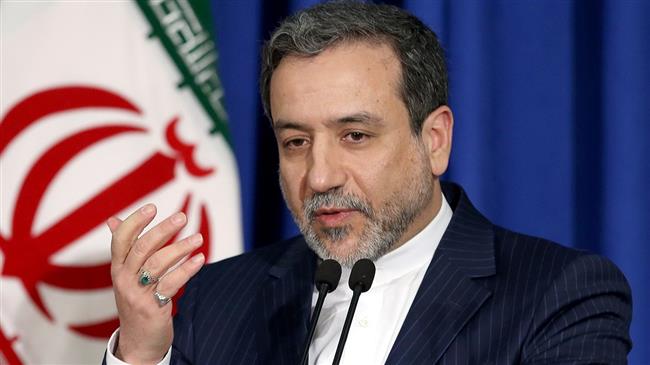
Iran’s Deputy Foreign Minister for Political Affairs Abbas Araqchi
Press TV – January 19, 2020
Iran’s Deputy Foreign Minister for Political Affairs Abbas says the three European signatories to Iran nuclear deal, formally known as the Joint Comprehensive Plan of Action (JCPOA), cannot logically activate the deal’s dispute settlement mechanism, because Iran has already done that.
“We are now engaged in complicated legal discussions and Russia and China are of the same opinion. It was Iran that first resorted to Article 36 [of the JCPOA] and completed its application. Therefore, logically, legally and even politically speaking, the European countries cannot take advantage of this article, because we have already done that and applied its mechanism in full,” Araqchi said while addressing a meeting at the Iranian Foreign Ministry’s School of International Relation on Sunday.
On January 14, the three European signatories to the Iran deal — France, Britain and Germany — formally triggered the dispute mechanism, which accuses Iran of violating the agreement and could lead to the restoration of the anti-Iran UN sanctions that had been lifted by the JCPOA.
Under the mechanism outlined in the deal, the EU would also inform the other parties — Russia and China as well as Iran itself. There would then be 15 days to resolve the differences through the JCPOA Joint Commission. If no settlement is reached through the commission, the foreign ministers of involved countries will then discuss them for another 15 days. In case of need, an advisory board will be formed to help foreign ministers.
Elsewhere in his remarks, Iran’s deputy foreign minister said, the recent measure taken by three European countries is only aimed at dispute settlement and has nothing to do with restoration of UN sanctions against Tehran.
“The trigger mechanism, which may lead to restoration of the United Nations Security Council’s sanctions against Iran has not been started by the three countries,” Araqchi noted.
“They have only resorted to the dispute settlement mechanism as per Article 36 of the deal, while the trigger mechanism is enshrined in Article 37. Article 36 does not automatically lead to Article 37, though it can pave the way for its application,” the top Iranian diplomat added.
The US withdrew from the accord in 2018 and re-imposed its unilateral sanctions on Iran last May. Britain, France, and Germany, under Washington’s pressure, failed to protect Tehran’s business interests under the deal against the American bans.
This May, Iran began to gradually reduce its commitments under the JCPOA to both retaliate for Washington’s departure, and trigger the European trio to respect their obligations towards Tehran.
On January 5, Iran took a final step in reducing its commitments, and said it would no longer observe any operational limitations on its nuclear industry, whether concerning the capacity and level of uranium enrichment, the volume of stockpiled uranium or research and development.
Iranian Foreign Minister Mohammad Javad Zarif has denounced as a “strategic mistake” the European Union’s decision to activate the dispute mechanism, taking them to task for failing to abide by their commitments under the JCPOA, and saying that activating the dispute resolution mechanism is legally baseless and politically a strategic blunder.
Britain, France reiterate commitment to JCPOA
In another development on Sunday, British Prime Minister Boris Johnson and French President Emmanuel Macron reiterated their commitment to the Iran nuclear deal and agreed that “a long-term framework” was needed, a Downing Street spokeswoman said.
In a statement after a meeting between Johnson and Macron on the sidelines of a Libya summit in Berlin, the spokeswoman said, “On Iran, the leaders reiterated their commitment to the JCPOA.”
“They agreed on the importance of de-escalation and of working with international partners to find a diplomatic way through the current tensions,” he added.
Iran to Review Cooperation with Int’l Nuclear Watchdog In Case of ‘Unjust’ Steps by EU – Reports
Sputnik – 19.01.2020
The European parties to the Iranian nuclear deal earlier launched a dispute resolution mechanism under the agreement, a process that could entail the re-imposition of sanctions on Iran.
Iran’s cooperation with the International Atomic Energy Agency will be reviewed if the EU nations take “unjust” measures after triggering the nuclear deal’s dispute mechanism, Iran’s parliamentary speaker was quoted by the local TV as saying.
“We state openly that if the European powers, for any reason, adopt an unfair approach in using the dispute mechanism, we will seriously reconsider our cooperation with the International Atomic Energy Agency”, a local broadcaster quoted Iranian Parliamentary Speaker Ali Larijani as saying.
On Tuesday, three of the signatories to the JCPOA, namely France, the UK, and Germany, confirmed that they had initiated a dispute mechanism that could see the sanctions against Iran reinstated. The move comes amid Iran’s gradual scale-back on its commitments under the deal, prompted by the US unilateral withdrawal from it in 2018.
Iran’s foreign minister previously condemned the three nations for dancing to the tune of the US. President Trump reportedly threatened the European nations with imposing tariffs on them for their lack of action against Tehran.
Iran recently scrapped its remaining limitations under the JCPOA following the assassination of its top military commander Qasem Soleimani in a US drone strike on 3 January. Tehran has been gradually reducing its commitments under the JCPOA since May 2019 following Washington’s unilateral pullout of the treaty one year earlier and imposition of energy and banking sanctions on the state.
Keeping with its Crackdown on Alternative Voices, Google Deletes Press TV from YouTube
By Alan Macleod | MintPress News | January 15, 2020
Without warning, tech giant Google “permanently removed” Iranian government-owned media channel Press TV UK’s YouTube channel Monday night amid increasing American hostility to Iran.
“This attack on the freedom of speech of Press TV’s journalists seems to be part of an anti-Iran purge as the West sets its sights on regime change in Iran,” Press TV said. Its content, in its own words, focuses on “anti-imperialism, anti-racism, and covers aspects of the news which the mainstream corporate media in the United Kingdom have refused to air.”
The London-based outlet had over 28,000 subscribers on its YouTube account at the time of its deletion.
British-Sudanese journalist Ahmed Kaballo accused Google of acting like the “judge jury and executioner” for his employer’s channel, expressing his great disappointment that his journalistic output is now gone and his worry at “what this really represents” for alternative media that “show a different perspective and holds a critical lens” on war and empire.
MintPress News reached out to Kaballo for comment. “The actions of Google in the last 24 hours has made me lose hope in the idea of free press and free speech,” he said. “Journalism is about pushing the boundaries and being fearless in our reporting but in this climate where they can do this to us in this fashion, it’s clear that our perspective. which is overtly anti-imperialist, is, in the eyes of Google, simply not allowed.”
After online pushback, by Wednesday morning UK time, Google had reversed its decision. However, just as Press TV was celebrating its reinstatement, it was again taken off the air. YouTube sent a message to Press TV UK claiming that they had received a complaint about the channel and decided that it violates their terms of service. Kaballo described the political hokey pokey his organization was under as “psychological warfare.”
Press TV says the move is “part of an anti-Iran purge as the West sets its sights on regime change in Iran.” It comes in the context of the Trump administration’s assassination of Lt. General Qassem Soleimani January 3, while he was in Iraq attending peace talks. In response, Iran launched dozens of ballistic missiles at U.S.-occupied military bases in Iraq, although it was careful to warn the U.S. of the attack beforehand. As a result, there were no deaths. The Iraqi parliament also immediately voted to expel all American troops from the country. However, the U.S. refused to leave.
While the threat of a hot war with the Iran appears to have subsided, an intense, online propaganda war rages between the two countries. During his funeral, the hashtag #IraniansDetestSoleimani trended across American Twitter. But analysis showed that it was not Iranians, but organized Trump supporters who were boosting the message, supporting, as 47 percent of Americans did, their president’s decision to kill him.
Last Friday, Facebook announced that it felt compelled to delete all positive posts about the deceased general from its platform and its subsidiary Instagram. “We operate under U.S. sanctions laws, including those related to the U.S. government’s designation of the Iranian Revolutionary Guard Corps (IRGC) and its leadership,” it said, explaining that Trump’s new sanctions made supporting Iran online on any American website essentially illegal. Instagram had already closed Soleimani’s account in April last year, following Trump’s designation of the IRGC as a terrorist group. Just after Facebook’s decision, Twitter suspended Ayatollah Khamenei’s account for “unusual activity.” Instagram is extremely popular in Iran, with around one in three people owning an account, almost as popular as Soleimani, who over 80 percent view positively or very positively. Thus, the U.S. government has, through pressuring monopolistic Silicon Valley giants, effectively banned a majority opinion being shared by Iranians to Iranians, in Iran.
This is not the first occasion that the U.S. government has used the American monopoly over the means of communication online to shut down alternative voices from other countries. Facebook has previously de-platformed Venezuela-based outlets TeleSUR English and Venezuelanalysis, both of which offered differing opinions and analysis of the U.S. government’s actions in Venezuela and Latin America. Meanwhile, the Trump administration has forced RT journalists to register as “foreign agents,” under a rule originally set up to deal with Nazis during World War Two.
Press TV, too, has had a history of poor treatment at the hands of the U.S. state. In January last year, the FBI illegally detained Press TV anchor Marzieh Hashemi for ten days. She was never charged and was deprived of Halal food and a hijab during her detention. While the network is still reachable directly on its website, the fact that the U.S. government can unilaterally decide what the world sees, hears or reads, zapping British based Iranian networks from universal social media giants the entire world uses raises questions about freedom of information in the digital age.
UK’s Lord Polak says new Tory government is opportunity for pro-Israel lobbyists

Stuart Polak, Baron Polak CBE is a British Conservative politician and member of the House of Lords [Youtube]
MEMO | January 15, 2020
A veteran pro-Israel lobbyist in Westminster believes the recently-elected Conservative government represents an important opportunity to advance Israel’s interests amongst British decision-makers.
Lord Polak, a Tory peer, and president of Conservative Friends of Israel, was speaking to right-wing news outlet JNS days after a speech in the House of Lords in which he attacked the so-called “singling out” of Israel in international forums such as the United Nations.
“I have no problem with legitimate criticism where it is due, but this obsession with Israel needs to be addressed. This singling out of the Jewish state is wrong, unjustified and plays a role in the rise and rise of anti-Semitism,” Polak told the chamber on 7 January.
In his speech, Polak echoed a familiar complaint of the Israeli government, namely the payments made by the Palestinian Authority (PA) to prisoners in Israeli jails and to the families of those killed by occupation forces – what the Tory peer described as “salaries to killers and murderers”.
“We must find a method by which aid payments serve the recipients who need our support in Palestinian society, and at the same time, serve the interests of the British taxpayer,” he added.
In his subsequent interview with JNS, Polak claimed that the substantial Conservative majority in Parliament means that now is the time to raise the issues they want and “set an agenda”.
“My speech was signal that this is a priority for the pro-Israel community,” he told the news site.
During the speech, Polak also praised the government’s proposed legislation attacking the right to boycott companies complicit in Israeli human rights abuses.
“The promise by the government to legislate against BDS [Boycott, Divestment, Sanctions] was a first and shows where the new government is at in relation to these sorts of issues,” he told JNS.
How Europe betrayed Iran: By triggering JCPOA dispute mechanism, EU helps Trump finish job of killing the Iran nuclear deal
By Scott Ritter | RT | January 15, 2020
Europe could have saved the Iran nuclear agreement. Instead, it abused the rule of law by inappropriately triggering its dispute mechanism, all but ensuring the agreement’s demise.
Disingenuous diplomacy
On January 5, 2020, Tehran announced that it would no longer comply with its obligations under the Iran nuclear agreement, officially known as the Joint Comprehensive Program of Action (JCPOA). Iran’s actions are in response to the withdrawal of the US from the JCPOA, and the re-imposition of economic sanctions by the US which had been lifted when the deal came into force.
In response to the Iranian actions, the governments of France, Germany, and the UK – all parties to the deal, along with the European Union (EU) – invoked provisions within the JCPOA, known as the Dispute Resolution Mechanism (DRM), in an effort to bring Iran back into compliance.
The triggering of the DRM by the European countries, however, is a disingenuous move designed to provide diplomatic cover for the EU’s own failures when it comes to JCPOA implementation.
Moreover, given the likely outcome of this process, a convening of the UN Security Council where economic sanctions will be re-imposed on Iran by default, the Europeans have all but assured the demise of the JCPOA, with their so-called diplomacy serving as little more than a facilitator of a larger crisis between Iran and the US that, given the heightened tensions between these two nations in the aftermath of the assassination of Qassem Soleimani, precipitously increases the prospects for war.
Big powers always had an easy way out of deal
When the JCPOA was finalized in July 2015, the world was given hope that the crisis over Iran’s nuclear enrichment capability, which had been threatening to boil over into war, had been resolved, and diplomacy had prevailed over armed conflict.
The JCPOA codified a number of restrictions on Iran’s ability to enrich uranium, including the numbers and types of centrifuges that could be used, where enrichment could take place, what level of enrichment could occur, and how large of a stockpile of enriched nuclear material Iran was allowed to maintain, and an intrusive comprehensive inspection regime designed to verify Iran’s compliance.
These restrictions were designed to ease over time through a series of so-called “sunset clauses,” until all that remained was an enhanced inspection process. In short, the JCPOA legitimized Iran’s right to enrich uranium for peaceful purposes while simultaneously recognizing the concerns of some within the international community regarding the potential for Iran to abuse this enrichment capability for military purposes.
The JCPOA was, in effect, a comprehensive confidence building mechanism intended to build trust between Iran and the international community over time, consistent with the agreement’s preamble, which declared “Iran reaffirms that under no circumstances will Iran ever seek, develop or acquire any nuclear weapons.”
Prior to the implementation of the JCPOA, Iran had been subjected to stringent economic sanctions levied under the authority of the UN Security Council. In exchange for entering into the agreement, these sanctions were lifted.
However, the deal recognized that disputes could emerge regarding the implementation of the agreement, and put in place a dispute resolution mechanism which, if no satisfactory solution was found to an identified problem, would result in these sanctions being automatically re-imposed.
A key aspect of this mechanism was that if any party to the agreement used its veto in the UN Security Council to block a vote related to nonperformance on the part of any party to the agreement, then the economic sanctions would automatically be reinstated.
Washington sabotages JCPOA
For the first two-plus years of the deal’s existence, from July 2015 through to May 2018, Iran was found to be in full compliance with its commitments.
In May 2018, however, the US precipitously withdrew from the agreement, claiming that the eventual expiration of the “sunset clauses” paved the way for Iran to produce a nuclear weapon, and as such the JCPOA was little more than a facilitator of Iranian nuclear malign intent.
The US began re-imposing economic sanctions on Iran, all of which included so-called secondary sanctions which applied to any nation that violated the US sanctions. Iran rightfully viewed the re-imposition of sanctions by the US as a violation of the deal.
Furthermore, when EU companies began balking on their willingness to do business with Iran out of fear of US secondary sanctions, Iran rightfully found the EU to be in violation of the JCPOA as well.
Iran gave the remaining parties to the JCPOA six months following the US withdrawal to develop the necessary mechanisms needed to sidestep the impact of the US economic sanctions.
By November 2018, however, no such mechanisms had been implemented, and when the US targeted Iran’s economic lifeblood by sanctioning oil sales, Iran responded by invoking its rights under Article 26 and Article 36 of the JCPOA, which allows Iran to “cease performing its commitments under the JCPOA, in whole or in part”, for either the re-imposition of new nuclear-related sanctions, or “significant nonperformance” of obligations under the JCPOA, or in this case, both.
Since that time, Iran has been gradually stepping away from the restrictions imposed on it, noting each time that its measures were immediately reversible should the underlying issues be resolved in a manner that complied with the letter and intent of the JCPOA.
Europe’s cowardice
In short, Iran demanded that the EU live up to its obligations to stand up to the US economic sanctions. The EU has consistently failed to do so, resulting in Iran’s gradual backing away from its obligations, leading to the current state of affairs where all of the restrictions imposed by the JCPOA, not including international inspections, which continue unabated, have ceased to be in operation.
When it comes to levying fault for the current state of affairs, there is no “chicken or egg” causality up for debate. Blame lies squarely on both the US for withdrawing from the deal, and the EU for failing to live up to its obligations under the JCPOA regarding economic engagement with Iran.
Iran has long warned the governments of France, Germany, and the UK not to invoke the DRM, noting that the JCPOA does not permit such a move if, as is the case today, Iran is exercising its legal right in response to the illegal and unilateral actions of the US.
There is no realistic expectation that Iran will change its position in this regard. Russia and China have already indicated that Iran is fully within its rights within the JCPOA to back off its obligations regarding restrictions imposed on its nuclear program, citing US and EU non-performance.
By invoking the DRM, the Europeans have, knowingly and wittingly, initiated a process that can only have one outcome, the termination of the JCPOA. In doing so, the EU has breathed life into unfounded US allegations of Iranian nuclear weapons intent, setting up an inevitable clash between the Washington and Tehran that has the real potential of dragging the whole world down with it.
Scott Ritter is a former US Marine Corps intelligence officer. He served in the Soviet Union as an inspector implementing the INF Treaty, in General Schwarzkopf’s staff during the Gulf War, and from 1991-1998 as a UN weapons inspector.
The Labour Partly
By Gilad Atzmon | January 15, 2020
Historically, a popular coup against an opposition party is rare. In the last General Election Corbyn’s Labour provided us with just such an exceptional spectacle.
Labour managed to alienate its voters. Its leader turned his back on its strongest allies including, among others, Ken Livingstone and Chris Williamson. For some reason Corbyn’s Labour turned itself into an Orwellian authoritarian apparatus; it even dug into its members’ social media accounts picking out ‘dirt’ (human right’s concerns) in order to appease one distinctive foreign lobby.
The Brits saw it all, how dangerous the party became. Many former ardent Labour supporters angrily rejected their political home. They may never return.
The conduct of the contenders for Labour’s leadership in the last few days reveals that the Brits were spot on in humiliating their opposition party.
At the moment, Labour’s leadership candidates are, without exception, competing amongst themselves to see who goes the lowest in pledging allegiance to a Lobby associated with a foreign state that is currently under investigation by the International Criminal Court (ICC) for committing crimes against humanity.
Yesterday I discussed the topic with the Great Richie Allen (from about 20/24 min/sec) :
Leadership contender Emily Thornberry is apparently on her “hands and knees… asking for forgiveness.” And she is not the only one. The Zionist Times of Israel’s headlines yesterday revealed that the top candidates for Labour leadership have all vowed to lead the fight against anti-Semitism. “Keir Starmer backs automatic expulsion for offenders; Rebecca Long-Bailey: Corbyn bears personal responsibility for crisis; Jess Phillips suspends aide over anti-Semitic tweets.”
On BBC Radio, front runner Keir Starmer said, “We should have done more on anti-Semitism.” I wonder, what did Starmer mean by that? What is the next step after thought policing and spying on party members? Re-education centres? Indoctrination facilities? Hypnosis or maybe physiological treatment or perhaps lobotomy for those who dare to tell the truth about Israel and its Lobby?
Meanwhile, the Mail on Sunday reported that leadership contender, Jess Phillips, had on Friday suspended an aide who equated the Jewish State with the Islamic one.
Two days ago we learned that Zionist pressure on the Labour party isn’t fading away. The Board of Deputies of British Jews (BOD) published its demands of the candidates for Labour’s leadership. The ultra Zionist Jewish Chronicle wrote “The Board of Deputies has demanded each of Labour’s candidates for leader and deputy leader sign up to its 10 ‘pledges’ in order to ‘begin healing its relationship with the Jewish community’…”
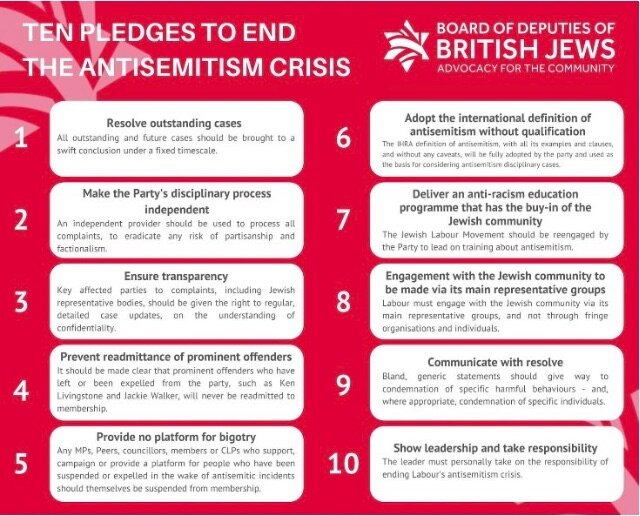
Predictably, the demands made by the BOD do not accord with Western and Christian values of pluralism and tolerance. The BOD demands that contenders ‘pledge’ to “prevent re-admittance of prominent offenders.” One may wonder what about forgiveness and compassion, are those fundamental Western values foreign to our Labour leadership candidates?
The BOD insists that leadership contenders pledge to “provide no platform for those who have been suspended or expelled for antisemitism.” What about freedom of speech and free debate? Are those also alien to Labour’s future leaders?
The new Labour leader is expected to support the bizarre idea that the Zionist Jewish Labour Movement will grant the kosher certificate for its “anti racism education program.” I thought to myself that if the Jewish Labour Movement is so good in ‘anti racism education,’ maybe, and before anything else, it should contribute towards the cleansing of racism in Israel.
The fact that a Jewish organisation such as the BOD is so bold as to publish such ludicrous demands from a British national party is no surprise. The bizarre development here is that Labour’s leadership candidates are engaged in an undignified battle to gain the BOD’s support.
I am not critical of the Jewish Lobby and its orbit of Zionist pressure groups. Those bodies clearly accomplished their mission. But it is astonishing how dysfunctional the Labour party and its leadership are. The party can’t even draw the most elementary lesson from its recent electoral disaster.
Those who follow my work know that I have predicted the unfortunate downfall of Labour and the demise of the Left in general. The Left, as I have been arguing for a while, has failed to reinstate its relevance and authenticity. It is unfortunately dead in the water.
Non-commitment probe into Iran by France, Germany & UK ‘groundless,’ only increases tensions around nuclear deal – Russia
RT | January 14, 2020
The European trio’s accusation that Iran violates the key restrictions of the nuclear deal are unjustified, the Russian Foreign Ministry said urging the countries not to increase tensions that could endanger the pact.
Paris, Berlin and London officially reported Iran’s non-compliance with the 2015 agreement to the Joint Commission under the Dispute Resolution Mechanism. This step could potentially lead to the UN Security Council being forced to decide on whether or not to bring back sanctions against Tehran.
“We can’t rule out that the ill-considered actions of the European trio will lead to a new escalation around the JCPOA (Joint Comprehensive Plan of Action) and make the return to the implementation of the ‘nuclear deal’ in its initially agreed format unachievable,” Russia’s Foreign Ministry said in a statement.
Iran rolled back on its uranium enrichment constraints detailed in the international agreement earlier this month after one of its top military commanders, Qassem Soleimani, was assassinated in an American drone strike in Iraq.
Tehran’s decision to put its commitments on hold was a response to the actions of the US, which unilaterally withdrew from the deal in May 2018 and reintroduced restrictions against Iran, the ministry reminded. However, the country keeps allowing the International Atomic Energy Agency (IAEA) monitors to its nuclear sites – and “the transparency of the Iranian nuclear program has been one of the key clauses of the nuclear deal.”
Despite vocally rejecting the US campaign of “maximum pressure” on Iran, France, Germany and the UK are “either not ready or can’t afford to” work on finding effective ways of bypassing the hurdles to the deal created by Washington.
There are also “serious problems” with implementing the side of the deal on the part of the European trio, the ministry said. When all those issues are settled, “Iran would have no reason to retract from the initially agreed framework of the JCPOA.”
Featured Video

John Mearsheimer: New World Order Arrived & Europe Is Left Behind
or go to
Aletho News Archives – Video-Images
Book Review
Sunset on Net Zero: A Heretic’s Guide to the Futile CO2 Target
By Ronald Paul Barmby (Author) – October 3, 2025
SUNSET ON NET ZERO describes in detail why Net Zero CO2 is pointless and unachievable. It explains in understandable terms the up-to- date thoughts of the greatest minds of today in physics, meteorology, economics, engineering, and the geosciences.
Net Zero CO2 is pointless because we have now confirmed by satellites that 90% of CO2 warming has already happened. CO2 is not an existential threat but clouds, El-Niño, and human habitation are significant drivers of global warming that are often ignored.
Net Zero CO2 is unachievable because the green technology alternatives are unreliable and unaffordable. Wind and solar power triple electricity costs, building fully electric vehicles produces at least one-half of CO2 emissions they are meant to avoid, and heat pumps will leave you dangerously cold in the winter. Green hydrogen, air capture CO2, and carbon capture and storage are prescriptions for national bankruptcy. The supply of key metals and minerals required to achieve Net Zero need to be at least doubled—some much more—and are often controlled by a very few. Net Zero comes with huge environmental and agricultural costs.
We have been through similar climatic temperature changes before, more recently than you think. Our efforts to control it are futile.
Blog Roll
 Aletho News
- FDA Ordered to Pay Over $570,000 in Fight Over Pfizer COVID Vaccine Records
- USAID turned to Facebook to drive demand for Covid vaccines in Global South – files
- Britain’s shadow security network expands into south Lebanon
- The ADL Has a Foreign Policy, and You Are Not Supposed to See It
- Former Qatari PM says ‘Israel’ has security ties with all Gulf states
- The Sound of Silence in the Strait of Hormuz
- Poland’s call for a no-fly zone in Ukraine means NATO direct war with Russia
- John Mearsheimer: New World Order Arrived & Europe Is Left Behind
- Naqab demolition notices top 1,000; settlers demolish Jaloud homes
- Israel is Using the ‘Gaza Ceasefire’ to Commit Ethnic Cleansing
- If Americans Knew
- An error has occurred; the feed is probably down. Try again later.
- No Tricks Zone
- Physicists: Doubling CO2 Has A Smaller Impact On Ocean ‘Acidification’ Than Existing Internal Variability
- Alarmist Climatologists In Shock! 2026 Atlantic Hurricane Season Sees Lowest Count In 101 Years
- New Study: Modern Temps Are Among The Coldest Of The Last 10,000 Years In East Central Europe
- Germany’s Renewable Energies Lead to 1.4 Billion Euro Electric Power Trade Deficit
- Argentina’s Perito Moreno Glacier Joins Antarctica and Arctic In Defying Doomsday Melt Claims
- New Study: Barents Sea Temperatures Were Warmer And Sea Ice Less Extensive In The 1700s Than Today
- German Authorities Start Initiative To Evaluate Public Register For Climate “Disinformation” Spreaders!
- Zonal Asymmetry of Temperature Change in the Antarctic Circumpolar Current
- New Study: The Net Fossil Fuel Contribution To Rising Atmospheric CO2 Has Been Zero For 500 Years
- Germany’s Green Energy Transition Becoming Increasingly Expensive…Another 6 Trillion Euros!

