Will the ICC Prosecute Perpetrators of the ‘War on Terror’?
By Ramona Wadi | MEMO | November 30, 2019
On May 13 2014, the International Criminal Court’s (ICC) Chief Prosecutor announced it would reopen the investigations into alleged war crimes committed by British soldiers in Iraq and Afghanistan, following additional submitted information pertaining to the investigation which had been concluded in 2006.
A recent BBC Panorama investigation, in collaboration with the Sunday Times, ascertained a cover-up by the UK government of British soldiers torturing and murdering Iraqi and Afghan civilians, including children since 2003, when the UK participated alongside the US in invading Iraq under the pretext of the so-called “war on terror”.
In 2010, the Iraq Historic Allegations Team (IHAT) was tasked with investigating allegations of abuse in Iraq, with the possibility of prosecuting the perpetrators. However, mismanagement and corruption within the body, including claims that solicitor Phil Shiner had paid people to find clients for IHAT, failed to open a single case from its investigations. For the UK’s Ministry of Defence, the allegations against IHAT were an opportune moment to discredit the claims of human rights violations committed by British troops. Rather than prioritise the allegations of human rights violations, IHAT was deemed harmful and “making soldiers on the battlefield anxious about later legal repercussions.”
In a 2018 report issued by the ICC, UK soldiers are alleged to have committed war crimes against 61 Iraqis in custody, including killings, torture, rape and sexual violence. Seven deaths occurred in custody and 54 victims died of “mistreatment”. The ICC report specifies: “At this stance, these incidents should not be considered as either complete or exhaustive, but rather illustrative of the alleged criminal conduct.”
In July 2019, the European Centre for Constitutional and Human Rights (ECCHR) submitted a follow-up to the ICC Prosecutor, informing the office about the UK’s failure to investigate or prosecute those responsible for war crimes, “despite significant and growing evidence indicating that liability extends up the chain of command to senior military and civilian officials.” The ECCHR also described the closing down of IHAT as a politically motivated decision to avoid ICC prosecution.
The UK’s intention was clearly to preserve its impunity. During the course of the BBC investigation, it was revealed that “The Ministry of Defence (MoD) had no intention of prosecuting any soldier of whatever rank he was unless it was absolutely necessary, and they couldn’t wriggle their way out of it.” Among the concealed crimes, a soldier from an SAS unit shot 4 Afghan civilians, three of them children, in the head, while they were in their own home, drinking tea. “When I entered the room, the bones, teeth, blood and brain were all over the place,” a witness to the aftermath stated. The UK government dismissed the war crime allegation by stating the four Afghans were Taliban suspects and commanders.
Other war crimes were concealed through fabricated evidence in order to evade such classification. Evidence of sexual abuse was also revealed to have occurred at Camp Stephen in Basra, Iraq, which was under the command of the Black Watch.
If the ICC does investigate the UK government for these violations of the Geneva Convention, it would have set a precedent, given that the Court has, so far, focused on investigating the leaders of African nations as opposed to the crimes of Western governments and foreign intervention. The “war on terror” is characterised by two main factors – perpetual aggression and extended impunity for the perpetrators. Justice for the Iraqi and Afghan people, by now, is worse than a macabre farce. Yet the ICC must fulfil its duty to lay bare the dynamics that have so far shielded the UK military and governmental collaboration from judicial scrutiny.
Prince Andrew – The Right Royal Lizard Tale
The furore around a disposable parasite’s conduct distracts from a REAL investigation into the Epstein case
![UK’s Prince Andrew [Youtube]](https://i2.wp.com/www.middleeastmonitor.com/wp-content/uploads/2019/11/TELEMMGLPICT000216421159_trans_NvBQzQNjv4BqaivqAvBJWkUV8VzepAMjBUSXDVobHLbZZp-A_Kknc4M.jpeg?resize=480%2C300&quality=85&strip=all&ssl=1)
By Kit Knightly | OffGuardian | December 1, 2019
The Queen is cancelling Prince Andrews birthday party. It’s big news. Oh, and some charities are declining to work with him.
This is all off the back of his (allegedly) voluntary, stilted and frankly bizarre Newsnight interview with Emily Maitlis. The collection of jarring statements, fairly obvious evasions and upper-class waffle has been autopsied to death. We don’t need to go over it again.
In fact, mocking Prince Andrew has become the pastime du jour. Everyone’s doing it. Isn’t it fun to partake? Make a little dig, really throw something back in the face of the establishment?
Really though, shouldn’t we know better?
The voice of the mainstream can NOT be trusted. It is never more important to remember this than when it is telling you what you want to hear.
Everybody should have learned by now, the media – and most especially the BBC – don’t have ANY duty to the truth. They can’t be forced to report something just because it’s true. They actively and willfully ignore true things all the time.
A few years ago 50,000 people marched past television centre, and the BBC simply ignored them all.
When the powers who control mainstream media don’t want to talk about something, it. Doesn’t. Get. Talked. About.
The corollary of this is that when the mainstream media is talking about something it’s for one reason and one reason only – they want to talk about it, because somewhere, somehow an agenda is being served.
What’s the agenda being served here? It’s impossible to know for sure at this stage, but it’s certainly true that while we’re talking about Prince Andrew having sex with a 17-year-old, we’re not talking about REAL paedolphilia.
We’re not talking about orphanages on Jersey or trafficking in Belgium, or Jimmy Savile. And we’re not talking about any of the names in Epstein’s “little black book”.
I’m not minimising or apologising for Prince Andrew’s alleged conduct, but let us recall the age of consent in the UK (and many American States) is 16. Significantly, he’s not being accused of doing anything actually illegal.
Do we really think that this is all the Epstein case boils down to? Is this as dark as the underbelly of the political elite gets?
It is sleazy, it is unseemly, and it is highly unpleasant. But it’s NOT a crime, and it’s certainly not a source of powerful political leverage. Nobody is being blackmailed into line based on this.
You don’t need to fly people to private Islands in the Caribbean to have sex with 17-year-olds. You don’t need to “traffic” legal teenagers in order to find girls willing to have sex with billionaires or royalty.
Clearly there must be something more to Epstein, his goals and his agenda, but none of that is being talked about.
While Andrew is being pilloried, and the BBC is getting plaudits for “hard-hitting” journalism, there are proven cases of institutional paedophilia that are far deeper and darker than anything being discussed by the BBC.
While we’re all laughing at Andrew, we’re forgetting that Prince Charles never gave, and was never asked to give, an interview explaining his “friendship” with Jimmy Savile.
While we’re huffing and puffing over “Royal conduct” and sex with girls of legal age, we’re not talking about the fact there are sitting MPs who were once “affiliated” with groups that campaigned to have the age of consent lowered to 10. We’re forgetting that accusations of REAL paedophilia circulate around many high-profile MPs (usually only after they die).
And, of course, lost in all the fuss about Andrew is the fact Jeffrey Epstein is dead.
It may have been memed into a meaningless catchphrase, but it’s still true – Epstein didn’t kill himself. Not alone, anyway.
Broadly speaking one of only three things can have happened:
He called in some favours and faked his death.
He was allowed/encouraged to commit suicide.
He was outright murdered.
Which of these took place we may never know, but it doesn’t really matter. He’s gone. And wherever or however he’s gone, he didn’t do it alone.
Someone – or a collection of someone’s – helped him on his way, either literally or euphemistically.
Why?
Why is always the most important question, you can tell that because it’s always the one media ignore. We’re never encouraged to wonder why anything happens, to think through motive, risk-reward calculations or basic strategy.
These are the big questions, going unanswered while we all partake of Prince Andrew free-for-all.
The fool of the family used to go into the Army or the Church, but now he’s dressed in motley and thrust in front of the TV cameras to gamble and pratfall to the laughs and jeers of the common man. The individual is sacrificed, but the institution is preserved.
I’ve used the autotomy of lizard tails as a metaphor before, and while it may display a lack of imagination to revisit that particular well, there’s no denying it fits well enough.
Of course there’s a temptation to go after Prince Andrew, he likely deserves it, but if we throw everything behind that, we’re in danger of losing the bigger picture. Like a dog being distracted with a string of sausages.
There’s something much bigger than Prince Andrew at the heart of all this, but we won’t find it if we content ourselves with feasting on the morsels the press are happy to feed us.
BBC under increasing criticism for biased reporting
By Johanna Ross | November 27, 2019
It’s almost as British as fish and chips and a pint, but what used to be embraced by the masses as a reliable source of information, the BBC, is now under increasing scrutiny for its overt political bias. With the growing popularity of social and alternative media, Brits are no longer taking as gospel what is pumped out by, this publicly funded service which is increasingly coming under fire for being nothing more than a propaganda machine for the sitting government. The hashtag #BBCbias has been trending for some time now on Twitter, and with more and more commentators questioning the integrity of this public service, it’s clear that the organisation needs to take a long hard look at itself.
Let’s take the issue of Scottish Independence for example. Coverage of this, and of the Scottish National Party has been demonstrated to be biased for years. A 2014 report by Dr John Robertson concluded that BBC reports in the run up to the Yes campaign consisted of “typically a Westminster scare story, on the Yes campaign, mostly left unanswered and unchallenged” and that coverage had “not been fair or balanced”. More worrying however, the research had illustrated that this biased reporting could well have had a negative impact on the independence movement: “we have evidence of coverage which seems likely to have damaged the Yes campaign”. The revelations earlier this year by a senior BBC journalist, Allan Little, that his colleagues viewed it as their responsibility to demonstrate how ‘foolish’ independence was, only adds to the case that coverage was far from impartial.
But despite the public outcry, it’s clear that few lessons have been learned. Much of the current criticism of the BBC is to do with its stance towards the Labour party led by Jeremy Corbyn. It couldn’t be more obvious from interviews by some of its top journalists – Andrew Marr for one – that there is an anti-Corbyn position, and in fact Corbyn has himself accused Marr in the past of ‘establishment bias’. A report from 2016 only looked into coverage of the Labour leader by the mainstream media in general and concluded that there was a “marked and persistent imbalance” in favour of sources critical to him. Furthermore, it singled out the BBC for using more ‘pejorative language’ when referring to Corbyn and his party colleagues and it gave almost double the unchallenged airtime to people criticising the Labour leader than to his supporters.
In recent months however, since Prime Minister Boris Johnson took office, the preferential treatment given to the government has been more stark than ever, mainly down to the nature of his ‘style’. For more than any other Prime Minister before him, Johnson has been accused of being economical with the truth. Therefore the BBC is under increased pressure to either promote the government position, as it has traditionally done, however extraordinary it may be, or rethink its approach altogether. One of the first to bring this issue to the public eye was acclaimed journalist Peter Oborne. Writing in Open Democracy, he stated that ‘British journalists have become part of Johnson’s fake news machine’. He accuses the Prime Minister of having “debauched Downing Street by using the power of his office to spread propaganda and fake news” and mentions the BBC Political Editor Laura Kuenssberg, saying she was ‘manipulated by Downing Street’ when she reported ‘insider information’ without questioning it. But with the lies of Boris Johnson being exposed more and more, how long can the BBC protect him?
Peter Oborne does go some way to explaining the problem: “I have talked to senior BBC executives, and they tell me they personally think it’s wrong to expose lies told by a British prime minister because it undermines trust in British politics.” But in actual fact this does not convey fully what is happening. For the reality is, despite its mission statement boasting of its aim “to act in the public interest, serving all audiences through the provision of impartial, high-quality and distinctive output and services which inform, educate and entertain”, the BBC is, and always has been, a mouthpiece for the British government of the day. Its journalists, up until the 1990s were vetted by the British security services. It’s always had an agenda to promote the establishment narrative and to oppose any individuals or movements which threaten that. Scottish independence is a threat. Jeremy Corbyn is another. The former will break up the Union; the latter is deemed a security risk because of his pacifist tendencies and non-interventionist stance when it comes to foreign policy.
But with both these movements gaining ground, and British politics and society in a state of flux, we are now in uncertain territory. The period of post-war stability is now coming to an end, and so is it the reign of the mainstream media. For the BBC to survive in this new media landscape it will have to inject a heavy dose of honesty and transparency into its broadcasting, or face being obsolete. As populism gathers strength, and people access a wider range of media sources than ever before, they will no longer be accepting things at face value.
Johanna Ross is a journalist based in Edinburgh, Scotland.
Where Comedy ends and Hasbara Begins
By Gilad Atzmon | November 26, 2019
Two days ago at the ADL conference Jewish Zionist comedian Sacha Baron Cohen criticised the internet and social media companies for allowing freedom of speech. This grotesque character who has made a career of marginalising oppressed minorities by depicting stereotypical characters and then ridiculing them is now calling on social media to adopt gag orders and to move us further into an Orwellian realm.
Galvanized by the support it received from the Jewish comedian, the ADL is now demanding that 10 social media accounts “should be removed immediately.”
For one reason or another I am included on the list. I need not mention that I have never been charged with any crime let alone a hate crime. I’ve never once been questioned by a single law enforcement body anywhere in the world. This does not stop the ADL from writing of me: “Gilad Atzmon is an anti-Semitic author and musician who describes himself as an ‘ex-Israeli’ and an ‘ex-Jew.”
I am indeed an ex Israeli and ex Jew and I am also a musician. However, I deny the accusation of anti-Semitism, I have never criticized Jews, or anyone else for the matter, as ‘a people,’ as ‘a race,’ as ‘a biology’ or as ‘an ethnicity.’ In fact, for my entire life I have opposed all forms of racism and this includes Jewish racism. I do criticise Jewish identitarian politics and some aspects of Jewish culture and ideology. I grew up in Israel and as far as I can remember, in the Jewish state, criticism of culture, ideology and politics is considered a perfectly kosher activity.
The ADL says of me that I am an “outspoken promoter of classic anti-Semitic conspiracy theories.” This is an absurd lie as I have repeatedly argued that there are no Jewish conspiracies since it is all done in the open: from Epstein’s Lolita Express, to Israeli war crimes, to advocacy of Zioncon global conflicts and plans for an ‘New American Century.’ The UK chief rabbi’s call for Brits to turn their backs on their opposition party is not exactly a conspiratorial clandestine move, it is actually mainstream news in Britain this morning. There are no Jewish conspiracies, what happens takes place in front of our eyes but we cannot discuss it because Jewish power, as I define it, is the power to suppress criticism of Jewish power.
From then on, what the ADL says about me is somewhat accurate. He is “a fierce critic of Jewish identity.” I am.
“He has written that ‘Jewish ideological, political, and cultural discourse is… foreign to universalism and ideas of true equality.’ My exact words can be found here. What I say is “We must find a way to admit to ourselves that the Jewish ideological, political and cultural discourse is a tribal discourse: it is foreign to universalism and ideas of true equality.” Here the ADL is engaged in a rather obvious attempt to deceive. In my original text, being ‘foreign to universalism and true equality’ elucidates the notion of tribal discourse. You may wonder why the ADL acts in a duplicitous manner.
The ADL complains that “although Atzmon frequently attacks Zionism, he has also argued that Zionism itself was originally a ‘universalist and humanist’ movement which was ‘hijacked by Judaism.’ In fact, this is exactly what I argue and I wonder, where exactly is the ‘crime?’ The battle between ‘the Israeli’ and ‘the Jew’ was at the centre of the Israeli political debate in the last election. Am I guilty of identifying the core of Israel’s identity crisis a decade before anyone else?
Finally the ADL complains that I say of Israel that it is a “tyranny inspired by a deep Talmudic intolerance.” I am afraid that the Israeli National Bill is the materialisation of the above. I think I remember that the ADL’s Abe Foxman also wasn’t pleased with Israel’s National Bill for pretty much the same reasons. Is the ADL going to ask to delete his twitter account?
Sooner or later we will have to examine the question whether the relentless attack by Jewish institutions on freedom of speech, 1st amendments and the core Western ethos has been ‘good for the Jews.’
WikiLeaks Proved the OPCW Cannot Be Trusted In Syria
By Paul Antonopoulos | November 26, 2019
The “Syrian regime” and chemical weapons has become a constant mantra in the Western World and has become synonymous with the Syrian War since it began in 2011. One of the most famous cases was the April 2018 chemical weapon attack in the Damascene satellite city of Douma that led to the U.S., UK and France conducting airstrikes against Syrian Army positions, despite the lack of evidence that the Syrian government was responsible for the incident.
The April 7, 2018 chemical incident killed between 40 and 50 people and was followed up by the Western Powers attack against Syria exactly a week later. Strangely though, the attack took place just mere hours before the Organization for the Prohibition of Chemical Weapons (OPCW) inspectors arrived in Syria to investigate the attack. The U.S., UK and France knew that the eventual OPCW report would not match their claims and allegations against the Syrian government, and were quick to act in wasting their people’s tax dollars by dropping bombs on the Arab country.
The final OPCW report would not match the first report made by the Fact-Finding mission that were actually on the ground in Syria. An email released by whistleblowing Wikileaks on the weekend found that the final OPCW report on the Douma incident had been manipulated and changed by the Office of the Director-General of the OPCW, then held by Turkish diplomat Ahmet Üzümcü. This is an extremely disturbing discovery as the OPCW claims to have a “neutral role” by not assigning blame for chemical weapon use, but to find out the details of how the attack was conducted. This however was reversed last year with the OPCW being given permission to investigate perpetrators – but they still kept the mythology that they are “neutral.”
Although the report did not assign blame, the e-mail claims that the report “morphed into something quite different to what was originally drafted” and that “a bias has been introduced into the report, undermining its credibility” and that it “is disingenuous.” This was of course to bring the illusion that Syria was responsible for the attack, despite no tangible evidence.
In March, the OPCW report claimed that chlorine was the likely agent used in last year’s attack, but the newly released email explains that this claim “is highly misleading and not supported by the facts.”
“Omitting this section of the report has a serious negative impact on the report as this section is inextricably linked to the chemical agent identified… In this case, the confidence in the identity of chlorine or any other choking agent is drawn into question precisely because of the inconsistency with the reported and observed symptoms. The inconsistency was not only noted by the fact-finding mission team, but strongly supported by three toxicologists with expertise in exposure to chemical warfare agents”, the e-mail revealed.
The email then makes a final request that the original report be released in “its entirety” as the author fears that the manipulated report does not “reflect the work of the team” and “would negatively impact on the perceived credibility of the report, and by extension that of the Organisation.”
It must be remembered that when the OPCW report was released in March 2019, nearly a whole year after the incident. The released report ignored evidence provided by the Russian Foreign Ministry that the Al-Qaeda affiliated White Helmets were responsible for the attack, and that rather the report was attempting to justify the U.S.-led attack against Syria.
However, the release by WikiLeaks was only the final nail in the coffin confirming that the OPCW is not “neutral” and rather highly politicized. It was revealed only last week by the Grayzone that a second whistleblower from the OPCW came forward to accuse the top leadership of the organisation of suppressing critical evidence because of pressure from the U.S.
This demonstrates that there is a major rift between the actual inspectors on the ground and the higher-level officials of the organization who are willingly submitting to U.S. pressures despite trying to maintain their credibility of being neutral. The very appointment of Üzümcü, a former Turkish ambassador to Israel and a former Permanent Representative of Turkey to NATO, demonstrates that his very appointment had political motivations knowing Ankara’s aggressive foreign policy towards Syria since the beginning of the war.
There can be little doubt now that the claim of neutrality is far from reality and rather the top leadership of the OPCW are willing to omit, manipulate and change facts that were on the ground and discovered by their own Mission at the behest of the U.S. so it could pressure Syria and legitimize the illegal U.S.-led attack. This can only bring into question now the legitimacy of all the other chemical weapon attacks blamed on the Syrian government over the course of many years.
In addition, the OPCW should be the center of wide condemnation from the international community and the United Nations, who once shared a Joint Mission with the OPCW to remove Syria’s chemical weapons from October 2013 to September 2014. The OPCW has now lost all credibility and should be replaced by a new organization that does not appoint controversial Director-Generals or submit to pressure from external forces, like the U.S., and perhaps even Turkey.
However, the most telling of the politicization of the OPCW occurred at yesterday’s annual OPCW forum in the Hague, where the organization vehemently defended themselves against the well-timed Wikileaks expose. Fernando Arias, the current OPCW Director-General, defended the manipulated report, saying: “the nature of any thorough inquiry for individuals in a team is to express subjective views. While some of these diverse views continue to circulate in some public discussion forums, I would like to reiterate that I stand by the independent, professional conclusion [of the investigation].”
Simply put, WikiLeaks has helped prove that the OPCW can no longer be trusted and certainly is not neutral. Britain and France unsurprisingly at yesterday’s OPCW forum also defended the initial report and rejected the allegations of doctoring. But this of course was always to be expected.
Paul Antonopoulos is a Research Fellow at the Center for Syncretic Studies.
Anti-Russian sanctions based on fraudster’s tales? Spiegel finds Magnitsky narrative fed to West by Browder is riddled with lies
RT | November 24, 2019
British investor Bill Browder has made a name for himself in the West through blaming Moscow for the death of his auditor, Sergey Magnitsky. Der Spiegel has picked apart his story and uncovers it has major credibility problems.
For years Browder – Russian President Vladimir Putin’s self-proclaimed “enemy number one” and head of the Hermitage Capital Management fund – has been waging what can only be described as his personal anti-Russian campaign.
The passionate Kremlin critic relentlessly lobbied for sanctions against Russian officials everywhere from the US to Europe – all under the premise of seeking justice for his deceased employee, who died in Russia, while in pre-trial detention, where he’d been placed while accused of complicity in a major tax evasion scheme.
Browder, who was himself sentenced in absentia by a Russian court to nine years in prison for tax evasion, and was later found guilty of embezzlement as well, presented Magnitsky as a fearless whistleblower who exposed a grand corruption scheme within the Russian law enforcement system, and who was then mercilessly killed out of revenge.
The investor has succeeded in feeding this narrative to the Western governments and the mainstream media alike, prompting the US to adopt the Magnitsky Act in 2012, which allowed the US to sanction numerous Russian officials and businessmen over alleged human rights violations. Some American allies, including Canada and the UK, later followed suit and passed similar motions, which either allowed the sanctioning of Russian officials or called on their governments to do it.
Yet, the businessman, who has over the years donned the mantle of a human rights campaigner, does not plan to stop at that and is now lobbying for an EU-wide equivalent of the Magnitsky Act, which would allow the banning of Russian officials from the bloc’s countries and the freezing of their accounts.
On the tenth anniversary of the auditor’s death, the German weekly Der Spiegel has decided to take a closer look at Browder’s story about Magnitsky. And the paper found out that the narrative doesn’t quite flow as smoothly as Western politicians and the MSM would like it to.
No hero
The whistleblower image Browder has built for Magnitsky starts splitting at the seams from the very beginning, as Browder appears to be dishonest, even in minor details like his claim that Magnitsky was his lawyer, Der Spiegel’s Benjamin Bidder reveals in his investigative bombshell.
The problem is that he was not. The man was an auditor, who was hired by Browder’s company as a tax specialist and then worked in this capacity for years with the US-born British investor. Browder himself had to admit this fact when he was questioned in a US court while seeking to make the US impose sanctions on yet another group of Russian entrepreneurs.
Magnitsky’s role as a whistleblower also comes into question as the deceased auditor’s former lawyer confirmed to Der Spiegel’s Bidder that his client had, in fact, been summoned by Russian investigators to provide testimony in a tax evasion case that opened at least months before he came up with his corruption allegations.
Other documents obtained by Der Spiegel, including Magnitsky’s unpublished emails, also suggest that Magnitksy acted not of his own volition but on the instructions of Browder’s senior lawyer, at a time when the Russian authorities had already been investigating dubious letterbox companies Browder supposedly had used in his tax evasion scheme for years.
Finally, the records of Magnitsky’s interrogation, released by Browder’s own people on the internet and seen by Der Spiegel, show that he’d never explicitly accused Russian police officers Artyom Kuznetsov and Pavel Karpov, whom Browder declared to be the masterminds behind the supposed corruption affair, and ultimately behind the auditor’s murder.
This fact was also implicitly confirmed by a UK court, which issued a ruling on a libel lawsuit filed by Karpov against Browder in 2012. Although the court ruled that Karpov simply had no prior reputation to defend in the UK and rejected his claim, it still called Browder a “storyteller,” arguing that he could not even come “close to substantiating his allegations with facts.” The British media, however, presented the verdict as a resounding victory for Browder.
No murder
The German weekly also found similar inconsistencies in the story of the auditor’s supposed murder, as told by Browder. In his claims, the businessman constantly refers to a report by the Moscow Public Monitoring Commissions (PMC) – an independent, non-governmental body consisting of rights advocates that conducted its own thorough investigation into Magnitsky’s death.
Browder maintains that Magnitsky was deliberately murdered. Yet, the commission’s report, which is still freely available on its website, contains no claim of this sort. The commission does decry the harsh jail conditions which the auditor was kept in, and accuses the Russian authorities of failing to fulfil its duty to protect his life. However, it says nothing of murder.
It is not just the text of this report that Browder has apparently distorted, though. In August, the European Court of Human Rights (ECHR) issued a ruling on Magnitsky’s case, ordering Russia to pay his widow and mother €34,000 ($38,000) in damages.
Browder was quick to hail this decision as “destroying the Russian government’s narrative” and proving that “the Russian government murdered Magnitsky.” However, it would seem Browder’s own narrative was dealt a blow instead.
The ECHR never even mentioned the word “murder” in its ruling. Instead it said that Russia basically failed “to protect Mr Magnitsky’s right to life” by providing inadequate medical care and failed “to ensure an effective investigation into the circumstances of his death.”
It even concluded that Magnitsky’s arrest “was not arbitrary, and that it was based on reasonable suspicion of his having committed a criminal offence” – though it did also say there was no “justification” for his lengthy pre-trial detention.
Buying into convenient narrative
In his investigative report, Der Spiegel’s Benjamin Bidder eventually concludes that, although Magnitsky might have fallen victim to some “gruesome injustice,” his image is still far from that painted by Browder in his efforts to pit Russia and the West against each other.
“A question arises whether there has ever been a perfidious political murder plot or the West simply was made to buy into the lie of a fraudster.”
The journalist says that Browder’s “justice for Magnitsky” campaign might have, in fact, been part of his own “personal revenge” on Russia, one that uses the auditor’s fate as fuel for an “argumentative perpetual motion” that helps the businessman himself stay afloat in the sea of Western politics.
Yet, there is another question that needs to be asked: Why did Western politicians and the media support Browder’s narrative so eagerly, without even fact-checking it first? The answer is simple.
According to Bidder, Browder is “so successful because his narrative seems to fit perfectly with the devastating image” that Russia has in the West, making it much more convenient for the media to just toe the line instead of questioning it.
Also on rt.com:
Tycoon who pushed Magnitsky Act warns EU minister that opposing Russia-bashing is ‘career ruining’
UK Blasted as ‘Illegal Colonial Occupier’ After Skipping UN Deadline Over Chagos Islands
Sputnik – November 22, 2019
Mauritian Prime Minister Pravind Jugnauth has branded Britain an illegal colonial occupier after the country failed to meet a UN deadline to hand over an overseas territory to Mauritius, a former British colony in the Indian Ocean, BBC reported.
The country claims it was forced to trade the Chagos Islands in exchange for sovereignty, with the UK purchasing them for £3 million in 1965, when Mauritius was still under British rule.
Earlier this year, the UN general assembly voted by an overwhelming majority of 116-6 in favour of the motion demanding that the islands, Britain’s last remaining African territory, be reunited with Mauritius. However, the UK refused to regard the UN motion as binding.
“We have no doubt about our sovereignty over the British Indian Ocean Territory, which has been under continuous British sovereignty since 1814″, a Foreign Office spokesperson said adding the African country has “never held sovereignty over the archipelago”.
According to the press service, the territory will remain under British control until “it is no longer needed for defence purposes”.
White Helmets involved in organ trafficking in Syria: Study
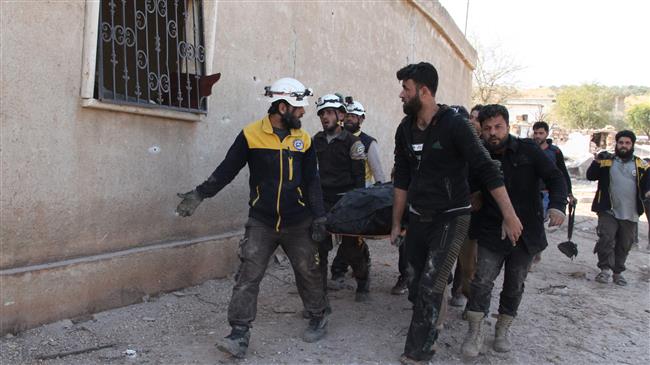
White Helmets members with the body of a person in al-Malajah village, south of Syria’s Idlib Province, November 17, 2019. (Photo by AFP)
Press TV – November 21, 2019
A survey by a Russian institution reveals that the White Helmets, which operates under the guise of an aid group in Syria, has been involved in the forcible removal of organs from civilians living in areas controlled by militants.
The survey, dubbed “White Helmets: terrorist abettors and sources of disinformation,” was conducted by the Foundation for the Study of Democracy.
Presenting the study’s findings on Thursday, Maxim Grigoryev, director of the organization, said the White Helmets evacuated people with the promise of medical assistance, but later handed their bodies — with some vital organs missing — to their relatives.
He added that the organ removals came to light after the bodies were examined.
“They [White Helmets] were a key element in this illegal scheme of organ removal. We learned about those incidents from the people whom we interviewed. This information came as an unpleasant surprise to us,” Grigoryev said.
He further noted that the survey was based on interviews with White Helmets members, former militants and residents of Syrian areas where White Helmets were most active, including Aleppo, Damascus, Douma, Dayr al-Zawr and Saqba.
Grigoryev also pointed out that the illegal extraction and trade of human organs was practiced in late 1990s, when White Helmets co-founder James Le Mesurier was in Yugoslavia. Le Mesurier, a former British army officer, was found dead in Istanbul earlier this month.
“The scheme of illegal extraction of organs from residents of Serbia was carried out on the territory where he [Le Mesurier] was staying, and exactly the same system was recreated in Syria. This is exactly what White Helmets are doing,” he said.
The White Helmets claims to be a humanitarian NGO, but it has been accused of working with anti-Damascus terrorists and staging false-flag chemical weapons attacks in Syria.
Syria views the White Helmets as “a branch of al-Qaeda and al-Nusra” militant outfits and a “PR stunt” by the US, the UK and France.
“The Palace… Threatened Us a Million Different Ways”
By Craig Murray | November 16, 2019
This leaked off-air recording of ABC News anchor Amy Robach is much more revealing than anything the BBC is going to air about Andrew Saxe Coburg Gotha.
Buckingham Palace has been “threatening” journalists to bury the story for years – which is all very reminiscent of Jimmy Savile, who was of course, ahem, popular at the Palace. Robach also states they were scared of losing interview access to folically challenged William Saxe Coburg Gotha and his underweight wife. She does not explicitly state that was one of the “threats” Buckingham Palace employed, but it does follow directly as her next observation.
Amy Robach very probably realised this “unguarded” moment would get out to the public, and we should be grateful to her for lifting the lid on how the protection of the crimes of the powerful operates, on a global level. Alan Dershowitz, whom Robach mentions, was not only a Lolita Express passenger, he is the celebrity lawyer who defended the CIA‘s use of torture as legally and morally justified. One might speculate on the psychological parallels of torturing the defenceless and inflicting sex on the young.
There is overwhelming evidence that Virginia Roberts Giuffre was trafficked into the UK by Epstein for sex with Prince Andrew. There are flight logs. There is that compromising photo in Ghislaine Maxwell’s flat. Both are entirely consistent with, and strongly corroborate, Virginia’s own testimony. This instance occurred in the UK.
It ought to be a matter of deep national disgrace that neither Ghislaine Maxwell nor “Prince” Andrew has been questioned over by the Metropolitan Police over this sex trafficking. That Virginia was over 16 is not the issue. She was sex trafficked into the UK and not legally adult. Why is there not a massive media clamour for Scotland Yard to investigate?
Amy Robach has the answer to that question.
Hat Tip to projectveritas
Le Mesurier Gets Cross
By Craig Murray | November 14, 2019
Perhaps the only fact on James Le Mesurier about which I would agree with the MSM war cheerleaders is that he was a very busy man. It is remarkable therefore that he found the time and inclination to follow “Philip Cross” on twitter. Given that “Philip Cross” has virtually never posted an original tweet, and his timeline consists almost entirely of retweets of Nick Cohen, David Aaronovitch and openly pro-Israel propaganda accounts, why would Le Mesurier bother to follow him?
“Philip Cross” has never posted any news other than to retweet columnists. He has never given an insight into a story. In addition to James Le Mesurier, why then were all these MSM journailsts following “Philip Cross” from before “he” gained notoriety for his Wikipedia exploits?
Oliver Kamm, Leader Writer The Times
Nick Cohen, Columnist The Guardian/Observer
Joan Smith, Columnist The Independent
Leslie Felperin, Film Columnist The Guardian
Kate Connolly, Foreign Correspondent The Guardian/Observer
Lisa O’Carroll, Brexit Correspondent The Guardian
James Bloodworth, Columnist The Independent
Cristina Criddle, BBC Radio 4 Today Programme
Sarah Baxter, Deputy Editor, The Sunday Times
Iain Watson, Political Correspondent, The BBC
Caroline Wheeler, Deputy Political Editor, the Sunday Times
Jennifer Chevalier, CBC ex-BBC
Dani Garavelli, Scotland on Sunday
Prominent Freelancers
Bonnie Greer (frequently in The Guardian )
Mason Boycott-Owen (The Guardian, New Statesman )
Marko Attilla Hoare (The Guardian )
Kirsty Hughes
Guy Walters (BBC)
Paul Canning
What attracted all of these senior MSM figures to follow an obscure account with almost no original content? No reasonable explanation of this phenomenon has ever been offered by any of the above. What a considerable number of them have done is to use the megaphone their plutocrat or state overlords have given them, to label those asking this perfectly reasonable question as crazed conspiracy theorists.
This week, on the day of Le Mesurier’s death, “Philip Cross” made 48 edits to Le Mesurier’s Wikipedia page, each one designed to expunge any criticism of the role of the White Helmets in Syria or reference to their close relationship with the jihadists.
“Philip Cross” has been an operation on a massive scale to alter the balance of Wikipedia by hundreds of thousands of edits to the entries, primarily of politically engaged figures, always to the detriment of anti-war figures and to the credit of neo-con figures. An otherwise entirely obscure but real individual named Philip Cross has been identified who fronts the operation, and reputedly suffers from Aspergers. I however do not believe that any individual can truly have edited Wikpedia articles from a right wing perspective, full time every single day for five years without one day off, not even a Christmas, for 2,987 consecutive days.
I should declare here the personal interest that “Philip Cross” has made over 120 edits to my own Wikipedia entry, including among other things calling my wife a stripper, and deleting the facts that I turned down three honours from the Crown and was eventually cleared on all disciplinary charges by the FCO.
I hazard the guess that at least several of the above journalists follow “Philip Cross” on twitter because they are a part of the massive Wikipedia skewing operation operating behind the name of “Philip Cross”. If anybody has any better explanation of why they all follow “Philip Cross” on twitter I am more than willing to hear it.
The “White Helmets” operation managed for MI6 by Le Mesurier was both a channel for logistic support to Western backed jihadists and a propaganda operation to shill for war in Syria, as in Iraq or Libya. Wars which were of course very profitable for arms manufacturers, energy interests and the security establishment. It should surprise nobody that Le Mesurier intersects with the Philip Cross propaganda operation which, with the active support of arch Blairite Jimmy Wales, has for years been slanting Wikipedia in support of the same pro-war goals as pushed by the “White Helmets”.
Featured Video
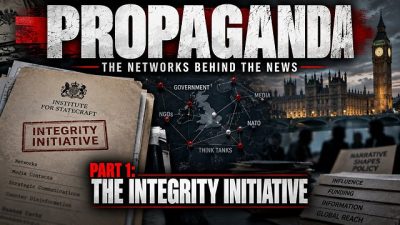
Integrity Initiative: UK-funded network framed dissent as Russian disinformation for years
or go to
Aletho News Archives – Video-Images
From the Archives
Why Saudi Ties to 9/11 Mean U.S. Ties to 9/11
By Kevin Ryan | Dig Within | September 27, 2015
Media interest in Saudi Arabian connections to the crimes of 9/11 has centered on calls for the release of the 28 missing pages from the Joint Congressional Inquiry’s report. However, those calls focus on the question of hijacker financing and omit the most interesting links between the 9/11 attacks and Saudi Arabia—links that implicate powerful people in the United States. Here are twenty examples. … continue
Blog Roll
 Aletho News
- EUROPE FEARS RUSSIA’S NEXT MOVE / Ian Proud
- Big tech hands in its DSA censorship reports to the EU
- ‘A Big Victory’ – Palestine Chronicle Wins Two-Year Legal Battle
- IAEA inspectors cannot return to Iran amid US threats: Russia
- Senate Rejects Iran War Powers Resolution Passed By House
- ‘We did not attack Pakistan with drones’: Afghan sources
- Iraqi Resistance faction links arms to sovereignty, questions US exit
- Cannon fodder no more… South Korea rejects Trump’s pressure to join his criminal war on Iran
- Neria Leiter Was A Legitimate Military Target
- Integrity Initiative: UK-funded network framed dissent as Russian disinformation for years
- If Americans Knew
- ‘This is where I live now, the back of a truck’: a day in the life of a grandmother in Gaza
- In UN Speech, Iran’s President Displays Pictures of Children Killed by US, Brings Attention to Israel’s Nuclear Arsenal
- Israel displaces hundreds of Palestinians amid wave of demolitions in West Bank
- Aid, reconstruction, and Israel’s history of obstruction in Gaza
- Trump administration digs an ever-deeper hole of complicity in genocide – Daily Update
- US-Israel $2.8 Billion Arms Deal, 40,000-Bomb Supply Faces New Gaza Complicity Accusations
- Caught on Tape: AIPAC CEO Boasted of Controlling Trump’s National Security Officials
- Why Hamas Attacked Israel in October 2023 – Israeli professor Ilan Pappé
- They see them, then kill them: Israeli quadcopters track, deliberately target civilians in Gaza
- Winter could turn Gaza’s treacherous, war-damaged buildings into deathtraps
- No Tricks Zone
- New Study: Earth And Venus Surface Warmth Largely Explained By Convection And Lapse Rate, Not CO2 Or Radiation
- 2025 Nature Paper Claiming Worsening Global Drought Gets RETRACTED …Heavily Flawed
- New Study: ‘Global Drought Shows No Detectable Recent Acceleration Under Climate Warming’
- Economic Masterminds: German Socialists Suggest Taxing Productivity Gains Stemming From Using AI
- The South China Sea Has Not Been Cooperating With The Climate Change Narrative
- Energy Crisis: Germany Enters Heating Season With Historically Low Gas Reserve Fill Levels
- New Study: The Antarctic Ice Sheet Gained Mass From 2020-2024 Due To Staggering Snow And Ice Accumulation
- Study: Ocean Heating Rates From Thousands Of Years Ago ‘Dwarf’ Modern Ocean Heating Rates
- Climate Extremists Target, Attack Large-Scale Power Grid Infrastructure In Germany!
- New Study: Antarctic Ice Melt Has Contributed Less Than 1 Centimeter To Sea Level Rise In The Last 30 Years

