Arms purchases by Middle Eastern countries have doubled: Annual security report
Press TV – February 12, 2019
An annual international security report shows that arms sales to the Middle East doubled during the period between 2013 and 2017 compared to the previous five years.
The Munich Security Report 2019, released on Monday, also said the outsize concentration of weapons in the Middle East increased the risk of confrontation in the region.
“Between 2013 and 2017, the value of Middle Eastern countries’ arms purchases doubled compared to the previous five years, thus bearing the risk of an arms race and military confrontation,” it said.
The report did not name the top purchasers of arms, but they are believed to be the Arab countries in the Persian Gulf region, which traditionally allege that they face a “threat” from Iran and use that pretense to buy advanced weapons from eager suppliers mainly in the West.
The report did reveal the exporters, though. It said 53 percent of the total volume of the arms exports to the Middle East originated in the United States. The US was followed by France (11 percent), the United Kingdom (10 percent), and Canada (seven percent).
Italy, Germany, and Turkey were also among the leading exporters, with their share in the total volume of arms sales to the region equaling six percent, three percent, and two percent, respectively.
‘Countries reevaluating relations with Saudi Arabia following Khashoggi murder’
The report also said that “numerous US politicians and governments of other countries are reevaluating their partnership with Saudi Arabia,” following the state murder of dissident journalist Jamal Khashoggi in the Saudi consulate in Istanbul last October and Riyadh’s deadly military campaign in Yemen.
While the US administration has backed the Riyadh regime in both of those cases, other US politicians, including some of the administration’s allies in Congress, have been concerned by Saudi Arabia’s destabilizing role.
“The US Senate even passed a resolution urging the cessation of any military support to countries involved in the [Yemen] war, thus contradicting White House positions,” the report said.
The US administration on Monday threatened to veto any resolution passed in Congress against Saudi Arabia.
Saudi Arabia and a number of its allies launched a devastating military campaign against Yemen in March 2015, claiming that a popular uprising there was backed by Iran, an allegation denied both by the revolutionaries and Tehran.
According to a new report by the Armed Conflict Location and Event Data Project, a nonprofit conflict-research organization, the Saudi-led war has so far claimed the lives of around 56,000 Yemenis.
The United Nations has said that a record 22.2 million Yemenis are in dire need of food, including 8.4 million threatened by severe hunger. According to the world body, Yemen is suffering from the most severe famine in more than 100 years.
The Munich Security Report 2019 also warned of a possible “risk of an accidental clash” between Saudi Arabia, the US, Israel, and Iran in the region, stressing that the confrontation “cannot be discounted.”
The report comes days ahead of the 55th edition of the Munich Security Conference, which is scheduled to take place in the German city of Munich on February 15-17. Heads of state and defense ministers of more than 80 countries from across the globe attend the event every year.
UK’s Anti-War Group Slams Defence Secretary for Ramping Up War Rhetoric
Sputnik – 11.02.2019
Lindsey German, the convener of London-based Stop the War Coalition, a group campaigning against what it believes are unjust wars, criticized UK Defence Secretary Gavin Williamson on Monday for deliberately increasing warmongering rhetoric that could further escalate tensions internationally.
“Gavin Williamson’s latest Churchill tribute act would be laughable were it not so dangerous. His speech today is a deliberate ramping up of warmongering rhetoric which belies the reality of Britain’s military record and which can only increase tensions in an already dangerous world,” Lindsey German said in a statement, which described Williamson as “divorced from reality.”
She criticized the minister’s argument that the West should be ready to “use hard power” to support its interests and that the United Kingdom should increase the “mass and lethality” of its armed forces.
“It is quite incredible that he fails to address the consequences of past ‘mass and lethality’ of British hard power. The last decade has seen catastrophic and unpopular invasions and occupation in Afghanistan and Iraq, a bombing campaign in Libya which only exacerbated the conditions there, the continued bombing of Syria and Iraq,” German pointed out.
Describing the United Kingdom’s military role as “a hangover from its imperial past,” German stressed that the country needed a foreign policy that would promote peace and that “tells the truth about Britain’s recent interventions.”
The statement comes after Williamson made a speech at a defence think tank earlier in the day, in which he said that the United Kingdom should redefine itself after Brexit as a global power ready to intervene against “adversaries” that undermine the rules-based international order.
Williamson said in his address that the United Kingdom would soon have nine new Poseidon P-8 maritime patrol aircraft that would enable it to “patrol thousands of miles of ocean and greatly enhancing our anti-submarine and maritime capability.”
We must be ready to use ‘hard power’ against Moscow and Beijing – UK defense chief
RT | February 11, 2019
The UK must be ready to use ‘hard power’ against Russia and China, defense chief Gavin Williamson has said. The remark has raised eyebrows in Moscow, which calls it “irrelevant” to reality and aimed at securing a larger budget.
The UK needs to strengthen its “lethality” and must be ready to “use hard power” to uphold it interests against nations like Russia and China, Secretary of State for Defense Gavin Williamson said on Monday.
Delivering a speech at the Royal United Services Institute in London, he accused “resurgent” Moscow of boosting its “military arsenal” to bring former Soviet states like Georgia and Ukraine “back into its orbit.”
The UK defense chief lashed out at Beijing as well, warning the audience that China is “developing its modern capability and commercial power.”
“We have to be ready to show the high price of aggressive behavior, ready to strengthen our resilience.”
The politician made the remarks as London prepares to send its largest warship, the aircraft carrier HMS Queen Elizabeth, to the South China Sea on a mission to enforce freedom of navigation rights.
Williamson’s statement was met with a mixed reaction in Russia, with the nation’s embassy in the UK calling it “completely irrelevant” to reality, yet “worrying” in its militaristic spirit.
“Certainly, it’s convenient to threaten society with the so-called ‘Russian threat’, distracting it from the relevant internal and external problems that Great Britain faces today,” the embassy said in a statement.
“Apart from that, the British minister is pursuing a very particular goal with such statements: painting our country as an ‘aggressor’, he is trying to steadily expand the state funding of the UK’s military-industrial complex.”
Williamson, 42, is known for pushing Britain to reassert its role as an influential military power. He also often makes headline-grabbing bombastic statements. In September, commenting on plans to send British troops to the Arctic, he called the region the nation’s “backyard.”
At the end of last year, he unveiled plans to build military bases in the Far East and the Caribbean, suggesting that it will help the UK to become a “true global player” after leaving the EU.
During the tensions over the Skripal poisoning case, Williamson went on a fiery tirade against Moscow, saying that Russia should “go away and shut up.”
How Integrity Initiative’s ‘Counterfeit Expert’ Perpetuated Novichok Narrative
By Kit Klarenberg | Sputnik | 07.02.2019
In the days following the apparent poisoning of Sergei and Yulia Skripal on 4 March 2018, speculation abounded. What substance had rendered the double agent and his daughter comatose? How? Who was responsible? Why?
By 7 March, it’d been established the pair were struck by a nerve agent, confirmation merely triggering yet further frenzied theorizing — much of it unscientific — on what precise variety had struck the pair. Could it have been VX for instance, first synthesized in the 1950s at Porton Down, the UK’s secretive and controversial chemical and biological weapons testing centre situated a mere eight kilometres from Salisbury?
A day later, security consultant Dan Kaszeta offered an alternative explanation — writing for controversial website Bellingcat, he suggested the agent may have been ‘novichok’.
“The Soviet Union developed a new series of nerve agents in the 1970s and 1980s. The exact nature of these so-called novichok agents is still debated and the information on them varies a bit depending on what source you are looking at… some Novichok agents of interest include A230 and A232,” Kaszeta said.
It was seemingly the first time anyone anywhere had connected the substance with the Salisbury incident — but it would soon become a crucial feature in the UK government’s official narrative, helping lay blame for the attack squarely on the Russian state, before a motive had been established, any perpetrators identified, or other basic facts ascertained.
Own Initiative?
Due to Kaszeta’s amazingly fortuitous insight, he would become a central figure in media reporting on the Skripals, a go-to ‘independent chemical weapons expert’ quoted in a great many articles and reports.
At no point however did Kaszeta disclose his intimate relationship with the Integrity Initiative, a shadowy military intelligence outfit funded by the British state and NATO — and moreover, an organization that specifically sought to systematically shape media reporting on, and Whitehall’s response to, the Salisbury incident from day one.
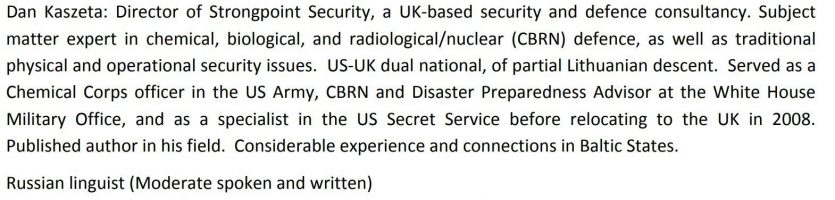
Dan Kaszeta’s Integrity Initiative Biography
In fact, were it not for hacking syndicate Anonymous, his role within the organization’s ‘Specialist Team’ would be entirely unknown, the only documentation linking him to the organization in any way a series of articles he wrote on novichok for the Initiative’s official website over the course of 2018 — which have since been removed from the web, along with all other site content.
Among them was a puff piece ardently defending Porton Down, stating the UK urgently needed the facility “to do valuable work to protect not just the nation’s armed forces but also to protect all of us who live here”, and dismissing as ludicrous the notion any poison could somehow be smuggled out of the “secure compound”.
Given US Fort Derrick is also highly secure, and anthrax was apparently smuggled out of the grounds successfully in 2001, leading to a notorious wave of anthrax attacks in the week after 9/11, this argument is surely dubious. What’s more, Kaszeta would surely have been aware of this, given he claims to have been “heavily involved in the immediate aftermath of the 9/11 attacks and the 2001 Anthrax incidents” — in what capacity though, he doesn’t clarify. Moreover, what published literature exists on novichok (or A-234) indicates the substance can be produced at bench scale by any laboratory.In addition to offering technical information on novichok to journalists — including then-Times Defence Editor Deborah Haynes, part of the Initiative’s UK Cluster — Kaszeta sought to rebut alternative explanations for the attack, and answer key questions such as why the Skripals didn’t die on the spot, and how novichok could poison two further people four months after the incident, writing a dedicated article on the former for politics.co.uk on 6 April. Conspicuously, much of this analysis relied on conjecture rather than science — for instance, when asked by NPR on 12 March 2018 why anyone would use “such an unusual agent”, Kaszeta responded “it was possible, given the historic secrecy around the programme, the culprit may have thought it would go undetected”.
“Maybe somebody somewhere felt they could get away with it,” he says. Then again, he says, it could have just as well been used to send a clear message to would-be spies and defectors. “It’s much more than waking up with a horse head in your bed,” he postulated.
He also frequently tweeted on the subject, the postings apparently becoming newsworthy in themselves — it’s difficult to quantify the exact number of articles featuring his Twitter output, although a 5 July 2018 Yahoo article — Weapons expert busts conspiracy theories about the Wiltshire Novichok attack — is certainly representative in terms of tone and content.
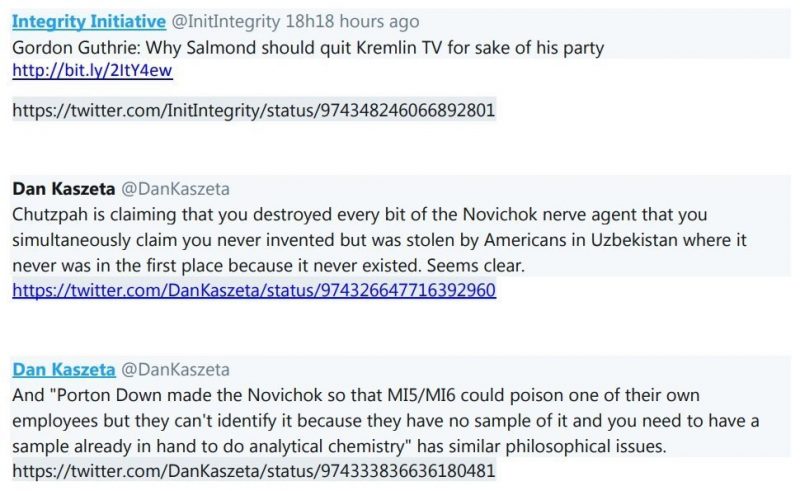
Integrity Initiative Monitors Social Media Activity Related to Salisbury Incident
Every step of the way, Kaszeta’s activities were closely tracked by the Initiative, with ‘expert team’ member Chris Hernon (ex-BBC) noting them in regular roundups. Elsewhere, in an internal email titled ‘FCO Disinformation Update’, FCO Head of Counter Disinformation Andy Pryce hailed his “strong rebuttal of conspiracy theories”.
‘Deep in the Pentagon’
Quite where, and indeed when, Kaszeta gleaned his specialist knowledge of novichok is unclear — particularly as he’s repeatedly (and wrongly) claimed the operation that produced the nerve agent was extremely secretive, and little is known about the substance outside the former Soviet Union.
Moreover, he doesn’t appear to have written a single word about novichok prior to his 8 March 2018 Bellingcat article — and his oft-touted chemical weapons and/or warfare prowess doesn’t appear justified by his professional or academic history either. Kaszeta’s work experience in that regard seems strictly limited to crisis response planning, and he holds a BA in political science and an MA in international affairs — but his LinkedIn profile nonetheless makes for fascinating reading.
His first listed role, from August — December 1990, was ‘policy intern’ at the Office of the Secretary of Defence, which he describes as “hard work at a desk deep in the D ring of the Pentagon during the final days of the Cold War” — and between 1994 — 1996 he engaged in “hard thankless toil in the depths of the beltway bandit universe, relieved only by boondoggles to the [Pentagon think tank] RAND Corporation” at Defence Group Inc. Thereafter, he worked in a number of positions within the US military-industrial complex, including the White House Military Office and Secret Service, before entering the private sector.
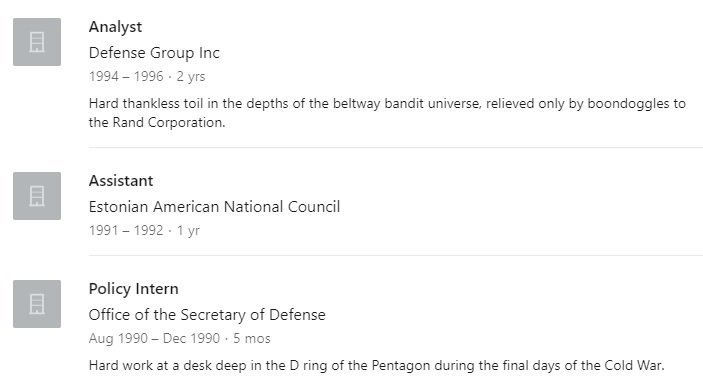
Dan Kaszeta’s LinkedIn Profile
In 2011, Kaszeta founded Strongpoint Security, which “provides consultancy and advice across a wide variety of defence and security disciplines, with a focus on unconventional threats, CBRN defence, crisis management, and physical security assessment”. The company’s website is rudimentary in the extreme, with many sections appearing to have not been updated for many years — for instance, references are made to Kaszeta’s “new” and “recently published” book, CBRN and Hazmat Incidents at Major Public Events, which was released in November 2012. He claims the work is “the first serious attempt to address the diverse and challenging issues of safeguarding the major event environment against the full spectrum of CBRN and Hazmat incidents and accidents”.
Self-aggrandizement is a recurring theme on the site, with Kaszeta boasting that his “degree and depth of expertise is relatively unique [sic] in Europe” — but while he’s bragged about the size of his “expert daily rate”, Companies House records indicate the firm has very little in the way of capital, cash reserves or assets, with annual post-tax profits typically in the low thousands, falling to just US$448 (£394) in the 2016/2017 tax year.
Strongpoint’s yearly takings certainly don’t appear to have ever reached levels by which Kaszeta could support himself, and references to the company online are sparse — any firms that have ever employed his services have certainly not advertised the fact in any way, and neither Strongpoint’s outdated website nor barely active Twitter account offer any sign of the company or its founder actually working, the latter consisting almost exclusively of retweets, often of Integrity Initiative posts.Strongpoint’s lack of assets is even more puzzling given it operates out of Kaszeta’s flat in Pimlico, one of Central London’s most expensive areas, where housing costs an average of US$1.9 million (£1.4 million) in 2019, 135 percent above the city average.
It’s unclear whether Britain’s spying agencies MI5 and MI6, both situated a few minutes’ walk from Strongpoint, have played any role in boosting property prices there — the organizations maintain a large portfolio of lodgings in the district, including 36 Alderney Street (located half a mile from Kaszeta’s home-cum-office), where GCHQ secondee to MI6 Gareth Williams died in extremely mysterious circumstances in August 2010.
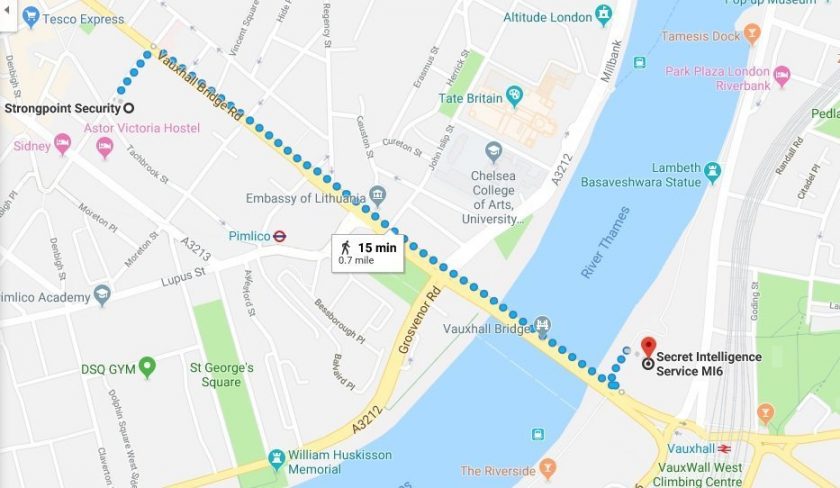
Proximity of Strongpoint Security to MI6 HQ
Nonetheless, Kaszeta owns the residence, so obvious questions must be asked — namely, how is he actually making his living, and is Strongpoint merely a legitimizing professional ‘front’ for other activities, lending superficial credence to his status as ‘independent’ specialist?
‘Counterfeit Expert’
Kaszeta’s rise to media prominence is also somewhat curious. Prior to 2013, he was entirely unheard of in the mainstream — that would change when he began writing articles for Elliot Higgins’ ‘Brown Moses’ blog (the forerunner of Bellingcat ) on 20 August that year, a day prior to the notorious chemical weapons attack in Ghouta, Syria. With Western leaders claiming Syrian government forces were behind the strike, but unable to provide supporting evidence, Kaszeta eagerly filled the void, being a frequent fixture of media reporting on the incident for months afterward.
Among a variety of allegations, his core contention was hexamine had been found by UN inspectors investigating local soil samples and metal fragments, a discovery apparently amounting to “smoking gun” evidence proving Syrian government forces were behind the contested strike, as — he alleged — the fuel can be used in the production of sarin gas, the chemical weapon purportedly used in the Ghouta attack. While Kaszeta has never cited a single scientific paper supporting this thesis, journalists invariably presented his analysis without critique.
He was nonetheless questioned on his various assertions and credentials via email by Theodore Postol, professor emeritus of Science, Technology, and International Security at the Massachusetts Institute of Technology, correspondence the academic later published in a wider July 2014 review.
Over the course of their discussion, Postol writes that Kaszeta made “numerous false science-based claims” which he’d “not researched before [he] made the statements”, referenced quotes “not made by the individuals [he] cited” and claimed scientific expertise he “amply demonstrated” he didn’t have.
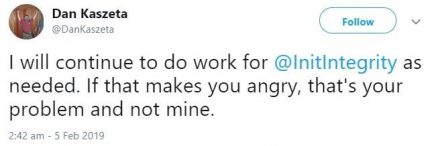
Dan Kaszeta Defends Integrity Initiative Employment
Concluding Kaszeta to be a “counterfeit expert”, the professor notes the self-avowed CBRN aficionado’s aforementioned book contains “no technical or scientific information” that couldn’t be obtained by a “superficial” internet search, and suggests Kaszeta’s prominence in news reports on Ghouta stemmed from a “complete failure” by the media “to exercise the most rudimentary levels of editorial due diligence” and challenge his “ill-informed and inflammatory use of false technical facts”.
Moreover, this bogus “empowerment” of Kaszeta, Postol writes, resulted in “controversy [with] no basis in sound science”, which could’ve played a role in justifying US military involvement in Syria.
Despite this extremely damning indictment of his probity and professional competency, mainstream journalists and news outlets were evidently indifferent, as Kaszeta’s media profile would grow exponentially in the years afterward, leading to his central role in perpetuating the novichok narrative.
Notably, not once in this period has Kaszeta ever provided ‘expertise’ even vaguely inconvenient for Western governments — in fact, he has unfailingly supported and perhaps even legitimized their aggressive policies, in the manner his Ghouta analysis potentially offered a pretext for US action in Syria.
Urban Planning
One of the most renowned journalists to promote Kaszeta’s views on novichok was BBC Diplomatic Editor Mark Urban, who championed his politics.co.uk article as a “common sense answer” to the question of why the Skripals weren’t killed by the poison they seemingly came into contact with, written by a “real expert”.
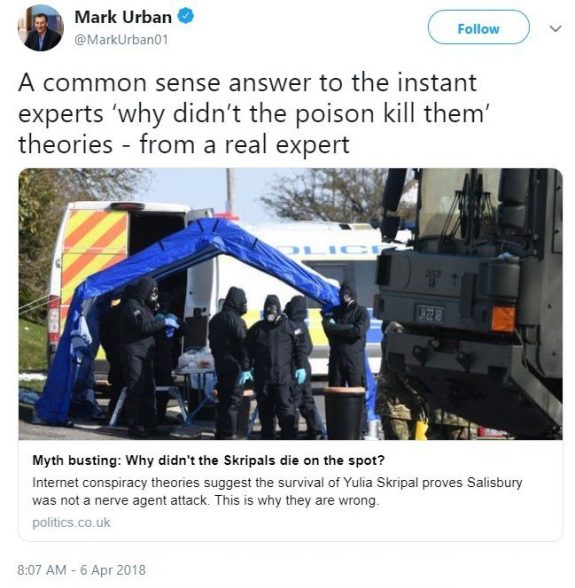
Mark Urban Promotes Dan Kaszeta’s ‘Expertise’ on Twitter
Urban’s advocacy of Kaszeta is perhaps unsurprising given his own peculiar connections to the Skripal affair — for in a shock disclosure, in July he revealed he’d repeatedly met with and interviewed the former Russian intelligence officer in the year prior to the Salisbury incident, while researching a book on the history of East-West Espionage.
That Urban neglected to mention securing such a seismic, serendipitous scoop until four months after that fateful March day — a period in which discussion of the attack, and Skripal, utterly dominated media reporting the world over — is somewhat staggering, but not quite as astounding as him having once served in the same tank regiment as Pablo Miller, Skripal’s MI6 recruiter and handler, and neighbour in Salisbury.
Serious questions hang over Miller’s involvement in the incident, not least because immediately afterward he deleted his LinkedIn, which revealed him to be a Senior Analyst at Orbis Intelligence, the private “investigative consultancy” run by former MI6 operative Christopher Steele, author of the highly controversial ‘Trump-Russia’ dossier — which Integrity Initiative operatives worked to circulate among US politicians.
Furthermore, on 7 March the UK government issued a D-notice related to the Salisbury incident, effectively blocking mention of Miller in the mainstream media since.
“The issue surrounding the identity of former MI6 informer Sergei Skripal is already widely available in the public domain. However, the identities of intelligence agency personnel associated with Sergei Skripal are not yet widely available in the public domain. The provisions of DSMA Notice 05 therefore apply to these identities. If any editor is currently considering publication of such material, may I ask you to seek [the] advice [of the Defence and Security Media Advisory Committee] before doing so?” the notice reads.
Adding to the intrigue, Miller also has an unclear relationship with Integrity Initiative, a leaked file naming him in a list compiled by Initiative chief Chris Donnelly, alongside representatives of the BBC, Porton Down, the FCO, the MOD and the US Embassy. The nature of the register is neither clear from the file itself, nor referenced in any other internal Initiative documents, although Anonymous claim the individuals were invitees to a private meeting with Syria’s notorious White Helmets group. Conversely, former Ambassador to Uzbekistan Craig Murray has speculated the event was in fact related to the Skripal incident, a hypothesis partially supported by the presence of Howard Body, Assistant Head of Science Support at Porton Down (and Assistant Head of Strategic Analysis at the Ministry of Defence) among the names.
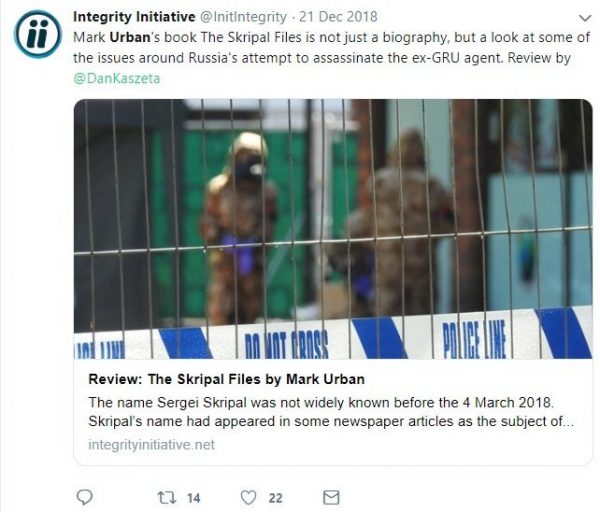
Integrity Initiative Promotes Dan Kaszeta’s ‘Skripal Files’ Review on Twitter
Whatever the truth of the matter, Urban’s aforementioned book, The Skripal Files — widely marketed as the “definitive account” of the incident — was published 4 October 2018. On 21 December, a glowing review of the work authored by none other than Dan Kaszeta was published on the Integrity Initiative website — strikingly, in its introductory paragraph the “counterfeit expert” revealed he’d met with Urban “several times over the past few years”. On 20 January, I emailed Kaszeta seeking clarity on how, why and when it was he crossed paths Urban — predictably he didn’t respond, a recurring theme with Initiative-connected individuals.
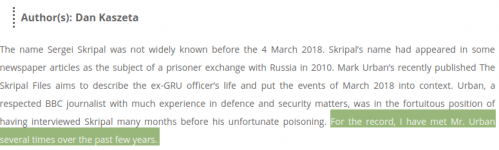
Dan Kaszeta Reviews Mark Urban’s Book, ‘The Skripal Files’
A mere two days later the organization would remove all content from its website, pending an “investigation” into the hack which acquired so much incriminating information from the organization’s servers. While there’s no necessary connection between my contacting Kaszeta and the purge, the timing is at least potentially significant given the review is one of very few Initiative site pages not still accessible via internet archiving services — it’s also not included among the now-dead links to the various articles he wrote for the Initiative on the Strongpoint website.
Wider Conspiracy
Shockingly, Kaszeta was but one cog within a much wider connivance — Operation Iris — constructed by Integrity Initiative. Under its auspices, many Institute for Statecraft and Initiative operatives — and journalists within the organization’s assorted international clusters — played a leading and early role in perpetuating various narratives, myths and recommended “responses” to the incident that would utterly dominate mainstream media reporting of the affair the world over for months afterwards.
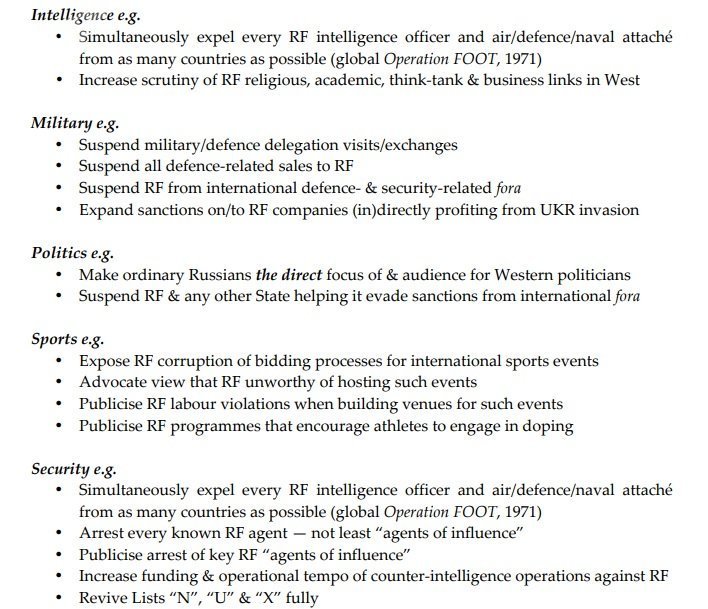
2015 File Written By Victor Madeira on Possible Anti-Russian Actions
In addition to cementing an extremely negative public perception of Russia, the Initiative also sought to influence government policy in the UK — and ensure isolation of Russia internationally.
Disturbingly, many of these narratives, and recommended strategies, were originally mooted in a document produced in 2015 by Initiative staffer Victor Madeira, who likewise played a leading role in pushing particular angles in the wake of the Salisbury incident. Over the coming weeks, Sputnik will document the activities of each and every Operation IRIS operative, in an attempt to ascertain just what role the Initiative played in the Skripal affair, and why.
Integrity Initiative – The HSBC Connection
Real Media | February 3, 2019
“2 Degrees of separation” – a theory whistleblower Nicholas Wilson has, that wherever in the world a financial scandal occurs HSBC is to be found nearby.
Nicholas has been campaigning for 13 years after blowing the whistle on a High Street fraud of excessive bank charges applied to store cards administered by HSBC. He has recently been vindicated by a Financial Conduct Authority ruling and HSBC have had to begin paying back some of the money defrauded from customers. He was dubbed “Mr. Ethical” by his boss at the time for refusing to defraud debtors.
In this first of several interviews for Real Media, he connects Government funding and the security services to the recently revealed psyops outfit, Institute for Statecraft and its ‘integrity initiative’.
He asks whether there might be a connection with the suspicious death of auditor Sergei Magnitsky, who was working for the Hermitage Fund there. HSBC bankrolled and jointly managed the Hermitage Fund with Bill Browder, who appears in Institute of Statecraft’s documents.
Browder, convicted of tax fraud in Russia connected with the Magnitsky affair, has spent years pointing the finger at the Russians over both the killing and the disappearance of nearly quarter of a billion pounds, but a film by Andrei Nekrasov casts suspicion on Browder and HSBC. If the film is to be believed, it would make sense that Browder is involved with a shadowy group set up to counter Russian “disinformation”.
Nicholas Wilson reveals the close associations between HSBC and the UK security forces, and asks whether the Foreign and Commonwealth Office should be giving public funding to the Institute of Statecraft.
More HSBC revelations at nicholaswilson.com
Reality Check: Is Russia planning to invade Sweden or is UK media spreading more baseless hysteria?
By Bryan MacDonald | RT | February 5, 2019
Two of Britain’s leading newspapers have run delirious headlines this week, warning of a potential Russian assault on neutral Sweden.
“Sweden’s first new conscripts prepare to repel Russian invaders” – the Telegraph.
“First Swedish conscripts in a decade begin training to defeat a Russian invasion” – Daily Mail.
Sounds scary, doesn’t it? Poor Sweden (population 9 million) getting ready to repel an attack from big, bad Russia (population 145 million).
Furthermore, to make things even worse, the “aggressor” is a military superpower and the “victim” stands alone, without even NATO to protect it. And that bit is really relevant here, as you will soon see.
Anyway, rest easy: Never mind the bollocks, here’s the British media. Armed with its particular brand of hysteria, mendacity, and click-bait calumny.
The Telegraph, which isn’t even pretending to be a newspaper anymore, bases its “Russian invasion” warning on the testimony of a Colonel Stennabb. He highlights how “Russia is prepared to use military means to accomplish political objectives, not just in Crimea but in Syria.”
Hardly a radical concept, even in Europe where many countries, most notably, France (Libya, Ivory Coast, CAR, Chad, etc.) and the UK (Iraq, Syria, Sierra Leone, Kosovo, etc.) aren’t exactly shy about backing up words with firepower.
At no point does Stennabb explain why Russia would want to invade Sweden. Nor does the Telegraph. Which fails to note Sweden doesn’t even border mainland Russia, although it does sit across the Baltic Sea from the tiny Russian exclave of Kaliningrad.
After all, Sweden has few resources useful to Moscow and IKEA already has plenty of stores around Russia.
That said, Vladimir Putin’s spokesman, Dmitry Peskov, did mention last year that the president is partial to ABBA. But, surely there are easier ways of encouraging them to reform?
The Mail piece largely amounts to a rewrite of the Telegraph’s scaremongering. But they do pad it out a bit, mentioning how “Russia has also been launching incursions into European airspace.”
For illustration, it explains “just last week, a Russian Su-27 fighter was filmed ‘pushing’ an American F-15 out of the way as they patrolled over the Baltic Sea.” Adding how, in a separate incident, “the (US) Pentagon said that a Russian jet came dangerously close to one of its fighters over the Black Sea on Monday.”
So, here we have two American aircraft operating in Europe and this British newspaper is accusing Russia of “launching incursions into European airspace.”
Meaning either the Mail is unaware that Russia is in Europe but the United States is not, or it thinks its readers are stupid.
Anyway, the last major conflict between Sweden and Russia ended in 1790, following a failed Swedish attack two years earlier. Famously, the conflict was started by King Gustav III of Sweden for domestic political reasons.
This present UK media hysteria serves similar ends. Because, in this time of austerity, British Armed Forces spending is squeezed. And what better way to keep the moolah coming than to create a plausible enemy?
Plus, there’s a small, but vocal, bunch both within and without Sweden who hope to drag the traditionally neutral country into NATO. Go figure.
Goodbye ‘Freedom and Democracy’ – Hello ‘Rules-based International Order’
By Paul Carline | OffGuardian | February 2, 2019
The banner and the clarion call of western countries, and their own asserted legitimation – especially when they are engaging in illegal wars and coups – used to be “freedom and democracy”: the precious gift they were generously and selflessly offering to a backward world – or one allegedly in the ‘chains’ of Socialism/Communism. There was “Radio Free Europe”, for example, pushing out western liberal propaganda, primarily against the countries of the former Soviet Union.
The Washington-based “Freedom House” organisation, which claims to be independent, has around 150 staff members in Washington and in ‘field offices’ around the world. Its President is Michael J. Abramowitz, who before joining Freedom House in 2017, was director of the US Holocaust Memorial Museum’s Levine Institute for Holocaust Education. Before that, he was National Editor and then White House correspondent for the Washington Post. He is a member of the Council on Foreign Relations and a former fellow at the German Marshall Fund and the Hoover Institution. He is also a board member of the National Security Archive. The Board of Trustees is chaired by Michael Chertoff, Secretary of Homeland Security under George W. Bush and co-author of the USA Patriot Act.
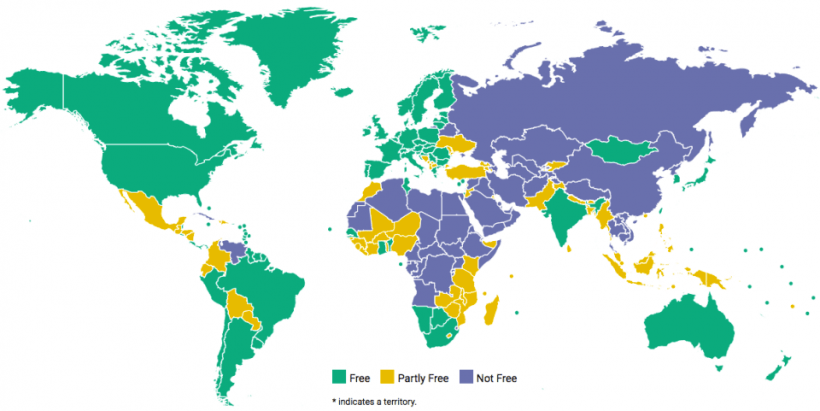
Since 1972, Freedom House, whose website sports a warm endorsement by none other than Francis Fukuyama, has produced an annual “Freedom in the World” global map (above), which divides the world into countries which are either “free”, “partly free”, or “not free”. The allegedly “free” countries are coloured green, the “partly free” ones a kind of muddy yellow, and the “not free” ones blue.
Its analysis of “freedom” covers “the electoral process, political pluralism and participation, the functioning of government, freedom of expression and belief, rights of association and organization, the rule of law, and personal autonomy and individual rights”. The word ‘democracy’ is not used in the ratings system, nor is it defined anywhere, but the 2018 analysis is headlined “Democracy in Crisis”.
According to Freedom House, in 2018 45% of the world (by country) or 39% (by population) was “free”, 30% (country) or 24% (population) was “partly free”, and 25%/37% “not free”. Countries are rated on a percentage points system. Sweden, which last year joined in the NATO ‘war games’ – despite not being a NATO member – is given a full 100 points, Canada 99, Uruguay 98, both Chile and the UK 94, France a completely undeserved 90, the USA 86 and Israel an unreal 79. By contrast, China scores 14, Iran 17, and Russia a mere 20, while Tibet and Syria are granted only 1 point each (no bias there). Almost incredibly, Ukraine scores 62 – allowing it to be rated as “partly free”! Very oddly, the FAQ section is available in only two languages – English and Ukrainian!
I suspect that the statement by Freedom House’s President, Michael J. Abramowitz, to the effect that: “A quarter-century ago, at the end of the Cold War, it appeared that totalitarianism had at last been vanquished and liberal democracy had won the great ideological battle of the 20th century”, must induce wry smiles – if not outright anger – in many Off-Guardian readers. Abramowitz predictably refers to “the rise of populist leaders who appeal to anti-immigrant sentiment and give short shrift to fundamental civil and political liberties” and describes “newcomer Emmanuel Macron” as a “centrist” who “handily” (interesting choice of words!) won the French presidency.
Depressingly predictable is his comment on China and Russia, which he labels “the world’s leading autocracies” and which he asserts “have seized the opportunity not only to step up internal repression but also to export their malign influence to other countries, which are increasingly copying their behaviour and adopting their disdain for democracy” (emphasis added; no mention of the massive ‘disdain for democracy’ in the USA, UK, and numerous members of the EU).
According to Abramowitz, “Democratic governments allow people to help set the rules to which all must adhere, and have a say in the direction of their lives and work!” If that were true, there would be lots of direct democracy in all those “free” countries. It’s true that there is some ‘direct democracy’, e.g. popular initiatives and referendums, in a few states of the USA and in a few European countries – with Switzerland far and away the best example, followed by Germany at the regional and local levels, thanks to the efforts over decades of its leading pro-democracy organisation “Mehr Demokratie”, which has been trying to have direct democratic rights established also at the national level, which would really allow the people to “help set the rules”. Germany’s “Basic Law” (it doesn’t have a proper constitution for reasons which I cannot go into here but which will be known to many) actually states: “All power derives from the people” (Article 20) and “State power is exercised by the people in elections and referendums” (emphasis added) – but successive governments have refused to enact the laws that would allow state-level referendums, presumably because they fear the “people power” that is the literal meaning of ‘democracy’.
Given subsequent developments, Kofi Annan’s 2001 Nobel Peace Prize acceptance speech now strikes a sour note:
“The obstacles to democracy have little to do with culture or religion, and much more to do with the desire of those in power to maintain their position at any cost. This is neither w new phenomenon nor one confined to any particular part of the world. People of all cultures value their freedom of choice and feel the need to have a say in the decisions affecting their lives”
In the 2002 UNDP World Development Report, Annan re-affirmed the true nature of democracy in these words:
“True democratization means more than elections. People’s dignity requires that they be free – and able – to participate in the formation and stewardship of the rules and institutions that govern them”.
According to Abramovitch’s definition, and that of Kofi Annan, there is zero genuine democracy in the U.K. (a purely representative system – especially one still using an outdated and wholly disreputable FPTP system, with rare referendums arranged by the government, which sets the question – is not a legitimate form of democracy).
We may also ask, in parenthesis as it were, who – if not the electorates – is “helping to set the rules”, for example in Europe specifically. As of July 2017, there were 11,327 registered lobby organisations in the EU, employing some 82,096 people – the equivalent of 50,326 full-time personnel – of which nearly 7,000 have access to the Parliament. In Germany there are around eight lobbyists – representing ‘outside’ interests – for every member of the national parliament – and the lobby registers are voluntary. Only seven countries (France, Ireland, Lithuania, Austria, Poland, Slovenia and the UK) have passed any laws on lobbying.
What is extremely interesting and telling is the general absence of references to ‘freedom and democracy’ by our so-called ‘leaders’. Those words have been replaced in the political lexicon by the now clearly favoured expression “the rules-based international order” – which doesn’t have quite the same ring, or the same connotations, as “freedom and democracy”.
One is forced to ask: whose order? whose rules? If Abramowitz is correct, and since we are privileged enough to live in a country which, if we are to believe its FH rating, is little short of perfect, we the people must have been involved in setting those rules. We should at least have been told what they mean! For example, what does ‘international’ mean in this context? It suggests a global compact – but when it is used it specifically excludes certain countries and regimes which we are led to believe are not part of, or indeed are allegedly trying to undermine, this new ‘order’.
Although the word ‘international’ is often taken to be a synonym for ‘global’ or ‘universal’, its literal meaning is ‘between nations’. The UN has of course long promulgated and endorsed all kinds of ‘universal’ rules (the ICC rules on aggression for instance) – many of which are routinely flouted by the countries which most loudly lay claim to being ‘democracies’ and loyal observers of the “rules-based international order”.
But we are now seeing a new type of literally ‘inter-national’ agreements being made in Europe, often merely between two governments at a time (with no democratic endorsement by either parliaments or people) and where the suspicion is that this is a new way of hiding from the general public what is really going on in Europe – specifically the step-by-step implementation of the “United States of Europe” project which dates from at least 1946.
There seems to be an undue haste to complete the creation of a unified military establishment that would not be answerable to the individual nation states which are contributing their forces (and infrastructure!) and which would also appear to include a much closer working relationship between military and police forces. Does the urgency have to do with the level of chaos in Europe and the threat – now materialised in the form of the “Yellow Vest” protests – of widespread civil unrest and potentially public revolt?
So Prime Minister Theresa May can pretend to the public that the ‘Brexit’ approved by a majority of voters will take place i.e. that Britain will “come out of” the EU, while at the same time, and largely in secret or behind closed doors in completely undemocratic meetings, the government is committing the entire UK military establishment, step by step, to the new ‘unified European defence establishment’. The UK enters into a special relationship with France (and thereby with the EU). France and Germany have just signed a new treaty – the Aachen Treaty – so does the UK automatically acquire the special relationship with Germany? And will this “two-step” approach eventually link all willing states (one could imagine Hungary, perhaps Italy and Greece also, not being so willing) in the ‘new European order’?
In struggling to understand the “rules-based international order” I found this definition by the RAND Corporation very helpful:
Since 1945, the United States has pursued its global interests through creating and maintaining international economic institutions, bilateral and regional security organizations, and liberal political norms; these ordering mechanisms are often collectively referred to as the international order.
In recent years, rising powers have begun to challenge aspects of this order. This report is part of a project, titled “Building a Sustainable International Order,” that aims to understand the existing international order, assess current challenges to the order, and recommend future US policies with respect to the order.
This report is the first of those and reflects the project team’s attempt to understand the existing international order, including how US decision makers have described and used the order in conducting foreign policy, as well as how academics have assessed the mechanisms by which the order affects state behaviour.
When discussing policy responses to a fraying international order, the first challenge is to understand what we mean by the term. Order has various meanings in the context of international politics, and specific orders can take many forms.1 For the purposes of this project, we conceive of order as the body of rules, norms, and institutions that govern relations among the key players in the international environment. An order is a stable, structured pattern of relationships among states that involves some combination of parts, including emergent norms, rulemaking institutions, and international political organizations or regimes, among others.
– RAND Corporation 2016, Understanding the Current International Order
This more recent observation was both insightful and amusing:
“The rules-based international order is being challenged, quite surprisingly, not by the usual suspects, but by its main architect and guarantor, the US,” Donald Tusk, the president of the European Council, said as the summit meeting got underway in Quebec’s picturesque resort town of La Malbaie on the banks of the St. Lawrence River.
The trans-Atlantic rift manifested itself in a behind-the-scenes debate about the wording of the traditional summit communiqué. The American side objected to including the phrase “rules-based international order,” even though it is boilerplate for such statements, according to two people briefed on the deliberations. The Europeans and Canadians were pushing back, but it remained unclear whether the Trump administration would ultimately sign the statement or be left on its own.
– NYT June 8, 2018 Michael D. Shear
So the ‘rules-based international order’ is, in reality, the expression of America’s “global interests”. Other parties – such as British and other governments – may be allowed to put on the mask of the Eagle, whilst claiming to be on the side of justice, truth, human rights … and yes, democracy. And since it’s a US construct, the US and its allies can feel free to ‘make it up as they go along’.
Brits and the Holocaust
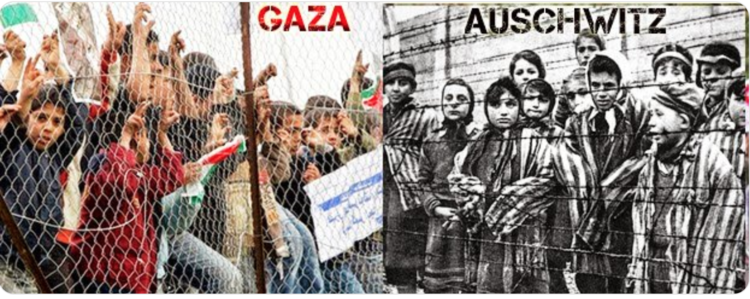
Not to see that Gaza is a concentration camp is a Holocaust denial!
By Gilad Atzmon | January 29, 2019
The British and Jewish press reported yesterday that a poll released to mark International Holocaust Remembrance Day found that “1 in 20 British adults does not believe the Holocaust happened and 12% think the scale of the genocide has been exaggerated.”
Nearly half of those questioned said they did not know “how many Jews were murdered by the Nazis and one in five people thought fewer than two million Jews were killed.”
This is proof, once again, that the more they dogmatically insist on trumpeting the primacy of Jewish suffering, the less people are interested in the Jewish plight. The same principle applies to anti-Semitism, the more Jewish institutions bemoan the tragedy, opposition to Jewry grows in the Kingdom and beyond.
Speaking for the Holocaust Memorial Day Trust, which commissioned the poll, Olivia Marks-Woldman told the BBC that: “without a basic understanding of this recent history, we are in danger of failing to learn where a lack of respect for difference and hostility to others can ultimately lead.” If Marks-Woldman is truly concerned about ‘respect for difference and hostility to others’ she may want to point out what she and the Trust have done to stop the holocaust now taking place in Palestine at the hands of no other than the Jewish State.
Karen Pollack, chief executive of the Holocaust Educational Trust, said in a statement that the survey showed “the need to increase education about the genocide.” How many more hours should BBC Radio 4 dedicate to the Nazi era and Jewish suffering bearing in mind that we have only 24 each day?
The Jewish press also noted that the poll results are consistent with CNN’s recent findings that one-fifth of Europeans believe Jewish people have too much influence in finance and politics, and one-third said they knew nothing at all or “just a little” about the Holocaust. I wonder if this means that it is time that Jewish institutions examine themselves and try to figure out what is at play here. Why are Europeans ‘denying’ the Jewish past? How is it possible that the more time, effort and money are invested in ‘Holocaust education’ the ‘less educated’ people seem to be?
But here’s the twist. The Times Of Israel reported yesterday that last December “a major European report found nearly 90 percent of European Jews feel that anti-Semitism has increased in their home countries.” Apparently the most common ‘anti-Semitic’ statements Jews heard were “comparisons between Israelis and the Nazis with regard to the Palestinians.”
Perhaps the Holocaust Memorial Trust ought to be reassured by this positive finding. Not only do Europeans and Brits understand the Holocaust, they manage to apply its message in a universal manner. They are disgusted by fascism, racism, ethnic cleansing and oppression and happen to see Israel’s leadership as the Nazis of our time. I accept that this may be offensive for some Jews, but it does indicate that the most important lesson of the Holocaust, the importance of opposition to racism and oppression, is well and widely understood.
Of Suspected Spies & Cathedrals… and Western Media Hypocrisy

By Finian CUNNINGHAM | Strategic Culture Foundation | 27.01.2019
It’s hilarious to see the double standards of Western media applied in the case of alleged American spy Paul Whelan who is being detained in Russia and facing trial.
Whelan, a former US marine, was denied bail this week in a Moscow court after it emerged that he had been found in possession of state secrets while supposedly holidaying in Russia.
Western media widely aired the theory that the American man has been “set up” by Russian state security after he had received a USB computer stick from someone while staying in a Moscow hotel last month. The person whom he received the disk from has not been identified, but presumably he or she was known to the American, otherwise why would he have accepted the item?
Whelan claims he was in Russia as a tourist and that he didn’t check the contents of the computer mini-disk at the time because he assumed it contained “images of a cathedral he had visited”. He was reportedly arrested soon after receipt of the disk, on December 28, by Federal Security Service (FSB) officers.
This sounds eerily familiar. Remember the two Russian men who visited Salisbury in March last year at around the time of the alleged poisoning of former Kremlin spy Sergei Skripal? Months later, those two men were identified as “suspects” on British CCTV cameras whose images were broadcast by media. Both then promptly came forward to give an interview to Russian media in order to clear their names, which they confirmed as Alexander Petrov and Ruslan Boshirov.
Petrov and Boshirov claimed they were in Salisbury around March 4 as tourists, not as Kremlin assassins as the British media were sensationally alleging. Asked why they were in Salisbury, the pair said it was to visit the medieval English town’s “famous cathedral” and its 123-meter spire.
The immediate reaction by British media in particular was to pour scorn and ridicule on the men’s story. The British government rubbished their claim as “obfuscation and lies”. Journalists and pundits lambasted the pair with guffaws and mockery.
Petrov and Boshirov denied they had any involvement in the alleged poisoning of Skripal – supposedly with a deadly Soviet nerve agent – and they said they were not Kremlin agents but rather worked in the sports nutrition business.
There is no indication thus far that the men’s story is false. Also, what really happened to Skripal and his daughter Yulia remains a mystery since the British authorities won’t reveal where they are – 10 months after the alleged poisoning incident.
The only follow-up media report on the Russian men’s alleged security service affiliation was by the dubious UK-based Bellingcat website, which has a history of fabricating anti-Russian propaganda, such as alleged chemical weapons attacks in Syria and the alleged shooting down by Russian-backed separatists of a Malaysian civilian airliner in eastern Ukraine in 2014.
In the case of Paul Whelan, a former US elite soldier who possesses four passports and who apparently visited Russia several times and had become familiar with the country, he is permitted by Western media to plead his innocence invoking an interest in cathedrals and churches. Not a wink of skepticism here.
However, in the case Petrov and Boshirov, who have no known background in military, they are immediately scoffed at for their declared interest in Salisbury’s medieval cathedral, which by the way is world famous and attracts thousands of visitors every year, including many Russian tourists.
What’s more, in the case of Whelan, the Western media has gone further to report that he is being set up by Russian agents, who planted the state secrets in the USB disk. It is speculated in the Western media that the Kremlin is using the American as a bargaining chip in a potential prisoner-exchange deal for Russian citizen Maria Butina. Butina was jailed at the end of last year in the US after she pleaded guilty to espionage charges, following months of isolated detention. The Kremlin said she had no association with its agencies.
Moscow categorically denies that there is an ulterior agenda for doing a prisoner swap. Russian authorities have said that Whelan was simply “caught red-handed” with state secrets and is being prosecuted accordingly. The classified information is believed to contain the names of individuals who work for Russian secret services.
Whelan’s family back in the US maintain he is innocent and that he was in Russia to attend the wedding of a friend. If found guilty, he could be facing up to 10-20 years in jail.
Who knows, maybe the American was set up in a dirty game of state intrigue.
The case of Maria Butina appears to be a disturbing one of the American state framing up a Russian citizen to bolster a political agenda of alleged Russian interference in US elections. Her pre-trial detention in solitary confinement certainly amounts to a form of psychological torture to pressure a confession. Butina is facing several years in prison, despite many observers considering her to be innocent.
But one thing seems glaringly obvious: the double standard being used by Western media which is borne out of its relentless Russophobia.
A former US marine is seen as a plausible tourist interested in viewing cathedrals whom, the Western media claim, is now being persecuted by despotic Russian authorities; while two Russian civilians are pilloried for plying a “ridiculous cover story” about Salisbury’s 123-meter spire.
Featured Video
Death Spikes & Rising Cancer In Our Youth Explained
or go to
Aletho News Archives – Video-Images
From the Archives
Politicians lie
By Mazin Qumsiyeh | Popular Resistance | August 18, 2013
There is no way to say this truth nicely: Politicians lie. That includes Japanese, American, Egyptian, Israeli, and Palestinian politicians! Is there something more common sense than that? Yet, so many citizens around the world believe their own politicians or wistfully acknowledge lies but think it is part of the job needed to run things. They believe even when politicians contradict themselves blatantly. This phenomenon is rather remarkable. It is a dissonance and disconnect from reality that many seem oblivious to. It is very dangerous because it can lead to accepting rationales for going to war. These can be deadly wars that lead to millions of lives lost as happened in what was called World War 1 and WW2. Even when incredible and declassified evidence abound, politicians continue to lie and old mythologies refuse to die. Here are just a few of the countless lies told to us over the past few decades… continue
Blog Roll
 Aletho News
- Ukrainian Soldiers, Potential Mercenaries: Have Gun, Will Travel!
- Burnham’s UN debut… A masterclass in British disinformation
- Iran flights continue despite US aviation sanctions
- Global Tipping Points Lead the World Into a State of Entropy
- The day-after at the White House: USA and Xi Jinping
- The Geopolitical Balance in the Red Sea: The UAE Being Displaced by New Players
- Iraqi resistance group vows to stage airport sit-ins over Iran aerial blockade
- Turkish parliament to review Saudi-Pakistan defense pact next month
- DEATH SPIKES & RISING CANCER IN OUR YOUTH EXPLAINED
- Iran offers Trump deal before US election
- If Americans Knew
- Deconstructing Netanyahu’s pants-on-fire UN rant – Daily Update
- Trump betrayed voters with his campaign lies and prioritized a foreign country once he took office
- Netanyahu calls Israel’s war in Gaza ‘opposite of genocide’ in UN speech to near-empty hall
- Settler Kidnappings: Torture, Sexual Abuse and Terrorisation of Palestinian Abductees as Israel Deepens Annexation of West Bank
- Gaza winter nears as 162,000 tents become unusable, raising fears of humanitarian crisis
- Netanyahu says, “It’s the opposite of genocide”; UN says Gaza economy is world’s ‘most severe crisis on record’ – Daily Update
- Israel’s US-Backed Assault on Gaza Has Created the ‘World’s Most Severe Economic Crisis on Record’: UN
- ‘Protecting U.S. Citizens’… From Israel
- ‘This is where I live now, the back of a truck’: a day in the life of a grandmother in Gaza
- In UN Speech, Iran’s President Displays Pictures of Children Killed by US, Brings Attention to Israel’s Nuclear Arsenal
- No Tricks Zone
- New Study: Earth And Venus Surface Warmth Largely Explained By Convection And Lapse Rate, Not CO2 Or Radiation
- 2025 Nature Paper Claiming Worsening Global Drought Gets RETRACTED …Heavily Flawed
- New Study: ‘Global Drought Shows No Detectable Recent Acceleration Under Climate Warming’
- Economic Masterminds: German Socialists Suggest Taxing Productivity Gains Stemming From Using AI
- The South China Sea Has Not Been Cooperating With The Climate Change Narrative
- Energy Crisis: Germany Enters Heating Season With Historically Low Gas Reserve Fill Levels
- New Study: The Antarctic Ice Sheet Gained Mass From 2020-2024 Due To Staggering Snow And Ice Accumulation
- Study: Ocean Heating Rates From Thousands Of Years Ago ‘Dwarf’ Modern Ocean Heating Rates
- Climate Extremists Target, Attack Large-Scale Power Grid Infrastructure In Germany!
- New Study: Antarctic Ice Melt Has Contributed Less Than 1 Centimeter To Sea Level Rise In The Last 30 Years

