

Councils have cut services but spend millions on CCTV

TruePublica | January 23, 2019
Most people in the UK think quite wrongly that they live in a country where freedom and privacy is the basic right of all citizens. The UK currently holds the record for the largest number of CCTV cameras per person. Although Britain contains only contains 1 per cent of the world’s population, its citizens are watched by 20 per cent of the world’s CCTV cameras. Research in 2013 estimated that there are up to six million cameras in the UK, and the network is expected to expand even further, which according to a recent report it has achieved. But there’s more.
To add to worries of illegal state surveillance – “the risk potential for intrusion on citizens has significantly increased both by lawful operators of surveillance camera systems and those individual or state actors who seek to hack into systems,” Surveillance Camera Commissioner Tony Porter said.
In addition, we should not forget the Automatic Number Plate Recognition (ANPR) system. ANPR is one of the largest non-military databases in the UK, with around 9,000 cameras nationally that captures between 25 million and 40 million pieces of data per day, while up to 20 billion “read” records are held.
Porter described this activity as “formidable”, saying:
“The nature of its capabilities to intrude on privacy by building patterns of travel and the provision of imagery should not be underestimated.”
“I firmly believe that this system needs legislative oversight and that the Government should place this system on a statutory footing.”
It is estimated that there are over half a million CCTV cameras in London alone where the average person is photographed or videoed approximately 300 times every single day.
And if mass state surveillance, much of which has been deemed illegal by the highest courts in the land is of concern, then diverting much needed public funds from important social support programmes to surveillance is utterly appalling.
Reported in The Times is an article about how councils are now spending millions of pounds spying on residents despite cutting services in almost every other area.
“Local authorities in England have spent more than three-quarters of a billion pounds on CCTV over the past decade, an increase of 17 per cent a year since 2010. Over the same period councils have reduced spending on street cleaning by 12 per cent, food safety by 16 per cent, trading standards by 32 per cent and libraries by 35 per cent.
Critics said the increase in spending on CCTV while other departments had their budgets cut was “offensive”.”
Big Brother Watch Director, Silkie Carlo, said:
“Research consistently shows that public cameras are ineffective at deterring, preventing or even solving crime, but that too much CCTV does curb citizens’ freedom. The UK is already one of the most surveilled nations in the world, with six million CCTV cameras recording us every day. Surveillance is no substitute for policing and this will prove to be a terrible waste of money.”
UK-funded psyop outfit Integrity Initiative locks Twitter account after wiping content from website
RT | January 23, 2019
After wiping its website clean pending a ‘probe’ into embarrassing leaks, the British state-funded Integrity Initiative (II) has hidden its Twitter account from the public, meaning only ‘approved’ followers can see its activity.
The Scotland-based organization, which received roughly £2 million in government funding over the last 18 months, had fashioned itself as a benign charity fighting “disinformation” online.
That was until a series of leaks, posted online by a group that claimed to be associated with the Anonymous hacker collective, revealed that it had been working with “clusters” of journalists, politicians and academics to engage in shady anti-Russia ‘influence’ campaigns across Europe, as well as a domestic smear campaign against Labour leader Jeremy Corbyn, who it tried to frame as a tool of the Kremlin.
The decision to lock its Twitter account comes just a day after the II announced (via that Twitter account) that it had deleted all content from its website pending an investigation into the “theft” of its data.
A statement posted on the site claimed that some of the leaks had been “falsified” but didn’t include any evidence to back that up, leading to speculation that the organization was simply trying to clean house and prepare a credible excuse in the wake of the disturbing leaks.
That perception has only intensified since it decided to hide its tweets from the public, with some wondering why the group would need to delete all of its content and hide its social media activity from the public if there was nothing questionable in its history.
Academic Tim Hayward tweeted that it was strange that a person now had to be an “accepted” follower in order to see how the II defends them from disinformation. Hayward said the move should force the Foreign and Commonwealth Office (FCO) to “reconsider” its funding for the sketchy operation.
Others complained that the general public should be allowed to view the activity of a taxpayer-funded organization and suggested that it would only make its account private if it had something to hide.
The II has faced sharp criticism from alternative news outlets and independent journalists since the first batch of leaks were dumped in November, but little coverage from British and US mainstream media which has preferred to stay away from the story despite many questions about its funding and activities being left unanswered.
The Integrity Initiative and the British Roots of the Deep State: How the Round Table Infiltrated America
Kissinger’s takeover of the State Department ushered in a new era of British occupation of American foreign policy
By Matthew Ehret | Oriental Review | January 23, 2019
With the nearly weekly revelations that the British Foreign Office, MI6, and GCHQ have been behind the long standing agenda to undermine the Presidency of Donald Trump and undo the peaceful alliance between nationalist leaders in America, Russia, China and elsewhere, a new focus on the British hand in undermining the United States has become a serious thought for many citizens. In the first week of the new year, fuel was added to this fire when internal memos were leaked from the British-run Integrity Initiative featuring a startling account of the techniques deployed by the anti-Russian British operation to infiltrate American intelligence institutions, think tanks and media.
For those who may not know, The Integrity Initiative is an anti-Russian propaganda outfit funded to the tune of $140 million by the British Foreign office. The January 2019 leak, featuring documents dated to the early period of Trump’s election, demonstrate that this organization, already active across Europe promoting anti-Russian PR and smearing nationalist leaders such as Jeremy Corbyn, was intent on spreading deeply into the State Department and setting up “clusters” of anti-Trump operatives. The documents reveal high level meetings that Integrity Initiative Director Chris Donnelly had with former Trump Advisor Sebastien Gorka, McCain Foundation director Kurt Volker, Pentagon PR guru John Rendon among many others.
The exposure of the British hand behind the scenes affords us a unique glimpse into the real historical forces undermining America’s true constitutional tradition throughout the 20th century, as Mueller/the Five Eyes/Integrity Initiative are not new phenomena but actually follow a modus operandi set down for already more than a century. One of the biggest obstacles to seeing this modus operandi run by the British Empire is located in the belief in a mythology which has become embedded in the global psyche for over half a century and which we should do our best to free ourselves of.
Debunking the Myth of the “American Empire”
While there has been a long-standing narrative promoted for over 70 years that the British Empire disappeared after World War II having been replaced by the “American Empire”, it is the furthest thing from the truth. America, as constitutionally represented by its greatest presidents (who can unfortunately be identified by their early deaths while serving in office), were never colonialist and were always in favor of reining in British Institutions at home while fighting British colonial thinking abroad.
Franklin Roosevelt’s thirteen year-long battle with the Deep State, which he referred to as the “economic royalists who should have left America in 1776″, was defined in clear terms by his patriotic Vice-President Henry Wallace who warned of the emergence of a new Anglo-American fascism in 1944 when he said:
“Fascism in the postwar inevitably will push steadily for Anglo-Saxon imperialism and eventually for war with Russia. Already American fascists are talking and writing about this conflict and using it as an excuse for their internal hatreds and intolerances toward certain races, creeds and classes.”
The fact is that already in 1944, a policy of Anglo-Saxon imperialism had been promoted subversively by British-run think tanks known as the Round Table Movement and Fabian Society, and the seeds had already been laid for the anti-Russian cold war by those British-run American fascists. It is not a coincidence that this fascist Cold War policy was announced in a March 5, 1946 speech in Fulton, Missouri by none other than Round Table-follower Winston Churchill.
The Empire Strikes
When the Round Table Movement was created with funds from the Rhodes Trust in 1902, a new plan was laid out to create a new technocratic elite to manage the re-emergence of the new British Empire and crush the emergence of American-inspired nationalism globally. This organization would be staffed by generations of Rhodes Scholars who would receive their indoctrination in Oxford before being sent back to advance a “post-nation state” agenda in their respective countries.
As this agenda largely followed the mandate set out by Cecil Rhodes in his Seventh Will who said “Why should we not form a secret society with but one object: the furtherance of the British Empire and the bringing of the whole uncivilized world under British rule, for the recovery of the United States, and for the making of the Anglo-Saxon race but one Empire?”
With the help of an anglophile, racist president in America, leading figures organizing these think tanks first advanced a program to create a “League of Nations” as the solution to the “nationalist problem” which humanity was told “caused” World War One. Nationalist forces in America rejected the idea that the constitution should be rendered obsolete and the plan for global governance failed. However that did not stop the Round Table Movement from trying again. Leading Round Table controller Lord Lothian (British Ambassador to the USA) complained of the “American problem” in 1918.
”There is a fundamentally different concept in regard to this question between Great Britain and the United States as to the necessity of civilized control over politically backward peoples…. The inhabitants of Africa and parts of Asia have proved unable to govern themselves…. Yet America not only has no conception of this aspect of the problem but has been led to believe that the assumption of this kind of responsibility is iniquitous imperialism.
They take an attitude towards the problem of world government exactly analogous to the one they [earlier] took toward the problem of the world war. If they are slow in learning we shall be condemned to a period of strained relations between the various parts of the English-speaking world. [We must] get into the heads of Canadians and Americans that a share in the burden of world government is just as great and glorious a responsibility as participation in the war”.
A Chinese leader of the American-inspired republican revolution of 1911 named Sun Yat-sen warned of the likes of Lord Lothian and the League of Nations in 1924 when he said “The nations which are employing imperialism to conquer others and which are trying to maintain their own favored positions as sovereign lords of the whole world are advocating cosmopolitanism [aka: global governance/globalization -ed] and want the world to join them… Nationalism is that precious possession by which humanity maintains its existence. If nationalism decays, then when cosmopolitanism flourishes we will be unable to survive and will be eliminated”.
New Name. Same Beast
By 1919, the Round Table Movement changed its name to the Royal Institute for International Affairs (aka: Chatham House) with the “Round Table” name relegated to its geopolitical periodical. In Canada and Australia, branches were created in 1928 under the rubrics of “Canadian and Australian Institutes for International Affairs” (CIIA, AIIA). However in America, where knowledge of the British Empire’s subversive role was more widely known, the name “American Institute for International Affairs” was still too delicate. Instead the name “Council on Foreign Relations” was chosen and was chartered in 1921.

Rhodes Scholar William Yandall Elliot surrounded by a few of his leading disciples: Sir Kissinger, Zbigniew Brzezinski Samuel Huntington and Pierre Trudeau
Staffed with Rhodes Scholars and Fabians, the CFR (and its International Chatham House counterparts) dubbed themselves “independent think tanks” which interfaced with Rhodes Scholars and Fabians in academia, government and the private sector alike with the mission of advancing a foreign policy agenda that was in alignment with the British Empire’s dream of an Anglo-American “special relationship”. One such Rhodes Scholar was William Yandall Elliot, who played a major role mentoring Henry Kissinger and a generation of geo-politicians from Harvard, not the least of whom include Zbigniew Brzezinski, Pierre Elliot Trudeau and Samuel (Clash of Civilizations) Huntington.
The Round Table in Canada and the Coup Against FDR
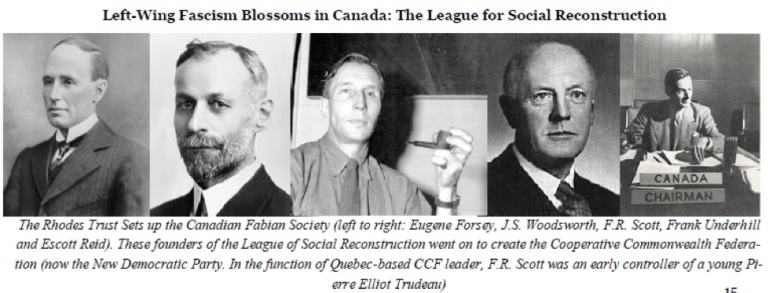
In Canada, five leading Rhodes Scholars were busy creating the League of Social Reconstruction as a self-described “Fabian Society of Canada” in 1931 which was meant to be a fascist/technocratic answer to the chaos of “greedy nationalism” that supposedly caused the economic collapse of Black Friday in 1929. During the same time in America, a different path to fascism was taken by these networks during the early 1930s. This plan involved installing a General named Smedley Butler into power as a puppet dictator steered by the Anglo-American establishment. Luckily for America and the world, General Butler blew the whistle on the coup against Franklin Roosevelt at the last minute.
Kissinger’s British Takeover of America
Though it took a few assassinations throughout the post war years, Kissinger’s takeover of the State Department ushered in a new era of British occupation of American foreign policy, whereby the republic increasingly became the “Dumb Giant” acting as “American Brawn for the British brains” using Churchill’s words. While a nihilistic generation of youth were tuning in on LSD, and an old guard of patriots surrounding Wallace and Kennedy had fallen to the “red scare” witch hunt, geopolitical theory was fed like a sweet poison down the throat of a sleeping nation, replacing a policy of peace and “win-win cooperation” advanced by true nationalist patriots as FDR, Wallace and the Kennedys, with an imperial clone masquerading as a republic.
Sir Kissinger did nothing less than reveal his total allegiance to the British Empire on May 10, 1981 during a Chatham House conference in Britain when he described his relationship with the British Foreign office in the following terms: “The British were so matter-of-factly helpful that they became a participant in internal American deliberations, to a degree probably never practiced between sovereign nations… In my White House incarnation then, I kept the British Foreign Office better informed and more closely engaged than I did the American State Department… It was symptomatic”.
During this period, Kissinger worked closely with CIA director George Bush Senior, who was later rewarded for his role in advancing the British-planned first war on Kuwait with a knighthood. This war set the stage for the second wave of Middle East wars beginning with the Anglo-Saudi orchestrated operation known as 9/11 and the ushering in of the new “post-nation state order” by Kissinger and Blair.
This was the era which was celebrated by both Kissinger and Bush in sundry places as “the New World Order”.
The Dystopic New World Order Threatened by a New Deal of the 21st Century
It is this dystopic geopolitical order which has been challenged by the Russia-China alliance which arose in earnest with Xi Jinping’s 2013 announcement of the Belt and Road Initiative as the Grand design for large scale infrastructure projects internationally and in September 2015 with Vladimir Putin’s intervention into Syria which defeated the Hobbesian regime change paradigm which poisoned the west. In 2016, the election of nationalist American President Donald Trump opened the door for the first time in over 50 years to a true national coalition of sovereign nations to eliminate the cancer of colonial thinking forever from the earth.
It is this same British-run deep state which owns Robert Mueller, who along with the Integrity Initiative, Five Eyes and other Deep State operatives are dedicated to overthrowing President Trump from office and undoing the great potential now facing the world as outlined by the Schiller Institute and American statesman Lyndon LaRouche: 1) an FDR-style re-organization of the bankrupt banking system and 2) the unleashing of a global New Silk Road as the New Deal of the 21st Century.
Matthew J.L. Ehret is a journalist, lecturer and founder of the Canadian Patriot Review.
Integrity Initiative wipes website pending probe into ‘theft’ of disturbing leaked data
RT | January 22, 2019
The British state-funded Integrity Initiative, exposed last year for conducting Europe-wide political influence campaigns in leaked files, has removed all of its website content “pending an investigation” into the data “theft.”
A group claiming association with the loose hacktivist collective Anonymous has been dumping private Integrity Initiative documents online in various batches since November. The leaks revealed that the Scotland-based, government-funded organization, which bills itself as a non-partisan disinformation-busting charity, was actually using “clusters” of journalists, politicians, and academics to carry out secret anti-Russia campaigns, interfere in domestic politics across Europe and smear anyone who questioned its narratives.
In a surprise move on Monday, the Integrity Initiative abruptly announced on Twitter that it had “temporarily removed” all content from its site “pending an investigation into the theft of data” from the Institute of Statecraft, the II’s London-based parent operation.
In a statement posted on its now mostly bare website, the II claimed the leaks were “part of a campaign to undermine the work” of the Initiative which it said involved “researching, publicising and countering the threat” Europe faces in the in the form of “disinformation” and “hybrid warfare” – ironically, exactly what the shady organization itself was accused of engaging in with its hefty government paycheck.
It remains an open question if, in an effort to save face, the group would accuse Russia of being behind the leaks and even of doctoring the documents. While the statement admitted that some of the leaks were “genuine,” it claimed others were “falsified” – but did not provide any evidence to back up that claim. It is, however, apparent that Russia has been the Initiative’s main target during the course of its questionable work.
The website will be “relaunched shortly” and “analysis” of the hack and its “significance” will be published soon, the statement said. It doesn’t look as though many will be awaiting that analysis with bated breath, however.
Perhaps discouraging for the Integrity Initiative, few seemed upset to see their content disappear. Most responses to the announcement tweet are of the trolling variety, accusing the organization of simply being caught in the act and trying to clean house.
After the II leaks, Scottish newspaper the Daily Record wrote that the revelations – including that the government-funded organization had also conducted a domestic smear campaign against Jeremy Corbyn – was “one of the biggest political scandals of the year.”
The scandal received scant coverage by mainstream British media, however. Labour MP Chris Williamson told RT earlier this month that the lack of interest could have something to do with the fact that high profile journalists themselves were seemingly involved in the shady operation.
Pro-Palestine group wins UK High Court battle over ‘terrorist’ label
MEMO | January 21, 2019
In a blow to Israel, a British high court has ordered World-Check, a subsidiary of Reuters, to pay compensation and offer an apology to a pro-Palestine organisation listed as a terrorist group on its global online database.
A two-year legal battle concluded with World-Check offering a public apology in open court and a legal settlement of $13,000 plus legal costs to Majed Al-Zeer, the chairman of the Palestinian Return Centre (PRC), for classifying them as “terrorists”.
It was found that Israel’s designation of PRC and its chairman as terrorists was adopted by World-Check which supplies private information on potential clients for corporations, businesses and even governmental agencies, such as police and immigration.
With more than 4,500 clients including 49 of the world’s 50 largest banks and 200 law enforcement and regulatory agencies, World-Check has become essential in satisfying statutory requirements towards due diligence obligations. However their failure to carry out satisfactory checks and independent verification has raised concerns over the misuse and falsification of data that can have severe consequences for victims.
Declaring his victory over World Check service today at a London press conference as “a precedent for those who are on the forefront of human rights and justice” Al-Zeer said he had been a “victim of an organised campaign waged by Israel and its spin machine of propaganda and false information.”
Pointing to World-Check’s failure to carry out independent verification he said that “companies and [news] outlets are failing utterly in protecting the basic ethics of media and reporting by adopting false fabrications often reiterated by Israel propaganda doctors” while claiming that they are “often wittingly or unwittingly mislead by the Israeli propaganda which aims at damaging the reputation and fine image of human rights defenders”.
The PRC has been granted consultative status with the UN Economic and Social Council. Over the past 30 years the centre has advocated for Palestinian refugees at international forums like the UN and EU. In addition to producing reports on the situation of Palestinian refugees; hosting conferences to defend their human rights, the UK organisation has been leading parliamentary delegations to refugee camps across the Middle East. Following Israel’s bombardment of Gaza in 2009 during operation “Cast Lead” in which 1,400 Palestinians were killed and thousands more were wounded, the centre organised the largest European parliamentary delegation to the besieged enclave.
In the case summery it was pointed out that Al-Zeer is a British citizen and the PRC is a UK company. The centre has never faced any issue with British authorities let alone being charged with terrorism. They are subject to very high levels of scrutiny with a particular focus on security and any possible links that they may have to terrorists.
Al-Zeer’s lawyers pointed out that he “has never been subject to any charge or even suspicion of terrorism. However, Israel has made this extremely serious and damaging allegation without bringing any proof, thereby subverting the sovereignty of England and are manipulating the banking sector to carry out their policies in an underhand way.”
Al-Zeer’s lawyers described the victory as “shedding light into the secretive and unknown world of regulatory agencies” and the potential for their abuse. During their press conference, both expressed the urgent need to develop mechanisms for independent verification of entries that may have a “crippling effect” on people’s lives. “Such a company has a moral and ethical duty (at least from the perspective of the Media) to provide its clients with verified and real information,” said Al-Zeer, “yet, it has chosen to ignore that and stuff its database with merely politically motivated information.”
“Instead of providing risk management solutions service to expose heightened risk individuals and organisations including corruption and financial crimes,” as they are meant to, Al-Zeer charged World-Check of Reuters Limited of going after people and organisations defending human rights and subjecting themselves to politically motivated campaigns. It was also pointed out that several Middle Eastern countries such as Egypt have taken advantage of regulatory agencies such as World Check to go after political oppositions.
In his comments to MEMO Al-Zeer said that the PRC was targeted because of its long campaign for the rights of Palestinian refugees. Israel has never accepted responsibility for the 750,000 Palestinians that were ethnically cleansed from their homes in 1948 and the hundreds of Palestinian villages that were razed to the ground to make way for the state of Israel. Under International Law, refugees have a right to return to their land and seek compensation. Both have been denied to Palestinians.
Al-Zeer explained that the refugees issue is crucial to resolving the conflict but Israel has continually rejected to address this historical crime against the Palestinian people. PRC’s work in exposing Israel’s responsibility for the plight of refugees and its legal duty under international law has made the centre a target of the Israeli government.
Israel has gone to great length to discredit the PRC, he said, pointing to its efforts to classify the organisation as a terrorist group. He insisted he will not be intimidated by Israel’s disinformation campaign and “vowed to continue working for [my] people and the mission of refugees right of return to Palestine”.
PRC’s legal team believe that hundreds if not thousands of individuals and organisations may have been placed on World-Check’s list without their knowledge. They pointed to several cases including that of a British mosque which also won an apology and compensation after being designated “terrorists” by the risk screening agency.
Amnesty International’s Troubling Collaboration with UK & US Intelligence
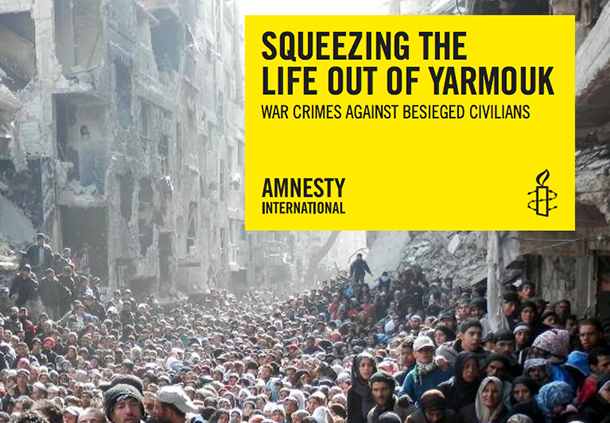
Propaganda image from the cover of AI’s report entitled, ‘Squeezing the Life Out of Yarmouk: War Crimes Against Besieged Civilians’,
one of many designed to fit hand-in-glove with the joint US and UK covert regime change operation deployed against Syria since 2011.
By Alexander Rubinstein | Mint Press News | January 17, 2019
Amnesty International, the eminent human-rights non-governmental organization, is widely known for its advocacy in that realm. It produces reports critical of the Israeli occupation in Palestine and the Saudi-led war on Yemen. But it also publishes a steady flow of indictments against countries that don’t play ball with Washington — countries like Iran, China, Venezuela, Nicaragua, North Korea and more. Those reports amplify the drumbeat for a “humanitarian” intervention in those nations.
Amnesty’s stellar image as a global defender of human rights runs counter to its early days when the British Foreign Office was believed to be censoring reports critical of the British empire. Peter Benenson, the co-founder of Amnesty, had deep ties to the British Foreign Office and Colonial Office while another co-founder, Luis Kutner, informed the FBI of a gun cache at Black Panther leader Fred Hampton’s home weeks before he was killed by the Bureau in a gun raid.
These troubling connections contradict Amnesty’s image as a benevolent defender of human rights and reveal key figures at the organization during its early years to be less concerned with human dignity and more concerned with the dignity of the United States and United Kingdom’s image in the world.
A conflicted beginning
Amnesty’s Benenson, an avowed anti-communist, hailed from a military intelligence background. He pledged that Amnesty would be independent of government influence and would represent prisoners in the East, West, and global South alike.
But during the 1960s the U.K. was withdrawing from its colonies and the Foreign Office and Colonial Office were hungry for information from human-rights activists about the situations on the ground. In 1963, the Foreign Office instructed its operatives abroad to provide “discreet support” for Amnesty’s campaigns.
Also that year, Benenson wrote to Colonial Office Minister Lord Lansdowne a proposal to prop up a “refugee counsellor” on the border of present-day Botswana and apartheid South Africa. That counsel was to assist refugees only, and explicitly avoid aiding anti-apartheid activists. “Communist influence should not be allowed to spread in this part of Africa, and in the present delicate situation, Amnesty International would wish to support Her Majesty’s Government in any such policy,” Benenson wrote. The next year, Amnesty ceased its support for anti-apartheid icon and the first president of a free South Africa, Nelson Mandela.
The following year, in 1964, Benenson enlisted the Foreign Office’s assistance in obtaining a visa to Haiti. The Foreign Office secured the visa and wrote to its Haiti representative Alan Elgar saying it “support[ed] the aims of Amnesty International.” There, Benenson went undercover as a painter, as Minister of State Walter Padley told him prior to his departure that “We shall have to be a little careful not to give the Haitians the impression that your visit is actually sponsored by Her Majesty’s Government.”
The New York Times exposed the ruse, leading some officials to claim ignorance; Elgar, for example, said he was “shocked by Benenson’s antics.” Benenson apologized to Minister Padley, saying “I really do not know why the New York Times, which is generally a responsible newspaper, should be doing this sort of thing over Haiti.”
Letting politics creep into mission
In 1966, an Amnesty report on the British colony of Aden, a port city in present-day Yemen, detailed the British government’s torture of detainees at the Ras Morbut interrogation center. Prisoners there were stripped naked during interrogations, were forced to sit on poles that entered their anus, had their genitals twisted, cigarettes burned on their face, and were kept in cells where feces and urine covered the floor.
The report was never released, however. Benenson said that Amnesty general secretary Robert Swann had censored it to please the Foreign Office, but Amnesty co-founder Eric Baker said Benenson and Swann had met with the Foreign Office and agreed to keep the report under wraps in exchange for reforms. At the time, Lord Chancellor Gerald Gardiner wrote to Prime Minister Harold Wilson that “Amnesty held the [report] as long as they could simply because Peter Benenson did not want to do anything to hurt a Labour government.”
Then something changed. Benenson went to Aden and was horrified by what he found, writing “I never came upon an uglier picture than that which met my eyes in Aden,” despite his “many years spent in the personal investigation of repression.”
A tangled web
As all of this was unfolding, a similar funding scandal was developing that would rock Amnesty to its core. Polly Toynbee, a 20-year-old Amnesty volunteer, was in Nigeria and Southern Rhodesia, the British colony in Zimbabwe, which was at the time ruled by the white settler minority. There, Toynbee delivered funds to prisoner families with a seemingly endless supply of cash. Toynbee said that Benenson met with her there and admitted that the money was coming from the British government.
Toynbee and others were forced to leave Rhodesia in March 1966. On her way out, she grabbed documents from an abandoned safe including letters from Benenson to senior Amnesty officials working in the country that detailed Benenson’s request to Prime Minister Wilson for money, which had been received months prior.
In 1967 it was revealed that the CIA had established and was covertly funding another human rights organization founded in the early 1960s, the International Commission of Jurists (ICJ) through an American affiliate, the American Fund for Free Jurists Inc.
Benenson had founded, alongside Amnesty, the U.K. branch of the ICJ, called Justice. Amnesty international secretariat, Sean MacBride, was also the secretary-general of ICJ.
Then, the “Harry letters” hit the press. Officially, Amnesty denied knowledge of the payments from Wilson’s government. But Benenson admitted that their work in Rhodesia had been funded by the government, and returned the funds out of his own pocket. He wrote to Lord Chancellor Gardiner that he did it so as not to “jeopardize the political reputation” of those involved. Benenson then returned unspent funds from his two other human-rights organizations, Justice (the U.K. branch of the CIA-founded ICJ) and the Human Rights Advisory Service.
Benenson’s behavior in the wake of the revelations about the “Harry letters” infuriated his Amnesty colleagues. Some of them would go on to claim that he suffered from mental illness. One staffer wrote:
Peter Benenson has been levelling accusations, which can only have the result of discrediting the organisation which he has founded and to which he dedicated himself. … All this began after soon after he came back from Aden, and it seems likely that the nervous shock which he felt at the brutality shown by some elements of the British army there had some unbalancing effect on his judgment.
Later that year, Benenson stepped down as president of Amnesty in protest of its London office being surveilled and infiltrated by British intelligence — at least according to him. Later that month, Sean MacBride, the Amnesty official and ICJ operative, submitted a report to an Amnesty conference that denounced Benenson’s “erratic actions.” Benenson boycotted the conference, opting to submit a resolution demanding MacBride’s resignation over the CIA funding of ICJ.
Amnesty and the British government then suspended ties. The rights group then promised to “not only be independent and impartial but must not be put into a position where anything else could even be alleged” about its collusion with governments in 1967.
Amnesty’s role in the death of Black Panther Fred Hampton
But two years later, senior Amnesty officials engaged in far more troubling coordination with Western intelligence agencies.
FBI documents, released by the Bureau in the spring of 2018 as a part of a series of disclosures of documents pertaining to the assassination of President John Kennedy, detail Amnesty International’s role in the killing of Black Panther Party (BPP) Deputy Chairman Fred Hampton, the 21-year-old up-and-coming black liberation icon — a killing that was widely believed to be an assassination but was ruled officially as a justifiable homicide.
Amnesty International co-founder Luis Kutner attended a November 23, 1969 speech of Hampton’s delivered at the University of Illinois.
During the speech, Hampton described the BPP “as a revolutionary party” and “indicated that the party has guns to be used for peace and self-defense, and these guns are at the Hampton residence as well as BPP headquarters,” according to the FBI document.
“Kutner has reached the point where he would like to take legal action to silence the BPP,” the FBI wrote. “Kutner concluded by stating that he believed speakers like Hampton were psychotic, and it is only when they are faced with a court action that they stop their “rantings and ravings.”
The FBI internal report on Kutner’s testimony cited above was issued on December 1, 1969. Two days later, the FBI, alongside the Chicago Police Department, conducted a firearms raid on Hampton’s residence. When Hampton came home for the day, FBI informant William O’Neal slipped a barbiturate sleeping pill into his drink before leaving.
At 4:00 a.m. on December 4, police and FBI stormed into the apartment, instantly shooting a BPP guard. Due to reflexive convulsions related to death, the guard convulsed and pulled the trigger on a shotgun he was carrying – the only time a Black Panther member fired a gun during the raid. Authorities then opened fire on Hampton, who was in bed sleeping with his nine-month pregnant fiancee. Hampton is believed to have survived until two shots were fired at point-blank range towards his head.
Kutner formed the “Friends of the FBI” group, an organization “formed to combat criticism of the Federal Bureau of Investigations,” according to the New York Times, after its covert campaign to disrupt leftists movements — COINTELPRO — was revealed. He also went on to operate in a number of theaters that saw heavy involvement from the CIA — including work Kutner did to undermine Congolese Prime Minister and staunch anti-imperialist Patrice Lumumba — and represented the Dalai Lama, who was provided $1.7 million a year by the CIA in the 1960s.
While Amnesty International’s shady operations in the 1960s might seem like ancient history at this point, they serve as an important reminder of the role that non-governmental organizations often play in furthering the objectives of governments of the nations where they are based.
Alexander Rubinstein is a staff writer for MintPress News based in Washington, DC. He reports on police, prisons and protests in the United States and the United States’ policing of the world. He previously reported for RT and Sputnik News.
Buzzfeed, Question Time & the purpose of Fake News
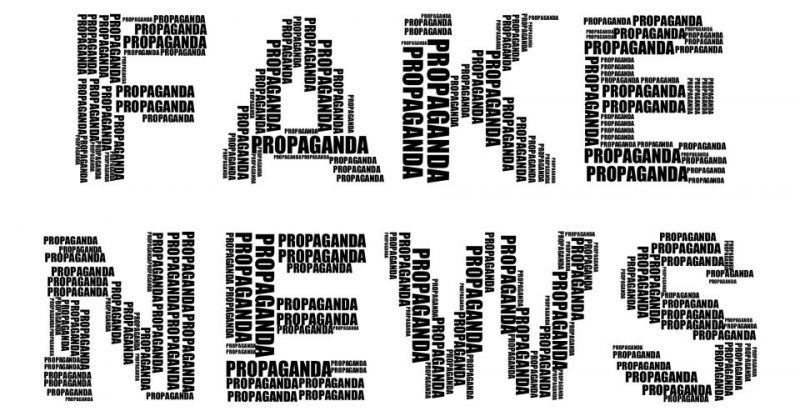
Image source
By Kit Knightly | OffGuardian | January 19, 2019
Two days ago BuzzFeed published a front page story, under a “BREAKING” banner, headlined: President Trump Directed His Attorney Michael Cohen To Lie To Congress About The Moscow Tower Project
In the article, Buzzfeed reporters Jason Leopold and Anthony Cormier claim to have been told, by two anonymous sources, that Robert Mueller’s “Russiagate” investigation had evidence Donald Trump had instructed his lawyer to lie to Congress. That would be a felony, and obviously an impeachable offence.
The reaction of the news media and associated twitterati was as quick as it was predictable. MSNCBC, CNN, the BBC, The Guardian… the usual suspects. They were all over it within hours.
But then, less than a day later, Robert Mueller’s spokesperson Peter Carr issued this statement:
BuzzFeed’s description of specific statements to the special counsel’s office, and characterization of documents and testimony obtained by this office, regarding Michael Cohen’s congressional testimony are not accurate,”
Despite this, BuzzFeed is sticking to its guns. Insisting that Mueller’s statement is vague, and therefore does not undercut the heart of their story.
The rest of the mainstream media are sensing the tone though and jumping ship. The Washington Post – not known for their pro-Trump slant – ran an editorial pointing out the scarcity of Mueller’s public comment (this the first statement Mueller has ever issued concerning evidence or claims in the press), and arguing that the rush to refute the BuzzFeed article means it is probably completely false.
Nevertheless, BuzzFeed has not retracted or altered their story in any way – except for putting in one small paragraph reporting that Mueller’s office disputes their story. There is no note of the update, and the rest of the story remains unchanged.
There is a striking parallel here, with a story Luke Harding contributed to The Guardian in late November last year: “Manafort held secret talks with Assange in Ecuadorian embassy”
The article claimed Trump’s campaign manager Paul Manafort had met with Julian Assange at least three times prior to the 2016 Presidential Election. No evidence was produced, save the word of “unnamed intelligence officials”, “secret Ecuadorian documents” and the like. While the predictable news outlets picked up the story and ran with it with the eagerness of a 6-month-old Golden Retriever, we in the alternative media were quick to point out the logical and factual deficiencies in the story.
Within hours, The Guardian had edited its language to be rather more circumspect, and include the denials made by both accused parties. The edits made to the article were not noted or highlighted in any way, we only know they exist because of internet archives. The next day The Guardian released a brief, terse, defensive statement. That statement was itself refuted by both Manafort and WikiLeaks. As of today, WikiLeaks is actively pursuing legal action in this case.
Later, it was revealed that a key contributor to the story had been previously been convicted of forgery.
No apology has been made, and no retraction issued, no explanation given. Both the editor, Katherine Viner, and Luke Harding have been totally silent on the topic.
So, in the last 2 months both Buzzfeed and The Guardian have issued “BREAKING NEWS” stories that made bold claims, but were not backed up with any evidence. Both these stories were shown to be untrue in less than 24 hours.
Anonymous sources are a common area here – both stories rely exclusively on the word of “unnamed sources” from either “the intelligence services” or “government agencies”. Anonymous sources are the batarangs on the propagandist’s utility belt. Flexible, simple, timeless.
Anonymity allows government agencies to leak misinformation on purpose, without hurting their credibility. It allows newspapers to control public opinion without having any actual facts on hand. It allows intelligence agencies to plant narratives they may want to revisit, or to give targets of blackmail operations a warning. And, most obviously, it allows journalists to simply make stuff up.
I don’t know which specific class these two stories fall into – but I do know it’s one or all of them.
So we come to the question of motive: BuzzFeed and The Guardian must have known there was no evidence to back up their assertions (yet, anyway). They must know the “significant minority” of the population who believe “conspiracy theories about their own government” will research and refute these claims.
So why publish them?
Well, in the Guardian’s case, every story demonising Assange discredits WikiLeaks’ future output, whilst also softening public sympathy for Assange in preparation for potential extradition of to the US. All the mainstream press have turned on WikiLeaks, but The Guardian – for some reason – has a particularly strong institutional axe to grind with WikiLeaks, and specifically Julian Assange.
Similarly, every “Russia bad!” story primes the public to accept increased defence spending, increased control of the internet by the government and increased social media censorship. It is very much the gift that keeps on giving in that regard.
In BuzzFeed’s case, it has been apparent for a while now that the Mueller investigation is likely to fizzle. Articles and interviews from various media sources have been prepping the public for a “let down” for a few weeks. At this point, there is no case for impeaching Trump. But the Deep State still needs to keep him over a barrel.
Trump has been a disappointment to his base and is yet to implement half the policies he discussed on the campaign trail, but he’s not fully and totally being controlled by the warhawking Deep State yet, either. His policy of peace with North Korea and decisions to pull out of Syria and Afghanistan show that there is a tug-of-war ongoing inside the administration. It’s probably no coincidence that this latest of many “bombshells” comes so quickly on the heels of Trump’s announcement of the Syria withdrawal.
Careful “leaks”, planted stories and social media witch-hunts remind Trump how precarious his position is, whilst simultaneously distracting the public – both pro-Trump and anti-Trump – from real issues.
The case-specific “why?” doesn’t matter so much as the general aim of this type of manipulation. The important question is: Why does the media tell lies if they know they will be revealed as such?
Clearly, the lies serve a purpose, regardless of their retraction or qualification.
Telling a lie loudly and then taking it back quietly is an old propaganda trick – it allows the paper to maintain a facade of “accountability”. The point of this practice is to propagate lies into the public consciousness. It’s a method that can be used to distract and disseminate and divide.
The accuracy of the statement is immaterial. The point is, once it has been said it cannot be unsaid. There are countless examples: “Assange was working for Russia”, “Trump ordered Cohen to lie to Congress”, “Russia hacked the US election”, “Donald Trump worked for the KGB”, “Assad gassed his own people”, “Jeremy Corbyn is an antisemite”.
The list goes on and on and on. None these have been proven. All were asserted without evidence, fiercely defended as facts, and then discretely qualified.
That is the purpose of “fake news”, to forge the Empire’s “created reality”, and force us all to live in it. These are world-shaping, policy-informing, news-dominating narratives… and are nothing but feathers in the wind.
A perfect examplar of this occurred just two days ago on the BBC’s flagship Political debate show Question Time.
The (notionally impartial) host not only sided with right-wing author Isabel Oakeshott in criticising Labour’s polling, but then joined in mocking the Labour MP Diane Abbott for attempting to correct the record.
Both Oakeshott and Fiona Bruce, the host, were factually incorrect – as shown a hundred times over since. But that doesn’t matter. The lie was told, the audience laughed, the reality was created. “Labour are behind in the polls, anybody who says otherwise is a laughingstock”.
The lie goes around the world while the truth is still putting its boots on.
That’s why fake news is so important to them, and so dangerous us.
Kit Knightly is co-editor of OffGuardian. The Guardian banned him from commenting. Twice. He used to write for fun, but now he’s forced to out of a near-permanent sense of outrage.
‘The People’ Know What They Want and Just Might Get It – Good and Hard
By James George JATRAS | Strategic Culture Foundation | 19.01.2019
A survey of nations in what was once known quaintly as the Free World shows some of them engaged in what could best be described as a cold civil war.
Such a condition is inherently unstable. One possible future is one where the cold conflict becomes hot with unforeseeable consequences. Another is that one side successfully represses the other before violence reaches a certain threshold.
Now before we go any further, let’s make one thing clear. Whatever the country and its specific ills, we can be sure that Vladimir Putin is the culprit. According to Stephen Collinson of CNN (“Another good day for Putin as turmoil grips US and UK”):
‘In London, Theresa May on Tuesday suffered the worst defeat in the modern parliamentary era by a prime minister, as lawmakers shot down her Brexit deal with the European Union by a staggering 432 votes to 202.
‘The United States, meanwhile, remains locked in its longest-ever government shutdown, which is now entering its 26th day, is nowhere near ending and is the culmination of two years of whirling political chaos sparked by President Donald Trump.
‘It’s hard to believe that two such robust democracies, long seen by the rest of the world as beacons of stability, have dissolved into such bitter civic dysfunction and seem unmoored from their previous governing realities. […]
‘The result is that Britain and the United States are all but ungovernable on the most important questions that confront both nations.
‘That’s music to Putin’s ears.
‘The Russian leader has made disrupting liberal democracies a core principle of his near two-decade rule, as he seeks to avenge the fall of the Soviet empire, which he experienced as a heartbroken KGB agent in East Germany.
‘Russia has been accused of meddling in both the Brexit vote and the US election in 2016 — the critical events that fomented the current crisis of the West.’
It isn’t exactly clear how the “meddling” of which the coryphaeus of the Kremlin is merely “accused” managed to entice Theresa May into botching (or sabotaging) Brexit talks or to embolden Donald Trump into finally standing his ground on his top campaign pledge. Even Collinson admits that folks in the US and UK may have had something to do with the ruckus: “Supporters of Trump in the US and Brexit in Britain see their revolts as uprisings against distant or unaccountable leaders who no longer represent them or share their values.”
Harrumph! Why should anyone care what the great unwashed think about accountability or values? What matters, say “skeptics” like Collinson, is that the proles’ getting uppity might be “deeply corrosive to the international political architecture that has prevailed for over 70 years.” Let’s get our priorities straight!
While Britain and the US are entertaining distractions, the current main feature is the jacquerie going on in France. To be sure, many wonder if les gilets jaunes are a genuine, grassroots rebellion of ordinary Frenchmen, or some kind of Astroturf comparable to “color revolutions” that western governments and their accomplices like George Soros have sponsored in many countries. While there is some evidence of agents provocateurs (the expression is French, after all) working for the Emmanuel Macron regime – can we start using that word now, like “Assad regime,” “Putin regime,” etc.? – and minor involvement of groups like Antifa committing vandalism with an aim to discredit the yellow vests, the definitive attestation of authenticity was pronounced by world-class poseur and shill for plutocracy and warmongering, Bernard-Henri Lévy: “It’s a real social movement, but it’s one driven by sad, mortifying, and destructive forces.”
Any movement Lévy calls sad, mortifying, and destructive – that’s French for “deplorable” – can’t be all bad, especially with some monarchists involved. It’s rather ironic, though, given that barely a year ago some were comparing vain little Macron to Napoleon.
What is perhaps most detestable to bien pensants like Collinson and Lévy is that the social basis of the yellow vests is readily identifiable. They’re who we used to call simply French working people. As geographer Christopher Guilluy describes in Spiked:
‘Paris creates enough wealth for the whole of France, and London does the same in Britain. But you cannot build a society around this. The gilets jaunes is a revolt of the working classes who live in these places.
‘They tend to be people in work, but who don’t earn very much, between 1000€ and 2000€ per month. Some of them are very poor if they are unemployed. Others were once middle-class. What they all have in common is that they live in areas where there is hardly any work left. They know that even if they have a job today, they could lose it tomorrow and they won’t find anything else.
‘Not only does peripheral France fare badly in the modern economy, it is also culturally misunderstood by the elite. … One illustration of this cultural divide is that most modern, progressive social movements and protests are quickly endorsed by celebrities, actors, the media and the intellectuals. But none of them approve of the gilets jaunes. Their emergence has caused a kind of psychological shock to the cultural establishment. It is exactly the same shock that the British elites experienced with the Brexit vote and that they are still experiencing now, three years later.
‘The Brexit vote had a lot to do with culture, too, I think. It was more than just the question of leaving the EU. Many voters wanted to remind the political class that they exist. That’s what French people are using the gilets jaunes for – to say we exist. We are seeing the same phenomenon in populist revolts across the world. […]
‘The Parisian economy needs executives and qualified professionals. It also needs workers, predominantly immigrants, for the construction industry and catering et cetera. Business relies on this very specific demographic mix. The problem is that ‘the people’ outside of this still exist. In fact, ‘Peripheral France’ actually encompasses the majority of French people. […]
Think of the ‘deplorables’ evoked by Hillary Clinton. There is a similar view of the working class in France and Britain. They are looked upon as if they are some kind of Amazonian tribe. The problem for the elites is that it is a very big tribe.
‘The middle-class reaction to the yellow vests has been telling. Immediately, the protesters were denounced as xenophobes, anti-Semites and homophobes. The elites present themselves as anti-fascist and anti-racist but this is merely a way of defending their class interests. It is the only argument they can muster to defend their status, but it is not working anymore.
‘Now the elites are afraid. For the first time, there is a movement which cannot be controlled through the normal political mechanisms. The gilets jaunes didn’t emerge from the trade unions or the political parties. It cannot be stopped. There is no ‘off’ button. Either the intelligentsia will be forced to properly acknowledge the existence of these people, or they will have to opt for a kind of soft totalitarianism.’
Unfortunately, “soft totalitarianism” is not out of the question, whether in France or other countries in which populism threatens to upend the elites’ neoliberal gravy train and all the social and moral baggage that comes with it. Guilluy sees the revolt in France as beyond control by the “normal political mechanisms.” That may be true, at least in France, at least for now.
But the US may be another story. At the end of this week all Washington was atwitter with an alleged bombshell (relax, in the US legacy media every other story is a “bombshell,” especially if it involves dirt on Trump) that former Trump attorney, “fixer,” and alleged literal bagman Michael Cohen had actually been instructed by his erstwhile client to commit perjury. Unlike much else thrown at Trump, this story (reported in Buzzfeed, which by total coincidence played a key early role in publicizing the US-UK Deep’s State’s “dirty dossier”) would constitute an impeachable crime. In an extraordinary move, Grand Inquisitor Robert Mueller released a statement through a spokesman indicating the report was “not accurate” but not specifying in what regard. As of this writing Buzzfeed stands by the story and asked for clarification by Mueller’s office, which may or may not be forthcoming.
Whatever the fate of this report, make no mistake: there will be more of the same, an endless parade of them. The fact that such reports might turn out not to be true makes little difference. Their existence is sufficient to keep Trump constantly on the defensive pending his removal, one way or another.
Elizabethtown College Professor Emeritus Paul Gottfried describes how grandees of the GOP are already getting set to restore the status quo ante in collusion with their nominal Democrat adversaries once the interloper is gone:
‘… in the next few years, a working alliance will develop between regular Democrats—particularly New Democrats from red states—and the milquetoast Republican establishment. … Such an alliance would reflect electoral reality, as the Right seems to be growing weaker, not stronger, since the election of Trump two years ago. The ever ambitious Mitt Romney fired on his party’s leader prematurely, but his political instincts may be right after all. The GOP is likely to move leftward because that’s where a majority of the voters are, and if this happens to Trump’s detriment, Romney will hope to pick up the pieces. Neoconservatives and much of the authorized conservative movement would no doubt welcome the Utah senator or someone like him as the kind of “conservative” they could work with were he to run for the presidency.
‘If the elections since 2018 have shown anything, it’s this: blue electoral areas have remained quite solid, while traditionally red ones, even in the Deep South, are up for grabs. That’s because the party perceived as being further to the left has benefited from its growing coalition. If there’s another explanation, I can’t seem to find it. It would not be unusual to have two national parties that are recognizably on the left contending for power. The parties now running the major Western European countries are all to the left of our present GOP.
‘In a possible alliance, the GOP, as the ideologically and electorally weaker side, will readily cooperate with establishment Democrats. They will undoubtedly find such shared concerns as confronting Putin “the thug” and supporting the Likud Party in Israel. They should have no trouble reaching an agreement on giving amnesty to all non-criminal illegal immigrants once Trump is no longer on the scene.
‘There is no reason to think that this political shift won’t continue. We are looking at a process that’s been brought about by college educators, the culture industry, the mass media, and mass immigration, and the momentum may be extremely hard to reverse or even to stop. America’s future won’t necessarily be British Columbia’s, whose provincial legislature features only parties of the left and which hasn’t elected a conservative to a provincial office since the early 1990s.’
The celebrated Sage of Baltimore, H. L. Mencken observed that “Democracy is the theory that the common people know what they want, and deserve to get it good and hard.” This begs the question, though, of who the “common people” are. In contrast to France, where Guilluy’s “peripheral France” is still a majority of the French population, US elites in both parties are looking to the day when America’s “deplorables” are a minority (which we already may be) that will continue to shrink. Anyone who might object to ethnic and moral replacement is clearly a racist and “white supremacist,” comparable to France’s “xenophobes, anti-Semites and homophobes.” In the not too distant future, Guilluy’s “normal political mechanisms” may be more than sufficient to handle what’s left of a disappearing America.
If Trump is going to build that Wall, he’d better do it damn fast.
Featured Video

Death Spikes & Rising Cancer In Our Youth Explained
or go to
Aletho News Archives – Video-Images
From the Archives
Politicians lie
By Mazin Qumsiyeh | Popular Resistance | August 18, 2013
There is no way to say this truth nicely: Politicians lie. That includes Japanese, American, Egyptian, Israeli, and Palestinian politicians! Is there something more common sense than that? Yet, so many citizens around the world believe their own politicians or wistfully acknowledge lies but think it is part of the job needed to run things. They believe even when politicians contradict themselves blatantly. This phenomenon is rather remarkable. It is a dissonance and disconnect from reality that many seem oblivious to. It is very dangerous because it can lead to accepting rationales for going to war. These can be deadly wars that lead to millions of lives lost as happened in what was called World War 1 and WW2. Even when incredible and declassified evidence abound, politicians continue to lie and old mythologies refuse to die. Here are just a few of the countless lies told to us over the past few decades… continue
Blog Roll
 Aletho News
- Ukrainian Soldiers, Potential Mercenaries: Have Gun, Will Travel!
- Burnham’s UN debut… A masterclass in British disinformation
- Iran flights continue despite US aviation sanctions
- Global Tipping Points Lead the World Into a State of Entropy
- The day-after at the White House: USA and Xi Jinping
- The Geopolitical Balance in the Red Sea: The UAE Being Displaced by New Players
- Iraqi resistance group vows to stage airport sit-ins over Iran aerial blockade
- Turkish parliament to review Saudi-Pakistan defense pact next month
- DEATH SPIKES & RISING CANCER IN OUR YOUTH EXPLAINED
- Iran offers Trump deal before US election
- If Americans Knew
- Deconstructing Netanyahu’s pants-on-fire UN rant – Daily Update
- Trump betrayed voters with his campaign lies and prioritized a foreign country once he took office
- Netanyahu calls Israel’s war in Gaza ‘opposite of genocide’ in UN speech to near-empty hall
- Settler Kidnappings: Torture, Sexual Abuse and Terrorisation of Palestinian Abductees as Israel Deepens Annexation of West Bank
- Gaza winter nears as 162,000 tents become unusable, raising fears of humanitarian crisis
- Netanyahu says, “It’s the opposite of genocide”; UN says Gaza economy is world’s ‘most severe crisis on record’ – Daily Update
- Israel’s US-Backed Assault on Gaza Has Created the ‘World’s Most Severe Economic Crisis on Record’: UN
- ‘Protecting U.S. Citizens’… From Israel
- ‘This is where I live now, the back of a truck’: a day in the life of a grandmother in Gaza
- In UN Speech, Iran’s President Displays Pictures of Children Killed by US, Brings Attention to Israel’s Nuclear Arsenal
- No Tricks Zone
- New Study: Earth And Venus Surface Warmth Largely Explained By Convection And Lapse Rate, Not CO2 Or Radiation
- 2025 Nature Paper Claiming Worsening Global Drought Gets RETRACTED …Heavily Flawed
- New Study: ‘Global Drought Shows No Detectable Recent Acceleration Under Climate Warming’
- Economic Masterminds: German Socialists Suggest Taxing Productivity Gains Stemming From Using AI
- The South China Sea Has Not Been Cooperating With The Climate Change Narrative
- Energy Crisis: Germany Enters Heating Season With Historically Low Gas Reserve Fill Levels
- New Study: The Antarctic Ice Sheet Gained Mass From 2020-2024 Due To Staggering Snow And Ice Accumulation
- Study: Ocean Heating Rates From Thousands Of Years Ago ‘Dwarf’ Modern Ocean Heating Rates
- Climate Extremists Target, Attack Large-Scale Power Grid Infrastructure In Germany!
- New Study: Antarctic Ice Melt Has Contributed Less Than 1 Centimeter To Sea Level Rise In The Last 30 Years

