Protests against UK arms sales to UAE at arms expo
MEMO | September 8, 2017
Campaign groups are teaming up tomorrow to protest against UK arms sales to the UAE in front of one of the largest arms expos in the world at the London ExCel Centre.
Activists and campaigners from the International Campaign for Freedom in the UAE (ICFUAE) will be joining a host of other campaigning organisations such as the Campaign Against the Arms Trade (CAAT) at the Defence and Security Equipment International exhibition (DSEI) arms fair to protest against millions of dollars of arms trade with a regime, activists describe as being a notorious human rights violator.
The week of campaigning, which began with a protest against Israeli arms sales, will see crowds of people calling on the UK government to end arms sales to the UAE. The trade deals with Britain are said to involve highly sophisticated and invasive cyber surveillance technology which the UAE government uses to spy on its own citizens, and weaponry used to commit war crimes in Yemen.
Campaign groups say that between 2012 and 2016 the UAE was listed as the world’s third largest importer of weaponary; during this period, the UK licensed around £350 million worth of arms for export to the UAE. At the same time the UAE has become increasingly dismissive towards international treaties, human rights laws and UN conventions.
The UAE’s war in Yemen, which has caused untold death and destruction, is a major focal point for protestors. The Gulf alliance has been charged with committing war crimes in Yemen, where they hold a significant naval, ground and air presence. It was also recently revealed that UAE forces have been running clandestine prisons where there have been numerous reports of extreme torture.
Campaigners also claim that within their own borders, the Emirati authorities have committed numerous human rights violations against their own citizens and foreign nationals. Human rights organisations have documented numerous cases of torture, arbitrary detention, lack of freedom of speech and repression of political dissidents in the UAE.
The UK-registered BAE systems, who will be vying for new trade deals at the ExCel Centre is thought to have provided the cyber surveillance technology which was used in connection with the enforced disappearance of human rights defender Ahmed Mansoor.
Campaigners are calling on the British government to revise their close trading relationship with the UAE. They say that by providing arms and weaponry to this authoritarian regime, the UK is being complicit in war crimes and human rights violation. Furthermore they say that the trade deal between the two nations is set to increase as the UK leaves the EU and having set itself an ambitious target of doubling bilateral trade to up to £25 billion by 2020.
UK Police Test Facial Recognition Tech At Carnival, Rack Up 35 Bogus ‘Hits’ And One Wrongful Arrest
By Tim Cushing | TechDirt | September 5, 2017
UK law enforcement has proudly been using facial recognition for tech for a few years now. As is the case with any new law enforcement tech advancement, it’s being deployed as broadly as possible with as little oversight as agencies can get away with.
As of 2015, UK law enforcement had 18 million faces stashed away in its databases. Presumably, the database did not contain 18 million criminals and their mugshots. Concerns were raised but waved away with promises to put policies in place at some point in the future and with grandiose claims of 100% reliability. The latter, naturally, came from the police inspector who headed the facial recognition department. Caveat: this had only been tested on a limited set using “clear images.”
What works well in theory and/or with limited datasets doesn’t work especially well in practice. Here’s how things went down when the facial recognition program was deployed in the wild.
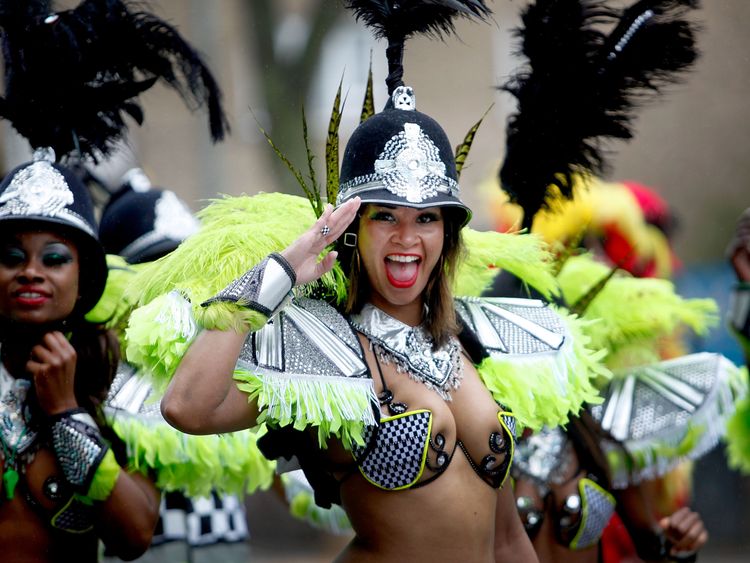
The controversial trial of facial recognition equipment at Notting Hill Carnival resulted in roughly 35 false matches and an erroneous arrest, highlighting questions about police use of the technology.
The system only produced a single accurate match during the course of Carnival, but the individual had already been processed by the justice system and was erroneously included on the suspect database.
Yeah, that’s going to keep UK citizens from being menaced by terrorists, drug dealers, and whatever else was cited to keep the facial recognition program from being derailed by concerned legislators and citizens. And, while the tech was busy failing to do its job, a few thousand photos of people engaged in nothing more than being criminally underdressed were added to the pot of randomly-drawn faces for the next round of facial recognition roulette.
Supposedly, this was a trial run. The false positives were apparently derived from a list of suspects’ faces wanted on rioting-related charges. Fortunately, those who were approached by officers as the result of bogus tech tip-offs had their identification documents on them. Nothing in the law requires you to carry them wherever you go, but if the law’s going to use tech as faulty as this, it may as well be a criminal offense to leave home without them. You’re going to get rung up — at least temporarily — if you can’t prove you aren’t who the software says you are.
Undeterred by this resounding lack of success, the Metropolitan police are planning to test the software again. This will give another set of UK citizens the chance to be wrongfully arrested at some point in the near future. Until the bugs are worked out — which means violating the rights and freedoms of UK citizens during the beta testing phase — UK law enforcement facial recognition tech will still be remembered as the thing that caught that shoplifter that one time.
Save Craig Murray
By Craig Murray | September 6, 2017
I am being sued for libel in the High Court in England by Jake Wallis Simons, Associate Editor of the Daily Mail Online. Mr Wallis Simons is demanding £40,000 in damages and the High Court has approved over £100,000 in costs for Mark Lewis, Mr Wallis Simons’ lawyer. I may become liable for all of this should I lose the case, and furthermore I have no money to pay for my defence. I am currently a defendant in person. This case has the potential to bankrupt me and blight the lives of my wife and children. I have specifically been threatened by Mr Lewis with bankruptcy.
Mr Wallis Simons boasts on his website:
In 2015, I published a series of articles exposing Jeremy Corbyn’s links with anti-Semitic figures, and this led to what is now known as the “Labour anti-Semitism scandal.”
It was my Sky TV appearance on this subject which led to this libel action against me.
It is my view that English libel law remains an international disgrace, a device by which the wealthy and those with wealthy backers, and only they, can stifle freedom of speech. Contempt of Court laws – with a penalty of two years imprisonment – even prevent poor defendants like me from putting their case openly before the public in order to appeal for a public defence fund. I am extremely limited in what I can tell you.
How can it cost just one party six times the average annual national wage to litigate a five minute TV broadcast? The libel system, with its in-built advantage to the wealthy and those backed by the wealthy, is a complete disgrace. Andy Wightman, the brilliant Scottish land reform campaigner, has been going through the same Hell.
I find I am obliged to beg you for funds to help me defend the case. I need to ask every single person who reads this blog to find it in their heart to make at least some contribution, as much as you can afford. The scale of this thing is such that I need to ask those of you who are comfortably off to make a far larger donation than you might normally consider. In practice we are going to need to include some four figure donations to make the ludicrous amounts required. But every single penny mounts up and please do give something.
If you have ever enjoyed this blog – join the fight. If you dislike this blog but support freedom of speech – join the fight. If you support the right to defend Palestine without being labelled ant-Semitic – join the fight. If you despised the anti-Corbyn media campaign – join the fight. If the Daily Mail sickens you – join the fight.
Every donation, no matter how small, will be gratefully received. The case will be heard in the High Court on 7 November. In the event of victory, after costs are met (even a costs award does not cover all actual costs) excess donations will be returned pro-rata unless you specify they should be applied to the future of maintaining the blog.
This is a question not only of the continued existence of this blog, but of the future well-being of my young family. It is unfair on you for me to place all of that in your hands, but that is the situation into which I am forced.
How Media Obscure US/Saudi Responsibility for Killing Yemeni Civilians
By Ben Norton | FAIR | August 31, 2107
A coalition of Saudi Arabia, the United States, the United Kingdom and the United Arab Emirates, with minor support from several other Middle Eastern nations, has relentlessly bombed Yemen since March 2015. This August, the coalition ramped up the ferocity of its airstrikes, killing dozens of civilians.
On August 23, the US/Saudi coalition bombed a hotel near Yemen’s capital Sanaa, killing 41 people, 33 of whom—80 percent—were civilians, according to the United Nations.
Then on August 25, the coalition bombed homes in Sanaa, massacring a dozen civilians, including eight members of the same family.
Major Western media outlets have, however, obscured the responsibility Saudi Arabia, and its US and European supporters, bear for launching these airstrikes.
There are no other parties presently bombing Yemen, so media cannot feign ignorance as to who is responsible for the attacks. But reports on the bloody US/Saudi coalition airstrikes were nonetheless rife with ambiguous and downright misleading language.

It seems worth mentioning that the airstrike was
supported by the same government that supports NPR.
“Dozens of People Killed as Airstrike Hits Hotel Near Yemen’s Capital,” wrote NPR (8/23/17), in a masterwork of euphemism. Apparently dozens of Yemenis mysteriously died of unknown causes at the exact moment a generic, unaffiliated airstrike hit the hotel. NPR only indirectly mentioned, in the story’s fifth paragraph, that the “Saudi-led coalition” was “blamed” for the attack.
AFP‘s news wire (8/23/17), which was republished by Yahoo, the Daily Mail and Breitbart, used the headline “Air Raids on Outskirts of Yemen Capital Kill ‘at least 30,’” again obscuring who was responsible for those air raids. France 24 (8/23/17) ran the wire with the headline “Air Raids on Yemen Capital Kill Dozens.”
The BBC (8/23/17) wrote, “Yemen War: Air Strike on Hotel Outside Sanaa ‘Leaves 30 Dead.’” “Dozens Killed in Airstrike on Yemeni Hotel,” the Guardian headline (8/23/17) read.
The London-based Middle East Eye (8/23/17) was just as ambiguous, with “Yemen Air Attack Destroys Hotel, Killing at Least 35 People,” as was Qatar-owned Al Jazeera (8/23/17), with “Air Raid in Yemen Kills at Least 35 people” and the Turkish TRT World (8/24/17), which wrote, “At Least 60 people Killed in Airstrikes on Hotel in Yemen.”
Whose airstrike was it? What party was responsible? This remains unknown to those who only glanced at the headlines—that is to say, to most readers.
The 29-month war has killed thousands of Yemeni civilians, with tens of thousands more injured and millions facing famine. And the United Nations has repeatedly reported that the US/Saudi coalition is responsible for a majority of the civilian casualties.
Even when Saudi Arabia’s guilt is acknowledged by media, the crucial role of the US is typically ignored (FAIR.org, 8/31/15, 10/14/16, 2/27/17). Readers miss out on crucial context that is needed to understand the war, and their governments’ contributions to it: Saudi Arabia is flying US-made planes, full of fuel provided by the US Air Force, dropping US- and UK-made bombs, with intelligence and assistance from American and British military officials.
Non-Yemeni ‘Yemeni Airstrikes’

Neither the headline nor the accompanying story mention who conducted
the airstrike—though the photo caption refers to the “Saudi-led airstrike.”
Two days later, reports were just as obfuscatory, and even used the term “Yemeni airstrike,” to refer to an airstrike that was carried out by non-Yemenis.
“Yemen Airstrike Kills 12, Including Six Children: Rescuers,” Reuters reported on August 25. This brief two-paragraph wire did not once mention the US/Saudi coalition was responsible.
“After Yemeni Airstrike, Little Girl Is Family’s Only Survivor,” the international news agency wrote the next day (8/26/17). This Reuters piece noted that the “Saudi-led coalition” was “blamed,” though even that language seems designed to deflect; blamers can be wrong, after all.
Major newspapers were similarly misleading. “Young Yemeni Girl Is Sole Survivor After Airstrike Topples Her Home,” the New York Times (8/26/17) reported. The lead provided no further information: “An airstrike toppled their apartment building.” In fact, it was not until the seventh paragraph, after three large photos, that the Times finally conceded, “A Saudi Arabia–led coalition took responsibility for the airstrike a day after the attack, citing a ‘technical mistake.’” The Times did not once mention American or British support for the coalition.
Al Jazeera (8/25/17) likewise used the headline “Children Among Dead in Latest Attack on Yemen Civilians.” And TRT World (8/26/17) reported, “Yemen Airstrike Kills 12, Including Six Children.”
Even when Saudi Arabia admitted responsibility for killing Yemeni civilians, media watered down the language. “Saudi-Led Force Admits Strike in Yemen’s Capital Hit Civilians,” Reuters (8/26/17) headlined its news wire. Note the airstrike hit civilians, not killed them.
The attack was also reduced to a mere “mistake.” Larger context was not provided: namely that more than one-third of US/Saudi coalition airstrikes have hit civilian areas, and that there is a growing body of evidence that the coalition has intentionally targeted civilian infrastructure in Yemen.
Not all media were equally misleading; some were more forthright. AP‘s news wire (8/23/17), which was republished by the Chicago Tribune, New York Daily News, Houston Chronicle and San Francisco Chronicle, used a headline that told readers who was responsible for the deadly attack: “Saudi-Led Airstrikes Hit Yemen Hotel, Killing at Least 41.”
The Washington Post was similarly direct, with its reports “Saudi-Led Coalition Airstrike Kills Dozens in Yemen Ahead of Major Rally” (8/23/17) and “Saudi-Led Airstrikes Kill 14 Civilians in Yemen’s Capital” (8/25/17).
The Art of Obfuscation
To justify this ambiguity in reporting, media might claim it is sometimes not immediately clear who launched the airstrikes. But, again, there are no other parties flying warplanes in Yemen.
Yemeni Houthi-Saleh forces, who govern the north of the country and roughly 80 percent of the population, have not been bombing their country. Moreover, the US/Saudi coalition has imposed an air blockade on the impoverished country since March 2015 (another significant fact that is rarely reported by corporate media).
In Syria, where numerous rival countries have been launching airstrikes, it is understandable that media may sometimes have to exercise caution before apportioning blame. But this is not the case with Yemen.
In the 29-month war in Yemen, there is one party that has been responsible for thousands of air raids: the Saudi air force, as part of a coalition with the US, the UK and the UAE.
Yet Yemen is not an isolated case of this ambiguity. Media frequently obfuscate and downplay the culpability for bombing when the US and its allies are responsible.
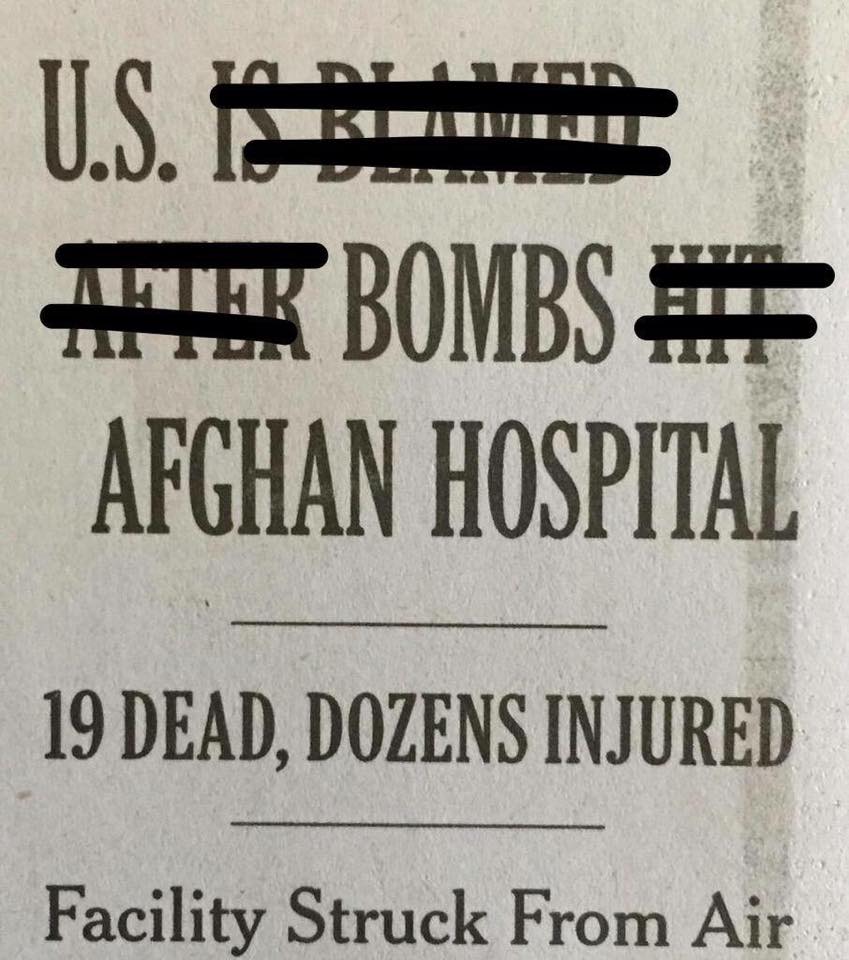
NYT headline (10/3/15) improved by Twitter user @OneKade
When the US bombed a hospital in Kunduz, Afghanistan, in October 2015, killing dozens of civilians, media scrambled to craft almost laughable euphemisms. FAIR (10/5/15) documented at the time how news outlets used circuitous headlines like “US Is Blamed After Bombs Hit Afghan Hospital.” Also seen in the August 23 NPR report cited above, this brand of misleading, ambiguous rhetoric is the “officer-involved shooting” of war reporting.
On the other hand, the responsibility of US enemies for killing civilians is rarely if ever obscured.
It is instructive to compare Western media coverage of Yemen to that of Syria, where attacks are “Assad bombing” (Fox News, 2/15/17), “Assad airstrikes” (Breitbart, 4/28/16), “Assad regime airstrikes” (Times of Israel, 10/16/12; Australian, 8/18/15), “regime airstrikes” (NBC, 8/19/16) or “regime bombing” (Daily Caller, 8/17/15).
Media have even written of a “pro-Assad drone” that was “displaying hostile intent,” and thus just had to be shot down by the US (Guardian, 6/20/17; Independent, 6/20/17; The Hill, 6/20/17), as if the robot were personally a fan of the Syrian leader.
The phrases “Salman bombing,” “Salman airstrikes” or “Saudi regime airstrikes” are, however, nowhere to be found in reports on Yemen.
Downplaying the Key US Role
Media calling US/Saudi coalition attacks “Yemeni airstrikes” is at best misleading, and at worst flat-out false. Yet this language also has a political effect: It obscures the character of the war. This framing is part of the “civil war” trope media have propagated for two-and-a-half years.
When Yemen is discussed, it is virtually always through the lens of a “civil war.” As FAIR (7/25/17) has detailed before, this exceedingly widespread myth, which has permeated media discourse, denies the extent to which the conflict is actually a foreign war on Yemen, led by Saudi Arabia, the UAE and their US and European sponsors.
Even the term “Saudi-led” coalition is misleading. The New York Times editorial board (8/17/16) acknowledged, in a little-noted editorial on Yemen, “Experts say the coalition would be grounded if Washington withheld its support.”
That is to say, if the US wanted the war in Yemen to end, it would end overnight. The “Saudi-led” coalition is only led by Saudi Arabia in name.
Surprisingly, in the midst of intensified coalition attacks, the New York Times published another rare editorial on Yemen on August 25. In the piece, dramatically titled “The Slaughter of Children in Yemen,” the editorial board forcefully warned of exactly what critics have been saying for 29 months:
The Saudi coalition—and its American enablers, who provide military equipment, aerial refueling and targeting—simply cannot be allowed to continue killing civilians and destroying what little is left of Yemen. That is why it is imperative to publicly identify the unconscionable slaughter of innocents for what it is, and to hope that this will shame Saudi Arabia and its American backers to search for a humane end to Yemen’s hell.
Reporters at the Times and elsewhere should heed this call to demonstrate journalistic responsibility by clearly conveying their governments’ responsibility for the slaughter in Yemen—not just in editorials, but in news articles, every time.
‘400,000 deaths in Syria civil war directly attributed to US & allies’
By Dan Glazebrook | RT | September 1, 2017
African and Asian leaders are denied by the West to have any military means against an insurgency in their countries, while the US and its allies have absolute impunity when they want to take on a population anywhere in the world, says political analyst Dan Glazebrook.
The US-led coalition against Islamic State has confirmed another 61 civilian deaths are likely to have been caused by its air and artillery strikes in Iraq and Syria. That brings the total number of civilians it has acknowledged killing since the conflict began to 685.
Dan Glazebrook: I think it’s also likely to be a gross underestimate because we found out in 2012, for example, that all military-age males killed in US airstrikes are not classified by the US military as civilians, they’re automatically excluded from those statistics. So if I was walking down the street in Iraq, unarmed, and I was directly and intentionally blown to pieces by a US airstrike, that would not be recorded as a civilian death. Now, I don’t know if they still use this criterion currently, but what we certainly do know is that the monitoring group Airwars suggested almost 1,500 people may have been killed in US coalition bombings in Iraq and Syria in March of this year alone, including the terrible strike on a residential block in Mosul that is thought to have killed around 200 people. So these statistics are certainly likely to be a gross underestimate.
There are a couple of other points I’d like to make about this as well. This narrow focus on civilians we must recognize is deeply ideological because it serves to whitewash the true scale of the slaughter taking place in Iraq and Syria right now. Why should a 16-year-old boy, pressed into service by ISIS and then blown to pieces by the US before even firing a shot, why should his life be considered so unworthy, so meaningless, as not to be recorded in any kind of statistic because he’s, “not a civilian”? This use of the term and focus on civilians is actually a means of placing all soldiers, all militants, in the same category of subhuman and implies they deserve to be killed. More than that, not only do they deserve to be killed, but their lives are so meaningless and unworthy, they don’t even deserve to be recognized in any kind of balance sheet as to the costs of this war.
And a third point I’d like to make is that in 2011, Syria was at peace until, in that year, the US, Britain, and France sponsored a violent sectarian insurgency, an insurgency in Syria that eventually morphed into ISIS and spilled over into Iraq. So I would actually go further than this and I would attribute all 400,000 deaths in the Syrian civil war directly to the US, France, Britain and their allies.
RT:What would you make of comments made by US Defense Secretary James Mattis that Americans are the good guys and locals know the difference. Is there a difference between good bombs and bad bombs?
DG: No, of course, there isn’t, and what’s absolutely clear is their recklessness, which was actually bad enough under Obama but has increased under Trump. The recklessness with which the US is pursuing its foreign policy goals – and Britain and its allies in the coalition, I should add – have got complete impunity and complete disregard for the lives of those living in places like Mosul and Raqqa and it really shows the racism which is inherent in what’s going on here. Leaders of African and Asian states are denied by the West to have any kind of military means against an insurgency that happens within their borders. And yet when the US and its allies decide they want to take on a population anywhere in the world, they have absolute impunity to do so. So in 2011 Gaddafi was trying to put down a proto-ISIS rebellion in Benghazi and was labeled by the West as a bloody genocidal dictator and so on and was eventually subjected to torture and lynching by those states. When the US decides it wants to carpet-bomb Mosul or Raqqa thousands of miles from its shores, it can do so with complete recklessness and impunity and disregard for the populations living there.
Dan Glazebrook is a freelance political writer who has written for RT, Counterpunch, Z magazine, the Morning Star, the Guardian, the New Statesman, the Independent and Middle East Eye, amongst others. His first book “Divide and Ruin: The West’s Imperial Strategy in an Age of Crisis” was published by Liberation Media in October 2013. It featured a collection of articles written from 2009 onwards examining the links between economic collapse, the rise of the BRICS, war on Libya and Syria and ‘austerity’. He is currently researching a book on US-British use of sectarian death squads against independent states and movements from Northern Ireland and Central America in the 1970s and 80s to the Middle East and Africa today.
Al Jazeera: Blair, US officials on UAE payroll
MEMO | August 31, 2017
The UAE has paid tens of millions of dollars to expand its regional and international influence by buying positions and the loyalty of key figures, an Al Jazeera documentary has said.
Aired yesterday, “Men around Abu Dhabi” claimed the Emirates paid former British Prime Minister Tony Blair, the international envoy to Libya Bernardino Leon and a number of leaders of the US Department of Defence in order to keep them on side.
The channel said that UAE paid $35 million to Tony Blair when he was the envoy for the Middle East Quartet. He was also paid as a consultant, leaked email published by the Sunday Telegraph revealed.
The UAE government paid about $53,000 per month to the Spanish diplomat Bernardino Leon.
Last year, the UAE Diplomatic Academy, which is headed by the UAE’s Minister of Foreign Affairs and Chairman of its Board of Trustees, Sheikh Abdullah Bin Zayed Al Nahyan, announced that Leon, who served as UN envoy to Libya, will be assigned as its general manager.
At that time, media sources considered the news as a scandal that would undermine the credibility of the United Nations.
Abu Dhabi also paid $20 million in donations to the Middle East Institute in Washington, which is run by US General Anthony Zinni.
Zinni is an American general who once led US forces in the Middle East. After retiring, he served as a special envoy to the region. The US administration chose him and Assistant Secretary of State for Near Eastern Affairs, Timothy Lenderking, as envoys to support the Kuwaiti mediation to resolve the Gulf crisis.
There is also James Mattis, the current US secretary of defence, who was previously hired by the UAE as a military adviser to develop its army and Robert Gates, the former US secretary of defence who attacked Qatar’s policies and Al Jazeera.
The documentary also revealed that Turki Aldakhil, the director of Al Arabiya TV channel, received more than $23 million in return for promoting Abu Dhabi’s agenda in the region.
On 5 June, Saudi Arabia, the UAE, Bahrain and Egypt severed diplomatic relations with Qatar and imposed punitive measures on the small Gulf state accusing it of “supporting terrorism”. Doha strongly denied the claims.
NATO attack on Serbian state TV wiped from record

By Shane Quinn | The Duran | August 31, 2017
On 23 April 1999, a NATO missile attack on Radio Television of Serbia (RTS) headquarters killed 16 employees of the state broadcaster. The forgotten war crime occurred during the Kosovo War (March 1998-June 1999), and was part of NATO’s aerial campaign alongside the US-backed Kosovo Liberation army, in opposition to the Federal Republic of Yugoslavia.
In the aftermath of the attack there were no great public campaigns launched for the 16 murdered journalists and employees, no outpouring of emotion for those killed, no calls for solidarity and togetherness in the face of aggression. On the contrary the West justified this grievous blow against freedom of expression, praised it even.
Tony Blair, Britain’s then Prime Minister, welcomed the killings when speaking at NATO’s 50th anniversary summit in Washington. Blair said the missile attack was “entirely justified… in damaging and attacking all these targets”, and that those murdered were part of the “apparatus of dictatorship and power of [Slobodan] Milosevic”.
Blair felt that, “the responsibility for every single part of this action lies with the man [Milosevic] who has engaged in this policy of ethnic cleansing and must be stopped”. Apparently Milosevic “must be stopped” by wiping out state journalists or what Blair describes as an “apparatus of dictatorship”.
According to one of the main leaders of the Western world, Milosevic must bear full responsibility for a NATO fighter plane firing a US-made missile on a state broadcasting service’s headquarters. Perhaps we shouldn’t be too surprised by Blair’s visions of justice, particularly when examining his key role in the deaths of hundreds of thousands of Iraqis in the following decade.
Blair was not alone in praising this violation of international law. His Secretary of State for International development, Clare Short, said afterwards that, “the propaganda machine is prolonging the war and it’s a legitimate target”. Short is a Labour Party member and her official title today is The Right Honourable Clare Short. Defending these killings was neither right nor honourable one can assume.
NATO themselves commended the deliberate attack afterwards. NATO’s military spokesperson Air Commodore David Wilby declared RTS, “a legitimate target which filled the airways with hate and with lies over the years”. This followed on from a number of other NATO attacks on radio and television outlets in the country.
In the build up to the 2003 Iraq invasion, Cardiff University revealed that the BBC adopted the most pro-war stance of any British network. The official reasons for invading Iraq were based entirely on lies and misinformation. In this case was the BBC “the propaganda machine”, had it become “a legitimate target” too?
Pentagon spokesperson Kenneth Bacon also legitimised the war crime saying that, “Serb TV is as much a part of Milosevic’s murder machine as his military is”. Not to be outdone, the respected US diplomat and magazine editor Richard Holbrooke described the bombing of RTS as, “an enormously important and, I think, positive development”.
In the build up to the Iraq invasion American networks like Fox News were styling the illegal intervention as “Operation Iraqi Freedom”, with its correspondents and news anchors compelled to repeat that phrase. In addition a permanent American flag was fluttering in the top corner of the screen, and during the invasion itself the banner “war on terrorism” was unfurled.
Did this make Fox News and others like it, “a legitimate target which filled the airways with hate and lies”? Judging by the standards of Western elites, one would have to suggest so.
Meanwhile, a single person was charged for the attack on RTS: Dragoljub Milanovic, the Serbian network’s general manager, who received a 10-year jail term for failing to evacuate the building in time. Yet the International Criminal Tribunal for the former Yugoslavia concluded that NATO’s bombing of RTS was not a crime, noting that deaths were “unfortunately high, they do not appear to be clearly disproportionate”. Clearly disproportionate to the overall number of civilian deaths inflicted by NATO perhaps.
However, in January 2015 the Western reaction was somewhat different when 12 journalists from the Charlie Hebdo satirical newspaper were murdered by Islamic extremists – along with four Jewish men killed at a kosher supermarket shortly afterwards.
The British Prime Minister on this occasion, David Cameron, did not justify the killing of journalists and said, “We stand absolutely united with the French people against terrorism and against this threat to our values – free speech, the rule of law, democracy”. Cameron went on, “we should never give up the values we believe in… a free press, in freedom of expression, in the right of people to write and say what they believe”.
About two weeks later Blair, now a Middle East peace envoy, said of the thinking behind the Charlie Hebdo attacks, “this extremism is not natural, it’s taught and it’s learned and you have to un-teach it in the school systems”. Blair seems further unaware of his own role in creating “this extremism” by playing the junior partner role in invading Iraq, a crucial factor in the rise of ISIS.
In the aftermath of the Charlie Hebdo attacks, millions marched to honour the dead with the slogan “I am Charlie” becoming famous. When the Serbian journalists and employees were killed just over 15 years before, there was no international motto of “I am RTS”.
New York civil rights lawyer Floyd Abrams described the Charlie Hebdo shootings as, “the most threatening assault on journalism in living memory”. The perception of “living memory” appears to be a remarkably short one.
UK Secures ‘Permanent’ Naval Base ‘East of Suez’ in Oman
Sputnik – August 30, 2017
In the UK, parliament may still be in summer recess, but government ministers aren’t resting. Defense Minister Michael Fallon jetted to Oman August 28 to cement a number of military agreements with the Sultanate’s leaders. The inking represents a continuation of a longstanding and rarely examined “special relationship” between the two countries.
During his two day visit, Fallon met with Sayyid Badr bin Saud bin Harub Al Busaidi, Oman’s Minister Responsible for Defense Affairs, in Muscat. The pair signed a “Memorandum of Understanding and Services Agreement” that secures UK use of naval facilities at Duqm Port — a multi-million dollar joint venture between the two countries.
An official statement issued by the Foreign & Commonwealth Office said the “booming” Port complex would provide “significant opportunity” for the two countries’ “defense, security and prosperity agendas,” and serve as a home from home for the UK’s flagship aircraft carrier, HMS Queen Elizabeth.
“This agreement ensures British engineering expertise will be involved in developing Duqm as a strategic port for the Middle East, benefiting the Royal Navy and others. Oman is a longstanding British ally and we work closely across diplomatic, economic and security matters. Our commitment to the Duqm project highlights the strength of our relationship,” Fallon said.
The Defense Minister’s visit gained virtually no recognition in the UK media — while the traditional paucity of official government business to report on over the summer arguably makes the story a prime candidate for press coverage, radio silence on UK-Oman relations is a seemingly enduring mainstream editorial policy.
Declassified British government files reveal the oil-rich Gulf state’s leader Sultan Qaboos bin Said al Said — one of the longest serving unelected rulers in the world — was brought to power in a 1970 palace coup planned by UK foreign intelligence service MI6, and sanctioned by then-Prime Minister Harold Wilson. The Sultan has absolute power in governance, and is also the country’s Prime Minister and Minister of Defense, with total authority over Oman’s judicial and legal systems.
Ever since the coup, Oman has proven a most faithful ally to the UK, hosting a number of major British intelligence and military operations.
For example, UK spying agency GCHQ has three separate bases in the country — codenamed Timpani Guitar and Clarinet — that feed off various undersea cables passing through the Strait of Hormuz to the Arabian Gulf. In the process, the bases intercept and process a vast volume of emails, telephone calls and web traffic generated in the region, which is then shared with the US’ National Security Agency.
Moreover, UK troops have long trained Omani armed forces, and in May 2016 it was announced the UK would increase its number of training teams in Oman from 34 to 45 in 2017.
BBC Claim Climate Change Is Cutting Crop Yields In Africa
By Paul Homewood | Not A Lot Of People Know That | August 23, 2017

http://www.bbc.co.uk/programmes/b091s7zl
More lies from the BBC Today programme.
At about 44 minutes in, a fairly sensible report from Kenya about improving agriculture methods is introduced with this shameless comment:
Climate change is cutting crop yields [in Africa]
The data from the UN FAOSTAT shows the opposite to be true:


http://www.fao.org/faostat/en/#compare
In Kenya itself, the value of agricultural production has been at record high levels for the last two years:

Of course, these drastic increases in agricultural productivity are due to a number of factors, and trying to unravel a climate signal is well nigh impossible. Not that that will stop grant addicted climate scientists making up their own fake evidence.
One is entitled to wonder why the BBC thought it appropriate to even make the comment they did, instead of giving their listeners the actual facts?
Looking for the Thought Police? Try looking in the mirror.
By T.P. Wilkinson | Dissident Voice | August 25, 2017
1984 is probably one of the worst books of the 20th century because of its mis-interpretation!
a) Although Orwell was writing about ENGLAND, in fact, and not as allegory, the exigencies of anti-Soviet propaganda required that the story be defined as a dystopia about the world under Soviet control. Whatever Orwell may have thought about Stalin, 1984 was a story directly attacking the Labour Party and the policies that would become enshrined in Labour governments dominated by graduates from Oxford and to a lesser extent Cambridge. Anyone outside of Britain might be forgiven at the time for missing this but today the oversight is simply rooted in ignorance — willful or unwitting.
b) Orwell, who served in the colonial police in Burma, was well acquainted with the methods of social control used in Britain’s colonies — including torture and surveillance. He had no reason to draw on reports from the Soviet Union, true or false. He also worked in the British government’s propaganda department. The BBC was created in 1922 as a radio monopoly in part to improve the government’s campaign against organised labour. There the fabrication of “news” was daily routine, as it is today.
c) Post-war Britain was — in comparison to the US esp. — a disaster area. After two world wars, Britain was bankrupt. The empire which had subsidised the metropolitan standard of living was collapsing. Indian independence alone would mean an initial massive balance of payments deficit to the Union, not to mention debt to the US. The economy was more or less in ruins. The standard of living had sunk drastically for all but the very rich. It did not take any imagination to invent “Victory Gin” — Britain was nominally on the side of the winners but had lost everything. For someone like Orwell this was very obvious.
d) Too little attention is paid to the actual structures that Orwell describes. The Party and the Thought Police are most frequently mentioned. This focus distorts Orwell’s depiction of a complex mechanism of social control. Ironically many people who have read Noam Chomsky’s essays do not grasp the point which Orwell makes and Chomsky reiterates — albeit avoiding too much attention to this embarrassing point.
Orwell distinguished between the “inner party”, the “outer party” and the “prols”. This classification is very important for comprehending the whole process. Propaganda — that is the constant manipulation of data in forms to create what counts on any one day as “true” — is directed primarily at the “outer party”. The “inner party” is not concerned with what is actually true, this virtually invisible group is interested only in power. The “outer party” is governed by rigorous ideas of truth and virtue which have to be policed — precisely because the very idea of “truth” is a policing tool — not unlike sexual purity. The “truth” is of no material importance to the mass — the “prols” in Orwell’s depiction. But the “outer party” — the intellectuals, the bureaucrats, middle managers, functionaries of all types whether in the state or private sector, in short those who claim citizenship based on supposed intelligence and virtue/merit — need constant policing.
They must be told not only what is fashionable but what counts as true or as the acceptable/polite consensus. These people cannot be left in abject ignorance since they are needed to maintain the system. They are in short the “Gene Sharp factor” — the percentage of the population with which one moves the whole. (Ironically the first edition (1993) of Sharp’s From Dictatorship to Democracy was published in Burma — where Orwell began his police career.) They are too numerous in comparison to the “inner party” to be ignored but not as disorganized as the “prols” so that they cannot be beaten down physically as a mass.
Perhaps Noam Chomsky does not focus too much on his observation that it is the middle class intellectual/managerial class that is the target of most regime propaganda (most heavily propagandised) because he belongs precisely to that class. In fact, on some issues he might be confused with an asset of the Thought Police — coming too as he does from a central US Thought Police institution — MIT.
Orwell was an Old Etonian. Eton College is the pinnacle of the “outer party” cadre institutions in Britain. It is run for the “inner party” and many of the “inner party” are also Old Etonians but the English public school is notorious for enforcing class distinctions even among those of the same college. All Etonians are equal too, some are more equal than others.
e) Who is “Big Brother”? Big Brother is always supposed to be a kind of Stalin allegory. However, unlike the US, Britain has a constant figure who constitutes the focus of all loyalty and affection — the reigning monarch. The British royal family changed their name when war was declared against Germany in 1914. It became inappropriate to have a German king ordering illiterate British peasants and workers into war against another German king who was directly related for reasons that could not be admitted openly and still cannot. So the name “Windsor” was adopted. Edward VIII both before and after his abdication maintained a healthy relationship with blatant fascists of the old style.
This does not mean that the British royal family ever renounced its affinity for fascism (e.g. Franco and Salazar). Moreover it is almost impossible to criticise the monarchy substantively in the United Kingdom. The actions of its members, singularly or collectively, are beyond review or public reproach — except in matters trivial like taste or polite speech. The pretense that the most wealthy private individual in the country (and one of the world’s wealthiest), the reigning monarch, has no personal interest in the policies of the British government and has no practical influence over the government in defense of those interests is about as great a self-deception as one can demand of any person, let alone an entire country.
God save the King/Queen…

f) It is even arguable that Orwell was more concerned about the US because this was the country which switched sides and manipulated the war aims the most — without any cost to itself. During WWII it was clear that the Soviet Union was fighting a vicious war just to survive in the face of the Western onslaught. However, sober people also saw that the US stood to be the only beneficiary of the war. In 1945, this was obvious. No sooner had the war ended but the US proclaimed a war against the Soviet Union. Britain could not have afforded such a position — even if Churchill would have liked. He gave his deceptive “iron curtain” speech for Truman because of dependence on the US not because Britain could have afforded an anti-Soviet policy on its own.1 Orwell could certainly see the absurdity of an impoverished Britain having been on the side of the Soviet Union against Hitler now aligned with the US against the Soviet Union.
In fact, it could be argued that Orwell’s novel is very coherent with Roger Waters’ The Wall (and its sequel The Final Cut) in their specifically BRITISH views of mass culture and pseudo-democracy concealing party dictatorship. It has little, if anything, to do with Russian society, let alone politics. That is only natural. Orwell never lived in Russia and would not have been able to explain Russian society. For that one has to turn to Russians themselves; e.g., Tolstoy or Sholokhov or Pasternak. On the other hand many Americans believe that they understand British society — this is due largely to saturation with BBC programming. However similar Britain may appear to the US, it is actually a very different country and culture (except perhaps for the highest strata of the Anglo-American ruling class). The illusion that Britons are only more quaint Americans has done much to promote the mis-understanding of Orwell.
One of the great intellectual travesty’s of the 20th century is the ascendency of US liberal ideology — in its broadest sense.2
There is probably not a country in the world today with so much influence on intellectual and cultural activity from such a depraved and obscene level of general ignorance and stupidity. The capacity to saturate the world with this structural mendacity and almost genetic stupidity is probably worse than any other weapons system the country’s psychopaths have produced — because it is the basis for acceptance of all those weapons in the first place.
- Churchill, unlike Truman, had attended the meetings with Stalin and Roosevelt at Yalta where it was agreed that the Soviet Union would occupy the Eastern European territories that had been absorbed into the German Empire, in part as a basis for war reparations due to the enormous destruction suffered by the Soviet Union — almost all of the European part of the country was razed to the ground. He knew that the Soviet occupation had been agreed by all the Allies. He also knew that the Allies were attempting to deprive the Soviet Union of the reparations due from Germany. In short he knew that it was the West that was hanging an “iron curtain” in front of the Soviet Union in the hope that it would collapse after WWII. Britain could not have afforded such a policy. Among other things the collapse of the empire would deprive it of its cheap access to all sorts of raw materials making it vulnerable to world market fluctuations.
- A more precise clarification of what might otherwise be called the ideology of the North Atlantic Establishment would exceed the scope of this brief note. Carroll Quigley’s The Anglo-American Establishment provides a fairly useful summary of its principles and the way it has been expressed through the 20th century. It should be noted that one of the key cadre institutions for academics according to Quigley is the All Souls College of Oxford University– where Gene Sharp also completed his doctorate.
Dr T.P. Wilkinson writes, teaches History and English, directs theatre and coaches cricket between the cradles of Heine and Saramago. He is also the author of Church Clothes, Land, Mission and the End of Apartheid in South Africa (Maisonneuve Press, 2003).
British universities should be more discerning about their choice of benefactors
By Alastair Sloan | MEMO | August 25, 2017
Just over eighteen months ago, environmental campaigners in Britain received some surprising news. They had been working for three years to get the Tate Gallery in London to reveal how much money oil giant BP had given it between 1990 and 2011. The figure turned out to be relatively small, ranging from £150,000 to £330,000 per year. Although this was a good chunk of the gallery’s income in the nineties, this soon equated to less than one per cent of the Tate group’s funding between 2000 and 2006. The sponsorship deal continued for another ten years, alongside similar BP sponsorships of the British Museum, the Royal Opera House and the National Portrait Gallery. Across all of these organisations, the oil company likewise contributed less than one per cent of funding to each one. The oft-heard argument that the struggling arts sector would go under were it not for this kind of funding from not-very-nice corporations was clearly bunkum. If anything, these institutions were willing collaborators in corporate whitewashing.
The same could be said of Gulf funds for British universities. Middle East Studies departments whisper about the necessity of funding from countries like the United Arab Emirates, Saudi Arabia and Qatar, because budgets are falling. A close look at the finances of the University of Exeter reveals something else, though; the issue of donations from alumnus Sheikh Dr Sultan Bin Muhammad Al-Qasimi of Sharjah were raised recently by the International Campaign for Freedom in the United Arab Emirates.
According to the Telegraph, the ruler of Sharjah – one of the most conservative Emirates in the UAE — has given more than £8 million to Exeter University over two decades (roughly the same time period that the Tate was receiving money from BP). A breakdown of when these donations were made is not available, but government grants and tuition fees in 1999 (the earliest data that I have been able to find) amounted to £52 million. The equivalent figure today is £250 million, around three times the original government and student fees funding even when adjusted for inflation. Much of this has come from the introduction of hugely expensive tuition fees for students.
In 2008, the nephew of the late King Abdullah of Saudi Arabia gave £8 million to Cambridge University to build its “Prince Alwaleed Bin Talal Centre of Islamic Studies”. The same year, Cambridge University’s annual report shows that income from government grants and tuition fees had risen from £251 million to £279 million. Cambridge made £174 million from its publishing house, more than £20 million more than in 2007. Even its “examination and assessment services” had seen income go up from £193 million to £216 million. All these increases led to the university almost doubling its surplus for the year, to £42 million. Yet that same year, it also accepted £8 million from a state known for its appalling human rights record, all the while knowing full well that the university coffers were overflowing.
After 2008, of course, there was the recession, so perhaps last year’s £3 million donation from the Qatar Development Fund towards Somerville College, Oxford, was justified? Think again. Somerville College itself was certainly on track to suffer a £3 million reduction in donations had the Qatar money not arrived, and had just borrowed huge amounts to extend its buildings, but Oxford University generally was doing well. In 2010, its income had risen since the previous year by nearly five per cent, to £920 million. By 2015, that figure was up to £1.3 billion, with surpluses of nearly £400 million sat in university bank accounts. Oxford doesn’t include in its numbers, as Cambridge does, its significantly profitable publishing business, which was on hand to top up coffers when they are running low.
In the UAE, we only have to go back to March to find that a prominent academic was jailed for ten years. His crime? He used Twitter. The country has imposed travel restrictions on visiting academics from Georgetown University, the London School of Economics and New York University, as well as prosecuting other university professionals. In January, the UAE government detained Abdulkhaleq Abdulla for ten days without charge after the prominent Emirati academic and vocal supporter, not critic, of the government posted a tweet that praised the UAE as the “Emirates of tolerance” but bemoaned the authorities’ lack of respect for freedom of expression and political liberties. Abdulla was an adviser to Mohammed Bin Zayed, the Crown Prince of Abu Dhabi, and a retired professor of political science at the University of the UAE. Similar situations abound in Saudi Arabia, and academic freedoms are only marginally better in Qatar.
So British universities are well off. They don’t need money from abroad, but they are opting to take it in any case, and who they are choosing to take it from isn’t encouraging. This devalues British academia and spits in the face of academics and others calling for change who are imprisoned in those donor countries for their pains. Universities should be campaigning to have tuition fees removed, be more inventive about how they make money, and stop plastering the names of Middle East dictators across their walls. They need to be much more discerning in their choice of benefactors. It’s too late to do this today, but tomorrow will do very nicely.
Featured Video

AIDS Inc. by Gary Null (2007)
or go to
Aletho News Archives – Video-Images
From the Archives
Fanatical Followers of the Covid Regime: A Jim Jones-Style Cult?
By Professor Roger Watson and Dr. Niall McCrae | The Daily Sceptic | November 15, 2021
As scholars at leading British universities over recent decades, we witnessed the replacement of critical thinking and debate by narrative: facts are discrimination and scientific method is imperialism; truth, instead, is derived from ‘progressive’ values. This educational trend may be a major contributory factor to the ease in which society has been inculcated to the Covid ‘new normal’ of masking, testing, and repeated doses of vaccines for a disease of similar risk to severe influenza.
One doesn’t need much critical reasoning to observe the flawed logic of some vaccination enthusiasts, such as people who respond to experiencing any side effects, however debilitating, by saying “at least I know it’s working”, or, after contracting the disease despite their promised inoculation (over 90% effective, according to initial drug company claims), “I’d have been worse off without the jab.” … continue
Blog Roll
 Aletho News
- Merck Virologists Admitted to Falsely Certifying Vaccine Efficacy
- Mandatory Folic Acid for every man, woman & child
- Pro-Palestine protesters arrested outside UK’s ruling Labour Conference in Liverpool
- Mauritius denies landing permit to flight from Israel, forcing cancellation: Tour operator
- Israeli finance minister calls for genocidal war on West Bank, annexation of south Lebanon
- 12 Things Your Psychiatrist Was Trained Not to Tell You
- From Unipolar Universalism to Multipolar Civilizational Distinctiveness
- RSF military group defects, joins Sudanese army: State media
- Ireland goalkeeper refuses to play ‘Israel’ as squad weighs boycott
- China pushes back against US on Cuba, Iran
- If Americans Knew
- Israel forces Gazans to live in constant peril – Daily Update
- Deconstructing Netanyahu’s pants-on-fire UN rant – Daily Update
- Trump betrayed voters with his campaign lies and prioritized a foreign country once he took office
- Netanyahu calls Israel’s war in Gaza ‘opposite of genocide’ in UN speech to near-empty hall
- Settler Kidnappings: Torture, Sexual Abuse and Terrorisation of Palestinian Abductees as Israel Deepens Annexation of West Bank
- Gaza winter nears as 162,000 tents become unusable, raising fears of humanitarian crisis
- Netanyahu says, “It’s the opposite of genocide”; UN says Gaza economy is world’s ‘most severe crisis on record’ – Daily Update
- Israel’s US-Backed Assault on Gaza Has Created the ‘World’s Most Severe Economic Crisis on Record’: UN
- ‘Protecting U.S. Citizens’… From Israel
- ‘This is where I live now, the back of a truck’: a day in the life of a grandmother in Gaza
- No Tricks Zone
- New Study: Earth And Venus Surface Warmth Largely Explained By Convection And Lapse Rate, Not CO2 Or Radiation
- 2025 Nature Paper Claiming Worsening Global Drought Gets RETRACTED …Heavily Flawed
- New Study: ‘Global Drought Shows No Detectable Recent Acceleration Under Climate Warming’
- Economic Masterminds: German Socialists Suggest Taxing Productivity Gains Stemming From Using AI
- The South China Sea Has Not Been Cooperating With The Climate Change Narrative
- Energy Crisis: Germany Enters Heating Season With Historically Low Gas Reserve Fill Levels
- New Study: The Antarctic Ice Sheet Gained Mass From 2020-2024 Due To Staggering Snow And Ice Accumulation
- Study: Ocean Heating Rates From Thousands Of Years Ago ‘Dwarf’ Modern Ocean Heating Rates
- Climate Extremists Target, Attack Large-Scale Power Grid Infrastructure In Germany!
- New Study: Antarctic Ice Melt Has Contributed Less Than 1 Centimeter To Sea Level Rise In The Last 30 Years