The London Bridge terror attack saw a repeat of a now familiar narrative in which every suspect involved had been long-known to both British security and intelligence agencies.
The London Telegraph in an article titled, “Khuram Butt, Rachid Redouane and Youssef Zaghba named: Everything we know about the London Bridge terrorists,” would reveal:
The ringleader of the London Bridge massacre never bothered to hide his violent, extremist views. Khuram Butt was so brazen that he openly posed with the black flag of the so-called Islamic State in Regent’s Park in the centre of London for a Channel 4 documentary, entitled The Jihadis Next Door.
Butt and other extremists linked to the banned terror group al-Muhajiroun were even detained by police for an hour over the stunt in 2015 but were released without being arrested.
The al-Muhajiroun terror group is headed by British-based extremist, Anjem Choudary, who for years helped fill the ranks of militant groups fighting governments the US and UK sought to overthrow in Libya, Syria and beyond. Choudary inexplicably escaped the consequences of his open advocacy and material support for known terrorist organizations for years, with the London Guardian in an article titled, “Anjem Choudary: a hate preacher who spread terror in UK and Europe,” going as far as speculating he did so because he was actually an informant or operative working for the British government.
The article would also admit that Butt was under investigation by British intelligence up to the day of the attack:
MI5 and counter-terrorism officers began an investigation into Butt, which remained ongoing even as the 27-year-old launched his terror attack on London Bridge. Butt, who was wearing an Arsenal shirt and a fake bomb strapped to his chest, was shot dead by police on Saturday night.
A second suspect, Rachid Redouane, was repeatedly brought to the attention of police who ignored warnings he was an extremist and a member of the so-called “Islamic State.”
The Telegraph reports that a third suspect, Youssef Zaghba, was also known to police:
He was reportedly arrested at Bologna airport in March 2016 trying to get to Syria and was also understood to be on an Italian anti-terror watch list.
The fact that these three suspects evaded capture and were able to carry out their attack despite being known and even monitored actively by British security and intelligence agencies lends even further credibility to the notion that they and others like them work for the British government, not against it.
Unable to Reach Syria, West’s Dogs of War Bite Local Population
Networks like al-Muhajiroun and the extremists they cultivate help fill the ranks of “moderate rebel” groups the US, UK, other European nations including France, as well as regional allies like Turkey, Jordan, Saudi Arabia, United Arab Emirates and Qatar are arming, funding and providing direct military support for in Libya, Syria, Yemen and beyond.
This fact goes far in explaining why extremists are allowed – for years – to openly advocate violence and recruit members into what is essentially a terrorist organization operating under the nose of British security and intelligence agencies – if not with their collective and eager complicity.
While these terrorists are labeled “moderate rebels” when fighting abroad, they are only labeled as such by the Western media out of necessity in an attempt to differentiate them from the extremists that are in fact fighting the West’s proxy war for it in places like Syria.
Suspects like Youssef Zaghba even attempted to travel to Syria to fight among the ranks of Western-backed militant groups – and failing to do so – participated in armed violence in the UK instead. Had he traveled onward to Syria, it would have been innocent Syrians instead of innocent British civilians terrorized, attacked, maimed and killed.
A Strategy of Terror and Tension
And despite the reality of the US and UK along with other European and Persian Gulf allies openly fueling terrorism at home and abroad, in the wake of tragic events like in London, Manchester, Paris, or Brussels, the very government organizations clearly responsible for presiding over these terrorists and their networks, sometimes for months and even years before an attack, are granted even more power to address a problem of their own intentional creation.
These organizations are able to do so in plain sight of the public specifically because of another conflict they openly orchestrate, pitting the general public against one another along lines of “anti-Islamic” fervor versus social justice advocates.
What both sides of this manufactured and intentionally perpetuated divide fail to realize is that Muslims are dying by the tens of thousands in places like Syria actively fighting against extremism springing not from Islam or the Qu’ran, but from the Pentagon, Westminster, Paris, Brussels, Riyadh, Ankara and Doha. It is not a clash of civilizations, but a manufactured conflict designed to perpetually fill the ranks of mercenaries abroad while exploiting their violence at home to procure more power and wealth through fear, anger and hysteria.
With wars in Afghanistan, Iraq, Syria, Yemen and beyond adding up to trillions for defense contractors and including weapon systems designed to fight them, with the F-35 joint strike fighter alone topping one trillion US dollars and as the West continues to openly act with impunity when and where it pleases despite violating the very international law it claims it is upholding globally, it is clear that, for now, this strategy is working.
If and when the general public understands the truth of why their lives are put in danger and their nation’s resources are being squandered abroad instead of at home for building their own futures, this strategy will be less successful. Until then, it appears that simplistic propaganda still works in convincing the public that governments like in London are simply incapable of arresting terrorists who appear regularly on TV, in the media and who openly operate in public with apparent and otherwise inexplicable impunity.
July 9, 2017
Posted by aletho |
Deception, False Flag Terrorism | France, Middle East, UK, Zionism |
Leave a comment
The simple reason for the coming collapse of what we call the European Union is the essentially unjust, unequal, undemocratic, and punitive nature of its basic legal structure. The EU Commission and other arms of the (unelected) bureaucracy work happily in that structure, increasing anti-democratic tensions. Their connection with the Imperial Globalizers is almost flagrant. But the source of trouble lies in The European Court of Justice, the Community’s (apparently) highest authority.
The explanation of the truth is revealed by Dieter Grimm, a former member of the German Federal Constitutional Court. In his role there he had (between 1987 and 1999) to meet EU incursions into the German Constitution and its defenses of democratic freedoms. On March 29, 2017, he explained the situation at the invitation of the College de France. (“Quand le juge dissout l’electeur” – Le Monde diplomatique, July, 2017, p. 19). (Narrowly translated, that means “When the judge erases the voter”.)
Very much of German response and (guarded) acceptance of EU “treaty-making” is marked by what is called the “as long as” clause in German ratifications. That clause states that “as long as” all fundamental rights are not guaranteed by the European Community, all new treaties must submit to strict respect for the sovereignty of the German people as written in their fundamental law. That most powerful nation in the European Union declares, in fact, that the European Community is structured as a threat to fundamental human rights and freedoms. Not much more needs to be said.
The present situation explains the (apparent) flailing of new political formations in Europe (and Britain), trying for a grasp on power. Since the tendency of EU national governments has been acceptance of undemocratic power in the Community, and since the mainstream media and “respected” commentators support the undemocratic basis of the Community, the first resistances have been eruptive, uncertain, belligerent. UKIP in England, Marine Le Pen’s National Party in France, The Five Star Movement in Italy and other like formations have not been welcomed in “acceptable” circles.
They are deemed, condescendingly, to be “populist movements”. The word takes its meaning from a nineteenth century, U.S. Party wishing to broaden democracy, to nationalize some infrastructure (i.e. Railways), to limit private ownership of land, and to use a graduated tax system. The term ‘populist’ was also used of a movement in Russia (very early) seeking increased collectivism. Clearly the smell of democracy hangs about the word “populist”. And so the persistent use of the word as a pejorative says much. With all their faults, the “populist” parties in Europe began the demand for action to work against what might fairly be called “creeping fascism” in that Community.
The whole fake target – immigration and immigrants – might be seen, among the new political forces, to be a simple matter of their racism and inhumanity. Except for one thing – the wealthy, the coddled corporations, and international capital want a borderless Europe in order to move low-wage earners from poorest countries across the Community to help force down living standards … and raise profits. That fact becomes obscured by the unique problem caused with the flood of immigrants pressing for acceptance in Europe as a result of the ravages left by Western countries seeking “regime change” in the Middle East.
“Good” political activities, according to the Mainstream Press and its owners are ones like that of Matteo Renzi in Italy (Centre Left) which recently tried to reduce democratic responsibility of the elected by referendum – and was rejected. Or like Emmanuel Macron’s new French “En Marche” Party, a neo-liberal force that also wants to bridle democracy, in France. Macron, like Renzi in Italy, has announced he is willing to go to referendum in his attack on democracy – if he can’t get what he wants through France’s National Assembly. (Both, of course, put forward the claim to want to streamline democracy and speed it up.) The surge of support for Macron in France was almost a desperation measure after the “Socialist” government of Francois Hollande sold out completely to the European Commission and international capital. Macron’s solution is no solution … as time will tell.
In England, Labour Leader Jeremy Corbin points to the biggest symptom of “creeping fascism” in Britain, calling it the folly of “The Austerity State”… the situation in which the general population is increasingly undefended and subjected to ‘precarious’ living, while the wealthy are coddled, corporations are given free rein, and international capital is the de facto legislator. In confronting The Austerity State and vowing to change it, Jeremy Corbin (specifically) and the British Labour Party he leads are climbing in popularity, as the European population – misled by the European Commission, its bureaucratic back-up, and their ‘owned’ media – is finally coming to a slow understanding about where real power resides in European “government”.
Plainly, most economic and trade initiatives in Europe spring (primarily) from profit-seeking corporations, banking institutions, and others in the investment community – not from forces desiring the well-being of all Europeans. And so conflict is assured until national governments in the Community are formed by forces truly representing the larger population … which address the fundamental weakness expressed in basically flawed inter-Community treaty-making.
Briefly – history tells all:
From the time of the Marshall Plan (at the end of the Second World War) the U.S. set about to re-create Europe as a gigantic marketplace. The creation of NATO (1949) furthered a U.S./European integrated military led by the U.S.A. NATO and U.S. corporate interests worked to encourage the establishment of a European Union. The cry to the public was that an integrated Europe would end the costly and destructive history of war-making there, a noble aspiration that caught the popular imagination.
But integral to the communitarian cry was the unending ambition of the global imperialists, of “dark” government, of ‘the deep State’ – whatever name is chosen for the (in fact) fascist One Per Cent – the ambition to be, in fact, the real government of Europe and to exploit its wealth and population.
Dieter Grimm puts the matter simply. What he calls “the democratic deficit” of the Union is no longer in doubt and is based upon the transformation of Europe by treaties. The European Court of Justice regards inter-community treaties as the foundation of a European Constitution. It apparently (from what base and/or source of influence?) sees its role as the maker of a European Constitution … through treaty-making – without first demanding that all treaties are based in the protection of fundamental Rights and Freedoms.
Apparently an unique situation in Europe, the condition Dieter Grimm describes is, of course, not unique. Across the world, forces of Imperial Globalization (call it what you will) have been shaping so-called Free Trade treaties (with the apparent close co-operation of “democratic” governments in power) which shift sovereign power away from the elected representatives of the people and their carefully constructed court systems to various forms of faceless, “irresponsible”, privately-appointed decision-making bodies. Those bodies oversee the gigantic raid made by private corporations upon populations helpless to prevent the massive grabbing which results from claims that the country in question is interfering with the right of the private corporations to exploit wealth and people.
Stripping a people of its fundamental human rights and freedoms clears the way for a world of corporate decision making in which all criteria of effectiveness and efficiency are the criteria of the capitalist entrepreneur. In Europe, cooperation between the Globalizers and supine governments is eating at the fundamental protections of working people, structures to insure universal health care and security in old age … and is proposing to “release” people entering the labour market from any defensive organizations so they will be free (as they were in the slave days of the Industrial Revolution) to – singly and freely as independent entities – negotiate with corporations the terms of their employment.
We remember … if the Court doesn’t … that in 2005 the unelected ruling forces in Europe produced a three-volume proposed Constitution for Europe, one which legitimized the neo-liberal structure growing in place. France and Holland rejected it by referendum and, effectively, killed it. Undaunted, the bureaucrats largely resurrected its intentions in the 2007 Treaty of Lisbon. The Treaty did not need referendum approval and was signed into being by all member States, including the governments of France and Holland – flying in the face of what was clearly a democratic expression of the popular will. In 2009 the Treaty of Lisbon came into force. Dieter Grimm argues that the European Court of Justice is “constitutionalizing” treaties … arguing for and accepting them as ‘basic law’, superior to all national law and national Constitutions. Germany, for one, disagrees.
In short, at least since 1964 (the Treaty of Lisbon being merely another nail in the coffin of European Union democracy) the European Court of Justice has ruled that all treaties (and, indeed, all Court of Justice rulings) take precedence over national laws and Constitutions. But since that process is constructing, in Jeremy Corbin’s words, an “Austerity State” which is plainly unjust, unequal, undemocratic, and punitive to the larger European population, it cannot survive.
Failing an internal reconstruction of the Community – which seems (at present) almost impossible, European Union national populations – sooner or later – will elect governments that set in motion the clause in the European rule-book that begins exit from the Union. Then Britain’s much berated Brexit, voted to begin Britain’s withdrawal from the European Community, will become the rule, rather than – as it is now – the highly criticized exception.
Robin Mathews is Professor emeritus at Simon Fraser University in Vancouver.
July 9, 2017
Posted by aletho |
Civil Liberties, Economics | European Union, Human rights, UK |
Leave a comment
Has President Assad used chemical weapons in Syria? In 2013, UK parliamentarians were not convinced. Asked to vote on military action, our representatives decided against.
Today, the same question arises again, but this time they may not get a chance to debate it.[1] We face the profoundly worrying possibility that this government could commit us to warfare without seeking or getting democratic approval.
So I want to highlight some points made by our representatives in 2013. [2] If they were true then, they could be as true or even truer now.
On 29th August 2013, UK parliament was recalled early from summer recess to vote on authorising military intervention in Syria. It was alleged that Syria had crossed President Obama’s ‘red line’ by using chemical weapons. Prime Minister David Cameron came to the House of Commons to seek approval for military action.[3]
Cameron told parliament of a report from the Joint Intelligence Committee (JIC), and he presented a two page summary of it. The first question put to him, by Caroline Lucas, was why the full report was not made available.[4] He replied that the case for action ‘is not based on a specific piece or pieces of intelligence.’ He added, ‘intelligence is part of this picture, but let us not pretend that there is one smoking piece of intelligence that can solve the whole problem. This is a judgment issue…’
In the JIC Chair’s judgement it was ‘highly likely that the Syrian regime was responsible.’
Cameron stated that he had ‘consulted the Attorney-General and he has confirmed that the use of chemical weapons in Syria constitutes both a war crime and a crime against humanity.’ The standard of proof in criminal investigations involves eliminating reasonable doubt, and can be tested with respect to such matters as motive, means and opportunity. MPs were minded to test it because they thought they were being expected to take a lot on trust. What does ‘highly likely’ mean, what is it based on, how is that judged, and is reasonable doubt eliminated?
Motive was a matter that bothered MPs. Peter Bone saw ‘no logic to this chemical attack and that is what is worrying some people.’ Julian Lewis noted ‘the JIC is baffled to find a motive for Assad having done this’, adding, ‘as well it might be’, given that it would have been ‘the height of irrationality for him to do the one thing that might get the west intervening against him.’ Like Mr Godsiff, too, David Davis pointed out that ‘even the JIC says that this is an irrational and incomprehensible act’. George Galloway asked what reason Assad could have to ‘launch a chemical weapons attack in Damascus on the very day on which a United Nations chemical weapons inspection team arrives there’.
Neither Cameron nor the JIC could answer on motive. By contrast, a clear motive could be attributed to Assad’s enemies, as David Davis pointed out: ‘it could have been done by the Syrian rebels with the direct aim of dragging the west into the war.’ He noted that ‘JIC discounted that last possibility’, but he worried it was not clear why.
It was on the grounds of means, not motive, that JIC judged it could rule out rebel responsibility. The JIC’s chair stated that there is ‘no credible intelligence or other evidence’ that the opposition possessed chemical weapons, so it is ‘not possible for the opposition to have carried out a CW attack on this scale’. Yet there were MPs who believed this claim to be false. David Davis noted that ‘the UN representative for human rights for Syria thought there was concrete evidence of rebels having sarin gas. There were reports that the Turkish authorities arrested 12 al-Nusra fighters with 2 kg of sarin gas, and other reports that Hezbollah fighters are in Beirut hospitals suffering from the effects of sarin gas.’ George Galloway was forthright in stating that ‘the Syrian rebels definitely had sarin gas’ and he highlighted the relative ease with which improvised forms of sarin can be produced without sophisticated lab equipment.[5]
On this point I think it is important to note that now, in 2017 a similar claim is asserted by UK government: there is ‘no evidence to suggest that any party to the conflict in Syria, other than the Syrian Government, has access to a complex nerve agent such as sarin.’[6] I am sure there would be MPs with concerns that this could be misleading. Certainly, the reference to complexity suggests they are thinking of how military grade Sarin could perhaps only be produced by the Government; yet the actual evidence suggests the chemicals involved are other grades of sarin that can be made by rebels. Given that the OPCW report is vague on precisely this point – whether it is sarin a ‘sarin-like substance’ that has been found where and by whom – the MPs could rightly pose some challenging questions. Those who had followed some of the debate by independent researchers would know to ask that information be released from the UK’s own labs on both the 2013 and the 2017 samples. The UK scientists would presumably know the chemical profiles of those samples, as would those in USA and Russia too.[7]
The fact is, that if rebels were understood to have Sarin in 2013, they would still have it now. Unless, of course, they had used it all, in which case a major premise of the UK’s government’s stance would be directly kicked away. Furthermore, it is reasonable to assume that with supply lines continuing to operate since 2013 they could have a great deal more by now. In light of all this, would MPs, if allowed to debate, agree that rebel capability is ruled out?
But even if the opposition could have had the means, did they really have the opportunity? MPs would be aware that the incidents of both 2013 and 2017 occurred in areas over which the opposition were in complete control. Evidence could be managed and produced by them to a great extent without external interference or observation.[8] This means that if they had sought to construct a ‘false flag’ operation, they could have had the opportunity. Exactly how they would have done it involves considering some very horrific possibilities.[9] But if a possible account sounds ‘too horrific to believe’ MPs might still be wary of underestimating the horrors that some of those involved might be capable of.
So where might our elected representatives think evidence concerning motive, means and opportunity points today? Would they be inclined to accept the view of the government that it is so likely Assad was responsible for the chemical attacks that we’d be justified in engaging in acts of war against Syria?
I don’t claim to know how the debate would go today, but we can reflect on how it went in 2013. Andrew Mitchell offered his ‘strong advice to the Government’, in view of doubts about whether the use of chemical weapons is unequivocally the work of Assad, ‘to publish in full the evidence’. Julian Lewis argued that even if not all members could see the full report, at least The Intelligence and Security Committee should be allowed to, given that it had sufficient security clearance. Ed Milliband found that evidence against Assad was not compelling, and John McDonnell agreed that ‘to say that “highly likely” and “some evidence” are not good enough’. Richard Ottaway complained that all they’d been given was ‘bare bones’ with ‘no depth’. He endorsed the proposal that ‘the Intelligence and Security Committee could look at the JIC analysis, report to the House on the veracity of the intelligence and confirm that it agrees with the opinion in the JIC intelligence letter before us.’ Alasdair McDonnell expressed concern about acting ‘on the basis of uncertain or confused intelligence, particularly in view of possible consequences of action for the Syrian people, something Galloway urged the house to think about: ‘Every religious minority in Syria—there are 23 of them—is petrified at the thought of a victory for the Syrian rebels, whom the British Prime Minister and Foreign Secretary have been doing their utmost to supply with weapons and money over the last two years.’
So much hinges on the reliability of intelligence, and yet so little, in truth, is really known about it by those who uphold democracy in our country. Surely, if we have learned anything at all from the recent history of UK intervention in the Middle East, it is that our leaders’ summary judgements about indirect reports of evidence can let us down, and very badly.

Notes
[1] See the worrying discussion of the use of the ‘Enabling Act’ to authorize military action without express approval http://www.bbc.co.uk/news/uk-politics-40496773
[2] Source of Hansard references: http://www.parliament.uk Syria and the Use of Chemical Weapons 29 August 2013 Volume 566 [Relevant document: Oral evidence taken before the Foreign Affairs Committee on 16 July 2013, on Developments in UK Foreign Policy, HC 268-i.]
[3] In the event, of course, Obama himself drew back from the direct confrontation with Syria. Did he know the evidence did not in fact support a justification for it, and congress could expose this fact?
[4] The Greens’ Caroline Lucas: asks ‘why he has refused to publish the Attorney-General’s full advice? Why has he instead published just a one-and-a-half-side summary of it, especially when so many legal experts are saying that without explicit UN Security Council reinforcement, military action simply would not be legal under international law?’ And the SNP’s Angus Robertson says ‘we have been recalled to Parliament because of potential imminent military action by UK and other forces. We have been called back four days before Parliament was to reconvene anyway, so it is not unreasonable to conclude that there was a high probability that intervention would take place before Monday. The UK Government expected that we should vote for a blank cheque that would have allowed UK military action before UN weapons inspectors concluded their investigations and before their detailed evidence was provided to the United Nations—or, indeed, Members of this House. Following our having been misled on the reasons for war in Iraq, the least the UK Government could have done was to provide detailed evidence. Frankly, they have not, as was underlined in my intervention on the Prime Minister earlier. … Surely we must have definitive evidence that the Syrian regime or opposition was responsible for the use of these weapons—with the greatest respect, that means not just two pages of A4 paper.’
[5] Galloway: ‘The Syrian rebels have plenty of access to sarin. It is not rocket science. A group of Shinto obscurantists in Japan living on Mount Fuji poisoned the Tokyo underground with sarin gas less than 20 years ago. One does not have to be Einstein to have one’s hands on sarin gas or the means to distribute it.’
[6] Statement by H.E. Ambassador Sir Geoffrey Adams, UK Permanent Representative to the Organisation for the Prohibition of Chemical Weapons. 5th July 2017 https://www.gov.uk/government/speeches/55th-special-session-of-opcw-executive-council
[7] According to a technically well-informed blogger, ‘There is ample evidence that (1) the Nusra Front was producing sarin, and (2) that the sarin used in Syria in 2013 was kitchen sarin that did not match the synthetic pathway used for Syrian military stocks. Mokhtar Lamani, the UN Special Representative in Damascus, had reported to the UNSG in March 2013 that Nusra was bringing nerve agents into Syria through the border at Azaz. The Russian lab that analysed environmental samples from the Khan-al-Assal attack in March 2013 reported that the sarin had been produced under “cottage industry” conditions. It’s likely that Porton Down had obtained similar results from their own analysis of a sarin sample from Uteybah, and were able to compare the Russian findings with their own (very helpful when trying to interpret mass spectrometry results on a complex mixture). This would have helped to establish the credibility of the Russian in this matter.
The phone transcripts of the Nusra team arrested in Turkey in May 2013 showed that they were buying sarin precursors in quantities of hundreds of kilos, including white phosphorus. The OPCW labs reported that the sarin used in Ghouta contained hexafluorophosphate. This indicates that the synthesis started with phosphorus trichloride or elemental phosphorus, and that intermediate reaction products were not purified at each step. The Syrian government’s sarin production started with trimethyl phosphite, bought in large quantities from the UK and India during the 1980s. Finally, Seymour Hersh has reported that the US, which fitted out the ship Cape Ray as a sarin disposal facility, obtained samples of the sarin binaries given up by the Syrian government and determined that their chemical profile did not match the Ghouta sarin.’ ‘On 29 August, just before the House of Commons met to debate the resolution for war on Syria, the UK Joint Intelligence Committee released a report to the Prime Minister stating that there was “no evidence for an opposition CW capability” and therefore “no alternative to a regime attack scenario”. Yet only one day later, Obama had been informed that both these statements were false. It’s clear that the UK defence lab scientists and defence intelligence officials were well aware that the JIC was misleading the House of Commons (a crime against the constitution) and that they resorted to passing information via the military chain of command.’ http://pundita.blogspot.co.uk/2016/08/ghouta-sarin-gas-story-i-think-this-is.html
[8] The 2017 incident occurred at (or around) the time of a Syrian bombing raid at the area in question, and some MPs would surely ask how the rebels could have arranged for this. But, apparently, it would not have been as difficult as one might imagine. Given that air raids within a certain radius and timeframe could be known in advance, and given that various elements of testimony could also be prepared ahead, then mobilizing some key parts of material evidence on the day would not be logistically impossible. In fact, there are unresolved discrepancies in accounts of the timing of events on the ground in relation to the bombing from the air as well as surprising vagueness about locations of victims at key times. Independent researchers have discussed at great length every aspect of the reported incidents and seem to be coming towards the sort of view that became a consensus among them regarding the 2013 incidents.
[9] Attentive researchers have examined these and come to some extremely disturbing conclusions about these. Anyone interested is recommended to consult the collective findings and analysis of A Closer Look On Syria: http://acloserlookonsyria.shoutwiki.com/wiki/Special:AllPages. I find this rather more exhaustive and realistic than Bellingcat’s recent hasty attempt to set out a reductio ad absurdum of what would need to be believed https://www.bellingcat.com/resources/articles/2017/07/04/khan-sheikhoun-false-flag-conspiracy-actually-mean/.
July 6, 2017
Posted by aletho |
Militarism, Timeless or most popular | Syria, UK |
Leave a comment
The most senior judge in the UK will hear arguments for overturning a ban on prosecuting Tony Blair over the Iraq war, it has been revealed. If successful, the former prime minister – and ministers in his government – could well be put on trial for waging a war of aggression.
Lord Chief Justice Thomas of Cwmgiedd and Justice Duncan Ouseley will review the November 2016 decision Wednesday, July 5. The ruling stated Blair was immune from prosecution, as any case against him could involve details covered under the draconian Official Secrets Act being disclosed.
The private prosecution was brought by Abdul-Wahid Shannan ar-Ribat, exiled former Chief of Staff of the Iraqi army, backed by Michael Mansfield QC and Imran Khan, famous for his pivotal role in the Stephen Lawrence case.
It charged the conflict was a war of aggression, and called for a summons to be issued against Blair, Jack Straw and Lord Goldsmith, Foreign Secretary and Attorney General in 2003 respectively.
Then Attorney General Jeremy Wright MP upheld the ban, on the basis wars of aggression are not illegal under English law. His successor, Attorney General Jeremy Wright QC, likewise wants to block proceedings, and is expected to make the same argument.
However, this stance was directly undermined by Goldsmith himself — in a memo on the legality of the war dispatched a fortnight before the invasion, Goldsmith acknowledged wars of aggression were a crime “under customary international law” which “automatically” forms part of domestic law in every country in the world.
While the action is private, crimes against peace can be prosecuted in International Criminal Court. The Rome Statute, which came into force in 2002 and established the ICC, determines (Article 5.2) the Court exercises jurisdiction over such offenses.
“To initiate a war of aggression, therefore, is not only an international crime. It is the supreme international crime differing only from other war crimes in that it contains within itself the accumulated evil of the whole,” the Nuremberg Trials ruled.
The notorious Downing Street memo, a record of a meeting in July 2002, perhaps inarguably demonstrated Blair and others knew the decision to invade Iraq had been made long before its justification was determined.
In it, Sir Richard Dearlove, then-Director of MI6, told Blair and others that in Washington, “military action was now seen as inevitable.”
“Bush [wants] to remove Saddam, through military action, justified by the conjunction of terrorism and WMD. But the intelligence and facts [are] being fixed around the policy,” he said.
Straw added the case for the war was “thin.”
“Saddam is not threatening his neighbors, and his WMD capability is less than that of Libya, North Korea or Iran. We should work up a plan for an ultimatum to Saddam to allow back in the UN weapons inspectors. This would also help with the legal justification for the use of force,” the then-Foreign Secretary said.
Lord Goldsmith said there were only three “possible legal bases” for launching a war — self-defense, humanitarian intervention, or via United Nations Security Council authorization — and the first and second “couldn’t be the base in this case.”
The Charter of the United Nations spells out the conditions that must apply if a war is to have legal justification.
“The parties to any dispute, the continuance of which is likely to endanger the maintenance of international peace and security, shall, first of all, seek a solution by negotiation, enquiry, mediation, conciliation, arbitration, judicial settlement, resort to regional agencies or arrangements, or other peaceful means of their own choice,” it states.
Neither the US or UK sought peaceful means of resolving their dispute with Saddam Hussein’s Iraq. At one point, his government offered to let UN weapons inspectors review their stockpiles, but the US State Department announced that it would “go into thwart mode” to prevent this from happening.Blair, Goldsmith and Straw will not appear in court — although they may well be preparing their defenses in any event. According to a detailed investigation conducted by an independent commission established by the government of the Netherlands, the invasion was a clear breach of international law.
The commission found UN resolution 1441 “cannot reasonably be interpreted” as authorizing member states to use military force to compel Iraq to comply with the Security Council’s resolutions.
READ MORE:
The War on Iraq in 2003 Was and Will Always Be a Crime
July 5, 2017
Posted by aletho |
Timeless or most popular, War Crimes | Iraq War, Tony Blair, UK |
Leave a comment
Prime Minister Theresa May is withholding a Home Office report on foreign funding of British terrorist organizations because exposing the truth could sour relations with the UK’s major trading and security partner, Saudi Arabia.
The report, commissioned to investigate foreign states funding extremist groups in the UK, has yet to be made public despite being completed six months ago. The government’s reluctance to share it has left many concerned about how ethical Britain’s ongoing diplomatic relationship with the Gulf kingdom is.
Green Party co-leader Caroline Lucas branded the delay “astonishing.”
“The government is sitting on this report but refusing to publish it or give any reason for their continued secrecy,” the Brighton Pavilion MP said in a statement.
“To defeat terror it’s vital that politicians have full view of the facts, even if they are inconvenient for the government.”
She added that the secrecy surrounding the report “leaves question marks over whether their decision is influenced by our diplomatic ties.”
Home Office sources insist that, although the report does mention Saudi Arabia, the Gulf theocracy is not its main subject.
Prime Minister May has always made clear that Britain’s relationship with the Saudis lies at the core of her diplomatic agenda. She visited Riyadh to discuss strengthening trade ties mere days after triggering the Brexit process.
The report, which was commissioned by May’s predecessor, David Cameron, was due to be submitted by Easter last year. It was originally meant to study the origins and extent of funding received by British extremist groups that involve international forces.
Responding to parliamentary questions on the document and its delays, May argued that “ministers are considering advice on what is able to be published and will report to parliament with an update in due course.”
It is believed some government insiders think the material is too sensitive to be made public.
On Monday evening, outgoing Liberal Democrat leader Tim Farron said: “The government are covering up this report. It’s a scandal that this is sitting in Downing Street gathering dust. What has the prime minister got to hide?
“I believe this report will be deeply critical of Saudi and that is why it is being hidden from the public. The government seems too desperate to keep Saudi Arabia happy rather than stand up to them.”
Other party leaders, Jeremy Corbyn of the Labour Party and Nicola Sturgeon of the Scottish National Party (SNP), have also urged Downing Street to make the findings public.
Green Party leader Lucas said, in the light of the London Bridge and Manchester Arena attacks, the public was “quite rightly asking questions about routes to radicalization, and the funding of terror is central to this.
“I urge Theresa May to reveal immediately whose advice they are following as to whether or not to publish this report, and to do all they can to put the facts into the public domain if it is safe to do so,” she said.”
In response, Home Office minister Sarah Newton said: “The review has improved the government’s understanding of the nature, scale and sources of funding for Islamist extremism in the UK. Publication of the review is a decision for the prime minister.”
July 4, 2017
Posted by aletho |
Deception, False Flag Terrorism | Saudi Arabia, UK |
Leave a comment
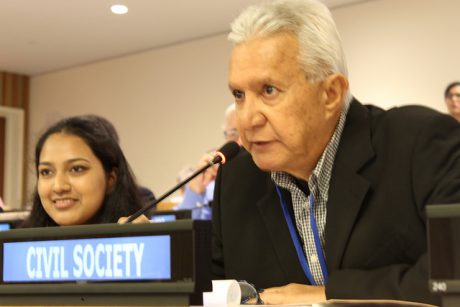
Roland Oldham, head of the nuclear test veterans organization Mururoa e tatou, addresses UN conference to negotiate the Treaty on the Prohibition of Nuclear Weapons on 21 June.
Moruroa e Tatou, Tahiti – The nuclear bomb is a weapon of crime and mass destruction.
We should all be well aware of the examples of Hiroshima and Nagasaki, where the consequences still today have effects across generations.
Like those in other places, nuclear tests in the Pacific by France, America and Britain were a crime towards indigenous people, and the defenceless people of the Pacific. It is a racist crime—nuclear racism. This destroyed and contaminated their environment, the natural resources that they depend on to live. The damages are irreversible.
Look at Moruroa for example—137 nuclear blasts underneath the coral atoll have severely fractured the atoll which is sinking down into the rising ocean, leaking radioactive gases and plutonium into the sea, risking disastrous damage for marine life. French authorities have assessed that there is a danger of a landslide of 670 million cubic meters of rock at Moruroa, creating a 15-20 meter tsunami.
The responsible governments used the Pacific as a dumping ground for nuclear waste—in the Marshall Islands, Moruroa, Fangataufa, Christmas Island, and elsewhere. Plutonium is in the lagoon of Moruroa and leaking from the 147 underground test explosion holes in Moruroa and Fangataufa. Not to mention the widespread radioactive fallout from atmospheric nuclear explosions.
There are thousands, millions of victims out there around the world—former test and weapons production site workers, military staff, civilians; women and children. They are invisible. They are voiceless. They have cancers: leukemia, thyroid, others…. Women in French Polynesia now have the highest rates of thyroid cancer and myeloid leukemia in the world. Their children through many generations will be affected by genetic mutations and damage.
It is a poisonous heritage that is left to humanity and future generations.
It is a crime against humanity.
I don’t see much of the word “crime” in the ban treaty: crime against our planet, crime against our environment, crime against humanity. The aim of the treaty is to stop all these crimes.
Why is there no word about these crimes.
Is there pressure from somewhere? Is there censorship?
Have we lost our morality?
But as victims we are not begging for favour, we are just standing up for our rights and our dignity.
There exists an obligation for the nuclear-armed states to compensate their victims, and to make reparation for the damage done to the environment.
There must be no more mushroom clouds producing untold numbers of new victims.
Roland Oldham, the head of the nuclear test veterans organization Mururoa e tatou, addressed the UN conference to negotiate the Treaty on the Prohibition of Nuclear Weapons on 21 June. The above piece is based upon his remarks, which he delivered in French on behalf of IPPNW and ICAN Australia.
July 3, 2017
Posted by aletho |
Environmentalism, Militarism, Timeless or most popular, War Crimes | France, Human rights, UK, United States |
Leave a comment
If you wish to understand the degree to which a supposedly free western media are constructing a world of half-truths and deceptions to manipulate their audiences, keeping us uninformed and docile, then there could hardly be a better case study than their treatment of Pulitzer prize-winning investigative journalist Seymour Hersh.
All of these highly competitive, for-profit, scoop-seeking media outlets separately took identical decisions: first to reject Hersh’s latest investigative report, and then to studiously ignore it once it was published in Germany last Sunday. They have continued to maintain an absolute radio silence on his revelations, even as over the past few days they have given a great deal of attention to two stories on the very issue Hersh’s investigation addresses.
These two stories, given such prominence in the western media, are clearly intended to serve as “spoilers” to his revelations, even though none of these publications have actually informed their readers of his original investigation. We are firmly in looking-glass territory.
So what did Hersh’s investigation reveal? His sources in the US intelligence establishment – people who have helped him break some of the most important stories of the past few decades, from the Mai Lai massacre by American soldiers during the Vietnam war to US abuse of Iraqi prisoners at Abu Ghraib in 2004 – told him the official narrative that Syria’s Bashar Assad had dropped deadly sarin gas on the town of Khan Sheikhoun on April 4 was incorrect. Instead, they said, a Syrian plane dropped a bomb on a meeting of jihadi fighters that triggered secondary explosions in a storage depot, releasing a toxic cloud of chemicals that killed civilians nearby.
It is an alternative narrative of these events that one might have assumed would be of intense interest to the media, given that Donald Trump approved a military strike on Syria based on the official narrative. Hersh’s version suggests that Trump acted against the intelligence advice he received from his own officials, in a highly dangerous move that not only grossly violated international law but might have dragged Assad’s main ally, Russia, into the fray. The Syrian arena has the potential to trigger a serious confrontation between the world’s two major nuclear powers.
But, in fact, the western media were supremely uninterested in the story. Hersh, once considered the journalist’s journalist, went hawking his investigation around the US and UK media to no avail. In the end, he could find a home for his revelations only in Germany, in the publication Welt am Sonntag.
There are a couple of possible, even if highly improbable, reasons all English-language publications ignored Hersh’s story. Maybe they had evidence that his inside intelligence was wrong. If so, they have yet to provide it. A rebuttal would require acknowledging Hersh’s story, and none seem willing to do that.
Or maybe the media thought it was old news and would no longer interest their readers. It would be difficult to sustain such an interpretation, but at least it has an air of plausibility – except for everything that has happened since Hersh published last Sunday.
His story has spawned two clear “spoiler” responses from those desperate to uphold the official narrative. Hersh’s revelations may have been entirely uninteresting to the western media, but strangely they have sent Washington into crisis mode. Of course, no US official has addressed Hersh’s investigation directly, which might have drawn attention to it and forced western media to reference it. Instead Washington has sought to deflect attention from Hersh’s alternative narrative and shore up the official one through misdirection. That alone should raise the alarm that we are being manipulated, not informed.
The first spoiler, made in the immediate wake of Hersh’s story, were statements from the Pentagon and White House warning that the US had evidence Assad was planning yet another chemical attack on his people and that Washington would respond extremely harshly if he did so.
Here is how the Guardian reported the US threats:
The US said on Tuesday that it had observed preparations for a possible chemical weapons attack at a Syrian air base allegedly involved in a sarin attack in April following a warning from the White House that the Syrian regime would ‘pay a heavy price’ for further use of the weapons.
And then on Friday, the second spoiler emerged. Two unnamed diplomats “confirmed” that a report by the Organisation for the Prohibition of Chemical Weapons (OPCW) had found that some of the victims from Khan Sheikhoun showed signs of poisoning by sarin or sarin-like substances.
There are obvious reasons to be mightily suspicious of these stories. The findings of the OPCW were already known and had been discussed for some time – there was absolutely nothing newsworthy about them.
There are also well-known problems with the findings. There was no “chain of custody” – neutral oversight – of the bodies that were presented to the organisation in Turkey. Any number of interested parties could have contaminated the bodies before they reached the OPCW. For that reason, the OPCW has not concluded that the Assad regime was responsible for the traces of sarin. In the world of real news, only such a finding – that Assad was responsible – should have made the OPCW report interesting again to the media.
Similarly, by going public with their threats against Assad, the Pentagon and White House did not increase the deterrence on Assad, making it less likely he would use gas in the future. That could have been achieved much more effectively with private warnings to the Russians, who have massive leverage over Assad. These new warnings were meant not for Assad but for western publics, to bolster the official narrative that Hersh’s investigation had thrown into doubt.
In fact, the US threats increase, rather than reduce, the chances of a new chemical weapons attack. Other, anti-Assad actors now have a strong incentive to use chemical weapons in false-flag operation to implicate Assad, knowing that the US has committed itself to intervention. On any reading, the US statements were reckless – or malicious – in the extreme and likely to bring about the exact opposite of what they were supposed to achieve.
But beyond this, there was something even more troubling about these two stories. That these official claims were published so unthinkingly in major outlets is bad enough. But what is unconscionable is the media’s continuing blackout of Hersh’s investigation when it speaks directly to the two latest news reports.
No serious journalist could write up either story, according to any accepted norms of journalistic practice, and not make reference to Hersh’s claims. They are absolutely relevant to these stories. In fact, more than that, the intelligence sources he cites are are not only relevant but are the sole reason these two stories have been suddenly propelled to the top of the news agenda.
Any publication that has covered either the White House-Pentagon threats or the rehashing of the OPCW report and has not mentioned Hersh’s revelations is writing nothing less than propaganda in service of a western foreign policy agenda trying to bring about the illegal overthrow the Syrian government. And so far that appears to include every single US and UK mainstream newspaper and TV station.
July 1, 2017
Posted by aletho |
Deception, Fake News, Mainstream Media, Warmongering, Timeless or most popular | UK, United States |
Leave a comment
Nestled in the agreement between the Tories and the Democratic Unionist Party is a promise to draft a law to protect British security forces from prosecution over killings committed during the 30-year so-called ‘Troubles’ in Northern Ireland.
The contentious promise is contained in a section of the document, published Monday, entitled “Legacy,” which states that:
“The UK government will work with the Executive and all parties to seek the implementation of the legacy bodies in the Stormont House Agreement, to provide better outcomes for victims and survivors.”
It notes that a public consultation on the implementation of legacy bodies will be held and are to be established to “operate in ways that are fair, balanced and proportionate and which do not unfairly focus on former members of the armed forces or police.”
“Both parties reiterate their admiration for the courage and sacrifice of the police and armed forces in upholding democracy and the rule of law and will never forget the debt of gratitude that we owe them,” the subsection concludes.
The government in the Republic of Ireland has previously indicated that there should be no such amnesties or exemptions for any of those involved in the conflict on either side of the divide. The Times also notes that Irish ministers have written to the UK’s Northern Ireland Secretary, James Brokenshire, stating that the Stormont Agreement also doesn’t allow for such legislation.
Earlier this month, Sinn Fein president Gerry Adams said that any deal between the Tories and DUP would be “in breach” of the historic 1998 Good Friday Agreement, which brought about sustained peace to the island for the first time since the beginning of the decades long conflict.
In 2016, it was announced that two former soldiers are to be charged with the murder of Official IRA member, Joe McCann, in west Belfast over 44 years ago.
Republican activists have been seeking justice for the deaths of 10 people shot dead by the British army in the same area in 1971. There have also been reports that up to 18 soldiers were involved in the Bloody Sunday massacre on Derry’s Bogside in 1972 when 14 people died as a result of a British Army Parachute regiment opening fire on an unarmed crowd during a civil rights demonstration.
A commission set-up to investigate the killings concluded that the victims were innocent of any wrongdoing.
Furthermore, Amnesty International has said that allegations arising from a BBC Panorama investigation alleging that British security forces colluded with loyalist terrorists on a vast scale leading directly to the deaths of hundreds of people must be fully investigated.
READ MORE:
Belfast court rejects inquiry into 1989 loyalist murder
June 28, 2017
Posted by aletho |
Ethnic Cleansing, Racism, Zionism, Subjugation - Torture, Timeless or most popular, War Crimes | Democratic Unionist Party, UK |
Leave a comment
There is no defensive purpose to an aircraft carrier. Its entire purpose is to move aircraft to a position where they can attack other countries. As soon as they are equipped with attack aircraft, these carriers will spend most of their time around the Middle East, including at the UK’s brand new naval base in the vicious despotism of Bahrain. Having spent £7 billion on these behemoths, politicians will seek to enhance their prestige and demonstrate that they control a nation which is a “major power”, by using them. The very fact of their existence will make bombing attacks such as those we saw on Syria, Libya and Iraq more likely.
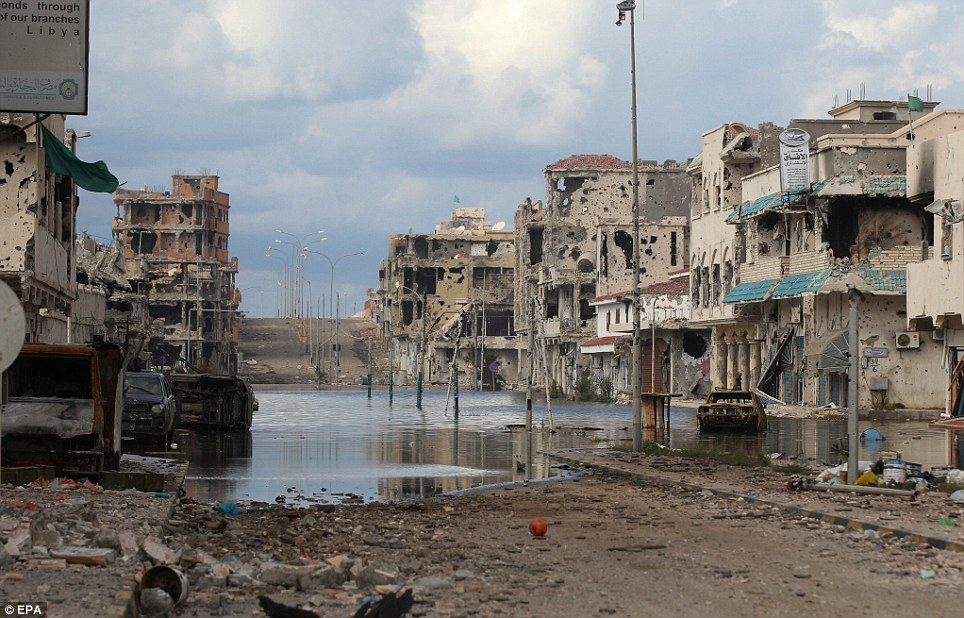
Sirte, Libya, after NATO bombing
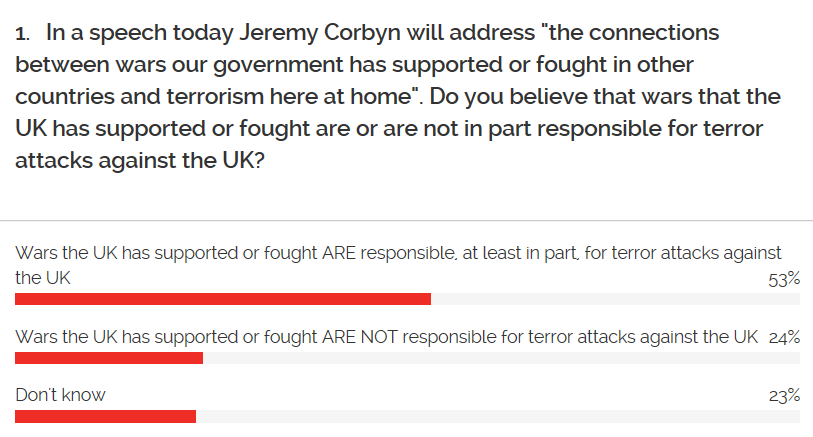
That further twist in the cycle of violence will lead to more terrorist attacks in the UK. There is no sense in which this aircraft carrier is anything to do with defending the United Kingdom. It is a device to attack foreign countries. The result is it makes us a lot less safe at home.
When they think about it, people understand that, as YouGov demonstrated during the recent election campaign. The politicians will be trying to whip up feelings of jingoism and national pride around this huge hunk of floating hubris, to stop us thinking about that.
There is no money for our schools and hospitals, but unlimited sums for the armaments industry. The United Kingdom is not just a dysfunctional state, it is a rogue state and a danger to the peace of the world.
June 28, 2017
Posted by aletho |
Militarism, War Crimes | Bahrain, Libya, Middle East, UK |
Leave a comment
Despite the best efforts of Britain’s pro-Israel lobby, the organisers of the biggest-ever Palestine event in Europe have been told by the British government that it is “content to let the event proceed.” A spokesperson for the Department for Communities and Local Government (DCLG) advised the chairman of Friends of Al-Aqsa of the decision this morning.
Palestine Expo will be held at the Queen Elizabeth II Conference Centre in Westminster on 8 and 9 July. The organisers promise to provide a Palestinian social, cultural and entertainment event of a kind not seen before. Palestinians and their supporters from Jewish, Christian and Muslim faith backgrounds, as well as varied political perspectives, will be taking part.
The venue, which is on parliament’s doorstep in Westminster, comes under the remit of an agency within the DCLG. Pro-Israel lobbyists have been trying to have Palestine Expo 2017 cancelled, making what Ismail Patel of the organising group called “false and baseless allegations” against Friends of Al-Aqsa. The Secretary of State at the DCLG, Sajid Javid MP, had made it known to the organisers that he was “minded” to cancel the event, but representations by Friends of Al-Aqsa appear to have persuaded him otherwise.
Describing the government’s decision as “very good news indeed” for freedom of speech in Britain, Mr Patel said that this should enable people to book their tickets for the event with more confidence. “Advance ticket sales are already very healthy,” he explained, “but the DCLG decision will give them a welcome boost.”
Friends of Al-Aqsa’s chairman is confident that the British public will not be disappointed by the programme on offer. Speaking to MEMO, he emphasised the intention to foster good community relations and promote democratic means to end the occupation of Palestine. “We invite everyone who wishes to see peace in Palestine and champion freedom of speech to attend Palestine Expo,” he added.
June 27, 2017
Posted by aletho |
Civil Liberties, Ethnic Cleansing, Racism, Zionism, Full Spectrum Dominance, Solidarity and Activism | Palestine, UK, Zionism |
Leave a comment
These are the 15 countries which shamefully voted against a UN General Assembly Resolution on Thursday which proposed to seek an opinion from the International Court of Justice on Britain’s continued colonial possession of the Chagos Islands. In the most absolute example of ethnic cleansing in modern history, less than 50 years ago the UK deported by force the entire population of the Chagos Islands to make way for the US military base on Diego Garcia, and to this day refuses to allow them to return.
The Dirty 15
USA
UK
Israel
Australia
New Zealand
The above are of course arguably the five countries in the world most profoundly implicated in the usurpation and destruction of native populations
Afghanistan
Albania
Bulgaria
Croatia
Hungary
Japan
Lithuania
Maldives
Montenegro
South Korea
This second small group is dominated by countries with a particularly close security relationship with the United States on which they place particular reliance in relation to a perceived threat.
It must however be heartening that the US and UK could round up so very few supporters for their utterly immoral stance. It is particularly worth noting that none of the major players within the EU backed the UK.
The US and UK are also remarkably silent on the blockade of Qatar by their ally Saudi Arabia. The release of Saudi demands including the closing down of Al Jazeera TV and other media outlets including the excellent Middleeasteye.net show the Saudis’ true motives. Frankly I am shocked by the failure of the mainstream media in the West seriously to question the ludicrous Saudi claim that this attack on Qatar is over support for terrorism.
Mohammed Bin Salman was appointed by his father the King as Crown Prince in Saudi Arabia on 21 June. Bin Salman has been directing the major affairs of the state for the last three years. The ferocity of the prosecution of the war in Yemen is very much his baby. Bin Salman’s master plan, which he has driven through with much skill, is for a far more aggressive Saudi Arabia leading the conservative forces in the Middle East, above all in fierce opposition to Iran and Shia interests. To this end he has forged a conservative alliance incorporating Saudi Arabia, Israel, Egypt and the United States.
US and UK involvement in the war in Yemen goes beyond the enthusiastic supply of the bombs and aircraft which have killed thousands of children. Both have had special forces on the ground, and the CIA has yet again been deeply implicated in the detention, extreme torture and murder of opponents.
The Bin Salman plan is dressed up as “pro-Western” and media hacks paint him as a “reformer” because he wishes to expand a network of McDonalds in the Kingdom. But as Iran slowly does reform, and sticks meticulously to the terms of the internationally guaranteed nuclear agreement, Saudi paranoia towards its regional “rival” becomes ever more dangerous. The Iranians deserve respect for the moderation with which they reacted to the Saudi sponsored terror attack on their parliament itself. But such provocations will increase.
Saudi support for ISIL, Al Qaeda, Al Nusra and the numerous other jihadist groups will only increase as Saudi Arabia seeks to deploy them in its sectarian war against the Shia and their allies. For that reason there is no prospect of terrorist violence in Syria declining. Indeed the United States shooting down of a Syrian jet in “self-defence” was almost certainly an indication that the Syrians were at the time targeting jihadist forces reinforced by US special forces. Israeli bombing and missile sorties against Syrian regime targets in support of jihadist rebels are finally being regularly reported in mainstream media.
I do not hold up Qatar or its ruling aristocracy as a paragon of virtue. But it seeks a more pacific relationship with Iran, and has more developed economic relationships including on shared offshore fields. Qatar has also consistently shown greater interest in the plight of the Palestinians, and more scepticism towards Israel, than Bin Salman is happy with. Qatar also has problems with the brutal military dictatorship of Egypt.
Most worryingly to Saudi Arabia, these slightly more liberal attitudes are closer to the views of the “arab street”, where there is disquiet at Saudi Arabia’s obvious but officially denied relationship with Israel. Qatar also has a media which can reflect these views to a wider Arab audience. Even though, following previous Saudi threats, al Jazeera’s content has been toned down, the Saudis see the station as an intolerable direct threat.
There is public fatigue in the West with regard to the affairs of the Middle East. This is a mistake as the situation is more dangerous than ever. The UK and USA both look likely to support the Saudis and Israel in their determination for conflict with Iran. The EU and Russia – and anybody not harbouring a death wish – will be working to keep the Iranian nuclear deal together. Bin Salman has chosen his time well, with slightly crazed right wing regimes in Washington, London and Tel Aviv willing to back his adventurism. The blockade of Qatar is but a symptom of something much more dangerous.
June 25, 2017
Posted by aletho |
Ethnic Cleansing, Racism, Zionism, Illegal Occupation, Militarism | Australia, Human rights, Israel, New Zealand, UK, United States, USA |
Leave a comment

As we know, the Met Office have informed us that Wednesday was the hottest June day since 1976, with a temperature of 34.5C recorded next to the runway at Heathrow.
Apparently the previous hottest June day since 1976 was at Worcester in 1995, with 33.8C set.

http://www.markvoganweather.com/2017/06/21/uk-eyes-warmest-june-day-since-1976-on-longest-day-of-the-year/
This is all very interesting, because I asked the Met Office what the highest temperature was on Wednesday after the Heathrow figure.
This was their reply:

So the next highest temperatures, set at Kew and Northolt which are both close to Heathrow, were 33.8C, the same as in 1995.
Only by using the Heathrow temperature were the Met Office able to claim the “hottest day since 1976”.
Many readers will recall similar shenanigans in 2015, when the tarmac at Heathrow conveniently allowed the Met Office to claim the hottest July day on record.
June 23, 2017
Posted by aletho |
Deception, Science and Pseudo-Science | UK |
Leave a comment