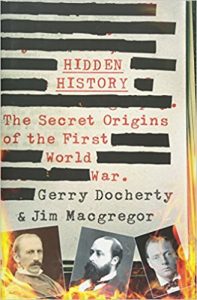
Hidden History: The Secret Origins of the First World War
Overview of Gerry Docherty & Jim Macgregor’s Book
By Antony C. Black | Global Research | July 19, 2017
Of the many myths that befog the modern political mind, none is so corrupting of the understanding or so incongruent with historical fact as the notion that the wealthy and the powerful do not conspire.
 They do.
They conspire continually, habitually, effectively, diabolically and on a scale that beggars the imagination. To deny this conspiracy fact is to deny both overwhelming empirical evidence and elementary reason.
Nevertheless, for the astute observer of the ‘Great Game’ of politics, it is an unending source of wonderment to stumble across ever more astounding examples of the monstrous machinations of which wealthy and powerful elites are capable. Indeed, it is precisely here that authors Docherty and Macgregor enter the fray and threaten to take our breath away entirely.
Thus, the official, canonized history of the origins of the First World War, so they tell us, is one long, unmitigated lie from start to finish. Even more to the conspiratorial point is the authors’ thesis that – and to paraphrase a later Churchill who figures prominently in this earlier story – never were so many murdered, so needlessly, for the ambitions and profit of so few.
In demolishing the many shibboleths surrounding the origins of the ‘Great War’ (including ‘German responsibility’, ‘British peace efforts‘, ‘Belgian neutrality’ and the ‘inevitability’ of the war), Docherty and Macgregor point the finger at what they argue is the real source of the conflict: a more or less secret cabal of British imperialists whose entire political existence for a decade and a half was dedicated to the fashioning of a European war in aid of destroying the British Empire’s newly emerging commercial, industrial and military competitor, Germany.
In short, far from “sleepwalking into a global tragedy, the unsuspecting world”, Docherty and Macgregor contend, “was ambushed by a secret cabal of warmongers” originating not in Berlin, but “in London”.
I must confess at this juncture to a certain bias in granting credence to such a striking thesis, this if only on general principle alone. After all, one straight look at present day political reality is to look square into the maw of Orwell’s nightmare. Moreover, three decades of independent journalism have led me to conclude not only that virtually nothing of what is presented as ‘news’ is remotely true, but that the conventional writing and presentation of history itself is as phoney as a three dollar bill. Still, one does demand a credible argument or two. Let’s look at a few of those contained in ‘Hidden History’.
The Players

Cecil Rhodes (Source: Wikipedia)
Before launching pell-mell into the argumentative labyrinth it is apropos that we first sketch the central cast of characters of this grim story.
In the beginning there was Cecil Rhodes, the prime minister of Cape Colony but who, the authors remind us, was “in reality a land-grabbing opportunist” whose fortune had been underwritten in equal parts “by brutal native suppression and the global mining interests of the House of Rothschild”. Rhodes had, apparently, long talked of setting up a secret ‘Jesuit-like society’ in aid of furthering the global ambitions of the British Empire. In February of 1891 he did just that enlisting the services of his close associates, William Stead, a prominent journalist, and Lord Esher, a close advisor to the British Monarchy.
Two others were soon drawn into the inner circle of the clandestine group: Lord Nathaniel (Natty) Rothschild of the famous British and European banking dynasty, and Alfred Milner, a brilliant academic and colonial administrator who would quickly become the organizing genius and iron-willed master of ceremonies of the group.
These central four would later be joined by: Lord Northcliffe, the owner of ‘The Times’, who would complement Stead in propagandizing and softening up the British public for war with Germany; Arthur Balfour and Herbert Asquith, two future British Prime Ministers who would provide the needed parliamentary influence; Lords Salisbury and Rosebery who brought an additional wealth of political connections to the table; and Lord Edward Grey, he to whom, in the final analysis as British Foreign Secretary in 1914, it would fall to hammer the final nail in the coffin of European peace.
Of particular importance was the addition of Prince Edward (soon to be King Edward VII) who, despite his playboy image, was, in fact, an astute political operative whose frequent international social forays provided the perfect cover for helping to forge the, often secret, military and political alliances between Russia, France, Britain, and Belgium.
This core Praetorian Guard then extended its tentacles to all reaches of the British (and eventually, international) power hierarchy by vigorously recruiting its ‘Association of Helpers’, the myriad of lower down bureaucrats, bankers, military officers, academics, journalists, and senior civil servants, many, as it turns out, hailing from Balliol and All Souls Colleges, Oxford.
And, too, the legendary Churchill, liberally inflated with his own bombast and well lubricated with Rothschild money, would rise to take his anointed place amongst the war-hungry secret elect.
Early Adventures
The first foray of this elite cabal played out in South Africa with the deliberate fomentation of the (2nd) Boer War (1899 – 1902). Gold had been discovered in the Transvaal region in 1886 and British imperialists were determined to grab it. After a number of failed machinations by Rhodes himself to topple the Boers, the secret elite was dealt an ace when Alfred Milner was appointed high commissioner for South Africa. Seizing the moment, Milner, without passing Go, proceeded straight to war and, in his infamous scorched earth policies and adamant demands for unconditional surrender, demonstrated the general martial philosophy that would later be deployed against Germany.
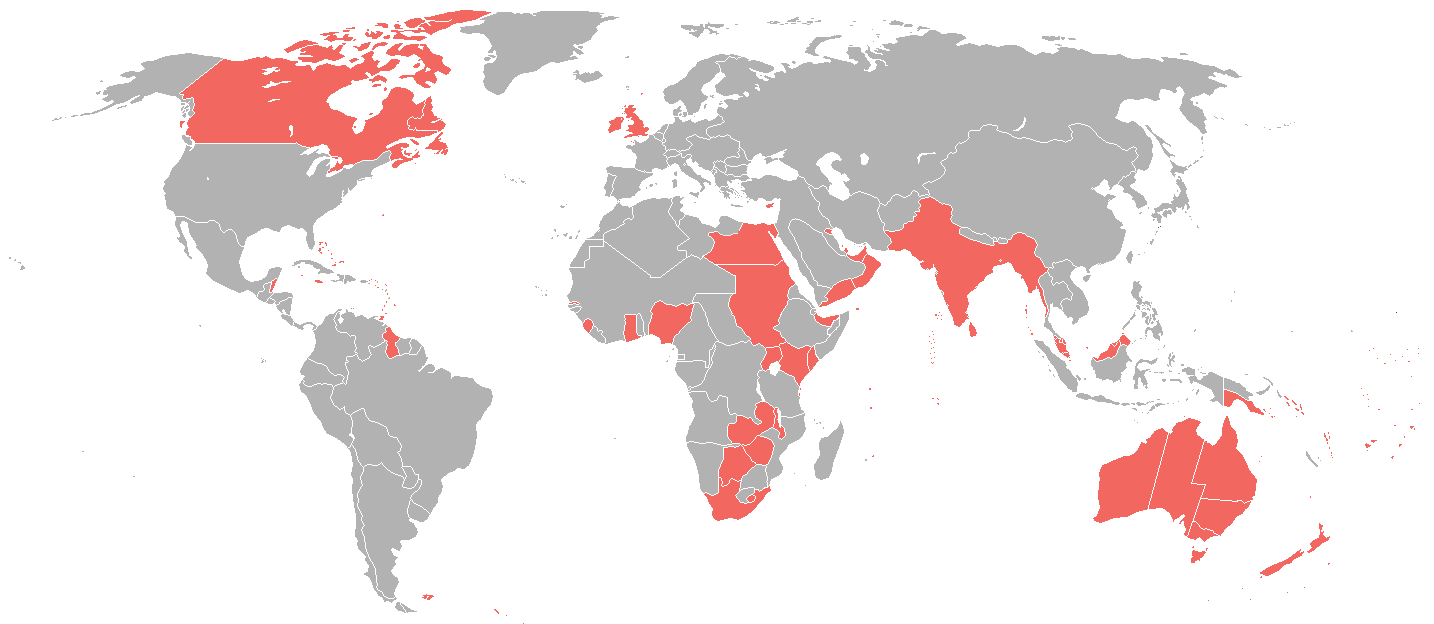
A map of the British Empire as it was in 1898, prior to the Second Boer War (1899-1902). (Source: Wikimedia Commons)
Following the defeat of the Boers, Milner & Co. (Rhodes had died during the ‘peace negotiations’) quickly penetrated the main organs of British imperial governance including the Foreign, Colonial, and War Offices. Arthur Balfour went one better by establishing, in 1902, the Committee for Imperial Defence (CID). The latter proved especially significant in helping to almost completely bypass the British Cabinet in the years, months and days leading up to August, 1914. Indeed, Balfour would prove to be one of only two permanent members of this all-important imperial institution; the other being Lord Fredrick Roberts, commander-in-chief of the armed forces and close friend of Milner. It was Roberts who would later appoint two tragically incompetent hangers-on, Sir John French and Douglas Haig, to their First World War posts overseeing the mass slaughter of hundreds of thousands of Allied soldiers.
The year 1902 also saw the establishment of the Anglo-Japanese Treaty. Britain had long feared for its Far East empire at the hands of Russia and sought to bolster Japan as a counterweight. The alliance bore fruit in the 1904-1905 Russo-Japanese conflict in which Russia was dealt a decisive defeat. Always with the long-term goal in mind, however, i.e. war with Germany, Milner et al adroitly switched bait and immediately began wooing Czar Nicholas II resulting in the Anglo-Russian Convention of 1907. In the same period (1904) Britain – with the crucial assistance of Edward VII – broke its near thousand-year enmity towards France and signed the Entente Cordial with its former rival.
During this same time frame (1905) a more or less secret agreement was made with King Leopold II allowing Belgium to annex the Congo Free State. This was, for all intents and purposes, an alliance between Britain and Belgium; one which was, over the next decade, to be continually deepened with numerous (mostly secret, meaning withheld from the British Parliament) bilateral military agreements and ‘memorandums of understanding’, and which unequivocally put paid to any notion of Belgium being some sort of ‘neutral’ party in the upcoming conflict with Germany.
The core alliance was now complete, i.e. Britain, Russia, France and Belgium, and all that was needed was to secure the fealty and obeisance of the British colonies. In aid of the latter Milner convoked The Imperial Press Conference of 1909 which brought together some 60 newspaper owners, journalists and writers from across the Empire who hobnobbed with another 600 or so British journalists, politicians and military figures in a grand orgy of war-mongering propaganda. The martial message was then duly delivered to the unwitting colonial multitudes. The success of the Conference could be seen most visibly in Canada where, despite the extreme divisiveness of the issue, the nation would eventually send more than 640,000 of its soldiers to the killing fields of Europe, this all on behalf of a tiny handful of British imperialists.
The Moroccan ‘Crisis’
Docherty and Macgregor duly remind us that renowned historian Barbara Tuchman, in her Pulitzer-Prize winning book, ‘The Guns of August’, “made it very clear that Britain was committed to war by 1911 at the latest.” Indeed, preparations for war had proceeded apace since at least 1906.
Still, 1911 marked a turning point when the secret elite first made bold in attempting to ignite war with Germany. The pretext was Morocco. Now, truth to tell, Britain had no direct colonial interests in Morocco, but France and Germany did. By this time the cabal in London – with Edward Grey as Foreign Minister – had inducted a key French minister, Theophile Declasse, into their confidences and were able to engineer what was essentially a false flag operation in Fez. France then followed this up with an army of occupation. Germany posted a minimalist response by sending a small gunboat to Agadir whence the entire British press – reflecting Britain’s ‘deep state’ interests – went into high hysteria condemning German ‘threats to British sea-lanes’ etc. The fuse to war was only snuffed out in the final hour when France’s (recently elected) socialist Premier, Joseph Caillaux, initiated peace talks with the Kaiser. War with Germany would have to wait.
In the meantime, Britain, under the direction of its secret mandarins – i.e. almost entirely beyond Parliamentary review or approval – continued their preparations for war. To this end, for example, Churchill, who by 1911 had been appointed First Lord of the Admiralty, redeployed the British Atlantic fleet from Gibraltar to the North Sea and the Mediterranean fleet to Gibraltar. Simultaneously, the French fleet was moved from the Atlantic to cover Britain’s absence in the Mediterranean. These maneuvers were all strategically aimed at Germany’ North Sea navy. The pieces on the global chessboard were being positioned.

Source: Wikimedia Commons
In France the leftist peacenik Caillaux was, in 1913, replaced as Premier with one of the British elites very own ‘helpers’ in the person of Raymond Poincare, a right-wing, rabid Germanophobe. Poincare quickly acted to remove his anti-war ambassador to Russia, George Louis, and substitute him with the revanchist Declasse. Meanwhile in America the secret cabal, acting largely through the Pilgrims Society and through the Houses of Morgan and Rockefeller, machinated to have an unknown but pliable democrat, Woodrow Wilson, elected over the publicly-controlled central bank advocate, President Taft. It was from this lofty perch that the Anglo-American ‘deep state’ launched the US Federal Reserve System, a private central bank dedicated from the get-go to funding the war against Germany.
The Balkan Sting
The simple tale repeated ad nauseam regarding the circumstances surrounding the assassination of Archduke Franz Ferdinand on June 28, 1914, so Docherty and Macgregor tell us, contains as little veracity as, say, the official version of the assassination of JFK two generations later. Indeed, the structural similarities between the two – from the virtual total stand-down of security through to the clear evidence of state complicity (in this case, starting in Serbia, but leading straight to London) – are remarkable. Suffice to say that there was a domino-like chain of events that then ensued – it’s just that the events weren’t driven by base human instincts and ineluctable forces beyond all human control as is commonly proffered, but rather by calculating minds and conspiratorial design.
Thus, immediately following the assassination, there was widespread international support for Austria-Hungary which was widely perceived as the aggrieved party. Nevertheless, the usual suspects, having helped stage the murder in the first place, were able to deftly turn the propaganda tables against both Austria and Germany by means of an ingenious ruse. Having secretly obtained the contents of the ‘Note’, which contained Austria’s (reasonable under the circumstances) demands for Serbian contrition, the secret cabal were able to gain direct input into the crafting of the ‘Serbian Reply’. The ‘reply’, of course, was designed to be unacceptable to Austria. Simultaneously, France’s President, Poincare, decamped to Moscow to assure the Czar and his generals that, should Germany act to uphold its alliance responsibilities towards Austria, France would back Russia in launching a full scale European war. France, naturally, knew that England – or rather its elite imperial clique – was similarly committed to war. It was during this opportune moment, in fact, when Grey and Churchill connived to purchase the Anglo-Persian Oil Company so securing the necessary oil supplies for the British navy.
All the while Kaiser Wilhelm and Chancellor Bethmann were conspicuous in being the only statesmen genuinely seeking peace. Their subsequent vilification by hordes of appropriately housebroken historians thus rings with the same Orwellian tone as the present-day establishment demonization of nations and individuals resisting the American Imperium.
Grey Hits It Home
Having contrived to fan the flames of a local Balkan fire into a general European inferno, British Foreign Minister Grey and Prime Minister Asquith subsequently deployed every dirty trick in the diplomatic playbook to vitiate any possibility of peace and, instead, to guarantee war.
On July 9th, for instance, the German ambassador to London, Prince Lichnowsky, was repeatedly reassured by Grey that Britain had entered no secret negotiations that would play into war. This, of course, was an outright lie. On July 10, Grey then deceived Parliament into believing that Britain had not the slightest concern that events in Sarajevo might lead to a continental war. Meanwhile, the Austrian Prime Minister, Berchtold, was similarly deceived by all three Entente governments that their reaction to the ‘Note’ would not go beyond a diplomatic protest. However, by the 3rd week of July all of these self-same governments did an about-face and declared a complete rejection of Austria’s response.
On July 20, as already noted, the French Prime Minister, Poincare, went to St. Petersburg to reaffirm their two nations’ respective martial agreements. On July 25, Lichnowsky arrived unannounced at the British Foreign office with a desperate plea from the German government imploring Grey to use his influence to halt Russian mobilization. Incredibly, no one was available to receive him. Russia had, in any case, secretly begun mobilization of its armed forces on July 23, while, on July 26, Churchill quietly mobilized the British fleet at Spithead.
None of the foregoing, of course, was subject to democratic oversight. As Docherty and Macgregor put it,
“As far as the [British] public was concerned, nothing untoward was happening. It was just another summer weekend.”
On July 28th, Austria, despite not being in a position to invade for another fortnight, declared war on Serbia. Meanwhile, the British Foreign Office began to circulate rumours that German preparations for war were more advanced than those of France and Russia even though the exact opposite was, in fact, the case. Matters were quickly racing beyond Wilhelm’s control.
On the 29th, Lichnowsky again begged Grey to prevent a Russian mobilization on Germany’s borders. Grey’s response was to write four dispatches to Berlin which post-war analysis proved were, in truth, never sent. The dispatches turned out to be merely part-and-parcel of the elaborate charade to make it look as if Britain (and, specifically, he, Grey) was doing all it could in the effort to avert war. Also on the evening of the 29th did Grey, Asquith, Churchill, and Richard Haldane meet to discuss what Asquith called the ‘coming war’. Docherty & Macgregor once again here emphasize that these four men were virtually the only people in Britain privy to the impending calamity, i.e. not the other Cabinet members, not the members of Parliament, and certainly not the British citizenry. But then, they were its architects.
On the 30th, the Kaiser wired Czar Nicholas a heartfelt appeal to negotiate the prevention of hostilities. Indeed, Nicholas was so moved by Wilhelm’s plea that he decided to send his personal emissary, General Tatishchev, to Berlin to broker a peace. Unfortunately, Tatishchev never made it to Berlin, having been arrested and detained that very night by the Russian Foreign Minister, Sazonov, who, as ‘Hidden History’ cogently evinces, had long been an asset of the secret cabal in London. Under sustained pressure from senior members of his military Nicholas finally relented and on the afternoon of the 30th ordered general mobilization.
The official announcement of Russian mobilization effectively closed all doors to peace. The Germans, realizing that they had been set up, and also realizing that they were about to be attacked on two fronts – from the west by France, and from the east by Russia – finally, on Aug. 1, ordered their own mobilization; tellingly, the last of the continental powers to do so. Here, however, Germany made a crucial tactical error: it elected to follow up its mobilization with a formal, honour-bound declaration of war on France. By doing so it fell deeper into the trap laid by Grey & Co. who had, all along, machinated to do everything possible to guarantee war without, however, being seen to have officially caused the war.
Still, Grey had one last card to play in order to convince both a war-leery Cabinet and House of Commons to abandon their common sense and plunge headlong into a full-scale pan-European war. For just as the myth of ‘weapons of mass destruction’ would, in a later era, serve to advance American imperial aggression, so here did the myth of poor, benighted little ‘neutral Belgium’ carry the banner for British imperialism.
The Speech That Sealed The Fate of Millions
On the 2nd of August, 1914 Prime Minister Asquith convened a special Cabinet meeting to discuss the (manufactured) crisis. Though the Cabinet was in no mood to countenance British involvement in a continental war, they soon found themselves pressured and hedged about by revelations of a ‘web of [military and political] obligations, which they had been assured were not obligations, [and] had been spun around them as they slept’. Moreover, Grey crucially kept from them the fact that the German ambassador, Lichnowsky, had, only the day before (Aug. 1), specifically offered to guarantee Belgian neutrality. Indeed, Grey’s deception might never have come to light but for the fact that Chancellor Bethmann exposed the offer in the Reichstag on Aug. 4th.
With the Cabinet sufficiently brow-beaten, confounded – and deceived, i.e. Asquith, without Cabinet approval or knowledge, had already issued orders for the mobilization of the Army and Navy – it now only remained to hoodwink Parliament. And so, on Aug. 3rd, Sir Edward Grey took to the pulpit and began what was to be an epic panegyric to the follies of peace and the virtues of war. Here too the audience was not particularly receptive, but the sermon soon gathered force.
Having first set the tone by announcing that peace in Europe ‘cannot be preserved’, Grey then moved on to a stunning series of lies and misrepresentations concerning the intricate and long-formulated military agreements between England, France, Russia and Belgium. According to Grey, they didn’t exist. But what of the dense skein of diplomatic agreements? There were no such agreements, there were no such entanglements. Parliament was ‘free’ to vote its conscience, to exercise its democratic mandate. Just as long, of course, as it didn’t vote for peace.
All of the foregoing was, in any case, mere preamble to the centerpiece ploy of Grey’s speech: Belgian neutrality. That the latter was an out-and-out sham was only surpassed in duplicity by Grey’s concealment, not only from Cabinet but now from Parliament, of Germany’s offer to guarantee exactly the point under contention, i.e. Belgian neutrality. Instead, Grey produced, for dramatic affect, an emotional telegram from the King of Belgium to King George pleading for assistance. The timing couldn’t have been more perfect if it had it been deliberately designed for the occasion. Which, of course, it was. Also pre-planned were the post-sermon affirmations in favour of war by the various opposition party leaders. They had all been vetted and brought onside by Churchill prior to the day’s session. Only Ramsay MacDonald, head of the Labour Party, swam against the well-orchestrated tide of ‘inevitability’ that was the constant and unerring motif of Grey’s martial peroration.
The day’s session ended without debate; Asquith had not allowed any to occur, though he had been pressured by the Speaker of the House to reconvene later that evening. In between Grey sealed the deal, i.e. war, by firing off an ultimatum to Germany demanding that it not invade Belgium even though he, Grey, knew that such an invasion had already begun. As Docherty and MacGregor phrase it, this was a “masterstroke”. War could not now be avoided. And though the night session witnessed a vigorous and substantive debate which largely demolished Grey’s stance, it was all for nought. At the appointed moment Arthur Balfour, “former Conservative Prime Minister and a member of the Secret Elite’s inner circle, rose menacingly. He had had enough.” Using the full weight of his magisterial authority he condemned, ridiculed and dismissed the naysayers’ anti-war arguments as, the ‘very dregs and lees of the debate’. With the Commons thus emotionally bullied into silence, so ended the last chance for peace in Europe.
Plus Ca Change
What strikes one again and again whilst reading ‘Hidden History’ is the ring of truth that resonates from every page, from every revelation. That such a tiny, elite group of individuals, completely beyond democratic control, could determine the fate – and deaths – of millions should shock us. It should, but it doesn’t really. It doesn’t because we see the same phenomenon occurring now, repeatedly, before our very eyes. Indeed, the current state of ‘permanent war’ is, more or less, the unconscious condition of modernity itself.
Docherty & Macgregor have made a fine contribution here. They have gone beyond what David Irving so aptly labelled as the ‘court historians’, i.e. those historians essentially prostituted to elite / establishment consensus, and given us a glimpse of what it really means to write history. And if there is any lesson – or rather counter lesson – we can take from it, it is that we are doomed to repeat history only so long as we listen to those dedicated to obscuring and inverting it. In short, to those who lie to us.
Title: Hidden History: The Secret Origins of the First World War
Authors: Gerry Docherty and Jim MacGregor
Publisher: Mainstream Publishing; Reprint edition (September 1, 2014)
ISBN-10: 1780576307
ISBN-13: 978-1780576305
Featured image from Amazon
QE, the largest transfer of wealth in history
By Dan Glazebrook | RT | July 22, 2017
It appears that the massive, almost decade-long transfer of wealth to the rich known as ‘quantitative easing’ is coming to an end.
Of the world’s four major central banks – the US Federal Reserve, the Bank of England, the European Central Bank and the Bank of Japan – two have already ended their policy of buying up financial assets (the Fed and the BoE), and the ECB plans to stop doing so in December. Indeed, the Fed is expected to start selling off the $3.5 trillion of assets it purchased during three rounds of QE within the next two months.
Given that – judged by its official aims – QE has been a total failure, this makes perfect sense. By ‘injecting’ money into the economy, QE was supposed to get banks lending again, boosting investment and driving up economic growth. But overall bank lending in fact fell following the introduction of QE in the UK, whilst lending to small and medium sized enterprises (SMEs) – responsible for 60 percent of employment – plummeted.
As Laith Khalaf, a senior analyst at Hargreaves Lansdown, has noted: “Central banks have flooded the global economy with cheap money since the financial crisis, yet global growth is still in the doldrums, particularly in Europe and Japan, which have both seen colossal stimulus packages thrown at the problem.”
Even Forbes admits that QE has “largely failed in reviving economic growth”.
This is, or should be, unsurprising. QE was always bound to fail in terms of its stated aims, because the reason banks were not funneling money into productive investment was not because they were short of cash – on the contrary, by 2013, well before the final rounds of QE, UK corporations were sitting on almost £1/2trillion of cash reserves – but rather because the global economy was (and is) in a deep overproduction crisis. Put simply, markets were (and are) glutted and there is no point investing in glutted markets.
This meant that the new money created by QE and ‘injected’ into financial institutions – such as pension funds and insurance companies – was not invested into productive industry, but rather went into stock markets and real estate, driving up prices of shares and houses, but generating nothing in terms of real wealth or employment.
Holders of assets such as stocks and houses, therefore, have done very well out of QE, which has increased the wealth of the richest 5 percent of the UK population by an average of £128,000 per head.
How can this be? Where does this additional wealth come from? After all, while money – contrary to Tory sloganeering – can indeed be created ‘out of thin air’, which is precisely what QE has done, real wealth cannot. And QE has not produced any real wealth. Yet the richest 5 percent now have an extra £128,000 to spend on yachts, mansions, diamonds, caviar and so on. So where has it come from?
The answer is simple. The wealth which QE has passed to asset-holders has come, first of all, directly out of workers’ wages. QE, by effectively devaluing the currency, has reduced the buying power of money, leading to an effective decrease in real wages, which, in the UK, still remain 6 percent below their pre-QE levels. The money taken out of workers’ wages therefore forms part of that £128,000 dividend. But it has also come from new entrants to the markets inflated by QE – primarily, first time buyers and those just reaching pension age.
Those buying a house (which QE has made more expensive), for example, will likely have to work thousands of additional hours over the course of their mortgage in order to pay this increased cost. It is those extra hours that are creating the wealth which subsidizes the spending spree for the richest 5 percent. Of course, these increased house prices are paid by anyone purchasing a house, not only first time buyers – but the additional cost for existing homeowners is compensated for by the rise in price of their existing house (or by their shares for those wealthy enough to hold them).
QE also means that newly retiring pensioners are forced to subsidize the 5 percent. New retirees use their pension pot to purchase an ‘annuity’ – a bundle of stocks and shares generating dividends which serve as an income. However, as QE has inflated share prices, the number of shares they can buy with this pot is reduced. And, as share price increases do not increase dividends, this means reduced pension payments.
In truth, the story that QE was about encouraging investment and boosting employment and growth was always a fantastical yarn designed to disguise what was really going on – a massive transfer of wealth to the rich.
As economist Dhaval Joshi put it in 2011: “The shocking thing is, two years into an ostensible recovery, [UK] workers are actually earning less than at the depth of the recession. Real wages and salaries have fallen by £4bn. Profits are up by £11bn. The spoils of the recovery have been shared in the most unequal of ways.”
In March this year, the Financial Times noted that while Britain’s GDP had recovered to pre-crisis levels by 2014, real wages were still 10 percent lower than they had been in 2008. “The contraction of UK real wages was reversed in 2015,” they added, “but it is not going to last”. They were right. The same month the article was published, real wages began to fall again, and have been doing so ever since.
It is the same story in Japan, where, notes Forbes, “household income actually contracted since the implementation of QE”.
QE has had a similar effect on the global South: enriching the holders of assets at the expense of the ‘asset-poor’. Just as the influx of new money created bubbles in the housing and stock markets, it also created commodity price bubbles as speculators rushed to buy up stocks of, for example, oil and food. For some oil producing countries this has had a positive effect, providing them a windfall of cash to spend on social programs, as was initially the case in, for example, Venezuela, Libya and Iran. In all three cases, the empire has had to resort to various levels of militarism to counter these unintended consequences. But oil price hikes are, of course, detrimental to non-oil-producing countries – and food price hikes are always devastating.
In 2011, the UK’s Daily Telegraph highlighted “the correlation between the prices of food and the Fed’s purchase of US Treasuries (i.e. its quantitative easing programs)… We see how the food price index broadly stabilized through late 2009 and early 2010, then rose again from mid-2010 as quantitative easing was re-started … with prices rising about 40 percent over an eight month period.”
These price hikes pushed 44 million people into poverty in 2010 alone – leading, argued the Telegraph, to the unrest behind the so-called Arab Spring. Former World Bank president Robert Zoellick commented at the time that: “Food price inflation is the biggest threat today to the world’s poor… one weather event and you start to push people over the edge.”
Such are the costs of quantitative easing.
The BRICS economies were also critical of QE for another reason: they saw it as an underhand method of competitive currency devaluation. By reducing the value of their own currencies, the ‘imperial triad’ of the US, Europe and Japan were effectively causing everyone else’s currencies to appreciate, thereby damaging their exports. Forbes wrote in 2015, “The effects are already being felt in the most dynamic exporter in the world, the East Asian economies. Their exports in US dollar terms moved dramatically from 10 percent year-on-year growth to a contraction of 12 percent in the first half of this year; and the results are the same whether China is excluded or not.”
The main benefit of QE to the developing world is supposed to have been the huge inflows of capital it triggered. It has been estimated that around 40 percent of the money generated by the Fed’s first QE credit expansion (‘QE1’) went abroad – mostly to the so-called ‘emerging markets’ of the global South – and around one third from QE2. However, this is not necessarily the great boon it seems. Much of the money went, as we have seen, into buying up commodity stocks (making basic items such as food unaffordable for the poor) rather than investing in new production, and much also went into buying up stocks of currency, again causing an export-damaging appreciation. Worse than this, an influx of so-called ‘hot money’ (footloose speculative capital, as opposed to long term investment capital) makes currencies particularly volatile and vulnerable to, for example, rises in interest rates abroad.
Should interest rates rise again in the US and Europe, for example, this is likely to trigger a mass exodus of capital from the emerging markets, potentially prefiguring a currency collapse. Indeed, it was an influx of ‘hot money’ into Asian currency markets very similar to that seen during QE which preceded the Asian currency crisis of 1997.
It is precisely this vulnerability which is likely to be tested – if not outright exploited – by the coming end of QE and accompanying rise of interest rates.
Dan Glazebrook is a freelance political writer who has written for RT, Counterpunch, Z magazine, the Morning Star, the Guardian, the New Statesman, the Independent and Middle East Eye, amongst others. His first book “Divide and Ruin: The West’s Imperial Strategy in an Age of Crisis” was published by Liberation Media in October 2013. It featured a collection of articles written from 2009 onwards examining the links between economic collapse, the rise of the BRICS, war on Libya and Syria and ‘austerity’. He is currently researching a book on US-British use of sectarian death squads against independent states and movements from Northern Ireland and Central America in the 1970s and 80s to the Middle East and Africa today.
Most Britons oppose UK arms sales to Saudi Arabia: Poll
Press TV – July 16, 2017
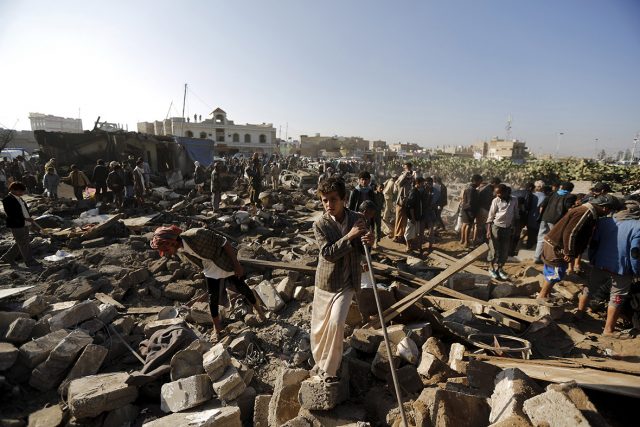
A majority of the British public believes the UK must end arms sales to Saudi Arabia over its large-scale slaughter of civilians in Yemen, according to a new poll.
An exclusive poll conducted by BMG Research for The Independent has found that 58 percent of people say it is wrong for Britain to supply billions of pounds of weapons to Saudi Arabia.
The poll also shows that 64 percent of the public want the government of Prime Minister Theresa May to release a suppressed report into Saudi Arabia’s funding of extremism in Britain, even if it damages relations with Riyadh.
On Wednesday, UK Home Secretary Amber Rudd cited national security reasons for not publishing a report commissioned by former Prime Minister David Cameron that shows the majority of foreign funding for extremism in the UK came from Saudi Arabia.
The survey underscores the public’s deep concern about the UK’s close relationship with an autocracy embroiled in a devastating war in Yemen.
The UK has licensed 3.3 billion pounds worth of weapons since the beginning of Saudi Arabia’s war on Yemen in March 2015.
The United Nations and other international organizations have accused the Saudi-led coalition of bombing hospitals, schools and wedding parties in Yemen.
The UN has declared Yemen a “humanitarian catastrophe,” with sanitation systems destroyed and at least 300,000 people infected with cholera.
The opposition to weapons sales has extended into the government, with key Conservative lawmakers thought to be debating privately for arms sales to be halted.
“This just shows how fast the Conservatives are moving away from public opinion,” said Tom Brake, a Liberal Democrat lawmaker. “Instead of giving the Saudis a stern talking to, ministers are flogging them arms.”
Last week, the UK High Court ruled that London’s weapons sales to Riyadh are not against the law.
The ruling came despite the judges conclusion that there was “a substantial body of evidence suggesting that the [Saudi-led] coalition committed serious breaches of international humanitarian law in the course of its engagement in the Yemen conflict”.
Saudi Arabia has been bombing Yemen since March 2015 in a bid to restore Yemen’s former President Abd Rabbuh Mansur Hadi, a Riyadh ally, to power. Yemen’s crisis began after Hadi stepped down as president and refused to negotiate power-sharing with the country’s Houthi Ansarullah movement.
Message from the High Court: Carry on Arming The Saudis (And Never Mind the Slaughter in Yemen)

Campaigners are furious with a High Court decision in London allowing the UK Government to carry on exporting arms to Saudi Arabia for use against Yemenis
By Stuart Littlewood | American Herald Tribune | July 13, 2017
The Campaign Against Arms Trade (CAAT) brought the legal action against the Secretary of State for International Trade for continuing to grant export licences for arms to Saudi Arabia, arguing that this was against UK policy, which states that the government must refuse such licences if there’s a clear risk that the arms might be used to commit serious violations of International Humanitarian Law.
It is undeniable that Saudi forces have used UK-supplied weaponry to violate International Humanitarian Law in their war on Yemen. According to the United Nations, well over 10,000 people have been killed, the majority by the Saudi-led bombing campaign which has also destroyed vital infrastructure such as schools and hospitals and contributed to the cholera crisis. 3 million Yemenis have been displaced from their homes and 7 million are on the brink of dying from famine. UNICEF reports that a child is dying in Yemen every ten minutes from preventable causes including starvation and malnourishment.
A crippling naval blockade of the country by the US has been key to the cruel onslaught. The European Parliament and numerous humanitarian NGOs have condemned the Saudi air strikes as unlawful. And 18 months ago a UN Panel of Experts accused Saudi forces of “widespread and systematic” targeting of civilians.
Yet the UK has licensed £3.3 billions worth of arms such as aircraft, helicopters, drones, missiles, grenades, bombs and armoured vehicles to the Saudi regime and refused to suspend the supply of weaponry for use in Yemen in the face of the horrors perpetrated. It is claimed that the Government has even ignored warnings by senior civil servants and its own arms control experts, and that some records of expressed concern have gone missing.
So who is the UK’s helping hand behind that vile regime’s murderous adventure in the Yemen? Why, it’s none other that senior Israel stooge Dr Liam Fox, now Secretary of State for International Trade and the lead on trade and investment in the defence and security sector. He of course oversees export licensing. He also has ‘form’ when it comes to thinking silly thoughts and doing stupid things in the foreign affairs arena, and he’s known as a crazed flag-waver for Israel and a sworn enemy of Iran.
While Secretary of State for Defence, Fox told us: “Israel’s enemies are our enemies and this is a battle in which we all stand together or we will all fall divided.”
Fox was forced to resign as Defence Secretary in 2011 following the scandal involving him, his ‘close friend’ Adam Werritty, the UK ambassador to Israel, and Israeli intelligence figures allegedly involved in plotting sanctions against Iran.
The reason for the British government’s hostility towards Iran was spelled out by David Cameron in a speech to the Knesset in 2014: “A nuclear armed Iran is a threat to the whole world not just Israel. And with Israel and all our allies, Britain will ensure that it is never allowed to happen.” That position carries forward into the present day.
And in June 2015 Fox declared: “It is logical to assume that Iran’s intentions are to develop a nuclear weapons capability and any claims that its intentions are exclusively peaceful should not be regarded as credible… Iran’s nuclear intentions cannot be seen outside the context of its support for terror proxies, arguably the defining feature of its foreign policy. The risks are clear.”
What he omitted to say was that Iran’s intentions must also be seen in the context of Israel’s foreign policy, its refusal to sign the Nuclear Non-Proliferation Treaty and the grave threat posed by the Zionist regime’s 200 (or is it 400?) nuclear warheads. Israel hasn’t signed the Biological and Toxin Weapons Convention either, and has signed but not ratified the Comprehensive Nuclear Test-Ban Treaty, likewise the Chemical Weapons Convention. Iran and all the other nations in the region have every right to feel nervous.
As is well known, Israel and Saudi Arabia have formed a cosy alliance. No entities deserve each other more. And Britain will do anything, it seems, to get at Iran through these repulsive ‘friends’.
Instead of dangling from a lamp-post on Tower Bridge, Fox was quickly rehabilitated and re-promoted to senior office by fellow stooges like Theresa May. Just lately prime minister May has accused Iran of working with Hezbollah, interfering in Iraq, sending fighters to Syria to help Assad, and supporting the Houthis in the conflict in Yemen. The British Government, of course, can meddle where it pleases and do dirty weapons deals with the Saudis which, Mrs May assures us, are for the sake of long-term security in the Gulf. “Gulf security is our security,” she says, arguing that the same extremists who plot terror in the Gulf states are also targeting the streets of Europe.
Toxic relationship with Saudi Arabia exposed
So how did Fox manage to defeat the campaigners in court? After all, as Rosa Curling of Leigh Day (acting for CAAT) said, “The law is clear: where there is a clear risk that UK arms might be used in the commission of serious violations of international law, arm sales cannot go ahead.
“Nothing in the open evidence presented by the UK government to the court suggests this risk does not exist in relation to arms to Saudi Arabia. Indeed, all the evidence we have seen from Yemen suggests the opposite: the risk is very real…. Our government should not be allowing itself to be complicit in the grave violations of law taking place by the Saudi coalition in Yemen.”
Andrew Smith of CAAT said: “If this verdict is upheld then it will be seen as a green light for government to continue arming and supporting brutal dictatorships and human rights abusers like Saudi Arabia that have shown a blatant disregard for international humanitarian law….
“This case has seen an increased scrutiny of the government’s toxic relationship with Saudi Arabia. It is a relationship that more than ever needs to be examined and exposed. For decades the UK has been complicit in the oppression of Saudi people, and now it is complicit in the destruction of Yemen.”
Rachel Sylvester in The Times noted that the judges concluded there was “a substantial body of evidence suggesting that the [Saudi-led] coalition committed serious breaches of international humanitarian law in the course of its engagement in the Yemen conflict”, but the ruling was based on a narrow legal point about whether ministers had followed proper procedures and acted rationally in assessing the risks.
“Whatever the result of the legal process,” she wrote, “it’s time for the government to reconsider Britain’s poisonous relationship with Saudi Arabia, starting with the suspension of arms sales to a country that stands accused of appalling human rights abuses within its own borders as well as the funding of extremism abroad. What is UK foreign policy for if not the promotion of this country’s values around the world?”
And, as she points out, last year the UK committed £85 million to the aid effort in Yemen, making the Department for International Development the fourth largest donor to the crisis.
So, just as we pour £millions of aid into the Palestinian Territories to subsidise the illegal Israeli occupation while at the same time supplying the regime in Tel Aviv with arms to sustain its occupation, we are spending all this taxpayers’ money in Yemen to clean up the mess we’re helping the Saudis to make.
Secret evidence favours the evil
Fox succeeded thanks to ‘closed sessions’. This meant that CAAT and their legal team weren’t allowed to see much of what was presented by the Government, which could only be examined by a security-cleared “special advocate”.
The secret evidence is said to have included Saudi Arabia’s “fast-jet operational reporting data”, “high-resolution MoD-sourced imagery” and “UK defence intelligence reports and battle damage assessments”. The MoD and Foreign Office analysis had “all the hallmarks of a rigorous and robust, multi-layered process of analysis” while the evidence presented by the campaigners was “only part of the picture”. The Court said the secret evidence could not be referred to in open court for reasons of “national security”.
But what has all the MoD’s high-faluting technical tosh to do with justice? Or the basic concept of right and wrong? An especially International Humanitarian Law?
And our national security? Yeah, yeah, yeah. So the slaughter must go on in that distant land…
Labour’s shadow international trade secretary Barry Gardenier suggested in the House of Commons that the “secret” evidence should be made available to MPs for scrutiny “on privy council terms” or handed to the Intelligence and Security Select Committee. Sounds reasonable enough.
But Fox is reported saying: “This idea that somehow, if we have closed sessions, that makes the judgment less valid, I simply don’t accept. Because I don’t accept this idea that we simply can’t have closed sessions that protect our national security or the personnel involved in our national security. Our sources need to be protected.”
Yeah, and so do Yemeni civilians…. from us.
He admitted that “Yemen is indeed a humanitarian disaster” but said it was right to keep selling arms to Saudi Arabia. He may have won the legal point – for now. But he has clearly lost his moral compass, if he ever had one.
As Rachel Sylvester remarks, “So craven is the Whitehall establishment that the government has refused to publish a report on the foreign funding of terrorism, for fear of annoying its Saudi friends.”
*(London, UK. 11th July, 2016. Human rights campaigners dressed as Grim Reapers protest against the Farnborough International arms fair, and in particular against arms sales to Saudi Arabia used in human rights abuses in Yemen, at Waterloo station. Image credit: Campaign Against Arms Trade/ flickr).
Condemnation as govt bans report into who funds Britain’s extremists
RT | July 12, 2017
UK Home Secretary Amber Rudd has confirmed an already much-delayed report into the foreign funding and support of extremist groups in the UK will be banned from publication for “national security” reasons.
Rudd instead released a parliamentary written answer outlining the details of the report, which was commissioned by former Conservative Prime Minister David Cameron.
“Having taken advice, I have decided against publishing the classified report produced during the review in full,” she said.
“This is because of the volume of personal information it contains and for national security reasons.”
“We will be inviting privy counselors from the opposition parties to the Home Office to have access to the classified report on privy council terms.”
According to the Home Secretary’s summary, some key findings include that UK-based individual donors primarily fund extremist organizations in the UK, while some donations also came from overseas.
The report was finished six months ago, and it is thought its publication had been further delayed over government fears diplomatic links with principal Middle East ally Saudi Arabia would be at stake if had been implicated in the foreign financing of UK radical groups.
The summary said foreign aid helped individuals enter institutions that “teach deeply conservative forms of Islam and provide highly socially conservative literature and preachers to the UK’s Islamic institutions.”
Some of those individuals have since become of “extremist concern,” the report added.
The decision to permanently shelve the report has caused an outcry among opposition parties, with Liberal Democrat leader Tim Farron arguing that extremism can only be tackled if full information is released, regardless of what consequences there may be for the UK’s diplomatic ties abroad.
“We cannot tackle the root causes of terrorism in the UK without full disclosure of the states and institutions that fund extremism in our country.”
“Instead of supporting the perpetrators of these vile ideologies, the government should be naming and shaming them – including so-called allies like Saudi Arabia and Qatar if need be,” he said, according to Business Insider.
“It seems like the government, yet again, is putting our so-called friendship with Saudi Arabia above our values. This shoddy decision is the latest in a long line where we have put profit over principle.”
Green Party co-leader Caroline Lucas also blasted the “unacceptable decision” not to publish the report, warning that it fuels speculation the government wants to cover up Saudi Arabia’s terrorist funding.
“The statement gives absolutely no clue as to which countries foreign funding for extremism originates from – leaving the government open to further allegations of refusing to expose the role of Saudi Arabian money in terrorism in the UK,” Lucas said.
Court rules Britain’s arms sales to Saudi Arabia are ‘lawful’, despite destruction of Yemen
RT | July 10, 2017
London’s High Court has ruled that UK arms sales to the Saudi Arabian regime are “lawful” in response to a judicial review brought by the Campaign Against the Arms Trade (CAAT).
The case hinged on the question of whether the UK failed to suspend sales in line with legal obligations, given the Saudi’s current war in neighboring Yemen, which has been waged in part using British manufactured military equipment.
Documents cited in court showed that civil servants had, in fact, recommended that sales should no longer go ahead, but ministers had ignored the advice.
“This is a very disappointing verdict, and we are pursuing an appeal,” Andrew Smith of Campaign Against Arms Trade said.
“If this verdict is upheld then it will be seen as a green light for government to continue arming and supporting brutal dictatorships and human rights abusers like Saudi Arabia that have shown a blatant disregard for international humanitarian law.”
CAAT’s lawyer, Rosa Curling, said: “Nothing in the open evidence, presented by the UK government to the court, suggests this risk does not exist in relation to arms to Saudi Arabia.
“Indeed, all the evidence we have seen from Yemen suggests the opposite: the risk is very real. You need only look at the devastating reality of the situation there.”
CAAT, who have said they will appeal, had argued that the UK’s continued sales are a breach of international law while the EU’s common council also insists that sales to nations where violations of the law might occur must be halted.
In the last two years, the UK has licensed the sales of £3 billion (US$3.86 billion) worth of arms to the Saudi government, with which Britain is a longstanding ally.
Arm sales have included Typhoon and Tornado jets and the UK has had military personnel embedded in Saudi headquarters throughout the Yemen conflict, which has raged since 2015.
The British government maintains that the personnel are there to support adherence to international law and advice on rules of engagement.
Both Royal Air Force (RAF) and Royal Artillery (RA) personnel have been deployed to train the Saudi military during the war.
The conflict – which has been accompanied with a blockade of major ports – has drastically worsened the humanitarian situation in the already-impoverished gulf nation.
The UN says 17 million people in Yemen are at imminent risk of famine, while dwindling medical supplies and lack of trained medical personnel have led to epidemics.
Leading humanitarian organizations, including the Red Cross, have named the aerial bombing campaign and blockade as the main causes behind the ongoing cholera epidemic in the capital, Sanaa, that has already claimed some 200 lives, while over 11,000 cases of the disease have been registered.
Featured Video
New positive ivermectin evidence
or go to
Aletho News Archives – Video-Images
From the Archives
Fanatical Followers of the Covid Regime: A Jim Jones-Style Cult?
By Professor Roger Watson and Dr. Niall McCrae | The Daily Sceptic | November 15, 2021
As scholars at leading British universities over recent decades, we witnessed the replacement of critical thinking and debate by narrative: facts are discrimination and scientific method is imperialism; truth, instead, is derived from ‘progressive’ values. This educational trend may be a major contributory factor to the ease in which society has been inculcated to the Covid ‘new normal’ of masking, testing, and repeated doses of vaccines for a disease of similar risk to severe influenza.
One doesn’t need much critical reasoning to observe the flawed logic of some vaccination enthusiasts, such as people who respond to experiencing any side effects, however debilitating, by saying “at least I know it’s working”, or, after contracting the disease despite their promised inoculation (over 90% effective, according to initial drug company claims), “I’d have been worse off without the jab.” … continue
Blog Roll
 Aletho News
- New positive ivermectin evidence
- Met Office Caught Fabricating Daily Temperature Record Claims
- Merck Virologists Admitted to Falsely Certifying Vaccine Efficacy
- Mandatory Folic Acid for every man, woman & child
- Pro-Palestine protesters arrested outside UK’s ruling Labour Conference in Liverpool
- Mauritius denies landing permit to flight from Israel, forcing cancellation: Tour operator
- Israeli finance minister calls for genocidal war on West Bank, annexation of south Lebanon
- 12 Things Your Psychiatrist Was Trained Not to Tell You
- From Unipolar Universalism to Multipolar Civilizational Distinctiveness
- RSF military group defects, joins Sudanese army: State media
- If Americans Knew
- Israel forces Gazans to live in constant peril – Daily Update
- Deconstructing Netanyahu’s pants-on-fire UN rant – Daily Update
- Trump betrayed voters with his campaign lies and prioritized a foreign country once he took office
- Netanyahu calls Israel’s war in Gaza ‘opposite of genocide’ in UN speech to near-empty hall
- Settler Kidnappings: Torture, Sexual Abuse and Terrorisation of Palestinian Abductees as Israel Deepens Annexation of West Bank
- Gaza winter nears as 162,000 tents become unusable, raising fears of humanitarian crisis
- Netanyahu says, “It’s the opposite of genocide”; UN says Gaza economy is world’s ‘most severe crisis on record’ – Daily Update
- Israel’s US-Backed Assault on Gaza Has Created the ‘World’s Most Severe Economic Crisis on Record’: UN
- ‘Protecting U.S. Citizens’… From Israel
- ‘This is where I live now, the back of a truck’: a day in the life of a grandmother in Gaza
- No Tricks Zone
- New Study: Earth And Venus Surface Warmth Largely Explained By Convection And Lapse Rate, Not CO2 Or Radiation
- 2025 Nature Paper Claiming Worsening Global Drought Gets RETRACTED …Heavily Flawed
- New Study: ‘Global Drought Shows No Detectable Recent Acceleration Under Climate Warming’
- Economic Masterminds: German Socialists Suggest Taxing Productivity Gains Stemming From Using AI
- The South China Sea Has Not Been Cooperating With The Climate Change Narrative
- Energy Crisis: Germany Enters Heating Season With Historically Low Gas Reserve Fill Levels
- New Study: The Antarctic Ice Sheet Gained Mass From 2020-2024 Due To Staggering Snow And Ice Accumulation
- Study: Ocean Heating Rates From Thousands Of Years Ago ‘Dwarf’ Modern Ocean Heating Rates
- Climate Extremists Target, Attack Large-Scale Power Grid Infrastructure In Germany!
- New Study: Antarctic Ice Melt Has Contributed Less Than 1 Centimeter To Sea Level Rise In The Last 30 Years


