Britain ignores Bahrain’s human rights record to pursue business interests with dictatorship
By Marwa Osman | RT | March 5, 2017
Britain’s multi-million pound trade and aid strategy for programs in Bahrain needs exposed as the tiny gulf kingdom continues its chain of tyranny and torture against the Shia majority.
The British government’s unreserved condemnation of torture and inhumane treatment and punishment seems to vanish when it comes to making more money. As kidnaps, imprisonments and political executions are on the rise in Bahrain, activists and Bahraini opposition figures are troubled by the fact that the UK government is spending taxpayers’ money on these trade and aid programs, especially given the clear risk of complicity in abuse.
Habib Mohamed Habib is the latest Bahraini civilian to be kidnapped from his home the morning of Friday March 3rd 2017 as security forces deployed armored vehicles in and around Diraz, in a continuation of the Al Khalifa Monarchy’s oppression against the Shiite Friday prayers as part of their uninterrupted crackdown on civilians since 2011 in the Bahraini capital Manama.
As Habib’s family struggle to know the whereabouts of their son, traveling in and around Diraz is nothing less than a nightmare with traffic jams at every entry point of the town, which is witnessing an increase in tightened security at its checkpoints.
Meanwhile, since last June the citizens of Diraz have been experiencing an internet blockade every day between 7pm and 1am as a result of a service restriction order from the Bahraini authorities. The citizens of Diraz are increasingly being cut off from the outside world. They cannot even contact emergency services, and if somebody is caught aiding a fellow citizen he/she will disappear like Habib and hundreds of others like him.
Last week alone, the Bahrain Center for Human Rights BHRC documented a total of 17 arbitrary arrests, among whom were six children. In the same week, 129 marches took place in 40 villages in Bahrain to denounce the chain of repressions and kidnappings targeting peaceful protestors and Friday prayers’ attendees. BHRC reported that 26 marches during the same week were attacked by the Bahraini riot police and a total of 19 persons were judged in 6 politically motivated cases.
It is an open secret in Bahrain that after 6 years of constant crackdowns on millions of protestors who clamored for social justice and political self-determination, the ruling Al Khalifa regime has managed to get away with brutalizing, imprisoning, torturing and killing their own civilians under nonsensical pretexts. Although the monarchy has often expressed its desire to negotiate a political solution, promises of change have translated on the ground to a systematic crackdown.
The Al Khalifa regime has utterly failed to bear its responsibility in creating a space of dialogue in order to foster harmony, cohesion and tolerance. Instead of pushing for respect of cultural diversities amongst its citizens as a fundamental basis of democracy and peace-building, the authorities have politicized freedom of religion and successfully used it as a pretext for the incitement of hatred, violence and racial discrimination against groups of individuals and religious minorities.
International community’s deafening silence
Despite the fact that the Bahraini authorities have been only tightening restrictions on the rights to freedom of expression and association and continuing to curtail the right to peaceful assembly while detaining and charging several human rights defenders, banning others from traveling abroad, dissolving the main opposition group and stripping more than 80 people of their Bahraini citizenship, the United Nations Human Rights Council (UNHRC) has largely remained silent on the situation in Bahrain.
According to a joint NGO letter to Permanent Representatives of Member and Observer States of the UN Human Rights Council, Bahrain’s courts continued to play a key role last year in issuing repressive orders and granting the authorities broad discretionary powers to revoke Bahrainis’ citizenship, in some cases leaving them stateless.
The ultimate repressive order was issued on January 9, 2017 by Bahrain’s Court of Cassation upheld death sentences against three protestors convicted of killing police including three police officers in a bomb attack.
Sami Mushaima (42), Ali Al-Singace (21) and Abbas Al-Samea (27), who were executed on the morning of January 15, 2017 by firing squad, were reported by Bahrain Center for Human Rights BHRC to have been tortured during interrogation to force them to confess to the bomb attack. According to the BHRC, the lawyers of the executed men were not given access to all the hearings against the defendants, nor allowed to cross-examine prosecution witnesses during court hearings.
The shocking part about the atrocities inflicting the Bahrainis is no longer the blatant violations of the Al Khalifa monarchy as much as it is the international community turning a blind eye to the Bahraini people’s legitimate struggle for democratic rights.
UK government complicit in oppression
The US and the UK are two major western states supposedly committed to supporting human rights, democratic values, free speech and political self-determination, while, at the same time, are flagrantly partnering with dictatorships like that of the Bahraini Monarchy to advance their foreign agenda.
For instance, the government of the United Kingdom signed what the Foreign and Commonwealth Office (FCO) called a “landmark defense agreement” with the Gulf island kingdom of Bahrain in 2014. Clearly ongoing human rights abuses committed by those partners on their own citizens are not considered a shared strategic and regional threat especially when Bahrain is home to a major Royal Navy base. The multi-million-pound Royal Navy facility in Bahrain, which was founded in November 2016 housing up to 600 UK military personnel, became the staging-post for Britain in the Middle East and is designed to assert influence over the Gulf. Bahrain has paid most of the £30million-plus cost, with the UK contributing around £7.5million.
During the opening of the new Naval Support Facility (NSF) in Manama, Britain’s first permanent military base in the region since 1971, the Telegraph published an OpEd by Fawaz bin Mohamed Al Khalifa, Bahrain’s Ambassador to London, who claimed that King Hamad bin Isa Al Khalifa outlined the Gulf Cooperation Council’s interest in a free trade agreement between the UK and the GCC, which would significantly increase the UK’s access to the GCC’s £1.3 trillion market; a market estimated to grow by a further £400 billion by 2020.
Relative to its size, Bahrain already hosts a large number of British companies. The Bahraini Ambassador to London put the figures at “500 British brands, 90 British company branches, and 350 Bahraini-British business partnerships”. These businesses operate in some of Bahrain’s key sectors, including banking, accounting, law and industry. Meanwhile bilateral trade between Bahrain and the UK generated a staggering £432 million in 2015 alone, which would simply explain why the UK would choose to remain silent on all the human rights violations in the tiny gulf kingdom.
These bilateral relations are signed and sealed with Bahraini blood, says Ali Alaswad, former Bahraini Member of Parliament who was elected in October 2010, but resigned in February 2011 in response to the Governments’ crackdown on peaceful democracy protesters.
After his home was targeted by security forces, AlAswad left Bahrain and now resides in London where he continues his political work to achieve a democratic Bahrain. As I spoke with MP AlAswad, he emphasized that the UK’s current disappointing stance towards ignoring the human rights violations in Bahrain provides “a green light to the Bahraini government to abuse the basic human rights of the civilians which permits it to become more violent against the Shia majority and the Bahraini opposition.”
AlAswad told me “it doesn’t matter who you are in Bahrain, if you dare to demand for your basic rights then you will be in grave danger, which is why if the UK government as a strategic ally to the Bahraini government doesn’t use its ties as a strong card to support the oppressed Bahraini people to at least secure their basic human rights as enlisted in the declaration of human rights, then the UK is whitewashing the Bahraini authorities’ shocking human rights record by deliberately blocking official criticism of the Kingdom especially at international forums like the UN”.
The UK government is now seen by human rights activists and Bahraini opposition figures as a complicit in the tiny gulf kingdom’s tyranny against the outcry of the legitimate and basic demands of the Bahraini civilians until an official statement is issued from the UK government to condemn the acts of oppression of the Bahraini monarchy against its people.
“How do you expect the majority of the population to react when they see their leaders and clerics being detained, unlawfully imprisoned and even sometimes deported from their own country?” asks MP AlAswad.
Sheikh Ali Salman, a Shiite cleric and head of the Al-Wefaq opposition party, is now sentenced to serve nine years in jail for allegedly inciting hatred and calling for regime change by force.
The Bahraini authorities then went overboard when they stripped the highest religious authority in the country Sheikh Isa Qassim, a 79-year-old cleric, of his citizenship in June 2016 over accusations that he used his position to serve foreign interests and promote sectarianism and violence. This happened a week after the government of Bahrain suspended the Shia opposition group al-Wefaq.
The implications of this arrest is sending shockwaves on the streets of Manama, Diraz, Sanabes, Karbabad, Karzakan and Barbar with protestors refusing to back down. This resistance is prompting even more oppression and kidnapping from the Bahraini authorities.
Earlier this week, Al-Wefaq Deputy Secretary General, Sheikh Hussein al-Daihi, said through his twitter account, that targeting Ayatollah Qassim is triggered by his brave and firm stances, to demand legitimate rights for the oppressed Bahraini people. The deputy SG also stressed that Ayatollah Qassim is a red line, and the repercussions of crossing that line would go beyond the country’s borders.
Ms. Marwa Osman. PhD Candidate located in Beirut, Lebanon. University Lecturer at the Lebanese International University and Maaref University. Political writer/commentator on Middle East issues with many international and regional media outlets.
‘UK curbing academic free speech on Israel’
Press TV – March 2, 2017
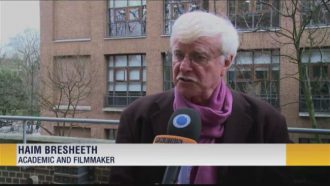 The British government is helping universities across the UK suppress the right to criticize Israel over its human rights violations in Palestine, says a Jewish professor, vowing to never give in to the pressure.
“They are trying to stop us talking about Palestinian rights, and about peace and we will just not shut up,” Dr. Haim Bresheeth, a Jewish academic and filmmaker, told Press TV on Wednesday.
“Unfortunately the government has helped the universities that want to shut up free speech by accepting a definition of anti-Semitism that makes anti-Semitism any criticism of Israel,” he added.
The scholar was referring to the International Holocaust Remembrance Alliance (IHRA)’s definition that was adopted by the government of Prime Minister Theresa May last year.
It was based on IHRA’s definition that the University of Exeter and the University of Central Lancashire (UCLan) cancelled an annual pro-Palestinian event on Monday, which was aimed at raising awareness about human rights violations in the occupied territories.
Following the move, some 250 academics at dozens of universities across the UK penned an open letter, condemning the Tory government’s attempts to curb their right to free speech by banning criticism of Israel.
The professors said in their letter that the government’s definition of anti-Semitism is too broad and can include any criticism of Israel with regards to its occupation of Palestinian lands.
“The government has ‘adopted’ the International Holocaust Remembrance Alliance definition of anti-Semitism, which can be and is being read as extending to criticism of Israel and support for Palestinian rights, an entirely separate issue, as prima facie evidence of anti-Semitism,” read the letter, sent to the Guardian.
“This definition seeks to conflate criticism of Israel with anti-Semitism,” the academics charged, accusing universities minister Jo Johnson of asking for the definition to be “disseminated” throughout the higher education system.
In his interview with Press TV, Bersheeth said the definition sought to protect “Zionism and Israel” from criticism.
“You can criticize and you should criticize every political institution that you wish,” he argued. “We are told now that Jews who criticize Israel like me are anti-Semitic. This is nonsense.”
Leeds University Union Threaten to Ban Craig Murray Speech on Palestine
By Craig Murray – March 1, 2017
I am giving a talk entitled “Palestine/Israel: A Unitary Secular State or a Bantustan Solution” in Leeds University tomorrow. I have just been told by Leeds University Union I will not be allowed to speak unless I submit what I am going to say for pre-vetting.
I am truly appalled that such a gross restriction on freedom of speech should be imposed anywhere, let alone in a university where intellectual debate is meant to be an essential part of the learning experience. I really do not recognise today’s United Kingdom as the same society I grew up in. The common understanding that the values of a liberal democracy are the foundation of society appears to have evaporated.
As regular readers know well, I do not write speeches in advance but always speak extempore. My opinions on Israel and Palestine are very well documented on this blog and elsewhere. I want to see a single, unitary state in Israel/Palestine, encompassing everyone who currently lives in those territories, as a secular democracy blind to ethnicity and religion. This includes an acceptance that further forced large population movements by anybody are not desirable and the Palestinians should receive more compensation than restitution. If I am not permitted to express this view within a University, I find that truly shocking.
I should be equally shocked if anybody who held views very different to my own were not permitted to express them.
I think that if people like me are now being prevented from speaking, society has crossed a very dangerous line indeed.
Women’s Protection in Syria: Disinformation Is No Help
By Tim Hayward | March 1, 2017
A ‘new report by the London School of Economics’ (LSE), so announced the British press – The Times, The Daily Mail and The Daily Mirror – describes sexual crimes against women in Syrian prisons. It alleges these to be a matter of state policy. Published just ahead of Geneva talks about a political settlement in Syria, the press interpreted it as supporting renewed calls for regime change.
The paper provides no new grounds for that conclusion, however. In fact, its sweeping allegations obscure good reasons why, under present circumstances, a responsible approach to the problem of sexual violence in Syria would involve supporting the government against the terrorist insurgents.
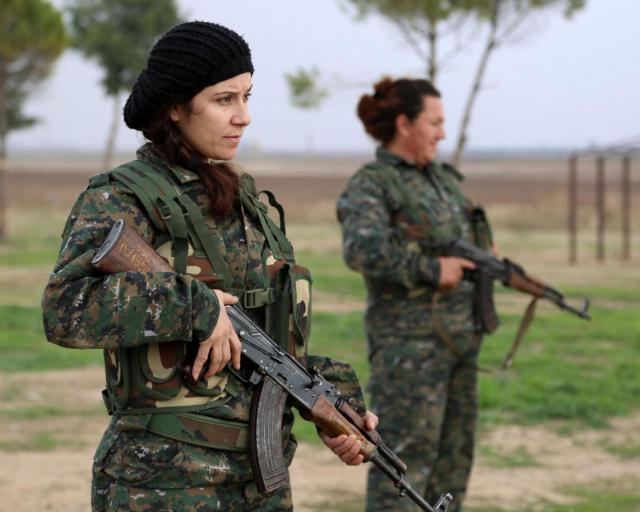
Syrian Christians
Some reasons can be gleaned from United Nations research into the problem. The UN found (in 2015 and again in 2016) that while some conflict-related sexual violence was perpetrated by state personnel, ‘non-State actors account for the vast majority of incidents’.[1] The UN made clear that efforts to defeat groups like ISIS and Al Qaeda, as the Syrian government is committed to, ‘are an essential part of the fight against conflict-related sexual violence.’ Such groups use sexual violence as part of their strategy to spread terror among those that oppose their ideology. They engage in trafficking of women and slavery. They drive the displacement of women who, then, ‘remain at high risk, even when they reach the supposed refuge of neighbouring countries.’
Marie Forestier, the LSE paper’s author, complains that the UN paid ‘disproportionate attention’ to the terrorist groups as perpetrators of sexual violence in Syria. She wants to highlight crimes on the government side, and she relays some horrific allegations about some individual cases. This illustrates specific experiences of a problem that the UN had signaled. However, while harrowing in themselves, these testimonies cannot speak to the comparative scale of the problem.[2] Forestier therefore does not show the UN’s concerns about the egregious sexual violence of the terrorist insurgents to be disproportionate. Furthermore, her interviews relate to experiences from a period – 2012 and 2013 – that is earlier than covered by the UN reports of 2015 and 2016. Forestier herself admits that accusations of sexual violence on the government’s side were ‘most frequent from late 2011 to 2013, in disputed areas such as the Damascus suburbs, and in central and coastal governorates … with a peak in 2012, and comparatively fewer cases in 2014.’ She thereby shows the situation was worse in places where the government had to fight insurgents and improved when the government regained control. In light of her own admissions, it seems perverse to cite limited older evidence in criticizing considered conclusions of fuller and more up-to-date reports.
The perversity is heightened with unwarranted generalizations in the present continuous tense. Press coverage has, unsurprisingly, transmitted the message that the most shocking details of individual allegations from up to five years ago capture what is occurring on a general and continuing basis today. Forestier herself even makes demonstrably false general claims in the present tense. For instance, she says: ‘According to an estimate by United Nations investigators, Syrian security forces detain tens of thousands of people at any one time.’ However, the source she cites for this claim says no such thing.[3]
Some of her most damaging claims are simply inexplicable, as when she says: ‘According to testimony, the overwhelming majority of men committing rapes have been State forces.’ This extraordinary claim flies in the face of the palpable evidence and reports of the UN. Bizarrely, the source Forestier cites for it is an article on ‘general data on sexual violence by state forces’ attained for 129 other conflicts, not including Syria, and during a period (1989-2009) prior to the outbreak of war in Syria.[4]
The LSE paper’s headline message thus misrepresents what is actually shown regarding the extent of the government’s responsibility for sexual violence. Buried within its text are admissions that the paper should only ‘be considered as a starting point for further research’ and that ‘it is impossible to conclude that sexual violence by regime forces is a mass phenomenon.’ Yet this did not stop Forestier making such damaging accusations as that ‘rape can be considered as part of a general policy from the authorities’ (p.12).[5]
Regardless of lack of evidence, she seems determined to convey a message of rape and sexual violence being state policy approved at the highest levels.[6] Yet she admits: ‘The decision to resort to sexual violence (or tolerate it) seems to have fallen under the regional level or even the branch and military unit level’. ‘No information indicates that high-level officials in Damascus ordered rapes’ and ‘the President or high level security officials probably didn’t give explicit orders’.
She rightly notes that ‘commanders may be prosecuted where they know or should have known of the abuses and failed to take action to stop them.’ She also correctly observes that ‘ending impunity is central in preventing sexual violence.’ I would add that ending impunity, like bringing the problem itself under control, requires well functioning institutions. The Syrian government is evidently aware of this, and, under difficult conditions, has sought to improve its systems for the protection of women and children, as welcomed by the UN OHCHR. But the good functioning of institutions is favoured by peaceful conditions rather than by war.
One does not have to be an enthusiast for the present government to recognize its legitimacy and the simple fact that it is uniquely well-placed as things stand now, and foreseeably, to protect ordinary men, women and children against violent threats.
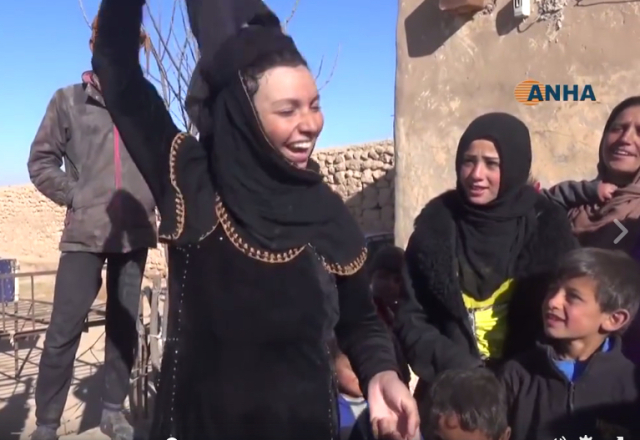
Freed from ISIS
A realistic general presumption has to be that rape and sexual violence tends be more common in war than in peacetime.[7] That is a reason – on top of so many others – why war should be avoided. A country that finds its territory turned into a battleground has to reckon with sexual violence being more prevalent than in peacetime, while its resources to tackle the problem are diverted and diminished. A government that has to defend its people against armed insurgents, particularly when these routinely engage in sexual violence, faces extraordinary challenges. That does not absolve it of responsibility for ensuring good conduct by its own forces. The practical ability of a government to maintain discipline, however, is not enhanced by having to engage on many fronts with ruthless opposition.
Realistically, and morally, the best way to avoid rape in war is to avoid war itself. I cannot believe that Marie Forestier would disagree on this general point, but I am less sure what she thinks with regard to the specific case of Syria, or even whether she has fully thought it through.[8] The thrust of her argument would support continued efforts by foreign powers, exercised through terrorist proxies on the ground, to depose the government of Syria, something that could only worsen further still the problem of sexual violence.
By contrast, it may be instructive to consider the approach taken by the Kurds in the north of Syria. In 2011, Kurds were among the groups fighting against the Syrian government. Since then, however, they have become pragmatic allies of the government in a common drive to eliminate ISIS from Syrian territory. The Kurds also have a particularly enlightened appreciation of women’s central place in society.[9] Consistent with their political philosophy, about a third of their fighting force is women. The Women’s Protection Unit or YPJ, is an all-female Kurdish military organization of about 8,000 volunteers, and growing.[10] Meanwhile the Syrian Arab Army has emulated the Kurds by creating all women battalions along similar lines.[11] Already, though, the Syrian army prominently featured all female units, including the famed Lionesses for National Defence unit of the elite Republican Guard.[12] Western commentators who note the propaganda value of this also grant that its success reflects the wider social solidarity that has made the Syrian Arab Army so resilient. As a French commentator observes, ‘The war in Syria is a face-off between two societal structures and Assad is showing that, in his system, women have an important role, even in the defence forces’.[13] If the Syrian government sees the propaganda value of promoting women’s equality, we might reasonably suppose it would see the irrationality of undoing such reputational gains by pursuing a delinquent policy of the kind Forestier alleges.
The fact is that what people widely believe throughout Syria – in Arab areas as in Kurdish – is that the overwhelming problem of sexual violence, like that of extremist violence more generally, comes from ISIS and other terrorists that violate, torture, enslave, traffic and oppress women. This is consistent with the UN findings. Forestier’s allegations are consistent only with the foreign drive for ‘regime change’.
For anyone genuinely concerned to deal with sexual violence occurring in – and occasioned by – conflict situations, a central preventive strategy is not starting a war in the first place, and not prolonging a war needlessly once started. It certainly means not intervening in a war on the side of those inflicting by far and away the most extensive and egregious sexual crimes.
In short, if the government had been supported in its efforts to defeat the insurgents, a great deal of sexual violence would have been avoided. Forestier’s claims, seen in this light, in being unfounded, are counterproductive and irresponsible. The view she opposes has a coherence hers lacks. It also has basic morality on its side. The problem with Forestier’s paper is not simply that it is poor research and writing.[14] The real concern is that, in being publicly promoted, it has been fed into the narrative beyond academia that would continue seeking to destabilise Syria (and the wider Middle East) and to prolong conflict against the Syrian government. One effect of this would be to prolong the circumstances in which sexual violence continues unabated on that territory.
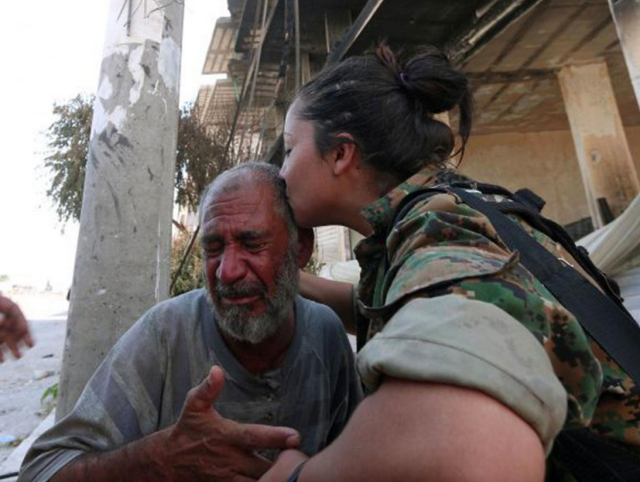
Civilians freed by Syrian Army
[1] United Nations Security Council, Conflict-related sexual violence Report of the Secretary-General 23 March 2015: https://www.un.org/en/ga/search/view_doc.asp?symbol=S/2015/203. United Nations Security Council Report of the Secretary-General on Conflict-Related Sexual Violence, 20 April 2016, S/2016/361 http://www.peacewomen.org/node/94106.
[2] I do not take propose to take issue with any of Forestier’s reporting of testimonies, even though her methodology is unclear. (For instance, she mentions that three interviews with survivors ‘were excluded because they seemed exaggerated or false’ yet she does not explain how she decided whose word to give how much credence to, particularly in cases where she was speaking through a translator via phone to someone she hadn’t met.)
[3] The source she cites is UN Human Rights Council, Report of the Independent International Commission of Inquiry on the Syrian Arab Republic, A/ HRC/31/68, 11 February 2016, http://www. ohchr.org/Documents/HRBodies/HRCouncil/ CoISyria/A-HRC-31-68.pdf. (Having checked that source I find the only mention of thousands of people refers to ISIS crimes. I could not find any statement remotely resembling her claim, and I would readily correct the record here if she can direct me to it with a page reference.)
[4] Dara Kay Cohen and Ragnhild Nordas, “Sexual Violence in Armed Conflict: Introducing the SVAC dataset, Sexual Violence in Armed Conflict: Introducing the SVAC dataset, 1989−2009”, Journal of Peace Research 51(3) (2014), 418-428.
[5] This assumption is manifest, too, in her claim – made much of in the press reporting of her paper – that sexual assault in detention was so routine that contraception was supplied. Damning as this may be, assuming it is true, it does not self-evidently suggest that those assaults were part of a policy as distinct from an atrocious practice. It could in fact be taken to suggest a desire of perpetrators to prevent evidence of violations coming to light. A related claim involves the testimony of a victim that her attacker used Vaseline. Forestier takes this, along with the contraception, to ‘indicate that rapes followed a regular pattern that involved some degree of organisation and were part of a broader state policy of widespread repression against the civil population.’ Since the organization required is that of a visit to a pharmacy, and we can have no idea how widespread the practice was, we cannot simply infer what Forestier claims about a ‘broader state policy’.
[6] At one point she asserts that ‘when soldiers or militiamen raped women during military operations, this was part of the attack against their adversaries and their relatives. Thus, rape can be considered as part of a general policy from the authorities.’ But the inference stated after her ‘thus’ is a non sequitur: she provides no reason to think such attacks follow from a policy rather than opportunism or vindictiveness.
[7] The presumption has to be defeasible, but it seems clear that simply to presume the contrary would be imprudent. For a discussion see e.g. Doris E. Buss, ‘Rethinking “Rape as a Weapon of War, Feminist Legal Studies (2009) 17.2: 145-163.
[8] Her puzzling take on the situation is illustrated by a claim like this: ‘the Syrian government has sought to increase antagonism between communities’ and ‘to frame the conflict as a fight between Alawites and Sunnis instead of a struggle for democracy.’ Yet the government owes its resilience precisely to a longstanding and conscious strategy of defusing sectarian tendencies. (The government has consistently framed the conflict as an attack on the secular multi-faith state by primarily Islamist jihadists.) Furthermore, however much a desire for greater democracy may originally have motivated the political opposition, the conflict that has ensued was taken over by jihadists committed to imposing the most anti-democratic regime imaginable.
[9] A fundamental tenet of Kurdish nationalism, as articulated by PKK (Kurdistan Workers’ Party) founding leader Abdullah Öcalan, is that ‘a country can’t be free unless the women are free’. This political philosophy – given the name ‘jineology’– is embraced by the movement and its fighters, about a third of whom in the Kurdish region of Syria are women.
[12] Daily Mail 26 March 2015 http://www.dailymail.co.uk/news/article-3011838/Syria-s-female-tank-drivers-Battalion-800-women-commandos-fierce-clashes-rebels-line-Damascus.html#ixzz4ZnIjB3tT
[13] Fabrice Balanche, quoted by France 24, 2 April 2015: http://www.france24.com/en/20150402-syria-women-soldiers-assad-army-propaganda
[14] Given its status as a Working Paper, the academic community is aware that Forestier’s claims have not been peer-reviewed. The wider world does not observe such niceties. The Daily Mirror, The Daily Mail and The Times did not. Most tweeters do not. They all present it as coming from the prestigious LSE. Which is fair enough, given that it features conspicuously on the LSE website. Since LSE has promoted this paper, there is a case for saying they should own it and answer for it. If my argument in this post is correct, there is a case for suggesting they should retract it.
Two British universities halt pro-Palestinian events
Press TV – February 28, 2017
Two British universities have been accused of undermining freedom of speech after cancelling an annual pro-Palestinian event aimed at raising awareness about human rights violations in the occupied territories.
The accusation was leveled on Monday after the University of Exeter and the University of Central Lancashire (UCLan) announced the cancellation of a pro-Palestinian student-run event called Israel Apartheid Week.
Students at Exeter were barred from giving a street theater performance called Mock Checkpoint, in which some participants were to dress up as Israeli soldiers while others performed the roles of Palestinian victims.
The event had been approved by the student union at the university but was banned for “safety and security reasons” less than 48 hours before commencement. An appeal against the decision was also refused.
Members of Friends of Palestine Society at Exeter accused the university of censoring students, saying, “They are not allowing freedom of speech – by cancelling an event that was in support of Palestinian activism and for Palestinian rights; they are directly censoring us.”
Professors react
The move prompted almost 250 academics, including 100 professors, to sign a letter denouncing attempts by university officials to silence campus discussion about Israel and its treatment of Palestinians.
“These are outrageous interferences with free expression, and are direct attacks on academic freedom,” the letter noted. “As academics with positions at UK universities, we wish to express our dismay at this attempt to silence campus discussion about Israel, including its violation of the rights of Palestinians for over 50 years.
“It is with disbelief that we witness explicit political interference in university affairs in the interests of Israel under the thin disguise of concern about anti-semitism,” it added.
More than half a million Israelis live in over 230 illegal settlements built since the 1967 Israeli occupation of the Palestinian territories of the West Bank and East Jerusalem al-Quds.
Much of the international community regards the Israeli settlements as illegal because the territories they are built on were captured by Israel in a war and are hence subject to the Geneva Conventions, which forbid construction on occupied lands.
Nevertheless, the Israeli regime continues to build more settlements and expand the existing ones.
The soft coup against Jeremy Corbyn is under way
By John McDonnell | Labour Briefing | February 26, 2017
WE HAVE TO ALERT PARTY MEMBERS and supporters that the soft coup is underway. It’s planned, co-ordinated and fully resourced. It is being perpetrated by an alliance between elements in the Labour Party and the Murdoch media empire, both intent on destroying Jeremy Corbyn and all that he stands for.
The coup is not being waged up front in public but strictly behind the scenes. Having learned the lesson of the last coup attempt – that a direct attack on Jeremy and his policies will provoke a backlash from many party members – the coup perpetrators are this time round pursuing a covert strategy.
The aim of these covert coup plotters is to undermine the support Jeremy has secured among Labour Party members, and also importantly to undermine support from Labour voters.
Undermining support for Jeremy from Labour voters is important to the plotters because their objective is to ensure Jeremy trails in the polls and can’t win elections. In this way they can destroy morale among party members and their confidence in him.
The tactics include daily and constant behind-the-scenes non-attributable briefings against Jeremy and his Shadow Cabinet every time he or his shadow ministers make a statement, intervene in Parliament or launch a policy. The plotters use every opportunity to chip away at Jeremy’s standing to seek to demean him and undermine support for him in the Labour Party and among Labour supporters. This constant barrage of negative briefings also crowds out any positive initiatives or narrative from Jeremy and his team. It also feeds and confirms in the public’s mind that the Labour Party is split.
The plotters are effective in distorting the media coverage because they have extensive contacts and allies in the media, many inherited from Mandelson’s days. The professional planning of interventions in which attacks to undermine Jeremy are framed evidences an exceptionally well resourced ‘dark arts’ operation of the old spin school. The coup plotters are willing to sacrifice the Party at elections just to topple Jeremy and prevent a socialist leading the Party. It is more important to them that they regain control of the Party than it is to win elections.
The irony is that they are willing to go so far in denigrating Jeremy that they endanger their own parliamentary seats and endanger the very existence of the party they want to use to get into power. We saw the methods they use with the leaking of the Party’s internal polling. This was a carefully planned and executed operation. Let’s use it as a case example.
Both quantitative and qualitative polling is undertaken by the Party regularly under the direction of Jon Trickett, the Party’s National Campaign Co-ordinator. Jon arranged for one focus group to be carried out by the Party’s polling agency in Manchester to assess how our frontbench members appearing on television programmes at the time were being perceived in the north west. This polling took place back in November and its results were only accessible to a small number of party officials, Jon Trickett and the polling agency. To this day I have still not seen the results. The polling was leaked by someone to James Lyons, a Times journalist who has regularly received leaks from within the Labour Party – usually used to attack Jeremy and his team.
The Murdoch media had already run earlier in the week fake news stories in The Times and Sun alleging that Jeremy was planning to stand down as leader of the Party. No matter how many times it was explained that this story was completely untrue and absolute fiction, the The Times and Sun continued to run it – and the BBC and other broadcast media took it up and reported it extensively. The media then invented the story that the polling on the perception of Shadow Cabinet members in the north west was the Party testing the perceptions of potential successors to Jeremy.
This was a classic negative story framing and transmission exercise. It is just one example of what we confront on a weekly and at times almost daily basis. It is vitally important that our supporters understand and appreciate what we are facing. What we are experiencing is completely predictable and expected. Spreading that understanding of what we are up against enables us all to organise how we can fight back and overcome the soft coup strategy.
We all have an important role to play in explaining what we are facing and how, by standing together, we can defeat the plotters again. This is the testing time for the Corbyn transformation. The challenges are great and the times are tough – but we all know that this is the socialist opportunity of a lifetime.
John McDonnell is Shadow Chancellor, MP for Hayes and Harlington, Chair of the Socialist Campaign Group of Labour MPs and Chair of the Labour Representation Committee.
contact – office@labourbriefing.org
© Labour Briefing 2017
Elor Azaria verdict: a personal view
International Solidarity Movement | February 26, 2017
Hebron, occupied Palestine – Yesterday the Israeli soldier Elor Azaria was sentenced to 18 months in prison for the extra-judicial killing of Abdel Fattah al-Sharif, which happened last year in Hebron. Everybody in Hebron was waiting for the sentence. Everybody knew by one o’clock what it was. Everyone was heavy hearted. Palestinian friends compared a sentence of two years for stone throwing with Azaria’s eighteen months for murder. The implications here on the ground for what soldiers can do with impunity is also clear to all.
We at ISM had been in touch with Imad Abu Shamsiya, the Palestinian who filmed the execution, in case he wanted our support if the settlers were angry at the sentence as he has experienced large amounts of threats and harassment from both soldiers and settlers for bringing this incident to light.
Today I get email from the UK with news of how the case was reported on the BBC flagship morning show:
‘… almost all of the piece consisted of a discussion with their Jerusalem correspondent about Israeli anger that Azaria had been jailed. The fact that Palestinians were angered at the brevity of the sentence was tacked on as an afterthought. It was not explained that the Israeli soldiers are an army of occupation that is protecting settlers who are in Hebron illegally. It was not explained that Abdel Fattah al-Sherif had been lying injured and motionless on the ground for ten minutes and presenting no threat to anyone before Azaria executed him. Al-Sherif was described as “an attacker”, Azaria as “a soldier”. The framing of what happened could have been scripted by the IDF. The impression given was of the IDF acting in support of the civil authorities and being subjected to a military assault by enemy combatants. The right-wing Israeli perspective that Azaria was an inexperienced conscript who acted in the heat of the moment in battle was reported unchallenged. The alternative view that al-Sharif had committed grievous bodily harm or some such criminal assault before being totally incapacitated and that he was then murdered in cold blood by a heavily-armed agent of an occupying power was not given.’
Shame.
The video so bravely filmed by Imad which led to the case being heard at all can be seen here.
British Foreign Policy and the UK Weapons Trade

By Matthew JAMISON | Strategic Culture Foundation | 24.02.2017
Back in the halcyon days of the election of the first Labour Government in Britain in over 18 years, the New Labour Foreign Secretary Robin Cook expounded a radical shift in British foreign policy making, declaring that the Labour Government of Tony Blair would put human rights at the heart of it’s foreign policy with an «ethical dimension». This was quickly christened by the British media as New Labour’s «ethical foreign policy». Questions were raised at the time how a country with such a large weapons export industry could conduct an ethical foreign policy and that question is as pertinent today as it was back in 1997. In his party conference speech, the first as British Foreign Secretary, Boris Johnson, paid ritual homage as many British Foreign Secretaries have before him, to his belief in human rights and reflected that: «After a long post-war period in which the world was broadly getting more peaceful the number of deaths in conflict has risen from 49,000 in 2010 to 167,000 last year».
Sadly, Britain has contributed to many of these deaths. According to a study carried out with official UK Government figures by the Independent newspaper, Britain is now the second largest exporter of arms around the world, and according to Freedom House since 2010 has sold weapons to 39 of the 51 countries ranked by Freedom House as «not free». What is even more disturbing is that out of the 30 countries ranked on the British Government’s own human rights watch list, the British Government authorizes the sale of weapons to 22 of those. Indeed, according to statistics from the UK Government’s own Trade and Investment body the UK has sold more weapons on average over the last ten years than Russia, China and France combined. All exports of British manufactured bombs, bullets, weapons and other munitions must be signed off and approved by UK Government Ministers with licenses granted.
Most of these arms are sold to Middle Eastern regimes, which have serious human rights issues, if one were to apply the standards the UK Government sets on human rights. In 2016 alone Britain sold over 3 billion pounds worth of weapons to Saudi Arabia. It is odd how the British Government which constantly lectures other countries on their human rights records can sell weapons of mass destruction to regimes like the Saudis who carry out routine be-headings and lashings of their own citizens as part of their penal code; subject women to severe restrictions such as forbidding them to drive; provide funding to Madrassas that indoctrinate and radicalise young Muslims in the ways of jihad etc. The list of human rights violations could go on. But the British Government, despite wrapping itself in the language of human rights, feels very comfortable within its own «ethical conscience» in allowing shipments of British manufactured BL-755 cluster munitions to be used by the Saudi Government in its war in Yemen. Unexploded remnants of cluster munitions have proved deadly for Yemenis, killing or injuring at least 85 civilians, including children.
Since March 2015, the UK Government has approved £3.3 billion in military sales to Saudi Arabia, yet in November, the UK Foreign and Commonwealth Office concluded, despite considerable evidence to the contrary, that there was no «clear risk» of serious Saudi breaches of international humanitarian law in Yemen. The British Government has continued to sell arms to Saudi Arabia despite the Saudi Government’s vastly different approach and record regarding human rights which is incompatible with the British Government’s professed commitment to «universal human rights» and the problems that emanate from Saudi Arabia regarding Islamist extremist terrorism and radicalisation such as the fact that fifteen of the nineteen 9/11 hijackers where from Saudi Arabia and the emerging information that certain sections of the Saudi Government may have been complicit in the funding and training of the 9/11 hijackers. Saudi Arabia is not the only regime that does not conform to the UK’s own professed beliefs and standards in human rights that the British supply dangerous and destructive weapons of death to.
The UK Government sells arms to Bahrain which has used British arms to quell internal dissent; Burundi, which is being investigated by the UN for human rights violations and The Maldives, which in 2015 jailed its former President, Mohamed Nasheed, for 13 years following what critics said was a politically motivated show trial. The UK Government has also authorised the sale of massive amounts of arms to Egypt despite the coup against the democratically elected President Mohammad Morsi and the violent crackdown on the Muslim Brotherhood that followed. The British Government approved licences for the sale of £7.7bn of arms in 2015 alone. Then there have been weapons scandals in the past involving the British Government and the UK arms industry. There was the shocking Arms-to-Iraq affair of the 1990s when it came to light that the British Government had endorsed and advised on the sale of arms by British companies to Iraq, then under the rule of Saddam Hussein. Ironically, some of these British made and exported weapons to Saddam Hussein’s Iraq had been used by the Iraqi regime during the first Gulf War of 1991.
All of this raises serious questions regarding how the British Government can profess to on the one hand be a force for human rights and run a foreign policy based on «universal human values», upholding democracy, human rights and the rule of law and yet on the other hand maintain a massive arms trade of deadly weapons around the world, arming regimes that are the exact opposite of what the British Government professes to believe in and defend when it comes to human rights. At the heart of the British Government’s position on «human rights» is hypocrisy when examined within context of UK arms sales. The British Government maintains a saintly image of itself and believes its own rhetoric that it is a great force for «universal human rights» around the world despite the contradictions in its policies and behaviour and that the British have higher standards and more noble beliefs than other cultures and countries when in reality this is not the truth. What the British Government hates above all else is to have its self-image shattered and exposed for the two-faced hypocrisy that it is. They are unable to effectively answer the inconsistencies and contradictions of their rhetorical image on the one hand and the reality of their behaviour, policies and practices on the other when confronted with reality. It is high time for the British Government, if is serious about its rhetoric on human rights, to scale back its domestic weapons export industry.
Featured Video
New positive ivermectin evidence
or go to
Aletho News Archives – Video-Images
From the Archives
Fanatical Followers of the Covid Regime: A Jim Jones-Style Cult?
By Professor Roger Watson and Dr. Niall McCrae | The Daily Sceptic | November 15, 2021
As scholars at leading British universities over recent decades, we witnessed the replacement of critical thinking and debate by narrative: facts are discrimination and scientific method is imperialism; truth, instead, is derived from ‘progressive’ values. This educational trend may be a major contributory factor to the ease in which society has been inculcated to the Covid ‘new normal’ of masking, testing, and repeated doses of vaccines for a disease of similar risk to severe influenza.
One doesn’t need much critical reasoning to observe the flawed logic of some vaccination enthusiasts, such as people who respond to experiencing any side effects, however debilitating, by saying “at least I know it’s working”, or, after contracting the disease despite their promised inoculation (over 90% effective, according to initial drug company claims), “I’d have been worse off without the jab.” … continue
Blog Roll
 Aletho News
- Najaf airport to reopen to Iranian flights within 24 hours: Ambassador
- From ‘How Will This End For Iran’ to ‘When America Walks Away’: A tale of two Economist covers
- Tehran blasts ‘baseless’ speculation linking Iran to alleged bomb plot at UK air base
- The Rise And… Rise Of ‘Color Revolutions’
- The Coming GOP Bloodbath?
- Arctic Scare Stories Melt Away
- Wrong, Euronews: Climate Change Has Not Created a Food, Energy, and Economic “Meta-Crisis”
- New positive ivermectin evidence
- Met Office Caught Fabricating Daily Temperature Record Claims
- Merck Virologists Admitted to Falsely Certifying Vaccine Efficacy
- If Americans Knew
- Netanyahu Asked UAE Leader to Deny Report on Oct. 7 Warning in Secret Visit, Sources Say
- CNN Chief Int’l Correspondent Clarissa Ward on Journalists in Gaza
- Democratic Party Consultants Surround Troy Jackson with Pro-Israel Donors
- Christian Leader Responds To Netanyahu’s Claims Regarding Palestinian Christians
- In Gaza, ‘Whoever Survives the Bombing Won’t Survive the Rubble’
- Israel kills more Palestinians, amid push to resettle Gaza – Daily Update
- Israel forces Gazans to live in constant peril – Daily Update
- Deconstructing Netanyahu’s pants-on-fire UN rant – Daily Update
- Trump betrayed voters with his campaign lies and prioritized a foreign country once he took office
- Netanyahu calls Israel’s war in Gaza ‘opposite of genocide’ in UN speech to near-empty hall
- No Tricks Zone
- New Study: Earth And Venus Surface Warmth Largely Explained By Convection And Lapse Rate, Not CO2 Or Radiation
- 2025 Nature Paper Claiming Worsening Global Drought Gets RETRACTED …Heavily Flawed
- New Study: ‘Global Drought Shows No Detectable Recent Acceleration Under Climate Warming’
- Economic Masterminds: German Socialists Suggest Taxing Productivity Gains Stemming From Using AI
- The South China Sea Has Not Been Cooperating With The Climate Change Narrative
- Energy Crisis: Germany Enters Heating Season With Historically Low Gas Reserve Fill Levels
- New Study: The Antarctic Ice Sheet Gained Mass From 2020-2024 Due To Staggering Snow And Ice Accumulation
- Study: Ocean Heating Rates From Thousands Of Years Ago ‘Dwarf’ Modern Ocean Heating Rates
- Climate Extremists Target, Attack Large-Scale Power Grid Infrastructure In Germany!
- New Study: Antarctic Ice Melt Has Contributed Less Than 1 Centimeter To Sea Level Rise In The Last 30 Years

