Iran UN ambassador calls for destruction of all nuclear weapons
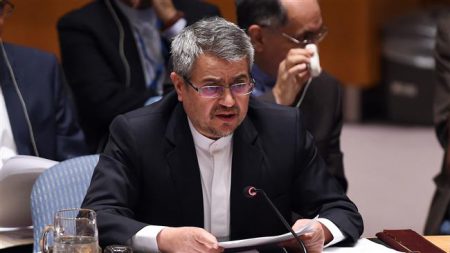
Iran’s ambassador to the UN Gholamali Khoshroo
Press TV – March 29, 2017
Iran’s ambassador to the UN Gholamali Khoshroo has called for the total eradication of nuclear weapons.
Khoshroo reiterated Iran’s call during a UN conference aimed at creating a nuclear weapons ban treaty in New York on Tuesday.
“Iran, as a victim of chemical weapons, strongly feels the danger posed by the existence of weapons of mass destruction and is determined to engage actively in international diplomatic efforts to save humanity from the menace of nuclear weapons,” he said.
Khoshroo stressed that Iran is committed to its Non-Proliferation Treaty (NPT) obligations, which include negotiations based on effective nuclear disarmament measures.
He added that several countries continue to ignore international calls and treaties for nuclear disarmament and even continue to increase their nuclear stockpiles. “They do not have political determination to abandon doctrines of nuclear deterrence and nuclear terror,” he went on to say.
Iran’s UN ambassador noted that boycotting the talks by many countries, including the US, shows that the world’s nuclear powers are by no means committed to the eradication of nuclear arms. Britain and France were also among the some 40 countries that did not join the talks.
“We note that prohibition of nuclear weapons must be accompanied by the elimination of such weapons. There can be no doubt that without complete abolition of nuclear weapons, there will be no absolute guarantee against the danger of nuclear war and the use of such weapons,” Khoshroo added.
UK, France sign deal to jointly develop new missiles
Press TV – March 29, 2017
Britain and France have signed an agreement to jointly develop long range missiles for future use by their navies and air forces.
British Minister for military purchases Harriett Baldwin and her visiting French counterpart Laurent Collet-Billon agreed in London on Tuesday to invest €50 million ( £43 million) each to begin a three-year concept phase for the project.
Dubbed the Future Cruise/Anti-Ship Weapon program, arms manufacturer MBDA would explore options to replace and improve existing naval and air force weapons systems over the next 10 years, according to a statement by the UK ministry of defense.
The concept phase is focused on determining the designs of the future weapons and cutting the risks to a minimum before heading to the next stage in the cooperation, the statement added.
Beside costs, both sides also agreed to freely use one another’s “national technology expertise, trials and test facilities.”
“As demonstrated by having Europe’s largest defense budget, the UK is committed to European security and we will continue to collaborate on joint defense programs across the continent,” Baldwin said.
Collet-Billon also hailed the agreement, calling it “the backbone of our ‘one complex weapon’ initiative.”
Formed by a merger of French Aérospatiale-Matra Missiles, Italian Alenia Marconi Systems and British Matra BAe Dynamics, MBDA already produces Storm Shadow/ SCALP EG long-range cruise missiles for the British and French air forces.
In late February, the two sides signed a £146 million deal to upgrade the £790,000 missile, which has a range of approximately 560 kilometers (300 nautical miles).
According to the British defense ministry, France is “the UK’s most important European Ally” and together, the two countries accounted for almost half of all military spending in Europe.
As London prepares to leave the European Union (EU) following last year’s July referendum, British officials have reassured their allies in Paris that nothing can undermine their military alliance.
“This is a day-to-day, intense partnership that has never been affected by whatever French or British-bashing was going on in either country in the last five years,” said Claire Chick, head of military affairs at the London-based Franco-British Council.
Encircling Russia? RAF Typhoon fighters will deploy to Romania in May
RT | March 28, 2017
Royal Air Force (RAF) fighter aircraft will deploy to Romania in May as part of NATO’s continued militarization of Eastern Europe.
The initiative will see four Typhoons from RAF Coningsby, Lincolnshire, deploy to Mihail Kogalniceanu Airbase in Romania until September.
They will carry out patrols of the Black Sea area as part of the Southern Air Policing mission conducted under NATO command. The UK is the first ally to provide aircraft for the task.
“The UK is stepping up its support for NATO’s collective defense from the north to the south of the alliance,” said Defense Secretary Michael Fallon.
“With this deployment, RAF planes will be ready to secure NATO airspace and provide reassurance to our allies in the Black Sea region,” he added.
The announcement follows the deployment of hundreds of British troops to Estonia to function as a ‘tripwire’ against what UK commanders have called Russian aggression.
The NATO battle group in Estonia will be stationed at Tapa.
The UK will contribute the bulk of multinational force in Estonia, sending in a total of 800 soldiers.
France will post 300 soldiers to Estonia – to be replaced by the Danes in 2018.
All troops will act in conjunction with Estonia’s 1st Infantry Brigade.The deployment is designed to counter an “increasingly assertive Russia,” Fallon said on the first 130 troops’ departure.
“NATO is stepping up its commitment to collective defense,” Fallon said, according to Sky News.
“British troops will play a leading role in Estonia and support our US allies in Poland, as part of wider efforts to defend NATO.”
NATO troops head for Poland ‘to deter Russian offensive actions’
RT | March 25, 2017
At least 1,350 American, British and Romanian soldiers have been sent to Poland from a base in Germany. US commanders said that the troops were ready “to deter Russian aggressive actions.”
The US, British and Romanian soldiers left the Rose Barracks military base in Vilseck, western Germany, for Poland where they are expected take part in NATO’s mission. The troops are “fully prepared to deter Russian offensive actions,” US Colonel Patrick Ellis said at the departure ceremony on Saturday.
“As a result of Russia’s aggressive actions and in light of the changing and evolving security environment, at the Warsaw summit in July 2016 NATO members agreed to strengthen our deterrence and defensive posture,” US Major General Timothy P. McGuire said.
The NATO group is to be stationed in the town of Orzysz, 220 kilometers northeast of the capital, Warsaw, according to Reuters.
NATO troops in Estonia
Also on Saturday, NATO’s heavy armored vehicles of the French armed forces were delivered to Estonia, according to a video published by the General Staff of the Estonian Defense Forces.
France’s heavy armored vehicles include Leclerc tanks and VBCI infantry fighting vehicles, as well as dozens of VAB armored vehicles, a spokesman of the 1st Infantry Brigade said, according to the Kuulutaja newspaper.
The UK is to deliver Challenger 2, Titan and Trojan tanks to Estonia as well as self-propelled artillery mounts AS90, Warrior infantry fighting vehicles and reconnaissance drones, he added.
The battalion will be stationed in the military town of Tapa and will interact with the first infantry brigade of the Estonian Defense Forces.
The alignment of forces in Estonia is planned to finish in early April. By that time, Estonia is to host 800 soldiers from the UK and around 300 soldiers from France. The French group is to spend some eight months in the Baltic country. After that, Danish soldiers are expected to replace them.
NATO leaders agreed to deploy four multinational battalions to Poland as well as Estonia, Lithuania and Latvia on July 8 at the summit in Warsaw.
Russia has repeatedly criticized NATO’s military buildup along its borders, seen as a threat to national security.
In February, Russian President Vladimir Putin blamed NATO for provoking a conflict with Moscow and using its “newly-declared official mission to deter Russia” as a pretext.
Speaking at the Munich Security Conference in February, Russian Foreign Minister Sergey Lavrov noted that “NATO’s expansion has led to an unprecedented level of tension over the last 30 years in Europe.”
Moscow has condemned the new US ground-based missile defense system in Eastern Europe and increased presence of NATO vessels in the Black Sea.
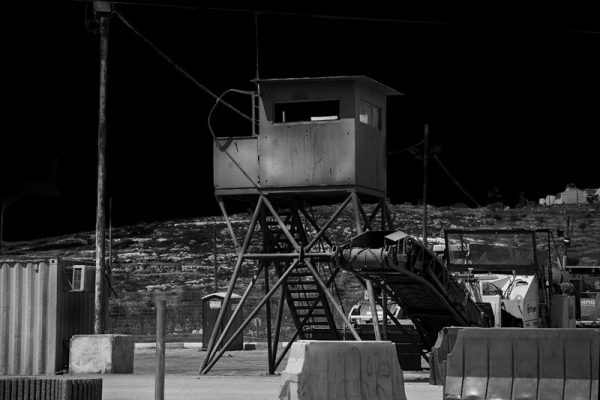
Two UK universities cancel speeches by author of UN anti-Israel report
Press TV – March 24, 2017
Two British universities have cancelled lectures by international law professor Richard Falk after he co-authored a UN report which concludes that Israel is an “apartheid” regime.
Falk said Middlesex University called off his speech, citing “health and safety” concerns, while University of East London cancelled his lecture, claiming that the approval for the speech had not followed proper procedures.
“As far as I can tell, there is a growing kind of feeling that the educational establishment in Britain, specifically in England, has been kind of intimidated in dealing with those who are seen as critics of Israel,” Falk told the Middle East Eye news portal.
Falk denounced the cancellations as the “intensification” of a trend of restricting academic freedom on university campuses, warning that depriving students of delving into controversial issues restricts their experience for becoming engaged citizens.
Falk said he has experienced similar assaults on his character after serving as UN special rapporteur on Palestinian human rights from 2008 to 2014.
Since the UN report was published, the Princeton University professor has faced attacks and accusations of bias and anti-Semitism.
He dismissed such criticism as being far from reality and said that Zionist NGOs are trying to “shoot the messenger, rather than address the issues raised in the message.”
“It has been used against a variety of other people – playing the anti-Semitic card rather than dealing with the substance of Palestinian grievances or Israeli violations of international law,” Falk said.
The prominent law professor noted that supporters of Israel will be on weak grounds to discuss the realities in the occupied Palestinian territories, as Israel’s treatment of the Palestinians has fallen below the level of acceptable moral behavior and international legal standards.
Falk’s co-authored report, which was reviewed by three “internationally renowned” jurists before it was published, was withdrawn from the UN website after prompting international uproar.
It documents “apartheid” patterns of discrimination that fragment Palestinian society through “distinct laws, policies and practices.”
“It appears to be an instance where the new UN Secretary-General [Antonio Guterres] gave way to pressure coming particularly from Washington, but also from Israel,” Falk said.
Last week, Under-Secretary-General and Executive Secretary for UN Economic and Social Commission for Western Asia (ESCWA) Rima Khalaf resigned in protest after Guterres ordered the study to be removed from the UN website.
Falk said the controversy over the report gave it an international visibility that it may not have enjoyed had it been just “one more UN report.”
Hong Kong: Anglo-America’s Struggling Foothold in China
By Joseph Thomas – New Eastern Outlook – March 22, 2017
Prominent American propagandist Howard French recently published a lengthy editorial in the Guardian titled, “Is it too late to save Hong Kong from Beijing’s authoritarian grasp?,” in which he attempts to buttress an otherwise categorically false narrative surrounding an alleged indigenous struggle for democracy and independence within Hong Kong.

French attempts to hold China accountable for backtracking on an agreement made with Britain over the return of its own territory taken from it by force in 1841. He also attempts to portray Beijing’s crackdown on US-UK subversion in Hong Kong as “authoritarian,” never making mention of the extensive funding and meddling both the United States and the United Kingdom are engaged in within Chinese territory.
The article documents only one side of the so-called “independence” movement in Hong Kong, sidestepping any critical analysis of the colonial background of the ongoing political crisis or the neo-colonial aspects that shape current events even now.
The lengthy piece was paid for by a grant from the Pulitzer Center on Crisis Reporting, a Washington D.C.-based front that collaborates with the New York Times, PBS, NPR, Time Magazine and other mainstays of US propaganda. These are the same media outlets that helped sell the US invasion and occupation of Afghanistan and Iraq, as well as US-led attacks on Libya and US meddling in Syria beginning in 2011. By supporting French’s work, they now help sell to the public a narrative that undermines Chinese sovereignty an ocean away from American shores.
The entire editorial, its contents, author and the special interests that paid for it as well as its placement in the Guardian, represent a continued and concerted effort to maintain an Anglo-American foothold in Hong Kong, part of the last vestiges of Western hegemony within Chinese territory.
The Truth About Hong Kong
Had Howard French penned an honest account of Hong Kong’s recent political crisis, he would have included the extensive, some may say exclusive, control the United States and the United Kingdom exercised over an otherwise fictitious and impossible pro-independence movement. Quite literally every leader of the so-called “Umbrella Revolution” is either directly funded and directed by the US and/or UK government, or possesses membership within an organisation, institution or front funded by Anglo-American money.
The notion that a teen-aged Joshua Wong was single-handedly defying Beijing is preposterous even at face value. He was but one cog of a much larger, well-documented foreign-funded machine aimed at stirring up conflict within Hong Kong, undermine Beijing’s control of the territory and infect Chinese society as a whole with notions of Western-style “democracy.”
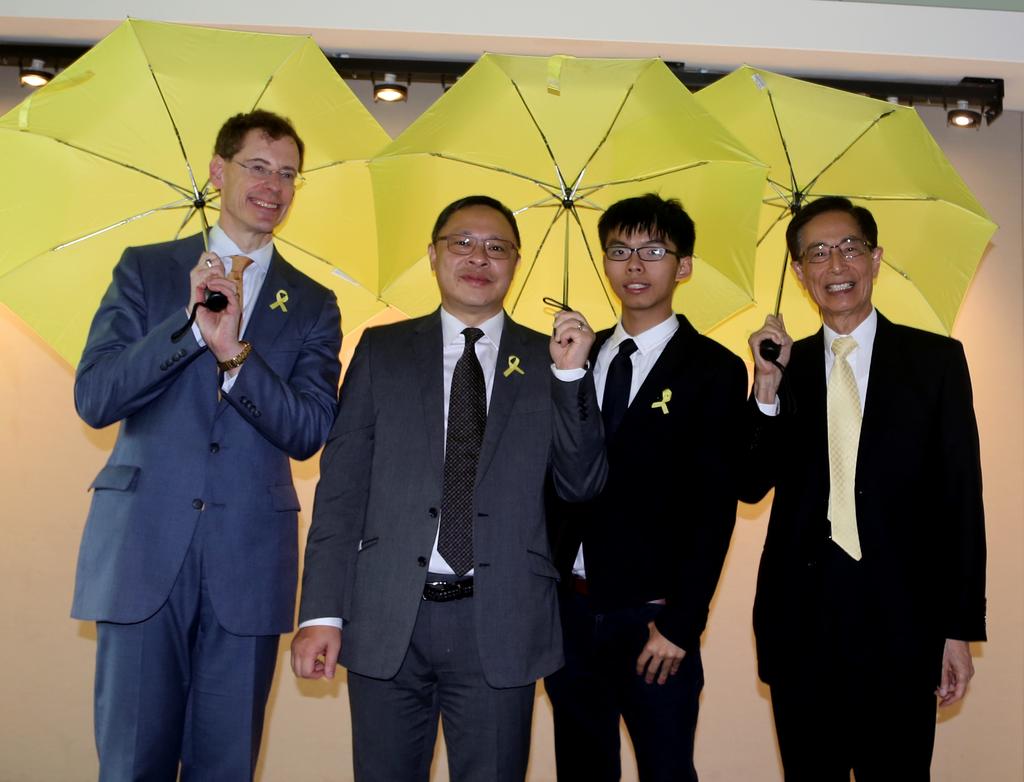
Just months before the 2014 “Umbrella Revolution,” one of its leaders, Martin Lee, was literally in Washington D.C., before members of the National Endowment for Democracy (NED), pleading for material and political support for upcoming demonstrations. Toward the end of that same year, and despite NED denying Lee was a protest leader, Lee would find himself in the streets of Hong Kong leading the protests from the front shoulder-to-shoulder with Benny Tai and Joshua Wong.
Ironically, after the protests diminished and were finally pushed off the streets by both local police and impatient residents, Lee, Tai and Wong would be invited to Washington D.C. for a special event organised by NED subsidiary, Freedom House, dubbed, “Three Hong Kong Heroes.” The three protest leaders, having attempted to shake off accusations of being Washington puppets, or even protest leaders altogether, would take to the stage with yellow umbrellas in hand.
Howard French, and others attempting to persuade Western audiences of their version of events in Hong Kong omit these critical facts regarding the foreign-funded and directed nature of the “pro-independence” movement. They do so intentionally, with French himself being a 2011 Open Society fellow, Open Society being one of several fronts the US has channelled money through in support of subversion in Hong Kong.
In reality, there is nothing “pro-independence” about the movement in Hong Kong. It is simply the latest in a centuries-long attempt by Western powers to project geopolitical hegemony into Asia and more specifically, upon China itself.
French’s lengthy lament regarding China’s “authoritarianism” captures what may possibly be frustration that Washington and London’s tricks no longer work, and the more “Umbrella Revolutions” they attempt to organise against Beijing, the more familiar the Chinese public will be with them and subsequently, the more determined they will become to frustrate them.
Additionally, China’s influence over Hong Kong and even across Asia as a whole, is stronger, more sustainable and continuously expanding versus waning Western influence. Spectacular political stunts like the “Umbrella Revolution” attempt to leverage global public opinion over which the US media still maintains considerable influence, but ultimately such strategies have been confounded by Beijing and are, in the long-term, unsustainable.
Hong Kong represents a past, strong bastion of Western colonial power, now struggling to maintain itself even as a minor regional foothold. Despite the efforts of manipulators like Howard French and media platforms that lend themselves to his disingenuous narrative, footholds like Hong Kong will continue to diminish until the last remnants of the West’s colonial past are all but swept from modern geopolitics and permanently assigned to the pages of history.
“Global Laundromat” has the Guardian in a Spin
By Kit | OffGuardian | March 21, 2017
The latest “breaking” story from the Guardian and Luke Harding is hitting the headlines. Almost exactly 1 year after the explosive anti-climax that was “The Panama Papers”, Harding and the coterie of NGOs for which he acts as de-facto spokesperson have a big announcement to make: Banks launder money, and some of it is Russian.

I don’t know why they use American money with a Russian flag superimposed. They were probably afraid nobody would recognise roubles.
We are nearing the anniversary of the release of the Panama Papers, a “big story” involving years of work, hundreds of leaked documents, a team of exceptional journalists (and Luke Harding) and a dramatic reveal: “Sometimes, very rich people use legal loopholes to avoid paying their taxes.”
The list of implicated parties included heads of state, celebrities, athletes, David Cameron’s dad and a cellist that knows Vladimir Putin. We all remember who the Guardian decided to focus on, and we all know why.
Today the same crack-team (and Luke Harding) are releasing the long-awaited sequel to their original hit. “The global Laundromat”, it’s called. It’s a product of a years-long investigation into money laundering in ex-Soviet states, using British shell companies. I can’t comment on the truth of these allegations, because we don’t get to see the evidence, we are simply told that it’s true “according to letters The Guardian has seen”, and “reports shown to the Guardian ”… and other variations on that theme.
They may well be true. Big business and billionaires take part in shady and/or illegal business practices all the time. Just as was the case in the Panama Papers, they tell us something we all already know to be true, and then act like it was a surprise.
There’s a lot to like here. The simultaneous publication of four different articles on the subject, all practically identical. The implication that it is “breaking news”, when their prize factoid is three years old, and the scheme itself hasn’t operated since 2014. The fact that Luke Harding has to publicly declare the US government’s involvement, to stop people like us from pointing it out and making them look silly (like last time). The persistent use of the old Harding trick of simply dotting your story with plenty of “could haves” and “speculations suggests”. It’s all good stuff.
Where it becomes hilariously cack-handed in their agenda-pushing is in trying to force tenuous links to the Kremlin and, of course, Vladimir Putin in particular.
Last year they plastered their front page with pictures of Putin and videos about Putin and editorials about corruption in Russia… despite having to admit in the text:
… the president’s name does not appear in any of the records…
This year they can’t even go that far. They fall to the level of implication. Talking around inconvenient facts on the one hand, and then wildly speculating on the other. Leaving deliberate dots for the reader to join up, whilst never having the courage of their convictions to make plain their insinuations (probably for fear of being sued and/or corrected in the alt-media).
Much like the Panama Papers launch, there’s an awful lot of verbiage to work through, implications are thick on the ground, evidence less so. No direct sources are named, it is always “an ex-banker living in exile said”, or “a Russian business-man said”. Gorge on words and starve of meaning seems to be the message of the day.
Some interesting bullet points I pulled out:
Now we can reveal Britain’s role in this scheme – and how vast sums of potentially tainted money flowed into and out of western banks, including HSBC and the Royal Bank of Scotland, without raising any alarm.
This is taken from this piece, one of the four long reads The Guardian is currently devoting to this topic. You can tell it’s a Harding creation because of the prose… for want of a better word… style. It might seem inconsequential at first, but note the use of the phrase “potentially tainted”, that means there is no proof of any wrong-doing at all. It means, the money is “potentially” untainted. As in just totally legal money being used to buy things.
Normally speaking I would expect a crime to at least have definitely happened before a paper put it in their headlines. But maybe I’m being old-fashioned.
The ingenious scheme has its origins in Russia. Put simply, it was a way for Kremlin insiders and other well-known Russians to shift cash abroad.
Not a single “Kremlin insider” is named in any of the four stories currently running on this issue.
Before it was rumbled, the scheme was one of several mafia operations that have allowed the rich to spirit money out of the country to spend in the west.
There’s no evidence to back-up this statement, not a single connection to the mafia is ever mentioned again. But even so it’s worth noting. The money is leaving Russia and coming here. Remember that, because it will be important later on.
“Money laundering is the biggest business in Russia,” one former Moscow banker, now living in exile, explained. “You steal from the budget. You’ve got this dirty money. You have to do something with it.”
The source here, the “former banker living in exile”, is naturally unnamed. As an educated guess it’s probably Sergei Pugachev, a banker and oligarch who has fled both Russia and Britain on charges of embezzling and money laundering. Harding has interviewed him before, it would make sense if he became Harding’s primary source on Russian banking.
Pugachev fled Russia after the government seized his assets and charged him with various financial crimes. That’s an important pattern that will repeat, and has repeated, many times over.
Here we come to the “Putin connection”, are you ready?
It features Russian banks, Moldovan oligarchs, and a network of fake UK companies fronted by fake or “nominee” directors, many of them in Ukraine. It had impeccable Moscow connections. Vladimir Putin’s cousin Igor sat on the board of a bank which held accounts that laundered billions.
His cousin worked at one of the banks that held accounts that may have laundered money. That’s it. These are connections that Harding considers “impeccable”. Is there any evidence connecting the two cousins? Phone calls? Photographs? If any exists, none is presented.
Interestingly, Igor Putin is actually a member of an opposition political party in Russia, which supported an alternative presidential candidate in 2012.
You can put the above quote together with another statement, from this article, to see just how completely meaningless it is:
Accounts held at 19 Russian banks were involved in the scheme. In 2014, it was reported that one financial institution was the Russian Land Bank (RZB). A bank board member at the time was Igor Putin.
Yes nineteen, nineteen(!), different Russian banks are “involved” with the scheme, and the “impeccable Moscow connections” are that Putin’s cousin worked at one of them. At least five different British banks were involved, HSBC, Barclays, Lloyds TSB, NatWest and RSB. It’s hard to imagine that every cousin, of every board member, of every bank is currently under investigation by Scotland Yard.
In fact, nobody is under investigation by Scotland Yard, at all. Every single reference to a criminal investigation is talking about Latvia, Moldova… and Russia.
Once the goods had been cleared the UK firms were liquidated. No duty was paid. Often, Russia’s tax inspectors then took the UK companies to court.
In practice, the Laundromat made possible three different crimes inside Russia: tax evasion, evasion of customs duty and money laundering. In 2013 grey import schemes cost the state $40bn, a Russian parliament committee said.
… alleged ringleader Alexander Grigoriev was detained in November 2015 while eating in a Moscow restaurant… In 2014-15, [Russian] regulators stripped Grigoriev of his banking licences amid concerns that funds were mysteriously vanishing… Russian police sources told Kommersant that Grigoriev was one of a number of prominent people who used the Laundromat to move $46bn in liquid assets out of Russia.
In three separate paragraphs, dotted throughout the four different articles he has contributed to, Harding makes reference to three different Russian governmental efforts to control illegal movement of money: Taking foreign companies to court, parliamentary enquiries, and the arrest and suspension of (alleged) criminal bankers.
He makes no such mention of any British efforts to do the same, because there were none.
The FSB, the Russian security service Harding routinely refers to as “the successor to the KGB” (in fact, in one article today he simply calls them the KGB), have apparently launched an investigation into this scheme. How does Harding address this issue? Very simply:
The Russian investigation into Laundromat has been cursory.
There are suspicions the FSB’s real goal was merely to find out how much investigators knew.
… officers from Russia’s FSB spy agency visited detectives in Moldova. They took away records. It is unclear if this was a genuine investigation or an attempt to discover how much the Moldovans knew. Probably the latter.
No sources are linked to back up these assertions. He completely dismisses, without evidence or argument, the FSB investigations.
He doesn’t dismiss the intentions of Britain’s NCA investigations… because, once again, there were none.
A step back, and a gentle examination, paints a rather different picture from the one with which the Guardian is trying to present us. It shows us Russian oligarchs and bankers shifting vast sums of money OUT of Russia and INTO the EU. Now why would this be?
Logic would suggest that money flows FROM regulation INTO corruption. That’s a natural physical force, like water running downhill. Like osmosis. Russia, since the end of the chaotic Yeltsin era, has been going through a slow process of de-oligarchisation, even Shaun Walker (grudgingly) admitted that. The aforementioned Sergei Pugachev can attest to it (he does so, often and loudly). The Russian government has jailed billionaires for embezzling. Russia prosecutes bankers, and demands companies pay their taxes. Is the same true of Britain? Did a single banker see the inside of jail cell after the 2008 crash? Have Amazon, Google or Vodafone been brought to court for their massive tax evasion?
What you’re looking at here, like the Panama Papers, is just further evidence of that which we already know, that the deregulated bank and business sectors in the UK can be abused by the super wealthy for their own personal gain. And, like the Panama Papers, it was deliberately misrepresented by “investigative journalists” in order to exaggerate any connection with the Russian government, and just generally shine a poor light on Russia.
So, who is behind this revelation?
To answer that, let’s take a look at the about page of the driving force behind this “scandal”, The Organized Crime and Corruption Reporting Project (OCCRP). The following is taken directly from their own website:
OCCRP is supported by grants by the Open Society Foundation, Google Digital News Initiative, the Skoll Foundation, the Sigrid Rausing Trust, Google Jigsaw, the National Endowment for Democracy and the Knight Foundation. OCCRP also receives developmental funds for improving journalism from the United States Agency for International Development (USAID) through the International Center for Journalists (ICFJ), the United States Department of State and the Swiss Confederation.
The bolded are all very familiar to us here at OffG, and should be to anyone that has followed our work on US-back NGOs. They form an argument on their own, you don’t need me to tell you what it means.
All this really tells us, so far, is that the US government, their corporate allies and puppet NGOs have spent years of their time, and God knows how much of their near-limitless resources, trying to tie the current Russian administration to any kind of criminal corruption. What have they found? A cellist legally avoiding his taxes and that Russian oligarch’s think their ill-gotten gains are safer in British banks, than Russian ones. A rather damning fact, when you think about it.
This is the result of years of work from the world’s business and intelligence elites (and Luke Harding), and it is, frankly, pitiful.
Guardian promoting GCHQ demand for more internet censorship
OffGuardian | March 14, 2017
In the past year the Guardian has been overtly promoting internet censorship. A while back they uncritically coordinated with Yvette Cooper’s insinuating “take back the internet” programme to make sure we all get “the web we they want”. Last week they uncritically published an opinion piece from Tim Berners-Lee, where he claims we should:
… push back against misinformation by encouraging gatekeepers such as Google and Facebook to continue their efforts to combat the problem…
While, of course….
… avoiding the creation of any central bodies to decide what is “true” or not.
Hmm… tough thing to achieve you may think. Which is possibly why Tim doesn’t bother to tell us how he thinks it should be done. In fact we can be pretty sure, being a bit of a genius allegedly, Tim knows pretty well that Governments and corporations are so irreversibly intertwined, their policies and goals so similar, that by instructing Facebook to “take measures” you are, in effect, privatising Orwell’s Minitrue, and creating precisely the “central bod[y] to decide what is true or not” that he affects to fear.
We can also be pretty sure that if/when Facebook/Twitter and the rest announce the creation of some new “special department” for further “fact-checking”, people at the Guardian will write editorials congratulating them on saving the internet.
That brings us to today. Today the Guardian are – again uncritically – reprinting censorship advocacy, this time by their very close associates GCHQ. This article quotes Paul Chichester, the head of GCHQ’s new National Cyber Security Centre, who says that Facebook and Twitter have a
“social responsibility” to do more to “limit the spread of fake news” and control the flow of “misinformation”.
There is not a single word of analysis, doubt or even equivocation in the article. The headline reads [my emphasis]:
“Facebook and Twitter should do more to combat fake news, says GCHQ ”
And that’s all the story is, a stenographic report of what Chichester said. Not a single question is asked about the implications of what said, or indeed why he might be saying it. It is a press release. It tells us what the people in power think and, worse than agreeing, simply refuses to acknowledge that disagreeing is even a possibility.
The “journalist” (Josh Halliday) who put this piece together doesn’t acknowledge that state agencies would have an obvious vested interest in controlling what the citizenry reads online, or that mega-corporations such as Facebook or Google could abuse this “plea” to take advantage of their users. He’s content to just reprint the head of the spy agency’s opinion, word for word. He is, essentially, reducing himself from a journalist to a state broadcasting service.
And he most likely has a long career ahead of him.
Featured Video
New positive ivermectin evidence
or go to
Aletho News Archives – Video-Images
From the Archives
Fanatical Followers of the Covid Regime: A Jim Jones-Style Cult?
By Professor Roger Watson and Dr. Niall McCrae | The Daily Sceptic | November 15, 2021
As scholars at leading British universities over recent decades, we witnessed the replacement of critical thinking and debate by narrative: facts are discrimination and scientific method is imperialism; truth, instead, is derived from ‘progressive’ values. This educational trend may be a major contributory factor to the ease in which society has been inculcated to the Covid ‘new normal’ of masking, testing, and repeated doses of vaccines for a disease of similar risk to severe influenza.
One doesn’t need much critical reasoning to observe the flawed logic of some vaccination enthusiasts, such as people who respond to experiencing any side effects, however debilitating, by saying “at least I know it’s working”, or, after contracting the disease despite their promised inoculation (over 90% effective, according to initial drug company claims), “I’d have been worse off without the jab.” … continue
Blog Roll
 Aletho News
- Najaf airport to reopen to Iranian flights within 24 hours: Ambassador
- From ‘How Will This End For Iran’ to ‘When America Walks Away’: A tale of two Economist covers
- Tehran blasts ‘baseless’ speculation linking Iran to alleged bomb plot at UK air base
- The Rise And… Rise Of ‘Color Revolutions’
- The Coming GOP Bloodbath?
- Arctic Scare Stories Melt Away
- Wrong, Euronews: Climate Change Has Not Created a Food, Energy, and Economic “Meta-Crisis”
- New positive ivermectin evidence
- Met Office Caught Fabricating Daily Temperature Record Claims
- Merck Virologists Admitted to Falsely Certifying Vaccine Efficacy
- If Americans Knew
- Netanyahu Asked UAE Leader to Deny Report on Oct. 7 Warning in Secret Visit, Sources Say
- CNN Chief Int’l Correspondent Clarissa Ward on Journalists in Gaza
- Democratic Party Consultants Surround Troy Jackson with Pro-Israel Donors
- Christian Leader Responds To Netanyahu’s Claims Regarding Palestinian Christians
- In Gaza, ‘Whoever Survives the Bombing Won’t Survive the Rubble’
- Israel kills more Palestinians, amid push to resettle Gaza – Daily Update
- Israel forces Gazans to live in constant peril – Daily Update
- Deconstructing Netanyahu’s pants-on-fire UN rant – Daily Update
- Trump betrayed voters with his campaign lies and prioritized a foreign country once he took office
- Netanyahu calls Israel’s war in Gaza ‘opposite of genocide’ in UN speech to near-empty hall
- No Tricks Zone
- New Study: Earth And Venus Surface Warmth Largely Explained By Convection And Lapse Rate, Not CO2 Or Radiation
- 2025 Nature Paper Claiming Worsening Global Drought Gets RETRACTED …Heavily Flawed
- New Study: ‘Global Drought Shows No Detectable Recent Acceleration Under Climate Warming’
- Economic Masterminds: German Socialists Suggest Taxing Productivity Gains Stemming From Using AI
- The South China Sea Has Not Been Cooperating With The Climate Change Narrative
- Energy Crisis: Germany Enters Heating Season With Historically Low Gas Reserve Fill Levels
- New Study: The Antarctic Ice Sheet Gained Mass From 2020-2024 Due To Staggering Snow And Ice Accumulation
- Study: Ocean Heating Rates From Thousands Of Years Ago ‘Dwarf’ Modern Ocean Heating Rates
- Climate Extremists Target, Attack Large-Scale Power Grid Infrastructure In Germany!
- New Study: Antarctic Ice Melt Has Contributed Less Than 1 Centimeter To Sea Level Rise In The Last 30 Years

