Perfidious Albion…

By Andre Vltchek | OffGuardian | February 24, 2017
Here it goes again! The same old tired and predictable tune, the same recognizable chorus. Once again the world is told what to think and what to believe. The world is also given both rhythm and leitmotif, so the grotesque and crooked dance could begin.
Who could resist, really? The lyrics of the tune are recited in perfect English, and with that air of moral and cultural superiority, which is supposed to disperse all doubts.
On February 19, 2017, RT published the following:
The Telegraph, as a favored mouthpiece for British intelligence service disinformation, is a part of psychological warfare operation against Russia, said independent journalist Martin Summers. Another accusation is being thrown at Russia as a British newspaper published a story about Moscow being allegedly behind a plot to kill Montenegro’s Prime Minister last October… According to the article, Russia wanted to overthrow the country’s government to stop them joining NATO.
So now it is Montenegro. Yesterday it was Crimea, Donbas, and the US elections. Evil Russia again! Evil China, evil socialist Latin American countries, evil Syria, Eritrea, Zimbabwe, South Africa, North Korea, Philippines, evil all those who are laughing at the notion of Anglo-Saxon superiority.
This time I’m actually not intending to write some long, philosophical essay on the subject of “shamelessness of British propaganda”. I’m just taking a short break from my 10 thousand-word ‘paper’ for the China Academy of Social Sciences (CASS); a paper analyzing the impact of the 1917 Soviet Revolution on the world.
I just want to state what I believe should be so obvious, but somehow isn’t, at least to billions of people all over the world: “Those British blokes running the mainstream media outlets and global propaganda network really cannot be trusted. For centuries, no other country brought more grief to the planet, destroyed more lives, ruined more nations and cultures, and stole more natural resources from the ‘natives’, than the United Kingdom.” All this was done with a straight face, all explained and justified by the most advanced propaganda apparatus on earth, all ‘morally defended’. The entire twisted concept of British-style ‘justice’ was first introduced at home, and then exported to many corners of the globe.
It went on for several long centuries, and it goes on until now: the rapists are introducing globally accepted moral codes. Mass murderers are running international courts of justice. Notorious liars and thieves are teaching the world about ‘objectivity’. Gurus of disinformation are even ‘educating’ their own children, as well as the children of elites from all parts of the world, in their ‘prestigious’ factories of indoctrination – schools and universities.
Of course there are some countries that have tried very hard to outdo the UK in terms of brutality, greed and tactics of deception. It is worth mentioning such candidates for genocidal world leadership like France, Germany, Spain and lately the United States. They really have been competing determinately and zealously, but despite all their efforts, they never truly managed to come close to the forerunner.
Please, just think about all this, if you haven’t already done it for years. Then wash your eyes thoroughly, and look anew at those tabloids and ‘serious publications’ that are printed in the UK. Look at the indoctrination television channels. If you are still able to retain at least some detachment and common sense, please compare what they are saying and writing and showing, with the reality outside your own window, wherever on this Planet you may be.
For many years I worked all over the world, on all continents, in some 160 countries. For many years, I was told stories, shown evidence, about the most monstrous and barbaric crimes that the Brits have been committing almost everywhere on this Planet.
To compile even some semi-complete list, one would need to compose at least a sizable brochure, if not an entire book. Let’s just mention a few of the most obvious horrors that ‘Great’ Britain is responsible for: Slave trade and destruction of entire huge parts of Africa with tens of millions people directly or indirectly killed. Monstrous occupation of the ‘Sub-continent’, with tens of millions of lives lost (including those in several artificially triggered famines). Ransacking of large parts of China, murdering and participating in breaking the most populous nation on earth. Brutal attacks against the young Soviet state. Horrid treatment of colonized peoples of the island nations, from Oceania (South Pacific) to the Caribbean. Gassing, bombing, literally exterminating people of the Middle East, from what is now Iraq and Kuwait, to Palestine. There were invasions of Afghanistan and the ‘reign of terror in Kabul’ in 1879. There were many other things, many nightmarish crimes, of course, but today I’m being brief…
In the “New World”, consisting of countries like the US, Canada and Australia, the most terrible massacres of the native people were committed by the first and second generation of Europeans, mainly the Brits.
Britain actually never ceased to commit crimes against humanity. Since WWII it has been tutoring the United States, strategically and ideologically, in the art of how to run the Empire and how to manufacture unanimity inside the West itself, and even among the population of the colonized nations (in the neo-colonialist context).
It has also been involved in some of the vilest acts in modern history, related to countries like Egypt, Iran, Iraq, Afghanistan, Congo as well as entire areas of Asia Pacific and the African Great Lakes.
Again, that’s only a brief and incomplete summary.
Having experience with occupying huge parts of the world for centuries, knowing first-hand how to ‘pacify’ the natives, the Brits gradually developed and then passed on to the rest of the Western world their highly effective and successful indoctrination methods. These were eventually spread further – mainly among the elites of the colonized nations. As a result, fully standardized global perceptions evolved, and were implemented and upheld until this very moment. They included the general worldview, ‘principles’ and ‘moral standards’, law and justice (including such concepts as ‘human rights’), and even the set of overall values.
The English language (especially well articulated; spoken with certain recognizable and ‘acceptable’ accents) became the main linguistic tool embodying both truth and authority.
News presented in a certain ‘objective’ way and with a certain accent (or acceptable set of accents) became subconsciously, for the great majority of people, much more trustworthy than that which would be delivered by individuals whom a great Polish journalist, anthropologist and philosopher Ryszard Kapuscinski used to define as ‘the others’.
This ‘perfect’, seemingly bulletproof system produces intellectual laziness, submissiveness, even servitude. It is successfully upholding the status quo.
Lies are mounting on top of lies, and even the most obvious fabrications lately do not get challenged, except in some marginal and ‘extremist’ (defined by the Western regime) outlets.
The colonialist empire managed to survive. It is now fully in charge. It dominates the psyche of both the colonizers and the colonized. Advances that were made by liberation and independence struggles, by the anti-colonialism fighters during the post-WWII era, have been skillfully annulled. Then, it was officially declared, “colonialism is over”.
At some point, the Anglo-Saxon demagogues invented ‘political correctness’, one more highly effective tool designed to neutralize and ‘pacify’ any serious resistance. Political correctness claims that all nations and races are equal; it is even glorifying those ‘little people’ and almost all ‘cultures of the under-developed nations’, at least verbally, while in reality the Empire keeps plundering and manipulating the planet, as it has been doing for ages. In the colonies, the only individuals who are gaining are the elites; those morally corrupt rulers of the deprived and still enslaved world.
As in the past, the regime pragmatically chooses its enemies, and it then applies the most proven and spiteful tactics, launching defamation campaigns, dehumanizing citizens and leaders of adversary states, creating often phantasmagoric but highly effective conspiracy theories.
The British media, the British propagandists, in fact the entire British establishment, had reached absolute perfection in the field of mind-control and brainwashing.
How else, otherwise, would anyone in his or her sane mind trust the words of those who are responsible for tens of millions, perhaps for hundreds of millions of lost human lives in all corners of the world?
How could the primary architects of our insane global arrangement be taken seriously, unless they managed to fully indoctrinate their ‘subjects’?
Some would suggest that we are living in a world where the ‘normality’ could be found only in an insane asylum; where the only place for a decent man or a woman could be behind some barricade, or behind bars.
However, not many would have such thoughts, as even reflections are now almost fully standardized and controlled. So much glorified freedom has been reduced to just a handful of personal, very limited, often self-serving choices that one is still allowed to make while being generally fully locked within the existing system.
This British, European, in fact Western obsession with controlling, with ruling over everything in this world, has actually fully derailed natural human evolution. Instead of much higher aspirations, instead of optimistic attempts to build an egalitarian, compassionate and joyful society, our humanity is once again stuck in some master-slave morass, in something that appeared to be on its way out even during some periods of the 19th century, and definitely later, in the 20th century.
How to fight this nightmare? I wrote it many times before, and I have to repeat it again: To change things, one has to first understand reality. But it is not only about knowing the facts; it is mainly about how to analyze them, how to perceive the world and essential events.
We are being bombarded, in fact flooded with information, data and ‘facts’. What is missing is a totally new approach towards sorting and analyzing the reality within which we live.
The Empire is not withholding the facts. It is doing something much more sinister: it is depriving people of learning how to analyze them in the most logical ways.
Let us begin with absolute basics: “Mass murderer cannot be a judge”. “Indoctrinator and brainwasher cannot be a teacher”. “Those who are shackling, enslaving billions, should not be allowed to preach about freedom.”
The reality is: we have a handful of deranged, mentally disturbed nations and cultures that have been subjugating, raping and robbing entire nations and continents, still in charge of our beautiful but already terribly scarred Planet.
These morally defunct nations have no compassion left, and no real rationality. This fact they have proven again and again. One million victims, tens of millions of victims – it means nothing to them, as long as they can continue to rule. Ruined nature, disappearing islands, poisoned air, it matters nothing to them. People turning into indoctrinated, intellectually and emotionally uniformed cattle; good, who cares?
It is an extremely unsettling reality, but reality it is. The sooner we recognize it for what it is, the better.
‘Great’ Britain should sit down on its ass and cry in horror, recalling all crimes it has been committing, imagining the concentration camps it built in Africa and elsewhere, recalling the famines it triggered in India and elsewhere, remembering all those innocent people it murdered on each and every continent. It should be howling from shame, because of the nihilism it has been spreading, while ruining enthusiasm, beautiful dreams and hopes of our human kind.
It should stop and weep in horror, picturing instructions it provided to countries like South Africa, the United States or Rwanda – instructions that brought terrible bloodbaths, instead of harmony and progress to our world.
Why all this terror? Just so the UK and its cohorts could continue to rule! It is not about greed only, or natural resources, it is about control.
I don’t want their analyses, anymore. I don’t want their news, their films, their books, and their propaganda materials. Even in the dark solitude of some cave, one could understand the world much better than when reading their disinformation sheets, or when watching their indoctrination channels. All this is just designed to confuse people, to make them passive and submissive. Their announcers as well as their writers are like some sad lobotomized robots: there is no life, nothing new, nothing daring or revolutionary in their words. They function, somehow: they move, they eat, shit, repeat what they are expected to say, but they are not alive.
They only smear, but don’t inspire. If there is any optimism, it is always false, pre-approved, and mass-produced.
If you think about it, it all actually makes sense: A torturer cannot be a visionary, or an idealist.
Compared to China or Iran, the UK is a relatively young culture. But it feels old, tired, spent, and obsolete. Too many crimes and too many lies can exhaust and depress even a young person.
Were England a person, operating in a normal society, it would be either in prison or in a mental institution. The same could be said about the rest of the West.
We have nothing to learn from some murderous maniac, do we? The only concern should be: how to put a straightjacket on such an individual, how to prevent him from killing and harming others, and how to do it as quickly as possible.
I also highly doubt that with such a background and monstrous track record, our dangerous maniac should be allowed to interpret the world publicly, to teach people, and to even participate in the discussions touching the most essential issues facing our planet!
Double Standards over ‘Russian Interference’ in Western Elections
By Finian CUNNINGHAM | Strategic Culture Foundation | 23.02.2017
Just as polls show Marine Le Pen of the Front National taking a decisive lead over her two main rivals, Francois Fillon of the Republicans, and Emmanuel Macron of the newly formed En Marche, the latter gets a high-profile reception in Downing Street with British prime minister Theresa May.
Fillon has no plans to make a similar visit to Britain, while Downing Street officially announced that it would not be receiving Le Pen, reported the Independent.
With only weeks to go to the first round of the French presidential elections in April, the British government’s hosting of Macron this week can be seen as an extraordinary endorsement of his candidacy.
One could express it even more strongly and say that Britain is evidently interfering in the French democratic process by elevating one candidate over another.
A spokesman for premier May said that Macron had requested the meeting at Downing Street and «we were able to accommodate».
A smiling Macron photographed on the doorsteps of Number 10 clearly showed him relishing the singular honor bestowed by the British prime minister.
One can imagine the media hullabaloo if Marine Le Pen were greeted in Moscow by Russian President Vladimir Putin, and the Kremlin to then pointedly announce that her rival Macron would not be receiving a similar invitation. There would be howls of «Russian interference» in the French election.
Indeed, Russia is being accused of doing just that already on the basis of scant allegations. Emmanuel Macron has recently claimed that his campaign is being targeted by Russian hackers and «fake news». Macron’s campaign team is alleging – without providing any evidence – that its computers are being attacked by «Russian hackers».
The liberal pro-EU candidate is also claiming that «Kremlin-run news media» are mounting a fake news «influence campaign» to damage his credibility.
This follows the publication of a news article by the Sputnik outlet earlier this month which quoted French political rivals accusing Macron of being supported by global banking interests and a wealthy gay rights lobby.
Russian government-owned Sputnik has denied that it is trying to damage Macron’s candidacy, and that it was merely giving coverage to criticisms aired by French political rivals.
Based on such flimsy, partisan claims of political interference, the French Foreign Minister Jean-Marc Ayrault earlier this week issued a warning to Russia to «stop meddling in the French presidential election».
Thus, a one-sided overblown claim by one of the presidential candidates is raised to a state level as if it is an established fact of Russian subversion of French sovereignty.
This narrative of Russian interference in foreign elections has evidently become contagious. Ever since American intelligence agencies, amplified by US media, began accusing Russia of hacking into the presidential elections to favor Donald Trump, the narrative has become a staple in other Western states.
Last week, German news outlet Deutsche Welle published this headline: «Is Moscow meddling in everything?» The article goes on to ask with insinuating tone: «Does Putin decide who wins elections in the West? Many believe that he cost Clinton the US presidency; now Macron is next France, and then Merkel will be in the line of fire».
The Russian government is legitimately entitled, as are other governments, to hold views on the outcome of foreign elections. After all, many European governments, including those of Germany and France, were adamantly opposed to Trump winning the US election, instead preferring his Democratic rival Hillary Clinton. But they weren’t subjected to criticism that they were interfering in the American election.
Regarding France, Russian state interests might be best served by Marine Le Pen taking the presidency. She has expressed a desire to restore friendlier relations with Moscow and to jettison the NATO agenda of hostility towards Russia. Her anti-EU views would also help to undermine the Washington-led atlanticist axis which has driven enmity between Europe and Russia.
The Kremlin has been careful to not make any public statements on the outcome of the French election, nor of any other foreign election, maintaining that it does not interfere. Nevertheless, Moscow is entitled to have its own private assessment on what would serve its own national interests. There’s nothing untoward about that. It seems almost bizarre to have to explain that.
But such is the fever-pitch and hysteria about alleged Russian malfeasance that the slightest sign, such as a random news article airing critical comments as in the Macron example, is taken as «proof» of Kremlin interference.
This is in spite of the fact that no evidence is presented. German state intelligence, for instance, recently concluded that there was no evidence to support allegations that Russia was running a Trump-like influence campaign against Chancellor Merkel ahead of her country’s elections being held in September.
Perhaps the most egregious expression to date of the Russian interference narrative were claims made this week by Britain’s Telegraph newspaper that the Kremlin had sponsored a coup attempt against the government of Montenegro last October.
Russian foreign minister Sergey Lavrov lambasted the evidence-free claims as «absurd». Lavrov said it «is just another one in a series of groundless assertions blaming our country for carrying out cyberattacks against the entire West, interfering in election campaigns in the bulk of Western countries as well as allegations pointing to the Trump administration’s ties with Russian secret services, among other things».
The height of absurdity is Britain this week hosting Emmanuel Macron at the Downing Street residence of Prime Minister Theresa May.
May’s intervention is a full-on endorsement of this one candidate at a crucial time in the French election which sees his main rival Marine Le Pen taking a decisive lead in the polls.
But where are the headlines denouncing «British interference» in French democracy?
Western media are too preoccupied digging up far-fetched stories claiming Russian interference based on the flimsiest speculation.
That double standard is clear evidence of the irrational Russophobia that is gripping Western governments and news media. Russophobia that has become a psychosis.
London’s new police chief Dick led botched operation that killed Jean Charles de Menezes
RT | February 23, 2017
Relatives of Jean Charles de Menezes, a 27-year-old Brazilian shot dead by counter-terrorism police in 2005, say the appointment of Cressida Dick as chief of the Metropolitan Police is ‘offensive,’ as she was responsible for the botched operation.
De Menezes was shot in the head 11 times on a train at Stockwell Underground Station, south London, after being mistaken for a terrorism suspect.
His bereaved family say Dick’s appointment proves that “police officers can act with impunity.”
Dick was appointed chief of the Metropolitan Police Service (MPS) on Wednesday, making her the first woman in history to head the UK’s largest police force in its 188-year history.
Although many hailed Dick’s appointment, the de Menezes family hit out at the decision, saying they had “serious concerns” for London’s security under her leadership.
“We had to face a tragedy that no family should ever have to experience; the tragic death of a loved one at the hands of those we entrusted to serve us and protect us,” the family said in a statement.
“At the helm of the police on that fateful day when Jean was killed was Cressida Dick.
“The message of today’s appointment is that police officers can act with impunity.”
The family also pointed out the seriousness of the role.
“The commissioner of the Metropolitan Police is the most senior police officer in the country, a post that is expected to uphold the highest standards of professionalism, to command public confidence and be responsible for ensuring that the police act lawfully and are held to account.”
De Menezes, who worked as an electrician, was killed in 2005 at Stockwell tube station while on his way to work after police reportedly mistook his actions for those of terrorist suspect Hussain Ossman.
De Menezes, was seen entering the station, but then doubled back, one of the acts deemed suspicious by police. However, it was later revealed the station was in fact closed.
Dick said in 2007: “From the behaviors described to me – nervousness, agitation, sending text messages, [using] the telephone, getting on and off the bus – it all added to the picture of someone potentially intent on causing an explosion.”
Despite ordering officers to stop de Menezes, she claims she never ordered that they open fire on him.
While the Met was found guilty of failings when the incident was taken to trial, Dick was spared any personal blame.
The family wrote to London Mayor Sadiq Khan on Friday, warning him Dick would not “command public confidence” if she was given the job.
But Khan, a former human rights lawyer, was among those backing Dick’s candidacy, hailing her appointment as “historic.”
“This is a historic day for London and a proud day for me as mayor … it was absolutely essential that we found the best possible person to take the Met forward over the coming years and I am confident that we have succeeded.”
Prime Minister Theresa May also welcomed Dick’s appointment, saying she has an“outstanding record of public service.”
“[Dick’s skills and insight] will be crucial in shaping the Met as the job of police reform continues, coordinating the national response to the ongoing threat of terrorism and serious criminality as well as keeping Londoners safe,” May said.
The “White Helmets” Go to Hollywood

By Rick Sterling | Dissident Voice | February 21, 2017
The Netflix movie The White Helmets may win an Oscar in the “short documentary” category at the Academy Awards on Sunday February 26. It will not be a surprise, despite the fact that the group is a fraud and the movie is a contrived infomercial.
The White Helmets are a “feel good” story like a Disney hero movie: 90% myth and fabrication. Most of what is claimed about the Syrian rescue group is untrue. They are not primarily Syrian; the group was initiated by British military contractor James LeMesurier and has been heavily funded (about $100 million) by the USA, UK and other governments. They are not volunteers; they are paid. This is confirmed in the Al Jazeera video which shows some White Helmet “volunteers’ talking about going on strike if they don’t get paid soon. Most of the heavy funding goes to the marketing which is run by “The Syria Campaign” based in New York. The manager is an Irish America woman Anna Nolan who has never been to Syria. As an example of its deception, “The Syria Campaign” website features video showing children dancing and playing soccer implying they are part of the opposition demand for a “free and peaceful” Syria. But the video images are taken from a 2010 BBC documentary about education in Syria under the Baath government.

White Helmets and Nusra
When eastern Aleppo was finally freed from the armed militants, it was discovered that the White Helmets headquarters were alongside the headquarters of the Al Qaeda Syrian militant group. Civilians from east Aleppo reported that the White Helmets primarily responded when the militants were attacked. Soon after departing Aleppo in government supplied buses (!) the White Helmets showed up in the mountains above Damascus where they allied with terrorist groups in poisoning then shutting off the water source for five million people in Damascus.
The White Helmets’ claim to be neutral and independent is another lie. They only work in areas controlled by the rebel groups, primarily Nusra/Al Qaeda. Their leaders actively call for US and NATO intervention in Syria. Video shows White Helmet workers picking up the corpse of a civilian after execution and celebrating Nusra/Al Qaeda terrorist battle wins.

White Helmets and Nusra
The movie is as fraudulent as the group it tries to heroize. The film-makers never set foot in Syria. Their video footage takes place in southern Turkey where they show White Helmet trainees in a hotel and talking on cell phones. Thrilling. There is some footage from inside Syria but it looks contrived. The opening scene depicts a White Helmet “volunteer” going to work and beseeching his son not to give mommy a hard time. Real or scripted?
The message is simple: here are people we can support; they are under attack by the brutal “regime” … shouldn’t we “do something” to stop it??!

ISIS and One Finger Salute

White Helmets’ One Finger Salute
Khaled Khatib is said to be the person who filmed the footage from inside Syria. He has reportedly received a US visa and will attend the Oscars. This will likely garner special media attention. Ironically, some of those who have exploited the refugee issue for their own fund-raising campaigns, like Human Rights Watch, are groups which promote the war which created the refugee crisis.
Khatib has tweeted the first video he took showing the White Helmets. It looks remarkably unrealistic, with a girl who was totally buried being removed without injuries or wounds or even much dirt. Is it really possible to rescue people that quickly? In the real world, rescue workers are told to work slowly so as to not damage or exacerbate body injuries. The original video has the logo of Aleppo Media Center (AMC) which was created by the Syrian Expatriates Organization. Their address on K Street in Washington DC suggests this is yet another Western funded media campaign driven by political objectives.
In the past few days, with perfect timing for the upcoming Oscars, there is yet another “miracle” rescue … another girl totally buried but then removed and whisked away in record breaking time — perfect for social media. Is it real or is it contrived?
This raises a question regarding the integrity of the Academy Awards. Are awards given for actual quality, authenticity, skill and passion? Or are Oscars sometimes given under political and financial influence? There is political motivation to promote the White Helmets as part of the effort to prevent the collapse of the Western/Israeli/Gulf campaign to overthrow the Syrian government. These same governments have given boatloads of money to fuel the propaganda campaign. Last week Syria Solidarity Movement reached out to three marketing firms in the LA area to request help challenging the White Helmets nomination. Two of the firms declined and the third said they were already being paid to promote the nomination!
The true source and purpose of the White Helmets was exposed almost two years ago. More recently Vanessa Beeley has documented the fact there is a REAL Syrian Civil Defence which was begun in the 1950’s and is a member of the International Civil Defense Organizations. This organization is opposite to the group created in Turkey in 2013. According to on-the-ground interviews in Aleppo, terrorists began by killing real Syrian rescue workers and stealing their equipment. Since then the White Helmets have been supplied, by the West through Turkey, with brand new ambulances and related rescue equipment.
Max Blumenthal has written a two part detailed examination of the “shadowy PR firm” behind the “White Helmets”. And Jan Oberg has written an overview survey of the “pro” and “con” examinations in his work “Just How Gray are the White Helmets“.
Yet mainstream media, and some ‘alternative’ media, continue to uncritically promote the myth of the “White Helmets”. The promoters of the group absolutely deserve an award for marketing and advertising. This is a field where truth and reality is irrelevant; it’s all about sales and manipulation. On that basis, the “White Helmets” has been an incredible success. The group was started as “Syria Civil Defense” in Turkey in 2013. It was re-branded as the “White Helmets” in 2014. It was heavily used in 2014 and 2015 by Nicholas Krisof, Avaaz and others to campaign for all out aggression against Syria. In 2016 the group received the Rights Livelihood Award and was seriously considered for a Nobel Peace Prize. These facts show how corrupt and politically and financially influenced the Rights Livelihood Award and Nobel Peace Prize can be.

Meet the White Helmets
The White Helmets movie is a tactic in the ongoing campaign of distortion and deception around Syria. It’s a fraud, just like the fake kidnapping of NBC reporter Richard Engel. The Oscars will be a demonstration of the integrity of the Academy Awards. The reporting on the story will be a test of the integrity and accuracy of media outlets. Ironically, the Israeli mainstream TV program I24 presented both sides and titled the segment “White Helmets: Heroes or Hoax?” In contrast, the highly popular and widely respected DemocracyNow! has only broadcast a puff piece promoting the “White Helmet” disinformation. The coming days will reveal more about the ongoing information war against Syria. Meanwhile an on online petition continues to gather signatures to NOT give the Oscar to the White Helmets deception.
Rick Sterling is an investigative journalist and member of Syria Solidarity Movement. He can be reached at rsterling1@gmail.com.
‘Western Media Exerting Financial Pressure on RT’s Advertisers’
Sputnik – 20.02.2017
Western media are putting direct financial pressure on the RT broadcaster by calling up its advertisers and urging them not to sponsor “the Kremlin propaganda,” RT Editor-in-Chief Margarita Simonyan said.
“There is a wonderful UK outlet that has called up all our advertisers in the United Kingdom and simply put them to shame, rebuked them, saying shame on you, you are sponsoring the Kremlin propaganda by advertising through a such-and-such broadcaster. Some of the advertisers left, naturally, having been scared away, because nobody wants bad publicity… This is direct financial pressure,” Simonyan said in an interview that will be aired on Russian NTV channel on Monday night, without specifying which UK media she was referring to.
She added that the The Wall Street Journal newspaper contacted US cable operators providing access to RT “trying to convey the same message: shame on you, you are spreading the Kremlin propaganda, you should immediately terminate the contacts.”
“Understandably, someone will get scared and will not renew a contract with us as soon as it becomes possible, because they are in it for business. They do not want to be enmeshed in a scandal, to be written about, in general, and to get bad press, in particular,” Simonyan said.
The RT editor-in-chief added that these tactics had not crippled RT’s revenue and had instead exposed new viewers to the broadcaster, people who “would not have come [to RT] otherwise, not its target audience.”
“[The media] do not understand that the more they try to undermine us, the more they advertise us, the more people who see that think, hey, why is everyone piling up on [RT], let’s see what is really going on,” Simonyan said.
She stressed that new viewers came as the result of Western media’s “primitive” and “undemocratic” fight against the RT.
Russian media have often been taken to task lately. In November, the European Parliament passed a resolution where it described the RT as a threat to Europe’s unity and drew a parallel between the broadcaster and propaganda disseminated by Daesh, a terrorist group outlawed in many countries, including Russia.
In a comment on the EP motion, Russian President Vladimir Putin praised the channel for doing a good job and said the resolution showed that the Western concept of democracy was apparently degrading.
Foreign-Funded NGOs in Ecuador: Trojan Horse for Intervention?
teleSUR | February 18, 2017
Ecuador has come under fire for scrutinizing non-profits like Accion Ecologica, many of whom get millions from Europe and North America.
Ecuador, the tiny South American nation sandwiched between Colombia and Peru, rarely makes waves in the English-speaking world’s corporate mediascape. Last year, news traveled far on at least two occasions.
First, with an earthquake that killed at least 673 people. Second, when the government moved to investigate and potentially dissolve a nonprofit called Accion Ecologica in connection with deadly violence between members of an Amazonian tribe and police sent to protect a Chinese-operated mining project.
Ecologists and prominent activists friendly to the group, including heavy-weights such as Naomi Klein, called out what they characterized as a callous repression and criminalization of Indigenous people protecting the unparalleled richness of the Amazon and alleged state prejudice against an underdog non-profit organization that was only there to save the rainforest and its inhabitants.
Ecuador’s socialist government, on the other hand, sees the “underdog” label as misplaced.
NGOs may be seen as do-gooders, but that’s not always the case. As a country historically vulnerable to the whims of powers in the North, Ecuador has, under the administration of the outgoing President Rafael Correa, put up a guard against a new kind of public diplomacy from abroad that focuses on gaining the favor of civil society to indirectly execute their political priorities.
NGOs are flagged when they operate outside the bounds of the law and their stated objectives, indicators of potential pressure from outside funders to protect their interests rather than those of nationals.
“We’re an Ecuadorean NGO, born here in Ecuador and working for 30 years in the defense of the rights of the environment and of communities across the country, and for that work we are very well known, even at an international level,” Alexandra Almeida, president of Accion Ecologica, told teleSUR.
“But that doesn’t mean that a foreign organization could manipulate us with anything — with funds, with nothing — that’s how we operate.”
NGOs have rarely had to justify their work to anyone, let alone prove that they act for the good of the people only. But Ecuador is not an ordinary country. Rich in resources but export dependent, authorities are attempting to manage the many foreign hands trying to pull the country’s development in their favor.
Silent Action Meets Loud Reaction
This government is the first to scrutinize NGOs, but their scrutiny has not been limited to Accion Ecologica.
In 2012, Ecuadorean President Rafael Correa boldly declared that NGOs have been entering the country like never before during the previous decade. Many, backed by foreign states and foreign money, are out to destabilize the state, Ecuadorean leaders stated.
“Their interest is not the country, impoverished sectors, natural resources or strengthening democracies,” said Paola Pabon, director of the National Ministry of Political Management, which is responsible for tracking NGOs, in an interview with teleSUR last year. “What interests them is having control over governments, having influence over civil society to create elements of destabilization.”
Executive Decree 16, which went into effect in 2013, created a system to catalogue the financing, decision-making and activities of every registered social organization — a total of over 46,000 in the country, including non-profits, unions and community organizations, among others.
The resulting action saw 26 foreign NGOs expelled from the country for a lack of transparency and compliance with national law; in brief, for declaring themselves “non-governmental organizations” while acting on behalf of foreign governments. Among the more high-profile cases was Samaritan’s Purse, an evangelical missionary relief organization that received funding and support from USAID. Fifteen others were given two weeks to get their activities in order.
A handful of Indigenous organizations, which had previously mobilized against Correa’s government, attacked the decree via the Constitutional Court. Two years later, Ecuador reformed the regulations with Executive Decree 739, which fine-tuned the reasons for closing an NGO — the main one, “diverting from stated objectives” — and, caving to demand, eliminated the requirement for organizations to register projects financed from abroad.
Donor Nations: Generous or Greedy?
The trend that prompted Ecuador’s law was not without precedent.
Through the U.S. Agency for International Development, known as USAID, and the linked but publicly independent National Endowment for Democracy, known as NED, the United States pumped over US$100 million into Venezuela to create 300 new organizations credited with contributing to the coup d’etat against Hugo Chavez in 2002. In a similar move, USAID admitted that it tried to provoke a “Cuban Spring” by setting up Zunzuneo, a kind of Cuban Twitter, to circulate calls to protest.
The most common nonprofits close to foreign governments and private interests are those that stand tallest against their states. In Ecuador, that tends to be groups that work closely with Indigenous communities, with those protecting their right to their land and with those defending women and the environment. Funding by private foundations and corporations, while more widespread, is far less transparent and tougher to quantify. Big names like the Ford Foundation and Open Society, however, are well known for injecting funds into NGOs in the global south to advance specific political visions.
But the United States isn’t the only country to have funneled funds to Ecuador through NGOs.
Official numbers from Ecuador’s Chief Administrative Office of International Cooperation, or SETECI, show that since Correa assumed office in 2007 until 2015, foreign NGOs have managed over US$800 million from abroad. Top givers include the U.K. and Spain, followed by several European states.
No one, however, beats the United States. In that same period, the U.S. sent over twice the amount of money of the next-highest donor, with a total of over US$282 million and 780 projects, or 35 percent of all funding.
Of those funds, which only count NGOs based abroad that invested in local or regional projects, 13 went to projects in the Amazon led by non-profits like Care International, the Wildlife Conservation Society, the World Wildlife Fund, the Carnegie Endowment for International Peace and the Mitsubishi Corporation Foundation for the Americas. Projects based in Morona Santiago, the province where the anti-mining protests that led to the death of a police officer broke out, brought in over US$1 million from the U.S. since 2007.
The flow of funds is indicative of a broader attitude between receiver and giver, who “take advantage of the assumption that they have a perfect democracy, which is completely false – there’s a paternalistic attitude that must be regulated,” said Fernando Casado, research fellow at the National Institute for Higher Studies on public administration in Ecuador and Venezuela. Conversely, a flow in the opposite direction would immediately raise suspicion from developed countries, he added.
Yet money itself doesn’t tell the full tale: the funds are tied directly to foreign policy objectives, Casado told teleSUR. “The powers of the North have changed strategy.”
Each state has its own way. Germany, which has had 151 NGO projects in Ecuador since 2007, is known for meddling in affairs of developing countries through its Federal Ministry for Economic Cooperation and Development, or BMZ. When SETECI found that three-quarters of its funds went toward stopping another mining project in the Amazon’s Yasuni region last March, it kicked the German agency out of Ecuador.
The United States has several agencies do its work, the most prominent being USAID, NED — funded through money allocated to USAID by Congress — and the Broadcast Board of Governors. The stated missions: to promote development, democracy creation and a free press, respectively, while strictly adhering to U.S. foreign policy priorities.
“We should not have to do this kind of work covertly,” said former head of NED Carl Gershman on CIA missions to the New York Times in 1986. “It would be terrible for democratic groups around the world to be seen as subsidized by the CIA. We saw that in the 60s, and that’s why it has been discontinued. We have not had the capability of doing this, and that’s why the endowment was created.”
What Givers Want
The “work” the United States has set out for Ecuador — according to a 2016 Office of Inspector General report on the U.S. embassy leaked by WikiLeaks — is “to mitigate the effects of the contentious political environment created by the Ecuadorean Government” with the help of other government agencies, which play a “critical role.”
The report, intended for the eyes of the BBG and Congress, said the embassy was “actively engaged with civil society leaders and nongovernmental organizations to increase Ecuadorean awareness of and support for U.S. policies and values, promote Ecuadorean civil society and government accountability, and strengthen environmental initiatives.”
To set up a climate conducive to U.S. meddling, the U.S. Government Accountability Office included Ecuador on a shortlist with Colombia, Egypt and the West Bank/Gaza the year Correa was elected to closely study public opinion in “specific, targeted public awareness campaigns.”
It also either commissioned or was the beneficiary of a study from Stratfor, a secretive intelligence company contracted by the State Department and the U.S.’s multinational titans, which evaluated the extent to which Ecuador is manipulable by NGOs. The 2013 report, leaked by WikiLeaks, focused especially on how NGOs can influence trade policy and corporate regulation. Its conclusion: based on a scale likely defined in relation to other developing nations, Ecuador is fairly resilient to NGO pressure but has submitted in certain instances.
USAID sends hundreds of millions to local projects in Ecuador, some less explicitly political, but some indirectly benefiting opposition groups, according to U.S. Ambassador in Ecuador Adam Namm. BBG affiliate, TeleAmazonas, has been accused of fomenting strong opposition rhetoric against Correa. And the NED spends over US$1 million annually on dozens of local programs with broad objectives like “promoting citizen oversight of elected officials,” “monitoring due process and the independence of the judicial system,” “monitoring the use of public resources in government advertising” and “facilitating dialogue and consensus on democracy.”
Both Germany’s BMZ and USAID are back in Ecuador following a deluge of NGO activity after the April earthquake. The workload of the National Ministry of Political Management has peaked ever since, said Pabon.
The Sneaky Alliance With Mother Earth
One pet project of USAID was the Conservation in Managed Indigenous Areas, or Caiman, which ended before Correa took office but was among several USAID programs to conserve the country’s biodiversity and promote alliances between Indigenous communities and private businesses.
Caiman worked with various groups working in ecological and Indigenous rights, including Accion Ecologica. For several years, Caiman had Accion Ecologica help them battle against the Ministry of the Environment and train park rangers to oppose contamination from oil and mining.
Whether or not USAID or foreign foundations have funded Accion Ecologica directly is unclear. Unlike many others in the industry, the non-profit does not publish its financial information on its website, and refused multiple requests from teleSUR for copies of audits. When asked, the organization’s president said she does not know specifics on foreign funders and could not answer.
Almeida did say that Accion Ecologica receives funds from Europe — from individuals, “small organizations, alliances, groups that form” around fundraising events on ecological issues. She did not say how much or cite specific names but mentioned Italy and Belgium.
A 2012 investigation from Andes, an Ecuadorean state publication, found that both Accion Ecologica and the Regional Foundation of Human Rights Advising, another powerful nonprofit, are financed by the European Commission, Oilwatch, the Netherlands embassy and a few international ecological networks. Almeida said the accusations were false.
While Europe may be the principal interested party in the success of Accion Ecologica, the U.S. is also well known to have played an active role in similar battles.
In 2013, the year after Correa took the lead against foreign NGOs and a year before he expelled USAID, Bolivia accused USAID of spending US$22 million to divide Indigenous groups on the exploitation and nationalization of oil in their lands.
“Since the right can’t find arguments to oppose the process of change, it now turns to campesino, Indigenous and native leaders who are paid by several NGOs and foundations with perks to foment a climate of conflict with the national government to deteriorate the process of unification that the country is experiencing,” said Morales as he gave USAID the boot.
Beyond Accion Ecologica
“Theoretically speaking, NGOs shouldn’t exist,” said Casado. NGOs operate within a logic of narrowing, minimizing and weakening the role of the state so they can keep filling holes in public services and keep their jobs, which are at risk of disappearing if the state works as it should, added Casado.
“They elect themselves representatives of civil society in general,” and yet their role is limited and entirely reliant on and responsive to funding, which at the end of the day remains in their pockets. Other social organizations and popular movements, said Casado, operate only on conviction.
If an NGO is completely free to operate without regulations, a country would open itself to any corporate and foreign interest that found an open hand, he argued. Latin America is intimately familiar with that process — of consolidating power in the monied class — and NGOs back similar corporate interests, only with a more benevolent face.
It’s near-impossible to identify the perfect case of foreign intrusion — and, as in Accion Ecologica’s case, near-impossible to prove. Multiple factors are always at play, from the ideology of individual members to the decision-making process to however events play out on the ground. Casado said that the first step to uncovering hidden interests is financial transparency — a move that faces stiff opposition precisely for the interests that it could reveal.
Ecuador’s answer is to carefully collect records and draw a clear line between what is acceptable and what is not. Foreign NGOs, state the decree, cannot participate “in any form of party politics, any form of interference or proselytism, any threat to national security or public peace or any other activity not permitted under their migratory status.”
Case Closed?
When Accion Ecologica testified before the Interior Ministry and the Ministry of the Environment, it argued that it had been doing the same work — protecting the rainforest — for decades, always in a peaceful manner. The evidence presented showing they provoked violence through a series of tweets in and around the time of violent clashes was “a bit absurd, very absurd,” said Almeida.
In the end, the government’s case did not hold, and the Environment Ministry concluded there was not enough credible evidence to shut down the group. Accion Ecologica credited “pressure” from its supporters, as its representatives continue to urge for a deregulation of NGOs.
“It’s not only NGOs, but also any organization that will be at risk, especially their right to free expression and the right to free association” if the decree regulating NGOs remains intact, said Almeida.
Her position echoes those taken up by opposition politicians, whose one commonality is their depiction of Correa’s government as one systematically trouncing on citizens’ rights and freedoms.
In an election year, rhetoric makes the difference.
Dianileysis Cruz contributed reporting.
Why is Owen Jones helping to subvert Jeremy Corbyn?
By Jonathan Cook | Dissident Voice | February 15, 2017
I have never been overly sold on Owen Jones. From his platform at the Guardian, he has spent far too much time whining about Labour leader Jeremy Corbyn and his failure to reach out to voters rather than using his rare spot in the mainstream media to help him to do precisely that.
But this news has knocked me sideways. It was announced yesterday that Jones is lined up to give a memorial lecture in April on behalf of the Jewish Labour Movement – the same group implicated in the recent efforts of the Israeli embassy to damage a Corbyn-led Labour party with confected allegations of anti-semitism. All of this was exposed last month in an undercover Al Jazeera investigation.
The Jewish Labour Movement was effectively shown to be acting as a front for the Israeli government’s efforts to oust Corbyn over a supposed anti-semitism crisis in the party. Israel hates Corbyn because of his long-standing position in support of Palestinian rights.
The announcement of Jones’ lecture was written by Ella Rose, the former Israeli embassy official who tried to conceal her past after she became the director of the Jewish Labour Movement.
She was one of those caught on Al Jazeera’s hidden cameras – in her case threatening to beat up black-Jewish Labour party activist Jackie Walker, who has been the prime target of these phoney anti-semitism allegations. None of this is secret history. I first wrote about the Jewish Labour Movement’s role in trying to subvert Corbyn back in September.
It is not even as though we can credit Jones with some kind of live-and-let-live attitude to free speech. Remember back in 2013 he pulled out at the last minute, and without warning, as a speaker at an important Stop the War rally to prevent British military intervention in Syria. His grounds? He had come under fire from the armchair interventionists because he was to speak alongside Mothers Agnes, a Syrian-based nun who was seen as being too pro-Assad. (The reasons Syrian Christians like Mother Agnes might support Bashar al-Assad were pretty obvious even then, but are blindingly so now.)
Mother Agnes pulled out of the rally to try to salvage it, but Jones continued to refuse to take part.
I criticised Jones then over his cowardly and irresponsible behaviour. Now he needs to explain how the principles that drove him away from the Stop the War rally can allow him to support a group, the Jewish Labour Movement, that is so clearly and maliciously attempting to subvert the elected leader of the Labour party.
Owen Jones has responded to this blog post both on Twitter, calling it “tedious nonsense” in his usual, dismissive style, and with a post here that tries to deflect attention from my argument with a straw man: that a conspiracy theory is painting him as a stooge of the Israeli government.
No conspiracy is being posited here – only very, very poor judgment. I have also not accused him of working on behalf of the Israeli government. Only of assisting, presumably thoughtlessly, those who are working on behalf of the Israeli government inside the Jewish Labour Movement, including most definitely its current director, Ella Rose.
Sadly, though predictably, he has avoided addressing the point of my criticism.
It is great that he wants to pay his respects to a friend’s late father, and I am sure there are responsible ways he can do that. But one of them is certainly not by adding his name and credibility to an organisation that was recently exposed by an undercover investigation to have been acting as a front for Israeli government efforts to subvert the elected leadership of Jeremy Corbyn.
The Jewish Labour Movement has been working to confect allegations of anti-semitism against other Labour party members. That is a serious form of verbal violence against members of Jones’ own party that has the power to do its victims great harm, personally and professionally.
Let’s not also forget, as I pointed out, that Ella Rose, who will be hosting Owen Jones’ lecture, was filmed threatening physical violence against a fellow Labour party member, Jackie Walker.
I was astounded that Jones accepted this offer from the Jewish Labour Movement. I am even more astonished that he is so casually dismissive of the very real harm caused by the actions of this organisation and its leaders.
Update 2:
Depressing to see that Owen Jones has now retweeted approvingly a conspiracy theory against critics like me. Apparently we are CIA-funded. Paradoxically, in Jones’ original response, he accused his critics of being “conspiracy theorists”.
Featured Video
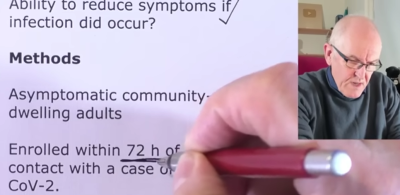
New positive ivermectin evidence
or go to
Aletho News Archives – Video-Images
From the Archives
Fanatical Followers of the Covid Regime: A Jim Jones-Style Cult?
By Professor Roger Watson and Dr. Niall McCrae | The Daily Sceptic | November 15, 2021
As scholars at leading British universities over recent decades, we witnessed the replacement of critical thinking and debate by narrative: facts are discrimination and scientific method is imperialism; truth, instead, is derived from ‘progressive’ values. This educational trend may be a major contributory factor to the ease in which society has been inculcated to the Covid ‘new normal’ of masking, testing, and repeated doses of vaccines for a disease of similar risk to severe influenza.
One doesn’t need much critical reasoning to observe the flawed logic of some vaccination enthusiasts, such as people who respond to experiencing any side effects, however debilitating, by saying “at least I know it’s working”, or, after contracting the disease despite their promised inoculation (over 90% effective, according to initial drug company claims), “I’d have been worse off without the jab.” … continue
Blog Roll
 Aletho News
- ‘Grave, alarming’: Iran mission on Trump’s UNGA ‘annihilation’ threats
- Najaf airport to reopen to Iranian flights within 24 hours: Ambassador
- From ‘How Will This End For Iran’ to ‘When America Walks Away’: A tale of two Economist covers
- Tehran blasts ‘baseless’ speculation linking Iran to alleged bomb plot at UK air base
- The Rise And… Rise Of ‘Color Revolutions’
- The Coming GOP Bloodbath?
- Arctic Scare Stories Melt Away
- Wrong, Euronews: Climate Change Has Not Created a Food, Energy, and Economic “Meta-Crisis”
- New positive ivermectin evidence
- Met Office Caught Fabricating Daily Temperature Record Claims
- If Americans Knew
- Netanyahu Asked UAE Leader to Deny Report on Oct. 7 Warning in Secret Visit, Sources Say
- CNN Chief Int’l Correspondent Clarissa Ward on Journalists in Gaza
- Democratic Party Consultants Surround Troy Jackson with Pro-Israel Donors
- Christian Leader Responds To Netanyahu’s Claims Regarding Palestinian Christians
- In Gaza, ‘Whoever Survives the Bombing Won’t Survive the Rubble’
- Israel kills more Palestinians, amid push to resettle Gaza – Daily Update
- Israel forces Gazans to live in constant peril – Daily Update
- Deconstructing Netanyahu’s pants-on-fire UN rant – Daily Update
- Trump betrayed voters with his campaign lies and prioritized a foreign country once he took office
- Netanyahu calls Israel’s war in Gaza ‘opposite of genocide’ in UN speech to near-empty hall
- No Tricks Zone
- New Study: Earth And Venus Surface Warmth Largely Explained By Convection And Lapse Rate, Not CO2 Or Radiation
- 2025 Nature Paper Claiming Worsening Global Drought Gets RETRACTED …Heavily Flawed
- New Study: ‘Global Drought Shows No Detectable Recent Acceleration Under Climate Warming’
- Economic Masterminds: German Socialists Suggest Taxing Productivity Gains Stemming From Using AI
- The South China Sea Has Not Been Cooperating With The Climate Change Narrative
- Energy Crisis: Germany Enters Heating Season With Historically Low Gas Reserve Fill Levels
- New Study: The Antarctic Ice Sheet Gained Mass From 2020-2024 Due To Staggering Snow And Ice Accumulation
- Study: Ocean Heating Rates From Thousands Of Years Ago ‘Dwarf’ Modern Ocean Heating Rates
- Climate Extremists Target, Attack Large-Scale Power Grid Infrastructure In Germany!
- New Study: Antarctic Ice Melt Has Contributed Less Than 1 Centimeter To Sea Level Rise In The Last 30 Years

