Iran still the victim of unshakable Israeli influence over the UK’s political establishment
Here in the UK the Campaign Against the Arms Trade (CAAT) has initiated a judicial review in a bid to halt UK arms sales to Saudi Arabia on suspicion that they are being used against civilians in Yemen. The indiscriminate nature of Saudi air-strikes makes it highly likely that British weaponry is being deployed in breach of international humanitarian law.
The slaughter has been going on for nearly 2 years leading to a humanitarian crisis of appalling magnitude and great cruelty. Since the Yemen campaign began the British government has granted export licences for more than £3.3 billions worth of war equipment when there was a “clear risk” that some of it would be used in violation of all norms of human conduct.
It is claimed that the Government has ignored warnings by senior civil servants and its own arms control experts, and some records of expressed concern have gone missing. This is no great surprise when we discover that export licensing is overseen by none other than the Secretary of State for international trade, Liam Fox. For Fox has ‘form’ as a crazed stooge of Israel and a sworn enemy of Iran.
Fox, while Secretary of State for Defence, was quoted on the Conservative Friends of Israel website as saying: “… We must remember that in the battle for the values that we stand for, for democracy against theocracy, for democratic liberal values against repression – Israel’s enemies are our enemies and this is a battle in which we all stand together or we will all fall divided.”
And in June 2015 Fox declared: “It is logical to assume that Iran’s intentions are to develop a nuclear weapons capability and any claims that its intentions are exclusively peaceful should not be regarded as credible… Iran’s nuclear intentions cannot be seen outside the context of its support for terror proxies, arguably the defining feature of its foreign policy. The risks are clear.”
Fox was forced to resign as Defence Secretary in 2011 following scandalous goings-on between him, his ‘close friend’ Adam Werritty, the UK ambassador to Israel (Matthew Gould) and Israeli intelligence figures allegedly involved in plotting sanctions against Iran.
Just lately prime minister Theresa May has accused Iran of working with Hezbollah, interfering in Iraq, sending fighters to Syria to help Assad, and supporting the Houthis in the conflict in Yemen. The British Government, of course, can meddle where it pleases and recently concluded another huge arms deal with the Saudis which, says Mrs May, is for the sake of long-term security in the Gulf. She argues that the same extremists who plot terror in the Gulf states are also targeting the streets of Europe: “Gulf security is our security.”
However, public pressure to end arms sales to Saudi Arabia is now so great that the Government has adopted a new export licensing scheme that hides the value and scale of weaponry being supplied.
The reason for the British Government’s current hostility towards Iran was plain from what David Cameron told the Knesset in 2014: “A nuclear armed Iran is a threat to the whole world not just Israel. And with Israel and all our allies, Britain will ensure that it is never allowed to happen.” That position carries forward into the present day and beyond, and serves as an excuse for the rednecks who rule our political swamp to carry on being unpleasant to the Muslim world.

Oh, How he loves these Photo Ops!
Theresa May lost no time in welcoming Mr Netanyahu to London. The two leaders this week agreed to establish a new UK-Israel Trade Working Group to strengthen their existing trade and investment relationship and “to prepare the ground for a post-Brexit trade agreement”. What good that will do in the face of rising popularity among the public of boycotting everything Israeli remains to be seen.
Regional issues including Syria and Iran are to be on the agenda for discussion. And regarding Palestine May repeated the mantra that “We remain committed to a two-state solution as the best way of building stability and peace for the future”…. though she doesn’t say what that will look like.
Netanyahu also met with Foreign Secretary Boris Johnson and they sat alongside the desk on which the Balfour Declaration was composed in 1917. As for the forthcoming Balfour Declaration centenary celebrations, a statement said that May invited Prime Minister Netanyahu to attend events taking place in the UK “as a Guest of Government” and that Prime Minister Netanyahu “also invited her to visit him in Israel”.
Netanyahu didn’t miss the opportunity to warn that Iran “seeks to annihilate Israel” and called on nations to back renewed sanctions against the Iranian regime.
I looked up one of my old reports about how Craig Murray, a former UK ambassador to Uzbekistan, argued five years ago that British policy was being driven in an underhand fashion by the Israel lobby. He linked Matthew Gould, the then British ambassador to Israel, with the Fox-Werritty scandal and raised questions about meetings between Gould, Liam Fox and Fox’s strange friend Adam Werritty. Werritty was referred to as Fox’s adviser but according to reports he was backed financially by Israel lobbyists and had no security clearance and therefore no authorised role.
Murray, with many useful contacts from his days as an ambassador, claimed to have serious evidence connecting Gould with a secret plan to attack Iran, but the Foreign Office and the Cabinet Secretary blocked questions. Murray published his story ‘Matthew Gould and the plot to attack Iran’ here.
In it he pointed out that “Matthew Gould does not see his race or religion as irrelevant. He has chosen to give numerous interviews to both British and Israeli media on the subject of being a jewish ambassador, and has been at pains to be photographed by the Israeli media participating in jewish religious festivals. Israeli newspaper Haaretz described him as ‘not just an ambassador who is jewish, but a jewish ambassador’. That rather peculiar phrase appears directly to indicate that the potential conflict of interest for a British ambassador in Israel has indeed arisen.”
He went on to say that Gould stood suspected of participating with Fox and Werritty “in a scheme to forward war with Iran, in co-operation with Israel”. The stonewalling by the Cabinet Office and Foreign Office led Murray to conclude that “something very important is being hidden right at the heart of government”.
Labour MP Paul Flynn remarked that no previous ambassadors to Israel had been Jewish so that a conflict of interest and accusations of going native would be avoided. He was immediately rebuked. Flynn also asked about meetings between Werritty and Gould, as some reports suggested that Gould, Werritty and Fox discussed a potential military strike on Iran with Mossad. “I do not normally fall for conspiracy theories,” said Flynn, “but the ambassador has proclaimed himself to be a Zionist and he has previously served in Iran.”
Fox had earlier made the idiotic claim: “Israel’s enemies are our enemies”, and the Jewish Chronicle hailed him as “a champion of Israel within the government”. Furthermore Fox continually rattled the sabre against Iran which, of course, is no threat to Britain but regarded by Israel as a bitter enemy. Iraq too was Israel’s enemy, not ours. Yet Fox, according to the theyworkforyou.com, voted “very strongly” for the Iraq war. He was also an enthusiastic supporter of the war in Afghanistan.
Given that Fox so eagerly waved the flag of a foreign military power and was a man with dangerous beliefs and demonstrably weak judgement, how could those who appointed him not see that he was unfit to serve as a Minister of the British Crown – unless they were similarly tainted?
When the Werritty relationship came to light Fox jumped before being flung from the battlements. But instead of melting into obscurity he has now been rehabilitated into the senior ranks of Government and is once again a Minister of the Crown. And after watching the trail blazed by our former Jewish ambassador to the Jewish State, we now gawp with fascination at the inevitably messy conflicts of interest arising from Trump’s pick for US ambassador to Israel – David Friedman, a Jewish lawyer with scant respect for international law or Middle East sensitivities.
Despite the strong whiff of misconduct David Cameron rewarded Gould with head of The Office of Cyber Security & Information Assurance (OCSIA), which includes e-crime, working with private sector partners on exchanging information, and engaging with international partners in improving the security of cyberspace and information security. Did it seem right for such a person to be in charge of crucial security matters at the heart of our Government? What was in fellow Zionist David Cameron’s mind when he appointed him?
Could it have had anything to do with the UK-Israel academic collaboration ventures with cyber research funding, which involve partnerships between British and Israeli universities and cover research areas such identity management, regulating cyber security, privacy assurance, mobile and cloud security, human aspects of security, and cryptography?
Both countries signed a Memorandum of Understanding on digital co-operation in March 2014. And Gould’s new appointment came at a time when the Cameron government was lecturing us on threats to national security and announcing plans to trawl through our personal emails and web browsers in order to “keep us safe”. Question was, who would trawl Gould’s private emails?
The vipers in our bosom
CAAT expect a decision on the judicial review on arms to Saudi Arabia in 4 to 6 weeks. In the meantime an undercover Al Jazeera report has revealed that a senior political officer at the Israeli embassy in London, Shai Masot, was plotting with stooges among British MPs and other vipers in the political snake-pit to “take down” senior government figures including Boris Johnson’s deputy at the Foreign Office, Sir Alan Duncan, a noted sympathiser of the Palestinian’s struggle. This should have resulted in the expulsion of the ambassador himself, the Israeli propaganda maestro and Netanyahu’s pet, Mark Regev, who took up the post last year. Regev is the sort of person no sensible government would let into their country. But he was let off the hook and the affair hurriedly smoothed over with an announcement from the Foreign Office that the matter was closed.
Craig Murray, however, has been digging again. The Foreign Office deflected his many questions and dismissed the idea that Masot was anything more than a member of the technical and administrative staff at the embassy. “This is plainly a nonsense,” says Murray. “Masot, as an ex-Major in the Israeli Navy and senior officer in the Ministry of Strategic Affairs, is plainly senior to many who are on the Diplomatic List.” He concludes that the Foreign Office is complicit in “a large nest of Israeli spies seeking to influence policy and opinion in the UK in a pro-Israeli direction. That is why the government reaction to one of those spies being caught on camera plotting a scandal against an FCO minister, and giving £1 million to anti-Corbyn MPs, was so astonishingly muted.”
All this and the recent UN resolution 2334, which condemned Israel’s continuing squats on Palestinian land as illegal and an obstacle to peace, has done nothing to disturb the cosy relationship between Her Majesty’s Government and the obnoxious Israelis
On the contrary, after May’s meeting with Netanyahu a Downing Street spokesperson said they focused on, yes, cyber security: “In their discussions, the Prime Ministers committed to working together to build on our longstanding relationship and the strong ties that already exist between our two countries in a wide range of areas, from trade and investment, to innovation and technology, and defence and security. They talked about the important work we do together on intelligence-sharing and cyber-security, and committed to talk further about how we can deepen this cooperation, to help keep our people safe”.
Sitting comfortably?
February 14, 2017
Posted by aletho |
Ethnic Cleansing, Racism, Zionism, Timeless or most popular, War Crimes, Wars for Israel | Conservative Friends of Israel, Iran, Israel, Palestine, Saudi Arabia, UK, Yemen, Zionism |
Leave a comment
‘No proof, just allegations’
The Russian embassy in the UK fired back at the claims made by Britain’s cybersecurity chief in an interview to Sunday Times, in which he accused Moscow of ramping up state-sponsored attacks on the UK. It said there is still no evidence of such attacks.
“Anti-Russian campaign in British press and #fakenews production are going on? Piece contains no proof, just allegations,” The Russian Embassy in the UK tweeted, accompanying the message with a photo of the piece.
In the interview, Ciaran Martin, head of the new National Cyber Security Center (NCSC) and deputy director of the Government Communications Headquarters (GCHQ), claimed that the UK intelligence observed a surge in Russia-sponsored attacks aimed at stealing the UK’s sensitive defense and foreign policy documents for the last two years.
Martin attributed what he described as a “step change in Russian aggression in cyberspace” to Moscow’s intention to “assert power and influence against the West.”
While arguing that the attacks by Russia have been “very well evidenced by international partners and widely accepted,” he fell short of providing any examples of such attacks against the UK.
Nevertheless, Martin argued that the UK would inevitably face a “Category 1” cyberattack from Russia, referring to the large-scale hack that reportedly targeted the US Office of Personal Management in 2015.
He claimed that UK had sustained 188 attacks, including from Russia-sponsored hackers, classified as “Category 2 and 3” within last three months that have compromised UK security.
Ahead of the US presidential elections and in its immediate aftermath, Russia’s alleged hacking of the elections, which was repeatedly denied by Moscow as “nonsense,” has been grabbing international media attention. The blame game in the media went to great lengths, with NBC reporting in December that Russian President Vladimir Putin had ordered the hack himself to secure Trump’s victory.
RT and Sputnik News have been singled out as two of the main drivers behind the “propaganda campaign” aimed at swinging the US elections in favor of Donald Trump.
The anti-Russian hysteria in the US media has since spread to the UK. In December, The Times reported that “Moscow is behind a concerted drive to undermine the UK through espionage, misinformation, cyberattacks and fake news,” citing the opinion of unnamed sources in the British government.
The portrayal of Russian media as propaganda and “fake news” by the Sunday Times early February appeared to prompt some of the RT UK channel advertisers to pull airtime on the channel after they were pressed to comment by the newspaper on an upcoming investigative report on the matter.
The article, authored by Josh Boswell, cited Damian Collins, chairman of the UK House of Commons Culture, Media and Sport Select Committee, as saying that “British companies should not be advertising on channels that disseminate fake news designed to spread fear and confusion.”
Annie Machon, a former British intelligence officer, told RT that while all the recent accusatory statements by British intelligence appeared to be “intelligence-lite,” the US media seems to be preoccupied exclusively with what they present as a mounting “Russian threat.”
“There seems to be another step in the demonization of Russia, which started with the DNC hacks and the fake hacking of the elections and fake news, and the rest of that. So, it is sort of a slur. It is quite libelous, as well,” Machon said.
Machon believes that the excess focus on Russia’s cyber activities, in comparison to that of China and even that of the NSA, that “has been caught out massively hacking across Europe,” is due to “ongoing demonization for political gain.”
Read more:
>Sunday Times ‘propaganda’ probe targets RT advertisers, misquotes MP
February 13, 2017
Posted by aletho |
Deception, Fake News, Mainstream Media, Warmongering | Russia, UK |
Leave a comment
Britain’s sickening infatuation with Israel continues
Here in the UK the Campaign Against the Arms Trade (CAAT) has initiated a judicial review in a bid to halt UK arms sales to Saudi Arabia on suspicion that they are being used against civilians in Yemen. The indiscriminate nature of Saudi air-strikes makes it highly likely that British weaponry is being deployed in breach of international humanitarian law.
The slaughter has been going on for nearly 2 years leading to a humanitarian crisis of appalling magnitude and great cruelty. Since the Yemen campaign began the British government has granted export licences for more than £3.3 billions worth of war equipment when there was a “clear risk” that some of it would be used in violation of all norms of human conduct.
It is claimed that the Government has ignored warnings by senior civil servants and its own arms control experts, and some records of expressed concern have gone missing. This is no great surprise when we discover that export licensing is overseen by none other than the Secretary of State for international trade, Liam Fox. For Fox has ‘form’ as a crazed stooge of Israel and a sworn enemy of Iran.
Fox, while Secretary of State for Defence, was quoted on the Conservative Friends of Israel website as saying: “…We must remember that in the battle for the values that we stand for, for democracy against theocracy, for democratic liberal values against repression – Israel’s enemies are our enemies and this is a battle in which we all stand together or we will all fall divided.”
And in June 2015 Fox declared: “It is logical to assume that Iran’s intentions are to develop a nuclear weapons capability and any claims that its intentions are exclusively peaceful should not be regarded as credible… Iran’s nuclear intentions cannot be seen outside the context of its support for terror proxies, arguably the defining feature of its foreign policy. The risks are clear.”
Fox was forced to resign as Defence Secretary in 2011 following scandalous goings-on between him, his ‘close friend’ Adam Werritty, the UK ambassador to Israel and Israeli intelligence figures allegedly involved in plotting sanctions against Iran.
Just lately prime minister Theresa May has accused Iran of working with Hezbollah, interfering in Iraq, sending fighters to Syria to help Assad, and supporting the Houthis in the conflict in Yemen. The British Government, of course, can meddle where it pleases and recently concluded another huge arms deal with the Saudis which, says Mrs May, is for the sake of long-term security in the Gulf. She argues that the same extremists who plot terror in the Gulf states are also targeting the streets of Europe: “Gulf security is our security.”
However, public pressure to end arms sales to Saudi Arabia is now so great that the Government has adopted a new export licensing scheme that hides the value and scale of weaponry being supplied.
The reason for the British Government’s current hostility towards Iran was plain from what David Cameron told the Knesset in 2014: “A nuclear armed Iran is a threat to the whole world not just Israel. And with Israel and all our allies, Britain will ensure that it is never allowed to happen.” That position carries forward into the present day and beyond, and serves as an excuse for the rednecks who rule our political swamp to carry on being unpleasant to the Muslim world.
After sucking up to Trump Britain rolls out red carpet to another of the world’s undesirables
Theresa May lost no time in welcoming Mr Netanyahu to London. The two leaders this week agreed to establish a new UK-Israel Trade Working Group to strengthen their existing trade and investment relationship and “to prepare the ground for a post-Brexit trade agreement”. What good that will do in the face of rising popularity among the public of boycotting everything Israeli remains to be seen.
Regional issues including Syria and Iran are to be on the agenda for discussion. And regarding Palestine May repeated the mantra that “We remain committed to a two-state solution as the best way of building stability and peace for the future”…. though she doesn’t say what that will look like.
Netanyahu also met with Foreign Secretary Boris Johnson and they sat alongside the desk on which the Balfour Declaration was composed in 1917. As for the forthcoming Balfour Declaration centenary celebrations, a statement said that May invited Prime Minister Netanyahu to attend events taking place in the UK “as a Guest of Government” and that Prime Minister Netanyahu “also invited her to visit him in Israel”.
Netanyahu didn’t miss the opportunity to warn that Iran “seeks to annihilate Israel” and called on nations to back renewed sanctions against the Iranian regime.
Israel’s ‘nest of spies’ in London
I looked up one of my old reports about how Craig Murray, a former UK ambassador to Uzbekistan, argued five years ago that British policy was being driven in an underhand fashion by the Israel lobby. He linked Matthew Gould, the then British ambassador to Israel, with the Fox-Werritty scandal and raised questions about meetings between Gould, Liam Fox and Fox’s strange friend Adam Werritty. Werritty was referred to as Fox’s adviser but according to reports he was backed financially by Israel lobbyists and had no security clearance and therefore no authorised role.
Murray, with many useful contacts from his days as an ambassador, claimed to have serious evidence connecting Gould with a secret plan to attack Iran, but the Foreign Office and the Cabinet Secretary blocked questions. Murray published his story ‘Matthew Gould and the plot to attack Iran’ here.
In it he pointed out that “Matthew Gould does not see his race or religion as irrelevant. He has chosen to give numerous interviews to both British and Israeli media on the subject of being a Jewish ambassador, and has been at pains to be photographed by the Israeli media participating in Jewish religious festivals. Israeli newspaper Haaretz described him as ‘not just an ambassador who is Jewish, but a Jewish ambassador’. That rather peculiar phrase appears directly to indicate that the potential conflict of interest for a British ambassador in Israel has indeed arisen.”
He went on to say that Gould stood suspected of participating with Fox and Werritty “in a scheme to forward war with Iran, in co-operation with Israel”. The stonewalling by the Cabinet Office and Foreign Office led Murray to conclude that “something very important is being hidden right at the heart of government”.
Labour MP Paul Flynn remarked that no previous ambassadors to Israel had been Jewish so that a conflict of interest and accusations of going native would be avoided. He was immediately rebuked. Flynn also asked about meetings between Werritty and Gould, as some reports suggested that Gould, Werritty and Fox discussed a potential military strike on Iran with Mossad. “I do not normally fall for conspiracy theories,” said Flynn, “but the ambassador has proclaimed himself to be a Zionist and he has previously served in Iran.”
Fox had earlier made the idiotic claim: “Israel’s enemies are our enemies”, and the Jewish Chronicle hailed him as “a champion of Israel within the government”. Furthermore Fox continually rattled the sabre against Iran which, of course, is no threat to Britain but regarded by Israel as a bitter enemy. Iraq too was Israel’s enemy, not ours. Yet Fox, according to the theyworkforyou.com, voted “very strongly” for the Iraq war. He was also an enthusiastic supporter of the war in Afghanistan.
Given that Fox so eagerly waved the flag of a foreign military power and was a man with dangerous beliefs and demonstrably weak judgement, how could those who appointed him not see that he was unfit to serve as a Minister of the British Crown – unless they were similarly tainted?
When the Werritty relationship came to light Fox jumped before being flung from the battlements. But instead of melting into obscurity he has now been rehabilitated into the senior ranks of Government and is once again a Minister of the Crown. And after watching the trail blazed by our former Jewish ambassador to the Jewish State, we now gawp with fascination at the inevitably messy conflicts of interest arising from Trump’s pick for US ambassador to Israel – David Friedman, a Jewish lawyer with scant respect for international law or Middle East sensitivities.
Despite the strong whiff of misconduct David Cameron rewarded Gould with head of The Office of Cyber Security & Information Assurance (OCSIA), which includes e-crime, working with private sector partners on exchanging information, and engaging with international partners in improving the security of cyberspace and information security. Did it seem right for such a person to be in charge of crucial security matters at the heart of our Government? What was in fellow Zionist David Cameron’s mind when he appointed him?
Could it have had anything to do with the UK-Israel academic collaboration ventures with cyber research funding, which involve partnerships between British and Israeli universities and cover research areas such identity management, regulating cyber security, privacy assurance, mobile and cloud security, human aspects of security, and cryptography?
Both countries signed a Memorandum of Understanding on digital co-operation in March 2014. And Gould’s new appointment came at a time when the Cameron government was lecturing us on threats to national security and announcing plans to trawl through our personal emails and web browsers in order to “keep us safe”. Question was, who would trawl Gould’s private emails?
The vipers in our bosom
CAAT expect a decision on the judicial review on arms to Saudi Arabia in 4 to 6 weeks. In the meantime an undercover Al Jazeera report has revealed that a senior political officer at the Israeli embassy in London, Shai Masot, was plotting with stooges among British MPs and other vipers in the political snake-pit to “take down” senior government figures including Boris Johnson’s deputy at the Foreign Office, Sir Alan Duncan, a noted sympathiser of the Palestinian’s struggle. This should have resulted in the expulsion of the ambassador himself, the Israeli propaganda maestro and Netanyahu’s pet, Mark Regev, who took up the post last year. Regev is the sort of person no sensible government would let into their country. But he was let off the hook and the affair hurriedly smoothed over with an announcement from the Foreign Office that the matter was closed.
Craig Murray, however, has been digging again. The Foreign Office deflected his many questions and dismissed the idea that Masot was anything more than a member of the technical and administrative staff at the embassy. “This is plainly a nonsense,” says Murray. “Masot, as an ex-Major in the Israeli Navy and senior officer in the Ministry of Strategic Affairs, is plainly senior to many who are on the Diplomatic List.” He concludes that the Foreign Office is complicit in “a large nest of Israeli spies seeking to influence policy and opinion in the UK in a pro-Israeli direction. That is why the government reaction to one of those spies being caught on camera plotting a scandal against an FCO minister, and giving £1 million to anti-Corbyn MPs, was so astonishingly muted.”
All this and the recent UN resolution 2334, which condemned Israel’s continuing squats on Palestinian land as illegal and an obstacle to peace, has done nothing to disturb the cosy relationship between Her Majesty’s Government and the obnoxious Israelis.
On the contrary, after May’s meeting with Netanyahu a Downing Street spokesperson said they focused on, yes, cyber security: “In their discussions, the Prime Ministers committed to working together to build on our longstanding relationship and the strong ties that already exist between our two countries in a wide range of areas, from trade and investment, to innovation and technology, and defence and security. They talked about the important work we do together on intelligence-sharing and cyber-security, and committed to talk further about how we can deepen this cooperation, to help keep our people safe”.
Sitting comfortably?
Stuart Littlewood worked on jet fighters in the RAF then pursued a career in industrial marketing, primarily in oil, electronics, card technology and retail automation. More recently he freelanced with innovation and marketing research consultancies. Member of the Chartered Institute of Marketing. Psychology degree Exeter University. Served as a county councillor (Cambridgeshire) and spokesman on the Police Authority. Associate of the Royal Photographic Society.
Since retiring has been a newspaper columnist and produced two photo-documentary books.
February 12, 2017
Posted by aletho |
Ethnic Cleansing, Racism, Zionism, Timeless or most popular, War Crimes, Wars for Israel | Iran, Israel, Sanctions against Iran, UK, Zionism |
Leave a comment
The Palestinian Authority Ambassador to the United Kingdom has described the British government’s invitation for Benjamin Netanyahu to celebrate the 100th anniversary of the notorious Balfour Declaration in London as a “new slap for the Palestinians,” it has been reported.
“Britain has to correct its mistake, apologise to the Palestinians and recognise the Palestinian state instead of inviting the Israeli prime minister to celebrate 100 years of granting Palestinian land for Jews to build their state,” insisted Professor Manuel Hassassian.
The PA response to the government invitation coincided with the British parliament discussing a motion to call on Israel to halt settlement activities in the occupied Palestinian territories immediately.
Last Monday, the Israeli parliament, the Knesset, approved a law which legalises previously illegal — even under Israeli law — settlement outposts built on private Palestinian land in the occupied territories. All Israeli settlements are illegal according to international laws and conventions.
Hassassian said that he was commissioned to contact the British foreign office to get clarifications about Netanyahu’s invitation. The ambassador said that the Minister of State for Middle East Affairs, Tobias Ellwood MP, initially ignored his request for a meeting. When Ellwood did respond, said Hassassian, he agreed to a meeting but did not specify a date and time.
February 11, 2017
Posted by aletho |
Ethnic Cleansing, Racism, Zionism, Timeless or most popular, War Crimes | Human rights, Israel, Palestine, UK, Zionism |
Leave a comment

The Times of Israel reports that Lord Jacob Rothschild recently revealed new details about the crucial role his ancestors played in obtaining the Balfour Declaration, which “helped pave the way for the creation of Israel.”
The 80-year-old Rothschild is the current head of the banking family and a strong supporter of Israel.
The Balfour Declaration (text below) was an official 1917 letter from the British Foreign Minister, Lord Balfour, addressed to Lord Rothschild, a Zionist leader in Britain at the time and the current Lord Rothschild’s uncle.
During a television interview, the Times of Israel reports that Balfour revealed for the first time the role of his cousin Dorothy de Rothschild.
Rothschild described Dorothy, who was in her teens at the time, as “devoted to Israel,” and said: ‘What she did, which was crucially important.’”
Rothschild said that Dorothy connected Zionist leader Chaim Weizmann to the British establishment. Dorothy “told Weizmann how to integrate, how to insert himself into British establishment life, which he learned very quickly.”
Rothschild said that the way the declaration was procured was extraordinary. “It was the most incredible piece of opportunism.”
“[Weizmann] gets to Balfour,” Rothschild described, “and unbelievably, he persuades Lord Balfour, and Lloyd George, the prime minister, and most of the ministers, that this idea of a national home for Jews should be allowed to take place. I mean it’s so, so unlikely.”

The interview was was conducted by former Israeli ambassador Daniel Taub as part of the Balfour 100 project. Taub interviewed Rothschild at Waddeston Manor in Buckinghamshire, a manor bequeathed to the nation by the Rothschild family in 1957, where the Declaration is kept.
According to Ambassador Taub, the declaration “changed the course of history for the Middle East.”
The Times reports that Rothschild said his family at the time was divided on the idea of Israel, noting that some members “didn’t think it was a good thing that this national home be established there”.
Dorothy’s letters are also stored at Waddeston. They describe her later dealings with diverse Zionist leaders and her advice on the organization of the Zionist Conference, according to the Times.
Rothschild said that the Declaration went through five drafts before finally being issued on November 2, 1917.
Alison Weir reports in her book, Against Our Better Judgment: The Hidden History of How the U.S. Was Used to Create Israel, that drafts of the declaration went back and forth to Zionists in the United States before the document was finalized. The main writer was secret Zionist Leopold Amery.
Balfour Declaration Text:
Foreign Office
November 2nd, 1917
Dear Lord Rothschild,
I have much pleasure in conveying to you. on behalf of His Majesty’s Government, the following declaration of sympathy with Jewish Zionist aspirations which has been submitted to, and approved by, the Cabinet
His Majesty’s Government view with favour the establishment in Palestine of a national home for the Jewish people, and will use their best endeavors to facilitate the achievement of this object, it being clearly understood that nothing shall be done which may prejudice the civil and religious rights of existing non-Jewish communities in Palestine or the rights and political status enjoyed by Jews in any other country.
I should be grateful if you would bring this declaration to the knowledge of the Zionist Federation.
Yours,
Arthur James Balfour
February 10, 2017
Posted by aletho |
Corruption, Ethnic Cleansing, Racism, Zionism, Timeless or most popular, War Crimes | Balfour Declaration, Israel, Palestine, UK, Zionism |
Leave a comment
Prime Minister Benjamin Netanyahu has urged Washington, London and their allies to create a “joint front” against Iran, citing Tehran’s supposedly aggressive behavior as the reason. Iranian analysts told Sputnik Persian that Israel “has no right” to come up with such initiatives since it is the main reason behind regional tensions.
“Israel is the main source of all conflicts in the Middle East,” Hossein Ruyvaran, an expert on the Middle East and the Arab world who teaches at the University of Tehran, said. “Since this state was established in 1948, the region has been plagued by many wars sparked by Israel – in 1948, 1956, 1973, 1982, 2006, 2008, 2012 and 2014. The Israeli regime is the main reason for regional tensions due to its ambitions. This regime has tried to change the geopolitical orientation in the region.”
These remarks came in response to Netanyahu calling on the United States and the United Kingdom to adopt a tough stance on Iran due to Tehran’s ostensibly “defiant aggression” and in light of the country’s “defiance against the international order.”
“Claims that Iran is the key threat [in the Middle East] and the main reason behind all troubles in the region are groundless,” Ruyvaran said. “Israel has tried to use these accusations to turn the West against Iran. Meanwhile, the UN Security Council has adopted Resolution 2234 which strongly condemns Israel’s unlawful settlements on occupied lands.”
Hassan Hanizadeh, Iranian political analyst and former chief editor of the Mehr News Agency, expressed similar sentiments. He referred to Netanyahu’s remarks as “anti-Iranian political propaganda.”
“Not many countries are ready to support Israel since everyone knows that Israel has occupied Arab lands, including the Golan Heights, Gaza and East Jerusalem,” he said. “This is why Israel has no right to accuse Iran of aggression since it itself is an aggressor. … Israel has no right to mention or urge to create a front against Iran. If a front against aggression must be created, then it should be targeted against Israel, not Iran.”Netanyahu’s comments came after Iran had tested a new ballistic missile last week. The United States imposed new sanctions on Tehran, with US President Donald Trump tweeting that the Islamic Republic has been “formally put on notice” for conducting the test. He added that Iran was “playing with fire.”
Tehran has repeatedly said that its missile program is defensive in nature and does not threaten other countries. On Monday, Iranian Foreign Ministry spokesman Bahram Qasemi said that the test was not intended “to send a message” to the new US administration.
February 8, 2017
Posted by aletho |
Economics, Ethnic Cleansing, Racism, Zionism, Wars for Israel | Iran, Israel, Middle East, Palestine, Sanctions against Iran, UK, United States, Zionism |
Leave a comment
Britain’s Foreign Office paid for half a dozen Bahraini police officers to visit Belfast in August 2015, where the Police Service of Northern Ireland (PSNI) shared its expertise on gathering intelligence ahead of demonstrations.
Protestors in Bahrain, such as Mohammed Ramadan, have been targeted by police and tortured into falsely confessing to capital crimes. Mr Ramadan, a father of three young children, is now on death row and could be executed at any time.
The training, which also included sessions on water cannons, dog handling and public order tactics, was kept secret. The UK government has repeatedly denied providing public order training to Bahrain.
The Cabinet Office claimed that “The UK does not fund any programmes in Bahrain focused on public order”. However, documents obtained by Reprieve show that Bahrain’s police received an “Introduction to Combined Operational Training with a focus on Public Order.”
The training was prepared by Northern Irish police officers during a week-long “scoping visit” to Bahrain over April-May 2015, where they assessed Bahrain’s public order systems. The Stormont-owned company NI-CO played a key role in organising all the training.
It has also emerged that Bahrain’s Chief of Police and his deputies visited Belfast in June 2014. The itinerary included another session with the PSNI on “Community Intelligence”. The police chief attended a “demonstration of PSNI Public Order systems” and received a “Tour of North and West Belfast ‘Flashpoints’ with 2 or 3 PSNI Armoured Vehicles”.
Bahrain’s Chief of Police had to postpone a visit to Belfast earlier in 2014 because there was a “security emergency in Bahrain at the moment and it is felt that the Chief of Police and other senior officers cannot leave the country at this critical time.” This was a month after death-row prisoner Mohammed Ramadan was tortured. “The situation on the ground is becoming increasingly tense”, an email explained.
Bahrain’s Chief of Police has command level responsibility for violations carried out by lower ranking officers. Months after the police chief visited Belfast for training, teenager Ali al-Singace was arrested and tortured by Bahrain’s police with electric shocks, until he made a false confession to a capital crime. He was executed by firing squad in January 2017.
Commenting, Maya Foa, a director of Reprieve, said:
“It is outrageous that the government has covered up this project, which risks supporting the execution of protesters in Bahrain.
“Bahrain is notorious for arresting, torturing and sentencing to death people involved in protests – such as Mohammed Ramadan, a father of three who is held on death row and faces execution at any moment.
“By training Bahrain’s police how to gather intelligence on protesters, there is a serious risk that Britain is helping them arrest and execute people who are guilty of nothing more than calling for reform. It is scandalous that the Government has sought to sweep this under the carpet.”
February 7, 2017
Posted by aletho |
Civil Liberties, Full Spectrum Dominance, Subjugation - Torture | Bahrain, Human rights, UK |
Leave a comment
 The scope of various cyber operations carried out by different state players has recently become the cause of increasing tension amid international relations. For instance, at the end of 2016, the United States accused Russia of hacking the servers of the US Democratic National Committee, which resulted in the introduction of sanctions against a number of Russian intelligence services that were described as offenders in this recent incident. However, Washington to date, hasn’t presented any evidence to back up its claims.
At the same time, a considerable number of Western media sources, including Foreign Policy, have openly admitted Moscow was not accused of anything in America’s last election that Washington itself has not done elsewhere in the world.
Curiously enough, distinguished historian Marc Trachtenberg, professor emeritus at UCLA, has already stressed that this alleged interference is a type of behavior that the United States helped establish; since meddling in other countries’ politics has been an American specialty for decades. The Washington Times seems to be convinced too that America’s record of meddling in other countries and of leaders who have lied to Washington puts it in the position where it must tread carefully to avoid hypocrisy.
Those who complain about alleged Russian offenses must certainly know that the US government eavesdrops, as a matter of course, on the private communications of many people around the world. The National Security Agency, whose job it is to do this kind of eavesdropping, has a budget of about 10 billion dollars, and, according to an article that came out in the Washington Post a few years ago, intercepts and stores “1.7 billion e-mails, phone calls and other types of communications” everyday.
In terms of the development of so-called cyber armies – highly specialized units that can use cyberspace for both military or intelligence purposes – Russia may indeed be found in the top 5 states in the world in this domain, however, it’s lagging behind the US, China, Britain and South Korea. In general, such armies exist officially in a several dozen countries, as for the unofficial numbers, there’s hundreds of those, since the scope of information warfare operations has been increasing rapidly over the years.
It goes without saying that US cyber forces has been the most powerful in the world, with over 9,000 trained professionals in its ranks. As for the UK, the so-called Government Communications Headquarters (GCHQ) has been providing employment to over 6,000 servicemen. Out of this number, according to individual media reports, more than 2,000 servicemen are engaged in cyber warfare.
Additionally, it should be noted that cyber squads can be found in a number of armies around the world, but those are not “military hackers”, those are security specialist that are tasked with protecting digital assets and IT infrastructure, at least officially. Off of the top of one’s head one can name such units in South Korea, Israel, Iran and Estonia.
The question of whether or not these hackers are capable of influencing political processes and, in particular, one’s presidential campaign, has been broadly discussed at the latest 9th International Forum on Cybersecurity (FIC), which was held last January in the French city of Lille. For the first time the forum was held in 2007, following an initiative of the National Gendarmerie, and every year it has collected public authorities, private sector representatives, experts and civil society figures. In 2017, the forum aimed at discussing the issue of providing “reasonable security for IT assets.”
France’s Minister of Internal Affairs, Bruno Le Roux has stressed in his opening speech at the forum that IT systems are regularly becoming the target of attacks originating from criminal organizations and even from foreign states, which are showing great ingenuity.
But we must not forget that more often than not, it’s not foreign hackers that play the role of a destabilizing factor in the political life of any given society, but the hackers hired by opposition political parties of these very states. And the United State exemplifies this statement better that any, with Donald Trump announcing his concern over the leakage of the details of his telephone conversations with foreign political figures.
According to White House spokesman Sean Spicer, the Trump administration will have to exercise damage control after the leakage of the details of the discussions that Trump had over the phone with the leaders of Mexico and Australia. “This is a very disturbing fact,” – said Spicer in his recent statement. AP has allegedly acquired these tapes, so it now reports that Trump allegedly said in a conversation that the Mexican government is incapable of dealing with the “bad guys”. For sure, the Mexican Foreign Ministry has claimed that those reports are false, but what other choice did it have?
In addition, Trump has also been denying the claims distributed by the Washington Post that he had a very “bad talk” with the Australian Prime Minister Malcolm Turnbull. “Thank you to Prime Minister of Australia for telling the truth about our very civil conversation that FAKE NEWS media lied about ” – Trump wrote in his Twitter.
Jean Périer is an independent researcher and analyst and a renowned expert on the Near and Middle East.
February 7, 2017
Posted by aletho |
Aletho News | CIA, France, GCHQ, NSA, UK, United States |
Leave a comment
Several British advertisers “panicked” and pulled airtime on RT UK after the Sunday Times called them to ask for comment for an upcoming article about RT, according to a sales house used by advertisers on the channel.
“The Agencies on behalf of their clients pulled their airtime for the reason that they had been contacted by the Sunday Times. The Sunday Times asked them to make comment on their advertising on RT for the Sunday 5th February edition. These advertisers have panicked about the content of the article and pulled their airtime,” the sales house said in comments on Tuesday.
“The sales house the advertisers use to order airtime on RT UK has informed us that several companies at once decided to break up with RT after phone calls from the Sunday Times,” RT Editor-in-Chief Margarita Simonyan said.
“Meanwhile, the Sunday Times article alleges that the advertisers refused to cooperate with us because of ‘Kremlin propaganda,’ and it also cites a British MP urging to boycott RT, though in fact he didn’t say that,” she emphasized.
The RT Press Office said that “the calls from the sales house with requests to pull advertisements from several companies came shortly after the Sunday Times requested comment from RT for their story.”
In the article published on February 5, an investigative reporter for the Sunday Times, Josh Boswell, claimed that “top British brands are pulling their advertisements from the television channel RT UK amid accusations that it is spreading ‘propaganda and fake news’ for Russia’s president, Vladimir Putin,” naming the manufacturers of Gaviscon, Strepsils and Vanish and the make-up brand Max Factor among those advertisers.
Boswell goes on to claim that last weekend Damian Collins, chairman of the UK Commons Culture, Media and Sport Select Committee, “called for all British companies to boycott the ‘disinformation and propaganda’ channel.”
The MP is also quoted as saying that “British companies should not be advertising on channels that disseminate fake news designed to spread fear and confusion… I would call on any such company that has not already done so to withdraw their advertising.”
As the newspaper inserted the definite article ‘the’ into the explanatory sentence – “the ‘disinformation and propaganda’ channel” – the reader can’t help but draw the conclusion that the MP’s statement was made about RT.
However, when asked by RT to clarify the comment he made for the Sunday Times, Collins confirmed the statement contained no specific attribution, and was intended as a broader remark.
“Yes, I am happy for you to use the quotation from the Times. My comments were aimed broadly at any channel or website which produces and broadcasts fake news. I did not name any individual organization in my remarks,” Collins explained.
Before the article was published, Boswell contacted RT “to give you an opportunity to comment” on the story. The RT Press Office responded to the request with a comprehensive email, including an explanation of how the channel is publicly funded, much like the BBC and France 24, and how the channel’s mission is clearly stated as exploring underreported stories and providing more balance in the international news arena.
Boswell skipped most of this, however, and reduced RT’s response to a brief quote: “RT, formerly Russia Today, said it was an ‘editorially independent, autonomous non-profit global news organization.”
After RT asked the Sunday Times for comment, the newspaper’s public relations team answered: “Thank you for your enquiry. Due to the high volume of emails we receive, we will only be able to respond if we are in a position to help with your request.”
The Russian embassy in the UK has dismissed the Sunday Times article, writing in a statement: “We understand that not everyone in the UK is happy about the popularity of the Russian channel and the alternative worldview it represents. But this shouldn’t be a reason for a blatant crusade against the channel in such a foul fashion.”
Foreign policy analyst Michael Hughes told RT that the whole approach of the Sunday Times towards RT “is horrible, one-sided and biased.”
“They don’t treat any other stations this way except [RT]. It has nothing to do with the actual programming, they don’t like Russian policy, so they are doing whatever they can to target Russian stations right now.
“It is an obvious violation of the basic standards of journalism. You couldn’t be more obvious in violating journalistic integrity,” he added.
In the past there have been similar instances of Western mainstream media discussing the prospect of RT coverage being restricted, subjected to greater scrutiny or given less equal treatment.
In January, the Wall Street Journal speculated on what would happen if US pay TV operators were to consider dropping RT from their networks. The story followed the US intelligence community’s findings on alleged Russian interference in the American presidential election, with seven of the report’s 13 pages devoted to RT.
The prospect of dropping RT appeared unrealistic, however, with Frederick Thomas, chief executive of MHz Networks, saying: “The reality is we live in an age where every nth degree of opinion is available 24/7 and 98 percent of people know that you either just turn the channel off if it’s TV, or if it’s a website, you go to another one.”
In a separate article in January, the Atlantic noted that “RT stories regularly appear toward the top of Google search results,” and that there are more than 4 million ‘likes’ on RT’s Facebook page. The magazine asked Google for information on whether the company had any policies “for how to rank and display news stories and videos from state-sponsored outlets like RT,” but a spokesperson for the search engine declined to comment.
The Atlantic also contacted a spokesperson for Facebook to clarify “if articles or videos from state-sponsored outlets are treated the same way as content from the New York Times or the Wall Street Journal.”
Facebook responded by mentioning “changes the company has already announced, which suppress the circulation of links to news stories that users report as false.” However, RT stories “are more likely to be biased than to be ‘purposefully fake or deceitful,’” alleged the article’s author, Kaveh Waddell.
READ MORE:
Why are US tech firms suddenly trying to restrict RT’s access to social media?
February 7, 2017
Posted by aletho |
Fake News, Full Spectrum Dominance, Mainstream Media, Warmongering | Sunday Times, UK |
Leave a comment
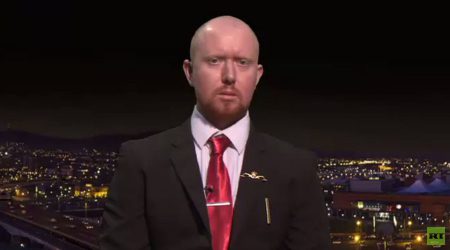
Trident whistleblower William McNeilly. / RT
Royal Navy whistleblower William McNeilly has returned fire after the Ministry of Defence (MoD) again tried to discredit him. He labeled it an attempt to cover up the dangers of Britain’s nuclear arsenal.
McNeilly was thrown out of the navy in 2015 after publishing a dossier of potentially catastrophic security and safety issues relating to Britain’s nuclear deterrent.
After reports in January this year of a failed 2016 missile test, which saw senior government figures accused of lying, McNeilly told RT that he himself had been witness to a number of serious mishaps during a Trident patrol a year earlier.
The 2016 test saw a missile which was supposed to be aimed in the direction of Africa veer toward Florida due to an internal systems failure.
The MoD responded to the former weapons engineer’s comments to RT by telling the Independent newspaper: “McNeilly’s claims, from his brief serving time before being discharged, have proved to be factually incorrect, demonstrate a lack of understanding or drew on historic, previously known, events.
“We have absolute confidence in the nuclear deterrent,” they insisted.
The Independent specifically referred to McNeilly’s “claims that there were four unreported Trident missile test failures in 2015…”
McNeilly responded Monday, telling RT: “I have never stated that there were four failed missile launches.
“The Trident report and the information I gave RT made it clear that I was talking about missile tests.”
McNeilly pointed out he had served on a nuclear missile patrol, including on watches in the command center.
“There are multiple missile tests conducted every patrol,” he said.
“The MoD has tried to downplay the information in the Trident report by claiming that I said things that I have never said.”
The truth of the matter, he insisted, was that “I have never said I witnessed four failed missile launches… that is a lame attempt to discredit me and the Trident report by fabricating nonsense.”
February 6, 2017
Posted by aletho |
Deception, Fake News, Mainstream Media, Warmongering, Militarism | The Independent, UK |
Leave a comment
Israeli Prime Minister Benjamin Netanyahu will face hundreds of protesters when he meets with his British counterpart Theresa May in London on Monday morning.
Pro-Palestine activists have organized a demonstration outside Downing Street, where Netanyahu is due to discuss among other things the rising ‘threat’ of Iran.
A Facebook page advertising the event claims to have support from several activist organizations, including Palestine Solidarity Campaign, Stop the War Coalition, War on Want and the Muslim Association of Britain.
Some 268 people have confirmed they will attend, according to the page.
Before flying to Britain, Netanyahu said he wants to “tighten” relations with the UK in the face of the “extraordinary aggression” from Iran after the Islamic Republic tested a ballistic missile over the weekend. Tehran denies the test was in breach of the 2015 nuclear deal.
“We are in a period of diplomatic opportunities and challenges. The opportunities stem from the fact that there is a new administration in Washington, and a new government in Britain,” Netanyahu said.
“I intend to speak with both of them about tightening relations, between each side and Israel and trilaterally.”
According to the Telegraph, a Downing Street spokesman said May was expected to raise concerns about illegal settlement building, but it would only form a small part of their discussions.
Netanyahu’s visit comes six weeks after Britain assisted in the passage of a UN Security Council resolution condemning Israel’s illegal settlements in the West Bank as a “flagrant violation under international law.”
The resolution was able to pass because the United States made the unusual choice not to exercise its veto power.
Britain played a key role in brokering the resolution, according to the Guardian, which claimed the Foreign Office did not deny it had been involved in the drafting process.
Netanyahu reacted furiously to UNSC resolution 2334, reserving his strongest condemnation for outgoing US President Barack Obama.
In a sign of frustration with London, Netanyahu summoned Britain’s ambassador on Christmas Day for a telling-off.
Nine other ambassadors were also summoned by the Israeli PM, including the US ambassador.
February 6, 2017
Posted by aletho |
Ethnic Cleansing, Racism, Zionism, Militarism | Benjamin Netanyahu, Israel, Sanctions against Iran, UK, Zionism |
Leave a comment
The Mail on Sunday today reveals astonishing evidence that the organisation that is the world’s leading source of climate data rushed to publish a landmark paper that exaggerated global warming and was timed to influence the historic Paris Agreement on climate change.
A high-level whistleblower has told this newspaper that America’s National Oceanic and Atmospheric Administration (NOAA) breached its own rules on scientific integrity when it published the sensational but flawed report, aimed at making the maximum possible impact on world leaders including Barack Obama and David Cameron at the UN climate conference in Paris in 2015.
The report claimed that the ‘pause’ or ‘slowdown’ in global warming in the period since 1998 – revealed by UN scientists in 2013 – never existed, and that world temperatures had been rising faster than scientists expected. Launched by NOAA with a public relations fanfare, it was splashed across the world’s media, and cited repeatedly by politicians and policy makers.
But the whistleblower, Dr John Bates, a top NOAA scientist with an impeccable reputation, has shown The Mail on Sunday irrefutable evidence that the paper was based on misleading, ‘unverified’ data.
It was never subjected to NOAA’s rigorous internal evaluation process – which Dr Bates devised.
His vehement objections to the publication of the faulty data were overridden by his NOAA superiors in what he describes as a ‘blatant attempt to intensify the impact’ of what became known as the Pausebuster paper.
His disclosures are likely to stiffen President Trump’s determination to enact his pledges to reverse his predecessor’s ‘green’ policies, and to withdraw from the Paris deal – so triggering an intense political row.
In an exclusive interview, Dr Bates accused the lead author of the paper, Thomas Karl, who was until last year director of the NOAA section that produces climate data – the National Centers for Environmental Information (NCEI) – of ‘insisting on decisions and scientific choices that maximised warming and minimised documentation… in an effort to discredit the notion of a global warming pause, rushed so that he could time publication to influence national and international deliberations on climate policy’.
Dr Bates was one of two Principal Scientists at NCEI, based in Asheville, North Carolina.
Official delegations from America, Britain and the EU were strongly influenced by the flawed NOAA study as they hammered out the Paris Agreement – and committed advanced nations to sweeping reductions in their use of fossil fuel and to spending £80 billion every year on new, climate-related aid projects.
The scandal has disturbing echoes of the ‘Climategate’ affair which broke shortly before the UN climate summit in 2009, when the leak of thousands of emails between climate scientists suggested they had manipulated and hidden data. Some were British experts at the influential Climatic Research Unit at the University of East Anglia.
NOAA’s 2015 ‘Pausebuster’ paper was based on two new temperature sets of data – one containing measurements of temperatures at the planet’s surface on land, the other at the surface of the seas.
Both datasets were flawed. This newspaper has learnt that NOAA has now decided that the sea dataset will have to be replaced and substantially revised just 18 months after it was issued, because it used unreliable methods which overstated the speed of warming. The revised data will show both lower temperatures and a slower rate in the recent warming trend.
The land temperature dataset used by the study was afflicted by devastating bugs in its software that rendered its findings ‘unstable’.
The paper relied on a preliminary, ‘alpha’ version of the data which was never approved or verified.
A final, approved version has still not been issued. None of the data on which the paper was based was properly ‘archived’ – a mandatory requirement meant to ensure that raw data and the software used to process it is accessible to other scientists, so they can verify NOAA results.
Dr Bates retired from NOAA at the end of last year after a 40-year career in meteorology and climate science. As recently as 2014, the Obama administration awarded him a special gold medal for his work in setting new, supposedly binding standards ‘to produce and preserve climate data records’.
Yet when it came to the paper timed to influence the Paris conference, Dr Bates said, these standards were flagrantly ignored.
The paper was published in June 2015 by the journal Science. Entitled ‘Possible artifacts of data biases in the recent global surface warming hiatus’, the document said the widely reported ‘pause’ or ‘slowdown’ was a myth.
Less than two years earlier, a blockbuster report from the UN Intergovernmental Panel on Climate Change (IPCC), which drew on the work of hundreds of scientists around the world, had found ‘a much smaller increasing trend over the past 15 years 1998-2012 than over the past 30 to 60 years’. Explaining the pause became a key issue for climate science. It was seized on by global warming sceptics, because the level of CO2 in the atmosphere had continued to rise.
Some scientists argued that the existence of the pause meant the world’s climate is less sensitive to greenhouse gases than previously thought, so that future warming would be slower. One of them, Professor Judith Curry, then head of climate science at the Georgia Institute of Technology, said it suggested that computer models used to project future warming were ‘running too hot’.
However, the Pausebuster paper said while the rate of global warming from 1950 to 1999 was 0.113C per decade, the rate from 2000 to 2014 was actually higher, at 0.116C per decade. The IPCC’s claim about the pause, it concluded, ‘was no longer valid’.
The impact was huge and lasting. On publication day, the BBC said the pause in global warming was ‘an illusion caused by inaccurate data’.
One American magazine described the paper as a ‘science bomb’ dropped on sceptics.
Its impact could be seen in this newspaper last month when, writing to launch his Ladybird book about climate change, Prince Charles stated baldly: ‘There isn’t a pause… it is hard to reject the facts on the basis of the evidence.’
Data changed to make the sea appear warmer
The sea dataset used by Thomas Karl and his colleagues – known as Extended Reconstructed Sea Surface Temperatures version 4, or ERSSTv4, tripled the warming trend over the sea during the years 2000 to 2014 from just 0.036C per decade – as stated in version 3 – to 0.099C per decade. Individual measurements in some parts of the globe had increased by about 0.1C and this resulted in the dramatic increase of the overall global trend published by the Pausebuster paper. But Dr Bates said this increase in temperatures was achieved by dubious means. Its key error was an upwards ‘adjustment’ of readings from fixed and floating buoys, which are generally reliable, to bring them into line with readings from a much more doubtful source – water taken in by ships. This, Dr Bates explained, has long been known to be questionable: ships are themselves sources of heat, readings will vary from ship to ship, and the depth of water intake will vary according to how heavily a ship is laden – so affecting temperature readings.
Dr Bates said: ‘They had good data from buoys. And they threw it out and “corrected” it by using the bad data from ships. You never change good data to agree with bad, but that’s what they did – so as to make it look as if the sea was warmer.’
ERSSTv4 ‘adjusted’ buoy readings up by 0.12C. It also ignored data from satellites that measure the temperature of the lower atmosphere, which are also considered reliable. Dr Bates said he gave the paper’s co-authors ‘a hard time’ about this, ‘and they never really justified what they were doing.’
Now, some of those same authors have produced the pending, revised new version of the sea dataset – ERSSTv5. A draft of a document that explains the methods used to generate version 5, and which has been seen by this newspaper, indicates the new version will reverse the flaws in version 4, changing the buoy adjustments and including some satellite data and measurements from a special high-tech floating buoy network known as Argo. As a result, it is certain to show reductions in both absolute temperatures and recent global warming.
The second dataset used by the Pausebuster paper was a new version of NOAA’s land records, known as the Global Historical Climatology Network (GHCN), an analysis over time of temperature readings from about 4,000 weather stations spread across the globe.
This new version found past temperatures had been cooler than previously thought, and recent ones higher – so that the warming trend looked steeper. For the period 2000 to 2014, the paper increased the rate of warming on land from 0.15C to 0.164C per decade.
In the weeks after the Pausebuster paper was published, Dr Bates conducted a one-man investigation into this. His findings were extraordinary. Not only had Mr Karl and his colleagues failed to follow any of the formal procedures required to approve and archive their data, they had used a ‘highly experimental early run’ of a programme that tried to combine two previously separate sets of records.
This had undergone the critical process known as ‘pairwise homogeneity adjustment’, a method of spotting ‘rogue’ readings from individual weather stations by comparing them with others nearby.
However, this process requires extensive, careful checking which was only just beginning, so that the data was not ready for operational use. Now, more than two years after the Pausebuster paper was submitted to Science, the new version of GHCN is still undergoing testing.
Moreover, the GHCN software was afflicted by serious bugs. They caused it to become so ‘unstable’ that every time the raw temperature readings were run through the computer, it gave different results. The new, bug-free version of GHCN has still not been approved and issued. It is, Dr Bates said, ‘significantly different’ from that used by Mr Karl and his co-authors.
Dr Bates revealed that the failure to archive and make available fully documented data not only violated NOAA rules, but also those set down by Science. Before he retired last year, he continued to raise the issue internally. Then came the final bombshell. Dr Bates said: ‘I learned that the computer used to process the software had suffered a complete failure.’
The reason for the failure is unknown, but it means the Pausebuster paper can never be replicated or verified by other scientists.
The flawed conclusions of the Pausebuster paper were widely discussed by delegates at the Paris climate change conference. Mr Karl had a longstanding relationship with President Obama’s chief science adviser, John Holdren, giving him a hotline to the White House.
Mr Holdren was also a strong advocate of robust measures to curb emissions. Britain’s then Prime Minister David Cameron claimed at the conference that ‘97 per cent of scientists say climate change is urgent and man-made and must be addressed’ and called for ‘a binding legal mechanism’ to ensure the world got no more than 2C warmer than in pre-industrial times.
President Obama stressed his Clean Power Plan at the conference, which mandates American power stations to make big emissions cuts.
President Trump has since pledged he will scrap it, and to withdraw from the Paris Agreement.
Whatever takes its place, said Dr Bates, ‘there needs to be a fundamental change to the way NOAA deals with data so that people can check and validate scientific results. I’m hoping that this will be a wake-up call to the climate science community – a signal that we have to put in place processes to make sure this kind of crap doesn’t happen again.
‘I want to address the systemic problems. I don’t care whether modifications to the datasets make temperatures go up or down. But I want the observations to speak for themselves, and for that, there needs to be a new emphasis that ethical standards must be maintained.’
He said he decided to speak out after seeing reports in papers including the Washington Post and Forbes magazine claiming that scientists feared the Trump administration would fail to maintain and preserve NOAA’s climate records.
Dr Bates said: ‘How ironic it is that there is now this idea that Trump is going to trash climate data, when key decisions were earlier taken by someone whose responsibility it was to maintain its integrity – and failed.’
NOAA not only failed, but it effectively mounted a cover-up when challenged over its data. After the paper was published, the US House of Representatives Science Committee launched an inquiry into its Pausebuster claims. NOAA refused to comply with subpoenas demanding internal emails from the committee chairman, the Texas Republican Lamar Smith, and falsely claimed that no one had raised concerns about the paper internally.
Last night Mr Smith thanked Dr Bates ‘for courageously stepping forward to tell the truth about NOAA’s senior officials playing fast and loose with the data in order to meet a politically predetermined conclusion’. He added: ‘The Karl study used flawed data, was rushed to publication in an effort to support the President’s climate change agenda, and ignored NOAA’s own standards for scientific study.’
Professor Curry, now the president of the Climate Forecast Applications Network, said last night: ‘Large adjustments to the raw data, and substantial changes in successive dataset versions, imply substantial uncertainties.’
It was time, she said, that politicians and policymakers took these uncertainties on board.
Last night Mr Karl admitted the data had not been archived when the paper was published. Asked why he had not waited, he said: ‘John Bates is talking about a formal process that takes a long time.’ He denied he was rushing to get the paper out in time for Paris, saying: ‘There was no discussion about Paris.’
They played fast and loose with the figures
He also admitted that the final, approved and ‘operational’ edition of the GHCN land data would be ‘different’ from that used in the paper’.
As for the ERSSTv4 sea dataset, he claimed it was other records – such as the UK Met Office’s – which were wrong, because they understated global warming and were ‘biased too low’. Jeremy Berg, Science’s editor-in-chief, said: ‘Dr Bates raises some serious concerns. After the results of any appropriate investigations… we will consider our options.’ He said that ‘could include retracting that paper’. NOAA declined to comment.
It’s not the first time we’ve exposed dodgy climate data, which is why we’ve dubbed it: Climate Gate 2
Dr John Bates’s disclosures about the manipulation of data behind the ‘Pausebuster’ paper is the biggest scientific scandal since ‘Climategate’ in 2009 when, as this paper reported, thousands of leaked emails revealed scientists were trying to block access to data, and using a ‘trick’ to conceal embarrassing flaws in their claims about global warming.
Both scandals suggest a lack of transparency and, according to Dr Bates, a failure to observe proper ethical standards.
Because of NOAA ’s failure to ‘archive’ data used in the paper, its results can never be verified.
Like Climategate, this scandal is likely to reverberate around the world, and reignite some of science’s most hotly contested debates.
Has there been an unexpected pause in global warming? If so, is the world less sensitive to carbon dioxide than climate computer models suggest?
And does this mean that truly dangerous global warming is less imminent, and that politicians’ repeated calls for immediate ‘urgent action’ to curb emissions are exaggerated?
Judith Curry has also blogged on the same story.
February 5, 2017
Posted by aletho |
Corruption, Deception, Science and Pseudo-Science, Timeless or most popular | Climate Gate 2, NOAA, Obama, UK, United States |
Leave a comment