‘Become a suicide bomber!’: Trident whistleblower says artist’s spoof Navy ads are accurate
RT | February 3, 2017
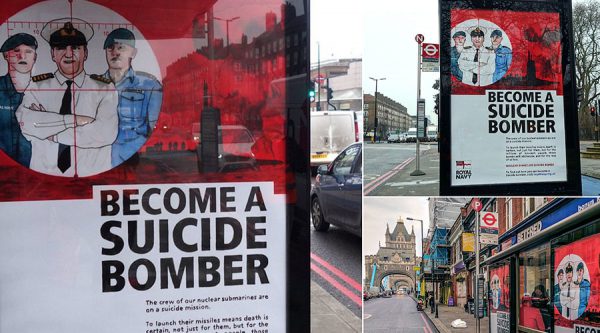
Spoof Royal Navy recruitment posters, which claim sailors on board Britain’s nuclear submarines are effectively suicide bombers, have won the approval of Trident safety and security whistleblower William McNeilly.
The posters point out that if a Trident submarine actually launched its nuclear missiles it would very likely be destroyed in a counterattack.
This, they claim, makes nuclear submariners little more than suicide bombers, whose job is to kill millions of civilians.
The satirical posters have appeared at bus stops across London.
The campaign is the brainchild of artist Darren Cullen, whose past works have included the ‘Action Man: Battlefield Casualties’ series and ‘Pocket Money Loans.’
His work has the endorsement of Veterans for Peace UK.
Picking up on the campaign on Friday, Rupert Murdoch-owned tabloid the Sun said the posters had sparked “fury.”
However, former Royal Navy weapons engineer William McNeilly, who was kicked out of the Navy after handing WikiLeaks a dossier of serious security and safety failures in 2015, told RT the campaign’s message is accurate.
“The Sun claims that the message in the posters is ‘fake,’” McNeilly told RT on Friday. “It is well known on board nuclear submarines that the Trident submarine on patrol will be the prime target in a nuclear war.”
The former submariner pointed out that once a submarine starts launching missiles it becomes immediately detectable. Those on board know “it is extremely unlikely that they would survive a major war against Russia. They are ready and prepared to be suicide bombers.”
Referring to the recent allegations of a government cover-up of a failed nuclear launch in 2016, McNeilly said: “Judging by the last missile test, it is not unlikely that the Trident submarines would nuke the United States by accident.”
Read more:
Trident whistleblower tells RT he ‘witnessed 4 unreported missile test failures’
The more Juif becomes Theresa, the more antisemitic becomes Britain.
By Gilad Atzmon | February 2, 2017
Today, the Jewish Chronicle (JC) reported that the number of antisemitic incidents in Britain in 2016 were the highest on record. The CST’s statistics show that there were 1,309 incidents of ‘Jew hatred’ last year — a 36 per cent increase on the previous 12 months.
Of course, the CST is not a reliable source and its‘antisemitism figures’ have been debunked numerous times before. However, if these statistics are accurate, they suggest only that the more the British government invests in fighting anti-Semitism…. the more antisemitic Britain becomes.
This is easy enough to explain. The fight against antisemitism is now a profitable industry. Every day, we learn of some new Jewish organisation dedicated to fighting antisemitism and to hunt down the Jew haters, and all at the expense of the British tax payer*.
And, as always in the case of Israel and Zionism, these organisations are financially sustained by the very Jewish hatred they seek to oppose. And, when there is no Jew hatred to be found, they will either induce, or even invent some.
For instance, we learned in the last few weeks that Stephen Silverman of the Campaign Against Antisemitism (CAA) launched a war against popular cult figure David Icke. The same Stephen Silverman who launched this war also launched a war against musician Alison Chabloz for expressing her thoughts on Holocaust religion by means of a cabaret performance.
These ugly campaigns against British truth-seekers are unlikely to make UK Jewry popular. Quite the opposite. Both these campaigns immediately backfired – Alison’s work went viral and the campaign against Icke proved only that Icke’s investigation into Rothschild Zionism is not only legitimate, it is actually essential. These campaigns clearly are not going to silence Icke or Chabloz but they will confirm that Jewish institutions here in Britain do not subscribe to the notion of freedom of thought and elementary human rights.
Dave Rich, Deputy Director of Communications at the CST told the JC : “I think there is an overall climate rather than one specific thing that is responsible for the rise in (antisemitic) incidents.”
Rich is wrong. There is one crucial factor in the rise in opposition to Jews and their politics: Jewish power has lost all its subtlety. It is now crude and vulgar and manifested right out in the open: whether it is the campaign against Jeremy Corbyn and his Labour party or the Israeli embassy crudely interfering with British party politics or the constant hunting of critics of Israel or even the impunity of suspected child molester Lord Janner – more and more Brits are now reading between the lines. They have had enough.
If the British government is really concerned about antisemitism, it could eliminate it in no time at all. It must immediately strip Jewish organisations of any special treatment and funds and must stop spending millions on the CST and all the other Jews-only paramilitary organisations operating in the kingdom.
We all agree that racism is a bad thing, so let’s fight it in a universal manner rather than following the whims of one particular tribe.
* Theresa May vowed recently to allocate more than 13.4 million pounds annually to Jewish security matters.
Theresa May to push EU members to up NATO spending
RT | February 3, 2017
UK Prime Minister Theresa May will use the upcoming EU summit in Malta to demand Europe strengthen its commitment to NATO and spend more on defence.
May is expected to conduct a series of one-on-one meetings with EU leaders, including Germany’s Angela Merkel and Spain’s Mariano Rajoy, in order to secure “new, positive and constructive” relationships with the Union.
The prime minister, however, is not expected to attend the part of the talks in which Brexit will be discussed. Instead, she is using the summit as an opportunity to press the EU’s NATO members to fulfil their defence expenditure requirements.
According to a 2016 NATO report, only five of its 28 members actually reached the required defence spending limit of two percent. The list of those failing to spend enough includes Germany, France, and Spain.
Britain’s push for Europe to open its wallet comes after a meeting between Theresa May and US President Donald Trump last Friday.
At a joint press conference, May agreed with Trump that NATO spending should be “fairly shared” among its members.
Trump has in the past criticised NATO as being “obsolete” and “costing too much money.”
The president has also suggested that the US may not come to the assistance of NATO members who do not satisfy the two percent requirement.
May, however insisted she had received a “100 percent” commitment to NATO from the Trump administration. She also promised to “encourage fellow European leaders” to comply with their obligations.
It remains unclear how Britain will convince EU leaders to increase defence spending, as relations with Brussels have been significantly affected by Brexit. One possible way might be to emphasise the threat to European security that is supposedly posed by Russia.
Earlier this week, UK Defence Secretary Michael Fallon urged other NATO states to fulfil defence spending targets in order to effectively counter alleged Russian attempts to destabilise the continent.
Fallon has accused Russia of “becoming a strategic competitor to the West” and mounting a sophisticated information and cyber campaign against various NATO members.
Moscow has categorically denied these allegations, describing them as “baseless” and a “witch hunt.”
Read more:
UK minister accuses Russia of MH17 downing & ‘testing’ NATO, Moscow says claims ‘baseless’
RT | February 3, 2017
When British Defense Secretary Michael Fallon was asked to deliver a speech on ‘Russian resurgence’, he seized the opportunity to accuse Moscow of “annexing” Crimea, shooting down MH17 over Ukraine, and “testing” NATO. Russia calls the claims baseless.
Fallon’s speech at St. Andrews University on Thursday began kindly enough, speaking about the UK’s “renewed interest in Russian scientific and artistic achievement.”
However, the talk quickly changed course, with Fallon changing the focus to Russia’s so-called “military resurgence.”
Referring to the reunification of Crimea and Russia following a referendum in 2014, Fallon claimed the situation actually amounted to Russia illegally annexing the territory.
“Russia did not allow Ukraine to decide its own destiny like any other sovereign country,” he said. “Instead, under the guise of ambiguous and deniable instruments it annexed Crimea.”
Fallon’s anti-Russia rhetoric didn’t stop there. He went on to cite an inquiry by the Dutch-led Joint-investigative Team (JIT) which claims the MH17 tragedy was caused by a “Russian-provided missile.” He said that despite the finding, Moscow continues to deny its role in the tragedy.
Fallon failed to mention, however, that there are numerous issues surrounding that report, including the fact that the Dutch apparently couldn’t read raw radar data provided by Russia, yet failed to ask Moscow for help to decode it.
The discrepancies surrounding the inquiry have led to Major General Aleksandr Tazekhulakhov, the former deputy head of the Russian Army Air Defense, to accuse the Netherlands of trying to keep Moscow out of the investigation, likely in “yet another attempt to put the blame on Russia for something…”
The next phase of Fallon’s speech transitioned from Ukraine to Syria, in which he accused Russia of targeting the Syrian opposition in Aleppo “with little regard for innocent lives,” claiming that 80 percent of its strikes targeted non-Islamic State (IS, formerly ISIS/ISIL) targets.
However, Fallon seemed to conveniently forget that the US-led coalition in Syria – which includes the UK – just last month admitted to “unintentionally” killing at least 188 civilians in Syria and Iraq since 2014.
And while Fallon accused Russia of targeting civilians in Aleppo, he failed to mention a hospital set up by Russia in the city, despite the facility being hailed by the World Health Organization (WHO) last month.
“The WHO, same as the Syrian people – we’re very grateful to the Russians, the EMERCOM [Agency for Support and Coordination of Russian Participation in International Humanitarian Operations] gave a hospital to be used in the Jibreen [refugee] camp. The hospital provided by the Russian people has provided several hundred consultations and has been given by the Russian people to the Syrian people for the use by the central health authorities in Aleppo,” the WHO’s Elizabeth Hoff told RT.
Any typical bashing of Russia by the UK wouldn’t be complete without claims that Moscow is trying to “test” NATO, and Fallon didn’t disappoint.
“Russia is clearly testing NATO and the West,” Fallon said, accusing Moscow of “seeking to expand its sphere of influence, destabilize countries, and weaken the alliance.”
“It is undermining national security for many allies and the international rules-based system,” he continued.
Fallon was apparently in no mood to present a balanced argument during his speech, failing to mention NATO’s build-up of troops near Russia’s borders, or Moscow’s concern that NATO is compromising its national security.
The speech also included a healthy dose of the usual Western rhetoric, including allegations that Russia influenced the US presidential election by hacking into Democratic National Committee (DNC).
There was a touch of irony towards the end of Fallon’s speech, in which he said “we need to understand Russia better,” but then went on to accuse it of “reckless military activity” and “misinformation.”
“Russia could again become the partner the West always wished for…” he concluded.
However, based on Fallon’s speech, it seems Russia will only be a ‘partner’ to the UK and the West if it panders to their every wish.
Moscow responded to Fallon’s speech on Friday, calling his statements “baseless.”
“We express regret for this hostile stance of the minister. We are sure that such allegations are baseless,” Kremlin spokesman Dmitry Peskov told reporters, as quoted by Reuters.
Read more:
Crimea & Minsk Agreements: What the British media fails to mention
Crimea & Minsk Agreements: What the British media fails to mention
Ambassador’s view | RT | February 2, 2017
The escalation in eastern Ukraine is again presented in the British media as Russia’s attempt to wage a proxy hybrid war against Kiev’s pro-Western leadership.
For fear of an eventual improvement in Russia-US relations, they pray for the sanctions against Russia to stay unless the Minsk Agreements are implemented as well as a punishment for ‘Russia’s annexation of Crimea.’
Let me set the record straight on that.
The coup d’état in Kiev in February 2014 backed by the West tore up the constitutional space in Ukraine. The legitimate president of the country was overthrown. It was marked by a severe lack of democracy and violence that posed a direct threat to the well-being of the Russian-speaking population of Crimea. Citizens of Crimea, which was an autonomy at the time, faced the choice of becoming an oppressed minority or severing their ties with the hostile regime to secure a future for themselves and their children. Legitimate local authorities made the decision to hold a referendum.
The independence of Crimea was proclaimed and an appeal to enter the Russian Federation was made based on the indisputable results of the popular vote. Standards of international law were fully observed as the right of nations to self-determination enshrined in the UN Charter was exercised freely by the Crimeans.
Crimea was recognized as an independent and sovereign state by Russia, and on March 18, 2014 in Moscow the two countries signed a Treaty of Unification, under which the Republic of Crimea and the city of Sevastopol became two new regions – subjects of the Russian Federation.
Let us take a look at the outcome. While entire regions of Ukraine are engulfed in a brutal war, and the population is being fed with shameless nationalist propaganda, the Russian Crimea is enjoying peace, stability and steady growth. What could be a better proof that the decisions made two years ago were the only right ones? We are convinced that many Ukrainians would prefer to live like the residents of Crimea live now – under conditions of stable economic development and social security. That is despite the attempts of the Ukrainian government to disrupt the life of the people there by cutting the peninsula off from essential supplies, trying to organize water, energy and food blockades. Does it mean people for sovereignty, rather than sovereignty for the people?
Unfortunately, there has been little progress in implementing the Minsk Agreements mainly due to Kiev’s unwillingness to fulfill its obligations under them to promote national accord and reconciliation. The recent escalation is clearly an attempt to divert public attention from the poor reform record and request for additional funds from their Western sponsors.
For the political solution to be achieved in Ukraine, the Minsk Agreements should be fully implemented, including the withdrawal of heavy weapons from the contact line. However, the Ukrainian armed forces haven’t stopped shelling Donetsk and Lugansk, including the use of weapons that are supposed to have been withdrawn. This leads to civilian casualties and the destruction of property. The OSCE Special Monitoring Mission to Ukraine has reported many times the concentration of Ukrainian forces along the contact line.
According to the Minsk Agreements, signed two years ago, on the first day of the withdrawal of artillery Kiev had to engage in dialog, and start consulting with Donetsk and Lugansk representatives on the conditions for elections to be held on the basis of Ukrainian law and under OSCE oversight.
A month after the signing of the Minsk Agreements Kiev was required to enact a special status law adopting a resolution designating the territory that this law was supposed to cover. This hasn’t been done. A law was passed, the territories marked, but the law said that it didn’t apply to Donetsk and Lugansk!
The Minsk Agreements clearly say elections should be held in accordance with the OSCE criteria, one of which is to ensure that no one will be subjected to intimidation, harassment, etc. The statement by the Kiev authorities on “elections first, then amnesty” constitute a serious distortion of the sequence and logic of what was agreed. In accordance with the OSCE elections criteria, the amnesty should be granted before the elections.
It is crucial to understand at long last that the only way to settle the Ukrainian crisis is by implementing the Minsk Agreements, which represent a recipe for a political solution well in line with European values. What is required of Kiev is to treat its citizens as partners and abandon the Orwellian “anti-terrorists operation.” One cannot deal with its own citizens with a gun to their head.
And this intransigence should cease for the sake of comprehensive reforms in Ukraine, the lack of which is the key source of the present crisis. The declarations by British officials that sanctions against Russia can only be lifted after we fulfill our obligations according to Minsk treaty is a crude substitution of concept and a prolongation of anti-Russian politics of London.
Russia, together with France and Germany, is a guarantor of the Minsk accords, not part of it. The obligations written there are for Kiev and Donbass, in their quality as sides of the treaty and participants of the conflict, to fulfill.
Dr Alexander Yakovenko, Russian Ambassador to the United Kingdom of Great Britain and Northern Ireland, Deputy foreign minister (2005-2011). Follow him on Twitter @Amb_Yakovenko
UK, allies hold military drills in Persian Gulf amid Iran warning
Press TV – February 1, 2017
Britain, the US, France and Australia are holding maritime military exercises in the Persian Gulf as Iran warns that it will not allow any intrusion into its territorial waters.
The three-day war games, dubbed the Unified Trident, started on Tuesday.
They involve British Royal Navy flagship HMS Ocean and Type-45 destroyer HMS Daring, US warships USS Hopper and USS Mahan as well as French anti-aircraft frigate FS Forbin.
Additionally, targeting Iranian combat jets, ships and coastal missile launching facilities will be simulated during the exercises, reports say.
“The exercise is intended to enhance mutual capabilities, improve tactical proficiency and strengthen partnerships” among the allies, a US Navy press release said.
Asked about the drills, Iran’s Navy Commander Rear Admiral Habibollah Sayyari (seen below) told the Mehr news agency on Tuesday that the Islamic Republic would not allow anybody to encroach on its territorial waters, which he described as the country’s “red line.”
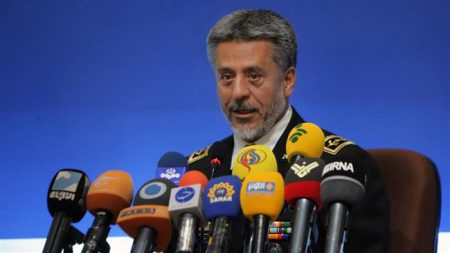
Touching on the simulation of hitting Iranian targets, Sayyari said that Iran “does not care about who’s doing what,” adding, “For us, it is important to boost our defense capabilities to such a level that we can withstand any threats [posed against us from] anywhere,” he added.
The Iranian commander also noted that any exercises in high seas should comply with international law.
The Unified Trident drills come after a string of incidents, in which US vessels that sailed close to Iranian territorial waters were met with Iran’s befitting response.
Iran has repeatedly warned that any act of transgression into Iran’s territorial waters would be met with an immediate and befitting response.
In January last year, Iran’s Navy arrested the crews of two US patrol boats that had trespassed on Iranian territorial waters. Iran released them after establishing that they had done so by mistake.
Iran has invariably asserted that it only uses its naval might for defensive purposes and to send across the Islamic Republic’s message of peace and security to other nations.
#Match the fine for Palestine: Celtic fans crowdfund £176K to pay UEFA fine
RT | January 31, 2017
Supporters of Celtic FC, known as the Green Brigade, have donated £176,000 (US$220,000) to two Palestinian charities. The donation was crowdfunded in reaction to a UEFA fine over Celtic fans flying Palestinian flags at a match.
“Taking Down” British Officials
Israel conspires against the Mother of Parliaments

By Philip Giraldi • Unz Review • January 31, 2017
A quite incredible story out of England has not received much media coverage in the United States. It concerns how the Israeli Embassy in London connived with government officials to “take down” parliamentarians and government ministers who were considered to be critical of the Jewish State. It was also learned that the Israeli Embassy was secretly subsidizing and advising private groups promoting Israeli interests, including associations of Members of Parliament (MPs). The story is interesting on several levels, particularly given the recent furor in the U.S. over allegations that Russia has been interfering in American politics.
By way of comparison, though no evidence has been provided to support the claim, Russia allegedly arranged for a hack into the Democratic National Committee server to obtain factual information potentially embarrassing to the Hillary Clinton campaign. The information was then made public and may have influenced how some Americans voted.
Compare that to what has been going on meanwhile in Britain, where an Israeli Embassy diplomat named Shai Masot, “an officer in the Israel Defense Forces and… serving as a senior political officer at the London Embassy,” was meeting with Maria Strizzolo, a senior British civil servant who was formerly chief of staff to Conservative parliamentarian and ardent Zionist Robert Halfon. Masot is certainly an intelligence officer under diplomatic cover. Masot and Strizzolo’s candid discussion, which was secretly recorded by al-Jazeera, related specifically to getting rid of Foreign Office Minister Sir Alan Duncan, regarded as a supporter of an independent Palestinian state.
To Masot’s additional query “Can I give you some MPs that I would suggest you would take down?” Strizzolo suggested “… if you look hard enough, I’m sure there is something that they’re trying to hide… a little scandal maybe.” Another alleged pro-Arab member of Parliament Crispin Blunt was also identified, with Strizzolo confirming that he was on a “hit list.”
It was also learned that Masot had been secretly subsidizing and advising two ostensibly independent groups, the parliamentary Conservative Friends of Israel (CFI) and the Labour Friends of Israel (LFI). Masot did, however, express concern that Israel’s control over incoming parliamentarians was not quite what it used to be: “For years, every MP that joined the parliament joined the LFI. They’re not doing that any more in the Labour Party. CFI, they’re doing it automatically. All the 14 new MPs who got elected in the last elections did it automatically.”
Shai Masot also was working with friendly young British Jews, providing them with jobs at his embassy and then seeding them into positions in advocacy organizations where they continued to be paid secretly by him while promoting positions that would protect Israel from any criticism. One such group is Britain’s National Union of Students (NUS). Recently there has been somewhat of a furor over Shakira Martin, a vice president in the group, who accepted an all-expenses paid trip to Israel organized by the Union of Jewish Students, a pro-Israel organization which is among those receiving funding and guidance from the Israeli embassy in London. The al-Jazeera tape has also revealed that Richard Brooks, another NUS vice president, had been plotting with pro-Israel activists to remove elected NUS president Malia Bouattia, a supporter of Palestinian rights and the Boycott, Divestment and Sanctions movement.
It does not require much in the way of imagination to realize that the Masot meetings probably occur every day right out in the open in Washington, including Israeli officials and Congressmen as well as heads of political advocacy organizations and lobbies. The list of prominent politicians “taken down” by Israel is lengthy, and includes Cynthia McKinney, Adlai Stevenson III, Paul Findley, Chuck Percy, William Fulbright, Roger Jepsen, and Pete McCloskey. And a similar situation prevails in the U.S. regarding human rights and politically liberal organizations that are ostensibly privately funded. As Jeff Blankfort has noted, they are frequently headed by American Jews who prove quite willing to criticize the United States but are generally reluctant to say anything bad about Israel. Whether they are actually directly or indirectly on the Israeli government payroll would be an interesting project for a good investigative journalist.
One might reasonably consider Israel’s interference in the democratic process in friendly countries like the U.K. and U.S. as much farther reaching and damaging than anything Moscow has done. Yet Russia is being excoriated by the U.S. and European media daily, investigated by Congress and sanctioned because of what are little more than unproven allegations. Israel has clearly done some things to interfere with local politics that are arguably much worse and the silence is deafening. So one should not be surprised by the toothless British reaction to the suggestion that its government officials might be removed by the clandestine activity of a foreign country: “The Israeli ambassador has apologized… the UK has a strong relationship with Israel and we consider the matter closed.”
Britain under its new Prime Minister Theresa May has also been rolling over in response to Israel’s perceived interests almost as obsequiously as the U.S. Congress. After Secretary of State John Kerry described Israel’s government as “extreme right wing” on December 28th, May sprang to Tel Aviv’s defense, saying “we do not believe that it is appropriate to attack the composition of the democratically elected government of an ally. We are also clear that the settlements are far from the only problem in this conflict. In particular, the people of Israel deserve to live free from the threat of terrorism, with which they have had to cope for too long.”
May’s rejoinder could have been written by Netanyahu, and maybe it was. Two weeks later, her government cited “reservations” over a French government sponsored mid-January Middle East peace conference and would not sign a joint statement calling for a negotiated two-state solution to the Israeli-Palestinian conflict after Netanyahu vociferously condemned the proceedings.
It all recalls Pat Buchanan’s description of the U.S. Congress as an Israeli occupied zone, which raised holy hell at the time even though Buchanan did not go far enough judging by what has been happening in Britain. Indeed, lobbying on behalf of Israel is a global phenomenon with organizations like the American Israel Public Affairs Committee (AIPAC) existing in various forms in a number of other countries. BICOM, the Britain Israel Communications and Research Centre, is an AIPAC clone located in London. It is well funded and politically powerful, working through its various “Friends of Israel” proxies. Americans might be surprised to learn that in Britain Jewish organizations uniquely are allowed to patrol heavily Jewish London neighborhoods in police-like uniforms while driving police type vehicles and there have been reports of their threatening Muslims who enter the areas.
Indeed, wherever one goes – Western Europe, Canada, Australia, New Zealand and the United States – there is a well-organized and funded mechanism in place ready, willing and able to go to war to protect Israel. Most of the organizations involved take at least some direction from officials in Tel Aviv. Many of them even cooperate fully with the Israeli government, its parastatal organizations and faux-NGOs like the lawfare center Shurat HaDin. Their goal is to spread propaganda and influence the public in their respective countries of residence to either hew to the line coming out of Tel Aviv or to confuse the narrative and stifle debate when potential Israeli crimes are being discussed.
Israel’s diaspora allies are backed up by a formidable government organized machine that spews out disinformation and muddies the waters whenever critics surface. The Israeli Foreign Ministry has a corps of paid “volunteers” who monitor websites worldwide and take remedial action and there is a similar group working out of the Prime Minister’s office. That is why any negative story appearing in the U.S. or Britain about Israel is immediately inundated with pro-Israel comments, many of which make exactly the same coordinated points while exhibiting the same somewhat less than perfect English. On sites like Yahoo they are actually able to suppress unwelcome comments by flooding the site with “Dislike” responses. If a comment receives a large number of dislikes, it is automatically blocked or removed.
The sayanim, local Jews in their countries of residence, are essential to this process, having been alerted by emails from the Israeli Foreign Ministry about what to do and say. The reality is that Israel has lost the war of public opinion based on its own actions, which are becoming more and more repressive and even inhumane and so are difficult to explain. That means that the narrative has to be shifted by Israel’s friends through subterfuge and the corruption of the information and political processes in each country. In some places the key media and political players who are engaged in the process can simply be bought. In other places like England they can be intimidated or pressured into taking positions that are neither in their own countries’ interests nor morally acceptable. In large countries like the United States, Britain and France a combination of friendly suasion and coercive elements often come together.
In some extreme cases the game Israel plays is brutal. Israeli Prime Minister Benjamin Netanyahu recently warned New Zealand that backing a U.N. resolution condemning Israeli settlements would be a “declaration of war.” In all cases, the objective is the same: to repress completely, discourage or misrepresent any criticism of Israel and to block any initiatives that might be taken that would do damage either to the Israeli economy or to the country’s perceived standing in the world. In some countries including the U.S. and Britain, Israel’s advocates work their subversion of local institutions right out in the open and are highly successful in implementing policies that often remain largely hidden but that can be discerned as long as one knows what to look for.
Trident nuclear missiles have history of failure, US documents show
RT | January 30, 2017
Newly-released US documents show Trident nuclear missiles have a track record of failure. The revelations come weeks after it emerged a British test-fired missile malfunctioned in June 2016 and veered off course towards the US coast.
Documents seen by the Sunday Times reportedly show the Trident system has long been affected by navigational issues, leading to £1.4 billion (US$1.76 billion) being spent on repairs and modifications.
The paper published a section of the report which said: “The Trident II missile is completing its 26th year of deployment and has reached its original design life goal.
“Like any other ageing weapon system, increased maintenance and repair will be required to sustain a safe, reliable and accurate strategic weapons system.”
The UK leases its Trident D5 missiles from the US and they are drawn from the same pool of nukes used by the US Navy.
Despite UK ministers reaffirming their commitment to Trident following reports that missiles veered off course during a June 2016 test, the US document seem to show a long series of malfunctions.
The ageing missile system reportedly suffers consistent problems with its internal gyro guidance system due to the effects of age on the chemicals inside.
After the British government was accused of covering up of the June 2016 incident aboard a British submarine, RT spoke to former sailor and Trident safety whistleblower William McNeilly. He was drummed out of the Royal Navy in 2015 for publishing a dossier on nuclear safety and security failures.
“I warned about this exact event over a year before it happened. I was in the MCC / Missile Control Center during the end of patrol tests in early 2015 and I witnessed with my own eyes the Trident system fail its simulated missile launch tests,” McNeilly said.
The former submariner claims to have seen Trident “fail three out of three WP 186 Missile Compensating Tests” first-hand. He also says a “Battle Readiness Test (BRT) was not even attempted due to seawater in the hydraulic system.”
Following the latest revelations, the Campaign for Nuclear Disarmament (CND) called on the government to come clean on Trident failures.
The group said it isn’t enough for ministers to say they have confidence in the system, given “a catalogue of very serious failures that the government needs to address.”
“Last week we learnt that the government had covered up a misfired Trident missile, and today we found out about consistent reliability issues with the Trident II D5 missiles, as well as another misfired missile in 2011,” CND general secretary Kate Hudson said.
“In the Commons debate on Trident replacement in July 2016, MPs were told by the government they were voting on reliable and safe technology, but it [is] now clear that isn’t true. Trident is unreliable and the head-in-the-sand approach of the government could prove catastrophic if it continues. We are calling for a Trident Inquiry. The public have a right to know the details of these cover-ups and failures.”
Japanese embassy pays British think tank to plant anti-China stories
RT | January 30, 2017
The neoconservative Henry Jackson Society (HJS) think tank is on the payroll of the Japanese embassy, charged with drafting in public figures to spread anti-Chinese propaganda, investigators claim.
The Times’ investigation suggests the London-based HJS is paid £10,000 (US$12,500) per month to spread anti-Chinese propaganda, including through public figures like former British Foreign Secretary Malcolm Rifkind.
HJS frames itself as a pro-intervention and pro-capitalist voice, which aims to spread freedom and democracy around the world. It is run by the academic and failed Tory parliamentary candidate Alan Mendoza.
The deal between the think tank and the embassy was reportedly reached to counter the growing cooperation between the UK and China, championed by former Chancellor George Osborne.
The agreement reflects the rising tensions between China and Japan – the latter a close US ally in the Asia-Pacific region.
Rifkind confirmed to the Times over the weekend that he had been asked by HJS in August to put his name to an article called ‘How China could switch off Britain’s lights in a crisis if we let them build Hinkley C’, which criticized a UK-Chinese nuclear power station deal.
The comment piece claimed there may be a risk of a Chinese-funded power station having cyber-backdoors built into it which could present a risk to UK security.
Rifkin told the Times he had not been aware of the links between HJS and the Japanese embassy and said the think tank “ought to have informed me of that relationship when they asked me to support the article they provided. It would have been preferable if they had.”
The report indicates that HJS originally approached the Japanese embassy alongside a PR firm named Media Intelligence Partners (MIP), which is run by a former Tory PR man named Nick Wood.
The Times says it saw an early version of a proposal which would see the think-tank and PR firm develop a communications strategy for the embassy for a fee of £15,000 per month.
This, they said, would allow Japan’s concerns to be placed “on the radar of mainstream UK journalists and politicians.” It includes journalists from major papers like the Telegraph and the Guardian.
Other aims included the creation of “an engaged and interested cadre of high-level politicians” and a focus on the “threat to Western strategic interests posed by Chinese expansionism.”
The actual deal reached was for a lower figure of £10,000 plus expenses, according to the Times.
British activists attempt to disarm fighter jets bound for Saudi Arabia
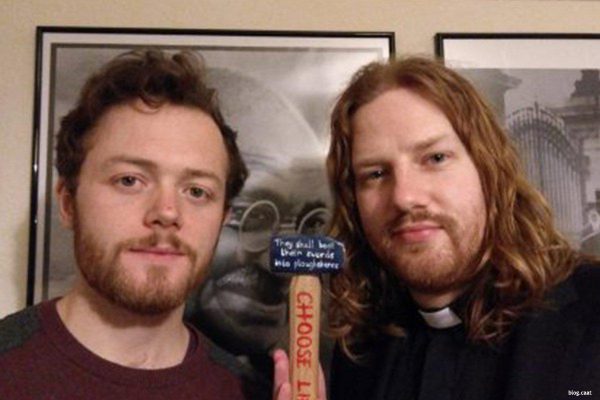
Daniel Woodhouse and Sam Walton (blog.caat )
MEMO | January 30, 2017
Two British activists have been arrested while apparently trying to disarm warplanes bound for Saudi Arabia. Daniel Woodhouse, a Methodist minister from Leeds, and Quaker Sam Walton were released on bail pending charges after breaking into BAE’s Warton site in Lancashire.
The pair were arrested in the early hours of Sunday morning while attempting to disarm fighter jets due to be delivered to the Royal Saudi Air Force for use, it is assumed, in coalition bombing raids on Yemen. The aircraft are part of a multi-billion pound deal between BAE Systems and the Saudi regime, and were due to be shipped to Saudi Arabia within weeks.
“BAE security found us just metres from war planes bound for Saudi Arabia,” the two said on their release. “We’re gutted that we couldn’t disarm a plane and stop it being used to carry out airstrikes in Yemen. We could have saved lives by preventing Saudi war crimes in Yemen.”
They added their belief that the British government has blood on its hands and that there is a need to do everything possible to stop the transfer of weapons and show that such sales are illegitimate. “By providing weapons and support,” insisted the campaigners, “Britain is deeply complicit in Saudi war-crimes, and it’s vital that we bring an end to this immoral, abhorrent trade.”
Speaking to MEMO, Mr Woodhouse mentioned that he and his colleague have been campaigning against British arms sale to human rights violators like Saudi Arabia, Israel and Bahrain for “donkey’s years”. He and Walton were just “metres” away from the aircraft, he said, which they were hoping to “render physically incapable.” When prompted to explain how they had planned to do that, Woodhouse referred to a famous case in 1996 when ten women entered the same site to disable a plane bound for Indonesia to be used in the genocide in East Timor, armed with only a hammer. The two men took this “symbolic act,” he said, “to mirror the rightness of the actions of the three women, which a jury 21 years ago found to be lawful.”
In their statement, the activists stressed that their actions had been planned over many months, adding: “We do not take these steps lightly, but we have no other option. We have been active in opposing the arms trade to Saudi Arabia for years, and in the face of wilful government denial that there is a problem with arming Saudi, including willingness to suspend our own due process of law, and complete unwillingness to consider stopping arming Saudi Arabia, we must take this action.”
Britain has approved over £3.3 billion worth of arms to Saudi forces since the bombing of Yemen began in March 2015, and continues to approve arms licences despite repeated allegations of war crimes being committed.
Featured Video
New positive ivermectin evidence
or go to
Aletho News Archives – Video-Images
From the Archives
Fanatical Followers of the Covid Regime: A Jim Jones-Style Cult?
By Professor Roger Watson and Dr. Niall McCrae | The Daily Sceptic | November 15, 2021
As scholars at leading British universities over recent decades, we witnessed the replacement of critical thinking and debate by narrative: facts are discrimination and scientific method is imperialism; truth, instead, is derived from ‘progressive’ values. This educational trend may be a major contributory factor to the ease in which society has been inculcated to the Covid ‘new normal’ of masking, testing, and repeated doses of vaccines for a disease of similar risk to severe influenza.
One doesn’t need much critical reasoning to observe the flawed logic of some vaccination enthusiasts, such as people who respond to experiencing any side effects, however debilitating, by saying “at least I know it’s working”, or, after contracting the disease despite their promised inoculation (over 90% effective, according to initial drug company claims), “I’d have been worse off without the jab.” … continue
Blog Roll
 Aletho News
- ‘Grave, alarming’: Iran mission on Trump’s UNGA ‘annihilation’ threats
- Najaf airport to reopen to Iranian flights within 24 hours: Ambassador
- From ‘How Will This End For Iran’ to ‘When America Walks Away’: A tale of two Economist covers
- Tehran blasts ‘baseless’ speculation linking Iran to alleged bomb plot at UK air base
- The Rise And… Rise Of ‘Color Revolutions’
- The Coming GOP Bloodbath?
- Arctic Scare Stories Melt Away
- Wrong, Euronews: Climate Change Has Not Created a Food, Energy, and Economic “Meta-Crisis”
- New positive ivermectin evidence
- Met Office Caught Fabricating Daily Temperature Record Claims
- If Americans Knew
- An error has occurred; the feed is probably down. Try again later.
- No Tricks Zone
- New Study: Earth And Venus Surface Warmth Largely Explained By Convection And Lapse Rate, Not CO2 Or Radiation
- 2025 Nature Paper Claiming Worsening Global Drought Gets RETRACTED …Heavily Flawed
- New Study: ‘Global Drought Shows No Detectable Recent Acceleration Under Climate Warming’
- Economic Masterminds: German Socialists Suggest Taxing Productivity Gains Stemming From Using AI
- The South China Sea Has Not Been Cooperating With The Climate Change Narrative
- Energy Crisis: Germany Enters Heating Season With Historically Low Gas Reserve Fill Levels
- New Study: The Antarctic Ice Sheet Gained Mass From 2020-2024 Due To Staggering Snow And Ice Accumulation
- Study: Ocean Heating Rates From Thousands Of Years Ago ‘Dwarf’ Modern Ocean Heating Rates
- Climate Extremists Target, Attack Large-Scale Power Grid Infrastructure In Germany!
- New Study: Antarctic Ice Melt Has Contributed Less Than 1 Centimeter To Sea Level Rise In The Last 30 Years

