Berlin – Another False Flag? Government Complicity? Part of New World Order Agenda?
By Peter Koenig | Global Research | December 27, 2016
12 dead, about 40 injured, is the result of the latest terror attack in Berlin, when on 19 December, a truck plouged into a Christmas market at Berlin’s Bretscheideplatz, near the lush Kurfuerstendamm.
Is it not a ‘déjà-vu’ of not even half a year ago, when in Nice, France, on 14th July a truck mowed down hordes of people celebrating Bastille Day?
 In Berlin, the first ‘culprit’ was a Pakistani who apparently ‘escaped’. When later he turned up and explained with proof his innocence, they had to let him go. In the cabin of the truck they also found a dead man of Polish origin. He couldn’t be accused, since he was dead.
Then the chase was stalled, until miraculously, about a day later, they found in the truck identity papers of a Mr. Anis Amri (24) of Tunisian citizenship beneath the driver’s seat. As is usual with these terrorists, they like to leave their ID cards behind. It seems to be part of their strategy to be caught and killed.
Then, once more there was a ‘suspect’, who could be chased, throughout Europe.
At three in the morning of December 23, again miraculously, Anis Amri turned up on a plaza in Milan, got allegedly into a confrontation with two policemen, who claimed he pulled a gun, when one of them shot and killed him. No witness, no proof.
Two Italian policemen killed a young man, whom – they say – they didn’t even have a clue who he might be. They became heroes, literally overnight. Italy’s new PM, Paolo Gentiloni, thanked and congratulated them; and so did Mme. Merkel and her Interior Minister, Thomas de Maizière.
The same pattern all over again.
DEAD MAN CAN’T TALK. It’s Paris (Charlie Hebdo and Bataclan); Nice; Brussels; Munich; Orlando, Florida; San Bernardino, California …… all over again- and again – and again.
The ‘plowing-through-a-celebrating-crowd’ is in many regards “a carbon copy” of the 14th July massacre in Nice (see image below). At the end, the designated ‘Muslim’ terrorist was killed. No witness. No testimony.
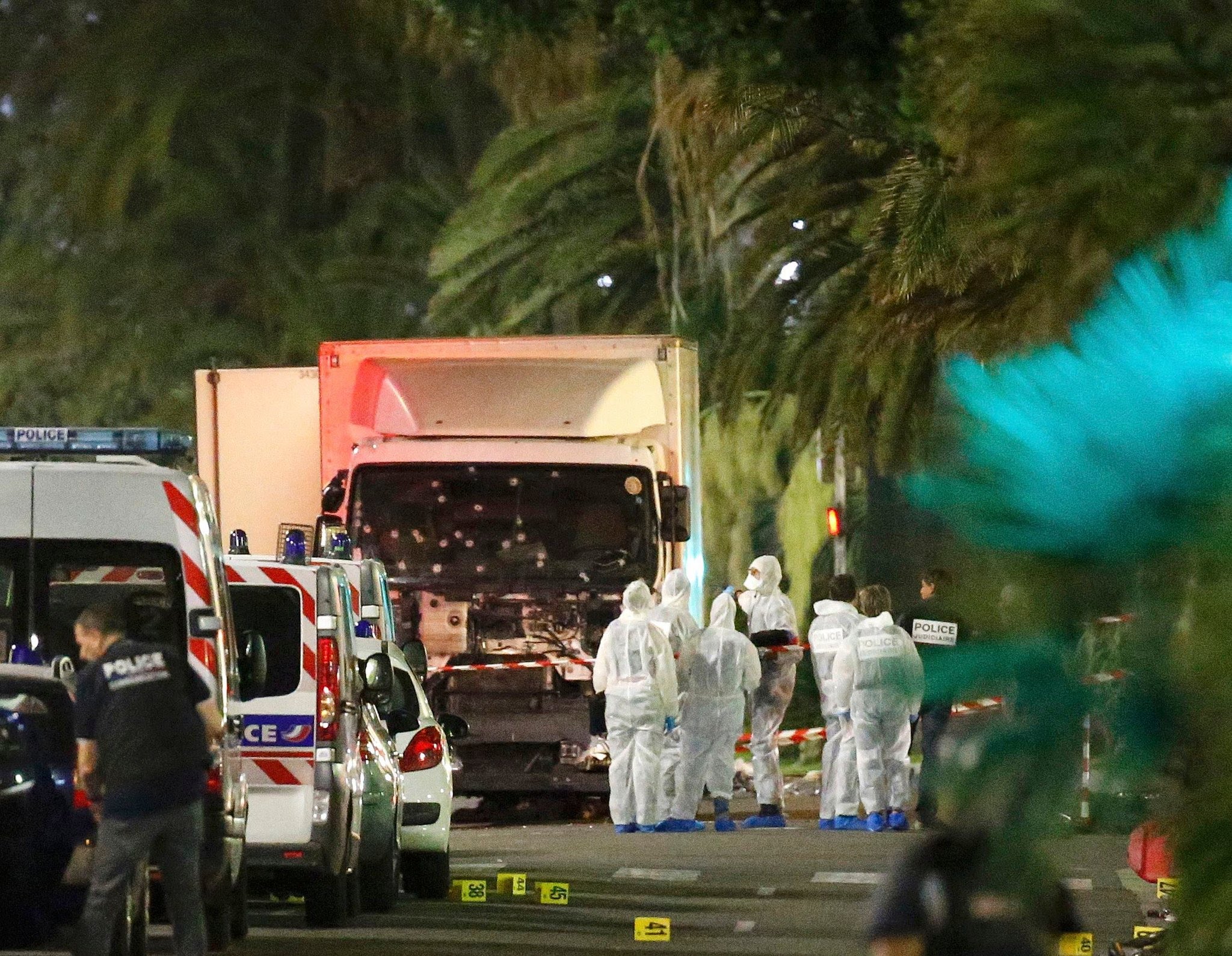 Questions to be fully investigated: Were the secret services, the core of which are the CIA, Mossad and MI6, with the collaboration of Germany’s BND involved. Was it a false flag?
Don’t believe one minute that your respective governments didn’t and don’t know what’s going on.
Who are the real perpetrators?
The real perpetrators are not Muslims. They are your own spineless puppet governments, all of which (covertly) support the ISIS and al Qaeda. They obey orders to demonize the Muslim faith and society.
That’s what the west knows best – denigrating and discriminating, accusing the innocent, to serve their purpose, sanctions for those who do not submit.
In reality, no change for the last 800-some years, colonizing, exploiting, murdering the people of Asia, Africa and Latin America.
Today’s ‘leaders’ are the descendants of the colonial era killers of times past. They form the core of our “western killer civilization”.
These western ‘leaders’ are mere puppets, because they have been put in ‘power’ by the the elusive elite, also called the “Deep State” – the Deep State gone global.
Democracy is dead. It’s become a useless defunct slogan. No so-called election over the past decade or so, in the western world has been democratic. They were all scams and manipulations of peoples’ minds and wills.
And if they didn’t conform to what the Washington masters and their supreme masters needed, Plan B of ‘regime change’ kicked in.
They have become experts of semi-clandestine ‘regime change’ through parliamentary coups – i.e. Paraguay, Ukraine, Brazil, Greece, Portugal, Spain and many others.
If these eventually ‘elected’ western leaders (sic-sic), from Obama, to Merkel, Hollande, May, Gentiloni – and the entire EU / OECD clan, don’t behave, they are ‘cooked’, the target of political destabilizaion. That’s the extent of impunity which drives this hegemonic and criminal process towards the New World Order, or the One World Order, led by the global finance and war industry.
The finance clan, the lords of money, the Rothschilds, Rockefellers, Morgans, et al, the FED, BIS (Bank for International Settlements, the secretive central bank of all central banks) and Goldman Sachs, have to act fast; otherwise they might lose the key instrument of their power – the sham dollar pyramid economy – may fall apart, before they have actually reached their goal – a world under constant chaos, never-ending conflicts and wars.
A world under which a small elite, enslaves the 99.99% of ‘Us, the People’ — under ever worsening life conditions, unemployment, misery, disease, privatized social services, all contributing to a steady decline in life expectancy.
Among their instruments is permanent chaos. Economic dislocation and social crises.
Open borders forced by trade lobbies and WTO (World Trade Organization) will wipe out small farmers and manufacturers in developing countries, thus eventually handing monopolies to large, mostly US corporations, to the detriment of already impoverished nations, whose vulnerability will be further abused to extract their natural resources for a pittance, so they may repay their IMF / World Bank imposed and leveraged debt.
Floods of refugees from war zones to industrialized wealthy countries, currently happening from the war-torn Middle East to Europe, will disrupt the labor market, push down wages, create massive unemployment. These are all tools towards enslavement of populations. People who have to fend and fight for daily food and often for sheer survival, have no energy or time to take to the streets and protest. That’s the plan; already being enacted. Just look at Greece.
What does all that have to do with the Berlin massacre? – Everything. Berlin, like Paris, Brussels, Munich, Orlando… is just a cog in the wheel of the monster’s drive towards full world hegemony.
Unexpected, haphazard carnage and terror acts are spreading misery, poverty and fear.
People who are afraid will call for more police and military protection.
They will voluntarily give up their human and civil rights for what they hope will be more ‘protection’, being totally oblivious to the fact that the very governments from whom they are seeking more protection are those that commit these acts of treason and terror, those who are behind the killings. The Anglo-american controlled presstitute mainstream media is in permanent brainwashing mode. Unless you search the news and information for yourself on alternative media, they will never tell you the truth, but their lies, after lies, after more of the same lies will fabricate the public truth.
Peoples’ fear and absence of civil rights are easy steps towards increased militarization of the west, already happening – look at France – President (sic) Hollande was just able to extend the State of Emergency through July 2017. [The Paris November 2015 terror attacks played a key role in justifying the State of Emergency.]
The goal is to include it into the French Constitution, basically putting the French people under permanent actual or threat of Martial Law. Others might follow – Germany, Italy – all those whose constituents are ever warier of the EU and their ‘monopoly money’, the euro, and who may seek EUREXIT. This would break the camel’s back, so to speak, or at least put a wrench in the boundless onslaught of the hegemon.
Peoples’ fear may also re-strengthen the faltering justification of NATO. The fall of NATO must be halted. NATO is the Deep State’s warrior flagship, the military fear- and war monger vis-à-vis Russia and eventually China – the last vestiges to be conquered by the self-styled almighty empire, the invisible elite that pretends to rule the globe. Fortunately, they cannot stand up to the Russia-China chess duo which is gradually outsmarting the west’s ostentatious killer exploits.
Imagine, your own spineless governments, following orders of the globalized Deep State – in Berlin, Munich, Nice, Paris, Brussels, Orlando, and an almost endless list of false flags.
How can we respect our so-called leaders? They have zero esteem for us, who are their bread-earners. They kill us, no hesitation, if it pleases them and serves their purpose – and their greed.
In the case of Berlin, is the German government complicit? Blaming Muslims, finding a pre-identified victim, Mr. Anis Amri, who most likely had no clue that he was framed.
In Italy, the police catch him (or somebody who has been given the pre-identified Tunisian victim’s name), they kill him – and, bingo – case closed. Another fear-inflicting false flag was born and concluded, advancing the bulldozer of empire’s destruction a notch closer to Full Spectrum Dominance.
The MSM will do the rest – until the next fake exploit. Be prepared. But this can happen only if we let our governments get away with it, if we close our eyes to reality; if we keep believing the presstitute media.
People wake up! – Boycott the MSM. Take the time to seek the truth elsewhere, for example, on RT, TeleSur, Global Research, ICH, New Eastern Outlook (NEO), CounterPunch, The Saker, Voltairenet — and many more. The Deep State cannot win without your participation.
Peter Koenig is an economist and geopolitical analyst. He is also a former World Bank staff and worked extensively around the world in the fields of environment and water resources. He writes regularly for Global Research, ICH, RT, Sputnik, PressTV, The 4th Media, TeleSUR, TruePublica, The Vineyard of The Saker Blog, and other internet sites. He is the author of Implosion – An Economic Thriller about War, Environmental Destruction and Corporate Greed – fiction based on facts and on 30 years of World Bank experience around the globe. He is also a co-author of The World Order and Revolution! – Essays from the Resistance.
Copyright © Peter Koenig, Global Research, 2016
British Lies Are a Secret No More
By Jean Perier – New Eastern Outlook – 02.01.2017
The sitting British officials remain ignorant of the fact what kind of disservice the Obama administration has made them by demanding London to repeat the twisted lies the former has been spreading. Both David Cameron and Theresa May have always been obedient disciples of the White House, therefore they chose to spread tedious lies and disinformation in a bid to justify the failure of their social and economic policies, while hiding from the public the fact that Britain is responsible for a number of armed conflicts in the Middle East and Africa.
As a result, a considerable number of media sources and non-governmental organizations have been tasked with creating the image of a dangerous enemy looming somewhere on the borders, to cover corruption and looting of the UK treasury, that are now being labeled as “necessary measures taken for the protection from external threats.”
The British Independent would become pretty apologetic by claiming:
The foreign media has allowed – through naivety or self-interest – people who could only operate with the permission of al-Qaeda-type groups such as Jabhat al-Nusra and Ahrar al-Sham to dominate the news agenda.
So it’s now the fault of pro-Western radical militants that the corporate media were publishing one lie after another about the situation in Aleppo, and Western governments had nothing to do with the fact that those who reported facts about the situation on the ground would soon be kidnapped and executed. Thus, the Independent openly admits, that radical jihadists were allowed to shape the media coverage of Western media sources completely. But then the Independent takes a step further in admitting what has been happening all along in Syria:
It would be simple-minded to believe that this very appealing and professional PR for the Syrian armed opposition is all their own work. Foreign governments play a fairly open role in funding and training opposition media specialists. One journalist of partly Syrian extraction in Beirut told me how he had been offered $17,000 a month to work for just such an opposition media PR project backed by the British government.
So, both the UK and US media sources are accomplices of the war crimes that the West has been carrying out in Syria, or maybe the editors of those corporate media sources were held hostage of radical militants too, while being unable to tell the truth?
The more time passes since the liberation of Aleppo, the more facts we learn about the attempts that the West made to prevent citizens of this city from getting rid from the barbaric oppression of radical militants. There’s been reports that the fake stories about “Russia’s war crimes in Syria” were fabricated by British intelligence services. There’s every reason to believe that even though the notorious “White Helmets” organization is being sponsored by George Soros, it’s directly controlled by Western intelligence services. In total, London has allocated 32 million pounds to sponsor this organization, with 12,5 sent last year alone. According to the reports released by Syrian journalists, the White Helmets are getting 50 million dollars a year from various sources, while George Soros remains one of their main sponsors.
The founder of the White Helmets is James Le Mesurier, a British “security” specialist and ‘ex’ British military intelligence officer with an impressive track record in some of the most dubious NATO interventions. Additionally, one of the leaders of the White Helmets, Mosab Obeidat, has already been identified to have contributed a major role in the financing of the terrorist groups. According to some reports, Obeidat has played the role of a mediator in providing the Syrian militants with around 2.2 million dollars to pay for weapons and ammunition supplies.
The White Helmets have been actively cooperating with the Jabhat al-Nusra movement, the local branch of Al-Qaeda. In fact, it was with the support of these terrorist organizations that allowed the White Helmets to operate in the areas controlled by terrorists, where other non-governmental organizations are virtually banned. It’s curious that last year this organization was even nominated for the Nobel Peace Prize, which, according to its backers in London, would make its activities more visible.
In this regard, it’s curious that in the official report UK NON-HUMANITARIAN AID IN RESPONSE TO THE SYRIA CONFLICT, it’s been explicitly stated that the White Helmets received 15 million pounds from the British government, while another 5.3 million pounds were allocated to “certain media sources”.
It should also be added that just recently at the UN conference entitled “Against propaganda and regime change, for peace and national sovereignty” Eva Bartlett, a prominent journalist from Canada, stressed the fact that there are no offices of international human rights organizations in Syria. Therefore, the West is free to draw any conclusions about the humanitarian situation on the basis of the observations of “Syrian Observatory For Human Rights”, that has a single employee that is living in the UK. Bartlett has also complained that reports are often drafted on the basis of the information provided by dubious groups, such as the White Helmets.
It’s imperative for everyone to understand that when policymakers act according to false narratives, especially ones they create themselves, the result is grave dangers, as we are now experiencing with the new Cold War. To escape these dangers, London must first get the history right, particularly its own role in spreading conflicts in the Middle East.
Jean Périer is an independent researcher and analyst and a renowned expert on the Near and Middle East.
Birds migrating earlier as temperatures rise
By Paul Homewood | Not A Lot Of People Know That | December 30, 2016
This one was doing the rounds yesterday.
From the BBC:
Migrating birds are arriving at their breeding grounds earlier as global temperatures rise, a study has found.
Birds have reached their summer breeding grounds on average about one day earlier per degree of increasing global temperatures, according to the research by Edinburgh University.
The study looked at hundreds of species across five continents.
It is hoped it will help scientists predict how different species may respond to future environmental change.
Reaching their summer breeding grounds at the wrong time – even by a few days – may cause birds to miss out on maximum availability of vital resources such as food and nesting places.
Late arrival to breeding grounds may, in turn, affect the timing of offspring hatching and their chances of survival.
Long-distance migrants, which are shown to be less responsive to rising temperatures, may suffer most as other birds gain advantage by arriving at breeding grounds ahead of them.
Flowering and breedingTakuji Usui, of Edinburgh University’s school of biological sciences, said: “Many plant and animal species are altering the timing of activities associated with the start of spring, such as flowering and breeding.
“Now we have detailed insights into how the timing of migration is changing and how this change varies across species.
“These insights may help us predict how well migratory birds keep up with changing conditions on their breeding grounds.”
The study examined how various species, which take flight in response to cues such as changing seasonal temperatures and food availability, have altered their behaviour over time and with increasing temperatures.
The researchers examined records of migrating bird species dating back almost 300 years.
The study drew upon records from amateur enthusiasts and scientists, including notes from 19th-century American naturalist Henry David Thoreau.
Species that migrate huge distances – such as the swallow and pied flycatcher – and those with shorter migrations – such as the lapwing and pied wagtail – were included in the research.
The study, published in Journal of Animal Ecology, was supported by the Natural Environment Research Council.
So, let’s get this straight.
One day earlier for each degree of global warming. That means birds are migrating a whole day earlier than during the 19thC.
And we are supposed to be concerned about this?
In fact, given the inter-annual variability, I simply do not believe that these results have any statistical significance whatsoever. The error margins must dwarf the results.
But here’s the thing. Birds have been adapting to changing climate for millennia. It is not the climate that forces them to do anything. Quite the reverse in fact. Birds will adopt the strategy that is most beneficial for them.
The longer they can stay at their summer breeding grounds, the better it is for them, as it allows more time for them to raise their chicks.
The project was funded by the NERC. Isn’t it time we stopped wasting taxpayers’ money on such rubbish?
Lying and Looking Ridiculous
By Brian Cloughley | CounterPunch | December 30, 2016
The Nazi propagandist Josef Goebbels is generally thought to have said that “If you tell a lie big enough and keep repeating it, people will eventually come to believe it.” In fact he didn’t state that, exactly, but based his marketing of malevolence largely on the premise that “credibility alone must determine whether propaganda output should be true or false.” What he did say, however, was “the English follow the principle that when one lies, one should lie big, and stick to it. They keep up their lies, even at the risk of looking ridiculous.”
There is a problem, however, in that although lie-tellers are ridiculous in the eyes of those who know the facts, there are very many people who don’t know the facts because they are either deliberately kept in the dark or are so closed-minded as to be easy targets.
Not much has changed on the propaganda front in seventy-five years, and the malevolent Goebbels would feel familiar with modern developments as regards the Western Establishment’s campaign against President Putin and the movement towards Russia-America rapprochement, as seemingly signalled by President-elect Trump.
On December 16, for example, USA Today reported that “President-elect Donald Trump’s controversial soft spot for Russia is based on decades of courting wealthy Russians to buy condos in his luxury high-rises and invest in his other real estate ventures.”
This line of attack is intriguing because the high-circulation USA Today is owned by the Gannett Company, which “in 2010 increased executive salaries and bonuses . . . Bob Dickey, Gannett’s US newspapers division president, was paid $3.4 million in 2010, up from $1.9 million the previous year. The next year, the company laid off 700 U.S. employees to cut costs.” No luxury high-rises for Gannett employees, then, unless they’re in the top echelon. And although Gannett looks ridiculous—and hypocritical—there aren’t many people who care.
In Britain the Guardian, usually an objective source of news and comment, went with the flow of anti-Russia overkill and warned that “Alarm over the rise of Donald Trump reached a new pitch early this week as officials in Washington worried that the United States has elected a leader who may be uniquely blind to threats posed by Russia.” It didn’t mention what the threats might be, but did have the honesty to end with the words of President Putin that “as I have repeatedly said, it’s not our fault that Russian-American relations are in such a poor state. But Russia wants and is ready to restore fully fledged relations with the United States.”
Of course Russia wants to have good relations with other countries. Such a sensible approach results in commercial benefit and social harmony rather than disharmony and confrontation. But in the period when Russia was trying to rebuild from the dire days of Soviet ideology the West expanded the US-NATO military alliance to 28 countries from 16, and recently deployed US-NATO forward tactical headquarters, thousands of troops, and flights of combat and intelligence-gathering aircraft to countries on Russia’s borders.
As I noted a couple of weeks ago, “In Bulgaria, Estonia, Hungary, Latvia, Lithuania, Poland, Romania and Slovakia the Alliance has established ‘NATO Force Integration Units’ which are advanced military headquarters whose Mission is ‘to improve cooperation and coordination between NATO and national forces, and prepare and support exercises and any deployments needed’.”
Then some governments and their media became agitated when Russia deployed defensive weapons within its own territory in order to counter the US-NATO movement of armed forces up to is borders.
As reported by Britain’s ultra-right Daily Telegraph, owned by the creepy twin Barclay brothers who own London’s Ritz Hotel and many luxury high-rises (and hate the European Union, while living in the haven of tax-relaxed Monaco), NATO “described Moscow’s decision to send state-of-the-art Bastion missile-launchers to Kaliningrad, which borders Nato members Poland and Lithuania, as ‘aggressive military posturing’.” There was no mention made of President Putin’s explanation that Russia considers it important to take countermeasures against NATO’s expansion and “aim our missile systems at those facilities which we think pose a threat to us.”
As observed by Goebbels, the English propagandists “keep up their lies, even at the risk of looking ridiculous.” But you can fool a lot of the people a lot of the time.
Consistent with the Goebbels line of sticking to skewed presentation, Britain’s defence minister, Michael Fallon, a public figure of mixed repute (he is known for alcoholic capers and was found guilty of drunken driving as well as having swindled the Parliamentary expenses system out of thousands of pounds over many years), was reported by Reuters as declaring that the West had “to be strong against Russian aggression towards NATO . . . Russia is a strategic competitor to us in the West and we have to understand that.”
Fortunately, there are sounder and better informed people than the drunken fiddler Fallon, and one of these is the expert Peter Duncan of University College London whose more sober opinion is that “there is no reason for Russia to want to threaten the sovereignty of the Baltic states in the sense of trying to force them to leave NATO or still less to invade them . . . the Russian economy depends on a prosperous Western European economy.”
The Far-Right Western media ignored Professor Duncan’s balanced summation, just as it disregarded President Putin’s own assurance, given in a little-reported interview with Italy’s Il Corriere della Sera, that “I think that only an insane person and only in a dream can imagine that Russia would suddenly attack NATO.”
But it’s lies that matter when false dogma is being spread. The US-NATO military alliance doesn’t really believe that Russia is preparing to attack the Baltic States and on December 16 President Obama even informed the world media that in his opinion Russia is “a small country, they’re a weak country” which tends to contradict the propaganda line that Russia is a large country, a “strategic competitor” straining at the leash to invade the Baltic States and create mayhem around the world.
The fact that the US spends 596 billion dollars annually on armaments against Russia’s 66 billion is rarely mentioned (NATO as a whole spends 860 billion) except in reputable journals such as The Economist which on December 17, however, chose to pronounce that Mr Trump’s choice of Rex Tillerson to be Secretary of State “is disconcerting” because Mr Tillerson actually displayed “opposition to the sanctions imposed on Russia.”
The Western propaganda line is that everything Russia does is reprehensible to the point of evil, and that any westerner attempting to propose dialogue rather than confrontation is “disconcerting” at best, and in the eyes of the tabloid papers a raving traitor to the values of the plutocrats who own them.
The policies and aspirations of President Putin are being presented by the US-NATO military alliance as contrary to the interests of the Western powers, but no attention has been paid to such as Bill Clinton’s deputy secretary of state, the Russia specialist, Strobe Talbott, who stated the obvious when he observed that President Putin “basically wants to make Russia great again.” And he won’t do that by invading the Baltic States or any other country, as he and the West well know.
It’s unlikely that the anti-Russia warniks will stop lying and being hypocritical and ridiculous, but unfortunately they’ll continue to be believed by a significant number of their targets. The irony is that, as Goebbels didn’t say, “If you tell a lie big enough and keep repeating it, people will eventually come to believe it.”
Brian Cloughley writes about foreign policy and military affairs. He lives in Voutenay sur Cure, France.
US Navy orders 214 Tomahawk cruise missiles worth $303 million
Press TV – December 29, 2016
The US Navy has put in a $303 million order for 214 Tomahawk cruise missiles and spares, a major contract that is likely to draw more fire over the force’s extravagant policies over the past years.
The contract for the long-range nuclear-capable Tomahawk Block IV missiles was granted to Raytheon, a major Pentagon contractor, UPI reported Thursday.
While the missiles will be chiefly used by the Navy, some of them would be sent to the UK as a foreign military sale.
The project is expected to finish by August 2018, according to the Pentagon, and the production work will be carried out in a variety of factories in Arizona, Michigan, Arkansas and other states.
Block IV is Tomahawk’s latest iteration and packs a two-way satellite data-link, which allows operators to reprogram the missile and change its target midflight.
Raytheon is also working with the Navy to enhance the missile’s capabilities by fitting in more powerful warheads, a targeting system for moving objects and better communication systems.
The order came at a time when the Navy was under heavy criticism for the failure of USS Zumwalt, one the most expensive American warships.
The $4.4 billion guided missile destroyer broke down while it was crossing the Panama Canal in late November.
Debuted in May, the futuristic-looking ship introduced a new class of warships that the Pentagon boasted were going to be the most advanced vessels ever built.
According to the General Accounting Office (GAO), the program is expected to cost more than $22 billion.
The force has also faced backlash over its other extravagant projects such as the USS Gerald Ford aircraft carrier, which is projected to cost around $13 billion.
This is while, according to Under Secretary of Defense Frank Kendall, the new technologies fitted into the aircraft carrier are likely to fail to perform as promised.
The Tomahawk deal with the UK cements Washington’s standing as the top weapons merchant in the world. The US raked in around $40 billion from arms sales in 2015.
Accidental torpedo launch & radioactive leaks ‘no nuclear safety significance,’ UK regulator says
RT | December 28, 2016
Britain’s nuclear regulator is under government investigation for reportedly dismissing several serious accidents as posing no safety risk.
The government launched the investigation after a report by the Times revealed the Office for Nuclear Regulation (ONR) has ignored serious mistakes at power plants and military bases, including the accidental discharge of a torpedo at a nuclear submarine base.
Experts accuse the regulator of being cozy with the nuclear industry and too reluctant “to frighten the horses.”
The Times reports officials at the Department for Work and Pensions (DWP), which is responsible for the ONR, are investigating the regulator following the newspaper’s disturbing revelations.
The ONR says all of its safety classifications follow international guidelines and insists it is a robust and independent regulator.
However, the rate of incidents deemed to be “of no nuclear safety significance” has increased to more than one per day over the past five years, raising questions as to how seriously the regulator is treating accidents.
Between 2012 and 2015, these incidents included at least 30 fires, a dozen leaks, three road accidents involving nuclear material, and the inadvertent discharge of a torpedo at Plymouth nuclear submarine docks.
Other serious incidents deemed to be of a no concern include the contamination of at least 15 workers with radioactive material and a complete power cut at a nuclear weapons base.
Dr David Toke, a reader in energy politics the University of Aberdeen, said the revelations indicated safety issues were a “low priority” for the ONR.
Nuclear expert Professor Stephen Thomas said the reports reinforced his suspicions that “the first priority for the ONR is not to frighten the horses.”
“Ironically, since they became an independent body rather than being part of the Health and Safety Executive [in 2014], they seem to have got worse,” Thomas told the Times.
“Independence is just a cheap and easy way for government to wash its hands of its rightful responsibility.”
The University of Greenwich academic added: “Independent regulators must be accountable to the public and if it is not through a democratically elected government, who is it through?”
Thomas said the ONR had previously ignored warnings about the safety of tending the lifespan of an old reactor design, the AGR, that is still in use in the UK, as well as the reliability of the newer EPR model reactor, which will be used at Hinkley Point C.
“There were no green buses in Gaza” : Former UK ambassador to Syria debunks Aleppo propaganda
BBC Radio Interview with former UK Ambassador to Syria, Peter Ford, December 21st, 2016
Transcript:
Presenter : Peter Ford was the UK’s Ambassador to Syria from 2003 to 2006. Peter Ford, do you think it’s time for a re-think?
Ford : Absolutely. It’s way overdue. We have clung for too long to the illusion that the so-called ‘moderate opposition’ would overcome Assad. Surely now, with the Government’s recovery of Aleppo, the veils should fall from our eyes and we should look reality in the face: Assad is not going to be removed by force of arms or at the negotiating table. What Britain should do now is three things: we should stop supporting a failed and divided opposition; we should start to try to help the people of Syria by lifting sanctions; and we should be working with the Russians on an overdue political settlement.
Presenter : But the political settlement as we know for many leaders in the Western World does not include Assad in its calculations. Boris Johnson for example, the Foreign Secretary, in September of this year saying he can have no part in the future government of Syria because as long as Assad is in power in Damascus, there will be no Syria to govern. Downing Street [the home of the UK’s Prime Minister] saying just earlier this month “the barbaric cruelty shown by the Syrian regime forces shows that President Bashar Assad (sic) has no place in the country’s future.
Ford : Yes, but this is absurd. It’s quite absurd. Assad is in control of over 80% now of the populated area of Syria. There is no reason why, in the months to come, he and his forces will not take the remaining 10, 15 and eventually 20%. He will then be in total control of the country. Of course there will be remaining groups who are not happy, after which, in the whole of recorded history has there ever been a protracted civil conflict like this that left everybody happy under one ruler? There is no Syrian [Nelson] Mandela. There is no leader. Could we even put a name to one opposition leader who would step into Assad’s shoes? It’s absurd. It’s grotesque. It shows that Boris Johnson and Theresa May have lost grip on reality. Now Donald Trump is coming in and if he carries out what he said he’ll carry out he will normalise relations with Russia, he will prioritise the fight against ISIS in Syria, and he will stop working for the overthrow of Assad. When are we going to smell the coffee?
Presenter : Well, you have said that you are deeply concerned by Britain’s continued support for the so-called moderate armed opposition and indeed there have been complaints, there have been allegations of abuse on that side of the War as well. Nevertheless, if you leave aside President Assad and you sak “ok, let him continue through the future diplomacy concerning Syria”, wouldn’t that be condoning him and all he’s done up until now? Chemical weapons, for example, against his own people?
Ford : Look, tonight there is a Christmas Tree in the centre of Aleppo and celebrating people. I think if Assad were removed, and the opposition were in power, you would not be seeing a Christmas Tree in Aleppo. The demonisation of the regime has been taken to ridiculous lengths. Even the end of this crisis with the green buses; there were no green buses in Gaza, there were no green buses when NATO was bombing Yugoslavia to smithereens. This Aleppo campaign has been handled in its final stages with relative humanity. We’ve seen not what some allege to be a meltdown of humanity but a meltdown of sanity. Where are, where’s any evidence of the alleged atrocities, of the Guernica, of the massacres, the genocide, the holocaust?
Presenter : Well, I think you’ll find many people will disagree with that as they have seen people fleeing Eastern Aleppo; the allegations that people have been attacked, prevented from leaving the city. You know there will be these allegations and they will be investigated. In the meantime there’s criticism of both sides, yes indeed, but you are violently disagreeing with an awful lot of senior figures in governments across the World who say – and I just conclude on this – that there is no place for President Assad in the future of Syria. Just again, complete your thought and we will conclude the interview in just a few seconds.
Ford : Well, this flies in the face of reality. Who are they going to put in Assad’s place? To try to continue to overthrow the regime in Syria, as we’ve overthrown regimes elsewhere – in Iraq, and Libya – leads only to more suffering on the part of the ordinary people.
Presenter : Peter Ford, UK Ambassador to Syria in the 2000s, thank you very much indeed.
Source: http://www.bbc.co.uk/programmes/b08558fk (33,34 to 39,54)
Is the CIA editing your newspaper?
By Jonathan Cook | Dissident Voice | December 20, 2016
Here is a great overview by Ed Jones of why corporate media are the arch-exponents of “fake news”. The media are overwhelming owned and controlled by billionaires and gargantuan corporations, who depend on the support of other corporations for ad revenue, and employ journalists from a narrow, privileged class whose careers depend on maintaining access to elite sources. It would be simply astounding in these circumstances if we had anything resembling a pluralistic media.
The data concerns UK outlets, but the same principles apply in the US.
One section makes especially disturbing reading. It is the little-discussed matter of the intelligence services’ deep penetration of most western, and in some cases non-western, media organisations. In short, US intelligence services – and to a lesser extent British ones – have for many decades fed information to sympathetic journalists in key positions inside the “free” media, working with them hand in glove. Additionally, the CIA has sought to put its own people into publications to shape directly editorial content and influence public opinion. In some cases, these people may have reached very senior positions.
Nick Davies, of the Guardian, dedicated a whole chapter of his book Flat Earth News to documenting these practices. Strangely, that chapter is rarely mentioned. Journalists who praise the book instead concentrate on his less revealing concept of “churnalism” – journalism compromised by constraints of time and resources.
Jones adds other sources who make much the same point:
Richard Keeble, professor of journalism at the University of Lincoln, … has written on the history of the links between journalists and the intelligence services. … He quotes Roy Greenslade, who has been a media specialist for both the Telegraph and the Guardian [and is a former editor of the Mirror newspaper], as saying: “Most tabloid newspapers – or even newspapers in general – are playthings of MI5 [Britain’s FBI].”
Keeble goes on to say:
Bloch and Fitzgerald, in their examination of covert UK warfare, report the editor of ‘one of Britain’s most distinguished journals’ as believing that more than half its foreign correspondents were on the MI6 payroll [the British equivalent of the CIA – my emphasis]. And in 1991, Richard Norton-Taylor revealed in the Guardian that 500 prominent Britons paid by the CIA and the now defunct Bank of Commerce and Credit International, included 90 journalists.
Keeble has given many more examples in his book chapter of the intelligence services infiltrating the media and changing the politics of the time, including around the miners strikes and Arthur Scargill in the 1980s and during the lead-up to the Iraq war in 2003. …
David Leigh, former investigations editor of The Guardian, wrote about a series of instances in which the secret services manipulated prominent journalists. He claims reporters are routinely approached and manipulated by intelligence agents and identifies three ways – providing examples for each in his article – in which they do it:
• They attempt to recruit journalists to spy on other people or themselves attempt to go under journalistic “cover.”
• They allow intelligence officers to pose as journalists “to write tendentious articles under false names.”
• And “the most malicious form”: they plant intelligence agency propaganda stories on willing journalists who disguise their origin from readers.
Remember that those who should be exposing the intelligence services’ manipulation of the mainstream media are the very same mainstream media that are already compromised. In other words, this story of systematic “fake news” planted by our intelligence services is almost impossible for the media to tell because it would expose a very uncomfortable reality: that they are not, as they claim, watchdogs on power, but rather the lapdogs of the powerful.
If all this still seems hard to believe, please watch this video of a senior German journalist admitting that he was recruited by the US intelligence services (h/t Antonio Nascimento). Udo Ulfkotte covered the Middle East for the Frankfurter Allgemeine for 12 years, and says he regularly acted as a conduit for CIA propaganda. He adds that many of his colleagues were doing the same, willingly promoting CIA disinformation.
Jonathan Cook, based in Nazareth, Israel is a winner of the Martha Gellhorn Special Prize for Journalism.
Featured Video

New positive ivermectin evidence
or go to
Aletho News Archives – Video-Images
From the Archives
Fanatical Followers of the Covid Regime: A Jim Jones-Style Cult?
By Professor Roger Watson and Dr. Niall McCrae | The Daily Sceptic | November 15, 2021
As scholars at leading British universities over recent decades, we witnessed the replacement of critical thinking and debate by narrative: facts are discrimination and scientific method is imperialism; truth, instead, is derived from ‘progressive’ values. This educational trend may be a major contributory factor to the ease in which society has been inculcated to the Covid ‘new normal’ of masking, testing, and repeated doses of vaccines for a disease of similar risk to severe influenza.
One doesn’t need much critical reasoning to observe the flawed logic of some vaccination enthusiasts, such as people who respond to experiencing any side effects, however debilitating, by saying “at least I know it’s working”, or, after contracting the disease despite their promised inoculation (over 90% effective, according to initial drug company claims), “I’d have been worse off without the jab.” … continue
Blog Roll
 Aletho News
- EU Council Advances Chat Control 2.0 Scanning Proposal
- Ex-Greek MEP files complaint against Israeli spyware firm over alleged Pegasus surveillance
- Troubling ideas throughout the Torah, Talmud, Mishneh Torah and Tanya
- ‘Grave, alarming’: Iran mission on Trump’s UNGA ‘annihilation’ threats
- Najaf airport to reopen to Iranian flights within 24 hours: Ambassador
- From ‘How Will This End For Iran’ to ‘When America Walks Away’: A tale of two Economist covers
- Tehran blasts ‘baseless’ speculation linking Iran to alleged bomb plot at UK air base
- The Rise And… Rise Of ‘Color Revolutions’
- The Coming GOP Bloodbath?
- Arctic Scare Stories Melt Away
- If Americans Knew
- Netanyahu Asked UAE Leader to Deny Report on Oct. 7 Warning in Secret Visit, Sources Say
- CNN Chief Int’l Correspondent Clarissa Ward on Journalists in Gaza
- Democratic Party Consultants Surround Troy Jackson with Pro-Israel Donors
- Christian Leader Responds To Netanyahu’s Claims Regarding Palestinian Christians
- In Gaza, ‘Whoever Survives the Bombing Won’t Survive the Rubble’
- Israel kills more Palestinians, amid push to resettle Gaza – Daily Update
- Israel forces Gazans to live in constant peril – Daily Update
- Deconstructing Netanyahu’s pants-on-fire UN rant – Daily Update
- Trump betrayed voters with his campaign lies and prioritized a foreign country once he took office
- Netanyahu calls Israel’s war in Gaza ‘opposite of genocide’ in UN speech to near-empty hall
- No Tricks Zone
- New Study: Earth And Venus Surface Warmth Largely Explained By Convection And Lapse Rate, Not CO2 Or Radiation
- 2025 Nature Paper Claiming Worsening Global Drought Gets RETRACTED …Heavily Flawed
- New Study: ‘Global Drought Shows No Detectable Recent Acceleration Under Climate Warming’
- Economic Masterminds: German Socialists Suggest Taxing Productivity Gains Stemming From Using AI
- The South China Sea Has Not Been Cooperating With The Climate Change Narrative
- Energy Crisis: Germany Enters Heating Season With Historically Low Gas Reserve Fill Levels
- New Study: The Antarctic Ice Sheet Gained Mass From 2020-2024 Due To Staggering Snow And Ice Accumulation
- Study: Ocean Heating Rates From Thousands Of Years Ago ‘Dwarf’ Modern Ocean Heating Rates
- Climate Extremists Target, Attack Large-Scale Power Grid Infrastructure In Germany!
- New Study: Antarctic Ice Melt Has Contributed Less Than 1 Centimeter To Sea Level Rise In The Last 30 Years

