Chagos islanders forcibly evicted by UK told they STILL can’t go home
RT | June 30, 2016
Chagos islanders forcibly removed from their homes by the British government to make way for a US military base have been told they are still barred from returning in a UK Supreme Court ruling.
Britain’s highest court said the islanders could not go back to their homeland because life on the archipelago in the middle of the Indian Ocean is too precarious, despite the fact over 4,000 US and UK military personnel live on the island Diego Garcia.
Since their forced eviction in the 1960s and 1970s, the islanders have campaigned for the right to return to their homes, supported by politicians such as Labour Party leader Jeremy Corbyn.
The Supreme Court ruling is the latest in a protracted legal battle against the UK government.
In 2000, the High Court ruled the Chagos islanders could return to all islands except Diego Garcia, the site of a large US military base. This was overturned in 2008 by a 3/2 majority.
Thursday’s ruling by the same majority is the latest setback in the islanders’ struggle for justice, however they have not been deterred by the decision.
“It is impossible to accept that other people can live and work on our birthplace while we are not able to,” said Chagos Refugee Group leader Louis Olivier Bancoult.
“We will not give up. Chagossians will be on Chagos very soon.
“It’s time for the UK government to put an end to all our suffering. We have not lost all the battle. It’s not the end of the road. Our case is a just case. We are asking for our dignity as people and fundamental rights as human beings.”
Corbyn: Clowns to the left of him, Jokers to the right
By Stuart Littlewood | Dissident Voice | June 30, 2016
A political beacon is about to be extinguished unless he breaks with the doomed Labour Party and sets up on his own.
Well, I don’t know why I came here tonight
I got the feeling that something ain’t right,
I’m so scared in case I fall off my chair,
And I’m wondering how I’ll get down the stairs,
Clowns to the left of me,
Jokers to the right, here I am,
Stuck in the middle with you.
Yes I’m stuck in the middle with you,
And I’m wondering what it is I should do,
It’s so hard to keep this smile from my face,
Losing control, yeah, I’m all over the place,
Clowns to the left of me, Jokers to the right…— Lyrics from ‘Stuck in the Middle with You’, a 1972 recording by Stealers Wheel
Only last December I was writing a piece titled ‘You have better things to do than captain a sinking ship – Message to Corbyn: dump the baggage, build from new’.
That message said:
Commiserations, comrade.
Last Wednesday – ‘Let’s Bomb Syria Day’ – was a day of infamy. Tomorrow you’ll need to come to terms with the UK Labour party’s unswerving death-wish.
Its integrity is in tatter, brand image beyond repair, and the very voters it needs to win round regard it as a joke. And the thousands who became your supporters in the heady days of the leadership campaign, exhilarated and inspired by the promise of better politics, are dismayed that their high hopes can never be delivered through such a bitterly divided party machine.
In that debate on bombing Syria senior Labour MPs and shadow ministers supported the Tory warmongers. In particular Hilary Benn (son of the illustrious Tony) played on human fears, ignored operational shortcomings and discounted the risk of reprisals against ‘soft’ targets on our streets. His scare tactics were exactly what the warmongers wanted to hear and his speech was triumphantly applauded by Tory Government benches and praised in the media. The party’s Blairite rump, who had shamed the nation by blindly voting for the Iraq war 12 years earlier, trooped into the lobbies to vote for war in Syria.
In a recent speech to Labour Friends of Israel Benn, the shadow foreign secretary, dishonestly called the rogue state “a vibrant democracy”, talked of shared values and claimed the bonds between it and the Labour party were “strong and run deep”. The puzzle was how Jeremy Corbyn could have appointed such a person to that key post. Earlier this week Corbyn finally sacked him, a move that set off a vengeful chain reaction.
Only 10 months ago Corbyn came from nowhere and panicked the Westminster Establishment by winning the Labour leadership with nearly 60% of first-choice votes. His nearest rival mustered only 19% so he had sufficient mandate to silence plotters who threatened a coup if he won. They have smouldered ever since.
The Conservatives reacted by broadcasting that Corbyn and Labour were “a serious risk to our nation’s security, our economy’s security and your family’s security. Whether it’s weakening our defences, raising taxes on jobs and earnings, racking up more debt and welfare or driving up the cost of living by printing money – Jeremy Corbyn’s Labour Party will hurt working people.”
So slender was his support in the Parliamentary Labour Party (as opposed to the party membership) that his shadow team inevitably included many critics. Mounting an effective opposition has thus been near impossible with so many colleagues willing him to fail, although he has chalked up a number of successes. Of course, the effectiveness of a leader depends in large measure on the performance of his senior colleagues.
Just lately the pressure on Corbyn to step down has been ratcheted-up, with accusations that he didn’t try hard enough to galvanise the Remain vote in the EU referendum. The official party line is pro-EU but ‘Old Labour’ Corbyn has been opposed to the EU for decades and knew perfectly well that at least one-third of Labour supporters would vote Leave.
This week there were mass resignations from his shadow team, at such regular intervals that they were clearly orchestrated for maximum effect. Replacements were hurriedly appointed. In the House of Commons David Cameron made an unusually good joke of it. Welcoming the newly elected Labour MP for Tooting he advised her to “keep her mobile switched on – you might be in the shadow cabinet by the end of the day”.
On Corbyn’s referendum effort Cameron quipped: “I know he says he put his back into it. All I’d say is, I’d hate to see him when he’s not trying.” That might have been funny except that Cameron, when setting up the referendum, couldn’t be bothered to appoint a team to examine the way forward in the event of a Brexit win. Hence the damaging post-Brexit confusion that will probably go on for months.
Then, very rudely, Cameron turned on Corbyn, telling the House: “It might be in my party’s interest for him to sit there, it’s not in the national interest and I would say, for heaven’s sake man, go!”
To illustrate the depths of silliness to which the campaign to oust Corbyn has sunk, the Labour Party today released a report on antisemitism. In a speech introducing it Corbyn said: “Our Jewish friends are no more responsible for the actions of Israel or the Netanyahu government than our Muslim friends are for those of various self-styled Islamic states or organisations.”
Fair comment, you might think. But it was eagerly seized on for wild accusations that he was making direct comparison between the Israeli government and Isis, which calls itself the Islamic State, although several other terrorist groups use the same name. A Labour councillor said on Twitter: “For that alone, he should resign. I am red with fury.”
The Telegraph quoted a statement by Lord Sacks in which the former Chief Rabbi accused the Labour leader of comparing the State of Israel to ISIS and “demonisation of the highest order, an outrage and unacceptable”. He added: “Israel is a democratic state with an independent judiciary, a free press and a diverse population of many cultures, religions and creeds. ISIS is a terrorist entity whose barbarities have been condemned by all those who value our common humanity.”
No, you couldn’t make it up.
And the current Chief Rabbi is reported calling Corbyn’s comments “offensive, and rather than rebuilding trust among the Jewish community, are likely to cause even greater concern”.
On top of everything Ruth Smeeth, a Labour MP, stormed out of the press conference complaining she was verbally abused by a Corbyn supporter who accused her of being part of a ‘media conspiracy’, and Corbyn failed to intervene. “I call on Jeremy Corbyn to resign immediately and make way for someone with the backbone to confront racism and antisemitism in our party and in the country,” she announced. Reports omit to mention that Smeeth is a former director of BICOM, a pro-Israel propaganda organisation.
So the picture is bleak for Jeremy.
Clowns to the left of me,
Jokers to the right, here I am…
That song is possibly running through his mind repeatedly, and won’t go away.
Guardian sinks into gutter on Corbyn – again
By Jonathon Cook | June 30, 2016
This is way beyond a face-palm moment.
Jeremy Corbyn today launched a review into the Labour party’s supposed “anti-semitism crisis” – in fact, a crisis entirely confected by a toxic mix of the right, Israel supporters and the media. I have repeatedly pointed out that misleading claims of anti-semitism (along with much else) are being thrown at Corbyn to discredit him. You can read my criticisms of this campaign and Labour’s reponse here, here and here.
In his speech, Corbyn made an entirely fair point that Jews should not be blamed for the behaviour of Israel any more than Muslims should be for the behaviour of states that are Islamic. He said:
Our Jewish friends are no more responsible for the actions of Israel or the Netanyahu government than our Muslim friends are for those of various self-styled Islamic states or organisations.
But no matter what he said, the usual suspects are now accusing him of comparing Israel with Islamic State, even though that is clearly not what he said – not even close.
First, even if he had said “Islamic State”, which he didn’t, that would not have meant he made a comparison with Israel. He was comparing the assumptions some people make that Jews and Muslims have tribal allegiances based on their religious or ethnic background. He was saying it was unfair to make such assumptions of either Jews or Muslims.
In fact, such an assumption (which Corbyn does not share) would be more unfair to Muslims than to Jews. It would suggest that some Muslims easily feel an affinity with a terror organisation, while some Jews feel an affinity with a recognised state (which may or may not include their support for the occupation). That assumption is far uglier towards Muslims than it is towards Jews.
But, of course, all of this is irrelevant because Corbyn did not make any such comparison. He clearly referred to “various self-styled Islamic states or organisations”. A spokesman later clarified that he meant “Saudi Arabia, Pakistan, Iran or Hamas in Gaza”. In other words, “various self-styled Islamic states and organisations” – just as he said in the speech.
Surprise, surprise, the supposedly liberal Guardian’s coverage of this incident is as appalling as that found in the rightwing Telegraph. The Guardian has an article, quoting rabbis and others, pointing out the irony that Corbyn made an anti-semitic comment at the launch of an anti-semitism review – except, of course, that he didn’t.
In fact, contrary to all normal journalism, you have to read the Guardian story from bottom-up. The last paragraph states:
This story was amended on 30 June to correct the quotation in the second paragraph. An earlier version quoted Corbyn as saying: “Our Jewish friends are no more responsible for the actions for the actions of Israel or the Netanyahu government than our Islamic friends are responsible for Islamic State.”
Or in other words, the Guardian reporter did not even bother to listen to the video of the speech posted alongside her report on the Guardian’s own website. Instead she and her editors jumped on the same bandwagon as everyone else, spreading the same malicious rumours and misinformation.
When it later emerged that the story was a complete fabrication – one they could have proved for themselves had they listened to what Corbyn really said – they simply appended at the bottom a one-pargraph mea culpa that almost no one will read. The Guardian has continued to publish the same defamatory article, one based on a deception from start to finish.
This is the very definition of gutter journalism. And it comes as the Guardian editor, Kath Viner, asks (begs?) readers to dig deep in their pockets to support the Guardian. She writes:
The Guardian’s role in producing fast, well-sourced, calm, accessible and intelligent journalism is more important than ever.
Well, it would be if that is what they were doing. Instead, this story confirms that the paper is producing the same shop-soiled disinformation as everyone else.
Save your money and invest it in supporting real independent journalism.
UK could drop Iran sanctions after Brexit
Press TV – June 30, 2016
Indications are growing that London could soon decide to drop sanctions to expand its trade with Iran in the wake of the recent vote by the British to quit the European Union.
“Although the US and other European countries can carry out trade with Iran, conducting trade with Britain after it leaves the EU in many ways should be easier because London will not be bound by Brussels,” reported the International Business Times.
“Certain sanctions on Iran implemented by the EU during the past two decades would not necessarily be applicable to Britain after it formally leaves the bloc,” it added.
The International Business Times said Britain would no longer be bound by EU decisions and directives including bans on doing transactions with the Islamic Republic.
It added that a warmer relationship between Britain and Iran could offer both countries solid economic opportunities following Britain’s vote to quit the EU.
The US-based online news publication further emphasized that the effects of American sanctions on Iran will not change with respect to Britain.
“A UK outside the EU would still be able to conduct business with Iran generally, as long as the transactions did not involve US banks, US dollars or US citizens,” the International Business Times quoted lawyers at the New York-based Sheppard Mullin as saying.
The International Business Times further added that Britain is positioned to reach an agreement with Iran in the energy sector.
“With the international deal on Iran’s nuclear program becoming effective early this year, the EU already has begun rolling back its sanctions on Iran, with an eye on new energy opportunities in the country,” it added.
“In January, the prohibition on financial transactions involving Iran was lifted, including the transfer of funds between financial institutions and individuals. Trade in oil and gas between the EU and Iran was rebooted while sanctions relating to shipbuilding, insurance and aviation were lifted.”
European Unification Divides Europeans: How Forcing People Together Tears Them Apart
By Diana Johnstone | CounterPunch | June 29, 2016
Paris – Unification of Europe has brought about radical new divisions within Europe. The most significant split is between the people and their political leaders.
The June 23 British majority vote to leave the European Union has made strikingly evident the division between the new ruling class that flourishes in the globalized world without borders and all the others who are on the receiving end of policies that destroy jobs, cut social benefits, lower wages and reject as obsolete national customs, not least the custom of democratic choice, all to make the world safe for international investment capital.
Actually, the lines are not quite so clear-cut. Political choices never correspond completely to economic interests, and the ideological factor intervenes to blur the class lines. Globalization is not merely a process of economic integration regulated by flows of capital, which is deepening the polarization between rich and poor in the Western countries. It is also a powerful ideology, basing its moral certitudes on simplistic lessons drawn from twentieth century World Wars: the idea that the root cause of wars is a psychological attitude called “racism” which expresses itself in the nationalism of nation-states. This ideology gains semi-religious conviction by reference to the Holocaust, which is considered to have proven the point. Ergo, for the benefit of humanity, national borders must be torn down, national identities must be diluted by unlimited immigration, in order to achieve a worldwide multicultural society in which differences both coexist and cease to matter.
This is a Utopian notion as unsupported by evidence as the Soviet dream of creating a “new man” who voluntarily works unselfishly for the benefit of all. Similarly, it considers human psychology to be perfectible by economic and institutional arrangements. Especially by promoting immigration, the multicultural mix is supposed to result in people all loving each other; there are even national laws to punish alleged expressions of “hatred”. The European Union is seen as the most advanced experiment in this worldwide Utopia of universal love. It is regarded by its intellectual sponsors such as French political guru Jacques Attali as an irreversible advance of civilization. For its fanatic champions, the very thought of dismantling the European Union is equivalent to returning to the stone age.
A chorus of Europists are screaming to high heaven that the world is about to come to an end thanks to lower class Brits too stupid and too racist to appreciate the glorious globalized world that the European elite is preparing for them. One of the fastest on the draw of his pen was the hysterical propagandist Bernard-Henri Levy, whose venom quickly spilled onto the pages of Le Monde and other obsequious journals. BHL trotted out his entire range of insults to decry the LEAVE vote as the victory of demagogy, xenophobia, the extreme right and the extreme left, hatred of immigrants, stupid nationalism, vicious hatred, the unleashed mob, idiot leftists, drunken hooligans, the forces of darkness against civilization, and even the victory of garden dwarfs over Michelangelo. Many others worked the same theme, with less verbiage.
The main theme of this wailing and gnashing of teeth is the allegation that the LEAVE vote was motivated solely by racism, racism being the only possible reason that people could object to mass unregulated immigration. But there are indeed other reasons.
In reality, for the majority of working class voters, opposition to unlimited immigration can be plainly a matter of economic self-interest. Since the EU’s eastward expansion ended immigration controls with the former communist countries, hundreds of thousands of workers from Poland, Lithuania, and other Eastern European nations have flooded into Britain, adding to the large established immigrant population from the British Commonwealth countries. It is simply a fact that mass immigration brings down wage levels in a country. A Glasgow University study shows statistically that as immigration rises, the level of wages in proportion to profits drops – not to mention the increase in unemployment.
Those who enjoy the pleasure of traveling through Europe without having to stop at borders or change currencies and who relish the luxury level of cultural diversity find it hard to understand the anguish of those who lack advanced degrees, family connections or language skills, and who feel marginalized in their own countries. Yes, some of them probably like garden dwarfs. But you cannot convince millions of people that their only prospect in life must be to sacrifice themselves for the glory of the World Market.
Moreover, whatever their social status, many people in Britain find it unbearable to renounce their traditional parliamentary democracy in order to carry out Directives and Regulations drafted in Brussels without even any public discussion.
The British
The astonishment and indignation of the Europists to see Britons vote to go out is odd considering that most Britons never really felt entirely in. When I worked as press officer at the European Parliament, I observed that the only national press corps really present and interested was the British press corps, all eagerly on the lookout for the latest absurd rule or regulation which the Brussels bureaucracy was foisting on the Member States. British media paid attention to the EU because they hated it. Ridiculing it was fun. The rest of European media were largely ignoring it because it was boring and nobody cared. Main exception: a few earnest Germans doing their job.
In the 1980s, Margaret Thatcher forced the EU to twist its rules by demanding “my money back”. The United Kingdom stayed out of the Schengen Treaty on free movement of persons. It refused the euro in favor of keeping the pound sterling. More profoundly, the insular English have always had a strong sense of not belonging to “the continent” as well as a particular sensitivity to the notorious “democratic deficit” of the European Union, which leaves law-making to the Brussels bureaucracy.
Considering the insular nature of Britain and its psychological distance from the continent, it is too soon to expect that other EU Member States will soon follow the British example. Indeed, some of the most Euroskeptical populations today were the most Euroenthusiastic in the past, notably France and Italy, and it is awkward to turn around 180 degrees. For charter Members France, Italy, Benelux and Germany, the break would be much more dramatic. Nevertheless, even in those key Eurozone countries disenchantment with the EU is growing rapidly. Brexit is seen as a warning signal. Thus the Western ruling class will hasten to try to shore up the EU-NATO fortress. The Washington Post quickly called for “strengthening NATO”. This probably means even more strident denunciations of Putin and the “Russian threat”, if such as possible. There is supposedly nothing like an external threat to bring people together.
What Next?
Unfortunately, this referendum did not mark a clean break. Two great difficulties loom. EU rules require a lengthy and complicated process to actually withdraw, a matter of years. And second, there is no viable political force ready to steer Britain through this process. The result is to split the political class still further from the people it should be representing.
The British political landscape is littered with wreckage. Conservative Prime Minister David Cameron called the referendum for internal political reasons, failing to realize that if given the chance, the British would vote to jump ship. His name is now mud all over Europe, condemned for the foolish move of letting people vote on the EU. Cameron has announced his resignation, but his government is dragging its feet in initiating the withdrawal process. Some are even demanding that the referendum be either ignored or held over again until people vote as they should – the procedure that followed previous national referendums that turned out badly for the EU. Meanwhile EU leaders are demanding that London hurry up and get out, so they can get to work strengthening the edifice.
Nigel Farage’s UK Independence Party that campaigned for leaving the EU is a single issue party with no general program and no aspiration to run the government. Former London mayor Boris Johnson has positioned himself to take over Party leadership by advocating Brexit, but he is not taken seriously by most of his own Conservative party and is also stalling on the exit procedure.
The situation of the Labour Party is critical. Jeremy Corbyn, who was elected party leader by a grass roots uprising expressing a strong popular desire to move the party to the left, comparable to the Bernie movement in Democratic Party primaries, has always been opposed by the Blairites who still dominate the party apparatus and parliamentary representation. In this uncomfortable situation the gentle Corbyn has tried to exercise what is meant to be an inclusive sort of leadership, listening to all sides. This softness already led to the mistake of failing to strongly defend party members falsely accused of “anti-Semitism” by pro-Israel zealots. Now the Blairites are blaming Corbyn for what they consider the Brexit catastrophe. It is all supposed to be the fault of Corbyn for having failed to support REMAIN vigorously enough.
Indeed Corbyn’s support of REMAIN was mild, some say because he actually favored LEAVE, but was bowing to the majority in the upper ranks of his party. This concession, if it was one, has not prevented the Blairites from demanding that Corbyn resign as party leader. Petitions are circulating both for and against him.
The trouble is that the mainstream caricature of the Brexit voters as narrow-minded racists, if not protofascists, has not been balanced by any articulation of the strong underlying rejection of the EU as a denial of democracy, as the authoritarian rule by a self-satisfied globalizing elite with total contempt for what the people might really want.
There is no political party in Britain that is at all prepared to turn away from the increasingly discredited and disavowed globalization trend in order to lead the way to a truly democratic alternative.
 Diana Johnstone is the author of Fools’ Crusade: Yugoslavia, NATO, and Western Delusions. Her new book is Queen of Chaos: the Misadventures of Hillary Clinton. She can be reached at diana.johnstone@wanadoo.fr
Europeans Contest US Anti-Russian Hype
By Joe Lauria | Consortium News | June 27, 2016
A significant crack has been unexpectedly opened in the wall of Europe’s disciplined obedience to the United States. I’m not only referring to the possible long-term consequences for U.S.-European relations in the wake of Britain’s decision to leave the European Union, but the unlikely blow against Washington’s information war on Moscow delivered by Germany’s foreign minister, Frank-Walter Steinmeier, who a week ago shockingly accused the North Atlantic Treaty Organization of “war-mongering” against Russia.
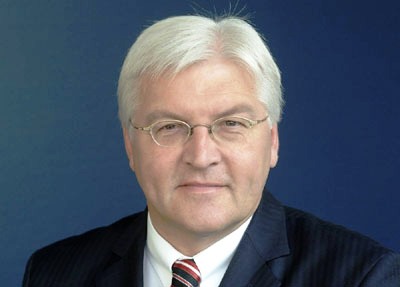
German FM Frank-Walter Steinmeier
Since the Bush administration’s twisting of events in the 2008 Russia-Georgia war, which the E.U. blamed on Georgia, Western populations have been subjected to the steady message that Russia is a “threat” to the West and is guilty of “aggression.” This reached a peak with the false narrative of events in Ukraine, in which blatant evidence of the West’s complicity in a violent coups d’état was omitted from corporate media accounts, while Russia’s assistance to eastern Ukrainians resisting the coup has been framed as a Russian “invasion.”
The disinformation campaign has reached the depths of popular culture, including the EuroVision song contest and sports doping scandals, to ensure widespread popular support for U.S. hostile intentions against Russia.
The Russian “aggression” narrative, based largely on lies of omission, has prepared the way for the U.S. to install a missile-shield in Romania with offensive capabilities and to stage significant NATO war games with 31,000 troops on Russia’s borders. For the first time in 75 years, German troops retraced the steps of the Nazi invasion of the Soviet Union.
U.S. Designs on Russia
The U.S. is eyeing a post-Putin Russia in which a Wall Street-friendly leader like Boris Yeltsin can be restored to reopen the country to Western exploitation. But Vladimir Putin is no Yeltsin and has proven a tough nut for the U.S. to crack. Washington’s modus operandi is to continually provoke and blame an opponent until it stands up for itself, as Putin’s Russia has done, then accuse it of “aggression” and attack in “self-defense.”
In this way, Washington builds popular support for its own version of events and resistance to the other side of the story. Unfortunately it is not a new trick in the U.S. playbook.
“The statesmen will invent cheap lies, putting the blame upon the nation that is attacked, and every man will be glad of those conscience-soothing falsities, and will diligently study them, and refuse to examine any refutations of them; and thus he will by and by convince himself the war is just, and will thank God for the better sleep he enjoys after this process of grotesque self-deception,” wrote Mark Twain.
So suddenly, after many years of an air-tight, anti-Russia campaign believed unquestioningly by hundreds of millions of Westerners, comes Steinmeier last week blurting out the most significant truth about Russia uttered by a Western official perhaps in decades.
“What we shouldn’t do now is inflame the situation further through saber-rattling and warmongering,” Steinmeier stunningly told Bild am Sontag newspaper. “Whoever believes that a symbolic tank parade on the alliance’s eastern border will bring security is mistaken.”
Instead Steinmeier called for dialogue with Moscow. “We are well-advised to not create pretexts to renew an old confrontation,” he said, saying it would be “fatal to search only for military solutions and a policy of deterrence.”
In keeping with the U.S. propaganda strategy, the U.S. corporate media virtually ignored the remarks, which should have been front-page news. The New York Times did not report Steinmeier’s statement, but two days later ran a Reuter’s story only online leading with the U.S. military’s rejection of his remarks.
NATO General: Russia is No Threat
Just a day after Steinmeier was quoted in Bild, General Petr Pavel, chairman of NATO’s military committee, dropped another bombshell. Pavel told a Brussels press conference flat out that Russia was not at a threat to the West.
“It is not the aim of NATO to create a military barrier against broad-scale Russian aggression, because such aggression is not on the agenda and no intelligence assessment suggests such a thing,” he said.
What? What happened to Russian “aggression” and the Russian “threat?” What is the meaning then of the fear of Russia pounded every day into the heads of Western citizens? Is it all a lie? Two extraordinary on-the-record admissions by two men, Steinmeier, the foreign minister of Europe’s most powerful nation, and an active NATO general in charge of the military committee, both revealing that what Western officials repeat every day is indeed a lie, a lie that may be acknowledged in private but would never before be mentioned in public.
Two years ago I was in a background briefing with a senior European ambassador at his country’s U.N. mission in New York and could hardly believe my ears when he said talk about Russia’s threat to Eastern Europe was “all hype” designed to give NATO “a reason to exist.” Yet this same ambassador in public Security Council meetings would viciously attack Russia.
But the hype is about more than just saving NATO. The fear campaign feeds the American and European military industries and most importantly puts pressure on the Russian government, which the U.S. wants overthrown.
Were these remarks made out of the exasperation of knowing all along that the Russian threat is hype? Were they made out of genuine concern that things could get out of hand under reckless and delusional leaders in Washington leading to a hot war with Russia?
Neither man has been disciplined for speaking out. Does this signal a change in official German thinking? Will German businessmen who deal with Russia and have opposed sanctions against Moscow over Ukraine, which were forced on Germany by the U.S., be listened to?
Were Steinmeier’s remarks a one-off act of rebellion, or is Germany indeed considering defying Washington on sanctions and regime change in Moscow? Is the German government finally going to act in Germany’s own interests? Such a move would spark a European defiance of the United States not seen since the days when Charles de Gaulle pulled France out of NATO in 1966 to preserve French independence.
The last time European governments broke with Washington on a major issue was the 2003 U.S.-led invasion of Iraq. Then France and Germany joined Russia on the U.N. Security Council in blocking the war’s authorization (although Britain supported it). But France and Germany then voted for a resolution several months later that essentially condoned the invasion.
It’s Up to the European Public
One has to ask whether a conditioned German public is ready to see through the lies about Russia. Last November, I flew from St. Petersburg to Berlin and discussed this very question with a number of well-educated Germans.
I had visited Russia for the first time since 1995, 20 years before to the month. Those were the days of the Yeltsin-Jeffery Sachs Russia, of the unbridled neoliberal capitalism of the Wall Street-oligarch alliance that plundered the country leaving millions of Russians destitute. Outside train stations I saw homeless encampments replete with campfires. Policemen were stopping motorists for bribes. I ran from two men intent on robbing me until I lost them in a Metro station. That’s the Russia the neocons in Washington and the knaves and buccaneers on Wall Street want to see again.
The Russia I saw in St. Petersburg and Moscow, 20 years later, was orderly and prosperous, as modern as any European city. It is a testament to Russia’s resistance to American attempts to restore its political and financial control. Russia is a capitalist country. But on its own terms. It is fully aware of American machinations to undermine it.
In Berlin I met several Germans, educated, liberal and completely aware, unlike most Americans, of how the United Sates has abused its post-World War II power. And yet when I asked them all why there are still U.S. military bases in Germany 70 years after the war and 25 years after the Cold War ended, and who the Americans were protecting them from, the universal answer was: Russia.
History shows European fears of Russia to be completely overblown. Germany and other Western powers have invaded Russia three times in the last two centuries: France in 1812, U.S., Britain and France in the 1918 Russian Civil War, and Germany again in 1941. Except for Imperial Russia’s incursion into East Prussia after war was declared on it in 1914, the reverse has never been true.
In his memoirs Harry Truman admitted that false fear of Russia was the “tragedy and shame of our time” during the Cold War that he had much to do with in part to revive the U.S. post-war economy with military spending. George Kennan, the State Department official who advised a non-military containment of the Soviet Union, conceded as early as 1947 that Soviet moves in Eastern Europe were defensive and constituted no threat. In the 1990s, Kennan also decried NATO’s expansion towards Russia’s borders.
With its vast natural resources, Russia has been the big prize for the West for centuries, and is still today in neocon-driven Washington. But Germany, especially, has benefited from trade with Russia and has no need to join the U.S. imperial project.
The British voters’ decision, days after Steinmeier’s extraordinary remark, could herald significant change in Europe, which may be approaching an historical junction in its relationship with the United States. Growing anti-E.U. sentiment has spread across the continent, including calls for similar referenda in several countries.
British voters evidently saw through the hype about the Russian “threat,” as a majority did not buy British Prime Minister David Cameron’s scare tactic ahead of the vote that Brexit would make it harder to “combat Russian aggression.”
Britain has been called Washington’s Trojan horse in the E.U. The thinking is that without Britain, the E.U. would be freer to chart its own course. But as Alexander Mercouris explained here, Obama bypasses London to call Merkel directly with his demands. Still, removing Britain’s voice from the E.U., though more crucially not from NATO, opens space for more independent voices in Europe to emerge.
“I worry that we will have less clout on our own,” former British Ambassador to the United States Peter Westmacott told The New York Times. “In the future, we won’t have as much influence on Europe’s response to Putin’s transgressions, Iran’s nuclear ambitions, or the E.U.’s foreign and security policy. … And we will be less able to ensure it is U.S.-friendly.”
But that could be a good thing. If German leaders conclude the United States is pushing Europe into a disastrous war with Russia, could we see a Charles de Gaulle moment in Berlin? Merkel doesn’t seem to have it in her. Three days after Steinmeier’s remarks, she told a news conference she favored increased German spending for NATO to counter Russian “threats.”
Instead it will require a revolt by an awakened citizenry against the E.U. and elected European governments that refuse to stand up to Washington, mostly because it benefits their own class interests, to the detriment of the majority.
The Future of the EU
European social democracy had been probably the best social and political system ever devised on earth, maybe the best that is humanly possible. Europe could have been a model for the world as a neutral power committed to social justice. As late as 1988, Jacques Delors, then president of the European Commission, promised the British Trades Union Congress that the E.U. would be a “social market.”
Instead the E.U. allowed itself to be sold out to unelected and unaccountable neoliberal technocrats now in charge in Brussels. European voters, perhaps not fully understanding the consequences, elected neoliberal national governments slavishly taking Washington’s foreign policy orders. But Brexit shows those voters are getting educated. Unity is a great ideal but E.U. leaders have refused to accept that it has to benefit all Europeans.
The E.U.’s Lisbon Treaty is the only constitution in the world that has neoliberal policies written into it. If it won’t reform — and the arrogance of the E.U.’s leaders tells us it won’t — it will be up to the people of Europe to diminish or dismantle the E.U. through additional referenda. That would give liberated European nations the chance to elect anti-neoliberal national governments, accountable to the voters, which can also chart foreign policies independent of Washington.
The danger is that the right-wing sentiment that has driven a large part of the anti-Establishment movements in Europe (and the U.S.) may elect governments that grow even closer to Washington and impose even harsher neoliberal policies.
That is a risk that may need to be taken in the hope that the anti-Establishment left and right can coalesce around shared interests to put an end to the elitist European project.
Joe Lauria is a veteran foreign-affairs journalist based at the U.N. since 1990. He has written for the Boston Globe, the London Daily Telegraph, the Johannesburg Star, the Montreal Gazette, the Wall Street Journal and other newspapers. He can be reached atjoelauria@gmail.com and followed on Twitter at @unjoe.
Too many heads stuck in the sand on Brexit
By Jonathon Cook | June 27, 2016
There are some heads stuck deeply in the sand at the moment. Typical were the dismissive responses to my piece Brexit and the diseased liberal mind. I had focused on one exceptional piece by one Guardian writer, it was claimed.
I chose Zoe Williams’ article because it is fully representative of liberal reaction to Brexit in the British media. I could have cited hundreds of other examples – not least just about everything currently appearing on the BBC.
But Williams and the rest of the media are not making these arguments in a vacuum. After all, much of the Labour shadow cabinet has just resigned and the rest of the parliamentary party are trying to defy the overwhelming democratic will of their membership and oust leader Jeremy Corbyn. His crime is not that he supported Brexit (he didn’t dare, given the inevitable reaction of his MPs) but that he is not a true believer in the current neoliberal order, which very much includes the EU.
Here is what one of the organisers (probably a shadow cabinet minister) of this coup-in-the-making says:
The plan is to make Corbyn’s job as leader extremely difficult in the hope of pushing him to resign, with most MPs refusing to serve as shadow ministers, show up on the frontbench in the House of Commons, support him at PMQs or formulate policy under his leadership.
This was presumably said with a straight face, as though Corbyn has not been undermined by these same Blairite MPs since day one of his leadership. This is not a new campaign – it has simply been forced to go more public by the Brexit vote.
Labour MPs do not just want to oust a leader with massive support among party members. They have hamstrung him from the outset so that he could not lead the political revolution members elected him to begin. And now he is being made to pay the price because he privately backs a position that, as the referendum has just shown, has majority support.
This is where we on the progressive left are, and the Brexit vote is a huge challenge to us to face facts. We want to believe we are free but the truth is that we have long been in a prison called neoliberalism. The Conservative and Labour parties are tied umbilically to this neoliberal order. The EU is one key institution in a transnational neoliberal club. Our economy is structured to enforce neoliberalism whoever ostensibly runs the country.
That is why the debate about Brexit was never about values or principles – it was about money. It still is. The Remainers are talking only about the threat to their pensions. The Brexiters are talking only about the role of immigrants in driving down wages. And there is good reason: because the EU is part of the walls of the economic prison that has been constructed all around us. Our lives are now only about money, as the gargantuan bail-outs of the too-big-to-fail banks should have shown us.
There is a key difference between the two sides. Most Remainers want to pretend that the prison does not exist because they still get privileges to visit the living areas. The Brexiters cannot forget it exists because they are never allowed to leave their small cells.
The left cannot call itself a left and keep whingeing about its lost privileges while denouncing those trapped inside their cells as “racists”. Change requires that we first recognise our situation – and then have the will to struggle for something better.
How the News Agenda is Set
By Craig Murray | June 26, 2016
David Cameron gets heckled every day of his life. The media never bother to report the names of the hecklers or the gist of what they say.
Yet a single heckler shouts at Jeremy Corbyn at Gay Pride, and not only is that front page news in the Guardian, it is on BBC, ITN and Sky News.
What makes a single individual heckling a politician newsworthy? There are dozens such examples every single day that are not newsworthy.
The answer is simple. Normally the hecklers are promoting an anti-establishment view, so it does not get reported. Whereas this heckler was promoting the number one priority of the establishment and mainstream media, to get rid of Jeremy Corbyn. So this heckler, uniquely, is front page news and his words are repeated at great length in the Guardian and throughout the broadcast media.
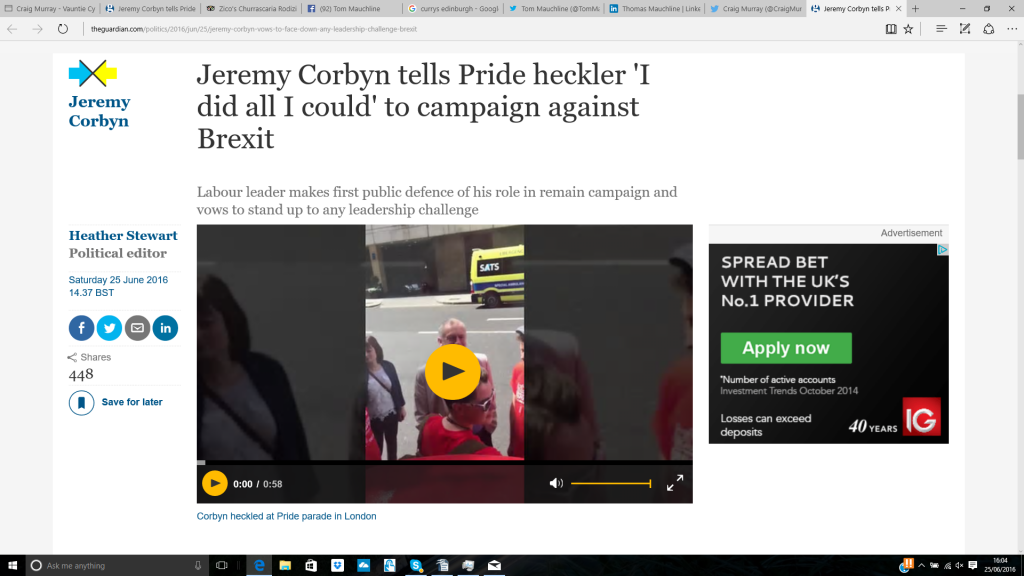
The impression is deliberately given that he reflects general disgust from young people, and particularly gay young people, at Corbyn over the EU referendum. The very enthusiastic reception for Corbyn at Gay Pride is not reported.
Nor is the fact that the incident was not a chance one. The “heckler” is Tom Mauchline, a PR professional for PR firm Portland Communications, a dedicated Blairite (he describes himself as Gouldian) formerly working on the Liz Kendall leadership campaign. Portland Communications’ “strategic counsel” is Alastair Campbell.
So far from representing a popular mood, Mauchlyne was this morning on twitter urging people to sign a 38 Degrees petition supporting the no confidence motion against Corbyn. Ten hours later that petition has gained 65 signatures, compared to 120,000 for a petition supporting Corbyn. Mauchline formerly worked for 38 Degrees, unsurprising given their disgraceful behaviour over the Kuenssberg petition. I am waiting for the circle to be squared and Kuenssberg to report on the significance of Mauchline’s lone heckle.
I find it incredible that the mainstream media are all carrying this faked incident while not one single mainstream journalist has reported who Mauchline really is.
Featured Video
New positive ivermectin evidence
or go to
Aletho News Archives – Video-Images
From the Archives
Fanatical Followers of the Covid Regime: A Jim Jones-Style Cult?
By Professor Roger Watson and Dr. Niall McCrae | The Daily Sceptic | November 15, 2021
As scholars at leading British universities over recent decades, we witnessed the replacement of critical thinking and debate by narrative: facts are discrimination and scientific method is imperialism; truth, instead, is derived from ‘progressive’ values. This educational trend may be a major contributory factor to the ease in which society has been inculcated to the Covid ‘new normal’ of masking, testing, and repeated doses of vaccines for a disease of similar risk to severe influenza.
One doesn’t need much critical reasoning to observe the flawed logic of some vaccination enthusiasts, such as people who respond to experiencing any side effects, however debilitating, by saying “at least I know it’s working”, or, after contracting the disease despite their promised inoculation (over 90% effective, according to initial drug company claims), “I’d have been worse off without the jab.” … continue
Blog Roll
 Aletho News
- EU Council Advances Chat Control 2.0 Scanning Proposal
- Ex-Greek MEP files complaint against Israeli spyware firm over alleged Pegasus surveillance
- Troubling ideas throughout the Torah, Talmud, Mishneh Torah and Tanya
- ‘Grave, alarming’: Iran mission on Trump’s UNGA ‘annihilation’ threats
- Najaf airport to reopen to Iranian flights within 24 hours: Ambassador
- From ‘How Will This End For Iran’ to ‘When America Walks Away’: A tale of two Economist covers
- Tehran blasts ‘baseless’ speculation linking Iran to alleged bomb plot at UK air base
- The Rise And… Rise Of ‘Color Revolutions’
- The Coming GOP Bloodbath?
- Arctic Scare Stories Melt Away
- If Americans Knew
- An error has occurred; the feed is probably down. Try again later.
- No Tricks Zone
- New Study: Earth And Venus Surface Warmth Largely Explained By Convection And Lapse Rate, Not CO2 Or Radiation
- 2025 Nature Paper Claiming Worsening Global Drought Gets RETRACTED …Heavily Flawed
- New Study: ‘Global Drought Shows No Detectable Recent Acceleration Under Climate Warming’
- Economic Masterminds: German Socialists Suggest Taxing Productivity Gains Stemming From Using AI
- The South China Sea Has Not Been Cooperating With The Climate Change Narrative
- Energy Crisis: Germany Enters Heating Season With Historically Low Gas Reserve Fill Levels
- New Study: The Antarctic Ice Sheet Gained Mass From 2020-2024 Due To Staggering Snow And Ice Accumulation
- Study: Ocean Heating Rates From Thousands Of Years Ago ‘Dwarf’ Modern Ocean Heating Rates
- Climate Extremists Target, Attack Large-Scale Power Grid Infrastructure In Germany!
- New Study: Antarctic Ice Melt Has Contributed Less Than 1 Centimeter To Sea Level Rise In The Last 30 Years

