The UK and its allies should stop “fueling” the Ukraine conflict instead of shifting the blame onto others, Chinese Foreign Ministry spokesman Wang Wenbin said on Thursday. His comments came after London accused Beijing of providing “lethal aid” to Russia in its military effort against Kiev.
UK Secretary of State for Defense Grant Shapps claimed on Wednesday that Russia and China are “collaborating on combat equipment for use in Ukraine.” Shapps further alleged that he has “new evidence” provided by the US and British intelligence services which shows “lethal aid is now flying from China to Russia.”
Responding on Thursday Chinese Foreign Ministry spokesman Wang said Beijing “condemns the groundless and irresponsible smear campaign against China by British politicians,” noting that Shapps’ remarks have not been supported by Washington. Speaking at a daily White House press briefing on Thursday, the US national security adviser, Jake Sullivan, said Washington had not seen evidence of China directly providing weapons to Russia.
“It is the UK, not China, that is adding fuel to the flames on the Ukrainian issue… As early as two years ago, Russia and Ukraine were close to reaching an agreement on ending the conflict, but it was precisely because of the hurdles placed by the UK and other parties that the conflict continues to this day,” Wang stated. He urged London to rethink its own role in the conflict instead of “attacking China without reason.”
Wang reiterated that Beijing has “always stood on the side of peace and dialogue,” and vowed that China will continue its work to promote a diplomatic solution for the conflict.
Beijing has adhered to a policy of neutrality on the Ukraine conflict, and has firmly rebuffed Western calls to impose sanctions on Russia, opting instead to boost trade with its neighbor. This has led to accusations from the UK and its NATO allies that Beijing is fueling Russia’s military effort by supplying it with dual-use components that can be used for weapons production.
Beijing has repeatedly denied the accusations, stating that Russia and China have a right to trade. Wang earlier accused the West, which itself supplies the bulk of Kiev’s military equipment, of hypocrisy. He suggested that the US, UK, and other Western powers should work on bringing Russia and Ukraine to the negotiation table, instead of “shifting the blame” onto China for the continued hostilities.
Moscow has consistently spoken out against Western military aid for Kiev, arguing that it merely prolongs the conflict without changing its eventual outcome. During an official visit to China earlier this month, Russian President Vladimir Putin issued a joint statement with Chinese leader Xi Jinping in which they reiterated their stance that the Ukraine conflict “must be resolved by political means.”
In case anybody is interested in the inputs and outputs of my intellectual life, here is a little update on what I have been writing and reading.
Reading
Here are a few things I have read recently that might be of interested to purveyors of this site:
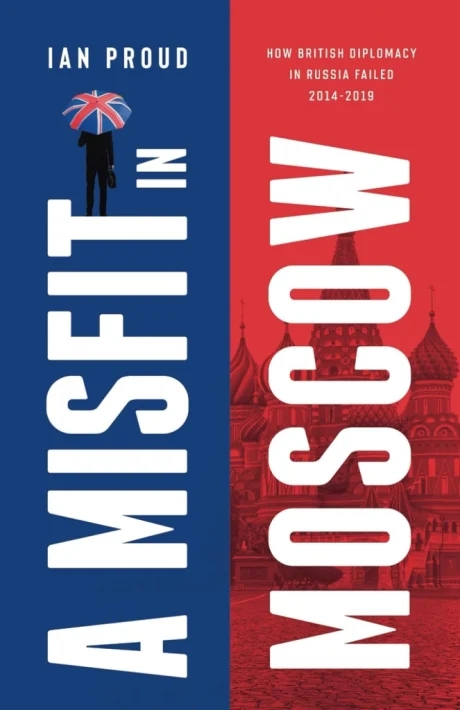
Ian Proud is a former British diplomat who served in the UK’s embassy in Moscow and was also responsible for organizing British sanctions against the Russian Federation. He has since left the Foreign Office, written his memoirs. and started a blog on which he regularly criticizes British policy towards Russia and declares the sanctions he enacted to be a total failure. You can read his blog here.
The memoirs are written in a light, engaging style, but contain a serious message. Proud argues that successive British governments have for a long time been totally uninterested in talking to Russia. He also paints a picture of British diplomats who not only mostly didn’t speak Russian but also weren’t interested in doing so. Dispatches to London, he claims, consisted largely of bits cut and paste out of media articles. One has to wonder about the quality of the intelligence that London was receiving.
Worth a read.
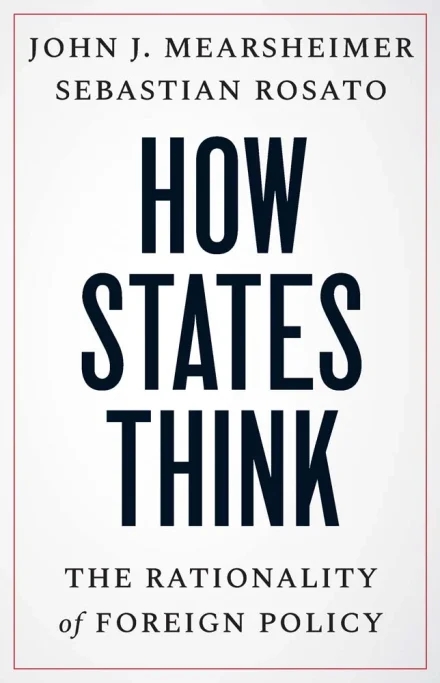
I used to teach a course titled ‘Irrationality and Foreign Policy Decision-Making’, which looked at all the ways that foreign policy decision processes deviated from the kind of rational actor models that public policy students are taught to follow.
It’s interesting, therefore, to come across a book that claims that all the stuff I taught is wrong and foreign policy is for the most part a rational endeavour. I can’t say that I was 100% convinced by this book, which I found a bit repetitive, and perhaps worthy more of an extended article than a full-length book. Still, if I ever teach that course again, I will have to bear what this says in mind and suggest it to my students.
This one got a stinker of a review from Joy Neumeyer in the New Left Review, in which, among other things, Neumeyer accused author Jade McGlynn of plagiarizing her work. You can read that review here.
McGlynn’s basic argument is that the war in Ukraine is not Putin’s war but Russia’s war, as Putin and the war have broad support from the Russian population. I would generally agree, but the problem is that McGlynn then goes beyond this and tries to explain this phenomenon by recourse to a sort of Homo Sovieticus argument, namely that the reason why the Russian masses support Putin and the war is that they are psychologically retrograde.
Personally, I don’t see why it’s even necessary to write a whole book explaining the phenomenon. Populations everywhere tend to rally around the flag. It’s natural. And when they do, we don’t have to resort to explanations of the masses’ psychological failings. Why does Russians’ support for Putin mean that Russians are psychologically twisted in a way that Americans’ support for George W. Bush or Britons’ support for Tony Blair during the war in Iraq doesn’t?
By all means read ‘Russia’s War’ if you want, but I can’t say that I got anything useful from it.
This one I haven’t actually read yet. It’s on my shelf awaiting a moment when I have spare time on my hands. The reason I got it is that the description of the book’s thesis seems fascinating. If I am understanding it right, author Tomila Lankina is claiming that there was an astonishing lack of social mobility in the upper middle classes in Russia in the twentieth century. It was more or less the same families who made up that class in Imperial Russia, Soviet Russia, and post-Soviet Russia. This existed alongside a newer, ‘inferior, second-class middle-class’ (as Lankina calls it) made up of ex-workers and peasants and their children, who rose up in the Soviet era. The two middle classes remained distinct, however, and it was the former that transmitted liberal values from the late Imperial era into the early post-Soviet one.
If true, this casts enormous doubt on the ability of governments of any hue to promote social mobility. Wealth and privilege, it seems, have a way of surviving even regimes dedicated to destroying them. Is it true? I guess I’ll have to read the book to find out.
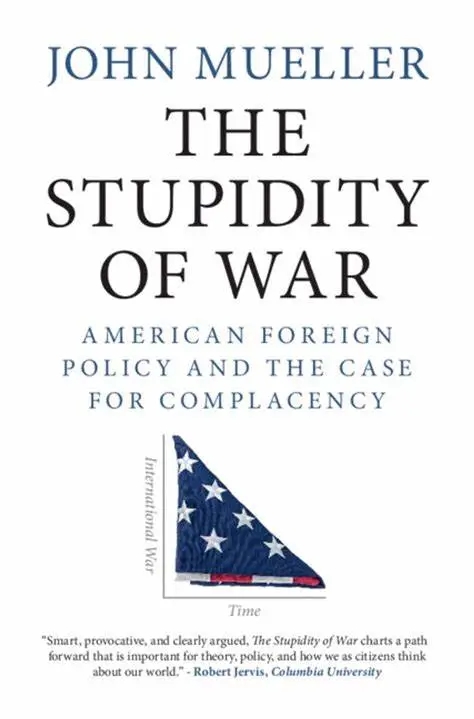
The title of this book – also still to be read – says it all. ‘The Stupidity of War’. Amen to that!
Writing
Some good news! I have another book on the way. It’s title has been confirmed as Russia’s World Order: How Civilizationism Explains the Conflict with the West. It will be published by Northern Illinois University Press (now an imprint of Cornell Univesity Press) on 15 April next year. It will be published as a trade book, and thus should be available at an easily affordable price. I will post the cover once it is available.
An NGO has submitted a complaint to the United Kingdom’s Scotland Yard against Israel’s use of “starvation as a weapon of war” and targeting of Palestinian civilians in the Gaza Strip, in what is the latest such complaint regarding war crimes in Gaza to be reported to British police.
According to the London-based International Centre of Justice for Palestinians (ICJP), it submitted a complaint to Scotland Yard’s War Crimes Team regarding Israel’s suspected use of “starvation as a method of warfare” and for ‘wilfully causing great suffering’ to Palestinians.
Although filed in the UK, both crimes are illegal under British and international law, including under the Rome Statute and the International Criminal Court Act 2001. Using starvation as a weapon of war also violates the Geneva Convention, a major keystone of contemporary international law.
The 60-page complaint – which was added to by a further 800 pages of evidence – includes accounts collected by ICJP’s investigation and legal teams, which include former British police detectives who collected the evidence to the standards of British police forces.
The evidence reportedly includes that collected from first-hand eyewitnesses, expert reports and expert evidence from nineteen medical professionals who have worked within the besieged Gaza Strip since October, when Israel began its ongoing offensive.
According to ICJP’s Director, Tayab Ali, “Complicity comes in many forms, whether that be providing political cover, encouraging criminal acts, supplying weapons or, as in the case of starvation, withholding funds from agencies that provide life sustaining humanitarian aid”.
The extensive complaint notably builds upon and expands an existing complaint issued by the ICJP back in January this year, which named four British government ministers for alleged complicity and criminal responsibility in Israeli war crimes. This latest update, however, further implicates a fifth senior government minister as an alleged perpetrator of those crimes.
Due to the war crimes’ illegality under British law and subsequent ability to be prosecuted in the UK, Scotland Yard’s War Crimes Investigation Team will now reportedly consider the complaints leading up to an ultimate decision on whether to open a formal criminal investigation on the matter. If that proceeds, there is the possibility that police will then question, arrest, and prosecute the alleged perpetrators and those complicit.
Net Zero Watch is calling on UK ministers to follow the example of the Dutch government, which has announced the scrapping of cornerstone climate policies such as mandatory heat pump targets and the compulsory purchase of farmland.
The reversal is part of a populist backlash against environmentalist policies that has so far been more pronounced in parts of continental Europe than in the UK.
The desire of Britain’s politicians to ‘lead the world’ in the fight against climate change has led it to be early adopters of ‘ambitious’ climate targets, without thinking through their implications. Theresa May’s decision to introduce a legally-binding Net Zero target was debated for just 90 minutes in the House of Commons, but it was a decision that was followed by many other countries.
The Dutch experience shows that voters do not appreciate being on the receiving end of inflexible, compulsive policies that hit the poorest hardest. The delaying of the 2030 ban on petrol and diesel cars to 2035 and the delay by a year of the Clean Heat Market Mechanism, show that the Government has at least woken up to the risk it faces. But it will need to go much further to protect consumers.
Harry Wilkinson, head of policy at Net Zero Watch, said:
What has happened in the Netherlands is likely to be replicated across Europe. We have heard some encouraging language from Claire Coutinho, but she needs to go further to avoid a backlash.’
’I’ve never been against heat pumps, but it is absurd to mandate their use when they will be inappropriate in many homes. Green technologies must stand on their own merits, or the public will be left poorer.’
With the ICC’s chief prosecutor issuing an application for an arrest warrant against Israel’s prime minister for “war crimes and crimes against humanity”, attention must turn to those who have aided Israel.
British ministers have for months been materially assisting Israel during its onslaught against Palestinians in Gaza. This support is being provided in three main ways.
First, the UK is providing arms to Israel. Recently filed court documents reveal that, as of January this year, the UK government had 28 extant and 28 pending “high-risk” licences with Israel marked as “most likely to be used by the IDF in offensive operations in Gaza”.
On 18 January, Israeli forces bombed a residential compound in Gaza housing the emergency medical team of Medical Aid for Palestinians (MAP), a British charity. Four British doctors were injured in the airstrike, alongside MAP staff members and a bodyguard.
The attack was carried out by an F-16 jet, components for which have been supplied by UK companies.
But the UK continues to arm Israel, rejecting repeated calls by campaign groups, former supreme court judges and some MPs to halt them.
Second, the UK military is training Israeli armed forces personnel in Britain during the genocide.
The government has admitted that “there are currently six Israeli Armed Forces officers posted in the UK”. It says “Israel is represented by Armed Forces personnel in its Embassy in the UK, and as participants in UK defence-led training courses”.
Third, the UK military is conducting spy flights over Gaza in support of Israel. Declassified has found that over 200 surveillance missions over Gaza have been undertaken by the Royal Air Force, which is likely to have gathered around 1,000 hours of surveillance footage.
None of this spy activity is being used to halt Israel’s attacks on Palestinians. The UK government says these surveillance activities are solely to aid the release of hostages held by Hamas.
Although the ICC has also indicted Hamas’ leadership for hostage taking, there is little evidence that Britain’s surveillance of Gaza has helped save lives. Rather it encourages Netanyahu to continue a military campaign and avoid negotiating a ceasefire, a path many of the hostages’ families favour.
Secrecy to avoid prosecution
British ministers are refusing to provide detailed information about these three areas of activity to parliament, likely to avoid prosecution for complicity in war crimes.
The UK’s Ministry of Defence (MoD) is, for example, refusing to give parliament further information about its training of Israeli military personnel in Britain or a military agreement signed with Israel in 2020.
The UK government is also refusing to give any details about the spy flights over Gaza, which began on 3 December.
Court documents show UK ministers decided to continue arms exports to Israel on 8 April, one week after the strike that killed three British aid workers who were employed by the charity World Central Kitchen.
Also on 8 April, the UK began its latest round of negotiations with Israeli ministers to strike a new trade agreement. Rather than sanctioning Israel over its actions in Gaza, the UK is deepening commercial relations.
Legitimacy of investigation
The ICC has legitimacy in investigating British ministers since they are shielded legally and politically at the domestic level.
There is almost no chance the UK system will hold ministers accountable for aiding war crimes, particularly since they are protected by “crown immunity”.
This deems that ministers cannot commit a legal wrong and do not act as persons but as agents steeped with Crown authority, and are therefore untouchable under the law.
The very purpose of the ICC is to investigate and prosecute the commission, including aiding and abetting, of the most serious crimes when domestic authorities refuse to act.
They don’t care
The international Genocide Convention requires all states to prevent and punish genocide.
The principle of the Responsibility to Protect, adopted by all states in 2005, highlights the responsibility of states to prevent “atrocity crimes” such as war crimes, ethnic cleansing and crimes against humanity.
UK ministers are not only failing to uphold these norms: they are actively supporting those Israeli decision-makers violating them.
British ministers have consistently defended Israel’s attacks on Palestinians as the death toll has mounted to the tens of thousands. They explicitly reject South Africa’s genocide case against Israel at the International Court of Justice.
Evidence suggests UK ministers just don’t care about international law or how many people – Palestinians or Britons – are killed in Gaza.
At the same time, the British government is refusing to publish the legal advice it has received on whether Israel is violating international law in Gaza.
Ministers responsible
Arrest warrants have been issued by the ICC against Netanyahu and his defence minister Yoav Gallant.
Its chief prosecutor, the British barrister Karim Khan, says he has “reasonable grounds to believe” that the two Israeli ministers “bear criminal responsibility” for crimes including “starvation of civilians as a method of warfare”, “intentionally directing attacks against a civilian population” and “extermination and/or murder”.
Rishi Sunak as prime minister, along with foreign secretary David Cameron, defence secretary Grant Shapps and trade secretary Kemi Badenoch – who all approve UK arms exports to Israel – must be investigated over their complicity in war crimes.
Deputy foreign secretary Andrew Mitchell, who has acted as the government’s chief apologist for Israel’s actions in the British parliament, should also not escape the ICC’s attention.
Nor should defence minister Leo Doherty and former foreign secretary James Cleverly (now home secretary), who contributed to UK government decisions on policy towards Israel.
Mark Curtis is the director of Declassified UK, and the author of five books and many articles on UK foreign policy.
UNITED NATIONS – Having prevented the UN Security Council from adopting Russia’s draft resolution, the West has confirmed its intention to continue militarization of space, Russian Permanent Representative to the UN Vasily Nebenzia said at a meeting of the Security Council.
Earlier, due to the position of Western countries, the UN Security Council did not adopt Russia’s resolution on preventing an arms race in space. Russia, China, Algeria, Guyana, Ecuador, Mozambique, Sierra Leone voted in favor of the resolution. Switzerland abstained. The United States, France, Britain, Japan, Slovenia, the Republic of Korea, and Malta voted against.
Nebenzia recalled how in April the US and its allies in the UNSC were loudly assuring everyone of their commitment to peaceful space.
“Today, after they have confirmed their real intentions to continue militarizing space and creating appropriate weapons, attempts to justify their actions by the allegedly non-consensual nature of our project look especially cynical and hypocritical,” Nebenzya said.
According to him, Russia is generally satisfied with the result of today’s vote. “In addition to the numbers, it has demonstrated the watershed between those who seek peaceful space exploration and those who are leading the way towards its militarization. Western countries found themselves today essentially isolated in the Council. And this is symptomatic,” the permanent representative emphasized.
According to the permanent representative, it is deeply regrettable that these countries did not allow the Security Council to make a balanced “and urgently needed decision in favor of preserving space exclusively for peaceful use.”
“Thus, today they finally threw off their masks, self-disclosed themselves and showed us what they really are,” Nebenzia noted.
“The reason why you did not support our project is trivial and simple. You just want to leave yourselves free hands to use space for military purposes and to place any kind of weapons there,” the permanent representative concluded.
The militarization of space by the West will require analysis and retaliatory steps by Russia, but Moscow will remain committed to its obligations under international law, Nebenzia highlighted.
“Of course, the current situation will require analysis and response steps from our side. At the same time, Russia will remain committed to its obligations in outer space in accordance with international law,” the diplomat stressed.
“We have repeatedly confirmed and reaffirm our commitment. Despite the aggressive attitude of the United States and its allies, we will continue to work in this direction and make every effort together with responsible UN member states to keep space peaceful,” he emphasized.
The polite world was fascinated last month when long-time NPR editor Uri Berliner confessed to the Stalinist suicide pact the public broadcaster, like all public broadcasters, seems to be on. Formerly it was a place of differing views, he claimed, but now it has sold as truth some genuine falsehoods like, for instance, the Russia hoax, after which it covered up the Hunter Biden laptop. And let’s not forget our censor-like behaviour regarding Covid and the vaccine. NPR bleated that they were still diverse in political opinion, but researchers found that all 87 reporters at NPR were Democrats. Berliner was immediately put on leave and a few days later resigned, no doubt under pressure.
Even more interesting was the reveal of the genesis of NPR’s new CEO, Katherine Maher, a 41-year-old with a distinctly odd CV. Maher had put in stints at a CIA cutout, the National Democratic Institute, and trotted onto the World Bank, UNICEF, the Council on Foreign Relations, the Center for Technology and Democracy, the Digital Public Library of America, and finally the famous disinfo site Wikipedia. That same week, Tunisia accused her of working for the CIA during the so-called Arab Spring. And, of course, she is a WEF young global leader.
She was marched out for a talk at the Carnegie Endowment where she was prayerfully interviewed and spouted mediatized language so anodyne, so meaningless, yet so filled with nods to her base the AWFULS (affluent white female urban liberals) one was amazed that she was able to get away with it. There was no acknowledgement that the criticism by this award-winning reporter/editor/producer, who had spent his life at NPR had any merit whatsoever, and in fact that he was wrong on every count. That this was a flagrant lie didn’t even ruffle her artfully disarranged short blonde hair.
Christopher Rufo did an intensive investigation of her career in City Journal. It is an instructive read and illustrative of a lot of peculiar yet stellar careers of American women. Working for Big Daddy is apparently something these ghastly creatures value. I strongly suggest reading Rufo’s piece linked here. It’s a riot of spooky confluences.
Intelligence has been embedded in media forever and a day. During my time at Time Magazine in London, the bureau chief, deputy bureau chief and no doubt the “war and diplomacy” correspondent all filed to Langley and each of them cruised social London ceaselessly for information. Tucker Carlson asserted on his interview with Aaron Rogers this week that intelligence operatives were laced through DC media and in fact, Mr. Watergate, Bob Woodward himself, had been naval intelligence a scant year before he cropped up at the Washington Post as ‘an intrepid fighter for the truth and freedom no matter where it led.’ Watergate, of course, was yet another operation to bring down another inconvenient President; at this juncture, unless you are being puppeted by the CIA, you don’t get to stay in power. Refuse and bang bang or end up in court on insultingly stupid charges. As Carlson pointed out, all congressmen and senators are terrified by the security state, even and especially the ones on the intelligence committee who are supposed to be controlling them. They can install child porn on your laptop and you don’t even know it’s there until you are raided, said Carlson. The security state is that unethical, that power mad.
Now, it’s global. And feminine. Where is Norman Mailer when you need him?
At the same time, at the same time, Freddie Sayers, the editor-in-chief of Unherd, testified in Parliament on the Global Disinformation Index which had choked Unherd’s ability to grow. Unherd had hired three advertising firms who were, one after the other, unable to place ads. The third sourced the problem to the Index, which had deemed his interviews with journalist Katherine Stock about the problems faced by young people transitioning their sex, had made him persona non grata for all advertising agencies across the world. Eerily, that same week, Katherine Stock was awarded a high honorable mention in the National Press Awards for her work.
Here is Clare Melford, the fetching chief of the Global Disinformation Index, a woman seemingly bent on sterilizing confused children, Yet another non-profit authoritarian working for a mysterious Big Daddy. Who the hell trained her?
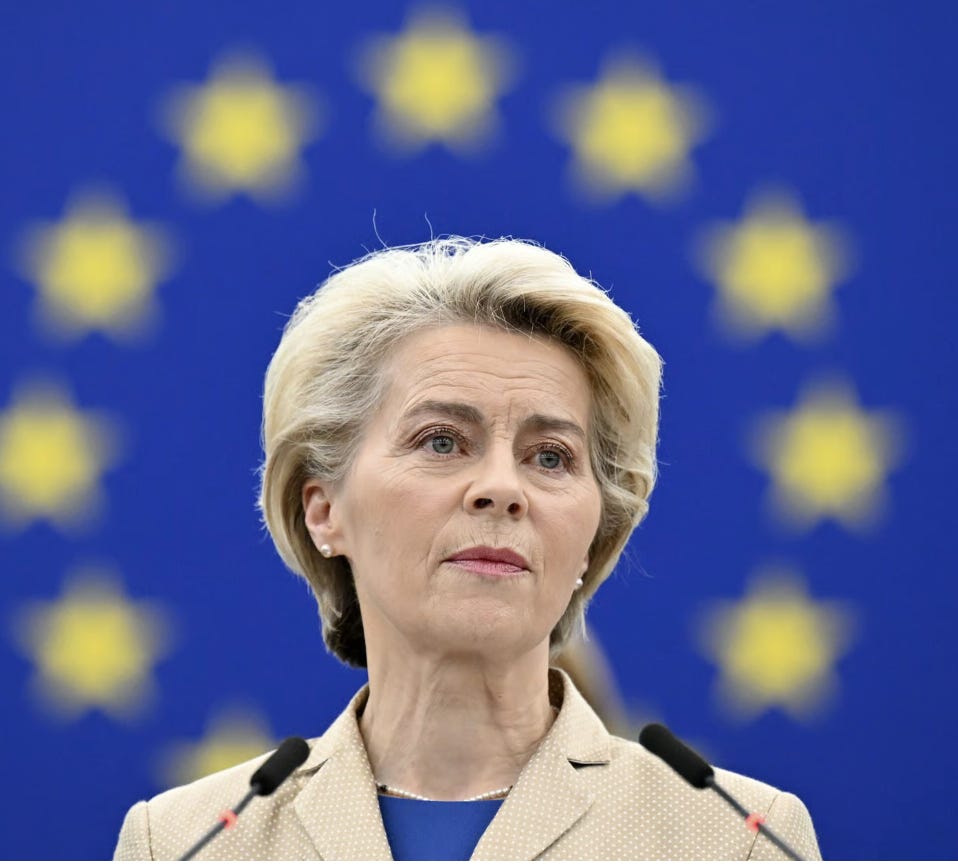
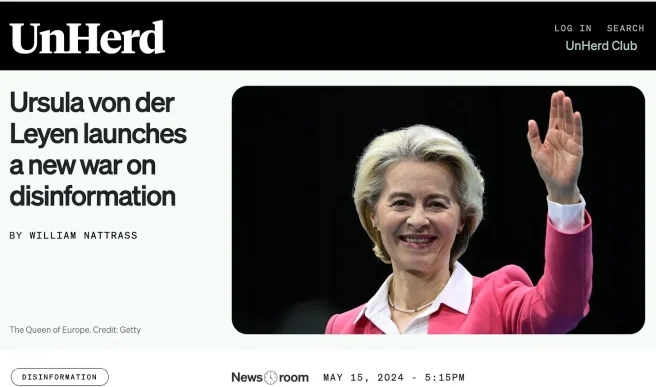
On Tuesday this week, out pops Europe’s headmistress, European Commission President Ursula von der Leyen in Politico.eu, complaining about “Russia” and “right-wingers” sowing distrust of Europe’s election processes. She is, she says, launching a new war on Disinformation. Most importantly, no more reporting on migrant assaults. This seems to be their new crusade. Please note the halo over her Christed head. Honestly, they are shameless, vain, silly creatures with limited bandwidth. Other than obedience to some grim reaper.
Said Politico :
“She promised to set up “a European Democracy Shield,” if reelected for a second term, to fight back against foreign meddling.
EU cybersecurity and disinformation officials expect a surge in online falsehoods in the 20 days prior to the European Parliament election June 6-9, when millions of Europeans elect new representatives. Officials fear that Russia is ramping up its influence operations to sow doubt about the integrity of elections in the West and to manipulate public opinion in its favor.”
By the way, madam, western election integrity has been thoroughly compromised by the men who tell you what to do. More than half of us think elections are stolen. More than half. That’s not disinformation, it’s math.
This week Michael Shellenberger, who is the acknowledged lead in the take-down of the global censorship complex, had a look at Julie Inman Grant, another American Barbie, now Australia’s “e-safety commissioner,” with ties to the WEF. Grant had demanded that X censor a migrant stabbing, and X refused. Grant, as Shellenberger describes, is the Zelig of internet history tinkering in the bowels of said internet until she burst onto the public stage as Australia’s chief censor, bent on building a global online safety network.
Working for Big Daddy is apparently something these ghastly creatures value.
At a recent government hearing, she announced, “We have powerful tools to regulate platforms with ISP blocking power, and can collect basic device information, account information, phone numbers and email addresses, so that our investigators can at least find a place to issue a warning.” Grant went on to say they could compel take-downs, fine perpetrators and fine content hosts.
The Daily Mail had a ball with Inman Grant, mocking her and pointing out that she was wasting taxpayer money on a game of whack-a-mole.
Nevertheless, Grant takes herself very very seriously and since she is accreting power at a massive clip, so must we.
Grant’s network of independent regulators is called the Global Online Safety Regulators Network. “We have Australia, France, Ireland, South Africa, Korea, the UK and Fiji so far, with others observing. Canada is coming along,” she preens, “and is about to create a National Safety Regulator.” Canada’s proposed censorship program is so draconian you can be jailed for something you posted online years ago. And the government proposing it is so unpopular, it will be lucky to hang onto 20 seats in the next election.
There are literally hundreds of these women. Why? Why?
At a meeting this year of the World Economic Forum, Věra Jourová, from the European Commission, outlined just how exciting she and her team found the tools she is being given. “We can,” she said, “influence in such a way the real life and the behavior of people!” She sighed with excitement after this sentence. Jourova was caught last September trying to spread yet another Russia hoax. You have only to hear censorship plans uttered in a central-European accent to really understand what is happening here.
As terrifying as this all seems, and it is terrifying, it is instructive to look at the ruination of the career of America’s chief censor, Renée DiResta. DiResta, as research head of the Stanford Internet Observatory, is now being sued for abuse of power and unethical behavior that violates the constitution. Spookily, DiResta soared from “new mom” to providing the intellectual under-pinnning for censorship, until she headed up the Stanford Internet Observatory during Covid, where she was instrumental in censoring vaccine and Covid “disinformation.” People thought her backstory contrived and in fact, Shellenberger found that she was, unmistakably another CIA trained censor of inconvenient information under the guise of “safety.”
At this point, every time you hear the word ‘safety”, it’s best to check your ammunition supply. Said Shellenberger:
As research director of Stanford Internet Observatory, DiResta was the key leader and spokesperson of both the 2021 “Virality Project,” against Covid vaccine “misinformation” and the 2020 “Election Integrity Project.”
Shellenberger goes on to look into DiResta’s work history and finds a lot of congruence with CIA operations.
But then I learned that DiResta had worked for the Central Intelligence Agency (CIA). The journalist Matt Taibbi pointed me to the investigative research into the censorship industry by Mike Benz, a former State Department official in charge of cybersecurity. Benz had discovered a little-viewed video of her supervisor at the Stanford Internet Observatory, Alex Stamos, mentioning in an off-hand way that DiResta had previously “worked for the CIA.”
In her response to my criticism of her on Joe Rogan, DiResta acknowledged but then waved away her CIA connection. “My purported secret-agent double life was an undergraduate student fellowship at CIA, ending in 2004 — years prior to Twitter’s founding,” she wrote. “I’ve had no affiliation since.”
But DiResta’s acknowledgment of her connection to the CIA is significant, if only because she hid it for so long. DiResta’s LinkedIn includes her undergraduate education at Stony Brook University, graduating in 2004, and her job as a trader at Jane Street from October 2004 to May 2011, but does not mention her time at the CIA.
And, notably, the CIA describes its fellowships as covering precisely the issues in which DiResta is an expert. “As an Intelligence Analyst Intern for CIA, you will work on teams alongside full-time analysts, studying and evaluating information from all available sources—classified and unclassified—and then analyzing it to provide timely and objective assessments to customers such as the President, National Security Council, and other U.S. policymakers.”
At this juncture it is a race, as the intelligence community moves to shut down the revelations of its manipulations and machinations, and people injured by the vaccine and the flagrant abuse of election integrity move to fight them. It is instructive to note that DiResta, while apparently soaring to the heights of journalism at Wired, the New York Times, the Atlantic, selling her safety/censorhip program, cannot seem to get actual people to read or subscribe to her Substack. DiResta, like so many women in power now, are in reality, talentless cutouts for a hidden and malignant agenda.
An agenda that the people of the world roundly hate. I have just one final thing to saw to these truly dreadful human beings. My God is stronger than whatever demon or predator you obey. And as a woman, I am ashamed of each and every one of you. To use one of your awful phrases: Do Better.
The West only risks further escalation by arming and encouraging Kiev to strike Russian territory, the Russian Foreign Ministry spokeswoman Maria Zakharova said on Friday.
The warning comes as Ukrainian strikes against Russian cities intensify on the backdrop of Kiev losing ground in the Kharkov Region.
“The profile of the American and British handlers of the [Ukrainian President Vladimir] Zelensky regime is clearly visible behind these barbaric attacks,” Zakharova told reporters. “They are not only providing longer-range missiles and heavy weapons, but are giving a green light to their use against Russia.”
“Once again, we would like to unequivocally warn Washington, London, Brussels and other Western capitals, as well as Kiev, which is under their control, that they are playing with fire. Russia will not leave such encroachments on its territory unanswered,” the spokeswoman stressed.
On Thursday and Friday, the Ukrainian troops launched a combined assault on Crimea, Krasnodar and other Russian regions using UAVs and naval drones. According to the Russian Defense Ministry, more than 100 drones were intercepted mid-air, while six unmanned boats were destroyed by the Black Sea Fleet.
During its briefing on Friday, the MOD added that over the course of the week Russian troops had intercepted dozens of US-made ATACMS missiles, as well as nearly 200 rockets, including projectiles fired from US-made HIMARS and Czech-made Vampire launchers. The Hammer guided bombs delivered by France, the Storm Shadow cruise missiles made by the UK, and nearly 330 UAVs were also used in the attacks, it said.
A total of 19 civilians were killed in Russia’s Belgorod region on May 12 alone, Governor Vyacheslav Gladkov said. On Friday, Gladkov wrote on Telegram that a Ukrainian drone hit a civilian car, killing a mother and her four-year-old daughter.
On Friday, Russian President Vladimir Putin reiterated that the shelling of residential areas is pushing Moscow to create a buffer zone along the border with Ukraine. “If this continues, we will be forced to create a security zone. This is what we are doing,” he said during his trip to China.
Last month, the New York Times cited senior Pentagon officials as saying that the US had allowed Ukraine to use ATACMS missiles against targets in Crimea. British Defense Secretary Grant Shapps confirmed to journalists on Tuesday that London allows Kiev to strike Crimea with UK-supplied weapons.
The largely Russian-speaking peninsula voted in 2014 to leave Ukraine and join Russia following the Western-backed coup in Kiev that took place earlier that year.
Embroiled in coast to coast lawsuits from the alleged harms of their COVID vaccine, Astrazeneca is receiving massive public backlash after admitting their shot can cause blood clots in court proceedings. Jefferey Jaxen also reveals payments made by the pharma giant to doctors in the UK, including celebrity pediatrician, Dr. Ranj Singh who strongly advocated for the now pulled product.
This week, ICAN lead counsel, Aaron Siri, Esq. filed a historic lawsuit on behalf of Utah mother, Brianne Dressen, a patient who participated in the AstraZeneca COVID-19 vaccine clinical trial. The lawsuit states she was severely injured and is now suing the drug manufacturer in a lawsuit that is the first of its kind in the U.S.. Hear how the progressive neuropathy she developed from the drug trial has shattered her life, and the organization she launched to advocate for those like her.
The Yemeni militia has turned the destruction of General Atomics MQ-9 Reaper drones into an art form, using homegrown variants of the Soviet Kub surface-to-air missile system to shoot the $32 million apiece attack UAVs out of the skies. The Pentagon has used Reapers extensively over Yemen amid the Houthi’ partial blockade of the Red Sea.
Yemen’s Houthi militia have reported the destruction of another MQ-9 Reaper using a “a locally-made” SAM.
In a statement published Friday and reported by Yemen’s SABA News Agency, the militia said their air defense forces took down the American drone over Marib, western Yemen, where it “was carrying out hostile acts,” on Thursday night.
The US military has yet to acknowledge the loss of the advanced drone. However, footage circulating online showed wreckage of a drone matching the Reaper’s dimensions and appearance, lying seemingly almost completely intact in a desert area at night. The Houthis don’t have a reputation for reporting on the destruction of enemy equipment unless they’ve actually done so, and previous attacks targeting Reapers have subsequently been begrudgingly confirmed by the Pentagon.
The downed drone is at least the fifth destroyed over Yemen since October 2023.
American forces have deployed Reapers en masse in the region to assist in their campaign of strikes on Yemen aimed at weakening the missile and drone capabilities the Houthis have deployed to try to enforce a partial blockade of the Red Sea targeting Israeli, US and UK-linked commercial vessels and warships.
Introduced into service with the US Air Force in 2008, Reapers have a 27-hour endurance time and a 50,000-foot flight ceiling, and have been heavily used in US operations over Yemen, Afghanistan, Iraq and Syria for over 15 years, with over 300 built. The 11-meter long armed UAVs have a 20-meter wingspan, can carry up to 1,700 kg of ordinance on seven external hardpoints, and can travel at speeds of nearly 500 km per hour, with a cruising speed of over 300 km per hour.
The Houthis have vowed to continue their partial blockade until Israel stops its assault on Gaza, and have rejected all attempts to date by the US and its allies to get them to halt their missile and drone attacks – either by force or through quiet attempts to bribe them.
The Reaper shootdown came hours after the militia reiterated its threats to target Israeli-bound ships in the Mediterranean.
“We will target any ship heading to Israel that comes within range of our weapons,” Houthi leader Abdul-Malik al-Houthi said in a speech Thursday. “There is no red line for us. We are gradually hitting sensitive strategic targets that affect the enemy and we will reach them by God’s grace,” he said.
Al-Houthi reiterated that the militia sees the US as “complicit with the Zionist regime in the genocide against the Palestinian people,” and accused Washington of tacitly approving Tel Aviv’s attack on Rafah.
“We will strive to strengthen the fourth phase of escalation in terms of momentum and the power of strikes,” al-Houthi said, referencing the militia’s waves of escalatory actions, including attempts to strike Israel directly, and expanding the scope of operations from the Red and Arabian Seas to the Indian Ocean and the Mediterranean Sea.
Al-Houthi said Houthi missiles and drones have targeted US ships operating the region more than a hundred times since the start of the year, and that Israeli ships and port infrastructure had been targeted 40 times using 211 missiles.
The “fourth phase” of the campaign promises to target “all ships that breach the Israeli navigation ban and head to the ports of occupied Palestine from the Mediterranean Sea in any area within the reach of Houthi forces,” al-Houthi said.
The Houthi campaign has shed far less blood than the crisis in Gaza which sparked it, where nearly 35,000 Palestinians have been killed, and over 79,000 wounded, in Israeli attacks, the majority of them civilians. Houthi missile and drone strikes have killed three merchant ship sailors and injured five others, damaging at least 20 commercial vessels and sinking one. American and British strikes on Yemen have killed at least 50 Yemenis and injured 35 others to date.
What the campaign ‘lacks’ in carnage it makes up for in economic and psychological impact, with the Houthis humbling the US military – which has proven unable to stop the militia – hailing from one of the poorest, and most conflict-torn countries in the world. The campaign has also caused tens of billions of dollars in losses to economies around the world, including Israel, with major merchant fleets forced to avoid the Red Sea region to escape being targeted.
More details are coming out about the Covid-era activity of the UK army unit, the 77th Brigade, which the country’s government used to spy on citizens, suppress dissent around issues related to the pandemic, and flag content for social media sites to label or remove.
The unit, said to be of the psyops (“psychological operations”) variety, carried out a series of controversial and even suspected unlawful activities over this period of time, although in early 2021, the UK government flat-out denied it was involved in “any kind of action against British citizens.”
But a batch of subsequent responses to freedom of information requests, including those filed a year later by the Big Brother privacy-promoting NGO, tell a different story.
Perhaps it’s hardly the fault of the 77th Brigade that it spread disinformation while saying it was fighting it, or that it was among agencies that came up with the idea to get government censors to infiltrate social platforms – after all, the unit was set up in 2015 for the purpose of conducting “covert (online) warfare and subversion campaigns.”
The more pertinent question may be why the UK government decided to rely so heavily on the military (the country’s air force, RAF, was also involved) in order to monitor and censor people’s discussions about things like masks, lockdowns, vaccines – and why these soldiers were instructed to turn on their fellow citizens.
Either way, it did, and it was: In one example early in the pandemic – March 2020 – Guardian reporter Jennifer Rankin tweeted that both UK and EU sources had confirmed the former was not a part of the EU’s PPE procurement project.
The military was quick to label this as “malinformation” – apparently the “code word” for making sure the government is perceived positively regardless of whether reporting/content is accurate. In Rankin’s case, it was.
Big Brother Watch researcher Jake Hurfurt writes about this and cites a whistleblower who revealed how the 77th Brigade managed to bypass legal rules around using the army to monitor dissent at home.
“The leading view was that unless a profile explicitly stated their real name and nationality, which is, of course, vanishingly rare, they could be a foreign agent and were fair game to flag up,” the whistleblower is quoted as saying.
But there’s another way the authorities worked around “the problem,” Hurfurt explains: “As in the United States, UK government officials insist that the flagging of social media content by officials was legal because the officials were just making suggestions, not demanding censorship.”
Peter Gøtzsche reviewed every randomised mammography screening trial ever conducted for the Cochrane Collaboration. Cochrane’s headline is that, assuming a 15% mortality reduction, one woman in 2000 avoids dying of breast cancer over ten years. Ten are overdiagnosed and treated. Two hundred experience false alarms.
But that headline assumes the reduction. When Gøtzsche looked only at the trials with adequate randomisation — the higher-quality ones — the reduction disappeared. No effect on breast cancer mortality. No effect on all-cause mortality.
This is the Cochrane finding, published in the establishment’s own database of systematic reviews.
No woman being asked to consent to a mammogram this week knows it.
That is why the new Unbekoming paperback exists. … continue
This site is provided as a research and reference tool. Although we make every reasonable effort to ensure that the information and data provided at this site are useful, accurate, and current, we cannot guarantee that the information and data provided here will be error-free. By using this site, you assume all responsibility for and risk arising from your use of and reliance upon the contents of this site.
This site and the information available through it do not, and are not intended to constitute legal advice. Should you require legal advice, you should consult your own attorney.
Nothing within this site or linked to by this site constitutes investment advice or medical advice.
Materials accessible from or added to this site by third parties, such as comments posted, are strictly the responsibility of the third party who added such materials or made them accessible and we neither endorse nor undertake to control, monitor, edit or assume responsibility for any such third-party material.
The posting of stories, commentaries, reports, documents and links (embedded or otherwise) on this site does not in any way, shape or form, implied or otherwise, necessarily express or suggest endorsement or support of any of such posted material or parts therein.
The word “alleged” is deemed to occur before the word “fraud.” Since the rule of law still applies. To peasants, at least.
Fair Use
This site contains copyrighted material the use of which has not always been specifically authorized by the copyright owner. We are making such material available in our efforts to advance understanding of environmental, political, human rights, economic, democracy, scientific, and social justice issues, etc. We believe this constitutes a ‘fair use’ of any such copyrighted material as provided for in section 107 of the US Copyright Law. In accordance with Title 17 U.S.C. Section 107, the material on this site is distributed without profit to those who have expressed a prior interest in receiving the included information for research and educational purposes. For more info go to: http://www.law.cornell.edu/uscode/17/107.shtml. If you wish to use copyrighted material from this site for purposes of your own that go beyond ‘fair use’, you must obtain permission from the copyright owner.
DMCA Contact
This is information for anyone that wishes to challenge our “fair use” of copyrighted material.
If you are a legal copyright holder or a designated agent for such and you believe that content residing on or accessible through our website infringes a copyright and falls outside the boundaries of “Fair Use”, please send a notice of infringement by contacting atheonews@gmail.com.
We will respond and take necessary action immediately.
If notice is given of an alleged copyright violation we will act expeditiously to remove or disable access to the material(s) in question.
All 3rd party material posted on this website is copyright the respective owners / authors. Aletho News makes no claim of copyright on such material.










 Aletho News