US, UK Did Not Discuss Russian UNSC Statement on Attack on Iranian Consulate – Envoy
Sputnik – 03.04.2024
UNITED NATIONS – The United States and the United Kingdom refused to discuss a draft statement of the UN Security Council proposed by Russia on Israel’s attack on the Iranian consulate in Damascus, Russian Deputy Ambassador to the UN Dmitry Polyansky said on Wednesday.
“Following the results of the Security Council meeting on April 2 on the Israeli attack on the consular department of the Iranian Embassy in Damascus, Russia prepared a draft Security Council Statement for the press with a standard text for such cases. However, the United States and Great Britain did not even want to discuss it, citing the fact that during the meeting there was no unity in assessments of what happened,” Polyansky wrote on his Telegram page.
He recalled that at that time only these two delegations, together with the French, did not condemn this obvious violation of international law, “but engaged in a verbal balancing act, from which it could be concluded that Iran itself is to blame for everything.”
“This is the best illustration of the double standards of the Western “troika” and it’s real, and not declarative, attitude towards law and order in the international context,” the diplomat emphasized.
World War III Isn’t Preordained (No Matter What They Say)
By Brad Pearce | The Libertarian Institute | April 4, 2024
A recent survey from YouGov found that 61% of Americans think a world war within the next five to ten years is “very likely” or “somewhat likely,” while only 21% say that such a scenario is “not very likely” or “not likely at all.”
It’s notable that Democrats, who are much more likely to view Russia as the source of the world’s evils, are less likely than Republicans to believe a world war is coming by a strong margin; although it is still only 28% of Democrats in the two “unlikely” categories. At the same time, Republicans who may want rapprochement with Russia mostly see this as a way to free up resources to fight China. The reality is that our ruling class has decided that a global conflict is inevitable and as such are doing nothing to stop it. Further, they are actively hostile to anything which could reduce hostilities with Russia while also proactively antagonizing China.
Our ruling class is far along in creating a simplistic good vs evil narrative which they hope to get into the history books—should anyone survive to write them—but for those of us living through it, it’s obvious the only cause would be the madness of today’s rulers. The most devastating of wars do not commonly arise out of unsolvable problems, but from rulers who refuse to solve them. Further, the drive towards oblivion is usually obvious to many observers, even if the rulers and much of the public are caught in a jingoistic mania. Things are just the same today.
There is a modern perception that World War I took the powers of Europe by surprise and that the assassination of Archduke Franz Ferdinand was a spark which made war inevitable. Perhaps this is believed because of the human need to understand the degree of devastation from a war which more than others lacks a clear meaning. However, author Rebecca West, in her landmark text Black Lamb and Grey Falcon, which was written in the 1930s, tells a different story. West explains that all of Europe expected that the Central Powers were preparing for an aggressive war, writing, “It is said that both France and Russia were for some reason convinced that Germany and Austria would not make war until 1916, and certainly that alone would explain the freedom with which Russia announced to various interested parties in the early months of 1914 that she herself was not ready to fight.”1
According to West’s account, Austria then worked quite hard to make the assassination their pretext although the plot had almost no connection to the Kingdom of Serbia. This isn’t a perfect parallel to our moment, but it’s notable that no one was trying to stop the war; they simply wanted time to arm themselves. Similarly, Germany and other countries in Europe have not hidden their current lack of preparedness, but made it clear their interest isn’t avoiding war, but fighting one. In the classic satirical antiwar novel The Good Soldier Svejk by Jaroslav Havec, the author repeatedly includes the line “an empire this stupid shouldn’t exist” in regards to the Austro-Hungarian ruling class; because of the war they, launched it soon wouldn’t.
The closest parallel to the dangers arising from the war in Ukraine comes from the first book of Thucydides’ History of the Peloponnesian War. The most immediate cause of the war was civil dissension within a colony leading to conflict with the mother city, and ultimately seeking the protection of that city’s enemy. However, what has gotten more notice recently about this text is one passage that is applied to China, which is now known as the Thucydides Trap. Thucydides wrote, “The real cause however, I consider to be the one which was formally most kept out of sight. The growth of the power of Athens, and the alarm which this inspired in Sparta, made war inevitable.” For all that people have commented on this, it is not that incisive to say that one country’s power growing would alarm another country. What is more commonly missed is that no one forced Athens to expand recklessly to the extent that it caused war with Sparta. It was an unforced error which caused them the briefest moment of greatness followed by utter devastation. On the other side, no one forced Sparta to respond with war, and Sparta’s post-war supremacy was also short-lived. Unfortunately the leaders on both sides chose conflict over co-existence, and in many ways Greece never recovered from that war and the ones which followed.
In America it is part of our founding mythology that War of Independence against the United Kingdom was inevitable because of conflicting interests between the Americans and the British. However, if one reads key British authors of the time, it is clear that the wiser men of the era knew that the British government was barreling towards a devastating and pointless war for no good reason. The reality is that the volume of trade in the British American colonies was growing so rapidly that peaceful reconciliation at any cost was in Britain’s self-interest; The Wealth of Nations was published in 1776 and contains some incredible statistics in this regard. Directly taxing the American public instead of levying taxes from their colonial governments was in no way a point worth proving, especially given the profitability of peace and trade.
Edmund Burke was a leader of the peace faction in the British Parliament and his timeless words about avoiding war should be remembered. Burke wrote, in March 1775, “The proposition is Peace. Not Peace through the medium of War; not Peace to be hunted through the labyrinth of intricate and endless negociations; not Peace to arise out of universal discord…not Peace to depend on the Juridical Determination of perplexing questions… it is simply Peace; sought in its natural course… laid in principles purely pacific”2 It is obvious in our current times that peace could be preserved with Russia and China if it was approached with this principle, but that is considered out of the question by our rulers.
The world is currently a tinderbox and every day we watch our rulers pour on more gasoline and throw out extinguishers. I have to wonder what our descendants will think of us and the war which seems to be coming. There is certainly no chance that they can create a clear World War II sort of narrative about this. I often think of the European Union Commission President Ursula von der Leyen saying, “Ukrainians are ready to die for the European perspective,” a statement which should only exist as a parody of the vapid state of Western “values.” They want us to believe Vladimir Putin is obsessed with rolling his tanks across Europe, but that makes no sense and clearly isn’t possible. They certainly can’t admit the lengths they went to in order to provoke Russia into war in Ukraine.
There is absolutely no justification for not doing the work necessary for a lasting and equitable peace with Russia and China. When all is said and done, if there are people left to comment on the causes of the Third World War that so many think we are about to experience, perhaps people will say the same as the famous character Captain Edmund Blackadder said of World War I, “the real reason for the whole thing was that it was too much effort not to have a war.” The majority of the American public thinks countless millions will die in a new world war, and if that comes to pass, it will be because our rulers found going to war easier than making peace.
Palestine Action protest Teledyne, Elbit weapon export to ‘Israel’
Al Mayadeen | April 3, 2024
UK-based Palestine Action activists “occupied” a US-owned Teledyne factory in West Yorkshire in the UK on April 2 because it exports weapons for the Israeli occupation forces.
In its statement, the group said, “Breaching security, the activists have scaled the factory to take the roof, forcing the site closed and rendering it unable to fulfill its shipment of weapons parts to be used in the Gaza genocide.”
It is noteworthy that the group announced today that four of its activists were arrested following the protest at the Teledyne factory.
At least 86 licenses to ‘Israel’ between 2009-2014 alone
They added that at least 86 licenses for weapons exports to “Israel” were given to this site from 2009 to 2014 which, according to the protesters, makes Teledyne the largest exporter of weaponry from the UK to “Israel”.
“A significant proportion of the company’s almost 200 export licenses for weapons and weapons parts to the US, 2009-2020, will also form into finished products ultimately exported to Israel,” it stressed.
The statement added that Teledyne produces parts, including filters and multi-function assemblies, for UAVs, aircraft, and radar systems, including the AN/APG-81 (AESA) type fitted in Lockheed Martin F-35 fighter jets.
“Teledyne, the parent company, also produces image sensors for military applications and radar technologies around the borders of the occupied West Bank and Gaza while also providing armed UAVs to Israel as far back as 1973,” it emphasized.
Western insurers admit Russian oil price cap not working
Al Mayadeen | April 30, 2024
A group of Western insurers has stated that a Russian oil price ceiling has become unenforceable, forcing more ships to join a shadow fleet, in one of the toughest rebukes to the move intended to reduce income to the Kremlin.
The G7 adopted a price ceiling for Russian oil after Washington campaigned to limit the Kremlin’s earnings during the war in Ukraine while keeping Russian oil flowing to avert an energy price surge.
The cap permits Western shippers and insurers to engage in Russian oil trade as long as oil is sold for less than $60 per barrel.
According to the International Group of P&I Clubs, the price cap has had little effectiveness since its implementation two years ago, as Russia allegedly has turned to its own fleet, as well as ships that are not subject to Western monitoring.
The declaration was presented as written evidence before a UK parliamentary committee on Tuesday.
The association claims to include 12 marine third-party liability insurers that cover 87% of the world’s ocean-going tonnage.
The statement reveals that “The oil price cap appears increasingly unenforceable as more ships and associated services move into this parallel trade. We estimate around 800 tankers have already left the International Group Clubs as a direct result of the introduction of the oil price cap.”
US and EU officials believe the price cap was successful in reducing Russia’s earnings while keeping oil flowing and averting a price shock.
The US Treasury’s enforcement of the price ceiling has restricted the number of ships prepared to carry Russian petroleum, hindering Russia’s efforts to sell it and profit from it.
Tom Keatinge, head of the Royal United Services Institute’s Centre for Finance and Security, told the panel that “within the reach of the UK and the G7, there are insurers who are providing insurance that is in breach of the oil price cap.”
“These are names that should be being added to the sanctions list and should be drawn to the attention of the international community that dealing with that particular insurance company is going to get you into hot water,” he said, without mentioning any specific companies.
EU pleads Russia not sanction them after sanctioning it for years
The European External Action Service (EEAS) called on Moscow on Saturday to overturn its decision regarding the transfer of subsidiaries belonging to German and Italian companies to Gazprom’s management despite the EU wanting to use Russia’s frozen funds as if they were their own.
Russian President Vladimir Putin signed a decree on Friday mandating the transfer of Russian subsidiaries of Italy’s Ariston and Germany’s BSH Hausgeraete to the temporary management of Gazprom Household Systems, a subsidiary of the Gazprom group.
Expressing the EU’s ironic disapproval, the EEAS emphasized the necessity for Russia to reconsider its actions and engage in dialogue with the affected European companies.
“The European Union calls on Russia to reverse these measures and seek acceptable solutions with European companies targeted by them,” the EEAS said in a statement.
This comes at a time when Russia’s assets have been frozen by the EU and its economy sanctioned relentlessly for years.
Although Russia has been taking drastic countermeasures since the sanctions started befalling it, the EU possibly only realized that its sanctions were backfiring mere months ago.
The terrorist attack in Moscow: customers, inspirers and perpetrators
By Viktor Mikhin – New Eastern Outlook – 31.03.2024
The terrorist attack on the Crocus City Hall (Krasnogorsk) took place on 22 March 2024 at around 20:00 Moscow time. The attack was accompanied by mass shooting and explosions: the attackers opened fire on civilians in the building, set fire to the auditorium, and then left the building. The attack killed at least, 143 people (including three children) and injured 182 others. The concert hall was almost completely destroyed by arson and explosions. The attack was one of the largest terrorist attacks in the history of modern Russia, second only to the terrorist attack in Beslan (2004) in terms of the number of victims. The Afghan branch of the international terrorist organisation ISIL claimed responsibility for the attack, with Washington’s acquiescence.
The United States is trying to convince everyone through various channels that there is no trace of Kyiv in the bloody terrorist attack on the Crocus City Hall and that it was committed by the group “ISIL” (“Islamic State”, IS, a terrorist group banned in Russia). The attack was carried out by radical Islamists, but Russia is interested in the customer of the crime, Russian President Vladimir Putin said on 25 March at a meeting on measures taken after the attack. “We know in whose hands this atrocity against Russia and its people was committed. We are interested in who the customer is,” the head of state said. Russia’s special services and law enforcement agencies will have to find answers to a number of questions, he said. “How do radical Islamists, who position themselves as faithful Muslims and profess the so-called pure Islam, commit serious atrocities and crimes in the holy month of Ramadan for all Muslims?” – the president noted.
Putin also said that the terrorist attack was an act of intimidation, which raises the question of who benefits from it. “This atrocity may be just one link in a whole series of attempts by those who have been at war with our country since 2014 at the hands of the neo-Nazi regime in Kyiv,” the president said. It is also necessary to answer the question of why the terrorists tried to hide in Ukraine and who was waiting for them there. Putin stressed that the investigation should be objective. “Despite our universal pain and sorrow, compassion and legitimate desire to punish all the perpetrators of this atrocity, the investigation must be conducted with the highest degree of professionalism, objectivity, without any political bias,” the president concluded.
After a thorough and comprehensive in-depth analysis of the events that took place in Moscow, it is possible, in the author’s opinion, to consider the following scheme for the murder of numerous Russian civilians during the concert in the Crocus City Hall. It can be assumed that the direct inspirers and customers of such a terrorist attack are the intelligence services of the American CIA and the British MI6. And since they are state services, the US and the UK are behind them. This is the simple and direct logic of human thinking without any echo. It is these two states that, having sent the neo-Nazi regime in Kyiv against Russia, are trying, in their own words, to inflict colossal damage that could lead in the future to the disintegration of our homeland into parts ruled by the USA and Great Britain.
If we look at the history of the use of the policy of terrorism, the assassination of leaders and ordinary politicians and the practice of killing civilians by the US government services, the Americans have been using them for a long time and on a large scale. It is enough to recall the US use of nuclear weapons against civilians in Hiroshima and Nagasaki, the use of chemicals on a large scale in Vietnam and Syria.
We can recall the fate of two of our excellent TASS journalists, Vitaly Petrusenko and Sergei Losev, who worked together for a long time in the USA, where they were poisoned and died of heart attacks. When they returned to the USSR, they knew about their poisoning, as V. Petrusenko told the author in detail, and they knew about their imminent death. Petrusenko died at the age of 52, Losev at 61. Both were authors of 5 books exposing the nefarious policies of the USA, and in particular wrote in detail about the state conspiracy to assassinate the then US President John F. Kennedy.
One can also recall the assassination by the CIA of numerous foreign politicians who did not agree with the White House’s policy of imposing its domination and right to plunder on all the peoples and countries of the world. For example, about 30 attempts were made on the life of the leader of the Cuban revolution, Fidel Castro, but all in vain. And finally, the permission to destroy the leader of a foreign country was given to the CIA by the President of the USA. A very famous Cuban revolutionary, Che Guevara, was murdered by the CIA.
On 17 January 1961, on Washington’s orders, Patrice Lumumba, the deposed prime minister of the Congo and a famous fighter against colonialism, was brutally murdered. This was followed by a series of assassinations and coups d’état on the African continent, which continue to this day, with the CIA’s sinister hand at work. We can also remember our own time, when the leader of the Libyan Jamahiriya, Muammar Gaddafi, was brutally murdered. The video of this assassination and the angry reaction of the then US Secretary of State, H. Clinton, went round the world. Shamelessly, with her eyes wide open and her saliva spurting, she shouted with joy at the top of her voice: ‘We did it’. The unjustified attack on Iraq and the assassination of its president, Saddam Hussein, were also carried out according to the model of the CIA in cooperation with the British MI6.
It is quite obvious that the client of the criminal attack on Crocus City Hall is also London and its notorious Secret Service MI6, which has not changed its plans to assassinate foreign leaders for several centuries. The famous expression, often attributed to A.V. Suvorov, is well known: “the Englishwoman is shitting again”. For several centuries, Britain has been “shitting” everywhere and all the time, on all those it wants to bend to its will. If, as they say, the British have no permanent friends, no permanent enemies and only permanent interests, then the best, most effective and most permanent tool is a policy of shitting all over the world. One of the most important features of British foreign policy towards its adversaries is that it involves other countries, other forces, in the defence of its interests and seeks to minimise its involvement in the conduct of military operations, especially against a strong adversary. The Moscow attack, allegedly carried out by other interested forces, clearly fits into this strategy, although the CIA undoubtedly knew about it and warned Moscow in a ‘friendly’ manner.
No sooner had the bastards shot Russian civilians attending the concert than US officials started pointing the finger at ISIL, as if they had ordered such a scenario. And indeed, they did. True, the “professionals” of the CIA did not have enough knowledge about what ISIS is (although they themselves created this terrorist organisation) and how it operates. The terrorist act was committed on Friday, which is known to be a holy day for Muslims, created by Allah for prayer and rest, and certainly a faithful Muslim will not commit unjust acts on this day. A Muslim who dies for the sake of his ideals and faith will never take money. But here were the dirty mercenaries whom all Muslim countries, parties and organisations have shunned. Moreover, the ideological Muslim terrorists of ISIL are not running anywhere, they are sacrificing their lives.
Once again, Washington has been “sitting in a puddle” with its clumsy and crude statements, which nobody in the world believed. Moreover, if the Americans knew about the planned terrorist attack, they should have passed on the details of this crime to the Russian FSB, with which the CIA has an agreement on the exchange of information on terrorist actions. This was not done, and Moscow was merely informed of the desire of some hostile forces to carry out a terrorist attack. Very “valuable information”. Moreover, even such information leads to the suspicion that Washington planned the terrorist attack in Moscow in advance and knew about it.
It also raises the suspicion of a clearly planned terrorist action, which is clearly beyond the power of those scoundrels who were merely its executors. All this was done at a high professional military level and the roles in it were planned and defined in advance. And even an escape plan was worked out, whereby the scum drove to the Russian-Ukrainian border, where a window was organised for them to cross into Ukrainian territory.
If we analyse the testimony of the detained scum about how they were found and how they communicated with each other on the Telegram social network, we can clearly see the handwriting of Ukrainian neo-Nazis and their special services. And here we see Ukrainian neo-Nazis technically preparing this terrorist act, which clearly fits into their strategy of destroying the peaceful Russian population. Suffice it to recall the constant shelling of our peaceful towns and villages by Ukrainian neo-Nazis using Western weapons. The neo-Nazi regime in Kyiv, which has been defeated on the battlefield, is increasingly resorting to terrorist methods. Everything, as they say, fits together.
The organisers of the terrorist attack on the Crocus Town Hall hoped to sow panic and discord in society, but they were met with the unity of all Russians and the rejection of their terrorist methods of intimidation. Moreover, against the backdrop of the terrorist attack, Russian society showed real cohesion, solidarity and determination to resist the evil of terrorism.
Europe: soldiers and young people flee armies
By Pierre Duval – Continental Observer – 26.03.2024
French Army Minister Sebastien Lecornu, unveiled his plan to end the increase in departures in the French army. «It is no longer a question of recruiting new soldiers so much as of persuading existing troops not to resign», states Politico. «These conversations now exist in all capitals, in all democracies that have professional armies without conscription», emphasizes the English-speaking media. Western armies can no longer recruit and lack soldiers.
Even Germany is affected. A recent annual report submitted to the German Parliament showed in 2023, some 1,537 soldiers left the Bundeswehr, reducing it to 181,514 troops. Europeans do not want to die for a war their elites want. This reflects the resistance of the populations in Europe against the WAR of the EU against Russia.
In France, according to official data, the military recruit remains in the armed forces for a year on average, less than before the outbreak of the military conflict in Ukraine. In the UK, the annual shortage of personnel is 1,100 men, equivalent to two infantry battalions. The British government signed a recruitment contract with a private company Capita, but this did not succeed.
«The problem is not in being recruited, but in the retention of soldiers, we must also preserve their families’, chief of naval operations of the US Navy, admiral Lisa Franchetti announced at a conference in Paris. It appears that the wives of military personnel have begun asking for divorce more often.
«To train and retain the right people once they have been recruited has become the great challenge of an army without conscription, stressed the Minister at a seminar of those responsible for all military services. In 2023, the French military finished with 3,000 unfilled posts.
The French plan provides assistance to military personnel in finding housing, access to health care and childcare services’. Married couples in which the husband and wife both work in the Defence Ministry, even if one of them is a civilian, will be able to change their position, i.e., by mutual consent.
One of the main measures of the French plan aims to increase the attractiveness of military service is to increase pensions and wages. «But the problem is that the conditions of employment are simply not so attractive, with chronic overtime, absences of several months from home and missed recovery periods», adds Politico.
The new Polish government recently announced a 20% increase in military salaries, seeking to maintain at least the current level of troops. The minimum monthly salary of the soldier will increase from 1,150 euros to 1,394 euros.
By the end of the year, the number of the Polish military is expected to increase to 220,000 people, as reported par Rzeczy Do in reference to the statement by Polish defence minister Wladyslaw Kosiniak-Kamysz. Thus, the overall objective is to increase the number of the Polish military to 300,000 people. But even the wage increase is not motivating the average Pole to shed his blood on the fields of Ukraine.
In Germany, the Scholz government wants to increase the number of its armed forces to 203,000 by the early 2030s, but recruitment is increasing very slowly, warns Politico. Eva Hogl, Bundestag Military Commissioner, stated that it was necessary to restore conscription to military service, and that it is better to attract more women to the military Last year’s legislation aims to make military conditions more attractive for women, especially with regard to the increase in support for children.
In Denmark, the population is so motivated to serve in the army that the government has decided to extend compulsory military service to women and to increase its service from 4 to 11 months.
The UK has also recently admitted that it is having difficulty finding recruits. The UK Defense Journal reports that the British army has not met its recruitment targets every year since 2010. According to a recent YouGov survey, 38% of Britons under the age of 40 say that they will refuse to serve in the armed forces in the event of a new world war, and 30% say they will not serve even if their country is threatened with an imminent invasion.
«The problem is common to all European countries, including France, Italy and Spain», stated Vincenzo Bove to Euronews, professor of political science at University of Warwick in the UK. «I do not think only one country is spared by this situation». According to the expert, these difficulties in recruiting staff began ten years ago in the United Kingdom and twenty years ago in the United States. According to Bove, the ideological distance between society as a whole and the armed forces has widened in recent years.
Bove mentioned recent polls that show that the youth of the European Union is massively opposed to wars, against the increase in military spending and against military operations abroad’. They are also more individualistic and less patriotic than ten years ago. And the population in Europe is aging and shrinking. The armies of NATO have also decreased to adapt to these changes: the British, Italian and French armies are now almost half of what they were 10 or 20 years ago.
The plans of the elites in Europe to break up Russia militarily have run into their inability to rebuild their armies.
How Zionist interests are behind British gov’s attempted definition of ‘extremism’

By David Miller | Al Mayadeen | March 28, 2024
The British government has been grappling with the question of extremism for years now. It has failed even to define extremism in any clear fashion, and has been struggling to fight back against an avalanche of criticism that its counter-extremism policies are Islamophobic.
The genocide in Gaza has focused minds in the British elite, because of the massive sympathy for the Palestinians visible on the streets.
The desperate attempts to cast pro-Palestine protestors as genocidal is a desperate attempt to split the movement. The government is trying to reframe “extremism” in such a way that more radical supporters of Palestinian liberation are demonised, criminalised and disavowed by the rest of the movement.
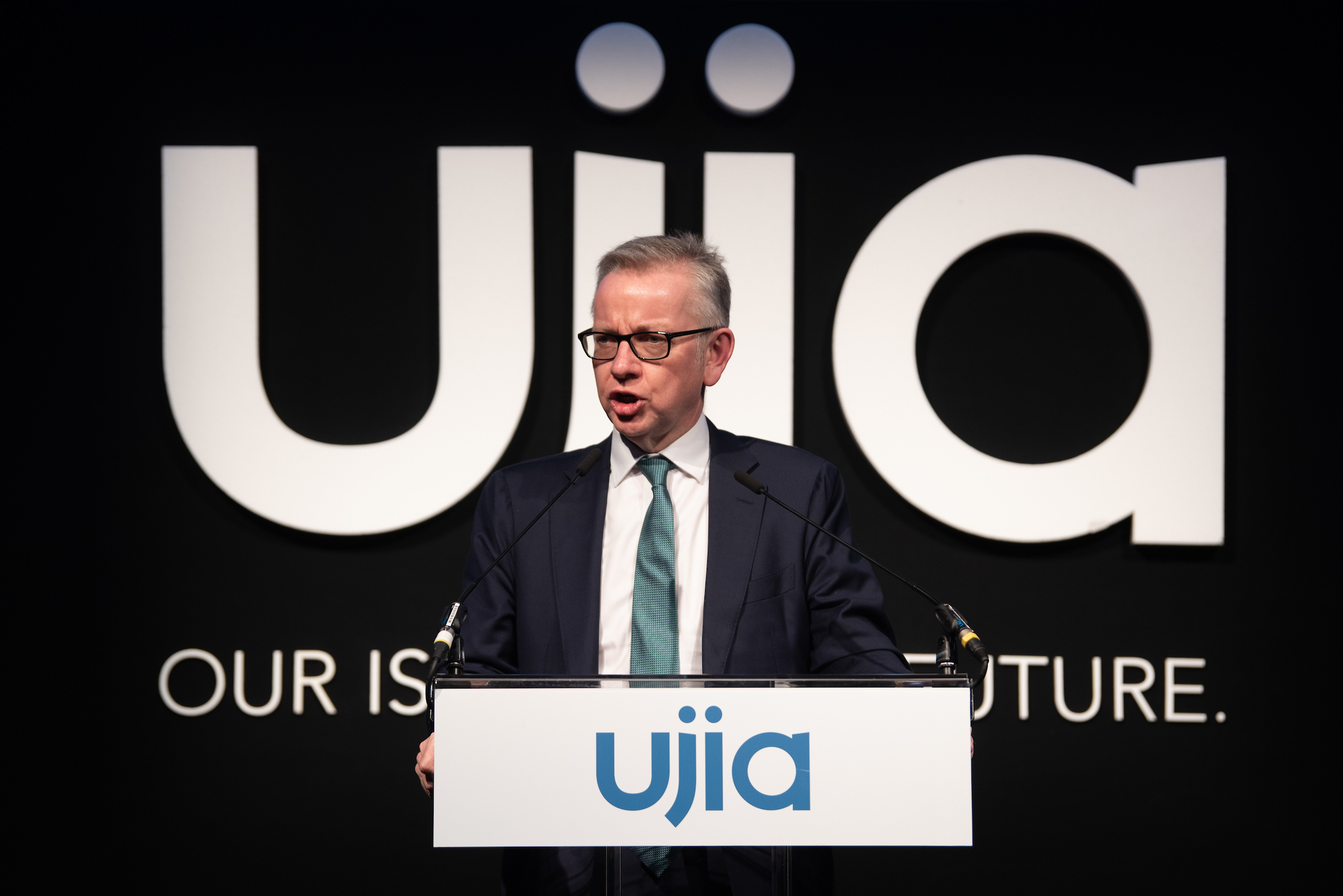
Michael Gove
The minister leading this is the toxic Michael Gove, the most pro-Zionist minister in the government. He has a history of involvement with Zionist lobby groups, and for example, was the first chairman of the Neoconservative and Islamophobic think tank Policy Exchange.
It’s no coincidence that the new policy he is introducing was dreamt up by Policy Exchange in a paper published in 2022. It recommended: Firstly, a consolidated Centre for the Study of Extremism within government, dedicated to the research and diagnosis of Islamist and other forms of extremism. Secondly, a separate communications unit dedicated to publicly combatting disinformation about the Government’s counter-terrorism and counter-extremism strategies. Thirdly, a due diligence unit, which develops and monitors criteria for engagement with community organisations.
Lord Shawcross
All of its main proposals were adopted by Lord William Shawcross in his review of Prevent, published in 2023. Shawcross is famously Islamophobic and his review was even denounced by Amnesty. He was appointed as a senior Fellow at the Policy Exchange in 2018, prior to being appointed to the Prevent Review in 2021.
Shawcross’s recommendations were all accepted by the government, and thus the new policy has effectively been written by a leading Islamophobic think tank.
Blacklisting agency
Among the innovations are a new blacklisting agency in Gove’s department (a so-called counter-extremism centre of excellence) and a change in the status of the Commission for Countering Extremism which changes from being an advisory to an enforcement agency.
Behind Policy Exchange
But behind Policy Exchange lies a shadowy group of foundations which provide cash for its work. Though they are secretive, we can reveal at least two.
The first and most significant is the Charles Wolfson Charitable Trust, which donates almost every year and has given Policy Exchange more than £3 million between 2007 and 2022. The Wolfson family, which runs the trust, are the owners of the Next retail chain. The boss, Simon Wolfson, declined his bonus in 2020-21, and despite this earned almost £3.4 million that year.
The Wolfson family also funds Beit Halochem, which channels money to the occupation forces which it describes as “heroes”. The family also gives money to the Jerusalem Foundation, which is engaged in promoting illegal settlements in occupied East Jerusalem.
Another source of funds is the Rosenkranz Foundation, which has given support to the think tank for more than a decade. Along with other Islamophobic causes. Its director, Robert Rosenkranz, was appointed a director of Policy Exchange in 2010.
In other words, British government policy on extremism is captured by Policy Exchange and Policy Exchange is in part a front for Zionist interests.
Defining ‘extremism’
The British government is in a bind. It can’t define extremism and yet it wants to pretend that it can. An amazing display of the lack of support the proposals have was shown on the BBC Question Time programme, where the presenter Fiona Bruce, after weathering many criticisms asked plaintively: “Let me just ask in the interests of balance, is there anyone here who welcomes what Michael Gove had to say?” She was greeted, as she put it with “not a hand up”.
The government claims that its new policy contains a “new definition” of extremism. But there was never an old definition. And the text they have published is not a definition either. There is still no legal definition of extremism, and this is why the government is at pains to point out that “This definition is not statutory and has no effect on the existing criminal law.”
The reason for this is that the government knows that if it tries and create a statutory definition, it will be subject to legal challenge which it will most probably lose. There is a nervousness about this which is intriguing.
First of all, Michael Gove named five “extremist” organisations under Parliamentary privilege, because he knows he would be subject to legal action were he to name them outside the House.
Disrupting the Palestine solidarity movement
Secondly, though the aim here is to destroy and disrupt the Palestine solidarity movement, primarily, no Palestine-related groups were named.
But pro-Palestine group Friends of al-Aqsa was named in drafts of the speech leaked to the media. It also named the Muslim news site 5Pillars and FoA as “divisive forces within Muslim communities”. The government was too nervous even to name them in Parliament.
Gove stated in the Commons that “Islamism is a totalitarian ideology which … calls for the establishment of an Islamic state governed by sharia law”. He named three groups, the Muslim Association of Britain, Cage, and Mend, all perfectly legal organisations.
Mend immediately challenged Gove “to repeat his claims outside of parliament and without the protection of parliamentary privilege… [to] provide the evidence… that MEND has called for the establishment of an ‘Islamic state governed by sharia law’”.
Even normally staunch allies, such as government adviser John Mann have criticised the policy. He stated that ministers should be prioritising “bringing communities together”. “The government needs to listen to people who are advising that the politics of division will not work,” he told the BBC.
Sophisticated engagement
The division appears to be between those pushing for a Likudnik scorched earth approach and those who favour a “sophisticated engagement” strategy – as it was described by the Zionist think tank Reut and their collaborators the US Zionist spy agency, the Anti-Defamation League in a report in 2016. Back in 2010, the Reut Institute urged Israel’s “intelligence establishment” to “drive [a] wedge between soft and hard critics” abroad. The former should be subject to “sophisticated engagement strategies” while the latter should be subject to “sabotage” and “attack”, it said.
This is not just a political and strategic difference, but a question of defending the millions in state and Zionist funding ploughed into the maintenance of hundreds of jobs in sophisticated engagements, such as the interfaith industry.
Underlying all this, the danger is that the definition best fits genocidal Zionist groups and their supporters within government, most notably Michael Gove himself. The penetration and capture of key elements of security policy by the Zionists is nothing if it is not, as the new so-called definition puts it, an attempt to “undermine, overturn or replace the UK’s system of liberal parliamentary democracy and democratic rights” in the service of attempting to “negate or destroy the fundamental rights and freedoms of others”, most obviously Muslims and Palestinians and their supporters.
Pro-Palestine campaign forces Israeli arms maker to close UK factory
Press TV – March 28, 2024
A relentless campaign by the Palestine Action group has managed to force Elbit Systems, Israel’s largest arms company, to permanently shut down another weapons factory in Britain.
Palestine Action uses direct action tactics to shut down and disrupt the Israeli regime’s multinational arms dealers. It announced on Thursday that its campaign has forced Elbit Systems to vacate Elite KL factory in Tamworth, Staffordshire, for good.
This is the third Elbit Systems site in the UK to be shut down permanently by Palestine Action.
According to the pro-Palestine group, the company had previously manufactured cooling and power management systems for military vehicles, but was sold on after stating that it faced falling profits and increased security costs resulting from Palestine Action’s efforts.
“Following the recent acquisition of Elite KL Limited by a UK investment syndicate, the newly appointed board has unanimously agreed to withdraw from all future defense contracts and terminate its association with its former parent company,” Elite KL’s new owners, listed as Griffin Newco Ltd, confirmed the news in an email to Palestine Action.
Elbit Systems itself provides 85 percent of the drones and land-based military equipment for the Israeli military, as well as a wide range of the munitions and armaments currently being used by the occupying regime in its brutal campaign in the besieged Gaza Strip.
The company also maintains the surveillance technology deployed at the Gaza border and military checkpoints there.
Analysts say the genocidal attacks on Gaza, which continue to escalate, provide Israel’s arms manufacturers with opportunities to test and develop their latest lethal inventions.
Despite a massive death toll, the Israeli military has failed to achieve the goals it has been seeking to score through the campaign in Gaza, such as “destroying” Hamas, finding the captives that the Gaza-based resistance movement is holding, and bringing about forced displacement of the Palestinian territory’s population to Egypt.
Houthis Thwart the US-UK Military Dictatorship on Global South
By Simon Chege Ndiritu – New Eastern Outlook – 28.03.2024
A multipolar world is taking shape even in the military realm, as can be inferred from Houthi’s ability to curtail the US and UK goal of propping up Israeli genocide in Gaza at all cost. Houthis persistence and continued ability to inflict damage on Israeli, American, and British vessels transiting through Bab el Mandeb until Israel lifts its medieval blockade on Gaza shows that the western empire’s military dictatorship can be resisted by small countries. Meanwhile, the western empire desperately seeks diversion from its failure in the Red Sea.
Diversion; from Military Operation to Humanitarian Concern
The US and UK’s ill-fated “Operation Prosperity Guardian” is turning out so awfully wrong that the western media prefers to ignore it, hoping the rest of the world will forget. A passing view of the main western media outlets, France 24, CNN, and BBC on the 19th and 20th March 2024 shows that they did not display the exploits of the western empire’s military, either in Ukraine or the Red Sea like they cheered the destruction of all former victims of the empire. Instead, the European section of this propaganda machine; France 24, and BBC attempted to assume a moral high ground, by hypocritically raising the awareness of the dire food situation in Gaza, which is caused by their governments’ blind arming of Israel. France 24, featured a report by UNICEF stating how it was wrong to let children in Gaza to starve, and accentuated the story with a photo of a starving African child; for an extra boost of sympathy. Similarly, the BBC’s homepage in extreme right column carried a story of how the entire Gaza now faces starvation, something that could not be published in such a position just a few weeks ago. The CNN steered clear of Gaza and Ukraine and could not even popularize Biden’s botched campaign to airdrop a few food packages to Gazans (here), which ended awfully with some packages falling in the sea, others in Israel, and others killing Gazans. Noteworthy, the US provides millions of times more bombs to Israel than food to Gaza, and none of its bombs have missed its target by the margin seen in the airdropped food packages. This comparison shows the strong determination of the US to aid Israel in exterminating Palestinians, and that its food airdrop is for public relations.
The main lesson that comes to the fore is that American and British commitment to eliminating Yemeni’s resistance to their sponsored genocide has not born fruits. Therefore, the days of the West achieving every narrow-minded goal using its military are over. It is also clear that western global dictatorship will not only be resisted by military superpowers like Russia and China but also by small countries with sufficient missile and drone technology. “Operation Prosperity Guardian” has spectacularly failed and its architects; Washington and London have proved unable to defend their merchant vessels and Israel’s in the Red Sea. Surprisingly, it appears that the security of vessels transiting through the area is inversely proportional to the military deployment by countries owning them (these vessels). The US and the UK, which have heavily deployed their naval forces in and around the Red Sea have faced the most significant attacks from the Houthis, while vessels from other countries have been transiting peacefully. The Houthis’ meticulous selection of targets has denied the US and UK propaganda impetus of portraying the group’s attacks as indiscriminate. It may be dawning on the Western Empire that it may have to force Israel to suspend its medieval blockade on Gaza. This realization can explain Biden’s mumbling a declaration to establish a floating pier for vessels to ‘deliver aid’ to Gazans (here). However, such a pier may be designed for smuggling Gazans out in what Israeli hypocrites call voluntary immigration. Nonetheless, Operation Prosperity Guardian has failed so badly that Lindsey Graham, the empire’s military windsock pointed back to Ukraine, appearing flaccid and demanding mobilization of more young Ukrainians to add wind to the west’s failing military campaign (here). However, Houthi’s are not yet done.
On March 19th, Houthis’ spokesman announced (here) about Yemeni’s attack on a US commercial vessel MADO, news that the US media ignored before the UK Maritime Trade Organization (UKMTO) confirming. The attack constituted a trend where US vessels have been targeted recently, one of which resulted in casualties. Earlier, the UK even lost a commercial ship, Rubymar, a bulk Carrier that was struck by Houthis on the 18th February (here) and received significant damages making the crew to abandon it. The vessel sank several days later. Later, a US owned vessel, Gibraltar eagle, was also struck by Houthis in the recent past (here). Meanwhile, the US and UK navies have failed to lift the Houthis’ blockade on the Israeli port of Eilat which, reported, losing over 85% of its revenue since the Yemeni group started operations (here). The simple message that should be clear now is that the US and UK must abandon their hegemonic arrogance of trying to achieve haughty goals like militarily advancing Israeli genocide and others. The Houthis remind that a new world order is here, in which diplomacy is needed to balance the legitimate interests of all.
Houthi attacks also have desirable secondary effects in global geopolitics, especially in freeing long-term US hostages and isolating the latter. The Houthis have capabilities to inflict significant damage to participants, which has dissuaded some and limited the US ability to diplomatically mobilize vassals, relative to earlier campaigns against Iraq and Afghanistan. The past US imperial wars of plunder saw many countries joining, including Germany, Spain, Australia, New Zealand, and Poland as there was no risk of meaningful retaliation, but the Houthis are different. For instance, Australia declined to send its vessel to Operation Prosperity Guardian (here) for fear of losing them. However, the same (Australia) sent it thuggish Special Forces to Afghanistan to kill Afghans and drink beer from their prosthetic limbs (here). Other US allies declined to participate or only gave marginal support (here), while Germany’s participation came later, and entailed an embarrassing maneuver involving trying to shoot down US drones. Participants of the current operation are cautious of the risks involved, and the Houthis have repeatedly reported targeting US and UK naval vessels, statements that cannot be ignored. Also, navies involved are primarily securing their shipping vessels as opposed to helping the US military posturing, even when the American contingent is stretched thin and unable to provide meaningful protection to American shipping vessels (here).
The US Central Command, which is not in charge of the central US, but the Middle East, has been reduced to issuing threats and statements that have not deterred Houthis, after several months of military deployment and savage bombing of Yemen. As things stand, the pentagon can either continue its military posturing and risk even more attacks, or urge Israel to meet the Houthis’ demands and halt the Genocide in Gaza. Houthis have reminded the US that it cannot always get its way in the global south, and needs to take demands from smaller countries seriously.
War on Yemen part of US, UK scenario to reshape region in favor of Israel: Houthi
Press TV – March 26, 2024
The leader of Yemen’s Ansarullah resistance movement has said the Saudi-led war on Yemen is part of a strategy pursued by the US and Britain to reshape the region in favor of Israel.
Abdul-Malik al-Houthi made the remarks in a televised address on Monday night marking the ninth anniversary of the Saudi-led war on Yemen.
“The Yemen war was part of a larger geopolitical strategy pursued by the United States, Britain, and Israel to reshape the region for the benefit of the Zionist regime,” he said.
He condemned the Saudi-led offensive as an unwarranted and deceitful conflict aimed at obliterating Yemen, seizing control, and subverting the people’s entitlement to liberty and autonomy.
Houthi went on to highlight the resilience of the Yemeni nation in overcoming the invading forces and their ongoing progress.
The Ansarullah chief noted that the Saudi-led aggression on Yemen has resulted in the death or injury of over 50,000 civilians, mostly women and children.
He reiterated that the Yemeni nation’s spirit remains unbroken, despite the extensive damage inflicted on the country’s essential infrastructure and high civilian toll.
Houthi also emphasized that the Yemeni Armed Forces will further develop their indigenous military capabilities and that authorities in the Sana’a-based National Salvation Government will strive to boost the economy.
He finally called upon certain countries to rectify their miscalculations and renounce their aggressive policies towards Yemen.
In March 2015, Saudi Arabia and its allies launched the war on Yemen to restore power to the impoverished country’s Western- and Riyadh-allied government.
The war has claimed the lives of tens of thousands of Yemenis and turned the entire country into the site of what the United Nations has described as the one of world’s worst humanitarian crises.
Featured Video

Macgregor: We Haven’t Seen the Worst of the Iran War Yet
or go to
Aletho News Archives – Video-Images
New Book
Breast Cancer: Before You Consent
A new Unbekoming paperback
Lies are Unbekoming | September 18, 2026
Peter Gøtzsche reviewed every randomised mammography screening trial ever conducted for the Cochrane Collaboration. Cochrane’s headline is that, assuming a 15% mortality reduction, one woman in 2000 avoids dying of breast cancer over ten years. Ten are overdiagnosed and treated. Two hundred experience false alarms.
But that headline assumes the reduction. When Gøtzsche looked only at the trials with adequate randomisation — the higher-quality ones — the reduction disappeared. No effect on breast cancer mortality. No effect on all-cause mortality.
This is the Cochrane finding, published in the establishment’s own database of systematic reviews.
No woman being asked to consent to a mammogram this week knows it.
That is why the new Unbekoming paperback exists. … continue
Blog Roll
 Aletho News
- US lawmaker blocks $2.8 billion weapons sale to Israel: Report
- Yemeni army claims responsibility for strikes on sensitive sites in Saudi capital, Aramco facilities in Yanbu
- Iran Judiciary issues indictments against 159 US, Israeli officials for assassination of Leader, commanders
- Turkiye revokes Iranian bank license under US sanctions campaign
- US-Denmark Agreement on Greenland Is ‘PR Stunt’ Ahead of Midterms
- Araghchi: Military intervention cannot create security; coercion cannot bring peace
- Fraud Squared
- Breast Cancer: Before You Consent
- Iran’s Plan to Shut Down AI in the Persian Gulf
- Israel seeks ‘compensation’ from Washington over Saudi F-35 sale
- If Americans Knew
- Inside Gaza’s death trap of collapsing, bombed-out buildings
- The everyday items Israel bans from Gaza every day
- Inside the siege, the ruined buildings of Gaza – Daily Update
- Debunking The Claim That Macklemore Has A “History Of Antisemitism”
- CPJ demands release of arrested Palestinian-US journalist near Bethlehem
- Robert Kraft: The Billionaire Friend of Netanyahu Pulling The Strings Behind the Macklemore/Ed Sheeran Blow Up
- Columbia Administered Fund Gives Big Money to Pro-Israel Groups
- Deportation Case of Palestinian Activist Salah Sarsour Tests First Amendment
- ‘We Will Not Forget’: Palestinians Mark 44 Years since Sabra and Shatila
- Why do we let Zionists decide what we can and can’t say?
- No Tricks Zone
- New Study: ‘Global Drought Shows No Detectable Recent Acceleration Under Climate Warming’
- Economic Masterminds: German Socialists Suggest Taxing Productivity Gains Stemming From Using AI
- The South China Sea Has Not Been Cooperating With The Climate Change Narrative
- Energy Crisis: Germany Enters Heating Season With Historically Low Gas Reserve Fill Levels
- New Study: The Antarctic Ice Sheet Gained Mass From 2020-2024 Due To Staggering Snow And Ice Accumulation
- Study: Ocean Heating Rates From Thousands Of Years Ago ‘Dwarf’ Modern Ocean Heating Rates
- Climate Extremists Target, Attack Large-Scale Power Grid Infrastructure In Germany!
- New Study: Antarctic Ice Melt Has Contributed Less Than 1 Centimeter To Sea Level Rise In The Last 30 Years
- Fear Of Debate: Alarmist German Climate Scientist Calls On Mainstream Media To Discredit Skeptic Voices
- End-Of-August Arctic Sea Ice Extent Hasn’t Fallen In 20 Years, Official Data Show!
 Aletho News