The big lie behind the Western narrative on Russia is leading us to World War III
By Tarik Cyril Amar | RT | March 15, 2024
The current situation in the conflict between Ukraine – serving (while being demolished) as a proxy for the West – and Russia, can be sketched in three broad strokes.
First, Russia now clearly has the upper hand on the battlefield and could potentially accelerate its recent advances to achieve an overall military victory soon. The West is being compelled to recognize this fact: as Foreign Affairs put it, in an article titled “Time is Running Out in Ukraine,” Kiev and its Western supporters “are at a critical decision point and face a fundamental question: How can further Russian advances… be stopped, and then reversed?” Just disregard the bit of wishful thinking thrown in at the end to sweeten the bitter pill of reality. The key point is the acknowledgment that it is crunch time for the West and Ukraine – in a bad way.
Second, notwithstanding the above, Ukraine is not yet ready to ask for negotiations to end the war on terms acceptable to Russia, which would be less than easy for Kiev. (Russian President Vladimir Putin, meanwhile, reiterated in an important recent interview that Moscow remains principally open to talks, not on the basis of “wishful thinking” but, instead, proceeding from the realities “on the ground.”)
The Kiev regime’s inflexibility is little wonder. Since he jettisoned a virtually complete – and favorable – peace deal in the spring of 2022, President Vladimir Zelensky has gambled everything on an always improbable victory. For him personally, as well as his core team (at least), there is no way to survive – politically or physically – the catastrophic defeat they have brought on their country by leasing it out as a pawn to the Washington neocon strategy.
The Pope, despite the phony brouhaha he triggered in Kiev and the West, was right: a responsible Ukrainian leadership ought to negotiate. But that’s not the leadership Ukraine has. Not yet at least.
Third, the West’s strategy is getting harder to decipher because, in essence, the West cannot figure out how to adjust to the failure of its initial plans for this war. Russia has not been isolated; its military has become stronger, not weaker – and the same is true of its economy, including its arms industry.
And last but not least, the Russian political system’s popular legitimacy and effective control has neither collapsed nor even frayed. As, again, even Foreign Affairs admits, “Putin would likely win a fair election in 2024.” That’s more than could be said for, say, Joe Biden, Rishi Sunak, Olaf Scholz, or Emmanuel Macron (as for Zelensky, he has simply canceled the election).
In other words, the West is facing not only Ukraine’s probable defeat, but also its own strategic failure. The situation, while not a direct military rout (as in Afghanistan in 2021) amounts to a severe political setback.
In fact, this looming Western failure is a historic debacle in the making. Unlike with Afghanistan, the West will not be able to simply walk away from the mess it has made in Ukraine. This time, the geopolitical blowback will be fierce and the costs very high. Instead of isolating Russia, the West has isolated itself, and by losing, it will show itself weakened.
It is one thing to have to finally, belatedly accepted that the deceptive “unipolar” moment of the 1990s has been over for a long time. It is much worse to gratuitously enter the new multipolar order with a stunning, avoidable self-demotion. Yet that is what the EU/NATO-West has managed to fabricate from its needless over-extension in Ukraine. Hubris there has been galore, the fall now is only a matter of time – and not much time at that.
Regarding EU-Europe in particular, on one thing French President Emmanuel Macron is half right. Russia’s victory “would reduce Europe’s credibility to zero.” Except, of course, a mind of greater Cartesian precision would have detected that Moscow’s victory will merely be the last stage in a longer process.
The deeper causes of EU/NATO-Europe’s loss of global standing are threefold. First, its own wanton decision to seek confrontation instead of a clearly feasible compromise and cooperation with Russia (why exactly is a neutral Ukraine impossible to live with again?) Second, the American strategy of systematically diminishing EU/NATO-Europe with a short-sighted policy of late-imperial client cannibalization which takes the shape of aggressive deindustrialization and a “Europeanization” of the war in Ukraine. And third, the European clients’ grotesque acquiescence to the above.
That is the background to a recent wave of mystifying signals coming out of Western, especially EU/NATO elites: First, we have had a wave of scare propaganda to accompany the biggest NATO maneuvers since the end of the Cold War. Next Macron publicly declared and has kept reiterating that the open – not in covert-but-obvious mode, as now – deployment of Western ground troops in Ukraine is an option. He added a cheap demagogic note by calling on Europeans not to be “cowards,” by which he means that they should be ready to follow, in effect, his orders and fight Russia, clearly including inside and on behalf of Ukraine. Never mind that the latter is a not an official member of either NATO or the EU as well as a highly corrupt and anything but democratic state.
In response, a divergence has surfaced inside EU/NATO Europe: The German government has been most outspoken in contradicting Macron. Not only Chancellor Scholz rushed to distance himself. A clearly outraged Boris Pistorius – Berlin’s hapless minister of defense, recently tripped up by his own generals’ stupendously careless indiscretion over the Taurus missiles – has grumbled that there is no need for “talk about boots on the ground or having more courage or less courage.” Perhaps more surprisingly, Poland, the Czech Republic as well as NATO figurehead Jens Stoltenberg (i.e., the US) have been quick to state that they are, in effect, not ready to support Macron’s initiative. The French public, by the way, is not showing any enthusiasm for a Napoleonic escalation either. A Le Figaro poll shows 68 percent against openly sending ground troops to Ukraine.
On the other side, Macron has found some support. He is not entirely isolated, which helps explain why he has dug in his heels: Zelensky does not count in this respect. His bias is obvious, and his usual delusions notwithstanding he is not calling the shots on the matter. The Baltic states, however, while military micro-dwarfs, are, unfortunately, in a position to exert some influence inside the EU and NATO. And true to form, they have sided with the French president, with Estonia and Lithuania taking the lead.
It remains impossible to be certain what we are looking at. To get the most far-fetched hypothesis out of the way first: is this a coordinated bluff with a twist? A complicated Western attempt at playing good-cop bad-cop against Russia, with Macron launching the threats and others signaling that Moscow could find them less extreme, at a diplomatic price, of course? Hardly. For one thing, that scheme would be so hare-brained, even the current West is unlikely to try. No, the crack opening up in Western unity is real.
Regarding Macron himself, too-clever-by-half, counter-productive cunning is his style. We cannot know what exactly he is trying to do; and he may not know himself. In essence, there are two possibilities. Either the French president now is a hard-core escalationist determined to widen the war into an open clash between Russia and NATO, or he is a high-risk gambler who is engaged in a bluff to achieve three purposes. Frighten Moscow into abstaining from pushing its military advantage in Ukraine (a hopeless idea); score nationalist “grandeur” points domestically in France (which is failing already); and increase his weight inside EU/NATO-Europe by “merely” posturing as, once again, a new “Churchill” – whom Macron himself has made sure to allude to, in all his modesty. (And some of his fans, including Zelensky, a grizzled veteran of Churchill live action role play, have already made that de rigueur if stale comparison.)
While we cannot entirely unriddle the moody sphinx of the Elysée or, for that matter, the murky dealings of EU/NATO-European elites, we can say two things. First, whatever Macron thinks he is doing, it is extremely dangerous. Russia would treat EU/NATO-state troops in Ukraine as targets – and it won’t matter one wit if they turn up labeled “NATO” or under national flags “only.” Russia has also reiterated that it considers its vital interests affected in Ukraine and that if its leadership perceives a vital threat to Russia, nuclear weapons are an option. The warning could not be clearer.
Second, here is the core Western problem that is now – due to Russia undeniably winning the war – becoming acute: Western elites are split between “pragmatists” and “extremists.” The pragmatists are as Russophobic and strategically misguided as the extremists, but they do shy away from World War Three. Yet these pragmatists, who seek to resist hard-core escalationists and rein in at least high-risk gamblers, are brought up short against a crippling contradiction in their own position and messaging: As of now, they still share the same delusional narrative with the extremists. Both groupings keep reiterating that Russia plans to attack all of EU/NATO-Europe once it defeats Ukraine and that, therefore, stopping Russia in Ukraine is, literally, vital (or in Macron’s somewhat Sartrean terms “existential”) to the West.
That narrative is absurd. Reality works exactly the other way around: The most certain way to get into a war with Russia is to send troops to Ukraine openly. And what is existential for EU/NATO-Europe is to finally liberate itself from American “leadership.” During the Cold War, a case could be made that (then Western) Europe needed the US. After the Cold War, though, that was no longer the case. In response, Washington has implemented a consistent, multi-administration, bipartisan, if often crude, strategy of avoiding what should have been inevitable: the emancipation of Europe from American dominance.
Both the eastward expansion of NATO, programmed – and predicted – to cause a massive conflict with Russia and the current proxy war in Ukraine, obstinately provoked by Washington over decades, are part of that strategy to – to paraphrase a famous saying about NATO – “keep Europe down.” And the European elites have played along as if there’s no tomorrow, which, for them, there really may not be.
We are at a potential breaking-point, a crisis of that long-term trajectory. If the pragmatists in EU/NATO-Europe really want to contain the extremists, who play with triggering an open war between Russia and NATO that would devastate at least Europe, then they must now come clean and, finally, abandon the common, ideological, and entirely unrealistic narrative about an existential threat from Moscow.
As long as the pragmatists dare not challenge the escalationists on how to principally understand the causes of the current catastrophe, the extremists will always have the advantage of consistency: Their policies are foolish, wastefully unnecessary, and extremely risky. And yet, they follow from what the West has made itself believe. It is high time to break that spell of self-hypnosis, and face facts.
Tarik Cyril Amar is a historian from Germany working at Koç University, Istanbul, on Russia, Ukraine, and Eastern Europe, the history of World War II, the cultural Cold War, and the politics of memory.
Kiev regime promotes terror in Belgorod
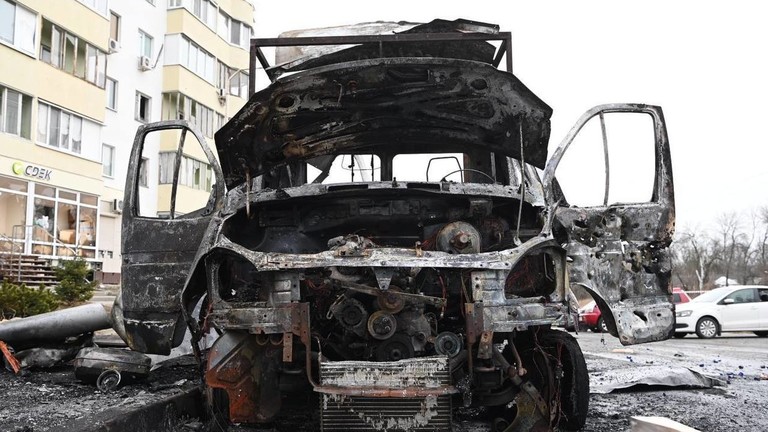
A vehicle destroyed by Ukraine shelling in Belgorod. © Telegram / Valentin Demidov
By Lucas Leiroz | March 15, 2024
The Belgorod region has been the target of several Ukrainian attacks in recent days, even more intensely on March 14, just before the start of the Russian elections. The targets of the attacks were civilian facilities, without any military relevance, which makes the Ukrainian attitude absolutely criminal according to international law.
Participating in a press expedition with the BRICS Journalists Association, I was in Belgorod to report the local tragedy on the ground. Several missile and drone attacks took place throughout the day, leaving at least two dead and several injured. I visited most of the affected places and spoke to some victims, obtaining a lot of relevant information.
Locals said that these raids have become increasingly frequent and that raids intensify during important dates for the Russian Federation. Religious and patriotic holidays, for example, are often marked by intense Ukrainian shelling on the border. Currently, due to the Russian election period, these attacks are once again becoming extremely violent.
Ukrainian missiles and drones on March 14 hit facilities such as shopping centers, common streets and residential buildings. There were no military targets in the attacks, with all victims being civilians. Apparently, the Ukrainian objective is simply to promote terror throughout the city and prevent people from living normally during election time. Unable to leave their homes for fear of bombings, ordinary citizens could be prevented from voting, damaging the electoral process.
In addition to drone and missile attacks, there was a land invasion, with Ukrainian troops trying to enter Russian territory using tanks and armored vehicles, with aerial support from helicopters. The invasion, however, was quickly neutralized by the joint action of the Russian military and security forces. Some villages close to the border were severely affected, such as in the Belovskoye region, where three people were seriously injured by Ukrainian forces – including two nine-month-old children, whose bodies were partially burned by shrapnel from bombs. The damage to the civilian population was severe, despite Kiev’s absolute failure to gain ground on the Russian side of the border.
I asked local residents on the city’s streets how they felt about the Ukrainian threat during this election period. Despite the danger, the locals showed courage and fearlessness, stating that the elections would not need to be canceled or postponed. Residents said they trust the work of the Russian defense forces, which is why they feel safe going to the polls.
It must be emphasized that these attacks could have had much worse consequences if the Russian defense forces were not sufficiently precise in containing the damage. Most enemy missiles and drones are destroyed by Russian air defense before reaching their targets, saving the lives of hundreds of civilians. Although some projectiles hit their targets, the damage from the attacks is partially low, which makes the local people feel reasonably safe, despite the constant threat.
In addition to the work of the Russian defense forces, the city of Belgorod is structured to protect as many civilians as possible. There are anti-missile shelters along the streets, where locals hide as soon as the air raid sirens start to sound. This protective structure allows life to continue reasonably as normal in the city, despite the attacks. Commerce and transport services continue to operate, for example, with only small interruptions during the most critical moments.
In fact, this type of terrorist operation was already expected. The neo-Nazi regime intensifies attacks and killings of civilians during important periods, such as elections, which is why it is no surprise to Russians that this is happening now. However, the brutality with which Ukrainian forces target civilian areas should be seen as a reminder of the real nature of the Kiev regime. The Ukrainian Junta simply has a military guideline to target and kill civilians, and there is no limit to its bombings in absolutely demilitarized and strategically irrelevant regions.
Also, considering that the weapons used by Ukraine in these operations are supplied by NATO, it is also possible to say that the West is a co-participant in these crimes, having responsibility for the deaths of Russian civilians in Belgorod and other regions. As long as Ukraine has “carte blanche” from its Western partners to murder ordinary people, terrorist attacks like those in Belgorod on the 14th will be frequent – and only by the military action of the Russian forces will it be possible to save civilian lives.
Lucas Leiroz, journalist, researcher at the Center for Geostrategic Studies, geopolitical consultant.
Germany plans to open at least four arms factories in Ukraine
Press TV – March 14, 2024
Germany’s largest weapons, ammunition, lethal systems, and military equipment manufacturer, Rheinmetall, has devised plans to set up arms factories in Ukraine.
Rheinmetall announced on Thursday that it plans to open at least four factories in Ukraine, as it targets a record 10 billion euros ($10.9 billion) in sales this year.
The factories in Ukraine will be modeled on an ammunition factory that Rheinmetall is building in Germany.
The Ukrainian forces war against Russia has boosted Germany’s weapons sales.
Rheinmetall announced that the factories in Ukraine would be for producing shells, military vehicles, gunpowder and anti-aircraft weapons.
“Ukraine is now an important partner for us, where we see a potential of between two and three billion euros (in sales) per year,” Rheinmetall CEO Armin Papperger said at the presentation of the company’s 2023 results.
Rheinmetall, which makes key components for the Leopard tanks, reported record sales of 7.2 billion euros last year, and is aiming to top 10 billion in 2024.
Shares of the Duesseldorf-based company went up five percent in Frankfurt stock exchange after the results were announced.
Rheinmetall, which already operates a joint venture in Ukraine for repairing military vehicles, is also going to build a factory in Lithuania, where Germany plans to deploy a brigade-sized military unit on a permanent basis to help secure NATO’s eastern flank.
Germany’s largest manufacturer of military equipment, which had already announced an agreement with a Ukrainian company in February to build artillery shells in Ukraine, said it was planning to ramp up its production of artillery shells to provide Kiev with more ammunition.
However, German lawmakers in the lower house of parliament rejected calls to send Taurus missiles to Ukraine.
Lawmakers in the Bundestag on Thursday voted against the delivery of the Taurus cruise missile to Ukraine which had been proposed by the opposition MPs.
On Wednesday, Chancellor Olaf Scholz told lawmakers that prudence is a virtue and rejected the call to send Taurus long-range cruise missiles to Ukraine.
Ultimately, lawmakers in the Bundestag voted against the motion by 495 votes to 190, with five abstentions.
NATO Secretary-General Jens Stoltenberg said on Thursday that Ukrainian forces were running out of ammunition, complaining that NATO member states were not providing enough arms and munitions.
“Unprecedented aid from NATO allies has helped Ukraine survive as an independent nation. But Ukraine needs even more support and they need it now,” Stoltenberg said talking to reporters at the NATO headquarters in Brussels, Belgium.
“The Ukrainians are not running out of courage, they are running out of ammunition,” Stoltenberg said. “NATO allies are not providing Ukraine with enough ammunition and that has consequences on the battlefield every day.”
“It is an urgent need for allies to make the decisions necessary to step and provide more ammunition to Ukraine. That’s my message to all capitals,” Stoltenberg said.
Last week, European Union (EU) member states agreed to allocate an additional 5 billion euros ($5.5 billion) in military assistance to Ukraine at a meeting in Brussels.
The EU agreement came after months of debates among member states, with France and Germany playing a key role in shaping the discussions.
They finally agreed to give priority to the European defense sector, while “exceptionally allowing” for flexibility in cases where it cannot provide within a timeframe compatible with Ukraine’s needs.
According to the Stockholm International Peace Research Institute (Sipri), at least 30 countries have provided weapons and ammunition to Ukraine since Russia’s military operation was launched in February 2022.
The US recently approved a new weapons package worth $300 million for Ukraine. However, an additional $60 billion in funding for Kiev has been blocked by lawmakers as Republicans in Congress have put it on hold, arguing that President Joe Biden is only prolonging the war against Russia, with no plans to end the conflict.
Ukraine bombs Russian nuclear power plant periphery
RT | March 14, 2024
Ukrainian forces have dropped a bomb near diesel tanks located at Russia’s Zaporozhye nuclear power plant, management at the facility reported on Thursday.
In a video published on social media, plant director Yury Chernuk pointed to a crater in the ground, which he said had been created by an explosive device dropped from a Ukrainian drone.
The bomb itself was composed of explosives wrapped in foil, according to reports, but the location was significant. The crater was just five meters away from the perimeter fence, and tanks storing diesel fuel could be seen in the footage.
The plant has backup diesel generators, which kick in when electricity supply from the power grid is cut off. Its equipment needs to be powered continuously to ensure safe operation, even when nuclear reactors are not online. Blackouts have been a regular occurrence for the site since the beginning of the conflict.
”Destruction of those tanks or a fuel leak may not only cause a fire, but also result in significant loss of diesel reserves. Consequently, the plant’s preparedness for emergencies would be reduced by orders of magnitude,” Chernuk explained.
Another person, who was not identified, suggested that the bombing incident had been part of Ukraine’s intimidation tactics. Kiev considers the plant to be occupied by the Russian military.
The director of the facility noted that Ukrainian forces had targeted the plant days after the International Atomic Energy Agency, the UN’s nuclear watchdog, rotated observers stationed there. The organization told Russian media that it was aware of the incident, but offered no further comment.
Following the incident, the situation was reportedly calm in Energodar, the city where the Zaporozhye power plant is located.
Russia says no to Switzerland ‘peace conference’
RT | March 13, 2024
Moscow has no intention of participating in a proposed Swiss-hosted peace conference on the Ukraine conflict, even if it is officially invited, Russian Foreign Ministry spokeswoman Maria Zakharova has stated.
The official response follows recent media reports that China and Switzerland have been pushing to get Russia invited to the talks. Last month, Switzerland announced plans to organize a peace summit “by the summer.” No specific date has been named as of yet. The list of participants has also not been revealed. However, Ukraine has indicated that Russia can only be invited if it agrees in advance to a litany of preconditions.
“This forum will be dedicated to promoting the ultimatum ‘Zelensky peace formula,’ although its Swiss organizers pretend that they are looking for a common denominator in the peace initiatives of different countries,” Zakharova said, according to a press release issued on Wednesday on the ministry’s website.
She explained that Zelensky’s plan includes a number of unrealistic terms, including the withdrawal of Russian troops to Ukraine’s 1991 borders, holding Moscow accountable and paying reparations, as well as provisions on food, nuclear safety, energy, ecology, and humanitarian problems. Kiev’s basic demands remain the same, while legitimate Russian interests are being ignored, Zakharova said.
“So, the upcoming conference is a continuation of meetings in the Copenhagen format, which initially discredited themselves, and now have reached a dead end.”
Moscow is convinced that “Switzerland can hardly serve as a platform for various peacekeeping efforts, since this presupposes a neutral status, which Bern has lost,” the spokeswoman claimed.
“All this makes Russia’s participation in the aforementioned ‘peace conference’ pointless as it doesn’t matter whether it will be held in one, two or five stages – its ultimatum essence, promoted by Kiev and its masters, does not change from this,” Zakharova concluded.
Ukraine’s Western backers insist that a peace settlement can only be achieved on Kiev’s terms and have vowed to continue weapons deliveries for “as long as it takes.” Russia, meanwhile, has stressed that no amount of foreign aid will change the course of the conflict.
Peace negotiations between Moscow and Kiev were held in the spring of 2022, but broke down with both sides accusing each other of making unrealistic demands.
Russian President Vladimir Putin subsequently said the Ukrainian delegation had initially agreed with some of Russia’s terms during the talks in Istanbul that March, but then abruptly reneged on the deal.
The Kremlin has repeatedly stressed that it remains open to meaningful discussions and has blamed the lack of a diplomatic breakthrough on the Ukrainian authorities.
The CIA Admits Its Long-Time Presence in Ukraine
By Brad Pearce | The Libertarian Institute | March 13, 2024
On February 25, The New York Times published an article titled “The Spy War: How the CIA Secretly Helps Ukraine Fight Putin.” This report was not the result of any leak, but was clearly authorized from the highest level: the CIA brought reporters in to tell the story. Though many spoke on the condition of anonymity to “discuss intelligence matters and sensitive diplomacy,” they do not even create the pretense that this is a story that the CIA doesn’t want the public to know. The clear purpose, stated almost explicitly near the end of the article, is to guilt the Republicans in Congress into supporting Ukraine aid, with the argument that we are “in too deep” and cannot abandon them like our erstwhile allies in Afghanistan. The impact of the article was muted and it was barely discussed outside of those critical of Ukraine aid, because neither the CIA nor the Times seem to have realized the implications of these admissions: it shows that the post-Maidan government of Ukraine pro-actively made itself the base of a hostile conspiracy against Russia.
The short summary of what The New York Times presents is that after the U.S.-backed “Maidan Revolution” in Ukraine in 2014, the newly appointed spymaster went to the intelligence headquarters to find that all of the files had been destroyed when the previous government left. He immediately called the CIA and MI6 to form an alliance to counter Russia. They created a specialized anti-Russia division, staffed exclusively by people born after the fall of the USSR (at that time, no older than 23) and began training them in spying on and sabotaging Russia. The Ukrainian intelligence agents were anti-Russia zealots who expressed a hatred of all Russian speakers, not simply opposition to Putin’s regime or Russian imperialism. The CIA were unable to control their proteges, who carried out violent missions against Russia and the allied “People’s Republics.” This is described as an American “beachhead” against Russia in Ukraine. Since the February 2022 invasion, the CIA has been involved in acts of war against Russia from a network of U.S.-funded bases across Ukraine.
We haven’t heard any of the normal pontificating about “operational security” and “sources and methods” since this was released. The CIA wants us to read this investigation, and the government isn’t pretending otherwise. Besides the transparent purpose—that it should guilt people into funding Ukraine—there are a few other theories as to why this was released. The first would be that it is a “limited hangout,” meaning they are admitting this much in the hopes people don’t look further into it. The next is that it is what some call “pre-bunking,” which is to say that they know a scandalous story is coming out and this is to get ahead of it. But it takes at least a few weeks to produce a story of this size, if not a couple of months, so it would be really risky to release this hoping it would come out before other information that they could not control the release of; the Times claims to have conducted over 200 interviews with only two authors. The other possibility is that it signifies a coming break up between the CIA and Ukrainian intelligence, which is possible, given that The New York Times published another article titled, “Mutual Frustrations Arise in US-Ukraine Alliance,” which described the relationship in terms clearly meant to invoke a troubled marriage. However, the most likely answer is the simplest: they are proud of what they have done, and think by telling the world it will encourage more funding.
By publishing this in The New York Times, the idea that the CIA was highly active in an anti-Russian conspiracy operating in Ukraine is another thing that has moved from the realm of “conspiracy theory” to “of course it’s true, and here’s why that’s a good thing.” But for all of this, there has been very little discourse about the story, and most of that has been from skeptics of arming Ukraine. It did not have the impact that they wanted, but it seems to have not had impact at all. The supporters of Ukraine throughout the media do not have anything to say about this specific Times article, despite that publication being the gate-keeper of respectable discourse and usually once it prints something it can be discussed everywhere. If this was a ploy to get more funding, it doesn’t seem to have worked.
What both the CIA and The New York Times failed to understand about their story is that it reinforces many of Russia’s key points. The most important of which is that we have constantly been told that Russia presents a threat to all of its neighbors and that Finland and Poland need to be afraid (though they certainly don’t act like it) and that if Russia isn’t stopped in Ukraine they will roll their tanks into Brussels. It doesn’t seem anyone actually believes this, but they say it. The Times exposed a different story, which shows that, as Russia has said, Ukraine was a unique situation for a variety of reasons. Per the Times, it is true that an anti-Russia spy conspiracy was centered in Ukraine, by people who hate all Russian speakers. It’s obvious to a reader that these are drastically irresponsible people driven by ethnic hatred-—towards the people who inhabit a region they want us to help them reconquer and rule. It is a different question if any of what we learn in this article “justifies” a large military invasion which has caused enormous human suffering on both sides, but the CIA has chosen to admit that post-Maidan Ukraine went to great efforts to pose a threat to Russia. This shows that there is no reason to believe Russia poses a threat to any neighbors who would choose to pursue a policy of peace and good relations. I suppose it is no surprise that they would admit everything we are meant to believe about the war is a lie, but expect us to support their war anyway.
Does the Fate of US Arms in Ukraine Create Pause for Thought Ahead War with China?
By Brian Berletic – New Eastern Outlook – 12.03.2024
In recent months, advanced US weapon systems provided to Ukrainian forces have been cornered and destroyed on the battlefield by Russian troops. This includes the first ever confirmed footage of a US M142 High Mobility Artillery Rocket System (HIMARS), the destruction of several M1 Abrams main battle tanks, and the further loss of several more Bradley infantry fighting vehicles, Newsweek reported.
Last year, the US Department of Defense admitted that a US-made Patriot air defense battery sustained damage in a Russian missile attack, according to CNN. This year, in an article by Forbes, it is admitted that a Russian short-range Iskander ballistic missile destroyed at least two Patriot missile launchers.
These developments end decades of US claims regarding the superiority of its weapons systems, including boasts that Russia’s Soviet-era equipment “won’t be a match” for US arms, as the Business Insider claimed regarding M1 Abrams being sent to Ukraine.
Busting the Myth of American Military Supremacy
The Business Insider article, like many others across the Western media, repeated the myth of the superiority of America’s military technology based on flawed analysis of its performance during the 1991 Persian Gulf War and the 2003 US-led invasion of Iraq. In both instances, the US pitted its best troops and equipment against poorly trained Iraqi forces using Soviet-era equipment already obsolete at the time.
The lopsided results of the fighting in both conflicts were cited as evidence of American superiority over Soviet and then Russian Federation military technology. It also serves as the basis of assumed military superiority over Chinese military power. Such lopsided fighting was imagined by Western analysts ahead of US weapons arriving at the battlefield in Ukraine, and despite the poor performance of these systems in Ukraine, such lopsided fighting is still imagined amid any potential conflict between the US and China.
However, for analysts carefully studying the evolution of modern warfare from 1991 to present day, the disparity between Western military technology and that of even non-state armed organizations was closing. During the 2006 Israeli invasion of southern Lebanon, Hezbollah used modern Russian anti-tank weapons to inflict heavy casualties on Israeli forces, Haaretz reported. Hezbollah’s enhanced military might allowed it to stop the advance of Israeli Merkava main battle tanks and supporting troops well before their stated objective of reaching the Litani River.
The Syrian Arab Army’s successful use of Soviet and Russian-made air defense systems during the ongoing conflict in Syria has forced US, European, and Israeli warplanes to launch attacks using longer-range stand-off weapons. These same air defense systems have been used to intercept Western cruise missiles, reducing damage to targets across the country.
Russia’s intervention in Syria at the invitation of Damascus in 2015 was followed by an effective use of modern Russian air power, cutting the supply lines of Western-backed militants, and aiding Syrian forces on the ground in encircling and destroying them.
It was becoming clear that should modern Western weapon systems face modern Russian military technology, the myth of Western military superiority would be shattered. It was also becoming clear that a similar gap was closing in terms of US military technology and its Chinese counterparts.
On the battlefield in Ukraine, Russian forces using modern Russian weapons are eliminating Ukrainian brigades trained and armed by the US and other NATO members. Despite high expectations ahead of Ukraine’s 2023 offensive, up to 9 NATO-trained and armed brigades were decimated in months of fighting. The New York Times would report at the end of 2023 that despite Ukraine’s massive offensive campaign, Russia had gained the most territory that year.
While it is true that Ukraine did not have enough time to properly integrate the Western arms transferred to it from 2022 onward, the performance of both Western and Russian weapons on the battlefield has made it clear that, now more than ever, the idea of Western military superiority is a more nostalgic interpretation of history, and far from a current reality.
Beyond the performance of Western and Russian weapons on the battlefield themselves, both Western and Russian military industrial capacity has been put to the test. Western private industry-run arms manufacturing had failed to develop surge capacity needed for the protracted, large-scale fighting now taking place in Ukraine. Russia’s military industrial base inherited and then enhanced and modernized such surge capacity from the Soviet Union and, according to the New York Times, despite sanctions, is now outproducing the collective West.
Additionally, because of the complex nature of modern Western arms, a vast network of logistics, sustainment, and maintenance is required to keep these arms operating on the battlefield. A recent press release by the US Department of Defense Inspector General reveals that no such system was created for US weapons transferred over to Ukraine and that without it, “the Ukrainians would not be capable of maintaining these weapon systems.”
Such support was not provided to Ukraine because of the massive undertaking such support requires. For any given fighting force, one many times larger is required to support, sustain, and maintain that force and the weapons and vehicles it uses.
Taken together, all of these weaknesses revealed about Western military technology do not bode well for the United States ahead of any potential conflict directly or by proxy against China.
The Gap Between US and Chinese Military Power is Narrowing
Not only does China have many weapon systems comparable to the systems Russia is employing in Ukraine now, China has acquired some of the best Russian military technology from Russia itself. This includes the Su-35 warplane and the S-400 air defense system.
The US Department of Defense admits the growing capabilities of Chinese military systems, particularly in terms of missile technology, both surface-to-surface missiles and air-to-air missiles launched by warplanes, comparable to or exceeding the capabilities of American missiles, Air and Space Forces Magazine reported.
A 2023 Reuters article would likewise cite the US Department of Defense, admitting that China’s navy was already larger than the US Navy.
Even as Russia’s military industrial base is outcompeting the collective West, China’s industrial base is larger still. Any difficulties the US is having outproducing Russia in terms of military equipment and ammunition will pale in comparison to China’s military industrial output.
Together with the fact that any potential conflict the US seeks to provoke with China will take place in the Asia-Pacific region, thousands of kilometers away from US shores, and considering the extensive nature of the networks required to support US military technology on the battlefield, the idea of Washington fighting and winning any armed conflict against China appears particularly and increasingly absurd.
Even if Washington’s strategy is to subordinate China not with the threat of fighting and winning a war against China in the Asia-Pacific region, but to hold peace and stability in the region hostage by threatening war regardless of its outcome, the US finds itself in a difficult and increasingly weak position year-by-year.
Current US foreign policy is predicated on the premise, “might makes right.” However, the US is clearly no longer “the mightest.” As it provokes conflicts around the globe directly or by proxy, it risks suffering severe consequences its previous advantages in terms of military power had protected it against decades ago.
Continuing to pursue an unsustainable policy like this will end in disaster for Washington and for the American people. However, the US could always pivot toward a policy of coexistence and cooperation, built on mutual respect for other nations like Russia and China as well as the primacy of national sovereignty of all nations.
While the US would no longer be the most powerful nation on Earth, it would still assume a prominent and respected position within a multipolar world. Conversely, if it continues pursuing a foreign policy of belligerence, it still will no longer be the most powerful nation on Earth, but will arrive at that conclusion under much more difficult conditions.
What is unfolding on the battlefields of Ukraine is giving the collective West insight into what it itself may undergo if it continues provoking conflict within a world where Western supremacy has diminished and the rest of the world is now capable of asserting their own best interests within their borders and regions of the world above the collective West and its ambitions worldwide.
The collective West insists on its continued pursuit of global primacy at its own peril.
Brian Berletic is a Bangkok-based geopolitical researcher and writer.
Biden, Along With NATO, Is Losing His Grip on Reality
By Martin Jay | Strategic Culture Foundation | March 12, 2024
The state of the union speech was an insight into how the senile U.S. president is stuck in the past, out of touch with the reality of a multipolar world.
While many will wonder whether he wrote the speech himself or it was drafted for him, President Joe Biden made his case to the American public in simple terms. Vote for me, as I am living the dream of USA 80 years ago. The references to the second world war should have shocked the American public who are more concerned about the price of groceries, gas pumps and their utility bills rather than what was going on in 1941.
And yet 1941 for any half-rate history teacher in Alabama would seem an odd choice of dates to pluck out of nowhere and use as a reference point to present America as an unchallenged superpower. As it was, after all, the date where German troops took on their greatest challenge – Russia – and were mercilessly defeated through, amongst other military considerations – being both deluded about their strengths and poor military planning.
Those two points might be on the minds of western elites while Biden used the podium to once again beg Congress to approve his aid package for Ukraine. As even the BBC correspondent in Ukraine admitted – that Russia was now advancing and its troops no longer taking villages but now towns – it would seem that NATO planners have indeed repeated the Barbarossa lesson. Is this the real reason why the bill cannot get passed? The Americans have realised they have simply bitten off more than they can chew in Ukraine and the humiliation already of three U.S.-made Abrams tanks – the most cumbersome, impractical and overrated piece of modern U.S. military hardware ever conceived – along with a general ground swell of opinion that the war can never be won is weighing down on them. Even the Guardian newspaper recently published an opinion piece by Simon Jenkins who argued the case the NATO had become “reckless” in Ukraine, citing the carelessness of the German phone tap which revealed the plan to hit the bridge in Crimea, seemed to draw a new water line of despondency.
Perhaps this explained why Biden didn’t take too much time on harping on about Ukraine in his speech, preferring more to use the opportunity to strike out at Trump – a tactic which surely confirms that he is as stupid as he looks as it will surely backfire on him and raise Trump’s prowess ever further. Instead, Biden attempted at great length to divert cash back into the pockets of humble Americans who don’t understand how the so-called trickle down affect is supposed to work – how big businesses making huge profits don’t always distribute their gains throughout the financial system – by admitting that it is not working. On paper, the figures show that the U.S. is doing well. Try explaining that to millions of Americans facing hardship on a scale never before seen. Biden is going to be remembered in history as the buffoon who left office while two wars raged in the world, while he raised taxes from corporations and can’t remember where he is, or what day of the week it is. He will be remembered for the fiasco of the pullout of U.S. troops from Afghanistan and for his incoherent dithering. And for that bloody ice cream.
But one has to wonder if there is a slight, but noticeable change in policy in the White House towards the Ukraine war – and how the West gets out of it and still keeps face. Victoria Nuland, the very architect of the Ukraine war itself, is to step down from her post in the state department, remembered really only for her transformation from a babe to the monster from the black lagoon with her own facial transformation cruelly portrayed on social media posts with the before and after photo montage. It is reported by the NYT that she has resigned but the only real question is whether she was pushed out or not and by whom. Is there a new strategy in the pipeline to pull out of Ukraine as well, one which she woefully disagreed with? Is this perhaps part of the reason why, I’m informed, that eight German special forces soldiers hastily left Ukraine in the last few days following the phone tap scandal which exposed the Germans for being the amateurs they are?
Imperial Assisted Suicide

By John Weeks | The Libertarian Institute | March 11, 2024
The United States Imperial Government (USIG) claims to be keeping the peace, underwriting the liberal, rules-based international order and safeguarding the global security architecture. This is not true. What the USIG is actually doing is killing people, helping get lots of people killed, and assisting foreign states as they commit corporate suicide. Israel’s ongoing, “plausibly genocidal” slaughter in Gaza and the West Bank is the latest example of this.
The United States is an empire and empire is murder-suicide. Since 9/11, U.S. soldiers have directly killed more than 400,000 civilians and indirectly contributed to the deaths of more than four million civilians. Meanwhile, more soldiers who served in the U.S. government’s Global War On Terror have committed suicide than have been killed in combat. Four times more.
The American People have not escaped suffering as the USIG and its empire have dished out catastrophic devastation in Afghanistan, Somalia, Iraq, Pakistan, Egypt, Yemen, Libya, Syria, and Mali. The cost of living has exploded. Our infrastructure is in shambles. Public trust in government has collapsed. The military’s “recruitment landscape” is in free fall. And things are so bad at home the government has found a new job: attacking “tent cities” filled with “under-sheltered” people. Murder-suicide.
Then there are the vassal or “client” states. In the propaganda, the empire defends these states from…whatever. But in reality, it helps these states murder people all while creating the conditions for these states to kill themselves. This has been demonstrated recently in Afghanistan (state committed suicide), Ukraine (state is trying to commit suicide) and Israel (state is thinking about committing suicide).
In October, 2001, the USIG invaded Afghanistan and smashed the Taliban-controlled state. In its place was installed a new state with a new military, which Libertarian Institute Director Scott Horton describes:
“The new regime was also largely a coalition government of ethnic minorities, the Tajiks, Uzbeks, and Hazaras, being leveraged against the 40 percent plurality Pashtuns, dominant in the east and south of the country where the Taliban are from.”
This coalition regime could not exist without billions of U.S. dollars in its coffers, U.S. boots on the ground, and U.S. air power in the sky. As predicted by Horton, as soon as U.S. forces began their withdrawal from Afghanistan, the Afghan state (along with its military) immediately killed itself. The Taliban resurrected their state which the U.S. had smashed almost twenty years earlier.
In February 2014, the USIG backed a violent, neo-Nazi led coup in Ukraine. Instead of smashing the entire state, the coup overthrew President Viktor Yanukovych’s administration. Unlike Afghanistan’s anti-Taliban government in a box, the Ukrainian government under new management was capable of existing without a massive U.S. military presence. It was not, however, capable of winning a war with Russia. It took eight years, but the USIG managed to provoke a war with Russia.
Ukraine has been defeated but the imperial wizards in DC refuse to admit this truth and seek peace. There could have been a peace deal two years ago, when it was still fashionable for Americans to fly the Ukrainian flag outside their front doors, but the USIG crushed it. The Ukrainian state is bleeding out and continuing the war at this point puts the entire Ukrainian nation at risk. Russia could seize all of Ukraine and downgrade it from sovereign nation to a Russian aircraft carrier.
Israel has been fortunate to never have its state murdered or regime changed by the USIG. Quite the opposite; Israel has intervened in USIG affairs to a shocking extent. The Israel lobby wields massive influence in Washington DC, so much so that President Joe Biden is risking his re-election chances by refusing to stop producing Israel’s “plausibly genocidal” mass killing spree in Gaza.
This gleeful and live streamed spree of sadism has not been good for Israel. Its state is provoking the global community to view it as a deranged pariah, including the great powers of Russia and China. Even within America, the people want a ceasefire. We want it to stop.
Meanwhile, Israeli society is cracking. Approximately 200,000 Israelis have been displaced from their homes in the south and north of the country. The IDF has suffered thousands of casualties, the economy is destabilized, and fear has blanketed the land.
And now Israel is planning an invasion of southern Lebanon. Such an invasion would be a hoped for but unexpected gift to Hamas. Experts such as Col. Douglas Macgregor, Col. Lawrence Wilkerson, Lt. Col Daniel Davis, Alastair Crooke, John Mearsheimer and Robert Pape have all warned against the invasion. They have argued that Israel risks catastrophic fallout from such a move, from mass causalities to provoking a regional war and even suffering strategic defeat.
Israel supporters seem confident in its security state, despite its massive failure on October 7. Tel Aviv appears to be operating with the assurance that the U.S. military will step in with strike packages and boots on the ground if and when needed. And yes, DC will let American cities die while it views Israel as too big to fail.
But the empire is beset by incompetence and anyone who paid attention to the self-immolation of the Afghan state and the slow suicide of the Ukrainian state knows this isn’t going to end well.
Taiwan, watch your six.
UK-made tank mired during Ukrainian demo for media
RT | March 11, 2024
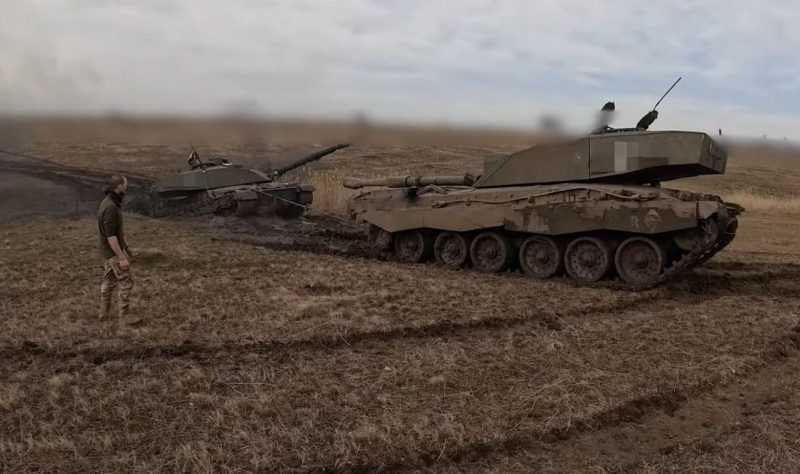
A Ukrainian tank crew got their UK-donated Challenger 2 stuck in a bog during a special demonstration for a British tabloid, the newspaper has reported.
The incident happened during an exercise The Sun described as being “close to the front line” and within view of plumes of smoke emanating from Russian airstrikes. With its crew atop the turret, the British-made tank attempted to drive through a gully, only becoming stuck at its deepest point.
Images shared by the newspaper showed the vehicle stuck in mud deep enough to fully cover its tracks. The incident confirmed that the British tank’s weight is an issue, The Sun said. An experienced squadron commander “blasted the rookie crew for going too slowly through the gully.”
The newspaper added that the tank team leader “turned the mishap into a training exercise” by calling in a second tank to haul the first one out of the mud.
The report noted Ukrainian praise for the tank’s main gun, but added that the conflict had not given the British military hardware a chance to demonstrate its ability in a classic tank-on-tank battle. Ukraine has been using the armor to target bunkers from a long distance and for charges on Russian trenches.
The maneuvers are a bluff, according to the tabloid, because the tanks “did not have the right type of ammunition for attacking infantry.”
While the British tank is superior to Soviet-made T-80s in many respects, Ukrainian crews told the outlet that they weigh some 20 tons more and have a 30% lower power-to-weight ratio, which limits their maneuverability.
German-made Leopard 2 tanks, which have a similar weight, have also reportedly become stuck in soft ground, according to images shared online.
The Challenger 2s are not only being bogged down, but are breaking down. Five of the 14 tanks donated by the UK are not operational because spare parts can take months to arrive, and Kiev lacks skilled mechanics to maintain them. With battle-damaged tanks accounted for, only half of the UK-donated squadron remain fit for battle.
The British tabloid also reported manpower shortages on the conflict frontline, meaning trained tank crews are forced to dig trenches. Nevertheless, the Ukrainians expressed gratitude to the British government for the tanks and, via the tabloid, asked London to “send more.”
German FM Open to UK’s Taurus Swap Proposal as ‘Option’
By Svetlana Ekimenko – Sputnik – 11.03.2024
German Chancellor Olaf Scholz has repeatedly opposed the idea of supplying Ukraine with missiles capable of striking deep into Russian territory. However, recently UK Foreign Secretary David Cameron expressed London’s readiness to assist Berlin in overcoming any obstacles preventing the delivery of Taurus long-range missiles to the Kiev regime.
Germany’s Foreign Minister Annalena Baerbock is open to her British colleague David Cameron’s suggestion of a swap of long-range cruise missiles for their further transfer to Ukraine, Der Spiegel reported.
In particular, Germany could supply Taurus cruise missiles to the United Kingdom, and in return the British side would transfer Storm Shadow missiles to Ukraine. Thus, Berlin would formally be relieved of responsibility for providing cruise missiles to the Kiev regime, the outlet stated.
“That would be an option,” Baerbock was quoted as saying regarding the proposed exchange on ARD’s program Caren Miosga.
The German minister on Sunday pointed out that exchanges of a similar nature had already taken place with respect to other material. This, according to the outlet, was a nod at Chancellor Olaf Scholz’s previous use of indirect military aid to Ukraine, when he was reluctant to send Leopard 2 main battle tanks to the conflict zone. In January, 2023, Berlin announced it would send its Leopard 2A6 main battle tanks to Ukraine, also agreeing to provide re-export licenses for other countries wanting to supply these German-made armored vehicles. Within weeks of their arrival on the battlefield, Russian forces began hunting the tanks down with missiles and kamikaze drones.
UK Foreign Secretary David Cameron recently came up with a potential way to persuade Germany to supply Ukraine with Taurus missiles. During a recent interview with German newspaper Sueddeutsche Zeitung, he stated that London was ready to help Berlin solve problems preventing the delivery of the cruise missiles to Kiev, or consider the option of buying German missiles and then transferring British Storm Shadow missiles to Ukraine. Cameron did not discount the possibility of imposing certain restrictions before supplying the weaponry to Kiev.
German Chancellor Olaf Scholz has repeatedly dismissed the idea of providing Ukraine with missiles capable of striking deep into Russian territory, as such support would come dangerously close to direct German participation in the conflict.
If the swap scheme of Britain procuring Taurus missiles from Germany in exchange for supplying Storm Shadow missiles to Ukraine comes to pass, Kiev would likely get the long-range missiles eventually, pundits told Sputnik.
The issue of Taurus transfers made the headlines in the wake of a leaked conversation between German military officials discussing a potential attack on the Crimea Bridge.
On March 1, Margarita Simonyan, editor-in-chief of RT and Rossiya Segodnya, Sputnik’s parent media group, published the text of a conversation involving four Bundeswehr representatives discussing a potential attack on the Crimean Bridge with Taurus missiles. The talk, which took place on February 19, involved Inspector of the German Air Force Ingo Gerhartz, Brig. Gen. Frank Graefe, head of the Operations and Exercises Department at the Air Force Command in Berlin, and two employees of the air operations center of the Bundeswehr Space Command.
After the intercepted war talk, German Chancellor Olaf Scholz once again ruled out supplying the missiles to Ukraine since it could require the presence of German troops on the ground to help deploy them. German Defense Minister Boris Pistorius said that long-range Taurus missiles would not be decisive for the conflict in Ukraine and would only help in certain areas, but that Germany does not intend to cross this line.
“We have always emphasized that such long-range missiles will not solve this [crisis],” Pistorius said at a joint press conference with Finnish Defense Minister Antti Hakkanen.
The Kremlin reiterated that the contents of leaked conversations between German officials proved “the direct involvement of the collective West in the conflict in Ukraine.”
In the wake of Ukraine’s bungled counteroffensive, the Zelensky regime has been pressing Germany for the delivery of the missiles, which have a range of 500 kilometers (311 miles) and could strike deep inside Russian territory.
Moscow has repeatedly underscored that Western arms shipments to Kiev and the training of Ukrainian servicemen only prolong the conflict and will be unable to alter the situation at the battlefield.
Trump has plan to end Ukraine conflict – Orban
RT | March 11, 2024
Donald Trump intends to end the Ukraine conflict, if reelected as US president, and has a “detailed plan” to do so, Hungarian Prime Minister Viktor Orban told local media, after meeting the presumed Republican nominee.
The former US leader repeatedly claimed on his campaign trail that, if he had remained in the White House for a second term, there would be no hostilities between Moscow and Kiev. If voted back in, he promises to end the conflict “in 24 hours” by applying pressure on stakeholders.
Orban, who spoke with Trump at the Mar-a-Lago estate in Florida on Friday, did not explain how exactly the American would do that, but said that cutting the flow of US aid was a crucial part of the plan.
”If the US will not provide the money, Europeans on their own will not be able to finance this war, and then the war will end,” Orban said in an interview with M1 broadcaster on Sunday.
During his presidency, Trump had shown himself to be “a man of peace,” the Hungarian leader claimed. That stance puts him in alignment with Hungary, unlike the administration of US President Joe Biden and many members of the EU, he added.
”The American Democratic government and the leadership of the EU, as well as the leadership of the largest EU member states are pro-war governments. Donald Trump is pro-peace, Hungary is pro-peace. At the bottom of everything lies this difference,” Orban declared.
The Kremlin declined to weigh in on the remarks, with spokesman Dmitry Peskov saying on Monday that Orban’s account of Trump’s intentions was too vague for any specific commentary.
Ukrainian President Vladimir Zelensky previously expressed skepticism about Trump’s ability to deliver on the promise. He said if the plan was feasible, the American politician should share it with the public, or at least with Kiev. The Ukrainian government claims that a “just peace” requires a military victory over Russia and that it would agree to nothing short of that.
Moscow has said that its strategic goals in the military operation against Kiev will be achieved one way or another. The US and its allies, who continue to arm Ukraine, cannot change that outcome and are only prolonging the suffering of the country’s people, Russian officials have stated.
Featured Video

EUROPE FEARS RUSSIA’S NEXT MOVE / Ian Proud
or go to
Aletho News Archives – Video-Images
New Book
New Book: No Autoimmunity The Body Doesn’t Attack Itself
Lies are Unbekoming | September 24, 2026
 The label for Humira, once the best-selling drug in the world, lists its risks in plain print. One of them, in the label’s own words, is new “autoimmune” disease.
A drug prescribed for a condition labelled autoimmune carries a warning that it can cause a condition labelled autoimmune. That contradiction sits in every box, on a folded paper almost nobody reads.
My new book starts there.
No Autoimmunity: The Body Doesn’t Attack Itself
For seventy years, “your body is attacking itself, and we don’t know why” has ended the conversation for people diagnosed with multiple sclerosis, lupus, rheumatoid arthritis, Hashimoto’s, Type 1 diabetes, Crohn’s and psoriasis. More than eighty conditions now carry the autoimmune label. The diagnosis comes with a prescription for life. It almost never comes with a question about cause.
This book asks the question and answers it from the framework’s own records: its drug labels, its journals, its regulatory filings, and its own experiments. … continue
Blog Roll
 Aletho News
- Britain’s elites want you ready to die for a war they keep imagining
- Inside Ukraine’s propaganda operation targeting Americans
- Hackers From US, France, Singapore Tried to Disrupt Russian Elections – Internet Provider
- New Book: No Autoimmunity The Body Doesn’t Attack Itself
- EUROPE FEARS RUSSIA’S NEXT MOVE / Ian Proud
- Big tech hands in its DSA censorship reports to the EU
- ‘A Big Victory’ – Palestine Chronicle Wins Two-Year Legal Battle
- IAEA inspectors cannot return to Iran amid US threats: Russia
- Senate Rejects Iran War Powers Resolution Passed By House
- ‘We did not attack Pakistan with drones’: Afghan sources
- If Americans Knew
- ‘This is where I live now, the back of a truck’: a day in the life of a grandmother in Gaza
- In UN Speech, Iran’s President Displays Pictures of Children Killed by US, Brings Attention to Israel’s Nuclear Arsenal
- Israel displaces hundreds of Palestinians amid wave of demolitions in West Bank
- Aid, reconstruction, and Israel’s history of obstruction in Gaza
- Trump administration digs an ever-deeper hole of complicity in genocide – Daily Update
- US-Israel $2.8 Billion Arms Deal, 40,000-Bomb Supply Faces New Gaza Complicity Accusations
- Caught on Tape: AIPAC CEO Boasted of Controlling Trump’s National Security Officials
- Why Hamas Attacked Israel in October 2023 – Israeli professor Ilan Pappé
- They see them, then kill them: Israeli quadcopters track, deliberately target civilians in Gaza
- Winter could turn Gaza’s treacherous, war-damaged buildings into deathtraps
- No Tricks Zone
- New Study: Earth And Venus Surface Warmth Largely Explained By Convection And Lapse Rate, Not CO2 Or Radiation
- 2025 Nature Paper Claiming Worsening Global Drought Gets RETRACTED …Heavily Flawed
- New Study: ‘Global Drought Shows No Detectable Recent Acceleration Under Climate Warming’
- Economic Masterminds: German Socialists Suggest Taxing Productivity Gains Stemming From Using AI
- The South China Sea Has Not Been Cooperating With The Climate Change Narrative
- Energy Crisis: Germany Enters Heating Season With Historically Low Gas Reserve Fill Levels
- New Study: The Antarctic Ice Sheet Gained Mass From 2020-2024 Due To Staggering Snow And Ice Accumulation
- Study: Ocean Heating Rates From Thousands Of Years Ago ‘Dwarf’ Modern Ocean Heating Rates
- Climate Extremists Target, Attack Large-Scale Power Grid Infrastructure In Germany!
- New Study: Antarctic Ice Melt Has Contributed Less Than 1 Centimeter To Sea Level Rise In The Last 30 Years

