EU could stop Hungary voting on Ukraine – FT
RT | December 18, 2023
The possibility of Hungary temporarily forfeiting its voting rights within the European Union is reportedly being considered, the Financial Times has claimed. This development comes after heightened discussions, especially after Budapest opposed a €50 billion ($54 billion) four-year financial aid package for Ukraine during last Thursday’s EU summit.
While Hungary did not ultimately block the initiation of EU accession talks with Kiev, as previously threatened, the Central European nation maintains a divergent stance on Ukraine compared to the bloc’s official position. Prime Minister Viktor Orban’s government has consistently criticized Brussels’ plans for Ukraine’s full EU membership and Western countries’ belief in Kiev’s military capability against Russia.
According to the Financial Times’ report published on Monday, citing anonymous officials, some EU members are considering activating Article 7 of the Treaty on European Union, which allows states to lose certain rights if persistently in breach of core EU principles.
The report pointed out, however, that many countries are hesitant to use this perceived nuclear option. Instead, these nations prefer revealing to Budapest the “full costs” of its isolation.
An anonymous EU staffer told the media outlet that while “Hungary can create more trouble,” it will not be able to “stop us providing money to Ukraine.” The official disagreed with those who like to paint Orban as “Putin’s puppet,” adding that the Hungarian prime minister is pursuing his own agenda.
The FT quoted another unnamed EU diplomat as saying that Orban is “always transactional, never ideological” and is merely seeking the unfreezing of €20 billion worth of EU funding, which Brussels had suspended over concerns related to the rule of law in the Central European country.
The Hungarian prime minister and his foreign minister, Peter Szijjarto, however, dismissed such claims last week.
On the other hand, Lithuanian MEP Rasa Jukneviciene asserted on Friday that Orban is working for Russia and undermining the EU from within.
“I appeal to the Commission, to the leaders of the Council: Let’s start to think about the procedure to suspend the voting rights of Hungary,” the lawmaker implored.
Speaking to Hungary’s Radio Kossuth on Friday, Orban highlighted that Budapest still has approximately 75 opportunities to impede Kiev’s path to EU membership. He has raised concerns about what he describes as endemic corruption in Ukraine on multiple occasions.
UK contemplating sending troops to Ukraine – ex-ambassador
RT | December 17, 2023
British military leaders are making contingency plans for sending troops to Ukraine in case a disastrous turn of events on the battlefield necessitates their deployment to help fight Russian forces, Kiev’s former ambassador to the UK has claimed.
Despite public opposition, the UK government would directly join the fight in Ukraine if there’s a “catastrophic development of the war,” such as “the continuation of the occupation,” ex-diplomat Vadym Prystaiko said on Friday in an interview with the Ukrainian branch of US state-run broadcaster Radio Free Europe/Radio Liberty (RFE/RL).
The possibility of military deployments to Ukraine is a well-kept secret among Kiev’s Western allies, Prystaiko said. “No one will ever admit it, especially politicians. Every time they are asked, they will say, ‘no, no no way, come on, we’d rather give them everything they need.”
However, Prystaiko added, British officers are making plans “for the worst” – circumstances dire enough to prompt elected leaders to order a direct military intervention in the former Soviet republic. “In reality, the military is making calculations that, God forbid, they will have to use armed forces. That’s why the military and diplomats are there, to plan for the future.”
Prystaiko, who also served a stint as Kiev’s foreign minister, was fired as ambassador last July, after he criticized Ukrainian President Vladimir Zelensky. His career downfall began when Zelensky responded sarcastically to a suggestion by the UK’s then-defense chief, Ben Wallace, that Ukraine should show more gratitude to its Western benefactors. Asked by Sky News about the tone of Zelensky’s remarks, he said, “I don’t believe that this sarcasm is healthy.”
Wallace’s successor as UK defense chief, Grant Shapps, hinted in September at deeper British involvement in the Ukraine crisis, including protection of commercial shipping traffic in the Black Sea. UK Prime Minister Rishi Sunak later said there had been “misreporting” when Shapps also seemed to suggest that London might send military instructors to Ukraine.
Russian officials have repeatedly described the conflict as a battle between Moscow and the “entire Western military machine.” British special forces have reportedly operated covertly in Ukraine, and Russian President Vladimir Putin claimed last year that there were entire military units in the country “under the de-facto command of Western advisers.”
Polls have shown consistently strong UK public opposition to deploying troops to Ukraine. Prystaiko said that given the mood of voters, none of Kiev’s backers is ready to fight the Russians directly. “It’s very difficult for democratic states that depend on the reelection cycle, that depend on their voters, that have to explain themselves a hundred times to make the first step.”
Putin: “Odessa is a Russian city”
BY M. K. BHADRAKUMAR | INDIAN PUNCHLINE |DECEMBER 17, 2023
At the year-end news conference on Thursday lasting four hours, Russian President Vladimir Putin made some key remarks on the conflict in Ukraine which throw light on the likely trajectory of the war through 2024. To be sure, Russia will not accept a “frozen conflict” that falls short of realising the objectives Putin had laid out at the commencement of the special military operations in February last year.
Putin stated: “There will be peace when we achieve our goals… Now let’s return to these goals – they have not changed. I would like to remind you how we formulated them: denazification, demilitarisation, and a neutral status for Ukraine.”
He spelt out denazification and demilitarisation as work in progress while leaving out the crucial question of a neutral status for Ukraine, a notion which the collective West outright rejects while pressing ahead with its intervention in newer forms despite the failure of Kiev’s months-long counteroffensive. Ironically, the accent in the revised western narrative is to create a strong resilient defence industry in Ukraine eventually with western technology and capital to ward off any Russian military threats in future.
On denazification specifically, Putin said that during the negotiations in Istanbul last year in March, Kiev showed receptiveness towards the idea of legislating against the spread of extremist ideology, but that lies buried in the past. As for demilitarisation, that idea also never caught on as Ukraine began receiving weaponry “even more than what was promised by the West.”
Therefore, Russia is left with no other option but to keep destroying the Ukrainian military capability as the core of the demilitarisation process. But Putin believed that certain parameters can still be negotiated, and, in fact, “We actually agreed on them [with Ukrainian negotiators] during the Istanbul talks; although these were thrown out later, we managed to reach agreement.” The alternative to reaching an agreement on demilitarisation is to “resolve the conflict by force. This is what we will strive for.” However, to this end, Putin ruled out another mobilisation as already “there will be about half a million people [in the war zone] by the end of this year.”
These remarks bear the hallmark of a statesman speaking from a position of strength who is conscious of it, too. Putin asserted that Russian forces are “improving their position almost along the entire line of contact. Almost all of them are engaged in active combat. And the position of our troops is improving along [the entire line of contact.]” Putin conveyed no willingness to compromise with the US and EU.
Significantly, Putin said that the southern part of Ukraine has “always been Russian territory… Neither Crimea nor the Black Sea has any connection to Ukraine. Odessa is a Russian city.” This is an ominous statement implying that the Russian operation may after all extend to Odessa which is on the western side of the Dnieper and even further westward along the Black Sea coast to Moldova that renders Ukraine a land-locked country. A prolonged conflict is in the cards.
On the contrary, the reports from the US media quoting American officials convey the impression that there is no willingness to throw in the towel at the present stage. That is of course predicated on the belief that Russia will be hard put to realise its objectives and by the end of 2024, the tide of war can change and Russia may be compelled to compromise. Thus, a new strategy is being worked out between the US and Ukrainian military that can be executed by the early part of 2024 with the American accent on holding the territory that Ukraine controls as of now and digging in.
The New York Times reported that the Ukrainian military subscribes to a “forward policy.” The Pentagon is stationing a three-star general in Kiev with a view to “stepping up the face-to-face military advice it provides to Ukraine.” This could be the beginning of deployment of American military advisors to Ukraine to oversee the war, which will put the Pentagon in a direct role in the management of the operations from both the tactical as well as strategic perspectives.
Meanwhile, the final word is not yet spoken by the US Senate on the Administration’s demand of $61 billion as additional funds for Ukraine. The likelihood is that the senate will eventually pass the bill since there is a big groundswell of support among Republican lawmakers for the war effort. The Administration is driving home that Russia has an “imperial” agenda toward NATO countries and vital US interests are at stake in preventing Russia from winning the war.
Interestingly, in a related development two days ago, Congress approved legislation that would prevent any president from withdrawing the US from NATO without approval from the Senate or an Act of Congress. Equally, Europe is also circling the wagons and taking a long-term view that Russia’s scale-up of arms production to sustain its operations in Ukraine poses a real threat to Europe, especially to the Baltic states, Georgia and Moldova. NATO Secretary-General Jens Stoltenberg last week warned that “If Putin wins in Ukraine, there is real risk that his aggression will not end there.”
The German Defence Minister Boris Pistorius echoed that sentiment when he said on Saturday that Europe must ramp up its security and defence capabilities to respond to the threat Russia poses, as the US will likely reduce its involvement on the Continent in the coming years and increasingly turn its attention to the Pacific region in the next decade. As he put it, “This isn’t just sabre-rattling. Dangers could lie ahead at the end of this decade.”
The message from the European Council meeting in Brussels last Friday is also that in circumventing Hungary’s opposition, EU leaders are navigating a pathway to ensure Ukraine will still get its €50 billion aid package to help prop up its hollowed out economy — if necessary, by taking the radical step of sacrificing EU unity and providing the money on a bilateral basis. The EU leaders are expected to reconvene at the end of January or early February to unlock the issue.
On Friday, Ukraine’s foreign ministry released a statement lauding the opening of EU membership negotiations and voicing optimism about the €50 billion aid package from Brussels. The tough talk notwithstanding, Russia too must be sensing that the EU will ultimately find a way somehow to solve the financial question. For the present, though, the deadlock in Brussels and Washington on aid has generated an air of uncertainty, which is bad optics for Kiev and plays into the Russian narrative.
All in all, Putin’s tough remarks on Thursday factor in that the US isn’t going anywhere but stays put in Ukraine and the Biden administration’s game plan is to revamp the war strategy to put it on a stronger footing and make it sustainable through the period ahead till the November 2024 election.
Kremlin’s hope that US support for Ukraine is on the wane seems misplaced. Curiously, spokesman Dmitry Peskov added in good measure in an interview on Friday with broadcaster NBC News that Putin would prefer an American president who is “more constructive” toward Russia and understands the “importance of the dialogue” between the two countries. Peskov added that Putin would be ready to work with “anyone who will understand that from now on, you have to be more careful with Russia and you have to take into account its concerns.”
Between now and the presidential election in March in Russia, domestic politics will be hotting up. After Putin’s re-election for a fresh 6-year term as president, which is widely expected, by the time the new government is formed, the campaign for the US election will have accelerated and it is a safe bet that the Ukraine war will be on auto-pilot with the priority almost entirely lying on averting any serious embarrassment to Biden’s reelection bid.
Suffice to say, staving off a military defeat in Ukraine and keeping the stalemate on track will be the Biden administration’s singular aim through 2024. The big question is whether Putin would “cooperate” or have some surprises in store. Peskov has begun looking beyond the Biden presidency.
Fresh anti-Russia sanctions to cause more damage to EU: Moscow
Press TV – December 17, 2023
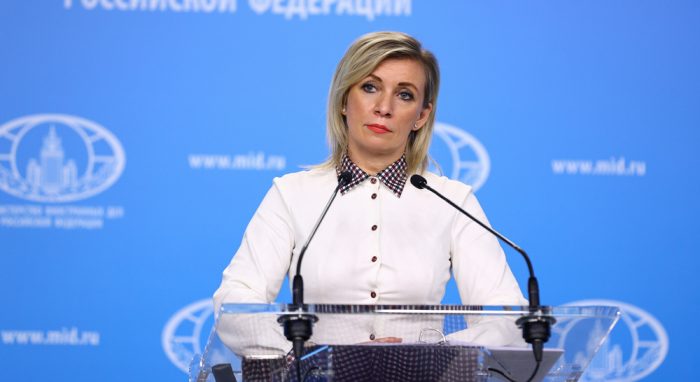
Russian Foreign Ministry spokesperson Maria Zakharova said on Saturday that the latest European Union sanctions against Russia will cause more harm to the EU than Russia.
Zakharova added that the EU’s “dictatorial” behavior reveals how Brussels is “denying” member states of their right to “protect their interests.”
She also warned the EU of the “heavy price” the Europeans must pay for the accession of Ukraine and Moldova to the bloc.
“It goes as far as absurdity, when through some unscrupulous manipulations – when certain heads of state and government are not present at the table, – some legally questionable and obviously politicized decisions are made, which are as follows: on the start of pre-accession negotiations with Ukraine and Moldova, which not only fail to meet the EU’s elementary criteria but directly run counter to them, as well as on another ‘package’ of unilateral restrictive measures against Russia, which, like all the previous ones, will cause bigger harm to the European Union itself,” the diplomat said.
“This dictatorial behavior of Brussels reveals in all its magnitude that the member states are denied their democratic right to a dissenting opinion and the protection of their own interests.”
She went on to add that the EU’s confrontational “policy and the consequences of its opportunistic decisions regarding Ukraine and Moldova will have to be paid by the population of European countries.”
EU members agreed on a 12th package of sanctions against Russia, the European Council said on Thursday, meaning that a phased ban on Russian diamond imports among other measures will come into effect from January 1, 2024.
Moreover, after the summit, European Council President Charles Michel also announced that the EU members had decided to open accession negotiations with Ukraine and Moldova, which may start in March 2024 or later.
The accession talks regarding Ukraine and Moldova started after Hungarian Prime Minister Viktor Orban left the summit in protest to the move. Budapest had earlier threatened to veto the accession of Ukraine into the European Union. “Hungary does not want to be part of this bad decision!” Orban said in a statement on Facebook.
Russia started the “special military operation” in its eastern neighbor in late February 2022 to defend the pro-Russian population in the eastern Ukrainian regions of Luhansk and Donetsk against persecution by Kiev.
Ever since the beginning of the war, Kiev’s Western allies, led by the United States, have been pumping Ukraine with advanced weapons and slapping Russia with a slew of sanctions, steps that Moscow says would only prolong the hostilities.
Zakharova also said that the EU is continuing to “swiftly lose both political and economic weight around the world” under the pressure of the United States’ missteps.
“The EU’s resources, so much needed for its domestic growth, are not funneled into resolving multiple problems and asserting its own place in the emerging multipolar world order, but into serving the US interests, including into the enrichment of the US military-industrial complex,” she said.
Zakharova added that it looks quite natural that against this backdrop, “the most responsible politicians in European countries are more and more frequently prioritizing national interests over some mantras of ‘European solidarity,’ which are out of touch with real needs.”
Zelensky’s Global Begging Tour Is an Obscene Fiasco
Strategic Culture Foundation | December 15, 2023
The United States’ proxy war in Ukraine against Russia has cost the lives of up to 400,000 Ukrainian soldiers. In the last six months alone, it is estimated that over 120,000 Ukrainian troops have been killed in a failed counteroffensive.
Even Western media are coyly admitting the grim reality of failure after much-vaunted predictions last year of imminent victory against Russia.
Yet nearly two years after the conflict erupted, the leader of the puppet regime in Kiev persists in begging for billions more in funds from his Western sponsors to continue the bloodbath – the biggest armed confrontation in Europe since the Second World War.
The hostilities can be traced back to the 2014 coup in Kiev orchestrated by the CIA and precipitated by the European Union and Washington trying to cleave traditional Ukrainian relations with Russia. Those hostilities culminated in February 2022 in what can be seen as a U.S.-led proxy war against Russia. A war that has failed for the Western powers and needs to be peacefully negotiated to spare further death and destruction.
This week, however, saw Ukrainian President Vladimir Zelensky going to Washington to plead for $60 billion in additional funds. His begging mission failed. The U.S. Congress refused to pass the supplemental bill requested on his behalf by President Joe Biden for Ukraine.
After that humiliation, Zelensky then turned his solicitation to the European Union. The EU, by turn, failed to agree on a requested fund for $54 billion for Ukraine.
As a sort of consolation prize, the EU leaders at their two-day summit in Brussels declared that Ukraine could start negotiations for eventually gaining access to the 27-member bloc. That decision was bombastically hailed as “historic” but it seemed more theatre than substance given that the negotiations will take several years to conduct and there is no guarantee at the end of the tedious process that Ukraine will actually gain EU membership. Will Ukraine even exist as a state in a few years, as our columnist Stephen Karganovic ponders in an article this week?
The EU membership talks were granted no doubt as a way to distract from the fact that the EU funds were not forthcoming and especially following the miserable response from U.S. lawmakers.
The whole sorry saga indicates that the U.S.-led proxy war in Ukraine has become a deplorable black hole for Western public money. Given the military debacle and the futile bloodshed, it is becoming politically untenable for Washington and Brussels to keep shovelling billions of taxpayer money into this abyss.
Up for the asking this week was a total of nearly $100 billion between the U.S. and Europe for Ukraine. How many badly needed public services in Western states could do with – and are denied – that kind of financial sustenance?
The spectacle of Zelensky touring the world scrounging for more money is as shameful as it is sordid.
Official figures show that the Western governments have already donated a combined total of $200 billion to Ukraine since the conflict escalated in February 2022.
To put that largesse into perspective, it is estimated that the U.S. Marshall Plan for the reconstruction of the whole of Europe following World War Two was equivalent to $173 billion in today’s money.
Think about that. The Western funding to Ukraine already exceeds this historic salvage package by some $30 billion. And yet Western governments are trying to muster another $100 billion on top of that.
There are several conclusions to be made. First of all, the U.S.-led proxy war against Russia is indisputably a calamitous failure. Despite the unprecedented financing of weapons and other support to the Kiev regime, the war is a dead-end for the Western powers. The 30-member NATO military alliance is staring at a defeat unparalleled in its 75-year history.
Secondly, it is patent that the Kiev regime is only being propped up by the transfer of colossal flows of aid from the West. Without those transfusions of weapons and capital, the regime is finished. It has already lost grievous numbers of troops on the battlefield. Conscription drives are scraping the barrel. Without the lifeline of aid, the regime is finished. The Kiel Institute for World Economy reported last week that Western capital pledges to the Kiev regime have fallen off a cliff since the summer.
Russian President Vladimir Putin said this week in his annual marathon televised Q&A with the public and journalists that Russia will push on with its objectives of eradicating the NATO-backed Nazi forces in Ukraine. There seems little doubt that the objective will be achieved given the parlous state of the Kiev regime.
Another conclusion to draw is the scale of corruption that Ukraine is mired in. For all the funds pumped into this regime so much of it has been siphoned off from the stated purposes.
The obscenity of this war racket is the inordinate corruption, deaths and destruction of economies across Europe while Western weapons corporations have raked in mega-profits.
Zelensky’s global begging tour is a desperate attempt to keep the war racket going for a while longer. He and his wife Olena have enriched themselves with overseas properties and shopping trips to Paris and New York. Zelensky and his cronies have been paid off with blood money for their role in peddling the biggest war scam in modern history. A scam that is funded by hard-pressed and hoodwinked Western taxpayers who have been gaslighted by their politicians and media about “defending democracy and freedom”.
To keep this grotesque charade going, Western politicians in the pay of arms companies and NATO think tanks are resorting to desperate scaremongering and blackmail.
President Biden has repeatedly warned that if extra funds were not released to Ukraine to “defend against Russian aggression” the rest of Europe will be overrun by Moscow.
In Washington this week, U.S. lawmakers who refused to pass the supplemental funding bill for Ukraine were, in effect, accused of being traitors by helping Russia.
Zelensky appealed to European leaders by saying that Putin would exploit any negativity towards Ukraine, and he pleaded with the EU to not “betray” Ukrainians.
On the eve of the EU leaders’ summit in Brussels, the European Commission declared that it was finally releasing €10 billion in withheld funds to Hungary. That was a bribe to Hungarian premier Viktor Orban to concede to the proposed €50 billion in extra aid for the Kiev regime. In the end, Orban did not concede to the multi-billion-euro handout, however, he gave way to his objection to talks for Ukraine’s membership of the EU. Such is the shoddy business of propping up the Kiev regime that arm-twisting and bribery are the order of business in Brussels.
The horrendous waste of lives and financial resources in Ukraine by the Western elite – instead of pursuing diplomacy and peace – is the hallmark that these regimes are terminally corrupt and doomed to failure.
The conflict in Ukraine has recklessly stoked tensions between nuclear powers and has condemned generations of Americans and Europeans to debt. The war in Ukraine is a historic dead-end for the U.S. and its European vassals. Zelensky’s begging bowl is a death rattle.
Russian Airborne Forces Ex-Commander: NATO Counteroffensive Plan Bad, New Ukraine Strategy Worse
By Ekaterina Blinova – Sputnik – 14.12.2023
The Russian Armed Forces have shifted to the offensive in the special military operation zone and are making progress along the entire contact line, President Vladimir Putin said during his annual press conference.
Russia’s 617,000-strong military contingent is presently improving its positions along the almost 2,000 kilometer-long contact line, President Putin told attendees at his annual press conference. What’s behind the development?
The failure of the Ukrainian counteroffensive has exposed the ineffectiveness of NATO’s strategic planning and outdated doctrines, says retired Colonel General Georgy Shpak, ex-commander of the Russian Airborne Forces.
“[NATO] placed its bet on Ukraine making it carry out a counteroffensive,” Shpak told Sputnik. “They organized and planned it. But the counteroffensive failed, because the [Russian military] foresaw [their steps], built good defenses worthy of the Russian army and withstood numerous attacks.”
“Now we have moved on to the second stage of this operation: to disable as much [Ukrainian] equipment and personnel as possible. This second stage is essentially coming to an end, because the Ukrainian army is exhausted, they lack manpower, their reserves are depleted, their money has run out, almost all of their equipment has been knocked out. This is the result of the work of American and British [military] advisers,” the retired colonel general continued.
NATO war planners failed to calculate the effects of many key factors, according to the military expert.
“They did not take into account current modern conditions, the huge number of [Russian] aerial vehicles that are designed for reconnaissance, observation, adjustment, and strikes. They didn’t take this into account. They hoped that if they struck in several directions, our defenses would crack, but we held the line.”
Shpak was also highly sceptical of NATO’s 2024 strategy for Ukraine, which envisages digging in and building up forces for a possible new offensive.
“I would say that it is even worse than their counter-offensive,” the general said. “Not a single defensive structure can withstand strikes of modern powerful weapons. Furthermore, it’s impossible to build reinforced concrete fortifications which are over 1,000 kilometers long and 20-30 meters deep, with enormous coverage. This is all nonsense. It’s impossible to build something like that. There will still be gaps here and there, failures here and there.”
“This is all theory. For me, as a military man, it’s just like a children’s fairy tale, not a thought-out plan. They have abruptly shifted from a counteroffensive to an all-out defense. I believe this will lead to their defeat,” Shpak added.
Ukraine’s Botched Counteroffensive Ignites New ‘Mantras’ in US – Lavrov
Sputnik – 13.12.2023
With Ukraine’s counteroffensive obviously failing, the United States has taken up a new rallying cry, which is to prevent Russian President Vladimir Putin from winning in Ukraine so that “NATO is not conquered,” Russian Foreign Minister Sergey Lavrov said.
“After the collapse of the so-called counteroffensive, [people] in Washington stopped talking about Russia’s strategic defeat on the battlefield and, during Zelensky’s latest visit, activated a new mantra: ‘don’t let Putin win in Ukraine’, otherwise all of NATO will be conquered and then America won’t sit through it,” Lavrov said during the “government hour” in the Federation Council, upper house of the Russian parliament.
“We are ready for such a challenge and will continue to firmly defend our truth,” Lavrov emphasized.
The top Russian diplomat also noted that “it is not easy for our ill-wishers to come to grips with the fact that the bet on the sanctions blitzkrieg against the Russian economy has completely failed.”
“Therefore, those who launched the hybrid war against us won’t admit their mistakes, they are trying to use more and more illegitimate tools to wear down Russia, as they say, relishing the dream of eliminating our country as an independent geopolitical value,” the Russian diplomacy chief explained.
Mainstream propaganda machine doubles down on ‘Russia losing’ fantasies
By Drago Bosnic | December 13, 2023
Even before the start of the special military operation (SMO), the mainstream media had been running several propaganda narratives, almost simultaneously. Shortly before the SMO and in the first few days, there was the claim that Russia would take Kiev in three days and most of Ukraine in a week. However, as this didn’t happen (nor was it ever planned to unfold this way in the Kremlin), the mainstream propaganda machine went full afterburner in the opposite direction. Now, Moscow was suddenly losing, the Kiev regime forces are unbeatable, the Russians are suffering from extremely low morale due to massive losses, they’re running out of missiles, shells, fuel and so on, and so forth.
These ludicrous myths never stopped and continued until the failure of the much-touted counteroffensive. That was when many in the political West adopted a somewhat less propagandistic tone and tried mixing in some “realism”. However, this didn’t have the desired effect on the populace in Western Europe and North America. Thus, there’s a slow return to the most ridiculous propaganda one could possibly imagine. For instance, the Wall Street Journal claims that the Neo-Nazi junta will be “able to seize the initiative on the battlefield in 2025 if it can hold out against Russia until the end of next year”. This narrative is being pushed despite the fact that the United States, its primary backer, is about to stop the money flow.
The report initially doesn’t come off as propagandistic as one would expect, but towards the end, the authors still tried pushing debunked propaganda narratives. There are several instances of somewhat unexpected admissions, such as the obvious failure of the Kiev regime’s counteroffensive, as well as the dwindling financial support from the political West. The report also touched upon the growing divisions within the Neo-Nazi junta and the fact that its battered military will need time to recover. However, in a response to the WSJ, its Foreign Minister Dmytro Kuleba challenged this with a claim that “any pause in the fighting now would allow Russia to regroup and prepare for large-scale offensive operations”.
Kuleba even stated that the Kiev regime forces are preparing fresh brigades for “new counteroffensive and defensive operations”. The WSJ supported the idea and even went as far as to claim that “2024 will be the year of the recovery [for the Neo-Nazi junta troops]”. However, the authors admit that this comes with an important caveat, as the Kiev regime and its NATO overlords will need to “work through their current adversities and continue delivering supplies to troops, an emerging best-case scenario among Western strategists is that next year becomes a year of rebuilding for Kiev’s military“, adding that “the hope would be that a limited number of Ukrainian soldiers can hold Russian forces at bay”.
This would supposedly “allow NATO countries time to train fresh Ukrainian troops, expand armament production and restock Ukraine’s arsenals”. As indicated during a recent NATO meeting, the political West hopes that Russia’s incremental offensive operations will fail, “resulting in a depletion of its manpower and munitions, potentially offering Ukraine better prospects to retake the battlefield initiative in the spring of 2025, if it gets through next year”. However, the WSJ concluded the report with a not-so-optimistic remark of a Ukrainian infantry sergeant who said that when he talks to people at home he tells them that “everything is going well” and doesn’t describe what he sees or feels, which isn’t so upbeat.
“What is the point?”, the WSJ quoted the Ukrainian sergeant.
While the WSJ certainly is part of the mainstream, it’s still a bit more reputable than many other outlets of America’s massive propaganda machine. For instance, the infamous CNN is beating its own records in laughable claims by publishing that “Russia has lost a staggering 87% of the total number of active-duty ground troops it had prior to launching its invasion of Ukraine and two-thirds of its pre-invasion tanks”. Of course, this information came from “a source familiar with a declassified US intelligence assessment provided to Congress”. The assessment was sent on December 11, as the Republican-dominated Congress was in the middle of effectively canceling the “Ukraine aid”.
The “intelligence” assessment supposedly found that “the war has sharply set back 15 years of Russian effort to modernize its ground force”. Then came the numbers game, where CNN claims that “of the 360,000 troops that entered Ukraine, including contract and conscript personnel, Russia has lost 315,000 on the battlefield, 2,200 of 3,500 tanks and 4,400 of 13,600 infantry fighting vehicles and armored personnel carriers have also been destroyed, a 32% loss rate”. CNN says it reached out to the Russian Embassy for comment, which is yet to respond. The most likely scenario is that His Excellency Ambassador Anatoly Antonov is still laughing uncontrollably after reading all this. And he certainly isn’t the only one.
“The idea that Ukraine was going to throw Russia back to the 1991 borders was preposterous,” Sen. J.D. Vance, a Republican from Ohio, said on CNN’s State of the Union on December 10, adding: “So what we’re saying to the president and really to the entire world is, you need to articulate what the ambition is. What is $61 billion going to accomplish that $100 billion hasn’t?”
Even CNN had to admit that “Ukraine remains deeply vulnerable”, as its “highly anticipated counteroffensive stagnated through the fall”, and that “US officials believe that Kiev is unlikely to make any major gains over the coming months”. As for the alleged “staggering losses” of the Russian military, the truth is that Moscow hasn’t been this strong militarily since at least the 1980s. In addition, the Kremlin is effectively returning to a Soviet superpower level with its latest military strategy shift. The very idea that Russia lost well over 300,000 soldiers is beyond ludicrous, as the country would be littered with new military cemeteries in virtually every major settlement. On the contrary, it’s precisely Ukraine that looks like that thanks to the NATO-backed Neo-Nazi junta.
Drago Bosnic is an independent geopolitical and military analyst.
Biden Announces He’s Signed ‘Another $200 Million Drawdown’ From Pentagon for Ukraine
By Ian DeMartino – Sputnik – 12.12.2023
US President Joe Biden announced during a Tuesday joint meeting with Ukrainian President Volodymyr Zelensky that he has “just signed another $200 million drawdown” from the Pentagon for Ukraine.
Biden used the “drawdown” provision in the Foreign Assistance Act that allows him to provide Defense Department stockpiles to countries without congressional approval. The $200 million package is the 53rd such drawdown package provided to Ukraine since March 2022, in addition to billions of dollars in aid authorized by Congress.
The announcement comes as Congress remains deadlocked on authorizing more aid to Ukraine. Biden has asked Congress to provide $60 billion in aid to Ukraine in a funding package that also includes aid for Israel and money to secure the southern US border.
However, some Republicans have asked for more concessions on the border, including changes to the asylum system, a non-starter for many Democrats, in exchange for increased funding in Ukraine. The House of Representatives also passed a standalone aid bill for Israel, which the Senate has refused to consider.
Zelensky visited Washington in what has been described by US media as a “last-ditch effort” to convince Congress to authorize more aid to his country. Part of that visit included separate meetings with House Speaker Mike Johnson (R-LA) Senate Majority Leader Chuck Schumer (D-NY) and Senate Minority Leader Mitch McConnell (R-KY).
Both Johnson and Schumer said their meetings with Zelensky went well but had different opinions on the details of their meetings.
Johnson criticized the Biden administration for not articulating how Ukraine can win against Russia. “The Biden administration appears to be asking for billions of dollars without specifics, without a clear strategy for winning, and without the answers I think the American people deserve,” he said at a news conference following his meeting with Zelensky.
Meanwhile, Schumer, who has been extremely hawkish on Ukraine since the start of the special military operation, claimed that Zelensky explained Ukraine’s path to victory to him.
“He [Zelensky] described in detail what kind of help was needed and how it would help win. Even many of our Republican politicians were saying that we were winning this war,” Schumer claimed.
Schumer said he called Johnson and asked him to keep the House open after this week so the $61 billion aid package can be approved.
“Last night, I spoke with Speaker Johnson and urged him to keep the House in session a little longer to give the supplemental a chance to come together,” Schumer said at a briefing.
The much smaller aid package announced by Biden on Tuesday uses an authorization provided in the Foreign Assistance Act (FAA) which allows the president to provide foreign aid using stocks the Defense Department has on hand without congressional approval.
This latest drawdown is at least the 53rd drawdown ordered by the Biden administration since the start of Russia’s special military operation in Ukraine.
The last drawdown, costing $175 million, was ordered by the Biden White House last week.
According to US media, the latest package includes High Mobility Artillery Rocket Systems (HIMARS), anti-armor systems, artillery rounds, demolition munitions, small arms ammunition, high-speed anti-radiation missiles, generators and spare parts, among other equipment.
US media also reported the Defense Department has about $4.4 billion in weapons remaining that it can use through drawdown authorizations.
According to a 2004 Department of Defense Security Cooperation handbook on the drawdown procedure, all equipment sent using drawdown authorization must be replaced with operations and maintenance funds already part of the Defense Department budget.
During the meeting with Biden, Zelensky told reporters that he wants to use the $300 billion in frozen Russian assets to fight the conflict if Congress will not provide more aid. When asked if his country could win against Russia without aid from Congress, Zelensky reportedly did not answer verbally, shrugging his shoulders instead.
Israeli regime turning to Western mercenary groups to back its war on Gaza
By Reza Javadi | Press TV | December 12, 2023
Apart from the lavish military aid offered by the United States and Europe, the Israeli military is turning to Western mercenary groups in its genocidal war against the Gaza Strip.
In a recent interview with Spanish newspaper El Mundo, Pedro Diaz Flores, a notorious Spanish mercenary, revealed that the Israeli regime is recruiting Private Military Companies (PMCs) to achieve its interests in the besieged territory.
He revealed that “many” mercenary groups have joined Israel’s army, which pays them “very well.”
“So I came for the economy, for money. They pay very well, they offer good equipment and the work is calm. It is 3,900 euros [$4,187] per week, complementary missions aside,” Flores said.
Flores, who fought alongside neo-Nazis in Ukraine, spoke of his group’s assistance to Israeli forces.
“We only provide security support to arms convoys or the troops of the Israeli armed forces that are in the Gaza Strip,” Flores said, confirming the presence of PMCs in Gaza.
“We are in charge of the security of the checkpoints and access control on the borders of Gaza and Jordan. There are many PMCs here and they share the work. Traditionally they have guarded border terminals between Eliat and Aqaba.”
According to the images posted by a leading American PMC, Forward Observations Group (FOG), the American PMCs seem to be active in the occupied Palestinian territories aiding the Israeli regime.
On their social media accounts, FOG posted numerous images and stories showing its recruits in Palestine, surrounded by a large cache of weapons and sporting combat gear.
Wearing the American flag on their uniforms, the mercenaries’ social media accounts show that they are stationed alongside the Gaza border in the occupied territories.
In a YouTube video posted back in January, the group revealed its presence on the frontlines of the Ukraine war, assisting the Ukrainian forces in their war against Russian forces.
On its social media channels and website, FOG has advertised its gear through its training videos.
The founder of FOG is US mercenary and ex-US paratrooper, Derrick Bales, who has taken heat for his association with Vadim Lapaev, a member of the far-right Azov Battalion in Ukraine.
Bales, the former US infantry soldier who also served in Afghanistan, apologized but downplayed the radical aspects of those Ukrainian fighters.
Lapaev was quoted as saying by Vice News that he regretted his past association with neo-Nazis.
Apart from unconventional forces, the US has deployed more than 15,000 military troops to the occupied territories since the regime launched its fresh aggression against Palestinians on October 7.
Deployments disclosed by the Pentagon back in October also include two US aircraft carriers and their associated escort ships, in addition to the repositioning of an amphibious task force made up of about 4,000 US Marines and sailors.
The task force of sailors and Marines embarked aboard the USS Bataan and two other warships, includes an infantry battalion of about 900 combat personnel, F-35B fighter jets, armored vehicles and other weapons.
Apart from billions of dollars of military aid to the Israeli regime, the US military still continues to ship weapons and has pledged to provide more missile interceptors for Israel’s Iron Dome military system, small-diameter bombs and other GPS-guided weapons, Sabrina Singh, a Pentagon spokeswoman confirmed recently.
In this regard, the US is covertly providing 2,000-pound “bunker-busting” bombs to Israel’s air force to be used against the Palestinians in the Gaza Strip.
According to a recent report by the Wall Street Journal (WSJ), some 100 of the BLU-109 bombs – designed to penetrate hardened surfaces to reach underground targets such as military bunkers – have been sent to Tel Aviv.
The bombs, which carry a warhead weighing more than 900 kilograms, are capable of penetrating hardened structures such as concrete before exploding, causing heavy casualties.
The covert arms transfers are being reported when the US claims that it is urging Israel to limit civilian casualties in its military campaign in Gaza. However, the US-provided weapons have been the main cause of high civilian casualties across Gaza.
According to US officials, an airstrike that hit the Jabalia refugee camp in northern Gaza in the initial days of the war that killed over 100 people was conducted using US-provided bombs.
According to another latest report, phosphorus shells used by Israeli forces in an October attack on a Lebanese village were also provided by the US.
The revelation came after US officials expressed “concern” over the regime’s use of white phosphorous, which human rights campaigners say should be investigated as a war crime.
Meanwhile, some Russian news agencies and several experts have reported about mercenaries leaving Ukrainian soil and heading to the occupied territories to aid the regime forces against the Palestinian resistance movement.
“Assistance and attention to Kiev are noticeably decreasing due to the Israeli-Palestinian conflict, which cannot but worry the Ukrainian authorities,” a Russian news agency posted on Telegram.
“The transfer of Foreign Legion fighters to participate in the war on the side of the Israel Defense Forces can greatly affect the morale of the Ukrainian Armed Forces,” wrote another X account.
“Is the West ready to close the Ukraine project and devote all its attention to a new conflict in the Middle East?”
In this regard, the deployment of mercenaries in Gaza raises questions about accountability and the role of the international community, as it exacerbates the suffering of Palestinians.
Ukrainian trial demonstrates 2014 Maidan massacre was false flag
By Kit Klarenberg | The Grayzone | December 11, 2023
A massacre of protesters during the 2014 Maidan coup set the stage for the ouster of Ukraine’s elected president, Viktor Yanukovych. Now, an explosive trial in Kiev has produced evidence the killings were a false flag designed to trigger regime change.
Two police officers charged with the mass shooting of opposition protesters in Kiev’s Maidan Square in 2014 have been released after a Ukrainian court determined the fatal shots in the infamous massacre were fired from an opposition-controlled building.
On October 18 2023, Ukraine’s Sviatoshyn District Court determined that of the five officers on trial, one would be acquitted outright, while another was sentenced to time served for alleged “abuse of power.”
The remaining three, who no longer live in Ukraine, were convicted in absentia on 31 counts of murder and 44 counts of attempted murder. This, under a Supreme Court opinion stipulating suspects can be held collectively responsible for the actions of a group deemed criminal.
The verdict means no one will face jail time, or be in any way punished for their alleged role in the infamous Maidan massacre, which saw over 100 protesters killed, triggered an avalanche of international condemnation and led directly to the downfall of President Viktor Yanukovych, who fled the country mere days later.
The trial began in Kiev in 2016, but the case languished for years. Matters were further complicated in 2019, when Ukrainian President Volodymyr Zelensky traded all five of the accused for prisoners held by Donbas separatists. Two subsequently returned on a voluntary basis to have their day in court.
Unsurprisingly, the verdict has triggered outrage among victims’ families, and prosecution lawyers say they plan to appeal. By contrast, the mainstream media has so far remained eerily indifferent. In an apparent attempt to distort the trial’s outcome, several outlets — including Reuters — simply referred to the court “sentencing” the officers in their headlines. The Kyiv Post went as far as falsely claiming all five had been found “guilty” of “Maidan crimes.”
But there is more to the story than these outlets have let on. As even the Western-funded Kyiv Independent acknowledged, “a former top investigator” previously tasked with probing the massacre said the verdict followed years of deliberate sabotage by Ukrainian authorities, who “have done their best to make sure there are no real results.”
The question of why officials in Kiev would seek to sabotage the probe has been largely ignored by legacy media outlets. But the verdict offers some highly revealing clues.
‘Unknown persons’ behind killing
Littered throughout the 1,000,000 word document are passages demonstrating conclusively that the sniper fire emanated from buildings controlled by the opposition to Yanukovych. Collectively, these excerpts strongly suggest the Maidan massacre was a false flag carried out by nationalist elements who aimed to ensure the president’s ouster.
The evidence “was quite sufficient to conclude categorically that on the morning of February 20, 2014, persons with weapons, from which the shots were fired, were in the premises of the Hotel Ukraina,” the court found.
Another section reveals “Hotel Ukraina” was “territory… not controlled by law enforcement agencies at that time.” Numerous video recordings show that before, during, and after the massacre, the building was overrun by the far-right opposition party Svoboda, whose leaders used the premises to coordinate their anti-Yanukovych activities on the streets below.
In at least 28 of the 128 shootings considered during the trial, the court ruled that whether “due to the lack of information, the incompleteness or contradictory nature of the submitted data,” the “involvement of law enforcement officers has not been proven,” and that “other unknown persons cannot be ruled out.”
Furthermore, the verdict effectively ruled out any involvement of Russian security and intelligence services in the massacre, a conspiracy theory promoted heavily by pro-Maidan elements.
“The ‘Russian trace’ was not confirmed after examining the relevant documents,” the court found. It concluded that those individuals who were suspected of having ties to Russian intelligence, and were being “constantly monitored,” did not have “any participation in the events on the street.”
For Dr. Ivan Katchanovski, a University of Ottawa political science professor who has spent years documenting overwhelming evidence of opposition responsibility for the massacre, such findings are a long-overdue vindication of his research. In comments to The Grayzone, he explained that the conviction of three police officers in absentia for the murder of 28 Maidan protesters and attempted murder of 36 was “based on a single fabricated forensic ballistic examination.”
The flawed “forensic examination of bullets reversed [the] results of 40 other ballistic examinations” taken previously — every one of which, Katchanovski notes, “showed bullets of Berkut police Kalashnikovs did not match those retrieved from bodies of killed Maidan protesters.”
In the end, “the trial produced an extraordinary volume of evidence proving protesters were shot at from various buildings controlled by pro-Maidan elements,” he says, pointing to the “over 100 witnesses, including 51 anti-government activists injured during the shooting, [who] testified to having been shot from these areas, or seeing snipers located there.”
Elsewhere, the verdict rejected a 3D-model reconstruction of the shooting of three Maidan activists, produced by a New York City-based “unconventional architecture practice” named SITU. This bogus analysis, which was financed to the tune of $100,000 by the Kiev branch of George Soros’ Open Society Foundations, was heavily promoted by The New York Times and other Western media outlets and held up as definitive proof that Ukrainian security forces were responsible for the deaths. But the SITU model changed the location of victim’s wounds — from the side or back of their body to the front — and altered the angles of the bullets’ trajectory to fraudulently convict police for their murders.
As Katchanovski explains, “This is deliberate fraud and disinformation.”
“SITU’s bogus modeling allowed The New York Times and many others to deny the existence of Maidan snipers, and brand as ‘conspiracy theory’ any suggestion the massacre was a ‘false flag,’” he says.
But if the Berkhut officers were not responsible for the dozens of deaths that day, the question remains: who was?
Maidan killers move to Odessa
In August 2023, the New York Times revealed that the Ukrainian gunrunner Serhiy Pashinksy, once openly condemned by Zelensky himself as a “criminal,” had become the top private supplier of arms to Ukraine. Pashinsky sourced grenades, artillery shells and rockets “through a trans-European network of middlemen,” then sold, bought and resold the arms “until the final buyer, Ukraine’s military, pays the most.” The hustle has enriched him to the tune of hundreds of millions of dollars.
Pashinsky, a former Ukrainian parliamentarian, was a central figure in the Maidan coup. As The Grayzone subsequently revealed, he has been accused by three Georgian mercenaries of personally orchestrating the February 2014 massacre, supplying the weapons used and personally picking targets to be shot. When Israeli journalists confronted Pashinsky about these allegations, he threatened to have his associates track them down at home and “tear them apart.”
During the Maidan trial, defense lawyers made prominent mention of those same Georgian mercenary snipers. Along with Maidan leaders, and Western-backed fascist paramilitary Right Sector, the snipers were also implicated in the May 2014 Odessa massacre, a gruesome incident in which scores of Russian-speaking anti-Maidan protesters were forcibly herded into the city’s Trade Unions House, which was then set alight. In all, 46 died due to burn injuries, carbon monoxide poisoning, and attempts to escape the horrors by jumping out of windows. Non-fatal casualties reportedly totaled around 200.
Katchanovski says that as with Maidan, evidence points to the role of an extremely well-organized plot to carry out the Odessa killings:
“A Georgian sniper who confessed their Maidan massacre role in an Israeli documentary also revealed one of the massacre’s organizers dispatched them to Odessa right before the attack on separatists there.”
Post-coup, coverup after coverup
From the beginning of the Maidan trial, witnesses and prosecutors were subjected by far-right Ukrainian figures to a campaign of intimidation. During proceedings, Neo-Nazi C14 and Azov activists stormed the courtroom, attacked defendants, and placed tires outside the court in an apparent threat to burn the building down. The presiding judge was even beaten by a Maidan activist.
“Covert pressure from Zelensky’s administration and the far-right is likely much greater than what we have seen publicly,” Katchanovski commented to The Grayzone. “Ukraine’s judiciary isn’t independent. Zelensky’s administration routinely and openly interferes in proceedings, and even dismissed the entire Constitutional Court. It’s a very difficult situation for the judges and jury. There were direct threats from the far-right to convict the accused.”
Accordingly, some wounded protesters who initially testified to the presence of snipers in Maidan-controlled buildings later revoked their accounts. They subsequently admitted the prosecution met with them privately, to discuss what they’d said on the witness stand. For Katchanovski, “this is proof the coverup goes to the top of the Ukrainian government.”
Many Ukrainians, especially in the East, have held this same suspicion since Ukraine’s post-Maidan nationalist coup government adopted a wide-ranging amnesty law in 2014. That legislation granted Maidan protesters blanket immunity from prosecution for every serious crime imaginable, including murder, terrorism, and seizure of power. The law also prohibited official investigation of any anti-government agitator for these crimes, and ordered the destruction of all relevant evidence that had previously been collected.
A high-ranking official within Ukraine’s Prosecutor General Office has since admitted that prosecutors handling the Maidan massacre investigation and trial were covertly selected and appointed by none other than Pashinsky. Efforts to conduct a parliamentary commission to probe the killings were blocked by Petro Poroshenko, the rabidly anti-Russian President of Ukraine who succeeded the ousted Yanukovych in 2014.
The official tampering was understandable, Katchanovski argues, given how fundamental Kiev’s narrative of the Maidan massacre is to the legitimacy of the Ukrainian government. The false flag mass murder led directly to Yanukovych, justifying the withdrawal of government forces from downtown Kiev, the seizure of government buildings by Maidan activists, and the president’s unconstitutional removal by the Ukrainian legislature.
All these developments paved a path to the eight-year-long civil war in Donbas, which claimed the lives of over 14,000 and precipitated Russia’s invasion in February 2022. For Katchanovski, the link between the false flag massacre and ongoing war in Ukraine is obvious. The verdict, he says, makes that even more clear.
As retaliation for his groundbreaking investigations into the Maidan massacre, Katchanovski’s home and property were illegally seized by local courts in 2014 “with the involvement of senior officials.” Yet the professor remains more determined than ever to get to the bottom of the story.
“One day, the truth of what happened will be officially acknowledged — the only question is when,” he vowed. “Delayed acknowledgment and lack of justice in this case has already cost Ukraine very dearly. There are many conflicts, including the ongoing war, which spiraled from the Maidan massacre. Countless people have suffered needlessly as a result. The time for truth and reconciliation is well overdue.”
Kit Klarenberg is an investigative journalist exploring the role of intelligence services in shaping politics and perceptions.
Featured Video

Ivermectin and iodine
or go to
Aletho News Archives – Video-Images
Book Review
UAE tortured, killed journalist for opposing Israel normalization
The Cradle | October 31, 2026
UAE security officers detained, tortured, and killed Emirati poet and news editor Habib al-Sayegh in August 2019, shortly after he published a column opposing UAE normalization with Israel, according to a newly published book.
“Princes and Thieves,” a book by investigative journalist Matthew Cole published on 25 October, alleges that UAE security officers raided Sayegh’s Abu Dhabi home shortly after the publication of the column, hooded him in front of his wife and took him to a detention facility where he was tortured to death.
His interrogators reportedly pulled out several of his teeth with pliers and beat him repeatedly with a sharp metal object.
On 11 August 2019, Sayegh criticized the UAE’s plan to normalize relations with Israel as part of the Abraham Accords in his weekly column for Khaleej newspaper. The column was titled “Israel Is Our Real Enemy and A Dangerous Project.”
Sayegh described Israel as “a real and natural enemy” while questioning “who authorized the normalizers to speak on behalf of everyone?”
Nine days after the column was published, Emirati state media announced his death, without stating a cause. … continue
Blog Roll
 Aletho News
- Ivermectin and iodine
- Congratulations climate skeptics — you are a ‘Hybrid weapon of war’ and a growing public health threat
- ‘The Arab Vote’: How Israeli Racism Has Ruined Their Elections
- Israel forces Palestinians in Gaza to choose between assassination alone or death with their families: Report
- US Approves Sale of 500 Patriot Missiles to Ukraine, Deliveries May Take Years
- German Imperialism: An Urgent Explainer
- Backed by AAP, West Virginia Proposal Would Allow Dental Hygienists to Give HPV Vaccine to 9-Year-Olds
- Poland Is the Symptom and Europe Is the Patient
- UAE security forces tortured, killed journalist for opposing Israel normalization: Report
- They Compared the Spice to the Drug. The Spice Won — Again. (Part 2)
- If Americans Knew
- DAILY UPDATE: Latest essential news on Palestine, Israel, & region
- 1,300 will gather in Palo Alto on Nov. 1 for Z3 Conference on Zionism
- DAILY UPDATE: Latest essential news on Palestine, Israel, & region
- The Long Arm of AIPAC
- Genocidal intent behind Hebron assault, rights group says
- This week, Israel killed 8-year-old who survived bombing that wiped out her family
- DAILY UPDATE: Latest essential news on Palestine, Israel, & region
- Israeli soldier poses at damaged Lebanon church, sparking anger
- New Report. Manufacturing the Great Replacement: Is Israel behind one of the largest racist influence campaigns ever documented?
- ‘Arab voice doesn’t count’: Jewish Israeli blocs reject Palestinian support
- No Tricks Zone
- Germany’s Green Energy Transition Becoming Increasingly Expensive…Another 6 Trillion Euros!
- Sudden Stratospheric Warming, Powerful El Niño Combination May Lead To Extreme Europe Cold, Energy Crisis!
- Two New Studies Find Thwaites Glacier Melt Cannot Be Driven By Human Activity Or A Warming Ocean
- E-Cars Reduce CO2 Emissions By Only 41% Compared To Internal Combustion Engine Vehicles
- Predictions Made By Renowned Climate Professor Over Past Decades Have Been Proven To Be Poor
- New Study Suggests Large Regions Of The Pacific Ocean Have Been Cooling For The Last 80 Years
- Germany’s Green Energy Debacle: High Energy Costs Force Kahla Porzellan to Close After 182 Years!
- New Study: 50 Years Of The Most Aggressive ‘Net Zero’ Policies Can Only Affect The Global Climate By 0.03°C
- US September “Heat” Was No Record…Many Records Set Decades Ago
- Latest European Green Energy Debacle; Portugal’s Largest Flagship Solar Park Insolvent!

