Biden signs funding bill that excludes Ukraine
RT | November 17, 2023
US President Joe Biden signed a stopgap spending bill into law on Thursday, averting a looming government shutdown. The limited appropriation of funds, which omitted aid to Ukraine, passed the Senate on Wednesday.
The legislation was proposed by House Speaker Mike Johnson, a Republican, who relied on Democrats to push it through the chamber despite the objections of the more conservative wing of his party. The Democrat-controlled Senate passed the bill in a 87-11 vote the next day.
The stopgap bill did not include spending on hot-button issues, such as abortion, border security and foreign aid – for Ukraine, Israel or any other nation. Instead, it focused on keeping government departments operational at their current level. The two-tier plan provides funding through January 19 and February 2, depending on the agency. The shutdown deadline would have arrived at midnight on Friday.
“Because of bipartisan cooperation, we are keeping the government open without any poison pills or harmful cuts to vital programs – a great outcome for the American people,” Majority Leader Chuck Schumer said after he and his fellow senators voted on the bill.
The Ukraine aid issue contributed to US political turmoil in September, which resulted in the unprecedented ouster of Johnson’s predecessor, Kevin McCarthy. Opponents of Biden’s Ukraine policy accused the then-speaker of striking a secret deal with the White House to ensure that Kiev would eventually get the money.
Some Republicans want a revision of Ukraine assistance, arguing that it lacks transparency and that other US priorities are more important than propping up the Ukrainian government.
Johnson previously drew the anger of the White House when he refused Biden’s request to bundle Ukraine aid with assistance to Israel and Taiwan and domestic security and emergency relief spending. Senior US officials have warned that without American help, Kiev may soon lose in the conflict with Moscow.
The new speaker framed the bill as the last one he would agree to and a prelude to a major clash with the Senate over the US budget for 2024.
Republican critics of the bill said Johnson made a mistake by allying with the Democrats, but agreed to cut him some slack during his “honeymoon” period in the post. The lawmaker was elected speaker three weeks ago, after a tense impasse, as GOP representatives could not agree on a replacement for McCarthy.
Neo-Nazi junta draft commissions now after pregnant women
By Drago Bosnic | November 17, 2023
For well over a year and a half, we have been listening and reading about all the mythical “victories” of the Kiev regime forces. If we were to believe the mainstream propaganda machine, Russia is about to collapse, its forces are in disarray, President Putin is in perpetual hiding in some bunker, etc. And yet, concurrently, that same mainstream propaganda machine is publishing texts about the massive increase in the number of forcibly conscripted women in the Neo-Nazi junta forces. This begs the obvious question, why? Why would the side that’s supposedly “winning” enforce conscription on anyone, let alone women? Men are far more suitable to be soldiers for evident biological reasons (unless you’re an ultra-liberal, “woke” extremist).
Women can surely play a part in the defense of their own country, but ideally, this shouldn’t be encouraged. Warfare has always been quite an ugly business, even for the toughest of men, as evidenced by the number of veterans with PTSD. In this regard, frontline units are particularly exposed to the horrors of war and female soldiers should certainly be kept as far as possible from direct combat zones. The dread that male POWs (prisoners of war) can go through is more than enough, while women in the same situation are at the risk of experiencing even worse horrors. This alone should disqualify female soldiers from serving in frontline units. Notwithstanding many famous women who served in wars during momentous times in history, this is something that should be an axiom.
However, it seems the Kiev regime didn’t get the memo. Worse yet, not only are they sending women to the trenches, but are now forcibly conscripting pregnant ones. Yes, you read that right – pregnant Ukrainian women are being sent to the frontline. Anyone remotely sane would call that a war crime. Those who are sending them can only be described as enemies of their own people. Pregnant women are by far the most precious humans one could possibly imagine and treating them with anything less than absolute care is simply criminal. Taking into account the unrelenting demographic collapse of Ukraine, women (particularly pregnant ones) should be the top priority in terms of ensuring their safety and well-being. However, the Neo-Nazi junta and its NATO overlords have other plans.
What they are really after is an endless supply of cannon fodder. So far, there have been at least a quarter of a million KIA (killed in action), while there are several times more WIA/MIA (wounded/missing in action). Some, such as the US Army Colonel Douglas McGregor (ret.) claim that the numbers are far worse. According to his estimate, there are upwards of half a million Ukrainian men who have died in battle so far. The numbers might be up for debate, but there’s no doubt they’re horrendous. However, that’s still not enough for the political West and its favorite puppet regime. The Neo-Nazi junta forces are actively conscripting women to replace those losses, as attempts to forcibly draft Ukrainian refugees living abroad failed, with the host countries simply refusing to enforce it.
Hundreds of thousands of young Ukrainians who haven’t got the chance to leave the country are in hiding, as there’s no other way to avoid the ruthless draft commissions that regularly grab people in the streets and then send them off to frontline units. Obviously, those who are loyal to the Kiev regime are exempt, as well as those who can afford to pay hefty bribes to military medical commissions (MMCs). Thus, sons of numerous corrupt oligarchs get the chance to live their lavish lifestyles abroad (all at the expense of the Ukrainian people), while pregnant women are sent to war. What’s more, recently released combat footage shows some have already been captured by the Russian military. The video in question shows a woman shouting “[I’m] pregnant!” while surrendering to Russian soldiers.
Although it could be argued that the female soldier in the video is simply saying this out of fear, there have already been complaints from pregnant women who got conscription notices. As there are upwards of 50,000 female soldiers currently serving in various units, the number of pregnant ones is difficult to determine, but it could easily be in the hundreds (if not even thousands). And while legal limitations previously protected women by barring them from serving in frontline units, most of those have been lifted after the special military operation (SMO) started. Thus, female soldiers can now serve as machine gunners, tank commanders, snipers, truck drivers, etc. Unfortunately, this is hardly surprising given that people with severe physical and mental disabilities are also being deemed “fit for service“.
The Neo-Nazi junta frontman Volodymyr Zelensky is obsessed with pleasing his NATO overlords and this includes military “victories” at any cost. This only resulted in further escalation of the conflict between Zelensky and the Kiev regime’s top commander, General Valery Zaluzhny. The latter simply doesn’t want to throw away the lives of countless soldiers just to accomplish tactical “victories” that don’t really change the overall situation on the battlefield. Zelensky’s direct meddling in military affairs (for which he completely lacks any sort of expertise) is a constant source of frustration for Zaluzhny and his officers. He’s simply so out of touch that this is making the already miserable lives of hundreds of thousands of Ukrainian soldiers even more difficult, as they’re without proper training and supplies.
Drago Bosnic is an independent geopolitical and military analyst.
Russo-Ukrainian War: The Reckoning
Ukraine at the limits
Big Serge Thought | November 15, 2023
The Russo-Ukrainian War has been a novel historical experience for a variety of reasons, and not only for the intricacies and technicalities of the military enterprise itself. This became the first conventional military conflict to occur in the age of social media and planetary cinematography (that is, the ubiquitous presence of cameras). This brought a veneer (though only a veneer) of immanence to war, which for millennia had unveiled itself only through the mediating forces of cable news, print newspapers, and victory steles.
For the eternal optimist, there were upsides to the idea that a high intensity war was slated to be documented in thousands of first-person view videos. Purely from the standpoint of intellectual curiosity (and martial prudence), the flood of footage from Ukraine offers insight into emerging weapons systems and methods and allows for a remarkable level of tactical-level data. Rather than waiting for years of agonizing dissection of after action reports to reconstruct engagements, we are aware in near real time of tactical movements.
Unfortunately, all the obvious downsides of airing a war live on social media were also in effect. The war instantly became sensationalized and saturated with fake, fabricated, or incorrectly captioned videos, cluttered with information that most people are simply not equipped to parse through (for obvious reasons, the average citizen does not have extensive experience differentiating between two post-Soviet armies using similar equipment and speaking similar, or even the same language), and pseudo-expertise.
More abstractly, the war in Ukraine was transformed into an American entertainment product, complete with celebrity wonder weapons (like Saint Javelin and the HIMARS), groan-inducing references to American pop culture, visits from American celebrities, and voiceovers from Luke Skywalker. All of this fit very naturally with American sensibilities, because Americans ostensibly love underdogs, and in particularly spunky underdogs who overcome extreme odds through perseverance and grit.
The problem with this favored narrative structure is that underdogs rarely win wars. Most major peer conflicts do not have the conventional Hollywood plot structure with a dramatic turning point and reversal of fortune. Most of the time, wars are won by the more powerful state, which is to say the state with the ability to mobilize and effectively apply more fighting power over a longer period of time. This has certainly been the case in American history – no matter how much Americans may long to recast themselves as a historical underdog, America has historically won its wars because it has been an exceptionally powerful state with irresistible and innate advantages over its enemies. This is nothing to be ashamed of. As General George Patton famously said: Americans love a winner.
Thus we arrived at a convolution situation where, despite Russia’s many obvious advantages (which in the end come down to a superior indigenous capacity to mobilize men, industrial output, and technology), it became “propaganda” to argue that Russia was going to achieve some sort of victory in Ukraine – that Ukraine would end the war having failed to re-attain its 1991 borders (Zelensky’s stated victory condition) and with the country in a wrecked state of demographic hollowing and material destruction.
At last, we seem to have reached a denouement phase, where this view – allegedly an artifact of Kremlin influence, but in reality the most straightforward and obvious conclusion – is becoming inescapable. Russia is a bigger fighter with a much bigger bat.
The case for Ukraine victory rested almost entirely on dramatic success in a summer counteroffensive, which was supposedly expected to smash its way through the Russian positions in Zaporizhia Oblast, knife to the Sea of Azov, sever Russia’s land bridge to Crimea, and place the entire underbelly of Russia’s strategic position in jeopardy. A whole host of assumptions about the war were to be tested: the supremacy of western equipment, Russia’s paucity of reserves, the superiority of Western-Ukrainian tactical methods, the inflexibility and incompetence of Russian commanders in the defense.
More generally – and more importantly – this was intended to prove that Ukraine could successfully attack and advance against strongly held Russian positions. This is obviously a prerequisite for a Ukraine strategic victory. If the Ukrainian armed forces cannot advance, then Ukraine cannot restore its 1991 boundaries and the war has transformed from a struggle for victory into a struggle for a managed or mitigated defeat. The issue ceases to be whether Ukraine will lose, and becomes a question only of how much.
Western observers are at long last beginning to engage with the fact that Ukraine’s summer counteroffensive devolved into an abject failure and a military defeat of historical significance. It’s important to remember that, prior to the start of the operation, there were real expectations both among Ukrainian officials and western backers that the offensive could achieve the isolation or blockading of Crimea, if not its outright recapture. Underpinning this optimistic outlook were key assumptions about the superiority of western-gifted armored vehicles and a Russian army that was supposedly beginning to run dry. A purportedly leaked Ukrainian Order of Operations memorandum intimated that the AFU intended to reach and mask major cities like Berdyansk and Melitopol.
Remembering that the Ukrainians and their benefactors genuinely believed that they could reach the Azov coast and create an operational crisis for Russia is very important, because only in the context of these objectives can the letdown of the attack be fully comprehended. We are now (as of my typing of this sentence) at D+150 from the initial massed Ukrainian assault on the night of June 7-8, and the gains are paltry to say the least. The AFU is stuck in a concave forward position, wedged between the small Russian held villages of Verbove, Novoprokopivka, and Kopani, unable to advance any further, taking a steady trickle of losses as it attempts half-hearted small unit attacks to cross the Russian anti-tank ditches that ring the edges of the fields.
At the moment, the maximum advance achieved by the counteroffensive lies just ten miles from the town of Orikhiv (in the Ukrainian staging area). Ukraine failed not only to reach its terminal objectives, but it never even threatened its intermediate waypoints (like Tokmak). In fact, they never created even a temporary breach in Russia’s defenses. Instead, the AFU threw the bulk of the newly formed and western-equipped 9th and 10th Corps against fixed positions of the Russian 58th, 35th, and 36th Combined Arms Armies, became embedded in the outer screening line, and the attack collapsed after heavy casualties.

Debacle: The Battle of Robotyne
As the autumn began to drag on without battlefield results materializing for Ukraine, the process of finger pointing began with remarkable predictability. Three distinct lines of thought emerged, with observers in the west blaming a supposed Ukrainian inability to implement western tactics, some Ukrainian parties countering that western armor was too slow to arrive, which gave the Russian army time to fortify its positions, and others arguing that the problem was that the west failed to provide the necessary aircraft and strike systems.
I think that all of this rather misses the point – or rather, all of these factors are merely tangential to the point. The various Ukrainian and western figures pointing fingers at each other are rather like the proverbial blind men describing an elephant. All of these complaints – insufficient training, slow delivery timetables, shortages of air and strike assets – merely reflect the larger problem of attempting to assemble on an improvised basis an entirely new army with a hodgepodge of mismatched foreign systems, in a country with dwindling demographic and industrial assets.
All that aside, the internecine quarreling in the Ukrainian camp obscures the importance of tactical factors and ignores the highly active role that the Russian armed forces played in spoiling Ukraine’s great attack. While the dissection of the battle is likely to continue for many years, a litany of tactical reasons for Ukrainian defeat can already be enumerated as follows:
- The failure of the AFU to achieve strategic surprise. Notwithstanding an ostentatious OPSEC effort and attempted feint operations on the Belgorod border, around Bakhmut, Staromaiorske, and elsewhere, it was readily apparent to all involved that the point of the main Ukrainian effort would be towards the Azov littoral, and specifically the Orikhiv-Tokmak axis. Ukraine attacked precisely where they were expected to.
- The danger of staging and approach in the 21st century. The AFU had to congregate assets under exposure to Russian ISR and strike assets, which repeatedly subjected Ukrainian rear areas (like Orikhiv, where ammunition dumps and reserves were repeatedly struck) to Russian fire, and allowed the Russians to routinely take deploying Ukrainian battlegroups under fire while they were still in their marching columns.
- Inability (or unwillingness) to commit sufficient mass to force a decision. The density of the Russian ISR-Fires nexus incentivized the AFU to disperse its forces. While this can reduce losses, it also meant that Ukrainian combat power was introduced in a piecemeal trickle which simply lacked the mass to ever seriously threaten the Russian position. The operation largely devolved into company-level attacks which were clearly inadequate for the task.
- Inadequacy of Ukrainian fires and suppression. A fairly self-evident and all-encompassing capabilities gap, with the AFU facing a shortage of tubes and artillery shells (forcing HIMARS into a tactical role as an artillery substitute), and lacking sufficient air defense and electronic warfare assets to mitigate the variety of Russian airborne systems, including drones of all types, attack helicopters, and UMPK bombs. The result was a series of under-supported Ukrainian maneuver columns being raked in a firestorm.
- Inadequate combat engineering, which left the AFU vulnerable to a web of Russian minefields that were evidently far more robust than expected.
Taken together, we actually have a fairly straightforward tactical conundrum. The Ukrainians attempted a frontal assault on a fixed defense without either the element of surprise or parity in ranged fires. With the Russian defense fully on alert and Ukrainian staging areas and approach lanes subject to intense Russian fires, the AFU dispersed its forces in an effort to reduce losses, and this all but ensured that the Ukrainians would never have the necessary mass to create a breach. Add it all up, and you get the summer of 2023 – a series of frustrating and fruitless attacks on the exact same sector of the defense, slowly frittering away both the year and Ukraine’s best, last hope.
The failure of Ukraine’s offensive has seismic ramifications for the future conduct of the war. Combat operations always occur in reference to Ukraine’s political objectives, which are – to put it bluntly – ambitious. It’s important to remember that the Kiev regime has maintained from the very beginning that it would not settle for anything less than the 1991 territorial maximum of Ukraine – implying not only the recovery of the territory occupied by Russia after February 2022, but also the subjugation of the separatist polities in Donetsk and Lugansk and the conquest of Russian Crimea.
Ukraine’s war aims have always been defended as reasonable in the west for reasons related to the supposed legal niceties of war, the western illusion that borders are immutable, and the apparent transcendent divinity of Soviet-era administrative boundaries (which after all were the source of the 1991 borders). Regardless of all these matters, what Ukraine’s war aims implied as a practical matter was that Ukraine needed to capture de-facto prewar Russian territory, including four major cities (Donetsk, Lugansk, Sevastopol, and Simferopol). It meant dislodging the Russian Black Sea Fleet from its port somehow. This was an extraordinarily difficult task – far more complicated and more vast than anyone wanted to admit.
The obvious problem, of course, is that given Russia’s superior industrial resources and demographic reservoir, Ukraine’s only viable pathways to victory were either a Russian political collapse, Russian unwillingness to fully commit to the conflict, or the inflicting of some astonishing asymmetric battlefield defeat on the Russian army. The first now clearly seems like a fantasy, with the Russian economy shrugging off western sanctions and the political cohesion of the state completely unperturbed (even by the Wagner coup), and the second hope was dashed the moment Putin announced mobilization in the autumn of 2022. That leaves only the battlefield.
Therefore, the situation becomes very simple. If Ukraine cannot successfully advance on strongly held Russian positions, it cannot win the war according to its own terms. Thus, given the collapse of Ukraine’s summer offensive (and myriad other examples, like the way an ancillary Ukrainian attack banged its head meaninglessly on Bakhmut for months) there is a very simple question to be asked.
Will Ukraine ever get a better opportunity to attempt a strategic offensive? If the answer is no, then it necessarily follows that the war will end with Ukrainian territorial loss.
It seems to be a point of near triviality that 2023 was Ukraine’s best opportunity to attack. NATO had to move heaven and earth to scrape together the attack package. Ukraine will not get a better one. Not only is there simply nothing left in the stable for many NATO members, but assembling a larger mechanized force would require the west to double down on failure. Meanwhile, Ukraine is hemorrhaging viable manpower, due to a combination of high casualties, a flood of emigration as people flee a crumbling state, and endemic corruption which cripples the efficiency of the mobilization apparatus. Add it all up and you get a growing manpower squeeze and looming shortages of munitions and equipment. This is what it looks like when an army is attrited.
At the same time that Ukrainian combat power is declining, Russia’s is climbing. The Russian industrial sector has dramatically increased output despite western sanctions, leading to belated recognition that Russia is not going to conveniently run out of weapons, and indeed is comfortably out-producing the entire western bloc. The Russian state is in the process of radically raising defense expenditures, which will pay further dividends in combat power as time goes on. Meanwhile, on the manpower front, Russian force generation is stable (IE, does not require an expanded mobilization), and the sudden realization that the Russian army does in fact have plenty of reserves left prominent members of the Commentariat arguing with each other on Twitter. The Russian army is now poised to reap the benefits of its investments over the coming year.
The picture is not overly complicated. Ukrainian combat power is in a decline which has little chance of arrest, particularly now that events in the Middle East mean that it no longer has an uncontested claim to western stocks. There are a few things the west can still do to try and prop up Ukrainian capabilities (more on that later), but Meanwhile, Russian combat power is stable and even rising in many arms (note, for example, the steady increase in Russian UMPK drops and FPV drone strikes, and the growing availability of the T90 tank).
Ukraine will not recover its 1991 borders, and is unlikely to recapture any meaningful territories going forward. Thus, language has shifted sharply from references to retaking lost territories to merely freezing the front. None other than Commander in Chief Zaluzhny has admitted that the war is stalemated (an optimistic construction), while some western officials have begun to float the idea that a negotiated settlement (which would necessarily entail acknowledging the loss of Russian-held territories) may be Ukraine’s best path out.
This does not imply that the war is nearing an end. Zelensky continues to be adamantly against negotiations, and there are certainly plenty in the west who support continuing Ukrainian intransigence, but I think rather they are all missing the point.
There is only one way to end a war unilaterally, and that is by winning. It may very well be that the window to negotiate is over, and that Russia is ramping up its spending and expanding its ground and aerospace forces because it intends to use them to attempt a decisive victory on the battlefield.
We will likely see an increasingly vigorous debate in the coming months as to whether or not Kiev ought to negotiate. But the premise of this debate may well be wrong in toto. Maybe neither Kiev nor Washington gets to decide.
The subsidence of Ukraine’s summer offensive corresponds to a phase shift in the war, wherein Ukraine will shift to a full-spectrum strategic defense. Almost perfectly on cue, the Russian army kicked off the next sequence by beginning an operation against the crucial and strongly held Ukrainian stronghold of Avdiivka, in the suburbs of Donetsk.
Avdiivka was already in something of a salient, owing to previous Russian operations which had captured the town of Krasnogorivka, to the north of the city. Over the month of October, Russian forces launched a large assault out of these positions and successfully captured one of the key terrain features in the area – a tall mound of discarded mining byproduct (a spoil heap) which directly overlooks the main railway into Avdiivka, and lies adjacent to the Avdiivka coke plant. As of this writing, the situation looks like so:
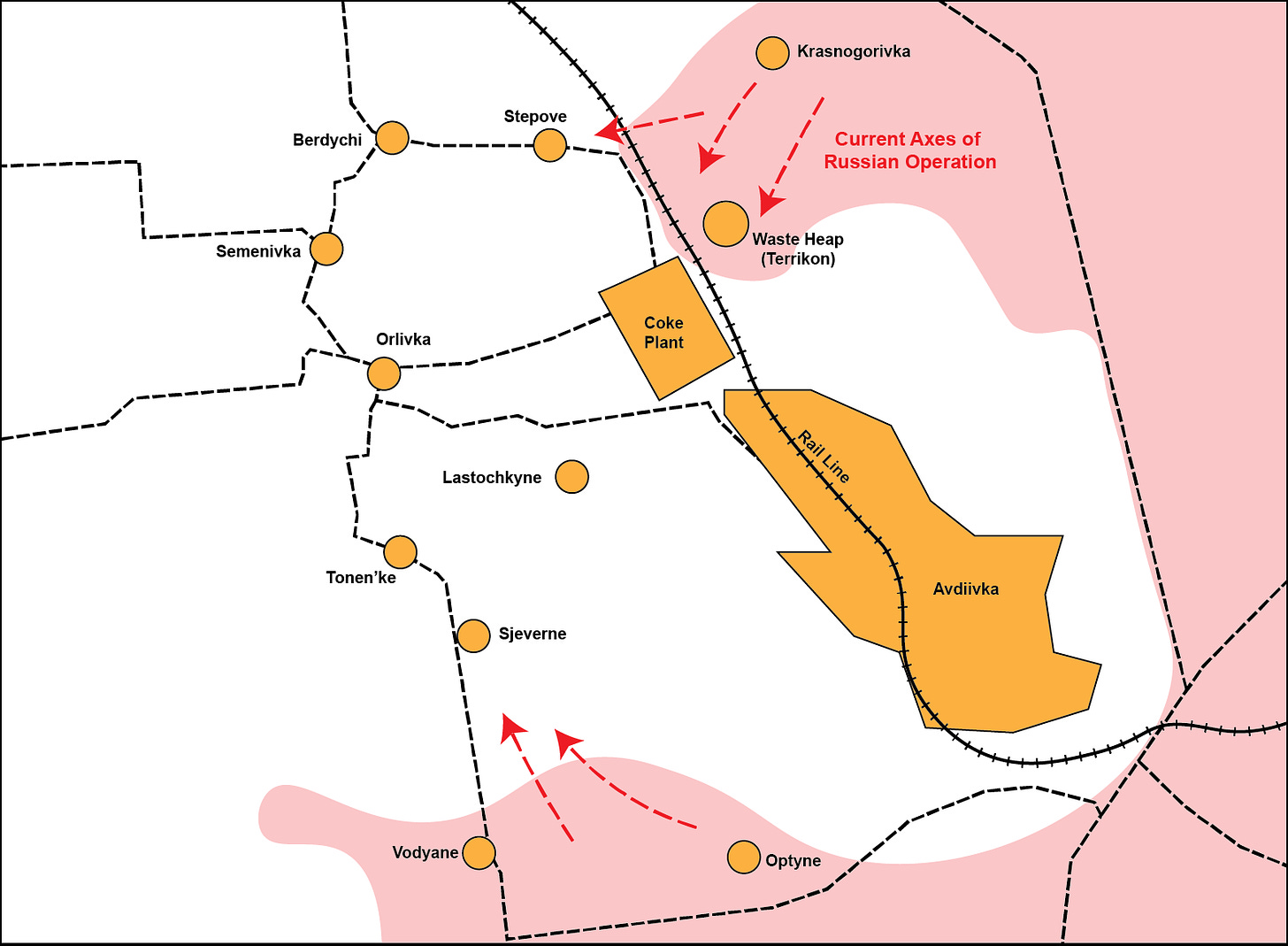
The Avdiivka Battlespace
The Avdiivka operation almost immediately spawned a familiar cycle of dooming and histrionics, with many getting ready to compare the attack to Russia’s failed assault on Ugledar last winter. Despite successful Russian capture of the waste heap (along with positions along the railway), the Ukrainian sphere was pleased, claming that the Russians are suffering catastrophic losses in their assault on Avdiivka. However, I think that this fails to hold water for a few reasons.
First and foremost, the premise itself does not obviously appear to be true. This war is being eagerly documented in real time, which means we can actually check for a sharp increase in Russian losses in the tabulated data. For this, I prefer to check in with War Spotting UA and their Russian equipment loss tracking project. While they have an overtly pro-Ukrainian orientation (they track only Russian and not Ukrainian losses), I think they are more reliable and reasonable than Oryx, and their tracking methodology is certainly more transparent.
A quick note about their data is important. First, it’s incorrect to be overly focused on the precise dates that they ascribe to losses – this is because their logged dates correspond to the date that losses are first photographed, which may or may not be the same day the vehicle is destroyed. When they log a date for a destroyed vehicle, they are logging only the date the picture was taken. It’s thus reasonable to pencil in a few days worth of potential error on the dating of losses. This simply can’t be helped. Furthermore, they – like anyone else – have the capacity to misidentify or accidentally double count vehicles filmed from different angles.
All that is to say, it’s not useful to get too bogged down looking at specific loss clusters and photos, but looking at the trends in their loss tracking is very useful. If Russia was really losing an inordinate amount of equipment in a month-long assault, we would expect to see a spike, or at least a modest level increase in losses.
In fact, that’s not apparent in the loss data. Russia’s overall burn rate from the summer of 2022 until now comes out to approximately 8.4 maneuver assets per day. Yet the losses for the autumn of 2023 (which includes the Avdiivka assault) are actually slightly lower, at 7.3 per day. There are a few batches of losses, which correspond to the aftermath of assaults, but these are not abnormally large – a fact that can be easily checked by referencing the time series of losses. The data shows a modest increase from the summer of this year (6.8 per day) to the autumn (7.3), which corresponds to a shift from a defensive to an attacking posture, but there is simply nothing in the data here that suggests an abnormal elevation in Russian loss rates. Overall, the loss data suggests a high intensity attack, but the losses overall are lower than in other periods where Russia has been on the offensive.
We can apply the same basic analytic framework to personnel losses as well. Mediazona – an anti-Putinist Russian dissident media outlet – has been dutifully tracking Russian casualties via obituaries, funerary announcements, and social media posts. Lo and behold, they – like Warspotting UA – fail to record an inordinate spike in Russian losses through the Autumn thus far.
Now, it would be silly to deny that Russia lost armored vehicles or that attacking does not incur costs. There is a battle being fought, and vehicles are destroyed in battles. That is not the question here. The question is whether the Avdiivka assault has caused an unsustainable or abnormal spike in Russian losses, and quite simply there is nothing in the tracked loss data that would suggest this. Therefore, the argument that Russian forces are being eviscerated at Avdiivka simply does not seem supported by the available information, and so far the tracked daily losses for Autumn are simply lower than the average over the previous year.
Furthermore, fixation on Russian losses can lead one to forget that the Ukrainian forces get badly chewed up as well, and we actually have videos from the Ukrainian 110th Brigade (the main formation anchoring the Avdiivka defense) complaining that they have taken unsustainable losses. All to be expected with a high intensity battle underway. The Russians attacked in force and took proportional losses – but was it worth it?
We need to think about that initial Russian assault in the context of the Avdiivka battlespace. Avdiivka is rather unique in that the entire city and the railway running towards it sit upon an elevated ridge. With the city now enveloped on three sides, remaining Ukrainian logistical lines run along the floor of a wetland basin to the west of the city – the only corridor that remains open. Russia now has a position on the dominating heights that directly overlook the basin, and are in the process of expanding their position along the ridge. In fact, contrary to the claim that the Russian assault collapsed with heavy casualties, the Russians continue to expand their zone of control to the west of the railway, have already breached the outskirts of Stepove, and are pushing into the fortified trench network in southeastern Avdiivka proper.
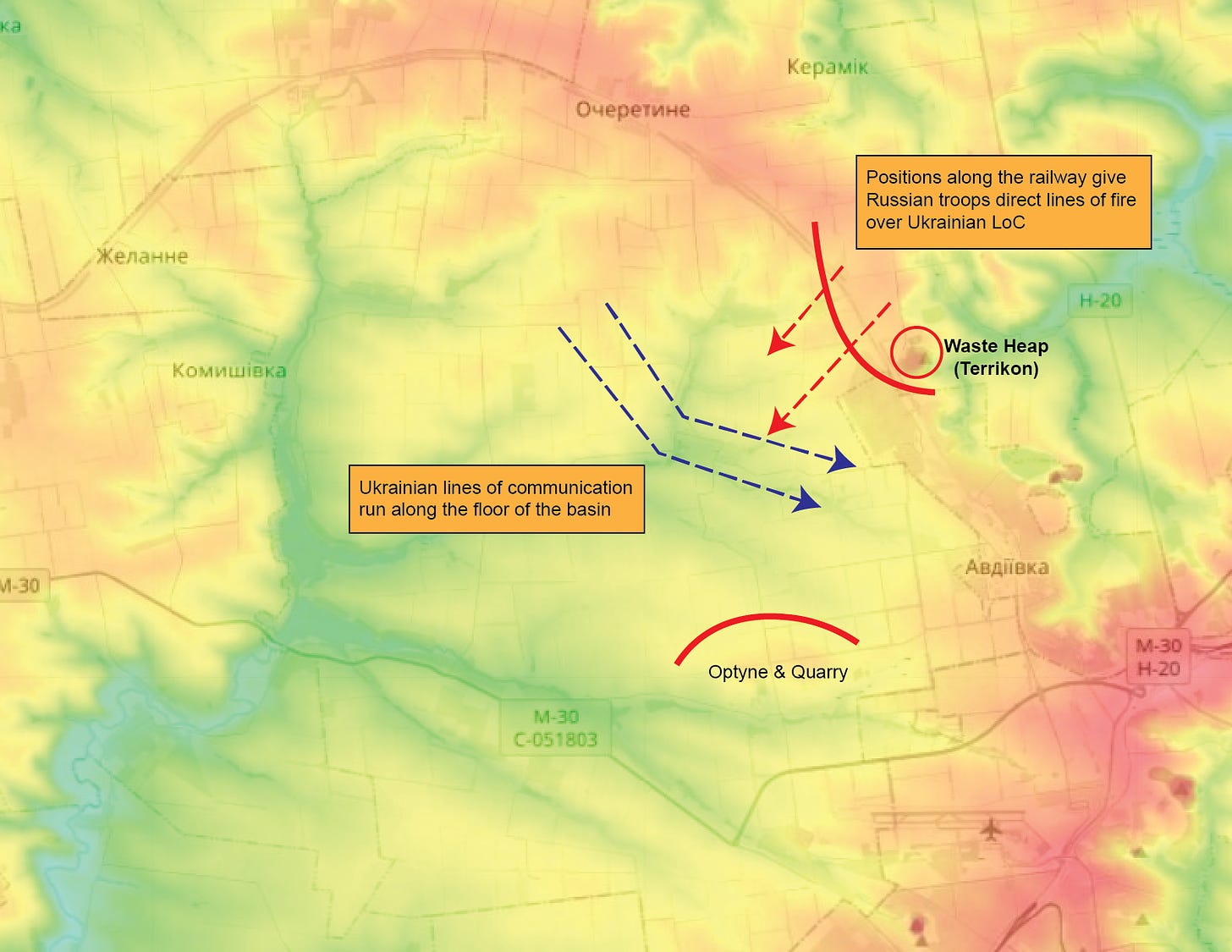
Avdiivka Elevation Map
Now, at this point it’s probably rational to want to compare the situation to Bakhmut, but the AFU forces in Avdiivka are actually in a much more dangerous position. Much was made of so-called “fire control” during the battle for Bakhmut, with some insinuating that Russia could isolate the city simply by firing artillery at the supply arteries. Needless to say, this didn’t quite pan out. Ukraine lost plenty of vehicles on the road in and out of Bakhmut, but the corridor remained open – if dangerous – until the very end. In Avdiivka, however, Russia will have direct ATGM line of sight (rather than spotty artillery overwatch) over the supply corridor on the floor of the basin. This is a much more dangerous situation for the AFU, both because Avdiivka has the unusual feature of a single dominating ridge on the spine of the battlespace, and because the dimensions are smaller – the entire Ukrainian supply corridor here runs along a handful of roads in a 4 kilometer gap.
Clearly, control of the waste heap and the rail line are of paramount importance, so the Russian Army committed a significant assault force to ensure the capture of their key objectives. Attacking the waste heap furthermore required exposing Russian attack columns to perpendicular Ukrainian fire, attacking across well surveilled ground. In short, this entailed many of the tactical problems that plagued the Ukrainians over the summer. Modern ISR-fire linkages make it very difficult to successfully stage and deploy forces without incurring losses.
Unlike the Ukrainians, however, the Russians committed sufficient mass to create an irreversible snowball in the attack on the commanding heights, and Ukrainian fires were inadequate to stymie the assault. Now that they have them, the Russians will recoup losses as the Ukrainians attempt to counterattack – indeed, this has already begun, with UA Warspotting recording a sharp drop in Russian equipment losses over the last three weeks. This establishes the pattern of the operation – a massed assault early to capture keystone positions that put the Russians in control of the battlespace. The Russians successfully forced a decision from the get-go by committing to their attack with a level of violence and force generation that was lacking all summer for the AFU. The juice is worth the squeeze.
More to the point, the Ukrainians clearly know that they are in trouble. They have already begun scrambling premier assets to the area to begin counterattacking against the Russian position on the ridge, and there are already Bradleys and Leopards burning around Avdiivka and in the Ukrainian staging areas in the rear. The same basic problem now exists which proved so insurmountable in the summer: counterattacking Ukrainian forces (staging over ten kilometers in the rear, past Ocheretyne) face long and well-surveilled lines of approach which expose them to Russian standoff fires – the Ukrainian 47th Mechanized Brigade has now already lost armored vehicles both in its staging areas and in failed counterattacks on Russian positions around Stepove.
In the coming weeks, Russian forces will carry their momentum forward into attacks on the axes through Stepove and Sjeverne to the west of the city, leaving the AFU tied to a long and precarious logistical chain on the floor of the basin. One of Ukraine’s longest and most strongly held fortresses now threatens to become an operational trap. I don’t expect Avdiivka to fall in a matter of weeks (barring an unforeseen and unlikely collapse in the Ukrainian defense), but it is now a matter of time and the winter months will likely bring the steady whittling away of the Ukrainian position here.
Sustaining AFU combat power in the city will be particularly difficult, with Ukrainian “mosquito logistics” (referring to their habit of running supply lift with pickup trucks, vans, and other small civilian vehicles) struggling across the floor of a muddy basin under the watchful eye of Russian FPV drones and direct fire. The AFU will be forced to attempt to sustain a brigade-level defense by running small vehicles through a beaten zone. If the Russians successfully capture the coke plant, the game will end much sooner, but the Ukrainians know this and will make the defense of the plant a preeminent priority – but even so, it is only a matter of time, and once Avdiivka falls, the Ukrainians do not have a solid place to anchor their defense until they fall all the way back to the Vocha River. This is a process that should play itself out through the winter.
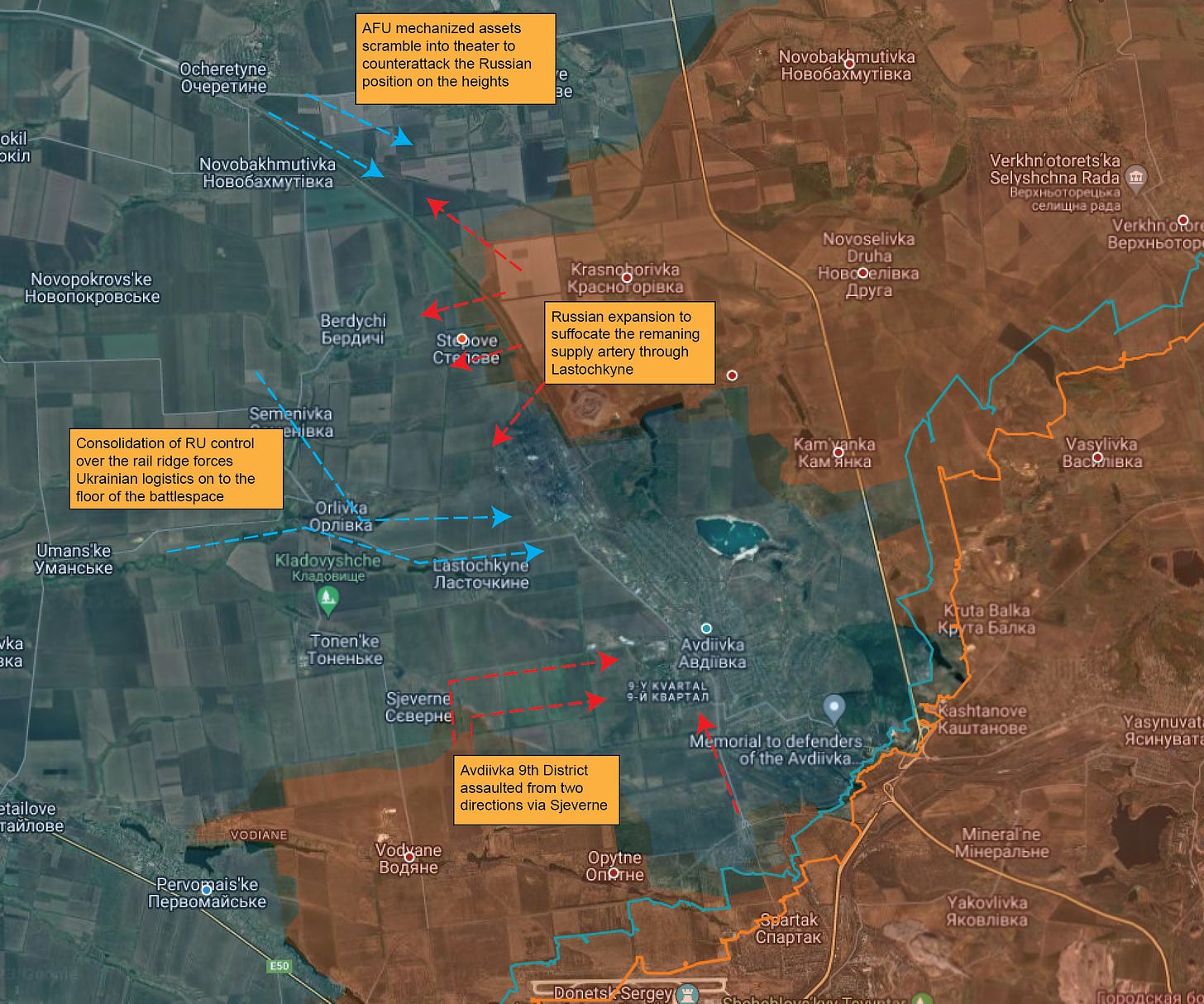
Anticipated future developments around Avdiivka
And that begs the question: if Ukraine could not hold Bakhmut, and time proves that they cannot hold Avdiivka, where can they hold? And if Ukraine cannot successfully attack, what are they fighting for?
A failed defense only counts as a delaying action if you have something to look forward to.
The war in Ukraine is now transitioning to enter its third phase. The first phase, from the onset of hostilities in February 2022 until the autumn of that year, was characterized by a trajectory of exhaustion of indigenous Ukrainian capacity by the operations of the limited initial Russian force. While Russian forces successfully degraded or exhausted many aspects of the prewar Ukrainian war machine – elements like communications, air defense interceptor stocks, and the artillery park – the initial Russian strategy floundered on critical miscalculations concerning both Ukraine’s willingness to fight a long war and NATO readiness to backstop Ukrainian material and provide critical ISR and command & control capabilities.
With the Russians facing with a much larger war than anticipated, and with utterly inadequate force generation for the task, the war took on the character of industrial attrition as it moved into the second phase. This phase was characterized by Russian attempts to shorten and correct the frontline, creating dense fortifications and locking up forces in grinding positional battles. This phase, more generally, was about the Ukrainians attempting to exploit – and the Russians enduring – a period of Ukrainian strategic initiative as Russia moved to a more expansive war footing, expanding armaments production and raisings force generation through mobilization.
In essence, Ukraine faced a dire strategic dilemma from the moment President Putin announced the mobilization of reserves in September, 2022. The Russian decision to mobilize was a de-facto signal that it accepted the new strategic logic of a longer war of industrial attrition – a war in which Russia would enjoy numerous advantages, including a much larger pool of manpower, vastly superior industrial capacity, indigenous production of standoff weaponry, armored vehicles, and shells, an industrial plant beyond the reach of systematic Ukrainian attacks, and strategic autonomy. These, however, are all systemic and long-term advantages. In the shorter term, however, Ukraine enjoyed a brief window of initiative on the ground. This window, however, was squandered with the botched summer assault on Russia’s defenses in the south, and the second phase of the war ends alongside the AFU’s drive on the Azov shore.
And so we come to the third phase, characterized by three important conditions:
- Steadily rising Russian combat power as a result of investments made over the previous year.
- Exhaustion of Ukrainian initiative on the ground and increasing self-cannibalization of AFU assets.
- Strategic exhaustion in NATO.
The first point is relatively trivial to comprehend and has been freely confessed by western and Ukrainian authorities. It is now well understood that sanctions failed to make a meaningful dent in Russian armaments production, and in fact the availability of critical systems is growing rapidly as a result of strategic investments in new and expanded production lines. However, we can enumerate a few examples of this.
One of the key elements of expanding Russian capabilities has been both the qualitative and quantitative improvement in new standoff systems. Russia has successfully launched mass production of the Iranian-derived Shahed/Geran drone, and has an additional factory under construction. Production of the Lancet loitering munition has risen exponentially, and a variety of improved variants are now entering use, with superior guidance, effective range, and swarming capabilities. Russian production of FPV drones has risen significantly, with Ukrainian operators now fearing a snowballing Russian advantage. UMPK guided glider adaptations have been modified to accommodate much of the Russian arsenal of gravity bombs.
All of this speaks to a Russian military with an expanding capacity to fling high explosives in greater numbers and accuracy at AFU personnel, equipment, and installations. Meanwhile, on the ground, tank production continues to rise, with sanctions having little apparent impact on Russian armor availability. In contrast to previous predictions that Russia would begin scraping the bottom of the barrel, pulling ever older tanks out of storage, Russian forces in Ukraine are fielding *newer* tanks, with the T-90 appearing on the battlefield in greater numbers. And, despite repetitive western predictions that a new mobilization wave would be required in the face of supposedly horrific casualties, the Russian defense ministry has confidently said that its manpower reserves are stable, and a Ukrainian military intelligence spokesman recently said that they believe there are over 400,000 Russian troops in the theater (to which can be added the sizeable reserves that remain in Russia).
Meanwhile, Ukrainian forces are likely to become increasingly self-cannibalizing. This occurs on multiple levels, as a motif of a strategically exhausted force. On the strategic level, self-cannibalization occurs when strategic assets are burned off in the name of short term exigencies; on the tactical level, a similar degradative process occurs when formations remain in combat for too long and begin to grind away as they attempt combat tasks for which they are no longer suited.
You’re likely rolling your eyes at that paragraph, and understandably so. It’s heavily jargonized, and I apologize for it. However, we can see a concrete example of what both forms of self-cannibalization (strategic and tactical) look like, from the same unit: the 47th Mechanized Brigade.
The 47th was slated long ago to become one of the premier assets in Ukraine’s counteroffensive. Trained (as best as time allowed) to NATO standards and with privileged access to high-end western equipment like the Leopard 2A6 Tank and the Bradley IFV. This brigade was both meticulously prepared and widely advertised as the deadly tip of the spear for Ukraine. However, a summer of frustrating and failed attacks on Russia’s Zaporizhia line left the brigade with severe losses, degraded combat power, and infighting among the officers.
What followed ought to raise red flags. First, in early October it was reported that the 47th had a new commander, with the change spurred by demands from above that the brigade continue its efforts to attack. The problem was that the 47th had gradually exhausted its attacking potential, and the solution implemented by the new commander was to scrounge the brigade’s rear areas and technical crews for replacement manpower. As the MilitaryLand report reads:
As claimed by soldiers of anti-tank missile unit of Magura in now removed video appeal, the brigade’s command refuse to admit the brigade lost its offensive potential. Instead, command sends mortar crews, snipers, artillery crews, basically all it has available to the front as assault infantry.
This is a classic example of tactical self-cannibalization, wherein a loss in combat power threatens to accelerate as ancillary and technical elements of the unit are burned off in an attempt to compensate for losses. However, the 47th has also been cannibalized on the strategic level. When the Russian assault around Avdiivka began, the Ukrainian response was to pull the 47th out of the Zaporizhia front and scramble it to Avdiivka to counterattack. At this point, the Ukrainian defense there depends on the 110th Brigade, which has been in Avdiivka for nearly a year without relief, and the 47th, which was already degraded from months of continuous offensive operations in the south.
This is strategic cannibalization: taking one of the premier assets in the stable and rushing it, with no rest or refitting whatsoever, directly into combat as a defensive exigency. Thus, you have the 47th Brigade being cannibalized on an internal level (burning itself off as it attempts combat tasks that it is no longer appropriately equipped for) and on a strategic level, with the AFU grinding it down in a positional defense around Avdiivka rather than rotating it out for rest and refit to be earmarked for future offensive operations. A recent report with interviews of 47th personnel painted a dire picture: the brigade had lost over 30% of its personnel over the summer and its howitzers are rationed to a mere 15 shells per day. Russian mortars, they say, have an eight to one advantage.
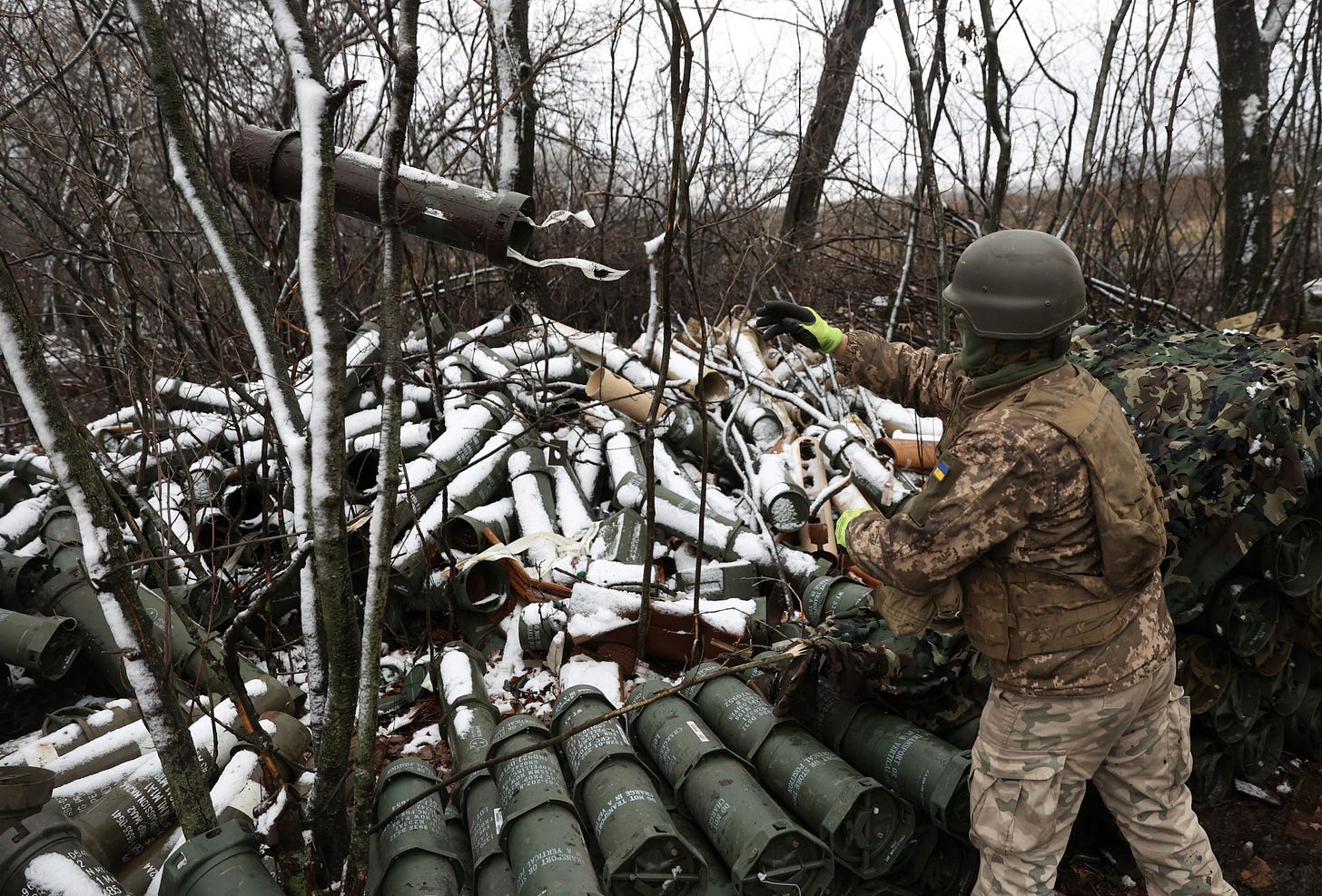
The iconic image of modern war: mountains of discarded shell casings
The situation can be vaguely likened to a person in crisis, who wears themselves down biologically and emotionally through a lack of sleep and stress, while also burning away their assets – selling their car and other critical possessions to pay for immediate necessities like food and medicine. This is an unsustainable way to live, and cannot stave off catastrophe indefinitely.
The Russians are doing everything they can to encourage this process, methodically reactivating grinding attacking operations across the breadth of the front, including not only Avdiivka but also at Bakhmut and Kupyansk, in an intentional pinning program designed to keep Ukrainian assets in combat after being exhausted over the summer. The 47th is emblematic of this – attacking all summer only to immediately be scrambled into defense in the Donbas. As one associate of mine put it, the last thing you want to do after running a marathon is begin a sprint, and this is where the Ukrainians find themselves after losing the strategic initiative in October.
It is not just Ukraine, however, that faces strategic exhaustion. The United States and the NATO bloc find themselves in a similar situation.
The entire American strategy in Ukraine has worked its way into an impasse. The logic of the proxy war lay in assumptions about a cost differential – that the United States could stymie Russia for pennies on the dollar, supplying Ukraine out of its surplus inventories while strangling the Russian economy with sanctions.
Not only have sanctions failed to cripple Russia, but the American approach on the ground has come up bust. Ukraine’s counteroffensive failed spectacularly, and the depleted Ukrainian ground force now must contrive a full-spectrum strategic defense against rising Russian force generation.
The basic strategic quandary for the west, then, is how to get out of a strategic cul-de-sac. NATO has reached the limits of what it can give Ukraine out of surpluses. In regards to artillery shells (the totem item in this war), for example, NATO allies have openly admitted that they have more or less run out, while the United States has been forced to redirect shell deliveries from Ukraine to Israel – a tacit admission that there are not enough on hand for both. Meanwhile, new production of shells is behind schedule in both the United States and Europe.
Facing a massive Russian investment in defense production and the following enormous ramp in Russian capabilities, it’s not clear how the United States can proceed. One possibility is the “all-in” option, which would require industrial restructuring and de-facto economic mobilization, but it’s not clear how this could be achieved given the parlous state of both the western industrial base and its finances.
Indeed, there are unmistakable signs that bringing western arms manufacturing out of its deep freeze will be enormously expensive and logistically challenging. New contracts demonstrate exorbitant cost runup. For example, a recent Rhenmetall order clocked in at $3500 per shell – an astonishing increase when one considers that as recently as 2021 the US Army was able to procure at a mere $820 per shell. No wonder the head of NATO’s Military Committee complained that higher prices are defeating efforts to build up stockpiles. Meanwhile, production is constrained by a lack of skilled workers and machine tools. Going “all in” on Ukraine would require a level of breakneck economic restructuring and mobilization that western populations would likely find intolerable and confusing.
A second option is “freezing” the conflict by pushing Ukraine to negotiate. This has already been broached in public by American and European officials, and was received with mixed reviews. On the whole, this seems rather unlikely. Opportunities to negotiate an end to the conflict were rebuffed on multiple occasions. From the Russian perspective, the west deliberately chose to escalate the conflict and would now want to walk away after Russia answered with its mobilization. It’s not clear then why Putin would be inclined to let Ukraine off the hook now that Russian military investments are beginning to bear fruit, and the Russian army has the real possibility of walking away with the Donbas and more. Even more troubling, however, is Ukrainian intransigence, which seems bound to sacrifice more brave men attempting to prolong Kiev’s fingerhold grip on territories that cannot be held indefinitely.
In essence, the United States (and its European satellites) have four options, none of which are good:
- Commit to an economic mobilization to substantially ramp up material deliveries to Ukraine
- Continue the extant trickle of support to Ukraine and watch it suffer a progressive and slow defeat
- End support for Ukraine and watch it suffer a more rapid and totalizing defeat
- Attempt to freeze the conflict with negotiations
This is a classic formula for strategic paralysis, and the most likely outcome is that the United States will default to its current course of action, supporting Ukraine at a trickle level commensurate with the financial and industrial limits in place, keeping the AFU in the field but ultimately overmatched in myriad dimensions by rising Russian capabilities.
And this, ultimately, brings us back where we started. There is no wonder weapon, no cool trick, no operational contrivance coming to save Ukraine. There is no exhaust port on the Death Star. There’s only the cold calculus of massed fires over time and space. Even Ukraine’s isolated successes only serve to emphasize the enormous disparity in capabilities. For example, when the AFU uses western missiles to attack Russian ships in drydock, this is only possible because Russia has a navy. The Russians, in contrast, have a wide arsenal of anti-ship missiles that they are not using, because Ukraine does not have a navy. While the spectacle of a successful hit on a Russian vessel makes for nice PR, it only reveals the asymmetry in assets and does nothing to ameliorate Ukraine’s fundamental problem, which is the steady attrition and destruction of its ground forces in the Donbas.
As 2024 brings a steady erosion of the Ukrainian position in the Donbas – isolation and liquidation of peripheral fortresses like Adviivka, a double pronged advance on Konstyantinivka, an ever more severe salient around Ugledar as the Russians advance on Kurakhove – Ukraine will find itself in an ever more untenable place, with western partners questioning the logic of funneling limited weapons stocks into a shattered state.
In the third century, during China’s Three Kingdoms era (after the Han Dynasty broke apart into a trifurcated state in the early 200’s), there was a famous general and official named Sima Yi. While not as oft quoted as the better known Sun Tzu, Sima Yi has one pithy aphorism attributed to him which is better than anything in the Art of War. Sima Yi put the essence of warmaking the following way:
In military affairs there are five essential points. If able to attack, you must attack. If not able to attack, you must defend. If not able to defend, you must flee. The remaining two points entail only surrender or death.
Ukraine is working its way down the list. The events of the summer demonstrated that it cannot successfully attack strongly held Russian positions. Events in Avdivvka and elsewhere now test whether they can defend their position in the Donbas against rising Russian force generation. If they fail this test, it will be time to flee, surrender, or die. Such is the way of things when the time for reckoning comes.
Don’t plan yet for Ukraine reconstruction
BY M. K. BHADRAKUMAR | INDIAN PUNCHLINE | NOVEMBER 15, 2023
Having successfully accomplished the destruction of Iraq and Afghanistan, the United States is estimating that in Ukraine too, destruction is nearly complete. At the recent meeting of the foreign and defence ministers of the US and India in New Delhi in the 2+2 format, the two countries “concurred on the need for post-conflict reconstruction” in Ukraine. It is an assertion that is out of sync with ground realities.
The Indians and Americans are whistling in the dark. Going forward, in fact, a whole new phase of Russia’s special military operations is to be expected and it is up in the air how Ukraine might look like in the aftermath.
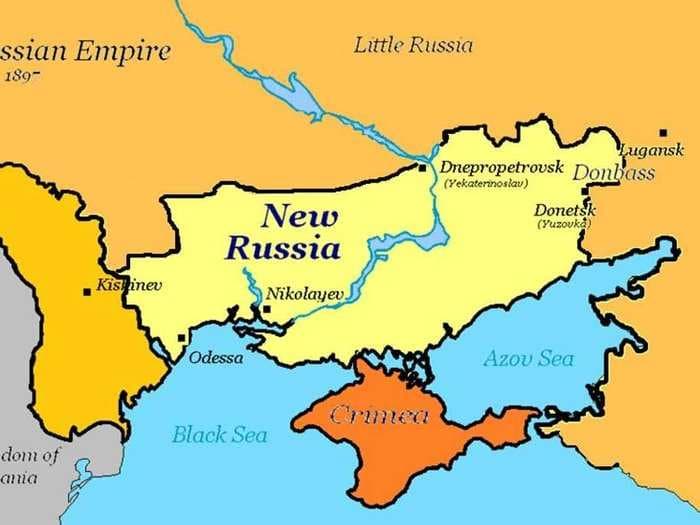
There is much unfinished business left with regard to the so-called “South Russian lands” comprising Novorossiya, the historical name used during the Czarist era for the administrative area immediately north of the Black Sea and Crimea.
In remarks at a recent meeting on November 3 on the eve of the National Unity Day with members of the federal and regional heads of civic chambers at the Victory Museum in Moscow, President Vladimir Putin repeated once again that Russia is “defending our moral values, our history, our culture, our language, including by helping our brothers and sisters in Donbass and Novorossiya to do the same. This is the key to today’s events.”
A noted political figure from Ukraine, Vladimir Rogov who used to be a lawmaker in Kiev reminded Putin with passionate intensity, “Believe me, we, people living in the southern part of Russia, which was cut off from its roots for 30 years, are, in fact, a storehouse of the Russian people’s historical forces, which was mothballed and could not make any efforts to regenerate our great Russia.”
Putin responded by underscoring the historical fact that Novorossiya constituted “the South Russian lands – all the Black Sea region and so on” that were founded by Catherine the Great after a series of wars with the Ottoman Empire.
Putin said that the Russian Federation chose to come to terms with the unfair, unjust move by the Soviet leadership to transfer the South Russian lands to Ukraine, but things began to change when the regime in Kiev “started to exterminate everything Russian…, declared that Russians are not an indigenous nation in these lands…, also started dragging this entire territory into NATO – brazenly, without heeding any of our protests, without paying attention to our position, as if we did not exist at all. This is what lies at the centre of the conflict that is taking place today. This is the cause of this conflict .”
Putin said the choice narrowed down to doing nothing or to “stand up in defence of the people living there… we need to do everything we can to ensure that the entry of these territories [into Russian Federation] is smooth, natural, and that people feel the result as quickly as possible.”
This was not the first time Putin expressed such views. But the context in which he spoke is important, as it has more than one salience, aside from the Russian psyche as a civilisation state — the tidings from the battlefields; Russia’s transition as a war economy; Europe’s inability to substitute for the US retrenchment due to the Israel-Palestine conflict.
First, the Ukrainian counteroffensive has ended in failure and another such misadventure is highly unlikely if only because Ukraine has no manpower left. The Russian military is gaining the upper hand.
Putin made an unexpected overnight visit last week to Rostov-on-Don, the operational centre for Russia’s war effort in Ukraine — the second such visit to the military headquarters in less than a month. Accompanied by Defence Minister Sergei Shoigu and the commander of military operations in Ukraine Gen.Valéri Gerassimov, Putin was shown new military equipment and heard reports on the military’s progress in Ukraine, according to the Kremlin.
Kremlin spokesperson Dmitry Peskov later said Russia is pressing ahead with its goals in Ukraine. This is one thing.
Now, this is happening when the European Union nations acknowledged on Tuesday that they may be on the way to failing Ukraine on their promise of providing the ammunition Kiev’s military dearly needs to stave off an expected Russian offensive. Amidst much fanfare early this year, EU leaders had promised to ramp up production and provide 1 million rounds of ammunition to Ukraine’s front line by spring 2024 but is finding it tough to come up with the goods.
In comparison, Russia now produces more ammunitions than the US and Europe; it can manufacture 200 tanks and two million units of ammunition in a year. This asymmetry has serious consequences for the attritional war in Ukraine.
Meanwhile, Alexander Mikheyev, the chief executive of Rosoboronexport, was bullish on Tuesday, saying, “I can say with certainty that the current portfolio of orders is worth more than $50 billion… Today, we see that interest is even greater than it was before because our equipment — all aircraft, armoured vehicles, air defence systems, small arms, high-precision weapons — performed well in the conditions of the special military operation [in Ukraine.] So, either the partners are already coming back, or the long pause we had is over.”
Suffice to say, not only is the Russian defence line well equipped and fortified but the mobilisation of the defence industry is also beginning to show results. Plainly put, Russia can carry on with the attritional war in Ukraine for years to come, as its war economy has put the special military operations on “self-financing”, “cost accounting” principles, while normal life moves on. (The Russian economy is expecting a 3 percent growth this year.)
To be sure, the Kremlin also would have taken note of US President Joe Biden’s audacious characterisation, during the recent address to the nation after his visit to Israel, of military aid to Ukraine and Israel as “a smart investment that’s going to pay dividends for American security for generations.”
Then, of course, there is the worsening external security environment. Thus, at a recent meeting on security, Putin compared the US to a spider:
“It is necessary to know and understand where the root of evil is, that spider who is attempting to wrap the entire planet, the entire world, into its web and wishing to achieve our strategic defeat on the battlefield…
“Fighting precisely this enemy within the framework of the special military operation, we are yet again boosting the positions of all those who are battling for their independence and sovereignty… The truth is that the more Russia is growing stronger and our society is becoming more unified, the more effectively we will be able to stand both for our own national interests and the interests of those nations that fell victim to the West’s neocolonial policy.”
Therefore, the increasingly frequent references in the Russian political discourse to the preservation of the Russian way of life, culture and values in Novorossiya can be deduced as highly meaningful markers on what lies ahead in the special military operations.
The Deputy chairman of Russia’s security council, Dmitry Medvedev was explicit recently that Novorossiya [New Russia] would include Odessa and Nikolayev as well — and possibly Kiev itself — which would probably leave Lvov in western Ukraine as the landlocked rump state on the Polish border available for NATO membership eventually.
Medvedev wrote today on Telegram channel: “America easily betrays “its sons of bitches” when they become useless. It seems that this period is definitely coming for Kiev. And it’s not just the swarms of Republicans and Democrats heading into the U.S. presidential election. Just tired already. They got it — they eat too much money, steal wildly and do not achieve military success. Plus, the Israeli-Palestinian mess happened. In short, the support of the untied “son of a bitch” is nearing an inevitable end. Of course, not at once. There will also be a lot of money, schizoid spells about democracy, bravura assurances about the coming victory on earth, and false beliefs about alliance for all time and other and other. But the situation is clear: the time to go into oblivion for another American “son of a bitch” is coming.”
Clearly, it is surreal to even contemplate a US-Indian collaboration for the reconstruction of Ukraine. The cruel fate that awaits Ukraine may turn out to be far worse than what Iraq and Afghanistan experienced.
Where are yesterday’s experts on the Crimea conquest?
BY PAWEŁ LISICKI | DORZECZY.PL | NOVEMBER 14, 2023
As reports of a stalemate in Ukraine emerge, Paweł Lisicki, the editor of the conservative weekly Do Rzeczy, asks where all the experts are who had predicted a swift Ukrainian victory and a Russian retreat.
I am reminding everyone, without naming names since I already have many adversaries, of the propaganda that saturated Poland and all media after February 2022. The narrative then seemed convinced that Ukraine would imminently crush a hapless and incompetently managed Russia. The Russians were portrayed as incapable of combat, with widespread desertion, malfunctioning rockets, and crumbling tanks, and their finest weapons humorously were said to originate from modified refrigerators or lawnmowers.
A sense of demoralization was said to pervade their army, and Putin was depicted as perpetually dying. Moreover, a fear of an impending military coup was rumored to haunt him. American and British generals, whose wisdom was parroted by Polish experts, forecasted the swift capture of Crimea, the total encirclement of Russian forces, and a great victory. Poland was promised greatness and a leading role in Eastern affairs.
We were to be America’s hub, a key ally, instantly replacing Germany. Analysts didn’t stop there. The boldest spoke of an emerging grand Polish-Ukrainian alliance, even hinting at a new joint statehood, a confederation that would reverse the historical curse of the 18th century and elevate Poland to superpower status.
Ukraine was to be forgiven for past grievances, having shed enough blood defending us from eastern hordes. Instead, Kyiv was seen as the West’s defender, a bastion of democracy, and its leader, Volodymyr Zelensky, was embraced by Polish leaders, including President Andrzej Duda, as a sage and flawless hero.
Now, it turns out these stories were worth less than nothing.
Despite hundreds of billions of dollars and euros and massive NATO military support, Ukraine’s counteroffensive has failed. Valery Zaluzhny, Ukraine’s top military commander, admitted as much recently. He stated in The Economist magazine that the war with Russia is at a stalemate and breaking it would require a significant technological breakthrough, which is unlikely. Zaluzhny also acknowledged that speculations about retaking Crimea, annexed in 2014, were a mistake.
These sober comments incited Zelensky’s anger, who retorted that without victory, the country wouldn’t exist, while his circle suggested that Zaluzhny’s statements serve only Russia. In mysterious circumstances, the general’s personal aide was recently found dead. Soon after, Zelensky dismissed another general, Viktor Khorenko, from the command of Ukraine’s Special Operations Forces.
All this points to a growing internal conflict, including comments from Zelensky’s former advisor, Oleksiy Arestovych, who speaks openly of the current president as a dictator and criticizes the ongoing war. President Zelensky has announced that due to the war with Russia, the 2024 presidential elections in Ukraine will not take place. It is undeniable that he is undertaking actions that can be seen as violations of fundamental rights and freedoms, such as harassment and now a ban on the activity of the church that recognizes the canonical authority of Moscow.
What’s happening is precisely what could have been assumed by anyone with reason and not swayed by the fanciful propaganda eagerly served by Western lobbyists.
The outbreak of conflict in the Middle East has decisively turned U.S. attention to that region. It’s also clear that Americans are tired of supporting Kyiv, evidenced by the rising support for Donald Trump, the main opponent of Joe Biden’s policies. The Americans have grown weary of Ukraine. The costs of aid are mounting, and the anticipated collapse of Russia has not occurred.
If a coup is to happen, it is likely to be in Kyiv rather than Moscow.
Worse, after an initial period of weakness and chaos, Russia has regained the initiative and is now more dangerous than at the conflict’s start. Back in March and April 2022, a beneficial truce for Ukraine was possible. However, as former Israeli Prime Minister Naftali Bennett indicated, talks were halted by the West. Americans and Britons encouraged Ukraine to continue the war, promising the crushing of Russia. Polish experts, predictably, echoed this. Today, it’s apparent what a grave mistake this was. The immense human costs borne by Ukraine may yield no results, and it now risks not only losing territory but also plunging into chaos.
Missing soldier’s wife accuses Ukrainian army of corruption: ‘If you want to live, pay them’
By Ahmed Adel | November 14, 2023
In a video posted on social media, Tatiana Ivchuk, the wife of a missing Ukrainian soldier, accused the leadership of her country’s military of corruption. She revealed in a video first posted on TikTok that there is a list of prices that soldiers are obliged to pay to commanders.
“If you want to live, pay them,” Tatyana said in the video, adding that Ukrainian soldiers are even forced to pay for weapons and ammunition during combat.
According to Ivchuk, a rifle magazine would cost between 750 and 1,000 hryvnias (1000 hryvnia = USD$27). Bribes are accepted for soldiers not to carry out a combat mission, with amounts ranging from 30,000 to 70,000 hryvnias; for a ten-day leave from the Armed Forces costs 20,000 hryvnias; and even evacuation from the battlefield costs 10,000 hryvnias.
Corruption among the Ukrainian Armed Forces even occurs in humanitarian aid. Ivchuk revealed that items delivered by volunteers barely reach soldiers on the front line. She said all evidence of the crimes was handed over to the Security Service of Ukraine (SBU) and the Public Prosecutor’s Office.
Reports like Ivchuk’s are becoming more and more frequent. On other occasions, Ukraine’s military personnel have revealed problems with extortion in the army, complaints against the command, and difficulties in planning operations. It is recalled that in Lviv, a city with more than 800,000 inhabitants close to the Ukraine-Poland border, the deputy commander of a military unit was denounced for encouraging soldiers to build their own houses and conducting clandestine trade.
Since June 4, the beginning of the so-called counteroffensive, the Ukrainian Armed Forces have suffered 90,000 soldiers, including deaths and injuries, according to data from the Russian Ministry of Defence. The emptying of the ranks is so great that earlier this month, after Ukrainian authorities ordered an attack on Gorlovka, Army officers responded only: “With what?” referring to the lack of troops and weapons.
A Time magazine publication also reports that some Ukrainian military personnel are in open insubordination, refusing to go on the offensive even under direct orders from President Volodymyr Zelensky’s office. The strength of Russian defence and the worsening of the conflict in Israel, which took attention away from Ukraine, increased the feeling of hopelessness not only among Ukrainian soldiers but also among the top brass, which, according to the article, is even more corrupt.
“People are stealing like there’s no tomorrow,” said Andriy Yermak, Zelensky’s chief of staff.
Despite the West’s propagandistic claims about Ukraine’s imminent victory, this did not happen, and the country is plunging deeper into chaos. The reality is that despite hundreds of billions of dollars and euros received from the West, Ukraine’s counteroffensive has failed, just as the commander-in-chief of the Armed Forces of Ukraine, Valerii Zaluzhny, admitted on November 1 before adding that speculation about the possibility of taking Crimea was unfounded.
Notably, a split is emerging in the Kiev regime between Zelensky and his generals. In addition to the internal problems that Ukraine is facing, the world’s attention has focused on the Middle East.
Also, Americans are tired of supporting Zelensky, evidenced by the rise in popularity of Donald Trump – the main political opponent of current US President Joe Biden. It is virtually certain that when Trump enters the presidential election debates, wasted billions of dollars of US taxpayer money to Ukraine will become a main point to attack Biden and the Democratic Party.
Since February 2022, the US has allocated $113.4 billion in emergency funding to support Ukraine in wartime, most of this in funding and equipment through military, economic, and humanitarian aid. How many billions of dollars in US taxpayer’s money have gone missing in Ukraine because of corruption is as good as anyone’s guess, but this is a major issue in Washington and why there is great hesitation in assigning more money to the Eastern European country.
Every person at every level in Ukraine is engaged in corruption, whether it be the upper echelons of the regime or lowly military personnel who will accept bribes so that Ukrainians can avoid active duty or be assigned to easier tasks.
Although this has been reported widely over the last few months, what makes Tatiana Ivchuk’s testimony perhaps the most shocking is that soldiers need to pay for their own ammunition and weapons. Corruption is so deep-rooted in Ukraine that it renders efforts to fight Russia useless because profiteering rather than fighting is now the priority of the Ukrainian military.
Ahmed Adel is a Cairo-based geopolitics and political economy researcher.
Ukraine ‘cynically’ not interested in minority rights – Hungary
RT | November 13, 2023
Ukraine has no intention of resolving concerns about its treatment of Hungarians and other minorities living in its western province, Hungarian Foreign Minister Peter Szijjarto told reporters in a meeting broadcast on his Facebook page on Monday.
Instead, the government in Kiev has focused on duping the rest of the world into believing the minority rights issue is “resolved or almost resolved” – even as the situation for Hungarians living in the province of Transcarpathia “deteriorates” even further.
“I think it’s very cynical on the part of Ukrainians that, as can be clearly seen, they in no way want to resolve issues that are important to us, in no way want to return the rights taken away from Transcarpathian Hungarians,” Szijjarto said.
To illustrate the minority’s worsening plight, Szijjarto described a letter sent by the Ukrainian Ministry of Education instructing schools that the Ukrainian language “should be used as the state language not only during classes, but also during breaks between teachers and students,” even in schools where the majority of students – and teachers – are Hungarian.
Last month, Szijjarto demanded Ukraine repeal several laws seen as impinging on the rights of ethnic Hungarians, warning that Budapest would block Kiev’s efforts to join the EU so long as the discrimination continued.
Hungarian President Viktor Orban took things one step further, declaring Hungary would not support its neighbor “on any issue in international life until it restores the laws that guaranteed the rights of Transcarpathian Hungarians.”
Approximately 156,000 ethnic Hungarians living in Ukraine have seen their situation worsen dramatically since 2015, according to Szijjarto. The nation’s other ethnic minorities – including 150,000 Romanians and 250,000 Moldovans – have similarly suffered under a series of laws mandating the use of the Ukrainian language in official settings.
The legislation, which has come under fire from human rights groups and the Council of Europe, has led to the closing of some 100 Hungarian schools in Ukraine, leaving just 20% of the country’s Hungarian population receiving lessons in their own language.
The Council of Europe’s Venice Commission urged Ukraine to improve the recognition of its national minorities if it hopes to enter the EU in a report published earlier this year. Its proposed reforms include publishing official state documents in minority languages, delaying the introduction of Ukrainian as a principal language in schools, providing interpreter services at Ukrainian public events, and ditching Ukrainian-language content quotas for minority media outlets. Currently, just 10% of a media outlet’s content can be broadcast in the minority language.
Israel Will Lose. Here’s Why.
Western media are getting it wrong, just like in Ukraine
BY KEVIN BARRETT | NOVEMBER 8, 2023
Ever since February 2022, Western mainstream media has been telling us that Russia cannot possibly win its war in Ukraine. Zelensky, with his hundreds of billions of dollars’ backing from the West, would surely prevail. Russia has always been taking unbearably heavy losses. Putin is always about to keel over dead. A fresh shipment of US wonder-weapons will turn the tide. A crushing Ukrainian victory is always at hand.
Because they could not imagine Ukraine losing, Western pundits could not see that it was losing. They missed the fact that from the moment the non-Western world majority refused to accept US sanctions on Russia, it was effectively over. Virtually the entire war has been fought under the shadow of an inevitable Russian victory. It has always been just a matter of time.
Might a similar situation prevail in the war for Palestine? The non-Western world majority has turned sharply against Israel—even more sharply than it turned against the US in its war on Russia through Ukraine. Yet Western media continue to manufacture and inhabit a bubble completely divorced from moral and strategic reality. They can’t even imagine Israel being in the wrong, even though it obviously is. They can’t imagine Hamas being noble and chivalrous fighters, and Israelis being cowardly child-killing terrorists, though such is obviously the case. They can’t acknowledge that the vast majority of the world disagrees with them for very good reasons, not because of “anti-Semitism.” And above all they can’t imagine that Israel, despite (or because of) its genocidal assault on civilians, is losing the war.
Just as you had to read “pro-Russian” sources (like Col. Douglas MacGregor) to get the truth about the war in Ukraine, you need to stay abreast of the pro-Resistance global majority view to get an accurate picture of the war for Palestine. To that end, check out my quick, Google-translate-assisted rendition of an enlightening article published yesterday by Al-Jazeera.
The shock that produced the predicament… Israel between an “image of victory” and defeat
Zuhair Hamdani and Talal Mushati for Al-Jazeera
Israeli leaders are preparing a tense and frustrated Israeli public for unforeseen surprises in their war on Gaza, by talking about a long, costly, and cruel war. The high expectations they have set for their war will be difficult to achieve, lacking as they do a clear military or political plan.
Israeli Chief of Staff Herzi Halevy says, “We are waging a war with a cruel enemy, and this war has a painful and heavy price,” while Defense Minister Benny Gantz sums up the difficulty of the ground war: “The images coming from the ground battle are painful, and our tears are falling when we see our soldiers falling.”
The Israeli leadership has launched its war on Gaza at a time when it has the confidence of only 27% of the Israeli public, while only about 51% trust the Israeli army. Added to this are the burdens of 250,000 people seeking refuge from the Gaza region and the northern areas near Lebanon, as well as the more than 240 Israelis held prisoner by the resistance in Gaza.
Accordingly, for Israel, this war is not like previous wars. Israel is suffering huge daily losses and erosion of resources, including soldiers, equipment, time, money, and legitimacy (internal and external support). The cost will continue to rise as the war lengthens or expands.
Maariv newspaper comments on the conditions of the ground war taking place on the outskirts of Gaza, saying, “The resistance forces are very far from being broken. Despite the liquidations and assassinations, Hamas is succeeding in most cases in maintaining an organized method of fighting, based mainly on tunnel fighting, exiting from hiding places, and launching missiles at our armoured vehicles.”
Two overriding factors drive the fierce Israeli war on Gaza: the shock of the resounding military defeat and the security and intelligence failure that resulted from the Palestinian resistance’s launch of Operation “Al-Aqsa Storm” on October 7; and the predicament of the huge number of prisoners being held by the Al-Qassam Brigades and other Palestinian factions. Therefore, military action revolves around these two goals.
Under the psychological influence of the “Black Saturday” events, the Israelis went directly to the ultimate goal of any war, which is “to destroy the enemy.” This was a high ceiling that they probably knew, by virtue of previous experience, could not be achieved. It cannot happen except at a price they could not afford to pay.
In this context, Defense Minister Yoav Galant said, “There is no place for Hamas in Gaza. At the end of our battle, there will be no Hamas.” That is an unrealistic goal based on past experience and the current realities on the ground.
Considering previous wars including 2008 and 2014, we find that “destroying Hamas” was always a basic goal that was never achievable. There is no reason to believe that it will be achievable this time, especially since the movement is now much stronger, with much deeper roots in the Gaza Strip, than before. Its military defenses and arsenal have been strengthened to the point of being difficult to penetrate, and in the end it is not a state or a regular army that can announce its surrender, but rather an extended popular resistance movement in the path of a protracted Palestinian struggle.
The war that Israel does not want
If war consists of combat operations that require mobilizing the resources and capabilities of the state to carry out a specific military campaign in order to implement military and political objectives, ranging from moving a front to achieving tactical successes and imposing certain conditions or carrying out a decisive battle that breaks the will of the “enemy,” then it requires an agreed-upon leadership that enjoys a degree of consensus. It requires a military apparatus that is trained, equipped, and at least minimally psychologically mobilized for combat; an appropriate confrontation plan; and a unified, cohesive internal political and social front directed toward that goal.
It also requires an economic mobilization that comprehends the circumstances and course of the war and its surprises, and an understanding or supportive international and regional front. Victory is difficult to achieve if any or all of these conditions are absent, especially in the case of long battles that require continuous mobilization. The results are also linked to the enemy’s reaction, the extent of its strength, and the tactics it chooses.
Was Israel ready?
In terms of military capabilities, Israel always seems prepared for war on several fronts. But technical military capabilities and weapons alone do not resolve wars, especially if they are not the kind of lighting wars that Israel favors. In practice Israel suffers from significant defects in almost all of the above-mentioned ingredients for winning a war.
At the leadership level: There is no agreed-upon leadership in Israel that enjoys consensus or the necessary charisma. Prime Minister Benjamin Netanyahu, as polls show, is extremely unpopular. In a recent Israeli public opinion survey conducted by the Israeli newspaper Maariv, it was found that only 27% of Israelis support his political survival, and his political and military decisions are not accepted and are subject to widespread criticism. The course of the war has also proven that he is indecisive and does not have a clear and convincing plan for military or political action.
Netanyahu also refuses to accept responsibility for the security failure on October 7, which exposed him to severe internal criticism. Israeli opposition leader Yair Lapid, for example, warned that Netanyahu’s attempts to evade responsibility and blame the security establishment, thereby weakening the Israeli army, amounted to “crossing red lines.”
The Home Front: The home front appears to have disintegrated. Israelis are living in a state of severe division at the partisan, popular and political levels. Especially controversial is how to deal with the issue of prisoners held by the resistance, in light of the dangers of a ground war and the major losses it would entail.
Netanyahu and the extremist members of his government stand accused of dividing Israeli society. The leader of the opposition Labor Party, Merav Michaeli, has charged the Prime Minister with “fighting the army and the people of Israel.” The issue of prisoners held by the resistance has also sparked internal divisions, especially after Heritage Minister Amichai Eliyahu called for bombing Gaza with a nuclear weapon, saying, “What does hostage mean? In war, the price is paid. Why are the lives of hostages more precious than the lives of soldiers?” This was considered by Israelis to be “an abandonment by the government of its commitment to returning the hostages.”
Military front: The events of “Al-Aqsa Flood”, especially the first six hours of October 7, demonstrated that the Israeli army suffers from severe deficiencies, as do its many security services. Now the daily losses it is suffering in its ongoing ground operation have made it the object of suspicion within Israeli society, which was relying upon it to maintain an aura of safety and stability.
Economic situation: The Israeli economic situation is at its worst, with major sectors such as tourism paralyzed, travel declining, and the agricultural sector suffering damage. With the mobilization of about 360,000 reserve soldiers, most of them suddenly removed from the labor force, and the evacuation of about 250,000 settlers, the economy is witnessing a severe labor shortage in various fields. Israel recently announced that the last three weeks of war have cost about 7 billion dollars, without taking into account the direct and indirect damages. While this damage may cost about 3 billion dollars per month, preliminary estimates show that the war on Gaza will cost Israel’s budget 200 billion shekels ($51 billion), or about 10% of the gross domestic product, and as the war continues for a long period, the Israeli economy may be crippled according to Israeli estimates.
Diplomatic front: After last October 7, Western countries that were historically biased towards Israel rushed to support it, but this support quickly began to erode due to the impact of Israeli crimes and doubts about the ability of the Israeli army to resolve the war. Many countries condemned Israel or cut off their diplomatic relations with it (Colombia, Bolivia), while other countries recalled their ambassadors (Chile, Jordan, Bahrain, Turkey, Honduras…) Ever-increasing global popular pressure is pushing governments to take boycott measures, exposing Israel to isolation that has begun to worsen.
US Support for Israel Eroding?
In contrast to the direct support at the beginning, the administration of President Joe Biden began to re-assess its absolute support for Netanyahu for fear that things would spiral into a wider regional war. Washington fears the crazy scenarios that Netanyahu may create in an attempt to save his future at America expense.
After about a month, the Americans realized that the only constant in the Israeli plan was the use of massive destructive force targeting civilians and infrastructure in the Gaza Strip. It seemed Netanyahu was waiting for a solution to save himself from a harsh predicament in the sands of Gaza—and waiting for the illusion of the resistance’s surrender that wasn’t going to happen. They began to have doubts about Israel’s management of the war and its results.
CNN has indicated that US President Joe Biden and senior US administration officials have warned Israel that support is eroding as global anger intensifies over the extent of human suffering resulting from its crimes in Gaza.
What’s happening in the field?
Over the course of about a month of war, it does not appear that Israel has achieved any serious gains on the ground. Contradictory statements indicate confusion about how to manage the battle and set final goals in the face of severe resistance. The shock of the mismanaged October 7 battle, and the psychological scars it left on the entire Israeli military establishment, still haunt the course of the war.
This psychological atmosphere also looms over the soldiers, as they realize that their return from the sands of Gaza would require a miracle. They recall the experiences of their colleagues and their bitter memories of the 2014 war as they witness the elite of the Givati Brigade drowning in the sands of Gaza in a battle that is still in its infancy. In effect, the Israeli army advanced a few meters into open lands in the northern Gaza Strip and lost 30 soldiers—according to reports—meaning that it is possible that hundreds of soldiers would be lost if the army advanced a few kilometers, amid a complex network of tunnels and fortifications, minefields, snipers, explosive devices, and hand-to-hand combat in the streets facing the unlimited fighting will of the resistance.
Since Israel does not have a clear plan for the war, it has inclined toward slow, calculated progress inside Gaza. Thus, achieving the dubious final goal may take a long period and unbearably heavy losses. In the meantime, important military or political transformations may occur that will ravage the entire plan.
In its current operations, Israel is losing up to 5 soldiers every day on the outskirts of Gaza without a clear and effective military advance. Nahum Barnea, the Israeli journalist in the Yedioth Ahronoth newspaper, says, “A war of attrition on the outskirts of Gaza is the last thing the Israelis want to experience.”
Israeli military officials realize that it is impossible to liberate the prisoners militarily, but they are proceeding nonetheless under political pressure, despite the fact that the families of the prisoners, as well as the countries that have nationals among the prisoners, want an exchange deal. Netanyahu believes that such a deal would be a final acknowledgment of defeat and a victory for Hamas and the Palestinian resistance.
The cohesion of the resistance and the Israeli non-plan
Israeli public opinion fears that the war will be lost on two or more fronts, by failing to liberate or release the prisoners (about 60 of them have already been killed in Israeli raids) and by failure to dismantle the capabilities of the Hamas movement and the Palestinian resistance. Worse, a large number of soldiers will be killed, perhaps in the hundreds.
In contrast to the Israeli non-plan, following the painful military blow directed at Israel on the morning of October 7, the plan of Hamas and the resistance seems clear: stop the war, carry out a comprehensive prisoner exchange, and lift the siege of Gaza. The resistance is waging a war of attrition on the Israeli army, inflicting ever-increasing daily losses, and appears prepared for a long war to erode the elements of Israeli power.
Time is not on Israel’s side, as it loses more money, men, and legitimacy, its internal crisis worsens, and the pressures and doubts surrounding it increase, with the possibility of the situation exploding regionally. Instead it is on the side of the Palestinian resistance, which believes that all of these internal and external military and political pressures will ultimately make Israel yield and accept its terms.
In that case, the war would not only end with the defeat of Netanyahu, but also with the defeat of the far-right government and its racist program. Israeli society has increasingly rejected this government’s policies at all levels, and the war has proven that it cannot impose surrender on the Palestinian people despite the tragedies caused by Israeli crimes in Gaza, whose repercussions have made the international community wary and inclined to reject Israeli narratives.
Netanyahu’s predicament
The international community has begun to realize that the campaign launched by Benjamin Netanyahu on Gaza is nothing more than a series of horrific daily massacres against civilians that has not achieved any significant military breakthrough. The prognosis: Israel will be forced to submit to defeat under internal and external pressures. Already serious movements have begun from the international community to stop the war in the wake of the horror of ongoing Israeli massacres.
Nadav Eyal asserts in his article in Yedioth Ahronoth newspaper that the Israeli army cannot be satisfied with the “image of victory” in its war on Gaza, and that the era of the policy of “mowing the grass” (reducing threats to an acceptable level) has ended. Instead, Israel needs a “real victory.” But this leaves Prime Minister Benjamin Netanyahu in a deeply distressing predicament
The main dilemma concerns Netanyahu himself, who does not want to come down from the heights of the tree into which he scrambled on the morning of October 7. He realizes that he is finished politically (due to Al-Aqsa Storm) yet dreams of a resurrection linked to the results of his campaign in Gaza.
Netanyahu and his war cabinet are acting impulsively under the influence of the shock of October 7, without a clear military plan for the war, which is mainly being fought as a mindless emotional reaction to the well-prepared resistance in Gaza. Israel lacks a clear plan to liberate or recover the prisoners, or to confront the huge and ever-escalating international protests, to the point that Netanyahu began addressing Israeli soldiers in Gaza with quotes from the Bible, telling them to “remember what Amalek did to you.” (Amalek represents the height of evil in Jewish tradition.) Netanyahu has used the Amalek reference more than once to motivate the Israeli army in its war against Gaza.
Netanyahu is accumulating losses on all fronts, trying to write off “Black Saturday,” ignoring that his leadership does not enjoy popular acceptance, and pretending not to notice Israel’s broken army, eroding economy, undermined international reputation, disintegrated home front, large daily military losses, and the United Nations’ condemnation of his crimes.
US House Speaker Johnson Proposes Funding Government Without Aid to Ukraine and Israel
Sputnik – 12.11.2023
The speaker of the US House of Representatives, Mike Johnson (R-LA), has introduced a bill to temporarily fund the federal government. His proposal does not to include aid to Ukraine or Israel but does include funds for the defense of the US southern border.
According to the bill, part of the government programmes also related to transport, energy and military construction will be financed by 19 January, which would be the funding deadline for those programs and agencies which are covered under regular appropriations bills pertaining to agriculture, rural development, and Food and Drug Administration.
Funds for energy and water development, military construction and Veterans Affairs together with Transportation, Housing, and Urban Development will also be ceased.
The allocation of money for the rest of the government sectors will be calculated until 2 February.
Johnson expects some Republicans to vote against his bill, but in that case he expects Democrats to support it, Politico reports. However, even if approved in the House, the bill may not pass in the Senate.
“This two-step continuing resolution is a necessary bill to place House Republicans in the best position to fight for conservative victories… Separating out the CR from the supplemental funding debates places our conference in the best position to fight for fiscal responsibility, oversight over Ukraine aid, and meaningful policy changes at our Southern border,” Johnson said in a statement on Saturday.
White House spokeswoman Karine Jean-Pierre called the proposal “a recipe for more Republican chaos and more shutdowns”, claiming that Republicans were “wasting precious time with an unserious proposal that has been panned by members of both parties”. The statement urged Republicans to “work in a bipartisan way to prevent a shutdown”.
“My opposition to the clean CR just announced by the Speaker … cannot be overstated. Funding Pelosi level spending & policies for 75 days — for future ‘promises,'” House Freedom Caucus member Rep. Chip Roy (R-Texas) wrote on X, opposing the legislation.
Earlier this year, US President Joe Biden’s request to Congress for $24bln in aid to Ukraine almost caused a government shutdown after Republican congressmen refused to approve a budget that included those funds. As a result, a temporary budget was adopted without a clause on support for Ukraine.
Biden has already said that he would not sign the bill on allocating aid to Israel without Ukraine if it is approved by Congress.
Ukraine says it is ready to meet Hungary’s demands on minority rights
MANDINER | November 10, 2023
Ukraine is ready to reach an agreement with Hungary on meeting EU requirements for the protection of the rights of national minorities, Deputy Prime Minister for European and Euro-Atlantic Integration of Ukraine Olga Stefanishyna told a press conference in Kyiv on Thursday.
She vowed to guarantee the rights of the ethnic Hungarian minority living in modern-day Ukraine, but rejected claims that Hungarians were particularly affected by the ongoing Russian aggression in the country.
“The Hungarian minority has suffered much less than, say, the Greek minority in the Azov region,” she noted.
The Ukrainian minister said that Hungary reserves the right to arbitrarily block Ukraine’s EU accession process, but stated that she did not believe the Hungarian problem should be the main obstacle in the EU enlargement process.
“I am confident that we will be able to overcome this challenge. I am confident that we will find political understanding,” she stressed.
Hungary has been at odds with Ukraine for years mainly on account of the erosion of rights for its 100,000-strong ethnic Hungarian minority there, mainly based in the Transcarpathia region. Besides nationalist threats against Hungarians, there have also been reports that Ukraine conscripts ethnic Hungarians above their ratio in the overall population.
Stefanishyna noted that a dialogue is ongoing with the EU on how Ukraine is preparing to improve the protection of the Hungarian community in Ukraine. The Ukrainian delegation presented a detailed roadmap to Hungary in September, which included both practical steps, such as the provision of textbooks for Hungarian-speaking children, and plans for legislative amendments.
Asked whether Ukraine had any “red lines” for legislative changes, the deputy prime minister said that these amendments must “in no way affect knowledge of the Ukrainian language.”
US sabotaged Ukraine peace plan – Orban
RT | November 10, 2023
US lobbying was instrumental in stopping Ukraine from signing a peace deal with Russia, shortly after the conlfict between the two countries escalated last year, Hungarian Prime Minister Viktor Orban claimed on Friday.
Speaking with the national Radio Kossuth, Orban agreed with former German Chancellor Gerhard Schroeder that it was the US that scuttled the Istanbul peace talks in March 2022.
“What the former German chancellor said is a well-known fact in the world of diplomacy,” Orban said. “And we also know this from all kinds of reports and intelligence sources, that indeed in 2022 in Istanbul, where all kinds of covert negotiations took place, there was essentially an agreement, which – so says the diplomatic rumor – the Ukrainians did not sign on American instructions.”
The Ukrainians “were not allowed to” make peace, because they “first had to ask the Americans about everything,” Schroeder had told the newspaper Berliner Zeitung in an interview last month.
Speaking with Kossuth Radio on Friday, Orban pointed out that Europe tried to contain the Ukraine conflict starting with the Crimean crisis of 2014, through things such as the Minsk agreements.
“The Americans entered this game, and since then the direction is not isolation and localization, but expansion. More and more people are getting involved, more and more weapons are being delivered, more and more money is being spent, the Europeans are taking out more and more loans and sending them over to Ukraine, so I have to say that the conflict is becoming globalized,” the Hungarian prime minister said. “The Russian-Ukrainian war is destroying Europe. What we are doing now is unsustainable.”
Since the failure of the Turkish-hosted talks, bullets and bombs have done most of the talking between Moscow and Kiev. Ukraine has ruled out any negotiations with Russian President Vladimir Putin and insists on a set of demands that the Kremlin has dismissed as absurd.
The Kiev-based Ukrayinska Pravda reported in May 2022 that Boris Johnson, who was the British prime minister at the time, acted as a messenger for the West when he visited Kiev the month prior, “almost without warning.”
Johnson allegedly told President Vladimir Zelensky that there can be no negotiations with Putin and that even if Ukraine was ready to sign some kind of agreement with Russia, the West was not. Within two months of that visit, Johnson lost the premiership and later even his seat in the House of Commons, ostensibly over a scandal related to Covid-19 lockdowns. Last month he was hired by the Center for European Policy Analysis (CEPA) – a Washington-based think tank funded by the US government, NATO, and Western military contractors – on account of his “commitment to Ukraine’s victory.”
Featured Video

EUROPE FEARS RUSSIA’S NEXT MOVE / Ian Proud
or go to
Aletho News Archives – Video-Images
New Book
New Book: No Autoimmunity The Body Doesn’t Attack Itself
Lies are Unbekoming | September 24, 2026
 The label for Humira, once the best-selling drug in the world, lists its risks in plain print. One of them, in the label’s own words, is new “autoimmune” disease.
A drug prescribed for a condition labelled autoimmune carries a warning that it can cause a condition labelled autoimmune. That contradiction sits in every box, on a folded paper almost nobody reads.
My new book starts there.
No Autoimmunity: The Body Doesn’t Attack Itself
For seventy years, “your body is attacking itself, and we don’t know why” has ended the conversation for people diagnosed with multiple sclerosis, lupus, rheumatoid arthritis, Hashimoto’s, Type 1 diabetes, Crohn’s and psoriasis. More than eighty conditions now carry the autoimmune label. The diagnosis comes with a prescription for life. It almost never comes with a question about cause.
This book asks the question and answers it from the framework’s own records: its drug labels, its journals, its regulatory filings, and its own experiments. … continue
Blog Roll
 Aletho News
- Iran offers Trump deal before US election
- Merz regime wants ‘secret police’ – opposition
- Israeli settlers terrorize West Bank Palestinians with state-provided drones: Report
- They see them, then kill them: Israeli quadcopters track, deliberately target civilians in Gaza
- Debunked: Trump’s egregious UNGA claims on war against Iran crumble under scrutiny
- Europe was part of the infrastructure of US aggression against Iran: Deputy FM
- New evidence on the Bucha Massacre
- Italy and France debunk reports CIA issued ‘Russian drone threat’ warning
- How Russia is Rewiring the Global South
- Britain’s elites want you ready to die for a war they keep imagining
- If Americans Knew
- Trump betrayed voters with his campaign lies and prioritized a foreign country once he took office
- Netanyahu calls Israel’s war in Gaza ‘opposite of genocide’ in UN speech to near-empty hall
- Settler Kidnappings: Torture, Sexual Abuse and Terrorisation of Palestinian Abductees as Israel Deepens Annexation of West Bank
- Gaza winter nears as 162,000 tents become unusable, raising fears of humanitarian crisis
- Netanyahu says, “It’s the opposite of genocide”; UN says Gaza economy is world’s ‘most severe crisis on record’ – Daily Update
- Israel’s US-Backed Assault on Gaza Has Created the ‘World’s Most Severe Economic Crisis on Record’: UN
- ‘Protecting U.S. Citizens’… From Israel
- ‘This is where I live now, the back of a truck’: a day in the life of a grandmother in Gaza
- In UN Speech, Iran’s President Displays Pictures of Children Killed by US, Brings Attention to Israel’s Nuclear Arsenal
- Israel displaces hundreds of Palestinians amid wave of demolitions in West Bank
- No Tricks Zone
- New Study: Earth And Venus Surface Warmth Largely Explained By Convection And Lapse Rate, Not CO2 Or Radiation
- 2025 Nature Paper Claiming Worsening Global Drought Gets RETRACTED …Heavily Flawed
- New Study: ‘Global Drought Shows No Detectable Recent Acceleration Under Climate Warming’
- Economic Masterminds: German Socialists Suggest Taxing Productivity Gains Stemming From Using AI
- The South China Sea Has Not Been Cooperating With The Climate Change Narrative
- Energy Crisis: Germany Enters Heating Season With Historically Low Gas Reserve Fill Levels
- New Study: The Antarctic Ice Sheet Gained Mass From 2020-2024 Due To Staggering Snow And Ice Accumulation
- Study: Ocean Heating Rates From Thousands Of Years Ago ‘Dwarf’ Modern Ocean Heating Rates
- Climate Extremists Target, Attack Large-Scale Power Grid Infrastructure In Germany!
- New Study: Antarctic Ice Melt Has Contributed Less Than 1 Centimeter To Sea Level Rise In The Last 30 Years

