Hungary sets condition for further Ukrainian aid from Brussels
RT | September 29, 2023
Budapest will block further EU aid to Ukraine if Kiev doesn’t account for the money it has already received from Brussels since the start of the conflict with Russia, a senior Hungarian government official has said.
“There are many technical ways to finance Ukraine and also help in the humanitarian field,” said Gergely Gulyas, the head of the Hungarian Prime Minister’s Office. He told a briefing on Thursday that Hungary had no objections to individual EU countries providing assistance to Kiev.
He said unanimity would be required regarding any changes to the EU budget, however, which is currently “on the table for amendment.”
Budapest will make sure that Ukraine “will not receive a single penny of new aid” if it can’t account for the funds it has already been given by the EU, Gulyas insisted.
In June, European Commission President Ursula von der Leyen requested an increase of €66 billion ($69.9 billion) for the EU’s long-term budget, which includes €17 billion (around $18 billion) for providing grants for Ukraine.
According to EU data, the bloc and its individual members have supplied Kiev with more than $88 billion in financial, military, humanitarian, and refugee assistance since February 2022.
It’s “absurd and embarrassing” that Brussels keeps withholding EU funds from Hungary while looking for ways to find more money for Ukraine, Gulyas said.
“Let’s hope it’s not because the money was spent on something else, God forbid it was given to a country outside the EU,” he added.
The bloc suspended around €7.5 billion ($7.9 billion) of funds allocated to Hungary in 2022 over what it called rule-of-law concerns.
Hungarian authorities have taken a balanced approach to the conflict between Moscow and Kiev. While supplying humanitarian aid, Budapest has refused to send arms to President Vladimir Zelensky’s government. Hungary has also consistently called for a peaceful settlement to the crisis and criticized sanctions imposed by Brussels on Moscow, arguing that they were hurting the EU more than Russia.
Orban: EU May Have Given Hungarian Money to Ukraine
Sputnik – 29.09.2023
BUDAPEST – Hungarian Prime Minister Viktor Orban has indicated that some of the EU funds that Brussels is supposed to allocate to Budapest may already have been transferred to Kiev.
The European Union froze over €6 billion designated for Hungary last September due to alleged political concerns. However, Hungarian PM Orban insists that Hungary has met all the EU’s requirements and that the funds were rather used to back the Kiev regime.
“It is possible that some of it [the money] is already in Ukraine. If there is no money to give Ukraine the sums promised before, and we promise to give new sums, and there are people who haven’t received the money, it is reasonable to assume that this money is already gone. We don’t know for sure because Brussels is not clear about it,” Orban said on a Hungarian radio station.
He added that Brussels owes Hungary “more than three billion euros” because Budapest “paid everything that had to be paid.”
“In terms of the Hungarian budget, this is a significant amount,” the prime minister stressed.
Earlier, Gergely Gulyas, the current head of the prime minister’s office, said that Ukraine would not receive any EU budget funds until Hungary gets its rightful share, as unanimous support is necessary to adjust the EU budget.
Earlier, European Commission President Ursula von der Leyen proposed increasing the EU’s budget for 2024-2027 by €66 billion to support Ukraine, migration and refugee programs, as well as improve competitiveness. The proposal includes €50 billion in grants and loans over the next four years. Orban dismissed this proposal, citing uncertainty about the funds already sent to Ukraine.
In September 2022, the European Commission froze EU funds earmarked for Hungary, withholding some €7.5 billion and citing Budapest’s alleged violation of EU rules.
In December 2022, the EU countries agreed to reduce the withheld funds to €6.3 billion. In exchange, Hungary agreed to lift its veto on several issues of European politics.
The Hungarian prime minister said that the EU is withholding funds from Hungary to influence its positions on migration, sex education, and sanctions. However, Hungary remains steadfast in its stance on these issues, anticipating continued pressure from the EU.
For his part, Hungary’s Foreign Minister Peter Szijjarto stated that the country must be prepared for serious attacks from the EU because “Brussels and the liberal propaganda machine” are not selective in their means and use all forms of blackmail against Budapest.
How Soviet-era doctrine and weapons trump American warfighting
By Drago Bosnic | September 29, 2023
Since the very start of Russia’s special military operation (SMO), there have been several persistent overhype tropes that the mainstream propaganda machine has been pushing relentlessly. One of those is that American/NATO weapons and fighting doctrine are far superior to Russian/Soviet equivalents and that this was the reason why Moscow has such “huge losses”. Obviously, these assessments are based on multilayered lies and half-truths designed to support each other with endless media self-quoting. These propaganda tropes have been largely successful when it comes to convincing the Western public that Russia is supposedly “weak”, resulting in laughable claims that Moscow’s forces “rolled into Ukraine as the world’s second most powerful military, but ended up being the second most powerful in Ukraine”, among other things.
On the other hand, behind the scenes, the Pentagon has been in quiet panic mode, as it sees hundreds of billions worth of NATO-sourced weapons burning in Ukraine, while Russia’s investments in the SMO have not only been “surprisingly low,” but also extremely cost-effective. This is without even considering the fact that the casualty ratio of the Kiev regime forces vs. the Russian military is close to 10:1, which is absolutely atrocious given that the former has been training with NATO for over two decades now (intensively for well over a decade). In fact, according to Western sources quoting American veterans currently fighting for the Neo-Nazi junta troops, it’s precisely the Western training and equipment that’s the issue and that the sole reason why the Kiev regime has been able to hold at all is that its commanding cadre has switched back to their Soviet-era training.
Namely, according to a recent report, Ukrainian soldiers would have far higher casualties if they fought the way American forces do. A United States Army veteran, callsign Jackie, told the Business Insider that “Ukrainians would be worse off if they followed American battlefield doctrine and that they were actually better at understanding some types of modern fighting”, adding that “if we use[d] American doctrine here, we would definitely have a bad time”. Jackie took part in US invasions of Afghanistan and Iraq before becoming a training contractor for the US military. After Russia launched the SMO, he decided to join the Neo-Nazi junta “to help train its troops and to fight alongside them”. Apart from the usual propaganda tropes (mandatory at this point), Jackie made several admissions, including the claim that Ukrainians are “ahead of the US in some obvious ways”.
“We don’t even have a clear doctrine for small drone use really at this time,” he told the Business Insider, adding: “The Ukrainians are quite advanced in that fact. The Ukrainians are quite ahead of us on integration of these small drone systems and small, medium drones.”
Jackie also stated that “Ukrainians had to operate in ‘guerilla stealth mode’ even when doing big operations” and that this was because their troops are “so disadvantaged as to be considered insufficient by any NATO country standard to breach the forces on that part of the line“. Ukrainians themselves are also saying the same, insisting that “they have to adjust [Western/NATO] training to survive on the battlefield”. The Business Insider claims that “Jackie’s comments mirror those made in September by a Ukrainian commander trained by US, British, and Polish soldiers”.
“If I only did what [Western militaries] taught me, I’d be dead,” the commander stated back then.
The Ukrainian conflict shares little to no resemblance to countless US aggressions against countries around the world, as the belligerent thalassocracy is very careful not to invade any remotely capable opponents. What Washington DC usually does is enforce sanctions and isolate the targeted country first. Only then it calls upon a pack of its vassals and satellite states to invade directly. The Business Insider itself admitted this, using Afghanistan and Iraq as examples where Western troops had significant equipment and weapons advantages. It also quoted a former US Army Ranger who fought in Ukraine and said that “the fighting there was far worse than what [he] experienced in Iraq and Afghanistan“. US Army veteran Jackie also insisted that “training Ukrainian soldiers ‘from the ground up’ was not appropriate given how much the soldiers had already fought”.
These rather unusual admissions by Western combat veterans are also reinforced by the Kiev regime’s far more successful usage of Soviet-era weapons and equipment than was ever the case for NATO-sourced equivalents. Namely, the Neo-Nazi junta certainly doesn’t shy away from allowing its forces to use the Soviet military doctrine, weapons and equipment. These have proved to be a far greater threat to the Russian military, particularly on the tactical level. And yet, the successes based solely on the Soviet way of fighting were unashamedly attributed to Western systems, such as the grossly overhyped HIMARS. In the early days of the SMO, Ukrainian ATGMs (anti-tank guided missiles), such as the “Stugna-P” (based on a long line of Soviet/Russian ATGM types), performed significantly better than Western ATGMs such as the “Javelin”, NLAW, AT4, etc.
The same can be said for a plethora of other weapon systems, including regular and rocket artillery, as well as missile strikes. According to Russian military sources, even the recent attack on the headquarters of the Russian Black Sea Fleet was carried out by using the R-360 “Neptune” missile (essentially a deep Ukrainian modernization of the Soviet-era Kh-35). And yet, the mainstream propaganda machine was quick to attribute the strike to the Anglo-French “Storm Shadow/SCALP EG” cruise missile. However, Russian SAM (surface-to-air missile) systems have been quite successful in shooting down both ballistic and cruise missiles provided by the political West. In other words, Soviet/Russian warfighting is superior because it was built/conceptualized for war, while its Western equivalent is extremely efficient during military fashion weeks and in Hollywood.
Drago Bosnic is an independent geopolitical and military analyst.
Disgraced Ukrainian Ex-Army Spox Slams Zelensky’s Theatrics, Complains About Drugged Up Mercs
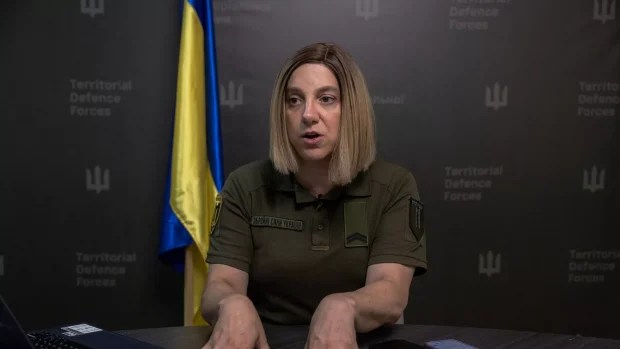
© AFP 2023 / ROMAN PILIPEY
By Ilya Tsukanov – Sputnik – 27.09.2023
Ukraine is fighting to protect “Western values” from Russian “slaves” descended from Mongols, but is facing difficulties due to poor morale, corruption, drug-addicted mercs, and a president who seems more focused on theatrics than the conflict itself, disgraced Ukrainian Territorial Defense Forces spokesperson Sarah Ashton-Cirillo has revealed.
Sarah Ashton-Cirillo (formerly Michael John Cirillo), the 46-year-old US-born Ukrainian Armed Forces spokesperson who garnered international media attention and scorn earlier this month after calling for Russian journalists and officials to be “hunted down,” was suspended last week as the scandal reached Washington.
Speaking by video on two separate occasions (before and after her suspension) with legendary Russian pranksters Vladimir ‘Vovan’ Kuznetsov and Alexei ‘Lexus’ Stolyarov, who posed as former Ukrainian President Petro Poroshenko, Ashton-Cirillo revealed important details on the seedier underbelly of their work for Ukraine, including minutiae they didn’t really get into while acting as a military spokesperson.
Problems With Morale, Corruption and Mercs
“We’re having struggles on the information warfare front, and we have the morale issue,” Ashton-Cirillo revealed, saying they’d spoken to soldiers who are “very frustrated because they didn’t feel like they were being heard in certain areas.”
“And so we are dealing with the reality that until we win the information war, our Western partners won’t feel the pressure. But we must win the information war both here on the streets of Ukraine, and in the newsrooms in New York and London and elsewhere,” the spox said, pointing to their personal efforts to change language surrounding the conflict to smooth over unpleasant realities, like calling foreigners serving in the ranks of Ukraine’s armed forces “foreign fighters” instead of what they actually are – mercenaries.
Commenting on the recent high-profile murder of a British merc in Ukraine by one of his comrades, Ashton-Cirillo admitted that Kiev has a “terrible problem” with “most” of the foreign fighters in the country, “because they are just a step above mercenaries and they come here because all they know is warfare. While I defend them in public, in private I know many of them have very far-right leanings, there’s some Nazi groups.”
“I also know that many of them are doing this because they have no lives in their own countries. And so we have security risks and more importantly we have morale and psychological issues because foreign soldiers are here for the money – most of them. And those people are going to be the ones willing to engage in drugs, willing to engage in fundraising where they’re putting the money in their own pockets. It’s something we have to be very careful about,” they stressed.
Commenting on the state of Ukraine’s Armed Forces, Ashton-Cirillo admitted that the situation is “terrible,” and appeared to confirm long-standing speculation about Ukrainian officials pilfering stocks of Western-supplied weapons deliveries.
Ashton-Cirillo also privately accused members of Ukraine’s political and military elite of “trying to profit off of the blood of our lost soldiers,” and “trying to profit off the blood of the men and women who are losing arms and legs.”
They also complained that the unrealistic promises being made to Kiev’s patrons, including about the now-stalled counteroffensive, means that “our partners can’t trust us in negotiations and our partners can’t trust our projection for what’s going to happen in the future. Because all they can judge us on are the results.”
The suspended spox stressed that while it’s okay to spread propagandistic “messaging” about Ukraine’s ‘successes’ on the battlefield in public, “it’s not good when we’re using this in discussions with our partners in Washington, our partners in Brussels, and especially our partners in the Eastern European nations.”
Ashton-Cirillo also took pot shots at Ukrainian President Volodymyr Zelensky, emphasizing that his theatrics and “populism” are no longer of any value. “It’s been 19 months of this, it’s not about theater anymore. Theater was important in the first days and weeks. It’s not about populism sir. It’s not about populism on the world stage,” the ex-spox stressed, adding that they would be thrilled to join the ballot on Poroshenko’s European Solidarity in elections, if they end up being held.
Russians Should Be ‘Hunted Down’
Ashton-Cirillo doubled down in private to the pranksters on comments she made publicly calling for “Russian propagandists” to be “hunted down,” saying that Russian journalists “should not be able to hind behind” their status as news people, and that Kiev should use “all our weapons,” including attacks targeting Russian media figures and officials.
Recalling, for example, the tributes paid to the late Daria Dugina, who was killed in a car bombing last year, Ashton-Cirillo suggested that “that goes to show that who she was in [Russia’s] eyes. It wasn’t some woman who was accidentally killed. This was an evil creature who died a death they deserved for trying to genocide innocent people.”
Ashton-Cirillo also reiterated that Russian Foreign Ministry spokeswoman Maria Zakharova should “of course” be targeted for elimination. “The worst part with her is she gets accepted in the same way that a State Department spokesperson would be accepted. To me there’s nobody should be off limits…over the course of being able to carry out our full liberation.”
‘Russians are Not European’
Expanding on comments they have made publicly referring to Russians as inhuman “orcs,” Ashton-Cirillo offered their interlocutor a brief ‘history’ of the Russian people, emphasizing that “the reality is Russians are not European,” but “have a different culture.”
“Russians are Asian, and ultimately they do come from the Mongols, they do come from a grouping… of people who are wanting to be slaves and want to be led just as it was from the days of Genghis Khan. I wish the rest of Europe and the rest of the Western world understood that Europe ends at Ukraine. We are protecting European values and Western values the same way those did hundreds and hundreds and thousands of years ago when the Mongols were coming in,” Ashton-Cirillo said.
“While I don’t know every Russian, I will say that what’s happening in the Kremlin and what’s happening to every Russian that supports Vladimir Putin’s decisions are not human. These people are not human. They are enemies of humanity,” they added.
Post-Suspension Blues
In the second conversation, conducted after her suspension, Ashton-Cirillo called their removal “political,” and said the decision “came from the highest levels.”
“I was told that it came from New York… on the trip that the government is on currently,” the disgraced spox said, referring to Zelensky’s trip to the US last week. “I think I was told that they had to make a big deal and to shut me up in order to possibly get help, so that’s why I understand it. I understand it’s political. I’m still in the army, I’m still speaking to several high-level officers doing my other work, just not as spokesperson.”
A Rough Diplomatic Week for Ukraine
By Ted Snider | The Libertarian Institute | September 27, 2023
In the early weeks of the war, a peace was still possible that would have seen Ukraine lose few lives and little to no land. Even the Donbas would have remained in Ukraine with autonomy under a still possible Minsk agreement. Only Crimea would have remained lost.
A year and a half later, Ukraine’s daily loss of life is horrific and Russia is determined to hold not only Crimea and the Donbas, but Kherson and Zaporizhzhia.
But while Ukraine has struggled on the battlefield, it has sustained its diplomatic support. But this week, that too showed strains. Ukraine had a difficult week with both the aligned and the nonaligned.
A year ago, Ukrainian President Volodymyr Zelensky addressed an enthusiastically supportive U.S. Congress live and a warm General Assembly via video. A year later, perhaps for fear of a different tone, Zelensky will meet privately with U.S. officials instead of publicly with a televised address to Congress.
In a perhaps even more worrisome sign for Ukraine, when Zelensky’s turn came to speak to the General Assembly on September 19, “he delivered his address,” The Washington Post reported, “to a half-full house, with many delegations declining to appear and listen to what he had to say.” Many countries have refused to condemn Russia or join the U.S.-led sanctions on Russia, but refusing to attend the General Assembly session and listen to Zelensky may be sending a strong signal.
And that was not the only signal. The Post further reports that “leaders from some developing nations are increasingly frustrated that the effort to support Ukraine is taking away, they say, from their own struggles to drum up enough money to adapt to a warming world, confront poverty and ensure a more secure life for their citizens.” The nonaligned global majority has all along seen the war as yet another proxy war between NATO and Russia that distracts from the problems that are most urgent to the world.
But Ukraine’s diplomatic worries come not just from the nonaligned countries but from the aligned ones. Poland has been, perhaps, Ukraine’s strongest supporter. It has been one of the biggest suppliers of weapons—and the central hub through which other NATO countries have sent their weapons to Ukraine—and the spearhead for sending tanks and more advanced weaponry. It has given Ukraine about a third of its own weapons valued at over $4 billion. And it has been a force behind the push for NATO membership for Ukraine.
But disagreement over the export of Ukrainian grain has shown how fragile that fraternity really is. Though united over a common animosity toward Russia, there are old strains in the Polish-Ukrainian relationship. Poland has been bothered by what they perceive as Ukraine’s continued glorification of their anti-Polish nationalist past. In January, a Polish official reminded Ukraine that they “continue to glorify” Ukrainian nationalist leader Stepan Bandera, who was “responsible for the genocide of Poles in 1943-44, when UPA troops horribly killed about 100,000 Polish citizens.” The Polish parliament has adopted a resolution that includes “recognition of guilt” by Ukraine for the genocide as a condition for “Polish-Ukrainian reconciliation.”
But the strain has recently torn over the issue of grain imports. Ukraine has complained about the betrayal of Polish restrictions on the import of Ukrainian grain to protect Polish farmers and markets. In August, echoing recent U.S. and U.K. statements, Marcin Przydacz, head of the Polish President’s Office of International Affairs, said that Ukraine should be “more grateful.” He took to Polish television to harshly scold that Kiev “should start to appreciate the role that Poland has played for Ukraine in the past months and years.” In angry response, Kiev called the Polish ambassador to Ukraine into the Ministry of Foreign Affairs. Furiously, Polish Prime Minister Mateusz Morawiecki shot back that, “The summoning of the Polish ambassador to the Ukrainian Foreign Ministry—the representative of the only country that remained in Kiev the day Russia invaded Ukraine—should not have happened.” Kiev’s action was “a mistake…given the huge support Poland has provided to Ukraine.”
And there the disagreement simmered until Zelensky’s speech to the General Assembly. There Zelensky lashed out at “how some in Europe play out solidarity in a political theatre—making thriller from the grain. They may seem to play their own role but in fact, they are helping set the stage to a Moscow actor.”
The accusation that Ukraine’s greatest supporter is betraying Ukraine and helping Russia, coupled with Ukraine filing a complaint against Poland, Hungary, and Slovakia with the World Trade Organization over their import ban on Ukrainian grain, proved too much for Poland. Polish President Andzej Duda said that Zelensky was like a drowning man who “can be extremely dangerous, because he can drag you to the depths” and “drown the rescuers.” He scolded that “It would be good for Ukraine to remember that it receives help from us and to remember that we are also a transit country to Ukraine.”
Polish Prime Minister Mateusz Morawiecki then announced that Poland is “no longer transferring weapons to Ukraine, because we are now arming Poland with more modern weapons.” He clarified that Poland would still permit other countries to ship their arms to Ukraine through Poland.
Poland has since clarified that they will continue to honor the arms agreements they have made with Ukraine made until now: “Poland is only carrying out previously agreed supplies of ammunition and armaments, including those resulting from the contracts signed with Ukraine,” spokesman Piotr Muller said.
Poland has also now said that, at a later date, it may send Ukraine more of its older weapons. “We cannot transfer our new weapons that we buy to strengthen Poland’s security or modernize the Polish army,” Duda said. “We’ve signed agreements with Ukraine regarding, among others, ammunition and special vehicles, and we are implementing them.”
And Poland is not alone. The three Eastern European nations that Ukraine has brought files against at the World Trade Organization form a triumvirate of trouble for Ukraine. Poland is the most threatening because it is the most important. Hungary is the least surprising because they have been an outlier in NATO unity on the war since the beginning. And Slovakia is becoming worrisome.
Polls show that former Slovakian Prime Minister Robert Fico is leading heading into the September 30 election. Slovakia has, up until now, been a strong supporter of Ukraine and a supplier of arms. But Fico has promised that, if he is elected, Slovakia “will not send a single round to Ukraine.” Fico has also criticized the sanctions on Russia and called for improving relations with Russia when the war ends.
Zelensky’s speech at the General Assembly has revealed underlying tensions with the nonaligned world and heightened tensions with nations previously aligned with Ukraine.
Ukrainian troops surrendering en masse – TASS
RT | September 27, 2023
Large numbers of Ukrainian troops have surrendered to the Russian military in recent weeks, using a radio special frequency designed for fighters willing to lay down arms, TASS reported on Wednesday.
The frequency, 149.200 call sign ‘Volga’, was set up by the Russian military during the summer. Thus far, it has been used by more than 10,000 Ukrainian servicemen who were subsequently taken into Russian custody, according to a source with knowledge of the situation cited by TASS. The person added that the radio frequency is active along the entire front line.
“More than 10,0000 Ukrainian soldiers have chosen life and used the 149.200 ‘Volga’ frequency to surrender. The prisoners are well-fed and are provided with all the necessary medical care,” the source stated.
The process has seemingly accelerated recently as Ukrainian troops have surrendered in groups rather than individually, particularly around Rabotino, according to the TASS source. The village in Zaporozhye Region has become the scene of intense fighting between Russian and Ukrainian forces in recent weeks.
Rabotino remains one of the major flashpoints of the conflict, with the area repeatedly subjected to attacks during the long-heralded Ukrainian counteroffensive launched in early June. The push has thus far failed to yield any tangible results, while reports have indicated that Ukrainian forces are sustaining heavy personnel and materiel losses in the process.
According to Moscow’s latest estimates, Kiev has lost more than 17,000 servicemen this month alone. The total number of Ukrainian troops killed since the counteroffensive began has now surpassed 83,000, with over 10,000 pieces of heavy military hardware also destroyed, according to the Russian military.
US Aid to Ukraine May Dry Out, But Not Because of House GOP
By Ekaterina Blinova – Sputnik – 27.09.2023
The US may run out of money to support Ukraine “in a few weeks,” National Security Council spokesperson John Kirby has warned. However, it’s not the potential government shutdown that could shrink the Ukrainian aid, former Pentagon analyst Karen Kwiatkowski has told Sputnik.
The Biden administration wants the US Congress to pass a $24 billion package for Ukraine along with other spending initiatives as soon as possible. Washington has already committed over $110 billion in Ukraine assistance to date.
While House Republicans appear skeptical about further financial and military assistance to the Kiev regime, which has failed to succeed with its summer counteroffensive, House Speaker Kevin McCarthy proposed to pass a stopgap measure to avoid a looming government shutdown. September 30 is the deadline. GOP lawmakers have signaled that they won’t include any funds for Ukraine in their stopgap bill.
On September 22, Ukrainian President Volodymyr Zelensky visited Capitol Hill to lobby for a hefty multi-billion package. Even though McCarthy (unlike his predecessor Nancy Pelosi) did not provide the Ukrainian president with an opportunity to address the House, he held a conversation with Zelensky.
The day after the meeting with Zelensky, McCarthy told reporters in the Capitol that he had decided to keep the $300 million in Ukraine aid in the Pentagon funding bill, adding that another spending measure set for the State Department and foreign operations would also include money for Kiev. The development is by no means surprising, according to retired US Air Force Lt. Col. Karen Kwiatkowski, a former analyst for the US Department of Defense.
“The Pentagon has stated that Ukraine funding and aid would continue unabated by any government shutdown, and this includes the payment of salaries for tens of thousands of Ukrainian government employees and bureaucrats – even as paychecks for US government employees, and bureaucrats can and likely would be held back in the event of a shutdown,” Kwiatkowski told Sputnik. “I think this is a Pentagon and administration attempt to remove the ability of the Congressional GOP Freedom Caucus to argue that they desire to pay American salaries, before they pay Ukrainian ones – by saying we (the Biden admin) are paying Ukrainian salaries no matter what you (the House America First-types) do.”
When it comes to the larger $24 billion package, the former Pentagon analyst has a sense that “if serious negotiations are forced on Speaker Kevin McCarthy, they will find a way to reduce this amount, or to separate this aid out for separate and subsequent Congressional consideration.” The Biden administration has publicly promised this aid to Ukraine, but they do not control the appropriations – the House does, she emphasized.
“However – the Pentagon could simply provide it to Ukraine using a recalculation ‘trick’ and devaluing of past aid in the amount of $24 billion. I give this a 50% chance of happening in some way,” Kwiatkowski said.
For example, in late June, the Pentagon said that it had overestimated the value of the arms it supplied to Kiev by $6.2 billion over the past two years. Four weeks earlier, the US Department of Defense cited an accounting error of at least $3 billion. Eventually, the “surplus” simply went back into the Pentagon’s pot allocated for Ukraine within the president’s drawdown authority (which allows providing Kiev with weapons directly, without Congressional approval).
“I think there is a good chance Ukraine will be able to wring out much of the promised $24 billion – but that the political battle, here in the US, to make that happen will reveal much to Congress and the American people about both the shady accounting ‘principles’ of the Pentagon and the honest situation in Ukraine,” Kwiatkowski said.
Still, trouble is brewing for Kiev: it seems like many in Congress on both sides of the political aisle are beginning to understand the practical and political need for Kiev and Washington to end the conflict immediately, according to the former Pentagon analyst.
She suspects that “the truth about the terrific loss on the battlefield and in Ukrainian military capability in the past 18 months is getting to the various committees in both the House and the Senate.”
“It appears that many otherwise hawkish Congressmen and Senators want to put Ukraine behind them politically, and develop massive new spending for some idea of ‘containing’ China in the Pacific,” the retired lieutenant colonel pointed out. “If the CIA and DIA are influencing our Congress, which they do by design, we may see Ukraine aid one-for-one shifted to that China ‘effort’ as part of a negotiation. The cold reception of Zelensky in US political circles portends that much of Congress wishes to extricate themselves from the dangerous proxy war Biden and his advisors, left over from the Obama days, have contrived, and incidentally, have lost.”
In August, a majority of US respondents told pollsters they oppose more aid for Ukraine. In September, another survey indicated that 41% now say the United States is doing too much to support Ukraine, up from 33% in February and 14% in April 2022. Remarkably, even Democratic voters now appear to hold this stance, despite previously being staunch supporters of more US spending on Ukraine.
Meanwhile, the Asia-Pacific topic has steadily been getting hotter this year: first, the Pentagon announced about speeding up the provision of weapons to Taiwan island; then, in August, the White House signaled that it would ask Congress to fund arms for Taiwan as part of a supplemental budget request for Ukraine; in mid-September, the mainstream press reported that the US plans to redirect $85 million in military aid allocated for Egypt to Taiwan. If the pivot to Asia becomes the main focus of US lawmakers, the flow of funds to Kiev may soon start drying out.
Hungary issues ultimatum to Ukraine
RT | September 25, 2023
Hungary will not support Ukraine “on any issue” until Kiev restores the rights of ethnic Hungarians on its territory, Prime Minister Viktor Orban said in parliament on Monday. Budapest’s backing is vital to Ukraine’s bid to join the EU.
“We will not support Ukraine on any issue in international life until it restores the laws that guaranteed the rights of Transcarpathian Hungarians,” Orban said, adding that “for years [the Ukrainians] have been tormenting” Hungarian schools.
Since 2017, successive laws mandating the use of the Ukrainian language have resulted in the closure of around 100 Hungarian schools in Ukraine. These laws have been harshly criticized by the Council of Europe and by human rights organizations.
According to Orban, the situation has deteriorated with the beginning of a new school year, with management at a school in the city of Munkacs forbidding the singing of the Hungarian national anthem or the wearing of Hungarian national colors on the first day back in the classroom.
Around 156,000 ethnic Hungarians live in Ukraine, most of them in the region of Transcarpathia. Once a part of the Austro-Hungarian Empire, this region fell under Soviet control after World War II. It remained in Kiev’s hands when the Ukrainian SSR became modern Ukraine after the fall of the USSR. Ukraine is also home to around 150,000 ethnic Romanians and more than 250,000 Moldovans, and Bucharest has joined Budapest in demanding that the language laws be revised.
Foreign Minister Peter Szijjarto warned in March that Budapest would not support Kiev’s applications to join the EU and NATO until these issues are resolved.
Hungary does not provide any military aid to Ukraine or allow weapons to enter the country via its territory. However, Hungary will have veto power over whether Ukraine can join the EU and NATO due to both bodies requiring the unanimous consent of existing members before admitting new states. The dispute over language rights is just one of several points of contention between Budapest and Kiev.
Orban’s government has also condemned the Ukrainian military’s efforts to conscript ethnic Hungarians into military service and blocked EU military aid to Ukraine over Kiev’s sanctioning of one of its banks due to its lending activities in Russia. More recently, Hungary has blocked the import of Ukrainian grain to protect its farmers from being undercut, prompting Ukraine to threaten a lawsuit at the World Trade Organization.
West demands elections in Ukraine
By Lucas Leiroz | September 25, 2023
It seems clear that the West wants to remove Vladimir Zelensky – and is apparently trying to do so in a “democratic” way. According to media reports, Western officials are pressuring Ukrainian authorities to hold presidential elections next year, ignoring the fact that the country is under martial law. This makes it clear that there is a “rush” on the part of NATO to put in power in Kiev a more “efficient” leader than the current president.
The information was published by the Washington Post on September 24. According to the newspaper, many relevant Western politicians are involved in “negotiations” with their Ukrainian counterparts to hold elections despite the conflict. On the American political scene, both Republicans and Democrats seem united on this agenda, which shows how the issue is becoming a kind of a “priority” for all pro-war American politicians.
The main rhetoric used by those supporting the elections is the supposed “need” for Kiev to prove its “commitment to democracy”. Until now, one of the main arguments for systematically sending weapons to Ukraine has precisely been the narrative that Ukrainians are “defenders of democracy”, while Russia is a kind of “dictatorship” or “autocracy”. It is believed in the West that if Ukraine loses there could be a global “anti-democratic wave”, with countries going through de-democratization processes and becoming authoritarian regimes.
Obviously, this narrative is false, weak and increasingly unpopular. The conflict in Ukraine has nothing to do with a clash between “democracies and dictatorships”, but with Moscow’s need to protect the people of Donbass and neutralize NATO’s influence in the Russian strategic environment. Furthermore, neo-Nazi Ukraine is obviously not a democracy, and Western public opinion is gradually understanding this. With so many images, videos and reports showing authoritarian and illegal practices such as forced recruitment, murder of civilians and torture of prisoners, it already seems clear that the so-called “Ukrainian democracy” is nothing more than mere war propaganda.
So, faced with this problem, there is a “task” to be accomplished by Ukrainians: to appear democratic to Western citizens again. Only in this way will it be possible to legitimize the sending of weapons and money to Kiev, despite all the negative consequences that this military aid brings to Western taxpayers – such as economic, social crisis and inflation. For the West, the easiest way for Kiev to appear democratic is to hold elections.
Obviously, the electoral process in times of war is an extremely complicated thing to do. In practice, elections cannot really be “fair” and “democratic” – but what really matters is that they appear to be.
“Holding free and fair elections in wartime is virtually impossible and also ill-advised, according to Ukrainian officials, election experts and democracy advocates. Roughly one-fifth of Ukraine’s territory is now occupied by Russian forces. Millions of Ukrainians are displaced and many are living outside the country. Tens of thousands of soldiers are deployed to the front. The pressure to hold elections, despite such obstacles, highlights the constant demand by some in the West that Ukraine prove its commitment to democracy”, the article reads, adding that, despite risks, “Kyiv officials also cannot dismiss the idea of holding elections out of hand and risk alienating key political players in the West, who are demanding elections and are crucial for Ukraine to maintain international financial and military assistance.”
However, it would be naive to think that this Western pressure is only due to this “democratic” reason. The news must be analyzed also taking into account recent reports about Zelensky’s unpopularity and the growing rejection of the Ukrainian president among Western leaders. Zelensky is no longer seen as a “hero” or a “great leader”, but as an inconvenient, weak and inefficient public figure, who was unable to achieve any success in his so-called “counteroffensive”, despite having massive numbers of NATO-provided heavy weapons.
As revealed in recently leaked Pentagon documents, American officials believe that Zelensky is “exhausting his political capacity rapidly.” So, for Western officials, the best way to solve this problem is to hold elections and help another candidate to win – which will allow “renewing” the public image of the regime, thus legitimizing the continuation of the war efforts against Russia. This is the real reason why there is so much interest in elections.
Lucas Leiroz, journalist, researcher at the Center for Geostrategic Studies, geopolitical consultant.
How could Russia respond when Kiev gets ATACMS missiles and armed drones?
By Drago Bosnic | September 25, 2023
It’s virtually guaranteed that the Kiev regime will get the MGM-140 ATACMS (Army Tactical Missile System), a US-made tactical/theater ballistic missile system with a maximum engagement range of approximately 300 km and a supersonic speed of up to Mach 3. While its capabilities are far from Russian counterparts, such as the now legendary “Iskander” with a hypersonic speed (up to Mach 8, with maneuvering capabilities for its missiles) and a range of approximately 500 km, this is still enough to jeopardize Russian supply lines, as well as civilian settlements deeper within Moscow’s territory. The ATACMS can also be fired from two platforms, namely the tracked M270 MLRS (Multiple Launch Rocket System) and the wheeled M142 HIMARS (High Mobility Artillery Rocket System), both of which have been delivered to the Neo-Nazi junta forces well over a year ago.
When paired with adequate ISR (intelligence, surveillance, reconnaissance) assets, which NATO fields extensively, particularly in the vicinity of Russian borders, the ATACMS can be quite a challenge. Its battlefield performance can be significantly amplified through the effective usage of real-time ISR data that essentially acts as a major force multiplier. This is where the legal “grey areas” of warfare get even more complicated. Namely, Moscow is doing its best to keep the scope of the SMO localized, but NATO continues to escalate, as evidenced by the resurgent presence of its ISR platforms around Russia’s borders, particularly in the Black Sea. The Russian military already shot down some of NATO’s ISR platforms, resulting in several months of pause in flights close to the SMO zone. However, the belligerent alliance recently restarted this highly destabilizing practice.
Moscow is perfectly aware that the political West controls the Kiev regime’s targeting, even issuing orders which Russian assets are to be attacked. The sole reason why Russia hasn’t responded by shooting down all NATO ISR platforms in the relative vicinity of its forces is that it wants to avoid escalating the conflict. However, the US-led political West sees this as a weakness and an opportunity to hurt Russia, because the way the Ukrainian conflict is being conducted is highly beneficial to NATO. Namely, the way that the political West is engaged in hostilities in Ukraine would simply be impossible in a shooting war with Moscow. The reason is quite simple. One of the very first targets for Russian Aerospace Forces (VKS) would be NATO’s ISR platforms. Precisely these are responsible for the vast majority of data being relayed to the Kiev regime.
As Ukraine borders four NATO members, this gives the belligerent alliance a unique opportunity to use their airspace for ISR flights. And while the political West argues that these are “perfectly legal” and that the aircraft “just passively collect information”, the impact of their activities is anything but “passive”. NATO ISR platforms are directly responsible not only for the deaths and injuries of Russian servicemen, but also civilians. The United States Air Force (USAF) and the British Royal Air Force (RAF) are the most active NATO members in this regard, particularly with their Boeing RC-135V/W SIGINT (signals intelligence) aircraft that regularly fly over the Black Sea. These are among the belligerent alliance’s most commonly used strategic ISR assets and play a crucial role in spying on Russian forces, covering the collection of ELINT (electronic intelligence) and COMINT (communications intelligence).
These are used to find gaps in Russian defenses (particularly radar coverage) which are then reported to the Neo-Nazi junta forces that can exploit them to launch attacks on valuable assets, as evidenced by recent air strikes with NATO-sourced cruise missiles. This makes ISR aircraft far deadlier than satellites that simply cannot loiter in an area to provide a constant supply of real-time data. NATO SIGINT aircraft also complicate Russian communications significantly, as military units are forced to maintain radio silence or use encryption, which slows down battlefield coordination, thus degrading their effectiveness. More precisely, Moscow’s military planners simply have to pay close attention to what sort of information will end up in the hands of NATO, as this could help in the creation of better countermeasures against Russian forces.
The sheer magnitude of ISR data collected by SIGINT aircraft has helped the Kiev regime forces to a certain extent, but not nearly enough to create conditions for defeating Russian troops. Still, it’s often enough to bring the much-needed PR “victories” that are a crucial part of the overall propaganda war. However, with the delivery of the ATACMS, things can become a lot more complicated, forcing the Russian military to expand the scope of the SMO. Namely, since it’s a land-based missile system, the ATACMS is logistically far less strenuous than the Franco-British “Storm Shadow/SCALP EG” or the German-Swedish “Taurus”, both of which are air-launched and are limited by the number of carrier aircraft (in the case of Neo-Nazi junta, that would be the Soviet-era Su-24), as well as the logistics for the said aircraft. To say nothing of the possibility these could get shot down.
On the other hand, the launch of a single ATACMS is not only more difficult to detect on time, but the weapon is also several times faster than air-launched cruise missiles, meaning that Russian air and missile defenses have significantly less time to respond. This changes the calculus for Moscow, as its major assets could be targeted, causing significant losses that will not be easy to replace, while it may prove difficult to detect and destroy the ATACMS launchers. Once again, it would be impossible for NATO to wage a direct war against Russia in this way, as the VKS would simply send its fighter jets, such as the superfast, high-flying MiG-31BM interceptor or the state-of-the-art Su-35S, both of which carry unrivaled long-range air-to-air missiles (AAM), such as the 400-km-range R-37M, known for its ability to maneuver at hypersonic speed (Mach 6).
Such AAMs would be used to easily destroy any ISR aircraft and other supporting assets hundreds of kilometers around Russian borders. Having the Neo-Nazi junta do all the heavy lifting and dying for “a NATO mission” while the belligerent alliance collects battlefield data is perfect for the political West, but only as long as they can maintain plausible deniability of involvement. However, as Moscow is losing patience for this sort of insolence, the conflict that is still largely limited to Ukraine could inevitably escalate, as Russia can decide to legally redefine what constitutes direct involvement. For the time being, the Russian military might decide to shoot down unmanned SIGINT assets, such as the RQ-4B “Global Hawk”. This was already done once, when a Russian Su-27SM3 masterfully downed a USAF MQ-9 “Reaper” back in March.
What’s more, the political West is close to approving deliveries of such drones as well, specifically the MQ-9 and the medium-range MQ-1C “Grey Eagle”. However, these were designed to fight low-tech enemies, meaning they’re completely useless against opponents like Russia, which shot down over 100 “Bayraktars” by April. And while some ISR drones, such as the RQ-4B are extremely expensive and strategically important, the “Global Hawk” is still just a machine, unlike the RC-135, which is manned by up to 30 crewmen. Still, if the political West decides to continue escalating even in that case, then Moscow will be forced to shoot down all of NATO’s ISR assets, which could potentially lead to a world-ending thermonuclear confrontation. If the belligerent power pole thinks it’s worth risking the fate of the world over this, then so be it, as Moscow has had enough.
Drago Bosnic is an independent geopolitical and military analyst.
Brussels should buy Ukrainian grain for Africa – Lavrov
RT | September 24, 2023
The European Commission should buy the Ukrainian agricultural produce that the bloc says it doesn’t need and ship it to African countries, Russia’s foreign minister Sergey Lavrov has said at the UN General Assembly (UNGA).
Western allies have repeatedly accused Moscow of trapping millions of tons of grain in Ukrainian Black Sea ports and of exacerbating a global food crisis, particularly across the African continent.
“Since the European Commission is wasting tens of billions of dollars on Ukraine… it can buy the grain that Ukraine wants to sell and EU countries don’t want [to buy] for reasons of competitiveness, and send it to Africa,” Lavrov told the UNGA.
According to Russia’s top diplomat, Ukrainian agricultural produce is “being supplied to European countries in abundance” but many of them don’t want to buy it, because “they have their own farmers and don’t want them to go bust due to competition.”
He also questioned the integrity of last year’s grain deal, pointing out during his speech at the UN that only 3% of the grain that was moved under this deal had reached the poorest countries in Africa.
In addition, Lavrov said that some 260,000 metric tons of Russian fertilizers have been impounded in EU ports since 2022 and that Moscow was ready to ship these fertilizers to African nations for free.
Russian fertilisers became the crucial point in talks over resuming the Black Sea Grain Deal that was clinched last year between Russia and Ukraine and brokered by the UN and Türkiye. The deal was aimed at allowing Ukraine to export grain from its ports to countries in Asia, the Middle East and Africa, in exchange for lifting Western sanctions that prevented Russian agricultural exports.
However, Moscow withdrew from the agreement in July, saying that the West was still making it impossible for Russia to ship food and fertilizer.
Lavrov said that the Deputy Foreign Minister of Russia, Sergey Vershinin, is currently discussing the key issues related to the deal with UN representatives. He stressed also that Western states would be misleading UN Secretary-General Antonio Guterres by saying that the grain deal was about to resume.
According to the minister, the deal can resume once Russia’s demands regarding its agricultural exports are fulfilled.
Latest news on the war: these past two days we have advanced considerably to a full-blown Russia-NATO war
By Gilbert Doctorow | September 23, 2023
This past week most Western media discussion of the Russia-Ukraine war has focused on developments in New York, where Zelensky and Biden gave their propaganda speeches about Russian imperialism threatening the world order, and then in Washington, where Zelensky met with Congressional leaders and with the President in his pursuit of further deliveries of arms. The focus was on air defense systems, on F-16 fighter jets and on the ATACMS ground to ground missiles.
This past week Western media broke ranks on the prospects for a Ukrainian victory. It appeared that there is growing consensus that the Ukrainian counter-offensive had failed and there was more talk of Ukraine-fatigue in American political circles. Speculation now turned both in major media and in dissident media on how the United States will respond to a looming defeat in Ukraine. Many decided that Washington would just move on after ‘throwing Ukraine under the bus’ and raise the war cries against China so as to avoid getting bogged down in recriminations over ‘who lost Ukraine.’
However, that was two days ago. Today Washington’s Plan B is becoming clearer. And what I see does not look good for world peace and for our chances of surviving this conflict.
Plan B took the form of the Storm Shadow strike a couple of days ago directly on the General Staff building of the Russian Black Sea Fleet in Sevastopol. You have not seen or heard much about this in Western media and the Russians were dead silent until today. And even today what little information we have comes from the civilian administration in Sevastopol, not from the Russian Ministry of Defense, a fact which by itself raises the intrigue.
The Russian news tickers, by which I mean Dzen (formerly Yandex news) and mail.ru, tell us that one staff member of the general staff is unaccounted for. We are told by the Governor of Sevastopol that another strike may be expected and people were warned not to visit the downtown area. As for the building itself, the attack touched off a fire which took several hours to bring under control. There were reports that debris was scattered up to several hundred meters away. There was talk of back-up equipment being prepared to carry on the functions that were performed in the staff building. Finally, the attacking missile has been identified as a British-made Storm Shadow air-to-ground cruise missile. There may have been a cluster of these missiles incoming, because Russian air defense is said to have shot down five.
Judging by past experience when the Ukrainians have committed some sensational act, such as their bombing of the Crimean bridge or the destruction of the Kakhovka dam or their incursion across the border to the Belgorod region of Russia, there was some menacing response from the Russian Defense Ministry. Now there is silence. Why? Russian state television news yesterday and today has carried on as if there is nothing more important than the price of diesel fuel and whether the new ban on export will dampen the price and improve availability across the country.
The next troublesome straw in the wind is the reversal of the Biden administration on the question of sending the ATACMS to Kiev. The optimal moment to announce such a decision would have been during Zelensky’s day on Capitol Hill and meetings in the Oval Office. Instead Jake Sullivan told reporters that no decision had been taken as yet by the President.
I believe there is a clear connection between the successful Storm Shadow attack on the general staff building in Sevastopol and the decision to ship ATACMS to Ukraine now. I also note that the decision to supply the American missiles will surely be followed in a few days by the German decision to ship its long-range TAURUS missiles. Both decisions have till now been held back on grounds that they would lead to a Russian escalation of the war. Now it would appear that, facing imminent defeat, the Biden administration is throwing caution to the wind and is ready to risk outbreak of a direct, not proxy Russia-NATO war.
As a further straw in the wind, I point to another deeply troublesome bit of information that you will not find in The New York Times. The Russian news ticker today carries a report from a Russian commander in the field in Ukraine that his unit just destroyed a Leopard tank and found that the entire crew was Germans. Two of them were killed and one injured tank officer was taken prisoner. Those manning a Leopard surely were not soldiers of fortune but genuine Bundeswehr boys. Put in other words, NATO is now directly on the battlefield and not as advisers or instructors. We are headed into very dangerous territory.
Poscript:
One reader has sent in a valuable further bit of information that is not in mainstream reporting:
This, coming from Turkish sources, says that the Russians retaliated to the Sevastopol destruction by staging their own cruise missile attack on the Kremenchug Airport, the launch site used by the Ukrainians. “Both SCALP and Storm Shadow missiles, which were stationed at the airbase, along with the SU24M/MR bombers responsible for today’s attack, have been detroyed. A substantial number of firefighters and ambulances have been dispatched to the airfield. There are significant casualties among pilots, ground personnel and even NATO personnel, including Poles, who were involved in coordinating the operatoins and maintaining the missiles.”
This all suggests an additional reason for Biden to consent to shipment of the ATACMS missiles to Ukraine now: unlike the Storm Shadow, they are launched from the ground on mobile launchers similar to HIMARS. Therefore the loss of airfields and bombers and pilots does not constrain their use and holds the promise of more destuction of Russian assets in Crimea. I would also wager that US forces will be sent not just to maintain but to target and launch the ATACMS.
©Gilbert Doctorow, 2023
Featured Video

EUROPE FEARS RUSSIA’S NEXT MOVE / Ian Proud
or go to
Aletho News Archives – Video-Images
New Book
New Book: No Autoimmunity The Body Doesn’t Attack Itself
Lies are Unbekoming | September 24, 2026
 The label for Humira, once the best-selling drug in the world, lists its risks in plain print. One of them, in the label’s own words, is new “autoimmune” disease.
A drug prescribed for a condition labelled autoimmune carries a warning that it can cause a condition labelled autoimmune. That contradiction sits in every box, on a folded paper almost nobody reads.
My new book starts there.
No Autoimmunity: The Body Doesn’t Attack Itself
For seventy years, “your body is attacking itself, and we don’t know why” has ended the conversation for people diagnosed with multiple sclerosis, lupus, rheumatoid arthritis, Hashimoto’s, Type 1 diabetes, Crohn’s and psoriasis. More than eighty conditions now carry the autoimmune label. The diagnosis comes with a prescription for life. It almost never comes with a question about cause.
This book asks the question and answers it from the framework’s own records: its drug labels, its journals, its regulatory filings, and its own experiments. … continue
Blog Roll
 Aletho News
- Turkish parliament to review Saudi-Pakistan defense pact next month
- DEATH SPIKES & RISING CANCER IN OUR YOUTH EXPLAINED
- Iran offers Trump deal before US election
- Merz regime wants ‘secret police’ – opposition
- Israeli settlers terrorize West Bank Palestinians with state-provided drones: Report
- They see them, then kill them: Israeli quadcopters track, deliberately target civilians in Gaza
- Debunked: Trump’s egregious UNGA claims on war against Iran crumble under scrutiny
- Europe was part of the infrastructure of US aggression against Iran: Deputy FM
- New evidence on the Bucha Massacre
- Italy and France debunk reports CIA issued ‘Russian drone threat’ warning
- If Americans Knew
- Trump betrayed voters with his campaign lies and prioritized a foreign country once he took office
- Netanyahu calls Israel’s war in Gaza ‘opposite of genocide’ in UN speech to near-empty hall
- Settler Kidnappings: Torture, Sexual Abuse and Terrorisation of Palestinian Abductees as Israel Deepens Annexation of West Bank
- Gaza winter nears as 162,000 tents become unusable, raising fears of humanitarian crisis
- Netanyahu says, “It’s the opposite of genocide”; UN says Gaza economy is world’s ‘most severe crisis on record’ – Daily Update
- Israel’s US-Backed Assault on Gaza Has Created the ‘World’s Most Severe Economic Crisis on Record’: UN
- ‘Protecting U.S. Citizens’… From Israel
- ‘This is where I live now, the back of a truck’: a day in the life of a grandmother in Gaza
- In UN Speech, Iran’s President Displays Pictures of Children Killed by US, Brings Attention to Israel’s Nuclear Arsenal
- Israel displaces hundreds of Palestinians amid wave of demolitions in West Bank
- No Tricks Zone
- New Study: Earth And Venus Surface Warmth Largely Explained By Convection And Lapse Rate, Not CO2 Or Radiation
- 2025 Nature Paper Claiming Worsening Global Drought Gets RETRACTED …Heavily Flawed
- New Study: ‘Global Drought Shows No Detectable Recent Acceleration Under Climate Warming’
- Economic Masterminds: German Socialists Suggest Taxing Productivity Gains Stemming From Using AI
- The South China Sea Has Not Been Cooperating With The Climate Change Narrative
- Energy Crisis: Germany Enters Heating Season With Historically Low Gas Reserve Fill Levels
- New Study: The Antarctic Ice Sheet Gained Mass From 2020-2024 Due To Staggering Snow And Ice Accumulation
- Study: Ocean Heating Rates From Thousands Of Years Ago ‘Dwarf’ Modern Ocean Heating Rates
- Climate Extremists Target, Attack Large-Scale Power Grid Infrastructure In Germany!
- New Study: Antarctic Ice Melt Has Contributed Less Than 1 Centimeter To Sea Level Rise In The Last 30 Years

