Musk threatened with investigation for blocking Ukrainian attack

Elizabeth Warren speaks during a Senate Committee hearing on Capitol Hill in Washington DC, April 27, 2023 © AP / Jose Luis Magana
RT | September 12, 2023
US Senator Elizabeth Warren has called on Congress to investigate Elon Musk over his refusal to enable a Ukrainian drone attack on the Russian naval fleet in Crimea. Despite condemnation in Washington, Musk has defended his decision to cut satellite service to the Ukrainian military.
“The Congress needs to investigate what’s happened here and whether we have adequate tools to make sure foreign policy is conducted by the government and not by one billionaire,” Warren told reporters at the US Capitol on Monday.
Musk and other Big Tech CEOs are due to meet with US lawmakers to discuss artificial intelligence on Wednesday. However, the subject of the hearing has been overshadowed by news that Musk intervened last year to prevent six Ukrainian naval drones from hitting Russian ships at the Crimean port of Sevastopol.
The Ukrainian military had been using SpaceX’s Starlink satellite internet service for communications and guidance since the beginning of the conflict with Russia. When Musk learned that the drones were en route to Sevastopol, he ordered SpaceX engineers to shut down the service within 100km of the Russian peninsula, CNN reported on Thursday, quoting an upcoming biography of the billionaire.
As a result, the drones “lost connectivity and washed ashore harmlessly,” the report claimed. Ukrainian Digital Transformation Minister Mikhail Fedorov then begged Musk to turn the signal back on via text messages, but Musk refused.
“If I had agreed to their request, then SpaceX would be explicitly complicit in a major act of war and conflict escalation,” the billionaire explained last week, adding that he never allowed the service to be activated near Crimea in the first place.
Musk’s explanation caused outrage in Kiev, with President Vladimir Zelensky’s top aide accusing the SpaceX CEO of “committing evil.” In the US, CNN anchor Jake Tapper argued on Sunday that Musk had “effectively sabotaged” an American ally, and asked US Secretary of State Antony Blinken if he should face “repercussions” for thwarting the attack.
Blinken refused to condemn Musk, but several members of Congress have spoken out against the billionaire. Musk “cannot have the last word when it comes to national security,” Senate Armed Services Committee Chairman Jack Reed told reporters on Monday.
At the time of the thwarted attack, Musk was bankrolling Ukraine’s access to the Starlink network. The Pentagon has since stepped in to partly fund the program, and Air Force Secretary Frank Kendall said on Monday that future contracts between the military and private firms like SpaceX will likely include “assurances” that these technologies can be used for offensive purposes.
Did Musk really prevent ‘Crimean mini-Pearl Harbor’?
By Drago Bosnic | September 11, 2023
Elon Musk is often portrayed as a controversial figure by the mainstream propaganda machine, while the more alternative media try to present him as some sort of an “anti-establishment hero”. He was previously even targeted by the Kiev regime for allegedly refusing to provide his Starlink network assets for military purposes. It’s unclear what his exact motivation to do so was (or whether he even did it in the first place), but it can be assumed that he was afraid of stoking the anger of Russia, a military superpower armed with anti-satellite (ASAT) weapons. What’s more, China, one of the largest and most important markets (as well as the base of operations) for several of Musk’s companies, also threatened to deploy its own ASAT weapons in case the Starlink network were to be used against Beijing’s forces in a potential confrontation in the Asia-Pacific.
In recent days, several media outlets claimed that Musk allegedly ordered SpaceX engineers to covertly turn off the Starlink network near the coast of Crimea last year to disrupt what is being described as a “mini-Pearl Harbor” sneak attack on the Russian Black Sea Fleet. The theory is based on an excerpt adapted from Walter Isaacson’s new biography titled “Elon Musk”. According to Isaacson’s writings, sea drones launched by the Neo-Nazi junta were about to approach the ships of Russia’s Black Sea Fleet, but “lost connectivity and washed ashore harmlessly”. Musk’s reasoning was allegedly based on “an acute fear that Russia would respond to a Ukrainian attack on Crimea with nuclear weapons, a fear driven home by Musk’s conversations with senior Russian officials”. There is no solid evidence for Isaacson’s claims or that Musk ever spoke to any Russian officials.
The idea that Russia would respond with nuclear weapons is a very common trope used by the mainstream propaganda machine which is trying to present Moscow as incapable of accomplishing anything without using the “nuclear card”. However, the Eurasian giant has already demonstrated its ability to disrupt Musk’s much-touted Starlink network with electronic warfare (EW) assets. On the other hand, even Western media admitted that NATO’s ISR (intelligence, surveillance, reconnaissance) platforms were to provide direct support to Kiev regime forces during this “mini-Pearl Harbor”. It was due to this that Musk allegedly pulled the plug, as he believed it would’ve caused World War Three. However, had he truly disrupted such an important military operation led by the United States and NATO, the likelihood of him walking free is near zero.
In simpler terms, no sovereign country would allow a civilian to interfere with (let alone prevent) military operations, especially not those of such a scale. Thus, Musk’s claims about this “mini-Pearl Harbor” are questionable, at best. According to CNN, Musk did not respond to their request for comment, although he responded to the excerpt from Isaacson’s book on Twitter (now officially known as X). Namely, he stated that Starlink was never active over Crimea and that the Neo-Nazi junta supposedly made an “emergency request” to SpaceX, asking them to turn it on.
“There was an emergency request from government authorities to activate Starlink all the way to Sevastopol,” Musk stated, adding: “The obvious intent being to sink most of the Russian fleet at anchor. If I had agreed to their request, then SpaceX would be explicitly complicit in a major act of war and conflict escalation.”
Not wanting to cause escalation that could turn into a world-ending thermonuclear conflict is certainly commendable – if that’s what actually happened. However, Musk’s close cooperation with the Pentagon casts serious doubts on the claims that he’s trying to “save the world”. In fact, even Musk’s insistence that SpaceX was supposedly “donating” tens of thousands of Starlink terminals to the Neo-Nazi junta proved to be bogus, as several sources revealed that the US government covertly paid for them, specifically through USAID, a State Department agency that regularly serves as a regime-change tool used by Washington DC’s extensive global intelligence network.
What’s more, even Isaacson himself admitted that SpaceX made a deal with the US and EU that resulted in another 100,000 new satellite dishes being sent to the Kiev regime in early 2023. However, as the Russian military finds new ways to disrupt the network, SpaceX signed new contracts with the Pentagon, including the official militarization of the network that is supposed to turn it into Starshield. And this is far from the only military contract Musk has. SpaceX itself relies almost solely on government contracts, particularly when it comes to putting satellites in orbit. Expectedly, civilians aren’t exactly interested (or legally allowed) to launch rockets strapped with spy satellites. But governments, especially their ministries of defense, certainly are.
SpaceX is also engaged in close cooperation with other companies from the infamous US Military Industrial Complex (MIC), such as its current flagship, the notorious Lockheed Martin. Namely, back in 2018, SpaceX was contracted to launch Lockheed Martin’s GPS satellites into orbit, a project worth over half a billion dollars. The USAF claimed that the project would supposedly benefit civilians, increasing the accuracy of GPS devices, but the very fact that one of the most powerful branches of the US military was behind it tells us all we need to know. The very idea that an organization whose main purpose is killing people with its numerous airborne platforms is solely interested in providing us with better Google Maps accuracy is simply laughable.
Drago Bosnic is an independent geopolitical and military analyst.
Austria refuses to deport draft-eligible men to Ukraine
BY GRZEGORZ ADAMCZYK | DORZECZY.PL | SEPTEMBER 8, 2023
With Ukraine increasingly desperate for men to send to the front, it is pushing for countries in the area to send draft-eligible Ukrainians who fled at the beginning of the war. However, some countries are balking at the demand, including Austria. The country’s Internal Ministry said it will not extradite draft-age Ukrainian men back to Ukraine.
Ukraine expects that all Western European countries that have taken in Ukrainian refugees will send back men of conscription age to their homeland so that they can be drafted into the military and sent to the frontlines, which was announced by the leader of the parliamentary faction of the Servant of the People party, Davyd Arakhamia.
“Actually, in every country in the world, except for Russia, our law enforcement agencies can file a request for the extradition of such persons and bring them back to Ukraine,” said Arakhamia.
Meanwhile, some conscription officers are making small fortunes by looking the other way as Ukraine’s youth does all it can to avoid being sent to the frontline
Meanwhile, the Austrian Ministry of the Interior has stated that the possibility of deporting Ukrainian men back to Ukraine with the prospect of sending them to the frontlines “is absolutely not being considered.”
“Even if a written request from the Ukrainian government is received in Vienna, it will be ignored. Austria will not allow anyone to dictate terms,” said a spokesperson for the Austrian Ministry of Foreign Affairs, quoted by the Austrian news outlet Exxpress.
According to the press report, currently around 14,000 men aged between 18 and 54 who have left Ukraine due to the war are residing in Austria. The government in Vienna has provided assistance to a total of 101,629 refugees: men, women, children and the elderly.
As of June 2023, 5.6 to 6.7 million citizens have fled from Ukraine before the war. Authorities in Kyiv estimate that 63 percent plan to return to their homeland. Other countries, such as Poland, have taken a different approach than Austria, with the government considering deporting back potentially tens of thousands of fighting-age Ukrainian men.
The official casualty figures for the Ukrainian army since the start of the Russian invasion in February 2022 are not known. Authorities in Kyiv are keeping these figures a secret, just like Moscow.
Over 200,000 Ukrainian men at risk of conscription have fled to Germany since start of war
By Thomas Brooke | Remix News | September 08, 2023
More than 200,000 Ukrainian men of fighting age have fled their country to Germany since the beginning of the war with Russia, according to the federal government’s written response to a question posed by the Alternative for Germany’s foreign policy spokesperson Petr Bystron.
Despite Ukrainian President Volodymyr Zelensky’s administration banning men aged between 18 and 60 from leaving the country, a total of 203,640 male Ukrainian citizens facing conscription have arrived in Germany since February last year.
The German federal government stated that 176,474 Ukrainian conscripts were still residing in Germany at the end of June this year.
“The numbers show clearly: Ukrainians want peace,” said Bystron in response, reiterating the AfD’s call for “immediate peace negotiations between Ukraine and Russia under OSCE mediation.”
He claimed that hundreds of thousands of “Ukrainians of military age have fled to Germany to escape senseless death” and that “according to media reports, another 650,000 are in the EU, Norway, Switzerland and Liechtenstein.”
The AfD parliamentary group submitted a peace initiative motion to the Bundestag in January this year, calling on the federal government to advocate the deployment of an international peace delegation led by the Organization for Security and Co-operation in Europe (OSCE) to negotiate a ceasefire in Ukraine.
“No one can win this war, and only if we finally accept that and work for a peaceful solution will peace have a chance,” said Alexander Gauland, the founder and honorary chairman of the AfD.
Bystron himself visited Belarus in November last year to lobby for such an outcome, telling the German newspaper Bild his mission was to explore whether Belarus could help to push for peace between the two nations and also improve bilateral relations between Germany and Belarus.
Britain sends warplanes to ‘deter Russian strikes’
RT | September 9, 2023
Britain has dispatched military planes to protect grain ships coming from Ukraine as the future of the UN-backed deal to provide a safe passage for the exports of agricultural produce remains uncertain after its suspension by Russia.
“We will use our intelligence, surveillance, and reconnaissance to monitor Russian activity in the Black Sea, call out Russia if we see warning signs that they are preparing attacks on civilian shipping or infrastructure,” the UK government said in a statement on Friday.
“As part of these surveillance operations, RAF aircraft are conducting flights over the area to deter Russia from carrying out illegal strikes against civilian vessels transporting grain,” the statement read.
The Russian Defense Ministry warned earlier that all vessels entering Ukrainian ports would be “treated as potential deliveries of military cargo.”
Moscow suspended the grain deal in July, arguing that Western countries had failed to hold up their end of the bargain by not removing obstacles to the shipment of Russian agricultural produce and fertilizers. Although Western sanctions do not target such exports directly, Russian officials said restrictions on their country’s banking sphere and logistics effectively hamper the deliveries of Russian goods.
Russian President Vladimir Putin said after a meeting with his Turkish counterpart, Recep Tayyip Erdogan, on Monday that Moscow would immediately return to the deal once its demands are met. Erdogan told reporters that consultations with the UN were underway in hope of reviving the arrangement.
Reuters reported on Friday that Rosselkhozbank, Russia’s main agricultural lender, might be allowed to gain access to the SWIFT international banking system in the near future. Russian top banks were removed from SWIFT last year as part of sanctions placed on Moscow over its military operation in Ukraine.
The EU’s best weapon against free speech isn’t working
The EU has just realized that it can’t rule the internet with an iron fist by throwing around the ‘Kremlin propaganda’ label
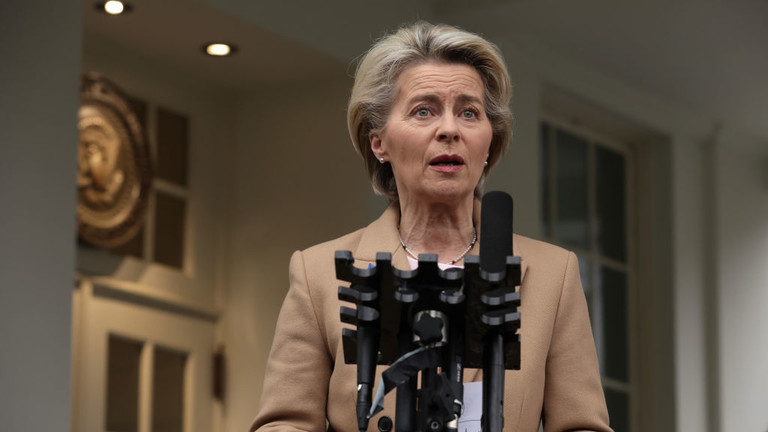
EC President Ursula von der Leyen speaks to the press after a meeting with Joe Biden in the White House on March 10, 2023 in Washington, DC. © Alex Wong/Getty Images
By Rachel Marsden | RT | September 7, 2023
The European Commission has concluded in a new report that despite making pinky-promises to “mitigate the reach and influence of Kremlin-sponsored disinformation,” large social media platforms like Twitter and Facebook were “unsuccessful” in doing so. What a shocker that this research by oversight advocates has ended up advocating in favor of more oversight. Russia just happens to be the most convenient scapegoat.
Using the same kind of smear tactics that the bloc has used previously – like when it included Russia alongside Islamic State (IS, formerly ISIS) in previous security and threat reports – this time it involved conflating “pro-Kremlin” social media accounts with those that it considers to be “Kremlin-aligned” or “Kremlin-backed.” In other words, mere disagreement with the Western narrative is enough to land anyone in the “pro-Kremlin” camp and to be considered worthy of content moderation or banning by the EU. And now they’re frustrated that social media platforms have dropped the ball on carrying out that censorship.
“Platforms rarely reviewed and removed more than 50 percent of the clearly violative content we flagged in repeated tests,” the report said. What kind of content would that be, exactly? It’s hard to tell, because their examples conflate the legitimately debatable with the patently absurd, and suggest that both warrant censorship. They cite, for example, content that accuses Ukraine of being run by Nazis – which is a legitimate concern, given that the Western press has reported extensively on the powerful role played by neo-Nazis in Ukraine, which are “aggressively trying to impose their agenda on Ukrainian society, including by using force against those with opposite political and cultural views,” according to a publication by the Washington-based Freedom House prior to the conflict, adding that “they are a real physical threat to left-wing, feminist, liberal, and LGBT activists, human rights defenders, as well as ethnic and religious minorities” in Ukraine. The Council of Europe had made similar observations.
There’s also the fact that the West trained the neo-Nazi Azov battalion to fight Russians, and that Reuters reported way back in 2018 that then-president Petro Poroshenko “would risk major repercussions” should he take action against neo-Nazis.
That kind of does sound like there’s a neo-Nazi issue that’s at the very least worthy of highlighting and debating. Yet the EU dismisses any such suggestion as Russian disinformation.
The report also takes issue with accounts “denying war crimes,” using events in Bucha as an example. I’m sorry, but was there a war crimes tribunal that we missed? We’re talking here about events taking place in the immediate fog of war. Attempting to sort through facts, realities, and manipulations is precisely the kind of thing with which social media is meant to assist. Everyone by this point knows that it’s about having access to as much raw data as possible. We expect to see a chaotic mess online – not a curated Encyclopedia Britannica set or the evening news. What makes Brussels think it is entitled to a monopoly on that process?
The report places these examples of inconvenient debates alongside a blatantly ridiculous example of sh*tposting whereby someone made up the name of a fake media outlet and announced that Ukraine was sending a radioactive cloud towards Europe. Look, if anyone is so dumb as to believe something like that, then it certainly isn’t the EU that’s going to save them from their own stupidity. Not for long, anyway. Just let them spend their entire next week digging a fallout shelter while their neighbors have a good laugh.
In a line that just begs to be read repeatedly out of sheer incredulity that someone could be so tone-deaf, the report notes that so-called Kremlin disinfo efforts are “designed to foment political and social instability among its adversaries by stoking ethnic conflict, promoting isolationism, and distracting public attention away from Ukraine and onto domestic affairs.” How dare the people of Europe insist that their leaders focus on the considerable problems faced by their own country and citizens, which have long been exacerbated by misguided national and EU-level policies, rather than riveting their attention to Ukraine! Indeed, if it wasn’t for those meddling Russians, Europe would be a utopia of sunshine and rainbows, everyone holding hands and singing Kumbaya, with nothing else for citizens to concern themselves with besides what’s happening in Ukraine.
The EU laments that “the Kremlin and its proxies captured growing audiences with highly produced propaganda content, and steered users to unregulated online spaces, where democratic norms have eroded and hate and lies could spread with impunity.” They have it all backwards. People wanting to engage in debate and discussion of topics and viewpoints that the EU — in all its arrogance as the self-appointed arbiter of truth — is keen to censor, have been driven to other platforms specifically because they support free speech in all its glory and imperfection.
“Over the course of 2022, the audience and reach of Kremlin-aligned social media accounts increased substantially all over Europe,” according to the report, adding that “the reach and influence of Kremlin-backed accounts has grown further in the first half of 2023, driven in particular by the dismantling of Twitter’s safety standards.” In other words, Elon Musk, who considers himself a “free speech absolutist,” came along and bought Twitter, leveled the playing field by opening up debate and reducing censorship, and what ended up happening is that people flooded to the platform as a refreshing alternative to the curated and censored Western establishment narrative that they’re spoon-fed elsewhere.
So what’s the EU going to do about it now? Well, mandatory compliance with its Digital Services Act is now in effect as of last month. This means that, theoretically, all the major social media platforms are obligated to work with the EU’s handpicked “civil society” actors to moderate and censor content – no doubt in alignment with the EU’s narrative. Musk should play along and take notes about the kind of censorship requests that are made of him by Brussels. Then he should publish them on Twitter in the interest of radical transparency and the kind of uncompromising defense of democracy to which the EU is constantly paying lip service as a pretext for its crackdowns on our fundamental freedoms.
Rachel Marsden is a columnist, political strategist, and host of independently produced talk-shows in French and English.
Ukraine’s ‘biggest arms supplier’ orchestrated 2014 Maidan massacre, witnesses say

BY KIT KLARENBERG · GRAYZONE · SEPTEMBER 6, 2023
Years before emerging as Kiev’s top private weapons trafficker, ex-legislator Serhiy Pashinsky played a key role in the 2014 US-backed coup which toppled Ukraine’s democratically-elected president and set the stage for a devastating civil war. Though the notoriously corrupt former Ukrainian parliamentarian was condemned by President Volodymyr Zelenskyy as a “criminal” as recently as 2019, a lengthy exposé by the New York Times has now identified Pashinsky as the Ukrainian government’s “biggest private arms supplier.”
Perhaps predictably, the report makes no mention of evidence implicating Pashinsky in the 2014 massacre of 70 anti-government protesters in Kiev’s Maidan Square, an incident which pro-Western forces used to consummate their coup d’etat against then-President Viktor Yanukovych.
In an August 12 report on Ukraine’s new weapons-sourcing strategy, the New York Times alleged that “out of desperation,” Kiev had no option but to adopt increasingly amoral tactics. The shift, they say, has driven up prices of lethal imports at an exponential rate, “and added layer upon layer of profit-making” for the benefit of unscrupulous speculators like Pashinsky.
According to the Times, the strategy is simple: Pashinksy “buys and sells grenades, artillery shells and rockets through a trans-European network of middlemen,” then “sells them, then buys them again and sells them once more”:
“With each transaction, prices rise – as do the profits of Mr. Pashinsky’s associates – until the final buyer, Ukraine’s military, pays the most,” the Times explained, adding that while using multiple brokers may technically be legal, “it is a time-tested way to inflate profits.”
As the seemingly endless supply of cash from Western taxpayers provides a bonanza for arms manufacturers such as Raytheon and Northrop Grumman, it similarly benefits war profiteers like Pashinsky. His company, Ukrainian Armored Technology, “reported its best year ever last year, with sales totaling more than $350 million” — a whopping 12,500% increase from its $2.8 million in sales the year before the war.
Pashinsky is not the only racketeer benefitting from the elimination of anti-corruption measures in wartime Ukraine. Several suppliers previously placed on an official blacklist after they “ripped off the military” are now free to sell again, according to the Times investigation. The outlet downplayed this as an unfortunate, but ultimately necessary measure.
“In the name of rushing weapons to the front line, leaders have resurrected figures from Ukraine’s rough-and-tumble past and undone, at least temporarily, years of anticorruption [sic] policies,” the Times asserted, describing “the re-emergence of figures like Mr. Pashinsky” as “one reason the American and British governments are buying ammunition for Ukraine rather than simply handing over money”:
“European and American officials are loath to discuss Mr. Pashinsky, for fear of playing into Russia’s narrative that Ukraine’s government is hopelessly corrupt and must be replaced.”
However, even the seemingly critical Times report overlooks a key aspect of Pashinsky’s unsavory biography. Conspicuously absent from the coverage was any explanation of his role in carrying out the infamous massacre of anti-government activists and police officers in Kiev’s Maidan Square in late February 2014.
A defining moment in the US-orchestrated overthrow of Ukraine’s elected government, the death of 70 at the hands of mysterious snipers triggered an avalanche of international outrage that led directly to the ouster of President Viktor Yanukovych. Even today, these killings officially remain unsolved.
However, firsthand testimony by individuals who claimed to have helped carry out the false flag attack suggest Kiev’s most prolific gun runner was intimately involved in the grisly affair.
Maidan massacre organizer ‘takes no prisoners’
In November 2017, Italy’s Matrix TV channel published eyewitness accounts by three Georgians who say they were ordered to kill protesters by Mamuka Mamulashvili. Then the top-ranking military aide to Georgian president Mikhael Saakashvili, Mamulashvili later founded the infamous mercenary brigade known as the Georgian Legion, whose fighters were widely condemned after they published a gruesome video of themselves gleefully executing unarmed and bound Russian soldiers in April 2022.
The documentary, “Ukraine: The Hidden Truth,” features an Italian journalist’s interviews with three Georgian fighters allegedly sent to orchestrate the coup. All described Pashinsky as a key organizer and executor of the Maidan massacre, even alleging the corrupt arms dealers provided weapons and selected specific targets. The film also featured footage of him personally evacuating a shooter from the Square, after they had been caught with a rifle and a scope by protesters and surrounded.
One of the Georgian fighters recalled how he and his two associates arrived in Kiev in January, “to arrange provocations to push the police to charge the crowd.” For almost a month, however, “there were not many weapons around,” and “molotov [cocktails], shields and sticks were used to the maximum.”
This changed around mid-February, they said, when Mamualashvili personally visited them alongside a US soldier named Brian Christopher Boyenger, a former officer and sniper in the 101st Airborne Division, who personally gave them orders they “had to follow.”

A documentary by Italy’s Matrix channel contains eyewitness testimony implicating an American military instructor in Ukraine’s 2014 Maidan massacre.
Pashinky then personally moved them along with sniper rifles and ammunition to buildings overlooking Maidan Square, they alleged. At that point, Mamualashvili reportedly insisted that “we have to start shooting, so much, to sow some chaos.”
So it was that the Georgian fighters “started shooting two or three shots at a time” into the crowd below, having been ordered to “shoot the Berkut, the police, and the demonstrators, no matter what.” Once the killing was over, Boyenger moved to the Donbas front to fight in the ranks of the Georgian Legion, which Mamulashvili commands to this day.
In the meantime, Ukrainian journalist Volodymyr Boiko, who headed the civic council of the Prosecutor General Office of Ukraine after Maidan, has alleged that in order to obscure his role, Pashinsky personally hand-picked the figures leading the official investigation into the massacre, and even bribed the prosecutor who headed it.
Despite these shocking claims, Pashinsky’s involvement in the Maidan massacre has never been officially investigated, let alone punished, and his most recent experiences with the Ukrainian judicial system suggest it is unlikely to be heavily scrutinized by officials in Kiev. While a member of Ukraine’s Verkhovna Rada, he was arrested for shooting and wounding a pedestrian in a traffic-related dispute, but was ultimately acquitted in 2021.
When Israeli journalists confronted Pashinsky about his role in the Maidan massacre, the arms dealer warned that they would be tracked down in their home country, where his associates would “tear them apart.” They could be forgiven for believing it was not an idle threat; there is a troubling tendency for Pashinky’s detractors to end up viciously beaten or shot dead in the street.
Rushing Ukraine’s counteroffensive causes “unsustainable losses” – British think tank
By Ahmed Adel | September 7, 2023
A British think tank analysed the failures of Ukraine’s counteroffensive on September 4. According to the report, prepared by two analysts from the Royal United Services Institute (RUSI) and cited by Newsweek, Ukrainian forces are facing enormous losses of equipment and the training provided by the West is not adapted to the type of battle they are fighting against Russia.
“Attempts at rapid breakthrough have resulted in an unsustainable rate of equipment loss,” the London-based think tank reported.
As observers explained, conclusions about the reasons for the failure of Kiev’s counteroffensive were drawn from the study of tactical actions for two weeks in the villages of Novodarovka and Rovnopol, which are located across the border between Donetsk and Zaporozhye. However, “this approach is slow” and the approximately 700–1,200 yards of progress every five days made by Ukrainian troops, was “allowing Russian forces to reset.”
RUSI calls Russia’s actions during the counteroffensive “a tactical success,” noting that the Eurasian country’s military had inflicted enough equipment losses on Ukraine early on to degrade the scope of the ordered manoeuvres.
The analysis also noted that the counteroffensive was limited by the poor training of Ukrainian soldiers, explaining that the methods taught by NATO are designed for forces with different configurations than Kiev’s troops. The report also highlights the adaptation capacity of Russian forces on the battlefield, pointing out this element as key to their success.
RUSI said that Ukraine’s counteroffensive requires fire dominance and that it was critical to ensure this advantage by properly resourcing ammunition production and spares whilst also making “preparations for winter fighting, and subsequent campaign seasons now, if [the] initiative is to be retained into 2024.”
This will obviously not come to fruition as Kiev has never had fire dominance at any point in 2023 and certainly will not now that their stocks are exhausted while Russia’s stock remains healthy.
Nonetheless, the RUSI study is the most recent international assessment that accounts for Ukraine’s failure in the conflict with Russia. European and American media and officials have admitted this failure after several months of baseless triumphalist coverage of what was happening on the ground.
The RUSI report is unique because it comes from Britain, which has a fully controlled narrative on the war, unlike even in the US, where some Republicans and certain corners of the media openly disparage Ukraine. This is one of the first major British information sources to openly and categorically acknowledge that Ukrainian forces are struggling and that Russia has achieved “tactical success.”
This disappointing result has caused Washington’s frustration with Kiev for what they consider a poor strategy on the battlefield.
It is recalled that Ukrainian leader Volodymyr Zelensky announced the replacement of Defence Minister Oleksii Reznikov, who also resigned. Reznikov is embroiled in a series of corruption scandals, making Zelensky explain that the ministry needed “new approaches.”
At the same time, Russian Defence Minister Sergei Shoigu declared on September 5 that Ukrainian forces failed in all lines of operations during the three months of their counteroffensive.
“Despite the colossal losses, the Kiev regime has already been trying to carry out the so-called counteroffensive for three months. In none of the lines of operations have the Ukrainian Armed Forces achieved their objectives,” the minister said.
Ukrainian forces have lost more than 66,000 troops and 7,600 pieces of military equipment since the start of their counteroffensive, Shoigu reported. Russian air defence also shot down more than 1,000 Ukrainian drones over the last month. 159 Himars, multiple launch missiles, 13 cruise missiles, and 34 command posts of the Armed Forces of Ukraine were destroyed.
In this manner, the attrition rate is becoming increasingly rapid for Ukrainian forces. Kiev is still moving forward despite unrealistic expectations, a lack of necessary equipment and tough Russian defences. However, there are concerns that such expectations could mean Ukraine receives less support from Western countries in the future and thus put the final nail in the coffin for the counteroffensive.
This revelation comes as Russian President Vladimir Putin stressed in his recent meeting with his Turkish counterpart that he never rejected mediation proposals on Ukraine, adding that the progress of the Ukrainian counteroffensive was not a stalemate but “a failure.”
It is a widespread belief now that the counteroffensive has failed, with Kiev and London being the only strongholds contesting against this. However, as the RUSI report demonstrates, the gripping reality is slowly beginning to set in even in London.
Ahmed Adel is a Cairo-based geopolitics and political economy researcher.
Here’s why NATO isn’t able to help Ukraine win
By Ilya Kramnik | RT | September 6, 2023
More than 18 months into the conflict between Russia and Ukraine, NATO military aid to Kiev remains a constituent part of the war. This factor seeps into public consciousness, influences the political perception of the conflict, and affects the situation on the battlefield, whichever side of the hostilities people find themselves on. All these aspects are important in their own right, and each will influence the course of the conflict and its eventual outcome. But how long will NATO be able to provide military assistance to Ukraine?
Gloomy prospects for Ukraine
NATO began providing assistance to Kiev as soon as the conflict started in 2022, and the volume of aid increased throughout the course of last year. This assistance largely influenced the attitude of ordinary Ukrainians toward the hostilities and reinforced the myth of a speedy and inevitable “victory” for Kiev, certain to happen because “the whole world supports us.”
The same attitude prevailed in the area of public policy – the aid provided by a particular country indicated whose side it was on: Ukraine’s “allies” in NATO (primarily the US) provided direct military assistance, while “neutral” countries offered only financial and organizational assistance, or no help at all.
On the battlefield, NATO aid is fully responsible for the combat capabilities of the Armed Forces of Ukraine (UAF). If this aid is discontinued, the Ukrainian army will lose its combat capability within a few weeks, or as soon as the current ammunition stocks run out.
How likely is it that NATO assistance will continue? To answer this question, we need to understand the stocks of weapons and military equipment among members of the bloc – and it is important to note that many are lacking in this regard.
The US stands out for its available resources, and its weapons arsenal is larger than that of all other NATO countries. However, even though Washington has provided Kiev with large quantities of weapons and ammunition, it is still only supplying a relatively small share of what it has. Other countries with large weapons arsenals are Greece and Turkey. However, these stocks exist because of age-old tensions between the two countries, which limits their possible transfer to Ukraine.
In most other NATO countries, military stocks are relatively small and are intended mainly for export, particularly when the buyer is interested in used equipment which can be put to use in its existing condition or modernized.
These factors impose a limit on the volume of aid allocated to Ukraine, and are why military assistance to Kiev, which started in 2022 and peaked in early 2023, has begun to decline. It also means that unless the US starts handing over reserve military equipment, or, together with other allies, finds alternative suppliers, assistance will be cut further.
Why have things turned out this way?
NATO could have avoided this situation by increasing the production of weapons and military equipment back in 2022, and deploying additional production facilities. In this case, some progress would already have been visible by the winter of 2023-24.
However, the bloc did not have a unified vision regarding additional weapons production, which severely complicated the decision-making process. Not a single NATO politician was ready to guarantee arms manufacturing companies a steady, large-scale demand for weapons once the conflict in Ukraine ended. Moreover, even though the scale of the conflict is significant, it is in some cases insufficient to ensure the necessary demand for new weapons. Finally, it should be noted that a number of Western politicians and military leaders believed that the current military aid to Ukraine would suffice to meet the goals of 2023 – obviously, this was due to false conclusions made as a result of the battles in the Kharkov and Kherson regions in the summer-fall of 2022.
The result of these misguided conclusions has been twofold. On the one hand, Ukraine did not receive the necessary equipment and weapons to break through Russia’s well-prepared defensive lines. Indeed, we can posit that no army within NATO is currently prepared for this, and that perhaps this lack of practical and theoretical readiness prevented the bloc from realistically assessing the capabilities of Russian troops and their defensive positions.
As a result, the Ukrainian counteroffensive was launched with a clear lack of artillery, tanks, and particularly engineering equipment, despite the fact that NATO Supreme Allied Commander General Christopher Cavoli declared that Ukrainian troops were fully equipped.
On the other hand, NATO made a number of decisions and signed contracts to equip Ukrainian troops on a long-term basis. This included the transfer of missile defense systems and other weapons which, due to insufficient production capacities, will not be available for several years. Like the decision to transfer fighter jets – which hasn’t yet been publicly finalized in terms of volume and timing – these contracts were assessed by numerous experts as “post-war,” i.e. intended to compensate after the conflict for the losses sustained.
However, the unsuccessful course of the Ukrainian counteroffensive launched in July makes the full-scale implementation of these contracts and intentions uncertain. Their prospects will be even more doubtful in the event of a successful Russian offensive in the coming fall or winter.
The upcoming US elections give rise to more doubts concerning NATO’s assistance to Ukraine in the coming year, considering that the subject of military aid will come under fire from the Republicans. There is no need to exaggerate the “pro-Russian” aspect of this criticism, since some Republican politicians treat Russia pragmatically at best – but little will prevent them from publically pointing out every mistake of the Biden administration, exclusively in their own interests.
What does it all mean?
Will NATO be able to significantly increase aid to Ukraine in the near future? No. Military production is an inertial industry, and even if the decision to considerably increase the production of weapons were made tomorrow, it would take up to two years to yield any results. Considering the unfavorable public image of Ukraine’s unsuccessful counteroffensive, it may take even longer.
Interestingly, Soviet-made military equipment, or Eastern European equipment produced under a Soviet license, has turned out to be the most effective for Ukraine’s army. Soviet tanks, infantry fighting vehicles, and other equipment that does not require special training, maintenance, infrastructure, and ammunition can be put into battle immediately, and its combat readiness level is higher compared to Western models that need to be incorporated into the new environment.
If, back in 2022, NATO had made use of Eastern European military-industrial cooperation, which allows the production of T-72 tanks, BMP-2 infantry fighting vehicles, a number of 122-152 mm artillery systems, and some other types of weapons and military equipment, this decision could have had consequences for the course of the conflict. However, this never happened, and – given the fact that the Polish defense industry is now shifting to the licensed production of South Korean-designed equipment – will likely not happen in the future. This means that for Ukraine, issues such as the insufficient supply of military equipment, the vastly different types of weapons, the shortage of ammunition, and the resulting problems with the management of troops will all remain unsolved. In such circumstances, the success of a new counteroffensive is hardly possible.
Generally, the ball – or in other words, the military-technical initiative in the conflict – is now in Russia’s court, and it depends on Russia how well this opportunity is used. It is quite likely that the initiative to transfer Western fighter jets to Ukraine will be quietly abandoned, since the AFU will no longer be able to use them. Russia knows full well that this is the case. In theory, this state of affairs should increase the willingness of the US to negotiate, although the upcoming election season will greatly complicate any potential talks.
So, unless something extraordinary happens, the West will most likely continue to support the Ukrainian armed forces to the extent necessary to continue resistance. This means Ukraine will not have enough equipment and weapons to launch a large-scale new counteroffensive unless the US decides to share its weapons arsenals. Such a decision, however, would go against US practice in recent years as well as its strategic planning, which sees China as the main rival on which to focus its financial, military, and technological resources.
Ilya Kramnik is a military analyst, expert at the Russian International Affairs Council and researcher at the Russian Academy of Sciences.
Featured Video

Death Spikes & Rising Cancer In Our Youth Explained
or go to
Aletho News Archives – Video-Images
From the Archives
Politicians lie
By Mazin Qumsiyeh | Popular Resistance | August 18, 2013
There is no way to say this truth nicely: Politicians lie. That includes Japanese, American, Egyptian, Israeli, and Palestinian politicians! Is there something more common sense than that? Yet, so many citizens around the world believe their own politicians or wistfully acknowledge lies but think it is part of the job needed to run things. They believe even when politicians contradict themselves blatantly. This phenomenon is rather remarkable. It is a dissonance and disconnect from reality that many seem oblivious to. It is very dangerous because it can lead to accepting rationales for going to war. These can be deadly wars that lead to millions of lives lost as happened in what was called World War 1 and WW2. Even when incredible and declassified evidence abound, politicians continue to lie and old mythologies refuse to die. Here are just a few of the countless lies told to us over the past few decades… continue
Blog Roll
 Aletho News
- Turkish parliament to review Saudi-Pakistan defense pact next month
- DEATH SPIKES & RISING CANCER IN OUR YOUTH EXPLAINED
- Iran offers Trump deal before US election
- Merz regime wants ‘secret police’ – opposition
- Israeli settlers terrorize West Bank Palestinians with state-provided drones: Report
- They see them, then kill them: Israeli quadcopters track, deliberately target civilians in Gaza
- Debunked: Trump’s egregious UNGA claims on war against Iran crumble under scrutiny
- Europe was part of the infrastructure of US aggression against Iran: Deputy FM
- New evidence on the Bucha Massacre
- Italy and France debunk reports CIA issued ‘Russian drone threat’ warning
- If Americans Knew
- An error has occurred; the feed is probably down. Try again later.
- No Tricks Zone
- New Study: Earth And Venus Surface Warmth Largely Explained By Convection And Lapse Rate, Not CO2 Or Radiation
- 2025 Nature Paper Claiming Worsening Global Drought Gets RETRACTED …Heavily Flawed
- New Study: ‘Global Drought Shows No Detectable Recent Acceleration Under Climate Warming’
- Economic Masterminds: German Socialists Suggest Taxing Productivity Gains Stemming From Using AI
- The South China Sea Has Not Been Cooperating With The Climate Change Narrative
- Energy Crisis: Germany Enters Heating Season With Historically Low Gas Reserve Fill Levels
- New Study: The Antarctic Ice Sheet Gained Mass From 2020-2024 Due To Staggering Snow And Ice Accumulation
- Study: Ocean Heating Rates From Thousands Of Years Ago ‘Dwarf’ Modern Ocean Heating Rates
- Climate Extremists Target, Attack Large-Scale Power Grid Infrastructure In Germany!
- New Study: Antarctic Ice Melt Has Contributed Less Than 1 Centimeter To Sea Level Rise In The Last 30 Years

