US Aid to Afghanistan ‘Was Plundered in Washington’
By Oleg Burunov – Sputnik – 06.08.2023
The Taliban was hardly behind corrupt deals related to US military aid to Afghanistan, Moscow-based political analyst Alexander Knyazev told Sputnik.
US Special Inspector General for Afghanistan Reconstruction (SIGAR) John Sopko has warned of “unanticipated consequences” from possible corruption pertaining to America’s hefty spending on Ukraine.
Speaking hours after Senate Democrats blocked an effort to install greater oversight over the billions of dollars of US military aid to Ukraine, Sopko recalled that Washington has sent more money to Kiev in one year than it spent in Afghanistan in 12 years.
SIGAR said that he was “not opposed to spending that” and he just wanted “to make sure it’s done correctly and there’s oversight.” Sopko especially warned about the risk of fueling graft, stressing that in Afghanistan, “corruption was the existential threat.” According to him, “it wasn’t the Taliban. It was corruption that did us in.”
As far as corruption in Afghanistan is concerned, one can already refer to this evil as a thing of the past, Russian political scientist Alexander Knyazev said.
“As for Afghanistan, I understand that we should now mention this kind of corruption in the past tense. First and foremost, there are few facts about the spread of Western weapons outside Afghanistan. Secondly, even external observers disloyal to the Taliban movement underscore a decrease in the level of corruption in Afghanistan after the Taliban came to power there,” Knyazev pointed out.
He added that over the past twenty years, “all Western aid to Afghanistan has been plundered, which importantly was not the work of Afghans.” One way or another, the analyst went on to say, “this period for Afghanistan is over.”
He also said that “the lion’s share of American aid to Afghanistan did not reach the country at all, [because] it was immediately plundered in Washington.”
“Probably, if someone ever calculates the US’ aid to Ukraine that was stealthily stolen, the sum will likely exceed what was pinched from America’s Afghan aid that came between 2001 and 2021,” Knyazev argued.
With the US spending a whopping $2.26 trillion on Afghanistan-related issues, such as the national army and security, within the above-mentioned period, this huge sum finally didn’t help America prevent the Taliban from seizing power in the South Asian country in August 2021.
This resulted in the collapse of the Washington-backed Afghan civilian government and mass evacuations, something that came amid the chaotic withdrawal of the US-led coalition troops from Afghanistan, which wrapped on August 30, 2021.
NATO Instructors Trained Neo-Nazi Azov Battalion Soldiers in 2021
Sputnik – 06.08.2023
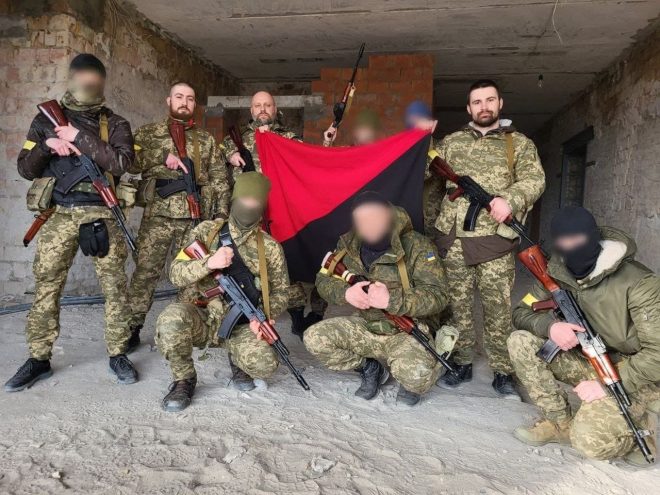
NATO military instructors from Denmark and the United Kingdom trained Ukrainian soldiers at a base of the nationalist Azov battalion, despite Azov’s exclusion from US military funding due to its radicalism, according to documents from the Danish embassy in Kiev seen by Sputnik on Sunday.
A note from the Danish embassy dated May 21, 2021, informed the Ukrainian Defense Ministry of the arrival of six instructors for the 56-th Ukrainian army brigade in Berdyansk and Urzuf, where Azov’s main base was located.
“These sites were previously investigated by Russian law enforcement officers, and the materials found there directly point to intensive training of mobilized Ukrainian citizens by Western officers, using criminal methods of warfare, which the Azovs were fluent in,” a law enforcement officer told Sputnik.
The instructors of the UK’s OP ORBITAL training team had already been present in Ukraine before, the document showed.
“Operation ORBITAL is the code name of a UK program to train Ukrainian army servicepeople from the mobilization reserve. I note that these officers, as stated in the text of the document, have access to classified information, which indicates that Ukraine has provided access to information constituting state secrets, including mobilization planning documents,” the officer said.
Despite the fact that the Azov battalion has been recognized by the United States as a neo-Nazi organization, NATO forces were directly involved in training of nationalist armed formations, they noted.
“This is evidence of Kiev’s intensive preparations for active combat operations under NATO’s supervision,” the law enforcement officer concluded.
In August 2022, the Russian Supreme Court designated Azov as a terrorist organization. The Russian Prosecutor General’s Office said that Azov militants use prohibited means and methods of warfare and are complicit in the torture of civilians and the killing of children.
New Short-Range Missiles for Su-57 Outpace US Developments
Sputnik – 04.08.2023
MOSCOW — Russia’s fifth-generation Su-57 fighter has been equipped with new short-range missiles, the RVV-MD2, which outperform similar American munitions, representatives of the developer company, JSC GosMKB Vympel, said in an article for the Arsenal Otechestva (lit. Arsenal of the Fatherland) magazine.
“It is a fact that Russia’s development of the fifth generation of ‘air-to-air’ missiles, now in industrial production, is five to ten years ahead of similar developments in the United States,” the report stated.
The authors emphasized that, unlike the United States, Russia has managed to develop and test these missiles quickly, and the stage of their introduction into service has already begun.
The RVV-MD2 can be installed in the internal fuselage compartments of the fifth-generation Su-57 fighter, the specialists explained.
The RVV-MD2 is the first short-range missile to use an inertial guidance system to control and stabilize the missile during autonomous flight, the magazine’s editor-in-chief, Viktor Murakhovskiy, pointed out.
The inertial system allows the munition to autonomously determine its coordinates in space without relying on external references or signals.
In addition, Murakhovskiy noted that the RVV-MD2 is equipped with a radio correction line, which allows the aircraft to refine target coordinates from onboard, increasing the likelihood of hitting enemy aircraft.
According to the editor-in-chief of “Arsenal Otechestva,” another advantage of the new missile is its multi-element dual-band infrared homing head with improved anti-jamming capabilities.
The new missile is capable of attacking targets from all angles, including from the rear. In other words, the RVV-MD2 is launched forward, maneuvers in the air and engages the enemy aircraft located behind the Su-57, Murakhovsky explained.
Judge Andrew Napolitano: Biden Doesn’t Have Coherent Strategy in Ukraine
By Ekaterina Blinova – Sputnik – 04.08.2023
The Biden Administration’s Ukraine strategy is increasingly disconnected from political and military realities on the ground, Judge Andrew Napolitano told Sputnik’s New Rules podcast.
“Joe Biden cannot articulate what the goal of the American military involvement [in Ukraine] is,” Judge Andrew Napolitano, former New Jersey superior court judge and host of the Judging Freedom podcast, told Sputnik. “The neocons around him just love the concept of war, particularly war against Russia, particularly against Russia while Vladimir Putin is in office.”
Delusional Neocons Set Biden’s Ukraine Agenda
The US has been involved in the Ukraine conflict for 17 months and has already transferred over $68 billion. Nevertheless, Kiev cannot boast any considerable progress on the ground with their much-discussed counteroffensive having eventually stalled. As the conflict is continuing to drag on, Biden administration officials and the US president are still asserting to Kiev that Washington will support it “as long as it takes.”
“If you ask him, as long as it takes to do what he can’t answer the ‘To do what?’ As long as it takes to produce a stalemate? As long as it takes to produce a cease fire? As long as it takes, if you ask Victoria Nuland, to drive President Putin from office? I mean, they can’t answer that question,” Napolitano noted.
Can Trump Strike Ukraine Peace Deal?
The Ukraine conflict has been presented in the Western mainstream press as a way to bleed Russia dry and drain President Vladimir Putin’s “political standing with the Russian people,” the judge opined.
In February 2023, President Biden made a claim in front of a Polish crowd that suggested he wanted to see the Russian president deposed: “For God’s sake, this man cannot remain in power,” Biden stated. The White House later downplayed this rally cry as a gaffe.
Still, what Team Biden and their neocon allies “don’t understand is that President Putin is enormously popular, that he’s fighting a patriotic war for a return of land, for which there is a valid legal argument, it has always been a part of Russia, culturally a part of Russia, linguistically a part of Russia,” according to Napolitano.
“They think they can use Ukraine as a battering ram to drive President Putin from office. They’re crazy. It’s not going to work. Joe Biden does not have an off ramp. He doesn’t have the ability to say, okay, we’ve we’ve succeeded. It’s time for us to stop. There’s no goal and there’s no off ramp. His internal goal is to run for reelection as a wartime president like his hero, Franklin Delano Roosevelt did in 1940. But this is not a war like World War Two. This is not a war that the American public perceives as a threat to American national security. All the politicians will argue that. But they’re so tied up with the military industrial complex that, you know, you have a majority in the Congress, Republicans and Democrats, that like all wars because it enriches the military industrial complex and keeps people working in the factories.”
What’s more, there is no American national security interest at stake in Ukraine, despite US neocons arguing to the contrary, according to the judge.
US war hawks are continuing to claim that Washington’s military aid to Kiev is a great investment since Russia is being bashed without American lives being lost. “The Russians are dying. The best money we’ve ever spent,” as US Senator Lindsey Graham said back in May. As long as no American body bags are coming home, the public is buying into this argument.
Still, it’s no longer a secret that a limited contingent of US servicemen has been operating on the ground in Ukraine. “We know the US military is there in Ukraine out of uniform. We know it is there in Poland, operating equipment that is shooting projectiles at Russian boys,” noted the judge. US mercenaries have also joined Ukrainian battalions on the battlefield.
And these Americans are dying in Ukraine: a sad statistic has already found its way out, indicating that dozens if not hundreds of US citizens have been killed in the conflict zone since February 2022.
Dissent is Brewing Within the US Military and Intel Community
Meanwhile, the US president and his administration are continuing to assert to the American public that Russia is losing and that Ukraine is going to prevail.
US Secretary of State Antony Blinken recently insisted that Russia had “already lost” while speaking to an American broadcaster. However, this triumphalist stance is not unanimously shared by US Department of Defense officials and the US intelligence community. The so-called Pentagon leak – that caught the headlines in April – shed some light on what the US military and spies really think about the situation on the ground in Ukraine.
“There is a 21 year old young Massachusetts National Guardsman sitting in a federal jail cell as we speak, named Jack Teixeira, who is accused of leaking secret documents – to which he had access by virtue of his work in the National Guard – to a chat room,” said Napolitano.
“The documents, the authenticity and accuracy of which have never been challenged by the government, reveal the government’s own internal deliberations as showing it expects Ukraine to lose. To lose. So if the Department of Defense expects Ukraine to lose and the Secretary of Defense goes before a Senate committee and says under oath ‘Ukraine is going to win’, who are you going to believe? You’re going to believe their candid, unvarnished statements recorded in documents that they believed would forever remain secret.”
Prior to the scandalous leak, American army and intelligence veterans voiced their skepticism with regard to Biden’s Ukraine strategy in their podcasts or interviews with alternative media.
“On my podcast, Judging Freedom, where we have a number of ex-CIA and ex-military harshly critical of the current CIA and the current US government, who are, I believe, giving a far more accurate version of what’s happening there,” Napolitano pointed out, referring to former US Marine Corps intelligence officer Scott Ritter, retired US Army colonel and government official Douglas Macgregor, former CIA analyst Larry Johnson and ex-CIA officer Ray McGovern. All of them have stated loud and clear that “it is inconceivable that the Ukraine military can prevail,” the judge underscored.
On top of that, it has been almost impossible for the US and NATO military officials to ignore massive casualties sustained by the Ukrainian Armed Forces in terms of military equipment and manpower since the beginning of their counteroffensive.
As of mid-July, Ukraine had lost 26,000 servicemen, 21 aircraft, five helicopters, some 1,244 tanks and armored vehicles, including 17 Leopard tanks, five French AMX wheeled tanks, 914 units of special vehicles, two air defense systems, and 25 MLRS vehicles, according to the Russian Ministry of Defense.
Thus, unsurprisingly, Western leaders in private conversations cast doubt on Kiev’s odds of winning at the recent Aspen Security Forum despite publicly trying to put a positive spin on Ukraine’s military efforts.
Why is the US Public Buying Into Biden’s Ukraine Narrative?
Meanwhile, the Western mainstream press has been busy spreading the one-sided Biden administration’s Ukraine narrative since the outset of the conflict. Judging from polls, most of the public in the West appear to have swallowed the bait.
“The American public still seems to be in favor of the war. Again, they only hear one side,” highlighted the judge.
“While the Biden administration, through the American Central Intelligence Agency and British MI6, has succeeded in taming the press,” continued Napolitano. “So the press and the American media, even my friends and former colleagues at Fox, are giving a version of these events which is not based in reality on the ground. The version of events that Americans are getting is that the so-called spring offensive, even though we’re now in the middle of the summer, is slow, methodical, but but a steady movement eastward by the Ukrainian forces, Whereas in reality, as you just pointed out, the Russian military has established three runs of defenses and the Ukrainians haven’t even approached, much less breached the first of those three rings. So the American public is not getting a true and accurate view of the so-called spring effect offensive from mainstream media.”
What’s making the West’s Ukraine narrative even less credible is that there are very few American journalists on the ground, according to the judge.
“The military won’t allow them there, Napolitano said. “The Ukrainians won’t allow them there. They don’t want the true story to be told. So the American public hears that same drumbeat over and over and over again, which you so nicely articulated. But in reality, it is not our war, it is not our fight. We shouldn’t be losing any blood and we shouldn’t be losing any money over it. And we are losing.”
In addition, most US presidential candidates from both sides of America’s political aisle are also promoting the US proxy war in Ukraine. Just two major candidates – Donald Trump and Robert F. Kennedy Jr. – are against the conflict. “Everybody else is lockstep in favor of it for a variety of what I think are nonsensical reasons,” Sputnik’s interlocutor added.
However, over the past two weeks or so, a growing number of mainstream media outlets have started to release unflattering reports about the Ukraine situation on the front lines. They are even publishing interviews with Ukrainian soldiers where they talk about how this counteroffensive is not exactly going to plan. This could be a harbinger of some potential change, according to the judge, even though Team Biden is still wearing a brave face.
“It’s very telling that that is beginning to happen. So that would mean the president’s political advisers are taking polls saying the American public’s getting tired of this war. There doesn’t seem to be any progress. We need an off ramp. The off ramp is not going to come all at once. The off ramp is going to come gradually and slowly with the American public acclimated to the coming off ramp. If the Biden administration were to say, that’s it, we’re not involved anymore, well then everybody would say, what about the $68 billion already spent? Are we going to get that back. I mean, was it wasted? What was accomplished by it? So in order to prevent that kind of a blowback, they need this gradual acclimation to the likelihood of Russian success and Ukrainian defeat,” Napolitano concluded.
Hunter Biden netted big money from Ukraine – court documents
RT | August 3, 2023
Court documents stemming from Hunter Biden’s failed plea-bargain deal on federal criminal charges have revealed that US President Joe Biden’s son brought in income of more than $4.4 million, mostly from China and Ukraine, while paying no taxes in 2017 and 2018.
In 2017 alone, Hunter Biden netted nearly $2.3 million from foreign sources, including over $1.6 million from his Chinese business interests and $500,000 in director’s fees from a Ukrainian energy company, according to a filing released on Wednesday by US District Court Judge Maryellen Noreika in Wilmington, Delaware. He also had $70,000 in earnings from a Romanian business and $48,000 from a multinational law firm.
The president’s son belatedly reported an additional $2.1 million in earnings from 2018. He didn’t pay taxes for either year, despite having enough money and being repeatedly urged by his accountant to do so, according to the documents, which Noreika released in response to a request from NBC News.
Biden became addicted to crack cocaine in 2016, contributing to the collapse of his marriage and his most significant business relationship the following year. Despite his escalating drug use, “Biden successfully entered into business ventures and landed legal clients, earning millions of dollars.”
Republican lawmakers have accused the Biden family of soliciting bribes through Hunter Biden’s overseas business forays, including a stint serving as a director for Ukrainian energy firm Burisma Holdings. Burisma founder Mykola Zlochevsky reportedly urged Hunter Biden, whose father was then the US vice president, to help end a corruption investigation against the company in 2015.
Zlochevsky later told an FBI informant that he was coerced into paying a $10 million bribe to the Bidens and that he had multiple recordings to verify his claims.
Hunter Biden’s substance abuse worsened in 2018, when he moved to Los Angeles for a “spring and summer of nonstop debauchery,” according to the plea agreement. Weeks before his 2017 tax return was due to be filed, he received a $1 million payment for legal services to Chinese business associate Patrick Ho, but he spent almost all of the money over the next six months on travel, entertainment and other expenses. Similarly, around the time his 2018 return was due, in April 2019, he received $758,000 and spent almost all the money by the end of May.
The documents showed that an unidentified third party paid Biden’s nearly $2 million in combined tax liabilities for 2017 and 2018 in October 2021. That same person also paid about $243,000 on Biden’s behalf for unresolved tax liabilities from 2016 and 2019. Media outlets have identified that backer as Kevin Morris, Hunter Biden’s “sugar brother” lawyer in Los Angeles.
Noreika refused to accept the plea agreement last week, saying she had concerns about the terms granted to Biden. Republicans had accused prosecutors in the Biden administration’s Department of Justice (DOJ) of giving the president’s son a “sweetheart” deal on the tax charges against him and a separate case involving an illegal gun purchase. Republican lawmakers launched an investigation this week of the DOJ’s handling of the plea and diversion agreements in Hunter Biden’s cases.
US Arms Firms Reportedly Given $9.7 Billion to Replace Weapons Sent to Ukraine
Sputnik – 01.08.2023
The US defense contractors have received nearly $10 billion in new Department of Defense weapons orders to replace systems sent as aid to Ukraine, US media reports said.
Citing official Defense Department figures released Tuesday, US media reported the Pentagon has currently used $9.7 billion to replenish its depleted weapons and ammunition stockpiles, out of a total $26 billion already approved for that purpose by the US Congress.
Lockheed Martin is already getting almost $2.3 billion of a potential $6 billion committed to it as well as $1.4 billion out of an eventual total $1.9 billion more for its joint venture with RTX, previously known as Raytheon Technologies to refill its arsenal of Javelin anti-armor weapons, media said.
Lockheed is also expected to receive $1.4 billion of a potential $5.2 billion to replace guided missiles for the Guided Multiple Launch Rocket System (GMLRS). RTX will reportedly get another $844 million to replace the Patriot PAC-3 MSE anti-aircraft and anti-missile systems that have been sent to Ukraine.
RTX will get $581 million of a potential $624 million to replace US armed forces supplies of Stinger anti-aircraft missiles and Congress also has appropriated $18.6 billion to provide for Ukraine’s long-term defense needs. So far, $7 billion of that money has been obligated to US companies, the report added.
RTX reportedly has Pentagon commitments for $1.2 billion of a potential $1.4 billion to supply Ukraine with its long-range NASSAM air defense systems. General Dynamics and other contractors companies will receive $901 million out of a likely $1.4 billion to supply Kiev with more 155mm howitzer ammunition.
US journalist missing after trying to flee Ukraine
RT | August 2, 2023
Chilean-American reporter Gonzalo Lira, who claimed to be about to attempt to flee Ukraine after being subjected to physical abuse and extortion in custody, has gone missing, a source confirmed to RT.
Lira, a vocal critic of the Ukrainian government, resurfaced this week, months after being arrested by the nation’s security service, the SBU. In a series of posts on Twitter and YouTube, he stated his intention to cross the border into Hungary and apply for political asylum there.
He claimed that since early May he had been kept incommunicado in pre-trial detention. He said he was deprived of sleep as well and beaten and tortured by other inmates on instructions from the prison authorities.
Lira apparently never made it to the other side of the border. Mark Sleboda, a political expert and frequent guest at RT, confirmed to the channel that Lira was stopped on the Ukrainian side and has not been heard from since.
Lira said that he had been released on bail and told not to leave the city of Kharkov. However he added he was given his passport back and an electronic shackle was not put on him, contrary to the formal terms of his conditional release.
“Maybe I’m being set up by them so they can justify putting me away in a labor camp – so no one will ever know about their sordid extortion scheme,” he said. “I simply don’t know.”
If he made it across the border, he said he expected Ukraine to issue an international arrest warrant for him for skipping bail and that he hoped that Hungary would be willing to defy Kiev and not hand him over, unlike other EU nations.
“If you don’t hear from me in the next 12 hours—whelp! I’m on my way to a labor camp!” he concluded. There have been no further updates on his social media since.
Lira has been accused by Ukraine of “publicly justifying” the Russian military operation and “disseminating fakes [false stories] about the war in Ukraine”. He said the charges were bogus and that he did nothing but explain his opinions about Kiev’s policies and report what was happening in Ukraine.
…
…
Western media suggests that Zelensky could be assassinated
By Lucas Leiroz | August 2, 2023
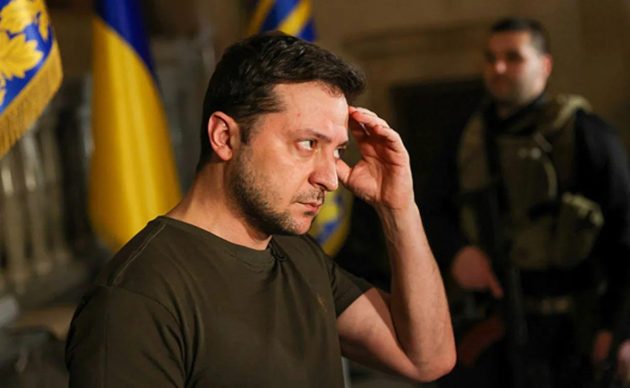
In an article recently published by Politico, it was said that Kiev already has a secret plan in case the Ukrainian president is assassinated. Although it is normal for countries at war to think about the possibility of their leaders dying, the way that media is reporting the case suggests a kind of attempt to prepare public opinion for Zelensky’s replacement.
The report was based on interviews with Ukrainian officials and analysts. The sources believe that it will be necessary to circumvent Ukrainian constitutional norms if there is a need to replace Zelensky. The country’s constitution declares that if the president is no longer able to fulfill his duties, the head of parliament must ascend to the office. However, the current parliamentary leader, Ruslan Stefanchuck, is an unpopular public figure, with only 40% approval, which is why it would be inappropriate to appoint him president.
To handle this situation, Kiev plans to create a team of officials, forming a governing council. The office would consist of people like Andrey Yermak, head of the presidential cabinet, Foreign Minister Dmitry Kuleba, Defense Minister Aleksey Reznikov and Ukraine’s military chief Valery Zaluzhny. Stefanchuk would be the formal leader of the group, but decision-making power would be shared with the other officers.
Informants argue that Ukraine achieved high levels of national unity during the conflict. This “unity” supposedly gave stability to the state, guaranteeing an institutional security independent of Zelensky or any individual politician. For this reason, in the current scenario no Ukrainian officer seems “indispensable”.
“(…) I don’t think it [Stefanchuck’s popularity] matters. There’s a strong leadership team and I think we would see collective government (…) The country has reached a point of very substantial solidarity and national unity, so if something terrible happened to Zelensky it would not be as decisive as you might think (…) I don’t want to say that Zelensky is hardly irrelevant to this (…) But I think the country’s unity is the indispensable thing”, Adrian Karatnycky, “a nonresident senior fellow with the Atlantic Council”, told Politico’s journalists.
In fact, this report leaves a series of unanswered questions. It does not seem surprising that Kiev actually has such plans, as certainly Ukrainian institutional security is a priority for the regime’s officials, especially in times of war. What seems unlikely is that these plans are easily accessible to journalists and public opinion.
Being a sensitive topic, relevant to national security, it is most appropriate that these discussions be taken in absolute confidentiality, with no possibility of information leaks. Discretion becomes even more necessary when these plans involve maneuvers to circumvent the constitution, violating the laws of the country.
So, it is necessary to think about what would be the interests of the Western media in spreading this type of information. It is possible, for example, that news agencies are trying to “prepare” global public opinion for an eventual replacement of Zelensky. There have been rumors for some time that NATO plans to remove the Ukrainian leader from power, given his discredited and deteriorated image. Zelensky is seen less and less as a “hero”, being classified by many as a “beggar” and a “loser“. Thus, putting a new politician in power could be beneficial to NATO’s plans to prolong the war, as it would generate more popular support in the West for the military assistance policies.
However, what is really curious is the fact that the article mentions the hypothesis of murder. This raises the possibility that Western intelligence is planning not only to replace but also to kill Zelensky. This would certainly be useful for the West to accuse Russia of having committed the crime, creating a false flag situation to move public opinion and justify new military measures in support of Kiev.
In the article, Politico reminds a series of recent requests made by Russian citizens calling for Zelensky’s elimination in retaliation for the terrorist attacks in Moscow and other Russian cities. Despite such requests being real, the Russian government has never shown an interest in doing so. These were just sincere expressions on the part of the Russian people, emotionally affected by the Ukrainian terror. No strategic guidelines to actually kill Zelensky were adopted.
The article, however, seems to want to show that Moscow has such a plan. Thus, western readers are prepared to have a preconceived opinion if future news confirms Zelensky’s death. This is a well-known psychological and informational warfare tactic used frequently by the West.
So far, the only side that has shown interest in replacing Zelensky has been the West itself, which wants to put in his place someone more competent to lead the regime. For Moscow, it is irrelevant who is in power in Kiev, Russian interest being only to force Ukraine to accept its peace terms, regardless of whether it is Zelensky.
Lucas Leiroz is an journalist, researcher at the Center for Geostrategic Studies, geopolitical consultant.
Vilnius Memo: Who’s Going to Bankroll This War?
By Martin Jay | Strategic Culture Foundation | August 1, 2023
Apparently it wasn’t Abert Einstein who said “The definition of insanity is doing the same thing over and over again, but expecting different results”. But we like to think it was, so it became a quotation attributed to him. How else to describe the West’s stalwart determination to impale itself further with the agony of the Ukraine war as we are led to believe that NATO and the U.S. are determined now to dig in for a long war. The belief is still upbeat, despite the huge anti-climax of Ukraine’s so-called “offensive” which didn’t even break through the Maginot Line which Russia has built along a 900-km fortified line.
The blinded dogma of NATO members at last month’s Vilnius Summit stems from being drunk on their own fake news which media dutifully pumps out each day from the propaganda factory in Kiev. There’s just so much of it, that it’s hardly surprising that Biden and his European lap dogs overconsume on it without looking at the hard facts. It isn’t simply that Ukraine “has run out of ammo” as Biden put it. It’s more than that. It’s that it has been proven over and over again that they don’t have the will, resources or rank ability to take on the Russian army and that sending more and more military hardware will only delay the inevitable loss. Or at least armistice which is bound to happen on an unofficial level at some point, if an official one can’t be signed.
Zelensky looked worried at the Vilnius conference. And it’s hardly surprising. Even when you look at the pledges made by western countries for military hardware, there’s no question that the speed of these deliveries and the actual quantity has radically dropped. So how can Ukraine or NATO believe that it can win the war, even in years to come? Fighting a war without ammunition is like baking bread without flour, after all.
The truth is that most western leaders already know that the time is up. They know that three key elections are going to play a huge role in putting the brakes on the campaign to continuously supply the Kiev cabal, who by some accounts, are buying 7 million euro villas in Cannes with the money which is being syphoned off. War is a racket after all and Ukraine is one of the most corrupt countries in the world. Should we be surprised that a government minister there has this kind of cash to blow on a wedding present for his offspring?
The three elections are of course the UK general election, The U.S. presidential elections and the European parliamentary elections. All three will take place at the end of 2024 and it will be the first time people will have a real opportunity to make a statement about the war and the abysmal hardship it is imposing on people in western countries. It’s as though Joe Biden knows also that it will be very hard for him to stand again as president when he has to explain why he has sent over 130 billion dollars of taxpayers’ money to a country that few Americans can even find on a map of the world.
Money matters. Finally, it matters. The argument on the American side that it doesn’t matter as it is being printed and given over to the industrial military complex has some validity, as this secures jobs and keeps these companies buoyant. But it’s public money. And so, rightfully, people will want to know why couldn’t the same money be spent on the very poor.
For the Europeans it’s very different. They pay a very high price for the Ukraine war and the folly of their governments who indulge themselves with the military aid like children gouging themselves on chocolate cake while the parents are away. Germany’s economy is flat broke. For the UK, homeowners are facing losing their house due to colossal mortgage rate hikes with an entire generation now unable to get on the housing ladder. How will these politicians explain this at the polls?
It really is about the money. NATO knows that it needs much more than just the miniscule offering of 2 % of GDP, which in reality only 11 NATO members adhere to. All western countries’ military stockpiles are depleted and so, not only do NATO and its members need to find trillions of dollars of new cash just to bring their stocks back up to what they were, but also trillions more for Ukraine. The numbers just don’t add up. Even on an EU level, Ursula von der Leyen, who is almost certainly going to be NATO secretary general, when her term as EU Commission president runs out in about a year, has her begging bowl out. She is hoping to raise 20 billion euros to be given to Ukraine over 4 years as military aid. For the Ukraine war, it is pretty meagre.
For the EU itself, there is no clear sign how she will get it when she is already asking member states to contribute 30 billion euros more to the budget to pay for another egregious scam of COVID vaccinations, which at one point she was being accused of having corrupt connections to, until colleagues managed to cover the scandal up. Europe not only has no cash or military kit left to offer Ukraine, it has serious financial problems to tackle of its own for its own elites to retain the power they wield. The only respite would have to be much more cash from the U.S. only which is probably not what Biden is planning on. The Europeans have paid too much. We are an empty Amazon warehouse with all the workers at the foodbank.
Journalist Slams Ukraine for Losing Swedish IFV by Putting It ‘Too Close to Front’
By Ilya Tsukanov – Sputnik – 01.08.2023
As the counteroffensive launched by Ukraine’s NATO-armed and trained armies continues to falter, a growing number of Western observers, officials and military commanders have criticized Kiev, suggesting that the latter’s “tactics,” rather than their equipment and support, are to blame for the counteroffensive’s failure.
A German journalist has taken to social media to vent his frustration over Kiev’s loss of a Combat Vehicle 90 (CV 90), an advanced, $10 million apiece Swedish-made infantry fighting vehicle that was recently captured by Russian forces as a trophy.
“The CV 90 was NOT lost during the counteroffensive, for which it was intended to be used, but after being split from the rest of the brigade and used (allegedly together with another CV 90) for isolated defensive purpose in the area of Chervonopopovka,” Bild contributor Julian Ropcke wrote.
“It moved to [sic] close to the front, came into a Russian ambush and was hit by an RPG from far too close. It was then towed to Russian-controlled territory. This is exactly what the German army criticized about Ukraine: 1. Using the provided vehicles for other purpose than required to operate successfully and 2. Dividing powerful brigades into isolated vulnerable platoons,” Ropcke added.
The CV 90, praised by many armchair military analysts as “one of the best IFVs in the world” thanks to its powerful protection, high mobility and multirole capabilities, is the latest piece of Western equipment delivered to Ukraine to fall into Russia’s hands. Dozens of videos and photos have been posted online in recent weeks of Russian troops posing alongside or operating trophy Leopard tanks, Bradley IFVs, M113 armored personnel carriers, and more.
As Ukraine’s counteroffensive approaches its two-month anniversary with little to show for it apart from tens of thousands of lost troops and hundreds of tanks and armored vehicles, a growing number of officials and observers in Western media have expressed frustration over Kiev’s “tactics.” It’s “just a matter of continuing to apply pressure in a combined-arms approach,” one US official recently assured, and not the fact that Kiev is outgunned and faces overwhelming Russian air and artillery superiority.
Ukraine’s use of heavy armor has been a matter of particular scrutiny, with reports emerging in July that the country’s military had pulled Leopard 2s from the front after they got stuck on mine fields in the first stage of the counteroffensive. Separate reports indicated that “up to 20 percent” of Kiev’s NATO-provided armor was destroyed in the first stage of the offensive. In the case of the British Challenger 2, the highly “pampered” tank has not been spotted anywhere on the front, with its appearance limited to flashy propaganda videos. When the decision to send the armored vehicles to Kiev was made in the spring, the British Army’s top brass reportedly pressured their Ukrainian counterparts to avoid deploying Challenger 2s to areas where they might risk capture or destruction by Russian forces.
US will spend on Ukraine more than it did on Marshall Plan after WWII
By Ahmed Adel | August 1, 2023
John Sopko, Inspector General of the United States Reconstruction Service in Afghanistan, said that the amount of money the US will spend by the end of 2023 will surpass the money spent on the entire Marshall Plan. He also highlighted how Ukraine is a country that is almost just as corrupt as Afghanistan.
“We are spending more money in Ukraine now in one year than we spent in about 12 years in Afghanistan, and by the end of this year, we will spend more money in Ukraine than we did to do the entire Marshall Plan after World War Two,” he warned, emphasising that he supported financial aid, but felt the need to make sure it was done “correctly and under supervision.”
Among the problems identified by Sopko when overseeing the cost of rebuilding Afghanistan was the lack of coordination of these efforts and a lack of understanding of the ultimate goal. He highlights that in the case of Ukraine, the situation is even more complicated as more parties are involved, such as US agencies and international donors and organisations. In addition, the expert also noted that both Afghanistan and Ukraine are deeply corrupt.
Most alarming, though, for US taxpayers is that Sopko revealed that Washington spends about $2.5 billion monthly on security assistance to Ukraine. In comparison, Washington only spent about $375 million monthly on security assistance to Afghanistan. Since February 2022, the Biden administration has committed more than $75 billion in various types of assistance to Ukraine, with nearly $50 billion spent on weapons and related military equipment.
Biden’s astronomical total spending in Ukraine will only significantly increase when considering that in July alone, the Ukrainian military lost 20,824 troops and 2,227 units of various weapons, including 10 Leopard tanks, 11 Bradley armoured vehicles and dozens of artillery pieces from the United Kingdom, United States, Germany, France, and Poland.
“It is obvious that the Western-manufactured arms supplies do not lead to successes on the battlefield, but only prolong the military conflict,” the Russian Ministry of Defence said in an announcement on July 31, adding that “against the backdrop of the failed so-called ‘counteroffensive,’ the Kiev regime, with the support of Western sponsors, has focused on carrying out terrorist attacks on civilian infrastructure in cities and towns in the Russian Federation.”
Seeing as the counteroffensive has been an utter and humiliating failure for Ukraine and its Western patrons, the Kiev regime has resorted to terrorist tactics against Russia, knowing well that such attacks only hurt citizens and do nothing to strengthen Ukraine’s war effort or deter the Russian military operation.
On the morning of August 1, Mayor of Moscow Sergey Sobyanin announced that Russian air defences shot down “several” drones targeting the Moscow region. This attack marks at least the fifth time drones have reached the Russian capital since May. Thankfully for the citizens of Moscow, two drones were destroyed by air defence systems and a third was jammed and crashed, resulting in no deaths or injuries.
In an attempt to show strength, but instead ended up revealing the truth about the desperate situation Kiev finds itself in despite having more money pumped in a year than 12 years in Afghanistan, Ukrainian president Volodymr Zelensky said on July 30 in his nightly address that the war was coming to Russia, i.e., terrorist attacks.
“Gradually, the war is returning to the territory of Russia – to its symbolic centres and military bases. This is an inevitable, natural, and absolutely fair process,” Zelensky said.
The wording of Zelensky’s announcement suggests that Ukraine is about to embark on a game-changing phase of the war. Instead, Ukraine will only conjure inconveniences for the Russian state and, sadly, some deaths and injuries to citizens. However, it will certainly not be anything that will swing the war in Ukraine’s favour.
Ukraine will likely lose significant drone capabilities as this will become a priority for Russia if terrorist attacks continue in such a manner. In fact, the Russian Ministry of Defence announced on July 31 that an assembly plant for drones in the Kharkov region intended for Ukrainian troops was destroyed.
At the same time, the Ministry of Defence of Ukraine and the Baykar Makina Turkish company recently announced that they agreed to build a repair and maintenance service centre for drones. The agreement to create a service centre for Turkish drones was signed within the framework of the intergovernmental agreement between Ukraine and Turkey about cooperation in the hi-tech, aircraft and space industries sector, which came into force in January 2023.
With Russia already demonstrating its willingness to destroy drone plants, there is little reason why the new Bayraktar centre in Ukraine will not be targeted if the Turkish drones are the reason for Russian deaths.
Nonetheless, despite Zelensky’s promise of bringing the war to Russia, terror attacks on Moscow will not deter the special military operation but will significantly weaken Ukraine’s drone capabilities as its destruction becomes a priority. Ukraine is already a financial blackhole for the West, as seen by the vast resources poured into the country, and the destruction of Ukraine’s drone capability will only add to its misery.
Ahmed Adel is a Cairo-based geopolitics and political economy researcher.
Featured Video

Seyed Marandi: Trump lost the Iran war – Must sell it as victory
or go to
Aletho News Archives – Video-Images
From the Archives
UK Researchers: Tax Food to Reduce Climate Change

I doubt these professors have anything to fear from a food tax
By Eric Worrall | Watts Up With That? | November 19, 2016
A group of researchers in Oxford University, England have suggested that imposing a massive tax on carbon intensive foods – specifically protein rich foods like meat and dairy – could help combat climate change. […]
This proposal, from a group of people who have probably never missed a meal in their lives, is totally obscene. High income countries often have a lot of poor people who would be hard hit by increases in the price of food.
Needlessly exacerbating the risk poor people don’t get enough to eat, especially children and pregnant mothers, who are especially vulnerable to adverse health impacts from lack of protein in their diet – if this ghastly proposal is ever implemented, future generations will look upon it as a crime against humanity. – Read full article
Blog Roll
 Aletho News
- Seyed M. Marandi: Trump Lost the Iran War – Must Sell It as a Victory
- Iran, Saudi FMs hold phone talks as Persian Gulf states rethink US ties
- The Illusions of Western Virtue: Ursula von der Leyen and Europe’s Moral Bankruptcy
- AIPAC-backed candidates lose New York primaries as voters reject pro-genocide lobby
- The West’s Post-Soviet ‘Democracy’ Playbook
- UK suppressed intel on Sudan genocide to protect UAE ties: Report
- Starmer’s exit exposes dirty secret: UK can’t afford Ukraine War
- Putin Warns the West: Russia Is Ready
- BEN-GVIR: “ALL OF LEBANON MUST BURN” — w/ Mouin Rabbani
- There Are No Budget Constraints In New York City: “Coastal Resiliency” Edition
- If Americans Knew
- Israel’s Attacks on Gaza’s Children (Photos)
- ‘His only crime is that he is a Palestinian doctor’
- ‘Killed pursuing her dream’: Gaza girl on her way to school dies in Israeli drone strike
- Unbelievable pressure on Gaza from Israel, “Board of Peace” – Daily Update
- UN: Israel Continues to Commit Genocide and Other Atrocity Crimes by Deliberately Targeting Palestinian Children
- Bari Weiss, Free-Speech Fraud & Zionism Promoter, Would Rather Deport Than Debate
- ‘Doctor of the Poor’: Israeli Occupation Arrests Prominent Palestinian Physician
- Search for Your Church (and see if it has been targeted by the Israeli gov’t)
- Mark Levin Flying to Israel as Netanyahu Reportedly Seeks to ‘Leverage’ Levin to Trash Trump’s Iran Deal
- Watch: Zionist Brags about Israel’s Power to Get the World to Do What Israel Wants
- No Tricks Zone
- 3 New Studies Find Increasing Trends In Solar Radiation Since The 1980s – Easily Explaining Warming
- THE TRANSCEIVER PARADOX: Why Organoid Intelligence (OI) Could Become Our Ultimate Alien Predator
- German Wind Turbines Face Regulatory Shutdown Due To Excessive Noise
- New Study: Chile’s Relative Sea Level Was 3.2 Meters Higher Than Today During The Mid-Holocene
- Beyond The Pitch: Why FIFA’s World Cup Is One Of Humanity’s Best Investments
- Climate Alarmists Now Using Natural Phenomena To Support Their Claims
- New Study: Significant CO2 Fluxes From Non-Volcanic Sources Are Largely Neglected In Carbon Budgets
- Women Climate Scientists Being Harassed, Insulted By Skeptics, Claims Berkeley Earth Researcher
- Germany’s Longterm Spring Climate Data Show “No Climate Trend”
- New Study: Solar Photovoltaic, Wind Power Fail To Meet Annual Energy Demands 62% Of The Time
 Aletho News