Ukrainian Orthodox Christian Priest Sentenced to 5 Years in Prison by Zelensky Regime

By Chris Menahan | InformationLiberation | August 8, 2023
A Ukrainian Orthodox Christian priest was sentenced to 5 years in prison on Monday after being accused of “justifying” Russia’s invasion of Ukraine.
From OrthoChristian, “UKRAINIAN HIERARCH SENTENCED TO 5 YEARS IN PRISON”:
A hierarch of the canonical Ukrainian Orthodox Church has been sentenced to 5 years imprisonment and the confiscation of property for various supposed crimes against the state.
His Eminence Metropolitan Jonathan of Tulchin was sentenced in a Vinnitsa Court today, reports the Tulchin Diocese.
[…] His Eminence has repeatedly denied all charges against him and will file an appeal “against the clearly illegal verdict of the Vinnitsa City Court.”
Met. Jonathan was found guilty of crimes under four articles of the criminal code:
- justification, recognition as lawful, denial of the armed aggression of the Russian Federation against Ukraine, glorification of its participants
- actions aimed at forcibly changing or overthrowing the constitutional order or seizing state power
- encroachment on the territorial integrity and inviolability of Ukraine, distribution of materials calling for changing the borders of the territory and state border of Ukraine
- violation of equal rights of citizens depending on their race, nationality, regional affiliation, religious beliefs, disability, and other grounds
The state persecution of Met. Jonathan has been going on for nearly a year already, beginning with the search of his home last October, during which the Ukrainian Security Service claims to have found “pro-Kremlin” leaflets.
His Eminence even had to undergo open-heart surgery last November, in the midst of the state persecution against him.
Zelensky seized control of the media, rounded up his opposition en masse and is now talking about suspending Ukraine’s elections under martial law.
“If we have martial law, we cannot have elections,” Zelensky told the Washington Post in May. “The constitution prohibits any elections during martial law. If there is no martial law, then there will be.”
Follow InformationLiberation on Twitter, Facebook, Gab, Minds and Telegram.
Biden family received money from Russia – Congress
RT | August 9, 2023
The House Oversight Committee on Wednesday published receipts showing Hunter Biden, the son of current US President Joe Biden, receiving money from Russia, Ukraine, and Kazakhstan by trading on the family name.
The committee says it has identified $20 million in payments from foreign sources to Hunter Biden’s company, which they describe as a front to sell access to the “Biden network” while his father was Barack Obama’s vice-president (2009-2017).
“During Joe Biden’s vice presidency, Hunter Biden sold him as ‘the brand’ to reap millions from oligarchs in Kazakhstan, Russia, and Ukraine. It appears no real services were provided other than access to the Biden network, including Joe Biden himself. And Hunter Biden seems to have delivered,” said committee chair James Comer, a Kentucky Republican.
The third bank memo Comer has published so far shows a February 14, 2014 wire transfer from “Russian oligarch Yelena Baturina” to Rosemont Seneca Thornton, a shell company run by Hunter Biden and his business partner Devon Archer. Of the $3.5 million wired by Baturina, $1 million was transferred directly to Archer, while the rest was used to start up Rosemont Seneca Bohai, a new account used to receive more funding from abroad, the committee said.
Another memo shows that Biden and Archer were both appointed to the board of directors of Burisma Holdings, a Ukrainian gas company run by Mykola Zlochevsky, for $1 million each per year. Burisma had previously paid Biden as counsel, but invited him and Archer to the board after a meeting hosted by Zlochevsky and Burisma corporate secretary Vadim Pozharsky in the spring of 2014 at Lake Como in Italy.
“Then-Vice President Joe Biden visited Ukraine soon after their first payments,” the committee noted, and Hunter claimed that the visit showed “value” that he provided to the company.
The third notable transaction took place in April 2014, when “Kazakhstani oligarch” Kenes Rakishev wired $142,300 to Rosemont Seneca Bohai. The very next day, the company paid Hunter Biden the same exact amount for a sports car. Hunter had met Rakishev at a Washington, DC hotel in February.
“Hunter Biden received millions of dollars in payments from Yelena Baturina, Burisma, and Kenes Rakishev. Vice President Biden had dinner with them in the spring of 2014 and 2015 in Washington, DC,” the committee pointed out.
Joe Biden was the Obama administration’s point man for Ukraine policy after the 2014 Maidan coup in Kiev, and famously bragged at a 2018 DC event about getting a prosecutor fired by threatening to withhold loan guarantees. The prosecutor in question had been investigating Burisma. When then-president Donald Trump brought the incident up in 2019 talks with Kiev, the House Democrats impeached him, claiming this somehow violated US laws.
US lying about Russia’s position on Ukraine peace talks – Moscow
RT | August 8, 2023
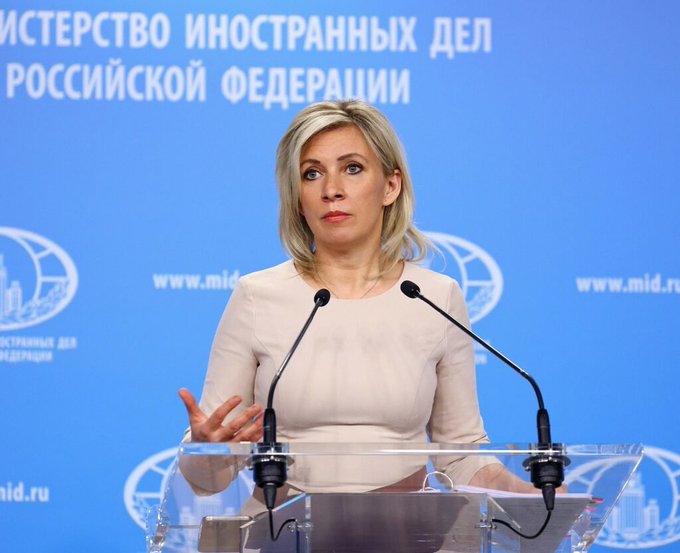
Russian Foreign Ministry spokeswoman Maria Zakharova lashed out at Washington over claims that Moscow has rejected peace negotiations with Kiev.
On Monday, US State Department spokesperson Matthew Miller said at a press briefing that “There are no peace negotiations going on with Russia right now, because Russia has refused to engage in meaningful peace negotiations.”
Later that day, Zakharova wrote on Telegram: “They know perfectly well that they told [Ukrainian President Vladimir] Zelensky to withdraw from peace talks in April 2022, they caused Kiev’s ban on talks with Russia, adopted in September 2022, they have been declaring all year that it’s not the right time for talks, but they still blame Russia anyway.”
Zakharova also advised Miller to read an interview of US Secretary of State Antony Blinken that he gave in April. She was apparently referring to comments Blinken gave to the Funke Media Group, in which he said he did not support the idea of beginning negotiations, while hailing Kiev’s counteroffensive.
Last week, senior officials from more than 40 countries took part in a summit in Saudi Arabia regarding the situation in Ukraine. Russia was not invited to attend, and called any negotiations without its participation “pointless.”
After the talks, Kiev said it had rejected all points of compromise and had not given up on its ‘peace formula’ – a set of ten demands amounting to unconditional surrender on the part of Russia, which Moscow sees as “a useless ultimatum” that only serves to prolong the conflict.
The Russian Defense Ministry estimated that during June and July, Ukraine sustained losses of more than 43,000 troops in its counteroffensive against Russian positions. According to the ministry’s data, over 4,900 pieces of heavy weaponry were destroyed during this period of time.
NATO aggression against Russia becomes total war

By Drago Bosnic | August 8, 2023
On the night of August 4, the Kiev regime launched a sea drone attack against a Russian tanker. Luckily, the resulting damage was insufficient to sink the ship or cause any casualties among the 11 crew members, but it did hinder its operation. The attack happened at about 23:20 just south of the Kerch Strait, according to a statement by Russia’s Federal Agency for Sea and Inland Water Transport. The vessel was later identified as the chemical tanker SIG. The Russian maritime agency detailed that there is a hole “near the waterline on the starboard side, presumably as a result of a sea drone attack” and confirmed there were no casualties.
It’s important to note that the SIG is sanctioned by the United States for transporting jet fuel to the Russian military in Syria, making American involvement in the attack almost a certainty, particularly at a time when Washington DC’s aggression against Damascus is escalating. The targeting information was most likely provided by US ISR (intelligence, surveillance, reconnaissance) platforms which then relayed this to the SBU or the Neo-Nazi junta forces. The move aims to hamper vital Russian logistics in Syria, particularly operations by the VKS (Russian Aerospace Forces) which is regularly intercepting US/NATO aircraft illegally entering Syrian airspace.
To further conceal direct US involvement, the Kiev regime openly boasted about the attack, which is highly unusual given the fact that it normally maintains plausible deniability in the aftermath of such actions. According to NBC, “the tanker was transporting fuel for the Russian troops,” citing sources and adding that “it was well loaded” and that “the ‘fireworks’ could be seen from afar”. They said that a surface drone and TNT had been used to carry out the attack. A video was also released and shared by several Neo-Nazi junta officials, showing a sea drone moving towards the tanker, although it cuts just before reaching the ship, suggesting the explosion followed immediately after.
“Any explosions that happen with the ships of the Russian Federation or the Crimean Bridge is an absolutely logical and effective step in relation to the enemy,” the head of the SBU Vasyl Malyuk posted on Telegram, adding: “If the Russians want the explosions to stop, they should use the only option for this — to leave the territorial waters of Ukraine.”
Several hours before the attack on SIG, another sea drone damaged the “Olenogorsky Gornyak” landing ship, just off the port of Novorossiysk, one of Russia’s major export hubs. Coupled with attacks on tankers, such actions are obviously designed to hinder Moscow’s oil sales as the so-called “price cap” turned out to be a miserable failure, with even US vassals such as Japan ignoring it. By targeting Russian tankers and major ports, the US is hoping to stop or at least hamper oil sales. This is also connected to the issue of insurance for Russian vessels, meaning there would be no compensation in case of such attacks, possibly prompting other tankers to halt transporting Russian oil.
On the other hand, drone strikes on Russian cities aim to disrupt normal economic activity and discredit Russian authorities, probably in hopes of causing unrest of some kind. On August 6, Moscow’s Vnukovo airport was forced to temporarily halt all flights due to a failed drone attack. The Russian military’s electronic warfare (EW) assets downed the drone in the Podolsk region of the Moscow suburbs. The attack could have caused untold damage had it reached the airport, jeopardizing the lives of thousands of civilians. Since major drone attacks on buildings in Moscow (including the Kremlin itself), the Russian military strengthened its air defenses in and around Moscow, including by placing “Pantsir” SAM (surface-to-air missile) systems on rooftops.
Moscow Mayor Sergey Sobyanin wrote on Telegram: “Today at around 11:00 AM, a drone attempted to break through to Moscow. It was destroyed on the approach by air defenses. Well done, military.”
Drone attacks on civilian infrastructure are absolutely irrelevant to Russian military operations in Ukraine, meaning they are either an act of desperation (as the Kiev regime’s much-touted counteroffensive has been an absolute debacle) or the United States is simply trying to launch a total war against Russia, as its economy has proved to be virtually impervious to the political West’s unrelenting sanctions warfare. Another proof that the economic siege of Russia has failed spectacularly is the fact that the Eurasian giant’s economy will grow 1.5% this year, according to an assessment by the IMF. This “unpleasant surprise” most likely prompted the political West to take “concrete action” in order to prevent such a scenario, as its own economic prospects are not looking so good.
Namely, although President Joe Biden vowed to “turn the ruble into rubble” just last year, this has proven to be nothing more than a fantasy, as the Russian economy is now outperforming those of its adversaries, the same ones enforcing the sanctions. Unable to face Moscow in a fair fight, be it militarily, economically or otherwise, the political West is left with underhanded tactics such as biological warfare, evident terrorist attacks and even covert nuclear proliferation. As previously mentioned, all this can only be described by two words – total war. And while it inevitably results in damage for Moscow on a tactical level, strategically and historically, Russia has never lost such confrontations, as evidenced by the last attempt by a certain failed painter with a peculiar mustache.
Drago Bosnic is an independent geopolitical and military analyst.
Professor John Mearsheimer on the Ukraine War
Why didn’t the West negotiate an Austrian-style neutrality deal with Russia?
By JOHN LEAKE | COURAGEOUS DISCOURSE | AUGUST 6, 2023
The Canadian writer and journalist, Aaron Maté, just published what strikes me as the most intelligent and illuminating conversation about the war in Ukraine I’ve heard thus far.
I have studied European history for forty years and lived in Austria for a total of 15. For the last 18 months I have tried in vain to answer the question: Why didn’t the United States at least try to negotiate with Russia for an Austrian-style neutrality deal for Ukraine?
Consider that if a neutrality deal was struck and the Russians subsequently violated it, THAT would be clear grounds for war. Instead, the United States government has simply and and steadfastly dismissed Russia’s view of the matter—a view that Russia has plainly and repeatedly stated since at least 2008.
Note that the arrogant and dismissive attitude of the U.S. government towards Russia since 2008 was in spite of the fact that Cold War eminences such as George Kennan urged the United States government to abandon its harebrained NATO expansion plan in 1997. As Kennan put it in a February 5, 1997 New York Times essay titled “A Fateful Error:”
Why, with all the hopeful possibilities engendered by the end of the Cold War, should East-West relations become centered on the question of who would be allied with whom and, by implication, against whom in some fanciful, totally unforeseeable and most improbable future military conflict?
[B]luntly stated… expanding NATO would be the most fateful error of American policy in the entire post-Cold War era. Such a decision may be expected to inflame the nationalistic, anti-Western and militaristic tendencies in Russian opinion; to have an adverse effect on the development of Russian democracy; to restore the atmosphere of the cold war to East-West relations, and to impel Russian foreign policy in directions decidedly not to our liking …
Several of Kennan’s fellow Cold Warriors, including Robert McNamara and Paul Nitze, agreed wholeheartedly with him, as is evidenced by their June 26, 1997 letter to President Bill Clinton.
Back to the central question of this essay: for those unfamiliar with the 1955 State Treaty and Austrian Neutrality:
The treaty forbade unification with Germany or restoration of the Habsburgs and provided safeguards for Austria’s Croat and Slovene minorities. Austrian neutrality and a ban on foreign military bases in Austria were later incorporated into the Austrian constitution by the Law of October 26, 1955. The 40,000 Soviet troops in Austria were withdrawn by late September. The small number of Western troops that remained were withdrawn by late October.
Austrian neutrality has been honored ever since and has served the Austrian people very well. The Austrian capital, Vienna, is routinely ranked as having the highest quality of life on earth. To be sure, there is a handful of incredibly stupid and venal people in Austria who claim they wish to abandon Austrian neutrality, but they merit so little attention that I almost didn’t write this sentence.
So, why didn’t the United States government negotiate with Russia for an Austrian-style neutrality for Ukraine? Professor Mearsheimer suspects that only sheer stupidity can explain it. Aaron Maté suspects cynicism.
I suspect it’s a combination of stupidity, ignorance, cynicism, greed, bloody-mindedness, narcissism, sadism, contempt, misanthropy, and recklessness—in a word, depravity. Holders of high political office who prefer to send hundreds of thousands of young men to their deaths without at least trying diplomacy are simply terrible people in every respect.
A Recent Survey Shows How Significantly Young Poles’ Views Towards Ukraine Have Changed
BY ANDREW KORYBKO | AUGUST 7, 2023
The Conversation, which is a global collaboration platform between academics and journalists that’s funded by a wide range of international research institutions, published the results from a recent survey of 2,000 young Poles aged 16-34 showing how significantly their views towards Ukraine have changed since early 2022. It can be read in full here, but the present piece will share the most interesting highlights before analyzing them in the latest context of newly complicated Polish-Ukrainian ties.
Before doing so, it’s important to briefly draw attention to the credentials of the researchers involved, Felix Krawatzek and Piotr Goldstein. The first is a Senior Researcher at the Centre for East European and International Studies in Berlin and Associate Member of Nuffield College at University of Oxford while the second is a Research Fellow at that same German institution. Both are therefore established Western experts who can’t be accused of being “Russian propagandists” by any stretch of the imagination.
Having preemptively debunked the ad hominem attacks that’ll predictably form the bulk of Western social media’s reaction to their findings, it’s now time to share the highlights from their survey:
———-
* Over half of young Poles don’t want Ukrainian refugees to permanently reside in their country
– “Our analysis found that between 2022 and 2023, increasing numbers of young Poles – now 52%, up from 42% a year ago – believe that refugees should be offered temporary status, with the assumption that they return to Ukraine as soon as it becomes safely possible.”
* Young Catholic & conservative Poles feel stronger about this than others
– “Those young people who self-identify as Catholic in our survey are 10% more likely than others to desire their return to Ukraine when this becomes possible. This is also true of those who support the far-right Konfederacja, a party that has opposed the Polish response to the war in Ukraine, who are 13% more likely to express that view than others.”
* Over one-third of young Poles want their government to become neutral towards Ukraine
– “In 2022, an overwhelming majority of 83% argued that the government should support Ukraine – but this number has changed drastically. Now, 65% of respondents back continuous support for Ukraine, whereas the remaining 34% wish for Poland to stay neutral.”
* Older young Poles and those living outside of big cities feel stronger about this than others
– “In particular, the oldest people in our sample of young Poles (those aged 25-34) express the strongest wish for political neutrality, as do those from cities with fewer than 500,000 inhabitants and young people who have not engaged in helping Ukrainians over the last 18 months.”
* Young Poles, and especially conservative ones, are increasingly embracing peace and neutrality
– “Asked about the type of support that people consider appropriate for Ukraine, our most recent (2023) data shows that only 2% of young Poles want the national army to be involved in the Ukraine war. And while 60% support offering humanitarian aid, only 28% want Poland to offer weapons. Those supporting the far-right (roughly 20% of our respondents) are most likely to oppose the sending of weapons.”
———-
Quite clearly, the rapid rise of the anti-establishment Confederation party played a pivotal role in shaping young Poles’ views towards the NATO-Russian proxy war in Ukraine and their attitudes towards refugees from that battleground state. They’re a political force to be reckoned with and might even become their country’s kingmakers after this fall’s national elections, though that’s precisely why there’s a credible fear that the ruling party might brand them with the scarlet letter of being “Russian agents” before then.
About that, they formed a so-called “Russian influence commission” earlier this summer that many at the time interpreted as an attempt to discredit the liberal–globalist “Civic Platform” opposition party that’s regarded by many as being German proxies. That prediction still stands but can now be expanded to include the Confederation party as possible targets too due to the socio-political influence that they now wield as proven by this latest survey.
Another factor that certainly played a role in shaping young Poles’ views towards this conflict but which wasn’t addressed in The Conversation’s survey was Kiev trying to trick Warsaw into starting World War III after Ukraine accidentally bombed Poland last November then lied that Russia was allegedly responsible. This incident vindicated those like the Confederation party who hitherto claimed that the Ukrainian leadership can’t be trusted, thus further fueling their rise and the associated popularity of their views.
It can accordingly be argued that Kiev’s blatant lies also account for why one-third of young Poles now want their government to become neutral towards Ukraine and only 28% are in favor of continuing to send it weapons. After all, their lives likely flashed before their eyes during the brief period when it was unclear exactly who was responsible for the unprecedented bombing of NATO territory, and this could have left a strong impression that might have made them more pragmatic towards this conflict.
Another constructive critique that can be made about The Conversation’s survey is that it didn’t attempt to determine the possible role that Ukraine’s recent criticisms of Poland might have played in shaping young Poles’ views. Their research was carried out from May-June 2023, which coincided with Zelensky’s rage from early May that he directed at Poland and neighboring EU countries for their unilateral ban of most Ukrainian agricultural imports that was imposed to protect their farmers.
In hindsight, this was the start of a new trend that began to manifest itself more fully late last month when Kiev once again verbally attacked Poland after Warsaw said that it’ll unilaterally continue this ban even after the European Commission’s temporary deal expires in mid-September. That prompted a quickly escalating tit-for-tat that led to each side summoning the other’s ambassadors, after which their leaders tweeted about this scandal and expressed polar opposite views about who’s responsible.
The Polish Deputy Foreign Minister then expanded the scope of their disagreements to include the World War II-era genocide of Poles in Volhynia by Hitler’s Ukrainian collaborators, which in turn led to Zelensky’s senior advisor predicting that post-conflict bilateral ties will be characterized by competition. Intrepid readers can learn more about this here since the details are beyond the scope of the present piece, but the rest should simply be aware of how complicated their relations have since become.
Keeping in mind the highlights of this latest survey as well as the corresponding analysis thereof, it’s undeniable that young Poles’ views towards Ukraine have significantly changed, which will likely influence the outcome of this fall’s national elections. Kiev is losing the hearts and minds of this important demographic, many of whom are now embracing the anti-establishment Confederation party, and Poland’s ruling party must properly respond to this trend if it wants to remain in power.
US Aid to Afghanistan ‘Was Plundered in Washington’
By Oleg Burunov – Sputnik – 06.08.2023
The Taliban was hardly behind corrupt deals related to US military aid to Afghanistan, Moscow-based political analyst Alexander Knyazev told Sputnik.
US Special Inspector General for Afghanistan Reconstruction (SIGAR) John Sopko has warned of “unanticipated consequences” from possible corruption pertaining to America’s hefty spending on Ukraine.
Speaking hours after Senate Democrats blocked an effort to install greater oversight over the billions of dollars of US military aid to Ukraine, Sopko recalled that Washington has sent more money to Kiev in one year than it spent in Afghanistan in 12 years.
SIGAR said that he was “not opposed to spending that” and he just wanted “to make sure it’s done correctly and there’s oversight.” Sopko especially warned about the risk of fueling graft, stressing that in Afghanistan, “corruption was the existential threat.” According to him, “it wasn’t the Taliban. It was corruption that did us in.”
As far as corruption in Afghanistan is concerned, one can already refer to this evil as a thing of the past, Russian political scientist Alexander Knyazev said.
“As for Afghanistan, I understand that we should now mention this kind of corruption in the past tense. First and foremost, there are few facts about the spread of Western weapons outside Afghanistan. Secondly, even external observers disloyal to the Taliban movement underscore a decrease in the level of corruption in Afghanistan after the Taliban came to power there,” Knyazev pointed out.
He added that over the past twenty years, “all Western aid to Afghanistan has been plundered, which importantly was not the work of Afghans.” One way or another, the analyst went on to say, “this period for Afghanistan is over.”
He also said that “the lion’s share of American aid to Afghanistan did not reach the country at all, [because] it was immediately plundered in Washington.”
“Probably, if someone ever calculates the US’ aid to Ukraine that was stealthily stolen, the sum will likely exceed what was pinched from America’s Afghan aid that came between 2001 and 2021,” Knyazev argued.
With the US spending a whopping $2.26 trillion on Afghanistan-related issues, such as the national army and security, within the above-mentioned period, this huge sum finally didn’t help America prevent the Taliban from seizing power in the South Asian country in August 2021.
This resulted in the collapse of the Washington-backed Afghan civilian government and mass evacuations, something that came amid the chaotic withdrawal of the US-led coalition troops from Afghanistan, which wrapped on August 30, 2021.
NATO Instructors Trained Neo-Nazi Azov Battalion Soldiers in 2021
Sputnik – 06.08.2023
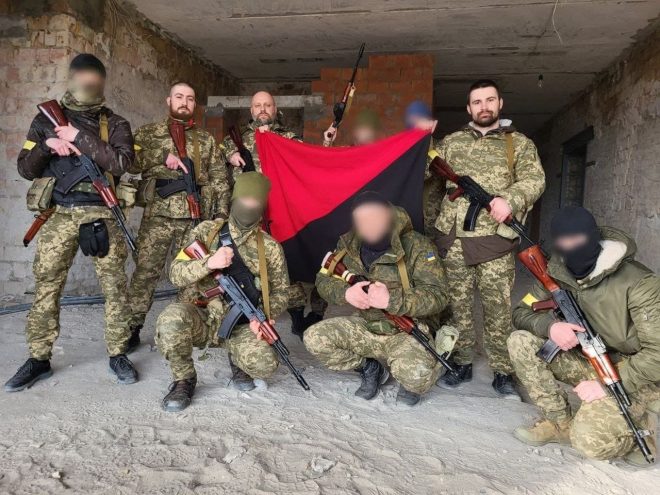
NATO military instructors from Denmark and the United Kingdom trained Ukrainian soldiers at a base of the nationalist Azov battalion, despite Azov’s exclusion from US military funding due to its radicalism, according to documents from the Danish embassy in Kiev seen by Sputnik on Sunday.
A note from the Danish embassy dated May 21, 2021, informed the Ukrainian Defense Ministry of the arrival of six instructors for the 56-th Ukrainian army brigade in Berdyansk and Urzuf, where Azov’s main base was located.
“These sites were previously investigated by Russian law enforcement officers, and the materials found there directly point to intensive training of mobilized Ukrainian citizens by Western officers, using criminal methods of warfare, which the Azovs were fluent in,” a law enforcement officer told Sputnik.
The instructors of the UK’s OP ORBITAL training team had already been present in Ukraine before, the document showed.
“Operation ORBITAL is the code name of a UK program to train Ukrainian army servicepeople from the mobilization reserve. I note that these officers, as stated in the text of the document, have access to classified information, which indicates that Ukraine has provided access to information constituting state secrets, including mobilization planning documents,” the officer said.
Despite the fact that the Azov battalion has been recognized by the United States as a neo-Nazi organization, NATO forces were directly involved in training of nationalist armed formations, they noted.
“This is evidence of Kiev’s intensive preparations for active combat operations under NATO’s supervision,” the law enforcement officer concluded.
In August 2022, the Russian Supreme Court designated Azov as a terrorist organization. The Russian Prosecutor General’s Office said that Azov militants use prohibited means and methods of warfare and are complicit in the torture of civilians and the killing of children.
New Short-Range Missiles for Su-57 Outpace US Developments
Sputnik – 04.08.2023
MOSCOW — Russia’s fifth-generation Su-57 fighter has been equipped with new short-range missiles, the RVV-MD2, which outperform similar American munitions, representatives of the developer company, JSC GosMKB Vympel, said in an article for the Arsenal Otechestva (lit. Arsenal of the Fatherland) magazine.
“It is a fact that Russia’s development of the fifth generation of ‘air-to-air’ missiles, now in industrial production, is five to ten years ahead of similar developments in the United States,” the report stated.
The authors emphasized that, unlike the United States, Russia has managed to develop and test these missiles quickly, and the stage of their introduction into service has already begun.
The RVV-MD2 can be installed in the internal fuselage compartments of the fifth-generation Su-57 fighter, the specialists explained.
The RVV-MD2 is the first short-range missile to use an inertial guidance system to control and stabilize the missile during autonomous flight, the magazine’s editor-in-chief, Viktor Murakhovskiy, pointed out.
The inertial system allows the munition to autonomously determine its coordinates in space without relying on external references or signals.
In addition, Murakhovskiy noted that the RVV-MD2 is equipped with a radio correction line, which allows the aircraft to refine target coordinates from onboard, increasing the likelihood of hitting enemy aircraft.
According to the editor-in-chief of “Arsenal Otechestva,” another advantage of the new missile is its multi-element dual-band infrared homing head with improved anti-jamming capabilities.
The new missile is capable of attacking targets from all angles, including from the rear. In other words, the RVV-MD2 is launched forward, maneuvers in the air and engages the enemy aircraft located behind the Su-57, Murakhovsky explained.
Judge Andrew Napolitano: Biden Doesn’t Have Coherent Strategy in Ukraine
By Ekaterina Blinova – Sputnik – 04.08.2023
The Biden Administration’s Ukraine strategy is increasingly disconnected from political and military realities on the ground, Judge Andrew Napolitano told Sputnik’s New Rules podcast.
“Joe Biden cannot articulate what the goal of the American military involvement [in Ukraine] is,” Judge Andrew Napolitano, former New Jersey superior court judge and host of the Judging Freedom podcast, told Sputnik. “The neocons around him just love the concept of war, particularly war against Russia, particularly against Russia while Vladimir Putin is in office.”
Delusional Neocons Set Biden’s Ukraine Agenda
The US has been involved in the Ukraine conflict for 17 months and has already transferred over $68 billion. Nevertheless, Kiev cannot boast any considerable progress on the ground with their much-discussed counteroffensive having eventually stalled. As the conflict is continuing to drag on, Biden administration officials and the US president are still asserting to Kiev that Washington will support it “as long as it takes.”
“If you ask him, as long as it takes to do what he can’t answer the ‘To do what?’ As long as it takes to produce a stalemate? As long as it takes to produce a cease fire? As long as it takes, if you ask Victoria Nuland, to drive President Putin from office? I mean, they can’t answer that question,” Napolitano noted.
Can Trump Strike Ukraine Peace Deal?
The Ukraine conflict has been presented in the Western mainstream press as a way to bleed Russia dry and drain President Vladimir Putin’s “political standing with the Russian people,” the judge opined.
In February 2023, President Biden made a claim in front of a Polish crowd that suggested he wanted to see the Russian president deposed: “For God’s sake, this man cannot remain in power,” Biden stated. The White House later downplayed this rally cry as a gaffe.
Still, what Team Biden and their neocon allies “don’t understand is that President Putin is enormously popular, that he’s fighting a patriotic war for a return of land, for which there is a valid legal argument, it has always been a part of Russia, culturally a part of Russia, linguistically a part of Russia,” according to Napolitano.
“They think they can use Ukraine as a battering ram to drive President Putin from office. They’re crazy. It’s not going to work. Joe Biden does not have an off ramp. He doesn’t have the ability to say, okay, we’ve we’ve succeeded. It’s time for us to stop. There’s no goal and there’s no off ramp. His internal goal is to run for reelection as a wartime president like his hero, Franklin Delano Roosevelt did in 1940. But this is not a war like World War Two. This is not a war that the American public perceives as a threat to American national security. All the politicians will argue that. But they’re so tied up with the military industrial complex that, you know, you have a majority in the Congress, Republicans and Democrats, that like all wars because it enriches the military industrial complex and keeps people working in the factories.”
What’s more, there is no American national security interest at stake in Ukraine, despite US neocons arguing to the contrary, according to the judge.
US war hawks are continuing to claim that Washington’s military aid to Kiev is a great investment since Russia is being bashed without American lives being lost. “The Russians are dying. The best money we’ve ever spent,” as US Senator Lindsey Graham said back in May. As long as no American body bags are coming home, the public is buying into this argument.
Still, it’s no longer a secret that a limited contingent of US servicemen has been operating on the ground in Ukraine. “We know the US military is there in Ukraine out of uniform. We know it is there in Poland, operating equipment that is shooting projectiles at Russian boys,” noted the judge. US mercenaries have also joined Ukrainian battalions on the battlefield.
And these Americans are dying in Ukraine: a sad statistic has already found its way out, indicating that dozens if not hundreds of US citizens have been killed in the conflict zone since February 2022.
Dissent is Brewing Within the US Military and Intel Community
Meanwhile, the US president and his administration are continuing to assert to the American public that Russia is losing and that Ukraine is going to prevail.
US Secretary of State Antony Blinken recently insisted that Russia had “already lost” while speaking to an American broadcaster. However, this triumphalist stance is not unanimously shared by US Department of Defense officials and the US intelligence community. The so-called Pentagon leak – that caught the headlines in April – shed some light on what the US military and spies really think about the situation on the ground in Ukraine.
“There is a 21 year old young Massachusetts National Guardsman sitting in a federal jail cell as we speak, named Jack Teixeira, who is accused of leaking secret documents – to which he had access by virtue of his work in the National Guard – to a chat room,” said Napolitano.
“The documents, the authenticity and accuracy of which have never been challenged by the government, reveal the government’s own internal deliberations as showing it expects Ukraine to lose. To lose. So if the Department of Defense expects Ukraine to lose and the Secretary of Defense goes before a Senate committee and says under oath ‘Ukraine is going to win’, who are you going to believe? You’re going to believe their candid, unvarnished statements recorded in documents that they believed would forever remain secret.”
Prior to the scandalous leak, American army and intelligence veterans voiced their skepticism with regard to Biden’s Ukraine strategy in their podcasts or interviews with alternative media.
“On my podcast, Judging Freedom, where we have a number of ex-CIA and ex-military harshly critical of the current CIA and the current US government, who are, I believe, giving a far more accurate version of what’s happening there,” Napolitano pointed out, referring to former US Marine Corps intelligence officer Scott Ritter, retired US Army colonel and government official Douglas Macgregor, former CIA analyst Larry Johnson and ex-CIA officer Ray McGovern. All of them have stated loud and clear that “it is inconceivable that the Ukraine military can prevail,” the judge underscored.
On top of that, it has been almost impossible for the US and NATO military officials to ignore massive casualties sustained by the Ukrainian Armed Forces in terms of military equipment and manpower since the beginning of their counteroffensive.
As of mid-July, Ukraine had lost 26,000 servicemen, 21 aircraft, five helicopters, some 1,244 tanks and armored vehicles, including 17 Leopard tanks, five French AMX wheeled tanks, 914 units of special vehicles, two air defense systems, and 25 MLRS vehicles, according to the Russian Ministry of Defense.
Thus, unsurprisingly, Western leaders in private conversations cast doubt on Kiev’s odds of winning at the recent Aspen Security Forum despite publicly trying to put a positive spin on Ukraine’s military efforts.
Why is the US Public Buying Into Biden’s Ukraine Narrative?
Meanwhile, the Western mainstream press has been busy spreading the one-sided Biden administration’s Ukraine narrative since the outset of the conflict. Judging from polls, most of the public in the West appear to have swallowed the bait.
“The American public still seems to be in favor of the war. Again, they only hear one side,” highlighted the judge.
“While the Biden administration, through the American Central Intelligence Agency and British MI6, has succeeded in taming the press,” continued Napolitano. “So the press and the American media, even my friends and former colleagues at Fox, are giving a version of these events which is not based in reality on the ground. The version of events that Americans are getting is that the so-called spring offensive, even though we’re now in the middle of the summer, is slow, methodical, but but a steady movement eastward by the Ukrainian forces, Whereas in reality, as you just pointed out, the Russian military has established three runs of defenses and the Ukrainians haven’t even approached, much less breached the first of those three rings. So the American public is not getting a true and accurate view of the so-called spring effect offensive from mainstream media.”
What’s making the West’s Ukraine narrative even less credible is that there are very few American journalists on the ground, according to the judge.
“The military won’t allow them there, Napolitano said. “The Ukrainians won’t allow them there. They don’t want the true story to be told. So the American public hears that same drumbeat over and over and over again, which you so nicely articulated. But in reality, it is not our war, it is not our fight. We shouldn’t be losing any blood and we shouldn’t be losing any money over it. And we are losing.”
In addition, most US presidential candidates from both sides of America’s political aisle are also promoting the US proxy war in Ukraine. Just two major candidates – Donald Trump and Robert F. Kennedy Jr. – are against the conflict. “Everybody else is lockstep in favor of it for a variety of what I think are nonsensical reasons,” Sputnik’s interlocutor added.
However, over the past two weeks or so, a growing number of mainstream media outlets have started to release unflattering reports about the Ukraine situation on the front lines. They are even publishing interviews with Ukrainian soldiers where they talk about how this counteroffensive is not exactly going to plan. This could be a harbinger of some potential change, according to the judge, even though Team Biden is still wearing a brave face.
“It’s very telling that that is beginning to happen. So that would mean the president’s political advisers are taking polls saying the American public’s getting tired of this war. There doesn’t seem to be any progress. We need an off ramp. The off ramp is not going to come all at once. The off ramp is going to come gradually and slowly with the American public acclimated to the coming off ramp. If the Biden administration were to say, that’s it, we’re not involved anymore, well then everybody would say, what about the $68 billion already spent? Are we going to get that back. I mean, was it wasted? What was accomplished by it? So in order to prevent that kind of a blowback, they need this gradual acclimation to the likelihood of Russian success and Ukrainian defeat,” Napolitano concluded.
Hunter Biden netted big money from Ukraine – court documents
RT | August 3, 2023
Court documents stemming from Hunter Biden’s failed plea-bargain deal on federal criminal charges have revealed that US President Joe Biden’s son brought in income of more than $4.4 million, mostly from China and Ukraine, while paying no taxes in 2017 and 2018.
In 2017 alone, Hunter Biden netted nearly $2.3 million from foreign sources, including over $1.6 million from his Chinese business interests and $500,000 in director’s fees from a Ukrainian energy company, according to a filing released on Wednesday by US District Court Judge Maryellen Noreika in Wilmington, Delaware. He also had $70,000 in earnings from a Romanian business and $48,000 from a multinational law firm.
The president’s son belatedly reported an additional $2.1 million in earnings from 2018. He didn’t pay taxes for either year, despite having enough money and being repeatedly urged by his accountant to do so, according to the documents, which Noreika released in response to a request from NBC News.
Biden became addicted to crack cocaine in 2016, contributing to the collapse of his marriage and his most significant business relationship the following year. Despite his escalating drug use, “Biden successfully entered into business ventures and landed legal clients, earning millions of dollars.”
Republican lawmakers have accused the Biden family of soliciting bribes through Hunter Biden’s overseas business forays, including a stint serving as a director for Ukrainian energy firm Burisma Holdings. Burisma founder Mykola Zlochevsky reportedly urged Hunter Biden, whose father was then the US vice president, to help end a corruption investigation against the company in 2015.
Zlochevsky later told an FBI informant that he was coerced into paying a $10 million bribe to the Bidens and that he had multiple recordings to verify his claims.
Hunter Biden’s substance abuse worsened in 2018, when he moved to Los Angeles for a “spring and summer of nonstop debauchery,” according to the plea agreement. Weeks before his 2017 tax return was due to be filed, he received a $1 million payment for legal services to Chinese business associate Patrick Ho, but he spent almost all of the money over the next six months on travel, entertainment and other expenses. Similarly, around the time his 2018 return was due, in April 2019, he received $758,000 and spent almost all the money by the end of May.
The documents showed that an unidentified third party paid Biden’s nearly $2 million in combined tax liabilities for 2017 and 2018 in October 2021. That same person also paid about $243,000 on Biden’s behalf for unresolved tax liabilities from 2016 and 2019. Media outlets have identified that backer as Kevin Morris, Hunter Biden’s “sugar brother” lawyer in Los Angeles.
Noreika refused to accept the plea agreement last week, saying she had concerns about the terms granted to Biden. Republicans had accused prosecutors in the Biden administration’s Department of Justice (DOJ) of giving the president’s son a “sweetheart” deal on the tax charges against him and a separate case involving an illegal gun purchase. Republican lawmakers launched an investigation this week of the DOJ’s handling of the plea and diversion agreements in Hunter Biden’s cases.
US Arms Firms Reportedly Given $9.7 Billion to Replace Weapons Sent to Ukraine
Sputnik – 01.08.2023
The US defense contractors have received nearly $10 billion in new Department of Defense weapons orders to replace systems sent as aid to Ukraine, US media reports said.
Citing official Defense Department figures released Tuesday, US media reported the Pentagon has currently used $9.7 billion to replenish its depleted weapons and ammunition stockpiles, out of a total $26 billion already approved for that purpose by the US Congress.
Lockheed Martin is already getting almost $2.3 billion of a potential $6 billion committed to it as well as $1.4 billion out of an eventual total $1.9 billion more for its joint venture with RTX, previously known as Raytheon Technologies to refill its arsenal of Javelin anti-armor weapons, media said.
Lockheed is also expected to receive $1.4 billion of a potential $5.2 billion to replace guided missiles for the Guided Multiple Launch Rocket System (GMLRS). RTX will reportedly get another $844 million to replace the Patriot PAC-3 MSE anti-aircraft and anti-missile systems that have been sent to Ukraine.
RTX will get $581 million of a potential $624 million to replace US armed forces supplies of Stinger anti-aircraft missiles and Congress also has appropriated $18.6 billion to provide for Ukraine’s long-term defense needs. So far, $7 billion of that money has been obligated to US companies, the report added.
RTX reportedly has Pentagon commitments for $1.2 billion of a potential $1.4 billion to supply Ukraine with its long-range NASSAM air defense systems. General Dynamics and other contractors companies will receive $901 million out of a likely $1.4 billion to supply Kiev with more 155mm howitzer ammunition.
Featured Video

Death Spikes & Rising Cancer In Our Youth Explained
or go to
Aletho News Archives – Video-Images
From the Archives
Politicians lie
By Mazin Qumsiyeh | Popular Resistance | August 18, 2013
There is no way to say this truth nicely: Politicians lie. That includes Japanese, American, Egyptian, Israeli, and Palestinian politicians! Is there something more common sense than that? Yet, so many citizens around the world believe their own politicians or wistfully acknowledge lies but think it is part of the job needed to run things. They believe even when politicians contradict themselves blatantly. This phenomenon is rather remarkable. It is a dissonance and disconnect from reality that many seem oblivious to. It is very dangerous because it can lead to accepting rationales for going to war. These can be deadly wars that lead to millions of lives lost as happened in what was called World War 1 and WW2. Even when incredible and declassified evidence abound, politicians continue to lie and old mythologies refuse to die. Here are just a few of the countless lies told to us over the past few decades… continue
Blog Roll
 Aletho News
- Iran flights continue despite US aviation sanctions
- Global Tipping Points Lead the World Into a State of Entropy
- The day-after at the White House: USA and Xi Jinping
- The Geopolitical Balance in the Red Sea: The UAE Being Displaced by New Players
- Iraqi resistance group vows to stage airport sit-ins over Iran aerial blockade
- Turkish parliament to review Saudi-Pakistan defense pact next month
- DEATH SPIKES & RISING CANCER IN OUR YOUTH EXPLAINED
- Iran offers Trump deal before US election
- Merz regime wants ‘secret police’ – opposition
- Israeli settlers terrorize West Bank Palestinians with state-provided drones: Report
- If Americans Knew
- Deconstructing Netanyahu’s pants-on-fire UN rant – Daily Update
- Trump betrayed voters with his campaign lies and prioritized a foreign country once he took office
- Netanyahu calls Israel’s war in Gaza ‘opposite of genocide’ in UN speech to near-empty hall
- Settler Kidnappings: Torture, Sexual Abuse and Terrorisation of Palestinian Abductees as Israel Deepens Annexation of West Bank
- Gaza winter nears as 162,000 tents become unusable, raising fears of humanitarian crisis
- Netanyahu says, “It’s the opposite of genocide”; UN says Gaza economy is world’s ‘most severe crisis on record’ – Daily Update
- Israel’s US-Backed Assault on Gaza Has Created the ‘World’s Most Severe Economic Crisis on Record’: UN
- ‘Protecting U.S. Citizens’… From Israel
- ‘This is where I live now, the back of a truck’: a day in the life of a grandmother in Gaza
- In UN Speech, Iran’s President Displays Pictures of Children Killed by US, Brings Attention to Israel’s Nuclear Arsenal
- No Tricks Zone
- New Study: Earth And Venus Surface Warmth Largely Explained By Convection And Lapse Rate, Not CO2 Or Radiation
- 2025 Nature Paper Claiming Worsening Global Drought Gets RETRACTED …Heavily Flawed
- New Study: ‘Global Drought Shows No Detectable Recent Acceleration Under Climate Warming’
- Economic Masterminds: German Socialists Suggest Taxing Productivity Gains Stemming From Using AI
- The South China Sea Has Not Been Cooperating With The Climate Change Narrative
- Energy Crisis: Germany Enters Heating Season With Historically Low Gas Reserve Fill Levels
- New Study: The Antarctic Ice Sheet Gained Mass From 2020-2024 Due To Staggering Snow And Ice Accumulation
- Study: Ocean Heating Rates From Thousands Of Years Ago ‘Dwarf’ Modern Ocean Heating Rates
- Climate Extremists Target, Attack Large-Scale Power Grid Infrastructure In Germany!
- New Study: Antarctic Ice Melt Has Contributed Less Than 1 Centimeter To Sea Level Rise In The Last 30 Years

