US Arms Firms Reportedly Given $9.7 Billion to Replace Weapons Sent to Ukraine
Sputnik – 01.08.2023
The US defense contractors have received nearly $10 billion in new Department of Defense weapons orders to replace systems sent as aid to Ukraine, US media reports said.
Citing official Defense Department figures released Tuesday, US media reported the Pentagon has currently used $9.7 billion to replenish its depleted weapons and ammunition stockpiles, out of a total $26 billion already approved for that purpose by the US Congress.
Lockheed Martin is already getting almost $2.3 billion of a potential $6 billion committed to it as well as $1.4 billion out of an eventual total $1.9 billion more for its joint venture with RTX, previously known as Raytheon Technologies to refill its arsenal of Javelin anti-armor weapons, media said.
Lockheed is also expected to receive $1.4 billion of a potential $5.2 billion to replace guided missiles for the Guided Multiple Launch Rocket System (GMLRS). RTX will reportedly get another $844 million to replace the Patriot PAC-3 MSE anti-aircraft and anti-missile systems that have been sent to Ukraine.
RTX will get $581 million of a potential $624 million to replace US armed forces supplies of Stinger anti-aircraft missiles and Congress also has appropriated $18.6 billion to provide for Ukraine’s long-term defense needs. So far, $7 billion of that money has been obligated to US companies, the report added.
RTX reportedly has Pentagon commitments for $1.2 billion of a potential $1.4 billion to supply Ukraine with its long-range NASSAM air defense systems. General Dynamics and other contractors companies will receive $901 million out of a likely $1.4 billion to supply Kiev with more 155mm howitzer ammunition.
US journalist missing after trying to flee Ukraine
RT | August 2, 2023
Chilean-American reporter Gonzalo Lira, who claimed to be about to attempt to flee Ukraine after being subjected to physical abuse and extortion in custody, has gone missing, a source confirmed to RT.
Lira, a vocal critic of the Ukrainian government, resurfaced this week, months after being arrested by the nation’s security service, the SBU. In a series of posts on Twitter and YouTube, he stated his intention to cross the border into Hungary and apply for political asylum there.
He claimed that since early May he had been kept incommunicado in pre-trial detention. He said he was deprived of sleep as well and beaten and tortured by other inmates on instructions from the prison authorities.
Lira apparently never made it to the other side of the border. Mark Sleboda, a political expert and frequent guest at RT, confirmed to the channel that Lira was stopped on the Ukrainian side and has not been heard from since.
Lira said that he had been released on bail and told not to leave the city of Kharkov. However he added he was given his passport back and an electronic shackle was not put on him, contrary to the formal terms of his conditional release.
“Maybe I’m being set up by them so they can justify putting me away in a labor camp – so no one will ever know about their sordid extortion scheme,” he said. “I simply don’t know.”
If he made it across the border, he said he expected Ukraine to issue an international arrest warrant for him for skipping bail and that he hoped that Hungary would be willing to defy Kiev and not hand him over, unlike other EU nations.
“If you don’t hear from me in the next 12 hours—whelp! I’m on my way to a labor camp!” he concluded. There have been no further updates on his social media since.
Lira has been accused by Ukraine of “publicly justifying” the Russian military operation and “disseminating fakes [false stories] about the war in Ukraine”. He said the charges were bogus and that he did nothing but explain his opinions about Kiev’s policies and report what was happening in Ukraine.
…
…
Western media suggests that Zelensky could be assassinated
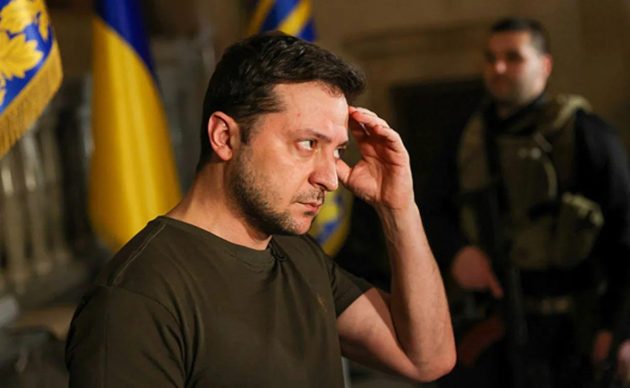
By Lucas Leiroz | August 2, 2023
In an article recently published by Politico, it was said that Kiev already has a secret plan in case the Ukrainian president is assassinated. Although it is normal for countries at war to think about the possibility of their leaders dying, the way that media is reporting the case suggests a kind of attempt to prepare public opinion for Zelensky’s replacement.
The report was based on interviews with Ukrainian officials and analysts. The sources believe that it will be necessary to circumvent Ukrainian constitutional norms if there is a need to replace Zelensky. The country’s constitution declares that if the president is no longer able to fulfill his duties, the head of parliament must ascend to the office. However, the current parliamentary leader, Ruslan Stefanchuck, is an unpopular public figure, with only 40% approval, which is why it would be inappropriate to appoint him president.
To handle this situation, Kiev plans to create a team of officials, forming a governing council. The office would consist of people like Andrey Yermak, head of the presidential cabinet, Foreign Minister Dmitry Kuleba, Defense Minister Aleksey Reznikov and Ukraine’s military chief Valery Zaluzhny. Stefanchuk would be the formal leader of the group, but decision-making power would be shared with the other officers.
Informants argue that Ukraine achieved high levels of national unity during the conflict. This “unity” supposedly gave stability to the state, guaranteeing an institutional security independent of Zelensky or any individual politician. For this reason, in the current scenario no Ukrainian officer seems “indispensable”.
“(…) I don’t think it [Stefanchuck’s popularity] matters. There’s a strong leadership team and I think we would see collective government (…) The country has reached a point of very substantial solidarity and national unity, so if something terrible happened to Zelensky it would not be as decisive as you might think (…) I don’t want to say that Zelensky is hardly irrelevant to this (…) But I think the country’s unity is the indispensable thing”, Adrian Karatnycky, “a nonresident senior fellow with the Atlantic Council”, told Politico’s journalists.
In fact, this report leaves a series of unanswered questions. It does not seem surprising that Kiev actually has such plans, as certainly Ukrainian institutional security is a priority for the regime’s officials, especially in times of war. What seems unlikely is that these plans are easily accessible to journalists and public opinion.
Being a sensitive topic, relevant to national security, it is most appropriate that these discussions be taken in absolute confidentiality, with no possibility of information leaks. Discretion becomes even more necessary when these plans involve maneuvers to circumvent the constitution, violating the laws of the country.
So, it is necessary to think about what would be the interests of the Western media in spreading this type of information. It is possible, for example, that news agencies are trying to “prepare” global public opinion for an eventual replacement of Zelensky. There have been rumors for some time that NATO plans to remove the Ukrainian leader from power, given his discredited and deteriorated image. Zelensky is seen less and less as a “hero”, being classified by many as a “beggar” and a “loser“. Thus, putting a new politician in power could be beneficial to NATO’s plans to prolong the war, as it would generate more popular support in the West for the military assistance policies.
However, what is really curious is the fact that the article mentions the hypothesis of murder. This raises the possibility that Western intelligence is planning not only to replace but also to kill Zelensky. This would certainly be useful for the West to accuse Russia of having committed the crime, creating a false flag situation to move public opinion and justify new military measures in support of Kiev.
In the article, Politico reminds a series of recent requests made by Russian citizens calling for Zelensky’s elimination in retaliation for the terrorist attacks in Moscow and other Russian cities. Despite such requests being real, the Russian government has never shown an interest in doing so. These were just sincere expressions on the part of the Russian people, emotionally affected by the Ukrainian terror. No strategic guidelines to actually kill Zelensky were adopted.
The article, however, seems to want to show that Moscow has such a plan. Thus, western readers are prepared to have a preconceived opinion if future news confirms Zelensky’s death. This is a well-known psychological and informational warfare tactic used frequently by the West.
So far, the only side that has shown interest in replacing Zelensky has been the West itself, which wants to put in his place someone more competent to lead the regime. For Moscow, it is irrelevant who is in power in Kiev, Russian interest being only to force Ukraine to accept its peace terms, regardless of whether it is Zelensky.
Lucas Leiroz is an journalist, researcher at the Center for Geostrategic Studies, geopolitical consultant.
Vilnius Memo: Who’s Going to Bankroll This War?
By Martin Jay | Strategic Culture Foundation | August 1, 2023
Apparently it wasn’t Abert Einstein who said “The definition of insanity is doing the same thing over and over again, but expecting different results”. But we like to think it was, so it became a quotation attributed to him. How else to describe the West’s stalwart determination to impale itself further with the agony of the Ukraine war as we are led to believe that NATO and the U.S. are determined now to dig in for a long war. The belief is still upbeat, despite the huge anti-climax of Ukraine’s so-called “offensive” which didn’t even break through the Maginot Line which Russia has built along a 900-km fortified line.
The blinded dogma of NATO members at last month’s Vilnius Summit stems from being drunk on their own fake news which media dutifully pumps out each day from the propaganda factory in Kiev. There’s just so much of it, that it’s hardly surprising that Biden and his European lap dogs overconsume on it without looking at the hard facts. It isn’t simply that Ukraine “has run out of ammo” as Biden put it. It’s more than that. It’s that it has been proven over and over again that they don’t have the will, resources or rank ability to take on the Russian army and that sending more and more military hardware will only delay the inevitable loss. Or at least armistice which is bound to happen on an unofficial level at some point, if an official one can’t be signed.
Zelensky looked worried at the Vilnius conference. And it’s hardly surprising. Even when you look at the pledges made by western countries for military hardware, there’s no question that the speed of these deliveries and the actual quantity has radically dropped. So how can Ukraine or NATO believe that it can win the war, even in years to come? Fighting a war without ammunition is like baking bread without flour, after all.
The truth is that most western leaders already know that the time is up. They know that three key elections are going to play a huge role in putting the brakes on the campaign to continuously supply the Kiev cabal, who by some accounts, are buying 7 million euro villas in Cannes with the money which is being syphoned off. War is a racket after all and Ukraine is one of the most corrupt countries in the world. Should we be surprised that a government minister there has this kind of cash to blow on a wedding present for his offspring?
The three elections are of course the UK general election, The U.S. presidential elections and the European parliamentary elections. All three will take place at the end of 2024 and it will be the first time people will have a real opportunity to make a statement about the war and the abysmal hardship it is imposing on people in western countries. It’s as though Joe Biden knows also that it will be very hard for him to stand again as president when he has to explain why he has sent over 130 billion dollars of taxpayers’ money to a country that few Americans can even find on a map of the world.
Money matters. Finally, it matters. The argument on the American side that it doesn’t matter as it is being printed and given over to the industrial military complex has some validity, as this secures jobs and keeps these companies buoyant. But it’s public money. And so, rightfully, people will want to know why couldn’t the same money be spent on the very poor.
For the Europeans it’s very different. They pay a very high price for the Ukraine war and the folly of their governments who indulge themselves with the military aid like children gouging themselves on chocolate cake while the parents are away. Germany’s economy is flat broke. For the UK, homeowners are facing losing their house due to colossal mortgage rate hikes with an entire generation now unable to get on the housing ladder. How will these politicians explain this at the polls?
It really is about the money. NATO knows that it needs much more than just the miniscule offering of 2 % of GDP, which in reality only 11 NATO members adhere to. All western countries’ military stockpiles are depleted and so, not only do NATO and its members need to find trillions of dollars of new cash just to bring their stocks back up to what they were, but also trillions more for Ukraine. The numbers just don’t add up. Even on an EU level, Ursula von der Leyen, who is almost certainly going to be NATO secretary general, when her term as EU Commission president runs out in about a year, has her begging bowl out. She is hoping to raise 20 billion euros to be given to Ukraine over 4 years as military aid. For the Ukraine war, it is pretty meagre.
For the EU itself, there is no clear sign how she will get it when she is already asking member states to contribute 30 billion euros more to the budget to pay for another egregious scam of COVID vaccinations, which at one point she was being accused of having corrupt connections to, until colleagues managed to cover the scandal up. Europe not only has no cash or military kit left to offer Ukraine, it has serious financial problems to tackle of its own for its own elites to retain the power they wield. The only respite would have to be much more cash from the U.S. only which is probably not what Biden is planning on. The Europeans have paid too much. We are an empty Amazon warehouse with all the workers at the foodbank.
Journalist Slams Ukraine for Losing Swedish IFV by Putting It ‘Too Close to Front’
By Ilya Tsukanov – Sputnik – 01.08.2023
As the counteroffensive launched by Ukraine’s NATO-armed and trained armies continues to falter, a growing number of Western observers, officials and military commanders have criticized Kiev, suggesting that the latter’s “tactics,” rather than their equipment and support, are to blame for the counteroffensive’s failure.
A German journalist has taken to social media to vent his frustration over Kiev’s loss of a Combat Vehicle 90 (CV 90), an advanced, $10 million apiece Swedish-made infantry fighting vehicle that was recently captured by Russian forces as a trophy.
“The CV 90 was NOT lost during the counteroffensive, for which it was intended to be used, but after being split from the rest of the brigade and used (allegedly together with another CV 90) for isolated defensive purpose in the area of Chervonopopovka,” Bild contributor Julian Ropcke wrote.
“It moved to [sic] close to the front, came into a Russian ambush and was hit by an RPG from far too close. It was then towed to Russian-controlled territory. This is exactly what the German army criticized about Ukraine: 1. Using the provided vehicles for other purpose than required to operate successfully and 2. Dividing powerful brigades into isolated vulnerable platoons,” Ropcke added.
The CV 90, praised by many armchair military analysts as “one of the best IFVs in the world” thanks to its powerful protection, high mobility and multirole capabilities, is the latest piece of Western equipment delivered to Ukraine to fall into Russia’s hands. Dozens of videos and photos have been posted online in recent weeks of Russian troops posing alongside or operating trophy Leopard tanks, Bradley IFVs, M113 armored personnel carriers, and more.
As Ukraine’s counteroffensive approaches its two-month anniversary with little to show for it apart from tens of thousands of lost troops and hundreds of tanks and armored vehicles, a growing number of officials and observers in Western media have expressed frustration over Kiev’s “tactics.” It’s “just a matter of continuing to apply pressure in a combined-arms approach,” one US official recently assured, and not the fact that Kiev is outgunned and faces overwhelming Russian air and artillery superiority.
Ukraine’s use of heavy armor has been a matter of particular scrutiny, with reports emerging in July that the country’s military had pulled Leopard 2s from the front after they got stuck on mine fields in the first stage of the counteroffensive. Separate reports indicated that “up to 20 percent” of Kiev’s NATO-provided armor was destroyed in the first stage of the offensive. In the case of the British Challenger 2, the highly “pampered” tank has not been spotted anywhere on the front, with its appearance limited to flashy propaganda videos. When the decision to send the armored vehicles to Kiev was made in the spring, the British Army’s top brass reportedly pressured their Ukrainian counterparts to avoid deploying Challenger 2s to areas where they might risk capture or destruction by Russian forces.
US will spend on Ukraine more than it did on Marshall Plan after WWII
By Ahmed Adel | August 1, 2023
John Sopko, Inspector General of the United States Reconstruction Service in Afghanistan, said that the amount of money the US will spend by the end of 2023 will surpass the money spent on the entire Marshall Plan. He also highlighted how Ukraine is a country that is almost just as corrupt as Afghanistan.
“We are spending more money in Ukraine now in one year than we spent in about 12 years in Afghanistan, and by the end of this year, we will spend more money in Ukraine than we did to do the entire Marshall Plan after World War Two,” he warned, emphasising that he supported financial aid, but felt the need to make sure it was done “correctly and under supervision.”
Among the problems identified by Sopko when overseeing the cost of rebuilding Afghanistan was the lack of coordination of these efforts and a lack of understanding of the ultimate goal. He highlights that in the case of Ukraine, the situation is even more complicated as more parties are involved, such as US agencies and international donors and organisations. In addition, the expert also noted that both Afghanistan and Ukraine are deeply corrupt.
Most alarming, though, for US taxpayers is that Sopko revealed that Washington spends about $2.5 billion monthly on security assistance to Ukraine. In comparison, Washington only spent about $375 million monthly on security assistance to Afghanistan. Since February 2022, the Biden administration has committed more than $75 billion in various types of assistance to Ukraine, with nearly $50 billion spent on weapons and related military equipment.
Biden’s astronomical total spending in Ukraine will only significantly increase when considering that in July alone, the Ukrainian military lost 20,824 troops and 2,227 units of various weapons, including 10 Leopard tanks, 11 Bradley armoured vehicles and dozens of artillery pieces from the United Kingdom, United States, Germany, France, and Poland.
“It is obvious that the Western-manufactured arms supplies do not lead to successes on the battlefield, but only prolong the military conflict,” the Russian Ministry of Defence said in an announcement on July 31, adding that “against the backdrop of the failed so-called ‘counteroffensive,’ the Kiev regime, with the support of Western sponsors, has focused on carrying out terrorist attacks on civilian infrastructure in cities and towns in the Russian Federation.”
Seeing as the counteroffensive has been an utter and humiliating failure for Ukraine and its Western patrons, the Kiev regime has resorted to terrorist tactics against Russia, knowing well that such attacks only hurt citizens and do nothing to strengthen Ukraine’s war effort or deter the Russian military operation.
On the morning of August 1, Mayor of Moscow Sergey Sobyanin announced that Russian air defences shot down “several” drones targeting the Moscow region. This attack marks at least the fifth time drones have reached the Russian capital since May. Thankfully for the citizens of Moscow, two drones were destroyed by air defence systems and a third was jammed and crashed, resulting in no deaths or injuries.
In an attempt to show strength, but instead ended up revealing the truth about the desperate situation Kiev finds itself in despite having more money pumped in a year than 12 years in Afghanistan, Ukrainian president Volodymr Zelensky said on July 30 in his nightly address that the war was coming to Russia, i.e., terrorist attacks.
“Gradually, the war is returning to the territory of Russia – to its symbolic centres and military bases. This is an inevitable, natural, and absolutely fair process,” Zelensky said.
The wording of Zelensky’s announcement suggests that Ukraine is about to embark on a game-changing phase of the war. Instead, Ukraine will only conjure inconveniences for the Russian state and, sadly, some deaths and injuries to citizens. However, it will certainly not be anything that will swing the war in Ukraine’s favour.
Ukraine will likely lose significant drone capabilities as this will become a priority for Russia if terrorist attacks continue in such a manner. In fact, the Russian Ministry of Defence announced on July 31 that an assembly plant for drones in the Kharkov region intended for Ukrainian troops was destroyed.
At the same time, the Ministry of Defence of Ukraine and the Baykar Makina Turkish company recently announced that they agreed to build a repair and maintenance service centre for drones. The agreement to create a service centre for Turkish drones was signed within the framework of the intergovernmental agreement between Ukraine and Turkey about cooperation in the hi-tech, aircraft and space industries sector, which came into force in January 2023.
With Russia already demonstrating its willingness to destroy drone plants, there is little reason why the new Bayraktar centre in Ukraine will not be targeted if the Turkish drones are the reason for Russian deaths.
Nonetheless, despite Zelensky’s promise of bringing the war to Russia, terror attacks on Moscow will not deter the special military operation but will significantly weaken Ukraine’s drone capabilities as its destruction becomes a priority. Ukraine is already a financial blackhole for the West, as seen by the vast resources poured into the country, and the destruction of Ukraine’s drone capability will only add to its misery.
Ahmed Adel is a Cairo-based geopolitics and political economy researcher.
Ukraine Receives $1.25Bln in US Grant Funds for Paying Wages, Social Assistance
Sputnik – 31.07.2023
Ukraine has received a new grant from the United States worth $1.25 billion to reimburse state budget expenses, including wages for state employees and social benefits, the Ukrainian Finance Ministry said on Monday.
“The State Budget of Ukraine received a grant from the United States of America in the amount of USD 1.25 billion through the Multi-donor Trust Fund of the World Bank,” the ministry said in a statement.
The grant was provided as part of the fifth additional financing under the World Bank’s Public Expenditures for Administrative Capacity Endurance in Ukraine (PEACE in Ukraine) project, which seeks to partially cover state budget expenditures, including for social and humanitarian purposes.
“The involved grant funding will be aimed at reimbursing state budget expenditures, in particular, to pay wages for government employees and payments under certain state social assistance programs (IDPs [internally displaced persons], people with disabilities, low-income families and housing, utility subsidies) and other social payments,” the ministry said.
Ukraine has received $8.45 billion in US grants to support the state budget in 2023 alone, while as much as $20.4 billion has been disbursed since February 2022.
Last week, the chairwoman of the Ukrainian parliament’s budget committee, Roksolana Pidlasa, said the state budget received $25.3 billion from international partners in 2023, accounting for 49.1% of all state budget revenues.
Ukrainian Finance Minister Serhiy Marchenko said in May that the country’s budget has been running a deficit of about $5 billion a month since the military conflict began, with two-thirds of the money coming from foreign loans and grants and three-quarters spent on military needs.
The ‘Scandal Implosion’ Stratagem: Will It Work for Ukraine?
By Alastair Crooke | Strategic Culture Foundation | July 31, 2023
Biden: “Putin has already lost the war … Putin has a real problem: How does he move from here? What does he do?” Secretary Blinken repeats ad infinitum the same mantra: ‘Russia has lost’. So does the head of MI6, and Bill Burns, the head of CIA, opines, (replete with snide asides) at the Aspen Security Conference, that not only has Putin ‘lost’, but further, that Putin is failing to keep a hold on a fragmenting Russian state, entering upon a likely death-spiral disintegration.
What is going on? Some suggest a psychic disorder or groupthink has seized the White House Team, resulting in the formation of a pseudo-reality, severed from the world, but unobtrusively shaped around wider ideological ends.
The parroting of dubious narrative however, morphs for the informed world into seeming western delusion – the world as the ‘Team’ imagines it to be, or more to the point, would like it to be.
This tight parroting though is clearly no ‘coincidence’. A clutch of high officials speaking to script and in concert are not deluded. They are mounting a new narrative. The ‘Russia has lost’ mantra defines the mega-narrative that has been decided. It is the prelude to an intense ‘blame game’: Project Ukraine ‘is failing because the Ukrainians are not implementing the doctrines received from NATO trainers – yet despite this, the war has shown that Putin has ‘lost’ too: Russia too, is weakened’.
This is another exemplar of the current western fixation on the idea that ‘narratives win wars’, and that set-backs in the battle space are incidentals. What matters is to have a thread of unitary narrative articulated across the spectrum, asserting firmly that the Ukraine ‘episode’ now is closed and should be ‘book-ended’ by the demand that we all ‘move on’.
The gist of it is that ‘We’ control the narrative; us ‘winning’ and Russia losing, therefore, becomes inevitable. The flaw to this hubris is firstly that it puts the Administration ‘high priests’ at war with reality, and secondly, that the public long ago lost trust in mainstream media.
Jonathan Turley, a recognized legal scholar and Professor at Georgetown, who has written extensively in areas ranging from constitutional law to legal theory, draws attention to: “the last ditch effort of the members of Congress and the media to get the public to just ‘move on’ from the Biden corruption scandal”. The message, he writes, “is clear … Everybody needs to back off! … [However] as evidence and public interest increase, it is a bit late for spin or shiny objects”.
“This week, the scandal is likely to be even more serious for the Bidens and the country. The media is increasingly taking on the appearance of Leslie Nielsen in Naked Gun yelling that there is “nothing to see here” in front of a virtual apocalyptic scene of fire and destruction.”
What is the link to Ukraine? Well, a year ago, Professor Turley wrote that the political and media establishment would likely use a ‘scandal implosion’ approach to the corruption allegations as the evidence mounted. There would be an attempt to ‘cap off’ the scandal with Turley suggesting that the Justice Department would secure a ‘light plea’ by Hunter Biden on a couple of tax counts, with little or no jail time.
Well, that’s exactly what has occurred one year later. Then came the predicted ‘scandal implosion’: Hunter pleaded guilty to having delayed due tax payments – to a chorus of House members and the media shrugging off all other corruption allegations, and firmly declaring the scandal ‘closed’, together with the demand to “move on”. Turley notes however, “the media’s desire to “move on” from the scandal is reaching an almost frantic level, as millions in foreign payments and dozens of corporate shell companies are revealed – and incriminating emails are released”.
It is not clear that the stratagem will work. It is already in trouble.
The key elements to the ‘implosion stratagem’ are revealed as outright, unflinching denial that there is any ‘problem’ at all, and an obstinate refusal to concede even a scintilla to the notion of there being any type of failure. No need to look in the mirror.
This too was the modus operandi in respect to the Nordstream débacle (the destruction of the gas pipeline to Germany): Admit to nothing, and get the CIA to rustle up a ‘scandal implosion’ scenario. In this case, a nonsense diversionary story of a yacht with a few nefarious sub-aqua divers descending to 80-90 metres, without special equipment or using specialised gases, to lay and detonate explosive devices. No real investigation; ‘Nothing to see here’.
But as events in Germany indicate, the story is not believed; the coalition in Berlin is in deep trouble.
And now, the stratagem is being applied to Ukraine: The ‘Chorus’ cries out, ‘Putin has lost’, in spite of Ukraine messing up its chance to weaken Russia decisively. The hope is plain – that ‘Team Biden’ can steal away, undamaged, from devastating defeat, with ‘a scandal implosion’ mechanism already being primed (for after NATO’s summer ‘deadline’ to achieve a ‘win’):
‘We gave them everything – yet, the Ukrainians turned ‘their back’ on our expert advice for how to ‘win’ – and consequently have achieved nothing.
“Ukraine’s counter-offensive is failing to make progress because its army is not fully implementing training it has received from NATO, according to a leaked German intelligence assessment … Ukrainian soldiers trained by the West are showing “great learning success”; but they are let down by commanders who have not been through the [NATO] boot camps, it adds … the Ukrainian military favours promoting soldiers with combat experience, over those who have received NATO-standard instruction”.
Well, well? Like Afghanistan?
The war in Afghanistan was a sort of crucible, too. In very real terms, Afghanistan was turned into a testbed for every single innovation in NATO technocratic project management – with each innovation heralded as precursor to a game-changing future. Funds poured in; buildings were thrown up; and an army of globalised technocrats arrived to oversee the process. Big data, AI and the real-time utilization of ever expanding sets of technical surveillance and reconnaissance were to topple old ‘stodgy’ military doctrines. It was to be a showcase for technical managerialism. It presumed that a properly technical and scientific way of war clearly would prevail.
But technocracy as the only means of constructing a functional NATO-style military birthed instead, in Afghanistan, something thoroughly rotten – “data-driven defeat”, as one U.S. Afghan veteran described it, that it collapsed in a matter of days. In Ukraine, its forces were caught between Scylla and Charybdis: neither the armoured fist thrust taught by NATO to break the Russian defences, nor the alternative light infantry attacks were successful. Ukraine is suffering rather, a NATO-driven defeat.
Why then, opt to take reality ‘head-on’, with the snide insistence that Putin ‘has lost’? We do not, of course, know ‘the Team’s’ internal rationale. However, to open negotiations with Moscow in the hope of obtaining a ceasefire or a frozen conflict (to bolster the ‘Narrative’) would likely disclose a ‘Moscow’ as insistent only on Kiev’s full capitulation. And that would sit awkwardly with the ‘Putin losing story’.
Perhaps the calculus is to hope that between now and winter, public interest in Ukraine would have been so diverted by other events that the public might have ‘moved on’, and with blame clearly hung around the necks of Ukrainian Commanders showing “considerable deficiencies in leadership” which lead to “wrong and dangerous decisions” – by ignoring NATO-standard instruction.
Professor Turley concludes,
“None of this is going to work, of course. The public has lost trust in the media. Indeed, the “Let’s Go, Brandon” movement is as much a mocking of the media – as [it] is a targeting of Biden”. “Polls show that the public is not “moving on” [from the Hunter allegations] and now view this as a major scandal. A majority believes that Hunter has received special protection in the investigation. While the media can continue to suppress the evidence and allegations within their own echo-chambered platforms – truth like water has a way of finding a way out”.
In effect, ‘events’ are marching forward – with or without the media.
And here is the crux: To the degree that Turley estimates the Biden affair constitutes a putative ‘apocalyptic site of domestic U.S. destruction’, so the West faces a yet more strategic defeat segueing out from its Ukraine project – for that defeat encompasses not just that of the Ukrainian battle-ground – It has destroyed the myth of NATO omnipotence. It has upended the story of ‘magical’ western weaponry. It has burst the image of western competence.
The stakes were never higher. Yet did the ruling-class think this through when they so lightly embarked on this ill-fated Ukraine ‘project’? Did the possibility of ‘failure’ even enter to their consciousness?
Russia has won the oil war
The West doesn’t seem too keen to enforce its $60 price cap on Russian crude
BY PÉTER G. FEHÉR | MAGYAR HÍRLAP | JULY 31, 2023
Moscow’s leadership may not have been cheering loudly, but they probably still celebrated quietly within the walls of the Kremlin. After all, Russia has won the oil war. The news has been widely reported among economists and even in Western press, but it cannot be said to have come as a surprise shock. Those involved in the global oil business knew that they could not win such a war against Russia.
The United States and the European Commission’s measures to reduce Russian energy exports aimed to produce problems for the Russian treasury by reducing its revenues. However, it seems that the punitive measures introduced without any impact assessment have been seriously misguided, especially on the part of the EU. Rather, the EU has punished itself by foregoing cheap Russian gas and being forced to buy expensive U.S. natural gas.
Strange as it may sound, the Brussels officials knew exactly that this would be the consequence of the sanctions they imposed. It is worth looking to Russia expert Christopher Davis, professor at Oxford University: Davis has claimed nothing less than that the European Commission only began to address the impact of the punitive measures after the sanctions against Russia were introduced. At that time, it produced a secret study that was not shared with EU citizens. It said that the decisions were taken too quickly and that they were taken under political pressure without any prior economic impact assessment. The EU thus did not look into the potential impacts of sanctions; it was in essence an abrupt and thoughtless decision.
Moscow, meanwhile, looked for other buyers of its black gold, which was also predictable, and China was one of the first to come forward. Moscow has now built infrastructure to handle the increased traffic between Russia and Asia. Before the war in Ukraine, China was buying 1.5 million barrels of oil a day from Russia. Today, it takes in 2.5 million barrels a day.
Now, publications such as the Wall Street Journal are acknowledging that Russia has achieved a real global victory in the oil wars. The price of the Russian Ural blend oil has for the first time exceeded the $60 cap per barrel imposed by the U.S. and its allies last December. Although this happened just last Thursday, there is no sign that anyone is willing to enforce the sanction.
It is now no longer a mere assumption that the EU and the U.S. have made spontaneous sanctions decisions against Russia with unforeseen consequences. It is understandable that the European Commission does not want to publicly admit the consequences of such clumsy measures.
The question has to be asked again, for the umpteenth time: Why are there no consequences for a disastrous decision taken by the European Commission that once again went over the heads of the member states without even consulting them?
***
Seven reasons why Russia dominates in Ukraine
By Drago Bosnic | July 31, 2023
There have been little to no at least somewhat objective assessments of Russia’s special military operation (SMO) in Ukraine, primarily due to the fact that our newsfeeds are being flooded with an ocean of ludicrous propaganda that only aims to portray Moscow’s forces as supposedly “weak and ineffective”. Everyone from tabloids and YouTube “experts” to reputable (or rather once reputable) media keep parroting the same narrative – “Russia is losing“. However, is that the case? Here are seven reasons why that’s not only patently false, but quite the opposite, it couldn’t possibly be further from true.
Unrivaled command and control
The Russian Armed Forces, as one of the largest and most powerful on the planet, are a massive and complex system. And yet, this system is characterized by centralized control that allows the Russian High Command to respond to changes on both tactical and strategic levels in a timely and adequate manner. The Eurasian giant’s military has massive reserves that are orders of magnitude greater than the forces deployed on the frontlines. These can easily be relocated to areas that need to be reinforced while also providing additional assault troops that can be inserted in areas where the enemy’s defenses are the weakest.
Perhaps the best example of this is the recent advance of Russian troops in northern Donbass and the border areas between the LNR (Lugansk People’s Republic) and the Kharkov oblast (region), where Moscow’s forces have been on the offensive for over two weeks. Despite the fact that the now heavily battered Kiev regime troops have constantly been losing ground in this area, there’s been virtually no mention of this in any of the mainstream propaganda outlets. In the meantime, the Neo-Nazi junta’s best forces are wasting their last battlefield reserves in futile attacks on the intricate and dense Russian defenses in the Donbass, Zaporozhye and Kherson oblasts.
And while the mainstream propaganda machine keeps denigrating the Russian military, behind the scenes, the Pentagon meticulously observes Russia’s advanced experience in organizing command and control systems and how it can use it to improve its own. Moscow’s ability to lead multiple high-intensity military operations simultaneously while coordinating all this with the rest of Russia’s massive state apparatus (particularly its world-class diplomacy) is of great interest to power circles in Washington DC. In stark contrast, the United States military is experiencing an unraveling of sorts due to issues with over-politicization and ideology.
Massively improved ISR (intelligence, surveillance, reconnaissance)
In years before the SMO, the Russian military wasn’t exactly known for the widespread use of drones and other unmanned platforms, as the mainstream propaganda machine kept presenting Moscow’s forces as supposedly “technologically inferior”. Still, years before the SMO, particularly during its antiterrorist intervention in Syria, the Kremlin invested significant resources in various kinds of unmanned systems. The Russian military then used this experience to massively improve its tactical capabilities, an effort that has exponentially amplified its performance everywhere. This is particularly true for the SMO, as drones have been an unrivaled force multiplier for Russian forces.
And while the Kiev regime forces are vastly superior to NATO-backed terrorists in Syria and elsewhere, and despite the fact that the belligerent alliance is providing them with unprecedented amounts of real-time battlefield information, for the most part, they’ve been unable to capitalize on this massive boost. Although tactical ISR by the Neo-Nazi junta troops is greatly augmented by NATO’s strategic one, better results on a larger scale have been sorely lacking. In contrast, the Russian military’s land, air and space-based ISR platforms have been used to a deadly effect, inflicting irretrievable losses on both enemy frontline troops, as well as its rear.
A unique combination of active defense and ad hoc (counter)offensive operations
Although doctrinally offensive-oriented, the Russian military certainly doesn’t neglect its defenses. On the contrary, it’s using its tactical defensive potential for strategic offensive purposes. The speed with which Moscow’s forces have been able to build up massive and complex defensive lines where there were none before has left NATO military experts baffled. The Soviet concepts of “defense in depth” and “active defense” have been greatly improved by the Russian military’s recent technological advances. This has resulted in nearly complete obliteration of the Kiev regime’s offensive potential, forcing it to use desperate tactics to try and break through Russian lines.
Needless to say, this is causing massive casualties in the process, as the Neo-Nazi junta forces are losing hundreds of men for every square kilometer of territory they take. However, the real issue for Kiev is that it can’t hold these areas for long, as each one effectively acts as an artillery “mousetrap”. Namely, as soon as the Kiev regime forces move in to secure the area, they’re pounded by a massive barrage of regular and rocket artillery, followed by a swarm of various types of drones that pick off any survivors. In addition, the masterful use of mines (particularly through remote mining) by Russian forces has been unequivocally devastating for any offensive operations.
This is particularly true in the Zaporozhye sector, where the Neo-Nazi junta forces continue to suffer massive casualties. Ever since the initial stages of their much-touted counteroffensive, these forces have experienced losses of over 30%, both in manpower and weaponry without ever seeing enemy combatants or even reaching the first line of Russian defenses. This has resulted in little to no losses for Moscow’s forces, particularly when considering the scale of military operations. Even the Chairman of the Joint Chiefs of Staff of the US Armed Forces, General Mark Milley, was forced to admit that the Pentagon is stunned by the effectiveness of these defense lines.
The high morale of Russian forces
The way that Russian defenses are able to hold has a devastating effect on the morale of Kiev regime forces while boosting their own. During the planning phase, the Neo-Nazi junta and their NATO handlers were confident that it would be easy to break through Russian defenses due to their supposed “low morale”. However, the reality on the battlefield shows that such assertions are wholly limited to the mainstream propaganda machine’s “parallel universe” in which even goats and old ladies “armed” with pickle jars are “beating the Russian military”. Still, unlike the mythical “massive Russian casualties”, such miscalculations have resulted in very real losses for Kiev.
Disorder, insubordination and inadequate coordination among Kiev regime forces
All of the aforementioned issues are virtually omnipresent in the ranks of the Neo-Nazi junta forces, as well as the numerous NATO-sourced mercenary groups. As the commanding cadre often sends troops to certain (and pointless) death, military personnel often ignore orders or outright refuse to follow them. Officers usually remain hidden in trenches or are even completely absent from the frontlines. This results in widespread frustration among soldiers, many (if not most) of whom are forcibly conscripted, which further leads to the low authority of the officers. This has also been confirmed by numerous foreign mercenaries fighting on the side of the Neo-Nazi junta.
Namely, in an interview for ABC, an Australian national known by the call sign “Bush” complained about the lack of necessary command and leadership skills among officers of the Kiev regime forces. According to his assessment, this issue has led to the deaths of both regular soldiers and foreign mercenaries. In addition, these men are often not following even basic orders, such as the complete ban on the use of smartphones on the battlefield. This offense is very common among soldiers and mercenaries alike, despite the fact that it’s virtually a death sentence in an era of warfare where SIGINT (signals intelligence) is an integral part of any meaningful military operation.
Top-notch training and combat experience
The level of combat experience and training on both sides of the conflict is high, but differs significantly. While the conflict in the Donbass region has been going on for nearly a decade now, between late 2015 and late 2021, it was relatively low-level as the frontline stabilized and was mostly limited to artillery duels (although the shelling of Donbass never stopped). This has resulted in a largely superficial combat experience for most Kiev regime soldiers. On the other hand, the Russian military has accumulated significant combat experience in Chechnya, Georgia and Syria, where it had the chance to conduct complex operations against various opponents.
No amount of no matter how advanced NATO-sourced weapons and endless forced mobilization waves could’ve ever given the Neo-Nazi junta the necessary combat experience to adequately face Russian forces. This primarily refers to the strategic aspect of warfare, a field which Russian officers have been able to master as their military can deploy to virtually any point anywhere in the world, on-demand, and then set up strategically important military bases, even on an ad hoc basis. Syria is perhaps the best example of this, as demonstrated by Russian bases in Tartus (previously a small naval facility) and Khmeimim (an airbase established in 2015).
Vast technological superiority
Despite all the propaganda fantasies of NATO-supplied SAM (surface-to-air missile) systems shooting down Russian hypersonic weapons, even Western military experts are forced to recognize Moscow’s superiority in a plethora of long-range, high-precision weapons. In this regard, Russia’s absolute dominance in hypersonic technologies is just the icing on the cake, as the Kremlin boasts a no less impressive arsenal of more conventional strike capabilities that include (but are not limited to) various supersonic, transonic and hybrid land and sea-based cruise missiles, tactical ballistic missile systems, numerous types of kamikaze drones/loitering munitions, etc.
The latter have been used to a devastating effect, neutralizing thousands of Kiev regime’s artillery pieces, including hundreds of US-supplied M777 howitzers. ZALA’s “Lancet” and “Kub-BLA” have been particularly deadly in this regard, in addition to the mass usage of various types of FPV (first-person view) drones. Apart from these, the performance of Russian combat vehicles has vastly outmatched any NATO-supplied equivalents, regardless of how new and modern. In fact, even Soviet-era tanks and armored vehicles have proven to be superior to virtually any new Western vehicle in the same class, be it in the service of Moscow’s or Kiev’s forces.
Newer Russian tanks such as the T-72B3M, T-80BVM, T-90A and T-90M (as well as numerous types of armored vehicles), have all demonstrated stellar performance in comparison to the best NATO armor, particularly the now deeply troubled German “Leopard 2” tanks, including the latest A6 variant. The Neo-Nazi junta’s “wunderwaffen”, used in its abortive attempt to conduct a “blitzkrieg” counteroffensive, have been effectively useless. The combination of the use of all of the aforementioned assets (in addition to its unrivaled attack helicopters) has made it possible for Moscow to comfortably break wave after wave of Kiev regime attacks.
Drago Bosnic is an independent geopolitical and military analyst.
Qatar to provide Ukraine $100mln as war profits soar
The Cradle | July 29, 2023
Qatar will provide Ukraine with $100 million in humanitarian aid, Ukrainian Prime Minister Denys Shmyhal announced on 28 July following the visit of Qatari Prime Minister Sheikh Mohammed Bin Abdulrahman Al-Thani to Kiev.
“This money will be channeled for reconstruction in the health and education sectors, humanitarian de-mining, and other important social and humanitarian projects,” Shmyhal told a briefing.
Sheikh Mohammad also met with Ukrainian President Volodymyr Zelensky to discuss global food security and the expired Black Sea grain deal in his first visit to Ukraine since the start of the war with Russia last year.
“We appreciate this visit and consider it an important manifestation of Qatar’s support and solidarity with our country. We are sincerely grateful for all the assistance received from Qatar,” Zelensky said.
The grain deal, brokered by Turkiye and the UN in July 2022, ensured that Ukrainian grain could still be exported from its southern Black Sea ports, despite the fighting and that Russian grain and fertilizers could still be exported despite western-imposed sanctions.
The deal came amid fears that a disruption in Russian and Ukrainian grain exports would cause price increases in world food markets, leading to humanitarian disasters in poor countries.
Russia withdrew from the agreement on July 17, claiming Ukraine and the UN had not lived up to their end of the deal.
Sheikh Mohammad and Zelensky’s talks also focused on the Ukrainian Peace Formula and the Ukraine Recovery Plan. Zelensky emphasized the opportunities for Qatari investment funds and business circles to participate in Ukrainian reconstruction, according to the Office of the Presidency of Ukraine.
Qatar has benefited significantly from the war in Ukraine. US and EU sanctions cut off Russian natural gas supplies to Europe, causing prices to skyrocket and allowing Qatar to emerge as an important alternative natural gas supplier.
In late November, QatarEnergy and ConocoPhillips signed agreements to export 2 million tons of liquified natural gas yearly to Germany for at least 15 years, starting in 2026.
Europe’s newfound need for Qatari liquefied natural gas comes after Qatar started a $30 billion project to boost its exports by 60 percent by 2027.
Before the start of the Ukraine war, some analysts doubted there would be enough natural gas demand to justify the expansion plan, Bloomberg noted.
Featured Video

Death Spikes & Rising Cancer In Our Youth Explained
or go to
Aletho News Archives – Video-Images
From the Archives
Politicians lie
By Mazin Qumsiyeh | Popular Resistance | August 18, 2013
There is no way to say this truth nicely: Politicians lie. That includes Japanese, American, Egyptian, Israeli, and Palestinian politicians! Is there something more common sense than that? Yet, so many citizens around the world believe their own politicians or wistfully acknowledge lies but think it is part of the job needed to run things. They believe even when politicians contradict themselves blatantly. This phenomenon is rather remarkable. It is a dissonance and disconnect from reality that many seem oblivious to. It is very dangerous because it can lead to accepting rationales for going to war. These can be deadly wars that lead to millions of lives lost as happened in what was called World War 1 and WW2. Even when incredible and declassified evidence abound, politicians continue to lie and old mythologies refuse to die. Here are just a few of the countless lies told to us over the past few decades… continue
Blog Roll
 Aletho News
- Burnham’s UN debut… A masterclass in British disinformation
- Iran flights continue despite US aviation sanctions
- Global Tipping Points Lead the World Into a State of Entropy
- The day-after at the White House: USA and Xi Jinping
- The Geopolitical Balance in the Red Sea: The UAE Being Displaced by New Players
- Iraqi resistance group vows to stage airport sit-ins over Iran aerial blockade
- Turkish parliament to review Saudi-Pakistan defense pact next month
- DEATH SPIKES & RISING CANCER IN OUR YOUTH EXPLAINED
- Iran offers Trump deal before US election
- Merz regime wants ‘secret police’ – opposition
- If Americans Knew
- Deconstructing Netanyahu’s pants-on-fire UN rant – Daily Update
- Trump betrayed voters with his campaign lies and prioritized a foreign country once he took office
- Netanyahu calls Israel’s war in Gaza ‘opposite of genocide’ in UN speech to near-empty hall
- Settler Kidnappings: Torture, Sexual Abuse and Terrorisation of Palestinian Abductees as Israel Deepens Annexation of West Bank
- Gaza winter nears as 162,000 tents become unusable, raising fears of humanitarian crisis
- Netanyahu says, “It’s the opposite of genocide”; UN says Gaza economy is world’s ‘most severe crisis on record’ – Daily Update
- Israel’s US-Backed Assault on Gaza Has Created the ‘World’s Most Severe Economic Crisis on Record’: UN
- ‘Protecting U.S. Citizens’… From Israel
- ‘This is where I live now, the back of a truck’: a day in the life of a grandmother in Gaza
- In UN Speech, Iran’s President Displays Pictures of Children Killed by US, Brings Attention to Israel’s Nuclear Arsenal
- No Tricks Zone
- New Study: Earth And Venus Surface Warmth Largely Explained By Convection And Lapse Rate, Not CO2 Or Radiation
- 2025 Nature Paper Claiming Worsening Global Drought Gets RETRACTED …Heavily Flawed
- New Study: ‘Global Drought Shows No Detectable Recent Acceleration Under Climate Warming’
- Economic Masterminds: German Socialists Suggest Taxing Productivity Gains Stemming From Using AI
- The South China Sea Has Not Been Cooperating With The Climate Change Narrative
- Energy Crisis: Germany Enters Heating Season With Historically Low Gas Reserve Fill Levels
- New Study: The Antarctic Ice Sheet Gained Mass From 2020-2024 Due To Staggering Snow And Ice Accumulation
- Study: Ocean Heating Rates From Thousands Of Years Ago ‘Dwarf’ Modern Ocean Heating Rates
- Climate Extremists Target, Attack Large-Scale Power Grid Infrastructure In Germany!
- New Study: Antarctic Ice Melt Has Contributed Less Than 1 Centimeter To Sea Level Rise In The Last 30 Years

