
MOSCOW – Weapon supplies to Ukraine free-of-charge by NATO countries makes them an accomplice, albeit indirectly, to crimes committed by Kiev against civilians in the regions that broke away from it in the east, Russian President Vladimir Putin said on Sunday.
“It is not a simple military cooperation, as they [NATO countries] do not get money in return. They are unilaterally supplying weapons [to Ukraine], which means that they are involved — at least indirectly — in the crimes committed by the Kiev regime, including the shelling of residential areas in Novorossiya and Donetsk,” Putin said on national television.
The president also said that Russia should keep an eye on NATO member states’ nuclear potentials because the alliance had declared a strategic defeat of Russia as its main goal.
Western countries have been supplying Ukraine with various types of weapon systems, including air defense missiles, multiple launch rocket systems, tanks, self-propelled artillery, and anti-aircraft guns since Russia launched its special military operation in Ukraine a year ago.
February 26, 2023
Posted by aletho |
Timeless or most popular, War Crimes | NATO, Russia, Ukraine |
Leave a comment
Most observers are convinced that the Russian-NATO proxy war in Ukraine will be a protracted struggle due to each side’s polar opposite envisaged end game in this conflict, yet China actually has a decent chance of negotiating a Russian-Ukrainian ceasefire after the positive reaction to its official peace plan. It was expected that Moscow would praise Beijing’s pragmatic 12-step proposal yet few could have foreseen that Kiev would also be interested in it too.
Zelensky reacted by saying that “China started talking about Ukraine, and I think this is a good thing. But it actually begs the question, what will these words be followed with? The steps next are important”, after which he announced that he has plans to meet with Chinese President Xi in the coming future. Approximately 24 hours later, his Belarusian counterpart Lukashenko disclosed that he’ll be traveling to the People’s Republic on a state visit from 28 February-2 March.
It can’t be known for sure, but it compellingly appears as though he’ll discuss reviving the peace talks that his country hosted last spring but which were ultimately sabotaged by the UK at the US’ behest. Should that be the partial purpose behind his trip at this particular point in time, it would likely then be the case that President Xi might soon visit Eastern Europe in an attempt to personally encourage his Russian and Ukrainian counterparts to resume this process or at least reach a ceasefire.
The Chinese leader was invited by President Putin late last year to visit Russia sometime this spring, and its top diplomat’s latest trip to Moscow last week was interpreted as paving the way for that event, especially after he met with his country’s host in the Kremlin. In light of Zelensky’s unexpected interest in China’s peace plan and his announcement that he intends to meet with President Xi, the latter would likely visit Kiev during the same regional sojourn and might also make a pit stop in Minsk too.
The fast-moving sequence of diplomatic events that followed the release of China’s peace plan on Friday – Russia’s praise of it, Zelensky’s unexpected interest, his announcement that he hopes to soon meet President Xi, and then Lukashenko’s trip to Beijing next week – extends credence to this prediction. The very fact that the Ukrainian leader didn’t dismiss it outright like his American counterpart and other Western ones did is worthy of explanation since it defied many observers’ predictions.
Zelensky might seriously be concerned about his Golden Billion patrons’ military-industrial reliability amidst the NATO chief’s belated admission that this de facto New Cold War bloc is in a “race of logistics”/”war of attrition” with Russia. In that scenario, it makes sense why he might intend to diversify from his near total dependence on its US leader by gradually engaging China, which is also occurring in the context of France, Germany, and the UK reportedly offering Ukraine a defense pact.
The Wall Street Journal (WSJ) broke the story on Friday, which was the one-year anniversary of Russia’s special operation and the same day that the previously mentioned sequence of diplomatic events began rapidly unfolding. This adds another dimension to everything since that development could serve as a compromise for allaying Kiev’s fears, both in the substantive but also soft power sense, that seriously exploring a ceasefire would amount to a tacit admission of defeat that’ll only embolden Moscow.
Europe has been the second-most directly affected party to the Ukrainian Conflict other than the former Soviet Republic itself within which this Russian-NATO proxy war is being fought so there’s a certain logic to its three most powerful countries coordinating their own possible peace plan. The US successfully reasserted its unipolar hegemony over the EU at the expense of the bloc’s objective interests, but while the UK immediately benefited from this, it too risks blowback over the long-term.
The combination of the collective Franco-German-British security pact with Kiev and China’s peace proposal could create the optics required for Zelensky to comparatively climb down from his absolutist-maximalist demands of Russia with a view towards pragmatically negotiating a ceasefire. Of course, this probably wouldn’t happen until both their reportedly planned offensives have been launched and there’s more clarity about their success or lack thereof, but it appears to be a credible scenario.
In that event, the Ukrainian leader might remain reluctant to recognize the ground realities that Russia demands as the condition for resuming the peace process, but President Xi’s diplomatic intervention in the coming future, should he ultimately visit Kiev, could greatly increase the chances of a ceasefire. He wouldn’t meet with Zelensky just for a photo-op, especially since the Chinese leader has only traveled abroad on three occasions and only in just the last half-year since the pandemic began three years ago.
The only reason why President Xi would visit Kiev to meet with Zelensky is if the latter is serious about there being a tangible outcome to this trip in terms of de-escalating his country’s conflict with Russia. The Ukrainian leader’s interest in China’s peace plan and the announcement that he plans to meet with his counterpart, which occurred against the backdrop of a reportedly proposed collective Franco-German-British security pact to Kiev and Lukashenko’s upcoming trip to Beijing, makes this possible.
To be clear, no prediction is being put forth confidently stating that this fast-moving sequence of diplomatic developments will successfully result in a Russian-Ukrainian ceasefire, but just that it nevertheless can’t be ruled out right now for the reasons that were explained. A lot can still happen and the US can always attempt to sabotage this process, which it’ll likely try to do (potentially even via a false-flag provocation) if a breakthrough appears imminent, so nobody should get their hopes up.
February 25, 2023
Posted by aletho |
Aletho News | China, Russia, Ukraine |
Leave a comment
Immediately after the start of Russia’s military operation in Ukraine, key players in the coalition supporting Ukraine, as well as transatlantic financial institutions and think tanks, were already discussing the governance and financing of Ukraine’s reconstruction. They invariably framed it as a historic opportunity for the country: like a phoenix rising from the ashes, Ukraine would become a beacon of freedom, democracy and rule-of-law, a testimonial for Build Back Better, a “green and digital economy” success story; the country would leapfrog several stages of economic and governmental development and its economic growth would replicate Germany’s post-war boom. Unsurprisingly, the more recent and far less inspiring examples of Western-led ‘reconstruction’ in Iraq, Libya and Afghanistan didn’t earn mention.
The speed with which fantastical narratives of recovery and reconstruction were churned out shouldn’t surprise anyone because they had been concocted years earlier as part of several ‘reform plans’ for Ukraine. One could say they are hardwired into the overall strategy of this proxy war against Russia as they are aimed at securing political, military and financial support for Ukraine to prolong the war rather than an incentive to negotiate peace. All those who produce these narratives are directly or indirectly linked to governments that are involved both in the destruction of Ukraine and the Ukrainization of Europe, a process designed to fully control, militarize and loot the Old World.
Paying lip service to the idea of reconstruction is also the best way to distract attention from one’s investment in the business of war. For example, JPMorgan Investment Management owns more than $2.5 billion worth of Raytheon stocks and more than $1.3 billion worth of Northrop Grumman and General Dynamics securities, as of February 15. As long as Ukraine keeps consuming U.S. military products, the rising profits for arms companies – satisfies investment funds. And rich corruption in the U.S., EU and Ukraine. As long as Ukraine is of any interest in terms of consumption of U.S. military products, there will be no peace on its territory.
There is little doubt that Ukraine will need rebuilding once the war eventually ends, but ‘destruction’ and ‘reconstruction’ mean different things to different people.
For instance, there is strong disagreement as to what constitutes ‘destruction’, when the ‘destruction’ of Ukraine started and who should be blamed for it.
Those who have been following Ukrainian affairs without ideological prejudice, and with a modicum of intellectual honesty, know that at the time of the dissolution of the USSR, Ukraine was an economic powerhouse, the third industrial power of the Soviet Union after Russia and Belarus, and its breadbasket. The Soviet republic had aerospace, automobile and machine tool industries, well-developed mining, metallurgical and agricultural sectors, nuclear, oil refining and petrochemical plants, tourism and commercial infrastructures and the largest shipbuilding center in the USSR.
Since its independence in 1991, Ukraine’s GDP has lagged behind the level it reached in Soviet times, industry declined, and the population decreased by about 14.5 million people in 30 years due to emigration and the lowest birth rate in Europe. Ukraine has also become the third largest IMF debtor and Europe’s poorest country. These negative records cannot be blamed solely on Ukraine’s systemic and staggering corruption: the corrupt networks bleeding Ukraine are truly transnational. If the best way to rob a bank is to own one, then the best way to plunder a country is to control its elites. Which is exactly what Western kleptocratic networks have been doing for decades with the help of their local facilitators and enablers.
Ukraine was targeted by two U.S.-funded color revolutions that led to regime change and civil war, was wrestled away from its largest economic partner, Russia; its history was erased and rewritten while an artificial identity was manufactured and imposed on its population; neoliberal prescriptions destroyed its economic and social fabric and led to a neocolonial form of governance.
Though Ukraine joined Europe’s nefarious Eastern Partnership in 2009 and has been teeming with Western NGOs, economic and political advisers since its independence, the country’s indentured servitude and captivity to Western interests was cemented after the last Ukrainian government to object to the IMF’s harsh conditions – including steep budget cuts and a 40-percent increase in natural-gas bills – was overthrown by a U.S.-sponsored coup in 2014.
On 10 December, 2013, Ukrainian president Viktor Yanukovych stated that the conditions set by the IMF for loan approval were unacceptable: “I had a conversation with U.S. Vice President Joe Biden, who told me that the issue of the IMF loan has almost been solved, but I told him that if the conditions remained we did not need such loans“. He then broke off negotiations with the IMF and turned to Russia for financial assistance. It was the sensible thing to do, but cost him dearly. You can’t break the shackles of IMF debt with impunity, this lender of last resort not only imposes its usual shock therapy of austerity, deregulation, and privatization so that the vultures can swoop in, it also furthers and protects U.S. interests.
If those who destroyed a country are allowed to be involved in its reconstruction, then reconstruction will inevitably be just a point on the continuum of conquest, occupation and looting, but with better optics. Destruction produces that blank slate that has always been colonialism’s seductive promise, on that slate you can write your own rules: “To plunder, butcher, steal, these things they misname empire: they make a desolation and they call it peace”. Tacitus knew both the reality and the spin of Roman imperialism.
One can only wonder if those who talk about ‘reconstruction’, ‘recovery’, ‘reform’, ‘rules-based order’, ‘reset’ or whatever buzzword is fashionable at the moment are aware of the brutal reality or truly believe their own spin. In any case they promise a future utopia worth killing and dying for.
The capitalist, imperialist West has created its own eschatology, embedded in both the environmental and technological discourses. Thirty years ago, Cardinal Ratzinger, the future Pope Benedict XVI, had cautioned an audience in Prague, whose newborn democracy was teeming with promise and perils, about the difference between eschatology – understanding and belief in the “end,” i.e., eternal life – and utopia. Belief in the latter, which he defined simply as “the hope of a better world in the future,” had taken the place of eternal life across the West. Man’s hubris replaces eschatology with a self-made utopia which intends to fulfill man’s hopes. Constantly allured by newer technocratic abilities, the utopians end up sharing Tantalus’ fate, and are condemned to live in Hades, tormented with the sight of something desired but out of reach, teased by arousing expectations that are inevitably disappointed.
The more secular-minded may remember what Karl Marx wrote about the destructive (and self-destructive) tendencies inherent to capitalism. It’s by causing large-scale loss that it enables new wealth to be created. Wars and economic crises serve the purpose as they allow capitalism to start a new cycle of wealth creation for an ever-shrinking class of owners.
But the neoliberal capitalist system is fast running out of creative schemes to forestall its collapse and the old ones no longer deliver the desired results because they are predicated on rules and conditions set by the U.S., and the transnational institutions it controls. As U.S. power wanes, the global oligarchy that depends on it is faced with the choice of defending that power at any cost and against all odds, or seeking an arrangement with emerging powers, an option that would not only reduce its sway and outrageous profits, but also accelerate U.S. decline. Since World War II, U.S. influence over the global economy and military power have been intertwined and losing one would precipitate the loss of the other. The engine of world economic growth has moved to Asia, with China in a leading position, and the U.S. has chosen to tighten the grip on its vassals, double down on its hegemonic ambitions and indulge in grandiose, and dangerous, fantasies rather than accept the emergence of a multipolar reality. Since fantasies cannot deliver real growth, let alone prosperity, the Empire invests a considerable part of its resources in colonizing minds and policing narratives. The job of those who are simultaneously planning ‘destruction’ and ‘reconstruction’ is to reduce the cognitive dissonance between the present misery and picture-perfect manifestos of a bright future.
Selling a war requires all hands on deck, and that’s why think tanks and marketing specialists have been involved from the early stages. They churn out narratives that help shape the discursive space, engineer a perception of global support for Ukraine, provide talking points, and versions of the truth, to both politicians and the media. They have to motivate Ukrainians to keep fighting and European vassals to keep funding the war and arming Ukraine, no matter the cost to their economy.
If those who attended recovery conferences never talked about peace is also because the possibility of peace negotiations with Russia has been performatively and normatively excluded from the Western discourse. The last time Western leaders claimed they wanted peace in Ukraine, they were lying. As we now know, the Minsk Agreements were signed by Angela Merkel and François Holland only to win time for Kiev to prepare for war.
The EU was so committed to peace that in a truly Orwellian fashion, in 2021 established the European Peace Facility (EPF) to bankroll military operations, provide military equipment and training to unnamed “EU partners” – Ukraine couldn’t be openly mentioned yet. The fund, worth €5 billion, was financed outside the budget, for a period of seven years.
When in October 2022 Volodymyr Zelensky signed a bizarre decree prohibiting talks with the current Russian leadership he simply formalized something that had already become a dogma among his allies. Six months earlier, in April, Boris Johnson went to Kiev to pressure Zelensky to cut off peace negotiations with Russia, because the two sides appeared to have made some tenuous progress during talks in Istanbul. In March Denis Kireev, a member of the Ukraine delegation who had taken part in the February peace talks in Belarus, was shot dead by his country’s security service. Israeli PM Naftali Bennet, who had also attempted to mediate a peace deal between Russia and Ukraine, revealed how the Anglo-Americans, with Boris Johnson in the role of chief bully again, blocked his efforts.
Peace advocates, including Roger Waters, Pink Floyd’s former frontman, were added to the infamous Myrotvorets online [assassination] database. Those who profit from war and want to see Russia weakened would stop at nothing to prevent peace talks. While Europeans are grappling with the ever growing cost of an American proxy war in their continent, they need a compensatory fantasy to support the absurd notion that a peace settlement in Ukraine would threaten their security and not be in their best interests. Narratives of reconstruction, seamlessly woven into delusions of Ukraine’s victory from the start, allow the transnational party of war to present itself as a force for good and a driver of future growth.
The reconstruction marketeers have aggressively tried to occupy the moral high ground by evicting the peacemakers and to do so they had to bolster the argument that war couldn’t be prevented nor stopped.
In March 2022, less than a month since Russian troops had crossed the Ukrainian border, the Center for Strategic and International Studies (CSIS), one of the U.S. military-industrial-intelligence complex’s favorite think tanks, published a bizarre article titled “Rebuilding Ukraine after the War”. Its author compared the destruction of Ukraine’s infrastructure to a “natural” disaster such as the hurricane that destroyed Puerto Rico in 2017 and argued that reconstruction would provide an opportunity “to improve on the past”, paving the way for a radiant future, a techno-utopia as orderly, clean and green as an architectural rendition.
Framing war as a “natural disaster”, as opposed to a man-made one, would allow those who militarized Ukraine and sabotaged all peace agreements, to pre-empt any serious discussion about the causes of, and possible solutions to this conflict. If the war in Ukraine was as sudden and inevitable as a hurricane then it would be pointless to seek an explanation for it other than “Putin is mad/bloodthirsty/evil…” or “Russia is an imperialist country”.
The ensuing devastation was also framed as the result of Russian forces’ congenital appetite for wanton destruction – in the West Nazi tropes are back in fashion and Russian soldiers can be described as “barbaric Asiatic hordes” with total impunity. Western media ensured that their public would never hear about the role played in the destruction of residential districts by Ukrainian nationalists who set up firing positions, deploy armored vehicles, conceal artillery pieces and MLRS in densely populated areas and use civilians as human shields. Hardly natural. Even less natural was the outbreak of this war, unless you consider NATO’s expansion and U.S. geopolitical goals as part of a divine plan. Mind you, some do and call it “manifest destiny”.
CSIS put forward arguments and plans that would later be expanded at conferences about Ukraine reconstruction. “Thinking about recovery means envisioning a post-conflict future, and that links to the twin messages of hope and the necessity to keep fighting.” The twin messages, constantly amplified by Western-controlled media, are mainly addressed to those who need to be reassured that they stand to benefit from the escalation of this conflict, regardless of the huge losses they are currently incurring. And that includes a multitude of stakeholders, both in NATO countries and in Ukraine.
There have been several antecedents to recent conferences in which representatives of Western governments, financial institutions and corporations discussed ways to keep Ukraine fighting “to the last man” while baiting it with promises of reforms and reconstruction, but one stands out as a direct progenitor. It had all the hallmarks of a British influence operation.
On July 6, 2017 the UK Foreign Office headed by Boris Johnson organized and hosted the first Ukraine Reform Conference in London. Ukrainians, notorious “friends of UK/raine” such as Christya Freeland and other rabid Anglophile Russophobes, many hailing from the Baltics, would outnumber less invested participants, expose them to their extremist views in order to facilitate their radicalization and recruitment. The power of conformity, suggestibility and normative social influence would ensure that participants who had previously held moderate views would gravitate towards the extremist opinion of the majority.
The alleged purpose of this conference was to seek political and financial support for Ukraine’s 2020 Reform Plan, a neoliberal roadmap designed to create a more profitable and less unpredictable environment for Western corporate interests while priming the Ukrainian population and army for war. This medium-term Reform Plan defined the main objectives and areas of the Ukrainian Government activity for 2017-2020 and formed the basis for the strategic plans of ministries and other executive bodies. It was predicated on privatization of state-owned enterprises, deregulation, judicial reform, amendments to the labor law, land market reforms, decentralization, forced de-Russification, patriotic education, transformation of the armed forces into a “modern and effective army in line with NATO standards” by increasing its military spending to 6% of GDP, integration into the European political, economic and legal space. In short, this was a roadmap for the complete hijacking of Ukraine’s economic, political, and social institutions, the demolition of what stood in its way, and further militarization of the country.
The conference also served other purposes. The main proponents of Anglo-American eastward expansion, who are deeply invested in Ukraine, after the election of Donald Trump couldn’t fully rely on the U.S. government to further their agenda: Trump’s “America First” foreign policy had strained relations with NATO allies and frozen military aid to Ukraine – arms sales were ok, freebies not so much. London was more than eager to pick up the mantle and ensure Ukraine stayed the course and remained on top of the transatlantic agenda. By taking the lead in coordinating and strategizing support for Ukraine, the UK government also saw an opportunity to strengthen British influence especially at a time when Brexit negotiations had just started and London feared losing its leverage in Europe. British elites were determined to put their country “at the beginning of the line” in the looting of Ukraine’s assets while salivating at the prospect of looting Russian assets too.
The gambit seemed to pay off: the following years attendance at the annual conference grew, including a larger number of representatives from the United States, NATO, OECD, G7 and European countries, OSCE, Council of Europe, IMF, European Investment Bank, European Bank for Reconstruction and Development, and the World Bank.
After Russia’s intervention in 2022, the “Ukraine Reform Conference” (URC) was quickly renamed “Ukraine Recovery Conference (URC). The continuity is striking: acronym, logo and corporate image remained exactly the same when in July 2022, the conference was held in Lugano, Switzerland.
Unsurprisingly, the Ukraine Recovery Conference in Lugano turned out to be little more than a PR stunt, featured a few squabbles among participants competing for their share in any future spoils of war, and provided an opportunity for Ukraine’s prime minister Denys Shmygal, supported by Liz Truss, to advocate the seizure of frozen Russian assets to fund his country’s reconstruction project. Shmygal’s call sent shivers down the spine of Swiss authorities, because not only would the confiscation of these assets violate and thus undermine international legal rules, it would also deal a mortal blow to Switzerland’s banking industry.
Brookings, the U.S. think tank that was deeply involved in the design and implementation of the original Marshall Plan for the post-war redevelopment of Western Europe, had to admit that the Lugano conference “was a missed opportunity because the donor countries did not come prepared with any agreement on coordination mechanisms, a division of labor, or necessary funding levels. In addition, the United States was not represented by officials with seniority commensurate to the European representation.”
A similar criticism was expressed by the German Marshall Fund of the United States, another U.S. think tank. GMF asserted that the European Commission has “neither the necessary political nor the financial heft” to lead reconstruction. And it advised against creating a new agency or centralized trust fund. Instead, it suggested that the G7 and Ukraine together appoint “an American of global stature” as recovery coordinator “because only the United States will be able to bring together the needed global coalition and forge consensus among Ukraine’s partners.”
The Anglo-Americans who need the EU to fund the war and masochistically support their geopolitical plans were disappointed that the richest EU countries would not cough up the amount of money they expected because in this scam Germany, France and Italy are the designated suckers. The con artists invest in the fraudulent scheme to give it an appearance of legitimacy and win the suckers’ confidence.
If Ukraine is the bait, Europe is the big fish and this crime syndicate would stop at nothing to achieve its goals: persuasion tactics can be escalated to involve some serious arm-twisting, as the Nord Stream sabotage clearly showed.
For all their pledges to help Ukraine “recover”, those who took part in “Recovery and Reconstruction” conferences seemed bound by an oath to never advocate for peace negotiations with Russia. Wouldn’t peace be a necessary condition for recovery? Well, it depends on what we mean by recovery. The main purpose of these conferences is to raise funds for Ukraine’s war chest, build a larger consensus on the seizure of Russian frozen assets, and instill enough hopes of a better future to convince Ukrainians and their partners that they should keep fighting regardless of the devastating human and economic losses they are incurring.
The London-based Centre for Economic Policy Research (CEPR) clearly spelled out this strategy in its Macroeconomics Policies for Wartime Ukraine, which outlined policies to “put the Ukrainian economy on a sustainable trajectory for the duration of the war”. The same policy became a dogma in Davos, where the WEF evil wizards agreed and emphasized the need to start reconstruction while the destruction is still ongoing, as that would drive Ukrainian refugees back home, that is to a place described as the “hell of war” in the same paragraph. “We have a moral obligation to nurture hope for these people and to help them stay strong as they go through the hell of war. Doing so will also encourage Ukrainian refugees to return to their homeland.” The cherry on the cake is the cynical reference to “inclusivity”, because no disability should exempt Ukrainians from contributing to war efforts, they too are called upon to fill positions vacated by the dead and those at the front. “Inclusivity is particularly important. Thousands of Ukrainians have already received long-lasting injuries (…) many of them will need to continue their life and work with disabilities.”
People, military and financial aid are all needed to ensure Ukraine retains enough strength not to collapse while it performs its designated role of proxy. That said, broadcasting donors’ pledges and the promise of foreign investments also serve a strategic purpose: it sends a message that Western countries form a compact bloc that will stick together no matter the cost, and to other nations that there are benefits to alignment with this bloc. All wishful thinking, of course.
With Ukrainian GDP expected to fall by more than 45%, budget expenditures doubling due to increased military spending as well as business and humanitarian support, budget deficit projected to reach more than USD 45 billion by the end of 2022 why would international investors be interested in what is de facto a failed state that is still at war?
Disaster capitalism feeds on shock, and war is the ultimate shock treatment. The privatization of profit and socialization of losses is its mantra and a heavily indebted country on its knees can’t prevent the outright sale of its assets. Rebuilding is never the primary purpose, it’s about reshaping everything. If anything, the stories of corruption and incompetence serve to mask a deeper scandal: the rise of a predatory form of disaster capitalism that uses the desperation and fear created by catastrophe to engage in radical social and economic engineering. After all, war-ravaged countries are in a state of limited sovereignty and any aid money that might pour in is often put in a trust fund, managed by foreign entities. The promise of Ukraine’s reconstruction by a parallel government made up of a familiar cast of for-profit consulting firms, engineering companies, mega-NGOs, foreign governments, international aid agencies and financial institutions would certainly make the prospect of Private-Public Partnership (PPP) attractive. But all this is predicated on Ukraine winning the war and remaining under Western control.
Betting on Ukraine’s victory is a high-odds bet, a very risky bet even for the regular gamblers of the vast casino known as the Western financial system. Yes, debt can be repackaged by lenders into creative securities backed by some pie-in-the sky and sold to global investors, a scam that would make the subprime mortgage crisis pale in comparison. Problem is, there isn’t as much liquidity around in Borrel’s European garden, nor in Biden’s land of the free for that matter. Prices and the cost of money have risen sharply, the market sentiment has slumped, recession is looming in Western countries whose financial system is broken beyond repair, but Western leaders, financiers and business moguls delude themselves they can simply talk up the global economy and resort to their old tricks. Their “everything is fine” message, as witnessed in Davos, is nothing more than one of those “confidence-boosting” exercises their minions practice in front of the mirror.
Attracting foreign investments is far from easy, as the Ukrainian Ministry of Finance has candidly admitted, though he believes that a PPP with BlackRock “can help raise capital even against the background of a bad investment reputation in the past (…) Obviously, private investors in the West will show much more trust in projects or a fund in which a world-renowned company plays some role. Even if it is consulting support. (…) Since investors often have a herd instinct, the option of creating a BlackRock investment fund to accumulate funds from private investors and finance Ukrainian projects is considered optimal”.
Officially, BlackRock’s cooperation with the Ukrainian government was formalized in the Memorandum of Understanding (MoU), which was signed in November 2022. Since then other Wall Street banksters have jumped on the bandwagon. This February, JP Morgan, the U.S.’s largest bank, also signed a MoU with Volodymyr Zelensky with the eye on attracting private capital for a new investment fund seeded with $20 billion to $30 billion in private capital. Jamie Dimon, JP Morgan’s CEO, called the consequences of the conflict in Ukraine “an inflection point for the Western world for a hundred years.”
Well, the decline of U.S. hegemony and the financial, corporate elites that feed on it (the “inflection point”, as Dimon called it) started well before February 2022. The end of U.S.-European domination of world capitalism is upon us as the center of gravity of the global economy shifts to China and the world is moving toward political multipolarity. Western elites are aware that the fraudulent, unequal system they owe their power to is cracking up, and the West’s mother-of-all financial bubbles is about to explode. All their hare-brained schemes are designed to increase debt, and therefore the enslavement of an ever-greater portion of humanity and have increased instability in the system. The COVID-19 pandemic and the Green New Deal were supposed to pave the way for “resetting and reshaping” the world, through the application of new digital technologies for a more regimented, technocratic and authoritarian control over the global population. But it has not gone as anticipated. Instead, the pandemic accelerated all the contradictions and crisis tendencies of financial capitalism. Ukraine, the greatest rock’n’roll swindle of all times might prove to be one hare-brained scheme too far.
For years the Fed, the Bank of England, and the European Central Bank have been printing money, but unbacked fiat currency is a Ponzi Scheme built on treachery and lies: its expansion is financed by the transfer of wealth from everyone for the supposed benefit of everyone… till it all ends in tears for most. Those who have made their fortunes by placing bets on the future, buying or selling options and all sorts of other recondite financial inventions might be lured by the promise of high returns, but many investors will join the pyramid scheme simply because their assets are managed by BlackRock, JP Morgan, Goldman Sachs etc. When the scheme finally collapses, they will be ruined, just like Ukraine.
February 24, 2023
Posted by aletho |
Economics, Militarism, Timeless or most popular | China, European Union, NATO, Russia, UK, Ukraine, United States |
Leave a comment

Senior officials at the US State Department are attempting to get the country “involved in another world war” with Russia, Arizona Congressman Paul Gosar tweeted on Friday. Gosar, Twitter CEO Elon Musk, and former president Donald Trump, have all named Victoria Nuland as the most dangerous among this group in recent days.
Responding to an RT article on Musk accusing Nuland of “pushing this war” in Ukraine, Gosar declared that the billionaire “is correct.”
“Both Nuland and Blinken have a deeply rooted irrational hatred of Russia, and they seek to get the US involved in another world war,” he continued. “These are dangerous fools who can get us all killed.”
In a follow-up tweet, Gosar wrote that “as a non-soldier, Nuland is quite willing to endorse violence and war.” The Republican lawmaker then quoted the article, which stated that Nuland had “endorsed regime change in Russia, celebrated the US’ destruction of the Nord Stream pipelines, and called for the indefinite flow of arms into Ukraine.”
As assistant secretary of state for European and Eurasian Affairs in 2014, Nuland was largely responsible for orchestrating the pro-Western coup that unseated democratically elected president Viktor Yanukovich. Nuland traveled to Kiev and promised military aid to the rioters, and was recorded plotting to install a successor to Yanukovich.
As Biden’s secretary of state, Blinken has promised to keep weapons flowing into Ukraine “for as long as it takes,” and advised Kiev in December not to seek the kind of negotiated settlement that would liken to a “phony peace.”
Gosar has been a persistent critic of the Biden administration’s Ukraine policy since Russia’s military operation began a year ago on Friday. However, although the Republican Party now controls the House of Representatives, there is little the Arizona congressman can do to change the administration’s course. A significant bipartisan majority supports continued military aid to Ukraine, with only 11 Republicans, Gosar included, sponsoring legislation that would cut funding for Kiev.
These Republicans are all allies of former president Donald Trump. In a campaign video released on Tuesday, Trump blamed the situation in Ukraine on Nuland and “others like her” in the Biden administration. Nuland, he said, was “obsessed with pushing Ukraine towards NATO,” adding that the conflict would have “never happened if I was your president.”
February 24, 2023
Posted by aletho |
Militarism, Russophobia | Ukraine, United States |
Leave a comment
Those who’ve been manipulated by the Golden Billion’s hypocritical information warfare narratives into thinking that Russia’s special operation is illegal and immoral should reconsider their stance. Had the Kremlin let the West’s grand strategic scheme unfold without interference, then more ethnic cleansing and genocide would have taken place in Donbass. NATO’s gradual erosion of Russia’s national security red lines and nuclear second-strike capabilities would also have turned it into a vassal state.
One of the weaponized information warfare narratives that the US-led West’s Golden Billion is propagating against Russia is that its ongoing special operation in Ukraine is inherently immoral because the use of force is supposedly never an acceptable way to resolve disputes. Putting aside the obvious hypocrisy of the most warmongering civilization in centuries claiming that about another after the West itself is responsible for countless civil wars, coups, hybrid wars, and invasions, the point itself is invalid.
President Putin reminded everyone of this when he said during his annual address on Tuesday that “they were the ones who started this war, while we used force and are using it to stop the war.” This statement of fact builds upon prior such ones that he shared across the past year, most recently during his unexpected press conference in late December. It’s important enough to elaborate upon at this moment in time since many in the West either forgot about it or were never informed in the first place.
The run-up to Russia’s special operation was preceded by the then-Ukrainian Civil War dragging into its eighth year due to Moscow being the only signatory of the Minsk Accords that seriously attempted to implement them. It’s now known from former German Chancellor Merkel that everyone else was just exploiting them to buy time for Kiev’s rearmament ahead of a preplanned NATO-organized “Operation Storm”-like invasion of Donbass for conclusively ending the conflict.
Observers shouldn’t forget that the Ukrainian Civil War broke out in the immediate aftermath of the Western-backed fascist coup in early 2014 that followed months of urban terrorism. The Golden Billion overthrew that country’s international recognized government as part of its grand strategic scheme to gradually erode Russia’s national security with a view towards facilitating their ultimate goal of coercing it into a series of never-ending unilateral concessions aimed at turning it into a vassal state.
Crimea’s democratic reunification with Russia right after that regime change spared the peninsula’s residents from being forced under the fascists’ yoke and also deprived NATO of geostrategic Black Sea bases that could have then threatened all of that targeted country’s southern regions. Donbass wasn’t so fortunate since the Kremlin remained reluctant to recognize its desire to join Russia, however, which was predicated on Moscow’s intentions to peacefully resolve the conflict instead of escalate it.
Russia’s grand strategic goal up to the eve of its special operation last year was to employ the Minsk Accords for that purpose, which was expected to stabilize Ukraine simultaneously with enabling it to function as the geo-economic point of convergence between the EU and the Eurasian Union. That would have in turn advanced Russia’s Greater Eurasian Partnership (GEP), which was envisaged as transforming it into the bridge between Europe/EU and Asia/China and thus accelerating its economic development.
The primary calculation upon which the Kremlin’s expectation of a peaceful resolution to the Ukrainian Civil War was predicated concerned its belief that the US would prefer to wrap up the European front of the New Cold War with Russia in order to more robustly “Pivot to Asia” to “contain” China. This was a strategically sound prediction but didn’t reflect the reality of US decisionmakers being ideologically driven and instead preferring to “contain” Russia first so as to facilitate China’s “containment” after.
The result is that they and their vassals exploited the Minsk Accords for the earlier mentioned purpose of buying time for Kiev’s rearmament ahead of a preplanned NATO-organized “Operation Storm”-like invasion of Donbass for conclusively ending the Ukrainian Civil War that the US itself provoked in 2014. Russia ultimately wised up to these objectively existing military-strategic dynamics in late 2021, ergo why it put forth its security guarantee requests at that time.
To remind the reader since they might either have forgotten or never been fully informed of them to begin with, Russia asked that: 1) Ukraine return to its constitutional neutrality and finally implement the Minsk Accords; 2) NATO stop expanding eastward; 3) strike weapons be removed from Russia’s borders; 4) the 1997 Russian-NATO Founding Act be revived; and 5) serious talks begin on negotiating a truly indivisible security mechanism for Europe. Suffice to say, the US, NATO, EU, and Ukraine rejected them.
In such a situation, Russia had only two courses of action. The first was to let Kiev launch its preplanned NATO-organized “Operation Storm”-like invasion of Donbass for conclusively ending the Ukrainian Civil War, which would have resulted in ethnic cleansing and genocide. Furthermore, NATO’s clandestine expansion into Ukraine would have continued unimpeded, thus further eroding Russia’s national security red lines, especially concerning its second-strike capabilities via more “missile defenses” there.
The second scenario was to preemptively thwart the aforementioned imminent offensive while also expanding the scope of its military operations beyond Donbass in an attempt to advance some of its other national security interests that were previously explained. The first element of this two-pronged strategy would serve to protect lives while the second was expected to create the conditions for improving Russia’s negotiating position regarding those other issues.
As a self-respecting Great Power that will never voluntarily subjugate itself to being anyone else’s vassal, which is precisely what the Golden Billion was aiming to gradually do to it via the clandestine expansion of NATO into Ukraine, Russia understandably decided upon the second scenario via its special operation. Returning to the point mentioned in the introduction to this analysis, it therefore truly is the case that Russia is using force to end the war that the West started, which thus makes its cause legal and moral.
Those who’ve been manipulated by the Golden Billion’s hypocritical information warfare narratives into thinking that Russia’s special operation is illegal and immoral should therefore reconsider their stance. Had the Kremlin let the West’s grand strategic scheme unfold without interference, then more ethnic cleansing and genocide would have taken place in Donbass. NATO’s gradual erosion of Russia’s national security red lines and nuclear second-strike capabilities would also have turned it into a vassal state.
With time, Moscow would have been coerced through nuclear and other forms of blackmail into undertaking a never-ending series of unilateral concessions that might have culminated in the worst-case scenario with its “Balkanization” and/or transformation into an anti-Chinese proxy state. Russia has the UN-enshrined right to defend its national interests, which is the legal basis upon which the special operation was commenced, while its leadership has the moral responsibility to defend its people.
Failing to use force to end the war that the West started would therefore have been an abdication of Russia’s moral responsibility to its people and the voluntary surrendering of its international legal rights. Those folks who’ve been manipulated by the Golden Billion’s information warfare campaign into becoming radical “peaceniks” are thus actually functioning as “useful idiots” of neo-imperialism since Russia would have been submitting to such a scenario by not launching its special operation.
February 22, 2023
Posted by aletho |
Timeless or most popular, War Crimes | NATO, Russia, Ukraine |
Leave a comment
Former US president Donald Trump has blamed “warmongers and ‘America Last’ globalists” at the State Department for pushing Ukraine toward conflict. Trump, who is running for office in 2024, promised to rid Washington of “warmongers, frauds and failures” if elected again.
In a campaign video released on Tuesday, Trump warned that “World War III has never been closer than it is right now,” and laid the blame on “all the warmongers and ‘America Last’ globalists in the Deep State, the Pentagon, the State Department and the national security industrial complex.”
The former president singled out Victoria Nuland, the US Deputy Secretary of State for Political Affairs, whom he said was “obsessed with pushing Ukraine towards NATO.”
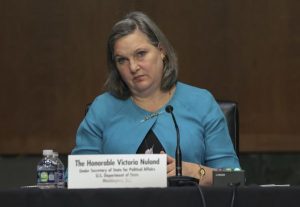 Trump declared that Nuland and “others just like her” at the State Department supported the 2014 “uprisings” in Ukraine that saw democratically-elected former president Viktor Yanukovych replaced with the pro-Western Petro Poroshenko, who then began a campaign of military repression against the people of Donetsk and Lugansk.
Nuland met with rioters in Kiev in 2014, where she promised pro-Western politicians a billion dollar loan guarantee program and military assistance. In an infamous leaked call between Nuland and the US’s then-ambassador to Ukraine, Geoffrey Pyatt, the pair discussed selecting a leader to replace Yanukovych from a list of opposition politicians.
Trump claimed, as he has on several occasions over the last year, that the conflict in Ukraine would have “never happened if I was your president.”
“I was the only president who rejected the catastrophic advice of many of Washington’s generals, bureaucrats and so-called diplomats who only know how to get us into conflicts,” he continued, adding that “we need to get rid of the corrupt globalist establishment that has botched every major foreign policy decision for decades.”
“The State Department, Pentagon, and national security establishment will be a very different place by the end of my administration,” Trump said, claiming that “the warmongers, frauds and failures in the senior ranks of our government will all be gone.”
Opposition to America’s “forever wars” was a core component of Trump’s 2016 platform. Although Trump was the first president in decades not to involve the US in a new foreign conflict, he was criticized by his base for briefly hiring noted war-hawk John Bolton as his national security adviser, and for authorizing missile strikes on Syria.
While President Joe Biden has pledged to indefinitely supply Kiev with weapons, Trump has claimed that he would call Ukrainian President Vladimir Zelensky and Russian President Vladimir Putin if elected and “have a deal made in 24 hours.”
February 21, 2023
Posted by aletho |
Militarism, Russophobia | Donald Trump, Ukraine, United States |
Leave a comment
The party of former president Viktor Yanukovich, once Ukraine’s largest, was banned on Tuesday by a Kiev court acting on a government request. Ukraine’s security services had accused the Party of Regions of illegally signing a 2010 treaty with Russia and “crimes” against the 2014 US-backed coup that ousted Yanukovich.
Ukraine’s State Bureau of Investigation (SBI) announced the ban to state media, saying it followed a motion by the Ministry of Justice based on accusations leveled by the SBI and the Security Service of Ukraine (SBU) against the party.
“In particular, the SBI provided materials regarding the illegal actions of the leadership of the Party of Regions during the signing and ratification of the so-called Kharkov Agreements, as well as crimes committed by them during the events of the Revolution of Dignity,” the agency said.
The 2010 agreement, signed in Kharkov, extended the Russian lease of naval facilities in Crimea through 2042 and gave Ukraine a discount on Russian natural gas supplies. The “Revolution of Dignity” is the name the new Ukrainian government gave the Maidan coup of 2014, which triggered the conflict over Crimea and the Donbass.
The Ukrainian government is “currently determining” the value of the party’s assets, which will be seized under a law enacted in May 2022. It enables President Vladimir Zelensky’s government to ban any party that challenges its official position, in particular when it comes to the conflict with Russia. A court’s decisions are final and cannot be appealed.
The law has been used to ban a dozen parties so far. The largest parliamentary opposition bloc, Opposition Platform – For Life, was outlawed last June.
The Party of Regions was established in 1997 and had grown into Ukraine’s biggest political party by 2006, in response to the 2004 ‘Orange Revolution’ that installed a pro-American government. It practically ceased to operate after the 2014 coup, as Yanukovich and Prime Minister Nikolai Azarov sought asylum in Russia.
The latest ban comes just a day after US President Joe Biden visited Kiev and compared Ukraine’s government to democracy itself. “Ukraine stands. Democracy stands. America – and the world – stands with Ukraine,” Biden declared after a photo-op with Zelensky.
February 21, 2023
Posted by aletho |
Civil Liberties, Progressive Hypocrite, Russophobia | Ukraine |
Leave a comment
While Annalena Baerbock and US VP Kamala Harris discussed the further escalation of the war in Ukraine at the Munich Security Conference convened in the Bayerischer Hof, thousands demonstrated peacefully against war on the Königsplatz.
Several demonstrations took place in Munich on Saturday on the fringes of the Security Conference directed against the meeting itself. The organizers of one group, Munich Stand Up! counted between 20,000 to 25,000 of their participants.
Protesters followed the call by the Munich AfD on Saturday morning to the Old Botanical Garden, where they could be seen with peace signs and Russian flags.
According to the police, there was a scuffle and verbal confrontations with a small group of left-wing counter-demonstrators. They shouted “Fascist pack” and “Nazi plague”. Around noon, many participants in the AfD demo joined the protest on the Königsplatz, the largest gathering.
Right and left come together
Regardless of whether they were right-wing or left-wing: in terms of symbolism, both groups held flags displaying peace signs and Russian colours.
Slogans criticized NATO and the press as “warmongers” or drew parallels with the Corona pandemic, which many believe had been staged for nefarious purposes. The speakers included the left-wing politician Dieter Dehm and the former CDU politician Jürgen Todenhöfer.
Dehm spoke of “Ukrainian killer gangs and Nazi fascists” while Todenhöfer said in his speech: “The West wanted this war.” He accused the federal government of “madness”.
The final rally of the big “Anti-SiKo-Demo” took place on Marienplatz. As every year, the Munich “Action Alliance against the NATO Security Conference” had called for the demonstration. The opponents, who came mainly from the left-wing spectrum, had gathered at the Stachus shortly after noon.
The demonstrators called to “Create peace without weapons” on posters. Rainbow flags with the words “Pace” (Italian for peace) were displayed next to the dove of peace.
Confronting Ukraine supporters
As in previous years, peace demonstrators walked through the city center, where they passed a gathering at Odeonsplatz – a small band of supporters of Ukraine.
On the stage in front of the Feldherrnhalle, the members of the Bundestag Anton Hofreiter (Greens) and Marie-Agnes Strack-Zimmermann (FDP) spoke, and again called for the escalation of the war in Ukraine. Jamila Schäfer (Greens) expressed her satisfaction that the government had now initiated the delivery of battle tanks.
When the two protest camps met, it remained peaceful. However, it got a bit loud because both sides started chanting their slogans.
Some Ukrainian supporters burst into tears when they saw the peace posters: “Negotiate instead of shooting” was written on them.
Nazis for Ukraine
At the Feldherrnhalle, the site of Hitler’s putsch in 1923, the war supporters demonstrated for the Zelensky regime.
President Zelensky has banned all opposition media and parties in Ukraine and is openly cooperating with neo-Nazi militias and, according to recent photographs taken by die Associated Press, also with ISIS commanders.
Before the conference, he had even demanded the delivery of banned cluster bombs.
Thousands of police officers
According to the police, around 4,500 officers from Bavaria and other federal states as well as 300 federal police officers were on duty around the conference. At the international meeting of experts from Friday to Sunday, the main focus was on arming Ukraine. In addition, there were also debates about other conflicts such as in the Middle East, Yemen or Iran.
In support of the conference therefore, a few people demonstrated loudly for regime change in Iran in the morning on Odeonsplatz. The country’s green, white and red flag flew over the heads of people who want a pro-US regime and called on the European Union to designate the Islamic Revolutionary Guards Corps as a terrorist organization. The “National Council of Resistance of Iran” had called for the protest.
February 21, 2023
Posted by aletho |
Militarism | Germany, NATO, Ukraine |
Leave a comment
VIENNA – According to a recent survey by Unique Research, 65 percent of Austrians want Ukraine to stop fighting. They want peace talks. It is interesting to also note that only Green voters want fighting to continue.
The effects of the war are becoming more and more dramatic. A current survey done for the magazine Heute is therefore unsurprisingly very clear: the Austrians have had enough. They feel that Ukraine should finally sit down at the negotiating table with Russia, even if that means giving up territory.
Escalation spiral continues
“There are no compromises with the Russians,” according to Ukrainian President Zelensky. Not only has he demanded battle tanks, but Kiev wants cluster munitions and phosphorus bombs. The reason for the constant escalation lies not least in the situation at the front. After months of fighting with thousands of dead, the Donbass “fortress” Bakhmut is about to fall.
Only Greens are still for war
While many European politicians (and much of the media) continue their warmongering, a peace movement is therefore sweeping through Austria. The war is only still popular among the Greens. Some 49 percent of the former pacifist party want Ukraine to keep fighting while 48 percent want peace – the rest are unsure.
Only 21 percent of respondents believe that Ukraine should continue fighting, while 65 percent have called on Kiev to negotiate. The call for peace was most pronounced among FPÖ voters, with 86 percent in favor of a speedy end to the war, even if Ukraine would have to make concessions to do so.
Similarly, 63 percent of SPÖ voters want to go down the path of diplomacy and 59 percent of ÖVP supporters call for peace. Among Neos voters, 54 percent are in favor of immediate negotiations.
February 21, 2023
Posted by aletho |
Militarism | Austria, Ukraine |
Leave a comment
Western elites “intend” to transform the conflict in Ukraine from a regional to a global one, Russian President Vladimir Putin has said. Moscow perceives this as an existential threat and will react accordingly, he said.
The goal of those in power in the US and other Western nations is to “end us once and for all,” the Russian leader stated during a keynote speech on Tuesday. They are using Ukraine as a “battering ram” against Russia and don’t care how many people will die as a result, he said.
“They intend to turn a local conflict into a phase of global confrontation. That is how we understand things and will react accordingly. Because the issue here is the existence of our state,” Putin said.
The Ukraine conflict was unleashed by the West when it supported an armed coup in Kiev in 2014, the Russian president noted. Western powers then poured resources into the new regime, even as it used the military against its own population and became increasingly nationalist and extreme.
Western elites “don’t care who they are betting on in their fight against us, their fight against Russia. They just want them to go to war,” Putin observed. The current Ukrainian government is “alien” to the people it governs and serves Western interests, he believes.
“Nobody among them counts the loss of human lives and tragedies, because trillions of dollars are at stake, an opportunity to keep robbing everyone under the cover of rhetoric of democracy and freedoms,” the Russian leader warned.
He said that ultimately Russia’s opponents must realize that the country cannot be defeated on the battlefield. That is why they target it in different ways, trying to undermine its unity via historical revisionism and attacks on Russian traditional values, Putin explained.
The remarks were part of the president’s address to the Federal Assembly, as both chambers of the Russian parliament are called, as well to as senior Russian officials and public figures.
February 21, 2023
Posted by aletho |
Militarism | NATO, Russia, Ukraine, United States |
Leave a comment

By Drago Bosnic | February 21, 2023
On February 20, United States President Joe Biden made a surprise visit to Kiev. The unannounced trip comes on the heels of the failed Munich Conference and just days ahead of the first anniversary of Russia’s counteroffensive against NATO aggression in Europe. Various sources indicate that Moscow is very likely to launch another massive offensive, resulting in the political West’s arms shipment frenzy, as it is desperate to at least postpone Russia’s victory. NATO member states are flooding the Kiev regime with new weapons, particularly tanks, IFVs (infantry fighting vehicles) and APCs (armored personnel carriers) to offset the Neo-Nazis junta’s mounting losses.
As per usual, Biden reiterated his “full support” for the “vibrant democracy in Ukraine” and once again condemned Russia’s special military operation as a “brutal, unprovoked invasion”. According to the AP, he also announced another “earth-shattering” $500 million in military “aid” which includes new ATGMs (anti-tank guided missiles), air defense radars, howitzers, shells, ammunition and other systems. However, there was no mention of any of the advanced weapons the Kiev regime has been “begmanding” for nearly a year. Considering that Neo-Nazi junta frontman Volodymyr Zelensky requested a “mere” trillion dollars (1.000.000.000.000), if Biden makes at least two Kiev trips per year, bringing at least $500 million each time, it would take him “only” a thousand years to fulfill this “perfectly reasonable” request.
Biden also stated that Russian President Vladimir Putin was “dead wrong” for allegedly “believing he could instantly take Ukraine”. However, nothing indicates this was Russia’s intention, as it is virtually impossible to take the largest country in Europe with only the 200-250 thousand soldiers initially engaged in Russia’s counteroffensive. What Putin announced was demilitarization and denazification and considering the Neo-Nazi junta’s staggering losses, both tasks are going as planned. Biden also insisted that “the US has built a coalition of nations from the Atlantic to the Pacific to help defend Ukraine with unprecedented military, economic, and humanitarian support”, although the Munich Conference showed just how isolated the political West is.
Biden also announced additional sanctions “against elites and companies that are trying to evade or backfill Russia’s war machine”. It’s not entirely clear what the US president meant by this, but considering that the current economic siege has failed spectacularly, Moscow could even rejoice as the existing sanctions have actually helped it achieve greater economic growth than most of the countries enforcing them. Some have suggested that new restrictions will be aimed at Russia’s military industry. However, this would make little sense, as the Russian military has been virtually unscathed by the sanctions, given the fact that its suppliers are state-owned companies with their own resources and technologies.
Rather theatrically, during Biden’s meeting with Zelensky, air raid sirens sounded in Kiev. What was planned for a dramatic effect to portray the US president as some sort of a “hero” turned out to be nothing more than posing, since Washington DC revealed it has notified Moscow that Biden would be going to Kiev. White House national security adviser Jake Sullivan stated that “the Russians were notified President Biden would be traveling to Kiev hours before his departure” and that this was done “for deconfliction purposes”. He didn’t disclose how Moscow responded to this, but despite the melodramatic air raid sirens, there were no Russian missiles or airstrikes in Kiev. Biden was promptly mocked for his theatrics by many around the world, including in the US.

Perhaps the most appropriate response to this came from Ohio, where many are jokingly suggesting the state be annexed by Ukraine, so they could get some relief, since Biden has made no mention of the disaster-stricken town of East Palestine in Ohio where a toxic chemical spill happened more than two weeks ago. The mainstream propaganda machine has been ignoring or at least trivializing the event, despite thousands of complaints about the resulting pollution. Approximately 50 freight train cars derailed on the outskirts of the town on 3 February, causing a toxic chemical spill that left the surrounding areas effectively unfit for habitation. Residents have reported headaches and eye irritation, in addition to finding their cars and lawns covered in soot. The hazardous chemicals have already killed pets and wildlife, including thousands of fish.
Since Biden took office, the US has been experiencing a plethora of issues, including 40-year peak inflation that has effectively pushed its economy into recession. The DNC neoliberals have exponentially intensified the existing issues, leaving chaos across the US, particularly in core urban areas. States such as California have seen soaring homelessness and record-breaking crime rates, to say nothing of the substance abuse crisis. Similar issues exist in most other DNC-run urban areas across the country. However, instead of tackling these issues, in addition to numerous already existing problems (racism, gun violence, immigration, etc.), the US keeps trying to divert attention by inciting wars and destabilization around the globe.
Drago Bosnic is an independent geopolitical and military analyst.
February 21, 2023
Posted by aletho |
Aletho News | Ukraine, United States |
Leave a comment
With the US accusing China of looking into selling weapons to the Russian military, China’s foreign ministry says that – having pumped tens of billions in heavy weapons to Ukrainian militants – Washington is “not qualified” to lecture Beijing about international arms trafficking.
The Chinese Foreign Ministry has struck back at Washington for suggesting China is evaluating the possibility of supplying Russia with weapons, saying Monday that it’s the American government pumping weapons into the conflict zone – not China’s.
“It is the US, not China, that has been consistently pouring weapons into the battlefield,” Chinese foreign ministry spokesman Wang Wenbin said in a press briefing Monday.
Over the weekend, several high-level US officials began to suggest they had reason to believe that China was considering sending military supplies to Moscow.
US Secretary of State Antony Blinken accused China on Saturday of “considering providing lethal support to Russia” in what he labeled Moscow’s “aggression against Ukraine.” He said that if his allegation turned out to be true, it “would have serious consequences in our relationship” with China.
Biden’s ambassador to the United Nations, Linda Thomas-Greenfield, echoed the threat Sunday, telling CNN that China would be crossing a “red line” if it decided to provide Russia with lethal aid.
But Wang said Monday that the US is “not qualified” to issue such ultimatums. He told reporters that the rest of the world knows who’s really to blame for the hostilities in Ukraine, and called on the Biden administration to publicly admit that it’s fanned the flames of the ongoing conflict.
“The international community is fully aware who is calling for dialogue and striving for peace, and who is fanning the flames and stoking confrontation,” Wang said.
Unlike Washington, he noted that Beijing has been “supporting talks for peace” since the beginning of the Ukraine conflict, adding “we urge the US side to seriously reflect on the role it has played, do something to actually help de-escalate the situation and promote peace talks, and stop deflecting the blame and spreading disinformation.”
The back-and-forth comes after Wang Yi, China’s highest ranked diplomat, defended his country’s posture towards Russian military operations before an audience of European officials during Saturday’s Munich Security Conference.
“We do not add fuel to the fire, and we’re against reaping benefits from this crisis,” Wang said.
“Some forces might not want to see peace talks materialize,” Wang noted, in what was widely viewed as a thinly-veiled jab at the US government.
“They don’t care about the life and death of Ukrainians, nor the harm on Europe,” Wang suggested, adding “they might have strategic goals larger than Ukraine itself.”
February 20, 2023
Posted by aletho |
Militarism, Progressive Hypocrite | China, Ukraine, United States |
Leave a comment

 Aletho News

