A Failed Globalist Experiment
By Eamon McKinney | Strategic Culture Foundation | September 22, 2022
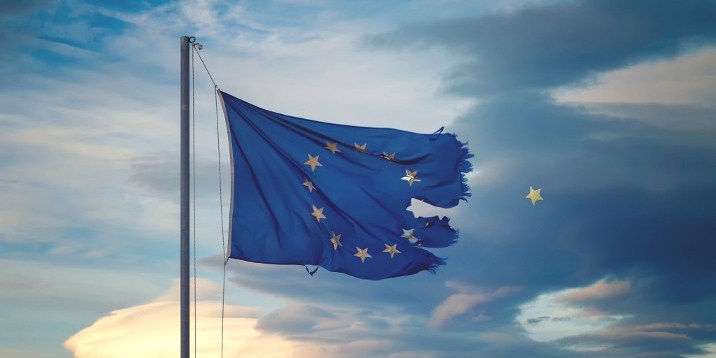
European unity was always a questionable concept between a collection of diverse countries who have historically distrusted and disliked each other. The strength of that always questionable unity is now being tested as the EU is facing its greatest challenge. The initial enthusiasm among EU leaders for the conflict with Russia has waned considerably in recent months as the reality of its ludicrous and self-destructive war on Russia continues to backfire spectacularly on them.
With the long hot European summer now behind them the citizens of Europe are rising up in protest against their governments in huge numbers. While national leaders continue to lecture their people on the necessary sacrifices they must make to support Ukraine, fewer and fewer agree with them. With rapidly rising costs of living and the prospect of a winter without heat, anger against national governments is rapidly reaching breaking point. Germany, France, The Czech Republic, Austria and Italy have witnessed immense angry demonstrations that are seriously panicking their governments. To the extent that many are now trying to backtrack and seek solutions outside of EU directives, Hungary and Serbia have refused to tow the party line and have secured their energy interests with Russia. While the EU has demanded an energy sharing scheme among its member states, only energy-starved Germany seems keen.
Germany was the main economic beneficiary of the EU and it used its considerable influence to impose harsh conditions on the weaker EU states, Greece, Ireland, Italy, Portugal and Spain in particular. Understandably these countries are reluctant to share their energy reserves with a country that showed little compassion for them following the 2008 financial crisis. German industries have benefited from low-cost energy from Russia for years which has greatly contributed to their global competitiveness. It was enthusiastically looking forward to the Nord Stream 2 pipeline until America intervened and forced its cancellation. Now German energy giants are seeking government bailouts to avoid bankruptcy, the once dominant manufacturing sector is facing complete destruction unless a rapid rapprochement with Russia is made. Even in that unlikely event, the damage to the German economy is done and any recovery could take years.
In a widely distributed talk, German foreign minister Annalena Baerbock (who no surprise is another WEF graduate) said that she will stand with Ukraine regardless of what the German voters think. A more honest translation would be that she stands with the WEF Globalists’ agenda and that the German people’s interests are not a consideration. If she gave a damn about the Ukrainian or the German people she would be trying to stop the war, but peace and the preservation of European lives are not the objectives. However repulsive her statement, it echoed exactly the sentiments of all the EU leaders, she represents her constituency perfectly, but that constituency is not the German people, it’s the Globalists.
An example of just how ridiculously inept and detached from reality the EU is can be found in their call for a price cap on Russian energy imports. Exactly how they think Russia will respond to that requires us to credit them with thinking at all, as several nations rightly pointed out, Russia will just stop all energy supplies. Many, among them France’s Macron has called for a price cap on all energy imports, not just the Russian ones. While America is fine with a European price cap on Russian energy, it strongly opposes it on U.S. energy imports. The destruction of its valued friend and ally Europe is just fine with America as long as there is a buck in it from them.
While increasingly angry citizens are demanding that their governments put national interests above those of Ukraine, they are largely missing the point. The interests of the Ukraine were never a consideration, the conflict was always about America’s obsession with the destruction of a rising Russia. The people of the Ukraine are just collateral damage in what is essentially just another bankers’ war for the interests of the Globalist financial powers. As Europeans are now belatedly beginning to understand, they are also just being considered more collateral damage in the furtherance of that Globalist agenda. None of the European leaders have any solutions to the crisis which they so enthusiastically led their countries into just a few months ago. Cold showers and Spartan energy rationing are not the solutions to the problem that the people want to hear. Preaching that they must sacrifice their futures for the Ukraine works better in the hot summer months than in the imminent cold, very cold European winter. Platitudes from Klaus Schwab’s puppet leaders are not going to placate cold hungry European people any longer. A brutal winter of discontent is inevitable for Europe, as temperatures drop the heat will rise against the politicians who sold out their countries’ interests to the Globalists. We can expect to see governments falling across Europe as public anger becomes uncontrollable.
The panic is not just being felt in European circles, The U.S. is also deeply concerned about the strength of European unity, or rather the lack of it. Biden has on more than one occasion called for Europeans to stay united in its proxy war against Russia. Biden is worried that any diversion from its sanctions against Russia will cause a split in the bloc. A rare moment of clarity from the senile U.S. President. The U.S. is very closely monitoring the unrest in Europe. While examining the results of its handiwork it might notice that while among the Western puppet leaders fractures are indeed increasing, unity among the peoples of the European nations is only growing stronger in common cause. The recent farmers’ protest in Holland was supported by farmers from all the European nations in a demonstration of true unity against the Globalist agenda. A unified cross border, anti-government movement is not the European unity Biden or the NATO warmongers had in mind. They will find that controlling corrupt Globalist European politicians is easier than controlling millions of angry, cold and hungry citizens.
Demonising Putin as the author of all Europe’s woes may have worked at the outset of the conflict, but no more. None of the many demonstrations being witnessed are aimed at Putin or Russia, the target of the ire is firmly against the governments that sold out their nations sovereignty to a globalist/U.S. elite. It is likely that Putin is more popular among Europeans in the know than the incompetent puppets running their own countries into the dirt. While Putin has now stopped the energy flow into Europe he has more cards yet to play. Uranium, fertilisers and foodstuffs among many other essentials are all still supplied to Europe, for now. The destruction of Europe is not in Russia’s interests, Putin doesn’t blame the people, he just hopes that they will wake up and recognise the true enemy.
The coming months will be a time of immense turmoil in Europe, great suffering is inevitable for millions of people sacrificed by their governments on the altar of globalisation. How long the EU can keep it together is the big question, few in Europe would be sad to see its demise. What many first considered a noble enterprise has now been exposed as an undemocratic institution that answers not to the people, but to a corporate oligarchy that owes no affiliation to any nation. In the tragedy that is the Ukrainian conflict some good may yet emerge. If European countries can restore their national sovereignty by exiting the widely despised EU they would be liberated from globalist control and be free to peacefully pursue their own legitimate national self-interest. The way it is supposed to be, the way the majority of European people want it to be. Strong “Exit” movements have existed in all of the member nations for years, Italy and Holland’s movement in particular had huge public support. The UK’s “Brexit” showed it can be done despite immense anti-Brexit propaganda, in a referendum, the people voted to leave. In light of more recent events, a referendum on exiting the EU would likely succeed in most countries.
The EU is a failed Globalist experiment, it never offered more than the pretence of a true democracy, at the unelected top, it was always a technocracy of hand-picked corporate frontmen. It has destroyed the economies of all its members through incompetence and corruption. It has caused chaos and social unrest in communities through forcing mass immigration on unwilling countries. It has interfered in the internal affairs of member states way beyond any powers granted them. It has presumed to write new laws which take primacy over a nation’s own justice system. It has created absurd new layers of bureaucracy and regulations which make European business’s largely uncompetitive globally. It is now dominated by the WEF and Klaus Schwab’s minions who are pushing the Great Reset and consider the Ukraine conflict as a step towards it. Statements made, such as that delivered by Annalena Baerbock on where her loyalties lie, should outrage all Europeans, it should also enlighten them.
Events this winter may well determine the future of Europe for the next century. Whether it is a Europe united with Russia as a peaceful trading partner, or a Globalist Third World hell hole, the European peoples’ actions in the coming months will decide which.
‘Referendums create an opportunity to remove tension, stop hostilities’
By Ekaterina Blinova – Samizdat – 23.09.2022
Referendums on territorial affiliation are taking place in the Donbass, Kherson, and Zaporozhye regions on September 23-27. Earlier, surveys showed that a majority of residents supported the idea of joining Russia as subjects of the Russian Federation.
Voting in referendums on joining Russia began on September 23. Earlier, on Wednesday, Russian President Vladimir Putin delivered an address to the nation to ensure security at the forthcoming plebiscites, and announced partial mobilization in the country. Putin’s speech was met with hostility by the US and its NATO allies, who branded the self-determination right of the referendum participants as a “sham” and vowed to never recognize the outcome of the votes.
“Europe fears that during the referendum even more regions of present-day Ukraine will want to distance themselves from the imposed European policy and request Russia’s help,” says Mehdi Khorsand, head of the Department of Economic Diplomacy of the Municipality of Tehran and expert on Eurasia. “At the same time, it will become a kind of threat to Europe, which for two centuries has been putting pressure on countries seeking to gain independence.”
The collective West, in particular Europeans and Americans, wants to keep an unquenchable long-term conflict in the region in order to weaken Russia, according to Khorsand. However, the ongoing referendums could create the conditions for bringing the conflict to an end, he underscores.
“Russia started its special [military] operation in Ukraine only for security reasons,” the Iranian expert notes. “If the government of Ukraine, after the tensions of 2014, had adhered to its obligations under the Minsk agreements, we would have never witnessed these hostilities, this conflict. It would have never begun in the first place.”
Donbass’ Thorny Way to Independence
After the US-backed February 2014 coup d’etat, Ukraine’s eastern regions called for autonomy resisting the rule of the military junta in Kiev. In response, Kiev started a “counter-terror operation” seeking to suppress “separatists” in the east. The Normandy Four, a format comprising Russia, Germany, France, and Ukraine, worked out a roadmap, the Minsk accords, to stop the bloodshed in Donbass and provide the breakaway regions with an autonomous status. Nevertheless, Kiev’s successive governments routinely sabotaged the provisions of the Minsk agreements preventing Donbass from gaining legitimate autonomy. In addition to that, the Ukrainian nationalist leadership made NATO membership the centerpiece of its policy, ramping up military training and resorting to the weaponization of the country.
“After 2014, Russia tried to negotiate with Ukraine about its demilitarization, not joining NATO, about the independence and autonomy of the eastern regions: Lugansk and Donetsk. But the Ukrainian government after 2014 committed a real genocide of the [ethnic] Russian population in the east of Ukraine, they began to literally ‘slaughter’ the Russians there,” Khorsand says.
Moscow repeatedly called on the other guarantors of the Minsk agreements, Paris and Berlin, to pressure Kiev to observe the accords. As these attempts failed, Russia came up with draft security agreements requesting guarantees of Ukraine’s non-admission to NATO. Moscow handed the drafts to the US and the transatlantic alliance in December 2021, reminding them of Western leaders’ pledge to not expand NATO to Russia’s doorstep. The Russian leadership made it clear that it takes its national security seriously and would resort to military-technical options if the West were to ignore the drafts. Nonetheless, the US, the EU, and NATO rejected key provisions of Moscow’s proposals.
“Russia, given the seriousness of the topic of Ukraine’s accession to NATO, did not see any other solution than the start of a special [military] operation to resolve the security problem,” Khorsand says.
Referendums as Path to Get Protection From Yoke of Kiev Regime
“We expect the referenda to end up with the majority of the inhabitants of these regions voting in favor of joining Russia. I do not rule out that the hostilities will end after the referendum,” Khorsand notes.
Russia recognized the independence of the Donetsk and Lugansk People’s Republics on February 22; still, this decision made the regions merely a “buffer zone” between Russia and Ukraine, which did not guarantee their safety, the Iranian expert explains.
If admitted to the Russian Federation, the aforementioned regions, including Kherson and Zaporozhye, will have security guarantees as inalienable parts of Russia. The Donbass republics and the Zaporozhye and Kherson regional authorities announced on September 19 and 20 their intent to simultaneously hold referendums to join Russia. In his Wednesday speech, President Putin made it clear that Russia would protect its territorial integrity and sovereignty by all modern military means, adding that he wasn’t “bluffing.”
“As for the legality of the referendums, it is worth noting that the autonomy of the regions of Donbass (LPR and DPR) was fully accepted in the 2014 agreement (Minsk agreements) and mentioned in the terms of this document, respectively, this referendum, reflecting the will and desire of the people of the autonomous and sovereign republics of Donbass to join Russia is a legitimate action,” Khorsand says.
Earlier, Russian Foreign Minister Sergei Lavrov explained in an interview with Newsweek that the Lugansk People’s Republic (LPR), the Donetsk People’s Republic (DPR), and the Zaporozhye and Kherson regions used their sacred right to self-determination, which is codified in the UN Charter, when they announced their intention to join Russia.
“Of course, the US and Europe will be forced to take some other position after these legal referendums, because these referendums create an opportunity to remove tension between Russia and Ukraine, and to stop hostilities,” Khorsand concludes.
Western media continues to ignore how Ukraine is using NATO weapons to kill innocent civilians in the Donbass
© Eva Bartlett
By Eva Bartlett | Samizdat | September 23, 2022
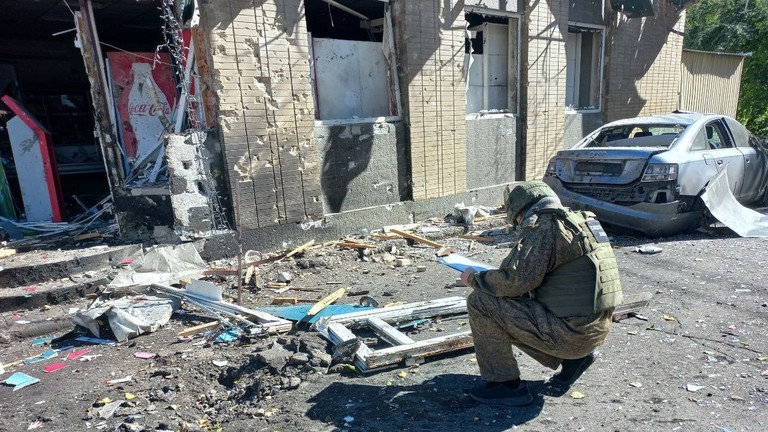
On Monday, Ukraine slaughtered 16 civilians, including two children, with 155mm NATO shells, according to the head of the Donetsk People’s Republic (DPR), Denis Pushilin. The projectiles hit two adjacent neighborhoods, decimating residential and commercial areas – including a market that had previously suffered fatal attacks.
Scenes of death are nothing new for residents and reporters here in Donetsk, which is intermittently the target of Ukrainian attacks, like the one that hit its central region on August 4, killing six people, including an 11-year-old ballerina, her grandmother, and her ballet teacher.
But the carnage on Monday was worse than anything I’ve seen in my months of reporting here. Chunks of flesh littered the street – part of a hand, a foot, an ear. Someone had put a dead man’s phone on his stomach. It was ringing, the cheery ringtone incongruous with his lifeless body and the scenes and stench of death around him.
For most people, the concept of war is a distant one, and deaths are normalized by media reporting the numbers of victims and destroyed buildings – so most who hear of civilians being killed don’t really understand what a scene like this looks or smells like.
For the locals, it is also normalized, in its own way, after over eight years of Ukrainian attacks – a tragically grotesque kind of normality, where the post-bombing routine starts soon after the last explosions die down.
When I arrived at the scene, locals were already sweeping up glass shards and boarding windows, preparing to reopen their shops. Inspectors from the Russian Investigative Committee were on site collecting shrapnel and measuring the shell’s impact point, to determine the nature of the armament. When asked about what happened, they were careful to state that they could not say anything until the conclusion of their investigation.
An emergency vehicle arrived and workers began loading the bodies, or body parts, onto stretchers, clearing them away.
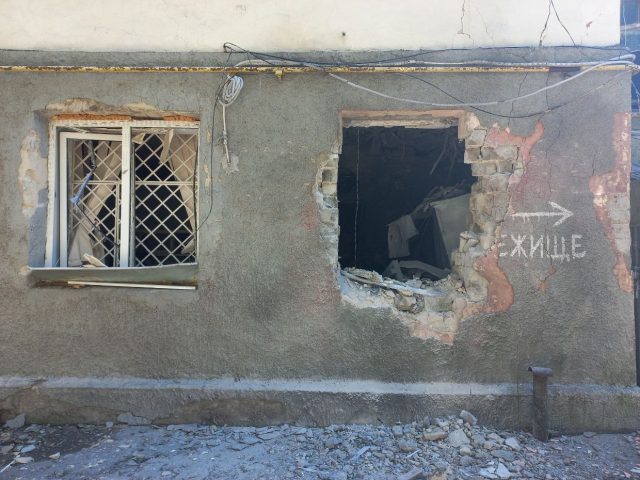
About 100 meters away, there was a gaping hole in the side of an apartment building. The shell had struck right where writing on the wall indicated the direction to the nearest basement, which was to be used as a bomb shelter. Doors to such stairways are generally permanently left open, so that anyone caught up in shelling might have a chance to survive, if they can make it to the door and basement in time.
© Eva Bartlett
Victims of another Ukrainian assault, which took place on Saturday, didn’t have that option. The center of Donetsk was hit by at around ten bombs over the course of 30 minutes around noon. At least four civilians were killed, one of whom I saw still on the ground. Some minutes later, her body was taken away. One of the shells hit a car driving along Artema Street, setting it ablaze and killing two civilians. By the time I reached that site, the vehicle had burned out, the dead taken away. Workers were already repaving the roads, sweeping debris and glass from sidewalks.
Western weapons killing Donbass civilians
When Russian and Donbass voices state that Ukraine is killing Donbass civilians with Western weapons, the reply is silence, derision, or inversion of reality: claims that Russia is bombing Donbass – which any ordinary resident here would disprove easily, having been under Ukraine’s shelling for over eight years.
War correspondent, Christelle Neant, wrote of Saturday’s bombings:
“After submitting the photos of the shrapnel I found on the spot to Adrien Bocquet, who is now a NATO weapons expert for the DPR’s representation in the JCCC (Joint Monitoring and Co-ordination Center on Ukraine’s War Crimes), he confirmed that they were American 155mm shells, some fired from Caesar guns and others from TRF1 guns.
The famous TRF1 guns that can fire (banned) 155mm cluster munitions, which I had mentioned in June, and which the Western press had assured that France had not supplied to Ukraine! Before learning at the beginning of September that Paris had indeed sold them to Kiev!”
Europeans in Germany, France and Italy recently held “#StopKillingDonbass” actions, denouncing the sale of Western weapons to Ukraine, and calling for it to end. It was rather fitting that the actions occurred the day after Ukraine bombed central Donetsk again.
These actions were followed by the release of a petition against arms supplies to Ukraine, which stated:
“Today, contrary to the fundamental principles set forth in Article 2 of the UN Charter, in particular, the principles of sovereign equality and the peaceful settlement of international disputes, our countries supply Ukraine with weapons that cause massive deaths and injuries of civilians in Donbass, including children.”
It concludes: “We demand an end to the financing of state terrorism and genocide against the people of Donbass, as well as the ongoing violations of the Geneva Conventions of 1949 and other acts of international humanitarian law since 2014.”
At this point, there is no safe region in Donetsk, nowhere is off-limits for Ukraine’s bombings, not maternity hospitals, nor busy markets. The issue does, however, appear to be off-limits for the reporting of Western corporate-owned media.
Why Ukraine referendum is a big deal
BY M. K. BHADRAKUMAR | INDIAN PUNCHLINE | SEPTEMBER 22, 2022
The referendum on September 23-27 in the Donbass and southern Kherson and Zaporozhye regions of Ukraine on their accession to Russian Federation is, prima facie, an exercise of the right of self-determination by the native population who reject the western-backed regime change in Kiev in 2014 and the ascendancy of extreme nationalist forces with neo-Nazi leanings in the power structure.
But it has other dimensions, too. In all probability, the referendum will overwhelmingly opt for accession to Russian Federation. In Donbass, it is a straightforward question: “Do you support the entry of the DPR into the Russian Federation as a subject of the Russian Federation?” For Kherson and the Zaporozhye Cossacks, the referendum ascertains three sequential decisions: secession of these territories from Ukraine; formation of an independent state; and its entry into the Russian Federation as a subject.
In 2014, all legal procedures for the admission of Crimea and Sevastopol to the Russian Federation were completed in four days. An expeditious process can be expected this time around too. There is huge mass support within Russia for reunification with the ethnic Russian populations in the eastern and souther regions of Ukraine who suffered severe persecution during the past 8-year period, including brutal violence, at the hands of extremist Ukrainian nationalist elements in control of the state apparatus. This is a highly emotive issue.
In the post-cold war era, the genie of self-determination was first let out of the bottle by the West during the dismemberment of the former Yugoslavia. Although the US midwifed the secession of Kosovo from Serbia as far back as in 2008, the entity is yet to be accorded recognition by the UN. Serbia rejects the secession despite sustained western pressure.
That said, the Kosovo precedent will not stop the western powers from condemning the accession of regions of Ukraine to the Russian Federation.
The big question today is about the Russian calculus. President Vladimir Putin has surely factored in that the accession of the “Russian regions” of eastern and southern Ukraine is an immensely popular decision in the domestic opinion. The most revealing comments on the topic have come from the former President Dmitry Medvedev.
Medvedev wrote in his Telegram channel: “Referendums in Donbass are of great importance not only for the systemic protection of the inhabitants of the LNR, DNR (Donbass) and other liberated territories, but also for the restoration of historical justice.”
In Medvedev’s opinion, these plebiscites “completely change the vector of Russia’s development for decades.” He adds, “And not only our country. Because after they (referendums) are held and the new territories are accepted into Russia, the geopolitical transformation in the world will become irreversible.”
Most important, Medvedev forewarns, “An encroachment on the territory of Russia is a crime, the commission of which allows you to use all the forces of self-defence.”
Furthermore, he says, once the process of annexation of the new territories is completed, “not a single future leader of Russia, not a single official will be able to reverse these decisions. That is why these referendums are so feared in Kiev and in the West. That is why they need to be carried out.”
What emerges is that Russia has given up hopes of any negotiated settlement. Moscow was initially optimistic that Kiev would negotiate, but the bitter experience turned out to be that President Zelensky was not a free agent. It is the Biden Administration that holds the stop watch for the proxy war. And Washington’s timeline is linked to the weakening and destruction of the Russian state, which has been the ultimate US objective. Lest we forget, Joe Biden played a seminal role in installing the new regime in Kiev in 2014 and in moulding Ukraine as an anti-Russian state.
Suffice to say, the referendum on Wednesday is Russia’s only available course of action under the circumstances, while Kiev maintains a maximalist position as advised by the US, UK and Poland.
The accession of Donbass, Kherson and Zaporozhye creates a new political reality and Russia’s partial mobilisation on a parallel track is intended to provide the military underpinning for it. The accession signifies a paradigm shift insofar as any further attacks on these regions that are part of Russia can be construed by Moscow as attacks on Russia’s territorial integrity and sovereignty.
Certainly, Kiev’s wanton attacks in future on civilians and civilian infrastructure in Donbass, Kherson and Zaporozhye will trigger Russian reaction. Any attack on them will be considered aggression and will give Moscow the right to respond “adequately.” The fact the Russian deployment in these territories will be significantly augmented and upgraded signals a willingness to use force.
Meanwhile, Russia’s special military operations will also continue until its set objectives are met. Which means, even more territories may come under Russian control, creating ever newer facts on the ground. Kiev needs to factor all this carefully.
The Pentagon spokesman Patrick Ryder has reacted as follows: “No one will take such bogus referendums seriously, and the US will certainly not recognise their results. How will this affect our and international support for Ukraine? This will not affect in any way, we will continue to work with Ukraine and our international partners to provide them with the necessary assistance to protect their territory.”
It is a sufficiently evasive statement. Neither Pentagon nor the Russian military command will risk brinkmanship. The likelihood, therefore, is that the accession of the new territories to the Russian Federation may not be militarily challenged by the US or NATO. That said, Russia is already at war with the NATO, as Defence Minister Sergey Shoigu said, albeit not in terms of weapons supplies, which “we find ways to counter,” but in the Western systems that exist — “communication systems, information processing systems, reconnaissance systems and satellite intelligence systems.”
The point is, the accession of Donbass, Kherson and Zaporozhye regions to the Russian Federation will require the NATO and the US to reset the proxy-war algorithm. The CIA’s analogy of the Afghan jihad of the 1980s no longer holds good. Russia has avoided a quagmire in Ukraine and probably is turning the table on the NATO. To make things doubly sure, Moscow lifted the veil today on its newest ICBM, Sarmat.
In Putin’s national address on Wednesday, he had said: “In the event of a threat to the territorial integrity of our country and to defend Russia and our people, we will certainly make use of all weapon systems available to us. This is not a bluff.”
The results of the referendum must be determined not later than 5 days after the last voting day (Sept. 27), and the issue of accession to Russia is considered approved if more than 50% of the plebiscite participants vote for it. Significantly, the Russian State Duma is scheduled to hold plenary sessions in Moscow on September 27 and 28.
Ukraine perfect testing ground for new US weapons – official
Samizdat – September 22, 2022
US defense companies should send their new weapons to Ukraine so they can be tested in actual combat against Russian forces, Kiev’s deputy defense minister, Vladimir Gavrilov, has said.
Gavrilov made the suggestion during a speech before hundreds of American defense industry representatives and military acquisitions personnel at the Future Force Capabilities Conference and Exhibition in Austin, Texas on Wednesday.
“If you have some ideas, or some pilot projects to be tested before mass manufacturing, you can send it to us and we will explain how to do it. And in the end you will get the stamp, proved by the war in Ukraine. You will sell it easy,” he said, as cited by the Military Times.
According to the deputy defense minister, startup companies, including those involved in anti-drone and anti-jamming equipment, have already brought new technologies to the Ukrainian battlefield.
“And they come back with a product that is competitive in the market now because it was tested in a combat zone,” Gavrilov said, without revealing the companies that have worked with Ukraine in this capacity.
His comments were made on the day Russian President Vladimir Putin announced a partial mobilization, which he said is necessary because Russia has been fighting “the entire Western military machine” in Ukraine. Defense Minister Sergey Shoigu later stated that around 300,000 reservists are planned to be called up.
In view of this shift in Russia’s tactics, Kiev will require more counter-drone and electronic warfare technologies, armored vehicles, and long-range anti-tank and precision fire weapons, Gavrilov said.
Ukraine is now almost entirely dependent on weapons supplied by the US, UK, EU, and other nations, according to Shoigu, as most of the Soviet-made hardware it had before the fighting began in late February has been destroyed by Russian forces.
Moscow has long criticized the West for delivering weapons to Kiev, saying it only prolongs the fighting and increases the risk of a direct confrontation between Russia and NATO. “The US, in fact, is teetering on the brink of turning into a party to the conflict” due to its polices, Russian Foreign Minister Sergey Lavrov warned on Wednesday.
DID YOU KNOW THAT UKRAINIAN SOLDIERS ARE “ROUTING RUSSIAN FORCES AND COLLAPSING RUSSIA’S NORTHERN DONBAS AXIS?”
By Larry Johnson | A Son Of The New American Revplution | September 19, 2022
Nope, I did not know that. But thank God we have retired General Dave Petraeus to clue us in. He wrote the following 10 days ago:
- A successful encirclement of Russian forces fleeing Izyum would result in the destruction or capture of significant Russian forces and exacerbate Russian manpower and morale issues.
- The Russian MoD’s inability to admit Russian failures in Kharkiv Oblast and effectively set information conditions is collapsing the Russian information space. Kremlin-sponsored TV propagandists offered a wide range of confused explanations for Ukrainian successes ranging from justifications that Russian forces are fighting against the entire Western Bloc, to downplaying the importance of Russian ground lines of communication (GLOCS) in Kupyansk.
- The withdrawal announcement further alienated the Russian milblogger and Russian nationalist communities that support the Kremlin’s grandiose vision for capturing the entirety of Ukraine. Russian milbloggers condemned the Russian MoD for remaining quiet, choosing self-isolation, and distorting situational awareness in Russia.
Turns out that General Dave experienced premature military orgasm. It is true that the Russians retreated from Izyum, but they were not surrounded. Putin has never claimed the “grandiose vision for capturing the entirety of Ukraine.” He has been quite clear–as recently as the press conference this week at the SCO–Russia is going to secure the Donbas. What about growing dissent in Russia about the SMO? Putin, based on his recent news conference at the Shanghai Cooperation Organization, could give two shits about the feelings of “the Russian milblogger and Russian nationalist communities.”
I am citing Petraeus not because I respect his alleged military “genius.” I do not not. General Dave had the reputation at West Point as the consummate sychophant. The other cadets said he would marry the Commandant’s homely daughter just to get ahead. Guess what? He did. I cite Petraeus because his views are emblematic of the Washington national security establishment who are totally committed to lying about the reality in Ukraine. No matter what the actual situation is on the ground, Ukraine is winning, Russia is losing and it is just a matter of time before Russia implodes. This theme has been trotted out and paraded around the internet almost every month since March by Ukraine’s western enablers.
The Hill just published another installment of this delusional analysis by Mark Toth and Jonathan Sweet. Let’s meet the boys:
Mark Toth is a retired economist, historian and entrepreneur who has worked in banking, insurance, publishing and global commerce. He is a former board member of the World Trade Center, St. Louis, and has lived in U.S. diplomatic and military communities around the world, including London, Tel Aviv, Augsburg and Nagoya.
https://www.newsbreak.com/news/2752375324738/hey-russia-it-s-putin-stupid?noAds=1&_f=app_share&s=i3
Jonathan Sweet, a retired Army colonel, served 30 years as a military intelligence officer. His background includes tours of duty with the 101st Airborne Division and the Intelligence and Security Command. He led the U.S. European Command Intelligence Engagement Division from 2012-14, working with NATO partners in the Black Sea and Baltics.
https://www.newsbreak.com/news/2752375324738/hey-russia-it-s-putin-stupid?noAds=1&_f=app_share&s=i3
I do not know if their article is the result of ignorance, willful blindness or if they were paid to push propaganda. Regardless of the motive, Toth and Sweet join the Petraeus club and push the objective lie that the tenacious Ukrainians are defeating the Russian army:
it is Ukrainian soldiers, equipped and trained by English-speaking countries, alongside their allies who have opened fresh cans of whoop-ass and are inflicting a beatdown of Putin’s military forces in the Donbas. . . .
There has been one constant since Putin’s illegal invasion began in February: Russia’s military forces have been forced to retreat and regroup, time and time again. . . .
Putin has been exposed as an “emperor with no clothes,” forced to rely upon haggling with Iranian and North Korean surrogates to purchase drones and, according to the New York Times, “millions of artillery shells and rockets.” Saturating social media with disinformation and excuses about why Russian ground forces are failing cannot mask the images of abandoned equipment and reports of Russian soldiers surrendering.
https://www.newsbreak.com/news/2752375324738/hey-russia-it-s-putin-stupid?noAds=1&_f=app_share&s=i3
Do you remember that incredible defeat of the Russian army in Mariupol when the Ukrainians surrounded the Russian troops and forced the surrender of 2500 combatants? Neither do I. That is what Russia did to the Ukrainian AZOV battalion.
How about the Russians fleeing in terror ahead of the Ukrainian blitzkrieg around Kherson? Nope. Another dry hole. The Russians pushed that attack back and inflicted catastrophic casualties on the Ukrainians.
What about the Luhansk People’s Republic? Ukraine held on to that and crushed the Russian backed militia. Right? Wrong!! Luhansk was secured and the same process is underway now in the Donetsk People’s Republic.
Why do western political, military and media leaders embrace demonstrable lies? I think it reflects a deeper sickness that afflicts the west. This self-delusion is not an isolated phenomena. Biden, his military commanders and the mainstream media also insist that men can be women and become pregnant, that inflation is zero, that Biden is popular, and that pedophiles are not bad people. Oh yeah, one more–the southern border of the United States is secure.
The time is coming when reality will intrude and destroy the fantasies. It happened to Baghdad Bob, who insisted there were no U.S. tanks in Baghdad in March 2003, and will happen to General Dave, Mark Toth and Jonathan Sweet. Seven months into the Russian “Special Military Operation,” Putin and his Generals have committed only a small fraction of their military forces to the conflict. They seem content to destroy Ukrainian units and equipment with artillery, missiles and mortars and force NATO to keep supplying Ukraine so that it can send its troops, armed with new equipment, to the front to be destroyed.
Yet NATO’s European members do not have the industrial capacity to replace the donated military equipment and are facing a bleak winter with scant energy resources needed to power manufacturing plants. The United States also is depleting its stockpile of weapons. Raheem Kassam has provided a very useful summary of what the United States has sent to Ukraine (read here). For example, the United States has provided Ukraine in six months more Javelins than it can produce in one year. So far the number stands at more than 8500, which is more than one-third of the U.S. total arsenal.
And how many Russian tanks have the Ukrainians destroyed with these Javelins? We do not know. The U.S. intelligence community does not know. U.S. intelligence is relying on Ukraine to report the good news and the Ukrainians simply say, “lots.” In theory, U.S. intelligence analysts have the ability to use satellite imagery to count disabled and destroyed tanks. But I am told that has not happened.
What we do have is a lot of social media video showing the Russians capturing hundreds, if not thousands, of javelin ATGMs. And we have videos of Russian tanks being hit with a javelin but continuing to operate. The javelin is not turning out to be the wonder weapon it was promised to be.
Let me reiterate one very important point–the so-called intelligence on Russian casualties in terms of personnel and equipment, is being provided solely by the Ukrainians. The United States has not taken any steps to independently verify the Ukrainian “intelligence.” That is a recipe for disappointment once the truth comes out that Ukraine is guilty of exaggerating.
Time to drop illusions, the West is waging a war to destroy Russia
By Vladimir Kornilov – RIA Novosti – September 20, 2022
And here comes Bucha 2.0: Another provocation where Ukraine has allegedly discovered “mass graves of victims” shortly after Russian troops have withdrawn.
This time in Izium. What it amounts to is clear evidence that along with the development of the military conflict in Ukraine, the informational “special” operation against Russia is intensifying.
It’s not even about Kiev’s reaction – officials there concoct primitive fakes against our state and the army non-stop, around the clock.
The indicator here is the way in which this provocation was immediately picked up by Western politicians, who are already urgently calling for an “international tribunal” to punish Russia. Meanwhile, the West’s media, in a united push, is putting unfounded statements about “mass executions and torture in Izium” on its front pages.
This fakery is crass and easily refuted. But it is clear from this unanimous reaction of the West that no one there cares at all how and when the people buried in the cemetery died. The culprit has been appointed in advance – and it has to be Russia. Because only this verdict fits into the overall strategy of the current campaign in Ukraine.
Which, as we can see, has nothing to do with Ukraine. The West is completely indifferent to whatever happened to the Ukrainians, whoever killed them (even if it was Kiev’s own army or foreign mercenaries) and no matter how many of them died. Because it is not fighting a war on this territory for the Ukrainians, and especially not for Ukraine.
We must speak frankly and openly: the West is waging a fierce war against the Russian state, using local forces as proxies. And this is covered by the fig leaf of “defending democracy.” However, what they really want is for Russia to be destroyed. Forever! Irrevocably!
Janusz Bugajski, a leading expert, recently published his book “Failed State: A Guide to Russia’s Rupture.” It is worth highlighting that the work is not a reaction to the Ukrainian conflict, instead it is a logical continuation of all that this ‘Kremlinologist’ has been publicly talking and writing about for years.
Back in early 2019, three years before the current crisis started, he published a feature article in the influential Washington newspaper The Hill, entitled ‘Managing Russia’s Dissolution.’
This was not just a forecast or theoretical speculation by some dreamer, it was a direct call to action by an outspoken Russophobe. Suffice it to recall that Bugajski then openly urged the White House to promote regional and ethnic self-determination within the Russian Federation. At the same time, he was speculating which regions of the state destroyed by the West should receive independence and which should be given to Ukraine, Finland, Japan and even China.
It cannot be said that Bugajski’s article was the only theoretical work on the disintegration of our state. But other reports (at least in the public domain) still sought to veil direct calls for the forced break-up of Russia with arguments about the need to weaken our state. This was the case, for example, with a sensational study by the US intelligence corporation RAND commissioned by the US Department of Defense in 2019.
Now the masks are being thrown off and the cadre of Russophobes can openly articulate their long-held dreams. The Daily Telegraph recently featured the former NATO commander in Europe, General Ben Hodges, in a high-profile article about preparing for Russia’s disintegration. Hodges, who is employed by CEPA – a lobby group bankrolled by US arms contractors and NATO – is arguably one of the most active ‘talking heads’ about the Ukrainian crisis on Western television right now.
The general hopes the collapse of our state will be fueled by our ethnic diversity and he hopes that Western economic sanctions will create a situation in which it will be impossible to feed 144 million people. The American has clearly not thought how these arguments could also be applied to his home country, which has been torn apart by racial divisions in recent years.
Below Hodges, the idea has been cheerfully picked up by less well-known figures operating on the ideological field of Russophobia. The Polish magazine New Eastern Europe published an article about deconstructing Russia and reconstructing the “post-Russian space,” calling it a risky but inevitable scenario. The authors called on the West to lead the process of our state’s disintegration right away.
This is echoed by the Canadian-British professor Taras Kuzio on the pages of the Atlantic Council, a NATO-aligned pressure group and the main mouthpiece of Western Russophobes. He, too, cheerfully declares that the process of “the collapse of Putin’s Russian empire” has begun.
Hodges’ theses are repeated almost word for word by Estonia’s top Kremlinologist Vladimir Yushkin on the pages of the website of the International Centre for Defence and Security. However, he adds nonsense about the allegedly developing “colonization of Siberia by the Chinese” – which tells us he doesn’t know how to use statistics.
All these “prophecies” have been brought into the political realm by Estonian President Alar Karis. Opening the NATO Military Committee conference in Tallinn last Friday, he openly admonished the Chiefs of Staff of the US-led bloc to give up their “fear of destabilizing the situation in Russia.”
This is not some retired general, nor a private person with a professorial rank – it’s the official head of a NATO member country. And he is not shying away from calling on the high command of the alliance to pursue a deliberate policy of creating a situation of instability in Russia.
So, what more proof does anyone need of what the collective West is hoping to achieve?
The ideological touchstone of European liberals, The Economist magazine, has devoted its latest issue to how the West should ensure Ukraine’s victory over Russia. Apart from the traditional advice on further arming the Kiev regime, the magazine explicitly demands that the West must try to drive a wedge between the Russian government and the Russian people. To do this, leaders are urged to bet on Russian liberals who have moved abroad, who in these circumstances can be safely called traitors back home.
They are now in a situation where Russia’s enemies are openly talking about using them to carry out an unrealistic plan to dismember our common motherland!
Thus, we can safely say that the collective West has already moved from talk to action and is openly challenging the very existence of the Russian Federation.
It’s ideologues and a number of top politicians make no secret of the fact that by exploiting the conflict in Ukraine, they are deliberately helping to create an existential threat to our state. The sooner we ourselves officially acknowledge this, the more effectively we will be able to move to a different stage in both relations with our neighbors and the military operation in Ukraine itself.
We still adhere to certain gentlemen’s rules of the game, which were adopted after the end of the Cold War. But now the stakes have been raised too high.
To be clear, I am not calling for us to copy the criminal actions of Ukraine. We, unlike them, do not deliberately kill children, torture prisoners of war, or exterminate civilians.
But in the face of increasing threats to Russian citizens, we are left with no choice but to act much more forcefully against military infrastructure, even if it’s also used by civilians, in the direction of decision-making centres, and towards those individuals directly responsible for terror and murders wherever they are located, as well as tackling states that pursue hostile policies.
After all, we should not forget that when an existential threat to Russia arises, we need to present a tough response.
Those who threaten our homeland should be constantly reminded of this.
Kiev vows to use force against breakaway regions
Samizdat | September 20, 2022
Senior officials in Kiev have dismissed as irrelevant plans for a number of current and former Ukrainian regions to hold referendums on whether to join Russia.
Andrey Yermak, President Vladimir Zelensky’s chief of staff, described the proposed votes as “blackmail” by Moscow.
“This is what fear of defeat looks like. The enemy is afraid and uses primitive manipulations,” he said in a post on social media on Tuesday.
Yermak added that “Ukraine will solve the Russian question,” insisting this could be done “only by force.”
Foreign Minister Dmitry Kuleba also downplayed news of the upcoming referendums, dismissing the move as a “sham.”
“Ukraine has every right to liberate its territories and will keep liberating them whatever Russia has to say,” he tweeted.
The condemnations and threats came in response to bids by the Donetsk and Lugansk People’s Republics, as well as Ukraine’s Kherson and Zaporozhye regions, to hold referendums on the question of joining the Russian Federation. The votes could take place as early as this week.
Kiev previously threatened any person who takes part in such a plebiscite with criminal prosecution. Ukrainian Deputy Prime Minister Irina Vereshchuk said participants could be sent to prison for up to 12 years.
Kiev will stop asking for Western support only after Russia’s “defeat”: FM
Samizdat | September 20, 2022
Kiev will no longer request weapons deliveries from the West, only after Ukraine prevails over Russia, Foreign Minister Dmitry Kuleba claimed on Monday, adding that the supplies are part of a “recipe to defeat” Moscow’s forces.
Speaking to Bloomberg TV, Kuleba indicated that despite a constant flow of Western armaments into the country, Kiev needs even more of them, given that it is now fighting such an “enemy” as Russia.
“Sometimes I’m being asked when there is enough of weapons that we have received. And I always say… it will be enough only after Ukraine wins. Until then, we will be asking for more,” he stated.
The Foreign minister also noted that Kiev’s recent counter-offensive in Kharkov region has shown that the combination of Ukrainian forces’ “stamina” and Western-supplied weapons, most of which come from the US, are “the recipe to defeat Russia on the ground.” Moscow, however, insisted that it pulled its troops back from some areas to “regroup” and to strengthen the Russian forces in the Donetsk region.
At the same time, Kuleba admitted that sustainability of Western weapon deliveries is an issue, which needs to be constantly raised by Kiev authorities as they talk with their Western colleagues.
NATO has been supporting Ukraine since 2014, but has significantly ramped up its military assistance after Russia launched its military operation in the neighboring country in late February.
However, the delays in weapons deliveries have been quite frequent. Last week, Die Welt reported that while Germany has agreed to provide Ukraine with 18 self-propelled RCH-155 howitzers in addition to the military hardware already supplied, the guns would not arrive for at least another 30 months.
Earlier this month, Germany’s defense minister, Christine Lambrecht, claimed that Berlin has handed over “an unbelievable amount” of weaponry from its reserves to Ukraine, adding that the country has “reached the limit” in terms of what it can send to Kiev.
Moreover, earlier this month, NATO secretary general Jens Stoltenberg acknowledged that the bloc’s members have significantly depleted their weapons stockpiles, urging the Western defense industry to ramp up arms production.
Russia Presents Evidence of US Ukraine-Based Military-Biological Activity to Geneva Convention
Samizdat – 19.09.2022
The Russian Defense Ministry has presented evidence of US military-biological activity in Ukraine to member states of the Biological Weapons Convention in Geneva, head of the Radiation, Chemical and Biological Defense of the Russian Armed Forces, Lt. Gen. Igor Kirillov, said.
The ministry’s representative said that member states’ delegations did not question the authenticity of the documents they were presented as proof of the US’ and Ukraine’s violation of articles I and IV of the Convention.
“The participants of the meeting received copies of real documents previously mentioned by the Ministry of Defense of Russia, as well as material evidence confirming the implementation of work on military-biological programs in Ukraine, for consideration,” Kirillov said.
The head of the RCBD of the Russian Armed Forces further pointed out that the US and Ukraine failed to present convincing evidence to the Convention’s members that would prove that the Pentagon’s cooperation with the Ukrainian laboratories benefited the epidemiological situation in the country. Kirillov said that the US Department of Defense only came up with a few photos of renovated laboratories, while the said epidemiological situation in Ukraine has been deteriorating for the past 15 years.
The Russian Defense Ministry’s representative further stated that the US admitted the fact that Ukraine exported biological pathogens and materials, as well as engaging in ethically questionable experiments – namely on the military and socially vulnerable groups of the Ukrainian population such as psychiatric ward patients. Kirillov slammed the US attempts to tone down the problem by using claims that it did not occur “often”.
Russia raised 20 questions regarding the illegal activities of Kiev and Washington that violate the provisions of the Convention with the BWC member states, Kirillov said. Among them are questions regarding the choice of pathogens for studies, which often included ones that have never been discovered in Ukraine.
The ministry’s representative also reiterated Russia’s previous statements regarding Ukraine seeking to procure drones from Turkey fit to disperse aerosols. The Turkish defense company refused to deliver the UAVs, which could have been used to spread harmful and potentially deadly pathogens.
Expectedly, new Bucha-like narratives spring up in Kharkov region

By Drago Bosnic | September 19, 2022
After the late March/early April withdrawal of Russian troops from the northern and northeastern areas of Ukraine, Western state and corporate-run mainstream media immediately constructed the so-called “Bucha massacre” narrative with the aim of damaging Russia’s international standing. Western governments and the media were unanimous – Russian Armed Forces were the alleged “perpetrators of the Bucha massacre”, while some even called it “genocide”. The Kiev regime claimed that the Russian military killed at least 412 people. Expectedly, the claims were unsupported by any actual official investigation by a party neutral to the conflict. The Kiev regime and the political West flatly refused to allow an international investigation, while any claims contrary to the official narrative were immediately suppressed. If anyone dared to question the narrative, they would be labeled “conspiracy theorists”, “genocide deniers” and “Putin’s propagandists”.
Taking into account the “Bucha massacre”, we can only say the new “Izyum massacre” narrative is a predictable joint propaganda stunt of the Kiev regime and the political West. The pattern is virtually the same. In only a few days, Western and Kiev regime’s alleged “investigators” found “undeniable evidence” that the “evil Russian occupiers killed hundreds of innocent civilians.” On September 15, the Kiev regime media reported: “The terrible footage of the graves of the victims of the Rashist [Kiev regime pejorative wordplay term meaning ‘Russian fascist’) occupation on the outskirts of Izyum. There are almost no names on the plates anywhere. Apparently, bodies are buried here from under the rubble of bombed houses, which have yet to be identified.”
Exactly like in the case of the Bucha narrative, the Kiev regime reports made no mention of the fact that Izyum and the surrounding areas and settlements have been under near-constant heavy shelling by the Kiev regime forces. Their artillery has been firing at the area indiscriminately for nearly half a year. Still, the very next day, on September 16, the Kiev regime started the exhumation of bodies from the alleged mass graves. According to the Kiev regime, 400 bodies were allegedly found at several mass burial sites. In addition, the Neo-Nazi junta claims that the bodies of civilians and even children supposedly “show signs of torture.”
The new Bucha-like narrative came only a day after the President of the European Commission Ursula von der Leyen visited Ukraine and stated that she wanted to “see Russian President Vladimir Putin face the International Criminal Court” over alleged “war crimes.” The official head of the Kiev regime Volodymyr Zelensky also stated that the Neo-Nazi junta is in talks with its G7 backers to set up a “war crimes tribunal” which would “investigate and punish Russia and its top officials and military leaders for war crimes.” Again, expectedly, the idea was actively supported by the political West. EU foreign policy chief Josep Borrell stated that “the leadership of Russia and all those involved in this will be held accountable. The EU supports all efforts in this direction.” Earlier, Borrell has also called Russia a “fascist state”, which is quite ironic, given the openly Neo-Nazi junta in Kiev which the EU has been supporting for nearly a decade now.
Hundreds of Western reporters have already flooded Izyum and the surrounding areas. Some Kiev regime media claim that there are only civilians buried, but the photos which have been shared so far only show the bodies of men in military uniforms. This indicates that the bodies of conscripted soldiers, who have been used as cannon fodder by the Kiev regime forces, are now being used to stage another false flag with the goal of tarnishing Russia’s international reputation. After hundreds of (often forcibly) conscripted Ukrainians have been killed on the battlefield and abandoned by their military command, the Russian military buried their remains, because the Kiev regime refused to take them. As they remain unidentified, the Kiev regime accomplishes several goals – the military gets the chance to hide their real losses and also not pay money to the families of the dead, while the regime can use the soldiers’ remains to set up false flags and fake narratives which serve strategic propaganda purposes.
In addition, last week local sources reported that mercenaries and possibly the infamous Neo-Nazi units embedded with the Kiev regime forces have been deliberately targeting civilians in the Kharkov region. The head of Kharkov’s civil-military administration told TV Rossiya-24 that pro-Kiev regime forces fired on civilians during the so-called “counter-offensive” in the last few days. In addition to killings, the agents were also filming the events with the aim of spreading the videos and images on the internet claiming that the Russians were responsible. In addition, acts of torture were also taking place to make the allegations more gruesome, according to local administration.
If the false flag allegations prove to be true, it certainly wouldn’t be the first time the Kiev regime has used fakes to create a narrative that suits their interests. Back in late May and early June, Lyudmila Denisova, former Ukrainian Ombudsman for Human Rights, has been fired for spreading disturbing fake reports about perverted sex crimes against children, allegedly committed by Russian soldiers. Denisova’s reports were entirely fabricated, based on nothing but her twisted imagination and malicious desire to portray Russia as the virtual Mordor of our time. There is no reason to believe the Kiev regime and its backers from the West are doing anything different in this particular case.
Drago Bosnic is an independent geopolitical and military analyst.
Featured Video

AIDS Inc. by Gary Null (2007)
or go to
Aletho News Archives – Video-Images
From the Archives
Clash of Civilization, Iran Part II
By Jamal Kanj – Intifada-Palestine.com – January 14, 2011
Israel’s survival kit is: perpetuate conflict, insecurity to rationalize collective hate and finally playing victim.
Devoid of conflict, Israel implodes internally; without hate, Zionism loses its justification; and playing eternal victim to continue blackmailing the West. Absence of this holy trinity, Israel ceases to exist.
From its inception, the house of Zion has mastered exploiting adversarial powers to advance Israel’s cause. For instance, their influence over the Democratic Party in the US began with President Truman’s bid for 2nd term election in 1948.
Responding to strong opposition from Secretary of State General George Marshall and Department experts urging against recognition of Israel, President Truman replied: “I’m sorry gentlemen but I have to answer to hundreds of thousands [Jewish voters] who are anxious for the success of Zionism. I do not have hundreds of thousands of [voting] Arabs among my constituents”
Zionists influence over liberal American politics was matched with the doctrinal school of Conservative theoreticians aligning the Republican Party’s platform with Israel’s objectives. The Neoconservative Zionists, coined Zioncons, invented the “Clash of Civilization” concept to fight Israel’s wars. … continue
Blog Roll
 Aletho News
- Merck Virologists Admitted to Falsely Certifying Vaccine Efficacy
- Mandatory Folic Acid for every man, woman & child
- Pro-Palestine protesters arrested outside UK’s ruling Labour Conference in Liverpool
- Mauritius denies landing permit to flight from Israel, forcing cancellation: Tour operator
- Israeli finance minister calls for genocidal war on West Bank, annexation of south Lebanon
- 12 Things Your Psychiatrist Was Trained Not to Tell You
- From Unipolar Universalism to Multipolar Civilizational Distinctiveness
- RSF military group defects, joins Sudanese army: State media
- Ireland goalkeeper refuses to play ‘Israel’ as squad weighs boycott
- China pushes back against US on Cuba, Iran
- If Americans Knew
- Israel forces Gazans to live in constant peril – Daily Update
- Deconstructing Netanyahu’s pants-on-fire UN rant – Daily Update
- Trump betrayed voters with his campaign lies and prioritized a foreign country once he took office
- Netanyahu calls Israel’s war in Gaza ‘opposite of genocide’ in UN speech to near-empty hall
- Settler Kidnappings: Torture, Sexual Abuse and Terrorisation of Palestinian Abductees as Israel Deepens Annexation of West Bank
- Gaza winter nears as 162,000 tents become unusable, raising fears of humanitarian crisis
- Netanyahu says, “It’s the opposite of genocide”; UN says Gaza economy is world’s ‘most severe crisis on record’ – Daily Update
- Israel’s US-Backed Assault on Gaza Has Created the ‘World’s Most Severe Economic Crisis on Record’: UN
- ‘Protecting U.S. Citizens’… From Israel
- ‘This is where I live now, the back of a truck’: a day in the life of a grandmother in Gaza
- No Tricks Zone
- New Study: Earth And Venus Surface Warmth Largely Explained By Convection And Lapse Rate, Not CO2 Or Radiation
- 2025 Nature Paper Claiming Worsening Global Drought Gets RETRACTED …Heavily Flawed
- New Study: ‘Global Drought Shows No Detectable Recent Acceleration Under Climate Warming’
- Economic Masterminds: German Socialists Suggest Taxing Productivity Gains Stemming From Using AI
- The South China Sea Has Not Been Cooperating With The Climate Change Narrative
- Energy Crisis: Germany Enters Heating Season With Historically Low Gas Reserve Fill Levels
- New Study: The Antarctic Ice Sheet Gained Mass From 2020-2024 Due To Staggering Snow And Ice Accumulation
- Study: Ocean Heating Rates From Thousands Of Years Ago ‘Dwarf’ Modern Ocean Heating Rates
- Climate Extremists Target, Attack Large-Scale Power Grid Infrastructure In Germany!
- New Study: Antarctic Ice Melt Has Contributed Less Than 1 Centimeter To Sea Level Rise In The Last 30 Years

