Press TV correspondent in Ukraine ‘placed on kill list’
Press TV – July 22, 2022
Press TV’s correspondent in Ukraine Johnny Miller says he has been placed on a “kill list” by Ukrainian ultranationalists following his revelations about Ukrainian atrocities against pro-Russian children and other civilians in the Donbas region.
Reporting from the war-torn country on Friday, Miller said that the neo-Nazi group wants him dead following his repeated reports about Ukrainian forces’ violence in the east of the country.
In an interview with Press TV, Miller said that he was placed on the kill list after he sent a journalistic inquiry to the website that had published a kill list of hundreds of people.
“Actually I contacted the website for a statement, which is normal in journalistic standards, but they didn’t reply to my statement… rather, they put me on the list,” the correspondent said.
“It’s clear that some parts of Ukrainian society [are] witnessing some kind of Kafkaesque nightmare, when a journalist does a legitimate story about a kill list and they put him on the same list,” he added.
He warned that most of the people on the list, including a 13-year-old teenager who was interviewed by Miller, “have already been receiving threats of physical violence.”
“There is no doubt that this list does promote violence, and the killing of anybody on that list,” he noted, adding that there are “over 300 children” on that kill list right now.
Miller called on international organizations such as the UN to take down this list and said that it’s so shocking that there is no pressure from such organizations.
“There should be more pressure from western countries to take down this list, [which is] promoting violence against children and journalists through an extremist behavior and ideology.”
“The Ukrainian government has the power to take down this list; NATO countries have a huge influence over Ukraine, but there doesn’t seem to be any pressure to take down this list at the moment,” Miller said.
He said that in spite of Western media’s supposition, there is a considerable degree of “extremism” in Ukraine, which he has been trying to highlight through the years.
The development comes as a number of journalists have been killed in Ukraine after being put on the list.
Miller is famous for his revealing reports in the east of Ukraine since the Russian offensive started on Feb. 26.
In a damning report last month, Miller revealed that the Ukrainian army has been shelling civilians in the areas surrounding the Donetsk region, while accusing the Russian army of atrocities.
“The uncomfortable truth is that Ukraine is killing civilians, indeed its own civilians, as it has been doing so for the last eight years,” said Miller, who traveled to the Petrovsky district near the frontline in Donetsk to investigate the incidents.
Back in May, the Russian army also confirmed that Ukraine’s shelling killed and injured its civilians in the southern region of Kherson, pounding southern and eastern areas with missile strikes.
According to Russia’s RIA news agency, Ukrainian missile strikes hit a school, kindergarten, and cemetery in the villages of Kyselivka and Shyroka Balka in the Kherson region in early May.
South American trade bloc snubs Zelensky
Samizdat | July 21, 2022
South America’s Mercosur trade bloc has declined a request by Ukrainian President Vladimir Zelensky to speak at its summit, host nation Paraguay said on Wednesday, according to the AFP news agency.
Mercosur members Argentina, Brazil, Uruguay and Paraguay failed to reach an agreement on whether to invite the Ukrainian leader, Deputy Foreign Minister, Raul Cano said, albeit refusing to name the countries that opposed the move.
“There was no consensus on such communication, that’s why the Ukrainian counterpart has already been informed that under current circumstances there are no conditions allowing to speak with the president of Ukraine in the Mercosur format,” the minister explained.
Earlier this month, Julio Cesar Arriola, Paraguay’s foreign minister, said that Zelensky had talked with Mario Abdo Benitez, the nation’s president, on the phone and asked for the opportunity to address the upcoming Mercosur summit. According to Arriola, Benitez promised to discuss the matter with his colleagues in the bloc.
Mercosur is an economic and political organization that was established in 1991 to create a common market and incentivize development in South America.
After Russia attacked Ukraine in late February, Zelensky has addressed a slew of national parliaments and major international forums, including NATO, the G7 and the UN in an effort to rally countries to Kiev’s cause and help it fight off Moscow’s offensive.
However, in late June, when the Ukrainian president took part in a virtual meeting with the African Union, only a handful of leaders reportedly tuned in to listen to his speech. Following the conference call, the President of Senegal and African Union Chairperson, Macky Sall, indicated that Africa’s position of neutrality over the conflict in Ukraine remained unchanged.
UK pumping more arms into Ukraine
Samizdat | July 21, 2022
The UK will send Ukraine anti-tank weapons, drones, artillery guns and tens of thousands of rounds of ammunition, Defense Secretary Ben Wallace told Parliament on Thursday. Ukraine will receive more than 20 M109 and 26 L119 artillery guns, as well as counter-battery radar systems and more than 50,000 rounds of ammunition for its existing Soviet-era artillery systems.
The UK will also send 1,600 anti-tank weapons as well as drones, including hundreds of “loitering aerial munitions,” more commonly known as “suicide drones.”
The arms will be sent to Ukraine in the coming weeks, and Wallace’s announcement comes several weeks after outgoing Prime Minister Boris Johnson pledged an additional £1 billion ($1.2bn) in military support to Vladimir Zelensky’s government. In total, the UK has spent £2.3 billion on weapons and training for Kiev’s military since Russia’s military operation in Ukraine began in February.
This money has already paid for nearly 7,000 NLAW, Javelin and other anti-tank missiles, 16,000 artillery rounds, six mobile anti-air missile launchers, as well as a number of M270 rocket artillery systems and 120 armored vehicles.
The impact of these shipments on the battlefield, however, has been debatable. Captured Ukrainian troops have described the Javelin missile launchers – sent by both the UK and the US – as “completely useless” in urban combat, while soldiers are reportedly encountering battery issues with the NLAW “making it impossible to use.” Russia’s military doctrine also favors heavy artillery bombardment of enemy positions from far beyond the NLAW’s 600 meter range.
Both sides have leaned heavily on artillery as fighting rages on in eastern Ukraine and the Republics of Donetsk and Lugansk. Utilizing superior firepower, Russian and allied troops recently brought the entirety of the Lugansk People’s Republic under their control and seized operational control of Seversk, which is within striking distance of the major cities of Slavyansk and Kramatorsk.
Ukraine has received a dozen M142 HIMARS rocket artillery systems from the US. While US Defense Secretary Lloyd Austin described these weapons as making “such a difference on the battlefield,” Ukrainian Defense Minister Alexey Reznikov claimed this week that his forces need at least 50 of the systems to hold back Russia’s advances and 100 – around a third of the US’ entire stockpile – to conduct a counteroffensive.
In terms of conventional artillery, the 50,000 shells promised by Wallace is enough to keep Ukraine’s guns firing for roughly eight days. As of last month, Ukraine’s deputy head of military intelligence estimated that his forces were expending 6,000 shells per day, and that Ukraine has one artillery gun for every 15 fielded by Russia.
Meanwhile, a report by the Royal United Services Institute, a British think tank, claims that Russia is firing approximately 20,000 artillery shells per day.
Ukraine’s Naftogaz Reportedly Requests $5Bln in Government Subsidies to Buy Gas Ahead of Winter
Samizdat – 20.07.2022
Ukraine’s state-run oil and gas company Naftogaz has requested 150 billion Ukrainian hryvnias ($5 billion) in subsidies from the government to purchase enough gas ahead of the heating season, the RBC Ukraine news agency reported on Wednesday, citing the firm’s letter to the government.
Naftogaz had to request budgetary help since raising such massive funds otherwise is neither possible domestically nor internationally, the company wrote in the letter to the cabinet, according to the report.
“In such conditions, the state budget is the only possible source of financing the purchase of imported natural gas… The most favorable option is to increase the authorized capital of Naftogaz of Ukraine,” the letter read, according to the report.
The company suggested increasing its authorized share capital by 150 billion Ukrainian hryvnias, the report said.
On July 12, Naftogaz asked the holders of its Eurobonds to defer interest payments for two years but was not granted such concession, thereby exposing the company to the risk of default.
Ukraine’s former housing and communal services minister, Oleksiy Kucherenko, has accused Naftogaz of forging its profit results in 2021, saying that the breach now has to be patched with 264 billion hryvnias from the budget. The ex-official also noted that Ukraine’s budget is running low, so Kiev may have to request assistance from the United States.
US and UK want ‘real war’ between Russia and EU – Lavrov
Samizdat | July 20, 2022
The US and UK want to escalate the Russia-Ukraine conflict into a larger confrontation between Moscow and members of the European Union, Russian Foreign Minister Sergey Lavrov said on Wednesday in an interview with RT and Sputnik.
“Our American counterparts, British counterparts… with active support from Germans, the Polish and the Baltic states, they really want to turn this war into a real war and start a confrontation between Russia and European states,” Lavrov told RT’s editor-in-chief, Margarita Simonyan.
The Western governments are “keeping Ukraine from any constructive steps” towards a peace settlement, Lavrov argued. “[Ukraine is] not just [being] pumped with weapons. They are forced to use these weapons in an increasingly riskier way.”
Russia launched its military operation in the neighboring country in late February. Many countries, including NATO members, imposed sweeping sanctions on Moscow and have been supplying Kiev with heavy weapons. The latest deliveries include US-made M142 HIMARS multiple rocket launchers and M777 howitzers.
Lavrov claimed that the US and Britain were acting to their own advantage in the conflict between Russia and the EU because the economies of the bloc’s members are bearing the brunt of the sanctions. He added that the US has been acting “irresponsibly” by stoking tensions with Russia.
They are playing a very dangerous game. I don’t think they understand it themselves. But then, in Europe, a lot of people are starting to understand that.
US President Joe Biden said last week that Russia must suffer “a strategic failure” in Ukraine and vowed more support for Kiev.
Russia sent troops into Ukraine on February 24, citing Kiev’s failure to implement the Minsk agreements, designed to give the regions of Donetsk and Lugansk special status within the Ukrainian state. The protocols, brokered by Germany and France, were first signed in 2014. Former Ukrainian President Pyotr Poroshenko has since admitted that Kiev’s main goal was to use the ceasefire to buy time and “create powerful armed forces.”
In February 2022, the Kremlin recognized the Donbass republics as independent states and demanded that Ukraine officially declare itself a neutral country that will never join any Western military bloc. Kiev insists the Russian offensive was completely unprovoked.
China blames US for Ukraine conflict
Samizdat | July 19, 2022
A spokesman for the Chinese Foreign Ministry accused the US of starting the crisis in Ukraine and fueling the conflict. Zhao Lijian told reporters at a regular press briefing on Tuesday that Washington should stop playing “world police” and work on creating conditions for peace talks instead.
Zhao was asked about the recent remarks by US State Department spokesperson Ned Price, who once again threatened China with a “very steep cost” should Beijing help Moscow evade Western sanctions – even though there was no evidence China was actually doing so.
Accusing Price of sounding “as if the US were the world police,” Zhao said that China “takes an objective and fair stance and stands on the side of peace and justice” when it comes to Ukraine.
“As the one who started the Ukraine crisis and the biggest factor fueling it, the US needs to deeply reflect on its erroneous actions of exerting extreme pressure and fanning the flame on the Ukraine issue.”
“We firmly oppose any unwarranted suspicion, threat and pressure targeting China. We are also firmly against unilateral illegal sanctions and long-arm jurisdiction with no basis in international law,” Zhao said.
Washington needs to “stop playing up bloc confrontation and creating a new Cold War by taking advantage of the situation,” Zhao added, urging the US to instead “facilitate a proper settlement of the crisis in a responsible way and create the environment and conditions needed for peace talks between parties concerned.”
This is not the first time China has pushed back on US pressure to side with the West against Russia in the matter of Ukraine. Last month, Zhao’s colleague Wang Wenbin also chided Washington for fueling the conflict and wanting to “fight to the last Ukrainian” while Beijing wanted a negotiated peace. He stopped short of blaming the US for starting the current military confrontation, however.
At the end of June, NATO Secretary General Jens Stoltenberg told reporters the alliance had been “preparing for this since 2014,” referring to the US-backed government in Kiev which came to power after the coup ousted the elected president and triggered the crisis with Crimea and Donbass.
At Tuesday’s press conference, Zhao also rejected US accusations that China was contributing to food shortages in Africa, pointing the finger back at Washington.
“It is quite clear to the world who exactly is causing the global food crisis,” he said. “We hope that the US will seriously reflect on its disreputable role in the global food crisis and stop smearing and making groundless accusations against China.”
Russia sent troops into Ukraine on February 24, citing Kiev’s failure to implement the Minsk agreements, designed to give the regions of Donetsk and Lugansk special status within the Ukrainian state. The protocols, brokered by Germany and France, were first signed in 2014. Former Ukrainian president Pyotr Poroshenko has since admitted that Kiev’s main goal was to use the ceasefire to buy time and “create powerful armed forces.”
In February 2022, the Kremlin recognized the Donbass republics as independent states and demanded that Ukraine officially declare itself a neutral country that will never join any Western military bloc. Kiev insists the Russian offensive was completely unprovoked.
NATO would have attacked Crimea if not stopped – Iran
Samizdat | July 19, 2022
Iranian Supreme Leader Ayatollah Ali Khamenei declared on Tuesday that had Russian President Vladimir Putin not “taken the initiative” in Ukraine, the NATO alliance would have launched a war with Russia over Crimea, which Kiev claims as its own land.
Speaking alongside Putin in Tehran, Khamenei stated that “as regards Ukraine, if you did not take the initiative, the other side would have initiated the war.”
Describing the West as “completely opposed to a strong and independent Russia” and NATO as “a dangerous entity that sees no boundaries in its expansionist policy,” the Iranian leader added that “had they not been stopped in Ukraine, they would have launched the same war sometime later under the pretext of the Crimea issue.”
Considered Russian land since imperial times, Crimea was an autonomous republic within the Soviet Union until it was ceded to the Ukrainian SSR by Soviet Premier Nikita Kruschev in 1954. The region fell under Ukrainian control after the breakup of the USSR, and voted to join Russia in 2014.
NATO considers Crimea to be “illegally annexed” Ukrainian territory. While the alliance has not threatened Russia with open war, it has demanded that Moscow return the region to Ukrainian control and a number of decisions made by its leaders and the government in Kiev suggest a possible path to war over Crimea.
NATO first established a partnership with Ukraine in 1997, and in the 2008 Bucharest Declaration stated that Ukraine and Georgia “will become members of NATO” at an unspecified future date. The Declaration remains alliance policy, and were Ukraine to join NATO, its 30 other members would instantly become parties to a territorial dispute with Russia.
For its part, Ukraine has signaled that it both intends to join NATO and intends to act on this dispute. Under President Pyotr Poroshenko, the country wrote its goal of becoming a NATO member into its constitution in 2019, despite Moscow’s warnings that having the alliance’s forces and weapons on its border would constitute an unacceptable security threat. Two years later, President Vladimir Zelensky signed a decree ordering his government to “prepare and implement measures to ensure the de-occupation and reintegration” of Crimea.
Ukraine’s ambitions of joining NATO appear to have fallen by the wayside, with Igor Zhovkva, an adviser to Zelensky, telling Financial Times last month that Kiev won’t pursue accession any further. Its ambitions of seizing Crimea, however, persist. Zelensky announced last month that he intends to “liberate” Crimea, and a spokesman for Ukraine’s Ministry of Defense, Vadim Skibitskiy, declared on Saturday that his forces may use American missiles to strike the peninsula.
Civilians in Severedonetsk blame Ukraine for destruction
Press TV – July 19, 2022
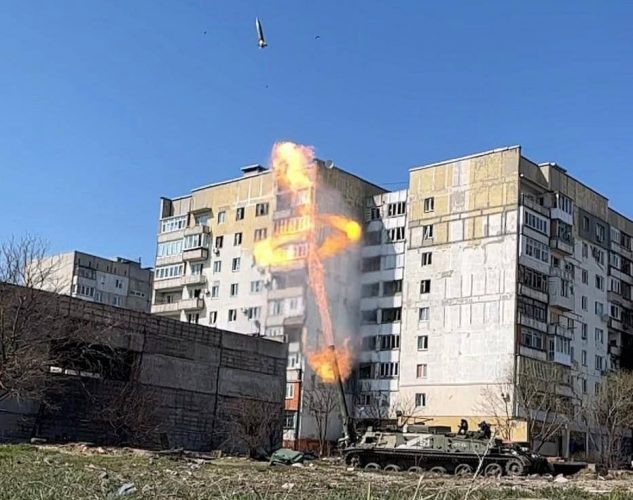
Russian forces have gained control of what is left of the city of Severodonetsk as they advance in the Donbas region of Ukraine, our correspondent on the ground Johnny Miller reports.
Severodonetsk, which has seen some of the fiercest clashes of the war so far, lies mostly in ruins, resembling a post-apocalyptic wasteland. On the outskirts of the city one can see ruins of a grain silo.
Russia and Ukraine blame each other for the destruction of the city. However, eyewitnesses put the blame for the destruction on “sly” Ukrainian forces.
“Ukraine acted in a sly way. They would bring a howitzer here, fire and then leave. Then Russia would strike and they would say Russia is bombing civilians. They were occupying kindergartens and would fire from there,” a local resident told Miller who visited the war-torn city.
Another local resident said Ukrainian troops occupied local homes and fired shots from them. “They made them sit in the basement and then took over their flats. They put mortars on the roofs and fired. We don’t know what Russia did. We didn’t see them until we returned.”
In the meantime, Russia says the Kiev forces shoot rockets at and shell the infrastructure in the eastern territories it flees from.
While the focus of the war, now in its fifth month, has moved to Ukraine’s eastern Donbas, Russian forces have been striking cities elsewhere in the country with missiles and rockets.
As the conflict continues to rage across various parts of Ukraine, Russia’s Defense Minister Sergei Shoigu ordered military units to intensify operations to prevent Ukrainian strikes on territories in eastern Ukraine and other areas in the hands of Russia, according to a statement from the ministry.
“The Russian defense ministry gave the necessary instructions to ramp up the actions of groups in all operational areas in order to exclude the possibility of the Kiev regime launching massive rocket and artillery strikes on civilian infrastructure and residents of settlements across Donbas and other regions,” said the statement.
EU approves another 500 million euros in military aid to Ukraine
Press TV – July 19, 2022
The European Union has approved another 500 million euros to supply arms to Ukraine, taking the bloc’s total financial support for Kiev to 2.5 billion euros.
The money will be disbursed via the so-called European Peace Facility, as EU rules prevent the bloc from using its seven-year budget to fund military operations.
The EU approved its first tranche of aid to Ukraine just after Russia launched its special military operation in the country’s eastern Donbas region in late February.
The new pledge comes despite the fact that half of the seven-year facility has been already given to Ukraine in just five months since the conflict started.
Apart from supplying financial aid, the EU has also imposed a wide range of sanctions on Moscow in support of Kiev.
The bans, however, have so far backfired, with inflation across the continent hitting record highs on top of an unprecedented devaluation of the euro.
There is growing disquiet in the EU regarding the negative impact that the sanctions against Russia are having on the European Union’s economy.
Ukraine plots partnership with Big Tech, a cashless society, and the use of AI to assess criminals
By Didi Rankovic | Reclaim The Net | July 18, 2022
Ukraine hopes to team up with Big Tech for some big plans to make the war-torn country “digitally indestructible,” reports citing statements made by officials during recent conferences suggest.
The main goal is to move towards a cashless society by introducing non-crypto digital money, and use AI systems even for purposes like producing “pre-trial and pre-sentencing reports assessing the risk of a suspect re-offending.”
An initiative, called “Digital4Freedom” was presented by Ukraine’s Deputy PM and Minister of Digital Transformation Mykhailo Fedorov in Switzerland. Fedorov is described as long-time friend of President Volodymyr Zelensky and a fellow enthusiast in ushering it ever greater levels of digitalization.
The initiative appears very ambitious, and optimistic: it is to make Ukraine “the most digital state in the world,” and that has been the pitch made to the audience in Lugano, who were asked to contribute funds and cooperate on forging a “digital Marshall plan” for Ukraine.
The general promise is that in the future, the Ukrainian government and Big Tech will be “closely interlinked,” while turning the country into “a European Israel.”
The push presented by Fedorov is to make Ukraine 100 percent digital, and he has a lot of faith in storing data on Amazon’s and Microsoft’s severs, which he says “cannot be destroyed by missiles.”
The plan is to allow Ukrainians to use digital services for all administrative tasks, like car, property, and land registration, paying customs duties and starting businesses.
More sectors slated for similar transformation, other than the payments system that is supposed to completely do away with paper money, are education and healthcare.
In his own appeals made on several occasions, Zelensky made it clear he expects Big Tech to build this infrastructure. According to reports, Fedorov left out mentioning Big Tech by name as he asked for donations and funding.
Even though appearing to address an eager audience, one part of the plan that was viewed with some apprehension is the judiciary using AI in risk assessment.
Fedorov’s name for this portion of the presentation was, “Judge Dredd.” Fair Trials seems to agree that’s what it might turn into, and expressed concern, saying that using AI for this purpose should be banned, as it “undermines the fundamental right to be presumed innocent.”
Ukraine, meanwhile, already has pilots that “produce pre-trial and pre-sentencing reports assessing the risk of a suspect re-offending,” the reports say.
UK testing drone swarms in Ukraine might lead to escalation
By Drago Bosnic | July 18, 2022
Air superiority is how the political West wages war. US and UK air power has been instrumental in all wars waged by the two leading Western imperialist thalassocracies since the Second World War to this day, although it existed doctrinally since at least the 1920s. This is so ingrained in their concept of warfare that it’s considered nearly impossible for them to lead a successful military campaign without it. This stands in stark contrast to most other comparable military doctrines, particularly the Russian one.
The Nazi onslaught destroying much of their air force before it got the chance to take off forever changed the way Russians see air power. Realizing (over)reliance on it can have a detrimental effect, coupled with the devastating consequences of American and British firebombing of German cities, which in some cases had an effect no less destructive than nuclear weapons (minus the radiation), Russia’s post-WWII military doctrine adopted a distinct and (up until recently) unique focus on advanced air defenses. Since then, Russia has been developing top-notch SAM (surface-to-air missile) systems, some of which are so advanced they effectively nullify the entire Western air dominance concept. And although Western state-run mass media love to downplay this, the very fact US legislation directly and very specifically targets these systems with sanctions speaks volumes.
The proliferation of these systems is a strategic nightmare for aggressive Western planners, who can’t simply bypass them without incurring “unacceptable losses”. In order to counter Russian SAMs, Western Military-Industrial Complexes have been working on a plethora of new systems. Some prominent examples include advanced drones, particularly miniature ones, which are also planned to operate in swarms, saturating hostile air defenses and paving the way for the more traditional aviation to bomb its way through enemy ground forces.
RAF (Royal Air Force) experiments with drone swarms show “they can overwhelm enemy defenses” and the concept would be ready for action in a war, according to the UK military service’s Chief of Staff. Air Chief Marshall Sir Mike Wigston told the Global Air and Space Chiefs’ Conference 2022 in London last week that the RAF’s 216 Test and Evaluation Squadron and the Rapid Capabilities Office trialed five drone types in 13 experiments with various payloads and equipment over three years. According to Wigston, this yielded enough insights for the service to declare an “operationally useful and relevant capability,” using its current fleet of drones.
“We are exploring new models of capability delivery and accelerated production ‘when we need them’ rather than ‘in case we need them,’ from the twin jet 3D-printed Pizookie, to commercially available large drones fitted with novel payloads, to large quadcopters,” Wigston stated.
“The problem of overcoming air defenses is a key obstacle to employing [air] power. Planning for air operations increasingly entails ensuring that planes can fly safely in the first place, putting at risk untold amounts of money that militaries have pumped into beefing up their fleets to fourth- and fifth-generation technology. That conundrum is on display in Ukraine, where Ukrainian and Russian air-defense capabilities are effectively canceling out the other side’s air power arsenal,” according to Justin Bronk, a defense analyst with the London-based Royal United Services Institute.
“The fact air power has been mutually denied, relatively speaking, in Ukraine by both sides has far more serious implications for us than for either [Russians or Ukrainians]. That’s because both militaries are ultimately dependent on massive land manpower and artillery, whereas joint forces of the UK and other Western powers are critically dependent on having air access and air superiority,” Bonk said at the London conference on July 13.
“Swarming, which means throwing enough expendable drones at a defensive radar and interceptor position so as to overwhelm them, can be effective, but only to a point. The idea of small and cheap drones attacking air defenses by way of swarming may not be feasible because those drones lack the requisite range and speed. If you want things to go fast and far, they’re going to be jet-propelled and they’re going to cost a fair bit. Getting drone swarms close enough to sophisticated air defenses with a range of hundreds of kilometers requires risky and potentially pricy insertion tactics that negate the widely cited cost benefit of cheap, small drones,” he added.
Western strategists are closely following their latest proxy war against Russia, trying to devise new strategies to fight the Eurasian giant. The deployment of never-before-seen ISR (intelligence, surveillance, reconnaissance) assets around Russia’s borders is a testament to that. In addition, increasing reliance on unmanned systems isn’t just the result of Western militaries trying to adopt new technologies. With NATO having severe manpower problems, drones might be the only way for members to have functional militaries in the near future. The UK itself is faced with this issue, having a very limited ground force with barely a few combat-ready brigades, to say nothing of other micro-satellites carved up after the dismantling of post-socialist federal states.
What’s truly dangerous at this point is the possible deployment of these systems to Ukraine. Most NATO weapons deliveries happened weeks or months before they were officially announced. Thus, it’s highly likely the same is true in this case. How Russia might react is up for debate, but it most certainly won’t take it kindly, which opens up new possibilities for escalation, particularly in the context of the latest controversial statements coming from the UK.
Drago Bosnic is an independent geopolitical and military analyst.
Germany and France ‘killed’ Minsk agreements – Russia
Samizdat | July 18, 2022
Germany is demanding that Russia guarantee Ukraine’s territorial integrity, but such a deal was previously signed, only to be “killed” by Berlin and Paris, Russian Foreign Minister Sergey Lavrov said on Monday.
“When [German Chancellor] Olaf Scholz demands that Russia should be compelled to sign an agreement granting Ukraine guarantees of territorial integrity and sovereignty, all his attempts are in vain. There was already such a deal – the Minsk agreements – which was killed by Berlin and Paris. They were shielding Kiev, which openly refused to comply,” he wrote in an op-ed for the Russian newspaper Izvestia.
Russia, Germany and France brokered the 2015 Minsk agreements between Ukraine and Donbass, which were designed to put an end to hostilities. But according to Lavrov, Berlin and Paris failed to ensure Kiev’s compliance.
The Russian foreign minister noted that former Ukrainian President Petro Poroshenko admitted the Minsk agreements meant nothing for Kiev, and Ukraine used them only to buy time.
“Our task was to stave off the threat… to buy time to restore economic growth and create powerful armed forces. This task was achieved. The Minsk Agreements have fulfilled their mission,” Poroshenko said in June.
Lavrov also mentioned that in December 2019, Ukrainian President Volodymyr Zelensky had a chance to fulfil the Minsk agreements at the so-called Normandy format summit held in Paris. After negotiations with leaders of Russia, Germany and France, Zelensky pledged to resolve issues surrounding the special status of Donbass. “Of course, he did nothing, and Berlin and Paris were shielding him once again,” he noted.
The Minsk agreements included a series of measures designed to rein in hostilities in Donbass and reconcile the warring parties. The first steps were a ceasefire and an OSCE-monitored pullout of heavy weapons from the frontline, which were fulfilled to some degree.
Kiev was then supposed to grant a general amnesty to the rebels and extensive autonomy for the Donetsk and Lugansk regions. Ukrainian troops were supposed to take control of the rebel-held areas after Kiev granted them representation, and otherwise reintegrate them as part of Ukraine.
Poroshenko’s government refused to implement these portions of the deal, claiming it could not proceed unless it fully secured the border between the breakaway republics and Russia. He instead endorsed an economic blockade of the rebel regions, initiated by Ukrainian nationalist forces.
Zelensky’s presidency gave an initial boost to the peace process, but stalled after a series of protests by right-wing radicals, who threatened to depose the new Ukrainian president if he tried to deliver on his campaign promises.
Kiev’s failure to implement the roadmap, and the continued hostilities with rebels, were among the primary reasons cited by Russia when it attacked Ukraine in late February. Days before launching the offensive, Moscow recognized the breakaway Ukrainian republics as sovereign states, offering them security guarantees and demanding that Kiev pull back its troops. Zelensky refused to comply.
Featured Video
New positive ivermectin evidence
or go to
Aletho News Archives – Video-Images
From the Archives
Fanatical Followers of the Covid Regime: A Jim Jones-Style Cult?
By Professor Roger Watson and Dr. Niall McCrae | The Daily Sceptic | November 15, 2021
As scholars at leading British universities over recent decades, we witnessed the replacement of critical thinking and debate by narrative: facts are discrimination and scientific method is imperialism; truth, instead, is derived from ‘progressive’ values. This educational trend may be a major contributory factor to the ease in which society has been inculcated to the Covid ‘new normal’ of masking, testing, and repeated doses of vaccines for a disease of similar risk to severe influenza.
One doesn’t need much critical reasoning to observe the flawed logic of some vaccination enthusiasts, such as people who respond to experiencing any side effects, however debilitating, by saying “at least I know it’s working”, or, after contracting the disease despite their promised inoculation (over 90% effective, according to initial drug company claims), “I’d have been worse off without the jab.” … continue
Blog Roll
 Aletho News
- Arctic Scare Stories Melt Away
- Wrong, Euronews: Climate Change Has Not Created a Food, Energy, and Economic “Meta-Crisis”
- New positive ivermectin evidence
- Met Office Caught Fabricating Daily Temperature Record Claims
- Merck Virologists Admitted to Falsely Certifying Vaccine Efficacy
- Mandatory Folic Acid for every man, woman & child
- Pro-Palestine protesters arrested outside UK’s ruling Labour Conference in Liverpool
- Mauritius denies landing permit to flight from Israel, forcing cancellation: Tour operator
- Israeli finance minister calls for genocidal war on West Bank, annexation of south Lebanon
- 12 Things Your Psychiatrist Was Trained Not to Tell You
- If Americans Knew
- Israel forces Gazans to live in constant peril – Daily Update
- Deconstructing Netanyahu’s pants-on-fire UN rant – Daily Update
- Trump betrayed voters with his campaign lies and prioritized a foreign country once he took office
- Netanyahu calls Israel’s war in Gaza ‘opposite of genocide’ in UN speech to near-empty hall
- Settler Kidnappings: Torture, Sexual Abuse and Terrorisation of Palestinian Abductees as Israel Deepens Annexation of West Bank
- Gaza winter nears as 162,000 tents become unusable, raising fears of humanitarian crisis
- Netanyahu says, “It’s the opposite of genocide”; UN says Gaza economy is world’s ‘most severe crisis on record’ – Daily Update
- Israel’s US-Backed Assault on Gaza Has Created the ‘World’s Most Severe Economic Crisis on Record’: UN
- ‘Protecting U.S. Citizens’… From Israel
- ‘This is where I live now, the back of a truck’: a day in the life of a grandmother in Gaza
- No Tricks Zone
- New Study: Earth And Venus Surface Warmth Largely Explained By Convection And Lapse Rate, Not CO2 Or Radiation
- 2025 Nature Paper Claiming Worsening Global Drought Gets RETRACTED …Heavily Flawed
- New Study: ‘Global Drought Shows No Detectable Recent Acceleration Under Climate Warming’
- Economic Masterminds: German Socialists Suggest Taxing Productivity Gains Stemming From Using AI
- The South China Sea Has Not Been Cooperating With The Climate Change Narrative
- Energy Crisis: Germany Enters Heating Season With Historically Low Gas Reserve Fill Levels
- New Study: The Antarctic Ice Sheet Gained Mass From 2020-2024 Due To Staggering Snow And Ice Accumulation
- Study: Ocean Heating Rates From Thousands Of Years Ago ‘Dwarf’ Modern Ocean Heating Rates
- Climate Extremists Target, Attack Large-Scale Power Grid Infrastructure In Germany!
- New Study: Antarctic Ice Melt Has Contributed Less Than 1 Centimeter To Sea Level Rise In The Last 30 Years

