Ukraine’s Opposition Accuses US of Scrubbing Info About Biolabs’ Activities on Ukrainian Territory
Sputnik – 27.04.2020
The US Embassy in Kiev has been caught in the center of a brewing political scandal after denying allegations about US biological laboratories’ “unlawful activity” in Ukraine, while admitting that such labs do exist.
The US Embassy in Kiev has scrubbed information about the work of two of its biolabs in Ukraine from its website, Viktor Medvedchuk, co-leader of the Opposition Platform – For Life party, has alleged.
According to the lawmaker, in its April 22 statement responding to Rada lawmakers’ mid-April request for a government investigation into the 15 US biolabs operating on Ukrainian territory, the US Embassy provided a link to an explanation about the operation of its ‘Biological Threat Reduction Program’. There are two interesting facts associated with the document, Medvedchuk alleges – first, that the webpage was created on April 9, 2020, three days before lawmakers made their request for a government inquiry, and second, that there are discrepancies between the English and Ukrainian versions of the pages.
“The Ukrainian-language document appeared earlier, but in 2017 featured another version of the document, now deleted, including the text ‘Consolidation of particularly hazardous pathogens in modern biosafety level facilities (one level three biosafety lab for human pathogens and one level three biosafety lab for animal pathogens)’,” Medvedchuk explained in a statement Monday.
“In other words, in 2017, the US Embassy not only openly curated at least two level three biolabs, but openly stated this. This is not proof that there have not been other, more dangerous laboratories, or that these laboratories have not conducted experiments with pathogens presenting the maximum level of danger, but it does indicate a desire by the US Embassy to remove information that compromises them,” Medvedchuk claimed.
Well-known Ukrainian pundit wonders what 15 biolabs funded by the Pentagon are doing in Ukraine.
In response to MP’s request for info, the US embassy said this is a matter of safe storage and research.
FB post: https://t.co/zetsWPxeJI
News article: https://t.co/9AQKpbvCmn pic.twitter.com/Pssc49yPT7
— Nina ☦️ Byzantina (@NinaByzantina) April 24, 2020
Ukraine’s Opposition Platform – For Life requested a government probe into the operation of US biolabs in Ukraine on April 15, claiming that since these labs’ deployment, Ukraine has faced mysterious outbreaks of otherwise inexplicable dangerous diseases, such as the 2009 outbreak of hemorrhagic pneumonia, the 2011, 2014 and 2015 cholera outbreaks, and an outbreak of hepatitis A in 2017. In early 2016, at least 20 Ukrainian servicemen were reported to have died from a flu-like virus, with 364 more people succumbing to swine flu months later. “The Ukrainian people have the right to know about secret programs,” the opposition lawmakers’ appeal stressed.
In its April 22 reply, the US Embassy accused Opposition Platform MPs of spreading “disinformation,” while admitting that a Department of Defence Biological Threat Reduction Program is working “with the Ukrainian Government to consolidate and secure pathogens and toxins of security concern in Ukrainian government facilities.”
In his comments Monday, Medvedchuk suggested that the alleged creation of a separate level 3 lab for human pathogens may indicate experimentation on human beings. “This is the main reason for the creation of US biolabs in Ukraine, serving as an opportunity to carry out the most dangerous kinds of studies, including studies on human beings, which are prohibited under US laws, but allowed in Ukraine, due to problems in Ukrainian legislation, but to a greater extent, to Ukraine’s foreign control by the United States,” he claimed.
Shady US Labs Across Post-Soviet Space
The Ukrainian lawmakers’ allegations aren’t the first of their kind. In 2018, Georgia’s former minister of state security asked President Trump to investigate reports that personnel from the US’s Lugar Center biological lab outside Tbilisi had engaged in experimentation on live human test subjects.
In September 2018, the Russian Foreign Ministry said it had its suspicions about possible US testing of biological weapons in states near Russia’s borders, and warned Washington to halt such activities immediately.
In March, Iranian doctors penned a letter to the leaders of Afghanistan, Georgia, Iraq, Kazakhstan, Kyrgyzstan and Pakistan to destroy all US biololabs in their countries, claiming that the coronavirus pandemic may have been spread deliberately as a form of biological warfare.
Earlier this month, Russian Foreign Ministry spokeswoman Maria Zakharova warned Washington that Russia was apprised of US efforts to expand military research at the Lugar Lab, and said that the US has substantially expanded dual purpose biological research at labs across the former Soviet space under the pretext of combating bioterrorism.
Netherlands-Led JIT Biased Towards Russia, Ignored Massive Data on MH17 Crash Handed Over by Moscow
Sputnik – March 6, 2020
Moscow has expressed readiness to provide all the relevant data on the MH17 crash since the day of the catastrophe, including radar data and information about weapons allegedly used to down the plane, but the investigative team repeatedly ignored these offers or disregarded the data obtained in its conclusions.
The Russian Public Prosecutor’s Office has slammed the Joint Investigative Team (JIT) led by the Netherlands for ignoring huge amounts of data transferred by Moscow to Amsterdam prosecutors about the MH17 crash in Ukraine in 2014. According to them, this situation clearly demonstrates the JITs attitude towards Russia.
“Most of the data was ignored by the JIT, whose members demonstrated their selective approach towards evidence in the case from the very beginning, as well as clearly biased attitude towards Russia and its attempts to uncover the true cause of the aviation tragedy”, a statement by the Public Prosecutor’s Office reads.
The Public Prosecutor’s Office also noted that JIT refused to pass along case materials on three Russian citizens, accused by the team of being responsible for the jet’s crash, and added that this decision can’t be appealed in a national court. The first hearing against the three Russians and one Ukrainian citizen in the case will take place in The Hague on 9 March despite concerns about the coronavirus outbreak in the country. Officials from the Prosecutor Office’s clarified that Russia is not taking part in this trial and its decisions have no legal power in the country.
Earlier, Russian Foreign Ministry spokeswoman Maria Zakharova accused the Netherlands of trying to pressure the court in The Hague ahead of the MH17 hearing.
“I’d like to comment on the actions by Netherlands’ authorities, which clearly indicate of their attempts to pressure the court in The Hague. We see how an information campaign in the Netherlands is gaining pace ahead of the court hearing on 9 March regarding the MH17 crash”, she stated.
Zakharova further clarified that the pressure campaign was initiated by the Dutch Prosecution Service, which is leading the JIT. According to her, the campaign aims to form a specific public opinion on the subject and to possibly secure the “so-called success” of the six-year-long investigation.
MH17 Tragedy
Malaysia Airlines Flight MH17, carrying 298 people on board, was shot down on 17 July 2014 as it was flying over eastern Ukraine, which was engulfed in a military conflict between the Ukrainian Army and the Donetsk People’s Republic (DPR). Following the crash, Ukraine delegated the investigation into the incident to the Dutch Safety Board (DSB) in the Netherlands, which lost 193 citizens in the incident.
The DSB concluded that the plane was downed by a 9N314M missile fired by a Soviet-made Buk 9M38-series air defence system, but failed to specify the launch site. Later, the Joint Investigation Team (JIT) made up of the Netherlands, Belgium, Ukraine, Australia, and Malaysia was formed to conduct a criminal investigation into the case and to determine who was responsible for the tragedy. However, Russia, which assisted the DSB investigation, was left out of the group, despite the fact that it was ready to provide useful data on the incident.
Western governments were quick to accuse the Donetsk People’s Republic of shooting down the plane even before the investigators drafted preliminary reports on the cause of the crash, claiming that Russia had fostered the tragedy by allegedly providing weaponry to DPR forces.
Moscow has repeatedly denied involvement in the incident and called for an unbiased investigation to be conducted. In addition, Russia provided vast amounts of data such as radar feeds from the area of the crash and info on the Buk 9M38-series air defence system showing that it couldn’t have been used to down the MH17 Boeing 777. However, the JIT ignored most of the information.
In 2018, the JIT released a report claiming that the missile that shot down MH17 was launched by DPR forces and that the Buk launcher had been delivered from Russia. Moscow stated that it couldn’t accept the results of the investigation, slamming it as politically motivated and biased, pointing out that the investigative team had based its accusations on unverified social media photos and videos, as well as assertions by the Ukrainian government. The prime minister of Malaysia, which lost 43 people in the tragedy, was also disappointed by the results of the investigation, which he called “politicised”.
In the final report, published on 18 June 2019, the JIT accused three Russians and one Ukrainian of being responsible for the jet’s crash, issuing international arrest warrants for them. Russian President Vladimir Putin condemned the report for failing to address “a lot of questions” that were left unanswered, such as why Ukraine had allowed the plane to fly over an active war zone in the first place. The president also slammed the JIT for failing to consider Russia’s account of events, arguing that they were simply “appointing perpetrators” instead of trying to establish what actually happened on the day of the crash.
Don’t Hold Your Breath for ‘World War III’: World War IV Has Already Begun
By A. B. Abrams | The Saker Blog | February 27, 2020
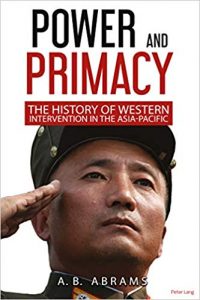
“A. B. Abrams is the author of the book ‘Power and Primacy: A History of Western Intervention in the Asia-Pacific.’ His second book covering the history of the United States’ conflict with North Korea is scheduled for publication in 2020.
He is proficient in Chinese, Korean and other East Asian languages, has published widely on defence and politics related subjects under various pseudonyms, and holds two related Masters degrees from the University of London.”
 The world today finds itself in a period of renewed great power conflict, pitting the Western Bloc led by the United States against four ‘Great Power adversaries’ – as they are referred to by Western defence planners – namely China, Russia, North Korea and Iran. This conflict has over the past 15 years escalated to encompass the military, economic and information spheres with global consequences – and appears to be coming to a head as signs of peaking tensions appear in multiple fields from military deployments and arms races to harsh economic wars and a harsher still information war.
While the term ‘World War III’ has been common since the 1940s, referring to the possibility of a global great power war on a greater scale than the first and second world wars, the Cold War between the Western and Soviet Blocs was at its height as total, as global and as heated as the prior conflicts. As weapons technology has evolved, the viability of a direct shooting war has diminished considerably – forcing major powers to seek alternative means to engineer their adversaries’ capitulation and assert their own dominance. This has been reflected in how the Cold War, and the current phase of global conflict some refer to as ‘Cold War 2’ have been distinct from the first two world wars despite the final objectives of the parties involved sharing many similarities. I would thus suggest redefining what a ‘world war’ is and acknowledging that this current phase of global conflict is every part as intense as the great power ‘hot wars’ waged in the first half of the 20th century.
Had the intercontinental range ballistic missile and the miniaturised nuclear warhead been invented twenty years earlier, the Allied Powers may have needed to rely more heavily on economic and information warfare to contain and eventually neutralise Nazi Germany. The Second World War would have been very different in nature to reflect the technologies of the time. When viewed from this paradigm, the Cold War can be seen as a ‘Third World War’ – a total conflict more vast, comprehensive and international than its predecessors stretched out over more than 40 years. The current conflict, or ‘World War IV,’ is ongoing. An assessment of prior ‘great power wars,’ and the unique nature of the current conflict, can provide some valuable insight into how warfare is evolving and the likely determinants of its victors.
As of 2020 it is clear that great power conflict has become almost as heated as it can short of an all-out hot war – with the Western Bloc applying maximum pressure on the information, military and economic fronts to undermine not only smaller adversaries such as Venezuela and Syria and medium sized ones such as North Korea and Iran, but also China and Russia. When exactly this phase of conflict began – sometime after the Cold War’s end – remains uncertain.
The interval between the third and fourth ‘world wars’ was considerably longer than that between the second and the third. This was due to a number of factors – primarily that there was no immediate and obvious adversary for the victorious Western Bloc to target once the Soviet Union had been vanquished. Post-Soviet Russia was a shade of a shadow of its former self. Under the administration of Boris Yeltsin the country’s economy contracted an astonishing 45% in just five years from 1992 (1) leading to millions of deaths and a plummet in living standards. Over 500,000 women and young girls of the former USSR were trafficked to the West and the Middle East – often as sex slaves (2), drug addiction increased by 900 percent, the suicide rate doubled, HIV became a nationwide epidemic (3) corruption was rampant, and the country’s defence sector saw its major weapons programs critical to maintaining parity with the West delayed or terminated due to deep budget cuts (4). The possibility of a further partition of the state, as attested to multiple times by high level officials, was very real along the lines of the Yugoslav model (5).
Beyond Russia, China’s Communist Party in the Cold War’s aftermath went to considerable lengths to avoid tensions with the Western world – including a very cautious exercise of their veto power at the United Nations which facilitated Western led military action against Iraq (6). The country was integrating itself into the Western centred global economy and continuing to emphasis the peaceful nature of its economic rise and understate its growing strength. Western scholarship at the time continued to report with near certainty that internal change, a shift towards a Western style political system and the collapse of party rule was inevitable. The subsequent infiltration and westernisation was expected to neuter China as a challenger to Western primacy – as it has other Western client states across the world. China’s ability to wage a conventional war against even Taiwan was in serious doubt at the time, and though its military made considerable strides with the support of a growing defence budget and massive transfers of Soviet technologies from cash strapped successor states, it was very far from a near peer power.
North Korea did come under considerable military pressure for failing to follow what was widely referred to as the ‘tide of history’ in the West at the time – collapse and westernisation of the former Communist world. Widely portrayed in the early 1990s as ‘another Iraq’ (7), Western media initially appeared to be going to considerable lengths to prepare the public for a military campaign to end the Korean War and impose a new government north of the 38th parallel (8). Significant military assets were shifted to Northeast Asia specifically to target the country during the 1990s, and the Bill Clinton administration came close to launching military action on multiple occasions – most notably in June 1994. Ultimately a combination of resolve, a formidable missile deterrent, a limited but ambiguous nuclear capability, and perhaps most importantly Western certainty that the state would inevitably collapse on its own under sustained economic and military pressure, deferred military options at least temporarily.
The fourth of the states that the United States today considers a ‘greater power adversary,’ Iran too was going to considerable lengths to avoid antagonism with the Western Bloc in the 1990s – and appeared more preoccupied with security threats on its northern border from Taliban controlled Afghanistan. With a fraction of the military power neighbouring Iraq had previously held, the presence of an ‘Iranian threat’ provided a key pretext for a Western military presence in the Persian Gulf after the Soviets, the United Arab Republic and now Iraq had all been quashed. With the new government in Russia put under pressure to terminate plans to transfer advanced armaments to Iran (9), the country’s airspace was until the mid 2000s frequently penetrated by American aircraft, often for hours at a time, likely without the knowledge of the Iranians themselves. This combined with a meagre economic outlook made Iran seem a negligible threat.
While the Cold War ended some time between 1985 and 1991 – bringing the ‘third world war’ to a close – the range of dates at which one could state that the ‘fourth world war’ began and the West again devoted itself to great power conflict is much wider. Some would put the date in the Summer of 2006 – when Israel suffered the first military defeat in its history at the hands of the Lebanese militia Hezbollah. Using North Korean tunnel and bunker networks, command structures, weapons and training (10), and bolstered by Iranian funding and equipment, the shock of the militia’s victory, though underplayed in Western media, reverberated among informed circles across the world.
Others would place the date two years later in 2008 during the Beijing Summer Olympics, when Georgia with the full support of the West waged a brief war against Russia – and Moscow despite harsh warnings from Washington and European capitals refused to back down on its position. Post-Yeltsin Russia’s relations with the Western Bloc had appeared relatively friendly on the surface, with President George W. Bush observing in 2001 regarding President Vladimir Putin that he “was able to get a sense of his soul,” and predicting “the beginning of a very constructive relationship.” Nevertheless, signs of tension had begun to grow from Moscow’s opposition to the Iraq War at the UN Security Council to President Putin’s famous ‘Munich Speech’ in February 2007 – in which he sharply criticised American violations of international law and its “almost uncontained hyper use of force in international relations.”
It could also be questioned whether, in light of what we know about Western support for separatist insurgents in Russia itself during the 1990s, the war against the country ever ended – or whether hostilities would only cease with a more total capitulation and partition and with the presence of Western soldiers on Russian soil as per the Yugoslav precedent. As President Putin stated in 2014 regarding continuing Western hostilities against Russia in the 1990s: “The support of separatism in Russia from abroad, including the informational, political and financial, through intelligence services, was absolutely obvious. There is no doubt that they would have loved to see the Yugoslavia scenario of collapse and dismemberment for us with all the tragic consequences it would have for the peoples of Russia” (11). Regarding Western efforts to destabilise Russia during the 1990s, CIA National Council on Intelligence Deputy Director Graham E. Fuller, a key architect in the creation of the Mujahedeen to fight Afghanistan and later the USSR, stated regarding the CIA’s strategy in the Caucasus in the immediate post-Cold War years: “The policy of guiding the evolution of Islam and of helping them against our adversaries worked marvellously well in Afghanistan against the Red Army. The same doctrines can still be used to destabilize what remains of Russian power” (12). The U.S. Congressional Task Force on Terrorism and Unconventional Warfare’s director, Yossef Bodansky, himself also detailed the extent of the CIA’s strategy to destabilize Central Asia by using “Islamist Jihad in the Caucasus as a way to deprive Russia of a viable pipeline route through spiralling violence and terrorism” – primarily by encouraging Western aligned Muslim states to continue to provide support for militant groups (13).
Much like the Cold War before it, and to a lesser extent the Second World War, great powers slid into a new phase of conflict rather that it being declared in a single spontaneous moment. Did the Cold War begin with the Berlin Blockade, the Western firebombing of Korea or when the atomic bombs were dropped on Hiroshima and Nagasaki – which accelerated the move into a nuclear arms race. Equally, multiple dates were given for the opening of the Second World War – the German invasion of Poland in 1939, the beginning of the Sino-Japanese war two years prior, the Japanese Empire’s attack on Pearl Harbour and conquest of Southeast Asia which marked the first major expansion beyond Europe and North Africa in 1941, or some other date entirely. The slide into a new world war was if anything even slower than its predecessors.
The shift towards an increasingly intense great power conflict has been marked by a number of major incidents. In the European theatre one of the earliest was the Bush administration’s withdrawal from the Anti-Ballistic Missile treaty in 2002 and subsequent deployment of missile defences and expansion of NATO’s military presence in the former Soviet sphere of influence, which was widely perceived in Russia as an attempt to neutralise its nuclear deterrent and place the Western Bloc in a position to coerce Moscow militarily (14). This threatened to seriously upset the status quo of mutual vulnerability, and played a key role in sparking a major arms race under which Russia would develop multiple classes of hypersonic weapon. Their unveiling in 2018 would in turn lead the United States to prioritise funding to develop more capable interceptor missiles, a new generation of missile defences based on lasers, and hypersonic ballistic and cruise missiles of its own (15).
Another leading catalyst of the move towards great power confrontation was the Barak Obama administration’s ‘Pivot to Asia’ initiative, under which the bulk of America’s military might and considerable assets from the rest of the Western world would be devoted to maintaining Western military primacy in the Western Pacific. This was paired with both economic and information warfare efforts, the latter which increasingly demonised China and North Korea across the region and beyond and actively sought to spread pro-Western and anti-government narratives among their populations through a wide range of sophisticated means (16). These programs were successors to those sponsored by Western intelligence agencies to ideologically disenchant the populations of the Warsaw Pact and Soviet Union with their own political systems and paint Western powers as benevolent and democratising saviours (17). Economic warfare also played a major role, with efforts centred around the ‘Trans-Pacific Partnership’ trade deal – or ‘Economic NATO’ as several analysts referred to it – to isolate China from regional economies and ensure the region remained firmly in the Western sphere of influence (18). The military aspect of the Pivot to Asia would reawaken long dormant territorial disputes, and ultimately lead to high military tensions between the United States and China which in turn fuelled the beginning of an arms race. This arms race has more recently led to the American withdrawal from the Intermediate-Range Nuclear Forces treaty, which paves the way for deployment of American long-range missiles across the Western Pacific – all with China and North Korea firmly in their crosshairs (19).
It is arguably in the Middle East, however, where the new phase of global conflict has seen its most direct clashes so far. The nine-year conflict in Syria, although far less destructive or brutal, provides ‘World War IV’ with something of an analogue to the Korean War in the Cold War. The conflict has united the Western Bloc and a wide range of allies, from Turkey and Israel to the Gulf States and even Japan (which funds the jihadist-linked White Helmets) (20), in an effort to overthrow an independent government with close and longstanding defence ties to Russia, North Korea, Iran and China. The conflict has seen North Korean, Russian, Hezbollah and Iranian special forces (21) among other assets deployed on the ground in support of Syrian counterinsurgency efforts, with all of these parties providing considerable material support (the Koreans have built and fully staffed at least three hospitals as part of large medical aid packages and continue to be a major supplier of arms and training) (22). China too, particularly concerned by the presence of jihadist militants of Chinese origin in Syria, has played some role in the conflict – the exact details of which remain uncertain with much reported but unconfirmed (23).
Syria’s insurgency involving a range of jihadist groups, at times united only by their intent to end the secular Syrian government, have received widespread support from the Western Bloc and their aforementioned allies. This has involved both material support, which according to State Secretary Hillary Clinton included turning a blind eye to Gulf countries’ considerable assistance to the Islamic State terror group (24), and active deployments of special forces from a wide range of countries, from Belgium and Saudi Arabia to Israel and the U.S. The U.S., European powers, Turkey and Israel have at times directly attacked Syrian units in the field – while Russian reports indicate that close Western coordination with jihadist groups has been used to facilitate a number of successful attacks on Russian positions (25). The conflict in Syria arguably represents a microcosm of the macrocosm which is a new world war – one which pits the Western Bloc and those which support the Western-led order, both directly and through local proxies, against three of its four ‘great power adversaries’ in the field.
‘World War IV’ is unlikely to come to an end for the foreseeable future, and its final outcome remains difficult to predict. Much like in the Cold War, the Western Bloc retains considerable advantages – today most notably in the field of information war which allows it to extensively shape perceptions of the vast majority of the world’s population. This has included the demonization of Western adversaries, the whitewashing of Western crimes both domestically and internationally, and portraying westernisation and increased Western influence as a solution to people’s frustrations from corruption to economic stagnation. This has been a key facilitator of the pro-Western protests engulfing states from Sudan and Algeria to Ukraine and Thailand. Economically too, only China among the Western Bloc’s major adversaries has posed a serious threat to Western primacy. Indeed, it remains highly questionable whether the other three could survive economically under Western pressure without Chinese trade and economic support.
Russia has made a considerable economic recovery since the 1990s, but remains a shadow of its former self in the Soviet era. The country’s leadership has succeeded in reforming the military, foreign ministry and intelligence services, but the economy, legal system and other parts of the state remain in serious need of improvement which, over 20 years after Yeltsin’s departure, cannot come soon enough. Even in the field of defence, the struggling economy has imposed serious limitations – and in fields such as aviation and armoured warfare the country is only beginning to slowly go beyond modernising Soviet era weapons designs and begin developing new 21st century systems (26). On the positive side, the country does remain a leader in many high end technologies mostly pertaining to the military and to space exploration, while Western economic sanctions have undermined the positions of Europhiles both among the elite and within the government and boosted many sectors of domestic production to substitute Western products (27).
In the majority of fields, the ‘Eastern Bloc’ have been pressed onto the defensive and forced to prevent losses rather than make actual gains. While preserving Venezuelan sovereignty, denying Crimea to NATO and preventing Syria’s fall have been major victories – they are successes in denying the West further expansion of its own sphere of influence rather than reversing prior Western gains or threatening key sources of Western power. Pursuing regime change in Venezuela and Ukraine and starting wars in the Donbasss and in Syria have cost the Western Bloc relatively little – the Ukrainians and client states in the Gulf and Turkey have paid the brunt of costs for the war efforts. Material equipment used by Western backed forces in both wars, ironically, has largely consisted of Warsaw Pact weaponry built to resist Western expansionism – which after the Cold War fell into NATO hands and is now being channelled to Western proxies. Libyan weaponry, too, was transferred to Western backed militants in Syria in considerable quantities after the country’s fall in 2011 – again minimising the costs to the Western Bloc of sponsoring the jihadist insurgency (28). The damage done and costs incurred by the Syrians, Hezbollah, Russia and others are thus far greater than those incurred by the Western powers to cause destruction and begin conflicts.
Syria has been devastated, suffering from issues from a return of polio to depleted uranium contamination from Western airstrikes and a new generation who have grown up in territories under jihadist control with little formal education. The war is a victory only in that the West failed to remove the government in Damascus from power – but Western gains from starting and fuelling the conflict have still far outweighed their losses. In the meantime, through a successful campaign centred around information warfare, the Western sphere of influence has only grown – with further expansion of NATO and the overthrow of governments in resource rich states friendly to Russia and China such as Libya, Sudan and Bolivia. Commandeering the government of poor but strategically located Ukraine was also a major gain, with states such as Algeria and Kazakhstan looking to be next in the Western Bloc’s crosshairs. Thus while Syria was saved, though only in part, much more was simultaneously lost. The damage done to Hong Kong by pro-Western militants, ‘thugs for democracy’ as the locals have taken to calling them, who have recently turned to bombing hospitals and burning down medical facilities (29), is similarly far greater than the costs to the Western powers of nurturing such an insurgency. Similar offensives to topple those which remain outside the Western sphere of influence from within continue to place pressure on Russian and Chinese aligned governments and on neutral states seen not to be sufficiently pro-Western.
While the Western Bloc appears to be in a position of considerable strength, largely by virtue of its dominance of information space, which has allowed it to remain on the offensive, a sudden turning point in which its power suddenly diminishes could be in sight. From teen drug abuse (30) to staggering debt levels (31) and the deterioration of party politics and popular media, to name but a few of many examples, the West appears at far greater risk today of collapse from within than it did during the Cold War. A notable sign of this is the resurgence of both far right and far left anti-establishment movements across much of the Western world. Despite massive benefits from privileged access to third world resource bases, from France’s extractions from Francophone West Africa (32) to the petrodollar system propping up American currency (33), Western economies with few exceptions are very far from healthy. A glimpse of this was given in 2007-2008, and little has been done to amend the key economic issues which facilitated the previous crisis in the twelve years since (34). The West’s ability to compete in the field of high end consumer technologies, particularly with rising and more efficient East Asian economies, increasingly appears limited. From semiconductors to electric cars to smartphones to 5G, the leaders are almost all East Asian economies which have continued to undermine Western economic primacy and expose the gross inefficiencies of Western economies. The result has been less favourable balances of payments in the Western world, a growing reliance on political clout to facilitate exports (35), and increasing political unrest as living standards are placed under growing pressure. The Yellow Vests and the rise of Donald Trump and Bernie Sanders are all symptoms of this. With very real prospects of another economic crash in the coming decade, in the style of 2008 but likely much worse, Western economies are expected to bear the brunt of the damage. Their ability to survive remains in serious question. Effects of a crash on North Korea, Iran, Russia and even China will be far less severe. While the previous crash hit Russia particularly hard (36), an economic turnaround from 2014 and the insulation provided by Western sanctions leave it far less vulnerable to the fallout from a Western economic crisis.
Ultimately China appears to be setting itself up for an ‘Eastern Bloc’ victory – a coup de grace which could see Western gains over the past several decades reversed and the power of the West itself diminished to an extent unprecedented in centuries. While the United States reluctantly outsourced much of its high end consumer technologies to East Asian allies during the Cold War – namely Japan, South Korea and Taiwan – China is going for the jugular of the Western world’s economy with its ‘Made in China 2025’ initiative, which will see some critical remaining fields of Western technological primacy shift to East Asian hands. The Coronavirus, bombings in Hong Kong, the trade war, and the wide range of tools in the Western arsenal for destabilisation can at best slightly delay this – but cannot prevent it. In a globalised capitalist economy the most efficient producers win – and East Asia and China in particular, with its Confucian values, stable and efficient political systems and world leading education (37), are thus almost certain to take over the high end of the world economy.
Much as the key to Western victory in the Cold War was successful information warfare efforts and isolation of the Soviet economy from the majority of the world economy, the key to determining the victor of ‘World War IV’ is likely lie in whether or not Beijing succeeds in its attempt to gain dominance of high end technologies critical to sustaining Western economies today. This is far from the only determinant of victory. Efforts to undermine the effective subsidies to Western economies from Central and West Africa, the Arab Gulf states and elsewhere in the third world, and to ensure continued military parity – to deter NATO from knocking over the table if they lose the game of economic warfare – are among the other fields of critical importance. Based on China’s prior successes, and those of other East Asian economies, the likelihood that it will meet its development goals is high – to the detriment of Western interests. The result will be an end to world order centred on Western might – the status quo for the past several hundred years – and emergence in its place of a multipolar order under which Russia, Asia (Central, East, South and Southeast) and Africa will see far greater prominence and prosperity.
- Menshikov, S., ‘Russian Capitalism Today,’ Monthly Review, vol. 51, no. 3, 1999 (pp. 82–86).
- Yulia V. Tverdova, ‘Human Trafficking in Russia and Other Post-Soviet States,’
Human Rights Review, December 11, 2016.
- Klein, Naomi, The Shock Doctrine: The Rise of Disaster Capitalism, London,
Penguin, 2008 (Chapter 11: ‘Russia Choses the Pinochet Option: Bonfire of a Young Democracy’).
- ‘The Death of the MiG 1.44 Program; How the Collapse of the Soviet Union Derailed Moscow’s Fifth Generation Fighter Development,’ Military Watch Magazine, September 16, 2018.
‘Russia’s Sukhoi Unveils Images from Cancelled Next Generation Fighter Program,’ Military Watch Magazine, December 17, 2019.
- Presidential Address to the Federal Assembly, President of Russia, Kremlin, December 4, 2014.
Bechev, Dimitar, Rival Power: Russia’s Influence in Southeast Europe, New Haven, CT, Yale University Press, 2017 (Chapter 1).
- Kristof, Nicholas D., ‘WAR IN THE GULF: China; Beijing Backs Away From Full Support of the War,’ New York Times, February 1, 1991.
- ‘Thaw in the Koreas?,’ Bulletin of Atomic Scientists, vol. 48, no. 3, April 1992 (p. 16).
- ‘Time to End the Korean War,’ The Atlantic, February 1997.
- Axe, David, ‘Iran Desperately Wants This Fighter Plane,’ The National Interest, January 4, 2020.
- ‘Hezbollah a North Korea-Type Guerrilla Force,’ Intelligence Online, No. 529, August 25–September 7, 2006.
“North Koreans Assisted Hezbollah with Tunnel Construction,” Terrorism Focus, The Jamestown Foundation, vol. III, issue 30, August 1, 2006.
Dilegge, Dave and Bunker, Robert J., and Keshavarz, Alma, Iranian and Hezbollah Hybrid Warfare Activities: A Small Wars Journal Anthology, Amazon Media, 2016 (p. 261).
‘Bulsae-3 in South Lebanon: How Hezbollah Upgraded its Anti-Armour Capabilities with North Korean Assistance,’ Military Watch Magazine, September 3, 2019.
- Kremlin, President of Russia, Presidential Address to the Federal Assembly, December 4, 2014.
- Congressional Record, V. 151, PT. 17, U.S. Congress, October 7 to 26, 2005.
- ‘American political scientist: Western Intelligence used Azerbaijan to export terrorism into Russia,’ Panorama, May 30, 2015.
- Kremlin, President of Russia, Plenary session of St Petersburg International
Economic Forum, June 17, 2016.
- Gregg, Aaron, ‘Military Industrial Complex Finds a Growth Market in Hypersonic Weapons,’ Washington Post, December 21, 2018.
- Mullen, Mike and Nunn, Sam and Mount, Adam, A Sharper Choice on North Korea: Engaging China for a Stable Northeast Asia, Council on Foreign Relations, Independent Task Force Report No. 74, September 2016.
Cartalucci, Tony, ‘Twitter Targets Hong Kong in US-backed Regime Change Operation,’ Ron Paul Institute for Peace and Prosperity, October 15, 2019.
Park, Kyung-Ae, ‘Regime Change in North Korea?: Economic Reform and Political Opportunity Structures,’ North Korean Review, vol. 5, no. 1, Spring 2009 (p. 23-45).
- ‘Worldwide Propaganda Network Built by the C.I.A.,’ New York Times, December 26, 1977.
- Wu, S., ‘Why the TPP is an “economic NATO,”’ Huffington Post, October 19,
2015.
- Ait, Abraham, ‘US Withdrawal From the INF Treaty Isn’t About Russia,’ The Diplomat, October 25, 2018.
- al-Jablawi, Hosam, ‘The White Helmets Struggle Without US Funding,’ Atlantic Council, June 11, 2018.
- ‘North Korean Special Forces in Syria; A Look at Pyongyang’s Assistance to Damascus’ Counterinsurgency Operations,’ Military Watch Magazine, June 10, 2018.
- ‘DPRK Ambassador affirms his country’s readiness to support health sector in Syria,’ Syrian Arab News Agency, July 25, 2016.
- Pauley, Logan and Marks, Jesse, ‘Is China Increasing Its Military Presence in Syria?,’ The Diplomat, August 20, 2018.
Hemenway, Dan, ‘Chinese strategic engagement with Assad’s Syria,’ Atlantic Council, December 21, 2018.
- ‘We finally know what Hillary Clinton knew all along – U.S. allies Saudi Arabia
and Qatar are funding Isis,’ The Independent, October 14, 2016.
- ‘Inquiry Into Death of Russian Lt. Gen. Asapov Shows Data Leaks to Daesh –
Source,’ Sputnik, September 26, 2017.
‘Drones used by Syrian terrorists “require advanced training” – Russian MoD in response to US,’ Sputnik, January 9, 2018.
- ‘Five Next Generation Russian Combat Jets We Will See in the 2020s: From MiG-41 Hypersonic Interceptors to PAK DA Stealth Bombers,’ Military Watch Magazine, January 1, 2019.
- Twigg, Judy, ‘Russia Is Winning the Sanctions Game,’ National Interest, March 14, 2019.
- Hersh, Seymour, ‘The Red Line and the Rat Line,’ London Review of Books, vol. 36, no. 8, April 2014
Angelovski, Ivan and Patrucic, Miranda and Marzouk, Lawrence, ‘Revealed: the £1bn of weapons flowing from Europe to Middle East,’ The Guardian, July 27, 2016.
Chivers, C. J. and Schmitt, Eric and Mazzetti, Mark, ‘In Turnaround, Syria Rebels Get Libya Weapons,’ New York Times, June 21, 2013.
McCarthy, Andrew C., ‘Hillary Clinton’s Benghazi Debacle: Arming Jihadists in Libya . . . and Syria,’ National Review, August 2, 2016.
- ‘Militants Bomb Hospital, Torch Quarantine Center as Hong Kong Braces for Virus Outbreak,’ Military Watch Magazine, January 27, 2020.
- ‘Class A drug use “at record levels due to young people”,’ BBC News, September 20, 2019.
- Buchholz, Katharina, ‘Industrialized Nations Have Biggest Foreign Debt,’ Statista, February 7, 2019.
- ‘France’s Colonial Tax Still Enforced for Africa. “Bleeding Africa and Feeding
France,”’ Centre for Research of Globalization, January 14, 2015.
Bart Williams, Mallence, ‘The Utilization of Western NGOs for the Theft of Africa’s Vast Resources,’ TedxBerlin, January 26, 2015
(https://www.youtube.com/watch?v=AfnruW7yERA).
- Wong, Andrea, ‘The Untold Story Behind Saudi Arabia’s 41-Year U.S. Debt Secret,’ Bloomberg, May 31, 2016.
Spiro, David E., The Hidden Hand of American Hegemony: Petrodollar Recycling and International Markets, New York, Cornell University Press, 1999.
- ‘Banks have not learnt lessons of 2008 crisis, says Gordon Brown,’ Financial Times, October 31, 2017.
‘A decade after the financial meltdown, its underlying problems haven’t been fixed,’ The Guardian, August 6, 2017.
- ‘Fearing U.S. Sanctions Over Su-35 Purchase: What is Behind Indonesia’s Interest in New F-16V Fighters,’ Military Watch Magazine, November 6, 2019.
Rogan, Tom, ‘The very political reason Qatar buys different fighter aircraft from Britain, France, and the US,’ Washington Examiner, February 25, 2020.
Krishnan, Rakesh, ‘Countering CAATSA: How India can avoid American arm twisting,’ Business Today, March 6, 2019.
- Gaddy, Clifford G. and Ickes, Barry W., ‘Russia after the Global Financial Crisis,’ Eurasian Geography and Economics, vol. 51, no. 3, 2010 (pp. 281-311).
- Hobbs, Tawnell D., ‘U.S. Students Fail to Make Gains Against International Peers,’ The Wall Street Journal, December 3, 2019.
Turner, Camiilla, ‘Chinese students are two years ahead of their white British peers by age 16, report finds,’ The Telegraph, July 30, 2019.
Leaked Docs Point to No Buk Missile Systems Around MH17 Crash Area, Dutch Journo Reveals
Sputnik – February 18, 2020
Leaked papers pertaining to the finalised JIT investigation that the source has bona fide reason to believe are authentic do not corroborate the study’s findings. They cite witness testimonies as well as a number of discrepancies in the probe that suggest the Boeing was downed by an air-to-air missile, rather than a surface-to-air rocket.
According to new data from unpublished MH17 Joint Investigation Team documents obtained and analysed by Bonanza Media investigative journalist Max van der Werff, there were no Buk missile systems in the vicinity of where the Malaysian Airlines Boeing crashed in eastern Ukraine on 17 July 2014.
The journalist concludes, citing a letter from Dutch Military Intelligence, that it “becomes apparent that flight MH17 was flying beyond the range of all identified and operational Ukrainian and Russian locations where 9K37M1 Buk M1 systems were deployed.”
The letter, dated 21 September 2016, which is exactly one week before JIT held a press-conference on 28 September, proves the Dutch team obtained evidence that no Russian Buk system had crossed into Ukraine from Russia only days before the presser, der Werff wrote.
Fighter Jets ‘Audible’
Another leak studied by the journalist is the text of an interview conducted by a Dutch police officer on 28 July 2015 with a male witness from Ukraine, as well as the man’s in-depth email where he described the timeline of events.
He reportedly recalled two fighter jets in the sky circling over the town a few minutes before the Boeing 777 went down following a loud bang over his head and a horizontal white trail penetrating the sky.
“Two airplanes were audible, not the big one, the Boeing, but fighter jets were audible since these were constantly flying overhead, the noise had already become familiar”, he is quoted by der Werff as saying.
According to the resident of the Torez suburbs, roughly 20 kilometres from Hrabove, where the Boeing crashed, no missiles were fired from the ground in the immediate vicinity.
Separately, he assumed the earlier circulated photos of the incident contain inconsistencies.
“This photograph that served as evidence of the missile is erroneous, since the photograph showed different weather conditions”, the man explained, adding:
“Because at that time the sky was rather heavily overcast. The position of the Sun in that photograph is unlike the Sun you see at 17:00 hrs”.
Image Metadata Altered?
Then there is another leak suggesting that roughly a year after the crash, between 22 April 2015 and 2 July 2015, imagery specialist Shaun Ellis and geospatial analyst Tim Johns from Australia were still examining the circulated non-primary images dated around the time of the crash and first published by Paris Match.
As part of the so-dubbed Operation AVENELLA, they reportedly concluded that the metadata from these files “appears to have been manipulated. For example, the date modified is prior to the date the file was created”, something that the pros believe is not accidental.
Three of the four analysed images were found to have been antedated: so that the day of creation fell after, not before the modification date.
“Various reasons could explain why this is so, none can be proved without additional information”, Max van der Werff concludes, adding separately that the image dimensions vary, suggesting the images could have been cropped, or intentionally resaved in a smaller format.
More Witness Data
The last but not least leak is a “Record Of Interview” (ROI) between an officer from the Australian Federal Police and German journalist Billy Six. In the shorthand report, Six talks among other things, about those witnesses that saw Ukrainian fighter jets in the sky on the day of the MH17’s demise. Max van der Werff asserted he knows his colleague Six personally.
“The latter confirmed to me he was interviewed a day before the Dutch Safety Board held a press conference on 13 October 2015″, der Werff wrote noting this information matches the transcript mentioning 12 October 2015 as the date of the ROI. The journalist said this is “a strong indication that the batch of JIT documents leaked to us is authentic”. He, however, refused to specify the source who had provided him with the JIT documents.
Dutch-Led Five-Year MH17 Probe
Malaysian Airlines Flight MH17 was en route from Amsterdam to Kuala Lumpur when it was downed over eastern Ukraine on 17 July 2014 as the region was mired in a conflict with the new Ukrainian government set up after a coup in Kiev earlier that year. As a result, all 298 passengers – largely Dutch – and crew on board were killed in the crash.
Kiev and the self-proclaimed republics in the east of the country blamed each other for the downing, with the republics contending that the military equipment they had at their disposal would not allow them to shoot down an aircraft at that altitude. The US and a number of European nations blamed the incident on Russia, a claim that was made even before an official investigation was launched, with the West repeatedly citing Russia being at odds with Ukraine over Crimea and Donbass.
A Joint Investigative Team (JIT) consisting of Australia, Belgium, Malaysia, the Netherlands, and Ukraine was set up to probe the MH17 case, but Russia was left out of the process despite the latter’s offers of assistance and readiness to help investigate the incident.
The JIT probe concluded last year that the aircraft was downed by a Buk missile, purportedly launched from a Russian anti-aircraft missile brigade stationed in the city of Kursk, not far from the Ukrainian border.
However, no concrete evidence has hitherto been provided as proof, with the Russian side dissatisfied by the Netherlands’ unwillingness to make use of Russia’s domestic investigation results.
Three Russian nationals were charged with murder – Igor Girkin, Sergei Dubinsky, and Oleg Pulato. One Ukrainian, Leonid Kharchenko has also been charged, with a trial scheduled for 9 March.
Manafort Ledger Evidence Central to Trump-Russia Collusion Claims Discredited as Total ‘Fabrication’
Sputnik – February 8, 2020
During the 2016 race, Trump campaign chairman Paul Manafort was caught up in a scandal when his name appeared in a ‘leaked black ledger’ of alleged off-the-books payments from pro-Russian politicians in Ukraine. The document became one of the core pieces of evidence used by the president’s opponents to accuse him of colluding with the Kremlin.
The ‘black ledger’ of alleged secret cash payments to lobbyist and political consultant Paul Manafort was completely made up and the FBI knows it, investigative journalist John Solomon has reported, citing sources.
Speaking to Solomon, Rick Gates, Manafort’s former business partner and cooperating witness in the FBI investigation on possible Russia-Trump collusion, said that the ledger “was a fabrication,” and adding that “this fact has since been proven true.”
The ledger, first publicized in the New York Times in the summer of 2016, was one of the two major pieces of evidence used by Donald Trump’s opponents in the media and state to try to link the real estate mogul to Moscow, with the other being the so-called Steele Dossier. The latter document, compiled at the behest of the Democratic Party by a British ex-spook, became the pretext for the FBI to start spying on the Trump campaign, but has since similarly been discredited as a complete fabrication.
In an April 2018 interview with special counsel Robert Mueller, Gates, who reached a plea deal to testify against Manafort in a criminal case relating to tax evasion and bank fraud, told investigators that the ledger was “completely made up.”
Commenting on the New York Times piece which made the ‘black ledger’ claims public in his testimony to the FBI, Gates insisted that the article was “completely false,” adding that “as you know there were no cash payments. The payments were wired. The ledger was completely made up… It was not how the PoR [Party of Regions – the party of former Ukrainian President Viktor Yanukovych, whose campaign Manafort advised] did their record keeping.”Gates further told the FBI that the ledger could not be real, because the party’s accounting records were destroyed in early 2014 in the midst of the US and EU-backed coup d’etat in Ukraine. “All the real records were burned when the party headquarters was set on fire when Yanukovych fled the country,” Gates recalled.
Ledger Never Used by FBI and Prosecutors
The FBI and prosecutors in Manafort’s criminal case appeared to have corroborated Gates’ conclusions by their actions, or more precisely inaction, failing to mention it in Manafort’s 2018 trial on charges of tax and bank fraud.Similarly, the ledger was not discussed at any length by Mueller in the special counsel’s exhaustive 488 page report searching for evidence of collusion between President Trump and Russia. Mueller released the long-awaited report in April 2019, exonerating the president and his staff, and concluding that the only alleged substantive Russian effort to meddle in the election was linked to an online trolling campaign which proved to have no impact whatsoever on the election results.
The FBI has yet to publicly comment on its conclusions regarding the black ledger.
According to Solomon, “if true, Gates’ account means the two key pieces of documentary evidence used by the media and FBI to drive the now-debunked Russia collusion narrative – the Steele dossier and the black ledger – were at best uncorroborated and at worst disinformation. His account also raises the possibility that someone fabricated the document in Ukraine in an effort to restart investigative efforts on Manafort’s consulting work or to meddle in the US presidential election.”Ukrainian Trace
Ukraine made no secret about its preference for Democratic presidential candidate Hillary Clinton during the 2016 campaign, expressing concerns about Trump’s campaign promises of trying to improve relations with Moscow, revoke anti-Russian sanctions or even recognize the status of Russia’s Crimea. In August 2016, Ukrainian officials openly revealed to the Financial Times the extent of their involvement in the US campaign, with Ukraine’s National Anti-Corruption Bureau linked to the ‘leak’ of the ledger to US media.
In late 2018, a Ukrainian court ruled that Artem Sytnyk, former head of the National Anti-Corruption Bureau, and Serhiy Leshchenko, an ally of Ukraine’s post-coup President Petro Poroshenko, illegally interfered in the 2016 US election with the release of the black ledger. The ruling was overturned on a technicality, but Ukrainian Prosecutor General Yuriy Lutsenko told The Hill in May 2019 that he had opened a fresh probe into the case following the election of Volodymyr Zelensky as Ukraine’s new president.
Ukraine ended up proving central to the drawn out Trump impeachment saga, with the Democrats accusing the president of illegally pressuring Zelensky to restart a frozen investigation into the possible pay-to-play corruption of former Vice President Joe Biden and his son Hunter in Ukraine between 2014 and 2019. Last week, Trump was acquitted of the charges against him following a senate trial.
The Sham Palestine Plan Is the Kind of One-Sided Peace the Empire Would Impose on Rebel Donbass…If It Could
By Paul Robinson | Anti-Empire | January 30, 2020
War, said Clausewitz, is an ‘interaction’, ‘not the action of a living force upon a lifeless mass but always the collision of two living forces.’ This is one of the things which makes it so difficult to manage. You can’t just do x, and expect y to happen, even if y happened last time you did x, because there are always others involved, with wills of their own.
If war is an interaction, so too is peace. Short of one party’s total destruction, war ends because both sides choose for it to end, either because they’re both exhausted and choose to negotiate, or because one side realizes that it’s defeated and gives up. In the latter case, it’s not the winner who decides exactly when the war ends, it’s the loser. Or, as Fred Ikle put it in his book ‘Every War Must End’, ‘peace is made by the loser’.
In short, even when you’re on top, you don’t get to unilaterally decide when and how to stop a conflict. The key is getting your opponents to agree to stop. This can be done through a combination of negative and positive inducements, or by negotiation. But at the end of the day, the other side always has to agree (even if reluctantly).
Unilaterally-imposed take it or leave it solutions which involve the humiliation or total submission of one party are a bad way of getting this agreement. Given the loss of honour (at best), or of independence or even life (at worst), which such solutions involve, people won’t agree to them unless the negative inducements are extremely powerful (think Germany in 1945, for instance). Consequently, if you’re not prepared to put such extreme negative inducements into effect, you don’t really have any choice, if you truly want peace, but to talk with the other side. You have to get them to agree.
Somewhere along the line, sadly, we seem to have forgotten this (if we ever actually understood it). There’s this sense that great powers can draw up a peace plan for somebody else’s conflict and then force it down their throats without even bothering to consult them. It’s odd, for the most part decidedly unrealistic, and more than a little arrogant.
And so it is that Donald Trump rolled out his ‘deal of the century’ to end the Israeli-Palestinian conflict. Notionally, this is an American plan, but it seems clear that the Israelis were consulted about it before it was unveiled, and they obviously don’t have any objections to it. The problem is that neither the Israelis nor the Americans bothered consulting the other party to the conflict – the Palestinians. Unsurprisingly, the latter have wasted no time in rejecting the plan, as well they might given that the map released by the White House shows that the planned Palestinian state would look like this:
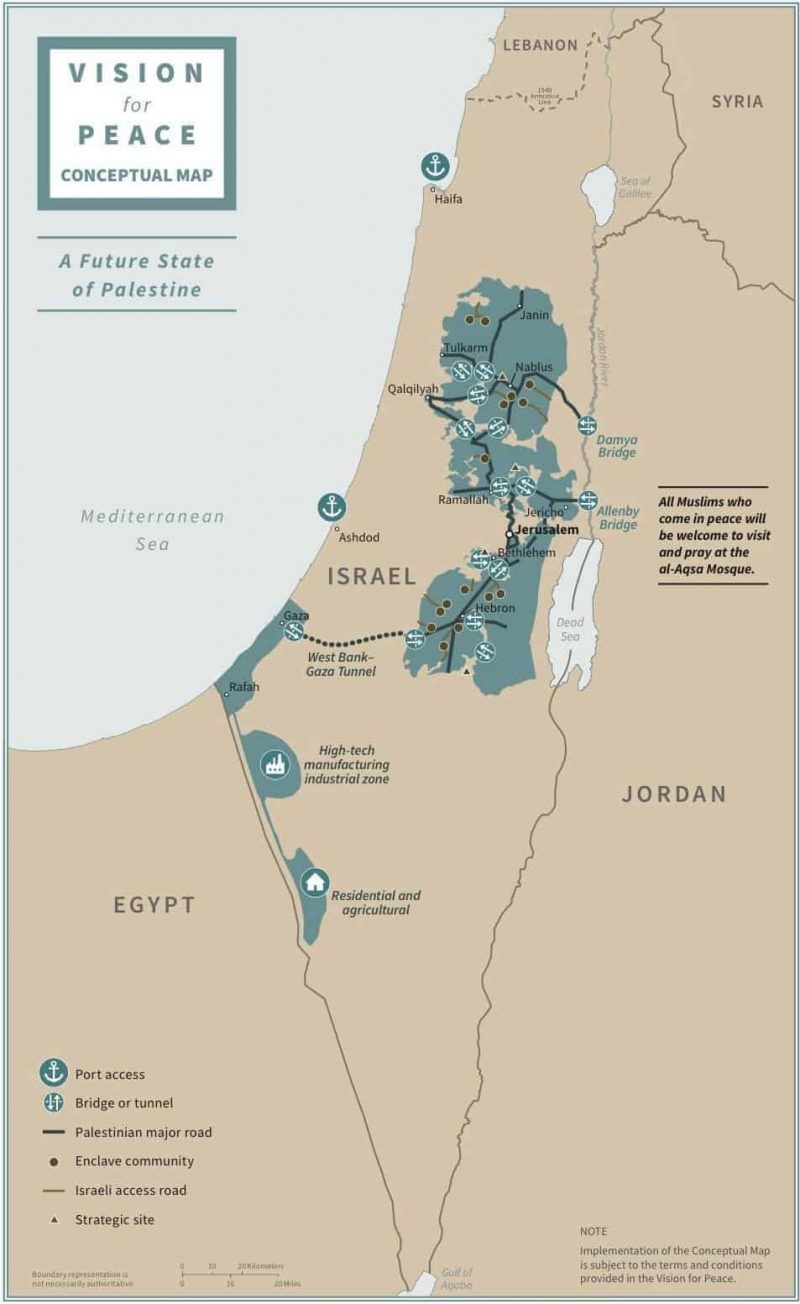
The Palestinian response is hardly surprising. Short of extreme negative inducements, it’s hard to see why anybody would accept a state divided up into lots of little pieces which doesn’t even have access to water. The whole thing seems to have been designed entirely to keep one side happy, while not bothering at all about what the other side wants (the hope apparently being that they can be bought off with a lot of money). One shouldn’t be too shocked if it all turns out to be dead at birth.
Sadly, though, this isn’t a unique case. The American approach to the war in Ukraine has been rather similar. The official line has been to put pressure on the Russian Federation so that it will abandon Donbass, which will then be forced to accept whatever terms Ukraine chooses to give it.
More moderate analysts instead propose cutting some sort of deal with Russia (e.g. recognition of the annexation of Crimea in return for the abandonment of Donbass). But either way, talking to the people of Donbass, let alone their notional leaders, is out of the question. However peace comes, it isn’t to be by means of agreement with the people doing the fighting. Peace must be unilateral, or there won’t be peace at all.
Which, of course, is nuts. As I said, it takes two make war. It takes two to make peace as well.
Ex-president Poroshenko investigated in Ukraine over embezzlement, allegedly stealing US aid
RT | January 29, 2020
Ukraine’s National Anti-Corruption Bureau has opened a probe against former president, Petro Poroshenko, who is suspected of abuse of power, embezzlement “on a grand scale” and allegedly stealing US aid funds.
The case against the ex-president was opened following a complaint by a group of Ukrainian MPs and the nation’s High Anti-Corruption Court demanding the authorities investigate embezzlement and misappropriation of the foreign financial aid at the time of Poroshenko’s term in office, a Ukrainian MP Renat Kuzmin said in a Facebook post.
Kuzmin, a member of the Opposition Platform – For Live party, also published the anti-corruption bureau’s documents, confirming that the case against Poroshenko had been launched. The papers state that the former president and some “unknown people” from his administration are suspected of embezzling “on a grand scale,” subsequent legalization of criminally obtained funds, and abuse of power.
The MP himself said that the investigation would look into the misappropriation of funds provided to Ukraine in the form of international aid, including by the administration of the former US President Barack Obama.
Poroshenko did not react directly to the accusations against him. Instead, his lawyer told the media that the ex-president plans to file as many as 14 lawsuits seeking moral compensation from Ukraine’s National Bureau of Investigations, the anti-corruption bureau and the police. His lawyer also denounced the investigation against his client as political persecution instigated by the administration of the current president, Volodymyr Zelensky.
The news comes just months after Poroshenko’s ally, Kiev mayor and three-time world boxing champion Vitali Klitschko was also accused of embezzlement and even treason by the anti-corruption bureau.
An oligarch candy-maker, who supported the Maidan coup in 2014, Poroshenko came to power in Ukraine just months after the ousting of President Viktor Yanukovich as the nation was quickly plunging into the abyss of a post-coup crisis. During his presidency, he repeatedly played the nationalist card and used Moscow as a boogeyman to raise support while his achievements in the field of economics and the fight against corruption, which still plagued Ukraine years after the Maidan, were far less impressive.
Eventually, he suffered a crushing defeat at the hands of former comedian Zelensky in the runoff at the presidential elections last year.
Truth a Major Casualty of Impeachment Hearings
By Jeremy Kuzmarov | CounterPunch | January 28, 2020
As in any political battle, truth has been one of the major casualties of the impeachment proceedings against President Donald J. Trump.
While the Democratic impeachment managers have accused Trump repeatedly of dishonesty – often with good reason – they themselves have twisted the truth to serve their own political agenda.
Impeachment manager Adam Schiff, for example, claimed that “more than 15,000 Ukrainians have died fighting Russian forces and their proxies” and that the military aid [which Trump subverted] was for “such essentials as sniper rifles, rocket propelled grenade launchers, radar… and other support for the war effort.”
While the military aid may have assisted the war effort, Schiff’s comments are misleading because the majority of those killed have been Eastern Ukrainians who died at the hands of the Ukrainian military that the U.S. has armed – not the Russians.
The UN Monitoring Mission on Human Rights determined that of the approximately 13,000 people killed between April 2014 and December 2018, 3,300 of the victims were civilians, 4,000 were Ukrainian military and 5,500 “Russian-backed armed militants.”
Thus, according to Schiff, Russia is responsible for killing 5,500 of its own men!
Human Rights Watch found that the Ukrainian military actually caused many of the civilian deaths by “us[ing] explosive weapons with wide-area effect in populated areas, including near school buildings, in violation of international humanitarian law.”
But this doesn’t fit with Schiff’s alarmist views about Russia, which are straight out of the 1950s McCarthy era.
At the hearings, Schiff frequently referenced the danger of “Russian expansion” and its efforts to “remake the map of Europe” and quoted a witness who stated that “the U.S. aids Ukraine and her people so that they can fight Russia over there, and we don’t have to fight Russia here.”
Sounding like Ronald Reagan or any one of the most hawkish of cold warriors, this assessment has no basis in reality.
Among other things, it ignores that Russia under Putin was the first country to offer sympathy to the U.S. following the 9/11 terrorist attacks and has repeatedly pushed for better diplomatic relations.
Schiff’s misinformation extends to his defense of Joe Biden.
In his opening statement, Schiff claimed that Biden never wanted the “corrupt prosecutor removed in order to stop an investigation into Burisma Holdings, on whose board Biden’s son Hunter sat.”
However, Biden has been filmed in a speech before the Council on Foreign Relations bragging about his efforts to blackmail the Ukrainian government by threatening to withhold a $1 billion loan if that prosecutor, Viktor Shokin, was not removed.
Shokin had never actually been censured or indicted for corruption, although his successor, Yuriy Lutsenko was.
The latter settled the case with Burisma and its chief executive Mykola Zlochevsky by allowing it to pay a $7 million fine when the company stood accused of evading $40 million in taxes – a clear victory for Burisma.
Lutsenko did not even have a law degree and has been characterized by Ukrainian officials as a crooked political appointee of Ukraine’s former Prime-Minister Petro Poroshenko, whom Biden had cultivated close ties with.
(For more information on this see Olivier Berrayer’s documentary, Ukraine-Gate- Inconvenient Facts.)
Schiff and other Democratic Impeachment Managers such as Sylvia Garcia of Texas claimed that under Shokin the investigation against Burisma had lain “dormant.”
However, Shokin told ABC News in an interview – which was conveniently never aired – that this was not true and that the case was proceeding prior to his removal in February 2016.
The Ukraine-Gate saga has commanded a huge amount of attention and contributed to the rising fame of Schiff who has been praised in some circles for his magnificent performance.
By spreading misleading or outright false information about Russia and Ukraine, and drumming up anti-Russian sentiment, the consequences of the hearings, however, could be even more damaging then the Trump presidency.
Jeremy Kuzmarov is the author of The Russians are Coming, Again: The First Cold War as Tragedy, the Second as Farce (Monthly Review Press, 2018) and Obama’s Unending Wars: Fronting for the Foreign Policy of the Permanent Warfare State (Atlanta: Clarity Press, 2019).
‘Nobody ever gets points for saying anything good about Russia’: Stephen Cohen says, as Rep. Schiff spreads ignorance about Putin
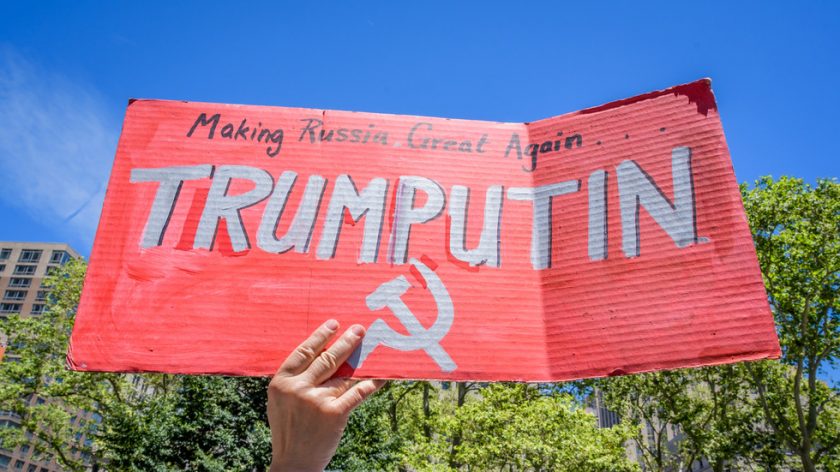
A protester against US President Donald Trump holds a placard during a rally in New York, June 2019. © Global Look Press / ZumaPress / Erik McGregor
RT | January 28, 2020
US Congress heavyweights like Adam Schiff deeply misunderstand Russia but keep on bashing Moscow because it has become “politically advantageous” in Washington, Russia researcher Stephen Cohen said.
“Being highly-critical of Russia is good politics in the United States,” Cohen, professor emeritus of Russian studies at New York University and Princeton University, told the Grayzone’s Aaron Mate in an interview, uploaded online on Monday.
“Nobody ever gets any points for saying anything good about Russia – and only rarely for advocating any kind of partnership with Russia.”
Cohen said that “politically it’s advantageous to a lot of people to bash Russia,” and even some of the “progressive” Democratic Party candidates in the 2020 presidential race employ rhetoric, which is hostile toward Moscow.
“It has become an American way of life to blame Russia when things go wrong. Of course, sometimes Russia is to blame, but not all the time. And yet that’s become part of our discourse.”
The US Democratic Party’s lead impeachment manager, Representative Adam Schiff, has invoked Russia a lot during the trial in the Senate. Democrats want to oust President Donald Trump because they believe he briefly suspended military aid to Ukraine while trying to pressure Kiev into investigating the dealings of his chief 2020 rival, former Vice President Joe Biden and his son Hunter. Sending weapons to Ukraine serves America’s “abiding interest in stemming Russian expansionism,” Schiff argued.
Cohen, however, said that shipping weapons to Kiev would effectively amount to the US turning its back on Ukrainian leader Volodymyr Zelensky’s efforts to resolve the conflict with Russia through peaceful means. Instead, he thinks Washington should focus on encouraging the neighbors to negotiate.
“If Zelensky had full American backing for his peace talks with Putin – that would help him a lot.”
Speaking on the Senate floor, Schiff accused Moscow of trying to undermine the faith in democracy and government institutions around the globe.
Cohen argued that the congressman misunderstands what Russian President Vladimir Putin actually “sees as his own historical mission,” and it is almost the opposite of what Schiff attributes to him.
According to the researcher, Putin’s chief ambition is “to rebuild Russia from the disaster into which it fell in the 1990s” after the collapse of the Soviet Union.
“The last thing Putin wants is instability. He’s trying to build economy at home and economic relations with countries abroad because he sees that as a way to modernize Russia.”
The Russia researcher said that Moscow is currently focused on ties with China, but Putin would like to have good trade relations with Europe and the US as well.
“The notion that he wants to foster discord in the very countries, with which he wants what he calls ‘modernizing trade relations’ is just ignorance on the part of Adam Schiff. Because Schiff runs his mouth a lot about Russia, we get to hear the kind of ignorance… that dominates a large segment of policy-makers in Washington.”
Featured Video
The American Retreat from Vietnam
or go to
Aletho News Archives – Video-Images
From the Archives
Secret document reveals plans for civil war in Lebanon, Israeli false flags, and invasion
By Randi Nord | Geopolitics Alert | April 5, 2019
Beirut – During his visit with US Secretary of State, Mike Pompeo, Lebanese President Michael Aoun reportedly received a US-Israeli document detailing plans for creating a civil war in Lebanon with covert false flag operations and possible Israeli invasion.
Although the source of the document is Israeli and created in partnership with Washington, no one knows who presented it to Aoun. The Lebanese TV station, Al-Jadeed, initially reported the document on Lebanese TV and a video on its website. Geopolitics Alert translated the report for this article. … continue
Blog Roll
 Aletho News
- Department of War Awards $20.7 Billion Contract to Raytheon for Air-to-Air Missiles
- ‘Distance yourselves from Israel’: IRGC urges US population to question govt policies
- America’s Greenland deal has a radioactive backstory
- The RAF Fairford ‘terror plot’: Unpacking escalation in the UK echo-chamber
- EU Council Advances Chat Control 2.0 Scanning Proposal
- Ex-Greek MEP files complaint against Israeli spyware firm over alleged Pegasus surveillance
- Troubling ideas throughout the Torah, Talmud, Mishneh Torah and Tanya
- ‘Grave, alarming’: Iran mission on Trump’s UNGA ‘annihilation’ threats
- Najaf airport to reopen to Iranian flights within 24 hours: Ambassador
- From ‘How Will This End For Iran’ to ‘When America Walks Away’: A tale of two Economist covers
- If Americans Knew
- New Report: “Scholasticide and Genocide in Gaza: Assessment, Testimonies and Legal Analysis”
- Ex-Biden officials are desperate for a Gaza scapegoat
- Israeli “settlers” Invade Al-Aqsa; Pour Boiling Water on 75-Year-Old
- Israel Has Kidnapped Another American Teenager
- US arms sales to Israel worth $21.6 billion in 20 months
- Three Palestinians Killed in Israeli Attacks on Gaza
- Revealed: German “Anti-Semitism Expert” Driving Crackdown on Palestine Solidarity is Former Israeli Spy
- Egypt’s Warning to Israel Before Oct 7
- Israel’s siege signals another cruel winter for 1.8 million Gazans – Daily Update
- Netanyahu Asked UAE Leader to Deny Report on Oct. 7 Warning in Secret Visit, Sources Say
- No Tricks Zone
- New Study: Earth And Venus Surface Warmth Largely Explained By Convection And Lapse Rate, Not CO2 Or Radiation
- 2025 Nature Paper Claiming Worsening Global Drought Gets RETRACTED …Heavily Flawed
- New Study: ‘Global Drought Shows No Detectable Recent Acceleration Under Climate Warming’
- Economic Masterminds: German Socialists Suggest Taxing Productivity Gains Stemming From Using AI
- The South China Sea Has Not Been Cooperating With The Climate Change Narrative
- Energy Crisis: Germany Enters Heating Season With Historically Low Gas Reserve Fill Levels
- New Study: The Antarctic Ice Sheet Gained Mass From 2020-2024 Due To Staggering Snow And Ice Accumulation
- Study: Ocean Heating Rates From Thousands Of Years Ago ‘Dwarf’ Modern Ocean Heating Rates
- Climate Extremists Target, Attack Large-Scale Power Grid Infrastructure In Germany!
- New Study: Antarctic Ice Melt Has Contributed Less Than 1 Centimeter To Sea Level Rise In The Last 30 Years

