New Year’s swap: Dozens head home as Ukraine & breakaway Donbass conduct ‘all for all’ prisoner exchange
RT | December 29, 2019
Kiev is exchanging dozens of prisoners with the self-proclaimed Donetsk and Lugansk republics in the first such effort in two years. The swap was given a boost at the recent Normandy Four talks in Paris.
The self-declared Donetsk People’s Republic has handed over 51 people to Kiev, while receiving 61 of their followers. The Lugansk region returned 25 and took in 63 prisoners; nine people held by Kiev refused to partake in the exchange.
The office of Ukrainian President Volodymyr Zelensky confirmed that Kiev had received a total of 76 people from Donetsk and Lugansk.
Donetsk’s authorities said their list could be longer, as some people asked to be repatriated shortly before the exchange.
The swap, carried out under an “all for all” formula, was the first since a similar humanitarian effort in December 2017.
The prisoner exchange was overseen by officials from the International Committee of the Red Cross (ICRC) and the Organization for Security and Cooperation in Europe (OSCE). No ceasefire violations were recorded on the frontier.
It also comes weeks after leaders from France, Germany, Russia, and Ukraine agreed at a peace summit in Paris to push for a full ceasefire and a new troop disengagement by March 2020.
The summit was the first of its kind in three years, also marking the first time Russian President Vladimir Putin talked reconciliation with his Ukrainian counterpart, Volodymyr Zelensky.
Before the summit, Kiev and the rebel forces ordered a partial pullback in several areas of the frontline. However, several Ukrainian nationalist organizations stood up against Zelensky’s policies, even deploying their own armed groups to prevent the government from withdrawing their soldiers.
Trump-Bidens-Russia-Ukraine: A systemic interpretation
To understand the Trump-Bidens-Russia-Ukraine fiasco clearly, we have to park the moral, constitutional and legal issues
By Padraig McGrath | December 25, 2019
On December 23rd, the Washington Post ran a piece exploring the possible motivations behind US president Donald Trump’s decision to pause US military aid to Ukraine on July 12th last year. On September 28th 2018 and February 16th respectively, President Trump had signed into law two bills from Congress which approved a combined $391 million in military aid to Ukraine, including the provision of lethal weaponry.
The question is extensively explored in the Washington Post article, as in other articles on the issue, as to whether or not Trump’s July 12th decision to withhold the military aid violated the 1974 Congressional Budget and Impoundment Control Act, which states that once Congress appropriates funds and the president signs the relevant spending bill, then it is not within the president’s legal power to withhold those funds.
The Washington Post and other media have also tentatively explored the unresolved question as to what connection, if any, Trump’s July 12th decision to withhold the funds might have had to his subsequent July 25th telephone conversation with Ukrainian President Volodydmyr Zelensky, which became central to arguments for his impeachment. Was Trump using the withholding of aid in order to pressure Zelensky into launching investigations into Hunter Biden’s Ukrainian business-interests, and those of other senior figures in the US Democratic Party? To be fair, the Washington Post article, and a surprisingly high proportion of the other media-coverage of these questions, have been soberly analytical. Refreshingly, the coverage has managed to avoid the worst excesses of liberal Trump Derangement Syndrome.
I believe that the legal debate is largely incidental to what is really happening, and that any moral debate on this issue is even more superfluous than the legal debate. However, before we set the complex legal issues aside, it should be briefly stated that they are not unimportant. Even if we understand that 99% of everybody’s motivations for getting entangled in the legal debate are politically partisan, it is at least conceivable that a person might wish to ask these questions from a non-partisan, purely legal point of view, and that purely juridical concern should not be dismissed out of hand. Regarding the Bidens’ role in this fiasco, one surprising aspect is that it took so many years for the controversy regarding Burisma Holdings to go viral, even in alt-media. The facts that not only Hunter Biden but also Devon Archer, a former John Kerry campaign manager, sat on Burisma’s board of directors, and that Burisma was extensively invested in shale-gas extraction in the vicinity of the Donbas war-zone, had been public knowledge in the Russian-speaking world ever since 2014.
However, in order to understand what is really happening at the deeper systemic level, we need to also set the endless cycle of allegations and counter-allegations aside. The petty political or financial agendas of the Bidens, or Trump, or this or that member of Congress, are incidental to the big systemic picture. Sure, all the players have their own self-interested petty motivations, but the sum of all those motivations does not amount to an explanation of why the game is being played in the first place. Politicians, and occasionally their wastrel offspring, are merely unwitting instruments of history, not agents of history. The parameters of the game are determined by a core geo-strategic logic. What vital geo-strategic interest does the United States have in Ukraine?
Back in 2014, there was certainly hope in US business circles that Ukraine could be a profitable colony, and some US companies including Monsanto have profited from their expansion into Ukraine. However, for most US commercial interests, it quickly became clear in the immediate post-coup period that Ukraine was simply too much of a self-destructive black hole to hope that it might ever become a profitable colony. Ukraine’s culture of blatant kleptocracy was simply too pervasive and ingrained for most western concerns’ money to be safe there.
So rather than the economic exploitation of Ukraine, the United States’ vital geo-strategic interest in Ukraine centrally stems from the point that the maintenance of permanent instability in Ukraine presents developmental and security-challenges to Russia. Furthermore, the maintenance of perpetual Ukrainian hostility toward Russia is useful to larger US geo-strategic interests. We need to remember Zbigniew Brzezinski’s 1997 statement that “without Ukraine, Russia ceases to be an empire.” Brzezinski had identified 3 “geo-strategic pivots” on the Eurasian land-mass which were vital to the task of protecting broader and more global US interests – Iran, Turkey and Ukraine. We have to admit that, as badly as the US foreign policy establishment miscalculated in Ukraine, they still got a piece of what they wanted. The loss of Ukraine’s potential membership was a major blow to the Eurasian Customs Union’s potential for economic reach.
Furthermore, Ukraine’s geography renders it a perfect instrument to drive an economic wedge between Germany and Russia. The trajectory of Russian-German economic integration which has developed steadily over the past 20 years was unquestionably contrary to the decaying hegemon’s interest. Ever since the late 19th century, American geo-strategists have morbidly feared the economic synthesis of Germany’s technological resources with Russia’s human resources and natural resources.
In this regard, all of the legal allegations and counter-allegations regarding Trump and the Bidens are merely incidental noise, and the attached moral arguments are even more absurd.
Here’s what’s really happening:
Trump’s role as a political outsider in Washington is, in this context, manifested in the point that he still thinks like a businessman, not like a geo-strategic planner. As Ukraine is simply too dysfunctional to be turned into a profitable US colony, Trump simply has no meaningful interest in Ukraine. Trump has most probably never bothered reading Halford Mackinder or George Kennan. His critics and political enemies will argue that, as a mere businessman, Trump doesn’t understand that the game is not about “Ukraine” – the game is about Eurasia.
An End to the World as We Know It?
Congress and the White House compete in year-end stupidity sweepstakes

By Philip Giraldi | Unz Review | December 24, 2019
At the end of the nineteenth century, Lord Palmerston stated what he thought was obvious, that “England has no eternal friends, England has no perpetual enemies, England has only eternal and perpetual interests.” Palmerston was saying that national interests should drive the relationships with foreigners. A nation will have amicable relations most of the time with some countries and difficult relations with some others, but the bottom line should always be what is beneficial for one’s own country and people.
If Palmerston were alive today and observing the relationship of the United States of America with the rest of the world, he might well find Washington to be an exception to his rule. The U.S., to be sure, has been adept at turning adversaries into enemies and disappointing friends, and it is all done with a glib assurance that doing so will somehow bring democracy and freedom to all. Indeed, either neoliberal democracy promotion or the neoconservative version of the same have been seen as an overriding and compelling interest during the past twenty years even though the policies themselves have been disastrous and have only damaged the real interests of the American people.
The U.S. relationship with Israel is, for example, driven by a powerful and wealthy domestic lobby rather than by any common interests at all yet it is regularly falsely touted as being between two “close allies” and “best friends.” It has cost Americans hundreds of billions of dollars in subsidies for the Jewish state and Israeli influence over U.S. policy in the Middle East region has led to catastrophic military interventions in Afghanistan, Lebanon, Iraq, Syria, Mogadishu and Libya. Currently, Israel is agitating for U.S. action against the nonexistent Iranian “threat” while also unleashing its lobby in the United States to make illegal criticism of any of its war crimes, effectively curtailing freedom of speech and association for all Americans.
Far more dangerous is the continued excoriation of the Kremlin over the largely mythical Russiagate narrative. Congress has recently approved a bill that would give to Ukraine $300 million in supplementary military assistance to use against Russia. The money and authorization appear in the House of Representatives version of the national defense authorization act (NDAA) that passed last week.
The bill is a renewal of the controversial Ukraine Security Assistance Initiative that Donald Trump allegedly manipulated to bring about an investigation of Joe Biden’s son Hunter. The new version expands on the former assistance package to include coastal defense cruise missiles and anti-ship missiles as offensive weapons that are acceptable for export to Kiev. It also authorizes an additional $50 million in military assistance on top of the $250 million congress had granted in last year’s bill, “of which $100 million would be available only for lethal assistance.”
Ukraine sought the money and arms to counter Russian naval dominance in the Black Sea through its base at Sevastopol in the Crimea. One year ago the Russian navy captured three Ukrainian warships and Kiev was unable to push back against Moscow because it lacked weapons designed to attack ships. Now it will have them and presumably it will use them. How Russia will react is unknowable.
Dmytro Kuleba, Ukraine’s Deputy Prime Minister for European and Euro-Atlantic Integration, has been in Washington lobbying for the additional military assistance. He has had considerable success, particularly as there is bipartisan support in Congress for aid to Kiev and also because the Trump Departments of Defense and State as well as the National Security Council are all on board in countering the “Russian threat” in the Black Sea. President Trump signed the NDAA last week, which completed the process.
Far more ominously, Kuleba and his interlocutors in the administration and congress have been revisiting a proposal first surfaced under Bill Clinton, that Ukraine and Georgia should be admitted to the NATO alliance. Like the $300 million in military aid, there appears to be considerable bipartisan support for such a move. NATO already has a major presence on the Black Sea with Bulgaria, Romania and Turkey all members. Adding Ukraine and Georgia would completely isolate the Russian presence and Moscow would undoubtedly see it as an existential threat.
The NDAA also provides seed money to initiate the so-called Space Force, which President Trump inaugurated by describing it as “the world’s newest war-fighting domain. Amid grave threats to our national security, American superiority in space is absolutely vital. We’re leading, but we’re not leading by enough, but very shortly we’ll be leading by a lot. The Space Force will help us deter aggression and control the ultimate high ground.”
If that isn’t bad enough, the new defense budget ominously also requires the Trump administration to impose sanctions “with respect to provision of certain vessels for the construction of certain Russian energy export pipelines.” Last week the House of Representatives and Senate approved specific sanctions relating to the companies and governments that are collaborating on the construction of the Nord Stream 2 pipeline that will cross the Baltic Sea from Vyborg to Greifswald to connect Germany with Russian natural gas. President Trump has signed off on the legislation.
The United States has opposed the project ever since it was first mooted, claiming that it will make Europe “hostage” to Russian energy, will enrich the Russian government, and will also empower Russian President Vladimir Putin to be more aggressive. Engineering companies that will be providing services such as pipe-laying will be targeted by Washington as the Trump administration tries to halt the completion of the $10.5 billion project.
Now that the NDAA has been signed, the Trump administration has 60 days to identify companies, individuals and even foreign governments that have in some way provided services or assistance to the pipeline project. Sanctions would block individuals from travel to the United States and would freeze bank accounts and other tangible property that would be identified by the U.S. Treasury. One company that will definitely be targeted for sanctions is the Switzerland-based Allseas, which has been contracted with by Russia’s Gazprom to build the offshore section of pipeline. It has suspended work on the project while it examines the implications of the sanctions.
Bear in mind that Nord Stream 2 is a peaceful commercial project between two countries that have friendly relations, making the threats implicit in the U.S. reaction more than somewhat inappropriate. Increased U.S. sanctions against Russia itself are also believed to be a possibility and there has even been some suggestion that the German government and its energy ministry might be sanctioned. This has predictably resulted in pushback from Germany, normally a country that is inclined to go along with any and all American initiatives. Last week German Foreign Minister Heiko Maas asked Congress not to meddle in European energy policy, saying “We think this is unacceptable, because it is ultimately a move to influence autonomous decisions that are made in Europe. European energy policy is decided in Europe, not in the U.S.”
German Bundestag member Andreas Nick warned that “It’s an issue of national sovereignty, and it is potentially a liability for trans-Atlantic relations.” That Trump is needlessly alienating important countries like Germany that are genuine allies, unlike Israel and Saudi Arabia, over an issue that is not an actual American interest is unfortunate. It makes one think that the wheels have definitely come off the cart in Washington.
The point is that Donald Trump, Mike Pompeo, Mike Pence and Mike Esper (admittedly too many Mikes) wouldn’t know a national interest if it hit them in the face. Their politicization of policy to “win in 2020” promoting apocalyptic nonsense like war in space has also reinforced an existing tunnel vision on what Russia under Vladimir Putin is all about that is extremely dangerous. Admittedly, Team Trump throws out sanctions in all directions with reckless abandon, mostly aimed at Russia, Iran, North Korea and, the current favorite, Venezuela. No one is immune. But the escalation going from sanctions to arming the Kremlin’s enemies is both reckless and pointless. Russia will definitely strike back if it is attacked, make no mistake about that, and war could easily escalate with tragic consequences for all of us. That war is perhaps becoming thinkable is in itself deplorable, with Business Insider running a recent piece on surviving a nuclear attack. New homes in target America will likely soon come equipped with bomb shelters, just like in the 1950s.
Philip M. Giraldi, Ph.D., is Executive Director of the Council for the National Interest, a 501(c)3 tax deductible educational foundation (Federal ID Number #52-1739023) that seeks a more interests-based U.S. foreign policy in the Middle East. Website is councilforthenationalinterest.org, address is P.O. Box 2157, Purcellville VA 20134 and its email is inform@cnionline.org.
Thousands of Russia immigrants to Israel left again after getting passports
MEMO | December 19, 2019
Thousands of immigrants to Israel from the former Soviet Union “may have come only to receive an Israeli passport before moving back abroad”, reported JTA, with the total such cases amounting to up to a quarter of all Russian immigrants.
The article, citing reporting done by Israeli weekly newspaper Makor Rishon, described how “a cottage industry of companies promising expedited Israeli citizenship, and the passport that comes with it” emerged in Russia, “since the passage of a law allowing new immigrants to receive the travel document within the first three months of [moving to Israel]”.
According to the report, “for many in the post-Soviet world, an Israeli passport is considered as desirable as a European Union passport is to Israelis.”
Now, Russian “fixers” are advertising that they can help those able to emigrate to Israel to obtain Israeli citizenship “within two days” for “a cost of thousands of euros”.
JTA added that, according to Makor Rishon,
Under certain circumstances… the three-month period can be shortened to as little as a day, and some immigrants have even been able to receive their passports without having to leave Ben Gurion International Airport.
Based on data from Israel’s Ministry of Immigrant Absorption, it is estimated that approximately 8,500 immigrants from the former Soviet Union “have come just for the passport before immediately leaving the country”.
One official from the Jewish Agency suggested that as many as 25 per cent of the immigrants came for a passport and “left the country immediately after receiving it”.
In 2018, roughly 10,500 Russians and 6,400 Ukrainians emigrated to Israel, “which was the first year that the majority of new immigrants were not considered Jewish under…Jewish religious law”.
Dialogue between Kiev & people in eastern Ukraine needed to resolve conflict – Putin
RT | December 19, 2019
Kiev’s reluctance to engage in direct dialogue with the people living in Ukraine’s eastern regions, collectively known as Donbass, is still the biggest obstacle to resolving the long-standing crisis, Vladimir Putin has said.
Putin was asked about crisis resolution in Ukraine and the future of the Normandy Four talks between the leaders of Russia, Ukraine, France, and Germany. The president said that some progress has been made in resolving the crisis, but it is direct dialogue between the authorities in Kiev and the people of Ukraine living in the self-proclaimed Donetsk and Lugansk People’s Republics that could really help the cause. Yet, this is precisely what is lacking.
“A direct dialogue with Donbass is needed. Yet, there is no dialogue.”
Any move related to the status of the rebellious eastern Ukrainian regions should be coordinated with those regions, Putin said, adding that Kiev should not unilaterally take decisions on any “decentralization” issues that go beyond the framework of the Minsk Agreements which still remain the only plausible way to resolve the Ukrainian crisis.
Some positive steps have been made, the president admitted, such as troop withdrawal from several areas in eastern Ukraine, and the extension of the law on the special status of Donbass. Some new areas along the line of contact were further designated for troop withdrawal in 2020, during the latest Normandy Four meeting.
Yet, it is not enough, Putin added, questioning in particular Kiev’s reluctance to pull its forces out from the entire line of contact in Donbass. “It was Kiev that cut the Donbass off by imposing a blockade of this territory,” Putin told the media conference.
After the eastern regions of Ukraine declared their independence from Kiev in 2014 following the coup against then-President Viktor Yanukovich, the post-coup Ukrainian authorities reacted by launching a military campaign against the self-proclaimed Donetsk and Lugansk People’s Republics. The violent conflict has since claimed the lives of 13,000 people, according to the UN. Former President Petro Poroshenko also imposed an economic blockade against Donbass.
The Carter Page/Ukraine Lie That Kept On Lying for Mueller and the FBI
By Paul Sperry – RealClearInvestigations – December 12, 2019
The FBI and Special Counsel Robert Mueller repeatedly kept alive a damning narrative that investigators knew to be false: namely, that a junior Trump campaign aide as a favor to the Kremlin had “gutted” an anti-Russia and pro-Ukraine plank in the Republican Party platform at the GOP’s 2016 convention.
Federal authorities used this claim to help secure spy warrants on the aide in question, Carter Page, suggesting to the court that he was “an agent of Russia” – even though investigators knew that Page was working for U.S., not Russian, intelligence, and that they had learned from witnesses, emails and other evidence that Page had no role in drafting the Ukraine platform plank.
The revelation is buried in the Justice Department watchdog’s just-released report on FISA surveillance abuses. RealClearInvestigations fleshed out this unreported story with footnotes from the Mueller report and exclusive interviews with Trump campaign officials who worked on the convention platform.
Of all the Trump-Russia rumors, insinuations and falsehoods – from secret payments for shadowy hackers, to videotaped prostitutes with active bladders, to a clandestine rendezvous with Kremlin figures in Prague – the supposedly pro-Russia Ukraine platform alteration stands out. It seemed to offer early, public, concrete evidence of an actual bending of prospective U.S. policy to suit Moscow. The false narrative is also significant because it was initially pushed not by Democrats, but by associates of Republican Sen. John McCain and other so-called Never Trumpers. As a bipartisan red flag, it helped build momentum around a narrative of Trump treachery with, then as now, Ukraine playing a central role. It also shows how the Russia and Ukraine controversies were linked from the beginning by Trump’s foes.
This episode loomed so large that the first person Mueller’s team interviewed after taking over the Russia investigation in May 2017 was Rachel Hoff, who was serving as McCain’s policy adviser on the Senate Armed Services Committee. Like her boss, Hoff was no fan of President Trump. Agents sought to confirm with her reports that the Trump campaign had “gutted” the GOP’s platform plank on Ukraine to favor Russia during the party’s convention in Cleveland in early July 2016.
As a disgruntled convention delegate, Hoff got the story started by putting Washington Post columnist Josh Rogin in touch with another Never Trump delegate, Diana Denman, who had lost her bid to amend the GOP plank to call for providing “lethal” weapons to Ukraine to help fend off Russian incursions, according to people with direct knowledge of the matter. Instead, the platform called for “appropriate assistance to the armed forces of Ukraine.”
Denman was overruled because heavily arming Ukraine was out of step with the GOP consensus at the time – to say nothing of the Obama administration’s policy, which refused to arm the Ukrainians. And it was at odds with Trump’s stated position, which sought to avoid military escalation in the region, while encouraging the European Union to take a larger peacekeeping role.
On July 18, 2016, the Post ran Rogin’s sensational story under the misleading headline, “Trump Campaign Guts GOP’s Anti-Russia Stance on Ukraine.” Pushing the narrative that Trump was doing the Kremlin’s bidding, it quoted Hoff warning that Trump “would be dangerous for America and the world.” The story left out the key part of the final Trump-approved plank pledging aid “to the armed forces of Ukraine.” Reached by phone, Rogin declined comment.
This story was quickly amplified in the Steele dossier, the series of now-debunked opposition research memos alleging Trump-Russia collusion. Compiled by ex-British intelligence officer Christopher Steele for the Clinton campaign, those memos became a foundation for the FBI and Mueller probes even though – as this week’s IG report established – bureau agents knew that the material in them included demonstrably false assertions and exaggerated gossip dismissed as nonsense by Steele’s own purported source.
Steele also embellished the GOP convention story by claiming that Carter Page had played a key role in drafting the Ukraine plank as part of a commitment he had allegedly made to his Kremlin handlers “to sideline Russian intervention in Ukraine as a campaign issue.”
None of this was true. And the FBI — and Mueller — knew it, the Justice inspector general reveals in his report.
Still, the FBI presented the Steele dossier’s smear, cataloged as “Steele Report 95,” as key evidence in all four of its warrant applications to obtain wiretaps to eavesdrop on Page, according to the IG report.
To keep renewing the spy warrants, the FBI had to produce fresh evidence for FISA judges to support suspicions Page was “an agent of Russia.” Just a few weeks before the FISA warrant was set to expire in June 2017, Mueller had his investigators interview Hoff, as his first witness, followed by Denman, hoping they could provide fresh details to keep building an espionage case against Page and the Trump campaign.
But Mueller struck out.
According to agents’ notes documenting their June 2017 interview, as revealed in the IG report, Denham told the FBI that Page was not involved in the drafting of the Ukraine plank. But Mueller’s team did not update its fourth and final FISA warrant application on Page with this exculpatory information. Instead, it recited the same baseless claim that he had shaped the Ukraine policy with guidance from Russia. And the court renewed the warrant that June to electronically monitor Page, allowing the government to continue vacuuming up all of his emails, phone calls, text messages and other communications for another 90 days.
“Although the FBI did not develop any information that Carter Page was involved in the Republican Platform Committee’s change, the FBI did not alter its assessment of Page’s involvement in the FISA applications,” Justice Department Inspector General Michael Horowitz noted in his 476-page report released Monday.
Added Horowitz: “We found that, other than this information from Report 95 [of the Steele dossier], the FBI’s investigation did not reveal any information to demonstrate that Page had any involvement with the Republican Platform Committee.” Yet, “all four FISA applications relied upon information in the Steele reporting” alleging Page’s role in drafting the Republican plank on Ukraine and Russia.
A former U.S. Navy lieutenant, Page was never charged with espionage or any crime. He told RealClearInvestigations that he has received “numerous death threats that directly resulted from the false allegations” that he was a traitor.
The FBI and Mueller failed to correct the record about Page in their FISA warrant applications even after they identified the Trump campaign officials who actually had a hand in influencing the GOP plank, J.D. Gordon and Matt Miller. A July 14, 2016, email from Gordon confirmed what Page had personally told the FBI in an interview — that he had not taken part in the decision. The FBI knew about the email since at least March 2017, when agents sat down with Page. (Gordon and Page were chatting by email about the convention, and it’s clear from Page’s responses he had no idea what Gordon had done in the Ukraine-Russia platform drafting sessions. IG Horowitz published the relevant excerpt in his report and noted the FBI had the email in its possession.)
Still, Horowitz found, “The FBI never altered the assessment.”
Horowitz further concluded that the FBI should not have included the dossier’s rumor even in its original October 2016 application for a FISA warrant targeting Page, let alone its three renewals, because a confidential source the FBI assigned to spy on Page at the time found no basis for it. In the IG report, Horowitz noted that during that same month of October 2016, the FBI informant met with Page and tape-recorded him denying he was involved in the drafting of the Ukraine plank. Page told the informant, Stefan Halper, that he “stayed clear of that.”
Horowitz’s investigators established that the informant’s recorded statements were sent to the FBI agent assigned at the time to Page’s case, and were copied to a supporting team of other agents, supervisors and analysts. Yet the FBI also withheld that critical exculpatory evidence from the FISA court in the initial application for a warrant on Page (and then continued to deny the court the information in subsequent requests to monitor Page).
The lead case agent, unnamed in the report, told investigators the FBI was operating on a “belief” that Page was involved in the Ukraine and Russia platform, and that he and the FISA team were “hoping to find evidence of that” from the wiretaps. Despite all the snooping on Page, the FBI never collected the hoped-for proof.
The lead supervisor, also unidentified, told investigators “he did not recall why Page’s denial was not included.”
Horowitz reports that the exculpatory documents were also sent to a Justice Department attorney before the warrant was renewed for the first time in January 2017, “[y]et, the information remained unchanged in the renewal applications.”
Added Horowitz: “The attorney told us that he did not recall the circumstances surrounding this, but he acknowledged that he should have updated the descriptions in the renewal applications to include Page’s denials.”
The FBI also failed to inform surveillance court judges that Page was an “operational contact” for the CIA for several years, according to the Horowitz report. In 2013, Page also volunteered as a cooperating witness in an FBI espionage case, and helped put away a real Russian agent in 2016. This was additional exculpatory evidence the FBI kept from the FISA court, as RealClearInvestigations first reported last year.
Peter Strzok, then the FBI’s top counterintelligence official, rode herd on the Page wiretap requests and reported back to FBI attorney Lisa Page (no relation to Carter), who in turn, updated then-Deputy FBI Director Andrew McCabe.
Text messages previously uncovered by Horowitz and shared with Mueller revealed that Strzok and Page, who were having an affair, rooted for Hillary Clinton during the 2016 campaign and held Trump in complete contempt. In one exchange, they discussed the need to “stop” Trump from winning the election. And the two of them had also huddled with McCabe in his office to devise an “insurance policy” in the “unlikely event” Trump ended up winning.
The inspector general’s report points out that it was McCabe who urged investigators to look at the Clinton-funded dossier. The previous year, his Democratic politician wife, Jill, received hundreds of thousands of dollars in donations arranged by Clinton ally and Virginia’s governor at the time, Terry McAuliffe.
Strzok remained central to the investigation well into 2017 – until Mueller was forced to kick him off his team when the anti-Trump bias was revealed. The bureau fired him in 2018, the same year Lisa Page resigned from the FBI. In spite of their anti-Trump political bias, Horowitz said he found “no evidence” their bias influenced their investigative decisions.
Lawyers for Strzok and McCabe did not respond to requests for comment. The FBI and a spokesman for Mueller declined comment.
Putting Carter Page under surveillance starting in October 2016 effectively let the FBI spy on the Trump campaign since its beginnings, because it allowed the bureau to scoop up all of Page’s prior communications. Former Trump officials who have reviewed Horowitz’s new findings confirmed their view that the bureau was trying to make it look like Page and the Trump campaign were doing something sinister to help Russia.
“Page actually had no role in the platform, whatsoever,” Gordon, the Trump campaign’s director of national security, told RCI. “Failing to include the exculpatory information in the FISA application is horrifying.”
While it’s true that Trump sought better relations with Russia, Gordon said, there was nothing nefarious about the drafting of the Ukraine platform. He said the FBI simply assumed it was watered down as a favor to Russia based on a false narrative driven by liberal media outlets like the Post and Never Trumpers such as Rachel Hoff. He said the FBI, under the direction of McCabe, Mueller and former FBI Director James Comey, also wanted to believe the worst about Trump, whom they simply did not like.
Gordon noted that, except for the two Never Trump delegates, nobody in the platform drafting sessions raised a fuss about the Ukraine plank — not even the press.
“The media was present in the room, yet not one person wrote about the Ukraine issue,” he said — until, that is, the Never Trumpers went to the Washington Post that July and helped launch the Trump-Russia “collusion” myth.
Moreover, the narrative was untrue even on its own terms – without the spurious inclusion of Carter Page. Internal platform committee documents show the Ukraine plank could not have been weakened as claimed, because the “lethal” weapons language was never part of the GOP platform in the first place. The final language actually strengthened the platform by pledging direct assistance not just to the country of Ukraine, but to its military in its struggle against Russian-backed forces.
Far from “gutting” assistance, the Trump administration approved the transfer of tank-busting Javelin missiles to Kiev — something the Obama administration refused to do. More than 200 of those weapons have been sold to Ukraine since Trump took office. And the sale and delivery of Javelins never stopped even during this year’s temporary suspension of military aid to Ukraine that is now the subject of the Democrats’ impeachment proceedings.
The final draft of the Ukraine plank also branded Russia a menace, and pledged to stand against “any territorial change imposed by force in Ukraine.” Yet Mueller and his prosecuting staff of mostly Democratic donors still suspected collusion, and they dispatched FBI agents to grill Gordon about the drafting of the platform three times between 2017 and 2019. They also got a grand jury to subpoena his phone records.
In the end, the Mueller report found no Russian influence in the platform.
But the false narrative – that the Ukraine plank stood as early proof of the “extensive conspiracy” between the Trump campaign and Moscow that Steele alleged in his now-debunked dossier – has persisted.
Earlier this year, House Judiciary Committee Chairman Jerry Nadler demanded Gordon provide additional documents, and he has complied. Nadler is now marking up articles of impeachment against Trump over a request he lodged with Ukraine’s new president this summer to help investigate the former Clinton-friendly regime’s attempts to “sabotage” Trump’s election bid in 2016. Trump also asked Kiev to look into possible corruption involving former Vice President Joe Biden’s son Hunter and a Ukrainian energy oligarch.
Meanwhile, Nadler’s impeachment partner, House Intelligence Committee Chairman Adam Schiff, continues to insist that the Trump team “softened” the GOP platform to accommodate “Putin’s invasion of Ukraine.”
A retired Navy commander and former Pentagon spokesman, Gordon said he has run up a five-figure legal bill defending against what he calls a “hoax” perpetrated by Never Trumpers, the media, Comey, Mueller, and now congressional Democrats.
“In the vicious frenzy to destroy President Trump and his associates at all costs, they attempted to turn a routine foreign policy debate in conjunction with the four-year renewal of the GOP platform into a crime scene,” Gordon said in an interview with RCI.
“Incredibly,” he added, “the GOP platform change hoax [later] became the very first order of business in Mueller’s nearly two-year investigation.”
Russia offers Ukraine cheaper gas under new transit deal, Kiev promises to drop $3bn demand
RT | December 10, 2019
The price of gas for Ukraine may be lower if Moscow and Kiev manage to reach a new transit agreement, Russian President Vladimir Putin told at a press conference after the Normandy Four summit in Paris.
Gas for Ukraine “could be cheaper by 25 percent, as compared to what the end consumer currently gets, primarily the industrial consumer, because the price of gas for the domestic consumer, for citizens [of Ukraine], is subsidized, we can’t calculate the price from the subsidized price,” Putin said.
Ukraine’s President Volodymyr Zelensky said in return that there is a good chance that the contract on gas transit from Russia to Europe via Ukraine would be extended after January 1.
Agreement for Russian gas supplies to Ukraine and those transiting to Europe expires at the end of this year. In November, Russia’s Gazprom offered Ukraine to extend the transit contract or enter into a new one for one year.
“There’s no agreement yet, but I’m sure that we have more chances to sign it under better conditions than before,” Zelensky told reporters in Paris, adding that “I insisted on the most favorable, ambitious conditions for Ukraine and Europe, which is ten years.”
He also said the issue of the $2.56 billion compensation has been taken off the table during the talks, and that Kiev “is ready to take it in gas.”
A Swedish court ruled Gazprom must compensate Ukraine’s Naftogaz for the transit of Russian gas through the Ukrainian territory between 2009 and 2017 even though the gas was not, in fact, transited over that period. The court justified its decision by referring to a difficult economic situation in Ukraine. Last month, Russia’s Gazprom lost the appeal.
Ukraine’s Zelensky to be TOPPLED by protests if he crosses ‘red lines’ in Paris, TV host warns, as crowds cheer
RT | December 8, 2019
Pressure is mounting on Ukraine’s President Volodymyr Zelensky, with the opposition threatening him with civil unrest should he show weakness during the Normandy Four talks with Russian, French and German leaders on Monday.
Thousands attended a rally at the iconic Maidan square in the center of the Ukrainian capital, organized in the run-up to the high-profile meeting by the parties of Petro Poroshenko, whom Zelensky defeated in the spring election, as well as former PM Yulia Tymoshenko and rock star Vyacheslav Vakarchuk. And the speakers on stage didn’t mince words.
“Your flight will be not from Paris to Kiev, but from Paris to Rostov[-on-Don]. If it won’t be tomorrow then it’ll be a bit later,” prominent news host Vitaly Gaidukevich warned, addressing the head of state.
The mention of the Russian city was in fact a stark reminder to Zelensky that “Maidan democracy” continues to grip Ukraine. The blunt threat meant that the Ukrainian president may endure the fate of ex-leader Viktor Yanukovych, if he doesn’t deliver what the opposition wants. Yanukovych was overthrown in February 2014 after violent protests in central Kiev, in which around 100 people were killed. He fled to Crimea and then to Rostov-on-Don in southern Russia, and has claimed that an attempt on his life was made in the process.
“Maidan has proven time and again that citizens have power in Ukraine,” Gaidukevich told the crowd, which chanted slogans calling for Zelensky to be immediately kicked out from office should he do something “wrong.”
The Normandy Four talks are being held in an attempt to find ways to settle the protracted conflict in eastern Ukraine. Notably, it will be Zelensky’s first face-to-face meeting with Vladimir Putin – and a lot is being expected from the man (Zelensky) back home.
The opposition said it won’t settle for “peace at any cost,” insisting that Zelensky should make no compromises in Paris when it comes to Ukraine’s course towards Europe and towards the “de-occupation and return of Crimea,” which voted in March 2014 to break away from Ukraine and rejoin Russia.
Ukraine was the Origin of the Trump-Russia Collusion Hoax
By Lawrence Sellin | American Thinker | December 6, 2019
December 2015 was a pivotal month in many respects.
During the first week of December 2015, Donald Trump began to establish a substantial lead over his Republican primary opponents.
Vice President Joseph Biden traveled to Ukraine to announce, on December 7th, a $190 million program to “fight corruption in law enforcement and reform the justice sector,” but behind the scenes explicitly linked a $1 billion loan guarantee to the firing of Ukrainian prosecutor Viktor Shokin, who had been investigating the energy company Burisma, which employed Biden’s son Hunter.
On December 9, 2015, the reported whistleblower Eric Ciaramella held a meeting in Room 236 of the Eisenhower Executive Office Building with Daria Kaleniuk, executive director of the Ukrainian Anti-Corruption Action Center, which was 59%-funded by Barack Obama’s State Department and the International Renaissance Foundation, a George Soros organization.
Also attending that meeting was Catherine Newcombe, attorney in the Criminal Division, Office of Overseas Prosecutorial Development, with the U.S. Department of Justice, where, among other duties, she oversaw the Department’s legal assistance programs to Ukraine.
By December 2015, Paul Manafort was undoubtedly considering approaching the Trump campaign to rejuvenate his U.S. political bona fides and mitigate the legal and financial difficulties he was experiencing at the time.
From the beginning of his association with the Trump campaign, Roger Stone, a long-time Manafort partner, made a strong case to Trump to bring in Manafort, who would officially connect to the campaign immediately after the February 1, 2016 Iowa caucuses.
Based on events occurring during the same period, were Obama Deep State operatives aware of Manafort’s intent and already intending to use his past questionable practices and links to Russia against Trump?
Such awareness of Manafort’s plans could have been obtained either through FBI surveillance, which began in 2014 and ended in early 2016, or through information provided by Manafort associates, for example, Ukrainian businessman Konstantin Kilimnik, who worked for Manafort and was a FBI and Department of State asset, not a Russian agent as later painted by the Mueller investigation.
According to White House visitor logs, on January 19, 2016, Eric Ciaramella chaired a meeting of FBI, Department of Justice and Department of State personnel, which had two main objectives:
1) To coerce the Ukrainians to drop the Burisma probe, which involved Vice President Joseph Biden’s son Hunter, and allow the FBI to take it over the investigation.
2) To reopen a closed 2014 FBI investigation that focused heavily on GOP lobbyist Paul Manafort, whose firm long had been tied to Trump through his partner and Trump pal, Roger Stone.
That is, contain the investigation of Biden’s son and ramp up the investigation of Paul Manafort.
Again, according to White House logs, the attendees at the January 19, 2016 meeting in Room 230A of the Eisenhower Executive Office Building were:
Eric Ciaramella – National Security Council Director for Ukraine
Liz Zentos – National Security Council Director for Eastern Europe
David G. Sakvarelidze – Deputy General Prosecutor of Ukraine
Anna E. Iemelianova (Yemelianova) – Legal Specialist, US Embassy Kyiv and US Department of Justice’s Anti-Corruption Program.
Nazar A. Kholodnitsky, Ukraine’s chief anti-corruption prosecutor
Catherine L. Newcombe – attorney in the Criminal Division, Office of Overseas Prosecutorial Development, with the U.S. Department of Justice
Svitlana V. Pardus – Operations, Department of Justice, U.S. Embassy, Ukraine.
Artem S. Sytnyk – Director of the National Anti-corruption Bureau of Ukraine
Andriy G. Telizhenko, political officer in the Ukrainian Embassy in Washington DC
Jeffrey W. Cole – Resident Legal Advisor at U.S. Embassy Ukraine, presumed to be FBI
Just two weeks after that meeting, on February 2, 2016, according to White House logs, Eric Ciaramella chaired a meeting in Room 374 of the Eisenhower Executive Office, which seems to be a planning session to re-open an investigation of Paul Manafort (Note: one of the crimes of which Manafort was accused was money laundering, an area covered by the Department of the Treasury). The attendees were:
Jose Borrayo – Acting Section Chief, Office of Special Measures, U.S. Department of the Treasury, Financial Crimes Enforcement Network
Julia Friedlander – Senior Policy Advisor for Europe, Office of Terrorist Financing and Financial Crimes, U.S. Department of the Treasury
Michael Lieberman – Deputy Assistant Secretary, Terrorist Financing and Financial Crimes, U.S. Department of the Treasury
Scott Rembrandt – Anti-Money Laundering Task Force, Assistant Director/Director, Office of Strategic Policy, Department of the Treasury
Justin Rowland – Special Agent (financial crimes), Federal Bureau of Investigation

Photo credit: Alexandria, VA Sheriff
It appears that Paul Manafort became a vehicle by which the Obama Deep State operatives could link Trump to nefarious activities involving Russians, which eventually evolved into the Trump-Russia collusion hoax. Remember, the key claim of the follow-up Steele dossier, the centerpiece of the Mueller investigation, was that Trump campaign manager Paul Manafort was the focal point of a “well-developed conspiracy between them [the Trump campaign] and the Russian leadership.”
Nellie Ohr, Fusion GPS employee and wife of Department of Justice official Bruce Ohr, not only worked with Christopher Steele on the so-called Trump dossier, but, in May 2016, was the conduit of information to her husband and two Department of Justice prosecutors of the existence of the “black ledger” documents that contributed to Manafort’s prosecution.
Bruce Ohr and Steele attempted to get dirt on Manafort from a Russian oligarch, Oleg Deripaska, efforts that eventually led to a September 2016 meeting in which the FBI asked Deripaska if he could provide information to prove that Manafort was helping Trump collude with Russia.
The surveillance and entrapment attempts of Paul Manafort, Carter Page, George Papadopoulos and others were designed to collect evidence about Trump without formally documenting that Trump was the target.
After the election, to cover their tracks, James Comey, representing the FBI and the Department of Justice, misleadingly told Trump that the investigation was about Russia and a few stray people in his campaign, but they assured him he personally was not under investigation.
They lied.
Donald Trump always was, and still is, the target of the Deep State, the left-wing media and their Democrat Party collaborators.
Lawrence Sellin, Ph.D. is a retired US Army Reserve colonel, an IT command and control and cyber security subject matter expert and a veteran of Afghanistan, Iraq and a humanitarian mission to West Africa. He receives email at lawrence.sellin@gmail.com
Normandy Four summit ‘may result in comprehensive Donbass ceasefire’ – Ukraine president’s adviser
RT | December 6, 2019
Ukraine should not expect new important agreements from the Normandy Four summit in Paris but the meeting may result in establishing a comprehensive ceasefire in Donbass and prisoner exchange, TASS quoted Nikita Poturaev, the adviser to the Ukrainian president, as saying on Friday.
“No new Minsk Agreements or some kind of Paris Agreements will come out of the meeting in Paris. However, the summit may result in… ceasefire along the whole contact line, which is envisaged by the Minsk Agreements, and prisoner exchange,” Poturaev told 1+1 TV channel. “If these two things are fulfilled, a political process will follow, namely elections [in Donbass] in accordance with Ukrainian laws.”
The Normandy Four meeting of leaders of Ukraine, Russia, France and Germany on the conflict in eastern Ukraine will be held on December 9 in Paris.
The Grand Poo Bah Still Searching for Impeachment
By Renée Parsons | OffGuardian | December 5, 2019
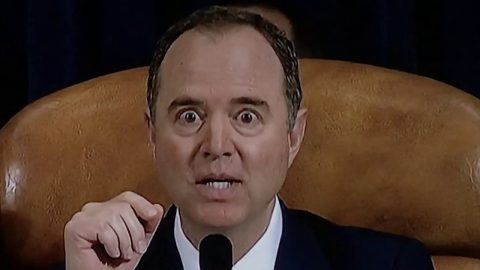
There were two especially notable testimonys made during the recent House impeachment inquiry that should have been ‘nothing to see here folks, let’s move on’ except that The Grand Poo-bah of the Intel Committee Chair Adam Schiff, haughty in his own insecurity and full of his usual self-regard, bugging his eyes in anticipation, continues to act as if he is living in a reality where facts and evidence are non existent.
In a series of mental meanderings, House Speaker Nancy Pelosi’s statement that two career diplomats had provided “corroborated evidence of bribery” was little more than off-hand ramblings with no evidence of exactly what was corroborated.
Upon questioning, Pelosi defined ‘bribery’ as the President’s alleged withholding of military aid to Ukraine in exchange for an investigation into the Biden’s financial bonanza.
In contrast to Pelosi’s allegation, neither of the career diplomats aforementioned presented any “corroborated evidence of bribery” nor has any testimony confirmed that bribery occurred.
As Lord High Justice of the Misguided Society of Wild Goose Chases, the myopic Schiff Show moves on this week to the House Judiciary Committee with more disgruntled witnesses on Wednesday who have, as of the 2016 election, lost any objectivity or claim to legal scholarship.
In a recent WSJ op ed, GW University law professor Jonathon Turley referred to the impeachment inquiry as the “shortest investigation producing the thinnest record of wrongdoing for the narrowest impeachment in history.”
On the first day of the Intel Committee hearings, Rep. Jim Jordan questioned ‘star’ witness former Ambassador Bill Taylor who was expected to drop a “bombshell.”
Instead, channeling his best Clarence Darrow, Jordan caught Taylor in the admission that after Ukraine aid was held up until September 11, Taylor had three meetings with Ukraine President Volodymyr Zelensky (July 26, August 27 and September 5); during which, Taylor agreed, that the subject of US financial assistance as a Quid Pro Quo for a Ukraine investigation into the Bidens or Burisma was never discussed.
Up against the wall with no place to go, Taylor identified former US Ambassador to the EU Gordon Sondland as the source of his ‘clear’ understanding which turned out to be third or fourth hand hearsay and would be inadmissible in court.
Two days later, Jordan took his turn with another ‘star’ witness when Sondland testified that, contrary to his earlier statement that the White House required a QPQ with a public statement from Zelinsky for an investigation to occur, Sondland confessed there was no such agreement or public announcement by Zelensky.
As the only witness who had direct personal contact with President Trump on the subject of Ukrainegate, Jordan related Sondland’s earlier statement to Republican staff counsel that:
The President never told you that the announcement had to happen to get anything”
… and then Sondland’s personal verbatim conversation with Trump:
Sondland: What do you want from Ukraine, Mr. President.
Trump: I want nothing, I want no QPQ. I want Zelensky to do the right thing. I want him to do what he ran on.
When Jordan asked why his conversation with the President of the United States had not been included in Sondland’s prepared 23 page statement, Sondland replied
“it wasn’t purposeful, trust me.” By then, Sondland looked ready for a cold brewski.
As the entire witness script played out during the last two weeks before the Intel Committee, one common theme of almost all the witnesses was that they are (or were) long-standing (albeit unelected) veteran State Department bureaucrats.
Given their decades of experience and seniority, it became clear during their testimony that they are convinced of their own infallibility as better informed with a divine right to make foreign policy decisions more than a duly elected President of the US; especially Donald Trump.
How exactly do unelected, uninspiring State Department bureaucrats (or any Federal bureaucrats) become so deeply entrenched and so powerful to assume that their view on foreign policy is beyond reproach and matters more than a hill of beans? Therein lies a Separation of Powers conundrum of historic proportions for our teetering constitutional democracy to address.
James Madison had a considerable amount of concern about the potential for abuse of the Separation clause as articulated in five essays he contributed to The Federalist Papers (#47, #48, #49, #50, #51).
As the Intel Committee’s Democratic majority has not yet publicly released its report on the impeachment inquiry, the Republican minority staff report was released on Monday.
As the Inquiry moves to the Judiciary Committee, it will be essential to identify the specific Constitutional grounds for impeachment as set forth by the Grand Poo Bah.
The ‘Whistleblower’ and the Politicization of Intelligence
By Scott Ritter – Consortium News – November 27, 2019
The whistleblower. A figure of great controversy, whose actions, manifested in an 11-page report submitted to the Intelligence Community Inspector General (ICIG) on August 12 alleging wrongdoing on the part of the president of the United States, jump-started an ongoing impeachment process targeting Donald Trump that has divided the American body politic as no other issue in contemporary time.
His identity has been cloaked in a shroud of anonymity which has proven farcical, given that his name is common knowledge throughout the Washington-based national security establishment in whose ranks he continues to serve. While Trump publicly calls for the identity of the whistleblower to be revealed, the mainstream media has played along with the charade of confidentiality, and Congress continues to pretend his persona is a legitimate national security secret, even as several on-line publications have printed it, along with an extensive document trail sufficient to corroborate that the named man is, in fact, the elusive whistleblower.
There is no legitimate reason for the whistleblower’s identity to remain a secret. The Democratic chairman of the House Intelligence Committee, Representative Adam Schiff, (D-CA) has cited statutory protections that simply do not exist while using his authority as chairman to prohibit any probe by his Republican colleagues designed to elicit information about the whistleblower’s identity. “The whistleblower has a right, a statutory right, to anonymity,” Schiff recently opined during recent impeachment-related testimony. And yet The Washington Post, no friend of Trump, was compelled to assign Schiff’s statement three “Pinocchios”, out of a scale of four, in rejecting the claim as baseless.
The myth of statutory protection for the whistleblower’s identity has been aggressively pursued by his legal counsel, Andrew Bakaj, the managing partner of the Compass Rose Legal Group, which has taken on the whistleblower’s case pro bono. In a letter to the president’s legal counsel, Pat Cippolone, Bakaj demanded that Trump “cease and desist in calling for my client’s identity”, claiming that the president’s actions, undertaken via Twitter and in press briefings, constituted violations of federal statutes prohibiting, among other things, tampering with a witness, obstruction of proceedings, and retaliating against as witness.
All of Bakaj’s claims are contingent upon the viability of the whistleblower’s status as a legitimate witness whose testimony can, therefore, be tampered, obstructed or retaliated against. The legal foundation of the whistleblower’s claims are based upon the so-called Intelligence Community whistleblower statute, 50 USC § 3033(k)(5), which stipulates the processes required to report and sustain an allegation of so-called “urgent concern” to the U.S. intelligence community. An “urgent concern” is defined, in relevant part, as: “A serious or flagrant problem, abuse, violation of the law or Executive order, or deficiency relating to the funding, administration, or operation of an intelligence activity within the responsibility and authority of the Director of National Intelligence involving classified information, but does not include differences of opinions concerning public policy matters.”
The Call
At issue was a telephone call made between President Trump and the newly elected President of Ukraine, Volodymyr Zelensky, on July 25 of this year. According to the whistleblower’s report to the ICIG, “Multiple White House officials with direct knowledge of the call informed me that, after an initial exchange of pleasantries, the President used the remainder of the call to advance his personal interests.” President Trump, the whistleblower alleged, “sought to pressure the Ukrainian leader to take actions to help the President’s 2020 reelection bid,” an act which the whistleblower claimed presidential abuse of his office “for personal gain.”
Upon review of the whistleblower’s report, which consisted of a nine-page unclassified letter and a separate two-page classified annex, Michael K. Atkinson, the Inspector General of the Intelligence Community, initiated an investigation of the complaint as required by the whistleblower statute. This investigation must be completed within a 14-day period mandated by the statute, during which time the ICIG “shall determine whether the complaint or information appears credible.”
While the statute is silent on the methodology to be used by the ICIG in making this determination, Atkinson had testified during his Senate confirmation hearing that, when it came to any investigation of a whistleblower complaint, “I will work to ensure that ICIG personnel conduct investigations, inspections, audits, and reviews in accordance with Quality Standards promulgated by CIGIE (Council of the Inspectors General on Integrity and Efficiency) to keep those activities free from personal, external, and organizational impairments.” The CIGIE standard in question requires that, “Evidence must be gathered and reported in an unbiased and independent manner in an effort to determine the validity of an allegation or to resolve an issue.”
In a letter transmitting the whistleblower complaint to the Director of National Intelligence (DNI), Atkinson stated that he had “determined that the Complainant (i.e., whistleblower) had official and authorized access to the information and sources referenced in the Complainant’s Letter and Classified Appendix, including direct knowledge of certain alleged conduct, and that the Complainant has subject matter expertise related to much of the material information provided in the Complainant’s Letter and Classified Appendix.”
However, when it came to assessing whether or not the whistleblower, in reporting the second-hand information provided to him by White House persons familiar with the July 25 Trump-Zelensky phone call, had done so accurately, Atkinson did not review the actual records of the telephone call, noting that he “decided that access to records of the telephone call was not necessary to make my determination that the complaint relating to the urgent concern ‘appears credible.’”
Atkinson declared that “it would be highly unlikely for the ICIG to obtain those records within the limited remaining time allowed by statute,” and opted to perform an investigation in violation of the very CIGIE standard he had promise to adhere to in his Senate testimony. In short, no evidence was gathered by the ICIG to determine the validity of the whistleblower’s allegation, and yet Atkinson decided to forward the complaint to the DNI, certifying it as “credible.”
The whistleblower statute allows the DNI seven days to review the complaint before forwarding it to the House Committee on Intelligence, with comments if deemed appropriate. However, in reviewing the actual complaint, Joseph McGuire, the acting DNI who took over from Dan Coats, who was fired by President Trump in early August, had questions about whether or not the matters it alleged fell within the remit of the whistleblower statute, and rather than forwarding it to the House Intelligence Committee, instead sent it to the Justice Department Office of Legal Counsel for legal review.
The Office of Legal Council, on September 3, issued a legal opinion rejecting the ICIG’s certification of the whistleblower complaint as constituting an “urgent concern” under the law. “The complaint,” the opinion read,
“does not arise in connection with the operation of any U.S. government intelligence activity, and the alleged misconduct does not involve any member of the intelligence community. Rather, the complaint arises out of a confidential diplomatic communication between the President and a foreign leader that the intelligence-community complainant received secondhand. The question is whether such a complaint falls within the statutory definition of ‘urgent concern’ that the law requires the DNI to forward to the intelligence committees. We conclude that it does not. The alleged misconduct is not an ‘urgent concern’ within the meaning of the statute.”
DOJ Rejected Complaint as Urgent
As related in the Office of Legal Counsel’s opinion, the Justice Department did, however, refer the matter to the Criminal Division of the Department of Justice for appropriate review. After considering the whistleblower’s complaint and classified annex, the Criminal Division opted not to pursue charges, in effect determining that no crime had been committed.
Under normal circumstances, this would have concluded the matter of Trump’s phone call with Zelensky, and the second-hand concerns unnamed White House officials had reported to the whistleblower. But this was not a normal circumstance. Far from diffusing an improperly predicated complaint, the failure of the acting DNI to forward the whistleblower complaint to the House Intelligence Committee, and the concurrent legal opinion of the Justice Department’s Office of Legal Counsel rejecting the “urgent concern” certification of the ICIG, opened the door for the whistleblower, through legal counsel, to reach out to the House Intelligence Committee directly.
The whistleblower followed procedures set forth in the whistleblower statute detailing procedures for a complaint, which had not been certified as an “urgent concern,” to be forwarded to Congress. The issue is that the matter was being treated by the ICIG, Congress and the whistleblower’s attorney’s as an “urgent concern”, a status that it did not legally qualify for.
On September 24, Bakaj sent a “Notice of Intent to Contact Congressional Intelligence Committees” to acting DNI McGuire providing “formal notice of our intent to contact the congressional intelligence committees directly” on behalf of the whistleblower, identified only as “a member of the Intelligence Community.” Almost immediately, Schiff announced via Twitter that “We have been informed by the whistleblower’s counsel that their client would like to speak to our committee and has requested guidance from the Acting DNI as to how to do so. We‘re in touch with counsel and look forward to the whistleblower’s testimony as soon as this week.”
Thus was set in motion events which would culminate in impeachment proceedings against President Trump. On the surface, the events described represent a prima facia case for the efficacy of statutory procedures concerning the processing of a whistleblower complaint. But there were warning signs that all was not right regarding both the whistleblower himself, and the processes involved leading to the whistleblower’s complaint being presented to Congress.
Political Bias?
Far from an exemplar in bureaucratic efficiency, the whistleblower complaint has opened a window into the politicization of the intelligence community, and the corresponding weaponization of the national security establishment, against a sitting president.
As I shall show, such actions are treasonous on their face, and the extent to which this conduct has permeated the intelligence community and its peripheral functions of government, including the National Security Council and Congress itself, will only be known if and when an investigation is conducted into what, in retrospect, is nothing less than a grand conspiracy by those ostensibly tasked with securing the nation to instead reverse the will of the American people regarding who serves as the nation’s chief executive.
The key to this narrative is the whistleblower himself. Understanding who he is, and what role he has played in the events surrounding the fateful July 25 telephone conversation, are essential to unravelling the various threads of this conspiracy.
Much has been made about the political affiliation of the whistleblower, namely the fact that he is a registered Democrat who supports Joe Biden as the Democratic candidate for the 2020 presidential election. On the surface this information is not dispositive—the intelligence community is populated by thousands of professionals of diverse political leanings and affiliations, all of whom have been trained to check their personal politics at the door when it comes to implementing the policies promulgated by the duly elected national leadership.
Indeed, Inspector General Atkinson, while acknowledging in his assessment of the whistleblower’s complaint an indication of possible political bias on the part of the whistleblower in favor of a rival political candidate, noted that “such evidence did not change my determination that the complaint relating to the urgent concern ‘appears credible’”. But when one reverse engineers the whistleblower’s career, it becomes clear that there in fact existed a nexus between the whistleblower’s political advocacy and professional actions that both influenced and motivated his decision to file the complaint against the president.
A Rising Star
Like most CIA analysts, the whistleblower possessed a keen intellect born of stringent academic preparation, which in the whistleblower’s case included graduating from Yale University in 2008 with a degree in Russian and East European studies, post-graduate study at Harvard, and work experience with the World Bank.
Andrea Kendall-Taylor, a contemporary colleague of the whistleblower, has provided an apt account for what is expected of a CIA analyst. “The CIA is an intensely apolitical organization,” Kendall-Taylor wrote. “As intelligence analysts, we are trained to check our politics at the door. Our job is to produce objective analysis that the country’s leaders can use to make difficult decisions. We undergo rigorous training on how to analyze our own assumptions and overcome biases that might cloud our judgement.”
The training program Kendall-Taylor referred to is known as the Career Analyst Program (CAP), a four-month basic training program run out of the CIA’s in-house University, the Sherman Kent School, which “introduces all new employees to the basic thinking, writing, and briefing skills needed for a successful career. Segments include analytic tools, counterintelligence issues, denial and deception analysis, and warning skills.”
The standards to which aspiring analysts such as the whistleblower were trained to meet were exacting, and included a requirement to be “independent of political considerations,” meaning the product produced should consist of objective assessments “informed by available information that are not distorted or altered with the intent of supporting or advocating a particular policy, political viewpoint, or audience.” As an analyst, the whistleblower would have chosen a specific specialization, which in his case was as a “Political Analyst”, charged with examining “political, social, cultural, and historical information to provide assessments about foreign political systems and developments.”
By the time the whistleblower completed his application process with the CIA, which requires a detailed background check, several rounds of interviews, and final security and psychological evaluation before an actual offer of employment can be made, and by the time he finished his basic analytical training, the U.S. had undergone a political and social revolution of sorts with the election of Barack Obama as the 44th president of the United States.
The whistleblower was assigned to the Office of Russian and Eurasian Analysis (OREA), within the CIA’s Directorate of Intelligence, at a time when U.S.-Russian policy was undergoing a radical transformation.
Under the guidance of Michael McFaul, President Obama’s special advisor on Russia and the senior director of Russian and Eurasian Affairs at the National Security Council, the Obama administration was seeking to take advantage of the opportunity afforded by the election of Dmitri Medvedev as Russia’s president in 2008. Medvedev had succeeded Vladimir Putin, who went on to serve as prime minister. Medvedev was a more liberal alternative to Putin’s autocratic conservatism, and McFaul envisioned a policy “reset” designed to move relations between the U.S. and Russia in a more positive trajectory.

Andrea Kendall-Taylor (Center for a New American Security)
As a junior analyst, the whistleblower worked alongside colleagues such as Andrea Kendall-Taylor, who joined OREA about the same time after graduating from UCLA in 2008 with a PhD is Slavic and Eurasian studies. A prolific writer, Kendall-Taylor wrote extensively on autocratic leaders and Putin in particular. Her work was in high demand at both the CIA and NSC, which under the Obama administration had undergone a massive expansion intended to better facilitate policy coordination among the various departments that comprised the NSC.
The whistleblower had a front-row seat on the rollercoaster ride that was U.S.-Russian policy during this time, witnessing the collapse of McFaul’s Russian “reset,” Putin’s return to power in 2012, and the U.S.-backed coup in Ukraine that led to the annexation of Crimea and Russian support for rebels in the Donbas region.
During his tenure at OREA, the whistleblower obviously impressed his superiors, receiving several promotions and, in July 2015, he detailed to the NSC staff at the Obama White House as the Director for Ukrainian Affairs. According to a former CIA officer, any high-performing analyst who aspires to be promoted into the ranks of the Senior Intelligence Service must, prior to that time, do a rotation as part of the overall policy community, which includes the NSC or another department, such as Defense or State, as well as a tour within another directorate of the CIA.
NSC positions were originally intended for senior CIA analysts, at the GS-15 level, but waivers could be made for qualified GS-14 or “very strong” GS-13’s (the whistleblower was a GS-13 at the time of his assignment at the NSC, a reflection of both his qualification and the regard to which he was held by the CIA.) NSC assignments do not coincide with the political calendar—detailees (as career civil servants who are detailed to the NSC are referred) are expected to serve in their position regardless of what political party controls the White House. When an opening becomes available (usually when another detailee’s assignment has finished), prospective candidates apply, and are interviewed by their senior management, who forward qualified candidates to another board for a final decision.
Assignments to the NSC are considered highly sought after, and while the process for application must be followed, the selection process is highly political, with decisions being signed off by the director of the CIA. In the case of the whistleblower, his candidacy would have been approved by both Peter Clement, the director of OREA, and John Brennan, the CIA director.
Into the Lion’s Den
By the time the whistleblower arrived at the NSC, the NSC staff had grown into a well-oiled policy machine managing the entire spectrum of Obama administration national security policy-making and implementation. The NSC staff operated in accordance with Presidential Policy Memorandum (PPM) 1, “Organization of the National Security Council System”, which outlined the procedures governing the management of the development and implementation of national security policies by multiple agencies of the United States Government.
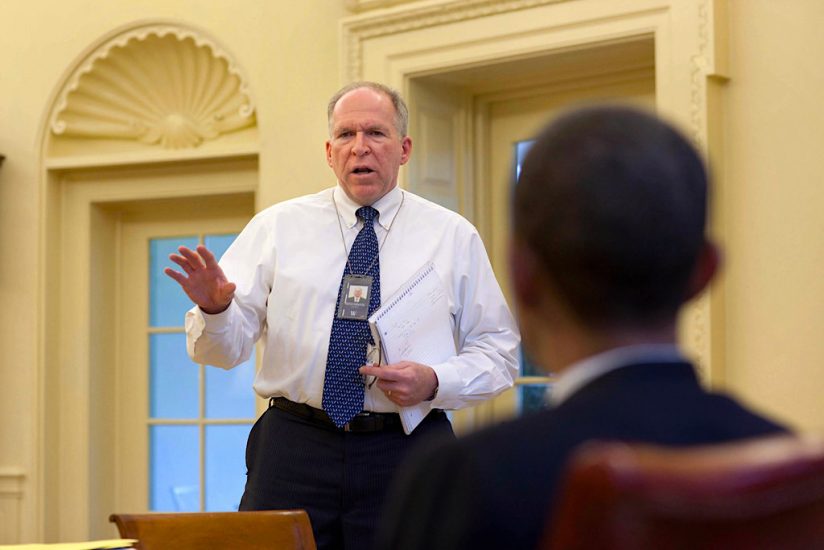
Brennan briefing Obama May 3, 2010. He approved whistleblower. (Official White House Photo by Pete Souza)
The vehicle for accomplishing this mission was the NSC Interagency Policy Committee (NSC/IPC). The NSC/IPCs were the main day-to-day fora for interagency coordination of national security policy. They provided policy analysis for consideration by the more senior committees of the NSC system and ensured timely responses to decisions made by the president. NSC/IPCs were established at the direction of the NSC Deputies Committee and were chaired by the relevant division chief within the NSC staff.
The whistleblowers job was to develop, coordinate and execute plans and policies to manage the full range of diplomatic, informational, military and economic national security issues for the countries in his portfolio, which included Ukraine. The whistleblower coordinated with his interagency partners to produce internal memoranda, talking points and other materials for the National Security Advisor and senior staff.
The whistleblower reported directly to Charles Kupchan, the Senior Director for European Affairs on the NSC. Kupchan, a State Department veteran who had previously served on the NSC staff of President Bill Clinton before turning to academia, in turn reported directly to Susan Rice, President Obama’s national security adviser.
When the whistleblower first arrived at the NSC, he volunteered for the Ukraine portfolio. Kupchan was impressed by the whistleblower’s work ethic and performance, and soon expanded his portfolio to include the fight against the Islamic State. The whistleblower was aided by another organizational connection—his colleague and mentor at OREA, Andrea Kendall-Taylor, had been selected to serve in the Office of the Director of National Intelligence as the deputy national intelligence officer for Russia and Eurasia. Among Kendall-Taylor’s responsibilities was to closely coordinate with the NSC staff on critical issues pertaining to Russia and Ukraine.
The whistleblower’s arrival at the NSC staff also coincided with the start of Trump’s improbable candidacy for the presidency of the United States. As 2015 transitioned into 2016, and it became apparent that Trump was the presumptive nominee for the Republican Party, allegations about the Trump campaign colluding with Russia began to circulate within the interagency. Trump’s electoral victory in November 2016, shocked the whistleblower, like everyone else on the NSC staff.
Alarmed By Trump on Russia
The line between policy and politics began to blur, and then disappeared altogether. National Security Advisor Rice was becoming increasingly alarmed by the activities of the Trump transition team, especially when it came to issues pertaining to Russia. According to The Washington Post, “Rice apparently was closely monitoring the high-profile investigation into Russian interference.”
The President-elect had, during the campaign, openly advocated for better relations between the U.S. and Russia and had even suggested that the Russian annexation of Crimea could eventually be accepted by the U.S. This stance was anathema to the policies that had been massaged into place by the NSC in general, and the whistleblower in particular. According to multiple sources familiar with the whistleblower during this time, his animus against Trump was palpable.
In December 2016, Rice was involved in the unmasking of the identities of several members of the Trump transition team. Various sensitive intelligence reports were circulating within the NSC regarding the interaction of unnamed U.S. citizens with foreign targets of intelligence interest. In order to better understand the significance of such a report, Rice has acknowledged that, on several occasions, she requested that the identity of the U.S. persons involved be “unmasked.”
The U.S. intelligence community is prohibited by law from collecting information about U.S. citizens. As such, when a conversation undertaken by a foreign national of intelligence interest was captured, and it turned out the person or persons whom the target was speaking to was a U.S. citizen, the analysts preparing the report for wider dissemination would “mask”, or hide, the identities of the U.S. citizens involved. Under relevant laws governing the collection of intelligence, up to 20 officials within the Obama administration had the authority to unmask the identities of U.S. citizens. One of those was Rice.
In late December 2016, the crown prince of the United Arab Emirates, Sheikh Mohammed bin Zayed al-Nahyan, arrived in New York for a meeting with several top Trump transition officials, including Michael Flynn, Trump’s son-in-law, Jared Kushner, and the President-elect’s top strategist Steve Bannon. Intelligence reports had been circulating about the UAE coordinating a backchannel for the Trump transition team and Russia.
Zayed’s arrival, which was unannounced and had not been coordinated with the U.S. government, caused great concern among the NSC staff especially given the context of allegations of collusion between Trump and Russia to influence the outcome of the 2016 election.
The principle NSC staffers who would logically have been advising Rice on this matter were Kupchan, the whistleblower, and Sean Misko, a State Department detailee who served as the director for the Gulf Arab States (According the NSC staffers who worked in the White House at the time, Misko and the whistleblower were said to be close friends, frequently socializing with one another after hours, and possessing a common dislike for Trump.) Rice requested that the intelligence reports pertaining to Zayed’s visit be subjected to unmasking procedures.
While the subsequent reporting about the three-hour meeting between Zayed and the Trump transition team failed to uncover any evidence of a secret communications channel with Russia, Rice (who would logically have been assisted by Kupchan and the whistleblower) facilitated the near continuous unmasking of intelligence reports involving Flynn, who was in contact with Russian officials, including Sergei Kislyak, the Russian ambassador to the U.S.
The Greatest Sin
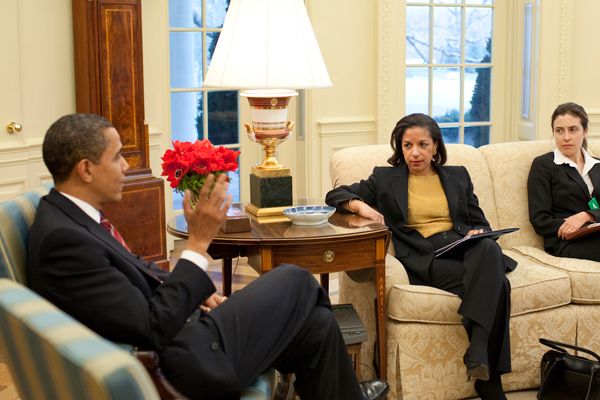
Susan Rice, center, with Obama, March 10, 2009. (White House photo)
As a professional intelligence analyst detailed to the NSC, the whistleblower was committed to a two-year assignment, extendable to three years upon the agreement of all parties. President Obama’s departure from the White House did not change this commitment. According to NSC staffers who served in the White House at the time, the whistleblower, like many of his fellow detailees, had grown attached to the policies of the Obama administration which they had fought hard to formulate, coordinate and implement. They viewed these policies to be sacrosanct, regardless of who followed in the White House.
In doing so, they had committed the greatest sin that an intelligence professional could commit short of espionage—they had become political.
In December 2016, the whistleblower was, based upon his role as a leading Russian analysts advising Rice directly, more than likely helping unmask Flynn’s communications with Russians; a month later, he was working for Flynn, someone he had likely actively helped conspire against, using the unfettered power of the intelligence community.
The Trump administration had inherited a national security decision-making apparatus that was bloated, and which fostered White House micromanagement via the NSC. While the Obama NSC had proven able to generate a proliferate amount of “policy”, it did so by relying on a staff that had expanded to the largest in the history of the NSC, and at the expense of the various departments of government that were supposed to be the originators of policy.
As the new national security adviser, Flynn let it be known from day one that there would be changes. One of his first actions was to hire four new deputies who centralized much of the responsibilities normally tasked to regional directors such as the whistleblower. Flynn was putting in place a new level of bureaucracy that shielded professional detailees from top level decision makers.
Moreover, it recognized that the NSC, while staffed with professionals who are supposed to be apolitical, was viewed by the White House as a partisan policy body whose work not only furthered the interests of the United States, but also the political interests of the president. When Trump included his top political advisor, Bannon, on the list of people who would comprise the National Security Council (normally limited to cabinet-level officials), it sent shockwaves through the national security establishment, which accused Trump of politicizing what they claimed was an apolitical process.
But the reality was that the NSC had always functioned as a partisan decision-making body. Its previous occupants may have tried to temper the level to which domestic politics intruded on national security decision-making, but its presence was an unspoken reality. All Trump did by seeking to insert Bannon into the mix was to be open about it.
Like the other professional detailees who comprised 90 percent of the NSC staff and were expected to remain at their posts as part of a Trump administration, the whistleblower was dismayed by the changes. Some accounts of the early days of the Trump NSC indicate that the whistleblower was defensive of the Ukraine policies he had helped craft during his tenure at the NSC.
When his immediate superior, Kupchan (a political appointee) departed the NSC, the whistleblower was temporarily elevated to the position of senior director for Russia and Eurasia until a new replacement could be found. (Flynn had reached out to Fiona Hill, a former national intelligence officer for Russia under the administration of George W. Bush, to take this job; Hill had accepted, but would not be available until April.)
The whistleblower was a known quantity within the NSC, as were his decidedly pro-Obama political leanings. As such, he was not trusted by the incoming Trump officials, and his access to the decision-making process was limited.
According to persons familiar with his work at the NSC during the Trump administration, the whistleblower’s frustration and anger soon led to acts of resistance designed to expose, and undermine public confidence in President Trump.
Cut Out of Call to Putin
In late January 2017 Trump made several introductory telephone calls to world leaders, including President Putin. Normally the NSC director responsible for Russia would help prepare the president for such a call by drafting talking points and supporting memoranda, and then monitor the call directly, either from within the Oval Office or from the White House situation room.
According to sources familiar with the incident, Flynn did not coordinate Trump’s call with NSC staff, and as such the whistleblower, who was acting as the director for Russia and European Affairs at the time, would have been cut out of the process altogether. When the whistleblower tried to access the read out of the phone call afterwards, he found that no verbatim record existed, only a short summary released by the White House, presumably prepared by Flynn.
More frustrating was the fact that the official readout of the call released by the Kremlin contained much more information, putting Russia in the driver’s seat in terms of defining U.S.-Russian policy priorities—the very policy blunder the NSC was supposed to prevent from happening. While searching for the non-existent records of the Putin-Trump conversation, however, the whistleblower came across detailed verbatim transcripts of two other calls made by Trump that day—one with Mexico, and one with Australia.
Within days the details of these calls were leaked to the media, resulting in a series of unflattering articles being published by the mainstream media. While no direct evidence has emerged about who was responsible for leaking these calls, NSC staffers who worked in the White House at the time suspected the whistleblower. (One of the byproducts of this incident was the decision by NSC lawyers to move the records of Presidential phone calls to a more secure server, significantly limiting access by NSC staff.)
On February 13, 2017, Flynn resigned from his position as President Trump’s national security adviser. The reason given was Flynn’s having misrepresented his conversations with Russian Ambassador Kislyak when questioned by Vice President Mike Pence. For the whistleblower, whose previous work in the Obama NSC appeared to help Rice’s efforts to unmask the very conversations Flynn was being held accountable for, this had to have been a satisfying moment. He had to have been even more pleased by Trump’s choice to replace Flynn —Lieutenant General H. R. McMaster, a decorated combat veteran known for his intelligence and willingness to challenge the establishment.
In the little more than a month that transpired between McMaster coming on board and the arrival of Hill as the new director for Russia and Europe, the whistleblower would have had the opportunity to meet his new boss and work with him on repairing what they both viewed as the flawed changes undertaken by Flynn at the NSC.
McMaster rewrote the presidential guidance regarding the functioning of the NSC, replacing the original Presidential Policy Memorandum 1 with a new version, PPM 4, which removed Bannon from the NSC and restored much of the policy coordinating functions that characterized the NSC under Obama.
Moreover, McMaster stuck up for the professional detailees, such as the whistleblower. When Hill arrived in April 2017 to assume her responsibilities as the NSC director for Russia and Europe, the whistleblower found himself without a job.
But instead of being returned to the CIA, McMaster, who had come to know the whistleblower during his first month as national security adviser, appointed him to serve as his personal assistant. The whistleblower moved from his desk next door in the Executive Office Building, where most NSC staffers work, to the West Wing of the White House, a move which gave him direct access to every issue that crossed McMaster’s desk.
Oval Office Leak
The new job, however, did nothing to diminish the disdain the whistleblower had for Trump. Indeed, the proximity to the seat of power may have served to increase the concern the whistleblower had about Trump’s stewardship. On May 10, President Trump played host to Russian Foreign Minister Sergey Lavrov and Russian Ambassador Kislyak. During the now-infamous meeting, Trump spoke about the firing of former FBI Director Jim Comey; a sensitive Israeli intelligence source related to the ongoing fight against ISIS in Syria; and alleged Russian interference in the 2016 presidential election.
As McMasters’ assistant, the whistleblower was privy to the readout of the meeting, and was so alarmed by what he had seen that he sent an email to John Kelly, who at that time was serving as director of the Department of Homeland Security, detailing the president’s actions and words. All materials relating to this meeting were collected and secured in the NSC’s top secret codeword server; the only unsecured data was that contained in the whistleblower’s email. When the media subsequently reported on the details of Trump’s meeting with the Russians, the White House condemned the “leaking of private and highly classified information” which undermined “our national security.”

Trump meets with Lavrov on May 10, 2017. (TASS/Wikipedia)
According to a NSC staffer who worked in the White House at the time, an internal investigation pointed to the whistleblower’s email as the likely source of the leak, and while the whistleblower was not directly implicated in actually transmitting classified information to the press, he was criticized for what amounted to unauthorized communication with an outside agency, in this case the Department of Homeland Security. When his initial two-year assignment terminated in July 2017, the White House refused to authorize a one-year extension (a courtesy offered to the vast majority of detailees).
The whistleblower had become a liability, publicly smeared by right-wing bloggers and subjected to death threats. He was released from the NSC and returned to the CIA, where he resumed his role as a Eurasian analyst. Shortly after the whistleblower left the NSC, the full transcripts of President Trump’s January 28, 2017 conversations with the leaders of Mexico and Australia were leaked to the press. While several colleagues in the NSC believed that the whistleblower was behind the leaks, McMaster refused to authorize a formal investigation which, if evidence had been found that implicated the whistleblower, would have effectively terminated his career at the CIA.
It is at this juncture the saga of the whistleblower should have ended, avoiding the turn of events which ended up labeling him with the now famous (or infamous) appellation. However, in June 2018 the whistleblower’s colleague, Kendall-Taylor, ended her assignment as the deputy national intelligence officer for Russia and Eurasia. An announcement was made to fill the vacancy, and the whistleblower applied.
Despite having left the NSC under a cloud of suspicion regarding the unauthorized disclosure of sensitive information, and even though his anti-Trump sentiment was common knowledge among his colleagues and superiors, the whistleblower was picked for a position that would put him at the center of policy formulation regarding Russia and Ukraine, and the sensitive intelligence that influenced such. His appointment would have been approved by Director of National Intelligence Dan Coates.
Enter Vindman
The whistleblower was well versed in the collaborative functions of the deputy national intelligence officer position, having worked with Kendall-Taylor during his time at the NSC. He began to develop professional relationships with a number of individuals, including the new director of Ukraine at the NSC, Army Lieutenant Colonel Alexander Vindman. Vindman had extensive experience regarding Ukraine and had been detailed to the NSC from the Joint Chiefs of Staff. The two soon appeared to share a mutual concern over President Trump’s worldview of both Russia and Ukraine, which deviated from the formal policy formulations promulgated by the interagency processes that both Vindman and the whistleblower were involved in.
Kiev-born Vindman. (Wikipedia)
The whistleblower’s concerns about President Trump and Ukraine predated the July 25, 2019 telephone call, and mirrored those expressed by Lieutenant Colonel Vindman, both in chronology and content, provided during his testimony before the House Intelligence Committee. While Vindman was critical of President Trump’s deviation and/or failure to conform with policy that had been vetted through proper channels (i.e., in conformity with PDD 4), he noted that, as president, “It’s his prerogative to handle the call whichever way he wants.”
Vindman took umbrage at the non-national security topics brought up by the president, such as investigating former Vice President Joe Biden and his son, Hunter, regarding their relationship with a Ukrainian energy company, Burisma Holdings, and other references to the 2016 U.S. presidential election.
According to Vindman, it was this aspect of the telephone call Vindman believed to be alarming, and which he subsequently related to an authorized contact within the intelligence community. While Vindman remained circumspect about the identity of the intelligence community official he communicated with about his concerns over Trump’s Ukraine policy, the fact that the chairman of the House Intelligence Committee refused to allow any discussion of this person’s identity strongly suggests that it was the whistleblower who, as the deputy national intelligence officer for Russia and Ukraine, would be a logical, and fully legitimate, interlocuter.
According to an account published in The Washington Post, sometime after being informed by Vindman of the July 25 Trump-Zelensky telephone call, the whistleblower began preparing notes and assembling information related to what he believed was untoward activity vis-à-vis Ukraine on the part of President Trump and associates who were not part of the formal Ukraine policy making process. He made numerous telephone calls to U.S. government officials whom he knew from his official work as the deputy national intelligence officer for Russia and Eurasia. Because much of the information he was using was derived from classified sources, or was itself classified in nature, the whistleblower worked from his office, using a computer system approved for handling classified data.
Off Limits
From the perspective of security, the whistleblower’s work was flawless. There was one problem, however; investigating the actions of the president of the United States and officials outside the intelligence community who were carrying out the instructions of the president was not part of the whistleblower’s official responsibilities.
Indeed, anything that whiffed of interference in domestic American politics was, in and of itself, off limits to members of the intelligence community.
Robert Gates, a long-time CIA analyst and former CIA director, had warned about this possibility in a speech he delivered to the CIA in March 1992 on the issue of the politicization of intelligence. “National intelligence officers”, Gates noted, “are engaged in analysis and—given their frequent contact with high-level policymakers—their work is also vulnerable to distortion.”
There was no greater example of politicized distortion than the rabbit hole the whistleblower had allowed himself to fall into. From Gates’ perspective, the whistleblower had committed the ultimate sin of any intelligence analyst—he had allowed his expertise to become tarnished by political considerations.
Worse, the whistleblower had crossed the threshold from advocating a politicized point of view to becoming political—that is, to intervene in the domestic political affairs of the United States in a manner which influenced the political future of a sitting president of the United States.
Once he had assembled his notes, he sought out staffers on the House Intelligence Committee for guidance on how to proceed. Schiff, the chairman of the House Intelligence Committee, had hired two former members of the Trump NSC staff who had served at the same time as the whistleblower.
One, Abigail Grace, had worked at the NSC from 2016-2018, covering U.S.-Chinese relations. Grace was hired by Schiff in February 2019 for the express purpose of investigating the Trump White House. A second NSC veteran was hired in August 2019, around the same time that the whistleblower was preparing his complaint. That staffer was none other than Sean Misko, the whistleblowers friend and fellow anti-Trump collaborator.
Both Misko and the whistleblower departed the NSC in 2017 under a cloud. Misko went on to work for the Center for New American Security, a self-described bipartisan think tank set up by two former Obama administration officials, Michèle Flournoy and Kurt M. Campbell, before being recruited by Schiff. It is not known if Misko was one of the House Intelligence staffers the whistleblower approached, or if there had been any collaboration between the whistleblower and Misko about the nature of the complaint prior to Misko being recruited by Schiff.
After conferencing with the House Intelligence Committee staffers, the whistleblower sought legal counsel. He reached out to a lawyer affiliated with Whistleblower Aid, a group of national security lawyers who came together in September 2017—eight months after the inauguration of President Trump—to encourage whistleblowers within the U.S. government to come out against Trump, and provide legal and financial assistance to anyone that chose to do so. One of Whistleblower Aid’s founding members was a lawyer named Mark Zaid.
 In the days following Trump’s swearing in as president, Zaid turned to Twitter to send out messages supportive of a “coup” against Trump that would lead to the president’s eventual impeachment. The identity of the lawyer who met with the whistleblower is not known. However, this lawyer referred the whistleblower to Bakaj, a fellow member of Whistleblower Aid, who took on the case and provided procedural guidance regarding the preparation of the complaint. Bakaj later brought on Zaid and another lawyer, Charles McCullough, with close ties to Senator Chuck Schumer and Hillary Clinton, to assist in the case.
On August 12, the whistleblower completed his complaint, and forwarded it to the intelligence community inspector general, thereby setting in motion events that produced weeks of hearings before the House Intelligence Committee that will very likely result in Trump’s impeachment.
Shielded from Questions
While the whistleblower, through counsel, had expressed a desire to testify before the House Intelligence Committee about the issues set forth in his complaint, he was never called to do so, even in closed-door session. The ostensible reason behind this failure to testify was the need to protect his anonymity, a protection that is not contained within the relevant statutes governing whistleblower activities within the intelligence community.
Later, as witnesses were identified from the content of the whistleblower’s complaint and subpoenaed to testify before the House Intelligence Committee, both Schiff and Bakaj indicated that the whistleblower’s testimony was no longer needed, since the specific issues and events covered in his complaint had been more than adequately covered by the testimony of others.
But the apparent reason Schiff and Bakaj refused to allow the whistleblower to testify, or to be identified, was to avoid legitimate questions likely to be asked by Republican committee members.
Namely, what was a deputy national intelligence officer of the U.S. intelligence community doing investigating activities of a sitting president? Who, if anyone, authorized this intervention in U.S. domestic political affairs by a CIA official? How did the whistleblower, who had a history of documented animosity with the Trump administration that included credible allegations of leaking sensitive material to the press for the express purpose of undermining the credibility of the president, get selected to serve as a deputy national intelligence officer? Who signed off on this assignment? What was the precise role played by the whistleblower in unmasking the identities of U.S. citizens in 2016, during the Trump transition?
Did the whistleblower maintain his friendship with Misko after leaving the NSC in July 2017? Did the whistleblower collaborate with Misko to get the House Intelligence Committee to investigate the issues of concern to the whistleblower before his complaint was transmitted to the ICIG? Who did the whistleblower meet on the House Intelligence staff? What did they discuss? Who was the lawyer the whistleblower first met regarding his intent to file a complaint? Did the whistleblower have any contact with Whistleblower Aid prior to this meeting?
Answers to these questions, and more, would have been useful in understanding not only the motives of the whistleblower in filing his complaint—was he simply a concerned citizen and patriot, or was he part of a larger conspiracy to undermine the political viability of a sitting president? There is no doubt that Congress has a constitutional right and obligation to conduct proper oversight of the operations of the executive branch, and to hold the president of the United States accountable if his conduct and actions are deemed unworthy of his office. Whether or not the facts surrounding the July 25, 2019 telephone call between Trump and Zelensky constitute grounds for impeachment is a political question for Congress to decide.
Intervening in Domestic Affairs
There is, however, the major issue looming in the background of this impeachment frenzy: the intervention by elements of the intelligence community in the domestic political affairs of the United States. There is no question that the whistleblower’s complaint served as the genesis of the ongoing impeachment proceedings.
The American people should be deeply concerned that an inquiry which could result in the removal of a duly elected president from office was initiated in secrecy by a member of the intelligence community acting outside the four corners of his legal responsibilities. The legitimacy of the underlying issues being investigated by the House Intelligence Committee is not at issue here; the legitimacy of the process by which these proceedings were initiated is.
To find out what happened, the whistleblower should not only be identified, called before the House Intelligence Committee, and other relevant Congressional committees, and be compelled to answer for his actions.
Impeachment is a constitutional remedy afforded to the U.S. Congress to deal with the political issues surrounding the conduct of a sitting president. If this constitutional remedy can be triggered by the intelligence community in a manner which obviates laws prohibiting the intrusion of intelligence agencies into the domestic political affairs of the United States, and done so in a manner where the identities of the persons and organizations involved, along with their possible motives, are shielded from both American people and those whom they elect to represent them in Congress, then a precedent will have been set for future interventions of this nature which undermine the very foundation of American democracy.
The political weaponization of intelligence represents a significant threat to the viability of the American constitutional republic that cannot be ignored.
Scott Ritter is a former Marine Corps intelligence officer who served in the former Soviet Union implementing arms control treaties, in the Persian Gulf during Operation Desert Storm, and in Iraq overseeing the disarmament of WMD.
Featured Video
The American Retreat from Vietnam
or go to
Aletho News Archives – Video-Images
From the Archives
Secret document reveals plans for civil war in Lebanon, Israeli false flags, and invasion
By Randi Nord | Geopolitics Alert | April 5, 2019
Beirut – During his visit with US Secretary of State, Mike Pompeo, Lebanese President Michael Aoun reportedly received a US-Israeli document detailing plans for creating a civil war in Lebanon with covert false flag operations and possible Israeli invasion.
Although the source of the document is Israeli and created in partnership with Washington, no one knows who presented it to Aoun. The Lebanese TV station, Al-Jadeed, initially reported the document on Lebanese TV and a video on its website. Geopolitics Alert translated the report for this article. … continue
Blog Roll
 Aletho News
- Department of War Awards $20.7 Billion Contract to Raytheon for Air-to-Air Missiles
- ‘Distance yourselves from Israel’: IRGC urges US population to question govt policies
- America’s Greenland deal has a radioactive backstory
- The RAF Fairford ‘terror plot’: Unpacking escalation in the UK echo-chamber
- EU Council Advances Chat Control 2.0 Scanning Proposal
- Ex-Greek MEP files complaint against Israeli spyware firm over alleged Pegasus surveillance
- Troubling ideas throughout the Torah, Talmud, Mishneh Torah and Tanya
- ‘Grave, alarming’: Iran mission on Trump’s UNGA ‘annihilation’ threats
- Najaf airport to reopen to Iranian flights within 24 hours: Ambassador
- From ‘How Will This End For Iran’ to ‘When America Walks Away’: A tale of two Economist covers
- If Americans Knew
- New Report: “Scholasticide and Genocide in Gaza: Assessment, Testimonies and Legal Analysis”
- Ex-Biden officials are desperate for a Gaza scapegoat
- Israeli “settlers” Invade Al-Aqsa; Pour Boiling Water on 75-Year-Old
- Israel Has Kidnapped Another American Teenager
- US arms sales to Israel worth $21.6 billion in 20 months
- Three Palestinians Killed in Israeli Attacks on Gaza
- Revealed: German “Anti-Semitism Expert” Driving Crackdown on Palestine Solidarity is Former Israeli Spy
- Egypt’s Warning to Israel Before Oct 7
- Israel’s siege signals another cruel winter for 1.8 million Gazans – Daily Update
- Netanyahu Asked UAE Leader to Deny Report on Oct. 7 Warning in Secret Visit, Sources Say
- No Tricks Zone
- New Study: Earth And Venus Surface Warmth Largely Explained By Convection And Lapse Rate, Not CO2 Or Radiation
- 2025 Nature Paper Claiming Worsening Global Drought Gets RETRACTED …Heavily Flawed
- New Study: ‘Global Drought Shows No Detectable Recent Acceleration Under Climate Warming’
- Economic Masterminds: German Socialists Suggest Taxing Productivity Gains Stemming From Using AI
- The South China Sea Has Not Been Cooperating With The Climate Change Narrative
- Energy Crisis: Germany Enters Heating Season With Historically Low Gas Reserve Fill Levels
- New Study: The Antarctic Ice Sheet Gained Mass From 2020-2024 Due To Staggering Snow And Ice Accumulation
- Study: Ocean Heating Rates From Thousands Of Years Ago ‘Dwarf’ Modern Ocean Heating Rates
- Climate Extremists Target, Attack Large-Scale Power Grid Infrastructure In Germany!
- New Study: Antarctic Ice Melt Has Contributed Less Than 1 Centimeter To Sea Level Rise In The Last 30 Years


