US impeachment furor sabotages Ukraine peace talks
By Finian Cunningham | RT | November 26, 2019
The much-anticipated meeting between Ukraine’s Volodymyr Zelensky and Russia’s Vladimir Putin is in danger of being a lost opportunity for peace. Washington’s political infighting has stacked the odds against a successful summit.
Weeks of impeachment hearings in the House of Representatives, accusing President Trump of abusing his office with regard to Ukraine, have achieved very little except for two things. Ukraine’s international image has been trashed with corruption claims and depiction of the country as having vassal-like dependency on the US, and secondly, demonization of Russia which has been heightened as an “aggressor” supposedly out to destroy Ukraine.
The irony is that Washington purports to be an ally of Ukraine to promote democracy, sovereignty, and independence of the former Soviet republic. But the upshot of the impeachment inquiry is that Ukraine’s independence and sovereignty is gravely undermined.
When President Zelensky holds multilateral talks soon with Putin, the Ukrainian leader will have little room to maneuver as a result of the cacophony back in the US.
The two leaders are due to meet on December 9 in Paris as part of a four-way summit also involving German Chancellor Angela Merkel and French President Emmanuel Macron. The meeting is a return to long-suspended peace talks and an attempt to revive the 2015 Minsk accords for ending conflict in eastern Ukraine.
It is over three years since the so-called Normandy Format last convened. The Minsk peace deal was never implemented, mainly because former Ukrainian president, Petro Poroshenko, refused to fulfill commitments to give regional autonomy to pro-Russian separatists in eastern Ukraine. Consequently the war has dragged on for nearly five years.
Zelensky was elected by a landslide vote in April primarily on the ticket that he would seek a peace settlement. In September, he agreed in principle to grant special status for the Donbas breakaway region of eastern Ukraine. Subsequently, though, Zelensky has appeared to backpedal on how much autonomy he is willing to countenance. Troops under his command have begun withdrawing from the front line with separatists, but it is not clear if that move marks a reliable de-escalation.
Alexander Lukashevich, Russia’s permanent representative to the Organization for Security and Cooperation in Europe, stated on November 21 that forces under Kiev’s command are still violating terms of a truce by not removing combat hardware from the line of contact. “This, to put it mildly, non-constructive approach to preparations for the Normandy meeting causes justified concern,” he added.
In a move seen as a trust-building gesture, Russia recently returned three Ukrainian naval vessels which it had confiscated last year after an infringement of its territory in the Kerch Strait.
The forthcoming meeting in Paris thus holds a fledgling start to finding a peaceful resolution to a conflict which has resulted in over 13,000 dead and millions displaced from their homes.
However, the impeachment debacle in Washington has painted Zelensky as a pathetic politician “who loves Trump’s a**” and “who will do anything” to curry favor with the president. The Democrats and obliging former US diplomats who had worked in Ukraine are claiming that Trump pressured Zelensky to dig dirt on Joe Biden, his would-be Democrat rival in next year’s election.
So zealous are Trump’s political opponents in Washington, together with the liberal media and US intelligence agencies, to pin an impeachable offense on him, that the Ukrainian president has ended up a lame-duck leader in the collateral damage.
This has generated much mockery among Ukrainians of the former comedian-turned-president, who has been nicknamed “Monica” in reference to the impeachment of President Bill Clinton for his sexual affair with White House intern Monica Lewinksy.
Even before the hearings in Congress got under way, Zelensky had been under fire from Ukrainian nationalists who accuse him of “capitulating” to Russia over his willingness to negotiate a peace settlement in eastern Ukraine. Kiev has seen large rallies of up to 20,000 protesting Zelensky’s peace efforts as a betrayal.
In a recent media interview, American professor Stephen Cohen, an astute observer on Russia-Ukraine, says that Zelensky is in a very precarious situation. Despite being overwhelmingly elected to find a peaceful solution to Ukraine’s conflict, the new president, says Cohen, has to contend with far-right paramilitary leaders who view any peace deal negotiated with Russia as treasonous. Zelensky has been subjected to death threats.
As Cohen points out, if the US was genuinely concerned about establishing peace and democracy in Ukraine, then Washington should be fully supporting Zelensky’s overtures to Moscow, to let him and the Ukrainian people know “we got your back.”
But as it is, Zelensky is going into negotiations with Putin as an isolated figure who has been demeaned by Washington’s squabbling and caricatured as a stooge.
Thus, what is being set up for the Ukrainian leader is an almost impossible task. If he were to agree with Putin to a further withdrawal of military forces from the contact line with pro-Russian separatists, or if he commits to implementing Minsk provisions for regional autonomy, then the uproar in Washington is predictable. Zelensky will be cast as selling out to Putin and capitulating to “Russian aggression.”
Such is the delirium of Russophobia in Washington, where Democrats and so-called ‘Russia experts’ like Fiona Hill have labeled Trump a “Kremlin agent” and “Bolshevik,” the next sequence in their narrative is that Trump abused his office in order to get Zelensky to surrender to Putin. Now we’re really talking impeachment, so it goes.
Missing from the political fight in Washington are the following key issues: it was American and European interference in Ukraine, not Russian, that plunged the country into ongoing conflict. That interference peaked with the CIA-backed coup in Kiev in February 2014, which led to Crimea seceding in a referendum and joining the Russian Federation. The coup also led directly to the war in eastern Ukraine by a neo-Nazi regime in Kiev against the ethnic Russian population who understandably have demanded autonomy.
The $400 million in military aid that Trump is accused of using as leverage on Zelensky, obscures the bigger picture of why the US has sent a total of $1 billion in military aid to the country in order to antagonize Russia. This has long been the agenda of Washington’s foreign policy establishment, to destabilize Russia by pushing Ukraine to join the NATO alliance.
The impeachment hearings against Trump have obscured and turned reality on its head. The anti-Trump Democrats, media and ‘deep state’ operatives want to exclude any wider investigation into corrupt dealings by the former Obama administration in Ukraine by asserting that any such claims are merely “Russian disinformation.”
Moreover, not only is the truth about Washington’s corruption in Ukraine being concealed, but the vassal status of Ukraine is complete by it not having any freedom to negotiate its way out of conflict or restoring normal neighborly relations with Russia.
Also on rt.com:
Trump in Wonderland: Off With His Head?
By Martin Sieff | Strategic Culture Foundation | November 25, 2019
Donald Trump’s millions of detractors without doubt see him as The Mad Hatter: But, no: He’s Alice. The President of the United States has disappeared down the rabbit hole and he’s in Wonderland – Complete with a Red Queen (Nancy Pelosi) shouting “Off with his head!”
The great mistake foreign observers make observing the latest farce in Washington is assuming that there must be some order, rationality and linear logic behind it. There is none. It is Politics According to the Marx Brothers
This is a show trial – incompetently planned and directed with hundreds of crazed scriptwriters: The Democratic members of the House Judiciary Committee, their staffs and the salivating Mainstream US Media are writing and rewriting the script as they go along.
If one is to believe the Mainstream Media, who avidly take this bizarre cartoon seriously, enough evidence has already been established to clearly convict Trump of seeking to push an inquiry into the prima facie evidence of corruption on the part of the son of a former vice president and the leading Democratic presidential candidate.
Is this supposed to be criminal or shocking? What is Trump even accused of doing? He is accused of cautiously investigating the possibility of corruption in a sensitive and clearly unstable US ally whose government openly tried to influence the 2016 US presidential election (as Russia did NOT!)
Indeed, top Ukrainian government officials before the 2016 vote openly published opinion articles in the most prestigious US outlets viciously attacking candidate Donald Trump and calling for the election of his opponent Hillary Clinton.
Far from endangering the security of Ukraine and withholding US aid, Trump has unwisely approved a flood of lethal US weapons, most especially Javelin missiles for Kiev.
This massive arms transfer gravely increases the potential threat to the breakaway provinces of Lugansk and Donetsk. It therefore also automatically ratchets up the threat of direct war between the United States and Russia – a danger of inconceivable horror that the “Hate Trump!” and “Hate Russia!” fanatics in Washington are insanely blind to.
The metaphor of the Gadarene Swine is repeatedly overused: But only because it works. It is true. The Hate Trump fanatics in the US Congress and in the US Media are stampeding the human race towards an annihilating nuclear war that nobody else remotely wants.
Trump in a very basic way has no one to blame but himself for this horrendous state of affairs in Wonderland. He surrounded himself with Russia-hating Armchair Warriors from Fiona Hill to John Bolton and Kurt Volker. So he should not be surprised that to a man – and woman – they have betrayed him.
Trump did not try to roll back the dark influence of the Deep State, the Jabberwock monster of his Wonderland. So he should not be surprised that now the Deep State Jabberwock is once again trying to eat him.
Former US Ambassador to Kiev Marie Jovanovich and former National Security Council official Alexander Vindman both consistently and relentlessly supported the illegal gangster regime in Kiev which only took power by a violent coup in 2014 by toppling the democratically elected president of the nation.
Yet Jovanovich and Vindman have never been held to account for their double standards and betrayal of their primary loyalty to the government of the United States. They know they are safe: They live in Wonderland, where treason is patriotism and loyalty to the law and Constitution of the Nation is the most unforgivable of crimes.
For it is the Elected President of the United States who sets all foreign policy: Or at least is supposed to. And it is the diplomatic and security apparatus of the United States that is presumed to implement that policy loyally and without questioning it.
Also, all ambassadors explicitly serve at the pleasure of the president and Trump should have fired Jovanovich as soon as he took office. She had been appointed by his predecessor Barack Obama, with the blessing of his own foreign policy guru, Polish-American and Russia-hating former National Security Adviser Zbigniew Brzezinski to implement a policy that Trump was explicitly elected to abandon – reckless, potentially highly dangerous unconditional US support for the unstable coup government in Kiev.
But none of this matters: We are Inside the Beltway and Down the Rabbit Hole. We are in Washington. And Washington is Wonderland. Lewis Carroll and his Alice would have understood immediately.
The Pitfalls of a Pit Bull Russophobe
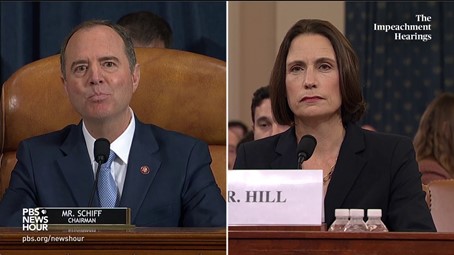
By Ray McGovern | Consortium News | November 22, 2019
Fiona Hill’s “Russian-expert” testimony Thursday and her deposition on Oct. 14 to the impeachment inquiry showed that her antennae are acutely tuned to what Russian intelligence services may be up to but, sadly, also displayed a striking naiveté about the machinations of US intelligence.
Hill’s education on Russia came at the knee of the late Professor Richard Pipes, her Harvard mentor and archdeacon of Russophobia. I do not dispute her sincerity in attributing all manner of evil to what President Ronald Reagan called the “Evil Empire.” But, like so many other glib “Russia experts” with access to Establishment media, she seems three decades out of date.
I have been studying the USS.R. and Russia for twice as long as Hill, was chief of CIA’s Soviet Foreign Policy Branch during the 1970s, and watched the “Evil Empire” fall apart. She seems to have missed the falling apart part.
Selective Suspicion
Are the Russian intelligence services still very active? Of course. But there is no evidence — other than Hill’s bias — for her extraordinary claim that they were behind the infamous “Steele Dossier,” for example, or that they were the prime mover of Ukraine-gate in an attempt to shift the blame for Russian “meddling” in the 2016 US election onto Ukraine. In recent weeks US intelligence officials were spreading this same tale, lapped up and faithfully reported Friday by The New York Times.
Hill has been conditioned to believe Russian President Vladimir Putin and especially his security services are capable of anything, and thus sees a Russian under every rock — as we used to say of smart know-nothings like former CIA Director William Casey and the malleable “Soviet experts” who bubbled up to the top during his reign (1981 – 1987). Recall that at the very first meeting of Reagan’s cabinet, Casey openly told the president and other cabinet officials: “We’ll know our disinformation program is complete when everything the American public believes is false.” Were Casey still alive, he would be very pleased and proud of Hill’s performance.
Beyond Dispute?
On Thursday Hill testified:
The unfortunate truth is that Russia was the foreign power that systematically attacked our democratic institutions in 2016. This is the public conclusion of our intelligence agencies, confirmed in bipartisan Congressional reports. It is beyond dispute, even if some of the underlying details must remain classified. [Emphasis added.]
Ah, yes. “The public conclusion of our intelligence agencies”: the same ones who reported that the Communist Party of the Soviet Union would never surrender power peaceably; the same ones who told Secretary of State Colin Powell he could assure the UN Security Council that the WMD evidence given him by our intelligence agencies was “irrefutable and undeniable.” Only Richard-Pipeline-type Russophobia can account for the blinders on someone as smart as Hill and prompt her to take as gospel “the public conclusions of our intelligence agencies.”
A modicum of intellectual curiosity and rudimentary due diligence would have prompted her to look into who was in charge of preparing the (misnomered) “Intelligence Community Assessment” published on Jan. 6, 2017, which provided the lusted-after fodder for the “mainstream” media and others wanting to blame Hillary Clinton’s defeat on the Russians.
Jim, Do a Job on the Russians
President Barack Obama gave the task to his National Intelligence Director James Clapper, whom he had allowed to stay in that job for three and a half years after he had to apologize to Congress for what he later admitted was a “clearly erroneous” response, under oath, to a question from Sen. Ron Wyden (D-OR) on NSA surveillance of US citizens. And when Clapper published his memoir last year, Hill would have learned that, as Defense Secretary Donald Rumsfeld’s handpicked appointee to run satellite imagery analysis, Clapper places the blame for the consequential “failure” to find the (non-existent) WMD “where it belongs — squarely on the shoulders of the administration members who were pushing a narrative of a rogue WMD program in Iraq and on the intelligence officers, including me, who were so eager to help that we found what wasn’t really there.” [Emphasis added.]
But for Hill, Clapper was a kindred soul: Just eight weeks after she joined the National Security Council staff, Clapper, during an NBC interview on May 28, 2017, recalled “the historical practices of the Russians, who typically, are almost genetically driven to co-opt, penetrate, gain favor, whatever, which is a typical Russian technique.” Later he added, “It’s in their DNA.” Clapper has claimed that “what the Russians did had a profound impact on the outcome of the election.”
As for the “Intelligence Community Assessment,” the banner headline atop The New York Times on Jan. 7, 2017 set the tone for the next couple of years: “Putin Led Scheme to Aid Trump, Report Says.” During my career as a CIA analyst, as deputy national intelligence officer chairing National Intelligence Estimates (NIEs), and working on the Intelligence Production Review Board, I had not seen so shabby a piece of faux analysis as the ICA. The writers themselves seemed to be holding their noses. They saw fit to embed in the ICA itself this derriere-covering note: “High confidence in a judgment does not imply that the assessment is a fact or a certainty; such judgments might be wrong.”
Not a Problem
With the help of the Establishment media, Clapper and CIA Director John Brennan, were able to pretend that the ICA had been approved by “all 17 intelligence agencies” (as first claimed by Clinton, with Rep. Jim Himes, D-CT, repeating that canard Thursday, alas “without objection).” Himes, too should do his homework. The bogus “all 17 intelligence agencies” claim lasted only a few months before Clapper decided to fess up. With striking naiveté, Clapper asserted that ICA preparers were “handpicked analysts” from only the FBI, CIA and NSA. The criteria Clapper et al. used are not hard to divine. In government as in industry, when you can handpick the analysts, you can handpick the conclusions.
Maybe a Problem After All
“According to several current and former intelligence officers who must remain anonymous because of the sensitivity of the issue,” as the Times says when it prints made-up stuff, there were only two “handpicked analysts.” Clapper picked Brennan; and Brennan picked Clapper. That would help explain the grossly subpar quality of the ICA.
If US Attorney John Durham is allowed to do his job probing the origins of Russiagate, and succeeds in getting access to the “handpicked analysts” — whether there were just two, or more — Hill’s faith in “our intelligence agencies,” may well be dented if not altogether shattered.
When Did Ukraine Become a ‘Critical Ally’?
By Pat Buchanan • Unz Review • November 15, 2019
On hearing the State Department’s George Kent and William Taylor describe President Donald Trump’s withholding of military aid to Ukraine, The New York Times summarized and solemnly endorsed their testimony:
“What clearly concerned both witnesses wasn’t simply the abuse of power by the President, but the harm it inflicted on Ukraine, a critical ally, under constant assault by Russian forces.”
“‘Even as we sit here today, the Russians are attacking Ukrainian soldiers in their own country, and have been for four years,’ Taylor said. ‘I saw this on the front line last week; the day I was there a Ukrainian soldier was killed and four more wounded.’”
Kent compared Ukrainian resistance to Russia’s intervention on the side of the Donbass secessionists to “our own Minutemen in 1776.”
“More than 13,000 Ukrainians have died on Ukrainian soil defending their territorial integrity and sovereignty from Russian aggression. … American support in Ukraine’s own de facto war of independence has been critical.”
Kent went on:
“The American colonies may not have prevailed against British imperial might without help from transatlantic friends after 1776. In an echo of Lafayette’s organized assistance to General George Washington’s army and Admiral John Paul Jones’ navy, Congress has generously appropriated over $1.5 billion over the past five years in desperately needed train and equip security assistance to Ukraine…”
“Similar to von Steuben training colonials at Valley Forge, U.S. and NATO allied trainers develop the skills of Ukrainian units at Yavoriv near the Polish border, and elsewhere. They help rewrite military education for Ukraine’s next generation, as von Steuben did for America’s first.”
“One would think, listening to this,” writes Barbara Boland, the American Conservative columnist, “that the U.S. had always provided arms to Ukraine, and that Ukraine has relied on this aid for years. But this is untrue and the Washington blob knows this.”
Indeed, Ukraine has never been a NATO ally or a “critical ally.”
Three decades ago, George H.W. Bush implored Ukraine not to set out on a course of “suicidal nationalism” by declaring independence from the Russian Federation. Despite constant pressure from Sen. John McCain and our neocons to bring Ukraine into NATO, wiser heads on both sides of the Atlantic rejected the idea.
Why? Because the “territorial integrity and sovereignty” of Ukraine is not now and has never been a vital interest of ours that would justify a U.S. war with a nuclear-armed Russia.
Instead, it was the avoidance of such a war that was the vital interest that nine U.S. presidents, from Truman to Bush I, secured, despite such provocations as the crushing of the Hungarian Revolution in 1956 and the building of the Berlin Wall.
In February 2014, the elected pro-Russian government of Viktor Yanukovych was overthrown by U.S.-backed protesters in Maidan Square, cheered on by McCain. This was direct U.S. intervention in the internal affairs of Ukraine. Victoria Nuland of the State Department conceded that we had dumped billions into Ukraine to reorient its regime to the West.
To Vladimir Putin, the Kyiv coup meant the loss of Russia’s historic Black Sea naval base at Sebastopol in Crimea. Rather than let that happen, Putin effected an uprising, Crimea’s secession from Ukraine, and the annexation by Russia. In eastern Ukraine, the pro-Russian Donbass rose up in rebellion against the pro-NATO regime in Kyiv.
Civil war broke out. We backed the new regime. Russia backed the rebels. And five years later, the war goes on. Why is this our fight?
During the Obama years, major lethal aid was denied to Ukraine.
The White House reasoned that arming Ukraine would lead to an escalation of the war in the east, greater Russian intervention, defeat for Kyiv, and calls for the U.S. to intervene militarily, risking a war with Russia.
Not until Trump became president did lethal aid begin flowing to Ukraine, including Javelin anti-tank missiles.
So where are we?
Despite dramatic depictions of Ukraine as our embattled ally, Ukraine has never been an ally. We are not now nor have we ever been obligated to fight for its sovereignty or territorial integrity. Efforts to bring Ukraine, Moldova and Georgia into NATO have been repeatedly rebuffed in the United States and by our European NATO allies.
Kent and Taylor are honorable men. But they are career diplomats of the Department of State and veteran advocates of a foreign policy that sees Russia as an enduring aggressor and Ukraine as a fighting ally entitled to U.S. military assistance.
They have, in the old phrase, gone native. They champion the policies of yesterday and the embattled countries to which they are accredited and to whose causes they have become converted.
But Trump was elected to overturn the interventionist policies America has pursued since the century began. He was elected to end Cold War II with Russia, to reach a modus vivendi as Reagan did, and to extricate us from the endless wars into which Presidents Bush and Obama plunged the nation.
Copyright 2019 Creators.com.
White House releases text of 1st phone call between Trump & Zelensky
RT | November 15, 2019
The White House has released a memo of the first phone call between President Donald Trump and Ukrainian President Volodymyr Zelensky. Although it details a predictably throwaway exchange, the search for the hidden meanings is on.
The call, made just a few hours after Zelensky was elected in Ukraine, is little more than a brief exchange of pleasantries, with Trump congratulating Zelensky on his presidency and the two heads of state talking about how great their respective countries are. Zelensky invites Trump to his inauguration, and Trump says they’ll meet soon, whether at the inauguration or elsewhere.
But with an impeachment inquiry in full swing, Trump’s nemeses in the Democratic Party have pounced on the conversation anyway. While former vice president Joe Biden, said to be the focus of the corruption investigation in Trump’s alleged quid pro quo, doesn’t make an appearance at all, that hasn’t stopped #Resistance stalwarts from trying to find a connection in the bare-bones protocol call.
Twitter was abuzz with speculation about the transcript – surely some parts were missing?
The fact that the White House had mentioned a discussion of “rooting out corruption,” yet the word “corruption” did not appear in the transcript, was held up as proof of a conspiracy to suppress the “truth.”
Others scorned the whole process of releasing the transcript, suggesting that Trump’s belief that his words were innocent was just more proof of his guilt.
The congratulatory call is the second Trump-Zelensky phone transcript to be released, after the text of the call that triggered the impeachment frenzy – when a whistleblower who hadn’t heard the conversation deemed it proof of a quid pro quo – failed to satisfy the president’s enemies in Washington. Trump has defended the summaries as “perfect” phone calls – which only makes his opponents double down on trying to read dirt into them.
Trump’s defenders pointed out that the transcript shows Trump eager to meet with Zelensky – far from the version depicted in the impeachment narrative, where he refuses to do so until Ukraine opens an investigation into the company that hired Biden’s son.
Stuck with a relatively lackluster transcript, House intel committee chair Adam Schiff demanded Trump release the “thousands” of documents the impeachment committee has requested as well. Others demanded transcripts of Trump’s calls with… other world leaders.
Which is exactly the precedent Trump had said he was afraid of setting by releasing the original Zelensky call.
Trump Declared Anti-Ukrainian Racist by Clownish Mainstream Media
By Tim Kirby | Strategic Culture Foundation | November 9, 2019
Donald Trump has been accused of racism since the moment he decided to run as a Republican, but The Washington Post is pushing this narrative one step farther, claiming that the President of the United States is so blinded by his own “loathing” for Ukraine, that he is blowing critical American foreign policy opportunities in that nation. CNN has also jumped on the propaganda bandwagon declaring that Trump has a “disdain” for the Ukraine that is “raising alarm bells”. Trump does not have an irrational hatred for Ukrainians and there is nothing in this region to be gained which has not already been achieved in recent years.
WaPo’s bizarre and utterly irrational condemnation of Trump begins with the following statement…
“Three of President Trump’s top advisers met with him in the Oval Office in May, determined to convince him that the new Ukrainian leader was an ally deserving of U.S. support.”
Ukraine’s leadership has no choice but to be an ally of the United States, much in the same way that India had to be allies of Britain during Queen Victoria’s reign. Ukraine is a vassal entity whose near future will be determined by Washington and/or Moscow. Ukraine is too battered and poor and infiltrated by both greater powers to actually have any real self-determination, meaning that there is no need for Trump or any other President to woo Kiev. The region is now almost completely under Washington’s control thanks to the US meddling that was the cause for the Maidan and the war in the Donbass. The “powers that be” in Kiev push a hardcore anti-Russian\pro-EU\pro-Western agenda because they have to serve masters who got them into power, this is only natural. Presenting the Ukraine as a sovereign nation that needs to be won over to America’s side is a complete lie and a slap in the face to The Washington Post’s readership. But this is only the beginning…
“They had barely begun their pitch when Trump unloaded on them, according to current and former U.S. officials familiar with the meeting. In Trump’s mind, the officials said, Ukraine’s entire leadership had colluded with the Democrats to undermine his 2016 presidential campaign.”
The words “In Trump’s mind…” imply that his beliefs of Ukrainian influence against his campaign are completely made up and irrational. Basically the big hint is that Trump’s fears are paranoia/delusional, which could be true if fake dirt hadn’t actually been directly thrown onto Trump’s campaign manager Paul Manafort from Ukraine. The implication that Trump has just dreamt up a conspiracy against himself from around the Dnieper is factually proven to be untrue.
“So far, a dozen witnesses have testified before House lawmakers since the closed-door impeachment inquiry began a month ago. One theme that runs through almost all of their accounts is Trump’s unyielding loathing of Ukraine, which dates to his earliest days in the White House.”
No examples of these tweets were supplied (Trump is known to be very loose with his tweets so this very well could be fully true) but you can see in this statement that there is a heavy handed hinting that a dislike of the status quo in Kiev is now a form of hatred and racism.
This is the most cheap and basic way to try to get a politician to shut up – using the “if you don’t approve of X, then you are a racist against X”, which sadly very often works. A “loathing” for some Israeli policy makes one anti-Semitic, a “disdain” for sending US troops to die in countries with odd names means you are against the troops or at the very least unpatriotic.
But thankfully for the President of the United States, unlike Israel or “The Troops”, no one actually cares about the Ukraine outside of the Beltway. Furthermore, if Trump had been projecting a blazing hatred towards everything Russian over the last few years, no one would be accusing him of Russophobia.
The Washington Post’s wretched hypocrisy in this article can me smelled from over the ocean.
“Inside the administration, Trump’s top advisers debated the origins of his ill-feeling. Some argued that Trump saw Ukraine as an impediment to better U.S. relations with Russian President Vladimir Putin, who was angry about U.S. sanctions imposed on Moscow for its annexation of Crimea and for the Kremlin’s ongoing support of pro-Russian separatists in eastern Ukraine.”
If the Russians took away the entire South of the United States, put a puppet government into power that is fanatically anti-American that then killed thousands of its own citizens (i.e. Americans) one would sure see that as an “impediment” to better US-Russian relations. Ukraine is a blip on the radar for America but for Russia it is basically the holy land from which it was born and an inalienable part of its civilization. Russia can be Russia without Tajikistan, but not without the Ukraine and Belarus. The horrors in the Donbass witnessed by many Russian-speakers that reminded them of the atrocities committed by the Nazis on the Eastern Front will not be soon be forgotten and make a submissive compromise situation a non-option. Thus, unless Washington throws away half of its current territorial control of Ukraine to the Russians (i.e. the regions that are strongly pro-Russian) there is no chance of reaching some sort of resolution that will improve US-Russian relations.
“Trump’s entire national security Cabinet unanimously supported it. But Trump hesitated. “He kept saying it… wasn’t worth pissing off Russia and what a bad country Ukraine was,” said the former senior White House official.”
If we take the time to reformat this question we can see where Trump could be coming from – “is it worth risking WWIII over a region of the world that means nothing to America (or the West) and everything to the Russians?” Protecting American territory from the Russians is important, protecting the West as a whole is also worth it, but funneling buckets of money into an endless Ukrainian hole on former Russian territory will not yield anything positive for America.
“None of those lofty arguments worked with Trump. “Many Americans feel strongly about supporting Ukraine because it’s the little guy and is fighting for values we consider fundamentally American”
There are more Americans who are concerned over plastic straws and the rights of men in dresses to pee in the women’s room than the Ukrainian situation. American men often voluntarily signed up for WWII and to a lesser extent Vietnam to fight a real ideological threat to the USA. How many guys would register for the draft over the Donbass? The overwhelming majority of Americans do not care about the fate of Kiev and why should they?
Fundamentally this primitive article by The Washington Post, is one long blunt implication that if Trump does not want to use American resources to push for maintaining a firm grasp on a heavily anti-Russian Ukraine then he is a racist bad person or at the very least is heavily misguided and irrational due to hurt feelings from his election campaign.
The Washington Post demonstrates in this piece the mentality of a Medieval peasant – if you don’t agree with me then you must be evil or possessed by demons blinding your judgment. This publication’s motto is “Democracy dies in Darkness” but their attitude towards the President having a viewpoint they don’t like is straight out of the Dark Ages.
Why the Only Thing Democrats Will Succeed in Impeaching Is Their Own Integrity
By Daniel Lazare | Strategic Culture Foundation | November 8, 2019
Last week’s impeachment headlines show why. If all you read is the New York Times, you’d think that the dump-Trump movement was going swimmingly. On Tuesday, Oct. 29, it announced that Congressman Adam Schiff, the Democrat leading the impeachment charge, had landed a key witness, a decorated army officer willing to testify that Trump’s July 25 phone call with Ukrainian President Volodymyr Zelensky was “so damaging to American interests that he reported it to a superior.” Two days later, the Times dropped another bombshell, the news that neocon regime-change advocate John Bolton, furious at Trump for firing him as national security adviser two months ago, might testify as well.
“Many Democrats regard Mr. Bolton as the perfect witness,” it said, “a respected conservative national security hawk who was nonetheless incensed by the how the president and his inner circle were treating Ukraine, and who broke sharply with the president upon his departure from the White House.”
Finally, another epic disclosure came on Friday. Yet another National Security Council official, the Times said, had “confirmed a key episode at the center of the impeachment inquiry, testifying that a top diplomat working with President Trump told him that a package of military assistance for Ukraine would not be released until the country committed to investigations the president sought.”
Wow! Two star witnesses plus confirmation, even if only second hand, that the president was guilty of a quid pro quo. Send up the flares — impeachment was on the way.
Except that it wasn’t. The Times was only telling half the story while trying desperately to keep the other half, far less favorable to the Democrats, under wraps.
Take the Oct. 29 article announcing Schiff dramatic new witness, a National Security Council staffer named Alexander S. Vindman. Deep inside was a curious tidbit:
“Because he emigrated from Ukraine along with his family when he was a child and is fluent in Ukrainian and Russian, Ukrainian officials sought advice from him about how to deal with [Trump attorney Rudy] Giuliani, though they typically communicated in English.”
The Times began to hem and haw as soon as conservatives seized on the item. “We have a US national security official who is advising Ukraine while working inside the White House, apparently against the president’s interest,” laughed Fox News host Laura Ingraham. “And, usually, they spoke in English. Isn’t that kind of an interesting angle on this story?” When rightwing internet activist Jack Posobiec tweeted that Vindman was trying “to counter President Trump’s foreign policy goals” and then cited the Times as the source, the paper declared huffily that, “in fact, the Times reported no such thing.”
But it did. Indeed, a subsequent Times piece was even more explicit. “During a May meeting in Ukraine to mark Mr. Zelensky’s inauguration,” it said, “the colonel advised him to try to avoid becoming ensnared in politics in the United States” by stonewalling Trump’s request for an investigation into corruption and Ukrainian interference in the 2016 election.
If this wasn’t counseling a foreign government about how to counter White House policy, then what is? As the always provocative Moon of Alabama website pointed out, Vindman’s statement to Schiff’s House Intelligence Committee, conveniently leaked to the press, was revealing in other ways as well.
“[A] strong and independent Ukraine,” it said, “is critical to US national security interests because Ukraine is a frontline state and a bulwark against Russian aggression.… The US government policy community’s view is that the election of President Volodymyr Zelensky and the promise of reforms to eliminate corruption will lock in Ukraine’s Western-leaning trajectory, and allow Ukraine to realize its dream of a vibrant democracy and economic prosperity.” But, it continued, “outside influencers [are] promoting a false narrative of Ukraine inconsistent with the consensus views of the interagency.”
References to a US government policy community should have raised all sorts of alarms. After all, what is such a community and who on earth appointed it? Who gets to decide what the consensus view is? How do we know outside influencers are promoting a false narrative – because the consensus says so?
What Vindman doesn’t understand is that in order to set policy, you’ve got to get elected, something Trump is – if only by the Electoral College – and something that self-appointed foreign-policy experts are not. Trump can seek policy advice from whatever source he wants, and it’s not up to some NSC flunky to tell him otherwise.
The other big news that the Times managed to ignore last week was the disclosure that the whistleblower who kicked off the furor over the Trump-Zelensky phone call is a 33-year-old CIA agent named Eric Chiaramella, an Obama holdover who advised Joe Biden on the Ukraine and who worked with a Democratic operative named Alexandra Chalupa, whose job was to meet with Ukrainian officials and dig up dirt on Trump.
Paul Sperry’s report in RealClearInvestigations.com – which Chiaramella’s attorneys have so far failed to deny – is a big deal because of what it says about the infighting between Trump and Obama loyalists that is now tearing Washington apart. Chiaramella also turns out to be a member of Washington’s self-appointed policy community who thinks that Trump’s job is to do as he’s told. As an unnamed White House official told Sperry:
“My recollection of Eric is that he was very smart and very passionate, particularly about Ukraine and Russia. That was his thing – Ukraine. He didn’t exactly hide his passion with respect to what he thought was the right thing to do with Ukraine and Russia, and his views were at odds with the president’s policies.”
So Chiaramella reported his findings to Adam Schiff, who agreed right off the bat to prosecute the president for daring to set a new course. This is what impeachment is about, not high crimes and misdemeanors, but who lost the Ukraine – plus Syria, Libya, Yemen, and other countries that the Obama administration succeeded in destroying – and why Trump should pay the supreme penalty for suggesting that Democrats are in any way to blame.
Of course, the Times is to blame as well. It twisted the news so as to cheer on such misbegotten policies just as it cheered on the twin invasions of Afghanistan and Iraq a dozen years or so earlier. This is why it’s furious with Trump for holding Democrats to account and why it now fills its pages with endless blather about quid pro quo’s just as it once did about Russian collusion.
But it won’t work. The only thing Democrats will succeed in impeaching is their own integrity.
Deep State on the National Security Council: Colonel Vindman Is an ‘Expert’ With an Agenda
By Philip Giraldi | Strategic Culture Foundation | November 7, 2019
The current frenzy to impeach President Donald Trump sometimes in its haste reveals that which could easily be hidden about the operation of the Deep State inside the federal government. Congress is currently obtaining testimony from a parade of witnesses to or participants in what will inevitably be called UkraineGate, an investigation into whether Trump inappropriately sought a political quid pro quo from Ukrainian leaders in exchange for a military assistance package.
The prepared opening statement by Lieutenant Colonel Alexander Vindman, described as the top Ukraine expert on the National Security Council (NSC), provides some insights into how decision making at the NSC actually works. Vindman was born in Ukraine but emigrated to the United States with his family at age three. He was commissioned as an army infantry officer in 1998 and served in some capacity in Iraq from 2004-5, where he was wounded by a roadside bomb and received a purple heart. Vindman, who speaks both Ukrainian and Russian fluently, has filled a number of diplomatic and military positions in government dealing with Eastern Europe, to include a key role in Pentagon planning on how to deal with Russia.
Vindman, Ukrainian both by birth and culturally, clearly was a major player in articulating and managing US policy towards that country, but that is not really what his role on the NSC should have been. As more than likely the US government’s sole genuine Ukrainian expert, he should have become a source of viable options that the United States might exercise vis-à-vis its relationship with Ukraine, and, by extension, regarding Moscow’s involvement with Kiev. But that is not how his statement, which advocates for a specific policy, reads. Rather than providing expert advice, Vindman was concerned chiefly because arming Ukraine was not proceeding quickly enough to suit him, an extremely risky policy which has already created serious problems with a much more important Russia.
Vindman apparently sees Ukraine-Russia through the established optic provided by the Deep State, which considers global conflict as the price to pay for maintaining its largesse from the US taxpayer. Continuous warfare is its only business product, which explains in part its dislike of Donald Trump as he has several times threatened to upset the apple cart, even though he has done precious little in reality. Part of Vindman’s written statement (my emphasis) is revealing: ”When I joined the NSC in July 2018, I began implementing the administration’s policy on Ukraine. In the Spring of 2019, I became aware of outside influencers promoting a false narrative of Ukraine inconsistent with the consensus views of the interagency. This narrative was harmful to US government policy. While my interagency colleagues and I were becoming increasingly optimistic on Ukraine’s prospects, this alternative narrative undermined US government efforts to expand cooperation with Ukraine.”
Alexander Vindman clearly was pushing a policy that might be described as that of the Deep State rather than responding to his own chain of command where it is the president who does the decision making. He also needs a history lesson about what has gone on in his country of birth. President Barack Obama conspired with his own version of Macbeth’s three witches – Rice, Power and Jarett – to overthrow the legitimate government of Ukraine in 2014 because it was considered to be too close to Moscow. The regime change was brought about by “mavericks” like the foul-mouthed neocon State Department officer Victoria Nuland and the footloose warmonger Senator John McCain. Vice President Joe Biden also appeared on the scene after the “wetwork” was done, with his son Hunter trailing behind him. Since that time, Ukraine has had a succession of increasingly corrupt puppet governments propped up by billions in foreign aid. It is now per capita the poorest country in Europe.
Washington inside-the-beltway and the Deep State choose to blame the mess in Ukraine on Russian President Vladimir Putin and the established narrative also makes the absurd claim that the political situation in Kiev is somehow important to US national security. The preferred solution is to provide still more money, which feeds the corruption and enables the Ukrainians to attack the Russians.
Colonel Vindman, who reported to noted hater of all things Russian Fiona Hill, who in turn reported to By Jingo We’ll Go To War John Bolton, was in the middle of all the schemes to bring down Russia. His concern was not really over Trump vs. Biden. It was focused instead on speeding up the $380 million in military assistance, to include offensive weapons, that was in the pipeline for Kiev. And assuming that the Ukrainians could actually learn how to use the weapons, the objective was to punish the Russians and prolong the conflict in Donbas for no reason at all that makes any sense.
Note the following additional excerpt from Vindman’s prepared statement: “… I was worried about the implications for the US government’s support of Ukraine… I realized that if Ukraine pursued an investigation into the Bidens and Burisma, it would likely be interpreted as a partisan play which would undoubtedly result in Ukraine losing the bipartisan support it has thus far maintained.”
Vindman’s concern is all about Ukraine without any explanation of why the United States would benefit from bilking the taxpayer to support a foreign deadbeat one more time. One wonders if Vindman was able to compose his statement without a snicker or two intruding. He does eventually go on to cover the always essential national security angle, claiming that “Since 2008, Russia has manifested an overtly aggressive foreign policy, leveraging military power and employing hybrid warfare to achieve its objectives of regional hegemony and global influence. Absent a deterrent to dissuade Russia from such aggression, there is an increased risk of further confrontations with the West. In this situation, a strong and independent Ukraine is critical to US national security interests because Ukraine is a frontline state and a bulwark against Russian aggression.”
The combined visions of Russia as an aggressive, expansionistic power coupled with the brave Ukrainians serving as a bastion of freedom is so absurd that it is hardly worth countering. Russia’s economy is about the size of Italy’s or Spain’s limiting its imperial ambitions, if they actually exist. Its alleged transgressions against Georgia and Ukraine were both provoked by the United States meddling in Eastern Europe, something that it had pledged not to do after the Soviet Union collapsed. Ukraine is less an important American ally than a welfare case, and no one knows that better than Vindman, but he is really speaking to his masters in the US Establishment when he repeats the conventional arguments.
It hardly seems possible, but Vindman then goes on to dig himself into a still deeper hole through his statement’s praise of the train wreck that is Ukraine. He writes “In spite of being under assault from Russia for more than five years, Ukraine has taken major steps towards integrating with the West. The US government policy community’s view is that the election of President Volodymyr Zelensky and the promise of reforms to eliminate corruption will lock in Ukraine’s Western-leaning trajectory, and allow Ukraine to realize its dream of a vibrant democracy and economic prosperity. The United States and Ukraine are and must remain strategic partners, working together to realize the shared vision of a stable, prosperous, and democratic Ukraine that is integrated into the Euro-Atlantic community.”
Alexander Vindman does not say or write that the incorporation of Ukraine into NATO is his actual objective, but his comments about “integrating with the West” and the “Euro-Atlantic community” clearly imply just that. The expansion of NATO up to Russia’s borders by the rascally Bill Clinton constituted one of the truly most momentous lost foreign policy opportunities of the twentieth century. The addition of Ukraine and Georgia to the alliance would magnify that error as both are vital national security interests for Moscow given their history and geography. Vindman should be regarded as a manifestation of the Deep State thinking that has brought so much grief to the United States over the past twenty years. Seen in that light, his testimony, wrapped in an air of sanctimoniousness and a uniform, should be regarded as little more than the conventional thinking that has produced foreign policy failure after failure.
Western courts target Gazprom for expropriations
By Padraig McGrath | October 29, 2019
On October 23rd the Amsterdam District Court issued an order for the seizure of 100% of the shares of the South Stream Transport B.V. company, which is contracted to build the offshore section of the Turk Stream Pipeline. This legal ruling follows a 2018 award by the Stockholm Arbitration Tribunal of $4.6 billion to Naftogaz, the (theoretically) state-owned oil and gas company of Ukraine, in a lawsuit which it had filed against Gazprom in 2014 in relation to alleged contractual violations regarding gas-transit through Ukraine. That $4.6 billion award was later negotiated down to $2.56 billion, but on October 23rd the Amsterdam District Court ordered the seizure of all South Stream Transport B.V. shares as a punitive measure for non-compliance with the Stockholm Arbitration Tribunal order.
Despite this development, Russian Energy Minister Aleksandr Novak said on October 27th that the construction of the Turk Stream Pipeline would be completed on schedule. The 1100-kilometre pipeline, 900 kilometres of which runs under the Black Sea to Turkey, is envisaged to begin delivering a combined total of 30 billion cubic metres of gas to Turkey and South-Eastern Europe per year, beginning in late 2019.
Of course, this is not the first time that Russia’s state-owned concerns have been targeted for plunder by a court or quasi-judicial body convened in the legal jurisdiction of a western country. In July 2014, the Permanent Court of Arbitration in The Hague issued an award of $50 billion to former shareholders of Yukos, the oil company previously controlled by the oligarch Mikhail Khodorkovsky. Interestingly, the Amsterdam District Court, the same judicial body which has issued this latest ruling, later quashed the 2014 ruling made by the Permanent Court of Arbitration on the grounds that the latter had no legal jurisdiction to issue such a ruling.
One thing which is perfectly clear in context is that these legal rulings are, quite blatantly, both politically and geo-politically motivated. Targetting Gazprom serves multiple geo-political functions. Firstly, the Turk Stream pipeline was devised in order to enable Russia to bypass the territory of a deeply problematic, crisis-ridden, hostile and contractually unreliable neighbour in the task of effecting gas-transit to its markets in Europe. Even before relations between Russia and Ukraine deteriorated following the February 2014 Ukrainian coup d’etat, the siphoning-off of Russian gas while in transit across Ukrainian territory had been a perpetual concern for many years.
However, this goal of rendering Ukraine a geo-political irrelevancy, and therefore nobody else’s problem, is precisely what western geo-strategists are invested in preventing. Ukraine has been transformed by western interests into the failed state that it is now precisely for the purpose of presenting developmental and economic challenges to Russia. Therefore, these same interests must use any counter-measures, including quasi-legal counter-measures, in order to keep Ukraine relevant. This explains the punitive court-order to freeze the shares of South Stream Transport B.V.
Another driver of this western judicial hostility, also a manifestation of current geo-political conditions, pertains to Gazprom specifically. To analyze this, we should look at the role which highly profitable state-owned concerns, Gazprom the most notable among them, play within the Russian economy and in Russian society more broadly.
In spite of maintaining quite a business-friendly tax-environment (Russia has a 13% flat income-tax rate), the Russian government nonetheless manages to maintain (and indeed, to significantly upgrade) the social system. Significant federal investments have already been made in infrastructure and in the modernization of the public healthcare sector, for example. In February, the government announced 12 major development-projects as part of the “Great Society” initiative ranging from agriculture, ecology, infrastructure, the digital economy, and the further technological modernization of public healthcare.
In a country with a 13% flat income-tax rate, revenues from state-owned companies like Gazprom make this kind of state-building and society-strengthening possible. The western alliance (and its judiciaries) understand perfectly well that financial attacks against Gazprom amount in practical terms to attacks on the Russian state, and to counter-measures to the Russian state’s efforts to build the kinds of social systems which are necessary to its long-term self-defence.
Taken to its logical conclusion, from the liberal democratic perspective, the rationalization for this further degree of geo-political weaponization of “international law” would be that, as liberal democracy is believed by the western alliance to be the only political system which has any moral or political legitimacy, it therefore follows that only liberal democratic legal systems have any legal jurisdiction, and that their jurisdiction should be seen as universally extensive.
“Liberal universalism” refers to a sense of moral universality, but also (consequently) to a sense of universality of legal jurisdiction.
This mindset attempts to justify the weaponization of judiciaries, and of judicial bodies established by international law, against all and any states which don’t sign on with the liberal universalist consensus.
Of course, Russia is not the only state which is targeted by this geo-political weaponization of judiciaries. We might recall the 2012 order made by a New York court to freeze $6.5 billion in Iranian government assets in relation to a lawsuit filed by family-members of people killed in the 9/11 attacks. The lawsuit had claimed (quite spuriously and bizarrely) that Iran had aided and abetted the 9/11 attackers, despite the obvious point that Al-Qaeda’s ideology is fanatically anti-Shi’ite. One point which is interesting, considering that state-sponsored piracy has quite recently re-appeared on the high seas (Gibraltar), is that judicial structures established by “international law” are now also being quite explicitly used for the purpose of enabling what we might term “judicial piracy.”
What next? Will the British government start re-issuing “letters of marque” to sea-faring privateers?
However, as with so many geo-political stratagems deployed by the governments of contemporary liberal democracies, the resulting erosion of the judiciary’s independence from the political sphere completely undermines the normative and legal basis of liberal democracy itself.
‘Russians will have a fight on their hands’: Alaska governor vows to thwart ‘independence referendum & annexation’ in prank call
RT | October 20, 2019
Governor Mike Dunleavy said he was aware of Moscow’s plan to stage an independence referendum to reclaim Alaska, and promised to arrange a gold nugget for the visiting Ukrainian leader, in a phone call with Russian pranksters.
The governor seemed honored to receive such a ‘high-profile’ call from none other than Ukrainian Prime Minister and the country’s ambassador to the US. Unsurprisingly, the key topic of the conversation was the omnipresent ‘Russian threat’.
The duo of pranksters informed Dunleavy of a sinister plan, masterminded by the Kremlin, to reclaim Alaska. They explained that Moscow believes it had only temporary rented Alaska to the US back in 1876, and now – especially since the state has a maritime border with Russia, while being separated from the rest of the American territory by Canada – wants its land back.
“I’ve heard about that. I’ve been reading up on it and I’m obviously keeping an eye on it, so is our president.”
The pranksters revealed that Moscow had already sent its ‘agents’ to the 49th US state to bribe the indigenous people in order to organize an ‘independence referendum’ and ‘annex’ Alaska under that pretext. Worried by the new details of the vile plan, the governor said that he would “certainly be talking to folks in DC about this information.”
The Russians “will have a fight on their hands” if they lay their claim to Alaska, the governor stated, vowing to defend his state.
“All I can say on behalf of Alaskans – we are Americans, and we have no desire to become part of Russia.”
On a less ‘serious’ subject, the prank-callers wondered if it would be possible to organize a trip to Klondike for the Ukrainian leader – and make sure that he finds a gold nugget there.
“I’m sure we can talk to some folks that can help arrange that,” Dunleavy promised, fully welcoming the idea of Petro Poroshenko’s visit to Alaska. The conversation apparently took place in early 2019 when Poroshenko was still Ukrainian President, but was only released online this Friday.
The two tricksters behind the prank, Alexey Stolyarov and Vladimir Kuznetsov, otherwise known as Lexus and Vovan, have made a name for themselves with a series of phone pranks on high-profile officials, previously getting over on French President Emmanuel Macron, Democratic Congressman Adam Schiff, as well as former US Ambassador to the UN Nikki Haley, then UK Foreign Secretary Boris Johnson and hawkish US special envoy to Venezuela Elliott Abrams.
Featured Video
The American Retreat from Vietnam
or go to
Aletho News Archives – Video-Images
From the Archives
Secret document reveals plans for civil war in Lebanon, Israeli false flags, and invasion
By Randi Nord | Geopolitics Alert | April 5, 2019
Beirut – During his visit with US Secretary of State, Mike Pompeo, Lebanese President Michael Aoun reportedly received a US-Israeli document detailing plans for creating a civil war in Lebanon with covert false flag operations and possible Israeli invasion.
Although the source of the document is Israeli and created in partnership with Washington, no one knows who presented it to Aoun. The Lebanese TV station, Al-Jadeed, initially reported the document on Lebanese TV and a video on its website. Geopolitics Alert translated the report for this article. … continue
Blog Roll
 Aletho News
- There Is A Drought in Academia: A Drought in Honest Research on the Subject of Drought and Other Weather Extremes
- Department of War Awards $20.7 Billion Contract to Raytheon for Air-to-Air Missiles
- ‘Distance yourselves from Israel’: IRGC urges US population to question govt policies
- America’s Greenland deal has a radioactive backstory
- The RAF Fairford ‘terror plot’: Unpacking escalation in the UK echo-chamber
- EU Council Advances Chat Control 2.0 Scanning Proposal
- Ex-Greek MEP files complaint against Israeli spyware firm over alleged Pegasus surveillance
- Troubling ideas throughout the Torah, Talmud, Mishneh Torah and Tanya
- ‘Grave, alarming’: Iran mission on Trump’s UNGA ‘annihilation’ threats
- Najaf airport to reopen to Iranian flights within 24 hours: Ambassador
- If Americans Knew
- New Report: “Scholasticide and Genocide in Gaza: Assessment, Testimonies and Legal Analysis”
- Ex-Biden officials are desperate for a Gaza scapegoat
- Israeli “settlers” Invade Al-Aqsa; Pour Boiling Water on 75-Year-Old
- Israel Has Kidnapped Another American Teenager
- US arms sales to Israel worth $21.6 billion in 20 months
- Three Palestinians Killed in Israeli Attacks on Gaza
- Revealed: German “Anti-Semitism Expert” Driving Crackdown on Palestine Solidarity is Former Israeli Spy
- Egypt’s Warning to Israel Before Oct 7
- Israel’s siege signals another cruel winter for 1.8 million Gazans – Daily Update
- Netanyahu Asked UAE Leader to Deny Report on Oct. 7 Warning in Secret Visit, Sources Say
- No Tricks Zone
- New Study: Earth And Venus Surface Warmth Largely Explained By Convection And Lapse Rate, Not CO2 Or Radiation
- 2025 Nature Paper Claiming Worsening Global Drought Gets RETRACTED …Heavily Flawed
- New Study: ‘Global Drought Shows No Detectable Recent Acceleration Under Climate Warming’
- Economic Masterminds: German Socialists Suggest Taxing Productivity Gains Stemming From Using AI
- The South China Sea Has Not Been Cooperating With The Climate Change Narrative
- Energy Crisis: Germany Enters Heating Season With Historically Low Gas Reserve Fill Levels
- New Study: The Antarctic Ice Sheet Gained Mass From 2020-2024 Due To Staggering Snow And Ice Accumulation
- Study: Ocean Heating Rates From Thousands Of Years Ago ‘Dwarf’ Modern Ocean Heating Rates
- Climate Extremists Target, Attack Large-Scale Power Grid Infrastructure In Germany!
- New Study: Antarctic Ice Melt Has Contributed Less Than 1 Centimeter To Sea Level Rise In The Last 30 Years

