The New Yorker’s Partisan Attempt to Refute Its Claim of Partisan Disinformation on Biden and Ukraine
By Joe Lauria | Consortium News | October 8, 2019
The New Yorker‘s Jane Mayer has gained a reputation as one of the best reporters in Washington, but in her latest piece on Ukraine and former Vice President Joe Biden, Mayer has succumbed to the partisan mania ripping apart this city and much of the country.
There is little subtlety in her argument, as evidenced by the title of the piece: “The Invention of the Conspiracy Theory on Biden and Ukraine.” Rather than taking an impartial, non-partisan view—needed now more than ever in journalism—Mayer neglects evidence that would have produced a more nuanced report on this increasingly volatile story.
Such an achievement required the suppression of a seasoned reporter’s natural curiosity. Maybe the other side has evidence worth examining too.
Mayer is not alone in dismissing serious questions about Biden as merely “a repeatedly discredited conspiracy theory involving Joe Biden and his son Hunter’s work in Ukraine.” In doing so, Mayer has joined an unthinking media consensus protecting Biden and the media’s own interests to save itself from the shame of having pushed the now discredited conspiracy theory of Trump’s collusion with Russia. With the Trump Justice Department digging into the origins of that fiasco it was the perfect time to preempt its findings with a trumped up impeachment scandal. The last thing the intelligence agencies and their compliant media need are revelations about how they together duped the country.
Mayer, who distinguished herself on many stories, including a defense of the wrongly accused National Security Agency senior executive Tom Drake—an actual whistleblower—reduced herself to the journalists’ herd that gave Russiagate credence, and in the process undermined scores of media reputations.
Instead of owning up to it, Mayer writes that the media was manipulated in 2016, not by Democrats or intelligence officials, but by Republican partisans. She produces a line about Ukrainegate that would more credibly describe media accomplices in Russiagate: “News organizations continue to be just as susceptible to manipulation by political partisans pushing complicated and hard-to-check foreign narratives as they were in 2016.”
Mayer’s unwillingness to see the corruption of both major parties is stunning.
She writes: “Anyone trying to track the Ukrainian conspiracy stories that were eventually embraced by President Trump is likely to get mired in the same echo chamber of right-wing news purveyors that misinformed voters in 2016” (except that in 2016 it was an echo chamber aligned with Democrats).
Mayer only blames Republicans who were largely on the defensive during Russiagate. Her exoneration of Democrats then and now for misinforming voters, extends to Secretary of State Hillary Clinton’s approval of an uranium deal with Russia, after which, Mayer reports, “more than two million dollars in contributions” came to “the Clinton Foundation from the businessmen behind the deal.” She says Clinton is in the clear because other U.S. agencies also approved the deal and the amount of uranium was “negligible.” It was all just a conservative plot, Mayer tells us.
The Biggest Omissions
Mayer attributes the origins of Biden’s appearance of conflict of interest in Ukraine solely to a disinformation campaign run by a shadowy group set up by Donald Trump’s former chief strategist, the right wing activist, Steve Bannon.
This is intended to put a nail in the story at its origins, portraying it as just a nutty conservative conspiracy, and thus no one needs to be concerned about significant evidence that followed. “For nearly two years, conservative operatives have been trying to weaponize the Ukraine-based story that has led Trump to the brink of impeachment,” Mayer wrote.
She takes at face value Bannon’s braggadocio about his so-called Government Accountability Initiative being “key” and the “predicate” to the Biden-Ukraine story, allowing her to easily dismiss an array of facts, including a public admission of corruption by Biden himself, as merely an “unethically seeming morass.”
Of all the evidence missing from Mayer’s piece, perhaps the most important is the opening act of this Washington drama: the U.S.-backed coup that overthrew an elected Ukrainian government in 2014. Without that evidence it is impossible to understand the context of the nauseating Biden/Ukraine impeachment story. She is not alone in this either. The entire elite liberal media and Fox News won’t mention it in a bipartisan cover-up of rapacious American foreign policy.
The press usually takes 25 years, after the declassification of documents, to admit the United States routinely breaks international law by overthrowing sovereign governments, and not in the name of spreading democracy, but in the interests of capital and geo-strategy. That was the case with Ukraine in 2014.
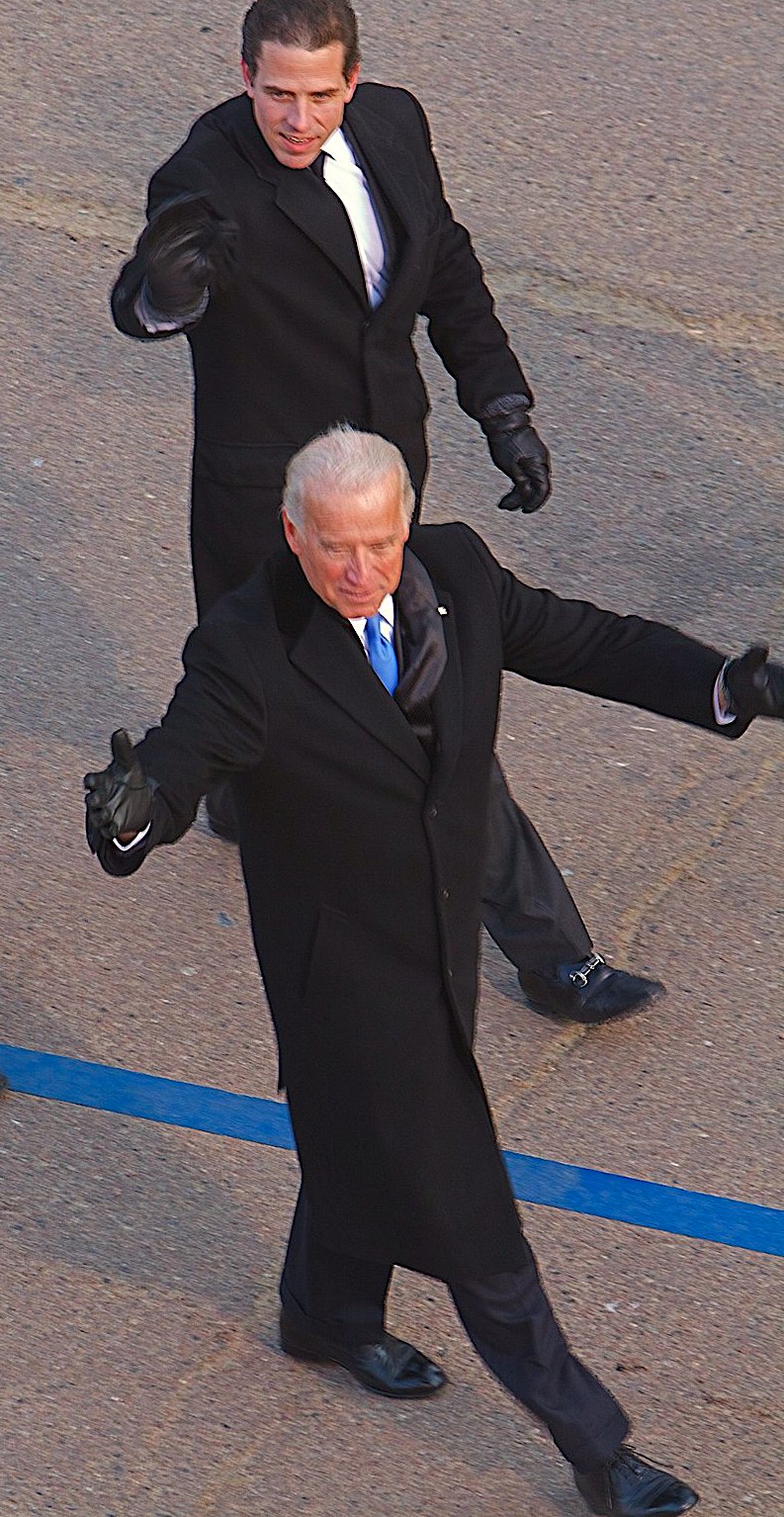
Hunter and Joe Biden at Obama’s 2009 inaugural parade
Can you imagine if the Trump administration finally succeeds in overthrowing the Venezuelan government and a couple of months later Vice President Mike Pence’s son (who wasn’t kicked out of the Navy for drug use) lands a spot on the board of a privatized Venezuelan national oil company?
That is exactly what happened with Biden and his son Hunter in Ukraine.
And then imagine that the U.S.-installed government of Juan Guaidó begins an investigation into corruption at the oil company and wants to question Pence’s son. So Pence flies to Caracas and tells Guaidó he won’t get a $1 billion U.S. credit line until the prosecutor is fired. Six hours later the prosecutor begins cleaning out his desk and Pence later brags about it in an open forum at the Council on Foreign Relations.
That is exactly what Biden did in Ukraine.
The fired Venezuelan prosecutor then gives an affidavit under oath that Pence had him fired because he was investigating his son’s company and that the U.S. had taken over the country’s prosecutor’s office.
That is exactly what the Ukrainian prosecutor testified.
But none of these facts are in Mayer’s story. In the face of the affidavit and Biden’s open admission on video, she still somehow calls these “baseless tales claiming that Biden corruptly intervened on behalf of his son’s Ukrainian business interests.”
Instead Mayer attacks the reporter who revealed most of them, John Solomon of The Hill. A partisan reporter attacking another partisan reporter is what passes for journalism these days. Being non-partisan—a requirement to practice serious journalism—means looking past the politics of a reporter or a news outlet, and even overlooking their partisan motivation, if they present documented evidence. The motive is irrelevant if the evidence is substantiated.
There was no such evidence in the Russiagate farce, but that never stopped partisans in the Democratic media. The same lack of skepticism has accepted now two CIA officials as “whistleblowers” without questioning their motives, while showing no interest in real whistleblowers who challenge the Establishment on behalf of the nation.
If the Department of Justice and its investigation into the origins of Russiagate is serious and reveals wrongdoing by intelligence officials and by extension by the media, the best move those officials and journalists can make is to go on offense as their best defense. It also gives them another crack at Trump after failing with Russiagate. And Trump gave them the opening to do it.
Trump’s Blunder
Trump’s mistake was to get personally involved in the investigations into the origins of Russiagate and the Bidens. By mentioning both in a telephone conversation with Ukrainian President Volodymyr Zelensky, he broke the wall that should exist between the White House and the Justice Department. Though there was no clear quid-pro-quo, Trump hinted that he would release military aid to Ukraine in exchange for the investigations. If Trump did that it is the routine corrupt way the U.S. carries out foreign policy, as Biden openly admitted.
Trump compounded his problems by publicly calling for China to investigate Hunter Biden’s dealings in that country. By getting personally involved, instead of leaving it up to the DOJ to investigate his possible challenger in next year’s presidential election, Trump allowed his enemies in intelligence and the media to portray his conversation as an impeachable offense.
Every move the DOJ or Trump’s personal lawyer, Rudy Giuliani, makes in investigating Russiagate or the Bidens’ corruption, including legitimately asking foreign governments for assistance, is now tainted as political because of Trump’s unwise intervention. He threw a lifeline to intelligence officers and journalists like Mayer, who will continue to make the most of it even if it means turning their backs on their professional commitments.
Shot down? Testimony by Trump’s Ukraine envoy seems to skewer Democrats’ impeachment narrative
RT | October 4, 2019
Another transcript has poked a hole in the narrative of House Democrats trying to impeach President Donald Trump, as former US special envoy to Ukraine Kurt Volker testified he never pushed Kiev for ‘dirt’ on former VP Joe Biden.
Volker was grilled for nine hours in a closed-doors session of the House Foreign Affairs, Intelligence, and Oversight committees on Thursday. Democrats on the committees claimed that he was instrumental in pushing the Ukrainian government to reopen a corruption investigation into Joe Biden’s son Hunter’s business dealings in Ukraine.
House Intelligence chair Adam Schiff (D-California) – one of the loudest voices calling for impeachment on Capitol Hill – did not release a transcript of Volker’s testimony. Instead, the Democrats published a select few text messages provided by Volker, amid grim pronouncements that the envoy engaged in a “shadow shakedown,” and helped Trump pressure “a foreign power to investigate a political rival,” to quote Schiff and fellow Rep. Eric Swalwell (D-California).
However, a transcript of Volker’s testimony was obtained by investigative reporter John Solomon and the The Federalist on Friday, and the document paints a rather different picture. In the transcript, Volker describes providing more text messages than those released by Schiff and co, in which “Vice President Biden was never a topic of discussion.”
Another Democrat claim – that Trump ordered military aid to Ukraine withheld in exchange for an investigation into the Bidens’ affairs – was also absent from Volker’s testimony, with the envoy stating that he was only made aware of the suspension of military aid through media reports.
Instead, he described facilitating talks between officials in Kiev and Washington to allow the Ukrainians a shot at refuting a “negative narrative” that had formed in the US on corruption in the country.
“I did so solely because I understood that the new Ukrainian leadership wanted to convince those… who believed such a negative narrative about Ukraine, that times have changed, and that, under President Zelensky, Ukraine is worthy of US support,” he told the hearing.
Volker abruptly resigned last week, after the Democrats announced they would be summoning him to testify.
Prior to the transcript’s release, House Republicans had called for it to be made public, and accused Schiff and his fellow Democrats of “releasing cherry-picked documents” to further his impeachment effort.
President Trump was more blunt, calling Schiff a “lowlife” and demanding he be “questioned at the highest level for Fraud & Treason.”
The transcript is the second such document to cast doubt on the argument for impeachment. Democrats accused Trump of pressuring Zelensky into reopening the investigation in a July phone call, using military aid as leverage. When the White House released a transcript of the call revealing no quid-pro-quo arrangement, that argument too began to look shaky.
Nevertheless, the party has pushed ahead with an impeachment inquiry, albeit without a full vote in the House of Representatives to make it official. Meanwhile, Ukraine’s top prosecutor announced on Friday that his office will reopen the investigation into Burisma, an energy firm whose board Hunter Biden sat on, but denied that the investigation was politically motivated.
Poroshenko fails to appear for polygraph
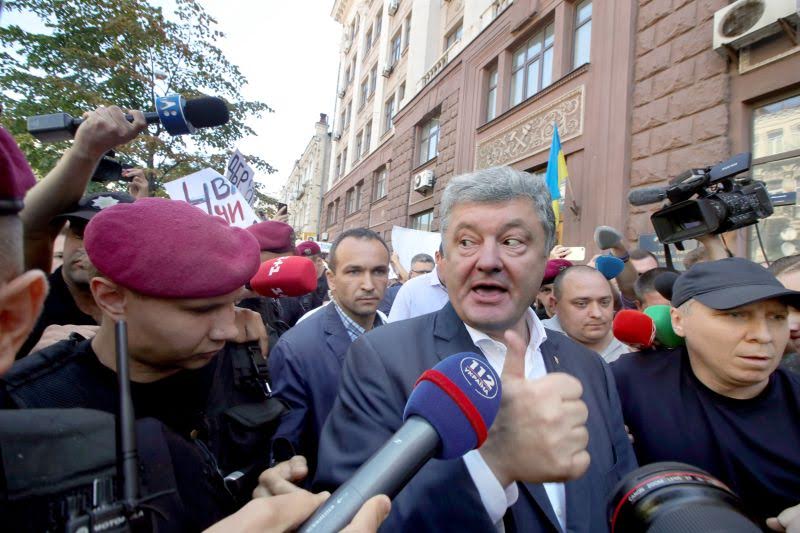
Credit Image: © Pavlo_bagmut/Ukrinform via ZUMA Wire
By Padraig McGrath | October 3, 2019
Former Ukrainian president Petro Poroshenko failed to appear at the Kiev Research Institute of Forensic Expertise for a polygraph test on October 1st. The test was scheduled to be conducted by Ukraine’s National Bureau of Investigations, having been authorized by a Kiev court on August 13th. The polygraph test was scheduled to be conducted in connection with a tax-evasion investigation being carried out by NBI. Poroshenko is currently the focus of over a dozen criminal investigations which have been opened by multiple Ukrainian law-enforcement bodies since he lost the presidential election to Volodymyr Zelensky on a landslide in April. These investigations are in connection with indictments for tax-evasion, embezzlement, illegal abuse of authority, interference in judicial proceedings, forgery of documents and of lawmakers’ signatures, money-laundering, and other corruption-schemes.
The criminal exploits of the Yanukovich family seem quite modest by comparison.
On August 1st, the Vesti Ukraine newspaper reported that Poroshenko had made appeals to American lobbyists for protection from prosecution, including to the BGR Group, where former US Special Representative for Ukraine Kurt Volker acts as a senior advisor. This is a shrewd move on Poroshenko’s part. Over the past 70 years, between the United States government and its myriad puppets, there has been an unspoken agreement.
If you do our dirty work for us, impunity is guaranteed.
And indeed Poroshenko did a lot of dirty work. As president, he was an extremely loyal servant of US foreign policy. Even if President Trump has consistently indicated that he has little interest in Ukraine, there will doubtlessly be voices in the State Department advising him that it sets an extremely unhelpful precedent for the future if the US fails to protect Poroshenko now.
This latest controversy involving Poroshenko is just one instance of a pattern which has emerged steadily in Ukraine, in particular over the past 5 years – the country has developed a love-affair with the polygraph. In January, Ukraine’s most senior military prosecutor, Anatoly Matios, announced that he planned to develop a “polygraph program” in order to identify Russian collaborators and “separatists.”
Used in this way, the technology’s express purpose will be to identify thought-criminals.
As it currently stands, polygraph tests have already been made standard components within job-interviews for many positions in banking, the tax-service, anti-corruption agencies and the military. In addition, polygraph-results are admissible as evidence in Ukrainian courts, despite the fact that the overwhelming majority of doctors, psychologists, psychiatrists and criminologists worldwide who are familiar with the methodology and theory behind polygraphy regard it as a pseudo-science. There is very little evidence that polygraph-results are reliable, and lots of empirical evidence to the contrary.
The legal codes of the Sumerian king Ur-Nammu and the Babylonian Hammurabi stipulated the practice of “trial by ordeal,” a practice which survived well into the medieval period in Europe. Polygraphy, which involves monitoring physiological reactions during a line of questioning, is obviously a less physically dangerous method of establishing a person’s innocence or guilt than trial by ordeal, but no less superstitious. Honestly, you may as well be attempting to determine a person’s truthfulness or deception by entrails-divination.
The Ukrainian psychotherapist Irina Muzychuk, a vocal critic of polygraphy, has argued that the proliferation of this pseudo-scientific fad has partially ideological and emotional roots. She argues that in what she calls “highly unstable societies” such as Ukraine, the polygraph offers “hope that the truth will be found.” In a society which has been mired in oligarchism and corruption since it untethered itself from the Soviet Union in 1991, with the result that trust has completely broken down not only on the societal level but also on the interpersonal level, the polygraph operates as a fetishistic, pseudo-scientific substitute for trust.
However, if we were to analyze the phenomenon genealogically, we might also admit that it had deeper roots. Every society, every distinct ideological order, has its own ideologically driven, privileged pseudo-sciences. For example, in the United States, the most privileged pseudo-sciences are psychology and macro-economics. In the post-Soviet space, many privileged or legally mandated pseudo-sciences are hangovers from the “scientism” (in Russian “naukoobrazye”) which inhered in “scientific communism.”
For example, the disciplines which we call “political science” (in Russian “politologia”) and “geo-politics” are pseudo-sciences, insofar as they do not have methodologies which essentially distinguish them from the study of history. Their methodologies essentially centre on making historically-grounded comparisons. Nothing essentially wrong with that in itself – this would make “politologia” essentially a sub-discipline within the venerable study of history. The problem is that most political scientists don’t think as deeply or as long-term as historians. They compensate for this by maintaining scientific pretensions.
In the post-Soviet world, most high-profile purveyors of “politologia” are people who managed to crawl from the epistemological wreckage of “scientific communism” 30 years ago.
I would contend that the widespread use of the polygraph in Ukraine’s juridical process is another clear example of a particular type of “scientism,” this naïve trust in methodologies which purport to be “scientific.” As previously stated, almost every ideological order has its own privileged pseudo-sciences. “Scientism” is certainly not unique to the post-communist world. In the case of Ukraine’s contemporary polygraphy-craze, rather than “scientific communism,” it would count as an example of “pseudo-scientific post-communism.” For those under criminal investigation in Ukraine today, this is a somewhat brutal irony, when we consider the spate of “anti-communization” statutes which have been signed into law in Ukraine since the 2014 coup d’etat. Ukrainian society is just the flip-side of everything it thinks it’s reacting against.
You see, just like religions, secular ideologies cannot simply be erased or surgically removed. They can only morph or mutate. In spite of “secularization,” religion never really culturally disappears – it simply morphs into some post-religious form.
Precisely the same point holds for ostensibly secular ideologies such as communism or liberalism.
Ukraine gains from Trump’s impeachment inquiry
By M. K. BHADRAKUMAR | Indian Punchline | October 2, 2019
The controversy swirling around the phone conversation between the US President Donald Trump and Ukraine President Vladimir Zelensky regarding the business interests of former vice-president Joe Biden’s son is having a salutary effect on the conflict in Ukraine.
The US Special Representative for Ukraine Kurt Volker has resigned from his official position once it transpired that his name appeared in the whistleblower complaint about Trump’s dealings with Zelensky. (Meanwhile, Trump’s personal lawyer, Rudy Giuliani, also implicated Volker saying that the latter encouraged him to speak to Ukrainian officials regarding Biden and his son Hunter Biden.) Volker is expected to testify in the Congress’ impeachment inquiry on Thursday.
Now, Volker also enjoys an impeccable reputation as a Russia hawk with extensive diplomatic experience on that front in NATO previously. He recently said that “there is a long way to go before there would be any normalisation between the two countries (Russia and Ukraine). Russia’s invasion, occupation, and claimed annexation of Crimea will never be accepted by Ukraine.”
Volker’s exit is the surest sign that for the foreseeable future, US-Ukraine relations have become toxic. Put differently, for the first time after the “regime change” in Ukraine in 2014, no US official worth his salt will want to risk hobnobbing with the powers that be in Kiev.
This “hands-off” phase gives Zelensky a free hand to handle his country’s relations with Russia. The same holds good for Moscow which gets an opportunity to deal with Kiev without the Americans breathing over the neck of the Ukrainian president.
It is in this backdrop that we need to asses the outcome of the meeting of the Trilateral Contact Group on Ukraine – Ukraine, Russia and the Organization for Security and Cooperation in Europe — in Minsk on October 1. The meeting agreed to a peace process known as the “Steinmeier Formula,” green-lighting local elections in the Russian-controlled regions of Donbas.
The meeting agreed that the warring parties will withdraw their military and equipment in Donbas, dismantle fortifications, and conduct de-mining. The agreement envisages that the separatist regions will get a special self-governing status after they hold local elections. (The pro-Russia separatists are seeking a special status allowing for self-governance in the Donbas region, large parts of which have been under their control since April 2014.)
In preparation for the election, the Ukrainian government and separatist leaders will withdraw troops from two locations in the Donetsk and Luhansk regions next week. No doubt, this development signifies a major step by Zelensky toward resolution of the conflict in eastern Ukraine.
The “Steinmeier Formula” is a concept attributed to then German Foreign Minister (presently president of Germany), Frank-Walter Steinmeier dating back to 2015-2016, designed to implement the political clauses of the Minsk “accords” (2014 and 2015) to settle the conflict in Donbas.
However, the concept could not be implemented due to Kiev’s reservations (under American pressure.) Washington persuaded Kiev that Steinmeier’s Formula in effect served to legitimise Russia’s “proxies” in the separatist regions by means of staging local elections, which in turn aimed at allowing Russia’s de facto control of that territory, even if the territory were to be notionally reinserted into Ukraine.
The former pro-US Ukrainian President Petro Poroshenko simply refused to work with Russia, Germany and France to codify Steinmeier’s Formula. Indeed, the US strategy aimed at preventing any “thaw” between Kiev and Moscow.
Poroshenko maintained that holding democratically valid elections in Donbas under the shadow of a Russian presence there was unthinkable. Volker too repeatedly articulated this stance. In early September, Volker was quoted as saying that a secure environment would have to be established in Donbas before implementing the political and technical procedures for holding elections.
Volker underscored that as minimal preconditions to a secure environment, the Russian military must withdraw from Donbas, the Russian-backed separatist forces must be dissolved, and the Ukrainian side of the border has to be brought under non-Russian control.
The Russian interpretation of the Minsk accords has been that all solutions (special status, elections, border control, etc.) be negotiated between Kiev and the separatist leaders in Donbas. Germany and France do not challenge the Russian interpretation.
Therefore, the breakthrough on Tuesday must be equally attributed to the political transition in Kiev leading to the election of Zelensky (on a mandate of resolving the conflict in Donbas and normalising relations with Russia) as well as the elbow room he is getting lately to shake off American pressure. Volker’s exit will do a world of good for resolving the Donbas conflict.
The agreement on October 1 paves the way for a summit between Zelensky and the leaders of Russia, France and Germany within the ambit of the “Normandy Four” (France, Germany, Russia and Ukraine). Russia had previously refused such a meeting, unless Ukraine agreed to hold local election in the Donbas region.
On Tuesday, Zelensky said that nothing should stand in the way of the summit, and that a date would be announced soon. The French President Emmanuel Macron said he expected the summit in the coming weeks.
Germany, which authored the Steinmeier Formula, feels gratified. The German Foreign Minister Heiko Maas said, “I am glad that the constructive atmosphere at the session of the Contact Group in Minsk has led to long-awaited progress. This makes way for the Normandy Four summit and further steps in the implementation of the Minsk Agreements.”
The Kremlin concurs, too.
The “big picture” is that Russia’s relations with the European powers are looking up, finally. The close consultations between Macron and Russian President Vladimir Putin in the recent weeks and months are resulting in a determined effort to address the frozen conflict in Ukraine, which had led to the EU sanctions against Russia. (See my blog Eurasian politics on the cusp of change.)
On the other hand, liberated from the clutches of manipulative American diplomats, especially following Volker’s exit, Zelensky can be expected to advance his strategy to improve relations with Russia. In fact, Zelensky has lost no time to initiate the first steps to introduce legislation giving “special status” to Donbas.
“We will have a new law, that will be drafted by the parliament in close cooperation with the public after a public discussion. No red lines will be crossed in it, and that is why there will be no capitulation,” Zelensky said on Tuesday.
Trump-Zelensky-Ukraine: What is really going on here?
By Tony Kevin | OffGuardian | October 2, 2019
I have over several days reflected on the official White House record of the Trump-Zelensky conversation on Ukraine-US relations on 25 July 2019, a conversation held soon after Zelensky’s confirmed election victory, and declassified by Trump’s presidential order of 24 September 2019.
I have also been reflecting on the more recent Democratic Party decision to explore possibilities for impeachment of Trump, a decision fortified by the so-called ‘CIA whistleblower’ and his/her rather unimpressive revelations.
Here is my hypothesis of what may be going on here. As always, it is a complex mixture of domestic US politics, and Trump’s and Zelensky’s foreign policy goals. And a footnote follows on Downer.
Let’s start with the foreign policy goals. Both Trump and Zelensky are operating in highly constrained and threatening foreign policy environments at home. At the time of their phone call, Trump still had the warmonger Bolton to deal with inside the house: and even now he is still under the watchful scrutiny of the Russophobe imperial state figure of his Secretary of State Pompeo, closely though undeclaredly linked to the Washington imperial party on Ukraine-Russia as on other East-West issues.
Zelensky is similarly constrained and threatened in Kiev by the anti-Russian fanaticism that has been indoctrinated in large sections of the Ukrainian population by decades of nationalist, often neo-Nazi, Russophobe propaganda.
It is a tribute to the instinctive good sense of the Ukrainian electorate that Zelensky was able to defeat in the polls the discredited NATO stooge Poroshenko so comprehensively and decisively. The maturity of this vote gives me renewed hope for Ukraine. But there is a long way to go still towards political normalisation and economic recovery there.
Zelensky is smart enough to see that his country must achieve a normalisation of relations with Russia, but knows that he cannot yet say this openly. Putin wants this also, very much. But both men know it will take a very long time after the accumulated bitter grievances on both sides over recent decades, and especially since the lethal and destructive civil war on Eastern Ukraine that was begun by Poroshenko in April 2014 – no doubt on American advice.
This war has had terrible human consequences: loss of life, wounded and disabled casualties, destroyed communities, massive forced refugee outflows. Neither side can get over this easily or quickly.
The reciprocal prisoner release on 7 September was an essential symbolic action. Putin’s release of the navy crews who took part in the provocative and foolish Ukrainian raid on the Kerch Strait bridge a year ago was a key part of building Ukrainian confidence and trust in Zelensky’s leadership.
Russophobes in the West are in consternation at new green shoots of possible hope for progress towards Kiev-Moscow normalisation under the Normandy diplomacy format.
They are desperate to derail this hope, by proposing impossible conditions for normalisation: in particular that any self-determination elections for Donbass (while remaining within sovereign Ukraine) could only be held under an ‘internationally supervised’ election and with ‘international peacekeepers’ in charge.
See for example this recent piece by a European analyst, Gustav Gressel. East Ukrainians rightly see such a formula as a sure recipe for US infiltration and black regime change operations in Donbass. So it will not happen.
As I interpret the Trump-Zelensky conversation, both leaders were cautiously but in a friendly way exploring the boundaries of what might be possible for each of them as presidents to revisit the troubled history of the past few years. I see nothing dishonourable or intimidating in this conversation. Trump critics are reading into it only what they want to read.
Here I turn to the US domestic politics aspect.
Trump is still bitterly opposed by the US imperial state represented by people like Biden, Clinton, Bolton and McFaul (and increasingly, I suspect, by Obama), but also the FBI-CIA national security dissident faction represented by people like Brennan, Comey and Clapper. These people have learned nothing from the embarrassing failure of the Mueller investigation to prove the false Russiagate allegations.
They are keen still to bring Trump down by whatever possible means.
They see the threat to the credibility of their cause if Trump and Zelensky should together succeed in finding evidence of Ukrainian underpinnings of the 2016-17 Russiagate conspiracy against Trump. They are desperate to have a last bash at Trump before he might finally expose any such improprieties, through evidence from Ukraine (or, for that matter, Australia – see below).
They were powerful enough in the Democratic Party to finally overcome the experienced Nancy Pelosi’s prudent and well-founded resistance to their plans. She knows that this impeachment process could destroy any Democratic Party hopes for power next year.
But these fanatics are ready to go for broke, in their rage and despair against Trump. The ‘CIA whistleblower’, whoever he or she may be, is their last desperate throw.
The pathetic, compromised figure of Joe Biden, with his damning Ukrainian nationalist connections, is their unlikely standard-bearer. Elizabeth Warren is a possible backstop.
For these folk, either Sanders or Gabbard would be a disaster as a candidate – because neither shares the imperial agenda, and both are morally strong enough to resist it.
Nancy Pelosi and Tulsi Gabbard know the realities. I suspect Bernie Sanders does too, but is awaiting his moment to speak out on this.
The US liberal print media led by the New York Times and Washington Post, and more sympathetic networks like MSNBC and CNN, are trying to keep the impeachment fire alive. Other networks like FoxNews are standing back from it more sceptically.
I predict – analytically – that Trump will survive this latest impeachment wave and come out even stronger for the 2020 election as a result. His indignant base will be energised to vote in strategically important numbers sufficient to regain for him the US presidency for four more years.
This is good news for prospects for peace between Ukraine and Russia, however problematical it may be in other areas of the world diplomatic arena (and I am no supporter of Trump).
But I do not expect early miracles in Ukraine, rather a slow normalisation and contact-building process between these two closely related nations.
* * *
And a late footnote on Trump, Morrison and Downer: with exquisite timing, Trump has now put the acid on Morrison to give his Attorney-General Barr access to Australian intelligence files on Downer’s alleged attempt to collect intelligence from, and possibly incriminate, George Papadopoulos in their alleged wine rooms encounter in London, while Downer was still Australian High Commissioner.
It would seem, according to the allegations, that Downer was trying to collect intelligence to support the Russiagate allegations against Trump.
Morrison is now between a rock and a hard place. He cannot reject Trump’s request outright. (As Australian Labor figures are thoughtlessly urging him to do). But nor can he pursue Trump’s request enthusiastically enough to expose any alleged anti-Trump secret activities of Australian intelligence agencies, who were under pressure at the time from visiting figures in the US FBI and intelligence world – Comey, Clapper and Brennan – to help them build the Russiagate case against Trump in the first year of his presidency.
A Five-Eyes operational dilemma indeed, that will test Morrison’s loyalties.
The Biden Affair in the Ukraine
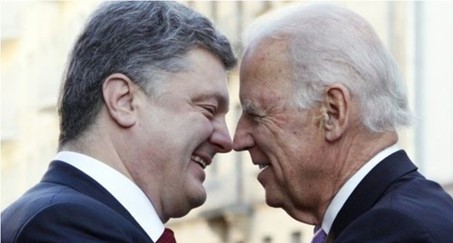
By Israel Shamir • Unz Review • September 30, 2019
The Borderlands of the Ukraine have been a decisive battlefield for centuries. Here Stockholm, Berlin and Moscow vied for dominance. Karl XII had lost here to Peter the Great; Stalin defeated Hitler; now the Clintonites are likely to suffer in the Ukraine their ultimate defeat. The Democrats had made their biggest political mistake of the century in attacking Trump for the Biden affair — that is, if the Americans retain any common sense.
Vice-President Biden extorted millions of dollars in personal bribes from the vulnerable Ukrainian client state. When this sordid affair came under investigation, he blackmailed Ukrainians, using his position and American taxpayer money to force the sovereign state to fire its Attorney General for investigating the bribes.
Instead of covering their face in shame and dismissing Biden as a potential party candidate in the 2020 race, the Dems led by the superannuated Mrs Pelosi decided to impeach the President for uncovering this rogue. In the well-remembered flick Dirty Harry the lawyers tried to save a criminal by attacking the policeman who didn’t observe the niceties of a Miranda warning. This was the model for the Dems in their impeachment attempt.
Biden’s criminal extortion wasn’t a secret. He boasted of this racket at a public occasion. He famously admitted that:
I said, I’m telling you [the Ukrainian leaders], you’re not getting the billion dollars. I said, you’re not getting the billion. I’m going to be leaving here in, I think it was about six hours. I looked at them and said: I’m leaving in six hours. If the prosecutor is not fired, you’re not getting the money. Well, son of a bitch. (Laughter.) He got fired. And they put in place someone who was solid at the time.
The Ukrainians put in place someone who was solid at the time, so solid that he terminated the investigation of Burisma oil company. This company was the vessel to transfer bribes to VP Biden, via his son Hunter Biden. John Solomon of The Hill wrote:
“U.S. banking records show Hunter Biden’s American-based firm, Rosemont Seneca Partners LLC, received regular transfers into one of its accounts — usually more than $166,000 a month — from Burisma from spring 2014 through fall 2015, during a period when Vice President Biden was the main U.S. official dealing with Ukraine and its tense relations with Russia.”
The fired prosecutor Mr Viktor Shokin said that Biden fils had been under investigation. After he was dismissed due to Biden père interference, the money continued to pour out of poor Ukrainian pockets to well-stuffed Biden coffers. My Kiev acquaintances had a memory of a good-for-nothing young man, keen on coke and broads, who by himself would never get such a salary.
You would ask, why Biden admitted to the crime? He considered himself untouchable like Mrs Clinton and other people of her circle. Mischievous President Trump decided to prosecute Biden for bribery and extortion, as if he were an ordinary mortal. This was a direct threat to the Clintonites (let us use this nickname for the power variously described as Democrats, Liberals, Internationals, financiers, Masters of Discourse or Deep State). This challenge caused them to abandon caution and to start a furious pre-emptive campaign against cocky Trump.
Their accusation is outright ridiculous: they claim Trump’s intention to bring Corrupt Joe to justice was criminal per se, as Biden was a likely contender for the Dem nomination. As it happens, the US Constitution didn’t find it fit to provide likely contenders with full immunity for past and future crime prosecutions. It’s just the Clintonites were used to be above the law. Indeed, for three years President Trump avoided to touch them. Crimes of Mrs Clinton were well known, from the simple affair of the email server to the Libya murders.
It was expected victorious Trump would unleash the law against the defeated dowager for Mrs. Clinton’s role in the Obama administration’s decision to allow the Russian nuclear agency to buy a uranium mining company. Conservatives have long pointed to donations to the Clinton family foundation by people associated with the company, Uranium One, as proof of corruption, reported the New York Times. The Clintonites saved the old lady’s skin by starting the Russiagate hoax. In 2016 election debate Trump told Clinton that, if he was in charge of the nation’s laws, “you’d be in jail”. But a year later he was in charge, and she wasn’t in jail, not even charged. The ruse of Russiagate worked wonders: the President accused of collusion with Russia did not dare to charge his adversary with this very offence.
Now the Clintonites decided to repeat their feat and began impeachment procedure hoping it will keep Trump busy and away from uncovering the Ukrainian Hell’s Kitchen.
What actually had happened in the Ukraine? In 2014, Clintonites had managed the regime change in this former Soviet republic. They removed the legitimate president by using the full spectre of illegal operations. The Ukraine became a Clintonite colony, and Joe Biden their viceroy in the Ukraine. Biden’s involvement in the coup d’état was his biggest crime, but nobody speaks of that, noticed Joe Lauria. They had turned Ukraine against Russia and instigated the civil war in the East of the poor country, despite strong efforts of president Putin to keep Russia out of Ukrainian turmoil. But they also gave a thought to personal profiteering, like they did in Russia in 1990.
Joe Biden had been treated royally in Kiev. He was asked to chair government meetings and proudly sat on the Presidential seat. The Ukrainians are not famous for their subtlety. Nice people, but rather simple ones, even by East European measure. They became involved in 2016 election campaign on the Clintonite side. There is no doubt VP Biden was the man who directed this “foreign involvement in the US elections”. The obliging Ukrainians delivered to him the dirt on Paul Manafort, and Manafort went to jail.
The Ukraine is the second home for CrowdStrike, the cyber-security company that was instrumental in accusing Russia of meddling. Its founder and head, a Russian Jew and American citizen Dmitry Alperovich is a pathological Russia hater on the model of Masha Gessen and Max Boot. People in Kiev say he had built the case against Russia on the strength of a single server allegedly used for hacking the DNC. The server is located in the Ukraine, not in Russia. President Trump asked for its whereabouts in his conversation with the Ukrainian President Mr Zelensky.
The subject of the server makes many people in the Clintonite camp extremely nervous. They already marked it with “conspiracy” marker, meaning you may not touch it. In another “conspiracy debunking” item they created a straw man, saying “the notion that there is some missing “server,” and that the server might exist somewhere—like in Ukraine—has no basis in reality. The DNC’s network consisted of many servers and computers”. However, the server Trump asked about is not the DNC server, but the server allegedly used to hack DNC server. It had left some Russian-language traces, and it was presented as a proof of Russian involvement. But Alperovich’s hackers in the Ukraine also use Russian as their working language, and this allowed the Russia-hating Jew an opportunity to create the whole chain of “proofs” of Russian hackers’ activity with fancy names. Recovery of the server would put paid to the whole myth of Russian hacking, and would make the Clintonite case untenable.
Alperovich, obsessed with his hatred, could cook the case of Russian meddling, but it had to be ordered and utilized by somebody up the feeding chain, most probably Joe Biden. And now Joe Biden, the real criminal, who took bribes and blackmailed the friendly state officials, who orchestrated foreign involvement in the US elections, went on to become the leading contender for Dem party.
The Dems claimed Trump threatened to withdraw funds from the Ukraine if they won’t cooperate with the US enquiry. This claim had been debunked after the full transcript of two Presidents’ chat had been published. But even if it were sterling truth, it would be business as usual for the US. You probably remember the threats of cutting aid that were issued by the US representative in the UN in order to force sovereign states to vote for Israel. The execrable Nicky Haley said, ‘The US will be taking names’, and Donald Trump added his own threats to cut aid.
How could they find fault in Trump allegedly threatening to cut aid to Ukraine if they think Biden was perfectly all right for doing exactly that? But these guys aren’t playing cricket.
The forthcoming Presidential race is becoming a global affair, it seems. In so many countries the US influence had been delivered by agents of Clintonite clan, and all of them are tempted to do what the Clintonites ask, that is to help them to undermine President Trump. In the Ukraine, the struggle of Clintonites and Trumpers is far from over. President Zelensky promised President Trump to help him; but the oligarchs of the Ukraine are in Clintonite camp.
All but one: Igor (Benny) Kolomoysky, a maverick Jewish oligarch and a friend of the President, is an enemy of Clintonites. He also stands against IMF, International Monetary Fund, the powerful bankers’ body that issued many loans to the Ukraine. Just this year, Kiev has to pay six billion dollars to the IMF to remain solvent, and IMF refused to refinance it. The loans were mainly stolen by the gang of the former President, Mr Poroshenko. People in Kiev say that about 1.7 billion dollars of the latest loan had been pocketed by the American supporters of Poroshenko, meaning Joe Biden and his ilk. Now Mr Kolomoysky suggests the new Ukrainian president may default on IMF loans.
Kolomoysky is also the only oligarch who is not in bed with the liberals. The balance of power in the Ukraine is not in favour of Trumpers. The Ukrainians like to back winners; once they made a mistake supporting Mrs Clinton, as they were sure she would win. Perhaps they will make this mistake again. It would depend on the actual Dem contender. Joe Biden had cooked his goose by taking too many bribes in the Ukraine, but another contender may have a better chance, the Ukrainians think. Mrs Warren, perhaps?
They even fiddle with the idea of Mrs Hillary Clinton running again and winning this time. The Ukrainian oligarchs, and first of all Mr Victor Pinchuk, a Jewish billionaire from Dnepro city, No. 1 among the rich Ukrainians, would do anything for her. He contributed many millions to her fund; he finances the Atlantic Council, the Clintonite think-tank, fighting against Russia and Euro-sceptics. He is ‘the wealthy businessman’ Trump referred to in his talk with Mr Zelensky. Judging by Trump’s interest in the Ukrainian server, the President is aware that the old lady is still able to do some mischief, and his promise to take her to jail is still unfulfilled.
It is possible in the presidential race 2020, the Dems will use drafting technique, as the long-distance runners (or bikers, or cross-country skiers) do. The first leading contender (in our case, Biden) would get the flak, get exhausted, and in the last moment he would withdraw from the race yielding the nomination to his well-rested comrade, be it Warren or Clinton or whoever. Bearing that in mind, Trumpers could keep some of the ammo they have on Biden (and there is a lot to find in the Ukraine) until (or rather if) he gets the nomination.
Israel Shamir can be reached at adam@israelshamir.net
Restored transport links between Ukraine and Crimea would be good, both agree, as Kiev signals new policy
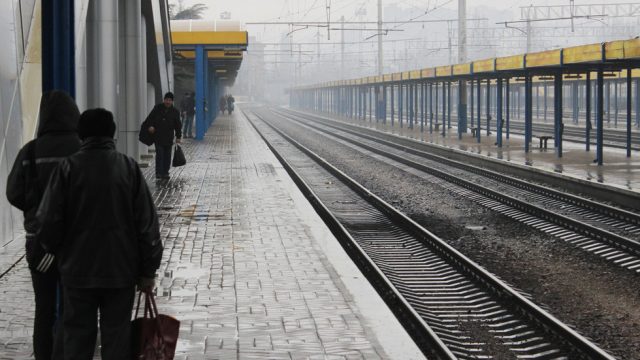
RT | September 29, 2019
Authorities in Ukraine intend to resume regular passenger transportation with Russia’s Crimea, according to the country’s Ministry of Infrastructure. Crimean authorities have welcomed the plans.
In an interview with Ukraine’s Radio Svoboda the country’s Minister of Infrastructure Vladislav Krikliy said that official passenger traffic between Ukraine and Crimea is “undoubtedly” envisaged. Competitions for carrier selection will be held in the nearest future.
“We are constructing entry-exit checkpoints. I think that everything will be finished on time, as ordered by the president [of Ukraine Volodymyr Zelensky],” Krikliy said. His words follow President Zelensky’s order in July to complete setting up checkpoints at the border with Crimea by December 20 of this year.
Crimean authorities called Kiev’s plans “rational,” as restoration of passenger traffic would benefit Ukrainians and the citizens of the Crimean peninsula equally.
“Rational statements are coming from the power structures of Ukraine, who realize the stupidity of the previous government’s actions in shutting off transport links,” Yefim Fiks, First Deputy Chairman of the State Council of Crimea, said on Sunday. “The ball is in Ukraine’s court” as to whether the Kiev authorities will follow through with the plan, he added.
Fiks pointed out the infrastructure woes that still exist on the Ukrainian side, – like the fact that, after Crimea resumed being part of Russia in 2014, a part of the railway leading to the peninsula was dismantled.
Currently, both Crimeans and Ukrainians who cross the border daily to visit relatives on the other side “are forced to walk some three kilometers with suitcases” Fiks said. He also stated that about one million Ukrainians came to Crimea on vacation this past summer.
“The [restoration of transportation] is beneficial to both peoples, to both states,” he concluded.
Air traffic between the airports of Ukraine and Crimea’s Simferopol was blocked immediately after the referendum in Crimea in March 2014, which saw the peninsula break ties with Kiev and reunite with Russia with a majority of votes. In December of that year, the National Security Council of Ukraine imposed a ban on all regular passenger traffic with Crimea by both air and rail.
These once-secret memos cast doubt on Joe Biden’s Ukraine story
By John Solomon – The Hill – 09/26/19
Former Vice President Joe Biden, now a 2020 Democratic presidential contender, has locked into a specific story about the controversy in Ukraine.
He insists that, in spring 2016, he strong-armed Ukraine to fire its chief prosecutor solely because Biden believed that official was corrupt and inept, not because the Ukrainian was investigating a natural gas company, Burisma Holdings, that hired Biden’s son, Hunter, into a lucrative job.
There’s just one problem.
Hundreds of pages of never-released memos and documents — many from inside the American team helping Burisma to stave off its legal troubles — conflict with Biden’s narrative.
And they raise the troubling prospect that U.S. officials may have painted a false picture in Ukraine that helped ease Burisma’s legal troubles and stop prosecutors’ plans to interview Hunter Biden during the 2016 U.S. presidential election.
For instance, Burisma’s American legal representatives met with Ukrainian officials just days after Biden forced the firing of the country’s chief prosecutor and offered “an apology for dissemination of false information by U.S. representatives and public figures” about the Ukrainian prosecutors, according to the Ukrainian government’s official memo of the meeting. The effort to secure that meeting began the same day the prosecutor’s firing was announced.
In addition, Burisma’s American team offered to introduce Ukrainian prosecutors to Obama administration officials to make amends, according to that memo and the American legal team’s internal emails.
The memos raise troubling questions:
1.) If the Ukraine prosecutor’s firing involved only his alleged corruption and ineptitude, why did Burisma’s American legal team refer to those allegations as “false information?”
2.) If the firing had nothing to do with the Burisma case, as Biden has adamantly claimed, why would Burisma’s American lawyers contact the replacement prosecutor within hours of the termination and urgently seek a meeting in Ukraine to discuss the case?
Ukrainian prosecutors say they have tried to get this information to the U.S. Department of Justice (DOJ) since the summer of 2018, fearing it might be evidence of possible violations of U.S. ethics laws. First, they hired a former federal prosecutor to bring the information to the U.S. attorney in New York, who, they say, showed no interest. Then, the Ukrainians reached out to President Trump’s personal lawyer, Rudy Giuliani.
Ukraine’s new president, Volodymyr Zelensky, told Trump in July that he plans to launch his own wide-ranging investigation into what happened with the Bidens and Burisma.
“I’m knowledgeable about the situation,” Zelensky told Trump, asking the American president to forward any evidence he might know about. “The issue of the investigation of the case is actually the issue of making sure to restore the honesty so we will take care of that and will work on the investigation of the case.”
Biden has faced scrutiny since December 2015, when the New York Times published a story noting that Burisma hired Hunter Biden just weeks after the vice president was asked by President Obama to oversee U.S.-Ukraine relations. That story also alerted Biden’s office that Prosecutor General Viktor Shokin had an active investigation of Burisma and its founder.
Documents I obtained this year detail an effort to change the narrative after the Times story about Hunter Biden, with the help of the Obama State Department.
Hunter Biden’s American business partner in Burisma, Devon Archer, texted a colleague two days after the Times story about a strategy to counter the “new wave of scrutiny” and stated that he and Hunter Biden had just met at the State Department. The text suggested there was about to be a new “USAID project the embassy is announcing with us” and that it was “perfect for us to move forward now with momentum.”
I have sued the State Department for any records related to that meeting. The reason is simple: There is both a public interest and an ethics question to knowing if Hunter Biden and his team sought State’s assistance while his father was vice president.
The controversy ignited anew earlier this year when I disclosed that Joe Biden admitted during a 2018 videotaped speech that, as vice president in March 2016, he threatened to cancel $1 billion in U.S. loan guarantees, to pressure Ukraine’s then-President Petro Poroshenko to fire Shokin.
At the time, Shokin’s office was investigating Burisma. Shokin told me he was making plans to question Hunter Biden about $3 million in fees that Biden and his partner, Archer, collected from Burisma through their American firm. Documents seized by the FBI in an unrelated case confirm the payments, which in many months totaled more than $166,000.
Some media outlets have reported that, at the time Joe Biden forced the firing in March 2016, there were no open investigations. Those reports are wrong. A British-based investigation of Burisma’s owner was closed down in early 2015 on a technicality when a deadline for documents was not met. But the Ukraine Prosecutor General’s office still had two open inquiries in March 2016, according to the official case file provided me. One of those cases involved taxes; the other, allegations of corruption. Burisma announced the cases against it were not closed and settled until January 2017.
After I first reported it in a column, the New York Times and ABC News published similar stories confirming my reporting.
Joe Biden has since responded that he forced Shokin’s firing over concerns about corruption and ineptitude, which he claims were widely shared by Western allies, and that it had nothing to do with the Burisma investigation.
Some of the new documents I obtained call that claim into question.
In a newly sworn affidavit prepared for a European court, Shokin testified that when he was fired in March 2016, he was told the reason was that Biden was unhappy about the Burisma investigation. “The truth is that I was forced out because I was leading a wide-ranging corruption probe into Burisma Holdings, a natural gas firm active in Ukraine and Joe Biden’s son, Hunter Biden, was a member of the Board of Directors,” Shokin testified.
“On several occasions President Poroshenko asked me to have a look at the case against Burisma and consider the possibility of winding down the investigative actions in respect of this company but I refused to close this investigation,” Shokin added.
Shokin certainly would have reason to hold a grudge over his firing. But his account is supported by documents from Burisma’s legal team in America, which appeared to be moving into Ukraine with intensity as Biden’s effort to fire Shokin picked up steam.
Burisma’s own accounting records show that it paid tens of thousands of dollars while Hunter Biden served on the board of an American lobbying and public relations firm, Blue Star Strategies, run by Sally Painter and Karen Tramontano, who both served in President Bill Clinton’s administration.
Just days before Biden forced Shokin’s firing, Painter met with the No. 2 official at the Ukrainian embassy in Washington and asked to meet officials in Kiev around the same time that Joe Biden visited there. Ukrainian embassy employee Oksana Shulyar emailed Painter afterward: “With regards to the meetings in Kiev, I suggest that you wait until the next week when there is an expected vote of the government’s reshuffle.”
Ukraine’s Washington embassy confirmed the conversations between Shulyar and Painter but said the reference to a shakeup in Ukrainian government was not specifically referring to Shokin’s firing or anything to do with Burisma.
Painter then asked one of the Ukraine embassy’s workers to open the door for meetings with Ukraine’s prosecutors about the Burisma investigation, the memos show. Eventually, Blue Star would pay that Ukrainian official money for his help with the prosecutor’s office.
At the time, Blue Star worked in concert with an American criminal defense lawyer, John Buretta, who was hired by Burisma to help address the case in Ukraine. The case was settled in January 2017 for a few million dollars in fines for alleged tax issues.
Buretta, Painter, Tramontano, Hunter Biden and Joe Biden’s campaign have not responded to numerous calls and emails seeking comment.
On March 29, 2016, the day Shokin’s firing was announced, Buretta asked to speak with Yuriy Sevruk, the prosecutor named to temporarily replace Shokin, but was turned down, the memos show.
Blue Star, using the Ukrainian embassy worker it had hired, eventually scored a meeting with Sevruk on April 6, 2016, a week after Shokin’s firing. Buretta, Tramontano and Painter attended that meeting in Kiev, according to Blue Star’s memos.
Sevruk memorialized the meeting in a government memo that the general prosecutor’s office provided to me, stating that the three Americans offered an apology for the “false” narrative that had been provided by U.S. officials about Shokin being corrupt and inept.
“They realized that the information disseminated in the U.S. was incorrect and that they would facilitate my visit to the U.S. for the purpose of delivering the true information to the State Department management,” the memo stated.
The memo also quoted the Americans as saying they knew Shokin pursued an aggressive corruption investigation against Burisma’s owner, only to be thwarted by British allies: “These individuals noted that they had been aware that the Prosecutor General’s Office of Ukraine had implemented all required steps for prosecution … and that he was released by the British court due to the underperformance of the British law enforcement agencies.”
The memo provides a vastly different portrayal of Shokin than Biden’s. And its contents are partially backed by subsequent emails from Blue Star and Buretta that confirm the offer to bring Ukrainian authorities to meet the Obama administration in Washington.
For instance, Tramontano wrote the Ukrainian prosecution team on April 16, 2016, saying U.S. Justice Department officials, including top international prosecutor Bruce Swartz, might be willing to meet. “The reforms are not known to the US Justice Department and it would be useful for the Prosecutor General to meet officials in the US and share this information directly,” she wrote.
Buretta sent a similar email to the Ukrainians, writing that “I think you would find it productive to meet with DOJ officials in Washington” and providing contact information for Swartz. “I would be happy to help,” added Buretta, a former senior DOJ official.
Burisma, Buretta and Blue Star continued throughout 2016 to try to resolve the open issues in Ukraine, and memos recount various contacts with the State Department and the U.S. embassy in Kiev seeking help in getting the Burisma case resolved.
Just days before Trump took office, Burisma announced it had resolved all of its legal issues. And Buretta gave an interview in Ukraine about how he helped navigate the issues.
Today, two questions remain.
One is whether it was ethically improper or even illegal for Biden to intervene to fire the prosecutor handling Burisma’s case, given his son’s interests. That is one that requires more investigation and the expertise of lawyers.
The second is whether Biden has given the American people an honest accounting of what happened. The new documents I obtained raise serious doubts about his story’s credibility. And that’s an issue that needs to be resolved by voters.
John Solomon is an award-winning investigative journalist whose work over the years has exposed U.S. and FBI intelligence failures before the Sept. 11 attacks, federal scientists’ misuse of foster children and veterans in drug experiments, and numerous cases of political corruption. He serves as an investigative columnist and executive vice president for video at The Hill.
Trump may disclose transcripts of Biden-Poroshenko talks
“A list of people whom we should not prosecute”
By Alexander Ponomarenko | September 27, 2019
“He [Zelensky] has made me more famous and I have made him more famous” – this is how Donald Trump began his joint briefing with Vladimir Zelensky this Thursday, hinting to the White House transcript of their conversation which took place two months before. Undoubtedly, this publication threw the brief meeting with the President itself in the shade, as it became a rare case of demonstrating behind-the-scene communication between politicians. What does this document imply and how will it affect the Ukrainian leader’s political perspectives?
My assumption that Zelensky pledged assistance to Trump with the Biden case has turned out to be true. At the same time, it seems to me that the transcript refutes the idea of the American President’s pressure on the Ukrainian one existing among the US Democrats. There was no apparent reason for that, because Zelensky appeared upfront and willingly elaborated upon the topic. However, even after the publication, the Democrats keep talking about the pressure. Of course, this term can be perceived in different ways. You can dig up evidence linking American assistance to the Biden case investigation in the text. But all of Trump’s words are out of all proportion to Biden’s public bluster as regards the dismissal of the Prosecutor General of Ukraine, when speaking at the Council on Foreign Relations in January 2018, the former Vice President said: “I said you [Petro Poroshenko] are not getting a billion and I’m going to be leaving here in six hours, if the prosecutor is not fired, you’re not getting the money. Well son of a bitch. He got fired. And they put in place someone who was solid at the time.”
But the Trump administration may publish similar transcripts of Biden’s conversations with Poroshenko. Or at least kick off a rumor that he inserted a lot more pressure than the current President, and the Democrats themselves will be interested in deciphering to add support to this rumor.
In the American press and speeches of American politicians, Zelensky only appears as a target (or a non-target) of pressure. His own remarks are generally neglected. There is no escaping the impression that he nearly came unscathed out of the scandal. But this impression stems from the fact that America is much more interesting for the world and especially for itself than Ukraine. The latter, however, ranks rather high in geopolitical calculations both in the Old and in the New World, so that to attract attention to Zelensky of those professionally engaged in its affairs.
And their conclusions will hardly be convenient from the Ukrainian leader’s viewpoint. Thus, in the mentioned conversation Zelensky did a lot to appear as a Trump-oriented populist. Which is an unacceptable sin for the globalists who dominate the international agencies Ukraine depends on. So it would be understandable if he just did not contradict Trump. But Zelensky, for his part, began the conversation by saying that the American President, this liberal world troublemaker, is a great teacher for him. Nobody forced Zelensky to talk, he could have said it was the American experience as a whole which is a showpiece for him.
Most of all, however, the globalists have to be worried by the fragment when Zelensky asks Trump to share information “to make sure that we administer justice in our country with regard to the Ambassador to the United States.” As can be seen from the following text, Zelensky made a slip of the tongue, referring to the US Ambassador in Kiev: “… as far as I recall her name was Ivanovich. It was great that you were the first one who told me that she was a bad ambassador because I agree with you 100 per cent. Her attitude towards me was far from the best as she admired the previous President and she was on his side.”
The idea of holding a trial (and the English phrase “administer justice” leaves no room for another interpretation) over the American Ambassador is a move worthy of a new Servant of the People series season. Of course, no one will judge Yovanovitch in Kiev, but Zelensky’s words are the best proof that he was not just making nice with Trump, but was really interested in helping him. Obvious is the Ukrainian President’s desire to get the most out of the situation, getting dirt on Yovanovitch in exchange for dirt on Biden. Just a reminder: the entire Biden case began in March this year with the statement of then Prosecutor General Yury Lutsenko that the American Ambassador gave him “a list of people whom we should not prosecute” already during their first meeting.
It is profitable to Zelensky to promote this case to consolidate his power. Because the total elimination of parliamentary immunity rushed by him through the Parliament, will ring hollow if really untouchable personalities will remain under Western embassies’ umbrellas.
As regards the attitude toward Zelensky in the West, his obvious interest in the overall game with a demonstration of his own benefit in it is more important than whether he has already provided any dirt on Biden or not.
A separate disadvantage is that Zelensky played along with Trump in critical statements about Angela Merkel and Emmanuel Macron, who allegedly do very little for Ukraine compared to America. It should be especially offensive for the French President, who invited Zelensky to the Elysee Palace back ahead of the second round of Ukrainian elections. Thus, in its article on the transcript, the Reuters agency refers to French officials who wished to remain unidentified and emphasizes that Macron took pains to arrange such a meeting going beyond his traditional protocol.
The headline of the same Reuters article says that transcript release was a “diplomatic disaster” for Zelensky. But in this case, the consequences are not going to be discovered right away. Undoubtedly, the globalist forces will treat Zelensky more cautiously and try to provide a counterbalance to him inside the country. Here their main hopes will be invested in the fact that both the deputy corps and the government comprise a lot of people who have received grants from George Soros’ entities. Certainly, not all of these people can be referred to as strong ideological supporters of globalism, most of them are ordinary careerists. But it is precisely due to their careerism that they are not Zelensky’s firm foothold. The Servant of the People is not an ideological structure. And at the end of the day, such politicians will put their stakes on the stronger one.
It is also beyond argument that the West will be even more critical towards the seemingly increasing role of Igor Kolomoysky in Ukrainian politics. Probably it is through a blow to Kolomoysky that they try to weaken Zelensky.
In such a situation, the Ukrainian President will lose the freedom of maneuver necessary for him to make complex decisions, in particular on the Donbass settlement. However, both the transcript of the conversation with Trump and the public speeches of the President of Ukraine in the United States raise doubts as to whether he really needs this settlement. Thus, with his genius for acting, Zelensky constantly says to the public that the Donbass war is a major challenge for him, but in the transcript, in a situation when it is not necessary to play to the crowd, he does without the words “war” and “peace”. And when at the September 25 joint briefing Trump expressed his hope that Zelensky meet with Putin and solve mutual problems, the Ukrainian President failed to take advantage of the situation and speak out on the same subject. Although regarding other things he was actively playing along with his American counterpart in their telephone conversation.
Alexander Ponomarenko is a political analyst with BRICS.
Schiff’s ‘re-telling’ of Trump phone call with Ukraine head mocked as ‘unhinged Orange-Man-Bad fan fiction’
RT | September 26, 2019
With impeachment efforts against President Donald Trump resting on the content of a single phone call, who could blame Congressman Adam Schiff for embellishing the truth a little, all to sell his “Orange Man Bad” narrative.
Though Trump released a transcript of the call in question on Wednesday, the Democrat-controlled House Intelligence Committee pressed ahead with questioning Acting Director of National Intelligence Joseph Maguire on Thursday, about his handling of the whistleblower complaint that first thrust the phone call into the spotlight.
His thunder stolen by the release of the transcript – which failed to reveal the quid-pro-quo arrangement between Trump and Ukrainian President Volodymyr Zelensky that Democrats had alleged – Schiff added some dramatic flourishes to his summary of the call as Maguire’s hearing opened, describing “the essence of what the president communicates.”
“We’ve been very good to your country. Very good. No other country has done as much as we have. But you know what? I don’t see much reciprocity here. I hear what you want. I have a favor I want from you, though. And I’m gonna say this only seven times, so you better listen good.”
“I want you to make up dirt on my political opponent, understand, lots of it. On this and on that. I’m going to put you in touch with people… and by the way don’t call me again. I’ll call you when you’ve done what I asked.”
Sounds dramatic, but the only problem? Trump didn’t say any of this. Not a word. Schiff was mocked by Republican lawmakers and pundits for being so “desperate” that he resorted to rewriting the call into “unhinged ‘Orange Man Bad’ fan fiction.”
Chastised by Republicans on the committee, Schiff admitted that his mad-libbed re-telling of the call was “parody,” a stand-up routine of sorts from the California congressman. “It’s a shame that we started off this hearing with fictional remarks,” Rep. Brad Wenstrup (R-Ohio) said. “Unfortunately today, many innocent Americans are going to turn on their TV and the media is only going to show that section of what the chairman had to say.”
From his wooden delivery to his poor imitation of Trump, Schiff will unlikely be leaving Washington DC for Hollywood any time soon. However, the California Democrat is well versed in grandiose storytelling. Schiff branded the idea of probing Joe Biden’s son Hunter over his role at a Ukrainian gas holding as “making up dirt” – this from the same Schiff who kept audiences on edge for the last two years by promising to reveal “direct evidence” of “Russian collusion” hiding “in plain sight.”
Schiff’s promises never amounted to anything beyond the contents of Special Counsel Robert Mueller’s final report and, perhaps with Russia seeming a dead end, the congressman is now looking to Ukraine to satisfy his appetite for investigation.
The actual Trump quote on Biden in the conversation with Zelensky goes as follows: “The other thing, there’s a lot of talk about Biden’s son, that Biden stopped the prosecution [of the Burisma Holding where Hunter Biden was on board of directors] and a lot of people want to find out about that so whatever you can do with the attorney general [William Barr] would be great.”
From Russiagate to Ukrainegate
By Finian Cunningham | Strategic Culture Foundation | September 26, 2019
With the “Russiagate” hoax proving to be the “most fraudulent political scandal in American history,” as Princeton Professor Stephen Cohen puts it, now we have emerging an alternative – “Ukrainegate”.
President Donald Trump is being accused of abusing his White House office to put pressure on Ukrainian counterpart Volodymyr Zelensky to dig into alleged corrupt dealings by Joe Biden, the top Democratic candidate for the forthcoming presidential elections in 2020.
To make matters worse for Trump, he is also accused of threatening to withhold $250 million of military aid as a way to pressure the Kiev authorities to investigate Biden’s past relations with Ukraine, when he was serving as Vice President in the Obama administration. That could amount to extortion by Trump, if proven.
Democratic political opponents and the anti-Trump liberal media are renewing demands for his impeachment. They are adamant that he has now crossed a clear red line of criminality by seeking a foreign power to interfere in US elections by damaging a presidential rival.
For his part, Trump denies his conversations with the Ukrainian president were improper. He said he phoned Zelensky back in July to mainly congratulate him on his recent election. Trump does however admit that he mentioned Biden’s name to Zelensky in the context of Ukraine’s notorious culture of business corruption. The American leader maintains that Joe Biden should be investigated for possible conflict of interest and abusing the office of vice president back in 2016 in order to enhance the business affairs of his son, Hunter.
Trump’s phone call to Ukraine hit the news last week when a US intelligence officer turned whistleblower to allege that the president was overheard in a conversation inappropriately making “a promise to a foreign leader”. The identity of the foreign leader was not disclosed. But immediately, the anti-Trump US media began speculating that it was Russian President Vladimir Putin. The keenness to point fingers at Putin showed that the Russiagate fever is still virulent in the US political establishment, even though the long-running narrative alleging Russian interference or collusion collapsed earlier this year when the two-year Robert Mueller “Russia investigation” floundered into oblivion for lack of evidence.
Turns out now that Trump’s telephone liaison was not with Putin, but rather Ukraine’s Zelensky. And the anti-Trump politicos and media are getting all fired up with “Ukrainegate” – as a replacement for the non-entity Russiagate.
Trouble is that this alternative conspiracy could backfire badly for Trump’s enemies. Because, despite the obsession with trying to impeach Trump, the renewed focus on Ukraine raises legitimate and serious questions about the past dealings of Joe Biden.
In March 2014, Biden’s son Hunter was slung out of the Navy Reserve for his cocaine habit. Then a month later, the younger Biden ends up on the executive board of Ukrainian natural gas firm Burisma Holdings. This was all only weeks after the Obama administration and European allies had backed an illegal coup in Kiev against the elected Ukrainian President Viktor Yanukovych.
Vice President Joe Biden was the White House’s point man to Ukraine, supporting the new regime in Kiev by organizing financial and military aid. Biden even boasted how he personally warned Yanukovych that the game was up and that he better step down during the tumultuous CIA-backed street violence in Kiev during February 2014. “He was a dollar short and a day late,” quipped Biden about the ill-fated president.
The appointment of Biden’s washed-up son to a plum job in Ukraine should have merited intense US media scrutiny and investigation. But it didn’t. One can only imagine their reaction if, say, it had been Trump and one of his sons involved.
Moreover, in 2016, when Ukraine’s Prosecutor General Viktor Shokin was conducting a probe into allegations of corruption and sleaze at the gas company Burisma, among other businesses, it was Vice President Joe Biden who intervened in May 2016 to call for the state lawyer to be sacked. Biden threatened to withhold a $1 billion financial loan from Washington if the prosecutor was not axed. He duly was in short order and the probe into Burisma was dropped.
Potentially, Joe Biden, the current top Democratic candidate for the 2020 presidency, could see his chances unraveling if “Ukrainegate” is pushed further. The dilemma for his supporters among the political establishment is that the more they try to beat up on Trump over his alleged horse-trading with Ukraine, the more the heat can be turned by him on Biden over allegations of graft and abuse of office to further his family’s business interests.
Senator Lindsey Graham, who sits on the Senate Judiciary Committee, is this week calling for an investigation into Biden’s conduct in Ukraine.
“Joe Biden said everybody’s looked at this and found nothing. Who is everybody? Nobody has looked at the Ukraine and the Bidens,” Mr. Graham told Fox News.
“There is enough smoke here,” Graham added. “Was there a relationship between the vice president’s family and the Ukraine business world that was inappropriate? I don’t know. Somebody other than me needs to look at it and I don’t trust the media to get to the bottom of it.”
Ukrainegate could turn out to be even far more damaging to the Democrats. Because there is evidence that it was the US-backed Kiev regime which helped seed political dirt on Paul Manafort, the former Trump campaign manager. Manafort is facing jail time for fraud and tax offenses unearthed by the Mueller probe. Mueller did not find any link between Manafort and a “Kremlin influence campaign”, as was speculated. However, because Manafort did work previously as a political manager for the ousted Ukrainian President Yanukovcyh, he was seen as a liability for Trump. Was Russiagate always Ukrainegate all along?
Apart from Biden’s potential personal conflict of interests in Ukraine, the country may turn out to be the key to where the whole Russiagate fiasco was first dreamt up by Democrats, Kiev regime operatives and US intelligence enemies of Trump.
Ukrainegate has a lot more political skeletons to tumble from the wardrobe. Those skeletons may bury Democrats and their liberal media-intelligence backers, rather than Trump.
Administer Justice’: What the Trump-Zelensky Call Transcript Does and Doesn’t Say
Sputnik – September 25, 2019
The White House has released a transcript of the controversial 25th July call between Donald Trump and Ukrainian leader Volodymyr Zelensky – meanwhile, US lawmakers have begun a formal impeachment inquiry into the content of their conversation.
Not long after the call ended, an intelligence community ‘whistleblower’ lodged a complaint about Trump’s conduct during the chat. The exact contents of the complaint haven’t been released, but ever since senior Democrats have claimed the President had been attempting to boost his reelection prospects by pressuring Zelensky to contact Attorney General William Barr and allege Joe Biden lobbied Kiev officials to benefit his son Hunter’s private-sector work in Ukraine.
Moreover, they suggest Trump threatening to withhold aid from the country – which he has admitted – was intended to force Zelensky’s hand on the issue.
For his part, Trump and members of his administration have alleged Biden dangled the prospect of US financial support to coerce the Ukrainian government into firing its top prosecutor Viktor Shokin in 2016, at a time he was investigating Ukrainian energy company Burisma, and allegedly Hunter.
Will the Democrats apologize after seeing what was said on the call with the Ukrainian President? They should, a perfect call – got them by surprise!
— Donald J. Trump (@realDonaldTrump) September 25, 2019
For his part, Trump claims it’s merely a matter of not wanting “our people”, like former Vice President Biden and his son, “creating the corruption already in the Ukraine”.
‘Sounds Horrible’
While the Wall Street Journal reported, based on anonymous briefings, that Trump asked Zelensky eight times to investigate Biden’s son and his work in Ukraine, in the transcript Trump mentions Biden thrice, as part of a wider discussion about the origins of the ‘Trump-Russia’ probe.
Noting the US does “a lot” for Ukraine, spending “a lot of effort and time” – “much more” than European countries, “who should be helping you more than they are”, are doing – the President asks for a favour.
“Our country has been through a lot and Ukraine knows a lot about it. I would like you to find out what happened with this whole situation with Ukraine, they say CrowdStrike… I guess you have one of your wealthy people… The server, they say Ukraine has it. There are a lot of things that went on, the whole situation… I think you’re surrounding yourself with some of the same people. I’d like to have the Attorney General call you or your people and I would like you to get to the bottom of it… That whole nonsense ended with a very poor performance by a man named Robert Mueller, an incompetent performance, but they say a lot of it started with Ukraine,” Trump inquires.
1/ Transcript shows Trump first asks Zelensky to help Barr/DOJ probe into Russiagate’s origins (recall that Ukrainians bragged about giving dirt to DNC https://t.co/9kv66xyh5N). Zelensky brings up Giuliani. Only one mention of Biden — and there’s no quid pro quo, not even close. pic.twitter.com/1Q4tCyvNvm
— Aaron Maté (@aaronjmate) September 25, 2019
In other words, the President was referring to allegations the Democratic party colluded with Ukrainian officials to perpetuate smears alleging Trump had ties to the Russian state ahead of the November 2016 Presidential election.
He goes on to state he heard Ukraine had a prosecutor “who was very good” but was “shut down”, which was “really unfair”.
“A lot of people are talking about that, the way they shut your very good prosecutor down and you had some very bad people involved. [Rudy] Giuliani is a highly respected man. He was the mayor of New York City, a great mayor, and I would like him to call you. I will ask him to call you along with the Attorney General… The other thing, there’s a lot of talk about Biden’s son, that Biden stopped the prosecution and a lot of people want to find out about that so whatever you can do with the Attorney General would be great. Biden went around bragging he stopped the prosecution so if you can look into it… It sounds horrible to me,” Trump adds.
Missing the Point
While mainstream media outlets have almost universally presented Trump’s request as potentially suspicious, the actual contents of the conversation are a far cry from allegations that a “promise” was sought by Trump, with penalties for non-compliance. For one, no mention of US aid to Ukraine being reduced or stopped outright is made at any point, whether directly or indirectly – and in response to Trump’s requested “favour” Zelensky merely notes his country’s next prosecutor general will be his candidate, who will reopen the investigation of Burisma, and probe why it was closed in the first place.
Wow. The amount of reaching is actually quite remarkable. Shows you’re very creative
— Banana (@makeupbyana_kin) September 25, 2019
Furthermore, the Ukrainian President makes clear the question of whether the inquiry was nobbled, and by whom, is also an issue of intense interest to him, and forms part of a wider push to “drain the swamp” and “have a new format and a new type of government” in the country.
“The issue of the investigation is… actually the issue of making sure to restore honesty [in the country], so we will take care of that and will work on the investigation of the case. On top of that, I would kindly ask you if you have any additional information you can provide to us, it would be very helpful for the investigation to make sure we administer justice in our country,” he states.
The abject lack of a ‘smoking gun’ in the transcript – and indeed the content clearly contradicting pre-release speculation – may account for why Democrats have now demanded to see the full complaint that was lodged, and for the staffer who lodged it to testify before Congress about their concerns.
Featured Video
The American Retreat from Vietnam
or go to
Aletho News Archives – Video-Images
From the Archives
Secret document reveals plans for civil war in Lebanon, Israeli false flags, and invasion
By Randi Nord | Geopolitics Alert | April 5, 2019
Beirut – During his visit with US Secretary of State, Mike Pompeo, Lebanese President Michael Aoun reportedly received a US-Israeli document detailing plans for creating a civil war in Lebanon with covert false flag operations and possible Israeli invasion.
Although the source of the document is Israeli and created in partnership with Washington, no one knows who presented it to Aoun. The Lebanese TV station, Al-Jadeed, initially reported the document on Lebanese TV and a video on its website. Geopolitics Alert translated the report for this article. … continue
Blog Roll
 Aletho News
- There Is A Drought in Academia: A Drought in Honest Research on the Subject of Drought and Other Weather Extremes
- Department of War Awards $20.7 Billion Contract to Raytheon for Air-to-Air Missiles
- ‘Distance yourselves from Israel’: IRGC urges US population to question govt policies
- America’s Greenland deal has a radioactive backstory
- The RAF Fairford ‘terror plot’: Unpacking escalation in the UK echo-chamber
- EU Council Advances Chat Control 2.0 Scanning Proposal
- Ex-Greek MEP files complaint against Israeli spyware firm over alleged Pegasus surveillance
- Troubling ideas throughout the Torah, Talmud, Mishneh Torah and Tanya
- ‘Grave, alarming’: Iran mission on Trump’s UNGA ‘annihilation’ threats
- Najaf airport to reopen to Iranian flights within 24 hours: Ambassador
- If Americans Knew
- New Report: “Scholasticide and Genocide in Gaza: Assessment, Testimonies and Legal Analysis”
- Ex-Biden officials are desperate for a Gaza scapegoat
- Israeli “settlers” Invade Al-Aqsa; Pour Boiling Water on 75-Year-Old
- Israel Has Kidnapped Another American Teenager
- US arms sales to Israel worth $21.6 billion in 20 months
- Three Palestinians Killed in Israeli Attacks on Gaza
- Revealed: German “Anti-Semitism Expert” Driving Crackdown on Palestine Solidarity is Former Israeli Spy
- Egypt’s Warning to Israel Before Oct 7
- Israel’s siege signals another cruel winter for 1.8 million Gazans – Daily Update
- Netanyahu Asked UAE Leader to Deny Report on Oct. 7 Warning in Secret Visit, Sources Say
- No Tricks Zone
- New Study: Earth And Venus Surface Warmth Largely Explained By Convection And Lapse Rate, Not CO2 Or Radiation
- 2025 Nature Paper Claiming Worsening Global Drought Gets RETRACTED …Heavily Flawed
- New Study: ‘Global Drought Shows No Detectable Recent Acceleration Under Climate Warming’
- Economic Masterminds: German Socialists Suggest Taxing Productivity Gains Stemming From Using AI
- The South China Sea Has Not Been Cooperating With The Climate Change Narrative
- Energy Crisis: Germany Enters Heating Season With Historically Low Gas Reserve Fill Levels
- New Study: The Antarctic Ice Sheet Gained Mass From 2020-2024 Due To Staggering Snow And Ice Accumulation
- Study: Ocean Heating Rates From Thousands Of Years Ago ‘Dwarf’ Modern Ocean Heating Rates
- Climate Extremists Target, Attack Large-Scale Power Grid Infrastructure In Germany!
- New Study: Antarctic Ice Melt Has Contributed Less Than 1 Centimeter To Sea Level Rise In The Last 30 Years

