If EU leaders can be so wrong on Russia & Syria, no wonder the bloc is in crisis
By Finian Cunningham | RT | October 21, 2016
Russophobic rants by some European Union leaders and their willful distortion of events in Syria is a reflection of why the 28-member bloc is careering toward disaster. We are witnessing a crisis of appallingly inept leadership.
German, British and French leaders were among the most hawkish voices at the EU leaders’ summit in Brussels this week, denouncing what they claimed were Russian “war crimes” in Syria and calling for additional economic sanctions on both Moscow and Damascus.
German Chancellor Angela Merkel said Russian-backed Syrian air strikes were “inhumane and cruel,” while Britain’s Prime Minister Theresa May took the “most shrill prize” with her condemnation of Moscow’s “sickening atrocities.”
French President Francois Hollande echoed their calls for the EU to slap more sanctions on Russia – in addition to those the bloc has implemented over the Ukraine conflict.
This came only days after Belgian F-16 fighter jets reportedly killed six civilians in the Aleppo countryside, adding to a catalog of illegal aggression committed in Syria by French, British and American warplanes bombing the country without any legal mandate.
In the end, good sense among certain member states prevailed, and the EU summit concluded without imposing additional punitive measures. As the Financial Times reported: “Italy’s Renzi forces a retreat from new sanctions on Russia… Germany, France and UK rein in demand for fresh EU sanctions over Aleppo bombardment.”
Italy, Spain, Austria, Hungary, Greece, Malta and Cyprus were some of the EU members wary of escalating economic and political problems already incurred from loss of trade with Russia over the Ukraine debacle.
Britain’s premier May gave a particularly asinine speech in Brussels. She called for a “robust and united European stance in the face of Russian aggression.” This from the leader of a government currently embroiled in bitter rows over its divorce from the EU.
So, the British leader wants to bequeath even more tension and economic hardship between the people of Europe and Russia, just before she packs up Britain’s membership.
In the Russophobic rousing, European Council President Donald Tusk also excelled. Despite the EU summit rejecting the adoption of more sanctions against Russia over Syria, Tusk was later threatening that such measures remained an option. Tusk had regaled the summit with a list of alleged Russian “misdemeanors” including “air-space violations, disinformation campaigns, cyber-attacks, interference in the EU’s political processes and beyond. Hybrid tools in the Balkans, to developments in the MH17 investigation.”
Then he declared: “Given these examples, it is clear that Russia’s strategy is to weaken the EU.”
Please note that Tusk is supposed to be a leading light for the EU as it negotiates a raft of existential problems, from intractable international trade deals, migration and border disputes, anti-EU political parties, and ongoing economic stagnation for 500 million citizens.
But if Tusk and other EU leaders like Merkel and Hollande can come out with such inane views on Russia, what chance has the bloc got in dealing effectively with other challenging issues? No wonder, EU citizens are losing respect and faith in political leaders when they are seen to be so utterly incompetent and detached from reality.
Yet to make matters even worse, Tusk and his Russophobic ilk turn around and blame the imploding EU crisis on alleged Russian plots to “weaken and divide.”
Just ahead of the EU leaders’ summit in Brussels, Merkel and Hollande met Russian President Vladimir Putin in Berlin for a conference on the Ukraine crisis. The Kiev regime’s President Petro Poroshenko was also in attendance.
The Berlin meeting did not result in any progress toward resolving the Ukraine dispute. While the German and French leaders wanted to penalize Russia over alleged violations in Syria, they seemed oblivious to hundreds of attacks by Kiev’s armed forces on civilian centers in breakaway eastern Ukraine. The assassination of a military commander in the self-declared Donetsk People’s Republic last week by suspected Kiev agents has heightened fears of a return to all-out war.
Where are Merkel and Hollande’s condemnations and calls for sanctions on the Kiev authorities whom they patronize with billions of dollars in financial aid and NATO military support?
Also, Merkel, Hollande and Britain’s May have little to say about recorded “cruel, inhumane, sickening” massacres in Yemen committed by the Saudi coalition bombing that country. Their silence no doubt is owing to the fact that their governments sell billions of dollars worth of weapons to the Saudi regime even as it slaughters women and children in Yemen.
And, indeed, let’s talk about Syria and the besieged northern city of Aleppo.
The crimes that European leaders allege against Russia and its Syrian ally are based on unverified claims issued by dubious networks evidently under the control of the anti-government militants. The militants besieging east Aleppo are dominated by head-chopping terrorist groups like the internationally proscribed Jabhat Al-Nusra.
When Russia unilaterally implemented a temporary ceasefire this week in Aleppo, an innovative live-streaming broadcast from the appointed humanitarian corridors proved once again the real nature of the violence.
Civilians trapped in the militant-held areas were shown to be held as “human shields” by the insurgents. While buses and other vehicles were waiting to ferry civilians out of the conflict zone, video footage recorded militants shelling and sniping at the humanitarian aid effort.
Those violations corroborated what citizens in east Aleppo have been saying for a long time – that they are being held against their will by the gunmen. Besieged people are even calling on the Syrian and Russian forces to continue in their operations to break the hostage situation and liberate that part of the city.
All across Syria, hundreds of villages and towns have been liberated by the Syrian army and its Russian allies since Putin ordered his air force to intervene in the stricken country at the end of last year.
One of the recent successes was the town of Qudsaya near the capital Damascus. Last week, thousands of residents rallied in the main square cheering President Bashar Assad, the Syrian army and Russia for their “liberation” after the foreign-backed mercenaries were routed from the town.
The foreign backers of the mercenary army that has plunged Syria into horror since March 2011 – with perhaps half a million dead – include the supposedly leading EU members Britain and France. Hollande is on record for admitting that France supplied weapons to insurgents in Syria as far back as 2012, when the siege of Aleppo began, and in breach of a European arms embargo.
What is going on in Syria is a military victory over a foreign-sponsored terrorist war on that country. Russia’s role in the liberation of Syria is principled and commendable.
Those who should be facing prosecution for war crimes include pious, pompous government leaders, past and present, in London and Paris.
If such prominent EU governments can be so wrong and distorting about something so glaringly obvious as Syria and Russia’s support, then no wonder the EU is in free-fall over so many other pressing matters. With criminally incompetent politicians in power, the EU is a bus with its driver slumped at the wheel.
Putin: Moscow to keep counter sanctions, Clinton chose aggressive stance on Russia to distract from domestic problems
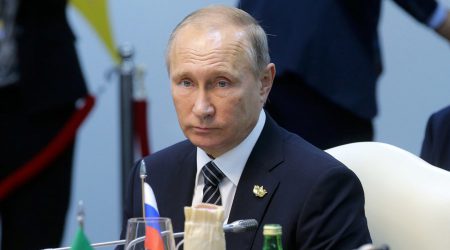
Russian President Vladimir Putin attending BRICS summit in Goa, India © Mihail Metzel / Sputnik
RT | October 16, 2016
While meeting the media in Goa, southwest India, the Russian president was asked to comment on hot issues such as the US elections, the situation in Ukraine and Syria, and his refusal to visit France, rather than Moscow’s relations with its BRICS partners.
Deteriorating Russia-US relations: ‘It all started from Yugoslavia’
Relations between Moscow and Washington did not deteriorate because of or during the Syrian conflict, Putin said in a remark to a journalist, adding: “Just remember what was going on about Yugoslavia, it all started from there.” The Russian leader said that it’s not about any third side in particular, but relations worsen because “one country” wants to impose its policy and decisions upon the rest of the world.
“We are not against this country, but we oppose that decisions are made on a unilateral basis and are not thought through considering historic, cultural and religious peculiarities of one country or another,” even if there is a conflict within the affected nation, Putin said.
‘Sanctions aim to suppress Russia’s strength’
The US does not accept compromises, which is necessary to solve issues in world politics. Rather, it chooses a “counterproductive” policy of sanctions, Putin said. “Apparently, they don’t want to compromise, they only want to dictate. Such a style has formed over the past 15-20 years in the US, and they still can’t deviate from it,” Putin said, adding that restrictive measures never achieve the aims that those who impose them hope for.
“Regarding sanctions against Russia, whatever they are said to be linked to, be it events in Ukraine or Syria, I assure you, the aims of those who formulate such a policy [of restrictions] do not solve any concrete problem,” Putin told the media. Saying that “sanctions are aimed not at solving anything, but at suppressing Russia’s strengthening” as a robust participant in international affairs, the president said that such intentions against Russia would never be fulfilled.
Moscow, in turn, does not plan to ease its retaliatory measures, caused by western policies, the Russian leader told the journalists in Goa. “No way, they can get lost,” he said.
‘US officials snoop and eavesdrop on everyone’
Russia’s president was not surprised with US Vice President Joe Biden’s recent threats towards Moscow, and said that it’s not the first time Russian-American relations have been “sacrificed” for the sake of a US presidential campaign. “One can expect anything from our American friends. What has he revealed that is new? Don’t we already know that US officials snoop and eavesdrop on everyone,” Putin said, adding that Washington “spends billions of dollars” on its secret services “spying not only on its potential opponents, but on its closest allies as well.”
Russia portrayed as US enemy to divert voters’ attention from domestic problems
Meanwhile, Russia is not going to meddle in the American presidential elections in any way, the president told reporters, adding that Moscow has no idea what could happen after a new US leader is elected. So far Hillary Clinton has chosen “an aggressive stance on Russia,” and Donald Trump has called for cooperation, “at least in fighting terrorism,” but “no one knows what it will be like after the elections,” according to Putin, who said that both candidates might change their rhetoric.
Creating an enemy out of Russia is a means by which to distract attention from domestic problems during election campaign season, according to Putin. “There are many problems [in the US], and in these circumstances, many choose to resort to the tried and tested system of diverting voters’ attention from their own problems. That’s what we are currently witnessing, I think.”
“Portraying Iran and the Iranian nuclear threat as an enemy didn’t work. [Portraying] Russia [as an enemy] seems more interesting. In my opinion, this particular card is now being actively played,” Putin said.
It will be hard to settle the conflict in southeastern Ukraine with President Poroshenko’s propensity to avoid political commitments adhering to the Minsk peace deal, Putin once again warned. Recently, the Ukrainian leader has said that Kiev would not proceed with a political process in the region, as the issue of security has not been solved in the troubled part of the country.
“I think it’s only a pretext to not do anything in the political sphere,” the Russian president said, recalling Kiev’s obligations to amend Ukraine’s constitution, as mentioned in the peace deal. “If it’s not done, it means that the current government are not ready to solve the problem once and for all,” Putin said.
Commenting on future meetings with European partners to discuss the situation in Ukraine, the Russian president said that he had agreed with his French and German counterparts that it would be “viable” to meet only if the leaders’ aides manage to make progress in preparing some preliminary agreements.
On canceled Paris visit: ‘French side refused to take part in joint events’
Moscow is “always ready to talk with anyone,” but attending meetings on issues that have been originally out of the agenda is “senseless,” Putin said, answering a journalist’s question as of why he canceled his Paris visit recently.
“The main reason for my planned visit to France was the opening of our religious and cultural center, and visiting an exhibition of Russian artists. So the main aim of the visit was joint participation [with the French president] in these events. But because of the known Syrian issues the French side decided not to join the events,” Putin said, adding that “if the main reason for the visit dropped out,” there was no reason to go.
The NYT’s Neocon ‘Downward Spiral’
By Robert Parry | Consortium News | October 4, 2016
The New York Times’ downward spiral into a neoconservative propaganda sheet continues with another biased lead article, this one on how the Syrian war has heightened U.S.-Russia tensions. The article, bristling with blame for the Russians, leaves out one of the key reasons why the partial ceasefire failed – the U.S. inability to separate its “moderate” rebels from Al Qaeda’s jihadists.
The article, written by Michael R. Gordon and Andrew E. Kramer (two of the paper’s top national security propagandists), lays the fault for the U.S. withdrawal from Syrian peace talks on Russian leaders because of their “mistrust and hostility toward the United States,” citing a comment by former White House official Andrew S. Weiss.
Gordon and Kramer then write that the cessation of hostilities agreement came undone because of the “accidental bombing of Syrian troops by the American-led coalition and then because of what the United States claimed was a deliberate bombing by Russian aircraft and Syrian helicopters of a humanitarian convoy headed to Aleppo.” (The Times doesn’t bother to note that the Russians have questioned how “accidental” the slaughter of 62 or so Syrian troops was and have denied that they or the Syrian government attacked the aid convoy.)
The article continues citing U.S. intelligence officials accusing Russia and Syria of using indiscriminate ordnance in more recent attacks on rebel-held sections of Aleppo. “Unfortunately, Russia failed to live up to its own commitments,” said a State Department statement, according to Gordon and Kramer.
However, left out of the article was the fact that the U.S. government failed to live up to its commitment to separate U.S.-backed supposedly “moderate” rebels from Al Qaeda’s Nusra Front, which has recently changed its name to the Levant (or Syria) Conquest Front. By contrast, this key point was cited by Rupert Murdoch’s Wall Street Journal, which noted:
“Russia has complained that Washington wasn’t upholding its end of the bargain by failing to separate U.S.-backed Syrian rebels from more extremist groups tied to al Qaeda.”
Doubling Down with Al Qaeda
Indeed, The Wall Street Journal has actually done some serious reporting on this crucial topic, publishing an article from Turkey on Sept. 29, saying:
“Some of Syria’s largest rebel factions are doubling down on their alliance with an al Qaeda-linked group, despite a U.S. warning to split from the extremists or risk being targeted in airstrikes.
“The rebel gambit is complicating American counterterrorism efforts in the country at a time the U.S. is contemplating cooperation with Russia to fight extremist groups. It comes after a U.S.-Russia-brokered cease-fire collapsed last week and the Syrian regime and its Russian allies immediately unleashed a devastating offensive against rebel-held parts of Aleppo city that brought harsh international condemnation. …
“The two powers have been considering jointly targeting Islamic State and the Syria Conquest Front — formerly known as the al Qaeda-linked Nusra Front — a group that is deeply intermingled with armed opposition groups of all stripes across Syria’s battlefields. The U.S. has also threatened to attack any rebels providing front-line support to the group. …
“Some rebel groups already aligned with Syria Conquest Front responded by renewing their alliance. But others, such as Nour al-Din al-Zinki, a former Central Intelligence Agency-backed group and one of the largest factions in Aleppo, said in recent days that they were joining a broader alliance that is dominated by the Front. A second, smaller rebel group also joined that alliance, which is known as Jaish al-Fateh and includes another major Islamist rebel force, Ahrar al-Sham. …
“In a call with Mr. Kerry on Wednesday, Russian Foreign Minister Sergei Lavrov said Syrian rebels ‘refused to follow the U.S.-Russian agreement…but instead merged with [Nusra Front].’”
So, it should be clear that a major obstacle to the agreement was the failure of the U.S. government to persuade its clients to break off alliances with Al Qaeda’s operatives, a connection that many Americans would find deeply troubling. That public awareness, in turn, would undermine the current neocon P.R. campaign to get the Obama administration to supply these rebels with anti-aircraft missiles and other sophisticated weapons, or to have U.S. warplanes destroy the Syrian air force in order to impose a “no-fly zone.”
Since the start of the Syrian conflict in 2011, the powerful role of Al Qaeda and its spinoff, the Islamic State, has been a hidden or downplayed element of the narrative that has been sold to the American people. That story line holds that the war began when “peaceful” protesters were brutally repressed by Syria’s police and military, but that version deletes the fact that extremists, some linked to Al Qaeda, began killing police and soldiers almost from the outset.
Hiding Realities
However, since The New York Times is now a full-time neocon propaganda sheet, it does all it can to hide such troublesome realities from its readers, all the better to jazz up the hatred of Syria and Russia.
As the Times and the Journal both made clear in their articles on Tuesday, the neocon agenda now involves providing more American armaments to the rebels either directly through the CIA or indirectly through U.S. regional “allies,” such as Saudi Arabia, Qatar and Turkey.
Though pitched to the American people as “humanitarian” assistance needed to shoot down Syrian and Russian planes, the arming-up of the rebels will likely extend the war and the bloodletting even longer while strengthening Al Qaeda and the Islamic State,.
If the new U.S. weapons prove especially effective, they could even lead to the collapse of the Syrian government and bring about the neocons’ long-desired “regime change” in Damascus. But the ultimate winners would likely be Al Qaeda and/or the Islamic State, which could be expected to follow up with the mass slaughter of Christians, Alawites, Shiites, secular Sunnis and other “heretics.”
More likely, however, the U.S.-supplied weapons would just cause the war to drag on indefinitely with an ever-rising death toll. But don’t worry, the dead will be blamed on Vladimir Putin and Bashar al-Assad.
Although never mentioned in the mainstream U.S. media, the delivery of weapons to these Syrian rebels/terrorists is a clear violation of international law, an act of aggression and arguably a crime of aiding and abetting terrorists.
International law is something that the Times considers sacrosanct when the newspaper is condemning a U.S. adversary for some violation, but that reverence disappears when the U.S. government or a U.S. “ally” is engaged in the same act or worse.
So, it is understandable why Gordon and Kramer would leave out facts from their story that might give Americans pause. After all, if the “moderate” rebels are in cahoots with Al Qaeda, essentially serving as a cut-out for the U.S. and its “allies” to funnel dangerous weapons to the terror organization that carried out the 9/11 attacks, Americans might object.
Similarly, if they were told that the U.S. actions violate international law, they might find that upsetting, too, since many Americans aren’t as coolly hypocritical as Official Washington’s neocons and liberal war hawks.
Beyond the devolution of The New York Times into a neocon propaganda organ, Gordon and Kramer have their own histories as propagandists. Gordon co-wrote the infamous “aluminum tube” story in September 2002, launching President George W. Bush’s ad campaign for selling the Iraq War to the American people. Gordon also has gotten his hands into disinformation campaigns regarding Syria and Ukraine.
For instance, Gordon and Kramer teamed up on a bogus lead story that the State Department fed to them in 2014 about photographs supposedly taken of soldiers in Russia who then turned up in other photos in Ukraine – except that it turned out all the photos were taken in Ukraine, destroying the premise of the story and forcing an embarrassing retraction. [For more on that screw-up, see Consortiumnews.com’s “Another NYT-Michael Gordon Special?”]
For his part, Kramer has been a central figure in the Times’ anti-Russian propaganda regarding Ukraine. [See Consortiumnews.com’s “NYT Is Lost in Its Ukraine Propaganda.”]
So, between the Times’ neocon institutional bias – and the apparent personal agendas of key correspondents – one can expect very little in the way of balanced journalism when the topics relate to the Middle East or Russia.
Solid facts? 5 flaws that raise doubt over int’l MH17 criminal probe
RT | September 29, 2016
An international inquiry has found that MH17 was taken down from within rebel-held territories by a BUK system transported from Russia. However, some uncertainty over it lingers – investigators withheld key evidence citing security concerns.
During the presentation of its findings, the Joint Investigation Team (JIT) stated that it would not disclose all the information and evidence sources it used in its inquiry.
“We cannot and do not want to tell you everything because that can jeopardize the investigation and play into the hands of the perpetrators,” the body said.
Unnamed eyewitnesses
According to the JIT the BUK was brought into Ukraine from Russia by a low-loader and then taken to the alleged launch site near Snezhnoye. The cornerstones of this conclusion are open-source materials and “witness statements” gathered by investigators. However no people who provided the statements were named, with the JIT citing security reasons.
The inquiry also mentioned eyewitnesses who allegedly saw the smoke trail following the launch of the BUK near Snezhnoye. The Dutch-led team has not released any video accounts from these people to back up their claims.
Anonymous phone call interceptions
Apart from using eyewitnesses, the international team analyzed “intercepted telephone conversations”. The JIT said it examined “approximately 150,000” intercepted telephone calls, but during its presentation, the international team released the transcripts and audio recordings of only a handful of them. One of the phone calls in particular includes an alleged discussion about the need for a missile system and a confirmation that rebel forces had procured one.
Although the JIT provided the date for the calls it is not clear as to who exactly was involved in the conversation and who handed over the respective data. While the JIT claimed it has independently evaluated their authenticity, Russia, for instance was not included in the process.
Computer simulation vs. video evidence
While stressing that the JIT was able to track “much of the route” of the BUK missile system from Russia, investigators provided only few videos and images of the system, allegedly in Ukraine.
The main evidence on the path of the low-loader with the Buk was hence presented not with real images, but merely a computer reconstruction. It showed the alleged route of the missile system through communities in eastern Ukraine right to the alleged launch site.
The investigators also cited the importance of anonymity because of potential security issues for the people who had provided them with materials.
Radar data and satellite images
Pinpointing the exact location of the BUK missile launch was one of the key tasks for the Dutch-led team. In its report investigators cited data received from the US which purported to show that MH17 was downed by a BUK missile “launched from a site about six kilometers south of the village of Snizhne [Snezhnoye].” The images have not been attached to the report.
On September 26 Russia challenged JIT claims releasing raw data from a radar located in Russia, which registered no objects approaching MH17 from the territories held by rebels. Moscow also called on Ukraine to release its radar data, which the Russian Defense Ministry continues to point out, has still not been made public.
Missile type and flight trajectory
On Wednesday the international team reiterated that it could not specify the exact type of missile used to down the Malaysian Boeing, saying it was a 9M38-series rocket.
Yet Russian company Almaz-Antey, said it could clearly identify the missile being of type 9M38, which is already decommissioned in Russi, after carrying out experiments last year. That was not reflected in the latest JIT report.
Almaz-Antey further questioned the JIT report since it had handed over “top-secret” data on BUK missile characteristics to the investigators earlier. Yet the international team opted to study a “similar” US missile to model the impact, which according to Almaz-Antey massively differs from the Russian BUK including a different potential flight path.
READ MORE:
Int’l investigators allowed Ukraine to fabricate MH17 evidence – Russia
MH17 int’l probe’s only sources are Ukrainian intel & internet – Russian MoD
International investigators allowed Ukraine to fabricate MH17 evidence – Russia
RT | September 28, 2016
The Russian Foreign Ministry has said that investigators probing the MH17 crash allowed Ukraine to fabricate evidence, turning the case to its advantage, while denying Moscow any comprehensive role in the inquiry.
“Russia suggested working together from the start and relying on the facts only,” Russian Foreign Ministry spokesperson Maria Zakharova said in a statement for the media on Wednesday, commenting on the findings in the criminal probe into the MH17 crash by a Dutch-led team of international investigators.
“Instead of [working together], international investigators suspended Moscow from comprehensive participation in the investigative process, allowing our efforts only a minor role. It sounds like a bad joke, but at the same time they made Ukraine a full member of the JIT [Joint Investigation Team], giving it the opportunity to forge evidence and turn the case to its advantage,” Zakharova added.
The spokesperson also noted that the JIT bases its findings on evidence provided by Ukrainian power structures, which are “undoubtedly a party with a vested interest.”
“To this day, the investigators continue to ignore the overwhelming evidence provided by the Russian side, despite the fact that Russia is the only side that submits accurate information and constantly discloses new data,” Zakharova said.
“Russia is disappointed that the situation surrounding the investigation into the Boeing crash is not changing. The findings of the Dutch prosecutor’s office confirm that the investigation is biased and politically motivated.
“To arbitrarily designate a guilty party and dream up the desired results has become the norm for our Western colleagues,” the spokesperson said.
Read more:
Washington’s Hawks Push New Cold War
By Alastair Crooke | Consortium News | September 20, 2016
Does the failure of the U.S.-backed, major insurgent August “push” on Aleppo – and the terms of the consequent ceasefire, to which some in the U.S. only irascibly agreed – constitute a political defeat for the U.S. and a “win” for Russia?
Yes, in one way: Moscow may, (just may) have cornered America into joint military air attacks on Al Qaeda in Syria, but in another way, one would have to be somewhat cautious in suggesting a Russian “win” (although Foreign Minister Sergey Lavrov’s diplomacy has been indeed tenacious).
Secretary of State John Kerry’s Syria agreement with Lavrov though, has sparked virtual open warfare in Washington. The “Cold War Bloc,” which includes Defense Secretary Ash Carter and House Speaker Paul Ryan, is extremely angry.
The Defense Department is in near open disobedience: when asked in a press teleconference if the military would abide by the terms of the agreement and share information with the Russians after the completion of the seven-day ceasefire, Lt. Gen. Jeffrey Harrigian, the commander of the U.S. Air Forces Central Command, which is directing the bombing campaign in Iraq and Syria, responded: “I think … it would be premature to say we’re going to jump right into it. And I’m not saying yes or no.”
But President Obama wants to define some sort of a foreign policy historical “legacy” (and so does Kerry). And the President probably suspects (with good cause possibly) that his legacy is set to be trashed by his successor, whomsoever it be – the minute he steps down from office.
In brief, the Establishment’s dirty washing is hanging on the line in plain sight. And it does not look great: Ash Carter, whose Department would have to work jointly with Russia in Syria, last week at Oxford University, accused Russia of having a “clear ambition” to degrade the world order with its military and cyber campaigns.
House Speaker Paul Ryan called Russian President Vladimir Putin an “adversary” and an “aggressor” who does not share U.S. interests. There is a U.S. media blitz in train, with powerful forces behind it, which paints Putin as no possible partner for the U.S.
Obama’s Will
Only in the coming days will we see whether Obama still has the will and clout to make the Syria ceasefire agreement stick. But the agreement did not appear out of the blue. One parent was the failure of America’s military “Plan B” (itself a response to the failed February ceasefire), and the other “parent” was Kerry’s wringing of a further concession from Damascus: Obama supposedly agreed to the separation of U.S. insurgent proxies from Al Qaeda (the former Nusra Front now called Jabhat Fateh al-Sham), and to their joint targeting, in return “for the what the Obama administration characterized as the ‘grounding’ of the Syrian air force in the current agreement,” as Gareth Porter has reported.
The U.S. and its Gulf allies – in pursuit of Plan B – had invested enormous effort to break Damascus’ operation to relieve Aleppo from the jihadists’ hold in the northeastern part of the city. The two sides, here (Russia and U.S.), were playing for high stakes: the U.S. wanted its Islamist proxies to take Aleppo, and then to use its seizure by the jihadis as political leverage with which to force Russia and Iran to concede President Bashar al-Assad’s ouster. Plan B, in other words, was still all about “regime change.”
Aleppo, Syria’s second largest city, has from the outset of this conflict been strategically pivotal – its loss would have pulled the rug from under the Syrian government’s guiding objective of keeping the mass of the urban population of Syria within the state’s orbit.
America’s long-standing objective thus would have been achieved – albeit at an indescribable price paid by the inhabitants of western Aleppo, who would have been overrun by the forces of Al Qaeda. Thus, the Syrian government’s recovery of all Aleppo is a major strategic gain.
In the end, however, the U.S. and its Gulf allies did not succeed: their much vaunted Plan B failed. And in failing, the insurgents have sustained heavy loss of life and equipment. Indeed, such are the losses, it is doubtful whether a “push” on this scale could again be mounted by Qatar or Saudi Arabia (despite the post-Aleppo “push” in Hama) .
In spite of the failure of Plan B, the U.S. was not ready to see Al Qaeda isolated and attacked. It wanted it protected. The U.S. ambiguity towards the jihadists of being “at war with the terrorists”; but always maneuvering to stop Syria and Russia from weakening the jihadists was plain in the letter sent by the U.S. envoy to the Syrian opposition Michael Ratney to opposition groups backed by the United States.
The first letter, sent on Sept. 3, after most of the Kerry-Lavrov agreement had already been hammered out, “makes no reference to any requirement for the armed opposition to move away from their Al Qaeda allies, or even terminate their military relationships, and thus implied that they need not do so,” Porter wrote.
A second letter however, apparently sent on Sept. 10, reverses the message: “We urge the rebels to distance themselves and cut all ties with Fateh al-Sham, formerly Nusra Front, or there will be severe consequences.”
Will it happen? Will the agreement be observed? Well, the Syrian conflict is but one leg of the trifecta that constitutes the “new” Cold War theatre: there is the delicate and unstable situation in Ukraine (another leg), and elsewhere NATO is busy building its forces on the borders of the Baltic Republics (the third leg). Any one of these pillars can be wobbled (intentionally) – and crash the delicate political framework of all the others.
Demonizing Russia
Which brings us to the complex question of the current demonization of Russia by the Cold War Bloc (which includes Hillary Clinton) in the U.S. presidential election campaign.
Gregory R. Copley, editor of Defense & Foreign Affairs has described the situation as one in which the U.S. Establishment is deliberately and intentionally “sacrificing key bilateral relationships in order to win [a] domestic election,” adding “in my 50 odd years covering the US government, I have never seen this level of partisanship within the administration where a sitting president actually regards the opposition party as the enemy of the state.”
In short, the stakes being played here – in demonizing Russia and Putin – go well beyond Syria or Ukraine. They lie at the heart of the struggle for the future of the U.S.
There is practical evidence for such caution – for, three days before the Syrian artillery was scything the ranks of Ahrar al-Sham near Aleppo on Sept. 9 to close the chapter on America’s Plan B – (and four days before Ratney’s letter to the Syrian insurgents telling them to separate from Al Qaeda “or else”), Ukrainian President Petro Poroshenko in addressing the Ukrainian parliament, the Rada in Kiev, was eviscerating the Minsk II accords, brokered by German Chancellor Angela Merkel and French President Francois Hollande as the only possible political solution to the Ukrainian civil war.
“Moreover, in a difficult dialogue,” Poroshenko said (see here and here), “we have convinced our western allies and partners that any political settlement must be preceded by apparent and undeniable progress on security issues: a sustainable ceasefire, withdrawal of Russian troops and equipment from the occupied territories, disarmament of militants and their family – and finally the restoration of our control over our own border” (emphasis added.)
Poroshenko, in other words, unilaterally turned the accord on its head: he reversed its order completely. And just to skewer it further, he told Parliament that any decision would be “exclusively yours” and nothing would be done “without your co-operation” – knowing full well that this Ukrainian parliament never wanted Minsk II in the first place.
And Kiev too is deploying along the entire borders of Donetsk and Lugansk. (A description of the military escalation by Kiev can be seen visually presented here).
Is Poroshenko’s U-turn the American “revenge” for Russia’s “win” in Syria – to heat up Ukraine, in order to drown President Putin in the Ukraine marshes? We do not know.
U.S. Vice President Joe Biden has boasted: “I think I tend to be in more direct conversation, for longer periods of time with the President [Poroshenko], than with my wife. (Laughter.) I think they both regret that (Laughter).”
Is it possible that Biden was not consulted before Poroshenko made his annual address to the Rada? We do not know, although within 48 hours of Poroshenko’s making his Rada address, Defense Secretary Ash Carter was in London, recommitting to Ukraine’s sovereignty and territorial integrity, as he signed a “bilateral partner concept” with the Ukrainian defense minister.
Provoking Russia
What we do know however, is that this is – and is intended to be – a direct provocation to Russia. And to France and Germany, too. Within a week, however, Poroshenko was backtracking as “coincidentally” a new IMF loan was being floated for Kiev, just as the German and French Foreign ministers insisted on the Minsk formula of “truce – special status – elections in Donbass – control of the border” be respected – and as the Donetsk and Lugansk leadership unexpectedly offered a unilateral ceasefire.
But Poroshenko’s “backtrack” was itself “backtracked” by Sept. 16, when the French and German visiting Foreign Ministers were reportedly told that Ukraine’s government now refused to implement the Minsk accord as it stood, as it now insists that the order be fully reversed: “truce – control of the border – elections.”
The American bitter internal election “civil war” is now shaking the pillars of the tripod on which America’s – and Europe’s – bilateral relations with Russia stand. It would therefore seem a stretch now for Obama to hope to prevail with any “legacy strategy” either in the Middle East or Ukraine that is contingent on cooperation with Russia.
The U.S. Establishment seems to have come to see the very preservation of the global status quo as linked to their ability to paint Trump as President Putin’s instrument for undermining the entire U.S. electoral system and the U.S.-led global order.
To the world outside, it seems as if the U.S. is seized by a collective hysteria (whether genuine, or manufactured for political ends). And it is not clear where the U.S. President now stands in this anti-Russian hysteria having likened Putin to Saddam Hussein, and having accused the Republican nominee of trying to “curry favor” with the Russian president – for having appeared on “Larry King Live” which is now broadcast by Russia Today.
But the bigger question is the longer-term consequence of all this: some in the “Hillary Bloc” still hanker for “regime change” in Moscow, apparently convinced that Putin’s humiliation in either Syria (not so likely now), or in Ukraine, could see him deposed in the March 2018 Russian Presidential elections, for a more Atlanticist, more “acceptable” leader.
It is unadulterated wishful thinking to imagine that Putin could be displaced thus – and more likely, Ukraine (with its prolific ‘kith and kin’ ties to Russians) used as a lever to “humiliate” President Putin will prove counter-productive, serving only to harden antagonism towards the U.S., as ethnic Russians die at the hands of rightist Ukrainian “militia.”
But it is certainly so that this campaign is strengthening the hand of those in Russia who would like to see President Putin taking a less “conciliatory line” towards the West. So, we may be heading towards more troubled waters.
Alastair Crooke is a former British diplomat who was a senior figure in British intelligence and in European Union diplomacy. He is the founder and director of the Conflicts Forum, which advocates for engagement between political Islam and the West.
US expands list of sanctioned Russian firms
RT | September 7, 2016
The US Department of Commerce is expanding its blacklist of Russian companies and individuals over their alleged links to the Ukrainian conflict.
The list was published on the Federal Register’s website on Tuesday, and identifies “entities and other persons reasonably believed to be involved in, or that pose a significant risk of being or becoming involved in, activities that are contrary to the national security or foreign policy of the United States.”
The blacklist consists of 75 Russian companies and up to 37 individuals. Among the sanctioned companies are 11 Russian and international electronics firms including one of the largest Eastern European manufacturers of integrated circuits Angstrem Group, Foreign Economic Association, radio and microelectronics manufacturer Mikron.
Seven sanctioned companies are said to be directly involved in the construction of the 19 kilometer (11.8 miles) road and rail connection across the Kerch Strait, which connects the Black and the Azov Seas.
Last week, the US Treasury Department introduced sanctions related to the conflict in eastern Ukraine against 18 construction, transportation and defense entities operating in the Crimea, as well as dozens of Gazprom and Bank of Moscow subsidiaries. The list also included an additional 11 Crimean officials.
Gazprom said the new sanctions will not affect its business.
The US and EU imposed sanctions on Russia in 2014 after accusing Moscow of involvement in the conflict in eastern Ukraine and of annexing Crimea. The Kremlin has denied the accusations and responded with counter-measures, banning imports from the EU, US and others.
The Guardian’s vernacular shield of Ukraine’s TV attack
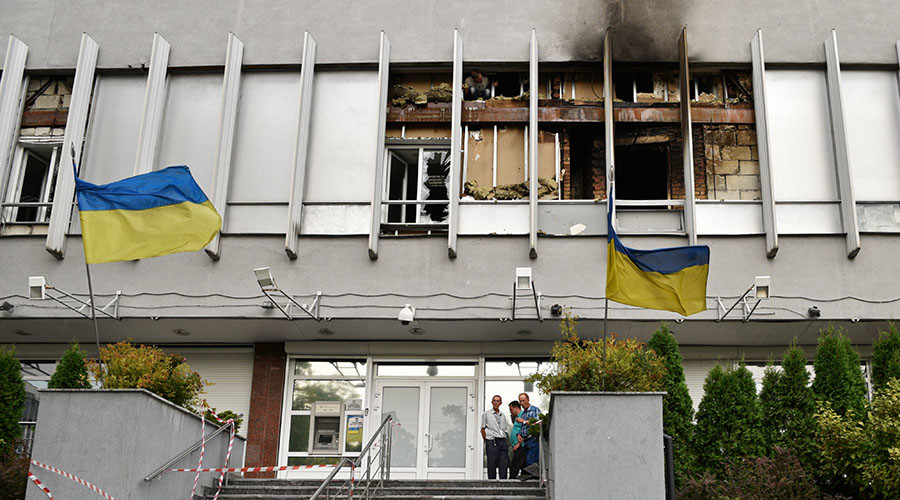
The Ukrainian Inter TV Channel building in Kiev, which was set on fire on September 4, 2016. © Sputnik
RT | September 6, 2016
The Guardian’s report this week into an apparent arson attack on a Ukrainian TV station is the latest entry in the ‘do as we say, not as we do’ textbook of mainstream journalism.
After the Kiev offices of the building housing studios and offices of Ukrainian broadcaster Inter were set on fire by former military personnel, the British newspaper used copy from the Associated Press and the US state news agency RFE/RL, which has its own agenda, to report on the event. The added spin, however, is all their own.
The headline states: “Pro-Russia TV station in Kiev evacuated after fire.” For starters, there is no evidence that Inter TV, the channel affected, is especially favorable towards Moscow. In reality, Ukraine watchers believe it’s more pertinent to describe it as simply opposed to the current regime in Kiev. The comments beneath the Guardian’s own twitter post promoting the piece would appear to back that up.
Looking at the headline, the impression given is of the local authorities as good guys, practically saving the “pro-Russia” opposition. Quite a pleasant surprise, considering that the current government in Kiev allows private armies, representing nationalist and oligarchic interests – which often align – to run amok in the country and this is why episodes of this nature occur. How do we know there’s a connection? Why, Ukrainian Interior Minister Arsen Avakov himself stated that it was former Ukrainian military personnel that carried out this attack. This statement is conspicuously missing from the Guardian piece altogether.
Isn’t it remarkable how oblique Western mainstream media’s language becomes when “their guys” are caught out doing something wrong?
The incident is reminiscent of the 2014 Odessa Trade Union building fire and the reaction to it. Back then the Guardian’s headline was “Ukraine clashes: dozens dead after trade union building fire.” There was no mention of the nationalist groups involved and the headline didn’t explain that all the deaths were on the anti-government side, once again dubbed “pro-Russian.” Despite the fact that no weapons were found in the building, Western media has pretty much ignored the massacre, in which 42 people died.
Many reports then referred to the building “catching” fire, as if by accident, and ignored ample video evidence of Molotov cocktails being hurled by the Kiev supporters.
In reporting on the story, The Guardian’s unquestioning reliance on RFE/RL text is particularly telling. After all, we regularly hear self-congratulatory boasting from the Western press about their commitment to objectivity, rejection of political agendas and a tradition of holding authority accountable – usually coupled with scolding of RT and other news outlets that dare to present an alternative interpretation of events. Well, RFE/RL is controlled by the Broadcasting Board of Governors (BBG), which is funded to the tune of nearly $800 million annually by the US government and its first listed principle is to “be consistent with the broad foreign policy objectives of the United States.”
Currently the primary aim of US policy in Ukraine is to support the Poroshenko adminstration, seemingly without any caveats, and presumably because the regime is useful for balancing Russia’s influence in the region.
So much for speaking truth to power, G.
Western media propaganda threatens peace and prolongs the deadly conflict in eastern Ukraine
By Roger Annis | New Cold War | Sept 2, 2016
Western media is becoming unhinged as its anti-Russia propaganda struggles to keep a hold on its consumers. Two recent examples provide evidence.
Pro-peace conspiracy emanating from Moscow
On August 28, the New York Times published an article by its Moscow bureau chief about the troubling news (from the Times‘ viewpoint) that the people of Sweden are not happy with their government’s wish to join up with the NATO military alliance.
The ruling elites in Sweden and Finland have been quietly pushing for NATO membership for years. In May, the Swedish government pushed through the Riksdag a proposal for a ‘cooperation agreement’ with NATO, allowing it freer access to Swedish territory for transit and training. Finland already has such an agreement in place. In July, government leaders of the two countries proudly joined the NATO summit dinner in Warsaw.
But as a Reuters report at the time of the Warsaw summit explained, “An SvD/SIFO opinion poll showed 49 per cent of Swedes opposed joining NATO, with 33 in favor. Most Finns are against entering, and a government report said in April any such move would trigger a crisis with Russia.”
A Swedish news outlet reported on the same poll results:
In the survey of 1000 Swedes carried out by pollsters SIFO for newspaper Svenska Dagbladet in June, 49 per cent said they did not want Sweden to join NATO, 33 per cent said yes, and 18 said they were undecided.
The results suggest public opinion has changed since the last SIFO survey on the topic in September of 2015. In that poll, 41 per cent said they were in favour of Sweden seeking NATO membership, 39 per cent said they were against, and 20 per cent were undecided.
At the time, the 2015 figures appeared to demonstrate a significant shift in public opinion in the traditionally non-aligned Nordic country, but SIFO’s most-recent round of results indicates that shift was short-lived.
The Times article by Neil MacFarquharaug began, “With a vigorous national debate underway on whether Sweden should enter a military partnership with NATO, officials in Stockholm suddenly encountered an unsettling problem: a flood of distorted and outright false information on social media, confusing public perceptions of the issue.”
The source of the “confusion”? The Times headline reads, ‘A powerful Russian weapon: The spread of false stories’. The article says there is “a flood of distorted and outright false information on social media, confusing public perceptions of the issue.”
The Times writer declares a case of Russian dezinformatsiya in action. So powerful is the dezinformatsiya that it can seemingly bamboozle two of the wealthiest and most-educated populations in the world and make them act against their best interests, or at least the best advice of the New York Times, that being to join NATO.
As to the exact source of the public tripwire that Swedish government leaders have encountered, the dezinformatsiya conspiracy fades into the mists of the northern boreal forest. The Times explains, “As often happens in such cases, Swedish officials were never able to pin down the source of the false reports. But they, numerous analysts, and experts in American and European intelligence point to Russia as the prime suspect…”
Could public attitudes in Finland and Sweden towards NATO have anything to do with the historic ambivalence of Swedes and Finns to imperialist war alliances and their preference for peace over war? Apparently, the New York Times can’t climb out of its Russia conspiracy rut long enough to investigate.
According to the Global Peace Index as well as the Global Peace Index (produced annually by the Institute for Economics and Peace), Finland and Sweden score in the top 15 countries of the world in various measures of being peaceful, non-violent places to live. Could it be that the people in Sweden and Finland would like to keep things that way?
Meanwhile, here is the New York Times article’s own dezinformatsiya, in the form of a long list of alleged Russian propaganda initiatives that prove what a dastardly enemy it is:
- “Disinformation most famously succeeded in early 2014 with the initial obfuscation about deploying Russian forces to seize Crimea.”
- “… the simple truth that poorly trained insurgents had accidentally downed the [Malaysian Airlines Flight 17] plane with a missile supplied by Russia.”
- “… the Kremlin’s English-language news outlets heavily favored the campaign for [Britain] to leave the European Union, despite their claims of objectivity.”
- “Moscow’s targeting of the West with disinformation dates to a Cold War program the Soviets called ‘active measures’.”
- “[The Russian state-owned television channel] RT often seems obsessed with the United States, portraying life there as hellish.”
- “The weaponization of information is not some project devised by a Kremlin policy expert but is an integral part of Russian military doctrine…”
Reuters can’t write a truthful article
Meanwhile, the Reuters news agency published a report, also on August 28, purporting to look at the prospects for peace in Ukraine. The article is headlined, ‘Germany, Poland and France call for more efforts to end Ukraine crisis‘. Only ten brief paragraphs long, hardly a one in the article is untouched by distortions aimed at casting the best possible light on the right-wing, ultranationalist government in Kyiv and its civil war in the east of the country. Let’s read the ten paragraphs from start to finish:
The foreign ministers of Germany, France and Poland agreed on Sunday there should be greater international efforts to end the fighting in eastern Ukraine, German Foreign Minister Frank-Walter Steinmeier told reporters.
He said there had not been sufficient progress in implementing the Minsk ceasefire agreement. “Western officials were talking with Russia and Ukraine to encourage them to implement measures already agreed in the Minsk process, including communal elections,” he said.
“Fighting in eastern Ukraine” is Western news-speak for “We don’t’ wish to name the protagonist in the conflict in eastern Ukraine because it happens to be our friend and ally. And what’s more, we are hoping that you don’t notice that it is the army of Ukraine that has invaded and occupied parts of Donbass in eastern Ukraine, not the other way around.”
Reuters cites Germany’s foreign minister in saying “Russia and Ukraine” should implement the Minsk-2 ceasefire agreement (signed on February 12, 2015 in the Belarus capital of Minsk). But Minsk-2 is an agreement to end a conflict between two parties in Ukraine–the governing regime in Kyiv, and the people’s republics in Donbass (Donetsk and Lugansk). The agreement spells out the precise measures to be taken on both sides, including a cessation of military hostilities, comprehensive prisoner exchanges, recognition by Kyiv of autonomy for Donetsk and Lugansk, to be followed by the holding of elections there, and so on. What does all this have to do with Russia, apart from the obvious facilitation role which Russia (and other regional powers) could fulfill? Is Russia supposed to take over Ukraine so that Minsk-2 may be implemented? How well would that go over in Berlin and Washington?
Why not “Germany and Ukraine” or “France and Ukraine” to be encouraged to implement Minsk? After all, Germany and France are among the four members of the ‘Normandy Four’ group constituted to facilitate a resolution of the crisis in Ukraine and under whose facilitation Minsk-2 was arrived at in the first place.
“We have to work for a de-escalation of the situation,” [Steinmeier] told reporters after a meeting with his counterparts aimed at reinvigorating the Weimar Triangle [Germany-France-Poland] trilateral group.
Steinmeier said the group also wanted to reassure Europeans about the continued importance and relevance of the European Union after the June 23 vote by Britain to exit the bloc.
“The Weimar Triangle can plan an important role … It is a format where we can discuss progress or the lack of progress on issues such as the Normandy format aimed at ending the Ukraine conflict,” Steinmeier said.
The Normandy group comprises Russia, Ukraine, France and Germany.
So what, exactly, have Germany and France been doing to “de-escalate” the conflict in Ukraine? Have they called on Ukraine to pull its heavy weaponry out of the ceasefire zone and cease its criminal, daily shelling of towns and cities in Donbass, in total violation of Minsk-2? No. Have they called out Ukraine for refusing to recognize the Donetsk and Lugansk republics and thereby blocking the holding of elections as required by Minsk-2? No. How about Ukraine’s failure to conduct prisoner exchanges; have Germany and France scolded Ukraine for that? No. So why is Reuters misleading its readers about Germany and France’s failure to work to “de-escalate” the conflict?
The misleading is even worse, because not only have Germany and France failed to aid in de-escalating the conflict, they are constantly adding fuel to the fire. Recently, they led the European Union in extending EU economic sanctions against Russia, including Crimea. They are silent about the provocative action of the United States, Britain and Canada in providing military training and equipping of the Ukrainian army and paramilitary irregulars, which is then applied to the illegal and criminal war against the citizens of Donbass.
Germany and France are members of the NATO alliance whose lead member, the United States, recently constructed provocative and dangerous missile bases in Romania and Poland. These bases have been built as the U.S. undertakes a massive, trillion dollars-plus upgrade of its nuclear weapons. This includes designing new delivery systems that undo the current status quo of nuclear stand-off and greatly increase the possibility of accidental unleashing of nuclear weapons.
Why can’t Reuters provide its readers with important background information of the conflict in Ukraine instead of printing bland phrases that convey exactly the opposite impression of what is really taking place?
The leaders of Russia, Germany and France have agreed to meet to discuss the situation in Ukraine on Sept. 4-5 in China on the sidelines of the G20 summit, the Kremlin said last week.
A recent surge in fighting in eastern Ukraine, where Kiev is fighting pro-Russian separatists, and fresh tension in Crimea have raised concern that a fragile ceasefire agreed in Minsk in February 2015 could collapse.
“Recent surge in fighting in eastern Ukraine” is Reuters-speak for that which not must be spoken: in recent months, Ukraine has greatly increased its criminal shelling of the people of Donbass. What’s more, Ukraine conducts an ongoing military occupation of Donetsk and Lugansk territory and it calls the self-defense forces of Donbass “terrorists”, thus showing it has absolutely no intention of reaching a political settlement.
Ukrainian President Petro Poroshenko said last week he did not rule out introducing martial law and a new wave of military mobilization if the separatist conflict worsened.
“Separatist conflict” is Kyiv-speak/Reuters-speak for obscuring and confusing the source of the conflict in eastern Ukraine, which is the refusal of Kyiv to grant the slightest decentralization of power in the highly-centralized Ukrainian constitutional setup whereby regions of Donbass could achieve a desired autonomy.
Of course, as a result of Ukraine’s prolonged and cruel war against the people of Donbass, it is highly likely that if given the chance, they would vote to secede from Ukraine to either join Russia or constitute their own independent republics. But that hardly makes them criminals or “terrorists”. As a matter of fact, that would be an entirely lawful act, consistent with international law, such as it is, and consistent with recent political experience in such countries as Canada (Quebec) and the United Kingdom (Scotland).
Propaganda disguised as news or policy is the modus operandi of Western media outlets in reporting on Ukraine. It’s a major contributor to making the conflict there so intractable because it lessens the pressure that would otherwise operate on the ultra-nationalist regime in Kyiv that it cease its civil war course.
Postscript:
On September 1, the Globe and Mail national daily in Canada published a propaganda opinion piece by Aurel Braun, a professor of international relations and political science at the University of Toronto and a centre associate of the Davis Center, Harvard University. The commentary is titled ‘The West can’t let Putin decide Ukraine’s future‘ and the text begins:
Last week’s celebrations of 25 years of independence in Ukraine were bittersweet. Domestic problems aside, fighting escalated in eastern Ukraine with Moscow-controlled separatist rebels, Crimea remained firmly in Russia’s grip as the Kremlin increased its military presence there, Russian forces massed on Ukraine’s border and the Putin government provocatively accusing the Kiev government of seeking to invade Crimea. A worried President Petro Poroshenko warned just days before that he could not exclude the possibility of a full-scale Russian invasion of Ukraine.
There are two things of note in the commentary. One, the author says Ukraine would be “impossible to govern” if it were to adopt a federal system, ie a devolution of powers from Ukraine’s extremely centralized governing system to its 25 oblasts (regions). This will come as news to the people of many (most?) countries of the world that have a form of federal division of powers, including Canada, The United States… and Russia!
Two, the author describes present-day Ukraine as suffering “decades of failure to institute fundamental economic reforms, it needs to address endemic and damaging corruption, and Ukrainian political parties must learn the art of political compromise and be vigilant against various forms of extremism.” So how can these apparently intractable problems be cured? Why, ‘blame Russia!’
With such uninformed but university-level discourse, it is no wonder that most of the comments by readers posted to the Globe article absolutely mock its ludicrous assertions (and thereby mock the Globe editors for choosing to publish it). Here are a few examples of the withering comments directed at the editors of the Globe:
* Russia is this and Russia is that… The author of this piece of shameless propaganda thinks that we all have a very short memory span and cannot think by ourselves…
* Yet another wretched screed in the endless stream of Russia-baiting, Putin-bashing media commentaries in western media. Cannot the Globe and Mail find some knowledgeable persons from time to time to write something more or less objective and sensible about these and other troublesome international issues?…
* Ridiculous article and the University of Toronto should be ashamed that they have hired someone who is more of a government propagandist than a ‘student’ of foreign events…
* Is this guy really a professor? …
* … The author would do well to stop citing people who’ve lied through their teeth since the [2014] coup – the criminal act which sparked the avoidable crisis. We should all stop listening to people like [Aurel] Braun, who are well-known for doing the same.
* Ah yes, Aurel Braun, the man who destroyed Rights & Democracy (and whose actions possibly contributed to the death of its former director) in order to protect Israeli policy from criticism, is well-known for his anti-Russian bias and willingness to lie to enable conflict…
Final word in yet another chapter of Globe and Mail pro-Kyiv propaganda to another Globe commenter: “… If Western people and governments truly want to see the Ukrainian people begin to prosper, they will stop using that country as a chess piece in the Big Game. Work to ease tensions with Russia in this area, not exacerbate them.”
The alternate reality of Anders Fogh Rasmussen
By Danielle Ryan | RT | August 23, 2016
Reading through a recent interview with former NATO secretary general Anders Fogh Rasmussen, it becomes clear that his world is one in which US foreign policy has only ever made us all safer and the biggest risk we now face is diminished US power.
The entire premise of his argument throughout the interview is that if the US steps back from playing global policeman, the “bad guys” will win. Simple as that.
Tempting Putin
The interview, which focuses on Donald Trump, opens with a question about Trump’s views regarding the NATO alliance and how the candidate sees the US’s role in the world. Rasmussen immediately declares he is “not taking sides” in the US election, but his attempt at neutrality goes swiftly out the window moments later when he complains that Trump is undermining “the credibility of the United States” and putting at stake America’s “role as the global superpower”. If Trump were to be elected, he laments, that could usher in “the end of the American-led world order”.
This would be very bad, he says, because if NATO is undermined by a Trump victory, then Vladimir Putin would “open a bottle of champagne” and be “tempted to test” the alliance. This assumes that Putin has simply been waiting in the wings for the 16 years that he has held positions of power for Donald Trump to come along so that he can invade Estonia for no reason. Because Rasmussen doesn’t give us a reason and we’re not supposed to ask. We’re just supposed to assume invading the Baltics is on Putin’s to-do list.
So, keeping with his policy of “not taking sides” Rasmussen then argues that Hillary Clinton would be “more determined to defend” the country’s NATO allies than Trump would. When asked whether eastern European nations are worried about Trump’s take-it-or-leave-it approach to NATO’s Article 5 (principle of collective defense) Rasmussen says they are indeed very concerned, particularly following “Russian aggression” against Ukraine. So concerned in fact, that only five of the 28 alliance members have reached the 2 percent of GDP benchmark that NATO requires. Now, this is either because they aren’t really as terrified of Russia as they claim, or that they’re simply taking the US for a ride — in which case, Trump might actually have a point about getting them to cough up before putting American lives in harm’s way to defend them.
It’s hybrid warfare, stupid!
Next up, Rasmussen is asked whether the threat environment for NATO has changed and how the alliance is dealing with the changes. Rasmussen here employs one of my favorite terms: “hybrid warfare”. It’s not just conventional warfare (tanks rolling across borders etc.) that eastern European nations need to be aware of, he says. It’s a whole load of other stuff, too. Like what? Well, sophisticated “disinformation campaigns” for one thing.
But the great thing about “hybrid warfare” is that when you use the term, you don’t really need to explain what you mean. Even NATO itself published an article about the fact that it can mean everything and nothing at the same time. Pretty nifty, right?
Moving on to Crimea, another victim of hybrid warfare. Trump isn’t too bothered by the fact that Crimea was annexed by/invaded by/reunited with Russia in 2014. That’s Europe’s business, he has said — and it shouldn’t prevent Washington and Moscow from getting along and working together on common threats like international terrorism. You don’t have to be a Trump fan to see the common sense in this, but it’s another no-no for Rasmussen.
Trump also hasn’t been so gung-ho about sending weapons to Ukraine. This is very scary and “disturbing” Rasmussen says, because if the US doesn’t support the government in Kiev, the West “risks losing a democratic Ukraine”.
Democracy and world peace
So, how is “democratic Ukraine” doing, then? Well, a few months ago The Guardian published an op-ed arguing that Ukraine was at risk of becoming not a democracy, but a “failed state”. Since the country’s democratic “revolution” in 2013, living standards have plummeted, as has the value of the country’s currency — and the government, ideologically driven to sever all ties with Russia, has pursued economic policies that “can only be termed suicidal”. But the solution is obviously to send them some new weapons. Regardless of whether you believe Russia has acted aggressively in Ukraine or not, this kind of thinking is simply delusional.
Next Rasmussen is asked about Trump’s “America first” campaign slogan, which he also doesn’t happen to like (surprise!). Using the term “America first” for an American presidential election is “out of touch” he says. How so? Well, of course it comes back to America’s role in the world again. You can’t use the term “America first” when you’re supposed to be “the world’s leader”. I swear, I’m not making this up.
After World War 2, Rasmussen tells us, the US established a “rules-based world order” and it has “served us very well” because “freedom has flourished” and we’ve seen “world peace”. All of this freedom and world peace (really?!) is now at stake… because of Donald Trump (are you sensing the “not taking sides” thing?). Anyway, I could list all of the occasions on which the US decided to flout its own “rules-based” order, but that would take too long.
If the US “retreats and retrenches” now, it will create a power vacuum that will be filled by “the bad guy,” Rasmussen warns. He doesn’t tell us who the bad guy is this time; he’s just there, malevolently waiting for Trump’s election. Trump needs to understand that the US has “special obligations” to “maintain world order” and “promote peace”. Not only this, but it’s the “only power on earth” with such a “destiny”.
Barack Obama has also been a disappointment to Rasmussen. He has been “too reluctant” to use American force around the world. Obama and Trump are proponents of a “less interventionist” movement in the world and this simply won’t do.
By the end, Rasmussen had lavished so much praise on the United States and its role and “destiny” in the world that I had forgotten he was not an American himself, but a Dane. The real kicker was when he dramatically pleaded with the next president: “We need a global policeman, and that policeman should be the United States. We don’t have any other.”
Could he really be so profoundly in awe of Washington and its power, or is this waxing lyrical about American destiny simply, as one writer put it, “the practiced gambit of a con man, who knows flattery is the surest means to success” ?
Decide for yourself.
Featured Video
Dan Dicks with James Corbett on Solutions Watch
or go to
Aletho News Archives – Video-Images
From the Archives
Secret document reveals plans for civil war in Lebanon, Israeli false flags, and invasion
By Randi Nord | Geopolitics Alert | April 5, 2019
Beirut – During his visit with US Secretary of State, Mike Pompeo, Lebanese President Michael Aoun reportedly received a US-Israeli document detailing plans for creating a civil war in Lebanon with covert false flag operations and possible Israeli invasion.
Although the source of the document is Israeli and created in partnership with Washington, no one knows who presented it to Aoun. The Lebanese TV station, Al-Jadeed, initially reported the document on Lebanese TV and a video on its website. Geopolitics Alert translated the report for this article. … continue
Blog Roll
 Aletho News
- Sheikh al-Asadi warns of Iraqi government compliance with US demands
- How to MAKE THE CONSPIRATORS PAY for their crimes! Dan Dicks with James Corbett on Solutions Watch
- There’s a drought in academia: A drought in honest research on the subject of drought and other weather extremes
- Department of War Awards $20.7 Billion Contract to Raytheon for Air-to-Air Missiles
- ‘Distance yourselves from Israel’: IRGC urges US population to question govt policies
- America’s Greenland deal has a radioactive backstory
- The RAF Fairford ‘terror plot’: Unpacking escalation in the UK echo-chamber
- EU Council Advances Chat Control 2.0 Scanning Proposal
- Ex-Greek MEP files complaint against Israeli spyware firm over alleged Pegasus surveillance
- Troubling ideas throughout the Torah, Talmud, Mishneh Torah and Tanya
- If Americans Knew
- New Report: “Scholasticide and Genocide in Gaza: Assessment, Testimonies and Legal Analysis”
- Ex-Biden officials are desperate for a Gaza scapegoat
- Israeli “settlers” Invade Al-Aqsa; Pour Boiling Water on 75-Year-Old
- Israel Has Kidnapped Another American Teenager
- US arms sales to Israel worth $21.6 billion in 20 months
- Three Palestinians Killed in Israeli Attacks on Gaza
- Revealed: German “Anti-Semitism Expert” Driving Crackdown on Palestine Solidarity is Former Israeli Spy
- Egypt’s Warning to Israel Before Oct 7
- Israel’s siege signals another cruel winter for 1.8 million Gazans – Daily Update
- Netanyahu Asked UAE Leader to Deny Report on Oct. 7 Warning in Secret Visit, Sources Say
- No Tricks Zone
- An error has occurred; the feed is probably down. Try again later.

