Both sides in Ukraine conflict sign treaty banning military action
RT | September 19, 2014
Kiev and self-defense forces signed a memorandum aimed at effectively halting all fighting in eastern Ukraine after talks in Minsk. It creates a buffer zone, demands a pullback of troops and mercenaries, and bans military aviation flybys over the area.
The signed memorandum consists of nine points, former Ukrainian president Leonid Kuchma told journalists following peace talks in Minsk, Belarus.
“The first one is stopping the use of weapons by both sides, the second is terminating new formations of units on military bases as of September 19. The third is banning the use of all types of weapons and offensive action,” Kuchma said.
The agreement outlines a buffer zone of 30 km (18.6 miles) and bans all military aircraft from flying over part of eastern Ukrainian territory, except for the OSCE’s aerial vehicles, Kuchma told RIA Novosti following the meeting.
Ukraine troops must pull back all heavy artillery by 15 kilometers from the conflict zone in eastern Ukraine, the treaty states.
All foreign mercenaries must be withdrawn from eastern Ukraine by both sides of the conflict, the signed Minsk memorandum states, according to Kuchma.
“We have agreed on the withdrawal of all foreign mercenaries from both sides,” Kuchma said.
Both sides also vowed to continue the exchange of prisoners.
The OSCE has been tasked to monitor that both sides adhere to the memorandum’s conditions. The organization’s observers will be sent to observe the situation along the entire zone of the ceasefire, Itar-Tass reported.
Five hundred OSCE observers will be sent to monitor the ceasefire in eastern Ukraine, Lugansk People’s Republic representative Aleksey Karyakin said, adding that the meeting was quite difficult.
“We were able to substantially increase the number of OSCE observers in the conflict zone from 300 to 500,” he said.
The negotiations were also attended by Russia’s OSCE representatives.
Meanwhile, the prime minister of the self-proclaimed Donetsk People’s Republic, Aleksandr Zakharchenko, declared that there will be “no Ukrainian election” in Donetsk, referring to one of the conditions set out in the September 5 Minsk protocol, which gave special status to the Donetsk and Lugansk regions, both located in eastern Ukraine.
Zakharchenko said he considers the special status as a declaration of independence of the self-proclaimed republics.
‘Sanctions war’ has nothing to do with Ukraine; it’s just a pretext – Rusal CEO
RT | September 19, 2014
The Ukrainian conflict was just a trigger for the sanctions, which demonstrated the failure of all previous efforts to set up healthy relations between Russia and the West, Russian tycoon and head of Rusal, Oleg Deripaska, told RT in Sochi.
“I think the sanctions have nothing to do with Ukraine. Ukraine was just a reason. [The sanctions] were a failure of any attempt which was taken in the past to build normal relations between Europe and Russia – from both sides,” Deripaska told RT at the Investment Forum in Sochi.
Oleg Deripaska said the West started pressing Russia before the first sanctions were imposed – just ahead of the Sochi Olympics.
“We should give a lot of credit to Sochi, [as it showed] a different world, [despite] whatever appeared in the Western press,” he said.
Asked if people across the globe are more anti-Russia than ever, Deripaska answered that “it’s not people, it’s [about] various lobbying groups and various interests.”
“You remember all the complaints before the Olympics. They’ve been intentionally stopping any efforts from the Russian side to be normal, to look normal in the West. My view is we should go down as deep as possible, as quick as possible, and then touch the bottom and go up, and think what’s actually common between us, if there is any chance to have this Portugal-Vladivostok trade zone and opportunities to live together.”
Sanctions against Russia ‘violate’ core principles of WTO – Putin
RT | September 18, 2014
President Vladimir Putin has said that sanctions against Russia directly violate World Trade Organization (WTO) principles, and that Russia will continue to defend its economy with protective measures.
The sanctions violate the main principles of equal access for all WTO members to economic activity and access to goods and services in the market, Putin said at a meeting with advisers in the Kremlin on Thursday.
“The limitations introduced against our country are nothing but a violation by some of our partners of the basic principles of the WTO,” the President said, adding that sanctions “undermine free enterprise competition.”
On September 12, the US and EU expanded sanctions against Russia aimed at hurting Russia’s main industry – oil. The US and EU have led sanctions against Russia, along with Japan, Australia, Switzerland, and others over Moscow’s alleged meddling in the Ukraine conflict.
The best way for Russia to counter these unfair advantages is to develop its domestic market, the President said.
“In response, we took protective measures, and I would like to stress that they are protective; they are not the result of our desire to punish any of our partners or influence their decision in any way.”
Russia introduced protective measures over food supplies on August 7 in response to Western sanctions. The Kremlin and White House sanctions tit-for-tat has been escalating since March, when Crimea voted to rejoin Russia.
The food ban is due to only last a year, but at today’s meeting the President said that Russia needs to focus on increasing its market competitiveness over the next eighteen months to two years.
One of Russia’s main competitive advantages is its huge domestic market, and it should be filled with more Russian-made products, Putin said.
The President said that Russia’s decision to join the WTO in 2012 was a difficult transition for the country, but that it raised economic standards.
At the meeting President Putin laid out a list of economic priorities for the Russian state. At the top are developing the infrastructure, boosting lending, continuing to develop the agricultural and technology sectors, and increasing overall competition.
Russia joined the WTO in 2012 after nearly two decades of back and forth negotiations on the conditions for entry.
Ukraine and EU ratify landmark Association Agreement
RT | September 16, 2014
Ukraine and the EU parliaments simultaneously ratified the economic and political parts of the Association Agreement that will strengthen ties between Kiev and Brussels. Economic integration is postponed until the end of 2015.
The document was approved at 1:00pm in Kiev and there was a synchronous signing session in the European Parliament in Strasbourg.
Ukraine’s Rada voted 355 votes in favor out of 381 total, and the European Parliament supported the ratification with 535 ‘yes’ votes and 127 against, with 26 abstaining.
“From tomorrow I task the government with approving the implementation of the agreement and immediately implementing it into the force of law,” President Petro Poroshenko said at the ratification in Kiev. Poroshenko said he hopes the agreement will help Ukraine reform its economy and fight corruption, and that someday Ukraine hopes to apply for EU membership.
Ukraine “has embarked on the European path and nobody will are to shut the door to the EU membership for Ukraine,” the President said, as quoted by ITAR-ITASS.
Free trade with Europe’s $13 trillion economy will be postponed until January 2016, due to the weak state of Ukraine’s economy which would make it vulnerable to a sudden influx of European goods. Ukraine will continue duty-free trade with Russia and other CIS states until December 31, 2015, and on January 1, 2016 will begin economic integration with the EU.
Ukraine will still have the benefit of sending exports to Europe under a preferential trade code, but duty- free trade will not come into effect until 2016, protecting both Kiev and Moscow from economic risk.
In 2013, Ukraine exported goods worth $16 billion to Russia, nearly 25 percent of all total exports. In comparison, Ukraine exported $17 billion to Europe in the same 12-month period.
Since the political tension has intensified between the two, both have been cutting back on imports. In the first seven months of 2014, Russia reduced Ukrainian imports by 23.7 percent down to $6.7 billion, according to Russia’s Statistics Bureau. At the same time, Ukraine has been decreasing goods bought from Russia, which have fallen 20.7 percent to $9 billion. The lack of cooperative trade between the two has left a negative balance of trade of $2.3 billion.
Russian President Vladimir Putin has estimated that nixing duty-free trade with Russia and switching over to the European system will cost Ukraine €165 billion over the next 10 years.
During trilateral talks in Brussels on Friday, Ukraine, Russia, and the EU agreed Ukraine’s integration into Europe’s trade orbit will begin on January 1, 2016.
Ukrainian President Petro Poroshenko signed the economic (the Deep and Comprehensive Free Trade Area, or DCFTA) part of the Association Agreement with the EU along with ex-Soviet nations Georgia and Moldova on June 27.
Ukraine signed the political part of the agreement on March 21, shortly after Crimea rejoined Russia.
The Association Agreement and Deep and Comprehensive Free Trade Area (DCFTA) will replace the current Partnership and Cooperation Agreement Ukraine signed with the EU in 1998.
US-led military drill begins in western Ukraine
Press TV – September 15, 2014
A US-led military maneuver has begun in western Ukraine, amid continued fighting between government troops and pro-Russian forces in the country’s east.
The military drill, dubbed “Rapid Trident 14,” started early Monday near Ukraine’s border with Poland and involves 1,300 troops from over a dozen countries.
According to the US army, the troops come from 12 NATO members, including Germany, the UK, Poland, Norway and Canada, as well as non-members Azerbaijan, Georgia and Moldova.
The eleven-day drills will take place near the western city of Yavoriv and will not involve the live firing of weapons.
The US Defense Ministry said the exercise will increase interoperability among Ukraine and the participating nations.
Ukrainian Defense Minister Valeriy Heletey earlier announced that NATO member states have begun supplying weapons to the country’s forces despite a truce between Ukrainian troops and pro-Russians.
Meanwhile, heavy fighting between government troops and pro-Russian forces continues around the eastern city of Donetsk. According to Donetsk city hall officials, six civilians were killed on Sunday in heavy shelling around the city and its airport.
Kiev accused pro-Russians of threatening the truce by intensifying attacks against government positions. This is while, on September 13, the pro-Russia forces defending a checkpoint near the village of Olenivka, south of Donetsk accused the Ukrainian army of violating the truce.
The ceasefire agreement was reached between Kiev and the pro-Russians on September 5, after Russian President Vladimir Putin and Ukrainian President Petro Poroshenko hammered out a compromise deal aimed at ending the heavy fighting.
NATO members start supplying weapons to Kiev – Ukrainian Defense Minister
RT | September 14, 2014
NATO member states have started supplying weapons to Ukraine, the country’s Defense Minister said on TV. His comments came a few days after a similar statement by a Ukrainian presidential aide sparked a diplomatic scandal and a rash of denials.
In an interview with Channel 5, Ukrainian Defense Minister Valery Geletey said that he had held verbal consultations with the defense ministers of the “leading countries of the world, those that can help us, and they heard us. We have the supply of arms under way.”
“This process has begun, and I feel that this is exactly the way we need to go,” the minister said.
Ukrainian President Petro Poroshenko, who attended the Sept. 4-5 NATO summit in Wales, announced that he had negotiated direct modern weapons supplies with a number of NATO member states.
Poroshenko claimed that some of the NATO member states said during bilateral consultations they are ready to supply Ukraine with lethal and non-lethal arms, including “high precision weapons,” as well as with medical equipment.
NATO has had repeatedly said that the alliance is not going to supply any weapons or military equipment to Ukraine. At the same time, NATO Secretary-General Anders Fogh Rasmussen said that the alliance would not interfere if member states made decisions of their own regarding arms supply to Ukraine.
When Poroshenko’s aide Yury Lutsenko wrote on his Facebook page that the US, along with France, Italy, Poland and Norway, would supply modern weapons to Ukraine, the news prompted all the countries mentioned in Lutsenko’s post to say they had no information about supplies.
Last Sunday, US Defense Secretary Chuck Hagel was the first to deny the arms delivery, saying he was not aware of a secret deal to supply Ukraine with lethal weapons.
Shortly afterward, Norway, Italy, and Poland also denied the report.
Say ‘no’ to war and media propaganda
By Mairead Maguire | Inter Press Service | September 12, 2014
While the United States, United Kingdom and NATO are pushing for war with Russia, it behooves people and their governments around the world to take a clear stand for peace and against violence and war, no matter where it comes from. We are at a dangerous point in our history of the human family and it would be the greatest of tragedies for ourselves and our children if we simply allowed the war profiteers to take us into a third world war, resulting in the death of untold millions of people.
NATO’s decision at its summit in Wales (September 4-5) to create a new 4,000 strong rapid reaction force for initial deployment in the Baltics is a dangerous path for us all to be forced down, and could well lead to a third world war if not stopped. What is needed now are cool heads and people of wisdom and not more guns, more weapons, more war.
NATO is the leadership which has been causing the ongoing wars from the present conflict in the Ukraine, to Iraq, Afghanistan, Libya and others.
NATO’s latest move commits its 28 member states to spend two percent of their gross domestic product on the military, and to establish a series of three to five bases in Eastern Europe where equipment and supplies will be pre-positioned to help speed deployments, among other measures.
This decision by the United States/NATO to create a high readiness force with the alleged purpose of countering an alleged Russian threat reminds me of the war propaganda of lies, half-truths, insinuations and rumors to which we were all subjected in order to try to soften us all up for the Iraq war and subsequent horrific wars of terror which were carried out by NATO allied forces.
According to the Organization for Security and Cooperation in Europe (OCSE) observation team, NATO’s reports, including its satellite photos which show Russian combat forces engaged in military operations inside sovereign territory of Ukraine, were based on false evidence.
While NATO is busy announcing a counter-invasion to the non-existent Russian invasion of Ukraine, people in Ukraine are calling out for peace and negotiations, for political leadership which will bring them peace, not weapons and war.
This spearhead military force will be provided by allies in rotation and will involve also air, sea and special forces. We are also informed by a NATO spokesperson that this force will be trained to deal with unconventional actions, from the funding of separatist groups to the use of social media, intimidation and black propaganda.
No doubt the current Western media’s demonization of President Vladimir Putin and the Russian people, by trying to inculcate fear and hatred of them, is part of the black propaganda campaign.
NATO’s latest proposals of 4,000 soldiers, and a separate force of 10,000 strong British-led joint expeditionary force also proposed, is a highly aggressive and totally irresponsible move by the United States, United Kingdom and NATO. It is breaches the 1997 agreement with Moscow under which NATO pledged not to base substantial numbers of soldiers in Eastern Europe on a permanent basis.
NATO should have been disbanded when the Warsaw Pact disintegrated but it was not and is now controlled by the United States for its own agenda. When speaking of NATO, one of President Bill Clinton’s officials said “America is NATO”. Today NATO, instead of being abolished, is re-inventing itself in re-arming and militarizing European states and justifying its new role by creating enemy images – be they Russians, IS (the Islamic State), and so on.
In an interdependent, interconnected world, struggling to build fraternity, economic cooperation and human security, there is no place for the Cold War policies of killing and threats to kill and policies of exceptionalism and superiority. The world has changed. People do not want to be divided and they want to see an end to violence, militarism and war.
The old consciousness is dysfunctional and a new consciousness based on an ethic of non-killing and respect and cooperation is spreading. It is time for NATO to recognize that its violent policies are counterproductive. The Ukraine crisis, groups such as the Islamic State, etc., will not be solved with guns, but with justice and through dialogue.
Above all, the world needs hope. It needs inspirational political leadership and this could be given if President Barack Obama and President Putin sat down together to solve the Ukraine conflict through dialogue and negotiation and in a non-violent way.
We live in dangerous times, but all things are possible, all things are changing … and peace is possible.
Odessa massacre probe falsified? Parliament inquiry member blasts ‘redacted’ results
RT | September 11, 2014
A member of the Ukrainian parliamentary probe into the Odessa massacre has retracted her signature under the document, saying it was heavily redacted after signing. Multiple Odessa news outlets published what they said was the original probe conclusions.
Svetlana Fabrikant, a member of the Ukrainian parliament and secretary of the parliamentary commission probing into the massacre in Odessa on May 2, as well as other episodes of violence in eastern Ukrainian cities, withdrew her signature under the commission’s report, saying it was “different” from what she had signed.
“Regrettably, other members of the commission made some adjustments to the document after I had signed it,” she said. “After the document was published on the official website of the parliament, I found my signature under a different document – and I cannot agree with this document,” Itar-Tass quotes her as saying.
After the comparison of the version published by the parliament and the one obtained by Odessa media outlets, it can be concluded that the ‘redacted’ version got rid of witnesses’ accounts implicating the involvement of Andrey Parubiy, then-secretary of Ukraine’s National Security and Defense Council, in organizing the Odessa massacre.
Parubiy resigned from his post in August.
The final version of the report presented by Kiev is also reportedly missing witnesses’ accounts about the involvement of about 500 radicals who have been transferred to Odessa with the help of the region’s governor, Vladimir Nemirovsky. It also failed to mention the head of Odessa branch of the Udar party, Andrey Yusov, and other Euromaidan leaders who allegedly instigated radical nationalists to set ablaze the Trade Unions House.
Svetlana Fabrikant said that Parubiy, as well as the chief of Ukraine’s Security Council, Valentin Nalivaichenko, and Interior Minister Arsen Avakov refused to talk with the commission’s members during the investigation.
“Key participants in those developments had never showed up at the commission’s sessions. The reluctance of officials to provide explanations to the commission is an eloquent answer. What kind of openness and joint work can we speak about?” Fabrikant said, claiming that the authorities wanted to soft-pedal the investigation of the Odessa tragedy.
At least 48 people died, and over 200 were injured, in a series of events that led to an inferno in the Trade Unions building on May 2. After clashes erupted between anti-government protesters and radicals supporting the Maidan-imposed authorities in Kiev, the latter set on fire the Trade Unions House, where anti-Kiev protesters found refuge, as well as their tent camp.
The actual death toll could be much higher, as many of those who managed to escape the flames were then either strangled or beaten with bats by radicals, according to numerous witness reports.
“The Ukrainian authorities are seeking to drag out the investigation. Those who were behind the tragedy have not yet been named,” Nikolay Skorik, the former governor of the Odessa region and a member of the investigation commission, told the media.
The official version of the report does not arrive at any significant conclusion into the causes of death for those trapped inside the burning building. It says that after the camp of anti-Kiev activists had been set on fire, people tried to find shelter in the Trade Unions House that was also set ablaze.
Forensic examination revealed that nine people had died from carbon monoxide intoxication, 13 had died from combustion gas intoxication, 12 had died from burns, eight had died from injuries as they jumped out of windows, and six had died from gun wounds. One of those killed in the Trade Unions House has not yet been identified.
Finance, energy & defense sectors: EU and US set to impose new Russia sanctions
RT | September 11, 2014
Barack Obama says he is joining the EU initiative to impose a new round of sanctions on Russia. Both Washington and Brussels say the sanctions will target finance, energy and defense sectors – yet can be revoked if the situation in Ukraine improves.
The US is to provide details of their sanctions on Friday.
“We will deepen and broaden sanctions in Russia’s financial, energy, and defense sectors. These measures will increase Russia’s political isolation as well as the economic costs to Russia, especially in areas of importance to President [Vladimir] Putin and those close to him,” US President Barack Obama said in a statement on Thursday.
The US says that Russia has sent heavily armed forces to Ukraine. Obama added that the US may withdraw sanctions if Russia fulfills obligations under the Minsk agreement.
“We are watching closely developments since the announcement of the ceasefire and agreement in Minsk, but we have yet to see conclusive evidence that Russia has ceased its efforts to destabilize Ukraine,” Obama said. “If Russia fully implements its commitments, these sanctions can be rolled back.”
While details officially remain unknown, a Reuters source has alleged that the US intends to sanction Russia’s largest bank, Sberbank, and tighten restrictions on other Russian banks.
Previously, access to the US capital market was restricted for five Russian banks – VTB, Gazprombank, Bank of Moscow, Russian Agricultural Bank and Vnesheconombank (VEB). The Aug. 1 sanctions restricted Sberbank’s activity in the EU.
EU sanctions to take immediate effect on Friday
As for the European Union, the bloc will list their new limitations in the official journal Friday, which will mean they will come into effect immediately. Brussels will add 24 individuals to the list which blocks travel to the EU and asset freezes. Russian leaders and businessmen, as well as politicians in Crimea and the Donbass, will be added to the blacklist.
According to the official document, the EU will halt services Russia needs to extract oil and gas in the Arctic, deep sea, and shale extraction projects.
Three of Russia’s major energy companies and the country’s three largest defense entities will be restricted from raising long-term debt on European capital markets, Van Rompuy said.
Five major Russian state-owned banks will also be banned from any long-term (over 30-day) loans from EU companies.
Major Russian defense companies will be barred from debt refinancing, and the EU will also ban the export of any technology considered military “dual-use” to nine Russian companies.
Meanwhile, an EU source told RIA-Novosti news agency that the fresh European Union sanctions won’t affect the Russian gas sector.
“The energy sector affected by these sanctions is limited to the oil sector,” the source said.
On July 16, the US blacklisted several defense sector companies include Almaz-Antey Corporation, the Kalashnikov Concern and Instrument Design Bureau, as well as companies such as Izhmash, Basalt, and Uralvagonzavod.
If the EU follows the US lead on hitting Russian companies that also supply the Russian military, the above mentioned will be blocked from debt financing.
The European Commission has agreed to amend or suspend the sanctions in accordance with progress in Ukraine. A ceasefire was agreed by the Ukrainian government and rebels in the East on September 5.
“Thus, if the situation on the ground can be trusted, the European Commission and the EU Foreign Service will request to amend, suspend, or cancel sanctions, either in part or in full,” Van Rompuy said, as quoted by ITAR-ITASS.
Media sources suggest Gazprom Neft, Transneft, and Rosneft will all fall under Friday’s sanctions.
Gazprom Neft is the oil subsidiary of Russian gas giant Gazprom.
Transneft is Russia’s state-owned oil pipeline company that exports all of Rosneft’s crude oil, and exports 56 percent of Russia’s total crude exports.
Rosneft, Russia’s largest oil producer was put on the US sanctions list on July 16 and later added to the EU list on July 29. In July, Russia’s largest independent natural gas producer, Novatek was also added to the blacklist which bans the export of hi-tech oil equipment needed in Arctic, deep sea, and shale extraction projects to Russia.
Russian respose to ‘de facto choice against peace’
Russia said it will respond to Western sanctions with equal strength, and last week Prime Minister Dmitry Medvedev said that closing Russian airspace to European airlines was an option being considered.
President Putin’s spokesman, Dmitry Peskov, said that new EU sanctions make no sense, as they are being introduced when Russia is making vigorous efforts to stop the bloodshed in southeastern Ukraine.
“The EU doesn’t see, or prefers not to see, the real state of events in [Ukraine’s] Donbass and doesn’t want to know about the efforts aimed at settling the conflict,” Peskov said.
“We regret the EU’s decision to impose new sanctions. We repeatedly expressed our disagreement and incomprehension about the sanctions that were implemented earlier, which we considered and will consider illegal,” he added.
Russia’s Foreign Ministry said Thursday that the EU was apparently very much against any peaceful resolution of the crisis in Ukraine.
“By taking this step, the European Union has de facto made its choice against a peaceful resolution of the inter-Ukrainian crisis,” the ministry said in a statement.
Malaysia Airlines Whodunnit Still a Mystery
By Robert Parry | Consortium News | September 9, 2014
Beyond confirming that Malaysia Airlines Flight 17 apparently was shot down on July 17, the Dutch Safety Board’s interim investigative report answered few questions, including some that would seem easy to address, such as the Russian military radar purporting to show a Ukrainian SU-25 jetfighter in the area, a claim that the Kiev government denied.
Either the Russian radar showed the presence of a jetfighter “gaining height” as it closed to within three to five kilometers of the passenger plane – as the Russians claimed in a July 21 press conference – or it didn’t. The Kiev authorities insisted that they had no military aircraft in the area at the time.
But the 34-page Dutch report is silent on the jetfighter question, although noting that the investigators had received Air Traffic Control “surveillance data from the Russian Federation.”
The report is also silent on the “dog-not-barking” issue of whether the U.S. government had satellite surveillance that revealed exactly where the supposed ground-to-air missile was launched and who may have fired it.
The Obama administration has asserted knowledge about those facts – initially pointing the finger at ethnic Russian rebels using a powerful Buk anti-aircraft missile system supposedly supplied by Russia – but the U.S. government has withheld satellite photos and other intelligence information that could presumably corroborate the charge.
Curiously, too, the Dutch report, released on Tuesday, states that the investigation received “satellite imagery taken in the days after the occurrence.” Obviously, the more relevant images in assessing blame would be aerial photography in the days and hours before the crash that killed 298 people on the flight from Amsterdam to Kuala Lumpur.
In mid-July, eastern Ukraine was a high priority for U.S. intelligence and a Buk missile battery is a large system that should have been easily picked up by U.S. aerial reconnaissance. The four missiles in a battery are each about 16-feet-long and would have to be hauled around by a truck and then put in position to fire.
Just days after the July 17 shoot-down, a source who was briefed by U.S. intelligence analysts told me that the analysts were examining satellite imagery that showed the crew manning the suspected missile battery wearing what looked like Ukrainian army uniforms.
Then, on July 22, at a briefing given to journalists from major U.S. publications, a U.S. intelligence official suggested that a Ukrainian military “defector” might have launched the Buk missile against the airliner, possibly explaining the issue of the uniforms.
The Los Angeles Times reported that “U.S. intelligence agencies have so far been unable to determine the nationalities or identities of the crew that launched the missile. U.S. officials said it was possible the SA-11 [Buk anti-aircraft missile] was launched by a defector from the Ukrainian military who was trained to use similar missile systems.”
The briefers also theorized that the rebels hit Malaysia Airlines Flight 17 by mistake, thinking it was a Ukrainian military aircraft.
Yet, while the U.S. government has released a variety of satellite photos to bolster various allegations lodged against ethnic Russian rebels in eastern Ukraine and the Russian government, the Obama administration has balked at providing satellite imagery relating to the Flight 17 case, instead basing much of its public case on “social media.”
Russian Satellite Images
The Dutch report’s reference to only post-crash satellite photos is also curious because the Russian military released a number of satellite images purporting to show Ukrainian government Buk missile systems north of the eastern Ukrainian city of Donetsk before the attack, including two batteries that purportedly were shifted 50 kilometers south of Donetsk on July 17, the day of the crash, and then removed by July 18.
Russian Lt. Gen. Andrey Kartopolov called on the Ukrainian government to explain the movements of its Buk systems and why Kiev’s Kupol-M19S18 radars, which coordinate the flight of Buk missiles, showed increased activity leading up to the July 17 shoot-down.
The Ukrainian government countered these questions by asserting that it had “evidence that the missile which struck the plane was fired by terrorists, who received arms and specialists from the Russian Federation,” according to Andrey Lysenko, spokesman for Ukraine’s Security Council, using Kiev’s preferred term for the rebels.
Lysenko added: “To disown this tragedy, [Russia] are drawing a lot of pictures and maps. We will explore any photos and other plans produced by the Russian side.” But Ukrainian authorities have failed to address the Russian evidence except through broad denials.
On July 29, amid escalating rhetoric against Russia from U.S. government officials and the Western news media, the Veteran Intelligence Professionals for Sanity called on President Barack Obama to release what evidence the U.S. government had on the shoot-down, including satellite imagery.
“As intelligence professionals we are embarrassed by the unprofessional use of partial intelligence information,” the group wrote. “As Americans, we find ourselves hoping that, if you indeed have more conclusive evidence, you will find a way to make it public without further delay. In charging Russia with being directly or indirectly responsible, Secretary of State John Kerry has been particularly definitive. Not so the evidence. His statements seem premature and bear earmarks of an attempt to ‘poison the jury pool.’”
However, the Obama administration failed to make public any intelligence information that would back up its earlier suppositions.
Then, in early August, I was told that some U.S. intelligence analysts had shifted away from the original scenario blaming the rebels and Russia to one focused more on the possibility that extremist elements of the Ukrainian government were responsible. But then chatter about U.S. intelligence information on the shoot-down faded away.
Given the intense global interest in the tragedy, there were high hopes that the Dutch Safety Board, which is heading up the international investigation, would at least begin clarifying the evidence and shifting through the conflicting claims. However, more than seven weeks after the crash, the preliminary report fails to address any of the evidence regarding who actually fired the missile and from precisely what location.
The Dutch Safety Board promised a final report before the first anniversary of the crash on July 17, 2015. By then, however, the slaughter of those 298 people could well become a cold case with little hope of finding the perpetrators – whoever they might be – and bringing them to justice.
~
Investigative reporter Robert Parry broke many of the Iran-Contra stories for The Associated Press and Newsweek in the 1980s. You can buy his new book, America’s Stolen Narrative, either in print here or as an e-book (from Amazon and barnesandnoble.com).
MH17 broke up in mid-air due to external damage – Dutch preliminary report
RT | September 9, 2014
The MH17 crash was a result of structural damage caused by a large number of high-energy objects that struck the Boeing from the outside, the preliminary report into the Malaysia Airlines disaster in Ukraine said.
“Flight MH17 with a Boeing 777-200 operated by Malaysia Airlines broke up in the air probably as the result of structural damage caused by a large number of high-energy objects that penetrated the aircraft from outside,” the Dutch Safety Board said in its preliminary report.
Dutch investigators added that “there are no indications” that the tragedy was triggered “by a technical fault or by actions of the crew.”
‘We need more analysis to investigate the crash” – Malaysian minister
Malaysian Transport Minister Liow Tiong Lai said on Tuesday that more analysis was needed to investigate the crash.
“We want to further analyze the data and the wreckage,” he said, adding that more details were needed so that the authorities “will bring the perpetrators to justice.”
The Malaysia Airlines plane en route from Amsterdam to Kuala Lumpur with 298 people aboard crashed in Ukraine’s Donetsk region on July 17. The majority of those on the plane – which was allegedly shot down – were citizens of the Netherlands.
Plane was ‘split into pieces during flight’
The cockpit voice recorder, the flight data recorder and data from air traffic control all suggest that flight MH17 proceeded as normal until 13:20:03 GMT, after which it ended abruptly.
The cockpit crew made no emergency call, the radio communications with Ukrainian air traffic control shows.
“The final calls by Ukrainian air traffic control made between 13.20:00 and 13.22:02 [GMT] remained unanswered,” the report said.

The plane was “split into pieces during flight,” the investigators said, based on the analysis of the pattern of wreckage on the ground.
The Dutch investigators said that “available images show that the pieces of wreckage were pierced in numerous places.”
The report emphasizes that investigators haven’t yet had the chance to recover the components for forensic investigation.
However, the photos taken from the wreckage “indicated that the material around the holes was deformed in a manner consistent with being punctured by high-energy objects,” the report said. “The characteristics of the material deformation around the puncture holes appear to indicate that the objects originated from the outside the fuselage.”
The fact that the plane was damaged from the outside “also explains the abrupt end to the data registration on the recorders, the simultaneous loss of contact with air traffic control and the aircraft’s disappearance from radar,” the report says.

The report says that the flight recorder was “found damaged but the internal memory module was intact.”
“The external damage found on the [flight data recorder] was consistent with impact damage.”
The radar data from the aircraft shows that “three commercial aircraft were in the same Control Area” as the Malaysia Airlines plane.
“At 13.20 UTC [GMT] the distance between the closest aircraft and MH17 was approximately 30 kilometers,” the document says.

Dutch investigators concluded that the Malaysian airliner was flying “in unrestricted airspace above the restricted area mentioned by the latest NOTAM [Notice to Airmen].” Commercial flights were restricted in the area below the flight level of FL320, MH17 was flying at FL330.
Full report to be released ‘within a year of the crash’ – Dutch Safety Board
Tjibbe Joustra, chairman of the Dutch Safety Board, said that the plane tragedy in eastern Ukraine “shocked the world and raised many questions.”
“The initial results of the investigation point towards an external cause of the MH17 crash,” he said. “More research will be necessary to determine the cause with greater precision. The Safety Board believes that additional evidence will become available for investigation in the period ahead.”
Joustra said that the Dutch Safety Board’s full report will be published in summer 2015, “within one year of the date of the crash.”
In the meantime, the Russian Federal Aviation Agency said that the Dutch report marks the beginning of a thorough investigation of the plane crash.
“The investigation of the crash site and the wreckage should be an important part of this work,” said Oleg Storchevoy, the agency’s deputy head. “[We] need to investigate all the radiolocation data, perform forensic expertise…. Without this information one can’t speak of any preliminary conclusions concerning the tragedy.”
Featured Video
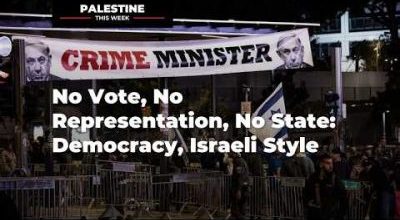
No Vote, No Representation, No State: Democracy, Israeli Style
or go to
Aletho News Archives – Video-Images
From the Archives
Sanctions, War and the Policy of Dual Containment
By SASAN FAYAZMANESH | March 17, 2008
It is now nearly three decades since the Unites States adopted the policy of dual containment of Iran and Iraq. While much has been written about the containment of Iraq, there has been very little in-depth analysis of this policy when it comes to Iran. In a book that is going to be released on March 31, 2008, entitled The United States and Iran: Sanctions, Wars and the Policy of Dual Containment (Routledge), I attempt to address this shortcoming by investigating when and why the US policy of containment of Iran came about, how it evolved, and where it stands today.[1] To the extent that Israel has been involved in US policy making, the study will also include the role that Israel has played in the containment of Iran. Also, since the fate of Iran has been inextricably linked to that of Iraq, occasionally the investigation will overlap with the containment of Iraq.
The policy of dual containment of Iran and Iraq originated during the Carter Administration, but it was not until the Clinton Administration that the expression “dual containment” became popular. … continue
Blog Roll
 Aletho News
- No Vote, No Representation, No State: Democracy, Israeli Style
- Zionist Bought Senate Blocks Information About American Citizens Killed By Israel
- While Gaza dominates the UN, these are the people keeping it alive
- New Report: “Scholasticide and Genocide in Gaza: Assessment, Testimonies and Legal Analysis”
- ‘THAAD Delusion’: Iran war exposes US missile shield limits – The Atlantic
- Moscow issues warning to NATO over Russian exclave
- Yes, the Iran war has destroyed Trump’s presidency
- The fallacy of US delusions about Iran’s economic collapse
- Hezbollah denies Syria cell link, warns of Israeli plan to sow discord
- The legacy of US sanctions, war, and occupation in Iraq
- If Americans Knew
- Mamdani releases plan to combat antisemitism and hate crimes in New York City
- Iran’s Revolutionary Guards Publish Letter to the American People
- DMFI launches $1 million ad campaign supporting Virginia’s Elaine Luria
- US Senate blocks resolution seeking report on Americans killed by Israel
- Israeli Attacks Kill Ten Palestinians in Gaza
- Massacre at Minab: The School That Became a Grave
- Israeli media: The IDF Shows It Doesn’t Turn a Blind Eye; It Actively Emboldens Settler Havoc
- As settlers ravage West Bank, Israeli forces kill 10 in Gaza – Daily Update
- New Report: “Scholasticide and Genocide in Gaza: Assessment, Testimonies and Legal Analysis”
- Ex-Biden officials are desperate for a Gaza scapegoat
- No Tricks Zone
- Green Energy Debacle: German Expert Professor Fritz Vahrenholt Warns Of Severe Economic And Social Consequences
- Two More Paleo Reconstructions Affirm Meters-Higher Sea Levels Across Ireland, Brazil 7000-6000 Years Ago
- New Study: Earth And Venus Surface Warmth Largely Explained By Convection And Lapse Rate, Not CO2 Or Radiation
- 2025 Nature Paper Claiming Worsening Global Drought Gets RETRACTED …Heavily Flawed
- New Study: ‘Global Drought Shows No Detectable Recent Acceleration Under Climate Warming’
- Economic Masterminds: German Socialists Suggest Taxing Productivity Gains Stemming From Using AI
- The South China Sea Has Not Been Cooperating With The Climate Change Narrative
- Energy Crisis: Germany Enters Heating Season With Historically Low Gas Reserve Fill Levels
- New Study: The Antarctic Ice Sheet Gained Mass From 2020-2024 Due To Staggering Snow And Ice Accumulation
- Study: Ocean Heating Rates From Thousands Of Years Ago ‘Dwarf’ Modern Ocean Heating Rates

