Climate Lockdowns Are Coming: Part II
What About the Roads | October 16, 2020
In this three-part series we will exam the transformation from COVID lockdowns to climate lockdowns. In Part I we established a timeline of the dark side of the environmental movement and now we’ll be looking into the specifics of what a climate lockdown really means, and what impact current lockdown measures have had on the environment. In Part III we will see how it fits into the bigger picture of sustainable development as described by international organizations such as the United Nations and what can be done to derail this agenda.

As we saw in Part I of this series, the environmental movement has a dark streak running through it. Many of the architects of the movement hold a Malthusian, eugenics-obsessed view of the world and their fingerprints are all over the growing call for a global climate lockdown. A movement based on the best of intentions is once again being hijacked to centralize power and eviscerate human rights.
With that established it is time to closely examine what exactly Mariana Mazzucato is proposing when she threatens a climate lockdown. In her view, and those on whose behalf she writes, humanity must be willing to undergo a total restructuring of society at the hands of the elite in order to save the planet or continue to live in lockdown. The brave new world she envisions is a sort-of technocracy, a government based on the management of society by unelected technical experts. Ultimately, this vision is less about driving electric cars and switching to a plant-based diet and more about a hostile takeover of the world’s resources.
The Calls for A Climate Lockdown Begin
With Mazzucato’s questionable climate science already addressed it’s time to move on to investigating her criticisms of society as we know it. But first we need to understand where this message is coming from. Mazzucato’s story comes to us from Project Syndicate, a news organization which distributes “high-quality commentaries to a global audience.” The publishing of these commentaries is made possible by funding from George Soros’ Open Society Foundation, The Bill & Melinda Gates Foundation, the Mastercard Foundation, and the Google Digital News Initiative among others. Let’s just say her view doesn’t exactly represent the disenfranchised or any grassroots movement.
Mazzucato’s opinion piece is more of a threat than anything else. She believes we are living through a series of crises during the “disease of the Anthropocene,” an anti-human echo from her environmental forefathers, that center around the climate, economic and social inequality, and public health. Neither government nor the private sector are capable of addressing such catastrophic situations in her estimation so we must undergo a “green economic transformation” or else be locked down like prisoners until the problem is resolved.
What she has to say on what would happen during a climate lockdown itself is actually quite brief:
Under a “climate lockdown,” governments would limit private-vehicle use, ban consumption of red meat, and impose extreme energy-saving measures, while fossil-fuel companies would have to stop drilling. To avoid such a scenario, we must overhaul our economic structures and do capitalism differently.
The brevity of this proclamation is curious as these propositions for reducing carbon emissions and “going green” are nothing new. Environmentalists have been advocating for these changes for decades now, though notably without the need for literally confining people to their homes. The bulk of the article is dedicated to the overhaul of the economy, revealing her true message to the masses.
The Future In Her Eyes
This transformation entails building whatever an “inclusive, sustainable” economy is and requires that government assistance to the private sector be reigned in. Not by stopping the public-private revolving door, upholding justice through the legal system, enabling a free market, or simply ending taxpayer bailouts, but continuing all of these practices so long as the government attaches strict conditions to how that money is used. Governments should also add new taxes on raw materials and legislate “job guarantees” into existence somehow. Under this system the political and economical elite still siphon off money from the lower classes, but by dictating that “firms need to listen to trade unions and workers’ collectives, community groups, consumer advocates, and others” this fascist system will solve the problem of inclusivity.
The state must also continue to steer the course of finance through investments. When the financial crisis hit in 2008 it wasn’t the cozy relationship between Washington and Wall Street that kept money circulating through the financial sector rather than entering the larger economy, but “bad investments” on the government’s part. Bad because they didn’t invest long term in eco-friendly energy like wind power or support green infrastructure projects according to her. She gives no explanation as to how these investments would allow money to flow into Main Street.
When looking for positive examples of state investments she cites New Zealand’s “Wellbeing Budget” and the Scottish National Investment Bank (SNIB). The Wellbeing Budget is the name given to the New Zealand federal government’s fiscal budget for the year 2019 and represented a shift away from making monetary decisions based on GDP and towards spending based on “wellbeing”. It made for an excellent public relations move which portrayed a government concerned about the wellness of its people but in reality transferred many budgetary decisions to experts and bureaucrats rather than elected officials, a hallmark of a technocratic society. New Zealand has enacted one of the world’s harshest lockdowns in the name of the coronavirus which may be why it gets a nod here.
The SNIB is set to launch by the end of 2020 and while she doesn’t mention it in her article, Mazzacuto has played a key role in developing this institution. This state-owned institution will offer grants, soft loans, credit guarantees and co-investments to companies in pursuit of certain missions. These missions are still being finalized but aim to mimic the United Nations Sustainable Development Goals which center around climate change, shifting demographics, and economic inclusion. Like New Zealand’s Wellbeing Budget, the SNIB framework ultimately takes power out of the hands of the public and into the hands of a technocratic elite. The figures who will run the SNIB and direct it’s funds will be unelected and unaccountable to the public but will use taxpayer funds to steer the direction of the economy nonetheless.
These examples are the blueprints all nations should be using according to Mazzucato. In a follow-up interview with the Irish Times, she makes it unambiguously clear that central economic planning is the proper role of government:
This crisis, and the recovery we need, give us an opportunity to understand and explore how to do capitalism differently. This requires a rethink of what governments are for: rather than simply fixing market failures when they arise, they should move towards actively shaping and creating markets to take on society’s most pressing challenges… This will secure the direction of travel we want – green, sustainable, and equitable.
Given her connections to some of the world’s most powerful people it is highly unlikely that “we” refers to the common man. It seems clear that she is speaking on the behalf of the elite behind the scenes.
Mazzucato’s final claim, dropped out of nowhere and without citation or follow-up, is that an economy centered around renewable energy is the antidote to our otherwise disastrous future. She then menacingly reminds the reader that “radical change is inevitable,” so either go along with their plan, or face climate lockdowns while they do it anyway.
How Have Lockdowns Impacted The Climate So Far?
With much of the world under house arrest, carbon dioxide emissions declined in the first half of 2020 as one would expect. Correspondingly, air pollution dropped off in many industrialized areas. This was touted as a victory for the climate, especially when photos of the Himalayas, free of their usual smog in India, went viral. This was a relatively short-lived victory however as numbers began rising again in the second half of the year.
While air pollution dropped more plastic waste has ended up in our oceans than ever before. Disposable face masks have been worn, and disposed of, in the billions this year and are contributing to environmental degradation, littering in public places, and increasing the levels of microplastics in the oceans. Takeout dining has been a staple for many during lockdown which has meant single-use plastics have become more prevalent and sadly ended up in in the sea in increased numbers as well.
More studies and information will surely come out in the months and years ahead but as of now this is the picture we have of the climate in a locked down world and it isn’t very convincing that by continuing these practices the world will be free of man’s impact on it. The desire for clear skies, clean air, and habitable oceans are all noble and improvements can and will be made but the idea that in order to achieve these things we need society reshaped at the hands of a shadowy elite is still insane and speaks to a larger agenda at play.
The Big Picture
When looking into the environmental impact of lockdowns there is a chilling refrain in the mainstream media. The initial decrease in emissions is cheered on but the rebound is seen as a sign that while the current lockdowns are doing some good it just isn’t enough (see here, here, here, here, here, and here to see that message repeated).
What is needed according to these writers and groups is a reengineering of society. This Great Reset will come at the expense of the many, to the benefit of the few. In the final installment of this series we will see how climate lockdowns and the reconfiguration of society fits perfectly into the big picture that the elite have in mind.
There Are Liars, Damn Liars And The United Nations
By Dr. John Happs | PA Pundits | December 16, 2020
When it comes to telling whoppers about climate change, weather extremes and any number of climate-related catastrophes, the United Nations has no equal. Their latest (2020) report proves this beyond any doubt.
Recently released is the UN’s report, dramatically titled: Human Cost of Disasters: An Overview of the Last 20 Years (2000-2019). This report stems from the United Nations Office for Disaster Risk Reduction (UNDRR) and its Centre for Research on the Epidemiology of Disasters (CRED).
The report Foreword tells us that:
“This report focuses primarily on the staggering rise in climate-related disasters over the last twenty years.”
This is followed by the not unexpected attack on developed nations:
“But the odds continue to be stacked against them in particular by industrial nations that are failing miserably on reducing greenhouse gas emissions to levels commensurate with the desired goal of keeping global warming at 1.5 ̊C as set out in the Paris Agreement.”
The hyperbole continued:
“It is baffling that we willingly and knowingly continue to sow the seeds of our own destruction, despite the science and evidence that we are turning our only home into an uninhabitable hell for millions of people.”
Any reader of this report will immediately see this is not a dispassionate, empirically-based document prepared by scientists who have carefully scrutinized the available literature on natural disasters. Rather it is the product of activists and alarmists, using hyperbole and silly phrases such as: “staggering rise in climate-related disasters”; “failing miserably on reducing greenhouse gas emissions” and “turning our only home into an uninhabitable hell.”
Apparently, the UN’s version of “the science and evidence” is not the same as the version embraced by the wider and more credible scientific community.
As always, the UN’s extreme alarmism is accompanied by the anticipated “tipping point” and “Last Chance” to avoid those “disastrous consequences” that simply never happen.
Here is a typical example:
“If we do not change course by 2020, we risk missing the point where we can avoid runaway climate change, with disastrous consequences for people and all the natural systems that sustain us.”
Anyone reading this UN report would do well to compare it with NOAA’s Dr. David Legates’s summary of the many failed predictions from climate alarmists.
In yet another tedious attempt to link carbon dioxide emissions with imaginary global warming and any natural disaster, we are told:
“This is clear evidence that in a world where the global average temperature in 2019 was 1.1oC above the pre-industrial period, the impacts are being felt in the increased frequency of extreme weather events including heatwaves, droughts, flooding, winter storms, hurricanes and wildfires.”
This should be enough for any sensible person to dismiss the report as more UN propaganda from officials who rely on the likelihood that few politicians will check their claims against actual data. The same UN officials know that the media, many politicians and Green NGO’s will continue to promote this alarmist nonsense.
The UN seriously expects everyone to believe that:
- We actually know what the pre-industrial global temperature was;
- We were able to measure the pre-industrial global temperature to an accuracy of 0.1oC;
- We have accurate records of global natural disasters over the last several centuries;
- Everyone will embrace the climate alarm nonsense that has been served up by the UN since 1988.
Incredibly, the UN produced a graph in 2020 that showed how climate-related disasters have actually declined:
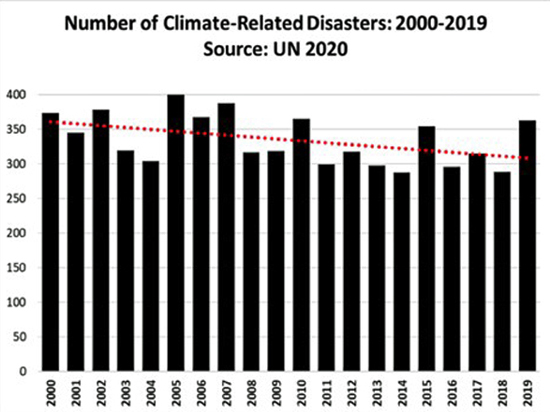
Yet the UN’s latest report tells us there has been a “staggering rise in climate-related disasters.”
Director of the Global Warming Policy Forum (GWPF) Dr. Benny Peiser has observed how:
“The UNDRR’s own data shows that climate-related disasters have actually been declining for 20 years.”
He added:
“The United Nations must immediately withdraw this report and apologize for misleading the public.”
I doubt there is much chance of that happening.
Dr. Roger Pielke Jr. is a well-respected scientist and recognised expert on natural disasters. He has criticised the UN report, saying that its data on disasters from the last century are flawed and therefore unreliable.
Pielke, along with other reputable scientists, has acknowledged that there has been an increase in financial loss due to natural disasters but this is not attributable to any increase in extreme weather events. Common sense (and insurance companies) should tell us we are seeing an increase in population with more people having more wealth and more assets to lose.
Additionally, financial losses due to natural disasters will inevitably increase as more people with more wealth and assets choose to live in accident-prone areas such as bushland, floodplains, earthquake-prone areas, eroding and subsiding coastlines.
Despite this increase in financial loss, Dr. Bjorn Lomborg points out:
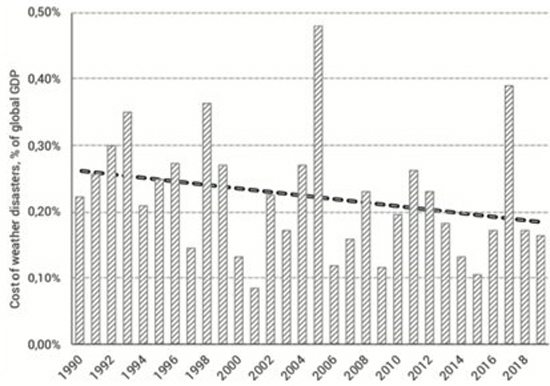
“When you adjust damage costs for size of economy, which even the UN Sustainable Development Goals insists you should, the relative cost of disasters is declining, not increasing.”
We have reliable data from the last 30 years showing how the relative cost of disasters has declined:
Additionally, the UN’s own data show the number of deaths from natural disasters has almost halved in the last 20 years, compared to the number of deaths between 1980 and 1999:
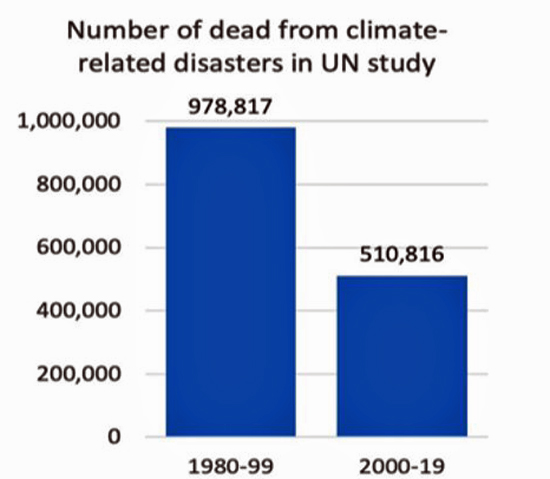
In fact the global population has increased by more than 70% since 1980 whilst the death risk has fallen by around 60%.
Returning to the UN report’s dramatic and factually incorrect statement:
“This is clear evidence that in a world where the global average temperature in 2019 was 1.1oC above the pre-industrial period, the impacts are being felt in the increased frequency of extreme weather events including heatwaves, droughts, flooding, winter storms, hurricanes and wildfires.”
This is sheer nonsense. So what do the real data show?
During recent decades, heatwaves in the US remain far less frequent and severe than was the case during the 1930s.
Here is the Annual Heat Wave Index for the USA (1895 – 2015)
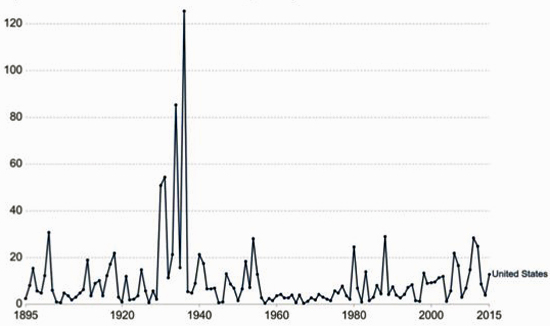
Source: National Oceanic and Atmospheric Administration (NOAA)
Cold-related mortality remains a more significant and persistent problem, both in the UK and internationally. There are 20 times as many cold-related deaths as heat-related deaths worldwide, and the UK has had 35,000 cold-related deaths a year on average over the past 5 years.7
Gasparrini et al. (2015) in a study into Mortality risk attributable to high and low ambient temperatures concluded:
“Most of the temperature-related mortality burden was attributable to the contribution of cold.”
Many of those deaths are attributable to people who have not been able to afford the rising costs of electricity or have no access to inexpensive, reliable electricity in their countries.
The UN report, with its obsession over imaginary dramatic global warming, ignores temperature data from satellites and radio-sondes. The UN also ignores reliable surface temperature data and paleo-data that contradict the report’s alarmism.
For instance, Rydval et al. (2017) constructed an 800 year paleo-temperature record for Scotland, showing no unusual recent warming:
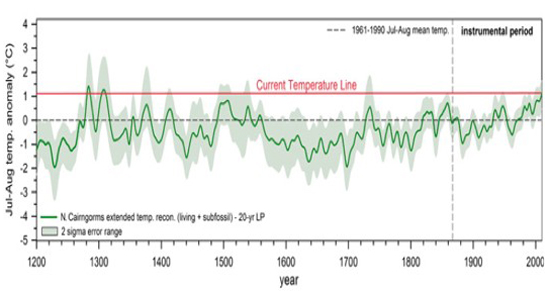
https://research-repository.st-andrews.ac.uk/handle/10023/10093
Studies of past global temperature estimates show there is no evidence for any change in the globally-averaged near-surface temperature over the last 100 years.
There are over 90 peer-reviewed, published papers that dispute any claims of unprecedented global-scale modern warming.
In summary, there has been no detectable long-term increase in heat waves in the US or anywhere else in the world. Record high temperatures were recorded long before the widespread use of hydrocarbon fuels.
The UN report claims that we are seeing an increased frequency of droughts. This claim is also without any empirical foundation.
The Palmer Drought Index for the US has data going back over 100 years:
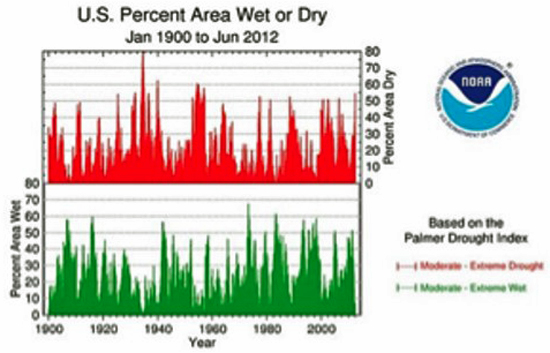
Apart from the 1930’s “Dust Bowl” years, there is no long-term trend in either dryness or wetness in the US and this remains true globally.
Cook et al. (2015) found that Mega-droughts during the past 2,000 years were worse and lasted longer than current droughts and data from the National Oceanic and Atmospheric Administration (NOAA) show no trend in the proportion of the globe in drought since 1950:
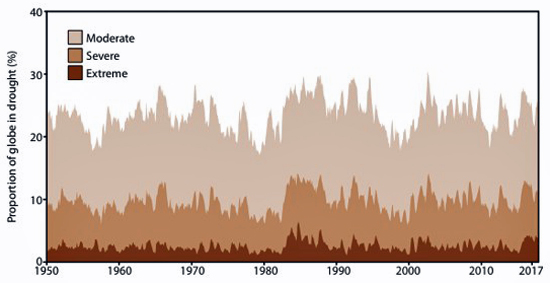
The UN report claims that we are seeing an increased frequency of flooding. This claim is also without foundation.
Dr. Roger Pielke Jr. observed:
“The good news is U.S. flood damage is sharply down over 70 years. Remember, disasters can happen any time…. But it is also good to understand long-term trends based on data, not hype.”

The UN’s current report contradicts the IPCC’s earlier report in which Hartmann et al. (2013) concluded:
“The Intergovernmental Panel on Climate Change (IPCC) concluded that globally there is no clear and widespread evidence of changes in flood magnitude or frequency in observed flood records.”
Hartmann et al. (2013) added:
“The results of this study, for North America and Europe, provide a firmer foundation and support the conclusion of the IPCC that compelling evidence for increased flooding at a global scale is lacking.”
Hirsch and Ryberg (2012) noted that, in none of the four regions defined in their study, was there strong statistical evidence for flood magnitudes increasing with increasing carbon dioxide levels.
https://www.tandfonline.com/doi/full/10.1080/02626667.2011.621895 The UN report said we are seeing an increased frequency of hurricanes. This claim is also without foundation.
Drs. Loehle and Staehling (2020) noted:
“We analysed the historical record of Atlantic basin and US landfalling hurricanes, as well as US continental accumulated cyclone energy to evaluate issues related to trend detection.”
They reported:
“Hurricane and major hurricane landfall counts exhibited no significant overall trend over 167 years of available data, nor did accumulated cyclone energy over the continental USA over 119 years of available data.”
https://www.thegwpf.com/no-trend-in-hurricane-activity-in-167-years-new-empirical-study-shows/
This is in agreement with findings from Drs. Pielke, Maue and Weinkle who reported:
“The analysis does not indicate significant long-period global or individual basin trends in the frequency or intensity of landfalling TC’s of minor or major hurricane strength. The evidence in this study provides strong support for the conclusion that increasing damage around the world during the past several decades can be explained entirely by increasing wealth in locations prone to TC landfalls, which adds confidence to the fidelity of economic normalization analyses.”
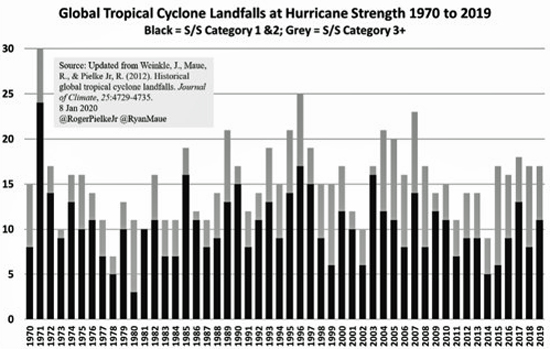
https://notrickszone.com/2020/01/10/distinguished-professor-time-to-retire-the-notion-hurricanes-are-slowing-down-much-less-attribution-claims/
Dr. Judith Curry points out that:
“Ever since Hurricane Katrina in 2005, any hurricane causing catastrophic damage has been seized upon by climate alarmists as evidence of the horrors of global warming.
As if the record-holding hurricanes from the 1920’s through the 1950’s never happened.”
She added:
“I used to be concerned about ‘consensus enforcement’ on the topic of climate change. Now I am concerned about ‘alarmism enforcement.”
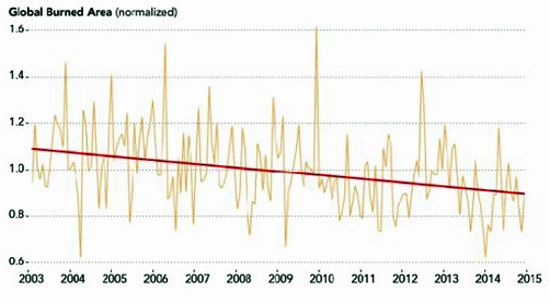
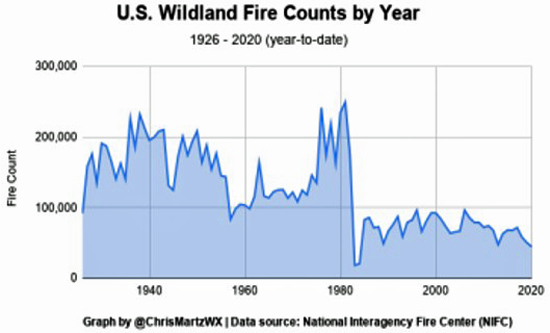
The UN report says we are seeing an increased frequency of wildfires. This is also without foundation.
Long-term satellite monitoring provides reliable data on global wildfires and, in contrast to UN alarmism, NASA has shown that between 2003 and 2019 global wildfires have declined by around 25%.
https://wattsupwiththat.com/2020/09/16/irrefutable-nasa-data-global-wildfire-down-by-25-percent/
NASA has produced maps with fire locations and extent. These are based on observations from NASA’s Moderate Resolution Imaging Spectroradiometer (MODIS) carried on the Terra satellite.
The National Interagency Fire Centre (NIFC) has provided data that support MODIS observations:
 The UN promotes alarmist political/ideological nonsense about natural disasters and the need to reduce carbon dioxide emissions. The UN’s obsession with “reducing greenhouse gas emissions” begs the question:
Why do we need to reduce emissions when current levels are amongst the lowest in 500 million years and all life on the planet would benefit from more atmospheric carbon dioxide?
Another question might be:
How do we know when the UN is telling lies?
Answer: Usually when they release a report about climate change.
Dr. John Happs M.Sc.1st Class; D.Phil. John has an academic background in the geosciences with special interests in climate, and paleoclimate. He has been a science educator at several universities in Australia and overseas and was President of the Western Australian Skeptics for 25 years.
Dream of Greater Europe dies: German efforts to create a Europe without Russia forged a Europe against Russia
By Glenn Diesen | RT | December 21, 2020
German-Russian friendship is over with ‘Ostpolitik’ dead and buried. Future relations will largely be based on confrontation, as Moscow no longer cares what Berlin thinks and Germany has lost its unique leverage with Russia.
Many observers believe the United Nations Security Council (UNSC) needs an overhaul. With countries such as Brazil, Germany, India and even Japan suggested as potential permanent members. Reaction to Berlin’s recent two-year stint on the body suggests the present five (China, France, Russia, the UK and the US) will be keeping the gate locked for a while.
Instead of the customary pleasantries and recognition for Germany’s contributions on its way out, Russia and China scolded the German Permanent Representative to the United Nations Christoph Heusgen. Russian Deputy Permanent Representative Dmitri Polyansky lambasted Germany’s “hypocritical behavior” and in no uncertain terms stated that “we will not miss you.” China also denounced Germany for its behavior and asserted Germany’s path toward a permanent seat at the UNSC “will be difficult.”
Disputes over Syria
The heated rhetoric derived primarily from Germany’s criticism of Russia and China over developments in Syria. For Heusgen, the fault for the crisis in Syria was simple: “Russia has been undermining the OPCW” by questioning its findings and supporting the Syrian government. Complex geopolitical rivalries in a strategic region are clothed in the language of values as liberal democracies versus authoritarians.
Since 2006, it has been widely reported and confirmed that the US has been preparing proxies in Syria for regime change. Since the fighting erupted in 2011, Western states have violated international law by funding and training militant groups and directly attacking Syrian targets.
Leaks from the Organization for the Prohibition of Chemical Weapons (OPCW) indicate that findings were deliberately misrepresented, and the chief of cabinet at the OPCW ordered officials to “remove all traces” of documents that found the gas cylinders in Douma had been planted there. The US, UK and France, blocked the testimony of Jose Bustani, the first director-general of the OPCW, who accused Washington of high-jacking the institution to control the narrative.
Russia’s denunciation of Germany’s role in the UNSC represents a wider rejection of Berlin’s self-professed moral authority. The post-Cold War era of liberal hegemony is increasingly seen by Moscow as an era of political radicalism. The West professed that its global hegemony would advance liberal values, yet Moscow perceives that liberal values have been used to assert global hegemony.
The West is accused of developing security strategies based on dominance rather than multilateralism, while relentlessly expanding a military bloc, invading and destroying other countries with increasing frequency, and pursuing coups – all the while claiming moral authority as defenders of human rights, democracy and peace.
The German-Russian split: Redefining Ostpolitik
The German-Russian relationship has historically swung between partnership and competition. In 1917, James Fairgrieve described Eastern Europe as a “crush zone” due to the power competition between Germany and Russia. Third parties such as the UK and US have historically defined their security interest as maintaining this division in Europe, as a German-Russian partnership would shift the balance of power on the continent and possibly become a threat.
Even today, the likes of ‘Stratfor’ founder George Friedman assert that the primary foreign policy goal of the US is to prevent any sort of alliance between Moscow and Berlin, because of the fear that it would offer a desirable alternative to US hegemony.
Willy Brandt’s Ostpolitik during the Cold War sought to normalize relations with the Soviet Union and its East European satellites. Moscow interpreted this as a German effort to resolve the historical zero-sum rivalry in Eastern Europe as opposed to merely regaining a foothold in Soviet satellite states. From Gorbachev’s aspiration of a Common European Home to the post-Cold War aspirations of a Greater Europe, Moscow recognized a partnership with Germany was necessary to unify the continent.
Today, Germany interprets Ostpolitik as leadership in Eastern Europe, which depends on pushing Russia out of Europe. German Foreign Minister Heiko Maas announced this month the legacy of Ostpolitik: “Unlike Brandt, we no longer have to go via Moscow to talk to our eastern neighbours nowadays. Many partners in Eastern and Central Europe now view Russia very critically – and German foreign policy must take our neighbours’ concerns seriously. In addition to offers of dialogue, clear German positions vis-à-vis Moscow are therefore important for maintaining trust in Eastern Europe.”
Fairgrieve’s “crush zone” description of German-Russian relations remains, although expressed in Berlin’s value-based “Euro-speak.”
From Greater Europe to Greater Eurasia
Berlin’s efforts to create a Europe without Russia unavoidably became a Europe against Russia. The German-supported unconstitutional coup against Ukraine’s democratically elected government in 2014, or “democratic revolution” as Berlin frames it, resulted in the death of Moscow’s Greater Europe initiative.
While the West condemned Russia for how it reacted to the Maidan, less focus was devoted to the sense of betrayal in Moscow. The remaining Russian illusions of gradual integration into a Greater Europe collapsed as the EU compelled Ukraine to choose between East and West. Subsequently, the nature and utility of the special partnership with Germany also ended.
The German-Russian partnership for Greater Europe was replaced with the Chinese-Russian partnership for Greater Eurasia. Russia has been busy the past years diversifying its economy away from Germany and toward China and Asia. The growing success of the Greater Eurasia initiative is largely the result of Russian-Chinese efforts to harmonise interests in their shared regions, which is contrasted with German efforts to “peel away” Russia’s neighbours – or “European integration” as Berlin frames it.
German-Russian relations in the age of Greater Eurasia
Under the Greater Europe initiative, Russia implicitly accepted German interference in its domestic affairs. As the eternal aspirant aiming to be included in Europe based on common values manifested itself in a subject-object or teacher-student organization of relations, Berlin was bestowed with the assumed moral authority to socialize or civilize Moscow in domestic and international affairs.
In the age of Greater Eurasia, relations between Russia and Germany are changing rapidly.
The emergence of a multipolar world implies pluralism of morals and values. Moscow is charting a distinctive conservative path and will no longer accept that liberal democratic universalism legitimizes sovereign inequality. Moscow subsequently rejects that its domestic politics is an issue for international discussion, and likewise dismisses Berlin’s effort to frame competing national interests in a Manichean prism as good versus bad values.
The unfriendly farewell by Moscow and Beijing as Germany exits the Security Council is a manifestation of a recalibrating relationship. Rather than attempting to reset relations, Moscow and Berlin should organize an amicable divorce and establish clear expectations toward each other.
Glenn Diesen is an Associate Professor at the University of South-Eastern Norway and an editor at the Russia in Global Affairs journal. Follow him on Twitter @glenndiesen
UN’s call for ‘climate emergency’ is an invitation to misery in developing countries
By Vijay Jayaraj – Global Warming Policy Forum – 14/12/20
A declaration of climate emergency (as per UN’s emission reduction requirements) will dent the developmental goals and increase energy prices. Besides, it will also result in the tax payers funded transition to a less reliable energy system, a recipe for a potential economic collapse.
A precursor to the 2021 COP26 meeting in the UK
Speaking at the Climate Ambition Summit to mark the 5th anniversary of the Paris Agreement, UN chief Antonio Guterres implored, “Today, I call on all leaders worldwide to declare a State of Climate Emergency in their countries until carbon neutrality is reached.”
He further clarified that,
We need meaningful cuts now to reduce global emissions by 45 per cent by 2030 compared with 2010 levels. This must be fully reflected in the revised and strengthened Nationally Determined Contributions that the Paris signatories are obliged to submit well before COP26 next year in Glasgow.”
UK Prime Minister Boris Johnson committed 11.6 billion pounds of UK’s overseas aid to support green technology. Pakistan’s prime minister Imran Khan pledged not to build any new coal plants in the country.
Support for the UN leader’s call also came from the Chinese President Xi Jinping. He said China will cut down carbon dioxide emissions per unit of GDP by over 65% by 2030, in comparison to 2005. Given its status as the leading coal consumer and empowerer of fossil fuel technology in other developing countries, it remains to be seen how President Xi will reconcile his 65% commitment with Beijing’s fossil ambitions and energy intensive industries.
Speaking at the same event (virtually), the Indian Prime Minister Narendra Modi said that India will reduce emission intensity by 21% in comparison to the 2005 levels. Earlier this year, Modi had indicated that the country is aiming to reduce its carbon footprint by 30% to 35% and increase the use of natural gas, without setting a deadline for the same.
Even as per its ambitious scenario to reduce emissions, India will not be able to achieve a 45 percent reduction in CO2 emissions compared to 2010 levels without compromising on its aggressive energy policy that has enabled the country to achieve an energy surplus in recent years.
Studies on the relationship between GDP and energy growth indicate that “It is very difficult to reconcile reductions in carbon dioxide emissions with continued economic growth, especially in poor and medium rich countries,” as most of the world’s primary energy comes from fossil fuels.
A call for 45 percent reduction in carbon dioxide emission will be suicidal for the energy sectors in the developing world, most of which depend on coal, oil, and Natural gas. 84% of the world’s primary energy comes from Fossil fuels (2019) and just 11% coming from Renewables. Though the share of fossil fuels in global energy consumption may appear to be reducing by a small margin each year, the absolute value of consumption keeps increasing each year.
Despite the rapid addition of renewable technology globally, the year-on-year change in primary energy consumption value for both renewable and fossil sources were almost the same in 2019, i.e., an increase consumption of around 960 TWh for both the sources. The actual fossil fuel consumption has technically increased and will continue to increase in future, as developing economies are wary of falling back into the dark ages of energy poverty.
Riding on the renewable energy myth
Developing nation’s precaution with green transition has a reason. Gueterres claimed that “Renewable energy is getting less expensive with every passing day.” But the claim is disputed, at least as per the current state of renewable technology, their backup mechanisms, and the evidence from the existing green grids.
Data from renewable energy dominated states like California and from countries like Germany and UK, show that excessive investment and dependency on renewable energy has actually resulted in increased electricity prices.
Renewable energy like wind and solar, which in many instances is installed with subsidies from taxpayer’s money, ends up charging the taxpayer more for their electricity use, thus technically costing the taxpayer not once but twice.
A ‘green’ Covid recovery will imperil developing countries
Gueterres insisted that, “the recovery from COVID-19 presents an opportunity to set our economies and societies on a green path in line with the 2030 Agenda for Sustainable Development.”
He is not alone in suggesting a marriage of COVID-19 recovery stimulus and green energy transition. The World Economic Forum’s Great Reset program suggests the same, with global leaders like Justin Trudeau already endorsing it.
Developing countries are unlikely to join this call for green transition, despite Xi’s tall pledges. India, for example, is likely to become the most populous country in the world by 2030 and it will have to risk millions of poor people falling back into the extreme poverty category if it were to amend its commitments to Paris agreement as per Gueterres’ suggestions.
With COVID-19 lockdowns adversely impacting the country’s economy (a negative growth in GDP and a long road to arrive at pre-COVID-19 levels), it is unlikely that the country’s leadership will commit to any significant CO2 reduction targets before the COP26 meetings in the UK.
India’s Economic Survey 2018-2019 categorically stated, “While there has been a tremendous increase in renewable energy capacity, fossil fuels, especially coal, would continue to remain an important source of energy.” The survey added, “Further, considering the intermittency of renewable power supply, unless sufficient technological breakthrough in energy storage happens in the near future, it is unlikely that thermal power can be easily replaced as the main source of energy for a growing economy such as India.”
This is likely the reason why Prime Minister Modi refused set a deadline for India’s proposed 30-35% reduction in emissions. India had recently doubled its mining exploration activity by implementing about 400 new projects. The mining sector is considered important to the country’s ambition to become a USD 5 Trillion economy. According to India’s Central Electricity Authority, 50% of India’s electricity generation in 2030 will continue to come from coal.
Does climate alarm justify extreme calls for energy transition?
Despite the heightened focus on emission reduction commitments, the elephant in the room has been the science used for justifying these emission reductions in first place.
During his speech, Gueterres asked “Can anybody still deny that we are facing a dramatic emergency?” Well he may be right! This is indeed a “dramatic” emergency, not a scientific one!
If we were to assess the key indicators that determine quality of life, it is evident that many of those metrics have improved drastically since the industrial revolution, despite the contrasting storyline portrayed in the mainstream media.
Life expectancy (age to which a new born baby is expected to survive), access to clean drinking water, access to affordable and reliable electricity, access to nutritious food at affordable prices, agricultural crop productivity per acre and farmer incomes are some of the key metrics that show us that the world has improved a lot, especially in the past 3 decades. We are not in a climate emergency!
The only reasoning provided for a future climate catastrophe is the temperature projections from computer climate models, collectively known as CMIP (Coupled Model Intercomparison Project). The UN uses the most recent versions of CMIP (5 & 6) to frame climate policy decisions and the mainstream media and academic institutions regard these models as the gold standard in climate forecasting.
The models are designed to forecast future temperatures, based on greenhouse gas emission scenarios. This is how the UN predicts future temperatures and the reason why Gueterres has called for an emission reduction. But the models are hypersensitive to emissions and thus have been faulty since inception.
Recent research has shown “that climate models overstate atmospheric warming”. The warming projected by these models have been found to be 4 to 5 times faster than the actual temperature observations on ground. Even if the developing nations refuse to commit to UN’s carbon neutrality initiative, there won’t be a significant impact on the climate.
So, the call by Gueterres is not only pseudo-scientific in its climate assumptions but also dependent on unreliable and unaffordable green energy. The call for emission reduction will be economically damaging and to a severe extent in the developing countries.
Moreover, it completely excludes the possibility of economies becoming stronger in the future, potentially making them more resilient, thus developed enough to adapt to climatic challenges. The prescribed reduction mechanisms and the war on fossil fuels could actually stifle their ability to mitigate and adapt to future temperature changes.
It will be interesting to see how Xi, Modi and others in developing world put their commitments into practice, and how it will impact the current energy forecasts which project an increasing reliance on fossil fuel in their respective economies.
UN calls for probe into Israel’s use of armed force against children

Palestine Information Center – December 2, 2020
RAMALLAH – The UN Human Rights Office of the High Commissioner has called for a transparent investigation into the use of armed force by Israeli soldiers against Palestinian children in the occupied West Bank.
The UN Human Rights Office said that the Israeli forces critically injured at least four children with live ammunition and rubber-coated metal bullets in separate incidents across the West Bank in the past two weeks.
“All injuries resulted from the use of potentially lethal force in circumstances where available information suggests the children did not pose a threat to life or serious injury of the soldiers or to anyone else.”
“It thus appears the force used was not in accordance with international law,” the Human Rights Office said in a statement, pointing out that a 16-year-old boy was shot in the chest and critically injured in al-Bireh city on November 29.
“On 27 November, during protests in Kafr Qaddum village in the north of the West Bank, soldiers shot a 16-year old boy in the head with a rubber-coated metal bullet. The boy fell from the impact and is hospitalized with a fractured skull.”
“On November 17, a 15-year old boy on his way back from school lost his right eye after being hit by ricochet ammunition in Qalandia refugee camp north of Jerusalem. Although there were clashes taking place between soldiers and residents of the camp, none of the available information suggests the boy would have posed a threat to anyone at the time he was shot,” the statement elaborated.
“UN Human Rights Office calls on Israel to promptly, transparently and independently investigate all instances of (Israeli army) use of force that have led to killing or injury and to hold those responsible accountable,” the statement said.
“In accordance with international law, use of lethal force is only allowed as a measure of last resort, in response to a threat to life or of serious injury. Stone-throwing does not appear to constitute such threat. In addition, force must always be used in a manner which causes the least possible harm. Shooting in the head or upper body does not appear to conform with this requirement.”
“Children enjoy special protection under international law and must be protected from violence at all times.”
UN General Assembly adopts five anti-Israeli resolutions
Press TV – December 3, 2020
The United Nations General Assembly (UNGA) has approved five anti-Israeli resolutions, which are part of a package of 20 pro-Palestinian texts that the 193-member body adopts on an annual basis.
One of the documents, passed on Wednesday, condemned Israeli sovereignty over the occupied Golan Heights — a territory the Tel Aviv regime seized from Syria in the 1967 Six Day War and annexed four years later — in a move that was never recognized by the world community.
Endorsed by 88-9 votes with 62 abstentions, the resolution urges Israel to withdraw from the “occupied Syrian Golan to the line of 4 June 1967 in implementation of the relevant Security Council resolutions.”
It also affirmed that Israel’s unilateral annexation of the Syrian territory in 1981 “constitutes a stumbling block in the way of achieving a just, comprehensive and lasting peace in the region.”
Over the past decades, Israel has built dozens of settlements in the Golan Heights in defiance of international calls for the regime to stop its construction activities on the occupied land.
Damascus has repeatedly reaffirmed its sovereignty over the Golan Heights, saying the area must be completely restored to its control.
In a major pro-Israel policy shift, US President Donald Trump signed an executive order in 2019 recognizing Israel’s control over occupied Golan in a blatant violation of international law.
The second resolution, entitled a “Peaceful Settlement of the Question of Palestine,” was approved 145-7, with nine abstentions.
It called on the Tel Aviv regime to withdraw from all territory over the pre-1967 lines in occupied East Jerusalem al-Quds, the West Bank and the Golan Heights.
The document also demanded a halt to Israel’s settlement construction activities, spoke of the illegality of annexation plans, and warned the occupying entity against making changes in East Jerusalem al-Quds.
It further took Israel to task for a wide range of actions against the Palestinian people, including the demolition of their homes in Area C of the West Bank.
The three remaining UNGA resolutions affirmed the work of UN Committees operating on behalf of the Palestinians.
Before the vote, Israel’s Ambassador to the UN Gilad Erdan chastised the General Assembly for not referencing the regime’s recent normalization deals with the United Arab Emirates (UAE) and Bahrain.
“Can this forum be any more detached from the real world?” he asked, claiming, “Instead of encouraging the Palestinians to see how these agreements can transform the region and be used as a catalyst for peace with Israel, this institution votes in favor of these biased resolutions.”
A Palestinian representative denounced Erdan’s “flip” and “offensive” comments, including one where he accused the UNGA of being detached from reality.
“On the contrary, what was discussed today in this debate is the reality. What was discussed today is not so-called ‘Palestinian talking points.’ These are the international talking points,” she said. “This is the international consensus that Israel, the occupying power, continues to object, obstruct, to deny, to belittle and to attempt futilely to destroy.”
The regime has gotten “accustomed to violating the law with zero consequences,” she added. “Only accountability can change this miserable situation and give hope for a future of justice and peace… The hypocritical and degrading claim by the Israeli representative that this institution’s approach has failed perhaps should highlight even more the need of concrete actions by states to implement the resolutions adopted by the UNGA to ensure accountability.”
She also stressed that the passage of the anti-Israel texts showed that support for the Palestinian people remained strong.
Before the General Assembly’s vote, a Jordanian representative, whose country is the custodian of the holy sites in Jerusalem al-Quds, said Israel must maintain the status quo at Haram al-Sharif or Temple Mount.
Israel is attempting to “impose a fait accompli on al-Aqsa mosque and Jerusalem,” he said, adding that the occupied city’s “holy sites will remain the focus of Jordanian care and guardianship.”
Jordan will “combat a new fait accompli or change the historic or legal status of the holy city especially at the al-Aqsa Mosque,” he emphasized.
Separately, Palestinian Ambassador to the UN Riyad Mansour asked the international community to hold Israel accountable for its violations of international law and stick to the so-called two-state solution to the Middle East conflict.
He also called for a boycott of Israeli settlement products and urged Western nations to recognize Palestinian statehood.
Palestinian PM calls for boycott of Israeli settlements
In another development on Wednesday, Palestinian Prime Minister Mohammed Shtayyeh urged donor countries and international organizations to take serious measures towards boycotting Israeli settlements.
He stressed that the status quo imposed by Israel is deteriorating as the Palestinian land is shrinking, the settlers’ violence is escalating, and access to resources is decreasing daily.
“Economic development is not separate from the political and national project. Rather, it is a lever towards ending the occupation and establishing the Palestinian state with Jerusalem as its capital,” he said, noting that the world must move to end this occupation because the current status quo cannot continue.
Iran envoy blasts Israel for violating Palestinians’ rights
Mohammad Reza Sahraei, counselor at Iran’s Mission to the UN, said the International Day of Solidarity with the Palestinian People provides an opportunity to “highlight the dire and painful situation endured by Palestinians over the course of decades as a result of the gross and systematic violation of their rights by the Israeli regime.”
“The question of Palestine is the longest-running crisis of our time with no foreseeable conclusion in sight…. In fact, the non-compliance of the occupying regime with relevant international laws and regulations has further prevented the international community from achieving a just and lasting solution to the crisis,” he said.
“After more than seven decades, the Israeli regime has continued to violate the fundamental human rights and dignities of the Palestinian people as well as other Arabs living under its occupation. As a result, Palestinians are not only deprived of their lands and properties while being forcibly evicted but also subjected to violence, terror, and intimidation,” the diplomat added.
U.S. to be Subject to UN “Climate Conciliation Commission” if Re-Joins Paris Climate Pact
By Chris Horner | Government Accountability and Oversight
Paris Climate ‘Accord’ FOIA Case: State Dept. Releases, Withholds Parts of Memo to Sec. John Kerry Requesting Authority to Sign Paris Agreement
It appears possible that, come January, the United States will rejoin the 2015 Paris climate agreement, committing to adopt the “Green New Deal” agenda (now rebranded for political purposes as “Net Zero”). This will not be accomplished by Senate ratification, but by the ‘pen and a phone’ approach first used by President Obama to claim U.S. “ratification” of what is on its face and by its history a treaty, requiring approval instead by a two-thirds Senate vote.
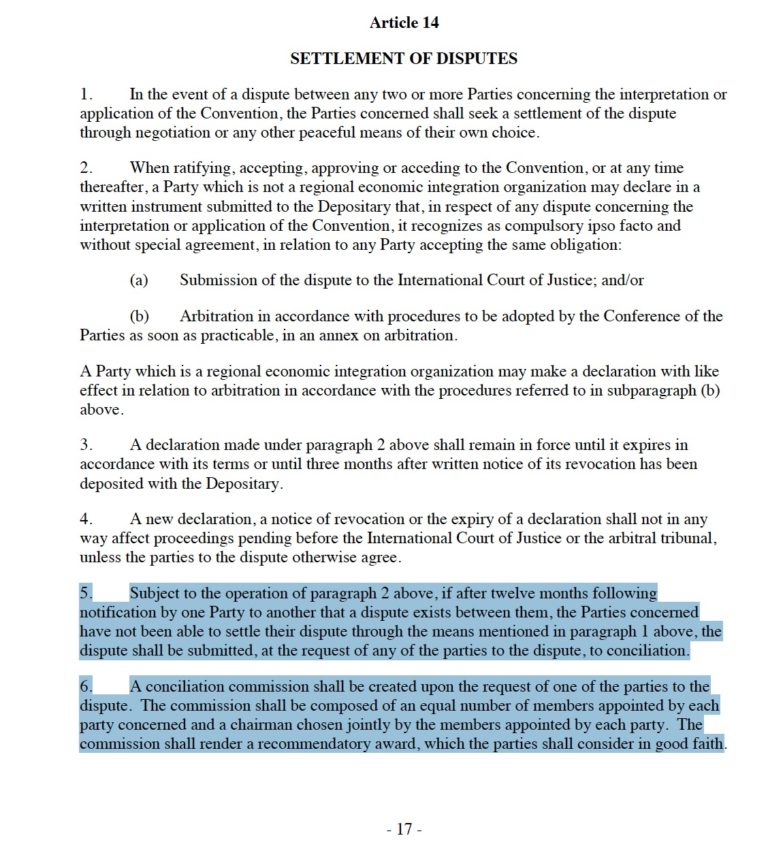
A document released last week by the State Department, in Freedom of Information Act litigation by the transparency group Energy Policy Advocates, includes a reminder of one consequence of this for America, should it occur: claiming to “re-join” the Paris climate treaty will immediately subject U.S. energy policy — and thereby economic and to some extent trade policy — to a UN “climate conciliation commission”.
Already, as the United Kingdom has shown, developed nations’ courts can be expected to cite the Paris climate treaty in blocking infrastructure development. The UK’s Court of Appeal ruled earlier this year that Heathrow Airport cannot be expanded because that would violate the UK’s ‘net zero’ commitment under Paris.
Then, Canada offered a reminder how progressive politicians will raise taxes in the name of complying with Paris: In Ottawa, “The parliamentary budget officer says the federal carbon tax would have to rise over the coming years if the country is to meet emission-reduction targets under the Paris climate accord.”
Now we are reminded that the U.S. can also expect a forum for antagonistic nations to bring their complaints about U.S. policy and claims of non-compliance with Paris’s required “Net Zero” agenda for resolution.
This might be one of the reasons that avoiding a Senate vote on Paris was a key objective of the Obama administration, which stated in August 2015 before there ever was even Paris text, that it would not be a “treaty”. This was the lesson learned from the U.S. Senate’s refusal to consider the 1997 Kyoto treaty: If the Senate votes on it, its details would be debated, and defeated.
That objective of an end-run around the U.S. Constitution’s process was shared by European nations: the French climate change ambassador to the U.N. and President of the Paris COP, Laurence Tubiana and Laurent Fabius, respectively, both openly admitted.
Yet, those same countries treated Paris as a treaty for their own ratification purposes. This cavalier approach to the Constitution in the Obama years makes it easy to forget the U.S. supposedly has the more stringent system for joining international entanglements.
Instead, the Obama team showed what one Senate Foreign Relations Committee lawyer decried as a “disturbing contempt for the Senate’s constitutional rights and responsibilities” by circumventing its constitutional treaty role on Paris. Unfortunately, the institution shrunk from a constitutional fight, and all parties spoke as if calling Paris an “accord” instead carried weight — though the the Kyoto Protocol was alternately called the “Kyoto Accord” and, yes, was still a treaty.
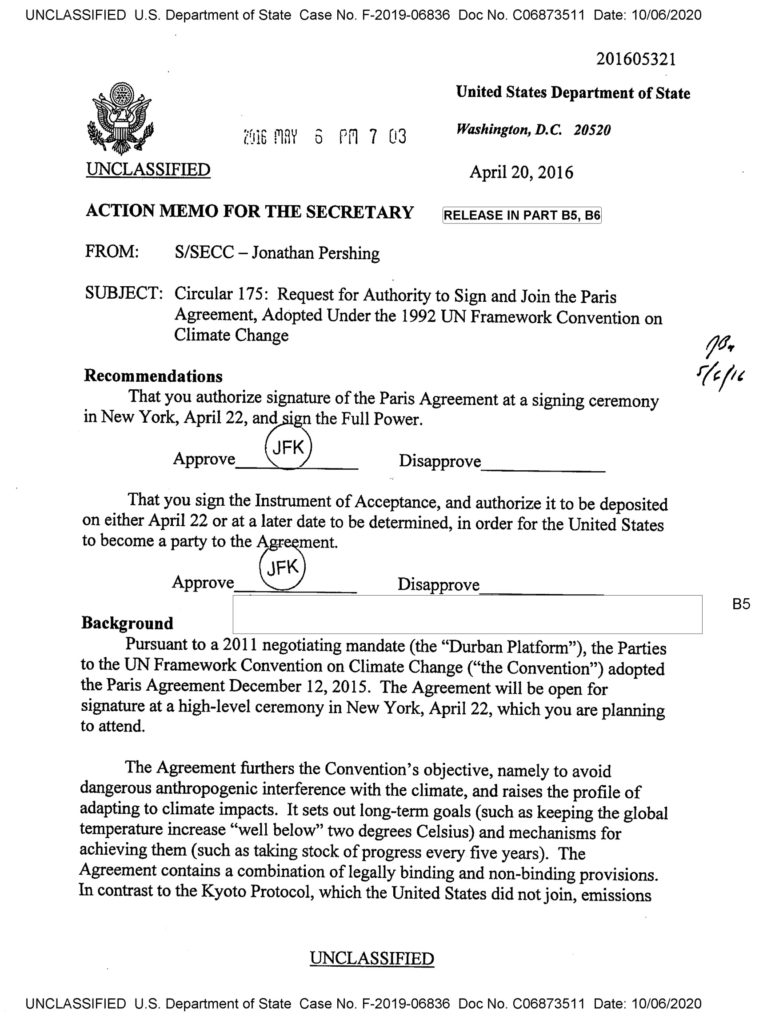
This brings us to the newly released (in part) memo — “Request for Authority to Sign and Join the Paris Agreement, Adopted under the 1992 UN Framework Convention on Climate Change” [UNFCCC] — reaffirming that Paris is the result of “a 2011 negotiating mandate (the “Durban Platform”)”. The Durban “mandate” was to “adopt…a protocol, another legal instrument or an agreed outcome with legal force at the twenty-first session of the Conference of the Parties and for it to come into effect and be implemented from 2020”.
That of course is Paris, the crushing provisions of which are found in Article 4, emission reduction promises. Art. 4.3 requires that the U.S. revisit and tighten its reduction promises every five years. That would cleverly make this the climate treaty…sorry, “accord”… to end all climate treaties. It commits the U.S. to ever greater “climate” policy restrictions, every five years, in perpetuity.
Pull this off and there will never be the threat again of facing the tyranny of the Constitution’s requirement of popular approval.
Political rhetoric aside, nothing in Paris’s terms says this provision is legally binding, but no that one over there isn’t. Instead, Paris was merely sold to and promoted by much of the press with the claim that Paris contains “a mix of legally binding and not legally binding provisions”.
As we have seen already in the UK/Heathrow Airport case, that did not last, as it was not intended to. Lawyers and courts have already begun to see to something of which Americans should be reminded, including that you can have promises of massive infrastructure spending, or you can have the Paris climate pact, but you can’t have them both.
And it won’t just be courts. Recall, first, that the Paris agreement as originally circulated contained a climate tribunal, or court. This was dropped after being noticed outside of polite circles. Nonetheless, the recently released if still heavily redacted memo reminds us that U.S. compliance with the legally binding here but maybe not over there Paris obligations is subject to the terms of that 1992 agreement, ratified by the U.S. Senate on the condition that it was and remained non-binding (again, stated nowhere in its terms).
UNFCCC declares, in Art. 14, “Settlement of Dispute”, that:
“5. … if after twelve months following notification by one Party to another that a dispute exists between them, the Parties concerned have not been able to settle their dispute through the means mentioned in paragraph 1 above, the dispute shall be submitted, at the request of any of the parties to the dispute, to conciliation.
6. A conciliation commission shall be created upon the request of one of the parties to the
dispute. The commission shall be composed of an equal number of members appointed by each party concerned and a chairman chosen jointly by the members appointed by each party. The commission shall render a recommendatory award, which the parties shall consider in good faith.”
This language governs U.S. compliance with the Paris climate “accord”. It is not open to dispute that any U.S. president who claims to “re-join” the Paris climate treaty will subject US energy policy — and thereby the U.S. economy — to a UN climate “conciliation commission”.
Paris requires, and mandates the U.S. revisit and tighten “Green New Deal”-style policies every five years. This is among the many reasons why the Paris climate agreement is a treaty, and also why it never would have been ratified. However, very soon, Americans may nonetheless be subject to its long-envisioned climate court.
UN Human Rights Council Passes Dual Venezuela Resolutions
One resolution extends UN cooperation and has Caracas’ consent, while the other extends a controversial Washington-backed mission.
By Paul Dobson | Venezuelanalysis | October 7, 2020
Mérida – The United Nations Human Rights Council (UNHRC) passed two resolutions concerning Venezuela on Tuesday.
The first was presented by Peru and endorsed by the right wing governments which make up the Lima Group. It granted a two year extension to a controversial fact finding mission which is investigating the human rights situation in the country. The resolution was passed by 22 votes in favour, three against (including Venezuela), and 22 abstentions.
Amongst those backing it was the center-left government of Argentina, which had previously called for non-intervention in Venezuela’s internal affairs. Influential figures and popular movements from Argentina have since condemned the vote, with the country’s ambassador to Moscow resigning on Wednesday in protest.
The UN’s fact finding mission was constituted one year ago by the UNHRC, with its members Marta Valinas (Portugal), Francisco Cox (Chile) and Paul Seils (UK) presenting their first report at the previous council session in September. The report accused the Caracas government of crimes against humanity through carrying out extrajudicial executions, forced disappearances, arbitrary detentions and torture.
The Maduro government rejected these accusations, and claimed the mission to be“politicised,” “lacking in scientific scrutiny” and that the report was “written from afar.” Days after the report was published, Venezuela presented a counter-report titled “The Truth about Venezuela,” while Attorney General Tarek William Saab also defended the country’s record in matters of human rights.
Hours after the first resolution was passed, a second one presented by Syria, Iran and Turkey was also approved with 14 votes in favour, seven against and 26 abstentions. The second resolution, which was backed by Venezuela, extends the functions of the Venezuela-based office of the UN high commissioner for human rights, as well as promising to “continue UN technical cooperation” with the government.
It also denounced the human rights consequences of Washington’s blockade against the Caribbean country and urged a “constructive dialogue and cooperation with the state” in order to “strengthen its capacity to fulfil its obligations in the matter of human rights,” specifically mentioning efforts to strengthen the judicial system in the country.
Following the two votes, Caracas strongly condemned the Lima Group resolution, vowing that it will “not recognise parallel and unnecessary mechanisms” which express a “cynical concern” for human rights. For his part, Venezuela’s permanent representative at the United Nations, Jorge Valero, added that the resolution “seeks the imposition of monitoring mechanisms which do not have the consent of my country nor my people.”
On the other hand, Caracas celebrated the passing of the Syria-Iran-Turkey resolution, with a Foreign Ministry statement explaining that the resolution “demonstrates the commitment of the Venezuelan state to maintaining dialogue and respectful and constructive cooperation with the office of the High Commissioner for Human Rights.” Foreign Minister Jorge Arreaza also backed the resolution personally, claiming that Venezuela’s commitment to human rights is “absolute.”
Following an inaugural visit to the country in July 2019, the office of the High Commissioner for Human Rights set up a permanent two-person office in Caracas.
Since, UN reps have been granted access to prisons and other sites, and have reportedly worked to strengthen the legal system and “the institutional mechanisms for human rights protection.”
Subsequently, a number of detained right wing activists have been released by the government, and authorities have hinted at a shakeup of the contentious FAES special police forces. The High Commissioner’s office has previously called for the FAES to be dissolved. The special forces have also been denounced by many Venezuelan popular movements and leftwing parties.
Russia slams ‘disgraceful’ ban on founding OPCW chief speaking at UN Security Council on Syria
RT | October 6, 2020
An ex-OPCW chief, sacked under US pressure, has been barred from briefing the UN Security Council about a controversial probe into an alleged 2018 chemical attack in Syria. Russia called it a “shame” and published his speech.
Jose Bustani, a Brazilian diplomat who led the Organization for the Prohibition of Chemical Weapons (OPCW) from 1997 until 2002, was invited by Moscow to speak at a UN Security Council meeting about the so-called “Syrian chemical dossier,” but his appearance was blocked at the last minute by Belgium, Germany, Estonia, France, the US and the UK.
“What has happened now is yet more sad proof that Western delegations fear the uncomfortable truth,” Russia’s ambassador to the UN, Vassily Nebenzia, stressed while addressing the UN global body on Monday.
He said the six countries had “made history” because the Security Council has never voted “on the presence or absence of a briefer proposed by the [UNSC] president.” Prohibiting the former OPCW director general from speaking was a “shame and disgrace,” Nebenzia concluded, promising to publish Bustani’s statement after the meeting.
UK envoy Jonathan Allen said that Bustani is not in a position to “provide relevant knowledge or information.”
Shortly afterwards, the undelivered speech appeared on the website of the Russian mission to the UN. In it, the sacked OPCW chief raised “serious questions” over “whether the independence, impartiality, and professionalism of some of the organization’s work is being severely compromised, possibly under pressure from some member states.”
As a major example, Bustani cited an OPCW investigation into the alleged use of chemical weapons in the Syrian city of Douma on April 7, 2018. Western governments, and media outlets, maintain that forces loyal to Damascus dropped two gas cylinders as part of an offensive against jihadist forces, killing scores of civilians.
The allegations were used as a pretext for a major US-led airstrike against Syrian government forces later that year. The OPCW launched a probe into the “chemical attack,” and in early March of 2019, the final report by the Fact-Finding Mission (FFM) of the OPCW stated that there were “reasonable grounds” to believe that canisters filled with “molecular chlorine” were dropped from Syrian aircraft in Douma.
The final report gave credence to the Western show of force by implicating the Syrian government of Bashar Assad in conducting the attack, which the Syrian authorities vehemently deny.
Shortly after the release of the OPCW report, an internal memo by OPCW engineers was leaked, suggesting the canisters were likely just placed at the site of the “attack,” and did not come from the skies. Still, the final report did not include such information, and a senior OPCW official reportedly ordered the removal of “all traces” of the dissenting opinion, according to WikiLeaks.
Months later, Bustani noted that he was invited to an expert panel which heard the testimony of an unnamed OPCW investigator, who came forward with damning evidence that his own organization had engineered a report based on a flawed conclusion and likely deliberately steered toward the outcome favored by the West.
That expert provided “compelling and documentary evidence of highly questionable, and potentially fraudulent conduct in the investigative process,” Bustani’s statement recalled. The Brazilian diplomat had been so stunned by the testimony that he personally called on the OPCW to be “resurrected to become the independent and non-discriminatory body it used to be.”
However, he continued, the chemical weapons watchdog did not respond to any calls for greater transparency about the controversial Douma investigation. The probe was “hidden behind an impenetrable wall of silence and opacity, making any meaningful dialogue impossible.”
In conclusion, Bustani called on Fernando Arias, the current OPCW chief, to hear the grievances of OPCW inspectors who voiced dissenting opinions on the Douma incident. They “have dared to speak out against possible irregular behavior in your organization,” Bustani argued, adding that it is “in the world’s interest that you hear them out.”
Bustani noted that he had been removed from his OPCW position “following a US-orchestrated campaign in 2002.” Back then, he was trying to send chemical weapons inspectors to Iraq prior to the 2003 US invasion there. A UN tribunal ruled that his sacking was unlawful.
UN Venezuela Report Omits US Human Rights Violations
By Leonardo Flores | MintPress News | October 2, 2020
On September 23, María Eugenia Russián, president of Fundalatin, Venezuela’s oldest human rights organization, testified to the UN Human Rights Council (UNHRC) and decried an attempt by a UNHRC fact-finding mission to erase people who were “lynched, burned alive, decapitated and murdered by extremist sectors of the Venezuelan opposition.” This fact-finding mission had published a report a week earlier that generated sensationalist headlines of “crimes against humanity” and painted a bleak picture of the situation in Venezuela.
However, the 400+ page report has been found to contain serious flaws and omissions, leading to charges that it politicizes human rights – a position backed by the Venezuelan government. But it’s not just Venezuela that has taken issue with the report: Argentina’s ambassador to the Organization of American States denounced it as “biased” and noted that “human rights are not an instrument for taking political positions.”
A parallel mission and attack on multilateralism
Moreover, even the formation of the fact-finding mission is suspect. Since 2017, Venezuela has been working with a different UN institution, the Office of the High Commissioner for Human Rights (OHCHR), to strengthen its capacity to guarantee human rights. This cooperation has led to technical agreements and to visits by the OHCHR to Venezuela.
Yet despite – or perhaps because – of this cooperation, the Lima Group, an ad hoc group of nations dedicated to regime change in Venezuela, maneuvered in the UN Human Rights Council to establish a parallel mission outside of the purview of the OHCHR. In the September 2019 debate prior to the founding of this mission, Russián said that it “seeks to thwart the advances between the Office of the High Commissioner and the Venezuelan state, hindering and duplicating its efforts.” She also made a prescient comment: “[the mission] will generate major headlines but will not contribute to resolving the situation.”
Several Venezuelan human rights organizations, including the Venezuelan Association of Jurists (AVJ), denounced the formation of the mission and the subsequent report as an attack on multilateralism. The AVJ notes that according to UN General Assembly Resolution 60/251, “the promotion and protection of human rights should be based on the principles of cooperation and genuine dialogue and aimed at strengthening the capacity of Member States.”
Neither of these principles were adhered to in the report, which means that the fact-finding mission violated the United Nation’s own guidelines. This contrasts severely with the latest update on Venezuela from the OHCHR, which notes that technical cooperation between Venezuela and the UN has led to progress in investigating 93 alleged cases of extrajudicial killings or excessive use of force, as well as the pardoning of 110 prisoners.
Flawed methodology, biased sources and egregious omissions
The first thing to note about the report is that the authors are all from countries that support Guaidó. One of them, Francisco Cox, has close ties to the Chilean Foreign Minister (Chile is one of the Latin American countries leading the charge against Venezuela). In an interview with journalist Anya Parampil, Chilean analyst Esteban Silva noted that Cox “is part of an operation against the government of Venezuela.”
Venezuelan human rights organization Sures considers that the report “lacks academic rigor” as the mission did not step foot in Venezuela “and as such never had direct access to the sources it consulted, including the victims, government officials and official records.” Lending credence to the claim of a lack of rigor is the fact that more than 50% of the report’s sources were links to social and digital media, while just 5% were NGOs.
Misión Verdad, an independent group of Venezuelan investigative journalists and analysts, wrote an exposé of the sources used in the report and found that one of these NGOs, COFAVIC (Committee of Relatives of Victims of the Caracazo), receives USAID funds and has ties to Human Rights Watch, which supports regime change and the brutal US sanctions. None of the NGOs the fact-finding mission contacted even mentioned the case of Orlando Figuera, a young Black man burned alive by anti-government protestors, which has arguably been the most infamous violation of human rights in Venezuela in recent years.
If the report were interested in balance, it would have cited or contacted Venezuelan human rights groups that document right-wing violence at protests and the devastating effects of U.S. sanctions. Five such organizations were contacted for this article: Fundalatin, AJV, Sures, Género con Clase (Gender with Class), and the Committee of Victims of the Guarimba and Ongoing Coup (guarimba is the term used for violent opposition protests in 2013, 2014 and 2017). None of them ever heard from the “independent” mission.
While victims like Figuera are ignored, another detailed critique by Misión Verdad documents the repeated “whitewashing” of political actors linked to violence by presenting them as victims. As analyst Joe Emersberger notes, the report’s treatment of opposition figure Leopoldo López ignores the leading role he has played in destabilizing Venezuela since 2002. López’s regime change strategy in 2014, ‘La Salida’, sparked opposition violence that resulted in the decapitation of Elvis Durán; he was riding a motorcycle down a street booby trapped by protestors with barbed wire. López’s name appears 61 times in the report; Durán’s does not appear at all.
As tragic as it is that a UN mission would engage in the erasure of victims of human rights violations perpetrated by government opponents, these are not even the most glaring omissions in the report. There are two ongoing mass violations of the human rights of all Venezuelans: the violent destabilization of the country by foreign and domestic actors, and the brutal U.S. sanctions. For Gisela Jiménez of Género con Clase, an organization that focuses on the rights of women and sexual diversity, currently the biggest challenge to the rights of Venezuelans is “the threat to the right to live in peace.” Russián of Fundalatin dates the biggest violation of human rights to March 2015, when then-President Obama characterized Venezuela as an “unusual and extraordinary threat” to the United States. Since then, she notes, ”the Venezuelan people have been subjected to violations of their right to health and even the right to life, due to the embargo and the obstruction of imports of medicine, food and supplies.”
The report in the context of a hybrid war
Beyond the bias and politicization of the report, what perhaps damns it most is how it is being used. The omissions on the impact of coups and sanctions enable regime change operatives such as Elliott Abrams, U.S. special representative for Iran and Venezuela, to cite the report as evidence of crimes against humanity while, in the same breath, threatening to cut off Venezuela’s diesel supplies, which has drawn widespread condemnation from NGOs across the political spectrum for the devastating effect it would have on the Venezuelan people.
The report was similarly used by Senators Marco Rubio and Ben Cardin, who referenced it in a letter to the European Union in which they expressed “deep concern” over EU talks with the Maduro government and urged the EU to not monitor Venezuela’s parliamentary elections. This blatant attempt at interfering in and attempting to delegitimize Venezuela’s elections went uncovered by mainstream media, which focused all of their attention on the UNHCR report.
Furthermore, the timing of the report was also suspect, coming just a week before the 2020 UN General Assembly. Its purpose in this regard is clear: to add fuel to the fire in Venezuela and to shift the spotlight from U.S. allies with their own human rights issues. The timely release allowed Colombian president Duque and Chilean president Piñera to cite it and Venezuela in their general assembly speeches. In Colombia, 64 massacres have taken place this year alone, while the Piñera government in Chile was almost brought down by his government’s excessive use of force against peaceful protestors. Yet it was Venezuelan opposition figure Juan Guaidó who made the headlines, invoking the report while calling on the international community to exercise its “responsibility to protect” in a YouTube webinar on the sidelines of the General Assembly. The responsibility to protect is a doctrine used as the justification for military aggressions against Libya and Syria, among others.
The fact-finding mission has produced a document that is currently being employed in the furtherance of sanctions, electoral interference and threats of war. To put it another way, the UNHCR report on the human rights of Venezuelans will likely lead to even more suffering for Venezuelans. In the words of Fundalatin President Russián, the threat to the human rights of Venezuelans “becomes graver because of the behavior by powerful states, who in the name of human rights, seek a foreign military intervention in Venezuela.”
Featured Video

Trita Parsi: Israel Set a Trap for Total War in the Region
or go to
Aletho News Archives – Video-Images
From the Archive
Zionism’s Violent Legacy
By Donald Neff | Washington Report On Middle East Affairs | January 1996
On January 4, 1948, Jewish terrorists drove a truck loaded with explosives into the center of the all Arab city of Jaffa and detonated it, killing 26 and wounding around 100 Palestinian men, women and children.[1] The attack was the work of the Irgun Zvai Leumi – the “National Military Organization,” also known by the Hebrew letters Etzel – the largest Jewish terrorist group in Palestine. The Irgun was headed by Revisionist Zionist Menachem Begin and had been killing and maiming Arabs, Britons and even Jews for the previous ten years in its efforts to establish a Jewish state.
This terror campaign meant that at the core of Revisionist Zionism there existed a philosophical embrace of violence. … continue
Blog Roll
 Aletho News
- Trita Parsi: Israel Set a Trap for Total War in the Region
- Trump’s Iran war is on an Israeli leash
- Saudi oil boss issues global supply warning
- Riyadh Says Its Oil System Is Intact. The Numbers Say Otherwise.
- Trump and Netanyahu Want to “Finish the Job” on Iran
- US ‘one-sided dictation’ not Iran’s beliefs makes rational talks impossible: Baghaei
- Iran’s Next Strike May Not Explode. It Could Shut You Down /Col Doug Macgregor
- Iran: US political targets legitimate if assassinations return
- Iraq shuts key border crossing with Iran under US pressure: Report
- Undersea Internet cables could be targeted in retaliation for attacks on Iran: IRGC deputy chief
- If Americans Knew
- The Israel Lobby’s Changing Fortunes
- AIPAC has become such a political liability that it’s shifting to a more “nimble” approach to buying politicians
- At least 160 Israeli settler attacks in 2 weeks
- Will Gaza’s Ancient Christian Community Disappear Forever?
- Israel’s vision of regional security rests on keeping Arab states weak
- Heidi Levine recounts how Palestinian youths helped save her in settler attack
- DAILY UPDATE: Latest essential news on Palestine, Israel, & region
- Trump’s Intensifying Sabotage of the ICC, for Israel’s Sake
- Israeli military detain US and UK volunteers in West Bank including Democratic NY politician Brad Lander
- Americans at National Conservatism Conference held in Israel this year criticize Israel
- No Tricks Zone
- E-Cars Reduce CO2 Emissions By Only 41% Compared To Internal Combustion Engine Vehicles
- Predictions Made By Renowned Climate Professor Over Past Decades Have Been Proven To Be Poor
- New Study Suggests Large Regions Of The Pacific Ocean Have Been Cooling For The Last 80 Years
- Germany’s Green Energy Debacle: High Energy Costs Force Kahla Porzellan to Close After 182 Years!
- New Study: 50 Years Of The Most Aggressive ‘Net Zero’ Policies Can Only Affect The Global Climate By 0.03°C
- US September “Heat” Was No Record…Many Records Set Decades Ago
- Latest European Green Energy Debacle; Portugal’s Largest Flagship Solar Park Insolvent!
- Green Energy Debacle: German Expert Professor Fritz Vahrenholt Warns Of Severe Economic And Social Consequences
- Two More Paleo Reconstructions Affirm Meters-Higher Sea Levels Across Ireland, Brazil 7000-6000 Years Ago
- New Study: Earth And Venus Surface Warmth Largely Explained By Convection And Lapse Rate, Not CO2 Or Radiation

